
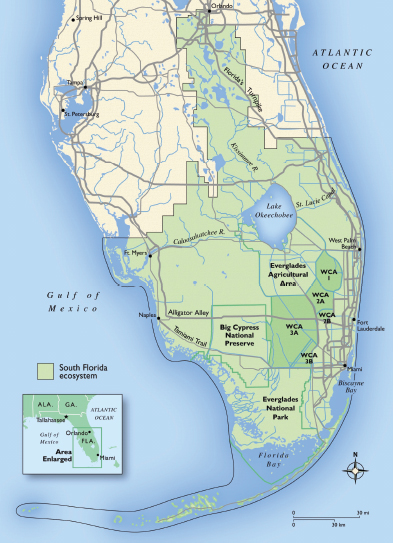
The Florida Everglades, a large and diverse aquatic ecosystem, has been greatly altered over the past century by an extensive water control infrastructure, designed to increase regional economic productivity through improved flood control, urban water supply, and agricultural production. The remnants of the original Everglades now compete for vital water with urban and agricultural interests and are impaired by contaminated runoff from these two activities. The Comprehensive Everglades Restoration Plan (CERP), a joint effort led by the state and the federal government launched in 2000, seeks to reverse the decline of the ecosystem. This $13.5 billion project was originally envisioned as a 30-to 40-year effort to achieve ecological restoration by restoring the hydrologic characteristics of the Everglades, where feasible, and to create a water system that serves the needs of both the natural and the human systems of South Florida (Figure S-1).
The National Research Council (NRC) established the Committee on Independent Scientific Review of Everglades Restoration Progress (CISRERP) in 2004 in response to a request from the U.S. Army Corps of Engineers (USACE), with support from the South Florida Water Management District (SFWMD) and the U.S. Department of the Interior (DOI), based on Congress’s mandate in the Water Resources Development Act of 2000 (WRDA 2000). The committee is charged to submit biennial reports that review the CERP’s progress in restoring the natural system (see Box S-1). This is the committee’s fourth report in a series of biennial evaluations.
The committee concludes that, 12 years into the CERP, little progress has been made on restoring the hydrology of the historical Everglades ecosystem; instead most of the recent progress has focused on the periphery. To reverse ongoing declines in the central Everglades, it will be necessary to expedite restoration planning and implementation in this area while integrating water quality and hydrologic improvements. The newly launched Central Everglades Planning Project offers an innovative approach to expedite restoration progress, although
BOX S-1
Statement of Task
This congressionally mandated activity will review the progress toward achieving the restoration goals of the Comprehensive Everglades Restoration Plan (CERP). The committee meets approximately four times annually to receive briefings on the current status of the CERP and on scientific issues involved in implementing the restoration plan, and it publishes biennial reports providing:
1. assessment of progress in restoring the natural system, which is defined by section 601(a) of WRDA 2000 as all the land and water managed by the federal government and state within the South Florida ecosystem;
2. discussion of significant accomplishments of the restoration;
3. discussion and evaluation of specific scientific and engineering issues that may impact progress in achieving the natural system restoration goals of the plan; and
4. independent review of monitoring and assessment protocols to be used for evaluation of CERP progress (e.g., CERP performance measures, annual assessment reports, assessment strategies, etc.).
additional rigorous analyses at the interface of water quality and quantity will be essential to maximize restoration benefits.
RESTORATION PROGRESS
The CERP, led by the USACE and the SFWMD, consists primarily of projects to increase storage capacity (e.g., conventional surface-water reservoirs, aquifer storage and recovery, in-ground reservoirs), improve water quality (e.g., storm-water treatment areas [STAs]), reduce loss of water from the system (e.g., seepage management, water reuse), and reestablish pre-drainage hydrologic patterns wherever possible (e.g., removing barriers to sheet flow, rainfall-driven water management). The CERP builds upon other activities of the state and the federal government aimed at restoration (hereafter, non-CERP activities), many of which are essential to the success of the CERP in achieving its restoration goals.
During the past two years, notable progress has been made in the construction of Everglades restoration projects, with eight CERP projects now under construction. These projects include all of the first-generation projects authorized by Congress (Picayune Strand, Site 1 Impoundment, Indian River Lagoon-South, and Melaleuca Eradication) as well as two second-generation projects (C-111 Spreader Canal, Biscayne Bay Coastal Wetlands) and two third-generation projects (Loxahatchee River Watershed Restoration, Lakeside Ranch STA) being
constructed solely with state funding. This level of construction, and the associated program funding for 2010-2011, reflect significant implementation progress since the committee’s previous review. Several major project phases are nearing completion in 2012, including the C-111 Spreader Canal Western Project and the Picayune Strand Merritt Canal components, which are expected to deliver significant increments of restoration benefits upon completion. Progress is also being made on important non-CERP projects, including the Kissimmee River, Modified Water Deliveries to Everglades National Park, and the state’s Long Term Plan for Achieving Water Quality Goals.
Nevertheless, as noted in previous committee reports, production of natural system restoration benefits within the Water Conservation Areas and Everglades National Park continues to lag behind restoration progress in other portions of the South Florida ecosystem. Early CERP implementation has largely focused on the periphery of the remnant Everglades, and in the most recent CERP project schedule, the projects with the greatest potential benefits to the remnant Everglades (e.g., decompartmentalization, seepage management, central Everglades storage) have been significantly delayed or remain uncertain.
For project components that have been implemented, the committee was generally unable to obtain rigorous analysis of incremental restoration benefits. In some cases, the only descriptions of progress are anecdotal accounts of vegetation changes or field observations of new water flows. Effective assessment of restoration progress will depend on monitoring data that cover periods long enough to establish pre-project trends, followed by similar data after the project (or project component) is complete to determine the ecological changes that can be ascribed to the project. Such a scientifically derived assessment of ecosystem response to project implementation is important to enhance the understanding of ecosystem recovery processes and may be useful to build public support for ongoing restoration efforts.
The Central Everglades Planning Project provides a means to expedite the realization of restoration benefits to the remnant Everglades while addressing major impediments inherent in the USACE project planning and approval process. The Central Everglades Planning Project is one of five USACE pilot projects nationwide that will test a new accelerated project planning process, with the goal of delivering an approved project implementation report to Congress within two years. The focus on the central Everglades (Water Conservation Area 3 and Everglades National Park) is appropriate for this pilot, given the urgent need to address ongoing ecosystem decline, as noted in NRC (2008). The Central Everglades Planning Project process allows for the combination of increments of multiple CERP projects (e.g., storage, seepage management, decompartmentalization) within a new planning framework to more easily identify their interdependence and system benefits. The pilot also intends to test new approaches
for project planning, including clear, early scoping of analyses and decision-making criteria, early coordination with decision makers at all levels of USACE leadership, and reduced reliance on detailed analyses within a framework of risk-based decision making. The Central Everglades Planning Project appears to be an important step forward, responsive to earlier concerns of this committee (NRC, 2007, 2008, 2010), and consistent with the concept of incremental adaptive restoration (NRC, 2007). However, at completion of this report, the process remained at an early stage, and no specific project plans were available for the committee to review.
State-proposed projects to improve water quality represent an important step forward, with critical implications for restoration of attributes in the central Everglades impacted by high levels of phosphorus. Additional progress toward meeting water quality criteria appears likely, because the state and the federal partners have recently agreed upon additional water quality improvements for the Everglades Protection Area. These proposed features, however, address only current inflows to the Everglades, and do not provide water quality treatment for increased water volumes anticipated under the CERP.
If the pace of restoration progress is to be maintained, then an increased level of federal funding will be necessary for two reasons. First, large cuts to the SFWMD budget have already led to deferral of several large projects, and relatively modest outlays are projected over the next five years, mostly for water quality improvements to attain compliance with water quality criteria. Projected funding relies heavily on a drawdown of reserve funds to levels that, without other changes, will leave the SFWMD with little flexibility and limited capability to fund new CERP projects. Second, overall state CERP spending (including land purchases and expedited construction efforts) has vastly exceeded federal spending. Thus, even if the state could sustain prior levels of spending, the SFWMD might be reluctant to do so until the overall spending gap is reduced between the two partners. Nevertheless, the capacity for increased federal spending could be impacted by CERP cost-sharing requirements, because calculations of the cost-share balance do not include extensive state expenditures from land purchases and construction for projects that are not yet authorized.
Without congressional action, project authorization could soon become a major impediment to restoration progress. To receive federal funding, individual CERP projects must be authorized by Congress. To date, only three projects have been congressionally authorized under WRDA 2007, and one additional project is under construction with programmatic authorization from WRDA 2000. Four additional projects await authorization. Without a new WRDA, the federal government will be unable to maintain progress on several second-generation, state-expedited projects now under way (e.g., C-111 Spreader Canal, Biscayne Bay Coastal Wetlands). Also, authorizations affect the projects that are eligible
for cost-share crediting. With no additional authorized projects and at current rates of federal spending, the federal creditable expenditures could exceed the state’s in approximately three years, bringing the CERP to a standstill because federal cost-share creditable obligations may not exceed those of the state. If Congress does not authorize additional projects and the state does not increase spending, federal funding and project implementation would need to be sharply curtailed. Additional project authorizations (with accompanying project partnership agreements) could allow for more than $500 million of state CERP-related expenditures being credited as cost-shared funds.
Innovative, multi-species approaches have been applied to resolve local conflicts between species management and restoration management, but such conflicts are likely to continue, requiring flexible and innovative multi-species approaches applied at even larger spatial scales to avoid restoration delays and optimize restoration benefits. Examples of innovative multi-species approaches include the Everglades Restoration Transition Plan (ERTP) to address a conflict between the water management needs of endangered snail kites and Cape Sable seaside sparrows in Water Conservation Area (WCA)-3A and an approach to address a conflict between stormwater treatment area (STA) operations and protection of the nests of black-necked stilts and other migratory birds. Additional conflicts between the needs of endangered species and what is required to restore the ecosystem restoration are inevitable in the transition to a fully implemented CERP. A recent conflict between efforts to protect snail kite nests and STA operations illustrates how single species management could potentially compromise water management required for system restoration.
Trajectories
An assessment of the status and trajectories of 10 ecosystem attributes reveals that conditions for tree islands, ridge-and-slough landscape, snail kites, and peat continue to degrade and that cattail coverage continues to expand 12 years after the initiation of the CERP. These declines can be attributed to altered hydrology and/or the elevated supply of phosphorus in the remnant Everglades. Despite its ability to search throughout the Everglades ecosystem for suitable conditions, the Everglade snail kite has experienced a precipitous decline in numbers over the past 15 years and is in danger of extirpation.
The state’s extensive phosphorus control efforts over the past two decades appear to be stabilizing or improving the current trends for several ecosystem components driven by phosphorus (e.g., periphyton, soil P). Cattail expansion, however, is continuing but at a decreasing rate in some areas (e.g., WCA-2). Implementation of STAs and best management practices has markedly decreased phosphorus loads to the WCAs, and interior phosphorus concentrations have
decreased in WCA-2 and -3 in response to decreases in the concentrations of inflowing waters. Despite this progress, impacted areas of the WCAs consistently fail the four-part test for compliance with Florida’s water quality standards. Thus, it is widely recognized that additional water quality improvements are needed to prevent further degradation and reverse ongoing adverse impacts to the ecosystem caused by elevated phosphorus.
In contrast, the restoration of flows in the central Everglades has been limited, and the ecosystem attributes most directly influenced by hydrologic factors continue to decline. In many cases, these ongoing losses can only be recovered over long time scales. The velocity, depth, and duration of water in the Everglades are important controlling factors for the distinctive terrain of the Everglades: tree islands, ridge-and-slough topography, and peat accumulations. These landscape components have been severely degraded by flow alterations during past decades. Recovering additional losses will require decades if not centuries. Of the many projects under construction, only Mod Waters (a non-CERP project) and the C-111 Spreader Canal (a CERP project) offer promise of direct, significant effects in the central Everglades.
Substantial near-term progress to address both water quality and hydrology in the central Everglades is needed to prevent further declines. Near-term progress that addresses only water quality or water quantity leads to continued system declines of many components. Additionally, many improvements in water quality are linked with improvements in water quantity. Thus, decisions on restoration project design and scheduling should not be viewed as simple tradeoffs between water quantity and water quality. Instead, this qualitative analysis points to the need for a more critical and comprehensive quantitative analysis using models and field data to evaluate management alternatives in an integrated manner (see Chapter 5). Also, it highlights the importance of stabilizing and ultimately reversing declines of attributes that would take a long time to recover, particularly if other aspects of the restoration depend on them. Because of its focus on the remnant Everglades and accelerated planning, the Central Everglades Planning Project conceptually provides promise for rehabilitating the remnant Everglades.
Science and Decision Making
Recent science synthesis efforts represent an impressive accomplishment, although clearer acknowledgment of conflicts and tradeoffs will be essential to maximize restoration success. Science synthesis is important to advance understanding among the scientific community, inform policy decisions for managers, and translate important findings for the interested public. Collectively, the recent science synthesis efforts, including the 2009 System Status Report, the Scientific and Technical Knowledge Gained report, and the Synthesis of
Everglades Research and Ecosystem Services (SERES) project, among others, successfully address all three of these audiences. Together, they present a relatively consistent view of the scientific principles relevant to the Everglades restoration. If the best aspects of these synthesis efforts can be combined and continued in an efficient, ongoing manner, then the effort can help policy makers coalesce around a common vision of scientific principles, key uncertainties, and challenges. In the future, the effectiveness of the synthesis effort could be improved by explicitly addressing tradeoffs, conflicts, and commonalities among water quality, water quantity, and ecosystem responses.
A comprehensive assessment of monitoring efforts is necessary to ensure that fundamental short- and long-term needs of the CERP are met and critical gaps are addressed in the most cost-effective manner. The recent large and sudden cuts to the RECOVER Monitoring and Assessment Program pose a risk to system-wide assessment, which is important to the success of Everglades restoration. However, previous NRC committees have raised questions about the ambitious list of indicators for monitoring relative to the likelihood of sustained funding. Recurring evaluations of all monitoring (not just RECOVER-funded monitoring) in support of the CERP should assess the usefulness of existing datasets and performance measures, consider emerging priorities, and explore opportunities for improved efficiency.
Progress has been made in the development of linked hydrologic and ecological models, but they remain largely unavailable to project planning, limiting the ability to evaluate differential benefits and impacts of restoration alternatives. No ecological models have been approved for use in benefits analysis for CERP, even though integrated ecological models provide an important tool to assist with project planning, particularly to assess the responses of critical performance measures to project design alternatives and to understand the restoration tradeoffs implicit in alternative plan approaches. If ecological models are to be available to support restoration planning and assessment, the CERP model development, testing, and review process should be accelerated so that models can move more quickly from development and testing in the research domain to application in support of restoration.
Integrated, or linked, water quality and ecological models are essential tools for exploring the benefits and impacts of project alternatives that affect water quality, water quantity, and habitat. To identify project designs and implementation sequences that maximize restoration benefits and assess potential impacts, project-planning teams need to analyze a range of inflow water quality conditions, including those that exceed targeted levels. The legal requirement that water quality constraints be met should not limit the modeling analyses of restoration alternatives under a range of conditions. Being overly cautious with respect to water quality modeling could prevent a thorough exploration of
restoration options and limit the understanding of water quality constraints in hydrologic restoration projects.
Transparent and systematic mechanisms to build trust and incorporate a range of stakeholder preferences relevant to CERP implementation into decision support frameworks would help to clarify and reduce conflict and enhance transparency. The committee acknowledges recent steps toward establishing formal structured decision support tools for components of the CERP with an emphasis on weighing multiple objectives. Decision support frameworks that build trust and provide opportunities for deliberation and negotiation can also assist in identifying and reducing sources of conflict, although they cannot, on their own, eliminate persistent conflict. Hence, additional mechanisms may be needed to resolve conflict, or at the very least, a strategy should be set in place for moving forward in the face of conflict while considering conflicting values, preferences, and objectives.
OVERALL EVALUATION OF PROGRESS AND CHALLENGES
Over the past two years, the pace of restoration implementation has improved, although restoration remains focused along the periphery of the remnant Everglades. Degradation of the Water Conservation Areas and Everglades National Park continues because of the altered hydrology and poor water quality in the system. Substantial progress has been made over the past two decades to reduce phosphorus in the inflows. Moreover, state and federal governments have reached agreement on the additional steps necessary to meet the phosphorus criterion for existing flows. However, minimal progress has been made on restoring the water flows essential to restoring the remnant Everglades ecosystem. The altered flow regimes have plagued the Everglade snail kite, whose trajectory to near extirpation is tied to that of the overall system. Degradation of key hydrology-dependent ecosystem components, such as the ridge and slough and tree islands, continues relatively unabated, and further losses can only be recovered over long timeframes, if at all.
Saving the historical Everglades at this critical juncture requires a new approach. Key components of a new strategy include: 1) focusing on restoring the central core of the historical Everglades to reverse the ongoing degradation before it is too late; 2) ending the segregation of water quantity and quality and integrating water quantity and quality analyses that explore opportunities to accelerate restoration in the remnant Everglades; and 3) finding a new way to do business that avoids costly and unproductive delays in the project planning and authorization processes. The Central Everglades Planning Project is a promising new initiative focused on the remnant Everglades with the goal of greatly expediting the project planning process.
Impressive science synthesis efforts over the past few years have advanced scientific understanding and provided a solid scientific foundation for decision making. Investments in continued cutting-edge research, consolidated and timely synthesis, and effective monitoring are critical to supporting sound decisions for a restored Everglades. However, key challenges remain—in particular, conflicts at the interface of water quality and quantity that have been exacerbated by the continuing challenges in meeting the 10 ppb water quality criterion and the resulting delays in implementing hydrologic restoration. Additional use of integrated ecosystem modeling and decision support tools could facilitate restoration progress by clarifying these conflicts, identifying interim strategies for limiting further degradation of critical ecosystem components, and enhancing the capacity to address these conflicts in a more timely and integrated way.


