
Status of Key Non-CERP Projects
KISSIMMEE RIVER RESTORATION
Overview: The project has two parts. First, the Kissimmee Headwaters Revitalization Project focuses on the upper Kissimmee River Basin to improve three canals, construct supplemental levees, and change the operating schedules for Kissimmee, Hatchineha, Cypress, and Tiger lakes. The more ambitious Kissimmee River Restoration Project focuses on the lower portion of the river’s watershed, by replacing the designed channel with a more natural geomorphology, backfilling 22 miles of the C-38 Canal, re-carving 10 miles of the historical river channel, reestablishing approximately 40 miles of meandering river channel, removing control structures S-65B and S-65C, and redefining the operations of S-65 that controls flows through the Kissimmee River (Figure B-1).
Status: Three of the four phases (reaches) of the Kissimmee River Restoration Project to backfill the C-38 Canal have been completed, which resulted in backfilling 14 miles of C-38 Canal and restoring a 24-mile section of the original river channel. Phase 4B backfilling began in 2009 and was completed in 2010. The last remaining construction phases, which are anticipated to be finished by 2015, will backfill the final 9 miles of C-38 Canal and recarve 4 miles of the historical river channel. Most of the 102,061 acres of land needed for the restoration have been acquired. In the upstream areas, the headwaters revitalization is expected to be complete in 2014, providing important upstream integrity to the entire river system and supporting downstream restoration (SFWMD, 2010). By 2015, operating rules are to be in place for control structures, and the entire project will be finished. Table B-1 details restoration progress made on this project.
Observed Benefits: About 7,700 acres of formerly drained portions of the river’s floodplain are now experiencing enhanced inundation and are reverting back to wetland habitat (Figure B-2). A comprehensive evaluation program for tracking
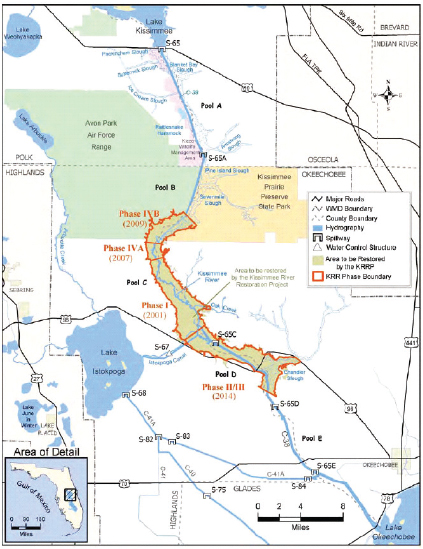
TABLE B-1 Restoration Progress on the Kissimmee River Restoration Project
| Construction Sequence | Name of Construction Phase | Timeline | Backfilled Canal (miles) | River Channel Recarved (miles) | River Channel to Receive Reestablished Flow (miles) | Total area (acres) | Wetland Gained (acres) | Location and Other Notes |
| 1 | Phase I | June 1999-February2001 (complete) | 8 | 1 | 14 | 9,506 | 5,792 | Most of Pool C, small section of lower Pool B |
| 2 | Phase IVA | June 2006 -September 2007 (complete) | 2 | 1 | 4 | 1,352 | 512 | Upstream of Phase I in Pool B to Wier#1 |
| 3 | Phase IVB | June 2008 - December 2009 (complete) | 4 | 4 | 6 | 4,183 | 1,406 | Upstream of Phase IVA in Pool B (upper limit approximately at location of Wier #3) |
| 4 | Phase ll/lll | April 2012-October 2014 (projected) | 9 | 4 | 16 | 9,921 | 4,688 | Downstream of Phase I (lower Pool C and Pool D south to the CSX Railroad bridge) |
| Restoration Project Totals | 22 | 10 | 40 | 24,963 | 12,398 | |||
| (40 sq mi) | (20 sq mi) | |||||||
| NA | Headwaters lakes (Lakes Kissimmee, Cypress, Hatch ineha, and Tiger) | NA | NA | NA | 63,585 | 7,200 | Total area includes entire area of the lakes; wetlands gained includes only the acres of improved littoral zone vegetation expected to be gained by increased high stage. | |
| NA | Kissimmee River | NA | NA | NA | 38,207 | 12,398 | Total area includes all of pools A-D within 100-year floodline, including areas that will not be restored. Wetlands gained is the total area of wetlands that will be restored in KRR project area. | |
| Pools A-D | 101.793 | 19.598 | ||||||
SOURCE: http://www.sfwmd.gov/portal/page/portal/xrepository/sfwmd_repository_pdf/krr_krrep_factstour_sheet.pdf; dated August 2010.
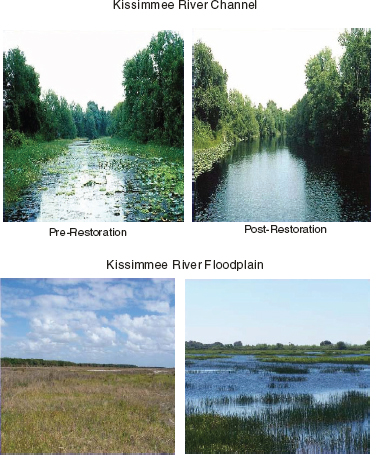
FIGURE B-2 Images showing ecosystem restoration in the Phase I reach of the Kissimmee River. ABOVE: Prior to restoration this channel was clogged with aquatic vegetation resulting from the lack of high flows brought about by the drainage and channel works on the main stream. In the restored case, aquatic vegetation forms bands along the channel edges leaving the channel itself clear of aquatic vegetation. BELOW: Prior to restoration this flood plain was not hydrologically connected to the river, so its vegetation was mostly upland species for pasturage. In the restored case, the flood plain periodically receives water from the channel, and its marsh vegetation community now reflects pre-drainage conditions.
SOURCE: Jackson (2011)
environmental responses to the restoration is gauging the success of the project in meeting its goal of restoring ecological integrity for the river and the flood-plain. Densities of long-legged wading birds on the restored floodplain have exceeded restoration expectations each year since 2002, with the exception of the drought year 2007.
In recent years the river has had continuous flows without periods of dry channel, and there have been periods of flood plain inundation (although not to pre-drainage depths). Organic material on the bed of the channel has declined 71 percent, returning the system to close to its original sandy condition. The concentrations of dissolved oxygen (DO) have generally improved: DO values near the surface of the river have met or exceeded the target value of 5-7 mg/l 97 percent of the time (much better than the 50 percent expected).
Integrated Financial Plan (IFP; SFERTF, 2009b) Start Date: 1994
Current Estimated Completion Date: 2015
Original Estimated Cost (WRDA 1992): $427M
2011 IFP Estimated Cost: $819.3M ($333.3M appropriated through fiscal year [FY] 2010)
EVERGLADES STORMWATER TREATMENT AREAS
Status: Construction of Compartments B and C build-outs and commissioning of associated pump stations are scheduled for completion in June 2012. When these new stormwater treatment areas (STAs) become operational, the total treatment wetland area will be approximately 57,000 acres. STA-5 Flow-way 3, which became flow-capable in 2006 and began limited operation in 2008, dried out during drought conditions in water year (WY) 2009. This flow-way was off-line for the latter half of WY 2010, all of 2011 and the first half of 2012 because of Compartment C construction activities. Large-scale bulrush planting was conducted in WY 2011-WY 2012. Planted areas included STA-5 Cells 1A and 1B; STA-1E Cells 5, 6, and 7; STA-1W Cells 5A and 5B; and STA 3/4 Cell 1A.
Observed Benefits: Since 1994, the Everglades STAs along with agricultural best management practices have retained more than 3,800 metric tons (mt) of phosphorus that would otherwise have entered the Everglades Protection Area.
Start Date: Authorized in 1994, Everglades Forever Act
Current Estimated Completion Date: Not available
Original Estimated Cost for Land, Design, and Construction: $825M
Current Estimated Cost for Land, Design, and Construction: $897M
MODIFICATIONS TO C-111 (SOUTH DADE)
Status: To date, two interim pump stations and one permanent pump station have been completed, along with construction of a retention/detention zone, replacement of the Taylor Slough Bridge, the backfilling of Canal 109, the removal of 4.75 miles of spoil mounds along lower C-111, and the construction and transfer to the sponsor of the S-331 Command and Control Center. Two features remain to be constructed: a detention area north of the existing retention/detention zone and the plugging of the L-31W Canal. A construction contract to extend the S-332B North detention area and contain discharges from the 8.5 square mile area STA component of the Mod Waters project is anticipated in 2012. Three project features have been deferred to the Comprehensive Everglades Restoration Program and are now components of the C-111 Spreader Canal - Western project: the pump station 332E, the spreader canal, and the C-110 backfill.
Observed Benefits: Not yet fully implemented. Distribution of flows has improved downstream of the Taylor Slough bridge replacement and C-111 Spoil Mounds Removal areas.
IFP Start Date: 1994
Current Estimated Completion Date: 2017
Original Estimated Cost: $121M (1994)
2011 IFP Estimated Cost: $391M ($118.7M appropriated through FY 2010)
MODIFIED WATER DELIVERIES TO EVERGLADES NATIONAL PARK
Status: Construction features completed:
1. Gated spillway structures S-355A and B in the L-29 Levee
2. Modifications to the S-333 and S-334 structures to accommodate higher water levels in the L-29 Canal
3. Raising the Tigertail Camp
4. Pump Station S-356 between L-31N Canal and L-29 Canal
5. Osceola Camp elevation evaluation
6. Degradation of the L-67 Extension Canal and Levee (4 of 9 miles degraded)
7. Levees and a seepage collector canal to provide flood mitigation for the east Everglades residential area (8.5 square mile area)
8. Pump Station S-357 constructed
9. S-331 Command and Control (cost shared with the C-111 [South Dade] Project)
Work is in progress on the Tamiami Trail Modifications feature with the ongoing construction of the 1-mile bridge and raising the road bed to accommodate a stage of 8.5 ft in the L-29 Canal. The project is currently estimated to be completed by December 2013.
The following project features were originally included in the Mod Waters project, but their completion is “affected by budget constraints” (SFERTF, 2011):
- Structures S-345 A, B, and C through the L-67A and C Levees
- Structures S-349 A, B, and C in the L-67A Borrow Canal
- Degradation of remaining five miles of L-67 Extension Levee and Canal
Observed Benefits: Not yet implemented
IFP Start Date: 1990
Current Estimated Completion Date: 2013
Original Estimated Cost: $98M (1989)
2011 Estimated Cost: $417.2M ($398.9M appropriated through FY 2011)
NORTHERN EVERGLADES AND ESTUARIES PROTECTION PROGRAM
Status: In 2007, the Florida legislature expanded the Lake Okeechobee Protection Act to include protection and restoration of the interconnected Kissimmee, Lake Okeechobee, Caloosahatchee, and St. Lucie watersheds. This interagency initiative, known as the Northern Everglades and Estuaries Protection Program (NEEPP), focuses on the water storage and water treatment needed to help improve and restore the Northern Everglades and coastal estuaries. As part of this initiative, the South Florida Water Management District (SFWMD) and the state will expand water storage areas, construct treatment marshes, and expedite environmental management initiatives to enhance the ecological condition of the lake and downstream coastal estuaries. The NEEPP requires the SFWMD, in collaboration with the Florida Department of Environmental Protection (FDEP) and the Florida Department of Agriculture and Consumer Services (FDACS) as coordinating agencies and in cooperation with local governments, to develop (1) the Lake Okeechobee Watershed Construction Project Phase II Technical Plan, (2) the St. Lucie River Watershed Protection Plan, and (3) the Caloosahatchee River Watershed Protection Plan. The Phase II Technical Plan was submitted to the legislature in February 2008, and the St. Lucie River and Caloosahatchee River Watershed Protection Plans were submit-
ted in January 2009. Although Northern Everglades projects have been conceptually identified in these plans, specific projects and activities will be included in the annual work plan for each fiscal year. The first updates to the River Watershed Protection Plans were submitted to the Florida legislature in 2012. The Lake Okeechobee Phase II Technical Plan was updated in 2011 by the coordinating agencies.
Observed Benefits: Coordinating agencies have been able to implement a large number of phosphorus reduction projects, including phosphorus source control grant programs for agricultural landowners, dairy best available technology pilot projects, soil amendment projects, isolated wetland restoration, remediation of former dairies, and regional public/private partnerships. Also, six Hybrid Wetland Treatment Technology projects have been constructed in a joint effort between the SFWMD and FDACS in the St. Lucie and Lake Okeechobee watersheds. A comprehensive monitoring program for water quality in the lake and watershed and ecological indicators in the lake has been implemented. The Phase II Technical Plan is currently being implemented.
Start Date: 2007
Current Estimated Completion Date: Not available
Original Estimated Cost (2008): $1.3 to 1.7 billion for the NEEPP, including CERP and non-CERP features
2011 Estimated Cost: Estimates for the near-term components of the Lake Okeechobee Protection Plan are $92.6 million. Near-term cost estimates for the St. Lucie and Caloosahatchee River Protection Plans are $196.3 million and 49.6 million. Cost estimates do not include long-term implementation measures.
INVASIVE SPECIES MANAGEMENT
Status: Progress is being made through several programmatic initiatives. Biocontrol agents have been successfully developed and introduced for Melaleuca with the plant being cleared and now under maintenance control in Water Conservation Areas 2 and 3 and Lake Okeechobee; efforts to develop agents for Lygodium are continuing; and conventional controls (physical removal, herbicide applications) and airborne surveys are carried out regularly. New management approaches for invasive plants have been developed through applied research and information exchange between cooperators. Funding comes from specific projects under the CERP (Melaleuca Eradication and Other Exotic Plants project, funded in 2002) and a variety of state-based non-CERP projects. Surveys of invasive species are conducted by a variety of agencies (FDEP, SFWMD, National Park Service [NPS]) and through interagency collaborations such as the Everglades Cooperative Invasive Species Management Area, Lake Okeechobee Interagency Aquatic Plant Management Team, and South Florida Ecosystem Restoration Task Force. Shortages of funds for monitoring and assessment of remote sections of Everglades National Park and the time intensive development
process of biocontrol agents hampers further progress. Management of exotic animal species lags well behind efforts for invasive exotic plants. Intensified efforts have recently been underway to develop new control tools and management strategies for several priority invasive animal species.
Observed Benefits: Regional coordinated efforts have yielded an Everglades Protection Area with few significant melaleuca infestations and most of the remaining dense populations are now found on private lands. Biocontrol agents are being introduced for Lygodium and Schinus; Lygodium is considered a major threat to ecosystem integrity.
Start Date: 2007
Current Estimated Completion Date: TBD
Original Estimated Cost: Information not found
Current Estimated Cost: Information not found
EVERGLADES AND SOUTH FLORIDA (E&SF) RESTORATION: CRITICAL PROJECTS
East Coast Canal Structures (C-4)
Status: Construction of a gated water control structure (S-380) in the C-4 Basin in Dade County southeast of the Pennsuco wetlands is complete.
Observed Benefits: Raised surface and ground water levels to help preserve wetlands, increased aquifer recharge, and reduced seepage.
IFP Start Date: 1999
IFP Completion Date: 2003
2011 IFP Cost: $3.7M ($3.7M appropriated through FY 2010)
Tamiami Trail Culverts
Status: Original plans included Phase 1 placement of 77 culverts along the Tamiami Trail (62 culverts west of State Road (SR) 92 in the Picayune Strand area, plus 15 culverts east of SR92 near the Big Cypress Preserve area), and Phase 2 resurfacing of Tamiami Trail related to these efforts. Construction of 17 Western Phase 1 Tamiami Trail Culverts between SR92 and SR29 in Collier County was completed in May 2006. This portion of Phase 1 has been included as a component of the Picayune Strand Restoration Project (see Chapter 3) and will be cost-shared under that CERP program instead of the Critical Projects Authority. Since the initial planning, the scope of the project was modified because of
budget and time constraints. The remainder of Phase 1 and Phase 2 work is on hold pending funding.
Observed Benefits: Installation of Phase 1 culverts under the Tamiami Trail established more natural hydropatterns north and south of the highway, which is expected to enhance biological restoration in the area.
IFP Start Date: 1998
Current Estimated Completion Date: TBD
2011 IFP Estimated Cost: $25.6M (for the original plan) ($3.6M appropriated through FY 2010)
Florida Keys Carrying Capacity Study
Status: This project has been completed. It included the development of a decision-making tool, which will provide a comprehensive basis for coordinating and strengthening water- and land-related planning efforts by local, state, and federal agencies.
Observed Benefits: The South Florida Regional Planning Council has agreed to steward and maintain the Carrying Capacity Impact Assessment Model as a decision-making tool. The Florida Marine Research Institute has also agreed to steward and maintain the databases.
IFP Start Date: 1997
IFP Completion Date: 2003
2011 IFP Estimated Cost: $4.5M ($4.5M appropriated through FY 2010)
Western C-11 Water Quality Treatment
Status: Construction is complete for this project to improve the quality and timing of stormwater discharges to the Everglades Protection Area from the Western C-11 Basin located in south central Broward County. The structures have been turned over from the U.S. Army Corps of Engineers (USACE) to the SFWMD for operation and maintenance.
Observed Benefits: The S-381 structure in the C-11 Canal separates clean seepage flows from untreated agricultural and urban stormwater runoff. The S-9A Pump Station pumps clean seepage water into Water Conservation Area (WCA)-3A.
IFP Start Date: 1997
IFP Completion Date: 2006
2011 IFP Estimated Cost: $18.5M ($18.5M appropriated through FY 2010)
Seminole Tribe Big Cypress Reservation Water Conservation Plan
Status: Construction of the Phase 1 conveyance canal system was completed in 2004. Construction is under way on water control and treatment facilities in the western portion of Big Cypress Reservation. Phase 2 of this project has been divided into four basins. The USACE completed construction of the largest basin, Basin 1, in August 2008 and was transferred for operations and maintenance in February 2010. Permeability rates necessitated design modifications for the other three basins. Construction of Basin 4 will begin in late 2012. The two remaining construction features, Basin 2 and Basin 3, are scheduled for construction completion in 2014.
Projected Benefits: Should improve the quality of agricultural water runoff within the reservation, restore storage capacity, and return native vegetation.
IFP Start Date: 1997
Current Estimated Completion Date: 2014 for all basins (Basin 1 is complete.)
Original Estimated Cost: $75.3M (1996)
2011 IFP Estimated Cost: $60M ($46.2M appropriated through FY 2010)
Southern CREW Project Additions and Imperial River Flow Way
Status: This project aims to reestablish more natural flow patterns to 4,100 acres in the Southern Corkscrew Regional Ecosystem Watershed (CREW) to improve and restore the hydrology and ecology of the project area. Land acquisition has been accomplished with state and federal cost sharing. Because of escalating land costs and the difficulty in restoring hydrology in the areas south of the Kehl Canal, the SFWMD governing board approved changes to the project footprint in March 2009, removing the southern half of Sections 32 and 33 that are south of the Kehl Canal. The SFWMD continues to acquire land for this smaller footprint and construct the project.
Observed Benefits: Removal of exotic species, primarily Melaleuca trees, on more than 2,560 acres has occurred. Two miles of canals have been plugged, associated berms have been breached, and 2 miles of dirt roads have been degraded to restore sheet flow in Section 25, restoring hydropatterns on approximately 640 acres of wetlands.
IFP Start Date: 1995
Current Estimated Completion Date: 2015
Yellow Book Original Estimated Cost: $33.5M ($3.4M Construction and $30.1M Real Estate)
2011 IFP Estimated Cost: $33.3M ($1.5M appropriated through FY 2010)
Lake Okeechobee Water Retention and Phosphorus Removal
Status: Construction of two new stormwater treatment areas within the Taylor Creek/Nubbin Slough Basin was physically completed in September 2006. The 120-acre Taylor Creek STA has been transferred to the SFWMD for operation and maintenance, repair, replacement, and rehabilitation. The interim construction and testing phase for the 810-acre Nubbin Slough STA identified a need for construction repairs and modifications. These repairs are currently under way; transfer of the Nubbin Slough STA is scheduled for late 2012.
Projected Benefits: To improve the quality of water flowing into Lake Okeechobee.
IFP Start Date: 1997
IFP Completion Date:
Construction complete: 2006
Testing complete; transfer to sponsor: 2012
2011 IFP Cost: $23.1M ($22.8M appropriated through FY 2010)
Ten Mile Creek Water Preserve Area
Status: Construction of an above-ground reservoir, stormwater treatment area, pump station, and gated water-level control structure was completed in 2006. Since that time, interim operations, testing, and monitoring have been under way by the SFWMD and the USACE in accordance with the water quality permit and Project Cooperation Agreement. During the process to transfer the project to the SFWMD for full operations, the USACE and the SFWMD identified operational concerns and a need for a course of action to remediate. The additional project needs that have been identified have significant associated costs. In June 2009 the SFWMD transferred responsibility for the Ten Mile Creek project to the USACE, which has placed the facility in a passive operating state. The 2009 Water and Energy Appropriations Act increased the federal spending authorization by $3.5 million; this funding was identified for the completion of a post-authorization change report and for facility maintenance until 2013.
Projected Benefits: Will provide 6,000 acre-feet of seasonal or temporary storage of stormwater from the Ten Mile Creek Basin on 526 acres of land, which will moderate high-volume freshwater flows and salinity fluctuations in the St. Lucie Estuary and reduce sediment and nutrient loads to benefit 2,740 acres of estuarine habitat.
IFP Start Date: 1997
IFP Completion Date: TBD
2011 IFP Cost: $50M ($49.3M appropriated through FY 2011)
Lake Trafford Restoration
Status: The in-lake portion of dredging was completed by spring of 2006. The second phase of construction and muck removal was completed in 2011.
Observed and Projected Benefits: Approximately 3 million cubic yards of organic sediments that blanketed the bottom of the lake were removed. Expectations include improving water quality, reestablishing native vegetation, and improving subsequent flows to Corkscrew Swamp Sanctuary and the Florida Panther National Wildlife Refuge. Lake monitoring by the local university has identified significant improvement in the quality of the lake from Phase I and Phase II dredging.
IFP Start Date: 1999
Completion Date: 2011
Yellow Book Original Estimated Cost: $15.4M
2011 IFP Estimated Cost: $26M ($13M appropriated through FY 2010)
SOURCES: Balci and Bertolotti (2012); Bertolotti and Balci (2012); Rodgers et al. (2012); SFERTF (2007; 2009; 2011); SFWMD (2007; 2008a; 2008b; 2011a; 2011b); USACE (2007); Williams et al. (2008); L. Gerry, SFWMD, personal communication, 2012; D. Tipple, USACE, personal communication, 2012.


