
4
Leverage the Entire Enterprise
The weather, water, and climate enterprise within which the NWS functions is increasingly dynamic. To interact effectively and maximize public benefit from the enterprise, the NWS will need to become more agile in how it cooperates and collaborates. At the start of the MAR, the United States had a small private weather sector that was robust given the business climate and technology at the time. The private sector played an important role in delivering near-real-time data to the broadcasting sector and the portions of the aviation industry not served by the NWS or the Federal Aviation Administration (FAA). Some other private-sector firms focused on a core group of specialty, or niche, clients, such as energy companies and ski resorts. In response to society’s demand for more information as well as the business world’s realization of the value of tailored weather and water forecasts, warnings, and information, the American commercial weather industry1 has broadened its spectrum of clients and its capability to provide many of the products and services that were once the exclusive domain of the federal government. The private sector today is involved in many areas, from data acquisition (e.g., National Lightning Detection Network and ground-based weather sensor mesonets) to specialized long-range forecasts for the financial sector (e.g., weather “derivatives”).2
The overlapping roles of the public, academic, and private sectors in providing weather, water, and climate services can lead to duplication and competition (NRC, 2003a), but it can also provide opportunities for collaboration. Box 4.1 provides examples of successful enterprise partnerships that could serve as models for the future. According to the Fair Weather report, “the public is best served when these sectors work together to take advantage of their different capabilities or to avoid duplication of effort” (NRC, 2003a). Together, this combination of the NWS and third parties serves end users in ways that the NWS could not do on its own. So, while the NWS is only one part of the overall weather, water, and climate enterprise, the enterprise as a whole would crumble without the core infrastructure and capabilities the NWS provides.
The Committee notes that the Weather-Ready Nation Roadmap (NWS, 2012) reflects a desire for enhanced enterprise relationships, but it provides very few concrete steps for accomplishing that. Instead, the vast majority of the Roadmap reflects NWS’s traditional direct-to-public perspective on how services are delivered. Indeed, the enterprise partnership efforts are focused on “communication and dissemination”
____________
1 This element of the enterprise is sometimes referred to as the American Weather Industry, the American Weather and Climate Industry, the commercial weather industry, the private sector, or similar terminology. Specific terminology, such as the American Weather Industry, often refers to that component of the enterprise providing weather, water, and climate services. Another key enterprise element encompasses providers of major infrastructure, such as the aerospace industry and its role in developing weather satellites. A number of companies span both areas. For the purposes of this report, the definition is purposely vague, consistent with the rapidly evolving nature of the enterprise.
2 As noted in Footnote 7 in Chapter 1, the size of the nonfederal portion of the enterprise is difficult to estimate, but is about $4 to $5 billion and is comparable to the federal portion. NOAA accounts for perhaps two-thirds of the federal portion. The private sector accounts for the majority of the nonfederal portion.
BOX 4.1
Examples of Successful Partnerships in the
Weather, Water, and Climate Enterprise
Integrated Warning Team Workshops
Since 2008 the National Weather Service has taken the lead on Integrated Warning Team Workshops to bring together emergency managers, broadcast meteorologists, and NWS forecasters to improve the coordination and effectiveness of weather information and dissemination. These regional meetings, considered a spin-off of the NWS-funded WAS*IS (Weather and Society * Integrated Studies) program, have been held in Springfield, MO; Kansas City, MO (4); Pittsburgh, PA; Cedar Rapids, IA; Indianapolis, IN; Detroit, MI; Miami, FL; Grand Forks, ND; Minneapolis, MN; and Colorado Springs, CO. These workshops have had many benefits. The partners build sustained relationships and learn about the decision-making contexts during severe weather and flood events.
The four Kansas City meetings have led to many communication and operations improvements that reflect a growing emphasis on impacts-based forecasting. Two are noted here:
• The broadcast meteorologists recognized that they were not providing a consistent message to all viewers. After the workshop and a conference call the competitors arrived at a consensus on a color scheme for representing tornado and severe thunderstorm warnings. As a result, when viewers change from one television channel to another, rather than having to interpret different colors for the same warnings from station to station, they now see consistent information across the channel spectrum.
• As a result of the first Integrated Warning Team workshop held in Kansas City, MO, in 2009, the NWS now provides hail and wind tags (special coding) showing the magnitude of the threat of strong straight-line winds and the expected hail sizes so broadcasters and others can easily tailor their own messages based on the best and most local information. This has been implemented across the Central Region forecast offices. This methodology has been expanded for use in tornado warnings with the Impact Based Warning Experiment, currently under way at 5 WFOs in Missouri and Kansas. These new tornado tags provide key partners and customers with impact magnitude and source information previously unavailable in tornado warnings. These tags had their roots in the initial Integrated Warning Team work lead by the Kansas City/Pleasant Hill WFO in Missouri.
Incident Meteorologists Help Fight Wildfires
Incident meteorologists (IMETs) are National Weather Service forecasters specially trained to work with Incident Management Teams and are deployed to severe wildfire outbreaks. They travel quickly to the incident site and set up a mobile weather center to provide continuous meteorological support for the duration of the incident. The mobile weather centers include a cell phone, a laptop computer, and a two-way portable satellite dish for gathering and displaying weather data including satellite imagery and numerical weather prediction output.
IMET duties include briefing firefighters. They have an understanding of the needs of fire managers and use their understanding of meteorology to communicate the relevant information to meet those needs. IMETs help fire control specialists from federal, state, and local agencies by interpreting weather information, assessing its impact on the fire, and helping develop strategies to best fight the fires and keep firefighters and the vulnerable public safe.
The NWS contributions to fighting Spring 2012 wildfires have been recognized by the Fish and Wildlife Service (from a letter from Troy L. Davis, District Fire Management Officer):
“The … fire we just attacked this past week was burning under extreme weather conditions of very low humidity and high winds in the middle of the night and early morning. A spot forecast was requested and promptly produced by this weather office. Shortly after the spot forecast was produced a change in the jet stream caused wind gusts up to 63 mph that was heading towards the fire. The forecaster at the weather office
of NWS-generated information. As noted previously, a substantial portion of weather, water, and climate information no longer comes directly from the NWS to the public and businesses but is enhanced along the way. Moving forward, more concrete steps for directly leveraging the broader enterprise beyond “communications and dissemination” will be needed as part of explicit NWS planning, including the expected update to the Weather-Ready Nation Roadmap (NWS, 2012).
This chapter provides details and sub-recommendations in support of Recommendation III.
Recommendation III: Leverage the Entire Enterprise
The National Weather Service (NWS) should broaden collaboration and cooperation with other parts of the weather, water, and climate enterprise. The greatest national good is achieved when all parts of the
promptly notified me of this new development by a direct phone call so I was able to notify all fire personnel on scene in a very timely manner. All personnel was prepared and expecting this new development. Time was passing as we were attacking this fire and from when we received the original spot forecast and new development phone call. I then received a second phone call from this weather office to inform me that they had produced an updated spot forecast as conditions were changing and new developments in the storm system warranted changes to the original spot. This is twice that this weather office took the initiative to warn us of the changing conditions to keep our fire personnel safe.”
NWS Chat
NWSChat has become an effective collaborative tool between the NWS and its core partners in emergency management, media, and other government agencies. The online chat rooms have opened up opportunities to coordinate and collaborate like never before. For example, an NWS forecaster can relay critically relevant information in quick and informal fashion during a severe weather threat so as to alert the partners to important changes:
[8:24 PM] <NWS> Our sounding just came in and it is eye-opening and we have high concern for tornadoes this evening. We are not in a typical South FL environment. This is more like plains type helicity/instability. Strong tornadoes could occur. Just a heads up that this is not our typical scenario and all need to pay attention to this as this unfolds.
Then as an event unfolds, the NWS can provide advance notice of upcoming warnings, and benefit from media or emergency management relaying event information as they unfold. All warnings and statements are transmitted automatically. Forecasters will not be distracted from issuing warnings and statements, but as time permits, radar trends as well as Q&A sessions may cross the chat room.
[9:27 PM] <media> Okay, will relay chaser reports if we get them, have someone on the storm.
[9:43 PM] <NWS> New tornado warning being issued for Miami-Dade & Broward counties … coming out shortly.
[9:59 PM] <media> Reports of multiple power flashes near Silver Lakes area about 5 minutes ago from our chaser.
[10:10 PM] <NWS> Small & tight circulation noted near Sawgrass Mills Mall … new TOR [tornado warning] will likely be needed.
[10:20 PM] <NWS> TOR warning will be canceled, the tight circulation once seen on the Terminal Doppler at FLL [Ft. Lauderdale International Airport] has significantly decreased—with only remnant elevated circulation.
[10:25:08] <media> Hey guys. We are getting calls into our newsroom of a house collapse in Sunrise with a man trapped inside. Has anyone else heard about this? We are sending a crew to try to confirm. The subdivision is near the mall. I am trying to get a name.
[10:26:09] <media> Silver Palms community near the mall. Multiple roofs off homes. That is the latest call.
[10:47 PM]<NWS> According to Palm Beach post report … Sunrise PD [police department] reported one or two homes damaged on 13300 block of NW 8 Ct in Sunrise. That’s S of Sawgrass Mills Mall.
Participation by NWS employees is not guaranteed, but the chat is always available to others, and warnings and statements will be displayed automatically. During recent major weather disasters, NWS Service Assessments have cited NWSChat as having been crucial to providing valuable information that enabled timely and accurate decisions at the local level (NWS, 2011b).
All content is archived and is subject to the Federal Freedom of Information Act.
enterprise function optimally to serve the public and businesses. This process starts with the quality of core NWS capabilities but is realized through the effectiveness of NWS-enterprise relationships. A well-formulated enterprise strategy will also return direct benefit from the enterprise to the NWS, especially in areas of shared research, technology development, observational data sources, and improved end-user access to NWS-generated information.
Over the last two decades, the non-NWS weather, water, and climate enterprise has grown rapidly. The NWS has evolved to both promote and benefit from the rest of the enterprise. The recommendations of the Fair Weather report, along with a 2004 revised NWS public-partnership policy, contributed substantially to progress in this area (NRC, 2003a; NWS, 2004). Not
BOX 4.2
Chain of Events Associated with a Tornado Warning
The sequence of events associated with the public receiving and acting on an NWS tornado warning involves many elements of the enterprise interacting to minimize loss of life and property. The first steps of the sequence involve meteorology and technology. The final steps involve sociology and psychology. Key to a good outcome (in addition to luck) is a coordinated situation in which good forecasts, warnings, and response all happen together. The sequence of events includes
• The continuous acquisition of data and the production of weather analyses and forecasts on the global, hemispheric, and national scales provide a constantly evolving, general picture of the atmosphere.
• Convective outlooks a few days in advance of a tornadic storm are originated by NWS forecasters in the Storm Prediction Center and lead to tornado watches.
• WFO forecasters use radar and spotter reports to detect tornados and issue warnings that are broadcast over NOAA Weather Radio, NWSChat, and elsewhere.
• Emergency managers use warnings, their own radar displays, their spotters, and other information to issue alerts in the form of sirens, emergency broadcast systems, and teleconferences with various local officials and the NWS.
• In many cases, local television stations and other media sources, including social media sites and emergency notification phone and text message systems, pass on warnings and other information to alert the public to take cover and stay tuned to television or radio for further instructions.
• For people who do learn about the warnings, they need to believe them, personalize them, decide to take an action, and take appropriate actions in the time before the severe weather arrives. School superintendents, airlines, various types of businesses, people in cars, homes, and out in the fields all respond (or don’t respond) in different ways, depending on their knowledge of what to do and their various assessments of the degree of risk to them and their ability to respond. It is worth noting that some warnings never reach some people, and that there is a public responsibility to reduce the likelihood of these failures.
only has competitive overlap been reduced3; the NWS now looks to the broader enterprise as a set of key partners for both creating and distributing weather and water services (Box 4.2).
NOAA’s Partnership Policy is to “foster the growth of this complex and diverse enterprise as a whole to serve the public interest and the Nation’s economy” (NOAA, 2007). Given the desire of the NWS to improve its effectiveness (NWS, 2012), the ability to further leverage the rest of the enterprise is very appealing. Facilitating a significantly richer and deeper engagement of the nation’s broad and diverse weather, water, and climate enterprise with the NWS, its data services, and its technology development could yield a greater return on the public’s investment. This reinforces, however, the need for the enterprise to support the maintenance of the collective infrastructure that all depend upon.
In the face of government budget pressures, it is conceivable that the non-NWS elements will provide most of the overall enterprise growth over the next decade. Public and private sectors will likely face different economic pressures in the near future. Non-NWS enterprise elements may have resources to expand capabilities and services when the NWS has none. One consequence of a growing enterprise external to the NWS is that the resource leverage available to the NWS will grow commensurately. This resource leverage represents critical capability that can be used by the NWS in accomplishing its mission—leverage that can allow the impact of the NWS on the nation to grow faster than its budget alone would allow. The Committee believes that a key aspect of NWS’s strategy for the coming decade could well be to enhance this leverage.
Elements of this non-NWS enterprise growth are evident. The public now receives a substantial portion of their weather information through digital media channels. These include general web portals (e.g., Bing, Google, Yahoo), weather-specific portals (e.g., Accuweather.com, Weather.com, Weather Underground), mobile applications installed as defaults
____________
3 Competitive overlap has been reduced though not fully eliminated. One emerging area of known conflict is what role the NWS should play in developing and distributing mobile applications. As new technologies emerge, such conflicts will continue to arise and will need to be resolved.
(such as on the Android, iPhone, and Windows phone platforms), third-party weather applications (of which the iPhone App Store lists over 1,600 and the Android Market lists over 5,000 as of July 2012), Twitter feeds, social networking sites, and more. Innovation in this arena is accelerating. For example, accurate localized road weather conditions will likely be delivered in real time to automobile dashboards within the next decade. It is appropriate for the NWS to make more effective use of such channels for reaching the public directly when authoritative sources are critical to public welfare. But there is also a tremendous opportunity for the NWS to better serve the public by improving the capability of other organizations—those with expertise in use of these channels—to provide weather-based information and services to businesses and the public.
Compared to the time of the MAR, the non-NWS enterprise is more capable and diverse. Perhaps most importantly, it is increasingly robust in areas where the NWS may seek a partner. In many areas, there are now multiple suppliers having long track records of reliable performance. When the NWS chooses to place elements of its mission in the hands of partners, the NWS must have confidence that changes in a partner’s financial state or business strategy can be dealt with by seeking out alternate providers of comparable quality. One consequence of an increasingly robust enterprise is the globalization of the industry and the growing complexity of business relationships. Companies based in the United States may now have international customers that influence their NWS-focused interactions. Patents and strategic business partners may constrain relationships that the NWS could build. Although such issues are routinely accommodated within many economic sectors, they are to some extent a new factor in NWS-enterprise relationships.
The benefit to the NWS in leveraging the entire enterprise is the payoff in the quality and amount of services provided to the nation. By leveraging the entire enterprise, new capabilities will arise that the NWS could not have provided on its own. Moreover, this can potentially enable the NWS both to increase the quality of its core capabilities and to provide enhanced service to its core partners (NWS, 2012).
The means by which the enterprise creates and delivers information to the public may be referred to as the information value-chain. The NWS has traditionally focused on a portion of the value-chain associated with its core partners. These partners include emergency managers, government agencies with a need for weather, water, and climate information, and electronic and broadcast media. The NWS has developed deep relationships with these partners and works closely with them during periods of severe weather. This portion of the overall information value-chain can be called the primary value-chain.
Today, a substantial amount of the weather, water, and climate information reaching the public arrives through a different part of the information value-chain associated with partners the NWS does not identify as core.4 This can be referred to as the secondary value-chain.5 It consists of private-sector companies as well as other governmental and nongovernmental organizations performing functions that complement the primary value-chain. Figure 4.1 illustrates the complementary roles of the primary and secondary value-chains for the specific case of a severe storm threat. The various organizations involved in the secondary value-chain will vary considerably with the particular use case, so this figure represents only a single snapshot to illustrate the concept.
The capability of the secondary value-chain to complement the primary value-chain presents an opportunity for the NWS to better serve the public. In many cases, the secondary value-chain has access to critical information not directly available to the NWS or the primary value-chain. It thus enables decisions and actions complementing those that can be made with support of the primary value-chain. It is important to recognize, however, that the primary value-chain is and should remain the main focus of the NWS. Moreover, all capabilities provided by the secondary value-chain depend on services or data originating in the NWS.
____________
4 As noted in Chapter 1, the majority of forecasts reaching the public arrive through the secondary value-chain, and the overall enterprise associated with this secondary value-chain is comparable to or larger than the NWS in terms of budgets.
5 As noted in Chapter 1, the terms “primary value-chain” and “secondary value-chain” are not intended to reflect superiority or inferiority of either chain. Instead “primary” is meant to reflect the mission of the NWS to be the authoritative source of weather, water, and climate information for the nation. The capability of the NWS to reach the public through the primary chain, when an authoritative perspective is required, cannot be compromised. The term “primary” is meant to reflect this critical NWS role.
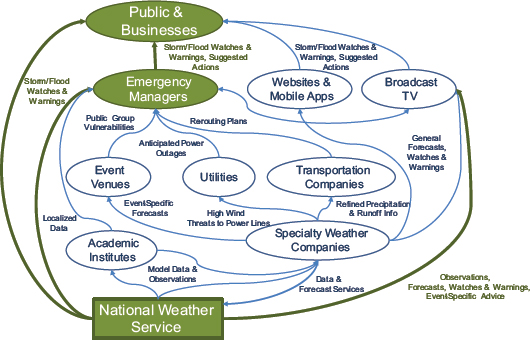
FIGURE 4.1 The hypothetical information value-chain during a period of severe storm threat accompanied by flood potential. The value-chain illustrates how various organizations may create and enhance the information that eventually reaches the public. The solid green paths represent the primary value-chain. The blue dashed-line elements represent the secondary value-chain. The figure does not present a comprehensive view of all activities but rather highlights the less-well-understood role of the secondary value-chain in serving the public. Thus only key elements of the primary value-chain have been shown, whereas the secondary value-chain is described in greater detail.
A growing overall enterprise provides opportunities for the NWS to serve the public in ways not possible on the basis of its budget alone. As stated in Recommendation III, the NWS should explore enhanced cooperation and collaboration with the enterprise. In doing so, the NWS needs to protect its direct public interaction through the primary value-chain, while improving the additional public benefit made possible by the secondary value-chain.
IMPLEMENTING A LEVERAGED ENTERPRISE
The Fair Weather report (NRC, 2003a) led to specific changes in NWS’s interaction with the overall enterprise that have enhanced the public’s access to weather, water, and climate information. This report recommends building on the success of Fair Weather. In general, the changes involved reflect a more direct NWS role in achieving public benefit through the secondary value-chain. Although it was beyond the Committee’s charge to be prescriptive in defining how a solution should be implemented, there are many different ways change could be accomplished. The NWS will need to implement an approach that best matches its ongoing evolution. A successful approach will likely involve inclusion of the secondary value-chain in NWS planning and perhaps even involve an office designed to work with the entire enterprise. A successful approach will also reflect this report’s theme of increased agility. Promising individual elements of an overall implementation approach could be examined relatively quickly as pilot projects or experiments. An effective approach will establish metrics for measuring success. Examples of key elements for successfully leveraging the enterprise include the following.
Improved Understanding of the Secondary Value-Chain and Its Role in Serving the Public
This would include better recognition of enterprise roles that go beyond “communication and dissemination” described in the Weather-Ready Nation Roadmap (NWS, 2012), such as how the secondary value-chain enhances information. A simple example is to include the secondary value-chain in post-event evaluations of performance (see Recommendation II.a), something that is not done with current practice. Such an assessment will allow the NWS to begin identifying actions it can take to better serve the public through the secondary value-chain, as well as how the secondary value-chain can more effectively complement the primary value-chain.
Improved Linking of NWS Capabilities to Needs of the Secondary Value-Chain
Based on the improved understanding of needs described above, NWS planning would directly guide better access to existing NWS capabilities and generation of new core capabilities so as to explicitly support the secondary value-chain. This includes foundational datasets as well as the services needed to deliver data. An example is probabilistic forecasting, as discussed in Chapter 2. Another example could be improved seasonal forecast models or integrated environmental services, a topic of high interest in the secondary value-chain and ultimately the public but of less immediate interest specifically to public safety.
Evolution of both technical and organizational capabilities, as discussed in prior sections, will need to reflect an enhanced consideration of secondary value-chain needs. The Committee suggests, however, that implementing changes to the NWS on the basis of value-chain assessment needs to proceed cautiously for the reasons cited in the following section on challenges and risks. The NOAA Science Advisory Board can provide assistance with identifying experiments, trials, testbeds, or pilot projects that accomplish this, as they have done with their Open Weather and Climate Services proposal (NSAB, 2011). Cost-benefit analyses will be helpful as well. This need not wait for a deeper understanding of the secondary value-chain within the NWS; the experiments themselves will help develop this understanding. New tools and processes may be needed to implement any changes, and the academic and research sectors can contribute to their development.
More Open Access to NWS Capabilities
A widely discussed means for improved linking of NWS capabilities to the secondary value-chain involves more open access to NWS data and services. The Committee notes that the NOAA Science Advisory Board has recently transmitted to NOAA management a white paper called Towards Open Weather and Climate Services (NSAB, 2011). There are still numerous potential issues to be resolved, including access to intellectual property (IP) generated by NWS–private sector cooperation, whether benefits from such collaboration would occur to all private-sector entities, and the joint funding of cooperative projects. However, given the potential for leveraging NWS resources to enhance the performance of its mission, the Committee supports the idea that a number of pilot or experimental projects be undertaken to explore both the benefits and the possible pitfalls. Such experiments will reveal potential conflicts of interest and IP issues, as well as resource issues involved in cooperative work and how to provide fair access to NWS data. For example, issues such as public data rights from private-sector sources represent important and only partly resolved problems. Such pilot projects will reveal how willing the private sector would be to participate equally, rather than just receiving more data. In developing these pilot projects, the NWS and its partners will need to give consideration to how progress in cooperation will be measured. If some of these experiments are successful, they will not only increase the NWS’s ability to fulfill its mission but also deepen its understanding of the need for customized weather services.
Improved Value-Chain Alignment
In general, each value-chain could be better executed through improved alignment or collaboration with the other value-chain with the goal of serving national priorities. In some cases, this may involve rethinking of the relative roles of each value-chain.
Expanded IT Infrastructure
As user needs expand through the proliferation of web and mobile applications, NWS IT infrastructure will need to keep pace. This infrastructure is somewhat different when serving the public directly as opposed to serving them indirectly through the secondary value-chain. In the latter case, though transaction volume may be lower, there may be higher expectations for such things as mature interface standards, services security, backward compatibility, reliability, throughput, data archive, cloud-based services, and product validation due to the increased dependence of business revenues on the NWS.
Supportive Organizational Structure
The capability to better support the secondary value-chain and the overall enterprise needs to be included as part of any rethinking of NWS function and structure, as discussed in Chapter 3. It is expected that any expanded support to the secondary value-chain will encounter some organizational and cultural pushback in that it will change the traditional approaches to how NWS operates. Among the keys tasks of any organizational evaluation is to identify and resolve such organizational and cultural impediments.
Extension of the Weather Enterprise Interaction to Water and Climate
The successes of the weather enterprise interaction of the last decade provide a solid model for broader interaction across enterprise disciplines, with space weather and seasonal and inter-annual forecasts being particular examples for improvement. Expansion of enterprise collaboration in social science research would also bring benefit to the entire enterprise. Investigation of the impact of weather, water, and climate on economic and social systems would help prioritize investments through the evaluation of services in an economic or risk framework.
Enhanced Interaction with Professional Organizations
One successful outcome of the Fair Weather report has been the role of professional organizations in resolving issues impeding progress of the enterprise as a whole. The NWS has effectively supported this approach in achieving the enterprise progress of the last decade. The next step is to do more of what has worked well, perhaps expanding and extending relationships with the AMS, AWCIA, NCIM, and others.
Industry-wide Standards
The NWS can enable enterprise growth by promoting development of industry standards. Such development will need to proceed through collaboration with professional organizations.
Deeper Formal Public-Private Partnerships
Going back as far as the 1800s, public-private partnerships have been a reliable tool for creating infrastructure and providing services that reflect the public good while requiring efficient implementation. The NWS has made limited formal use of such partnerships. NESDIS has explored public-private partnerships in the form of data buys, but with generally little follow-through. The international community routinely employs such partnerships for activities such as those of the NWS. The NSAB Open Weather and Climate Services proposal presents a vision for how deeper public-private partnerships could enhance the NWS in a variety of areas (NSAB, 2011). They are in no way a general solution to NWS needs; done right and taken seriously, however, they can become an important part of NWS’s enterprise leveraging.
Recommendation III.a
The National Weather Service (NWS) should seek to better understand the functioning of the secondary value-chain, including ways in which it complements the primary value-chain. When appropriate, it should identify new or evolved NWS data and services that can enhance public value delivered through the secondary value-chain, the benefits associated with such services, and any challenges or risks in implementing them. To the greatest extent possible, this should be accomplished through collaborative efforts with corresponding enterprise partners.
The Committee reaffirms the recommendations of the Fair Weather report regarding the enterprise partnership (NRC, 2003a). Notable among these is an understanding that the enterprise is evolving and that fixed organizational boundaries are less productive than are interactive processes (e.g., meetings and committees) that identify and evolve relationships among enterprise partners as needed. Recommendation 5 of the Fair Weather report, regarding availability of data and products, needs to receive increased focus (NRC, 2003a). The Towards an Open Weather and Services white paper recently prepared by NSAB presents an excellent opportunity to further this goal (NSAB, 2011).
As an aggregation of independent entities, the enterprise cannot commit to plans or obligations. Government agencies can be obligated by their charters, with Congress holding them accountable to those charters. Private-sector “responsibilities” or “obligations” have no real meaning unless accompanied by contracts. Yet, despite this, the private sector can be a reliable partner when private incentives and values align with the NWS mission. The U.S. government does not produce many of the things it relies on, from airplanes to paper. It does not need to do so itself, and it does not need an “obligation” from the private sector—because the private-sector industries producing those things are sufficiently robust that they can be counted on. In the weather enterprise, the broadcast sector has achieved such robustness—the NWS does not need its own backup daily television broadcasts nor do they need to tell television channels what to do. The broadcast sector already does it well and reliably. Other elements of the enterprise are also beginning to achieve such robustness. Ground-based weather sensor networks are one and wind forecasting for renewable energy is another. The NWS could achieve increased leverage by encouraging the emergence of such “robust sub-enterprises.”
The structure and function of the enterprise varies from country to country. Some, like the United States, have a strictly public, not-for-profit National Hydrological Meteorological Services (NHMS) and a separate private sector. Other countries have both a public component and a private component within their NHMS. Some private-sector entities offer products and services internationally. In the 1970s and 1980s, the growth of the interactions between the public and private sectors were seen to begin to impair the free and unrestricted international exchange of hydrometeorological and related data and products and led the Twelfth World Meteorological Congress (Cg-XII) in 1995 to negotiate Resolution 40.6 The Resolution specified those data and products to be exchanged internationally without charge and with no conditions on use. The Resolution also set guidelines for relations among NHMSs regarding commercial activities, and it further proposed guidelines for relations between NHMSs and the private sector itself.
One result of the Resolution is that some data and information falling outside the designated “without charge and no conditions on use” category could be exchanged but with restrictions as to how it could be passed on to third parties in other countries, as per the dictates of the originating country’s NHMS. This could, for example, increase the global coverage of weather and water observations to an NHMS but could make such an increase unavailable to private-sector entities.
Another result of the Resolution has been to provide guidelines for the expansion of, for example, U.S. weather, water, and climate enterprise companies to service the global market. At the same time, it has provided guidelines for those NHMSs that wish to offer hydrometeorological services commercially to other countries. This, then, could provide alternative weather and water information services in countries to those provided by the NHMS in that country, and it raises the fear of government decisions to reduce funding support to their NHMS, on the logic that they can get weather forecasts from international companies for less than the cost of the NHMS. The important side effect is that the capacity of the NHMSs to make and exchange the needed observations is reduced, and a lack of information on which both the NHMSs and the international enterprise base their services could result.
____________
6 Resolution 40 (Cg-XII) WMO Policy and Practice for the Exchange of Meteorological and Related Data and Products, including Guidelines on the Relationships in Commercial Meteorological Activities (WMO, 1995).
The Committee is not aware of any international assessment of the impact or effect of WMO Resolution 40 (Cg-XII) on the global exchange of hydrometeorological data and products or on the provision of hydrometeorological services. This is an area where private-sector interests could fail to align with NWS responsibilities to international partners. The Committee feels the tradition of “free and unrestricted” international exchange of hydrometeorological data and information is crucial to the provision of the best possible weather, water, and climate services.
When thinking about the role of the private sector in the context of the broader weather, water, and climate enterprise, the focus tends to be on the provision of value-added services rather than infrastructure providers. These two private-sector roles are distinct, and each has their own issues. The diversity of the private sector is reflected in a broad spectrum of commercial interests. These range from designing and building weather, water, and climate data acquisition systems and data processing systems via direct contract to a government program office to developing value-added products and services based on NWS data and directly selling these to a third-party consumer.
NOAA has well-established contract procurement processes for weather, water, and climate data acquisition and processing systems and subsystems. These systems form the core of NOAA’s observation network and include elements such as satellite platforms, launch vehicles, sensors (space, air, and ground-based), command and control systems, and data processing and distribution systems. The procurement processes for elements of this core infrastructure include architecture studies at the system level (e.g., trades comparing many smaller satellites versus fewer larger satellites based on cost, risk, schedule; data product requirements such as spatial and temporal resolution), sensor design trades (cost, risk, schedule, data requirements), or segment trades (location and number of ground stations, cost, risk, schedule). Early stage studies are often only partly funded by government contracts. The competing private-sector entities frequently fund studies and early R&D largely with their own internal funds.
In line with NOAA’s Partnership Policy to “foster the growth of this complex and diverse enterprise as a whole to serve the public interest and the Nation’s economy” (NOAA, 2007), the Committee believes the nation needs a strong private sector capable of developing core infrastructure. The existing NOAA procurement process should be reviewed, well-functioning aspects retained, and any poorly functioning aspects improved. Per Lesson 2 presented in the Committee’s first report, aspects subject to improvement may include strengthening NOAA’s system architecture and system engineering processes (NRC, 2012a). It is also important that NOAA improve contract management practices where needed. Maintaining a healthy and vibrant private sector that competes to design and build traditional key infrastructure components helps to provide a best value approach for the nation. Not only do competing entities frequently develop and test some of the more innovative design ideas on their own internal, nongovernment funds; competition typically leads to important technical innovation too.
Recommendation III.b
The National Oceanic and Atmospheric Administration (NOAA) as a whole should strengthen its systems engineering and procurement processes for major systems, including ground-based sensor, gauge, and radar networks, satellites and ground processing, and major communications and processing systems so as to achieve more productive and cost-effective interactions with the enterprise partners developing and building such systems.


