
Highlight: Nuclear Crime Scene Forensics
An attack using a nuclear device on one of our cities would be both catastrophic and world changing. President Obama describes it as the single biggest threat to U.S. security. In the event of such an attack, a set of urgent and crucial questions would have to be answered: What was exploded? Who was responsible? Do they have more? Was the device improvised or sophisticated? Did they steal it or have help making it? Is the material reactor-grade or weapons-grade fuel? How old is it? Detonation of a radiological device, a “dirty bomb,” could also result in widespread contamination and public concerns. Nuclear forensics is the technical means and set of scientific capabilities that, in the event of such attacks, would be used to answer these questions (see Figure FOR 1).
Nuclear forensics involves the analysis and evaluation of postdetonation debris following a nuclear explosion. It is also essential in the analysis of unexploded devices or material that have been seized. The basic idea behind nuclear forensics is the same as that behind the
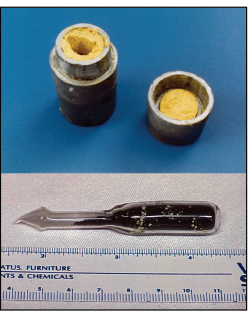
FIGURE FOR 1 Lead container and the glass ampoule containing highly enriched 235-uranium seized in Bulgaria in 1999 and analyzed at Lawrence Livermore National Laboratory for forensic purposes. SOURCE: “Forensic Analysis of a Smuggled HEU Sample Interdicted in Bulgaria,” UCRL-ID-145216, August 2001.
analyses of stellar nucleosynthesis. In stellar astrophysics, the debris from nuclear reactions inside a star is used to infer detailed information about the nature of the star and the reactions, including the mass, density, compositional layers, and temperature of the star. Very similar analyses are used in nuclear forensics to answer the pertinent questions for an exploded nuclear device here on Earth.
During the nuclear testing era, the United States and other countries used radiochemistry techniques to characterize the explosions from collected debris. The application of the radio-chemistry experience and techniques developed over those decades has proved invaluable in generating the key concepts underlying nuclear forensics. The current forensic capabilities have been used in postdetonation exercises in which the national laboratories have demonstrated that they can characterize nuclear debris and other forensic data and can infer the key design features for a variety of hypothesized nuclear explosive devices.
Several key nuclear physics concepts apply in forensics. One is the use of the natural radioactive decay of a nuclear material to determine its age. Plutonium, which does not occur naturally on Earth, would originally have been produced in a reactor with some unavoidable plutonium-240 and plutonium-241 content. The decay of plutonium-241 into americium-241 with a 14.4-year half-life indicates the time lapsed since production. This is analogous to the way in which carbon dating is used to determine the age of some material. Key information regarding the origin of plutonium material can also be obtained from the ratio of the different plutonium isotopes—for example, whether it is weapons grade or reactor grade and the total reactor neutron fluence (or burnup) to which it was originally exposed.
The design of a detonated device from the explosion debris can be inferred from the shape of the neutron flux spectrum, which serves as a fingerprint for the design. An analogous fingerprint for nuclear reactors is the average energy of the neutron spectrum, from which one can deduce whether the reactor is a thermal light or heavy water reactor or a fast reactor, which will point to whoever designed the reactor. To extract the shape of the neutron flux spectrum for a detonated nuclear device, forensics takes advantage of the very different energy dependencies of nuclear cross sections. Useful nuclear reactions fall into three categories: (1) neutron capture, which characterizes the low-energy part of the spectrum, (2) inelastic neutron scattering to nuclear isomers, which characterizes the fission neutron component of the spectrum, and (3) threshold (n, 2n) reactions, which characterize the high-energy component of the spectrum from fusion neutrons.
As an example, let us consider how we could use the americium-241 present in the fuel of a plutonium-based nuclear device to extract information about the shape of the neutron spectrum. During the explosion, some of the americium-241 will be transmuted to americium-240 through the (n,2n) reaction; this americium-240 could not have been present before detonation because it lives for only 2.1 days. Producing americium-240 from americium-241 requires the presence of neutrons with energies of at least 6.67 MeV, because the nuclear reaction involved is a so-called threshold reaction. Thus, the relative abundance of americium-240 provides unique information about the high-energy component of the neutron spectrum (see Figure FOR 2).
Detailed studies of the implication of the production of americium-240 or other isotopes of interest require that all of the significant paths for producing and destroying these isotopes during a nuclear explosion be known. To address this requirement, a number of multiinstitutional programs are performing a series of measurements. One of the collaborations is attempting the first measurement of the fission of americium-240, a very challenging undertaking for several reasons. The first two challenges are the production of a significant quantity of americium-240 and its subsequent chemical separation to form a target. These are being carried out at LBNL using the 88-in. cyclotron and radiochemistry facilities. Stewardship Science fellow Paul El-
ison, who is featured in the Highlight “Future Leaders” between Chapters 5 and 6, is part of this team. Only very small targets of americium-240 will be possible, making the fission cross section measurement another challenge. For the fission measurement, the very high neutron intensity capability of the Lead Slowing-Down Spectrometer (LSDS) at the Los Alamos Neutron Science Center will be used. The LSDS will also be used to measure another fission reaction of interest for uranium devices—in particular, the fission of uranium-237. Like americium-240, uranium-237 is very radioactive and difficult to produce and chemically separate. In these experiments, uranium-237 is produced by irradiation of uranium-236 in the high-flux reactor at Oak Ridge National Laboratory. Uranium-237 has a half-life of 6.75 days, and handling the irradiated sample to chemically separate uranium-237 requires use of Oak Ridge’s hot cell facilities. Once the targets are fabricated, the fission measurements will be carried out at Los Alamos using the LSDS.
The committee hopes that the validity of our nation’s nuclear forensics schemes will never need to be tested directly. Confidence in the program capability is greatly enhanced by the tight coupling between the fundamental nuclear data community, radiochemists, and the weapons design community. It hopes as well that broadcasting the capabilities of nuclear forensics to identify the source of a nuclear device and its fuel will deter advocates of such unthinkable acts.
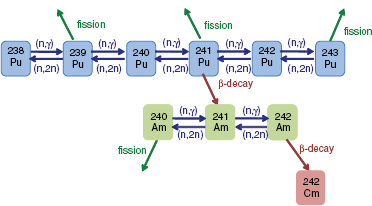
FIGURE FOR 2 Plutonium (Pu) and americium (Am) reaction chains. One of the pieces in a nuclear forensics puzzle is the amount of plutonium-241 in a nuclear device, which can be determined after an explosion. The figure illustrates all of the neutron-induced reactions that need to be understood to deduce the original amount of plutonium-241 in the device and the fluence of high-energy neutrons in the subsequent explosion. These include reactions on americium-241, the daughter from radioactive decay of plutonium-241. The relative abundance of americium-240 in the explosion debris would provide key information for forensic analyses, because americium-240 can only be produced by high-energy (En > 6.67 MeV) neutrons. SOURCE: Courtesy of A. Haynes, Los Alamos National Laboratory.


