
This fourth decadal assessment of nuclear physics by the National Research Council (NRC) comes exactly one century after Ernest Rutherford’s discovery of the atomic nucleus. His visionary insight marked the beginning of nuclear physics. At 100 years, nuclear physics is a robust and vital science, with technological breakthroughs enabling experiments and computations that, in turn, are opening diverse new frontiers of exploration and discovery and addressing deep and important questions about the physical universe. Nuclear physicists today are advancing the frontiers of human knowledge in ways that are forcing us to revise our view of the cosmos, its beginnings, and the structure of matter within it. At the same time, these advances in nuclear physics are yielding applications that address some of the nation’s challenges in security, health, energy, and education, as well as contributing innovations in technology and manufacturing that help drive our economy.
There have been stunning accomplishments and major discoveries in nuclear science since the last decadal assessment. Like Rutherford, today’s nuclear scientists find that the data from well-crafted experiments often challenge them to revise their ideas about the structure of matter. Indeed, the matter that makes up all living organisms and ecosystems, planets and stars, throughout every galaxy in the universe, is made of atoms, and 99.9 percent of the mass of all the atoms in the universe comes from the nuclei at their centers, which are over 10,000 times smaller in diameter than the atoms themselves (the proton’s radius is about a femtometer, or 10−15 m, a distance scale called the “femtoscale”). Although nuclei are incredibly
small and dense, they are far from featureless: They are complex structures made of protons and neutrons, which themselves are complex structures made out of (as far as is known) elementary constituents known as quarks and gluons. Beyond what Rutherford could possibly have imagined, nuclear physics spans an enormous range of distance scales from well below the femtoscale upward to the scale of the universe itself.
The United States became a powerhouse in nuclear physics in the decades following the Manhattan Project. Today, vibrant nuclear physics programs are found, along with large and sophisticated nuclear physics laboratories, in most of the technologically advanced countries around the world. U.S. nuclear physicists often involve themselves in large collaborative efforts with scientists from many countries, carrying out experiments in the United States or abroad. Such efforts create new opportunities and optimize the deployment of the resources needed to germinate and sustain scientific progress and maintain intellectual leadership in nuclear physics. Managing these resources has become essential. To this end, the U.S. nuclear physics community has developed processes that build a community-wide vision, identifying which pathways will be the most effective and direct to scientific discoveries that open new vistas and drive the field. NRC’s decadal assessments of nuclear physics have become one of the tools by which the field develops its roadmap. In this report, the Committee on the Assessment of and Outlook for Nuclear Physics (“the committee”) assesses the state of nuclear physics at a time when it is rapidly evolving and new frontiers are opening up. It also looks at the prospects for the field in an international context.
Nuclear physics is broad and diverse in the questions it is answering and the challenges it faces on its many frontiers, as well as in its techniques and technologies. The committee frames this introduction with four overarching questions that span several of the traditional subfields of nuclear physics, that are central to the field as a whole, that reach out to other areas of science as well, and that together animate nuclear physics today:
(1) How did visible matter come into being and how does it evolve?
(2) How does subatomic matter organize itself and what phenomena emerge?
(3) Are the fundamental interactions that are basic to the structure of matter fully understood?
(4) How can the knowledge and technological progress provided by nuclear physics best be used to benefit society?
Accomplishments since the last NRC decadal assessment have brought us much closer to answering each of these four questions. In each case, recent research has revealed new physics discoveries and opened new frontiers for exploration. The
questions are multifaceted, broad, and deep, and the challenges they pose provoke intriguing opportunities for the decade to come.
In the remainder of this introduction, these four questions are discussed in some detail and illustrated by a few vignettes. In Chapter 2 the scientific rationale and objectives of nuclear physics are articulated more fully. Chapter 2 is organized according to the main science areas within the field, but the four overarching questions cross the boundaries between these subfields, linking the discipline together as an intellectual whole while at the same time advancing on varied frontiers. Nuclear physics has Janus-like qualities, probing fundamental laws of nature that link it to particle physics while at the same time looking toward complex phenomena that emerge from the fundamental laws, as in atomic and condensed matter physics, and astrophysics and cosmology; zooming in on phenomena happening at the shortest distance scales that our best microscopes can see and zooming out to the stars and the cosmos. Because it sits in this liminal position between the fundamental and the emergent, between the microscopic and the astronomical, nuclear physics naturally addresses these central questions from varied angles, providing unique perspectives.
HOW DID VISIBLE MATTER COME INTO BEING AND HOW DOES IT EVOLVE?
The challenges posed by this question are shared by cosmologists, astronomers, particle physicists, and nuclear physicists alike. The universe is not entirely made of atoms and light: It also contains dark matter and dark energy—components that are known to exist because their gravitational influence on ordinary matter can be observed. But all the matter that can be seen—visible matter—is made of atoms, consisting of a tiny, compact nucleus and electrons orbiting around it. Atomic nuclei come in a very broad range of masses and electric charges. When the charges of the negative electronic cloud cancel out the positive charge of the nucleus, the atom is neutral. Interactions of the electronic clouds around nuclei enable the complex chemical processes that are essential for life and form the basis of our modern technological world. Atomic interactions are thus dictated by the atomic nuclei, as it is their charge that determines the electronic structure. Understanding nuclear physics and what goes on within the nuclei at the core of all visible matter starts with understanding the origins of the nuclei, light and heavy, and of the protons and neutrons of which they are made. How were the protons and neutrons created during the big bang? And, how did these protons and neutrons assemble into such a broad range of nuclei through nuclear transformations inside stars and stellar explosions? Nuclear science in concert with astrophysics attempts to answer these questions. The quest to understand how protons, neutrons, and nuclei form and evolve is fundamental to understanding our origins.
One example of how nuclear physicists are learning how visible matter comes into being is provided by experiments at two accelerators: the Relativistic Heavy Ion Collider (RHIC) in Brookhaven, New York, and the Large Hadron Collider (LHC) in Geneva, Switzerland. By colliding nuclei at enormous energies, scientists are using these facilities to make little droplets of “big bang matter”: the same stuff that filled the whole universe a few microseconds after the big bang. Using powerful detectors, they are seeking answers to questions about the properties of the matter that filled the microseconds-old universe that cannot be ascertained by any conceivable astronomical observations made with telescopes and satellites. Since the last decadal assessment of nuclear physics, research has shown that during the microsecond epoch, when the temperature of the universe was several trillion degrees, it was filled with a nearly perfect liquid that flowed with little viscous dissipation. This basic feature of big bang matter could only be discovered by recreating such matter in the laboratory.
As illustrated in Figure 1.1, sometime when the universe was about 10 microseconds old, this hot liquid cooled enough that it condensed, forming protons and neutrons (as well as other particles called pions), which, as far as is known, are the first complex structures ever created. These basic building blocks of all the visible
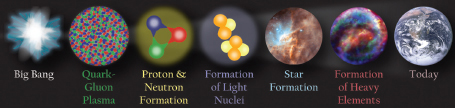
FIGURE 1.1 Nuclear physics in the universe. Over 99.9 percent of the mass of all the matter in all the living organisms, planets, and stars in all the galaxies throughout our universe comes from the nuclei found at the center of every atom. These nuclei are made of protons and neutrons that themselves formed a few microseconds after the big bang as the primordial liquid known as quark-gluon plasma cooled and condensed. The lightest nuclei (those at the centers of hydrogen, helium, and lithium atoms) formed minutes after the big bang. Other elements were formed later in nuclear reactions occurring deep within the early stars. Cataclysmic explosions of these early stars dispersed these heavy nuclei throughout the galaxy, so that as the solar system formed it contained nuclei of carbon, nitrogen, oxygen, silicon, iron, uranium, and many more elements, which ended up forming our planet and ourselves. SOURCE: Adapted from the Nuclear Science Wall Chart, developed by the Nuclear Science Division of the Lawrence Berkeley National Laboratory and the Contemporary Physics Education Project. Available at http://www.lbl.gov/abc/wallchart/index.html. Last accessed on May 30, 2012. Star Formation image: NASA/ESA and the Hubble Heritage Team (AURA/STScI/HEIC); Formation of Heavy Elements image: NASA/ESA/JHU/R. Sankrit and W. Blair; Today image: NASA.
matter in the universe today are under intense investigation at the Thomas Jefferson National Accelerator Facility (JLAB) in Newport News, Virginia. The facility there hosts an accelerator that can be thought of as an electron microscope so powerful that it can see inside protons and neutrons. Once the universe was a few minutes old, all the remaining neutrons in the universe paired up with protons to form light nuclei like those at the centers of helium and lithium atoms today; the remaining protons became the nuclei of hydrogen atoms. However, a panoply of elements exist in the world, not just hydrogen, helium, and lithium.
The processes of element synthesis go on today all across the universe, continuously creating new worlds. Nuclei are the fuel that powers the burning of stars and drives stellar explosions, some of which result in the formation of neutron stars, which can be thought of as nuclei of giant stellar masses. New nuclei, including those of which life is composed, are the ashes of stellar burning ejected into space by violent explosive events and stellar winds. The nuclear reactions that synthesize elements depend directly on the structure of the nuclei involved. This means that the element-by-element composition of matter in the universe today depends on features of thousands of nuclei, both the stable ones that are ordinarily seen and the unstable ones whose presence is fleeting. Many of these short-lived radioactive nuclei also play crucial roles in reactions taking place within the cores of nuclear reactors. Most important, very short-lived nuclei that are close to the limits on proton or neutron richness, beyond which no nuclei can exist, are thought to hold the secrets to the structure and formation of many of the stable nuclear species that surround us. There have been significant advances in the study of neutron-rich, proton-rich, and super heavy nuclei in the last decade, but the limits of nuclear existence still have not been demarcated. The characterization of nuclei near these limits that are so important to understanding the origins of visible matter also remains a challenge. Here, the Facility for Rare Isotope Beams (FRIB) at Michigan State University will utilize beams of short-lived nuclei to access the unknown regions of the nuclear landscape, providing new tools and new opportunities to address the challenge.
Significant advances in astronomy since the last decadal assessment have led to the discovery of very rare, very ancient stars whose composition reflects the production of elements by even earlier generations of stars, in some cases reaching back to stars formed from the debris of the very first generation of stellar explosions after the big bang. These ancient metal-poor stars are beginning to provide us with a chemical history of the galaxy, providing detailed information about the output of element-producing processes and in some cases hinting at previously unknown cycles of nuclear reactions responsible for making some of the elements heavier than iron. New facilities like FRIB will allow nuclear physicists to unravel the unknown properties of the nuclei and reactions that, in stars, are responsible for the creation of heavy elements.
Exploring the nuclear physics of the cosmos requires a broad range of experimental and theoretical approaches and can push nuclear science to its technical limits. Two important frontiers have arisen in the last decade and will be explored in the next decade with accelerators, detectors, and computers: (1) the fabrication and characterization in the laboratory of unstable nuclei that nature makes in stellar explosions and (2) the description of extremely slow nuclear reactions that are important for the understanding of stars, where they occur on astronomical timescales.
HOW DOES SUBATOMIC MATTER ORGANIZE ITSELF AND WHAT PHENOMENA EMERGE?
This question has been central to nuclear physics from Day One: Rutherford’s 1911 discovery of the nuclei at the center of every atom framed it and provided the very first step toward answering it. Rutherford discovered heavy, apparently pointlike entities at the centers of atoms. He was correct to conclude that nuclei contain most of the mass of an atom, but little did he know how intricate their composition and structure would turn out to be. Nuclei are complex structures made of protons and neutrons. The number of protons in a nucleus determines the chemistry of the atom in which it is found—for example, all carbon nuclei have six protons, and this is what distinguishes carbon from oxygen, which possesses eight protons. As of today, nuclei containing as many as 118 protons have been found in nature or created in laboratories. The number of neutrons in a nucleus with a given number of protons can vary significantly. For example, although stable carbon nuclei contain either six or seven neutrons, short-lived variants have been discovered containing anywhere from 2 to 16 neutrons. There are far more isotopes (nuclei with a specified number of neutrons and protons) than elements (nuclei with a specified number of protons). Indeed, more than 3,100 different isotopes are known, and many thousands of additional isotopic species are believed to participate in element production in the stellar cauldrons of the cosmos. Understanding the patterns and regularities of their structure is one of the challenges of nuclear physics.
Remarkably, this challenge repeats itself at an even smaller length scale: Each proton and neutron is itself a complex structure made of (apparently) pointlike quarks, which are continually exchanging the force-carrying particles called gluons that provide the strong interactions binding the quarks into protons and neutrons (and pions and other short-lived complex structures). Unless, that is, one is talking about the matter that filled the microseconds-old universe, which was so hot that the matter that would later cool down and form protons, neutrons, and nuclei was a liquid of quarks and gluons. The complexities of the different structural elements of subatomic matter result in a plethora of possible states of matter at varying temperatures and densities. Understanding the structure of nuclei, and of their constituent protons and neutrons,
as well as understanding the phases and phenomena that emerge when many of them get together, is among the grand challenges in nuclear physics. These challenges resonate across the many other areas of science in which macroscopic complexity emerges from large numbers of microscopic constituents obeying elementary rules. Some of the questions that arise are analogous to questions in other fields: How do large numbers of atoms organize themselves into materials: crystals, glasses, liquids, superfluids, and gases? How do large numbers of electrons arising from the atoms that make up these materials organize themselves to create metals, semiconductors, insulators, magnets, and superconductors? Just as the rich and varied forms of matter that make up the world originate in vast numbers of atoms and electrons interacting according to elementary microscopic laws, both theory and experiments have shown that large numbers of quarks or neutrons and protons or nuclei can also assemble themselves into a rich tapestry of possible phases of strongly interacting matter. The question of how many-body systems that are strongly correlated manifest new phases and new phenomena is a major intellectual thrust across many areas of physics. Examples of such bodies include novel superconductors, newly discovered topological patterns of quantum entanglement and quantum phase transitions in various condensed matter systems, warm dense plasmas, nuclear matter, quark-gluon plasma, and cold dense quark matter.
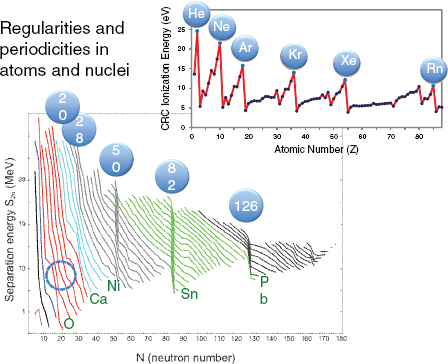
One of the most exciting discoveries since the last decadal assessment is that the long-assumed periodicities in nuclear structure are, in fact, not always periodic. For about half a century, nuclei have been understood to be complex structures made of densely packed protons and neutrons with a structural organization that exhibits many regularities, analogous to the regularities in the structural organization of atoms that are manifest in the periodic table (see Figure 1.2). Recent experiments have shown that this need not always be so and have revealed that the familiar pattern of regularities occurs only for nuclei in which the numbers of protons and neutrons are not very different, as is the case for most known nuclei. For example, the number of neutrons it takes to “fill a shell”—the analogue of starting a new row in the periodic table, when structure starts to repeat itself—turns out to be different in short-lived nuclei with many more neutrons than protons than in stable nuclei with similar numbers of each. These recent discoveries challenge us to extend our understanding of the structure of matter and further motivate the study of very exotic nuclei—those that are extremely neutron-rich or extremely proton-rich or extremely heavy. These short-lived nuclei are but one example of the diverse patterns or phenomena that emerge as protons and neutrons organize themselves into nuclei.
In many instances, the quest to understand emergent phenomena connects nuclear physics directly with other areas of science in which interacting many-particle structures are central. For example, superconductivity in metals, in which
pairs of electrons move in lockstep, and superfluidity in ultracold trapped atoms, in which pairs of atoms are created, both have analogues in nuclei (involving pairs of neutrons, pairs of protons, or possibly even proton-neutron pairs), in nuclear matter within neutron stars, and in dense quark matter that may exist at the very centers of neutron stars (where it is the quarks that form pairs). These are examples of collective quantum mechanical phenomena that can emerge only when many particles interact with one another. Many equally important emergent collective phenomena involving protons and neutrons in atomic nuclei will be studied at FRIB.
Remarkably, the basic story of having new phenomena emerge when elementary constituents organize themselves into complex structures repeats itself within single protons and neutrons. Although they are ordinarily thought of as the elementary constituents of nuclei, when protons and neutrons are looked at on shorter length scales, they themselves are revealed to be complex structures. Their
elementary constituents, quarks, are glued together by a force that is much stronger than the familiar electric and magnetic forces and that is associated with the exchange of elementary force-carrying particles called gluons. The experimental discoveries of quarks and gluons and the discovery of the laws that govern how they interact—called “quantum chromodynamics” (QCD)—are now more than 30 years old. And yet our understanding of how the properties of protons and neutrons arise from the interactions between their elementary constituents remains incomplete because the equations of QCD are simple to state but fiendishly difficult to solve. The underlying reason for this difficulty is that it is the interactions themselves that are the key feature. For example, while the electric and magnetic forces (mediated by massless photons) that bind an electron and a proton to form a hydrogen atom contribute only a tiny fraction of a percent to the mass of the atom, which is mostly just the mass of its constituents, it is now understood that approximately 99 percent of the mass of the protons and neutrons comes from
FIGURE 1.2 Regularities in the patterns of nuclei and of electrons in atoms. Upper panel: The elements in the periodic table are arranged in order of increasing atomic number, which is to say increasing numbers of electrons and protons per atom. (Atoms are electrically neutral; the number of protons in each atomic nucleus is balanced by the number of electrons orbiting the nucleus.) Elements having similar chemical properties and electronic structures appear in the same groups. This atomic periodicity, governed by the motion of the electrons in atoms, shows up in the behavior of the atomic ionization energy measured in electron volts of energy—namely, the energy needed to remove one electron from an atom. The chemical reactivity of an atom is determined by this ionization energy. Large jumps in the ionization energy occur in the noble gases (helium, neon, argon, krypton, xenon, and radon). High ionization energies mean that noble gases have very low chemical reactivity. Lower panel: Atomic nuclei themselves offer many examples of regularities and periodic behavior. The two-neutron separation energy (measured in millions of electron volts) is the energy required to remove a pair of neutrons from a nucleus that contains even numbers of protons and neutrons. This energy exhibits a sudden decrease immediately after specific “magic” neutron numbers (2, 8, 20, 28, 50, 82, 126). Nuclei with magic numbers of neutrons are more tightly bound than their neighbors with one extra neutron, making the former very much like noble gas atoms. (Different colors denote isotopes lying between proton magic numbers.) However, recent experiments have shown that the regular pattern of separation energies and other nuclear properties does not hold in sufficiently exotic nuclei, and that the magic numbers are “fragile.” Examples that illustrate this phenomenon and are causing textbooks to be rewritten include the neutron-rich nuclei around magnesium-32, marked by a dashed circle, which do not seem to know about the magic neutron number N = 20, and the neutron-rich nuclei just to their right in the figure, which seem to almost ignore the magic neutron number N = 28. SOURCES: (Upper right) Data from David R. Lide (ed.), CRC Handbook of Chemistry and Physics, 84th Edition. Boca Raton, Florida: CRC Press. 2003, Section 10, Atomic, Molecular, and Optical Physics, Ionization Potentials of Atoms and Atomic Ions; (Lower left) E.J. Lingerfelt, M.S. Smith, H. Koura, Nuclear Masses Toolkit, 2012. Available at http://nuclearmasses.org.
the motion of the quarks inside them and from the mediators of the strong interaction: massless gluons interacting with one another. The elementary masses of the quarks are so small that they contribute only a small fraction of the mass of the visible matter in the universe. So, the origin of 99 percent of the mass of the visible matter in the universe can be traced back to the energy of moving quarks and interacting gluons, according to Einstein’s famous equation, m = E/c2. The last decade has seen tremendous growth in the development of decisive experimental and theoretical tools that are for the first time giving us a precise look at the “shape” of protons and neutrons—for example, at the distribution of electric charge within them. Since quarks are the underlying charge carriers, such results are essential for understanding how the complex structure of protons and neutrons emerges from quarks and their QCD interactions.
One of the great surprises of the most recent decade has been the discovery that the elementary constituents within a proton or neutron have a significant net orbital motion, an “orbital angular momentum,” as if the nucleons have hidden within them a circulating current of quarks and/or gluons. It has long been known that protons and neutrons have spin, a feature that makes medical diagnoses via magnetic resonance imaging possible. However, it was long assumed that this spin was due to the intrinsic spins of the elementary quarks lurking inside protons and neutrons rather than to their orbital motion. Just as the electron in a hydrogen atom has no orbital motion (no angular momentum) when it is in its lowest energy state, it was assumed that since protons and neutrons are the lowest energy states of three quarks, these quarks must have no orbital motion. Instead, experiments carried out during the last decade, discussed in more detail in Chapter 2 under “Momentum and Spin Within the Proton,” have taught us that the spin of the proton and neutron appears to be largely due to orbital motion of the quarks or gluons trapped within them. This makes the internal structure of a single proton or neutron less like that of a hydrogen atom and more like that of a large nonspherical nucleus in which the collective orbital motion of hundreds of constituents is primarily responsible for the overall spin of the nucleus (see Figure 1.3). However, protons and neutrons are unique in having constituents within them that are moving at (ultrarelativistic) speeds very close to the speed of light. This discovery is motivating a new generation of experiments at JLAB, Brookhaven National Laboratory, and many nuclear laboratories worldwide that will exploit advances in accelerator and detector technologies to fully characterize the distribution of mass and orbital motion within protons and neutrons.
As described above, the formation of the first protons and neutrons about 10 µsec after the big bang represented the earliest instance of the emergence of complex structures from the previously featureless primordial fluid. Although featureless in the sense that it was the same everywhere in the universe, the liquid of quarks and gluons (called the quark-gluon plasma, or QGP) that filled the
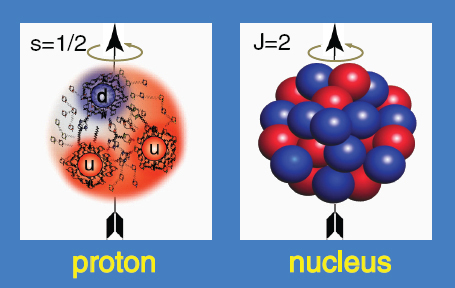
FIGURE 1.3 The spin of the proton is the sum of contributions from the spins and motions of all the quarks (u and d), quark-antiquark pairs (little circles), and gluons (connecting lines) within it. Recent experiments indicate that the sum of the orbital motion contributes more than the sum of all the spins, much as the total angular momentum of a large nonspherical nucleus is primarily the sum of contributions from the orbital motion of hundreds of protons (red) and neutrons (blue). SOURCE: (left) Lawrence S. Cardman, JLAB; (right) Witold Nazarewicz, University of Tennessee.
microseconds-old universe—and that is now being created and studied in experiments in which nuclei are collided at extreme energies—turns out itself to have very interesting properties that are emergent, in the sense that characteristics of the macroscopic fluid are far from apparent from the fundamental laws that govern the fluid’s elementary constituents. As discussed in more detail in Chapter 2 under “Exploring Quark-Gluon Plasma,” all observations of the droplets of QGP made in nuclear collisions over the last decade indicate that QGP acts more like a pureed soup—a liquid—than a dilute plasma in which particle-like quarks and gluons would be traveling appreciable distances between interactions, analogous to particle-like disturbances in ordinary gaseous atomic plasmas. Instead, liquid QGP responds to disturbances only with hydrodynamic waves, like those in water reacting to a dropped pebble. QGP is not the only known example of a fluid with collective properties but no apparent particle description: The challenge of understanding such liquids appears in several formerly disparate frontier areas of physics,
including the study of ultracold atomic fluids; condensed matter systems such as oxide superconductors, which resist all conventional approaches to explaining their properties; and, perhaps most surprisingly, the fluid of quantum fluctuations found near black hole horizons. In the coming decade, nuclear physicists have the opportunity to understand how a complex liquidlike phase of matter emerges from the underlying elementary quarks and gluons, whose dynamics are well understood at very short distances. In addition to shedding light on the nature of the QGP that filled the microseconds-old universe, progress on this frontier could advance our understanding of phenomena that pose central challenges in many other areas of contemporary science.
We move into the twenty-first century with confidence that a full understanding of the fundamental theory of the strong interaction is within reach. QCD is a rich and enormously complex theory that describes complex structures, phases, and phenomena at the femtoscale. Applying QCD, and the effective nuclear theories that emerge from it at longer length scales, to develop a full understanding of the structure and properties of stars, nuclei, protons, and neutrons, and of the liquid QGP, will be one of the most compelling contributions of nuclear physics to science.
Within the next few years, a new generation of accelerators and detectors enabling new and perhaps unanticipated experimental discoveries, together with unprecedented computing power enabling groundbreaking calculations, will yield myriad new opportunities for advancing our understanding of the organization and properties of nuclear matter in all of its manifestations (see Figure 1.4). Current calculations are able to explain the basic properties of a proton or neutron, including its mass, in terms of interacting quarks and gluons. Now, such calculations are being extended to include more than one neutron or proton. Similarly, while the most advanced calculations done today that describe nuclei in terms of protons and neutrons and the empirical strong forces between them (without looking at the quarks and gluons inside the protons and neutrons) can explain the long lifetime of carbon-14 used for archaeological dating, a microscopic picture of the nuclear fission of uranium-235 still eludes us. Indeed, to fully explain the inner workings and multiscale complexity of protons, neutrons, and nuclei remains an enormous undertaking. The challenge is to include all the relevant physical features in deciphering truly complex problems rather than being forced to rely on simpler models that do not take into account the full physics involved. Examples of the pathways that have been mapped to overcome the daunting computational challenges include microscopic calculations of the properties of quark-gluon plasma and how it flows, how the quarks and gluons spin in a proton, and how protons and neutrons conspire to produce the collective phenomena and simple regularities seen in nuclei. A new generation of exascale computers, capable of performing a million trillion calculations per second, will allow simulations of nuclear fission, nuclear reactors, and hot and dense evolving environments such as those found in
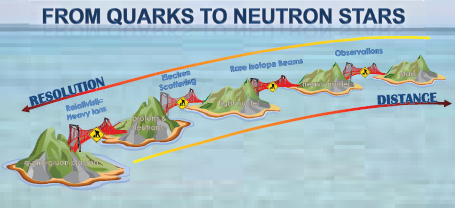
FIGURE 1.4 From quarks to neutron stars: Different technologies are being brought to bear on the myriad challenges in understanding nuclear matter at different spatial resolution scales or, equivalently, at different energy scales. At the shortest distance scales, relativistic heavy ion collisions are used to study quark-gluon plasma and how protons and neutrons and other hadrons condense from it as it cools. Electron-scattering experiments are used to study the complex structure of those protons and neutrons, with varying spatial resolution. Rare isotope beams are used to understand the patterns and phenomena that emerge as protons and neutrons form larger and larger nuclei. Nuclear phenomena occur on truly macroscopic distance scales in stars, in the nuclear reactions that drive certain classes of cataclysmic stellar explosions and in the description of the structure, formation, and cooling of neutron stars, which are basically gigantic nuclei. Building bridges of understanding between the physics at different spatial resolution scales is one of the paramount challenges facing contemporary nuclear science. For example, the most natural description of nuclei is in terms of neutrons and protons, and the most natural description of neutrons and protons is in terms of quarks and gluons. However, a rigorous connection between these two descriptive frameworks requires a description of the lightest nuclei in terms of quarks and gluons. This is the challenge for which the coming generation of accelerators, detectors, and computers is being designed, and is one of the great challenges for theoretical nuclear physics as well. SOURCE: Courtesy of Witold Nazarewicz, University of Tennessee.
inertial confinement fusion, nuclear weapons, and astrophysical phenomena and will provide a consistent picture of the fission data needed for national security and nuclear energy applications. Such computational capability, coupled with conceptual and algorithmic advances, will allow the physics of simple nuclei to be understood directly from QCD in terms of interacting quarks and gluons in a way that will serve as a benchmark for a rigorous computational approach to the full nuclear many-body problem. This bridge would link a century’s worth of classic questions directly to the fundamental interactions that are now known to be basic to the structure of all matter.
ARE THE FUNDAMENTAL INTERACTIONS THAT ARE BASIC TO THE STRUCTURE OF MATTER FULLY UNDERSTOOD?
The first part of the answer to this question is known: The fundamental strong interactions between quarks and gluons (the laws of QCD) are known, and these elementary laws must be responsible first for the emergence of protons, neutrons, and their interactions, and then of nuclei. The interactions of QCD are not the only fundamental interactions we know of, however. All matter interacts by the gravitational force, and electrons are bound to nuclei (making atoms) by the electric and magnetic forces. Finally, the weak interactions (“weak” because they act only over distances much smaller than the size of a proton) are responsible for the radioactive decay of the majority of unstable nuclei—for example, carbon-14, used to estimate the age of carbon-bearing materials, and fluorine-18, used in medical imaging—and they determine the properties of the elusive neutrinos that pass through space, Earth, and our bodies, without us ever noticing. Nuclear scientists are able to utilize handpicked nuclei as laboratories in which to make extraordinarily precise measurements that provide stringent tests of our theories of all the fundamental interactions except gravity, which does, however, play a role in nuclear physics in the context of neutron stars, where neutron stars can be thought of as giant nuclei with a mass comparable to that of the sun. The theory that describes these fundamental interactions, namely QCD, together with the unified theory of electromagnetism and the weak interactions, is called the Standard Model. (It could more descriptively be called the “Theory of Visible Matter.”) By testing the predictions of this theory for nuclear phenomena to exquisite precision, nuclear physicists are challenging the Standard Model and seeking evidence for new interactions that go beyond it.
Nuclear physics has played a key role in the most significant revision to our understanding of the fundamental laws of nature that has come since the last decadal assessment—the discovery that neutrinos oscillate, transforming from one type, or “flavor,” to another, even perhaps to a third type, and back and then repeating. The first evidence for this discovery came from Ray Davis’s historic Nobel prize-winning experiment designed to measure the flux of neutrinos from the sun in conjunction with John Bahcall’s precise modeling of how the sun shines, based on nuclear theory and nuclear data from laboratory experiments. Comparing the measured neutrino flux with solar model expectations, Davis found that about two-thirds of the expected neutrinos were missing, a mystery that remained unsolved for more than 30 years. Since the last decadal survey, however, two nuclear physics experiments, one at the Sudbury Neutrino Observatory in Canada (SNO) and the other in Japan (KamLAND), established convincingly that the neutrinos were not missing at all. Davis’s experiment was sensitive to only one of the three flavors of
neutrinos in nature, meaning that most of the neutrinos from the sun were hiding from Davis’s detectors by oscillating into another flavor. Neutrino oscillations require that neutrinos must come with different masses, implying that at least two of them must have masses that are not zero. This discovery constitutes the first change in several decades in our understanding of the fundamental laws that govern the elementary constituents of all matter, namely the Standard Model (see Box 1.1). It opens new questions, the most profound of which are the determination of the average neutrino mass and the source of thier mass and the determination of whether neutrinos are their own antiparticles. Concerted efforts to answer these and other questions are now being mounted by nuclear physicists in a mutually beneficial partnership with their particle physics colleagues.
Physicists do not expect the appearance of neutrino masses to be the last word in the quest to understand the laws of nature at the level of elementary particles and their interactions. Our current understanding, as codified in the Standard Model, has had an extraordinary run of success in describing many phenomena, but it is incomplete. Nuclear and particle physicists are seeking a new Standard Model (NSM), which will incorporate the many successes of the Standard Model but will in addition provide an understanding of aspects of physics that are now mysterious. Questions here include: Why do quarks and electrons have the masses that they have? What is the nature of the dark matter and dark energy that pervade the universe? and Why is the universe filled with matter but little antimatter? One approach to answering these questions, led by particle physicists, is to push back the high-energy frontier, seeking to create whatever new particles and new interactions that may exist in the NSM in proton-proton collisions at the Large Hadron Collider. An alternative approach, where nuclear physicists play a leading role, is to make advances on the precision frontier, where exquisitely sensitive measurements may reveal tiny deviations from Standard Model predictions and point to the fundamental symmetries of the NSM. For example, the symmetries of the Standard Model do allow a neutron to have a very tiny permanent separation between the center of mass of the positively charged quarks and the center of mass of the negatively charged quarks within it, but many ideas for the NSM allow for a possibly larger charge separation, known as the neutron dipole moment. In the coming decade, nuclear physicists are planning a campaign to detect such an effect or at least greatly reduce the experimental limits on it. The detection of a charge separation larger than that allowed by the Standard Model could have decisive implications for our understanding of the NSM and would naturally accommodate mechanisms for the generation of an excess of matter over antimatter when the universe was a trillionth of a microsecond or less old.
Box 1.1
The Fundamental Matter Particles of the Standard Model,
Also Sometimes Called the “Theory of Visible Matter”
There are six quarks in the Standard Model: the up (u), down (d), charm (c), strange (s), top (t), and bottom (b) quarks. Quarks are matter particles that emit and absorb massless gluons, meaning that they experience the strong interactions. The matter particles that do not participate in the strong interactions (called “leptons”) include the electron (e) and its two cousins, the muon (µ) and the tauon (τ). Leptons and the quarks are charged, meaning that they emit and absorb massless photons and thus experience electric and magnetic interactions. Neutrinos (µ) are the only known fundamental matter particles that do not absorb or emit either photons or gluons. All matter particles, including neutrinos, emit and absorb W and Z bosons; the consequent interactions are weak because the W and Z bosons are heavy, each having about half the mass of the heaviest known matter particle, the top quark. All matter particles also feel the force of gravity. All the particles in Figure 1.1.1 except the neutrino have antiparticles with the same mass and the opposite electric charge. Each of the three neutrinos may have an antiparticle or may be its own antiparticle; ongoing nuclear physics experiments aim to determine which.
The three neutrinos have different masses and so, when labeled by their masses as in this figure, they can be called “light,” “medium,” and “heavy.” The pattern of neutrino masses shown is one of the possibilities suggested by the recent discovery of neutrino oscillations, captured in the pie chart for each neutrino. The three colors reflect the flavors of the electron, muon, and tauon charged leptons. They show that the only way to construct a neutrino that is the exact partner of the electron (called an “electron neutrino,” it is blue in this diagram) is to combine neutrinos with differing masses in a certain way. Nuclear reactions in the sun produce electron neutrinos. And, all Standard Model processes in which a neutrino is made produce the exact partner of one of the charged leptons. The fact that these are combinations of neutrinos with differing masses is what causes the neutrino to oscillate as it flies through space. (Quarks also show this mixing property but to a much lesser degree.) Although the discovery of neutrino oscillations has given us good information about the differences between the three neutrino masses, the mass of the lightest neutrino is not known precisely; it could even be zero. Ongoing nuclear physics experiments seeking to measure the average neutrino mass directly, not via oscillations, will help. But we do not yet have any fundamental understanding of the pattern of the masses of the 12 Standard Model matter particles, in particular of why the neutrinos are millions of times lighter than any of the other particles.
Nuclear physics is not only a basic scientific enterprise, but it also has stunning practical applications. These in themselves can justify the cost and effort of the research, going beyond the basic knowledge that has been gained. Nuclear science has a many-decade-long history of accomplishments that benefit our health, the economy, and our safety and security: The societal benefits derived from nuclear physics are by now ubiquitous. This track record continues, with many new accomplishments since the last decadal assessment and many more under development. Smoke detectors in our
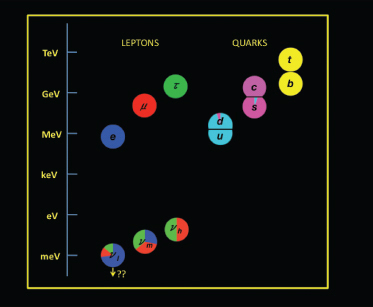
FIGURE 1.1.1 The masses of particles. The vertical scale is the particle mass in electron-volts, with each tick representing a 1,000-fold increase. SOURCE: Courtesy of R.G. Hamish Robertson, University of Washington.
homes, new medical diagnostic imaging methods, therapies using ion beams and new isotopes for cancer treatments, and new methods for assessing breaches in national and homeland security are just some of the ways that nuclear physics makes a difference to our safety, health, and security. Technological advances driven by advances in nuclear physics, which range from particle accelerators (most of which are now used either for medical purposes or in the semiconductor industry) to supercomputers, make significant contributions to our economy. A mutually beneficial synergy has developed in which a fundamental intellectual enterprise has consistently produced technological gains that, pursued with societal benefit in mind, have more than compensated the
public support required to pursue this science. Also beneficial to society is informing people about the discoveries from nuclear physics and explaining to them the origin and structure of matter and the fundamental interactions.
Positron emission tomography exemplifies the synergy between nuclear science, technological advances, and benefits to society. This medical imaging technique has become a powerful new tool for the diagnosis of cancer. The positron sources as well as the highly segmented crystalline detector elements come directly from nuclear physics research. Another example of synergy: Over the last two decades, nuclear physicists interested in the structure of the neutron have developed spin-polarized helium-3 targets, and it now turns out that these very techniques can be used to make spin-polarized helium-3 or xenon-129. These, in turn, can be introduced into the air a patient breathes, allowing for a new kind of magnetic resonance imaging (MRI) of the lungs. Without these developments, MRI could not be used to image gases and thus would not be able to accurately visualize lung function.
Nuclear science plays a role in treatment as well as in diagnosis. Nuclear medicine is a well-established field within medical research and therapy, with techniques that originated in nuclear science now used as a matter of course in the irradiation of tumors with high-energy particles. One of the many exciting advances in treatment being pursued today is targeted radionuclide therapy, which has been the most highly sought-after goal of nuclear medicine physicians and scientists for decades. Targeted therapy involves attaching a “targeting molecule” to a relatively short-lived radioactive isotope. The isotope emits radiation (alpha particles, for example) that reacts strongly with nuclei of atoms that comprise the tissues in the body and so deposits most of its energy nearby. The biologically active targeting molecules are carefully designed to bind to receptors on cancer tumor cells. When the radioactive nuclei attached to the targeting molecules bound to the tumor decay, they deliver a lethal dose of radiation only to the tumor tissue. By careful construction, the targeting molecule will pass through the body quickly if it does not bind to tumor cells, thus minimizing the exposure of healthy tissue to radiation. The use of these techniques in human clinical trials and in actual clinical therapy has just started. Two radiopharmaceuticals are now in use to treat non-Hodgkins lymphoma. And, recently, researchers at the Institute for Transuranium Elements in Karlsruhe, Germany, treated neuroendocrine tumors with the alpha-emitting bismuth-213 nucleus attached to a biological molecule that targets these particular tumor cells; they found in a small initial trial with human patients a reduction in the size of some tumors with no discernible negative side effects. If this approach can become routine, the treatment of cancer will undergo a paradigm shift. Nuclear
scientists play an essential role in this interdisciplinary effort, which blends biology, medicine, modern technology, and nuclear physics.
The years since 9/11 have seen important advances in nuclear forensics. An attack using a nuclear or radiological explosive device would of course be catastrophic, but it would also raise a set of urgent and crucial questions: What was exploded? Who did it? Do they have more? Was the device improvised or sophisticated? Did they steal it, and if so from where? Is the material reactor-grade or weapons-grade fuel? How old is it? Nuclear forensics refers to the techniques and capabilities needed to answer these questions. It can be likened to forensics-style exercises in nuclear astrophysics, whereby scientists analyze and evaluate the debris left behind by a stellar-scale nuclear explosion. Both efforts—nuclear astrophysics and nuclear forensics—are led by nuclear physicists.
The last decade has also seen major advances in the use of nuclear physics techniques to detect heavy nuclei like uranium or plutonium in a truck or cargo container—one such technique might detect the cosmic ray muons, elementary particles similar to electrons, that scatter off these elements at large angles. The techniques are based on well-understood basic nuclear physics, reminiscent of Rutherford’s early experiments, but their application to the detection of nuclear contraband crossing U.S. borders is new. The detector and computational challenges are related to very recent developments in basic nuclear physics.
Nuclear physics has long been a driver in the development of accelerators and computers, both of which are prevalent in our lives and in many sectors of the economy. Solving the design challenges associated with the building of very high energy accelerators being used to probe the fundamental nature of the matter in our universe will bring advances that improve the more than 30,000 accelerators used around the world for radiotherapy, for ion implantation to precisely embed dopants in semiconductor chips, and for other applications from developing new materials to improving food safety and benefiting other areas of industrial and biomedical research. Advancing nuclear science also drives innovations in computer architecture. For example, when IBM developed the Blue Gene line of computers that have become successful commercial machines with an impact on climate science, genomics, protein folding, materials science, and brain simulation, it employed a paradigm that had been developed first for lattice QCD machines—in fact, IBM employed people who had previously designed a computer called the QCDOC (QCD on a chip).
These examples all show how investment in nuclear physics has benefits beyond addressing the fundamental overarching questions earlier in this chapter. These investments are yielding progress on some of the nation’s biggest challenges as well as innovations that help to drive the economy.
As the complexity of the main challenges in the field has grown, so have the cost and size of the experimental nuclear physics tools. What began 100 years ago primarily as efforts of individuals or small groups has grown into a mix of small and large groups working as teams, both here and abroad. The U.S. nuclear physics community has developed a number of complementary processes for establishing consensus and setting priorities and future directions. The Division of Nuclear Physics in the American Physical Society, one of the most active divisions, provides help with planning and outreach for the benefit of nuclear physics. Another effective element is the Long-Range Planning process organized by the Nuclear Science Advisory Committee (NSAC) of the Department of Energy and the National Science Foundation. Using this tool, the community has been establishing its priorities and providing guidance and advice to the funding agencies. The present decadal assessment of nuclear physics brings experts from the diverse areas of the field to assess the achievements and provide a forward-looking vision of the new horizon. Anticipating needs for personnel and for building new facilities as well as developing and improving infrastructure for the field are all important components of the planning process. The charge for this study reflects the mission of decadal studies:
The new 2010 NRC decadal report will prepare an assessment and outlook for nuclear physics research in the United States in the international context. The first phase of the study will focus on developing a clear and compelling articulation of the scientific rationale and objectives of nuclear physics. This phase would build on the 2007 NSAC Long-range Plan Report, placing the near-term goals of that report in a broader national context.
The second phase will put the long-term priorities for the field (in terms of major facilities, research infrastructure, and scientific manpower) into a global context and develop a strategy that can serve as a framework for progress in U.S. nuclear physics through 2020 and beyond. It will discuss opportunities to optimize the partnership between major facilities and the universities in areas such as research productivity and the recruitment of young researchers. It will address the role of international collaboration in leveraging future U.S. investments in nuclear science. The strategy will address means to balance the various objectives of the field in a sustainable manner over the long term.
This present report offers the committee’s assessment and outlook. Chapter 2 summarizes the main scientific areas and the science questions addressed by nuclear physics, focusing on accomplishments since the last decadal assessment and directions for the decade to come. From the beginning the diversity of the science is evident in the range of topics, from the behavior of quarks and gluons to the universe. In this introduction, the committee has highlighted the interconnections of these main scientific areas with each other.
In Chapter 3 as well as elsewhere in this report, some of the ways in which society benefits from applications of nuclear physics are emphasized, and snapshots
of various important uses of the knowledge and know-how gained from nuclear physics are provided. Again, the topics of application are astonishingly diverse.
Nuclear physics in the global context is described in Chapter 4. Resulting from remarkably productive international cooperation, the global program in nuclear physics combines competition, cooperation, and communication in a way that is benefiting all the participants and accelerating scientific progress.
Chapter 5 addresses the important issues related to decision-making processes. The critical NSAC Long Range Planning exercise and other less structured global planning processes have become vital for keeping the nuclear physics enterprise on a successful path to the future. Workforce issues are explored in this chapter along with the steps being taken to ensure a productive workforce in the coming years. Finally, the committee discusses its findings and recommendations in Chapter 6.


