
THE TECHNOLOGY ECOSYSTEM
Technology does not exist in a vacuum. For advances to occur, there must be an ecosystem of supporting elements, including basic science, engineering know-how, materials, energy, and imagination.
The concept of a technology ecosystem is portrayed in Figure D-1. The interaction of all the portrayed elements is important for the development of technological innovations or advances in existing applications. This concept is important because each element can influence the success or failure of a technological advance. Thus, considering the future of a technology or a class of capabilities must take all the elements into account.
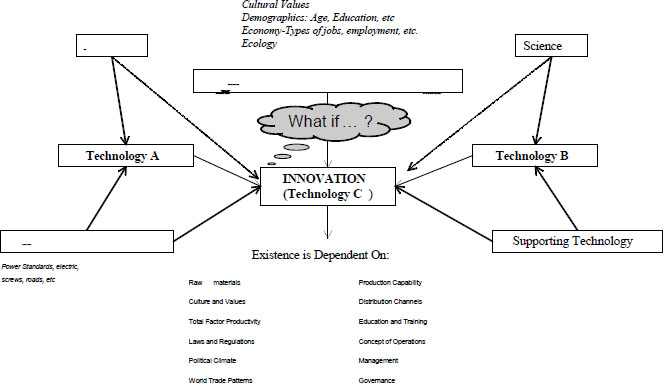
FIGURE D-1 The technology ecosystem.
Time is an intriguing and difficult element to consider in the context of a technology ecosystem. Time-related issues include time in existence, time to create, and time to innovate. Those all affect the richness and turmoil of an ecosystem.
• Time in existence. How long have the basic technological components been in existence? Technological components that have been in existence for a long time have the benefit of an existing support ecosystem: people who understand the technology and the science, existing applications, existence of manufacturers and support services, and other systemic elements. Newer technologies suffer in that fewer people understand the technology or the science and there are few manufacturers and support services.
• Time to create. How long does it take to make one instantiation of a new technology? In the case of complex systems that require the integration of many physical parts, such as a B-2 bomber, manufacture takes a long time. In the case of complex systems that require the integration of many logical parts, such as software, but not many physical parts, the finished product can go out on the market more quickly. The time it takes to make one of something affects an observer’s opportunity to observe: faster products are harder to observe in production but easier to observe in distribution. The observation opportunities and speed of creation may influence imagining of moving technologies toward new uses.
• Time to innovate. The speed of innovation in the technology ecosystem may be tightly coupled to the nature of the particular technology. If the speed is fast, predictions of innovation can be easier than if it is slow. For example, many people are reasonably familiar with Moore's law, which makes it fairly easy to predict cycle times in computer systems. Predicting a cycle time for innovation in other industries is a little more difficult.
TECHNOLOGY FORECASTING
The committee describes here some aspects of technology forecasting that were applied for this report. The definition of a “successful” technology is important. Many technologies are being discovered and developed every day, but “useful” or “successful” technologies solve important and relevant problems in an economically viable way (whether for a commercial or a defense application). Given that definition and as depicted in Figure D-2, the challenge for technology forecasting comes from the fact that whether a technology is useful or not can change drastically while it is being developed. Consequently, technology forecasting is not just a matter of “labeling” and assessing maturity. It is a difficult and iterative task in which the environment constantly changes. The situation is like that of a moving target: a technology has to be constantly reassessed to permit understanding of whether it can provide a useful function at a future intersection point.
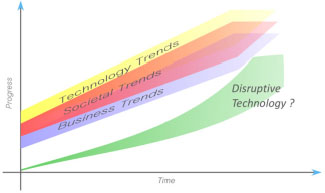
FIGURE D-2 Technology forecasting.
Generally, the usefulness of a technology will depend on the overall technology environment or ecosystem, but societal and business trends are also important. It is not uncommon for an application of a technology to change as it is being developed. For example, although energy-efficient light bulbs were developed to reduce energy consumption, they were first used in places
where the high cost of changing a light bulb would provide enough incentive to use the more durable energy-efficient light bulbs. The general technology environment is important because relevant applications require integration of several technologies into a system. The availability of the other (enabling) technologies changes over time as well. Often, new and initially superior technologies will be outpaced by continued progress of existing ones. Other technologies can emerge, often for other markets, and make an existing technology suddenly obsolete or nonviable. Societal trends and the political environment are important, especially for human performance modification (HPM) technologies. The effect of the political environment on the development of controversial fields such as stem-cell research or nuclear energy technologies can be drastic and should not be underestimated.
Clearly, the longer it takes to develop a new technology, the less certain the likelihood of success is. One way to assess the time horizon and the technology potential is to look at the “product” lifetime and effect once the technology has been developed (NRC, 1992). Evidently, the time horizon for technology development depends on the product lifetime: a product with a longer lifetime can afford a longer time for development.
Generally, it can be useful to distinguish between two development approaches, and this can help in understanding both the potential and the required development time of a particular technology. As depicted in Figure D-3, one might want to distinguish between a “forward-based” and a “reverse-based” approach. A forward-based approach is typically based on a core technology or research and is exploratory. Basic research has to be carried out to investigate fundamentals of the science that underlies a technology before it can be developed and brought to market. In this scenario, market and products are often being developed after the core technology has been proved and is well under way to being developed. In contrast, a reverse approach is more opportunistic: one looks first at the application and the market opportunity and then finds often-existing technologies, which might need only to be assembled or integrated into a working system.
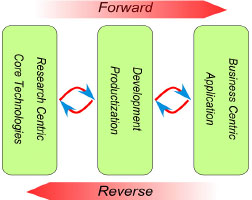
FIGURE D-3 Technology development approaches.
The relevance of that rather simplistic categorization is that the time horizon for forward-dominated approaches can be different from that for reverse-dominated approaches. Although most technology development is a combination of both approaches and changes over time, particularly as the technology matures, the time horizon in a forward-dominated approach can easily exceed 20 years. Such cases often involve high-risk projects that have unpredictable but potentially game-changing outcomes.
An example of a more forward-dominated approach is the development of near-field technologies for thermally assisted recording in magnetic hard disk drives. This technology allows boosting storage capacity by locally heating the magnetic media and thereby easing the recording process. The technology has been under development for more than 15 years and is
projected to be complete in 2014-2015 (NRC, 1992). Near-field physics and engineering were pioneered in the 1970s and 1980s. Initial laboratory experiments demonstrated the viability of the technology for thermally assisted magnetic recording in 1995 and 2005 (New, 2008; Betzig et al., 1992), but the technology required much additional basic research and development to gain understanding of the underlying physics of the recording processing and the manufacturing process. In addition, throughout the development process, alternative technologies had emerged, such as perpendicular recording and improved magnetoresistive sensors. The alternatives could increase the storage density by different means, and this constantly changed the performance target for thermally assisted recording. Another example of forward-based approaches is the development of high-dielectric-constant materials to reduce gate leakage of a transistor, which took much more than 15 years.
In a reverse-dominated approach, the time horizon is much shorter—about 2-10 years—and the outcome is more predictable. This approach is “system-centric” with an eye toward a specific application. Most development and research work in industry is in this category. An example of a classical reverse approach is an improved windshield-washer nozzle that exploits hydrodynamic instabilities to distribute cleaning fluid on a windshield more evenly (Raghu, 2010). The full development cycle of the technology took less than 3 years and included a clever design of a bistable twin jet nozzle that could be adapted to a standard windshield fluid distribution system.
These examples are meant to provide support for the following notions:
• Forward-based approaches are less likely to be successful within the period that this report concerns, 15 years.
• It seems to be more likely that future HPM applications will be realized with a reverse-dominated approach that uses technologies that are off-the-shelf or in the late stages of development.
• Although forward-based approaches can result in the biggest “surprise”, the vast variety of possible HPM applications coming from reverse-based, short-term development approaches could be as much a source of surprises as groundbreaking discoveries in a specific field.
There is an additional reason to pay careful attention to reverse-dominated approaches, based on common technology development models (Raghu, 2010; Perez, 2002). These models show that a typical technology cycle is triggered in a first phase by an initial discovery, followed by frenzy or hype, which results in a crash (Linden, 2003). The time between the discovery and the crash is around 30–50 years; this has been repeatedly observed in the history of technology. The crash is followed by a longer second phase, which is characterized by a slower but systematic adaptation of the technology, in which reverse-dominated technology-development approaches are favored. Although HPM involves a variety of technologies, the models suggest that the current HPM research environment resembles the second phase.
CULTURAL ISSUES
Cultural issues can be problematic with respect to both the understanding and the use of technologies. One issue is the approach to the development of technology. Another is the normalization of the use of technology. And a third is the interface between cultural norms and human performance. Layered on those issues is the cultural acceptability of copying innovation—what some might call theft of intellectual property.
The cultural values of a group can affect how technology is developed. Important cultural elements include respect for elders, the question of individuality versus community, and the cultural acceptance of failure. Cultures that place great value on seniority and deference to age tend to develop technologies more linearly and incrementally and in accordance with accepted
practices. Innovation is difficult in such cultures. Conversely, cultures that accept and celebrate individuality tend to generate radical innovations that depart, sometimes dramatically, from accepted approaches and development structures. Cultures that view failure without shame as a natural potential result of risk-taking also tend to spawn more radical innovations; cultures that value team identities and view failure as a shameful state tend not to spawn radical innovations.
The normalization of the use of technology can affect the development of technologies. Some cultures, such as the Amish, specifically exclude some technologies from their lifestyle (Amish Heartland, 2012). Others adapt technologies in ways that the technology developers never envisioned. One can visualize this as a continuum of technology adoption and adaptation, and it has been the subject of much study, most notably by Rogers, who developed the concept of innovation diffusion (Rogers, 1962; Rogers, 1983). A study of Internet-adoption attitudes by female academic faculty in Saudi Arabian colleges illustrated the cultural barriers that can influence the adoption and development of technologies (Al-Kahtani et al., 2005-2006):
There are sharp differences in the perceptions of elements of Saudi society …as to the potential use of the Internet. The more conservative elements of the society see more danger and shortcomings in Internet access than benefit. The members who are focused on new knowledge, such as the science faculty, are less likely to see the Internet as a danger and more likely to see it as a powerful tool for work enhancement.
The interface between cultural norms and human performance can present both challenges and opportunities. For example, the month-long fast of Ramadan in Islam has been shown to affect the biological health of participants (Lancet, 2009). The requirement for periodic religious practices during normal daily activities may affect human performance adversely. For example, depending on the geographic latitude and the season, it is possible for the first morning prayer in Islam to start as early as about 3 a.m. and the evening prayer as late as about 9 p.m. around the summer solstice. Daily participation in both prayers may lead to cumulative fatigue (Al-Kahtani et al., 2005-2006).
Finally, different cultures have different tolerances for or levels of acceptance of copying other people’s work. In some cultures, copying innovations and technologies is not only accepted but rewarded. In other cultures, it is illegal. Interactions between those cultures can provide both the opportunity for tense geopolitical relationships and an environment for the development of advanced technologies that discourage copying.
MYTH-BUSTING
Predicting the future has never been easy, but there are many examples of the realization of science fiction, perhaps because it is not far from existing technology. Humans have always wanted to be better, smarter, and faster and to live longer—HPM is not new. Furthermore, multiple studies, not unlike the current one, have attempted to predict the future of HPM, so the obvious question is, how well did they do?1
In 2006, the American Association for the Advancement of Science (AAAS) published Human Enhancement and the Means of Achieving It (AAAS, 2006). Although that was only 6 years ago, it is instructive to look at some of the technologies highlighted in that study and where they are today. In the field of “artificial organs/implants”, Bion devices, which electrically stimulate muscles, are highlighted. They are being used to treat arthritis but have the potential

1The 1988 National Research Council report on human performance enhancement that discussed Department of Defense work on extrasensory perception, neurolinguistic programming, time travel, and “warrior monks” indicates how quickly plausible HPM "technologies" change. See NRC, 1988. Enhancing Human Performance: Issues, Theories, and Techniques, National Academy Press, Washington, D.C.. Available at http://www.nap.edu/openbook.php?isbn=0309037921.
for performance enhancement. They appear to be in continuing studies, but not commercial products, although they were described in considerable detail 10 years ago. In the field of “interfacing with computers and technology”, the report highlights brain implants at Brown University that are being developed by Cyberkinetics, now a part of BrainGate. The work was greeted with enormous interest and press attention; although it is fascinating and is still receiving press attention (for example, a recent dramatic movie showed a stroke victim moving an artificial arm and getting a drink), it remains largely a subject of research, not something that will affect the market (in this case, for rehabilitation) soon. In the field of nanotechnology, the report describes respirocytes, reputed to be able to “deliver 236 times more oxygen per unit volume than natural blood cells,” in principle a tool for enhancing performance under extreme conditions (Freitas, 1996). The “device” was and still is hypothetical—something envisioned and not real. The 236-times enhancement of oxygen capacity is based on a calculation of something that does not exist.
These examples, a substantial fraction of the predictions of what would enhance human performance in a 2006 analysis, provide a cautionary note (AAAS, 2006). The remarkable pictures of a woman who has suffered a severe stroke and is using a brain implant to lift a water bottle and take a sip are dramatic evidence of progress, but practical technology, applicable to the battlefield, appears very unlikely. Any invasive device or chemical or biologic intervention that uses the tools of nanotechnology requires many years of development and testing, and genuinely disruptive technologies are, by their nature, unpredictable.
Perhaps the largest change is the emergence of bioengineering as a high-profile discipline that marries many fields of basic science, medicine, and engineering. The seeds planted by the Whitaker Foundation in the early 1980s have blossomed in many new university departments throughout the United States, and similar entities have rapidly emerged all over the world (Whitaker Foundation, 2009). This way of thinking about biological systems and ultimately humans is different from traditional biology or medicinal chemistry or from more traditional engineering fields, such as biomechanics. Large international consortia are focusing on building interfaces between tissues and devices, often computers. New treatments will emerge from the efforts, but probably not suddenly, and some of the results will be used to enhance human performance. The examples noted here suggest that it is easy to be seduced by dramatic visuals, and it is unlikely that one will be blind-sided by entirely new approaches.
CONCLUDING THOUGHTS
Technology development and adoption are messy, human processes that are resistant to clean predictability. There are methods for peering into the uncertain future to glimpse the potential, but the reality of human social existence affects the eventual actuality. Any effort to predict technologies must take into account not just the state of the science but also the state of humanity.


