
VIOLENCE: CONTAGION, GROUP MARGINALIZATION, AND RESILIENCE OR PROTECTIVE FACTORS
Carl C. Bell, M.D.
Community Mental Health Council, Inc.
Department of Psychiatry, College of Medicine,
University of Illinois at Chicago
The relationships among contagion, group marginalization, and resilience form a complex issue that does not lend itself to quantitative methodology, but rather is best studied using qualitative methods. Thus, having a historical perspective is an important attribute to understand appropriately the phenomenon of violence as it relates to contagion, group marginalization, and resilience or protective factors. Furthermore, in order to have a coherent discussion about violence, we must first understand which type of violence we are focusing on, as violence is a very complex and multi-determined phenomenon. In addition, we must understand the science.
The Need for Good Science
To understand this complex problem, we must understand the need for good science. Unfortunately, there is a fundamental scientific problem with understanding violence, whether it is directed toward others or self-directed. The reality is that these phenomena, while being the third or leading cause of death for some population groups, such as teens or young black males, respectively, are actually rare events. The reality is that suicide rates tend to be 11 suicides/100,000 (IOM, 2002) and homicide rates are about 9/100,000 (Douglas and Bell, 2011). Even if you focus on non-Hispanic black people who have rates of homicide of around 33/100,000 or gun homicides with rates of 58/100,000, these are low base rates and developing statistical power to differentiate between an experimental intervention and control is very difficult. Accordingly, the 2002 Institute of Medicine report Reducing Suicide: A National Imperative noted that to prove a suicide prevention intervention is evidence-based, a study would need 5 to 10 population studies with 100,000 persons per study to get enough statistical power to show that either a suicide or homicide prevention study works (IOM, 2002). Because the homicide rates are actually lower than the suicide rates, despite many scientific claims to the contrary, apparently one would need an equally large population to prove a homicide prevention intervention is evidence-based, and neither of these two studies has been done.
Having formally studied the phenomenon of violence for more than 30 years, we proposed that there were many different forms of violence, which required different prevention, intervention, and postintervention strategies (Bell, 1997). As identified by Baker and Bell (1999), such types of violence include
• group or mob violence;
• individual violence;
• systemic violence, such as war, racism, and sexism;
• institutional violence, such as preventing inmates from getting the benefit of prophylactic medications to prevent hepatitis;
• hate-crime violence, such as terrorism;
• multicide (e.g., mass murder, murder sprees, and serial killing);
• psychopathic violence;
• predatory violence, also known as instrumental or secondary violence;
• interpersonal altercation violence, also known as expressive or primary violence (e.g., domestic violence, child abuse, elder abuse, and peer violence);
• drug-related violence, such as systemic drug-related violence (whereby drug dealers kill to sell drugs), pharmacological (whereby an individual perpetrates violence because of drug intoxication), economic-compulsive (whereby a drug addict uses violence to obtain drugs), and negligent (e.g., a drunk driver who kills a pedestrian);
• gang-related violence;
• violence by mentally ill individuals;
• lethal violence directed toward others (homicide);
• lethal violence directed toward self (suicide);
• violence by organically brain-damaged individuals;
• legitimate/illegitimate violence; and
• non lethal violence.
Observations About Types of Violence Regarding Issues of Contagion, Group Marginalization, and Resilience
Culture Destroys and Culture Protects
Culture destroys Black communities in Chicago experience discrimination, stigma, and injustice at higher rates than their white counterparts. Consider the science that illustrates white males perpetrate similar levels of
violence as black males (HHS, 2001) and engage in more illegal drug use; however, the majority of children and young adults who are incarcerated for these offenses are people of color. There also have been well-known allegations that Chicago police forced confessions of murder from innocent black men, several of whom were on death row until DNA evidence proved their innocence. For example, police officer Jon Burge, fired after the Police Board determined he had used torture, was convicted on counts of obstruction of justice and perjury arising out of a civil suit in which Burge was named a participant in the abuse or torture of people in custody (Stein, 1993). Structurally, we understand that most mid- and large-size cities have more absolute numbers of low-income whites than low-income blacks, but there are few low-income white neighborhoods because low-income whites have scattered-site housing. Police have a more difficult time finding and incarcerating illegal drug users when they live in scattered-site housing. Therefore, blacks who use illegal drugs are incarcerated more often than whites who use illegal drugs; this is one of the reasons for the disproportionate percentage of incarcerated black people.
In Canada, children from First Nations communities were removed from their families and told their culture was not acceptable, resulting in individuals within First Nations communities losing their cultural protective factors, which ultimately led to many of them engaging in the risky behaviors of suicide and intragroup homicide. Within these communities, alcoholism is common. For every one child in Canadian juvenile detention centers without fetal alcohol syndrome, 19 children have fetal alcohol spectrum disorders (Popova et al., 2011). Bell (2012) has proposed that many disruptive behaviors leading to incarceration results from fetal alcohol exposure (FAE). It is well known that FAE is a leading cause of speech and language disorders, attention deficit hyperactivity disorder, and other developmental or cognitive disorders (IOM, 1996). These are often responsible for affect dysregulation, which leads to disruptive behaviors, which in turn leads to incarceration.
These phenomena increase marginalization, thus facilitating fertile ground for promoting the contagion of violence. A perfect example is the victimization of Rodney King by police that spread into the African American community and resulted in mob violence. Thus, when we talk about violence and the contagion of violence, we must also discuss the systemic violence of racism and imperialism that historically spread across the world.
Culture protects While doing HIV prevention work in Durban, South Africa, it was striking that 40 percent of the Zulu people were HIV positive, 6 percent of the white South Africans were HIV positive, but only 1 percent of the Indian South Africans were HIV positive. The conclusion was that the Indian South African culture protected them, while the Zulu culture and
its protective influence had been stripped from them, making them vulnerable to risky activities, such as risky sexual behavior, substance abuse, and violence. The white South African culture also is eroding, resulting in higher levels of HIV-positive individuals (Murray, 2012).
Contagion of Suicide and Mass Murder
In discussing self-directed violence, we understand the phenomena of contagion of suicide (Phillips et al., 1992) and how the mass media can cause what is referred to as cluster suicide, copycat suicide, and suicide contagion. Accordingly, in an effort to reduce this phenomenon of contagion, this recognition resulted in the “Reporting on Suicide: Recommendations for the Media.”1 Given that certain types of mass murders often lead to suicide (Petee et al., 1997), it is proposed that these mass murders are actually suicides preceded by mass murder (Bell and McBride, 2010a). One could hypothesize that when the media publicizes events such as the ones that occurred in Columbine High School; Platte Canyon High School; an Amish school in Nickel Mines, Pennsylvania; Virginia Tech; and Northern Illinois University, such “suicides preceded by mass murder” are inadvertently promoted. We understand the high level of public interest in sensational news stories; nevertheless, unless we understand that an individual suicide is the dynamic driving the mass murder behavior, we will continue to inadvertently encourage this behavior. The difficulty is that electronic media is so ubiquitous; it would be difficult to design a study as Phillips (1974) did when we only had to contend with local print media. We need a consensus meeting to discuss these issues and figure out how to responsibly report on “suicides preceded by mass murders,” or the hypothesized contagion will likely continue.
Interpersonal Violence
Regarding the type of violence known as interpersonal violence, we understand this type is responsible for most violence. Furthermore, although different cultural, racial, and ethnic groups have different rates of different types of violence (e.g., Latinos have more gang-related violence), we understand that interpersonal violence is more common in the African American community; however, from the mid-1970s to the mid-1990s, African American domestic violence decreased from 16/100,000 to 3/100,000 (Greenfield et al., 1998). Why? Because the number of domestic violence shelters increased dramatically, reducing the number of battered African
_______________
1 See http://www.sprc.org/sites/sprc.org/files/library/sreporting.pdf.
American women who turned to committing violence against their partner as a means to stop being battered.
Other Forms of Violence
One form of violence that has not been studied adequately is violence by organically brain-damaged individuals (Bell et al., 1985; Bell, 1986, 1987; Bell and Kelly, 1987). Although there is no evidence for the reason for this lack of study, it can be hypothesized that the major reason for this oversight is the marginalization of those afflicted with head injury that ultimately results in their explosive behavior. It is hoped the recent “discovery” of this problem in football players will reduce the marginalization of this population resulting in appropriate study of the issue yielding more prevention and treatment strategies. The issue of legitimate versus illegitimate violence is another issue we must explore.
Protective Factors That Cultivate Resilience Against Various Types of Violence
Social Fabric Prevents Contagion of Violence
As director of the Institute of Juvenile Research, where child psychiatry began and where the issue of family and community violence was addressed more than 100 years ago, I am aware of a great deal of relevant history that pertains to contagion, group marginalization, and resilience or protective factors as they relate to violence. The lessons learned from this history are quite instructive to this discussion. In Chicago in 1871, the Great Fire created a lot of instability in a city with a population that was 70 percent either foreign-born or first-generation. The results were families who, due to being disrupted by poverty and unfamiliar community circumstances as result of immigration, were unable to provide stable family environments and to flourish. Evidence of this problem was the extraordinarily high rate of European immigrant domestic violence in Chicago from 1875 to 1920 (Adler, 2003). Seeing the problem, Jane Addams made efforts to found Hull House “to aid in the solution of the social and industrial problems which are engendered by the modern conditions of life in a great city.” In 1889, Addams and her colleagues established a Juvenile Court in Illinois to distinguish between delinquency and criminality. The procedures of this new institution were not to be adversarial; rather it was “primarily protective and educational rather than punitive, and the commission of a child to a correctional institution is deemed to be for his welfare and not for the sole purpose of inflicting penalty.” Ten years later, in 1909, these foresighted women convinced the state of Illinois to discover the cause of delinquency;
the Juvenile Psychopathic Institute (later called the Institute for Juvenile Research, or IJR) was created, and neurologist William Healy was hired to be the first director. Later, IJR researchers Shaw and McKay (1942) noted delinquency was less due to biological, ethnic, or cultural factors and more due to social disruption eroding formal and informal social control in specific transitional neighborhoods (delinquency areas) in a city.
Fifty years ago, the science was not as advanced as it is now. The research designs were empirical and qualitative instead of being quantitative, and much of the IJR’s research was mostly biographical. Thus, the statistical methodology was very primitive by today’s standards and multivariate influences could not be studied well enough statistically. However, despite this lack of scientific methodology, it is interesting that the IJR’s observations were correct. Their observations were that children’s biology was not causing delinquency, but rather it was the lack of social fabric in the new immigrant communities. Of course, this finding predated by 50 years the seminal research of Sampson et al. (1997) that coined the term “collective efficacy.”
Another example of how protective factors cultivate resiliency, which in turn is protective against contagion of violence, specifically cluster or copycat suicide, is found in building protective factors around vulnerable populations of potentially suicidal individuals. Because 20,000/100,000 people in the United States suffer from depression, 5,000/100,000 attempt suicide, and 11/100,000 actually complete suicide, something must be protecting people (Health Care Innovations Exchange Team, 2012). Accordingly, because youth engage in multiple risky behaviors due to their immature brain development, we have likened adolescents to be like cars with just gasoline, but no brakes and steering wheels, that is, community or social fabric (Bell and McBride, 2010b). These protective factors can be cultivated (Bell, 2001) and have been proposed as a strategy of suicide prevention. A specific example of infusing protective factors to prevent suicide occurs when, in an effort to prevent copycat or cluster suicide after a successful suicide, the victim’s friends are screened for suicidality and then provided with preventive services (Brent et al., 1989).
Research has indicated that children who are sexually and physically abused are more likely to engage in suicidal behavior compared to children who are not abused (IOM, 2002). However, children with protective factors in their lives have fewer traumatic stress drivers of suicidal and other-directed violent behavior than children without these protective factors (Griffin et al., 2011). Thus, it is possible to cultivate resiliency in these populations as well.
Finally, based on years of public health research and work, the Seven Field Principles for Health Behavior Change are appropriate universal guiding principles to infuse protective factors in populations at risk for
various types of violence: (1) rebuilding the village; (2) access to modern and ancient technology; (3) connectedness; (4) building self-esteem (a sense of power, uniqueness, connectedness, and models); (5) cultivating social and emotional skills; (6) reestablishing the adult protective shield; and (7) minimizing trauma. These efforts have led to the maxim that “risk factors are not predictive factors due to protective factors” (Bell et al., 2008).
SCHOOL-BASED VIOLENCE AND INTERRUPTION
Patrick Burton, Ph.D.
Center for Justice and Crime Prevention, South Africa
Introduction
Crime is one of the most significant challenges facing democratic South Africa, and young people between the ages of 12 and 21 are often at the receiving end of this escalating violence. Figures show that young people experience violence at rates that are exponentially higher than their adult counterparts (Leoschut and Burton, 2006). Given that this age cohort constitutes a significant proportion of the general population of South Africa, any efforts to reduce and prevent violence should incorporate components addressing child and youth violence. Furthermore, substantial evidence shows that violence and victimization against young people is closely correlated to later violence; any attempt to adequately address violence at a community or societal level must therefore take into account the levels and nature of violence experienced by young people and children.2
Schools in South Africa are consistently shown to be one of the most common sites of violence perpetrated against children and youth. This is not surprising because children spend most of their time away from home in the school environment. In 2005, the first National Youth Victimization Study in South Africa revealed that 11.5 percent of youth between ages 12 and 22 feel anxious and fearful while at school. These feelings of apprehension were most frequently attributed to the fear of criminals (52.5 percent), of being harmed (21.4 percent), of classmates (18.3 percent), and of educators (4.8 percent). Fear was not limited to the school environment, but was
_______________
2 See, for example, Farrington, D., and P. Welsh. 2007. Saving children from a life of crime. Oxford University Press, Oxford; Haggerty, R., et al. 1996. Stress, risk, and resilience in children and adolescents: Processes, mechanisms and interventions. Cambridge: Cambridge University Press; and Cornell, D. G., and M. J. Mayer. 2010. Why do school order and safety matter? Educational Researcher (39)1:7-15.
also often associated with the journey to and from school, as reported by 16.8 percent of the more than 4,000 young persons surveyed.
Being raised in violent social contexts influences children’s understanding of how the social world works (CIET Africa, 2004). In addition to undermining their sense of safety and security, creating feelings of fear and anxiety, disrupting eating and sleeping patterns, and leading to difficulties concentrating at school, direct and indirect exposure to violence can result in the adoption of violence as a legitimate means of resolving conflicts and as a way of protecting oneself from harm (Boxford, 2006). All of these factors make it extremely difficult, if not impossible, for quality learning to occur and have thus been found to contribute to grade repetition and the non-completion of schooling. This suggests that the vast majority of children and youth in South Africa are deprived of their right to live and learn in a safe environment that is free of violence or its threat.
This paper will provide insights into just one approach to addressing school violence in South Africa, and into some of the lessons learned as the program has evolved and adapted based on several evaluations. The program is the Hlayiseka School Safety Toolkit, and forms the basis for the National Department of Basic Education’s developing school safety framework.
The Approach
The departure point for the toolkit recognizes that violence has physical, social, psychological, and environmental roots, and that, to end it, we need to address it at multiple levels and from different sectors of society. The complex and dynamic interactions of all the environments (e.g., communities, homes) in which young people live out their life are what impact the experience and nature of violence, within the school environment in particular.
Another point needs to be emphasized at the outset. While the most common reaction to the phrase “school-based violence” may lead the mind to jump to high-profile incidents of school shootings, or increasingly maybe highly reported cases of cyberbullying, for example, these are not the manifestation of violence within the learning environment that we should be most concerned. Rather, these are isolated, high-profile, and sensationalized incidents, and while tragic, are not where the problem lies. Rather, the real problem lies in the apparently minor, but repetitive, acts of violence. These acts lead to the most frequent negative consequences of violence in schools: dropping out, truancy, school (and often social) phobia, depression, and lack of self-confidence in students. These acts can also negatively affect educational outcomes and attachment to schools and learning, which we
know are among some of the most significant protective factors for young people (Debarbiaux, 2003).
The Hlayiseka Toolkit uses a training methodology built on the principle of a “whole school approach” to school safety. This approach posits that the responsibility for and successful approach to school safety requires the commitment of all those who constitute the schooling environment: learners, educators, principals, parents, and the school governance structures. It also advocates that a safe school needs to be first and foremost a functional school. In short, the more effectively and democratically a school is managed, generally, the higher the likelihood of a positive impact on safety outcomes (Gottfredson, 2001). The approach provides the basis for the South African School Safety Policy that is being developed; details the implementation of standardized school policies regarding learner and educator conduct, rights, responsibilities, and expectations; and requires buy-in from principals, learners, educators, school safety teams, and school governing bodies.
The toolkit acknowledges that each school is at a different point in its journey toward school safety and that available resources and capacity differ from school to school. The toolkit thus allows for the least resourced school to find an appropriate entry point into the system as well as the most-resourced school. The toolkit is built on a foundation composed of four building blocks: Be prepared to prevent and manage problems and violence; be aware of what is happening at school; take action when something happens; and finally, take steps to build a caring school. Each building block assists the school to work systematically toward achieving school safety. The broad objectives of the toolkit are to help the school to understand and identify security issues and threats; guide schools to respond effectively to security issues and threats; establish reporting systems and manage reported incidents appropriately; monitor the school’s progress over time; and integrate existing departmental policy and legislation to ensure that school safety is not an “add on.” On a purely programmatic level, the whole-school approach provides each school with the tools to themselves understand and identify threats to safety; respond effectively to violence and threats of violence (including early identification of threats); and prevent, report, and manage threats and incidents effectively. These effectively constitute a process of diagnosing, planning, acting, and monitoring. Most importantly, such an approach is designed to improve school management rather than the range of additional activities and interventions that may be offered. It does not serve to replace, for example, life skills, conflict mediation, positive discipline, or after-school care activities that may be implemented at the school level.
Although the implementation of the toolkit in some instances resulted in decreases in school incidents by up to 23 percent (when controlled for external variables), there were also sufficient examples of a whole-school approach failing to adequately address violence issues in schools to warrant further exploration into what works and what does not, particularly as within South Africa, where the approach was to be scaled up from the original 85 pilot sites to more than 2,200 schools nationally. This assessment of what was impacting the success and failure of the toolkit has increasingly been done through the application of a public health lens, together with a greater recognition placed on the interactions among different environments in which, on individual and community levels, learners and educators live, and on an institutional level, the school is situated. This reflects findings into the efficacy of school-specific interventions to reduce violence, which show that comprehensive school-based interventions achieve greater and more sustained impact than single interventions.3
The approach thus requires that the school-based intervention is embedded in what is happening in the homes of children, and the communities in which the school is situated. This reflects the findings of the report on school violence released by the Special Representative of the Secretary-General on Violence Against Children, which argues that community outreach (i.e., engaging with parents and community members) is a prerequisite for establishing safe schools. Accordingly, a revised model of Hlayiseka was piloted in a number of sites in urban environments throughout South Africa, and paired with different family and community-based interventions, determined through a process of site-based safety auditing. Three particular family-based interventions were prioritized in the different sites: healthy masculinities for fathers, and young fathers in particular; family role modeling; and parenting interventions. These were introduced in a phased manner, and resulted in further reductions of up to 18 percent in levels of violence within each of the targeted schools. Other indirect impact was reported by school principals, primarily in the form of improved educational performance in class tests and examinations. However, the degree to which the improved impact is a direct measure of the additional family-directed interventions, or the effect of a longer implementation period of the toolkit at each school, has not been measured.
_______________
3 See, for example, Farrington, D., and B. Welsh. 2007. Saving children from a life of crime. Oxford, UK: Oxford University Press; and Swearer, S. M., K. S. Bevin, D. L. Espelage, W. L. Kingsbury, J. Peugh, and A. B. Siebecker. 2006. A socioecological model for bullying prevention and intervention in early adolescence: An exploratory examination. In S. R. Jumerson and M. J. Furlong, Eds., Handbook of school violence and school safety. Mahwah, NJ: Lawrence Erlbaum Associates.
A number of challenges have been documented through the evaluation process that impact the potential of the toolkit to successfully interrupt violence at and relating to the school. These arise particularly from the need to embed the interaction and intervention in the broader environments:
1. The consecutive addressing of protective factors outside the control of the school, and parents or caregivers. The greatest impact is seen when interventions specifically targeting school safety occur concurrently with tailored family and community interventions.
2. Ownership is key, particularly in environments where effective and efficient school managers are scarce. The most effective usually serve as project champion and are usually also those who are moved on in relatively quick succession to where the need for effective leadership is seen as greatest. This often leaves an ownership vacuum, with particular approaches or interventions seen as being the property of an individual; hence there is no institutionalization of the approach.
3. Accountability from the school level up to districts, provinces, and national levels. Most often, accountability, where it exists at all, stops at a district or provincial level. School principals are often faced with the same challenge as police station commanders—whereas increased reports of violence may initially signal an increase in reporting and trust and action, rather than an actual increase in the levels of crime. Furthermore, competition among districts and provinces results in data not being fed up the chain to national levels, which results in an inaccurate picture, if any picture at all.
4. Furthermore, an ongoing debate as to the core business of the school, and the Department of Basic Education, which sees learning as its core business, rather than enhancing the safety of the school. Safety is perceived by many to still be a police or parental function.
5. Not unrelated to this is the blame-laying game, where educators shift the blame for violent behavior to parents, and vice versa—often resulting in a lack of engagement between the two and a lack of willingness to engage.
CONTAGION OF COLLECTIVE VIOLENCE: CONTAGION FROM ETHNOPOLITICAL VIOLENCE TO OTHER FORMS OF AGGRESSION AND VIOLENCE4
Eric F. Dubow, Ph.D.
The University of Michigan and Bowling Green State University
Wars, ethnopolitical violence, and state-perpetrated violence are prevalent throughout the world, and a risk for such violence exists in many countries. The Economist Intelligence Unit (2009) calculates a Political Instability Index based on four factors that predict outbreaks of social and political unrest: higher infant mortality rates; extreme cases of economic or political discrimination against minorities; living in “a bad neighborhood” (if a country has at least four neighboring countries that suffered violent conflicts); and oppressive regime type. Once political instability results in violence, however, the consequences for children in the affected countries become even worse as violence begets more violence. In this paper, I focus on how exposure to ethnopolitical violence infects the community, the family, and the individual child with violence. I also describe evidence about some specific psychological processes accounting for how observed war violence leads the child to become more aggressive and violent.
The general idea of contagion of violence across levels of the social ecosystem is based on Bronfenbrenner’s (1979, 2005) model of hierarchically nested ecosystems: ethnopolitical violence might produce direct or indirect effects on the child. The indirect effects occur in part because violence at the political/governmental level of the social ecology, what Bronfenbrenner described as the exosystem, infects violence at levels more proximal to the child (the microsystem)—the community, the school, and the family, which in turn have direct effects on the child.
War Affects Community-Level Indicators of Violence
Significant evidence shows that war affects community-level indicators of violence. Archer and Gartner (1976, 1984) reviewed studies showing that wars were related to subsequent postwar crimes in the community. The authors examined homicide rates in combatant and noncombatant comparison nations in World Wars I and II—homicide rates 5 years before and 5 years after war. In combatant nations, homicide rates increased in 19
_______________
4 This research was supported by a grant from the Eunice Kennedy Shriver National Institute of Child Health & Human Development (Grant No. HD047814; L. Rowell Huesmann, Principal Investigator).
countries and decreased in 6; in noncombatant control countries, 7 countries decreased and 5 increased in homicide rates. Archer and Gartner noted that previous research in this area attributed effects of war on subsequent community-level crime to factors such as loosening of family ties and weakened respect for law, human life, and property. The authors examined several factors that could account for war effects on subsequent homicides, including whether the country won or lost the war and subsequent economic effects, and none of these factors accounted for the significant effects. Archer and Gartner argued that the effects were likely due to a legitimation hypothesis that stipulates that sanctioning of killing interculturally during times of war normalizes and legitimizes killing and other acts of violence intraculturally.
Landau found that during a 15-year period (1967-1982) in Israel, a monthly increase in security-related casualties predicted the number of homicides (Landau and Pfeffermann, 1988; Landau, 1997, 2003). This relation extended 1-5 months ahead. Landau also examined crime statistics comparing 2000 and 2001 (the year before and the year after the onset of Second Intifada): homicide rates increased 28 percent, robbery 11 percent, and road accident fatalities 16 percent. Landau and Pfeffermann (1988, p. 500) concluded, “Violence resulting from conflicts with out-groups (enemies) is generalized also toward in-group members in society. In other words, there is a gradual, consistent, and continuous process of erosion of basic social norms regarding violence in society.”
As another example of war violence affecting a community-level indicator of violence, Miguel et al. (2008) examined the on-field behavior of European soccer players with different degrees of exposure to civil war in their home countries. The authors found a significant positive relationship between the number of years of civil war in a player’s home country and his subsequent earning of yellow cards for aggressive behavior on the soccer field. The relationship was significant even when controlling for player positions, income, age, and league and team fixed effects.
War Affects Family-Level Indicators of Violence
Researchers also have reported that war violence and family-level violence co-occur. Landau (2003) found that during the First Intifada, there was a significant increase in domestic homicides in Israel. Similarly, Clark et al. (2010) found that in a Palestinian sample, married women’s reports of their husbands’ exposure to ethnopolitical violence was associated with acts of domestic violence. Catani et al. (2008, 2009) surveyed 287 Afghan and 286 Sri Lankan youths between the ages of 9 and 15. More than half witnessed three or more family violence events (e.g., interparental,
parent-to-child, sibling-to-sibling); in both samples, a history of war trauma predicted domestic violence.
War Affects the Child’s Aggressive Behavior
A fair amount of literature has been published recently on the damaging psychosocial effects of war on youth in Iraq, Palestine, Israel, Bosnia, Rwanda, Sierra Leone, Uganda, and Northern Ireland. Studies most commonly focus on posttraumatic stress. Only 12 of 95 studies of adolescents exposed to war violence published between 1972 and 2006 examined effects on problem behavior, Barber (2009) reported. Researchers in the Gaza Community Mental Health Programme (Qouta and El Sarraj, 1992; Qouta et al., 2008) reported that 38 percent of children during the First Intifada in Gaza developed aggressive behavior. In two samples of 12- to 16-year-olds, one during a peaceful time and one during the Second Intifada, witnessing and being victimized by war violence predicted children’s self- and parent-reported aggression. In our own 3-year longitudinal study of 1,501 Israeli and Palestinian 8-, 11-, and 14-year-olds (Dubow et al., 2010; Landau et al., 2010; Boxer et al., 2012), exposure to ethnopolitical conflict/violence was related both to aggression and posttraumatic stress symptoms, even after controlling for a range of demographic and contextual factors. Political violence exposure predicted increases in violence at more proximal levels of the social ecology (e.g., school, community), but only political violence predicted subsequent aggression at peers across all three age groups.
A body of literature is also emerging on outcomes for child soldiers. Much of the research examines child soldiers in Sierra Leone and Uganda once they become reintegrated into their communities. In Sierra Leone, Betancourt et al. (2010) found that youth who wounded or killed others or survived rape reported more hostility and fighting with peers when they returned home. However, most of the associations between war exposure and subsequent outcomes were no longer significant once postconflict experiences were included in statistical models. Specifically, that study and other studies in Sierra Leone and Uganda (Annan et al., 2006; Klasen et al., 2010) showed that exposure to domestic violence, community violence, and the stigma of having been a child soldier—even though these youth were generally abducted into the armed warfare—predicted further problem behaviors. Family and community acceptance upon reintegration, literacy, and economic opportunities helped shape resilient outcomes.
Psychological Processes Accounting for the Contagion of War Violence to Individual Violence
Empirical research has identified a few psychological processes that appear to promote the contagion of violence. First, consistent with the legitimation-habituation hypothesis, exposure to violence seems to promote social cognitions that support and justify aggression (Huesmann and Kirwil, 2007). Observing violence promotes an aggressive way of thinking that includes fantasizing about aggression, normative beliefs that aggression is a justified response to solving social conflicts, and internalized scripts (guidelines for social behavior) for how to behave aggressively in social conflict situations. In our study of Israeli and Palestinian youth (Dubow et al., 2011), exposure to political violence led to increased aggressive fantasizing and increased normative beliefs that aggression is a justified way to solve interpersonal conflicts; in turn, these social cognitions affected subsequent aggressive behavior toward in-group peers.
In addition, Cummings et al. (2010, 2011) hypothesize that protection, safety, and security are core concerns in regulating emotions, cognitions, and behavior. In a 3-year longitudinal study of 10- to 17-year-olds in Northern Ireland, the authors found that sectarian violence affected problems at the family level (i.e., more marital conflict and less monitoring of the child, and child’s emotional insecurity about living in the community), which in turn predicted the child’s conduct problems and attention deficit-hyperactivity symptoms.
Conclusions
War and ethnopolitical violence are contagious: exposure to it stimulates violent behavior both in those who are victimized by it and in those who observe it. Studies support the idea of ethnopolitical violence as a higher level stressor or “legitimizer,” increasing other forms of violence at lower levels of the social ecology, that is, within the community, within the schools, and within the family—with effects accruing on children’s aggression. Psychological processes that account for this contagion of violence include the development of social cognitions that justify aggression and disruptions in children’s emotional security about the community, as well as more general emotional dysregulation.
In terms of interventions for war-affected youth, Miller and Rasmussen (2010) suggested moving beyond the “trauma-focused model,” which views war exposure as the critical intervention target. Instead, these authors advocated for a “psychosocial model,” where the focus includes other critical ecological factors affecting development of youth in settings of persistent ethnopolitical conflict. Based on the contagion of violence across ecological
levels, interventions may include school-based (e.g., violence prevention), community-based (e.g., neighborhood watch programs), and family-level (e.g., addressing spousal conflict) approaches. In addition, some have proposed approaches to preventing collective violence in the first place (Krug et al., 2002; De Jong, 2010) through international efforts to reduce poverty and inequality among groups in society; promote respect for human rights; adopt treaties restricting the use of landmines; decrease the production of biological, chemical, and nuclear weapons; and support accountable, democratic forms of government.
THE CONTAGION OF SUICIDAL BEHAVIOR
Madelyn S. Gould, Ph.D., M.P.H.
Columbia University and New York State Psychiatric Institute
and
Alison M. Lake, M.A.
New York State Psychiatric Institute
Introduction
Evidence has accumulated to support the idea that suicidal behavior is “contagious” in that it can be transmitted, directly or indirectly, from one person to another (Gould, 1990). This evidence is derived from three bodies of research: studies of the impact of media reporting on suicide, studies of suicide clusters, and studies of the impact on adolescents of exposure to a suicidal peer. In each case, suicide contagion can be viewed within the larger context of behavioral contagion or social learning theory. While research has also addressed the distinct but related topic of the contagion of nonsuicidal self-injurious behavior (Jacobson and Gould, 2009; Hawton et al., 2010; Whitlock, 2010), the current review focuses specifically on attempted and completed suicide.
Impact of Media Reporting on Suicide
Research into the impact of media stories about suicide has demonstrated an increase in suicide rates after both nonfictional and fictional stories about suicide. Most research in this area has addressed nonfictional reporting, which has been shown to have a more powerful effect (Stack, 2003). More than 50 studies on nonfictional stories reported in newspapers, on television, and more recently on the Internet, have yielded consistent findings. Suicide rates go up following an increase in the frequency of
stories about suicide (e.g., Hagihara et al., 2007). Moreover, suicide rates go down following a decrease in the frequency of stories about suicide (e.g., Motto, 1970). A dose-response relationship between the quantity of reporting on completed suicide and subsequent suicide rates has consistently been demonstrated (e.g., Phillips, 1974; Phillips and Carstensen, 1986; Pirkis et al., 2006). Changes in suicide rates following media reports are more pronounced in regions where a higher proportion of the population is exposed (Etzersdorfer et al., 2004). The prevalence of Internet users, with access to Internet stories about suicide, has been associated with general population suicide rates in males, but not females (Hagihara et al., 2007; Shah, 2010).
The way suicide is reported is a significant factor in media-related suicide contagion, with more dramatic headlines and more prominently placed (i.e., front page) stories associated with greater increases in subsequent suicide rates (Phillips, 1974, 1979; Kuess and Hatzinger, 1986; Michel et al., 1995). Repetitive reporting on the same suicide and definitive labeling of the death as a suicide have also been associated with greater increases in subsequent suicide rates (Niederkrotenthaler et al., 2009, 2010). Content analyses of suicide newspaper reports from six countries with different suicide rates (Austria, Finland, Germany, Hungary, Japan, and the United States) found that attitudes toward suicide in newspaper reports varied by country, and that national suicide rates were higher in countries where media attitudes toward suicide were more accepting (Hungary) and suicide completers were more positively portrayed (Japan) (Fekete et al., 2001). Conversely, national suicide rates were lower in countries (Finland, Germany, and the United States) where reporting tended to portray the suicide victim and act of suicide in terms of psychopathology and abnormality, and to describe the negative consequences of the suicide. Moreover, media stories about individuals with suicidal ideation who used adaptive coping strategies to handle adverse events and did not attempt suicide have been negatively associated with subsequent suicide rates (Niederkrotenthaler et al., 2010).
The impact of media reporting on subsequent suicides is not monolithic, but interacts with characteristics of the reported suicide and characteristics of the media audience, as well as with characteristics of the media portrayal, as noted above. For example, celebrity suicides are more likely and the suicides of criminals are less likely to be followed by increased suicide rates (Stack, 2003; Niederkrotenthaler et al., 2009); individuals with a recent history of suicide attempt and/or a concurrent severe depression are more likely to attempt suicide in the wake of a media report (Cheng et al., 2007a,b).
Ecological studies of the impact of media on suicide rates, like those described above, meet four of Hill’s five criteria for demonstrating causality (namely, consistency, temporality, strength of association, and coherence),
but provide less convincing evidence of specificity (Hill, 1965; Gould, 1990; Insel and Gould, 2008). A handful of extant individual-level studies, however, have examined whether individuals who attempted suicide following a media story were exposed to and influenced by the media report, and have contributed evidence to support the specificity of the media effect. Hawton and colleagues (1999) conducted a study in emergency departments in the United Kingdom, examining the pattern of suicide attempts before and after a fictional Royal Air Force pilot took an overdose of paracetamol (i.e., acetaminophen) in an episode of a popular weekly TV drama. Presentations for self-poisoning increased by 17 percent in the week after the broadcast and 9 percent in the second week. Increases in overdoses using the specific drug used by the model were more marked than increases in other types of overdoses. The most compelling evidence of modeling from this study was that use of the specific drug for overdose among overdose patients who were viewers of the drama doubled after the episode in question, compared with overdose patients who were viewers of the drama prior to that episode. Twenty percent of the interviewed patients reported that the model had influenced their behavior. In a more recent study, 63 individuals who attempted suicide in Taipei, Taiwan, following the suicide of a young female pop singer were assessed for exposure to media reporting about her death. Forty-three (68 percent) respondents had been exposed to the media reporting, of whom 37 percent reported that the media stories influenced their suicide attempts (Chen et al., 2010). This study also demonstrated a positive modeling effect on the chosen method of suicide (burning charcoal inside a closed car), with an adjusted odds ratio of 7:3 (for additional evidence of a modeling effect based on choice of suicide method, see also Etzersdorfer et al., 2004; Cheng et al., 2007b; Chen et al., 2012).
Suicide Clusters
A suicide cluster is an excessive number of suicides occurring in close temporal and/or geographical proximity (Gould et al., 1989). Clusters occur primarily among teenagers and young adults, with between 1 percent and 5 percent of teen suicides occurring in clusters (Gould, 1990; Gould et al., 1990; Hazell, 1993). A case-control study of two teen suicide clusters in Texas indicated that the clusters included teens who had close personal relationships with others in the cluster, as well as teens from the same community who were not directly acquainted with one another (Davidson et al., 1989). When compared with matched living controls, suicide completers were more likely to have preexisting vulnerabilities (e.g., emotional illness, substance abuse problems, frequent changes of residence, recent or anticipated relationship break-up) that may have increased their susceptibility to suicide contagion.
It has been suggested that teen suicide clusters may result from the combination of assortative relating, the tendency for similar individuals (in this case, teens at high risk of suicide) to preferentially associate with one another, with shared life stress (Joiner, 2003). According to this argument, which should apply only to those teens within a suicide cluster who were directly acquainted with one another, teen suicides may cluster within a peer group because of high levels of preexisting vulnerability across the peer group, not because of suicide contagion. A recent study used agent-based computer simulation modeling to test this hypothesis and to explore the possible mechanisms behind suicide clustering (Mesoudi, 2009). As programmed in the simulation model, social learning was sufficient to generate suicide clusters localized both in time and space. The simulation model further found that assortative relating, also known as homophily, was likely to generate spatially localized suicide clusters among high-risk peer groups, but less likely to generate spatiotemporal suicide clusters and unlikely to generate purely temporal clustering of suicides. As the study’s author notes, homophily seems to provide no reason why suicides should be clustered in time. Finally, the model confirmed that media effects, in combination with the effects of prestige and similarity biases, were capable of generating suicide clusters localized in time, but not space.
Even within spatiotemporal suicide clusters, where decedents are more likely to have direct contact with one another, media reporting on suicide can play a role. A recent analysis of the Foxconn suicides in China found support for a temporal clustering effect (Cheng et al., 2011). National (but not local) newspaper reporting on the suicides and the occurrence of a Foxconn suicide or suicide attempt were each associated with elevated chances of a subsequent suicide 3 days later, demonstrating the impact of both media-related contagion and direct contagion within the Foxconn company.
Impact on Adolescents of Exposure to a Suicidal Peer
Of 16 studies reviewed by Insel and Gould (2008) on the impact on adolescents of exposure to a suicidal peer, the majority found a significant association between exposure to the suicidal behavior of an adolescent peer and a subsequent adolescent suicide attempt. Odds ratios ranged from 2.8 to 11.0 for attempted suicide. Analysis of data on a nationally representative sample of U.S. high school students from the National Longitudinal Study of Adolescent Health (ADD Health) found that “teens who know friends or family members who have attempted suicide are about three times more likely to attempt suicide than are teens who do not know someone who attempted suicide” (Cutler et al., 2001). Girls were more likely to attempt suicide if they knew someone who had survived a suicide attempt, while boys were more likely to attempt suicide if they knew someone who
had died by suicide. Teens who had not made a suicide attempt in wave one of the study were more likely to have attempted suicide in wave two if they knew someone who had attempted suicide in the interim; this temporal sequencing lends support for the role of contagion alongside the possible effect of assortative relationships among high-risk teens. In the context of exposure to the suicidal behavior of an intimate, contagion may operate via the impact on a vulnerable teen of stress or grief at the loss of a loved one, as well as via social learning about suicide.
Strategies to Prevent Suicide Contagion
A number of evidence-based interventions capable of combating suicide contagion have been developed. Studies have shown that it is possible to intervene to mitigate media-driven suicide contagion by implementing media guidelines for suicide reporting (Gould, 2001; Pirkis and Nordentoft, 2011). Media guidelines can interrupt the transmission of suicidality by identifying the types of media reporting through which suicidality is likely to be transmitted, and by modifying the volume and content of media reporting, with resultant decreases in suicide rates. For example, suicides in the Vienna subway system decreased by approximately 75 percent in 1987 following implementation of media guidelines for reporting on subway system suicides (Etzersdorfer et al., 1992). Applying media guidelines to new electronic media, including social networking websites, presents a new challenge to the suicide prevention community (Pirkis and Nordentoft, 2011; Robertson et al., 2012).
Screening for suicide risk can also interrupt the transmission of suicidality by identifying in advance individuals who may be susceptible to suicide contagion (Gould et al., 2009). In addition, suicide screening works to alleviate that susceptibility by enabling services to be directed to at-risk individuals identified by the screen. Key settings for suicide screening include schools and primary care practices. A range of school- and community-based psychosocial programs may also work to alleviate susceptibility to suicide contagion by, for example, changing adolescent peer norms through positive messaging (Wyman et al., 2010), or educating and empowering parents to communicate with teens (Toumbourou and Gregg, 2002). Finally, research suggests that coordinated postvention/crisis intervention efforts following a death by suicide may minimize and contain the effects of suicide contagion (Poijula et al., 2001; Hacker et al., 2008).
Conclusion
While the complex etiology of suicidal behavior is recognized (Gould et al., 2003), it has become increasingly apparent that suicide contagion
exists and contributes to suicide risk along with psychopathology, biological vulnerability, family characteristics, and stressful life events. Strategies to prevent suicide contagion are essential and require ongoing evaluation.
THE POTENTIAL ROLE OF MIRROR NEURONS IN THE CONTAGION OF VIOLENCE
Marco Iacoboni, M.D., Ph.D.
David Geffen School of Medicine at
University of California, Los Angeles
Introduction
The social sciences have documented the contagion of violence with carefully controlled studies, including longitudinal studies over long periods of time. Indeed, some have proposed for the contagion of violence a model that mimics the spreading of infectious diseases (for both these issues, see other contributors to this workshop summary). This model captures well the phenomenon of contagion associated with violent behavior. The model, however, does not provide a biological mechanism that can plausibly account for the spreading of the behavior. Infectious diseases such as the flu have well-defined and well-studied causes, that is, the viruses that spread the flu from individual to individual. The missing link between the compelling social science studies on contagion of violence and the model of such contagion as an infectious disease is a biologically grounded mechanism. A recent neuroscience discovery, a type of brain cell called mirror neuron, may provide such a missing link. This paper summarizes what we know and do not know yet about mirror neurons and discusses the empirical findings from the neuroscience labs in light of potential implications for policy regarding the contagion of violence and its control.
Mirror Neurons: Original Findings
Mirror neurons were reported for the first time in the scientific literature exactly 20 years ago (Dipellegrino et al., 1992). The scientists who discovered mirror neurons were investigating a region of the monkey brain that controls actions with the hand (e.g., grasping an object, holding it, manipulating it, and so on), and actions with the mouth (e.g., as ingestive actions like biting and drinking, but also facial gestures like lip smacking, a social communication gesture of positive valence in monkeys) (Gentilucci et al., 1988; Rizzolatti et al., 1988). All of these actions are essential for
normal everyday functioning. The scientists were studying the responses of the neurons, while the monkeys were performing those actions, to better understand how the brain controls motor behavior. Unexpectedly, the scientists found that some of the neurons were activated not only when the monkey was performing the action, but also when the monkey was simply observing somebody else making the same action. For instance, some grasping neurons activate when the monkey grasps a tiny object like a raisin (this type of grasp is called precision grip and is performed with the thumb and the index finger), but do not activate when the monkey grasps a large object like a banana (this type of grasp is called whole-hand prehension and requires the use of all fingers and the palm, too). Among these grasping neurons for precision grip, there were some that activated when the monkey did not move at all, but simply watched somebody else grasping a tiny object (not necessarily a raisin, but any kind of tiny object) with a precision grip. The activity of these cells nearly suggested that while watching other people busy with their own activities, the monkey appeared to be seeing her own actions reflected by a mirror. Hence, the scientists decided to call these brain cells mirror neurons (Gallese et al., 1996).
The early studies on mirror neurons focused on the brain region in which these cells were originally discovered. These early studies demonstrated that there are two main classes of mirror neurons. While approximately one-third of mirror neurons activated for exactly the same action, whether performed or observed (these are called strictly congruent mirror neurons), about two-thirds of mirror neurons also fired for other kinds of observed actions (these are called broadly congruent mirror neurons) (Gallese et al., 1996). These neurons would activate as long as the observed action achieved the same goal of the performed action. This property suggests that these cells implement a fairly sophisticated mapping of the perceived actions of other people onto the motor repertoire of the perceiver. But how sophisticated is this mapping? Studies have shown that mirror neurons can activate for observed actions that are not completely in sight (that is, vision is partially occluded) (Umilta et al., 2001) and for simply listening to the sound of the action (e.g., breaking a peanut) (Kohler et al., 2002). The most compelling of these studies demonstrate that the majority of mirror neurons do not even code the action itself (e.g., grasping), but rather the intention associated with it (e.g., grasping to eat rather than grasping to place in a container) (Fogassi et al., 2005).
All these data suggest that when we watch other people’s activities, mirror neurons automatically make our own motor system active as if we are performing those activities. This seems a wonderfully efficient mechanism for imitation, which is a fundamental behavior for learning and transmission of culture, and possibly for empathy. However, the mirror mechanism in the brain also suggests that we are automatically influenced by what we
perceive, thus proposing a plausible neurobiological mechanism for contagion of violent behavior.
Recent Developments in Mirror Neuron Research
While the early studies on mirror neurons focused on hand and mouth actions, more recent studies have demonstrated the existence of mirror neurons for other kinds of actions (or specific aspects of the observed action) and most importantly in many brain regions. This new wave of studies suggests that the neural mirror mechanism is rather diffuse and pervasive.
In monkeys, three different labs have reported mirror neurons for reaching movements in two different brain areas (Cisek and Kalaska, 2004; Pfeifer et al., 2008; Dushanova and Donoghue, 2010). Mirror neurons have also been reported for eye movements (Shepherd et al., 2009). The neurons that code for eye movements tend to have a preferred direction. That is, some neurons activate for eye movements toward a specific sector of space, but not others. Mirror neurons for eye movements do the same. When the monkey is simply watching another monkey looking in the preferred direction of the neuron, the neuron activates as if the monkey was moving the eyes toward that direction. This mirroring mechanism may be important for gaze following and joint attention, two foundational behaviors for the development of social cognition.
Single-cell recordings require invasive brain surgical procedures and are obviously performed in experimental animals, but not in human subjects volunteering for research experiments. However, in some rather exceptional situations, it is possible to piggy-back on existing medical procedures to obtain recordings of individual cells in the human brain. A recent study indeed was able to do so (Mukamel et al., 2010). The subjects of the study were patients with epilepsy who did not respond well to medications. In these situations, it is appropriate to treat epilepsy with brain surgery, in which the neurosurgeon removes the pathological brain tissue and spares the healthy tissue. To determine the epileptic focus or foci, the surgeon implants depth electrodes into the brain. While in the hospital, the patient stops taking medications and eventually seizes, thus allowing the electrodes implanted in the depth of the brain to show the surgeon exactly where the pathological brain tissue is.
Typically, this procedure only requires the registration of the electroencephalograph (EEG) signal that allows the surgeon to localize the affected tissue. However, with a slight modification of the electrodes used for this procedure, it is also possible to record the activity of individual neurons from the brain of patients. A recent study that recorded for the first time individual mirror neurons in humans reported mirror neurons in two areas that were previously not known to have these kinds of brain cells (Mukamel et al., 2010).
Note that the location of the electrodes in the study on neurosurgical patients is exclusively dictated by medical considerations, not by research questions. Thus, the study in human neurosurgical patients did not record at all from brain areas in which mirror neurons were found in the monkey brain. The two areas in which mirror neurons in humans were found are known to be important for initiating action and for memory. Mirror neurons in a brain region known to be important for memory suggest that we mirror the actions of others in a rather rich fashion. That is, when I watch somebody else grasping a cup of coffee, my brain not only mirrors the motor plans to perform the same action, but also retrieves memory traces of my previous grasping actions. This neural mechanism provides an “inner imitation” of the behavior of other people, which most likely allows us to learn by observation and imitation, and to empathize with others. However, it also makes us more prone to imitate what we see, thus facilitating social contagion.
The Study of the Mirror Neuron System with Noninvasive Techniques
So far we have discussed data from single-cell recordings in monkeys and, in one study, in humans. These data are probably the most compelling data one can obtain in neuroscience. However, single-cell recordings require invasive brain surgery, and their use in humans is obviously extremely limited. There is a large body of scientific literature on the study of mirror neurons in humans that uses noninvasive forms of brain investigation. The four main techniques used are functional magnetic resonance imaging (Iacoboni et al., 2005), EEG (Oberman et al., 2007), magneto-encephalography (Hari et al., 1998), and transcranial magnetic stimulation (Fadiga et al., 1995; Aziz-Zadeh et al., 2002). Although the data obtained with these techniques are not as compelling as the data obtained with single-cell recordings, they are still extremely valuable. These techniques make it possible to study healthy subjects and neuropsychiatric patients, and to correlate the activity recorded in the brain with behavioral variables.
The data from this vast literature seem to confirm the initial intuitions about the role of mirror neurons in social behavior. Human brain areas with mirroring properties have been associated with imitation (Iacoboni et al., 1999) and empathy (Carr et al., 2003). Indeed, some studies show correlations between individual differences in empathy and activity in mirror neuron areas (Pfeifer et al., 2008). The more empathic the subject is, the higher the activity during imitation (Pfeifer et al., 2008), or simply during observation of actions (Kaplan and Iacoboni, 2006) or emotional facial expressions of other people (Pfeifer et al., 2008), including pain (Avenanti et al., 2005). Furthermore, patients who find social interactions difficult, such
as patients with autism spectrum disorders, seem to show reduced activity in mirror neuron areas (Dapretto et al., 2006). These data support the idea that mirror neurons are important for the effortless, automatic understanding of the mental states of other people (Iacoboni, 2009), and may also be the basis of automatic imitation (Cross and Iacoboni, 2011).
Control of Mirroring to Prevent Contagion of Violence
If we have a mechanism in the brain that automatically activates our own motor system when we see others performing actions, we should also have a control mechanism to avoid continuous automatic imitation. Indeed, while humans tend to imitate others automatically and subconsciously, they tend to do that in a subtle way, imitating postures or the onset of movements (when I reach for the glass you may reach for the napkin), without overtly parroting the behavior of other people. Our behavior would be highly dysfunctional if we were imitating each other all the time. For instance, even during conversation humans tend to imitate each other, often using the same grammatical structures or noun selection (if we are talking about furniture in the living room and I say sofa, it is highly unlikely that the person talking to me will use a synonym like couch; that person most likely will also use the word sofa) (Garrod and Pickering, 2004; Pickering and Garrod, 2007). However, we do not repeat word for word what the other person has just told us. What are the mechanisms and neural systems for control of mirroring?
The evidence, albeit not conclusive yet, points to a number of potential mechanisms for control of mirroring. Neurological patients with prefrontal lesions show imitative behavior, the rather dysfunctional tendency to imitate whatever other people do in front of them. The lesions that produce this rare behavior are very large, suggesting that multiple brain centers may be involved in mirroring control (Lhermitte et al., 1986; De Renzi et al., 1996). Some imaging studies indeed suggest that multiple brain areas in the frontal lobe may implement some type of control of mirroring (Brass et al., 2005; Bien et al., 2009). The differential role of these areas is unclear. Finally, other imaging data suggest that in some situations control is implemented by reconfiguring the connectivity among many different brain systems important for sensory-motor behavior (Cross and Iacoboni, 2011).
The study of the mechanisms of control of mirroring is potentially extremely important. If we can understand how the brain implements control of mirroring, we can in principle intervene and modulate its activity. In some cases, as in the case of autism, it may be beneficial to reduce control and increase mirroring. In some other cases, as in the case of individuals exposed to violent behavior who may be involved in spreading contagion of violence, it may be beneficial to increase control of mirroring, thus reducing
imitative violence and possibly preventing the spreading of contagion of violence (Iacoboni, 2008).
Conclusions
Mirror neurons provide an important missing link between the social science data on contagion of violence and the model that draws similarities between contagious mechanisms in infectious diseases and contagion of violence. They provide a neurobiologically grounded mechanism that is fairly automatic and reflexive (albeit not entirely reflexive, of course). It is important to pay attention to the neuroscience data because they suggest forms of human automatic behavior that require careful consideration when planning interventions and policy that attempt to reduce contagion of violence.
Eleanor Taylor-Nicholson, L.L.M.
and
Barry Krisberg, Ph.D.
Earl Warren Institute on Law and Social Policy at the
University of California, Berkeley, School of Law
Among justice system officials and the citizenry at large, one of the most accepted methods for dealing with individual and community violence is punishment of offenders through incarceration. The United States has the largest imprisonment rate of any nation. As of the end of 2011, 2.3 million people (one in 33 adults) were in correctional facilities, either at the state, federal, or county level. The majority of violent offenders are sentenced to prison (BJS, 2011). Besides these adults, more than 75,000 juveniles were held in juvenile incarceration facilities or adult institutions.
The role of prisons in responding to violent crime has grown considerably. In 2008, the number of offenders sentenced to state prison for violent offenses reached 715,400, up from 95,400 violent offenders in 2000. This increase accounted for 60 percent of prison growth during this period (BJS, 2011).
Little is understood, however, about whether prisons really work to reduce or prevent the spread of violence in society. Many people assume that prison prevents violence, at least temporarily, by keeping violent individuals off the street. But what if imprisonment makes matters worse and increases transmission? Few longitudinal studies have examined the effects
of incarceration as a factor in the mental and physical health of former prisoners, let alone more nuanced analyses such as the effects of particular types of incarceration facilities or length of imprisonment.
We do know that recidivism is high among former inmates, and we also have some limited indication from studies of prison life about the levels and types of violence among prisoners and former inmates. It is striking that this literature may suggest that incarceration could in fact exacerbate violence in some cases, both within the prison walls and in the broader community. This raises significant questions about the dominant ideology that determines how governments invest in strategies to reduce violence.
Violence in Prisons
“[P]rison is no fairy-tale world. He never said who did it, but we all knew. Things went on like that for awhile. . . . Every so often; Andy would show up with fresh bruises. The Sisters kept at him—sometimes he was able to fight ’em off, sometimes not.” —The Shawshank Redemption
One big concern about addressing violence through incarceration is that prisons themselves are extremely violent places. While this has long been recognized, quantitative studies only began in the 1970s (Ellis et al., 1974) and epidemiological research more recently has allowed us to better understand the frequency and characteristics of violence in facilities.
Nancy Wolff and Jing Shi, for example, have conducted research in prisons across a northeastern state of the United States to determine frequency of victimization of physical and sexual violence. They defined physical violence in line with the National Violence Against Women and Men surveys to include being hit, slapped, kicked, bit, choked, beat up, or hit with or threatened with a weapon. Of the 20,447 inmates at 14 facilities (13 for males and one for females) surveyed, Wolff and Shi (2009) found that approximately 20 percent of female inmates and 25 percent of male inmates reported being physically assaulted during their current sentence by either another inmate or a guard. In the previous 6 months before the survey, men reported much higher incidence of assault with a weapon than women, and also reported much higher victimization by a staff member; nearly one in four men was assaulted by a staff member in the 6-month period.
Not all prisoners are violent, and not all inmates are victimized. On average, victims in the Wolff and Shi study were in their early 30s, African American, had spent at least 2 years in the facility, had 4 to 5 years remaining to serve, and had spent 8 years in prison since turning 18 (Wolff and Shi, 2009). Victimization was noted to depend on age and vulnerability. Younger inmates were more likely to be targeted either by other inmates
(one in three younger inmates was assaulted by another inmate during their sentence compared to one in four among older inmates) or by a corrections officer (36 versus 25 percent). Furthermore, sexual orientation and mental illness/disability were identified as contributing to prison sexual assault in one quarter of all assaults by other inmates.
Other research has demonstrated the powerful “situational” impact of prisons on prisoner and guard behavior. Of these, the most famous is the Stanford Prison Simulation study by Philip Zimbardo and colleagues. In 1971, Professor Zimbardo engaged a group of “normal, average, healthy American college males” in a planned 2-week simulation of a prison. The researchers assigned half of the students to role-play “guards” and rotated on 8-hour shifts, and the other half to play “prisoners” continuously. After just 1 week the project had to be terminated because “it became apparent that many of the ‘prisoners’ were in serious distress and many of the guards were behaving in ways that brutalized and degraded their fellow subjects.” The prisoners demonstrated “learned helplessness” behavior and the guards displayed physical and verbal aggressiveness that was not indicated in their preexperiment personality tests.
Juvenile facilities are not immune from these challenges. Mendel (2011) conducted an analysis of the court-sanctioned remedies ordered to address violent or abusive conditions in juvenile facilities, as well as of reports written by reputable media outlets. The Annie E. Casey Foundation found there had been documented “systemic violence, abuse and/or excessive use of isolation or restraints,” as opposed to isolated incidents, in a number of states, plus the District of Columbia and Puerto Rico. The findings are as follows: since 1970, 39 states; since 1990, 32 states, and since 2000, 22 states.
Root Causes Left Untreated
The causes of violent behavior are rarely treated effectively in prisons. A number of researchers have argued, for example, that prison violence may often be related to untreated mental illness. Emotionally disturbed inmates or inmates who require mental health services have been found to commit prison infractions disproportionately compared to other inmates. Because the correlation between prison infractions and violence is often high, these inmates are disproportionately involved in violent incidents as well (James and Glaze, 2006).
Preexisting mental illness is not limited to adult inmates. In one early study of juveniles, 85 boys detained in California for mostly violent offenses were given a standard psychiatric screen, a semi-structured interview for posttraumatic stress disorder (PTSD), and self-report questionnaires measuring personality traits and defenses. A sex- and age-matched group was
used for comparing psychometrics. The results indicated that 32 percent of the inmates fulfilled criteria for PTSD, and 20 percent partial criteria. Half of the subjects said witnessing of interpersonal violence was the traumatizing event (Steiner et al., 1997), indicating the vulnerability of these incarcerated youth to exposure to violence.
Incarceration may in some cases exacerbate mental illness or emotional frailty of inmates. Craig Haney, also one of the researchers in the Zimbardo experiment, has subsequently written further about the psychological impact of incarceration (Haney, 2002), and identified the following common symptoms among his clients:
• dependence on institution, loss of capacity/judgment;
• hypervigilance, distrust, suspicion;
• emotional over-control, alienation, and psychological distancing;
• social withdrawal and isolation;
• incorporation of exploitative norms; and
• diminished sense of self-worth and personal value.
Importantly, Haney notes that these effects vary from individual to individual, and may not necessarily be permanent. This echoes another considerable body of research that has explored the ways different prisoners adjust to life in prison and noted that some prisoners even improve functioning (Bukstel and Kilman, 1980). A Canadian study found that some prisoners saw being in prison as a chance to turn their lives around, and many inmates, while resenting imprisonment, expected their lives to improve after release (Zamble and Porprino, 1988). There is little research on the attributes of prisons that are helpful or hurtful in terms of postrelease adjustment. An assumption has been that smaller prisons, which have more education and treatment services and less restrictive custody situations, are less criminogenic, but the research on these issues still needs to be conducted.
Release and Reentry
Of all those incarcerated in U.S. prisons, more than 93 percent will return home eventually; more than 700,000 persons are released from prisons each year (see, generally, Travis and Waul, 2003). However, recidivism rates are high. One study found that within 3 years, 67 percent of returning prisoners were rearrested for a serious offense and 52 percent were returned to prison for a new criminal offense (Langan and Levin, 2002). These rates are highest for nonviolent criminals (robbery, burglary, larceny, motor vehicle theft), but violent criminals also recidivate. Overall, 1990s
data showed that released prisoners had at least a 53 times higher homicide rate than the general population (Langan and Levin, 2002).5
Some evidence has also emerged of high levels of family violence among current and recently released inmates. White et al. (2002) reported that 1 in 3 men incarcerated in federal prisons for low-risk crimes admitted recent physical violence against intimate female partners and 1 in 10 reported severe violence toward women. Other studies have found that domestic violence perpetrated by recently released inmates was related to frustration at joblessness, changed relationship circumstances, and displaced anger at incarceration (Oliver and Hairston, 2008).
Conclusion
Although there is good reason to assume that sources of violence transmission spread violence among prisoners, family members, the children of prisons, and in the communities where released inmates return, the research on this key topic is underdeveloped. What longitudinal studies are available rarely employ the experience of incarceration as an independent variable. The criminal justice community assumes that incapacitation is the major tool to stop violence in society. Incarceration consumes an enormous amount of government funds in lieu of spending on community-based violence prevention programming.
With the movement away from a pure criminal justice model to one that is informed by public health principles, the primacy of imprisonment will need to be reevaluated. In the past, other public health issues, such as tuberculosis, polio, mental illness, and HIV, were responded to with incapacitation and isolation of affected individuals. This approach was not very effective in terms of curtailing the problems in the community.
We need much rigorous research on the ways in which the prison experience increases exposure to violence both within and outside the walls. There is an urgent need to examine how prisons and reentry programs can be redesigned to stem the contagion of violence.
_______________
5 Of the 272,111 prisoners released in 1994, 719 were rearrested for homicide in 13 states in 1995, 8.4 percent of all the homicides in those states.
NATIVE ASPIRATIONS: ADDRESSING THE CONTAGION OF VIOLENCE IN THE CONTEXT OF HISTORICAL TRAUMA
Iris PrettyPaint, Ph.D.
and
Corinne Taylor
Native Aspirations
Background
For the past 7 years, an innovative and transformative project called Native Aspirations (NA) has successfully addressed the crisis of youth violence in American Indian and Alaskan Native (AI/AN) communities. Sixty-five Native communities across some of the most remote and underserved areas of the United States have benefited from the NA approach. Native Aspirations started in 2005 with emergency funding from the Substance Abuse and Mental Health Services Administration (SAMHSA), the aim of which was to tackle the violence facing AI/AN youth. The NA approach respects tribal sovereignty by collaborating with tribal leaders, community members, and tribal behavioral health departments. At the heart of the NA approach is the recognition of two salient factors that contribute to both the problem of and the solutions to community-wide violence. The first factor is the role that historical trauma plays in community violence. The second factor consists of honoring the local knowledge and cultural practices that heal communities.
The traumatic history of war, colonization, removal, and oppression of indigenous populations in the United States is well documented. As a result of this trauma, the American Indian population, which was 15-60 million before European contact, dropped to its lowest level, just under 200,000, at the turn of the 20th century (Thornton, 1987; Campbell, 2010). While the population has grown, with just over 7 million people identifying as AI/AN (alone and mixed race) in the 2010 Census, the effects of trauma can still be seen in the violence, poverty, and behavioral health indicators in Native populations.
Effects of Historical Trauma
The effects of trauma on the lives of AI/ANs have been examined and discussed in the historical trauma literature. Historical trauma can include the loss of language, spiritual practices, ceremonies, and lifestyle caused by forcible removal from traditional homelands, federal relocation policies, and paternalistic practices. AI/AN children were forcibly separated from
their families and communities and placed in boarding schools, ostensibly to educate them, but the true objective was to “erase and replace” Indian culture (Trafzer et al., 2006).
Historical trauma is defined as the cumulative emotional and psychological wounding over the lifespan and across generations, caused by massive group trauma. It can be characterized by violence that is both individually and systemically perpetrated on individuals, families, and systems that are without mechanisms in place to cope with repeated traumatic events (Yellow Horse Brave Heart, 2003). By this definition, AI/AN communities continue to experience historical trauma today. A small but growing body of research is beginning to conceptualize and measure the effects of historical trauma on AI/AN communities (Whitbeck et al., 2004).
Institutional Cofactors
Although the heartbreaking statistics for AI/AN psychosocial cofactors of violence are easy to obtain, they must be considered in the context of the systemic and institutional cofactors, which are more difficult to quantify. Across Indian country, the roles of courts, police, and incarceration facilities are multicultural, multi-institutional, and multijurisdictional (Champagne, 2012). Jurisdictional and systemic complexities can lead to frustration, desensitization, and hopelessness when it comes to addressing change in AI/AN communities. The complexities of these institutional cofactors make causation difficult to attribute. This confusion of causation can lead to split perspectives in addressing the problems of violence. Some people believe the tribal court personnel need more training; others see the vast distances police are asked to patrol as the cause; still others see the enabling roles families play as contributors to the violence. These multiple perspectives are difficult to bridge in terms of prevention. A tribal prosecutor from one of our communities said, “People are desensitized to the issues of rape, incest, and domestic violence and don’t see how their actions hurt others.”
The NA approach works within the tribal infrastructure to strengthen interagency coordination and collaboration. For example, two NA communities that have historically not worked together, but whose youth attend the same high school, have recently begun collaborating on prevention activities. Another NA strategy is to encourage communities to mentor each other. Communities have responded positively to this strategy by planning and conducting prevention activities together.
Psychosocial Cofactors
The far-reaching web created by historical and current trauma that traps AI/AN communities includes the ongoing legacy of both institutional
and psychosocial cofactors. Across Indian country, the high incidence of violence, suicide, substance abuse, and mental health disorders is well documented. Each of these behavioral health issues, which are at rates twice that of the general population, feed into the contagion of violence for tribal communities. On average, American Indians experience 1 violent crime for every 10 residents age 12 or older. Although violent crime rates were significantly higher in every age group under 35, for ages 25 to 34 they are 2.5 times higher than the U.S. general population (DOJ, 2011). According to the National Crime Victimization Survey, AI/AN rates of violent victimization are two times that of the next highest group (black non-Hispanic) and nearly four times higher than the average of the other three groups (white non-Hispanic, Hispanic, and Asian and Pacific Islander) (DOJ, 2011). This violence and victimization have a devastating impact on youth, families, schools, and communities.
These numbers do not fully capture the tremendous psychological and physical toll that sexual assault, domestic violence, rape, and post-traumatic stress disorder (PTSD) take on youth and families (HHS, 2011). Amnesty International’s interviews with survivors, activists, and support workers across the United States suggest that available statistics greatly underestimate the severity of the problem. For example, on one reservation, many of the women who agreed to be interviewed could not think of any Native women within their community who had not been subjected to sexual violence (Amnesty International, 1997). In addition, in one population of American Indian adolescents, 61 percent of children had witnessed at least one traumatic event (Jones et al., 1997). PTSD is an anxiety disorder characterized by a fight-or-flight response that becomes triggered when, after having experienced a life-threatening event, a person responds repeatedly with the same reactions to minor stimuli, even when their life is not in danger. Because violence in some form is the typical trigger for this condition, the PTSD rates can be seen as a gauge for the contagion of violence. Obviously, when one is continually responding as if in a life-threatening situation, problem solving, decision making, and a sense of belonging are impacted.
With these staggering rates of community violence, comorbid youth suicide and bullying have emerged as significant issues and priorities for AI/AN communities. Suicide is the second leading cause of death among Indian youth between ages 15 and 24—1.8 times higher than the national average. When clusters occur, the suicide rate in a community can soar to 10 times the national average. Among AI/AN youth, suicide is the second leading cause of death behind accidental injuries (HHS, 2010). Tragically, Alaska Natives commit suicide at rates four times the national average. For Alaska Native males of all ages, the suicide rate is six times higher than the national average, with teen suicide rates nearly six times the rate of non-AI/AN teens (Statewide Suicide Prevention Council, 2004). A National
Education Association study released in 2011, Focus on American Indians and Alaskan Natives: The Scourge of Suicides Among American Indian and Alaska Native Youth, strongly suggests that bullying is one of the contributing factors in the high rate of suicides among American Indians and Alaska Natives.
The most recent Indian Health Service Trends publication states that the AI/AN alcohol-related death rate is 519 percent greater than the U.S. all-races rate (HHS, 2011). Risk of exposure to violence and risk of experiencing multiple victimization episodes is higher when family alcohol problems or drug use are present (Stevens et al., 2005; Hanson et al., 2006). Chief of the Blackfeet Nation Earl Old Person states, “These statistics haunt our communities and touch each of our lives. The pain our communities endure as a result of generations of active and passive assault upon our land, language, spiritual practices, ceremonies, and traditional lifestyle is real. Today that nightmare has a name: historical trauma.”
Native Aspirations Approach
In 2005, SAMHSA contracted with Kauffman and Associates, Inc., to create a nationwide tribal community movement toward healing, violence prevention, and positive youth development. Employing a team of AI/AN mental health professionals, the NA project staff first consults with the local tribal government of the targeted community to confirm their willingness to participate. A central focus of the NA approach is recognizing the sovereignty of each community and supporting their choices about how to connect to young people. In turn, the project provides opportunities for youth to share, discuss, and understand the difficult challenges they confront. NA understands the importance of creating and fostering safe environments for young people to process and understand trauma while creating a vision for a better, healthier community. These environments are created by modeling traditional values, such as respect and sharing, while also embracing digital technology to create visual stories that preserve and convey their vision of hope and strength for the future.
NA begins work in each community by organizing a large community healing ceremony known as the GONA (Gathering of Native Americans) or GOAN (Gathering of Alaska Natives) to support open dialogue about historical trauma, conduct an inventory of community needs, and enhance connections among organizations and individuals already working on violence prevention. This team approach has a demonstrable impact on creating a community-wide prevention strategy that involves everyone. “Native Aspirations provides us with continual support, bringing valuable new tools to the table and helping us to learn what other tribes are doing successfully,” said Myrna Warrington, council member of Menominee Nation.
NA encourages AI/AN communities to bring culture-based prevention strategies to the development of community-based prevention planning. The NA approach focuses on empowering planning and interventions in the following ways: (1) encourage the expression of cultural norms and values, (2) bridge evidence-based interventions (EBIs) and cultural practices, and (3) enhance capacity of local community members in key sustainability skills.
Cultural norms, values, and beliefs provide the informal social controls that counteract antisocial behavior, which relates to levels of community violence (Sampson et al., 2002). Levels of community violence not only contribute to youth violence and bullying, but also are a risk factor in mental, emotional, and behavioral disorders (IOM, 2009). Therefore, impacting these informal social controls should affect rates of suicide and suicidal behavior. Through events based on local culture and existing resources (e.g., the community mapping and readiness assessment event, the GONA/GOAN, the community prevention planning event), communities review their strengths; articulate cultural values in a public forum that connects elders, adults, and youth; and collaboratively create a plan for prevention activities and sustainability. Native Aspirations encourages communities, as a part of their prevention plans, to integrate community-sponsored cultural intervention activities, such as drum groups, culture camps, cultural skills building, and autobiographical digital films about cultural values.
Nearly all EBIs for violence, bullying, and suicide prevention were evaluated using non-Native populations. Often EBIs do not take into account cultural norms outside the dominant culture or disallow adaptation to various linguistic and cultural frameworks or value systems. For example, the suicide intervention Question Persuade Refer (QPR) encourages and trains laypersons to recognize and respond to suicide warning signs by asking about suicide. However, the QPR approach does not consider AI/AN cultural taboos against explicitly talking about suicide, which hold that speaking about suicide attracts it to you. In response to the need for culturally competent suicide prevention programming, NA has developed and disseminated materials regarding culturally adapting EBIs to tribal communities. For communities that have created their own culturally based interventions, NA assists them in validating and replicating cultural practices so they can meet the standards set for establishing a cultural intervention as a promising or best practice, potentially for use or adaptation across other AI/AN communities.
Lastly, NA’s training and technical assistance focuses on building capacity in skills that are fundamental for sustainability: planning, collaboration, self-determination, and evaluation. Oppression and cultural suppression have undermined these skills, which once had to exist for AI/AN cultures to survive. The unique difference in the NA approach is that each community
is treated with respect, consulted in advance, and empowered to seek its solutions. Instead of imposing practices based on predetermined criteria or competition, the project training and technical assistance support focus on building on existing community strengths, local agencies, and personnel.
The underlying philosophy of NA is that the answers to the challenges facing Native youth are found within the cultural traditions, teachings, and stories of their families and communities. Based on our experience and anecdotal evidence, we believe the NA approach strengthens cultural protective factors, helps to heal historical trauma, and thus breaks the cycle of violence. Those of us who care about the survival of AI/AN tribes—and the future generations—need to come together to heal the wounds of historical trauma.
CONTAGION OF VIOLENCE AGAINST REFUGEE WOMEN IN MIGRATION AND DISPLACEMENT
Fariyal Ross-Sheriff, Ph.D.
Howard University School of Social Work
Women are vulnerable to violence during times of migration and displacement, specifically where social structures are disintegrated by war. Two groups that are most vulnerable to violence are female refugees and internally displaced women (IDW) among displaced populations. A refugee woman is someone who flees her country to escape war or persecution based on race, religion, gender, ethnicity, and political orientation (UNHCR, 1992). IDW are those who are still in their country, but have fled from their home place for the same reasons—war or persecution. Of the total refugee populations, more than 80 percent are women and their dependent children. The numbers of IDW are higher than refugees and they experience high levels of violence. Because the incidents are underreported, the true scale of the problem is generally unknown. Gender-based violence against refugee women and IDW is a serious human rights abuse and a public health issue because of its substantial consequences for women’s physical, mental, and reproductive health problems.
Gender-based violence has been defined as narrowly as rape, or broadly to include physical, mental, and emotional abuse. The General Assembly of the United Declaration of Violence Against Women defined it broadly, as any act of violence that results or is likely to result in physical, sexual, or mental harm or suffering to women, including threats of coercion or arbitrary deprivation of liberty whether occurring in public or private life
(United Nations, 1993). Refugee women and IDW incur gender-based violence in many forms and from diverse sources ranging from family members and people who are supposed to protect them, such as police and refugee administrators, to total strangers. Amnesty International (1997, 2008) has reported especially dire conditions for IDW in several African conflict areas, including Republic of Congo, Sudan, and Uganda. In their 2008 Special Report on Sexual Violence in the Democratic Republic of Congo (DRC), Tosh and Chazan report epidemic repeated violence against girls and women in the eastern part of the DRC. Similarly, Lives Blown Apart: Crimes Against Women in Times of Conflict reports thousands of Congolese women and girls suffering repeated bodily harm and by different forces (Amnesty International, 2004). Among the crimes against women and girls are repeated experiences, during and after the rapes, of tortures and bodily harm, including vagina mutilation with spears, machetes, sticks, broken bottles, and gun barrels; and cutting off breasts, clitoris, and vaginal lips with razor blades. The pain and suffering from such heinous crimes take years to heal for those who survive, and leave many with physical handicaps and emotional turmoil for the rest of their lives.
This paper examines the violence that refugees and IDW experience in terms of the transmission of violence during the five stages of migration and displacement. It also considers how violence can be stopped and women supported to overcome the trauma of violence in safe spaces with support from service providers, family, and friends. The five stages of displacement and migration from pre-uprooting to adaptation, as described by a model developed by Cox (1987) and Berry (2001), are
1. pre-uprooting/preflight in countries of origin;
2. uprooting when they flee their homes to avoid persecution;
3. transition in refugee camps, camps for internally displaced persons (IDPs), or as self-settled refugees in countries of first asylum;
4. resettlement in countries of first asylum or to a second country of asylum or repatriation after the end of war; and
5. adaptation and integration to a new homeland.
Uprooting and displacement involves multiple losses and experiences of violence, issues of trauma, and consequent physical and mental health problems for refugee women and IDW. Refugee women and IDW can be supported to overcome or at least mitigate negative health effects if they receive appropriate support from health and mental health specialists, family, friends, and community during the stages of resettlement and adaptation (Ross-Sheriff et al., 2012).
During the preuprooting stage in times of war, women are vulnerable to increasing domestic violence from spouses and relatives due to stress, availability of arms, and depletion of resources. Women’s risks are increased when the households’ men flee or leave to join fighting forces and women stay back to protect their children and manage their homes (Jansen et al., 2004). They incur violence by fighters from both sides, as described by Waldman (2005), who reports widespread atrocities where women’s bodies become battlegrounds. Rapes, kidnapping, and sexual servitude are common in war (Rehn and Sirleaf, 2002; Wood, 2004). Some are victims of gang rapes and suffer from physical injuries; sexually transmitted diseases, including HIV/AIDS; and miscarriages. Women have to remain silent after being raped or violated lest their spouses reject them and other family members abuse them for bringing shame to the family and their community ostracizes them. This worsens the mental and physical harm. Conflicts in such places as Bosnia, Liberia, Rwanda, and Sierra Leone have drawn attention to the modern use of rape as a weapon of war.
Uprooting/Flight
The uprooting stage involves flight from the refugees’ and IDW’s homes to a location far away in their own country or to another country. Women experience several forms of severe anxiety and violence during flight, including constant fear of being discovered and robbed of their few possessions; pain of seeing children and spouses being physically assaulted; and personal injury, molestation, and gang rapes inflicted by police, armed forces, and armed bandits. Despite the atrocities and suffering, women have to continue to provide daily care for their children and families. As is the case during preuprooting, the violation of women’s bodily and sexual integrity is compounded by the victims’ reluctance to report rape for fear of family shame and community ostracism. They consider discussion regarding molestation and rape as shameful and so they suffer in silence. Many believe it would have been better if they were killed rather than raped. For them the disgrace from rape is a violation of their integrity, both in religious and social terms.
Transition
During this third stage of forced migration, refugee women and IDW either live in refugee or IDP camps or self-settle, doubling up with families and friends in countries of first asylum, or at a safer location in their own country. Women may experience temporary feelings of relief from having
successfully managed to leave life-threatening and very challenging conditions. However, these feelings of relief soon pass and are replaced by feelings of uncertainty, fear, and anxiety.
Women and children make up 80 percent of the refugees worldwide. Refugee camps have overcrowded conditions, unsanitary facilities, inadequate health care, and lack of food, compounded by lack of safety and security from physical, emotional, and mental abuse, especially for women and children (Cole et al., 1993). Among the most pressing challenges in the camps reported by Chung were a “lack of physical safety, lawlessness, violence, the lack of effective law enforcement and internal security” (Chung, 2001, p. 117). Mollica (1986) noted that 95 percent of the Cambodian women in refugee camps had experiences of unwanted sexual encounters, abuse, or rape.
Refugee women and IDW are responsible for day-to-day survival of their families in the camps and self-settle temporary locations. They must collect, find, and carry fuel for cooking and water; prepare food; and attend to the health, safety, and other basic needs of the family. Physicians for Human Rights, in partnership with Harvard initiative, noted that Darfuri women did not feel safe in Chad. They were in constant fear of being raped and subsequently rejected by their husbands and ostracized by their families; yet, they had to leave camps to gather wood for fuel to cook food. They had to endure an oppressive environment of insecurity on a daily basis. Camps commonly have lit sanitary latrines, but women often do not use them at night as they are vulnerable to attack by refugee men as they walk from their shelter to the latrine location. Amnesty International (2004) reported that women of refugee camps are raped each day while collecting water. Some refugee women are forced to exchange sex for protection by the police officers and other male camp residents. The mental impacts of such oppressive conditions include high levels of anxiety and depression among women.
Resettlement
The resettlement stage begins when the refugees or IDW are cleared for repatriation back to their homeland or accepted for permanent settlement in the first country of asylum or in a second or third country of asylum. The plans for permanent resettlement or repatriation are generally developed by the Office of the United Nations High Commissioner for Refugees or by a nongovernmental organization. Women refugees and IDW and their families generally receive at least some support for resettlement or repatriation and for rebuilding their lives. This may include assistance to build new homes or to rebuild their former homes, which are often destroyed. The support can include help with housing, food, water, education, health care,
and income generation. However, women continue to experience severe challenges from lack of employment, poverty, and racial discrimination after resettlement (Gozdiak and Long, 2005). They survive and rebuild their lives (Gozdiak and Long, 2005). The potential for violence continues at home in the form of domestic violence and aggression in the community for many women.
In the United States, like several western resettlement countries, agencies such as the U.S. Committee for Immigrants and Refugees, Church World Service, Episcopal Migration Ministries, International Rescue Committee, Lutheran Immigration and Refugee Service, U.S. Catholic Conference, and World Relief Corporation, provide services for predeparture assistance, medical examinations, U.S. culture orientation, assistance with housing, school enrollment of children, English language training, and health insurance. The services are designed to facilitate resettlement, with a focus on acculturation and adaptation to the new homeland. However, mental health conditions arising from past trauma may impede the progress of refugee women to adjust to a new country; to develop a supportive community; and to navigate the economic, educational, political, and social services.
Adaptation and Integration
This last stage of migration involves settling back home for repatriated women or in the host country for resettled women, adapting and integrating into the structures of the society, and eventually learning to lead normal lives. Refugee women and their families experience discrimination, and cultural and language differences as they start their lives in a host country. Such experiences can impede their ability to establish new friendship networks and support systems, leading to long-standing feelings of alienation and loneliness (Potocky-Tripodi, 2002). Discrimination is recognized as an adverse mental health risk for the refugees in general and for refugee women, in particular (Finch et al., 2000). Discrimination and microaggression in adaptation stage may not only originate from the people of the host countries, but also from other refugees from their own countries who had arrived earlier (Sue, 2010). Additionally, cultural differences create stress for refugee women, especially where the culture of origin is distinctly different from the culture of the country of resettlement. Martin (2004) notes that refugee women heads of household, single women, or widowed women are especially at risk of health and mental health problems, which are exacerbated by language barriers in the new country. However, over time most do learn the host language and manage well. In a survey of refugees living in the United States who came from Africa, Eastern Europe, and Russia, 90 percent spoke no or little English at the time of arrival, but within 5 years 68 percent spoke English well or fluently (Martin, 2004). It is generally
believed that refugee women learn English language at a slower pace than men because they are socially more isolated in host society than men.
Gozdziak (2009) discusses a number of challenges faced by resettled refugee women, including the difficulty of making “life-and-death decisions at every stage of the migration process” (Gozdziak, 2009, p. 146) and the mental health consequences that must be acknowledged during resettlement. She notes that resettled refugee women are resilient and she recommends an inclusive model of addressing health and mental health needs, using cultural-specific methods of coping and surviving traumatic experiences such as indigenous healing, religion, and spirituality.
In her analysis of the day-to-day living situations and experiences of institutionalized practices with Afghan refugee women resettled in Canada and repatriated in Afghanistan, Dossa notes serious mental health problems, including anxiety, alienation, and severe depression. However, these women want to build a new life in their host or home countries (Dossa, 2004, 2010). They want to work. They want to leave their past sufferings and dehumanizing experiences behind; and, most importantly, they want to work toward a future for themselves and their children. However, lack of opportunities, gendered discrimination, marginalization, and insensitive bureaucratic and institutional responses intensify their pain rather than provide support to overcome the impact of past trauma. Dossa suggests a holistic approach to develop survival and coping strategies involving family, community, and social support for women and their children.
Violence against refugee women and IDW is a serious problem that can be deterred, mitigated, and redressed through prevention and intervention programs in all locations, including countries of origin, refugee and IDP camps, and countries of resettlement. Prevention will require conditions of safety and security in countries of origin, and development and implementation of laws within a civil society. Interventions will require educational and health and mental health programs to support women who experience violence.
VIOLENCE IS A CONTAGIOUS DISEASE6
Gary Slutkin, M.D.
The University of Illinois at Chicago
Cure Violence (formerly CeaseFire)
Violence is a contagious disease. It meets the definitions of a disease and of being contagious—that is, violence is spread from one person to another. This paper will clarify (1) how violence is like infectious diseases historically by its natural history and by its behavior; (2) how violence specifically fits the basic infectious disease framework—and how we can use this framework to better understand what is known of the pathogenic processes of violence; and (3) how we can provide better guidance to future strategies for reducing violence, in order to get more predictable results, and develop a clearer path to putting violence into the past. This paper intends to clarify to the scientific and policy community, as well as the general public, how violence is acquired and biologically processed, and begins to outline how the spread of violence can be interrupted in short-term emergencies and longer term situations.
The Great Plagues and Violence
We begin by reminding ourselves that the great infectious diseases and violence have each killed tens to hundreds of millions of persons throughout history. Nothing else has caused this level of human fatalities. Yet, before we understood the causes of the great infectious diseases, that is, before discovering what was causing epidemics of leprosy, plague, tuberculosis, cholera, and other infectious diseases, we frequently treated the people affected as “bad people”; we blamed them for the problem, and in particular lamented their moral character. People with leprosy, plague, typhus, cholera, tuberculosis, and other maladies were frequently considered morally “bad,” suffering stigma at a minimum, and in many cases worse treatment, including being put in dungeons, burnt at the stake, or thrown down wells.
Why did we do this?
We did this because we did not know—did not yet know—what was really happening. Why we did not know was because the causes and
_______________
6 The author would like to acknowledge Charlie Ransford for his excellent technical help in the preparation of this manuscript; John Mills and David Heymann for their generous reviews of the infectious diseases sections; and Emile Bruneau and Jamil Zaki for their reviews of the neurobiology sections.
underlying processes were invisible. Plague, for example, is due to an invisible microorganism, carried by a flea, otherwise living inside a rat.
Who knew?
It was not until very recently in human history, the 17th century, that Anton Leuwenhoek, a tradesman and scientist-to-be, invented the microscope and discovered these previously invisible microorganisms (De Kruif, 1926). Another 200 years passed before Louis Pasteur, a chemist working as a consultant for the beer, wine, and milk industries who wanted to know why these products spoil, discovered that Leuwenhoek’s organism did something. It was then up to Robert Koch to definitively prove that these invisible creatures caused animal and then human disease, first anthrax and then tuberculosis, the latter the most highly feared killer of the time (Green et al., 1982). These massively important discoveries built on each other and led over the course of the next few decades to the identification of most of the infectious organisms that cause epidemic diseases. This then led, over just a few short decades of human history that followed, to entirely new and rational strategies for reducing the amount and impact of these historical major killers—strategies as varied as case finding and therapy for tuberculosis; immunization for polio; and environmental sanitation, better food handling, the use of toilets, and hand washing for diarrheal disease (Dowling, 1977; Nelson and Williams, 2007; Heymann, 2008). One historic killer, smallpox, has been totally eliminated by a global immunization strategy. Some of these strategies, for example, using impregnated bed nets for malaria, are still evolving and improving.
But before these discoveries, and a new understanding of the problem, humankind was stuck.
Misdiagnosis and Mistreatment
It now seems as if the problem of violence, like the great infectious diseases of the past, has been stuck—not because we do not care enough, nor because we do not have enough money devoted to it, but because we have made the wrong diagnosis. Wrong diagnoses, in particular moralistic diagnoses, usually lead to ineffective and even counterproductive treatments and control strategies. Problems of mankind frequently do get stuck, sometimes for decades or even for the history of man, commonly because we do not correctly understand the problem scientifically, a step that is required to design and implement rational and effective control measures. It also seems that, historically, moralistic views and solutions usually fill that gap in understanding.
Moralistic ideas actually have a very poor record of solving problems, in part because people differ in their interpretations of moralistic ideas, and in part because they lack an understanding of the actual biology of
the problem. Sometimes this is because of the fundamental attribution bias where we humans replace incomplete understanding with blame of others. As a result, people who have learned violence, as for those affected or infected with the great infectious diseases, have been misdiagnosed and mistreated. However, in 2012 we have more pieces of the puzzle. Violence can now be better understood scientifically, and as a result, there must be a new strategy to reduce and eliminate violence.
Scientific Understanding
Violence, for starters, is a phenomenon driven by the brain, as the brain regulates and controls behaviors. Like our previous lack of knowledge of infectious organisms, our knowledge of the invisible workings of the brain has also been a field in the dark (or dark ages). Recent discoveries, if brought together into a coherent framework, allow us to see that brain processes are in fact contagious too. If we can begin to draw on the fairly new research findings of social psychology (40 to 50 years old) and functional magnetic resonance imaging of the brain (15 to 20 years old), connect these findings with what is known from infectious disease epidemiology, and add the first studies of new therapeutic approaches—we can now define a new set of causations and strategies to reduce violence more predictably. Understanding epidemiology and invisible brain mechanisms will carry us farther out of the middle ages to new possibilities immediately available.
Infectious Diseases and Violence in Populations
There are three main characteristics of infectious diseases in populations: clustering, spread, and transmission. Clustering in space, or spatial grouping, is simple in concept and is characteristic of epidemic diseases. Clustering is shown in Figure II-1 for the infectious disease cholera in Bangladesh, and in Figure II-2 for violence in Chicago. Spread in epidemics is characteristically nonlinear. This may be one of the reasons why many researchers have difficulty attributing rises and falls to simple causative factors such as the economy or jobs. Nonlinear spread may occur as waves, frequently appearing as waves on top of waves. (This is characteristic of plague, smallpox, and many other infectious diseases; see Anderson and May, 1991, and as shown in Figure II-3 for the homicides in the United States over the past several decades.) This pattern of waves upon waves occurs because epidemics frequently consist of many epidemics, as spread itself diffuses and as contagious populations meet with new susceptible populations in new locations, and to be met with new provoking factors.
Another characteristic of spread in some circumstances is that seen from point source epidemics, sometimes exhibiting very rapid spread, as shown in Figures II-4 (cholera) and II-5 (violence). In these cases, one initial infectious event may cause many subsequent cases (for cholera, precipitated by an infected water source in Somalia; for the Rwanda genocide, the killing of the Rwandan president). Secondary epidemic waves are seen in each of these figures. With cholera, the secondary wave occurred when a new group of “susceptibles,” in this case, refugees new to camp, became infected later. In Figure II-5, in this case, a violence/killing curve from Rwanda, the secondary wave similarly represents a new group of “susceptibles,” in this case, persons who were previously hiding and then were found and killed (Verwimp, 2004). The similarities of these patterns reflect similar contagious dynamics.

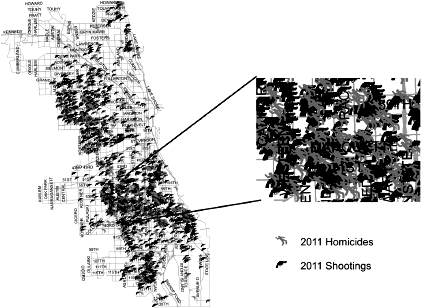
FIGURE II-2 Clustering in violence epidemic, Chicago.
NOTE: This data was provided by and belongs to the Chicago Police Department. Any further use of this data must be approved by the Chicago Police Department. Points of view or opinions contained within this document are those of the author and do not necessarily represent the official position or policies of the Chicago Police Department.
SOURCES: City of Chicago Data Portal.
Spread may be dramatic and rapid, or slow, depending on many factors. Rapid spread, well known for infectious diseases, is seen, for example, in foodborne outbreaks, flu, or severe acute respiratory syndrome (SARS). Rapid spread is seen in violence outbreaks such as gang wars, soccer riots, or the Rwanda genocide. Dramatically rapid recent outbreaks include the London and UK riots and even the “Arab Spring.” Slower spread may be seen in infectious disease outbreaks with longer incubation periods, such as tuberculosis or AIDS—showing spread over decades—analogous to the spread of violence in U.S. cities that showed increases over decades.
Some acute-phase outbreaks are from common or point source transmission, as described above; while longer term outbreaks are more commonly a result of person-to-person transmission. The speed of transmission varies not only according to incubation periods of the infection, but also according to the number of persons susceptible and infected from a given source, as well as other factors. World War I was a violence outbreak with multiple features including multiple “point sources” as new countries “joined in.” The result: 15 to 20 million persons died in less than 4.5 years.
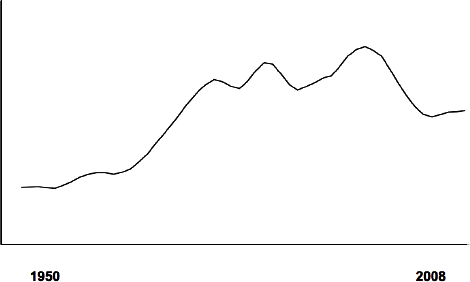
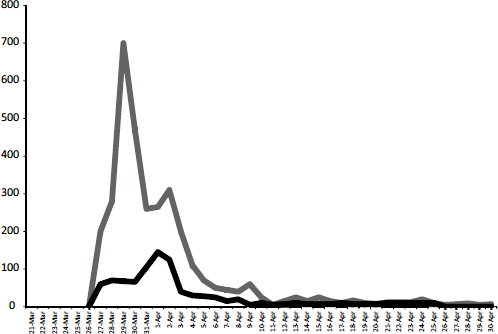
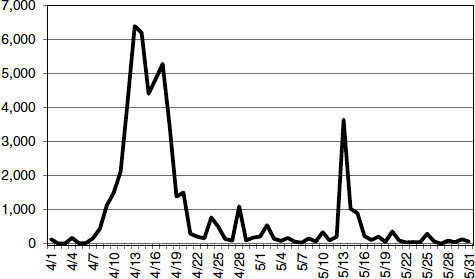
FIGURE II-5 Killings—Kibuya, Rwanda.
SOURCE: Data from Verwimp, 2004, Table 8.
Transmission is the passage of an infection (or other condition) from one organism to another. The classic infectious diseases are transmitted by invisible infectious agents (e.g., viruses or bacteria), while violence is transmitted from human to human by equally invisible and now newly discovered pathways. Essentially transmission means that the disease or condition causes something of itself to be communicated, causing another person (or animal) to take on some of the same characteristics. In infectious disease language it means simply that being exposed to the disease makes it more likely that you will also develop the symptom complex characteristic of the same disease. This phenomenon has been shown for violence through many studies: people who are exposed to violence—either by observing, witnessing, or being subjected to violence themselves—are more likely to become what is called a perpetrator of violence (Widom, 1989; Stith et al., 2000; Reitzel-Jaffe and Wolfe, 2001; Ehrensaft et al., 2003; Guerra et al., 2003; Crooks et al., 2007; Huesmann and Kirwil, 2007; Kokko et al., 2009; Roberts et al., 2010). This is true for multiple forms of violence, as will be summarized and interpreted later in this paper.
Infectious Diseases and Violence in Individuals
Violence not only shows the characteristics of infectious diseases in populations, but also the characteristics and key concepts of an infectious disease in an individual. These characteristics are listed in Table II-1 and shown schematically in Figure II-6. Space does not permit an in-depth review of these concepts, but the reader is referred to infectious disease textbooks (Anderson and May, 1991; Nelson and Williams, 2007). In brief, all of these concepts apply to violence, including susceptibility, exposure, transmission, incubation, and latency periods, as well as possibilities for different clinical courses and clinical outcomes, from minimal infection to death.
TABLE II-1 Concepts in Infectious Diseases in Individuals
Susceptibility (versus immunity, resistance)
Exposure, infectivity, transmission
Incubation, latency
Pathogenesis
Inapparent/subclinical
Carriers
Clinical spectrum (mild, severe, acute, intermittent, chronic)
Cure, relapse
An infectious disease begins with exposure to the infection by a susceptible person. Susceptibility refers to the level (or lack) of resistance to infection for an individual; this could be due to the immune system (or other factors). For the usual infectious diseases, there are several mechanisms of immunity or resistance (e.g., mucosal cell integrity, or prior antibody or cell-mediated responses). Susceptibility and resistance are relative terms that can be overridden by dosage, types of exposure, or other circumstances. Drops in immunity can occur with time or context or due to changes in other biological or environmental circumstances, such as extreme temperatures or immune suppression. Immunity or resistance to exposure to violence may be a result of a family or peer environment in which views, behaviors, and norms against violence are very well established and maintained, and
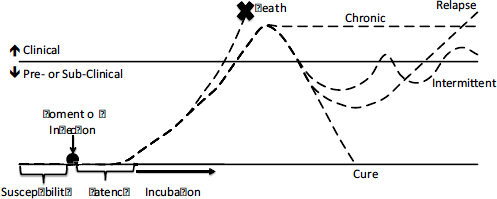
FIGURE II-6 Natural history of an infectious disease.
where alternative responses to exposure to violence are well supported, in particular among close peers (Berman et al., 1996; Osofsky, 1999; Garbino et al., 2002). In infectious disease language this is sometimes referred to as “herd immunity.”
Incubation periods, defined as the time from infection to evidence of clinical disease, is variable in both infectious diseases and violence. In other words, influenza has an incubation period of days, while leprosy has incubation periods of years. The incubation period between HIV infection and AIDS can vary from months to decades. Some infectious diseases have extremely variable periods that can be weeks or years, for example, malaria or tuberculosis. Violence can also have quite varied incubation periods—rapid like cholera, such as for soccer riots, or gang wars, or the genocide in Rwanda (Verwimp, 2004), or longer incubation periods like tuberculosis, where the period between being subjected to child abuse and becoming a perpetrator of community or family violence may be years or decades later (Ehrensaft et al., 2003; Huesmann et al., 2003).
Even prolonged latencies of decades can be seen for both, where conditions for reactivation may be important (e.g., Huesmann et al., 2003). Interestingly both tuberculosis and violence show this ability for a person to be infected very young and then show active disease decades later. For example, a child younger than age 5 exposed to tuberculosis may show active disease in his late teens or early 20s; likewise, an abused child age 5 or less may exhibit violent behavior (community violence or be a child abuser himself) in the late teens, 20s, or later. The intervening years would be called the incubation period for an infectious disease, and could also be called an incubation period for violence.
Technically, whereas incubation period refers to the time to clinical disease, latency refers to time until infectivity to others. This infectivity or contagion can occur from among asymptomatic or presymptomatic persons, including carriers (see below), but also from persons who have not yet completed their incubation period, but who will become symptomatic later. Latency (or infectivity to others) can therefore come before or at the same time as the end of the incubation period; for example someone may spread a diarrheal infection before they are symptomatic. The violence analogy may be that persons may be provoking others to do violence, but do not (or yet) show the characteristic symptoms themselves (definition issues here will need to be worked out, such as whether persons who train others to do violence are showing a clinical syndrome or are just contagious to others).
Persons exposed to violence, as for infectious disease, can develop a wide spectrum of possible clinical courses or outcomes as a result of exposure, including no disease at all, a chronic or relapsing syndrome, disability, or death. Carrier states for infectious diseases include the classic example
of “Typhoid Mary,” a cook at the turn of the 20th century who was a carrier of Salmonella typhi (the bacterium causing typhoid fever), who although having no clinical disease herself was responsible for transmitting typhoid to more than 50 persons, with 3 deaths. The analogous situation for violence disease would be the person who causes others to become violent (e.g., through provocation) without manifesting overt violence disease themselves (all of these outcomes require treatment, in individual care and public health terms, once detected).
For each infectious agent, there are many different clinical syndromes. For example, with plague there are bubonic (lymphatic) and pneumonic (lung) syndromes. For tuberculosis the clinical picture may be that of respiratory disease, bone disease, or even meningitis. These may appear as different disease states, but they are in fact caused by the same microorganism or infection for each of these diseases mentioned.
Likewise there are different violence syndromes that are currently viewed as different “types of violence” to the general public, such as community violence, intimate partner violence, child abuse, and suicide. I suggest that these now be classified as different syndromes of the same disease because they derive from the same cause, but manifest under different circumstances. Differences in susceptibilities, contexts, and ages may play a part, just as polio may have different manifestations in very early ages than in childhood, or how influenza differentially affects older and very young persons.
Transmission: Including Transmission Across Syndromes
Exposure to violence increases the likelihood that the exposed person will commit violence, that is, to become a perpetrator (Kaufman and Zigler, 1987; Widom, 1989; Stith et al., 2000; Reitzel-Jaffe and Wolfe, 2001; Ehrensaft et al., 2003; Guerra et al., 2003; Crooks et al., 2007; Huesmann and Kirwil, 2007; Kokko et al., 2009; Roberts et al., 2010). In some cases the likelihood of being a victim may increase as well (Coid et al., 2001; Heyman and Slep, 2002; Ehrensaft et al., 2003). If we define violence disease as performing acts of physical harm to others or having acts performed against you, we can see through examining these different “categories” of violence that there is a chain of transmission that occurs across syndromes. By comparison, someone febrile and coughing with tuberculosis as well as someone with the disease in their lymph nodes or even brain (meningeal) tuberculosis are all infected with M. tuberculosis. We know that exposure to community violence can lead to perpetrating community violence (DuRant et al., 1994, 1996; Barkin et al., 2001; Kelly, 2010). In its most obvious example, the most likely predictor of a subsequent case of
a shooting in street or gang violence is a previous shooting (Decker, 1996). Likewise, the greatest predictor of subsequent cases of colds, flu, SARS, Legionnaire’s disease, and other infectious diseases is a prior case—and specifically exposure to a prior case—of that infection.
It has been said for a long time that violence begets violence, but it is just as tuberculosis begets tuberculosis, or flu begets flu, that violence begets violence.
We see violence causing violence in its most acute setting in cases of retaliations in gang violence (Decker, 1996) and even in war. For example, this was seen in what was called civil, or intrastate, wars, such as following the 2005 bombing of the Samarra Mosque in Iraq, or even what we call wars between states, or interstate wars, such as World War II. To an epidemiologist these should be known simply as violence outbreaks.
Furthermore, considerable evidence shows that having been a victim of violence increases the risk of someone perpetrating community violence (DuRant et al., 1994, 1996; Barkin et al., 2001; Morris et al., 2002; Mullins et al., 2004; Kelly, 2010). However, it is also now clear that exposure to community violence (outside the family unit) leads to an increased likelihood of family violence, both against intimate partners and abuse of (or violence against) children, as well as an increased risk of violence against self or suicide (Mullins et al., 2004; Devries et al., 2011). Furthermore, exposure to (observing) violence between parents leads to a greater likelihood of being a perpetrator of intimate partner violence (Stith et al., 2000; Reitzel-Jaffe and Wolfe, 2001; Ehrensaft et al., 2003; Naved and Persson, 2005) or child abuse (Kaufman and Zigler, 1987; Heyman and Slep, 2002; Milner et al., 2010), and to being exposed to community violence (Hanson et al., 2006). Being traumatized as a victim of child abuse also leads to community violence (Widon, 1989; Crooks et al., 2007), intimate partner violence (Stith et al., 2000; Ehrensaft et al., 2003), and child abuse (Kaufman and Zigler, 1987; Heyman and Slep, 2002; Milner et al., 2010). Exposure to war and political violence, particularly when accompanied by posttraumatic stress disorder, leads to being a perpetrator of intimate partner violence and community violence (Archer and Gartner, 1976; Landau and Pfeffermann, 1988; Sela-Shayovitz, 2005; Catani et al., 2008; Clark et al., 2010; Landau et al., 2010; Teten et al., 2010; Widome et al., 2011). Exposure to violence in the media leads to the perpetration of violence in the community and at home (Huesmann et al., 2003), as does witnessing violence in video games (Huesmann, 2010). Suicide, a type of violence directed at oneself, can also frequently follow exposure to intimate partner violence, community violence, (Cavanaugh et al., 2011; Devries et al., 2011) or other suicides (Gould, 2001; Gould et al., 2003; Jeong et al., 2012).
Further evidence of this cross-syndrome connection has been shown, for example, in studies by Eric Dubow and Rowell Huesmann in war settings. These studies have shown, in the setting of Israeli Jew, Israeli Arab, or Palestinian Arab, that exposure to or involvement in ethnopolitical violence leads to the performance of violence against spouses and peers, removing any pretense of the primacy of “reasons” for violence (Dubow et al., 2009; Landau et al., 2010). Like the example of different forms of tuberculosis, something common has been transmitted—in this case, a tendency toward violence, likely mediated by underlying biological processes. A violence disease or predisease state is present.
Therefore, something is being transmitted across and between various “types” of violence. Because something common is being transmitted, likely involving common intermediate brain pathways, these different “types” of violence should be called syndromes of the same violence disease.
Definitions—Violence Is a Contagious Disease—and Is Like an Infectious Disease
Disease
Dorland’s Illustrated Medical Dictionary, 32nd Edition (2010), defines a disease as “any deviation or interruption of structure or function of a part, organ, or system of the body, as manifested by characteristic symptoms and signs (causing morbidity and mortality); the etiology, pathology, and prognosis may be known or unknown.” The classic Oxford dictionary defines a disease as a “pathological condition of a part, organ, or system of an organism resulting from various causes, such as infection, genetic defect, or environmental stress, and characterized by an identifiable group of signs or symptoms.”7
I would suggest that the characteristic signs and symptoms of violence are the behavioral actions that cause or attempt to cause physical injury to another person or to one’s self, and that these constitute a disease. I would add that anyone who has suffered physical injury as a result of violence, and in some cases been traumatically threatened, may also be considered infected, or diseased. In other words I am suggesting that both what is called perpetrator and what is called victim in the current literature be considered as violence infected or having the violence disease. I also suggest that, until we develop a clear marker for infection, we consider most persons that are exposed as infected, and clinical disease as the presence of symptoms. In
_______________
7 A second definition, referring to a condition of society, reads “a condition or tendency, as of society, regarded as abnormal and harmful.”
many infectious diseases, there are many more people infected than have clinical disease.
Contagious and Infectious
Dorland’s medical dictionary defines contagious as “capable of being transmitted from one individual to another; communicable.” This has been shown in the preceding section of this paper, for many clinical syndromes of violence. Violence is a contagious disease.
For infectious disease, some definitions or medical experts may prefer or choose to require a free-living microorganism, or physical agent, and for them violence may not be considered an infectious disease. However, not all microorganisms or microscopically transmissible definable entities are free living, for example, viruses or prions. Some medical textbooks refer to infectious as having a presence of a microorganism, but not always (Dorland, 2010; Stedman, 2012). The characteristic of infectivity itself is frequently synonymous with contagious or communicable, and this sometimes differential in medical textbooks may be simply conforming to the need for practitioners to be able to use antimicrobial agents or conventional medical approaches. However, as a practitioner, I am aware of the existence of many infectious diseases in which we do not have effective antimicrobial agents nor immunization (e.g., Ebola, Marburg, many viral diseases, antibiotic-resistant diseases, and for many years, AIDS), yet we still need to have effective approaches.
Using the term contagious remains technically sound, while avoiding possible controversies around the need for a physical agent that the term infectious might require for some.
Means of Transmission
Infectious diseases have many routes and means of transmission, from respiratory to fecal-oral to bloodborne to vectorborne. A full listing is available in most infectious disease textbooks. Pathogens can enter via the respiratory tract, gut, skin, or other routes to then cause dysfunction or dysregulation of one or more organs.
In the case of violence, we are looking at a process clearly mediated by the brain, with transmission appearing to come from at least two possible pathways: visual observation (o) and direct victimization (v). A third mechanism may be considered intentional training (t), for example by the military. Following transmission there are mediating factors that help predict the likelihood of a “take,” and intervening or mediating mechanisms facilitate whether exposure or infection is likely to result in disease, which in this case is a violent act.
Mechanisms of Contagion or Infectivity, and Pathogenesis of Disease Formation
Biological mechanisms underlie the acquisition of infectious and other diseases. These are not just mechanisms of destruction or tissue damage, but frequently changes in organ function such as regulation, or dysregulation (e.g., immune responses in the lung to tuberculosis, flu or cold viruses).
For infectious processes, biological mechanisms must be elucidated for acquisition, and pathogenesis and mediators of progression defined. With respect to violence, where the behavior is being transmitted, Albert Bandura showed that social learning or what we could call imitating or modeling, is a principal mechanism for the acquisition of behaviors (Bandura and Huston, 1961; Bandura et al., 1961; Bandura, 1977, 1986). Several variables cause behaviors to more likely be copied, such as proximity to the learner and dose, effectively the amount, or intensity of exposure. The biological mechanisms here are not well known, but may involve cortical mirror-type of circuits, which are likely more complicated than mirror neurons alone (Iacoboni et al., 2005; Uddin et al., 2007). Besides acquiring simple behaviors, there is evidence for the acquisition of “scripts” or more likely responses to common events (Huesmann and Eron, 1984; Huesmann and Kirwil, 2007). Such behaviors are then maintained in large part by how the brain maintains habits, and by the largely invisible force of social pressure or expectations of peers. It may be that rewards for social approval, or other cues to belonging to social networks (e.g., positive reputation, consensus) may be mediated by dopamine-like reward pathways (Baumeister and Leary, 1995; Izuma et al., 2008; Losin et al., 2012). Perhaps equally importantly, it appears that not belonging (or social isolation) engages the same brain regions (shows up on brain scans) with some of the same patterns as physical pain (Panksepp, 1998; Eisenberger and Lieberman, 2004, 2005; Macdonald and Leary, 2005; Eisenberger, 2011, 2012), and is therefore avoided at great cost. Additional research shows that trauma (an outcome of exposure to violence) causes dysregulation in the limbic system and prefrontal cortex leading to hypervigilance (Margolin and Gordis, 2000; Perry, 2001; Fonzo et al., 2010), and hostile attribution (Joshi and O’Donnell, 2003) to perceived insults, resulting in more rapid and less regulated responses to real or perceived insults. These regions are affected by exposure to violence (Wang et al., 2009; Hummer et al., 2010). These mechanisms appear to be some of those that may underlie the infectivity of violence itself, as well as those underlying the capabilities for escalation, and rapid recruitment of individuals and further events.
In other words, both the infectious nature of the violence disease and the intervening brain processes causing the violence disease process can, at least in part, be defined, or at least speculated on, with refinements and
new research certain to continue. These pathways could be considered, for example, parallel to how infection by the cholera bacterium causes the severe diarrhea characteristic of cholera disease, not by destroying the intestines, but by causing a dysregulation of salt and water transport in the intestine (with V. cholera, the dysregulation is manifested by a blocking of the Na-K pump that absorbs water in the small intestine, thereby causing diarrhea and likewise the perpetuation and additional infectivity to others of the clinical syndrome). Similarly, brain processes affected by observation and trauma cause both alterations and dysregulation of specific mechanisms and pathways in the brain noted above.
It is important to add that not all people infected with infectious diseases (or violence) will show disease. In fact for many infectious diseases, a minority of persons develop clinical disease following infection. For example, approximately 2 billion people in the world are currently infected with tuberculosis, but only approximately 9 million have cases of the clinical disease, with 1.4 million deaths per year (WHO, 2012). Many factors influence the likelihood of disease, and both infectious diseases and violence are more likely to “take” and progress with larger doses, particular contexts, less immunity, certain types of exposures, and absent or ineffective treatment.
Treating Violence as an Infectious Epidemic Is Effective
Three main strategies are used in reversing infectious epidemic processes. These are (1) detecting and interrupting ongoing and potentially new infectious events; (2) determining who are most likely to cause further infectious events from the infected population and then reducing their likelihood of developing disease and/or subsequently transmitting; and (3) changing the underlying social and behavioral norms, or environmental conditions, that directly relate to the spread of the infection (Nelson and Williams, 2007; Heymann, 2008).
The Cure Violence (previously known as CeaseFire Health) Method uses these same principles that are used to reverse infectious epidemics to prevent and reverse epidemic violence. The Cure Violence Method is therefore, both a science and community/street-based intervention. The method was designed in the late 1990s in Chicago, piloted in 2000 in West Garfield Park, replicated in multiple cities throughout the United States and other countries, independently evaluated, and is now considered a best practice by several national and international organizations and publications (DOJ, 2009; The Economist, 2009; Skogan et al., 2009; U.S. Conference of Mayors, 2012; Webster et al., 2012).
The Cure Violence Method begins by analyzing the clusters involved and transmission dynamics, and uses several new categories of disease
control workers—including violence interrupters, outreach behavior change agents, and community coordinators—to interrupt transmission (or the contagion) to stop the spread of the violence disease and to change underlying norms. Workers are trained as disease control workers, similar to tuberculosis or HIV/AIDS workers or those looking for first cases of bird flu or SARS (Slutkin et al., 2006; Ransford, in press).
Tuberculosis workers help find cases and ensure that persons are sufficiently rendered noninfectious, albeit in the case of tuberculosis it is through the use of antimicrobial agents. However, tuberculosis outreach workers also require the use of persuasion (e.g., for taking medications) to ensure that effective change is occurring. Cure Violence disease control workers have training in modern methods of persuasion, behavior change, and changing community norms—all essential for limiting spread of outbreaks of violence. The principles underpinning the approach come from modern knowledge of social psychology and brain research, just as the principles of controlling other infectious disease flow from understanding their underlying mechanisms and patterns of flow.
Some of these principles include using persons from the same “in-group,” which causes less defiance and more trust, credibility, and access. A number of cognitive processes are sensitive to group membership and for assessing “us” or “them” (Mathur et al., 2010; Bruneau et al., 2012), and determining whether someone is working in your own interest or not. The modern practice of behavior change requires the use of credible messengers, as well as ensuring that the new behaviors are acceptable and feel right socially, including being able to overcome social, physical, and other barriers (for example, the pressure that other groups are doing it). Messages need to be constructed to include new information about the behavior and new skills practiced along with developing opportunities for positive peer reactions and avoiding negative peer reactions. Violence interrupters’ training also includes new and newly anticipated responses so that new brain circuits can be used in the short and longer term, as well as new social pressure and direction for “belonging.”
Changing norms is done most effectively by putting some of these practices in play to scale as well as questioning existing norms and proscribing new norms at population levels. As thoughts, behavioral scripts, and norms are transmissible, new scripts and norms are developed and a new set of behaviors becomes more normal. Interruption is essential; however, brain processes, including preexisting emotional dysregulation as well as continued peer pressures to belong, remain problems if unattended to or untreated.
Changing norms is done most effectively by putting some of these new practices into play to scale—by developing a cascading diffusion through social networks, gradually accumulating the new responses. This is
accelerated by systematically questioning existing norms and proscribing new norms at population levels. As thoughts, behavioral scripts, and norms are transmissible, new scripts and norms are developed and a new set of behaviors becomes more normal. Interruption remains essential; as brain processes, including preexisting emotional dysregulation difficulties—as well as continued peer pressures to belong—remain problems if unattended to or untreated.
These methods have resulted in reductions in shootings and killings of 16 to 28 percent directly attributed to the strategy by time series analysis (see Table II-2); from 41 to 73 percent overall (Skogan et al., 2009); and in its first outside replication, in Baltimore, reduced shootings and killings by 34 to 56 percent (Webster et al., 2012). The initial implementation has been replicated in more than 20 communities in Baltimore, Chicago, New York, and several other cities with large reductions in violence found by independently performed studies commissioned by the U.S. Department of Justice, the Centers for Disease Control and Prevention, and Johns Hopkins University (Skogan et al., 2009; Webster et al., 2012).
This new approach is now being used by more than a dozen U.S. cities and a growing number of countries, including in Kenya to prevent or reduce election violence, South Africa to reduce and prevent community violence, and Iraq to reduce and prevent interpersonal and intertribal violence.
The idea of violence as a contagious or infectious disease is rapidly catching hold. In 2008, the New York Times Sunday Magazine cover story by Alex Kotlowitz about the Cure Violence epidemic control method (formerly referred to as CeaseFire) ran with the title “Is Urban Violence a
TABLE II-2 National Institute of Justice External Evaluation of CeaseFire Chicago: Three Approaches to Impact Analysis
| Change in Violence Due to Program | |||
| Shootings Down | Hot Spots Coolera | Retaliation Homicides Down | |
| Auburn–Gresham | –16%/–21% | –15% | –100% |
| East Garfield Park | Not evaluated | –100% | |
| Englewood | –100% | ||
| Logan Square | –21% | –100% | |
| Rogers Park | –40% | No change | |
| Southwest | –20%/–23% | –100% | |
| West Garfield Park | –22%/–28% | –24% | –46% |
| West Humboldt Park | –17% | –50% | |
a Hot spots are locations where shootings are particularly concentrated. Cooling indicates a reduction in this concentration after implementation.
Virus?” The 2009 Economist special “World in 2009 Edition” described the epidemic control approach and predicted that this would be “the approach that would come to prominence.” The recent award-winning documentary The Interrupters also highlighted the disease control approach.
The science, and the public understanding that follows this science, are bringing us into a new era. This new era is an era of discovery—but more importantly of transition. We can now leave the days of a vocabulary of “bad people” and “enemies” and apply a scientific understanding and a scientific approach to this problem. Violence has all of the historical, population, and individual characteristics of an infectious disease. It has routes of transmission, incubation periods, and different clinical syndromes and outcomes. There are definable biological processes underlying the pathogenesis. In addition, treatment as an infectious disease is effective. All of this requires more refinement and research. We are still performing research and refining our approach with tuberculosis, cholera, and malaria as well, but at least we have taken these problems out of the moral, medieval, and superstitious realms of evil and dungeons.
The advantages to this new and scientific understanding and approach to violence are countless. We can more proactively avoid exposure and develop new ways of responding to exposure. We can treat and develop better methods of treating infected persons and communities. We can further strengthen the Cure Violence and other early epidemic control approaches referred to here. Most of all, we can now move away from counterproductive practices into the modern era.
Violence is a contagious disease. This is good news as this knowledge offers new strategies for control. There are massive implications for how to better treat urban violence, as well as for international conflicts. As we have done before—for plague, typhus, leprosy, and so many other diseases—we can now apply science-based strategies and, as we did for the great infectious diseases, similarly move violence into the past.
EMOTIONAL AND EVOLUTIONARY ASPECTS OF CONTAGIOUS VIOLENCE: OVERLAPPING FACTORS IN THE GENESIS OF DIVERSE TYPES OF NON-SANCTIONED HUMAN AGGRESSION8
Jeffrey Victoroff, M.D.
University of Southern California Keck School of Medicine
The Evolution and Mechanism of Aggression
Animals employ aggression in many ways to serve many intermediate goals, such as acquisition of nutrients, defense against predators, social control, and sexual success. However, the reason that aggressive behavior occurs throughout the kingdom Animalia is simply that natural selection favors the genetic replication of individuals who are more likely to survive and reproduce, and aggression facilitates inclusive fitness in multiple ways.
Some aggression is collective. For example, social insects such as ants and bees act aggressive collectively to advance and protect their fitness interests (Moffett, 2011). Social primates such as chimpanzees or spider monkeys coordinate their aggression in ways that enhance individual and (indirectly) group benefit (Mitani et al., 2010). Other social primates such as humans routinely engage in collective aggression. Examples include cooperative hunting, intergroup raiding and defense, police-like social control, and later in history, the emergence of specialization of subgroups who participate more than other community members in warfare. This type of collective aggression seems to have evolved, at least in part, because reciprocal altruism requires and rewards a costly signal demonstrating risk taking on behalf of the in-group (Barclay and Willer, 2007; Miller, 2007). Evidence shows that the very existence of human civilization derives from the innovation of such pro-social collective aggression (Bowles, 2009). Soldiers join armies and wage wars to demonstrate their commitment to reciprocal altruism. Genetic variants and cultural trends that tended to perpetuate or enhance such aggression have been favored, perhaps for millions of years of hominine evolution. It is possible, but remains to be shown that the success of Cro Magnons over Neanderthals was strongly related to this early modern human trait.
The human brain embodies aggressive potential. Multiple anatomical regions play complex interactive roles in mediating individual or collective aggression, including (1) brainstem (which help to monitor the environment, mediate arousal, and regulate the many neurotransmitters and neurohumoral agents that either increase or permit aggression); (2) the
_______________
8 The author wishes to gratefully acknowledge Janice Adelman, Ph.D., for her valuable contribution to the analysis of the data on Palestinian terror attacks and their support.
hypothalamus (which helps regulate multiple steroid and peptide hormones relevant to the mediation and moderation of aggression, such as serotonin, dopamine, cortisol, and the nonapeptides—arginine vasopressin and oxytocin); (3) the medial temporal lobar allocortex, especially the amygdala, which plays an important role in both detecting and learning threat; and (4) the cingulate gyrus (which mediates drive or motivation, as well as integrating cortical/liminal activity with subcortical/subliminal activity); and several regions of the neocortex (e.g., the dorsolateral prefrontal cortex, which mediates conscious or semiconscious decision making, and the ventromedial prefrontal cortex, which plays multiple roles, including assessment of social circumstances and inhibition of impulsivity) (Adams, 2006; Victoroff et al., 2011; Comai et al., 2012). Differences occur in the level of aggressiveness of individuals who are not accounted for by focal brain anatomy, but correlate instead with a variety of genetic polymorphisms that appear to underlie brain function, or with physiological variations such as hormone levels, central electrophysiology, or autonomic nervous system function.
Therefore, an innate capacity for and tendency toward aggressive behavior, embodied in the brain, represents an important and valuable outcome of the coevolution of genes and cultures.
For better or for worse—and perhaps contrary to the conventions of intuition—the same evolutionary, cultural, and neurobiological factors endow humans with a capacity for antisocial aggression, whether perpetrated by individuals or groups. More aggressive individuals, even psychopathic individuals, are merely expressing one perfectly adaptive life history option for maximizing fitness: the live-fast-die-young strategy (Wolf et al., 2007; Victoroff et al., 2011). Examples of this adaptive strategy include the commission of unsanctioned murder, rape, and participation in violent juvenile gang activity, and participation in violent adult organized criminal activity.
Individual and collective aggression varies. Some individuals and some groups indisputably exhibit relatively higher or lower frequencies and severities of individual (e.g., homicide) or collective (e.g., gang-related homicide) antisocial aggression. At least eight overarching factors contribute to the variation in observed aggressive behavior over time and space:
1. Individual genetic and epigenetic variation, for example, proaggressive polymorphisms such as the short allelic variant of the gene for monoaminoxidase, the A1 allele of the dopamine receptor D2 gene, the short variation of a repetitive sequence in the transcriptional control region of the serotonin (5-HT) transporter gene (SCL6A4, 5-HTT), or shorter repeat length of androgen receptor gene CAG.
2. Individual congenital/infancy factors, such as pre- or perinatal injury, fetal exposure to neurotoxins, birth complications, infantile illness, or larger body size at birth.
3. Individual variations in biological endophenotypes such as atypical neurotransmitter levels, transmission dynamics, cytokine levels, neuroendocrine traits and states associated with both steroid and peptide hormone levels, atypical central electrophysiology, atypical amygdalar responsiveness, atypical autonomic nervous system function, or a recently hypothesized reward deficiency syndrome linked to atypical monoamine function.
4. Individual postnatal environmental factors, such maternal deprivation, child abuse or harsh punishment, neurotoxicity (e.g., lead paint exposure), anabolic steroid exposure, prescribed agents, or substance abuse (note that a distinction is made between the comorbidity of substance abuse and aggression, described below, and the occurrence of aggression-promoting neurotoxicity due to substance abuse), stressful events or losses (with or without posttraumatic stress disorder or PTSD), exposure to media incitement or modeling, head trauma, or, rarely, infectious disease.
5. Occurrence of significant Axis I or Axis II mental disorders, including conduct disorder, schizophrenia, autism, antisocial personality disorders, borderline personality disorder, mood disorders, PTSD, dissociative disorders, substance abuse, posttraumatic encephalopathy, and combinations of such disorders, especially comorbid thought disorder and substance abuse.
6. Variation in personality traits, including callous-unemotional traits, impulsivity, antisocial traits, sensation seeking or risk taking, seeking or defense of dominance, fearlessness, or low frustration tolerance.
7. Variations in cognitive style or intellectual capacity, including the occurrence of learning disabilities or attention deficit disorders.
8. Group environmental factors, such as cultural tolerance or support of violent problem solving or revenge killings, socioeconomic factors reducing the availability of alternate life history strategies such as marriage and/or gainful employment, social learning of aggression, and social network factors exposing individuals to other innovators from whom they learn the efficacy of aggression. Such group factors inspire the coalescence of like-minded persons into groups sharing an identity. This dynamic transcends ideology and drives collective aggression of multiple types. For example, as Crenshaw opined (1986, p. 395):
Terrorist organizations become countercultures, with their own values and norms, into which new groups are indoctrinated. . . . They are in this respect similar to youth gangs or nonpolitical cults and sects.
Indeed, evidence suggests that while individuals with some genomes may be inherently at lower or higher risk of phenotypic aggression, and that certain environmental exposures increase the risk of adopting a violent lifestyle, it is most likely that aggressiveness is determined by bidirectional interactions between genes, epigenetic variations, endophenotypes, and environmental exposures (Veenema, 2009; Cohen, 2010; Nordstrom et al., 2011). For example, a child born with a neurobiologically based reward-deficiency syndrome may both be attracted to risk-taking behaviors and to substances of abuse. Seeking rewarding substances will not only plunge that child into a problematic social milieu, but may produce brain damage that will exacerbate his or her antisocial traits. A child who experiences early stress may develop the endophenotype of altered neuropeptide function, causing a lowered threshold for reactive aggression (Fries et al., 2005). Similarly, a child born with a suboptimal central processing system for emotional regulation may be more vulnerable to early victimization (Rudolph et al., 2011)—a known precursor of gang participation.
In essence, variations in cognitive style and emotional reactivity based on evolutionary diversity of adaptive life history strategies lead to variations in expression of both individual and, perhaps, collective aggression.
The Useful Metaphor of Contagion
Curiously, however, despite decades of research, variation in the rate of individual and collective aggression cannot be completely accounted for by factors that intuitively would explain the waxing and waning in violence. Neither economic markers, group humiliation nor dispossession, availability of weapons, exposure to psychotropic substances, nor any other plausible factors have been shown to account for all of the up and down swings in the rate of communal violence (Gilligan, 1997; Zimring and Hawkins, 1997; Fagan et al., 1998; Rutter et al., 1998).
This observation has perhaps been the inspiration for a number of novel theories about the ultimate genesis of criminal violence, including the hypothesis that violence is contagious. That is, entirely apart from changes in age distribution, population frequency of proaggressive genetic polymorphisms, rates of child abuse, rates of poverty, or political oppression, scholars have noted what appears to be a cyclical pattern of the occurrence of community violence and have proposed that the spreads and contractions in the rate of such violence may represent a phenomenon that is strongly analogous to the spreads and contractions in the occurrence of infectious diseases.
An abundant literature has emerged over the past 60 years examining the plausibility that the concept of contagion usefully accounts for trends in a wide variety of social phenomenon. Contagious diffusion—or innovation
followed by imitation—has been proposed as an important cause of biobehavioral trends as diverse as medical innovation, sexual behaviors, team behavior, mood, entry into first marriage, smoking, teenage suicide, and even everyday decision making.
Many forms of political aggression have also been attributed to contagion, including political unrest, political coups, civil wars, riots, ethnoreligious conflict, and terrorism (Bandura, 1973; Huff and Lutz, 1974; Li and Thompson, 1975; Bohstedt, 1994; Fox, 2004; Sedgwick, 2007; Nacos, 2009; Kathman, 2011). More specifically with regard to the waxing and waning of community violence, multiple authors have offered theoretical and empirical reasons to believe that such violence spreads in a contagious manner (Fagan and Davies, 2004; Patten and Arboleda-Florez, 2004; Fagan et al., 2007; Papachristos, 2009).
According to this hypothesis, individuals innovatively adapt their behavior to the goals and circumstances. Some will be innovators of violence. As other people observe the innovators, especially if the innovators are seen to achieve important life goals, imitation will occur (e.g., Fagan et al., 2007). Bandura (1973, p. 215) described the dynamics of this clearly:
Social contagion of new styles and tactics of aggression conforms to a pattern that characterizes the transitory changes of most other types of collective activities: New behavior is initiated by a salient example; it spreads rapidly in a contagious fashion; after it has been widely adopted, it is discarded.
(If those societies ever discard interpersonal and intergroup violence as a behavioral tactic.)
Authorities in quantitative sociology have proposed that, in such cases of contagious diffusion of behavior, independent of external factors one would expect phenomena such as the level of community violence to vary in a cyclical pattern that will roughly approximate a sigmoid curve. Yet the inevitability of historic or demographic factors playing a role has led to the prediction that that curve would be asymmetric. Indeed, Fagan and colleagues (2007) published evidence of just such a curve describing the otherwise inexplicable waxing and waning of handgun violence in New York City between 1968 and 2000 (see Figure II-7).
Figure II-7 from Fagan et al. (2007) may be compared with our preliminary analysis of data from the Israeli/Palestinian conflict. With Janice Adelman, I recently analyzed both the occurrence of terrorist attacks and the level of Palestinian community support expressed for such attacks between January 1996 and January 2011. Our initial hypothesis was that, in accordance with Crenshaw’s admonition (1986, 1995) that the behavior of terror groups is often (but not always) linked to social approval and communal support for that behavior, and her comment that this is particularly the case
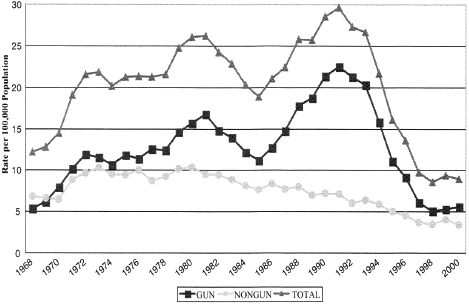
FIGURE II-7 Gun and nongun homicide rates per 100,000 persons, 1968-2000, New York City.
SOURCE: Fagan et al., 2007; used by permission.
with regard to Hamas (Crenshaw, 2000), one would observe a time-lagged correlation between measures of communal support and measures of militant action, with attacks increasing as support for those attacks increased. We also speculated that major historical events, such as Ariel Sharon’s stepping onto the Temple Mount and the construction of the security wall, would perturb the relationship between communal support and attacks. The data were more complex. While some upswings or downswings in attacks seemed explicable by reference to communal support or major historical/policy changes, an asymmetric quasi-sigmoid curve emerged that could not be accounted for entirely by these factors (see Figure II-8).
Comparing Figures II-7 and II-8, and acknowledging the major differences in the types of aggression and the methodology of data acquisition, one is at least tempted to consider the possibility that (a) contagion-like dissemination of aggressive behaviors may help to explain otherwise mysterious fluctuations, and (b) the early prediction of asymmetric quasi-sigmoid trajectories in the occurrence of such phenomena seems defensible.
Obviously, if there exists an asymmetric sigmoidal trend in the occurrence of communal violence of widely disparate types, that pattern of variation-with-time has a cause. For both theoretical reasons and because of our Palestinian data, I propose a hybrid model of the contagion hypothesis.
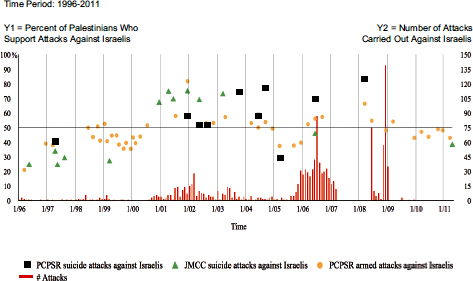
FIGURE II-8 Plot of support for attacks (Y1) and number of perpetrated attacks (Y2) over time.
SOURCE: Victoroff and Adelman, 2012.
Violence waxes and wanes in part because of innovation and imitation. Yet it is vital to acknowledge the multiplicity of other factors that may contribute to or cause major changes in community rates of individual or collective violence. Innumerable such factors have been proposed or identified—from the population density of proaggressive genetic polymorphisms, to the occurrence of harsh discipline or parental abuse, to the rate of childhood heavy metal neurotoxicity, to the cohesiveness of the community, and to the structural stresses of deprivation and income inequality.
The neurobiological mechanisms by which these factors influence the central nervous systems of participants in violence are slowly being elucidated. At this point, it is premature to propose a weighting of factors or tight localization of systems, circuits, neurons, and neurohumors contributing to the causal pathway. Yet one conclusion has become inescapable: People do not simply choose to become violent by the rational exercise of free will.
That is, according to the discipline of behavioral economics, all decisions are rational. Humans are assumed to have evolved rational decision-making nervous systems, and indeed, the primate brain appears to contain systems that internally represent values, calculate risks and benefits, and make useful behavioral choices.
But classical microeconomic algorithms fail to provide accurate predictions of real human decision making for several reasons. First, contrary to
a basic assumption of rational choice theory, empirical evidence shows that humans are not good intuitive calculators of risk and benefit. Second, there is considerable individual variation in human decision making, mediated not only by biases such as risk aversion, ambiguity aversion, and choice blindness, but by variations in numeracy—all neural operations potentially subject to genetic and epigenetic variation. Both intra- and interindividual variation occurs in emotional biasing of decisions. Emotional framing, for instance, makes brains process moral options with different tissue and outcomes. Innate and acquired variation may alter decision calculus. Fourth, recent research has identified systematic cultural-bound differences in punishment decisions. These recent findings may be especially relevant to the analysis of Islamist extremist behaviors; compared with most Westerners, those in some Middle Eastern societies appear more willing to engage in costly and irrational “antisocial punishment,” which may take the form of vengeance even when such actions are self-defeating.
All these real-world violations of economic prediction are sometimes excused as so-called bounded rationality—the claim that hominids simply lack the calculating capacity for reliable self-interested choice (Simon, 1955). It is possible that one major conceptual error underlying the misguided enthusiasm for rational choice models is the untenable assumption that human brains are serial processors (Simon, 1967). Although some authorities cling to the framework of quantitative predictive validity by calling their new calculus “neuroeconomics,” far too many deviations from rational economic predictions have been observed to sustain a hypothesis that economic balancing of expected risks and benefits plays a major role in the occurrence of most human actions. Newer models of decision making at least acknowledge an element of random or stochastic choice that only slowly drifts toward reward maximization (Soltani et al., 2006). Revising the rational choice/econometric theories of the past, a new generation of scholars is exploring the interaction between emotions and decision making.
The deep philosophical issue that lurks beneath these investigations is the popular assumption of free will. That issue cannot be addressed adequately in this brief essay. Suffice it to say that, from the biologist’s perspective, the evidence for human free will is just as robust as the evidence for precognition. The illusion of free will is perhaps best regarded as a curious adaptation, perhaps confined to species with cortices, the value of which remains to be elucidated.
Still, rather than considering the overwhelming evidence of rationality violations as debunking a myth of rational man, I propose that such discoveries open the door to refinements that will lead to a better, wiser, biologically informed psychoneuroeconomics. Human actions on this earth are determined by actions in brains. Actions in brains are determined by physical laws, the investigation of which remains in its early infancy. That
incipient science is beginning to attend far more to the importance of emotions. Emotions are central to determining who among us ultimately acts violently and who deals with life’s challenges without resort to violence.
Emotions are subjective feelings in response to either internal or external stimuli. They derive both from innate, inborn, and probably genitivally and epigenetically determined personality traits and from many fetal, childhood, and later developmental and environmental influences. When one of three boys in a family joins a gang and the others do not, it is insufficient to point to political structural factors, economic factors, or even parenting as the trigger. The gang joiner is different. He or she probably exhibits different types and degrees of emotional and physiological responsiveness to loss, to perceived threat, to perceived injustice, to out-group exposure, and to the rewards of peer acceptance. I predict that empirical research will identify both emotional and biological traits that distinguish gang participants from the nonparticipant siblings.
Discoveries in this domain potentially have implications for the prevention of violence. If, for example, early childhood depression or traumatic brain injury were shown to account for a significant amount of the variance in gang participation, the community could redouble its efforts to provide comprehensive maternal health care, and to protect young brains from injury (e.g., by evidence-based revisions in return to play guidelines in youth sports).
Cause(s) of Violence
Based on the foregoing discussion, it becomes clear why any unidisciplinary approach to the terrible dilemma of nonsanctioned human violence will founder. The metaphor of contagion (which shares a great deal of its empirical authority with findings from studies of network theory), may help to account for some aspects of trends in violence over time. Yet, rather than searching for “the” cause of a violent event, it may be useful to consider the interaction of multiple causes.
The epidemiology of primary injury prevention also offers a potentially useful way to conceptualize this kind of causality: the Haddon Matrix. Haddon matrixes were originally devised by physician William Haddon as a new way to analyze the causes of injuries and the multiple potential avenues for prevention. This framework alerts policy makers that factors influencing injuries—including violent injuries—are subject to the influence of three overlapping tiers of potential intervention: individual behavioral, environmental, and public policy. Since Haddon’s introduction of this conceptual framework, it has been applied to diverse forms of injury, including
• crocodile attacks,
• burns,
• amusement park accidents,
• chemical warfare terrorism,
• the 2005 London bombings,
• workplace violence, and
• youth gun violence.
For purposes of illustration, I have prepared two preliminary Haddon matrixes addressing the largely overlapping phenomena of violent youth gangs and violent political extremists (Tables II-3 and II-4). There appear to be important shared characteristics of these superficially different social problems. Both involve in-groups of persons who share an identity that is in conflict with one or more out-groups. Another similarity is that individuals who elect to participate are, in essence, electing a live-fast-die-young life history strategy (Victoroff et al., 2011). Another may be that both gang members and extremists are preoccupied with collective blame of others. It seems plausible that both urban youth and extremists may be propelled, to some degree, by audiovisual media depictions or incitement of violence (Tsfati, 2002; Atran and Stern, 2005; Gunter, 2008; Wright, 2008; Anderson et al., 2010). Moreover, it was recently reported that, just as elevated testosterone (T) levels are associated with antisocial behavior among adolescent boys, evidence suggests that elevated T may be associated with support for extremist violence among adolescent boys (Victoroff et al., 2011).
While it is tempting to propose a distinction—that youth gangs are not ideologically driven while extremist groups are—this overstates the difference. Although urban youth gangs may not base their violent plans on a coherent, articulated religious or political ideology, they clearly base their behaviors, in part, on a shared weltanschauung in which the local world is viewed as a hostile, hopeless, and insecure place in which conventional values are irrelevant, injustice is rampant, social Darwinism determines success, and in-group age-related gang affiliation offers identity, fictive kinship, and physical protection. Thus, gangsters evading the police in a crack house in Detroit or extremists evading drones in the souks of North Waziristan perhaps share the worldview of a beleaguered oppositional counterculture.
This is not by any means to say that urban youth gangs and violent extremist groups are identically structured or motivated. In conversations with members of Los Angeles gangs and with members of Hamas, both similarities and differences emerge. One important difference between these types of groups is that gang violence is often reactive—an immediate response to a confrontation with a rival, often unplanned, while terrorist
TABLE II-3 Haddon Matrix for Violent Urban Youth Gang Membership: Known or Suspected Risk Factors for the Occurrence and Dissemination of Gang-Related Violence
| Personal Factors | Vector or Agent Factors | Physical Environmental Factors | Social Environmental Factors | Policy Factors | |
| Pre-event |
• Gene variations impacting impulsivity, aggression, antisociality • Acquired differences in impulsivity, aggression, antisociality • Personal psychodynamics • Mood disorder • Proaggressive endophenotype • History of traumatic brain injury • ADHD • Autism spectrum disorder • Atypical steroid or peptide hormone metabolism • Other neuroatypicality • Perception of major loss • History of victimization • Frustration of aspirations |
• Fetal environment • Environmental factors causing epigenetic variation • Childhood biological influences (e.g., lead exposure, malnutrition) • History of actual major loss • History of actual victimization • Media dissemination of violence and violent role models |
• Dilapidated neighborhoods • Insufficient police presence • High ambient temperature and humidity • High housing density • Access to a motor vehicle • Anonymity afforded by large streets/freeways • Access to a weapon • Awareness of ready escape routes and hideouts |
• Insufficient parental supervision • No successful noncriminal male role model • Childhood (especially familial) negative psychodynamic influences • Negative older sibling or peer influence • Social network influences • Widespread social disaffection • Social learning of violence • Lower socioeconomic status • Relative deprivation • Income inequity • Poor job prospects • Poor marriage prospects |
• Inadequate funding for prenatal care • Inadequate funding for preschool education • Inadequate funding for day care • Inadequate funding for schools • Insufficient focus of schools on preparation for next-generation jobs • Inadequate funding for after-school programs • Inadequate funding for violence intervention programs • Inadequate funding for violence intervention research • National and local fiscal policy facilitating unemployment • Welfare and tax policies facilitating single motherhood • Right wing facilitation of nearly universal access to guns |
| Personal Factors | Vector or Agent Factors | Physical Environmental Factors | Social Environmental Factors | Policy Factors | |
|
• Attribution of that frustration to others • Need for identity consolidation • Perceived prejudice • Perceived injustice • Strong personal gang identity • Perceived need to defend gang status (e.g., to earn reputation or to escape from levaa) • Perceived financial need • Alienation from alternative identity groups (family, church, school, team) • Emotional state in the minutes prior to a confrontation |
• Weak culture of scholastic achievement • Historical reasons for distrust of police and other authorities • Social prejudice • Social ignorance regarding the supposed deterrent efficacy of harsh sentencing • Reasons for the perpetrator to doubt the justice system • Strong gang in-group identity • Perception of gang and/or neighborhood collective jeopardy • Availability of a scapegoat |
• Government facilitation of corporate arms sales • Lax oversight of media representations of violence • Inadequate oversight and correction of police and jail brutality • Political climate of disparaging minorities • Dysfunctional immigration policies • Political pressure for creating the appearance of being tough on crime • Mismatch between justice and sentencing guidelines • State emphasis on incarceration over rehabilitation • Vested political interests of law enforcement and prison guards • Political corruption supporting a movement to for-profit prisons |
|||
aLeva refers to being given the silent treatment by other gang members due to period infractions of the code of conduct.
TABLE II-4 Haddon Matrix for Violent Extremist Groups: Known or Suspected Risk Factors for the Occurrence and Dissemination of Political Violence
| Personal Factors | Vector or Agent Factors | Physical Environmental Factors | Social Environmental Factors | Policy Factors | |
| Pre-event |
• Gene variations impacting in-group affiliation/out-group derogation, perceived injustice, moral certainty, aggression • Acquired variations in in-group affiliation/out-group derogation, perceived injustice, moral certainty, aggression • Pro-aggressive endophenotype • Personal psychodynamics • Depression • Frustration of aspirations • Attribution of that frustration to political out-group • Atypical steroid or peptide hormone metabolism |
• Fetal environment • Environmental factors causing epigenetic variation • Childhood biological influences • History of actual major life losses • History of actual victimization by outgroup • Media dissemination/glorification of extremist ideology and actions |
• Inadequate physical defenses • Insufficient police/military presence • Ability to travel • Anonymity afforded by large cities • Access to weapons, including WMDs • Awareness of ready escape routes and hideouts |
• Childhood (especially familial) psychodynamic influences • Widespread social disaffection • Social learning of violence • Positive social image of extremist role models • Communal support for extremist group • Social network influences • Exposure to charismatic ideologues • Collective moral condemnation of out-group • Fear of challenges to social or sexual order from out-group • Perceived social injustice |
• Political oppression • Systematic prejudice in laws, housing, education, or employment against out-groups • Educational systems biased against outgroups • Government facilitation of corporate arms sales • Mismatch between a government’s stated and actual values • Poor control of media representations of terrorist ideology and behavior • Out-group police, military, and judicial policies blind to justice or likely to be interpreted as unjust |
| Personal Factors | Vector or Agent Factors | Physical Environmental Factors | Social Environmental Factors | Policy Factors | |
| Pre-event |
• Neuroatypicality • Perception of major loss • Perception of victimization • Need for identity consolidation • Perceived prejudice • Perceived injustice • Perceived need to prove oneself to group • Strong personal extremist in-group identity • Frequent religious observance |
• Perceived threat against the in-group • Perceived social or religious requirement for extremist behaviors • Historical reasons to distrust authorities • Actual social prejudice • Poor job prospects • Poor marriage prospects • Strong culture of antisocial punishment • Historical disputes over territory/resources • Inadequate defensive intelligence • Strong extremist ingroup identity • Groupthink denying risk and vulnerabilities |
• Poor oversight and correction of police and jail brutality • Political climate of disparaging minorities • Failure of moderation of political rhetoric about the in-group by the out-groupa • Dysfunctional immigration policies • Discriminatory laws • Unilateral actions by the out-group, especially those likely to be perceived as arrogant, culturally insensitive, or unjust • Institutional failures to recognize connections between government policies and extremism |
||
a E.g., Bush, 2001, “this crusade, this war on terrorism is going to take a while.”
aggression is more likely to be proactive and premeditated. Even so, just as extremists usually plan their attacks, gangs sometime premeditate attacks or lie in wait. Another difference is that urban street gangs usually comprise age-stratified networks, while extremist networks are less likely to be age stratified. Another difference is that, while members of urban gangs would die to defend their fictive brothers, they are not devoted to advancing an ideological goal that would benefit a significant part of society as much as they are devoted to advancing their own personal interests, including entrepreneurial ambitions. That is, while young people ultimately join any type of violent group out of personal interest, that interest is conscious and explicit in the case of urban gangsters, but not among violent extremists. Another possible difference relates to perceived progress toward life goals, hope, and well-being; while frustration is expressed by both gang members and extremists, acknowledging a lack of quantitative empirical evidence, it is my impression that there is more fatalism and anomie among typical urban gang members and more hope (realistic or not) of a changed world among extremists. This is perhaps consistent with the empirical observation of relatively high rates of depression and anxiety among members of youth gangs—a phenomenon that perhaps relates, in part, to another difference: youth gang members are at a high rate of victimization in their communities (Taylor et al., 2008).
In these preliminary Haddon matrixes, the content of each cell is based on empirical research, but does not provide weightings in terms of scientific defensibility for each proposed causal factor. Instead, these are known or suspected causal factors for which the literature supports further investigation (for the sake of concision in this brief essay, I will not offer citations for each factor in each cell; such citations are available on request).
It is immediately apparent that known or suspected causal factors might sometimes be assigned to more than one cell. For example, heritable environmentally induced epigenetic changes favoring impulsivity, aggression, hyperresponsiveness or threat, irritability, group allegiance, or urge for antisocial punishment could be classified as Vectors or Agents that disseminate violent gang behavior, but, once present in somatic cells, might also be classified as Individual factors. One must rush to acknowledge the relative paucity of empirical findings supporting the influence of the proposed factors in Tables II-3 and II-4. The biggest challenge is to identify the vector. That is, if violent behaviors, like injuries, occur in contagious clusters, it would be valuable to identify the mechanism of transmission.
Conclusion
In conclusion, natural selection is responsible for the human population as it is. Human brains mediate both individual and collective violent behaviors because those
behaviors proved active in the ancestral environment. Self-recruitment to aggressive groups—whether Seal Team 6, al Qaeda, or the Crips—occurs largely for the same reasons: late adolescents and young adults, men more than women, have brains that arrive at the largely unconscious conclusion that being seen to participate in violence against an out-group makes one worthy of the rewards of reciprocal altruism. Violence and altruism are not polar opposites, but two sides of the same coin of evolved, adaptive human nature.
It is self-evident that innate and acquired biological factors interact with environmental factors to determine who will become a violent criminal, a gangster, or a terrorist. That indisputable observation does not relieve us of the responsibility to determine how this occurs, and what elements of the causal algorithm are susceptible to what cost-effective interventions. Political agendas probably represent a barrier to the mitigation of violence. Yet rigorous empirical research holds the promise of informing better violence prevention policies. This will be the work of generations.
REFERENCES
Adams, D. B. 2006. Brain mechanisms of aggressive behavior: An updated review. Neuroscience and Biobehavioral Reviews 30(3):304-318.
Adler, J. S. 2003. “We’ve got a right to fight; we’re married”: Domestic homicide in Chicago, 1875-1920. Journal of Interdisciplinary History 34(1):27-48.
Amnesty International. 1997. Amnesty International report 1997. London, UK: Amnesty International, International Secretariat.
Amnesty International. 2004. Lives blown apart: Crimes against women in times of conflict, stop violence against women. London, UK: Amnesty International, International Secretariat.
Amnesty International. 2008. Amnesty International report 2008: The state of the world’s human rights. New York: Amnesty International USA.
Anderson, C. A., A. Shibuya, N. Ihori, E. L. Swing, B. J. Bushman, A. Sakamoto, H. R. Rothstein, and M. Saleem. 2010. Violent video game effects on aggression, empathy, and prosocial behavior in eastern and western countries: A meta-analytic review. Psychological Bulletin 136(2):151-173.
Anderson, R. M., and R. M. May. 1991. Infectious diseases of humans: Dynamics and control. New York: Oxford University Press.
Annan, J., C. Blattman, and R. Horton. 2006. The state of youth and youth protection in Northern Uganda: Findings from the survey of war affected youth. Kampala, Uganda: UNICEF.
Archer, D., and R. Gartner. 1976. Violent acts and violent times: A comparative approach to postwar homicide rates. American Sociology Review 41(6):937-963.
Archer, D., and R. Gartner. 1984. Violence and crime in cross-national perspective. New Haven, CT: Yale University Press.
Atran, S., and J. Stern. 2005. Small groups find fatal purpose through the Web. Nature 437(7059):620.
Avenanti, A., D. Bueti, G. Galati, and S. M. Aglioti. 2005. Transcranial magnetic stimulation highlights the sensorimotor side of empathy for pain. Nature Neuroscience 8(7):955-960.
Aziz-Zadeh, L., F. Maeda, E. Zaidel, J. Mazziotta, and M. Iacoboni. 2002. Lateralization in motor facilitation during action observation: A TMS study. Experimental Brain Research 144(1):127-131.
Baker, F. M., and C. C. Bell. 1999. African Americans: Treatment concerns. Psychiatric Services 50:362-368.
Bandura, A. 1973. Social learning theory of aggression. In The control of aggression: Implications from basic research, edited by J. F. Knutson. Hawthorne, NY: Aldine.
Bandura, A. 1977. Social learning theory. Englewood Cliffs, NJ: Prentice Hall.
Bandura, A. 1986. Social foundations of thought and action: A social cognitive theory. Englewood Cliffs, NJ: Prentice Hall.
Bandura, A., and A. C. Huston. 1961. Identification as a process of incidental learning. Journal of Abnormal and Social Psychology 63(2):311-318.
Bandura, A., S. A. Ross, and D. Ross. 1961. Transmission of aggression through imitation of aggressive models. Journal of Abnormal and Social Psychology 63(3):575-582.
Barber, B. K., ed. 2009. Adolescents and war: How youth deal with political violence. New York: Oxford University Press.
Barclay, P., and R. Willer. 2007. Partner choice creates competitive altruism in humans. Proceedings of the Royal Society B-Biological Sciences 274(1610):749-753.
Barkin, S., S. Kreiter, and R. H. DuRant. 2001. Exposure to violence and intentions to engage in moralistic violence during early adolescence. Journal of Adolescence 24(6):777-789.
Baumeister, R. F., and M. R. Leary. 1995. The need to belong: Desire for interpersonal attachments as a fundamental human-motivation. Psychological Bulletin 117(3):497-529.
Bell, C. C. 1986. Coma and the etiology of violence, part 1. Journal of the National Medical Association 78(12):1167-1176.
Bell, C. C. 1987. Coma and the etiology of violence, part 2. Journal of the National Medical Association 79(1):79-85.
Bell, C. C. 1997. Community violence: Causes, prevention, and intervention. Journal of the National Medical Association 89(10):657-662.
Bell, C. C. 2001. Cultivating resiliency in youth. Journal of Adolescent Health 29(5):375-381.
Bell, C. C. 2012. Preventing fetal alcohol syndrome. Clinical Psychiatry News 40(5).
Bell, C. C., and R. P. Kelly. 1987. Head injury with subsequent, intermittent, nonschizophrenic, psychotic symptoms and violence. Journal of the National Medical Association 79(11):1139-1144.
Bell, C. C., and D. F. McBride. 2010a. Commentary on Bourget D, Gagné, Whitehurst L. Domestic homicide and homicide-suicide: The older offender. Journal of the American Academy of Psychiatry and the Law 38(3):312-317.
Bell, C. C., and D. F. McBride. 2010b. Affect regulation and the prevention of risky behaviors. Journal of the American Medical Association 304(5):565-566.
Bell, C. C., B. Thompson, K. Shorter-Gooden, B. Shakoor, D. Dew, E. Hughley, and R. Mays. 1985. Prevalence of episodes of coma in black subjects. Journal of the National Medical Association 77(5):391-395.
Bell, C. C., A. Bhana, I. Petersen, M. M. McKay, R. Gibbons, W. Bannon, and A. Amatya. 2008. Building protective factors to offset sexually risky behaviors among black youths: A randomized control trial. Journal of the National Medical Association 100(8):936-944.
Berman, S. L., W. M. Kurtines, W. K. Silverman, and L. T. Serafini. 1996. The impact of exposure to crime and violence on urban youth. American Journal of Orthopsychiatry 66(3):329-336.
Berry, J. W. 2001. A psychology of immigration. Journal of Social Issues 57(3):615-631.
Betancourt, T. S., R. T. Brennan, J. Rubin-Smith, G. M. Fitzmaurice, and S. E. Gilman. 2010. Sierra Leone’s former child soldiers: A longitudinal study of risk, protective factors, and mental health. Journal of the American Academy of Child and Adolescent Psychiatry 49(6):606-615.
Bien, N., A. Roebroeck, R. Goebel, and A. T. Sack. 2009. The brain’s intention to imitate: The neurobiology of intentional versus automatic imitation. Cerebral Cortex 19(10):2338-2351.
BJS (Bureau of Justice Statistics). 2005. Homicide trends in the United States; long term trends. http://bjs.ojp.usdoj.gov/content/homicide/tables/totalstab.cfm (accessed on September 13, 2012).
BJS. 2011. U.S. correctional population declined for second consecutive year. Washington, DC: Bureau of Justice Statistics.
Bohstedt, J. 1994. The dynamics of riots: Escalation and diffusion/contagion. In The dynamics of aggression: Biological and social processes in dyads and groups, edited by J. Bohstedt. Hillsdale, NJ: Lawrence Erlbaum Associates.
Bowles, S. 2009. Did warfare among ancestral hunter-gatherers affect the evolution of human social behaviors? Science 324(5932):1293-1298.
Boxer, P., L. Rowell Huesmann, E. F. Dubow, S. F. Landau, S. D. Gvirsman, K. Shikaki, and J. Ginges. 2012. Exposure to violence across the social ecosystem and the development of aggression: A test of ecological theory in the Israeli-Palestinian conflict. Child Development [Epub ahead of print].
Boxford, S. 2006. Schools and the problem of crime. Devon, UK: Willan Publishing.
Brass, M., J. Derrfuss, and D. Y. von Cramon. 2005. The inhibition of imitative and overlearned responses: A functional double dissociation. Neuropsychologia 43(1):89-98.
Brent, D. A., M. M. Kerr, C. Goldstein, J. Bozigar, M. Wartella, and M. J. Allan. 1989. An outbreak of suicide and suicidal-behavior in a high-school. Journal of the American Academy of Child and Adolescent Psychiatry 28(6):918-924.
Bronfenbrenner, U. 1979. The ecology of human development: Experiments by nature and design. Cambridge, MA: The Harvard University Press.
Bronfenbrenner, U. 2005. Making human beings human: Bioecological perspectives on human development. In The Sage program on applied developmental science. Thousand Oaks, CA: Sage Publications.
Bruneau, E. G., N. Dufour, and R. Saxe. 2012. Social cognition in members of conflict groups: Behavioural and neural responses in Arabs, Israelis and South Americans to each other’s misfortunes. Philosophical Transactions of the Royal Society B-Biological Sciences 367(1589):717-730.
Bukstel, L. H., and P. R. Kilmann. 1980. Psychological Effects of Imprisonment on Confined Individuals. Psychological Bulletin 88(2):469-493.
Campbell, G. R. 2010. Many Americas: Critical perspectives on race, racism, and ethnicity. Dubuque, IA: Kendall/Hunt Publishing Company.
Carr, L., M. Iacoboni, M. C. Dubeau, J. C. Mazziotta, and G. L. Lenzi. 2003. Neural mechanisms of empathy in humans: A relay from neural systems for imitation to limbic areas. PNAS 100(9):5497-5502.
Catani, C., E. Schauer, and F. Neuner. 2008. Beyond individual war trauma: Domestic violence against children in Afghanistan and Sri Lanka. Journal of Marital and Family Therapy 34(2):165-176.
Catani, C., E. Schauer, T. Elbert, I. Missmahl, J. P. Bette, and F. Neuner. 2009. War trauma, child labor, and family violence: Life adversities and PTSD in a sample of school children in Kabul. Journal of Traumatic Stress 22(3):163-171.
Cavanaugh, C. E., J. T. Messing, M. Del-Colle, C. O’Sullivan, and J. C. Campbell. 2011. Prevalence and correlates of suicidal behavior among adult female victims of intimate partner violence. Suicide and Life Threatening Behavior 41(4):372-383.
Champagne, D. 2012. Justice and consensus. Indian Country 2(19):16.
Chen, Y. Y., P. C. Tsai, P. H. Chen, C. C. Fan, G. Hung, and A. T. A. Cheng. 2010. Effect of media reporting of the suicide of a singer in Taiwan: The case of Ivy Li. Social Psychiatry and Psychiatric Epidemiology 45(3):363-369.
Chen, Y. Y., S. F. Liao, P. R. Teng, C. W. Tsai, H. F. Fan, W. C. Lee, and A. T. A. Cheng. 2012. The impact of media reporting of the suicide of a singer on suicide rates in Taiwan. Social Psychiatry and Psychiatric Epidemiology 47(2):215-221.
Cheng, A. T. A., K. Hawton, T. H. H. Chen, A. M. F. Yen, J. C. Chang, M. Y. Chong, C. Y. Liu, Y. Lee, P. R. Teng, and L. C. Chen. 2007a. The influence of media reporting of a celebrity suicide on suicidal behavior in patients with a history of depressive disorder. Journal of Affective Disorders 103(1-3):69-75.
Cheng, A. T. A., K. Hawton, C. T. C. Lee, and T. H. H. Chen. 2007b. The influence of media reporting of the suicide of a celebrity on suicide rates: A population-based study. International Journal of Epidemiology 36(6):1229-1234.
Cheng, Q. J., F. Chen, and P. S. F. Yip. 2011. The Foxconn suicides and their media prominence: Is the Werther effect applicable in China? BMC Public Health 11:841.
Chung, R. C.-Y. 2001. Psychosocial adjustment of Cambodian refugee women: Implications for mental health counseling. Journal of Mental Health Counseling 23(2):115.
CIET Africa. 2004. Sexual violence and HIV/AIDS. Executive report on the 2002 nationwide youth survey.
Cisek, P., and J. F. Kalaska. 2004. Neural correlates of mental rehearsal in dorsal premotor cortex. Nature 431(7011):993-996.
City of Chicago. City of Chicago data portal. https://data.cityofchicago.org (accessed October 1, 2012).
Clark, C. J., S. A. Everson-Rose, S. F. Suglia, R. Btoush, A. Alonso, and M. M. Haj-Yahia. 2010. Association between exposure to political violence and intimate-partner violence in the occupied Palestinian territory: A cross-sectional study. Lancet 375(9711):310-316.
Cohen, D. 2010. Probabilistic epigenesis: An alternative causal model for conduct disorders in children and adolescents. Neuroscience and Biobehavioral Reviews 34(1):119-129.
Coid, J., A. Petruckevitch, G. Feder, W. S. Chung, J. Richardson, and S. Moorey. 2001. Relation between childhood sexual and physical abuse and risk of revictimisation in women: A cross-sectional survey. Lancet 358(9280):450-454.
Cole, E., E. D. Rothblum, and O. M. Espin, eds. 1993. Refugee women and their mental health: Shattered societies, shattered lives. Binghampton, NY: Haworth Press, Inc.
Comai, S., M. Tau, and G. Gobbi. 2012. The psychopharmacology of aggressive behavior: A translational approach part 1: Neurobiology. Journal of Clinical Psychopharmacology 32(1):83-94.
Cox, D. 1987. The migration-integration process. In Migration and welfare: An Australian perspective. Sydney, Australia: Prentice Hall.
Crenshaw, M. 1986. The psychology of political terrorism. In Political psychology, edited by M. Hermann. San Francisco, CA: Jossey-Bass Publishers.
Crenshaw, M. 1995. Thoughts on relating terrorism to historical contexts. In Terrorism in context, edited by M. Crenshaw. University Park, PA: The Pennsylvania State University Press.
Crenshaw, M. 2000. The psychology of terrorism: An agenda for the 21st century. Political Psychology 21(2):405-420.
Crooks, C. V., K. L. Scott, D. A. Wolfe, D. Chiodo, and S. Killip. 2007. Understanding the link between childhood maltreatment and violent delinquency: What do schools have to add? Child Maltreatment 12(3):269-280.
Cross, K. A., and M. Iacoboni. 2011. Optimized neural coding? Control mechanisms in large cortical networks implemented by connectivity changes. Human Brain Mapping [Epub ahead of print].
Cummings, E. M., A. C. Schermerhorn, C. E. Merrilees, M. C. Goeke-Morey, P. Shirlow, and E. Cairns. 2010. Political violence and child adjustment in Northern Ireland: Testing pathways in a social-ecological model including single- and two-parent families. Developmental Psychology 46(4):827-841.
Cummings, E. M., C. E. Merrilees, A. C. Schermerhorn, M. C. Goeke-Morey, P. Shirlow, and E. Cairns. 2011. Longitudinal pathways between political violence and child adjustment: The role of emotional security about the community in Northern Ireland. Journal of Abnormal Child Psychology 39(2):213-224.
Cutler, D. M., E. L. Glaesen, and K. E. Norberg. 2001. Explaining the rise in youth suicide. In Risky behavior among youths: An economic analysis, edited by J. Gruber. Chicago, IL: University of Chicago Press.
Dapretto, M., M. S. Davies, J. H. Pfeifer, A. A. Scott, M. Sigman, S. Y. Bookheimer, and M. Iacoboni. 2006. Understanding emotions in others: Mirror neuron dysfunction in children with autism spectrum disorders. Nature Neuroscience 9(1):28-30.
Davidson, L. E., M. L. Rosenberg, J. A. Mercy, J. Franklin, and J. T. Simmons. 1989. An epidemiologic study of risk factors in two teenage suicide clusters. JAMA 262(19):2687-2692.
De Jong, J. 2010. A public health framework to translate risk factors related to political violence and war into multi-level preventive interventions. Social Science & Medicine 70(1):71-79.
De Kruif, P. 1926. Microbe hunters. New York: Harcourt, Brace and Co.
De Renzi, E., F. Cavalleri, and S. Facchini. 1996. Imitation and utilisation behaviour. Journal of Neurology, Neurosurgery and Psychiatry 61(4):396-400.
Debarbiaux, E. 2003. School violence in Europe: Discussion, knowledge and uncertainty. In Council of Europe violence in schools: A challenge for the local community. Luxembourg: Council of Europe Publications.
Decker, S. H. 1996. Collective and normative features of gang violence. Justice Quarterly 13(2):243-264.
Devries, K., C. Watts, M. Yoshihama, L. Kiss, L. B. Schraiber, N. Deyessa, L. Heise, J. Durand, J. Mbwambo, H. Jansen, Y. Berhane, M. Ellsberg, and C. Garcia-Moreno. 2011. Violence against women is strongly associated with suicide attempts: Evidence from the WHO multi-country study on women’s health and domestic violence against women. Social Science and Medicine 73(1):79-86.
Dipellegrino, G., L. Fadiga, L. Fogassi, V. Gallese, and G. Rizzolatti. 1992. Understanding motor events: A neurophysiological study. Experimental Brain Research 91(1):176-180.
DOJ (U.S. Department of Justice). 2009. CeaseFire: A public health approach to reduce shootings and killings. NIJ Journal 264.
DOJ. 2011. National Crime Victimization Survey: Criminal victimization, 2010, http://bjs.ojp.usdoj.gov/index.cfmty=dcdetail&iid=245 (accessed August 20, 2012).
Dorland, W. A. N. 2010. Dorland’s illustrated medical dictionary. 32nd ed. Philadelphia, PA: Saunders/Elsevier.
Dossa, P. 2004. Politics and the poetics of migration: Narratives of Iranian women from the diaspora. Toronto, Canada: Canadian Scholars’ Press.
Dossa, P. 2010. Exploring the disjuncture between the politics of trauma and everyday realities of women in Afghanistan. Journal of Muslim Mental Health 5(1):8-21.
Douglas, K., and C. C. Bell. 2011. Violence prevention in youth. Psychiatric Clinics of North America—Prevention in Psychiatry 34(3):205-216.
Dowling, H. F. 1977. Fighting infection: Conquests of the twentieth century. Cambridge, MA: Harvard University Press.
Dubow, E. F., L. R. Huesmann, and P. Boxer. 2009. A social-cognitive-ecological framework for understanding the impact of exposure to persistent ethnic-political violence on children’s psychosocial adjustment. Clinical Child and Family Psychology Review 12(2):113-126.
Dubow, E. F., P. Boxer, L. R. Huesmann, K. Shikaki, S. Landau, S. D. Gvirsman, and J. Ginges. 2010. Exposure to conflict and violence across contexts: Relations to adjustment among Palestinian children. Journal of Clinical Child and Adolescent Psychology 39(1):103-116.
Dubow, E. F., P. Boxer, L. R. Huesmann, S. F. Landau, S. D. Gvirsman, K. Shikaki, and J. Ginges. 2011. Mediators of the relation between exposure to violence and aggression in Israeli and Palestinian youths. Presented at the 2011 Biennial Meeting of the Society for Research in Child Development, Montreal, April 2, 2011.
DuRant, R. H., R. A. Pendergrast, and C. Cadenhead. 1994. Exposure to violence and victimization and fighting behavior by urban black-adolescents Journal of Adolescent Health 15(4):311-318.
DuRant, R. H., F. Treiber, E. Goodman, and E. R. Woods. 1996. Intentions to use violence among young adolescents. Pediatrics 98(6):1104-1108.
Dushanova, J., and J. Donoghue. 2010. Neurons in primary motor cortex engaged during action observation. European Journal of Neuroscience 31(2):386-398.
Economist. 2008. The world in 2009. Westminster, UK: The Economist Group.
Economist Intelligence Unit. 2009. The political instability index: Social unrest. Economist. http://viewswire.eiu.com/site_info.asp?info_name=social_unrest_table&page=noads (accessed August 1, 2012).
Ehrensaft, M. K., P. Cohen, J. Brown, E. Smailes, H. N. Chen, and J. G. Johnson. 2003. Intergenerational transmission of partner violence: A 20-year prospective study. Journal of Consulting and Clinical Psychology 71(4):741-753.
Eisenberger, N. I. 2011. Why rejection hurts: What social neuroscience has revealed about the brain’s response to social rejection. In The handbook of social neuroscience, edited by C. J. Decety. New York: Oxford University Press.
Eisenberger, N. I. 2012. The neural bases of social pain: Evidence for shared representations with physical pain. Psychosomatic Medicine 74(2):126-135.
Eisenberger, N. I., and M. D. Lieberman. 2004. Why rejection hurts: A common neural alarm system for physical and social pain. Trends in Cognitive Science 8(7):294-300.
Eisenberger, N. I., and M. D. Lieberman. 2005. Broken hearts and broken bones: The neurocognitive overlap between social pain and physical pain. In The social outcast: Ostracism, social exclusion, rejection, and bullying, edited by K. D. Williams, J. P. Forgas, and W. von Hippel. New York: Cambridge University Press.
Ellis, D., H. G. Grasmick, and B. Gilman. 1974. Violence in prisons: A sociological analysis. American Journal of Sociology 80(1):16-43.
Etzersdorfer, E., G. Sonneck, and S. Nagelkuess. 1992. Newspaper reports and suicide. New England Journal of Medicine 327(7):502-503.
Etzersdorfer, E., M. Voracek, and G. Sonneck. 2004. A dose-response relationship between imitational suicides and newspaper distribution. Archives of Suicide Research 8(2):137-145.
Fadiga, L., L. Fogassi, G. Pavesi, and G. Rizzolatti. 1995. Motor facilitation during action observation: magnetic stimulation study. Journal of Neurophysiology 73(6):2608-2611.
Fagan, J., and G. Davies. 2004. The natural history of neighborhood violence. Journal of Contemporary Criminal Justice 20(2):127-147.
Fagan, J., F. E. Zimring, and J. Kim. 1998. Declining homicide in New York City: A tale of two trends. Journal of Criminal Law & Criminology 88(4):1277-1323.
Fagan, J., D. L. Wilkinson, and G. Davies. 2007. Social contagion of violence. In The Cambridge handbook of violent behavior, edited by D. Flannery.
Farah, A. H., K. H. Aaden, C. Bentley, S. Gove, A. Ali-Salaad, and G. Slutkin. 1985. The Cholera epidemic in the Northwest Regions of Somalia, March-April, 1985. Official Report of the Cholera control Committee (Hargeisa). Somali Democratic Republic.
FBI (Federal Bureau of Investigation). 2008. Uniform crime reports. http://www.fbi.gov/about-us/cjis/ucr/ucr (accessed September 13, 2012).
Fekete, S., A. Schmidtke, Y. Takahashi, E. Etzersdorfer, M. Upanne, and P. Osvath. 2001. Mass media, cultural attitudes, and suicide. Results of an international comparative study. Crisis: The Journal of Crisis Intervention and Suicide Prevention 22(4):170-172.
Finch, B. K., B. Kolody, and W. A. Vega. 2000. Perceived discrimination and depression among Mexican-origin adults in California. Journal of Health and Social Behavior 41(3):295-313.
Fogassi, L., P. F. Ferrari, B. Gesierich, S. Rozzi, F. Chersi, and G. Rizzolatti. 2005. Parietal lobe: From action organization to intention understanding. Science 308(5722):662-667.
Fonzo, G. A., A. N. Simmons, S. R. Thorp, S. B. Norman, M. P. Paulus, and M. B. Stein. 2010. Exaggerated and disconnected insular-amygdalar blood oxygenation level-dependent response to threat-related emotional faces in women with intimate-partner violence posttraumatic stress disorder. Biological Psychiatry 68(5):433-441.
Fox, J. 2004. Is ethnoreligious conflict a contagious disease? Studies in Conflict and Terrorism 27(2):89-106.
Fries, A. B. W., T. E. Ziegler, J. R. Kurian, S. Jacoris, and S. D. Pollak. 2005. Early experience in humans is associated with changes in neuropeptides critical for regulating social behavior. Proceedings of the National Academy of Sciences USA 102(47):17237-17240.
Gallese, V., L. Fadiga, L. Fogassi, and G. Rizzolatti. 1996. Action recognition in the premotor cortex. Brain 119:593-609.
Garbino, J., C. P. Bradshaw, and J. A. Vorrasi. 2002. Mitigating the effects of gun violence on children and youth. The Future of Children 12:73-85.
Garrod, S., and M. J. Pickering. 2004. Why is conversation so easy? Trends in Cognitive Science 8(1):8-11.
Gentilucci, M., L. Fogassi, G. Luppino, M. Matelli, R. Camarda, and G. Rizzolatti. 1988. Functional-organization of inferior area-6 in the macaque monkey. Somatotopy and the control of proximal movements. Experimental Brain Research 71(3):475-490.
Gilligan, J. 1997. Violence: Reflections on a national epidemic, edited by 1st Vintage Books. New York: Vintage Books.
Gottfredson, D. C. 2001. Schools and delinquency. Cambridge, UK: Cambridge University Press.
Gould, M. S. 1990. Suicide clusters and media exposure. In Suicide over the life cycle: Risk factors, assessment, and treatment of suicidal patients, edited by S. Blumenthal and D. Kupfer. Washington, DC: American Psychiatric Association. Pp. 517-532.
Gould, M. S. 2001. Suicide and the media. In Clinical science of suicide prevention. Vol. 932, Annals of the New York Academy of Sciences, edited by H. Hendin and J. J. Mann. New York: New York Academy of Sciences.
Gould, M. S., S. Wallenstein, and L. Davidson. 1989. Suicide clusters: A critical-review. Suicide and Life-Threatening Behavior 19(1):17-29.
Gould, M. S., S. Wallenstein, M. H. Kleinman, P. Ocarroll, and J. Mercy. 1990. Suicide clusters: An examination of age-specific effects. American Journal of Public Health 80(2):211-212.
Gould, M. S., T. Greenberg, D. M. Velting, and D. Shaffer. 2003. Youth suicide risk and preventive interventions: A review of the past 10 years. Journal of the American Academy of Child and Adolescent Psychiatry 42(4):386-405.
Gould, M. S., F. A. Marrocco, K. Hoagwood, M. Kleinman, L. Amakawa, and E. Altschuler. 2009. Service use by at-risk youths after school-based suicide screening. Journal of the American Academy of Child and Adolescent Psychiatry 48(12):1193-1201.
Gozdiak, E. M. 2009. Culturally competent responses to the effects of armed conflict on well-being on refugee women. In Women, migration and conflict: Breaking a deadly cycle, edited by S. Forbes Marton and J. Tirman. New York: Springer.
Gozdiak, E. M., and K. C. Long. 2005. Suffering and resiliency of refugee women: An annotated bibliography 1980-2005. Institute for the Study of International Migration (ISIM), Georgetown University. http://isim.georgetown.edu/publications/2005_Suffering_and_Resiliency.pdf (accessed August 1, 2012).
Green, M., D. Thomas, W. Ball, and M. Gareth. 1982. Koch centennial memorial: 100th anniversary, announcement of the discovery of the tubercle bacillus by Robert Koch, March 24, 1882. New York: American Lung Association.
Greenfield, L. A., M. R. Rand, D. Craven, P. A. Klaus, C. A. Perkins, C. Ringel, G. Warchol, C. Maston, and J. A. Fox. 1998. Violence by intimates. Washington, DC: US Department of Justice, Office of Justice Programs, Bureau of Justice Statistics.
Griffin, G., E. McEwen, B. H. Samuels, H. Suggs, J. L. Redd, and G. M. McClelland. 2011. Infusing protective factors for children in foster care. Psychiatric Clinics of North America 34(1):185-203.
Guerra, N. G., L. R. Huesmann, and A. Spindler. 2003. Community violence exposure, social cognition, and aggression among urban elementary school children. Child Development 74(5):1561-1576.
Gunter, B. 2008. Media violence: Is there a case for causality? American Behavioral Scientist 51(8):1061-1122.
Hacker, K., J. Collins, L. Gross-Young, S. Almeida, and N. Burke. 2008. Coping with youth suicide and overdose—one community’s efforts to investigate, intervene, and prevent suicide contagion. Crisis: The Journal of Crisis Intervention and Suicide Prevention 29(2):86-95.
Hagihara, A., K. Tarumi, and T. Abe. 2007. Media suicide-reports, Internet use and the occurrence of suicides between 1987 and 2005 in Japan. BMC Public Health 7.
Haney, C. 2002. The psychological impact of incarceration: Implications for post-prison adjustment. Paper presented at From Prisons to Home Conference, National Institutes of Health: Bethesda, MD. January 30-31.
Hanson, R. F., S. Self-Brown, A. Fricker-Elhai, D. G. Kilpatrick, B. E. Saunders, and H. Resnick. 2006. Relations among parental substance use, violence exposure and mental health: The national survey of adolescents. Addiction Behavior 31(11):1988-2001.
Hari, R., N. Forss, S. Avikainen, E. Kirveskari, S. Salenius, and G. Rizzolatti. 1998. Activation of human primary motor cortex during action observation: A neuromagnetic study. Proceedings of the National Academy of Sciences USA 95(25):15061-15065.
Hawton, K., S. Simkin, J. J. Deeks, S. O’Connor, A. Keen, D. G. Altman, G. Philo, and C. Bulstrode. 1999. Effects of a drug overdose in a television drama on presentations to hospital for self poisoning: Time series and questionnaire study. BMJ 318(7189):972-977.
Hawton, K., L. Harriss, and K. Rodham. 2010. How adolescents who cut themselves differ from those who take overdoses. European Child & Adolescent Psychiatry 19(6):513-523.
Hazell, P. 1993. Adolescent suicide clusters—evidence, mechanisms and prevention. Australian and New Zealand Journal of Psychiatry 27(4):653-665.
Health Care Innovations Exchange Team. 2012. Preventing and mitigating the effects of childhood violence and trauma: An interview with Carl C. Bell, M.D. http://www.innovations.ahrq.gov/content.aspx?id=3382 (accessed August 1, 2012).
Heyman, R. E., and A. M. S. Slep. 2002. Do child abuse and interparental violence lead to adulthood family violence? Journal of Marriage and Family 64(4):864-870.
Heymann, D. L. 2008. Control of communicable diseases manual, 19th ed. Edited by D. L. Heymann. Washington, DC: American Public Health Association.
HHS (U.S. Department of Health and Human Services). 2001. Youth violence: a report of the Surgeon General. Rockville, MD: Department of Health and Human Services.
HHS. 2010. Suicide Prevention Research in Indian Country. Office of Minority Health. http://minorityhealth.hhs.gov (accessed August 1, 2012).
HHS. 2011. American Indian/Alaska Native national behavioral health strategic plan, 2011-2015. http://www.ihs.gov (accessed August 1, 2012).
Hill, A. B. 1965. Environment and disease-association or causation. Proceedings of the Royal Society of Medicine-London 58(5):295-300.
Huesmann, L. R. 2010. Nailing the coffin shut on doubts that violent video games stimulate aggression: Comment on Anderson et al. (2010). Psychological Bulletin 136(2):179-181.
Huesmann, L. R., and L. D. Eron. 1984. Cognitive-processes and the persistence of aggressive-behavior. Aggressive Behavior 10(3):243-251.
Huesmann, L. R., and L. Kirwil. 2007. Why observing violence increases the risk of violent behavior in the observer. In The Cambridge handbook of violent behavior and aggression, edited by D. Flannery. Cambridge, UK: Cambridge University Press.
Huesmann, L. R., J. Moise-Titus, C. L. Podolski, and L. D. Eron. 2003. Longitudinal relations between children’s exposure to TV violence and their aggressive and violent behavior in young adulthood: 1977-1992. Developmental Psychology 39(2):201-221.
Huff, D. L., and J. M. Lutz. 1974. The contagion of political unrest in independent black Africa. Economic Geography 50(4):352-367.
Hummer, T. A., Y. Wang, W. G. Kronenberger, K. M. Mosier, A. J. Kalnin, D. W. Dunn, and V. P. Mathews. 2010. Short-term violent video game play by adolescents alters prefrontal activity during cognitive inhibition. Media Psychology 13(2):136-154.
Iacoboni, M. 2008. Mirroring people: The new science of how we connect with others. New York: Farrar, Straus and Giroux.
Iacoboni, M. 2009. Imitation, empathy, and mirror neurons. In Annual Review of Psychology. Vol. 60. Palo Alto, CA: Annual Reviews. Pp. 653-670.
Iacoboni, M., R. P. Woods, M. Brass, H. Bekkering, J. C. Mazziotta, and G. Rizzolatti. 1999. Cortical mechanisms of human imitation. Science 286(5449):2526-2528.
Iacoboni, M., I. Molnar-Szakacs, V. Gallese, G. Buccino, J. C. Mazziotta, and G. Rizzolatti. 2005. Grasping the intentions of others with one’s own mirror neuron system. PLoS Biology 3(3):e79.
Insel, B. J., and M. S. Gould. 2008. Impact of modeling on adolescent suicidal behavior. Psychiatric Clinics of North America 31(2):293-316.
IOM (Institute of Medicine). 1996. Fetal alcohol syndrome: Diagnosis, epidemiology, prevention, and treatment. Washington, DC: National Academy Press.
IOM. 2002. Reducing suicide: A national imperative. Washington, DC: National Academy Press.
IOM. 2009. Preventing mental, emotional, and behavioral disorders among young people: Progress and possibilities. Washington, DC: The National Academies Press.
Izuma, K., D. N. Saito, and N. Sadato. 2008. Processing of social and monetary rewards in the human striatum. Neuron 58(2):284-294.
Jacobson, C. M., and M. S. Gould. 2009. Suicide and non-suicidal self-injurious behaviors among youth: Risk and protective factors. In Handbook of depression in adolescents, edited by S. Nolen-Hoeksema and L. Hilt. Hillsdale, NJ: Lawrence Erlbaum Associates.
James, D. J., and L. E. Glaze. 2006. Mental health problems of prison and jail inmates. Washington, DC, U.S. Department of Justice, Office of Justice Programs, Bureau of Justice Statistics.
Jansen, C., C. Watts, M. Ellsberg, L. Heise, and C. Garcia-Moreno. 2004. Interviewer training in the WHO multi-country study on women’s health and domestic violence. Violence Against Women 10(7):831-849.
Jeong, J., S. D. Shin, H. Kim, Y. C. Hong, S. S. Hwang, and E. J. Lee. 2012. The effects of celebrity suicide on copycat suicide attempt: A multi-center observational study. Social Psychiatry and Psychiatric Epidemiology 47(6):957-965.
Joiner, T. E. 2003. Contagion of suicidal symptoms as a function of assortative relating and shared relationship stress in college roommates. Journal of Adolescence 26(4):495-504.
Jones, M. C., P. Dauphinais, W. H. Sack, and P. D. Somervell. 1997. Trauma-related symptomatology among American Indian adolescents. Journal of Traumatic Stress 10(2):163-173.
Joshi, P. T., and D. A. O’Donnell. 2003. Consequences of child exposure to war and terrorism. Clinical Child and Family Psychology Review 6(4):275-292.
Kaplan, J. T., and M. Iacoboni. 2006. Getting a grip on other minds: Mirror neurons, intention understanding, and cognitive empathy. Social Neuroscience 1(3-4):175-183.
Kathman, J. D. 2011. Civil war diffusion and regional motivations for intervention. Journal of Conflict Resolution 55(6):847-876.
Kaufman, J., and E. Zigler. 1987. Do abused children become abusive parents? American Journal of Orthopsychiatry 57(2):186-192.
Kelly, S. 2010. The psychological consequences to adolescents of exposure to gang violence in the community: An integrated review of the literature. Journal of Child and Adolescent Psychiatric Nursing 23(2):61-73.
Klasen, F., G. Oettingen, J. Daniels, M. Post, C. Hoyer, and H. Adam. 2010. Posttraumatic resilience in former Ugandan child soldiers. Child Development 81(4):1096-1113.
Kohler, E., C. Keysers, M. A. Umilta, L. Fogassi, V. Gallese, and G. Rizzolatti. 2002. Hearing sounds, understanding actions: Action representation in mirror neurons. Science 297(5582):846-848.
Kokko, K., L. Pulkkinen, L. R. Huesmann, E. F. Dubow, and P. Boxer. 2009. Intensity of aggression in childhood as a predictor of different forms of adult aggression: A two-country (Finland and United States) analysis. Journal of Research on Adolescents 19(1):9-34.
Krug, E. G., J. A. Mercy, L. L. Dahlberg, and A. B. Zwi. 2002. The world report on violence and health. Lancet 360(9339):1083-1088.
Kuess, S., and R. Hatzinger. 1986. Attitudes toward suicide in the print media. Crisis: The Journal of Crisis Intervention and Suicide Prevention 7(2):118-125.
Landau, S. 1997. Homicide in Israel. Homicide Studies 1(4):377-400.
Landau, S. F. 2003. Societal costs of political violence. Palestine-Israel Journal of Politics, Economics, and Culture 10:28-35.
Landau, S. F., and D. Pfeffermann. 1988. A time-series analysis of violent crime and its relation to prolonged states of warfare—the Israeli case. Criminology 26(3):489-504.
Landau, S. F., S. D. Gvirsman, L. R. Huesmann, E. F. Dubow, P. Boxer, J. Ginges, and K. Shikaki. 2010. The effects of exposure to violence on aggressive behavior: The case of Arab and Jewish children in Israel. In Indirect and direct aggression, edited by K. Osterman. New York: Peter Lang.
Langan, P. A., and D. J. Levin. 2002. Recidivism of prisoners released in 1994. In Special report/Bureau of Justice Statistics. Washington, DC: Bureau of Justice Statistics.
Leoschut, L., and P. Burton. 2006. Results of the 2005 National Youth Victimisation Study. Capetown, South Africa: Centre for Justice and Crime Prevention.
Lhermitte, F., B. Pillon, and M. Serdaru. 1986. Human autonomy and the frontal lobes. Imitation and utilization behavior—a neuropsychological study of 75 patients. Annals of Neurology 19(4):326-334.
Li, R. P. Y., and W. R. Thompson. 1975. The “coup contagion” hypothesis. Journal of Conflict Resolution 19(1):63-88.
Losin, E. A., M. Iacoboni, A. Martin, and M. Dapretto. 2012. Own-gender imitation activates the brain’s reward circuitry. Social Cognitive Affective Neuroscience.
Macdonald, G., and M. R. Leary. 2005. Why does social exclusion hurt? The relationship between social and physical pain. Psychological Bulletin 131(2):202-223.
Margolin, G., and E. B. Gordis. 2000. The effects of family and community violence on children. Annual Review of Psychology 51:445-479.
Martin, S. F. 2004. Refugee women. In Program in migration and refugee studies. Lanham, MD: Lexington Books.
Mathur, V. A., T. Harada, T. Lipke, and J. Y. Chiao. 2010. Neural basis of extraordinary empathy and altruistic motivation. NeuroImage 51(4):1468-1475.
Mendel, R. A. 2011. No place for kids: The case for reducing juvenile incarceration. Baltimore, MD: Annie E. Casey Foundation.
Mesoudi, A. 2009. The cultural dynamics of copycat suicide. PLoS One 4(9):e7252.
Michel, K., F. Conrad, T. Schlaepfer, and L. Valach. 1995. Suicide reporting in the Swiss print media. The European Journal of Public Health 5(3):199-203.
Miguel, E., S. M. Saiegh, and S. Satyanath. 2008. National cultures and soccer violence. National Bureau of Economic Research Working Paper Series No. 13968. Cambridge, MA: National Bureau of Economic Research.
Miller, G. F. 2007. Sexual selection for moral virtues. Quarterly Review of Biology 82(2):97-125.
Miller, K. E., and A. Rasmussen. 2010. War exposure, daily stressors, and mental health in conflict and post-conflict settings: Bridging the divide between trauma-focused and psychosocial frameworks. Social Science & Medicine 70(1):7-16.
Milner, J. S., C. J. Thomsen, J. L. Crouch, M. M. Rabenhorst, P. M. Martens, C. W. Dyslin, J. M. Guimond, V. A. Stander, and L. L. Merrill. 2010. Do trauma symptoms mediate the relationship between childhood physical abuse and adult child abuse risk? Child Abuse & Neglect 34(5):332-344.
Mitani, J. C., D. P. Watts, and S. J. Amsler. 2010. Lethal intergroup aggression leads to territorial expansion in wild chimpanzees. Current Biology 20(12):R507-R508.
Moffett, M. W. 2011. Ants & the art of war. Scientific American 305(6):84-89.
Mollica, R. 1986. Cambodian refugee women at risk. Washington, DC: American Psychological Association.
Morris, R. E., M. M. Anderson, and G. W. Knox. 2002. Incarcerated adolescents’ experiences as perpetrators of sexual assault. Archives of Pediatrics & Adolescent Medicine 156(8):831-835.
Motto, J. A. 1970. Newspaper influence on suicide. Archives of General Psychiatry 23(2):143-148.
Mukamel, R., A. D. Ekstrom, J. Kaplan, M. Iacoboni, and I. Fried. 2010. Single-neuron responses in humans during execution and observation of actions. Current Biology 20(8):750-756.
Mullins, C. W., R. Wright, and B. A. Jacobs. 2004. Gender, streetlife and criminal retaliation. Criminology 42(4):911-940.
Murray, C. A. 2012. Coming apart: The state of white America, 1960-2010. 1st ed. New York: Crown Forum.
Nacos, B. L. 2009. Revisiting the contagion hypothesis: Terrorism, news coverage, and copycat attacks. Perspectives on Terrorism 3(3):3-14.
National Education Association. 2011. Focus on American Indians and Alaska Natives: Bullying emerges as a contributing factor—the scourge of suicides among American Indian and Alaska Native youth. http://www.nea.org (accessed on August 1, 2012).
Naved, R. T., and L. A. Persson. 2005. Factors associated with spousal physical violence against women in Bangladesh. Studies in Family Planning 36(4):289-300.
Nelson, K., and C. M. Williams. 2007. Infectious disease epidemiology: Theory and practice. Sudbury, MA: Jones and Bartlett Publishers.
Niederkrotenthaler, T., B. Till, N. D. Kapusta, M. Voracek, K. Dervic, and G. Sonneck. 2009. Copycat effects after media reports on suicide: A population-based ecologic study. Social Science & Medicine 69(7):1085-1090.
Niederkrotenthaler, T., M. Voracek, A. Herberth, B. Till, M. Strauss, E. Etzersdorfer, B. Eisenwort, and G. Sonneck. 2010. Role of media reports in completed and prevented suicide: Werther v. Papageno effects. British Journal of Psychiatry 197(3):234-243.
Nordstrom, B. R., Y. Gao, A. L. Glenn, M. Peskin, A. S. Rudo-Hutt, R. A. Schug, Y. L. Yang, and A. Raine. 2011. Neurocriminology. In Aggression, Vol. 75, edited by R. Huber, D. L. Bannasch, and P. Brennan. San Diego, CA: Elsevier Academic Press. Pp. 255-283.
Oberman, L. M., J. A. Pineda, and V. S. Ramachandran. 2007. The human mirror neuron system: A link between action observation and social skills. Social Cognitive and Affective Neuroscience 2(1):62-66.
Oliver, W., and C. F. Hairston. 2008. Intimate partner violence during the transition from prison to the community: Perspectives of incarcerated African American men. Journal of Aggression, Maltreatment & Trauma 16(3):258-276.
Osofsky, J. D. 1999. The impact of violence on children. Future of Children 9(3):33-49.
Panksepp, J. 1998. Affective neuroscience: The foundations of human and animal emotions. In Series in affective science. Oxford, UK: Oxford University Press.
Papachristos, A. V. 2009. Murder by structure: A network theory of gang homicide. American Journal of Sociology 115(1):74-128.
Patten, S. B., and J. A. Arboleda-Florez. 2004. Epidemic theory and group violence. Social Psychiatry and Psychiatric Epidemiology 39(11):853-856.
Perry, B. D. 2001. The neurodevelopmental impact of violence in childhood. In Textbook of child and adolescent forensic psychiatry, edited by D. Schetky and E. P. Benedek. Washington, DC: American Psychiatric Press.
Petee, T. A., K. G. Padgett, and T. S. York. 1997. Debunking the stereotype. Homicide Studies 1(4):317-337.
Pfeifer, J. H., M. Iacoboni, J. C. Mazziotta, and M. Dapretto. 2008. Mirroring others’ emotions relates to empathy and interpersonal competence in children. NeuroImage 39(4):2076-2085.
Phillips, D. P. 1974. Influence of suggestion on suicide—substantive and theoretical implications of Werther effect. American Sociological Review 39(3):340-354.
Phillips, D. P. 1979. Suicide, motor-vehicle fatalities, and the mass-media—evidence toward a theory of suggestion. American Journal of Sociology 84(5):1150-1174.
Phillips, D. P., and L. L. Carstensen. 1986. Clustering of teenage suicides after television news stories about suicide. New England Journal of Medicine 315(11):685-689.
Phillips, D. P., K. Lesyna, and D. J. Paight. 1992. Suicide and the media. In Assessment and prediction of suicide, edited by R. W. Maris, et al. New York: The Guilford Press.
Pickering, M. J., and S. Garrod. 2007. Do people use language production to make predictions during comprehension? Trends in Cognitive Science 11(3):105-110.
Pirkis, J. E., and M. Nordentoft. 2011. Media influences on suicide and attempted suicide. In International handbook of suicide prevention: Research, policy and practice, edited by R. C. O’Connor, S. Platt, and J. Gordon. Oxford: Wiley-Blackwell.
Pirkis, J. E., P. M. Burgess, C. Francis, R. W. Blood, and D. J. Jolley. 2006. The relationship between media reporting of suicide and actual suicide in Australia. Social Science & Medicine 62(11):2874-2886.
Poijula, S., K. E. Wahlberg, and A. Dyregrov. 2001. Adolescent suicide and suicide contagion in three secondary schools. International Journal of Emergency Mental Health 3(3):163-168.
Popova, S., S. Lange, D. Bekmuradov, A. Mihic, and J. Rehm. 2011. Fetal alcohol spectrum disorder prevalence estimates in correctional systems: A systematic literature review. Canadian Journal of Public Health 102(5):336-340.
Potocky-Tripodi, M. 2002. Best practices for social work with refugees and immigrants. New York: Columbia University Press.
Qouta, S., and E. El Sarraj. 1992. Curfew and children’s mental health. Journal of Psychological Studies 4:13-18.
Qouta, S., R. L. Punamki, and E. El Sarraj. 2008. Child development and family mental health in war and military violence: The Palestinian experience. International Journal of Behavioral Development 32(4):310-321.
Ransford, C. L., Kane, C., Slutkin, G. In press. CeaseFire: A disease control approach to reduce violence and change behavior. In Epidemiological criminology, edited by T. W. Akers and E. Waltermauer. London, UK: Routledge.
Rehn, F., and E. J. Sirleaf. 2002. Women, war, peace: The independent expert’s assessment on the impact of armed conflict on women and women’s role in peace building. New York: U.N. Development Fund for Women.
Reitzel-Jaffe, D., and D. A. Wolfe. 2001. Predictors of relationship abuse among young men. Journal of Interpersonal Violence 16(2):99-115.
Rizzolatti, G., R. Camarda, L. Fogassi, M. Gentilucci, G. Luppino, and M. Matelli. 1988. Functional organization of inferior area 6 in the macaque monkey. Area f5 and the control of distal movements. Experimental Brain Research 71(3):491-507.
Roberts, A. L., S. E. Gilman, G. Fitzmaurice, M. R. Decker, and K. C. Koenen. 2010. Witness of intimate partner violence in childhood and perpetration of intimate partner violence in adulthood. Epidemiology 21(6):809-818.
Robertson, L., K. Skegg, M. Poore, S. Williams, and B. Taylor. 2012. An adolescent suicide cluster and the possible role of electronic communication technology. Crisis: The Journal of Crisis Intervention and Suicide Prevention. (33)4:239-245.
Ross-Sheriff, F., R. Foy, E. Kaiser, and M. Gomes. 2012. Mental health of refugee women. In Refugee worldwide, edited by D. A. S. Elliot. Santa Barbara, CA: ABC-CLIO.
Rudolph, K. D., W. Troop-Gordon, and D. A. Granger. 2011. Individual differences in biological stress responses moderate the contribution of early peer victimization to subsequent depressive symptoms. Psychopharmacology 214(1):209-219.
Ruiz-Moreno, D., M. Pascual, M. Emch, and M. Yunus. 2010. Spatial clustering in the spatiotemporal dynamics of endemic cholera. BMC Infectious Diseases (10)51.
Rutter, M., H. Giller, and A. Hagell. 1998. Antisocial behavior by young people. Cambridge, UK: Cambridge University Press.
Sampson, R. J., S. W. Raudenbush, and F. Earls. 1997. Neighborhoods and violent crime: A multilevel study of collective efficacy. Science 277(5328):918-924.
Sampson, R. J., J. D. Morenoff and T. Gannon-Rowley. 2002. Assessing “neighborhood effects”: Social processes and new directions in research. Annual Review of Sociology 28:443-478.
Sedgwick, M. 2007. Inspiration and the origins of global waves of terrorism. Studies in Conflict & Terrorism 30(2):97-112.
Sela-Shayovitz, R. 2005. The effects of the Second Intifada, terrorist acts, and economic changes on adolescent crime rates in Israel: A research note. Journal of Experimental Criminology 1(4):477-493.
Shah, A. 2010. The relationship between general population suicide rates and the Internet: A cross-national study. Suicide and Life-Threatening Behavior 40(2):146-150.
Shaw, C. R., and H. McKay. 1942. Juvenile delinquency and urban areas, a study of rates of delinquents in relation to differential characteristics of local communities in American cities, Behavior Research Fund monographs. Chicago, IL: The University of Chicago Press.
Shepherd, S. V., J. T. Klein, R. O. Deaner, and M. L. Platt. 2009. Mirroring of attention by neurons in macaque parietal cortex. Proceedings of the National Academy of Sciences USA 106(23):9489-9494.
Simon, H. A. 1955. A behavioral model of rational choice. The Quarterly Journal of Economics 69(1):99-118.
Simon, H. A. 1967. Motivational and emotional controls of cognition. Psychological Review 74(1):29-39.
Skogan, W., S. M. Harnett, N. Bump, and J. DuBois. 2009. Evaluation of CeaseFire-Chicago. Chicago, IL: Northwestern University Institute for Policy Research.
Slutkin, G., S. Okware, W. Naamara, D. Sutherland, D. Flanagan, M. Carael, E. Blas, P. Delay, and D. Tarantola. 2006. How Uganda reversed its HIV epidemic. AIDS and Behavior 10(4):351-360.
Soltani, A., D. Lee, and X. J. Wang. 2006. Neural mechanism for stochastic behaviour during a competitive game. Neural Networks 19(8):1075-1090.
Stack, S. 2003. Media coverage as a risk factor in suicide. Journal of Epidemiology and Community Health 57(4):238-240.
Statewide Suicide Prevention Council. 2004. Report to the legislature 2004. Statewide Suicide Prevention Council. http://www.hss.state.ak.us/suicideprevention/pdfs_sspc/2004sspcannualreport.pdf (accessed on August 1, 2012).
Stedman, T. L. 2012. Stedman’s medical dictionary for the health professions and nursing. Illustrated 7th ed. Philadelphia, PA: Wolters Kluwer Health/Lippincott Williams & Wilkins.
Stein, S. 1993. Police Board fires Burge for brutality. Chicago Tribune, February 11.
Steiner, H., I. G. Garcia, and Z. Matthews. 1997. Posttraumatic stress disorder in incarcerated juvenile delinquents. Journal of the American Academy of Child and Adolescent Psychiatry 36(3):357-365.
Stevens, T. N., K. J. Ruggiero, D. G. Kilpatrick, H. S. Resnick, and B. E. Saunders. 2005. Variables differentiating singly and multiply victimized youth: Results from the National Survey of Adolescents and Implications for Secondary Prevention. Child Maltreatment 10(3):211-223.
Stith, S. M., K. H. Rosen, K. A. Middleton, A. L. Busch, K. Lundeberg, and R. P. Carlton. 2000. The intergenerational transmission of spouse abuse: A meta-analysis. Journal of Marriage and the Family 62(3):640-654.
Sue, D. W. 2010. Microaggressions in everyday life: Race, gender, and sexual orientation. Hoboken, NJ: Wiley.
Taylor, T. J., A. Freng, F. A. Esbensen, and D. Peterson. 2008. Youth gang membership and serious violent victimization—the importance of lifestyles and routine activities. Journal of Interpersonal Violence 23(10):1441-1464.
Teten, A. L., J. A. Schumacher, C. T. Taft, M. A. Stanley, T. A. Kent, S. D. Bailey, N. J. Dunn, and D. L. White. 2010. Intimate partner aggression perpetrated and sustained by male Afghanistan, Iraq, and Vietnam veterans with and without posttraumatic stress disorder. Journal of Interpersonal Violence 25(9):1612-1630.
Thornton, R. 1987. American Indian Holocaust and survival: A population history since 1492. 1st ed. The civilization of the American Indian series. Norman, OK: University of Oklahoma Press.
Toumbourou, J. W., and M. E. Gregg. 2002. Impact of an empowerment-based parent education program on the reduction of youth suicide risk factors. Journal of Adolescent Health 31(3):277-285.
Trafzer, C. E., J. A. Keller, and L. Sisquoc. 2006. Boarding school blues: Revisiting American Indian educational experiences. In Indigenous education; Variation: Indigenous education. Linclon, NE: University of Nebraska Press.
Travis, J., and M. Waul. 2003. Prisoners once removed: The impact of incarceration and reentry on children, families, and communities. Baltimore, MD: Urban Institute Press.
Tsfati, Y., and G. Wiemann. 2002. www.terrorism.com: Terror on the Internet. Studies in Conflict & Terrorism 25:317-332.
Uddin, L. Q., M. Iacoboni, C. Lange, and J. P. Keenan. 2007. The self and social cognition: The role of cortical midline structures and mirror neurons. Trends in Cognitive Science 11(4):153-157.
Umilta, M. A., E. Kohler, V. Gallese, L. Fogassi, L. Fadiga, C. Keysers, and G. Rizzolatti. 2001. I know what you are doing. A neurophysiological study. Neuron 31(1):155-165.
UNHCR (Office of the United Nations High Commissioner for Refugees). 1992. Handbook on procedures and criteria for determining refugee status: Under the 1951 convention and the 1967 protocol relating to the status of refugees. Geneva, Switzerland: UNHCR.
United Nations. 1993. Declaration on the elimination of violence against women. New York: U.N. Department of Public Information.
U.S. Conference of Mayors. 2012. CeaseFire violence prevention model. Paper presented at 80th Annual Meeting of the U.S. Conference of Mayors, Orlando, FL. June 15.
Veenema, A. H. 2009. Early life stress, the development of aggression and neuroendocrine and neurobiological correlates: What can we learn from animal models? Frontal Neuroendocrinology 30(4):497-518.
Verwimp, P. 2004. Death and survival during the 1994 genocide in Rwanda. Population Studies (Cambridge) 58(2):233-245.
Victoroff, J., and J. R. Adelman. 2012. Community support or contagion? A test of two theories of political violence in the Israeli-Palestinian conflict. International Society of Political Psychology Annual Meeting, Chicago, IL. July 7.
Victoroff, J., S. Quota, J. R. Adelman, B. Celinska, N. Stern, R. Wilcox, and R. M. Sapolsky. 2011. Support for religio-political aggression among teenaged boys in Gaza: Part II: Neuroendocrinological findings. Aggressive Behavior 37(2):121-132.
Waldman, R. 2005. Public health in war: Pursuing the impossible. Harvard International Review 27(1):60-63.
Wang, S. J., J. Modvig, and E. Montgomery. 2009. Household exposure to violence and human rights violations in western Bangladesh (I): Prevalence, risk factors and consequences. BMC International Health and Human Rights 9:29.
Webster, D. W., J. M. Whitehill, J. S. Vernick, and F. C. Curriero. 2012. Effects of Baltimore’s Safe Streets program on gun violence: A replication of Chicago’s CeaseFire program. Journal of Urban Health.
Whitbeck, L. B., G. W. Adams, D. R. Hoyt, and X. J. Chen. 2004. Conceptualizing and measuring historical trauma among American Indian people. American Journal of Community Psychology 33(3-4):119-130.
White, R. J., E. W. Gondolf, D. U. Robertson, B. J. Goodwin, and L. E. Caraveo. 2002. Extent and characteristics of woman batterers among federal inmates. International Journal of Offender Therapy and Comparative Criminology 46(4):412-426.
Whitlock, J. 2010. Self-injurious behavior in adolescents. PLoS Medicine 7(5):e1000240.
WHO (World Health Organization). 2012. Tuberculosis fact sheet n°104. Geneva, Switzerland: World Health Organization.
Widom, C. S. 1989. The cycle of violence. Science 244(4901):160-166.
Widome, R., S. M. Kehle, K. F. Carlson, M. N. Laska, A. Gulden, and K. Lust. 2011. Post-traumatic stress disorder and health risk behaviors among Afghanistan and Iraq war veterans attending college. American Journal of Health Behavior 35(4):387-392.
Wolf, M., G. S. van Doorn, O. Leimar, and F. J. Weissing. 2007. Life-history trade-offs favour the evolution of animal personalities. Nature 447(7144):581-584.
Wolff, N., and J. Shi. 2009. Contextualization of physical and sexual assault in male prisons: Incidents and their aftermath. Journal of Correctional Health Care 15(1):58-77; 80-82.
Wood, S. K. 2004. A woman scorned for the “least condemned” war crime: Precedent and problems with prosecuting rape as a serious crime in international criminal tribunal for Rwanda. Columbia Journal of Gender and Law 13:274-315.
Wright, M. 2008. Technology and terrorism: How the Internet facilitates radicalization. Forensic Examiner 17:14-20.
Wyman, P. A., C. H. Brown, M. LoMurray, K. Schmeelk-Cone, M. Petrova, E. Walsh, W. Wang, X. Tu, and Q. Yu. 2010. An outcome evaluation of the Sources of Strength suicide prevention program delivered by adolescent peer leaders in high schools. American Journal of Public Health 100(9):1653-1661.
Yellow Horse Brave Heart, M. 2003. Historical trauma response among Natives and its relationship with substance abuse: A Lakota illustration. Journal of Psychoactive Drugs 35(1):7-13.
Zamble, E., and F. Porporino. 1988. Coping, behavior, and adaption in prison inmates. New York: Springer.
Zimring, F. E., and G. Hawkins. 1997. Crime is not the problem: Lethal violence in America. New York: Oxford University Press.


