
Page 10
2 Definition and Applications
Recommended Dietary Allowances (RDAs) are the levels of intake of essential nutrients that, on the basis of scientific knowledge, are judged by the Food and Nutrition Board to be adequate to meet the known nutrient needs of practically all healthy persons.
The first edition of the Recommended Dietary Allowances (RDAs) was published in 1943 during World War II with the objective of "providing standards to serve as a goal for good nutrition." It defined, in "accordance with newer information, the recommended daily allowances for the various dietary essentials for people of different ages" (NRC, 1943). The origin of the RDAsa has been described in detail by the chairman of the first Committee on Recommended Dietary Allowances (Roberts, 1958). The initial publication has been revised at regular intervals; this is the tenth edition.
From their original application as a guide for advising "on nutrition problems in connection with national defense," RDAs have come to serve other purposes: for planning and procuring food supplies for population subgroups; for interpreting food consumption records of individuals and populations; for establishing standards for food assistance programs; for evaluating the adequacy of food supplies in
a Recommended Dietarv Allowances (RDAs) should not be confused with U.S. Recommended Daily Allowaces (USRDAs)—a set of values derived from the 1968 RDAs by the Food and Drug Administration as standards for nutritional labeling.
Page 11
meeting national nutritional needs; for designing nutrition education programs; for developing new products in industry; and for establishing guidelines for nutrition labeling of foods. In most cases, there are only limited data on which estimates of nutrient requirements can be based.
ESTIMATION OF PHYSIOLOGICAL REQUIREMENTS
Where possible, the subcommittee established an RDA by first estimating the average physiological requirement for an absorbed nutrient. It then adjusted this value by factors to compensate for incomplete utilization and to encompass the variation both in requirements among individuals and in the bioavailability of the nutrient among the food sources. Thus, there is a safety factor in the RDAs for each nutrient, reflecting the state of knowledge concerning the nutrient, its bioavailability, and variations among the U.S. population. It is the intent of the subcommittee that the RDAs be both safe and adequate, but not necessarily the highest or lowest figures that the data might justify.
There is not always agreement among experts on the criteria for determining the physiological requirement for a nutrient. The requirement for infants and children may be equated with the amount that will maintain a satisfactory rate of growth and development; for an adult, it may be equated with an amount that will maintain body weight and prevent depletion of the nutrient from the body, as judged by balance studies and maintenance of acceptable blood and tissue concentrations. For certain nutrients, the requirement may be the amount that will prevent failure of a specific function or the development of specific deficiency signs—an amount that may differ greatly from that required to maintain body stores. Thus, designation of the requirement for a given nutrient varies with the criteria chosen.
Ideally, the first step in developing a nutrient allowance would be to determine the average physiological requirement of a healthy and representative segment of each age and sex group according to stipulated criteria. Knowledge of the variability among the individuals within each group would make it possible to calculate the amount by which the average requirement must be increased to meet the need of virtually all healthy people. Unfortunately, experiments in humans are costly and time-consuming, and even under the best of conditions, only small groups can be studied in a single experiment. Moreover, certain types of experiments are not possible for ethical reasons. Thus, estimates of requirements and their variability must often be derived from limited information.
Page 12
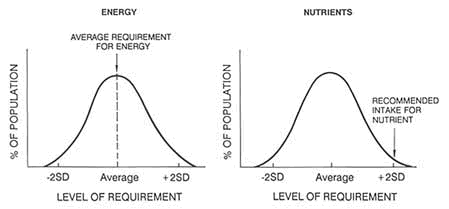
FIGURE 2-1 Distributions of requirements for energy and nutrients. SOURCE: Beaton, 1985, with permission.
If population requirements follow a normal, or Gaussian, distribution pattern (Figure 2-1), adding 2 standard deviations (SDs) to the observed mean requirement would cover the needs of most (i.e., 98%) individuals. With the possible exception of the protein requirement, however, there is little evidence that requirements for nutrients are normally distributed. The distribution of the iron requirements for women, for example, is skewed (NRC, 1986). In this report, therefore, each nutrient is treated individually to allow for variability within a population, as explained in the relevant chapters of this report.
Allowances for energy are established in a different manner than the allowances for specific nutrients. The RDA for energy reflects the mean population requirement for each age group. Energy needs vary from person to person; however, an additional allowance to cover this variation would be inappropriate because it could lead to obesity in the person with average requirements. Over the long term, a surplus of energy intake from any source is stored as fat, which may be detrimental to health.
ESTABLISHMENT OF DIETARY RECOMMENDATIONS
Recommended allowances for nutrients are amounts intended to be consumed as part of a normal diet. Therefore, it is necessary to take into account any factor that influences the absorption of food nutrients or the efficiency with which they are utilized. For some nutrients, a part of the requirement may be met by consumption of
Page 13
a substance that is subsequently converted within the body to the essential nutrient. For example, some carotenoids are precursors of vitamin A; since some or all of the vitamin A allowance can be met by dietary carotenoids, the efficiency with which these precursors are converted into vitamin A must be considered. The allowance for protein is expressed as if it were the RDA for a single dietary constituent. In fact, it is the sum of different requirements for several amino acids that occur in different proportions in various food proteins. For many nutrients, digestion, absorption, or both are incomplete and recommendations for dietary intake must make allowance for the portion of the ingested nutrient that is not absorbed. For example, the absorption of heme and nonheme iron differs; it is affected by other dietary components that are considered in establishing the RDA. The relative importance of such factors varies from nutrient to nutrient. Therefore, the degree to which the RDA, a dietary allowance, exceeds the physiological requirement also varies among nutrients. This is discussed in subsequent chapters.
Traditionally, RDAs have been established for essential nutrients only when data are sufficient to make reliable recommendations. The subcommittee that prepared the ninth edition of the RDAs created the category ''Safe and Adequate Intakes" for nutrients with data bases insufficient for developing an RDA, but for which potentially toxic upper levels were known. In this category were three vitamins (vitamin K, biotin, and pantothenic acid), six trace elements (copper, chromium, fluoride, manganese, molybdenum, and selenium), and three electrolytes (sodium, potassium, and chloride). In this, the tenth edition, only minimal requirements are given for the electrolytes, and vitamin K and selenium have been advanced to RDA status.
HOW ARE RDAs TO BE MET?
Because there are uncertainties in the knowledge base, it is not possible to set RDAs for all the known nutrients. However, the RDAs can serve as a guide such that a varied diet meeting RDAs will probably be adequate in all other nutrients. Therefore, the subcommittee recommends that diets should be composed of a variety of foods that are derived from diverse food groups rather than by supplementation or fortification and that losses of nutrients during the processing and preparation of food should be taken into consideration in planning diets.
Diets of various types can be devised to meet recognized nutritional needs. However, RDAs should be provided from a selection of foods that are acceptable and palatable to ensure consumption. In addition
Page 14
to being a source of nutrients, food has psychological and social values that are important, although difficult to quantify.
RDAs relate to physiological requirements, where these are known. On the whole, the RDA committees tend to err on the side of generosity, since there is little evidence that small surpluses of nutrients are detrimental, whereas consistent uncompensated deficits, even small ones, over a long period call lead to deficiencies. Deficiency states in humans and animals have been reported for nutrients accorded RDA status. Such deficiencies are preventable or curable by the amounts of nutrients supplied by a well-selected diet. In the few cases where deficiency is commonly observed (e.g., iron deficiency in women), food fortification and individual supplementation are appropriate.
PHARMACOLOGIC AND TOXIC EFFECTS OF NUTRIENTS
In recent years, much attention and public interest have been focused on the possible effects of nutrients, often at high intakes, on conditions other than those associated with specific deficiencies. At higher levels of intake, both the toxicity and the pharmacological action of specific nutrients must be considered. All substances will cause harmful effects at some level of intake. For example, water or salt in excess can be lethal, large doses of vitamins A and D produce well-defined toxic syndromes, andeven water-soluble vitamins (e.g., niacin and vitamin B6) can cause adverse effects when taken in sufficiently large amounts. Several nutrients have specific therapeutic uses at high dosages (e.g., vitamin A and other retinoids are used in treating some types of skin disorders), but detrimental side effects after prolonged use. The pharmacological actions of nutrients differ in several ways from their physiological functions, namely:
· Doses greatly exceeding the amount of a nutrient present in foods are usually needed to obtain a therapeutic response.
· The specificity of the pharmacological action is often different from the physiological function.
· Chemical analogues of the nutrient that are often most effective pharmacologically may have little or no nutritional activity.
REFERENCE INDIVIDUALS
RDAs shown in the Summary Table at the end of this volume are expressed in terms of Reference Individuals in different age and sex
Page 15
| TABLE 2-1 Weights for Height of Adults in the United Statesa | ||||||||
| Weight, kg (lb) | ||||||||
| Males, by percentile | Females, by percentile | |||||||
| Height | cm | (in) | 15th | 50th | 85th | 15th | 50th | 85th |
| 147 | (58) | 45 (99) | 55 (122) | 72 (159) | ||||
| 152 | (60) | 49 (107) | 60 (132) | 75 (164) | ||||
| 157 | (62) | 57 (125) | 64 (142) | 76 (168) | 51 (112) | 60 (132) | 77 (170) | |
| 163 | (64) | 58 (129) | 67 (148) | 79 (174) | 54 (I18) | 63 (139) | 79 (175) | |
| 168 | (66) | 61 (134) | 71 (158) | 83 (183) | 55 (122) | 64 (141) | 81 (179) | |
| 173 | (68) | 65 (143) | 76 (167) | 88 (195) | 59 (130) | 67 (148) | 83 (184) | |
| 178 | (70) | 67 (149) | 79 (173) | 93 (206) | 61 (133) | 69 (152) | 78 (171) | |
| 183 | (72) | 73 (161) | 83 (183) | 99 (218) | ||||
| 188 | (74) | 77 (171) | 88 (194) | 99 (217) | ||||
| 193 | (76) | 85 (187) | 103 (227) | 103 (227) | ||||
a Unpublished data from NHANES 11 (1976-1980) provided by the National Center for Health Statistics. Values rounded to nearest whole number. Subjects were ages 18 to 74 years. Height determined without shoes. Weight includes clothing weight, ranging from an estimated 0.09 to 0.28 kg (0.20 to 0.62 lb).
classes. The heights and weights of the Reference Individuals could have been set at some arbitrary ideal (e.g., 70 kg for adult men and 55 kg for adult women, as in the ninth edition). However, since weight is used as the basis for setting RDAs for many nutrients, the figures presented for adults in the Summary Table are the actual medians for the U.S. population of the designated age, as reported in the second National Health and Nutrition Examination Survey (NHANES II). Table 2-1 shows the actual weights for heights of adults in the United States. The use of these figures does not imply that the height-to-weight ratios for this population are ideal. The medians for those under 19 years of age were taken from Hamill et al. (1979) (Table 2-2). For groups or individuals with body mass substantially different from that of the Reference Individual, allowances can be adjusted using the median weight appropriate to the observed height.
The Summary Table in this report is similar to those in previous editions but features several changes. RDAs are now provided for the first and second 6 months of lactation to reflect the differences in the amount of milk produced. RDAs for women during pregnancy and lactation are now tabulated as absolute figures rather than as additions to the basic allowances. This is a convenience and reflects the subcommittee's judgment as to the precision with which the additional costs of reproduction and lactation are known. The RDAs displayed in the Summary Table are the sum of the RDAs for women
Page 16
| TABLE 2-2 Weight and Height of Males and Females Up to 18 Years in the United Statesa | ||||||||||||||
| Males, by percentile | Females, by percentile | |||||||||||||
| Weight, kg (lb) | Height, cm (in) | Weight, kg (lb) | Height, cm (in) | |||||||||||
| Age | 5th | 50th | 95th | 5th | 50th | 95th | 5th | 50th | 95th | 5th | 50th | 95th | ||
| Months | ||||||||||||||
| 1 | 3.16 | 4.29 | (9.4) | 5.38 | 50.4 | 54.6 (21.5) | 58.6 | 2.97 | 3.98 | (8.8) | 4.92 | 49.2 | 53.5 (21.1) | 56.9 |
| 3 | 4.43 | 5.98 | (13.2) | 7.37 | 56.7 | 61.1 (24.1) | 65.4 | 4.18 | 5.40 | (11.9) | 6.74 | 55.4 | 59.5 (23.4) | 63.4 |
| 6 | 6.20 | 7.85 | (17.3) | 9.46 | 63.4 | 67.8 (26.7) | 72.3 | 5.79 | 7.21 | (15.9) | 8.73 | 61.8 | 65.9 (25.9) | 70.2 |
| 9 | 7.52 | 9.18 | (20.2) | 10.93 | 68.0 | 72.3 (28.5) | 77.1 | 7.00 | 8.56 | (18.8) | 10.17 | 66.1 | 70.4 (27.7) | 75.0 |
| 12 | 8.43 | 10.15 | (22.3) | 11.99 | 71.7 | 76.1 (30.0) | 81.2 | 7.84 | 9.53 | (21.0) | 11.24 | 69.8 | 74.3 (29.3) | 79.1 |
| 18 | 9.59 | 11.47 | (25.2) | 13.44 | 77.5 | 82.4 (32.4) | 88.1 | 8.92 | 10.82 | (23.8) | 12.76 | 76.0 | 80.9 (31.9) | 86.1 |
| Years | ||||||||||||||
| 2 | 10.49 | 12.34 | (27.1) | 15.50 | 82.5 | 86.8 (34.2) | 94.4 | 9.95 | 11.80 | (26.0) | 14.15 | 81.6 | 86.8 (34.2) | 93.6 |
| 3 | 12.05 | 14.62 | (32.2) | 17.77 | 89.0 | 94.9 (37.4) | 102.0 | 11.61 | 14.10 | (31.0) | 17.22 | 88.3 | 94.1 (37.0) | 100.6 |
| 4 | 13.64 | 16.69 | (36.7) | 20.27 | 95.8 | 102.9 (40.5) | 109.9 | 13.11 | 15.96 | (35.1) | 19.91 | 95.0 | 101.6 (40.0) | 108.3 |
| 5 | 15.27 | 18.67 | (41.1) | 23.09 | 102.0 | 109.9 (43.3) | 117.0 | 14.55 | 17.66 | (38.9) | 22.62 | 101.1 | 108.4 (42.7) | 115.6 |
| 6 | 16.93 | 20.69 | (45.5) | 26.34 | 107.7 | 116.1 (45.7) | 123.5 | 16.05 | 19.52 | (42.9) | 25.75 | 106.6 | 114.6 (45.1) | 122.7 |
| 7 | 18.64 | 22.85 | (50.3) | 30.12 | 113.0 | 121.7 (47.9) | 129.7 | 17.71 | 21.84 | (48.0) | 29.68 | 111.8 | 120.6 (47.5) | 129.5 |
| 8 | 20.40 | 25.30 | (55.7) | 34.51 | 118.1 | 127.0 (50.0) | 135.7 | 19.62 | 24.84 | (54.6) | 34.71 | 116.9 | 126.4 (49.8) | 136.2 |
| 9 | 22.25 | 28.13 | (61.9) | 39.58 | 122.9 | 132.2 (52.0) | 141.8 | 21.82 | 28.46 | (62.6) | 40.64 | 122.2 | 132.2 (52.0) | 142.9 |
Table continued on page 17
Page 17
| 10 | 24.33 | 31.44 | (69.2) | 45.27 | 127.7 | 137.5 (54.1) | 148.1 | 24.36 | 32.55 | (71.6) | 47.17 | 127.5 | 138.3 (54.4) | 149.5 |
| 11 | 26.80 | 35.30 | (77.7) | 51.47 | 132.6 | 143.3 (56.4) | 154.9 | 27.24 | 36.95 | (81.3) | 54.00 | 133.5 | 144.8 (57.0) | 156.2 |
| 12 | 29.85 | 39.78 | (87.5) | 58.09 | 137.6 | 149.7 (58.9) | 162.3 | 30.52 | 41.53 | (91.4) | 60.81 | 139.8 | 151.5 (59.6) | 162.7 |
| 13 | 33.64 | 44.95 | (98.9) | 65.02 | 142.9 | 156.5 (61.6) | 169.8 | 34.14 | 46.10 | (101.4) | 67.30 | 145.2 | 157.1 (61.9) | 168.1 |
| 14 | 38.22 | 50.77 | (111.7) | 72.13 | 148.8 | 163.1 (64.2) | 176.7 | 37.76 | 50.28 | (110.6) | 73.08 | 148.7 | 160.4 (63.1) | 171.3 |
| 15 | 43.11 | 56.71 | (124.8) | 79.12 | 155.2 | 169.0 (66.5) | 181.9 | 40.99 | 53.68 | (118.1) | 77.78 | 150.5 | 161.8 (63.7) | 172.8 |
| 16 | 47.74 | 62.10 | (136.6) | 85.62 | 161.1 | 173.5 (68.3) | 185.4 | 43.41 | 55.89 | (123.0) | 80.99 | 151.6 | 162.4 (63.9) | 173.3 |
| 17 | 51.50 | 66.31 | (145.9) | 91.31 | 164.9 | 176.2 (69.4) | 187.3 | 44.74 | 56.69 | (124.7) | 82.46 | 152.7 | 163.1 (64.2) | 173.5 |
| 18 | 53.97 | 68.88 | (151.5) | 95.76 | 165.7 | 176.8 (69.6) | 187.6 | 45.26 | 56.62 | (124.6) | 82.47 | 153.6 | 163.7 (64.4) | 173.6 |
SOURCE: Adapted from Hamill et al. (1979).
a Data in this table have been used to derive weight and height reference points in the present report. It is not intended that they necessarily be considered standards of normal growth and development. Data pertaining to infants 2 to 18 months of age are taken from longitudinal growth studies at Fels Research Institute. Ages are exact, and infants were measured in the recumbent position. The measurements were based on some 867 children followed longitudinally at the institute between 1929 and 1975. Data pertaining to children between 2 and 18 years of age were collected between 1962 and 1974 by the National Center for Health Statistics and involve some 20,000 individuals comprising nationally representative samples in three studies conducted between 1960 and 1974. In these studies, children were measured in the standing position with no upward pressure exerted on the mastoid processes. In the ninth edition of this report, data for children up to 6 years of age were taken from longitudinal growth studies in Iowa and Boston, where children were measured in the recumbent position. This explains the systematically smaller heights for 2- to 5-year-old children in this current table compared with those represented in previous editions. In this table, actual age is represented.
Page 18
of reproductive age and increments as justified in the text. The 19to 22-year age class in the ninth edition has been extended through 24 years for both sexes in consideration of the time required to attain peak bone mass. When extrapolating from Reference Individuals to specific population groups (e.g., military personnel), recommendations for nutrient intakes can be obtained by multiplying the number of people within the group by the RDAs for Reference Individuals, making allowances for the body sizes, age distribution, and physiological state (e.g., pregnant, lactating) of those in the group.
NUTRIENT ALLOWANCES FOR INFANTS
The starting point in estimating allowances for infants is usually the average amount of the nutrient consumed by thriving infants breastfed by healthy, well-nourished mothers. With a few exceptions, nutrients in it readily bioavailable form are present in human milk in proportions appropriate for adequate nutriture for the first 3 to 6 months of life. For this reason, RDAs for the very young infant are intended to serve as a guide for those who are not breastfed exclusively.
Since the previous edition, new data on breast milk production have emerged (e.g., Butte et al., 1984; Chandra, 1982; Hofvander et al., 1982; Neville et al., 1988). Average milk consumption for infants born at term is now accepted to be 750 ml for the first 6 months (with a coefficient of variation of approximately 12.5%), and 600 ml during the next 6 months when complementary foods are given. Maternal production is slightly higher than infant consumption, but it is subsumed within the variation. Therefore, the subcommittee accepts 750 ml and 600 ml as figures for both average milk production and consumption.
Recommendations for infants are subdivided into the first and second 6 months of life. Further subdivision of these age groups can be justified on physiological grounds, but the information base is not yet sufficient to establish nutrient allowances with such precision. RDAs for infants up to 6 months old are based primarily on the amounts of nutrients provided by 750 ml of human milk, plus an additional 25% (2 SDs) to allow for variance. RDAs during the second 6 months of life are consistent with infant feeding practices in the United States, i.e., increasing amounts of mixed solid foods are given to supplement milk or formula during that period.
Page 19
NUTRIENT ALLOWANCES FOR THE ELDERLY
In this edition, as in previous editions of the RDAs, adults are divided into two age categories: 25 (or 23) to 50 years, and from 51 years upward. The subcommittee considered subdividing healthy older people into two groups, since increasing age may alter nutritional requirements due to changes in lean body mass, physical activity, and intestinal absorption. However, it concluded that data are insufficient to establish separate RDAs for people 70 years of age and older.
In applying the RDAs, one should remember that a given person may be physiologically younger or older than his or her chronological age would suggest and that it becomes increasingly difficult to define the term healthy with advancing age. There is some evidence that the elderly have altered requirements for some nutrients. For example, intestinal absorption, particularly of minerals, may be impaired. However, there is no evidence that an increased intake of nutrients above the RDAs is necessary, or that higher intakes will prevent the changes associated with aging.
CONDITIONS THAT MAY REQUIRE ADJUSTMENT IN APPLICATION OF RDAs
Climate
Ordinarily, adjustments made in clothing and housing protect the body against heat and cold. Therefore, adjustments in dietary allowances to compensate for environmental temperature changes rarely are necessary.
Prolonged exposure to high temperatures may reduce activity, energy expenditure, and therefore food intake. Except under extreme conditions, however, it is unlikely that this reduced food intake would greatly affect the nutriture of the individual. Sweat losses may need to be considered, as noted below.
Strenuous Physical Activity
Increased activity increases the need for energy and some nutrients. Such needs usually are met by the larger quantities of food consumed by active people, provided foods are sensibly selected.
In hot environments, activity increases water and salt losses through sweating and, if prolonged, can also lead to measurable losses of other essential nutrients. Special attention should be given to the immediate need for water under such conditions.
Page 20
Clinical Considerations
RDAs apply to healthy persons. They do not cover special nutritional needs arising from metabolic disorders, chronic diseases, injuries, premature birth, other medical conditions, and drug therapies.
Data on the role of diet as a causal or contributing factor in chronic and degenerative disease lead to recommendations derived through approaches different from those used in developing RDAs for specific nutrients. Reference is made to relationships between dietary patterns and health in certain chapters; a detailed evaluation of relationships between dietary patterns and health can be found in the Food and Nutrition Board's publication Diet and Health (NRC, 1989) and The Surgeon General's Report on Nutrition and Health (DH HS, 1988).
APPLICATION OF RECOMMENDED DIETARY ALLOWANCES
Underlying all uses of the RDAs is the recognition that humans are highly adaptable. Throughout its existence, the human species has developed regulatory and storage mechanisms that permit it to survive in a variety of environments and to withstand periods of deprivation. These basic biological considerations, coupled with the fact that the RDAs include reasonable margins of safety, are the overriding considerations that should guide the user in applying the RDAs in specific situations. Experience with uses and misuses of the RDAs has indicated that certain areas require emphasis and clarification. These are discussed below.
In the Summary RDA Table at the end of this volume, nutrient intakes are expressed as quantities of a nutrient for a Reference Individual per day. However, the terms per day and daily should be interpreted as average intake over time. The length of time over which averaging should be achieved depends on the nutrient, the size of the body pool, and the rate of turnover of that nutrient. Some nutrients, such as vitamins A and B12, can be stored in relatively large quantities and are degraded slowly. Others, such as thiamin, are turned over rapidly, and total deprivation in a person can lead to relatively rapid development of symptoms (i.e., in days or weeks, rather than in months). If the requirement for a nutrient is not met on a particular day, body stores or a surplus consumed shortly thereafter will compensate for the inadequacy. For most nutrients, RDAs are intended to be average intakes over at least 3 days; for others, (e.g., vitamins A and B 12), they may be averaged over several months.
Nutrient intake varies from day to day among individuals and for different nutrients. For example, the day-to-day variability in intake
Page 21
of some nutrients, such as protein and thiamin, is low, whereas vitamin A intake is highly variable. For this reason, dietary surveys that depend on single 24-hour recalls provide valid data only for the population average intake. A person who on one day may have consumed little of a given nutrient may on a subsequent day ingest considerably more. Only a time-averaged intake need approximate the RDA.
If a group average intake approximates that of the calculated group RDA, some persons within the group are consuming less than the RDA and others more. Except for energy, in which the average requirement of the population group is recommended, the RDAs are intended to be sufficiently generous to encompass the presumed (albeit unmeasured) variability in requirement among people. Thus, if a population's habitual intake approximates or exceeds the RDA, the probability of deficiency is quite low. Such comparisons between intake and RDA cannot, however, be used to conclude confidently that the requirements for a given person have or have not been met, because there is no assurance that the high (and low) consumers are the high (and low) requirers of the nutrient in question. Without knowing the distribution of intakes and requirements, there is no way to verify probable deficiency within a group. If individual intakes can be averaged over a sufficiently long period and compared with the RDA, the probable risk of deficiency for that individual can be estimated.
NUTRITIONAL ALLOWANCES AS GUIDELINES FOR FOOD SUPPLIES AND FOR HEALTH AND WELFARE PROGRAMS
The RDAs have been used by federal, state, and local health and welfare agencies as a starting point for determining the desirable nutrient content of foods and meals for school feeding programs, special food services, and various child-feeding programs, and as a basis for licensing and certification standards for such group facilities as day-care centers, nursing homes, and residential homes.
The attainment of RDAs should not be the only objective of food procurement or meal design for these programs. Since RDAs have not been set for all nutrients, meeting the RDAs from a wide variety of food classes is the best assurance that needs for non-RDA nutrients will be met. The foods selected must also be palatable and acceptable in other ways so they will be consumed over long periods in the required quantities. Although the subcommittee is aware that changes in the RDAs from the previous edition might have an impact on food
Page 22
assistance programs, it believes that modifications to these programs should be based on the recommendations in the Food and Nutrition Board's report Diet and Health (NRC, 1989) as well. Together, the RDAs and the Diet and Health recommendations should be considered the appropriate basis for diet planning.
In planning meals or food supplies, it is technically difficult and biologically unnecessary to design a single day's diet that contains all the RDAs for all the nutrients. Nor is there biological reason for expecting that each meal should contain a fixed percentage of an RDA for a nutrient. As stated previously, the RDAs are goals to be achieved over time—at least 3 days for nutrients that turn over rapidly, whereas one or several months might be adequate for more slowly metabolized nutrients. In practice, menus for congregate feeding should be designed so that the RDAs are met in a 5- to 10-day rotation.
REFERENCES
Beaton, G.H. 1985. Uses and limits of the use of the Recommended Dietary Allowances for evaluating dietary intake data. Am. J. Clin. Nutr. 41:155-164.
Butte, N.F., C. Garza, F.O. Smith. and B.L. Nichols. 1984. Human milk intake and growth in exclusively breast-fed infants. J. Pediatr. 104:187-195.
Chandra, R.K. 1982. Physical growth of exclusively breast-fed infants. Nutr. Res. 2:275-276.
DHHS (U.S. Department of Health and Human Services). 1988. The Surgeon General's Report on Nutrition and Health. Government Printing Office, Washington, D.C. 727 pp.
Hamill. P.V.V., T.A. Drizd, C.L. Johnson, R.B. Reed, A.F. Roche, and W. M. Moore. 1979. Physical growth: National Center for Health Statistics percentiles. Am. J. Clin. Nutl. 32:607-629.
Hofvander, Y.U. Hagman, C. Hillervik, and S. Sjolin. 1982. The amount of milk consumed by 1-3 months old breast- or bottle-fed infants. Acta Paediatr. Scand. 71:953-958.
Neville, M.C., R. Keller, J. Seacar, V. Lutes, M. Neifert, C. Casey, J. Allen, and P. Archer. 1988. Studies in human lactation: milk volumes in lactating women during the onset of lactation and full lactation. Am. J. Clin. Nutr. 48:1 375-1386.
NRC (National Research Council). 1943. Recomnended Dietary Allowances. Report of the Food and Nutrition Board, Reprint and Circular Series No. 115. National Research Council, Washington, D.C. 6 pp.
NRC (National Research Council). 1982. Diet, Nutrition, and Cancer. Report of the Committee on Diet, Nutrition, and Cancer, Assembly of Life Sciences. National Academy Press, Washington, D.C. 478 pp.
NRC (National Research Council). 1986. Nutrient Adequacy: Assessment Using Food Consumption Surveys. Report of the Subcommittee on Criteria for Dietary Evaluation, Food and Nutrition Board. Commission on Life Sciences. National Academy Press, Washington, D.C. 146 p.
Page 23
NRC (National Research Council). 1989. Diet and Health: Implications for Reducing Chronic Disease Risk. Report of the Committee on Diet and Health, Food and Nutrition Board, Commission on Life Sciences. National Academy Press, Washington, D.C. 750 pp.
Roberts, L.J. 1958. Beginnings of the Recommended Dietary Allowances. J. Am. Diet. Assoc. 34:903-908.


