
5
BREAKOUT SESSION 2
DISCUSSIONS OF THEORETICAL FRAMEWORKS
The aim of the second day’s breakout groups was to identify theoretical frameworks that might guide research to answer questions raised the day before. Attendees in the four randomly assigned groups were asked to
- identify challenges,
- characterize how they are manifested in the target populations,
- examine underlying mechanisms and remediation strategies, and
- provide models of innovative and successful approaches to overcoming the challenges.
Breakout group participants were invited to provide a graphical representation of their proposed frameworks.
Breakout Group 2A
This group developed a graphic of a circle with four quadrants corresponding to the major areas of inquiry and showing relevant theoretical frameworks (Figure 4). The group members identified a challenge—lack of culturally responsive faculty (Quadrant 1)—to illustrate application of the framework to the academic performance of minority males at the undergraduate level. The challenge is manifested by toxic school cultures that marginalize minority males (Quadrant 2). The underlying mechanisms of the challenge include social conformity and lack of incentives for change, and possible remediation strategies are faculty training and implementation of equity audits (Quadrant 3). Two models to address the challenge are replication of support structures shown to be effective at HBCUs and the use of culturally responsive activities (e.g., equity scorecards) to incentivize change (Quadrant 4).
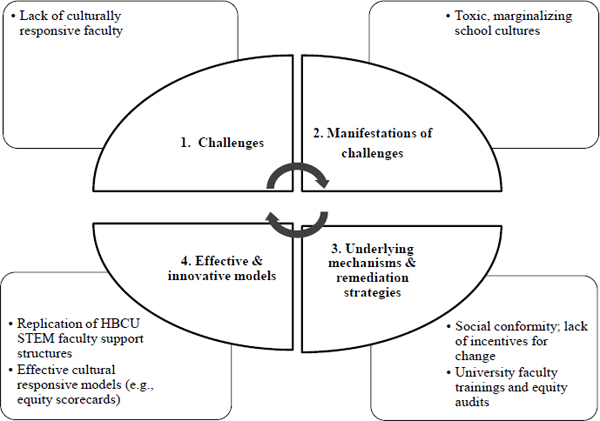
FIGURE 4. Breakout Group 2A’s theoretical metaframework to address the challenge of having few culturally responsive faculty at the undergraduate level.
Breakout Group 2B
This group developed a table with four rows corresponding to the major areas of inquiry, with accompanying relevant theoretical frameworks (Table 2) that are applicable for both precollege and postsecondary levels. For example, in the area of “Identify Challenges” the suggested frameworks are all in the broad category of Human Ecology, including attributional work (e.g., the work of Claude Steele) and Kurt Lewin’s approach to social psychology.
TABLE 2. Metaframework Linking Major Areas of Inquiry with Theoretical Frameworks
| Identify Challenges |
Human Ecology:
|
| Characterize Manifestations in Target Population |
|
| Underlying Mechanisms (Models of Intervention) |
|
| Successful Examples |
|
SOURCE: Participants in Breakout Group 2B.
Breakout Group 2C
Members of this group developed the graphic shown in Figure 5, which, unlike the others, is not tied to the four major research areas. Rather, it considers the individual in various contexts and interactions. The framework places particular emphasis on context as created by interactions among various metatheoretical frameworks related to an individual’s social and cultural competency (e.g., one’s identity, race and ethnicity, and social status).
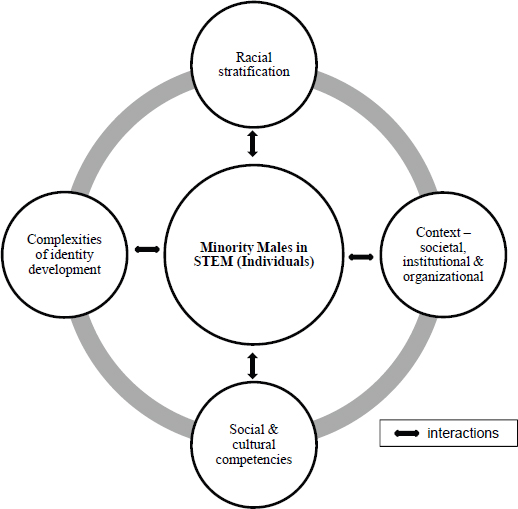
FIGURE 5. Theoretical framework connecting individuals, their interactions, and context. Developed by participants in Breakout Group 2C.
Breakout Group 2D
This breakout group approached its task by developing a series of questions tied to the four major areas of inquiry (Box 2).
BOX 2: Key Framework Questions for Each Major Area of Inquiry
Identify challenges:
- Do male views of masculinity play into their decisions to pursue (or to not pursue) specific fields in STEM?
- What role do masculinity and gender play in the pursuit of science (e.g., the “feminization of science”; characterization of disciplines as “soft” vs. “hard”)?
- What can be learned from a review of the data on students being “pushed out” or transferring from one science field to another? What role does microaggression play?
- How might deficit cognitive frame theory,a specifically with regards to faculty attitudes, improve understanding of the experience of minority males in STEM?
Manifestations (characterize how challenges are manifested in target populations):
- How might a review of cumulative advantage inform efforts to understand the experience of minority males? What are some best practices for creating a system of cumulative advantage in STEM for minority males? Are there different models at different educational levels?
Mechanisms (examine underlying mechanisms and remediation strategies):
- What layers of context should be taken into consideration in developing complex and comprehensive models of research interventions that include attention to individuals and families? How such models might be informed by a review of social, racial, policy, and ecological frameworks?
Success models (provide models of innovative and successful approaches to overcoming the challenges):
How might the following models (in whole or in part) improve understanding of what works to enhance the academic and career prospects of minority males?
- Resiliency and coping models
- Critical race theory (CRT), specifically with respect to interest convergenceb
- “Academic identification,” based on how well male students perform academically
- “Self theory,” based on encouragement of students to see themselves in STEM programs and careers
aAccording to Estela Maria Bensimon (“Closing the Achievement Gap in Higher Education: An Organizational Learning Perspective” in New Directions for Higher Education, No. 131, Fall 2005, p. 103), deficit cognitive frame theory “focus[es] on stereotypical characteristics associated with the culture of disadvantage and poverty.”
bAccording to interest convergence theory, substantive gains for minorities will occur only when they converge with the interests of the majority. See Derrick Bell’s seminal article in the Harvard Law Review 518 (1980).
Source: Participants in Breakout Group 2D.


