
Lorelle Espinosa, Director of Policy and Strategic Initiatives at the Institute for Higher Education Policy in Washington, gave the plenary speech. She explained that more research on different populations will contribute to both the translation of research into practice and to the framing of theoretical work on the intersection of race and gender. Studies on men of color1 can benefit, she said, from previous research and assessment of programmatic activities on gender that have focused on women and girls, adding that findings from prior theoretical work may be applicable to men and boys. For example, research on intersectionality2 for minority males could refer to Black Feminist Theory as it looks at gender, race, and socioeconomic status. For research on men of color, Espinosa noted that it was important to take into account where they are in terms of their institution of higher education (e.g., community colleges and minority-serving institutions). It is also important to consider the geographic location of populations of young (precollege) minority males, as there are distinct geographic differences in the largest minority populations on the east and west coasts as well as the southern borders (see Figure 1).
__________________
1 The terms “men of color,” “minority males,” and “underrepresented minority males” are used interchangeably in this report.
2 The term intersectionality is used “to denote the various ways in which race and gender interact to shape the multiple dimensions” of an individual’s experience. The term is often used in research on African American women. The core concept of intersectionality is that one cannot understand the full impact “wholly by looking at the race or gender dimensions of those experiences separately.” Source: Kimberle Crenshaw, “Mapping the Margins: Intersectionality, Identity, Politics, and Violence against Women of Color,” Stanford Law Review, Vol. 43, 1241, 1993.
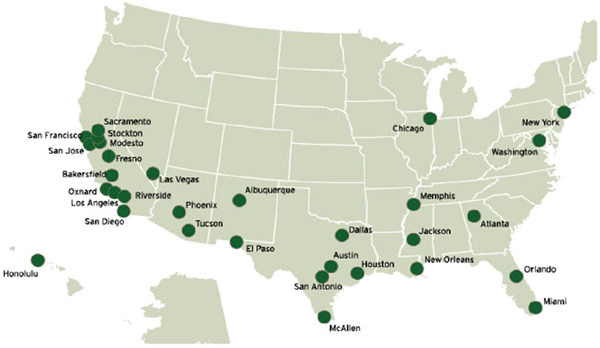
FIGURE 1. Large metro areas with majority-minority child (under 18) populations, 2008.
SOURCE: Brookings Institution, 2010.
In response to an audience member’s question, Espinosa agreed that it was important to look at research data on minority men in a disaggregated manner and that data for any single minority group may look very different from aggregated data across groups. Disaggregating the data by populations, regions, or ethnicities is critical to identifying target populations and capturing their unique characteristics as it relates to STEM participation. To illustrate, she referred to her slides on the top BS-granting colleges for minority males in STEM in 2007 (Table 1), showing that very few schools are listed as top producers for more than one minority male population.
TABLE 1. Top Ten BS-Granting Colleges/Universities for Minority Males in STEM, 2007
| Black Men | Latino Men | Native American Men | Asian Pacific Islander Men | |
| 1 | Southern University and A&M College | University of Puerto Rico, Mayaguez | Oklahoma State University | University of California, Berkeley |
| 2 | Florida A&M University | Florida International University | University of Oklahoma, Norman | University of California, Davis |
| 3 | North Carolina A&T State University | University of Texas, El Paso | Southeastern Oklahoma State University | University of California, San Diego |
| 4 | University of Phoenix | Universidad Politecnica de Puerto Rico | Northeastern State University | University of California, Irvine |
| 5 | Strayer University | University of Texas, Austin | North California State University, Raleigh | University of California, Los Angeles |
| 6 | Alabama A&M University | University of Florida | University of North Carolina, Pembroke | University of Texas, Austin |
| 7 | Howard University | University of Texas, Pan American | Arizona State University | University of Washington, Seattle |
| 8 | Prairie View A&M University | Texas A&M University | University of Arizona | San Jose State University |
| 9 | University of Florida | California State Polytechnic University, Pomona | East Central University | California State Polytechnic University, Pomona |
| 10 | University of Maryland, Baltimore County | The University of Texas, San Antonio | University of Washington, Seattle | University of Illinois, Urbana-Champaign |
SOURCE: Lorelle Espinosa, Institute for Higher Education Policy, Presentation on August 9, 2010.


