
5
Demonstrating Data Sharing: The UNITY System
UNITY is a data-sharing, visualization, and collaboration platform developed jointly by DOD and USAID to make visible the scope and scale of humanitarian development, security assistance, and peacebuilding investment worldwide. By making key data visible to peacebuilders, UNITY can maximize allocation of scarce resources and, it is hoped, improve outcomes for the society receiving the peacebuilding intervention.
UNITY was described and demonstrated at the workshop by Mark Hainsey, project leader at the US Army Corps of Engineers, and Steven Wood, support lead for the Cooperative Security (CS) Joint Capability Technology Demonstration (JCTD) program. JCTDs are intended to exploit mature and maturing technologies to solve important military and civilian-military problems and to concurrently develop the associated concept of operation, a guidance document for the technology’s users. These capabilities and operational concepts are then evaluated in exercises on a scale large enough to clearly establish operational utility and system integrity. Emphasis is on technology assessment and integration. After the presentation by Hainsey and Wood, workshop attendees offered comments on the system and ideas for its enhancement.
UNITY is designed to provide data visibility for the US government, nongovernmental organizations (NGOs), international organizations, and other entities working in fragile environments. Organizations working in post-conflict zones tend to manage planning independently. Consequently, project activities become siloed, and interventions can become uncoordinated and inefficient. UNITY aggregates nonclassified data from partner organizations and displays it through a Web-based browser interface as a series of overlays, charts, graphs, and tables that are geospatially referenced to a map of the region. As shown in Figure 5-1, each peacebuilding project is represented by an icon that can be clicked on to see more information on budget, partners, and other project details.
UNITY was developed under the Cooperative Security JCTD, an interagency research and development initiative overseen by the Office of the Assistant Secretary of Defense for Research and Engineering. Partner agencies are USAID, the US Southern Command, the US European Command, and the US Army Corps of Engineers. The objective of this JCTD, said Hainsey, is to develop cutting-edge capabilities to produce a better integrated “whole of government” approach to development and defense cooperative activities both with other US agencies and across the public-private divide.
The problem the UNITY system addresses is the absence among regional stakeholders of integrated, interagency adaptive planning, decision support, and assessment capabilities; information-sharing architectures; and orga-
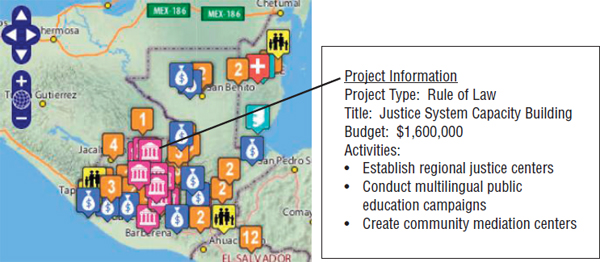
FIGURE 5-1 Hypothetical USG and NGO Development Projects in Guatemala and Belize Shown on UNITY.
nizational structures needed to conduct effective cooperative security and partner capacity-building activities. Planning is stove-piped within agencies, resulting in overlapping solutions and wasted resources. Requirements for the new system were that it use nonclassified information in non- and precrisis environments and that it engage public sector stakeholders. The system “is not a holistic solution for all of the challenges that we’ve discussed through the morning and early afternoon” but rather “an opportunity to start looking at tools and techniques for how to share data, how we collaborate, and how we provide mutual visibility to our partners and stakeholders,” said Hainsey.
The UNITY system allows regional and multinational nonclassified information sharing, mutually visible situation and event assessment and planning, and collaborative implementation, monitoring, and evaluation. It connects communities of interest through a federated, collaborative forum called the All Partners Access Network (APAN). For the first time, users will be able to juxtapose DOD and USAID country plans to show overlaps and gaps in their planning processes. It takes in authoritative project data and categorizes it by sector based on the Department of State’s Foreign Assistance Framework. And the system is scalable, with the capacity to include all federal agencies and departments that conduct foreign assistance activities as well as nongovernmental sources of information that choose to share their project data.
Platform tools enable users to access information in their areas of interest, and an innovative RSS reader discerns what individual users may want to see and custom-tailors the information provided by the system. A dashboard, tailored to a user’s profile, can be configured to enable faster and more efficient visualization of information in their area of interest. Data can be sorted, filtered, searched, and displayed according to the user’s preferences. The original format and syntax of the data are retained so that information from the data providers is not lost. A fine-grained data access control system allows some data to be shared only with small groups or individuals, while other data are freely available. The system is government owned and does not have proprietary components and consequently, said Hainsey, can be easily updated should new capabilities be required.
Several workshop participants applauded the capabilities and scope of the UNITY system, describing it as a valuable tool for information gathering and planning. For example, Michael Shipler, senior program advisor, Search
for Common Ground, pointed out that the system provides a way to develop a shared understanding of what is happening in a country and thus could be used not just by civil society groups but by the media, local government officials, the police, and others to assess local situations and capacities.
Participants also offered feedback on the characteristics of the system, which Elmer Roman, oversight executive, Office of the Secretary of Defense, US Department of Defense, Anne Ralte, senior advisor, Office of the Director of Human Resources, US Agency for International Development, and Hainsey and Wood, who were involved in the system’s development, welcomed as input for future changes. Among the suggestions proposed were software tools that could be added to the system. One useful tool would be software that could find patterns in seemingly unrelated data. For example, as Melanie Greenberg, president and CEO, Alliance for Peacebuilding, noted, if everyone in a region is suddenly buying AK-47s, access to data documenting that trend could help to prevent the outbreak of hostilities.
In response to a question about what other kinds of data can be entered into the system, Wood said that information from authoritative sources will be entered into the system. The system has been designed for precrisis environments. Roman acknowledged that including conflict indicators would be a valuable addition so that the effects of both development and peacebuilding could be monitored over time.
Participants also noted potential shortcomings in the UNITY system. As Lisa Schirch, professor, Center for Justice and Peacebuilding, Eastern Mennonite University, pointed out, much of civil society does not want the military to engage in development because of its negative impact on NGOs working on the ground. The military and other organizations may have different perceptions about the problems that need to be solved and how to solve them, and unless organizations are on the same page it can be difficult to share information. “We wouldn’t want to share information if we have different goals,” she said. “We do want to have conversations about those different goals and different analyses.”
Another problem cited by several participants is that the tool lacks a way for countries included in the database to provide feedback. A system containing information only from US agencies seems to imply that the countries being mapped need outsiders to gather and share information. It also does not represent the full range of activities, including those of the host countries. More generally, Shipler noted, within countries different actors might identify different sorts of data as vital to their planning processes. There does not appear to be a way to manage these differences in UNITY.
Kevin Brownawell, interagency professional in residence, US Institute of Peace (USIP), observed that, though Americans may be interested in the acquisition and sharing of data, that is not necessarily the case in other countries. As a result, several basic questions need to be answered: Does everyone agree that data should be collected and shared? If so, what kind of data? With whom should data be shared? Are data open or closed? How will data be used? Brownawell suggested starting with the posting of country statistics generated by the US government and then seeing how far the system can expand into data provided by the NGO community and other countries.
Roman countered that many of the countries in which he has worked have been eager for the military to engage in development activities. The military understands its role, he said, and sharing information can allow development and stability to progress. Also, the military wants to show, in part through this program, that it can be a responsible partner in development as part of the security cooperation plan. “The more you know and understand and the more you understand what others are doing, the better it is for the unity of effort overall,” he said.
Marcia Hartwell, visiting scholar, USIP, also pointed out that, although she is not a fan of military involvement in development projects, the situation varies from country to country. In some cases, NGOs prefer the military to be active. For example, in Iraq, the military secured a perimeter within which everyone working on humanitarian aid could operate safely. She also acknowledged that the military excels in dealing with other armed groups and military organizations. “Civilians work well with civilian groups, and the military works well with armed groups,” Hartwell said.
In response to participants’ concerns about placing their data on a platform hosted by DOD servers, Roman and Hainsey both observed that UNITY could be hosted outside the DOD environment and that both DOD and USAID have been looking for opportunities to do so. In particular, Roman suggested that USIP might be an excellent place to host such a data-sharing program.
Another potentially valuable source of data cited by workshop participants is the information available through crowdsourcing. Crowdsourcing techniques could be used to survey the viewpoint, priorities, and perceptions of the ultimate beneficiaries of development in a country—the people. However, this information, too, would most likely be accepted if available through a system not involving the military.
Patrick Vinck, research scientist, Harvard Humanitarian Initiative, noted that many platforms offering data related to peacebuilding are emerging.
Ways need to be found to enable these platforms to talk with each other, and the UNITY system could help make such cooperation possible. Other participants similarly pointed to other systems that provide complementary information, including conflict indicators. Linking to these other sources may be a better way of sharing information than having it compiled in a system developed by the military.
Vinck also asked whether UNITY or some other collaborative software system could be made more open and sharable. Wood explained that the platform will support multiple server configurations, so extensibility has already been built into it and multiple versions of the platform could be spread across multiple user communities.


