
The goal of the US Department of Defense’s (DoD’s) Chemical and Biological Defense Program (CBDP) is to provide “support and world-class capabilities enabling the US Armed Forces to fight and win decisively in chemical, biological, radiological, and nuclear environments.”1 To accomplish this objective, the CBDP must maintain robust science and technology capabilities to support the research, development, test, and evaluation required for the creation and validation of the products the program supplies to the Services. As the threat from chemical and biological attack is an evolving one, due to the changing nature of conflict and rapid advances in science and technology, the core science and technology (S&T) capabilities that must be maintained by the CBDP must also continue to evolve. In order to address the challenges facing DoD, the Deputy Assistant Secretary of Defense for Chemical and Biological Defense (DASD(CBD)) asked the National Research Council (NRC) of the National Academy of Sciences to conduct a study to identify the core capabilities in science and technology that must be supported by the program.
The NRC Committee on Determining Core Capabilities in Chemical and Biological Defense Research and Development has examined the capabilities necessary for the chemical and biological defense science and
_______________________
1 US Department of Defense. 2010. “Department of Defense Chemical Biological Defense Program Annual Report to Congress 2010.” Note that this report focuses only on the chemical and biological aspects of the program.
technology program in the context of the threat and of the program’s stated mission and priorities. This report contains the committee’s findings and recommendations. It is intended to assist the DASD(CBD) in determining the best strategy for acquiring, developing, and/or maintaining the needed capabilities.
Because science and technology development is a long process, the products and materials from the CBDP must not only respond to the needs of the Services today, but also anticipate those of the future. Since the United States cancelled its offensive program for biological weapons in 1969 and for chemical weapons a decade later,2 DoD must rely on analysis and simulations to understand how these agents might be used. Offensive programs are being conducted by adversaries where understanding of their intentions and capabilities is uncertain; at least some of the technology developed by nation states has escaped, and capability in all parts of the world in civilian uses of biotechnology and medicinal chemistry is rising rapidly. Because of uncertainty about how much protection current materiel and procedures will provide, there is potential for a gap between needs and deployable capabilities. For example,
- Do we need new, more effective vaccines?
- Does the current protective gear adequately protect, and against what agents?
- Would warfighters be able to “fight through” operations that use conventional agents (for example, persistent nerve agents) deployed in conventional ways? In innovative ways (for example, on suicide bombers)? With unconventional agents?
- How much would operational tempo be slowed by attacks on logistics and supply chains using chemical or biological weapons, and what would be the influence of successful attacks on operational tempo?
Many of the questions related to the capabilities that warfighters and combatant commands have at their disposal could be answered, but the current technical and organizational structure is not designed to answer them. Instead, the process for prioritizing research efforts and allocating resources is based on a requirements-driven process that promotes a focus on the development of technical solutions without adequately considering the range of contexts in which they may be used. This focus carries over into the approaches taken in evaluating the efficacy of the products. Although a device or material meets its threshold and objective bench-
_______________________
2 In 1969, the United States renounced first use of chemical weapons, and in 1991 renounced retaliatory use as well; the United States ratified the Chemical Weapons Convention in 1993.
marks in a test chamber or facility, these benchmarks may not necessarily represent the range of operating environments.
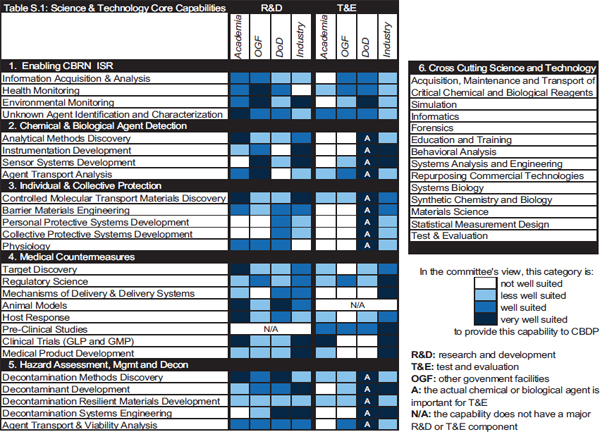
The committee identified 39 core chemical and biological defense S&T capabilities and created a framework that groups them in six categories. In Chapter 3, the committee discusses these S&T capabilities and identifies where, in their view, the capabilities should be obtained by the CBDP. To inform their thinking about which S&T capabilities are actually core and comment on where the capabilities may be found the committee developed a decision tree (Figure 3.1). Using this decision framework the committee found that almost all of the capabilities can be found outside of the service laboratories. The committee went on to identify, for a variety of possible reasons, some capabilities that should be maintained within DoD service laboratory infrastructure. For each capability, research and development (R&D) and test and evaluation (T&E) are discussed separately and typically were not best suited to the same organization.
The committee considered four types of institutions with laboratories that may be suited to provide CBDP core capabilities and organized them from typically having the most fundamental-science-focused to the most product-focused research. These institutions are (1) academia, (2) other governmental facilities (e.g., the National Institutes of Health, Centers for Disease Control and Prevention, Department of Energy National Labs, National Institute of Standards and Technology), (3) DoD laboratories and facilities, and (4) industry (e.g., pharmaceutical companies). For some capabilities, T&E requires use of actual agent;3 institutions other than DoD laboratories may be well suited to do the work but would need to do so in close collaboration with DoD.
Table S.1 summarizes the committee’s judgments about how well suited the types of institutions are for R&D and for T&E with respect to 26 of the core capabilities. Dark shades indicate an institutional category that the committee views as well suited to maintain a given capability for the CBDP, while the lighter shade indicates less well-suited locales. The white boxes indicate that the institutional category is, in the committee’s view, not well suited to maintain the capability. The other 13 capabilities are cross-cutting science and technology that the committee views as necessary for effective RDT&E for any of the capabilities defined in the preceding capability categories. Discussion of the potential locales for the cross-cutting science and technology capabilities can be found in Chapter 3. The committee does not intend to imply that each of the 13 cross-cutting capabilities be maintained exclusively, or indeed at all, within DoD.
_______________________
3 Actual agent testing refers to the actual chemical or biological agent the capability is being tested against (e.g., Vx, Sarin, sulfur mustard, anthrax, tularemia, botulinum toxin), as opposed to testing with simulants.
When considering the various locales for obtaining S&T capabilities, it is important to recognize that
- the analysis of the various laboratory locales is general, and individual performers within a category may be exceptions;
- the color coding of each category represents the aggregate of reasons considered, including but not limited to
- reputation and experience at providing the given capability,
- the extent to which the capability requires work with classified information,
- limitations on the locale of the capability resulting from international treaties or other laws,
- the need to maintain important capabilities, at least in part, at government facilities to ensure availability (e.g., Biological Safety Level 4 facilities).
The committee identified a number of concerns that affect the program’s ability to sustain these core capabilities, including
- the amorphous and changing nature of the threat;
- the breadth of the mission and lack of shared strategic objectives across all of the chemical and biological defense enterprise elements;
- a requirements-driven, as opposed to capabilities-based, process for prioritizing and directing RDT&E and acquisition;
- a funding structure that minimizes local flexibility over allocated RDT&E funds; and
- challenges to effective engagement with individuals and organizations external to DoD.
RDT&E for the CBDP rely upon capabilities that have been primarily resident in the military departments because of both the classified nature of the original offensive program and specialized aspects of the problem. While key competencies and special facilities in the laboratories and test ranges remain important to the program, most of the expertise in relevant science and engineering now lies outside of DoD. The work that is done largely by the military (for example, protective suits) is not carried out in a way that allows its effectiveness to be evaluated usefully, and the transfer of commercial technology into DoD laboratories (e.g., in gene sequencing) is inefficient and expensive. The fundamental questions of how RDT&E programs should be organized, and how much of chemical and biological defense research is really “core” to DoD require rethinking.
FINDINGS AND RECOMMENDATIONS
Program Framework and Structure
Mission and Strategy
Finding 1.1: The threat is unpredictable, changing, and dependent on the nature of conflict. The CBDP cannot rely on breakthroughs in intelligence on adversaries’ chemical or biological terrorism or warfare programs to inform how its investments are prioritized.
Finding 1.2: The program has not adapted to the changing nature of the chemical and biological threat. It is impossible technically—and unfeasible economically—to try to provide solutions to all potential threats. The United States simply cannot afford to deal with all threats on an individual basis, and there is no universal solution—it has to choose which problems to solve.
Finding 2.1: The CBDP mission is too broadly stated. The stated mission of CBDP is to “Provide global chemical, biological, radiological, and nuclear defense capabilities in support of National Strategies.” The mission statement is large enough to allow for a wide variety of interpretations, making it challenging for both the customers of the program and the facilities that support its work to understand the program priorities.
The CBDP has responsibilities that span missions from protecting the warfighter and providing support to the warfighter, to defending the United States from attack (i.e., Homeland Defense) and supporting local authorities following a chemically or biologically related incident (i.e., Consequence Management, Foreign or Domestic). Events requiring the Department to perform each of these missions could unfold in innumerable, unexpected ways; for example,
- naturally occurring disease or unintentional chemical exposures may be difficult to distinguish from intentional attacks;
- intelligence, as noted above, has historically proved uncertain and/ or unreliable in assessing the chemical and biological (CB) threat;
- innovations, as witnessed in the case of improvised explosive devices, will certainly occur in the development and use of chemical and biological weapons; and
- the United States has a poor understanding of the intentions of those who might use chemical and biological weapons, and an even poorer understanding of the barriers that prevent them from doing so.
The combination of a broadly stated mission and numerous uncertainties calls for top-level guidance on focus and priorities, which the current program lacks.
Finding 2.2: There is no program-wide CB defense strategy, nor common characterization of the program elements among the participating organizations. The many different organizations currently involved in the CBDP (e.g., Office of the Assistant Secretary of Defense for Nuclear, Chemical, and Biological Defense Programs/Chemical and Biological Defense (OASD(NCB/CB), Joint Requirements Office for Chemical, Biological, Radiological, and Nuclear Defense (JRO-CBRND), Joint Science and Technology Office for Chemical and Biological Defense (JSTO-CBD), and Joint Program Executive Office for Chemical and Biological Defense (JPEO-CBD) each view the chemical and biological defense mission from different perspectives. Although this can be expected based on their different roles, the coordination and collaboration between these groups is far from seamless. As a result, the program has been—and continues to be—limited in its ability to deliver fielded solutions in a timely manner.
Finding 2.3: Strategic priorities tend to change with changes in senior leadership. As a result, efforts requiring sustained and/or longer-term commitments (e.g., medical countermeasures) are unable to deliver timely results, if at all.
Recommendation 2.1: The DASD(CBD) should lead a mission and strategy development activity that aligns all of the program elements and offices. The differences among offices in how they portray and communicate their stories, in their priorities, and in the terminology they use to describe the program are stark. Bold moves are needed to break the current stagnation that permeates the chemical and biological S&T and acquisition environment. Tweaking the management or refocusing a few projects will not be sufficient. The recommended alignment activity should promote a shared understanding of and commitment to key priorities for maintaining the core capabilities and expertise needed to fulfill the overall program mission and strategy.
Science and Technology
Scientific Collaboration
Finding 3.1: Little of the fundamental science required for CBD lies primarily in the DoD. The vast majority of the scientific research performed in the United States occurs in academic and industrial laboratories. This is
particularly true for the biological and chemical sciences which lie at the nexus of the S&T requirements of the CBDP.
Finding 3.2: The military laboratory community is not as strongly partnered with key external research institutions and programs as it could and should be. As the United States has a robust S&T sector, the CBDP can and does engage with individuals and organizations external to DoD and the US government, but this typically occurs at the individual project or principal investigator level, and not necessarily on a sustained basis. The CBDP has not systematically promoted institutional ties with academic, industrial (especially pharmaceutical companies), and other non-DoD laboratories or related federal programs.
Recommendation 3.1: The Director, JSTO-CBD, should ensure that the development of a Culture of Collaboration is a high priority for all elements of the chemical and biological defense enterprise. Although information control requirements and contracting concerns have been stated as barriers on both sides to collaboration, these are issues that can and should be addressed. To ensure that the program delivers products based on the best S&T available, the CBDP needs to find ways to partner with the broader scientific community and other federal agencies in areas relevant to chemical and biological defense.
Tech Watch and Adopt
Finding 3.3: There is the potential to significantly improve chemical and biological defense capabilities by using existing technology. Despite the nation’s superb biomedical research establishment and the explosive growth of biological and biomedical science that is relevant to DoD as well as the public health community, relatively little of this broad competency has been applied to problems relevant to chemical and biological defense.
Recommendation 3.2: The DASD(CBD) should establish an effective “tech watch and adopt” component within the CBDP to bring innovative solutions to ongoing needs. Program managers and scientists within the CBDP should recognize the importance of technology watch and adoption before a major new RDT&E investment is made. The incorporation of a “tech watch and adopt” concept would have at least the following three elements: (1) mechanisms for searching and identifying relevant breakthroughs in the literature and from the private sector; (2) mechanisms and processes in place for incorporating innovation into the ongoing program for the capability needed; and (3) processes for rapid
adoption of “tweaks” that would significantly improve existing capabilities. An adjunct objective would be to get the external performers interested in CBD problems such that they might be recruited to work on the problem.
Linking R&D Community to Operators
Finding 3.4: Separation of S&T performers from the end user is impeding their ability to meet the user’s needs. Individuals in the military laboratories noted that understanding more fully the context of their work could assist S&T personnel in developing operationally relevant products, identifying variables or factors that would otherwise be overlooked, and possibly shortening development time. In addition, a stronger relationship between operators and R&D performers could support innovation by enabling informed, collaborative “blue sky thinking.”
Recommendation 3.3: The DASD(CBD) should survey the military laboratories and associated facilities to identify strong relationships between S&T performers and the warfighters, and support replication of such interactions across the program.
Simulants for Test and Evaluation
Finding 3.5: Broadly speaking, the capacity for test and evaluation to support the needs of the CBDP exists within DoD. Test and evaluation is a core component of the program and important to maintain within DoD at a high level of competency and responsiveness.
Finding 3.6: Much of the current T&E is based on unrealistic expectations of how the material or equipment being tested would actually be used. The threat, although long-standing, is uncertain. In addition, the lack of connection with the military operators often leads to the omission of realistic simulation of deployment and use environments.
Recommendation 3.4: Because of the economic, logistical, and environmental concerns with actual agent testing, DASD(CBD) should give priority to the active development and production of realistic and relevant threat agent simulants for both outdoor and large-chamber tests. A single simulant, especially for chemical agents, is unlikely to possess all of the same physical, chemical, and/or transport properties of an actual agent; therefore, multiple simulants may be required to fully stress critical design parameters during T&E.
Review of Test and Evaluation Plans
Finding 3.7: Test and evaluation plans apparently are not subject to independent external review. These plans are created internally, and the committee observed little evidence of the use of external expertise to review testing plans.
Recommendation 3.5: For CBD products to be viable for fielding, the Deputy Under Secretary of the Army for Test and Evaluation should require that (1) T&E activities be based on testing protocols that accurately emulate actual operating environments (both threat properties and operator employment) and (2) independent reviews of testing protocols be conducted.
Organization and Management
Capabilities-Based Planning, Development, and Acquisition
Finding 4.1: A requirements-driven S&T process is not a good match for the CBDP. The planning and experimentation carried out by the CBDP is usually so removed from plausible use that it is difficult to believe that the Combatant Commands would know how to understand and evaluate the program’s impact, how best to protect their forces, to carry out their operations in the face of current and/or high-probability future threats. Planning tends to focus on narrow conceptions of threats and responses derived from historical events. Outcomes tend to be described in terms of consequences which can be easily measured, such as fatalities and injuries. Options tend to be developed based on incremental modifications to current materiel and operations. Each of these approaches is inadequate for addressing the evolving and innovative nature of chemical and biological threats. Moreover, the perceived goal of “100% protection” appears to impact all aspects of the program such that few products reach the field in a timely manner, especially in the medical countermeasures part of the program.
Recommendation 4.1: The Office of the Secretary of Defense (through the Assistant Secretary of Defense for Nuclear, Chemical, and Biological Defense Programs) should evaluate a shift to capabilities-based planning, as a more appropriate approach for this program. The goal is to adopt strategies that are flexible to provide capabilities for events other than those anticipated, adaptive to conditions other than those that are planned, and robust to attempts made to diminish these capabilities. Planning should expand the range of options considered; iterative review and realistic red-teaming should challenge assumptions built into plans and promote innovations in defense to correspond to that in the threats.
The scope of red-teaming and review should encompass the threats and activities against which performance is assessed and the evaluations of performance are made. The overall S&T focus should shift from “zero casualties” to “mission success.”
Program Management
Finding 5.1: Successful transition between the JSTO-CBD and the JPEO-CBD offices requires a mutual agreement on appropriate transition points, encoded in multiyear program plans and budgets. Regardless of the chosen trigger, expertise and resources within or contracted by JSTO-CBD and JPEO-CBD need to be appropriately positioned. This approach would also be supportive of overlap in JSTO-CBD and JPEO-CBD personnel engagement on the project to ensure smooth and knowledgeable transitions. However, the committee observed that the partnership between the JSTO-CBD and JPEO-CBD is weak and that neither office viewed transition plans as a responsibility.
Finding 5.2: There is no end-to-end authority for the CBDP, which is particularly problematic for medical products. Though both JSTO-CBD and JPEO-CBD are overseen by the CBDP, there is no one office or individual with the responsibility and authority for the entire process for any given product. The risk—and reality—is that a transition gap between R&D and acquisition could result in the development of a project management “valley of death.” The existing research-development-acquisition process may be adequate for acquiring the non-medical products in the CBDP. For the medical countermeasures program, however, FDA regulatory requirements must be considered early enough to influence product development decisions. The current management structure within the CBDP is not well suited to the task because of the lack of a whole-process, integrated view of product development.
Recommendation 5.1: The DASD(CBD) should evaluate alternative program management approaches, including incorporation of an end-to-end project management authority, especially for the medical countermeasures program.
Laboratory and Major Facility Management
Finding 5.3: The principal RDT&E military organizations associated with the CBDP are benefiting from major facility investments that are planned to provide both capabilities and capacities to meet the anticipated needs of the program. Operating and maintaining these facilities, however, will place a burden on both the owning Service (principally
the Army) and the program. The initial operating plans appear to be resourced.
Finding 5.4: All or part of the elements required for healthy RDT&E activities were missing at the organizations visited by the committee. A successful RDT&E enterprise should include the following elements to ensure clarity of purpose, focus of investments, and coherence of management:
- Clear mission and objectives
- Continuity in leadership
- The ability to understand, accept, and manage risk throughout the process
- Predictable and stable funding
- Effective asset management at the laboratory level
- A sense of excitement and pride in the work among the staff
Of special concern are strained relationships between JSTO-CBD and the laboratories, the new rotational policy for military commanders in the Army, and a trend toward increasing oversight of both technical work and operations at the facilities.
Recommendation 5.2: The DASD(CBD) should formally review alternative laboratory management models, taking advantage of the numerous prior studies, reviews, and evaluations of laboratory and large facility management of S&T organizations. A principal objective is to define the level of stewardship that the program should provide to the principal RDT&E in-house facilities and laboratories.
Scientific Peer Review
Finding 5.5: All programs benefit from scientific peer review when done well, and these reviews keep the skills of scientists and engineers sharp.
Recommendation 5.3: The DASD(CBD) should implement a nested review process for chemical and biological defense RDT&E bound by consistent standards of rigor, frequency, and reporting. The CBDP and its supporting laboratories would each benefit from independent, periodic review at the programmatic and scientific levels. The CBDP should also encourage and participate in institutional reviews. An annual roll-up of review outcomes could help identify thematic areas of promise and concern.


