
seemingly eat all the salt they want and not show any increase in blood pressure. Nevertheless, elevated blood pressure can develop very late in life.
Unfortunately, there is no easy way to measure salt sensitivity. Until there is, it makes sense for all of us to reduce our salt intake as a means of protecting ourselves against high blood pressure. If you already have high blood pressure, reducing the amount of sodium you eat may help lower your blood pressure.
A less important reason to restrict the amount of salt you eat is the increased incidence of stomach cancer in people who eat a great deal of salted, salt-cured, and pickled food. In countries where people eat a good deal of these foods, gastric cancer is relatively common. In Japan, the incidence of stomach cancer has declined in recent years as people are eating less salt-cured fish and salted vegetables. The incidence of stomach cancer is also declining in this country.
In food, sodium is present mainly in table salt. As a rule, 1 teaspoon of salt supplies 2000 mg of sodium. Some sodium in the diet comes from compounds such as sodium bicarbonate (baking soda), sodium citrate (a preservative), and monosodium glutamate (MSG, a flavor enhancer).
VITAMIN AND MINERAL SUPPLEMENTS
About 45 percent of the adult men and 55 percent of the adult women in the United States take a vitamin or mineral supplement either regularly or occasionally. Sales of dietary supplements have increased sixfold in the past 15 years, reaching $3 billion in 1987. The average U.S. adult who buys supplements spends about $32 a year for them.
People take supplements for a variety of reasons, most relating to a desire for better health and well-being. The odd thing is, people who take vitamin and mineral supplements tend to consume greater amounts of these nutrients in their
foods than do people who do not take supplements. In other words, people who take supplements are more likely to meet their nutrient needs just from diet alone than people who do not take supplements—and who might actually need the extra nutrients.
The Eat for Life guidelines emphasize eating a balanced diet. By doing so, you will obtain all the vitamins and minerals you need to maximize your chances of staying in good health. Some vitamins and minerals are harmful in large doses, and people can get sick from overdosing on dietary supplements. Low levels of dietary supplements are safe, although they have not been shown to have any beneficial effect on health either. So unless your doctor specifically directs you to take a vitamin or mineral supplement for a specific medical reason, there is no reason for you to waste money on these preparations.
Chapter 9
ALCOHOL, OTHER FOOD SUBSTANCES, AND CHRONIC DISEASES
The foods you eat and drink are more than just a combination of fats, carbohydrates, proteins, vitamins, and minerals. There are thousands of other substances present in food that also enter your body, some in minute quantities, others in large amounts. These food components do not serve any essential nutritional purpose, or at least none that we know about, and yet they might affect your body if you were to consume enough of them.
Ethanol, otherwise known as alcohol, is one example of a nonessential substance. Even though the body can use the 7 calories of energy provided by each gram of alcohol, it does not need alcohol to function—it can get the calories it needs from many food sources. In fact, there are no biochemical processes in the body that require alcohol. Caffeine—found in coffee, tea, and some soft drinks—and many of the trace chemicals that give food its flavor and smell are other examples of nonessential food substances that produce effects in the brain.
Food additives are another group of substances that you ingest almost daily. These include artificial colors and flavors, preservatives, and ''texturizers," materials that give certain processed foods a desirable texture. Artificial sweeteners are another type of food additive.
There are also compounds in foods that are considered contaminants. This group of substances includes pesticide residues, environmental pollutants, and chemicals produced by microorganisms that might grow undetected on a food.
Evaluating the health effects of nonessential dietary substances is difficult. With alcohol, for example, it has been hard to determine with any accuracy how much people drink, mostly because people are reluctant to discuss their drinking habits with researchers. We consume such small amounts of most other nonessential substances that it is nearly impossible to detect any untoward effect on our health. So with those caveats in mind, here is what is known about the links between these substances and chronic diseases.
ALCOHOL
Alcohol, or actually beverages containing alcohol, has long been a part of human culture. Ancient Egyptians believed that bouza, what we call beer, was invented by the goddess Osiris and that it was both food and drink. Wine was also produced in ancient Egypt and was used in religious celebrations and as a medicine. Even then, wine was considered the aristocrat's drink, while beer was for the masses. In the New World, both the Aztec and the Incan societies valued alcoholic beverages made from fermented corn.
It was not until the first half of the eighteenth century that physicians in England recognized the adverse health consequences of alcohol. Soon afterward, the British Parliament passed the Gin Act of 1751, which made it more difficult and expensive to drink.
Figure 9.1 shows the alcohol content of beer, wine, and whiskey. There is no universally acceptable standard for the safe level of drinking, but for our purposes a light drinker is someone who downs between 0.01 and 0.21 ounces of alcohol a day—for example by having a bottle of beer or less every other day. A moderate drinker consumes between 0.22 and
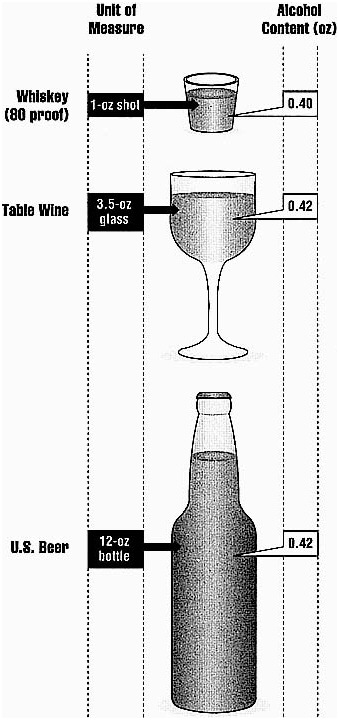
FIGURE 9.1 Amount of alcohol in a drink. Most table wines contain 11 to 13% alcohol. Fortified wines, such as sherry and port, contain approximately 20% alcohol. Most U.S. brands of beer contain 3.2 to 4.0% alcohol.
SOURCE: Baum-Baicker, C. 1985. The health benefits of moderate alcohol consumption: a review of the literature. Drug Alcohol Depend. 15:207-227.
0.99 ounces of alcohol a day, perhaps by having a bottle of beer each day. Heavy drinkers consume an average of an ounce or more of alcohol each day. Nine percent of all adults in the United States are characterized as heavy drinkers, 24 percent are moderate drinkers, and 33 percent are light drinkers. The remaining 33 percent abstain from drinking.
The best indicator of the effect of drinking is the blood alcohol level. At a blood alcohol level of 0.05 (5 parts of alcohol to 10,000 parts of blood), which a person reaches after one or two drinks, most people experience positive sensations such as relaxation, euphoria, and well-being. Above this mark, a person starts feeling worse and gradually loses control of speech, balance, and emotions. When the blood alcohol level reaches 0.1, a person is drunk; at 0.2, some people pass out; at 0.3, some people collapse into a coma; and at 0.4 a person can die.
In 1985, some 18 million adults had problems with alcohol use. Of these, 41 percent, or 7.3 million adults, were alcohol abusers: they had experienced at least one moderately severe consequence of alcohol abuse, such as losing a job or being arrested, during the previous year. The remaining 59 percent, or 10.6 million adults, were alcoholics.
Alcohol abuse is more frequent in men than women and more common in youth and middle age. The Eat for Life guidelines do not recommend that you drink alcoholic beverages if you currently avoid them. But they do not recommend that you not use alcohol either (except during pregnancy), especially if you use it responsibly in limited amounts.
Liver Disease
Most cases of liver cirrhosis are caused by chronic heavy drinking. One study showed that drinking five drinks a day can cause cirrhosis in men. Women who drink heavily are more susceptible than men to cirrhosis; as few as three drinks a day can produce cirrhosis in women.
Although heavy drinking can lead to liver disease, only
about 18 percent of all alcoholics have cirrhosis. Perhaps this is because many alcoholics die from other causes before cirrhosis sets in. One study estimated that it takes an average of 25 years of drinking 7.5 ounces of alcohol—about one-third of a bottle of liquor—a day to produce cirrhosis. Compared with not drinking at all, downing 3.5 to 7 ounces of alcohol a day increases the risk of developing cirrhosis fivefold. Drinking even more than that makes it 25 times more likely that the drinker will develop cirrhosis.
Cancer
There is consistent evidence that alcohol increases the risk of cancers at several sites in the body, including the mouth, throat, esophagus, larynx, and liver. For cancer of the mouth, throat, esophagus, and larynx, drinking and smoking cigarettes appear to act synergistically to cause cancer. In other words, the damage caused by smoking and drinking together is worse than if you merely added the damage caused separately by each activity.
In North America and Western Europe, drinking is the main cause of cirrhosis of the liver, and cirrhosis is a primary cause of liver cancer. This does not mean, necessarily, that drinking causes liver cancer, though it does show that drinking produces a condition that may itself lead to liver cancer. However, some studies suggest that liver cancer may be more common in alcoholics even in the absence of cirrhosis, suggesting that alcohol itself may indeed cause liver cancer.
For women, heavy drinking may increase the risk of developing breast cancer. Several studies have found that among groups of women the incidence of breast cancer increases with the amount of alcohol consumed. But because some investigations have failed to find this association, the connection between alcohol consumption and breast cancer is far from proven.
Alcohol may cause cancer by a variety of mechanisms. Some experiments show, for example, that alcohol activates enzymes that can produce other cancer-causing chemicals within
the body. Alcohol may also damage DNA, the gigantic molecule of which the body's genetic material is made. This, in turn, can cause a cell to begin multiplying uncontrollably.
Stroke and Heart Disease
People who regularly drink an average of two or more alcoholic beverages a day have higher average blood pressure levels and higher numbers of strokes than do people who are light drinkers or abstainers. In addition, heavy drinking increases the chances of suffering a stroke.
Heavy drinking is also associated with a greater chance of suffering a heart attack. On the other hand, moderate drinking may afford some protection against heart disease. A large study in Hawaii showed that men who are light or moderate drinkers have fewer heart attacks than men who either drink heavily or do not drink at all. In women, the "benefits" of drinking are not as apparent as they are in men.
Obesity
It is not unreasonable to think that alcohol may contribute to obesity, since for some people it can be a major calorie source. Drinking two beers a day would provide an additional 2100 calories a week. Over the course of several months, those extra calories might be expected to add a few inches to the waistline. And, indeed for some people, the extra calories from alcohol do translate into extra weight. But alcohol also increases the body's metabolic rate, causing it to burn calories at a higher rate than normal. Thus, although consuming alcohol may contribute too many calories to the diet, it is not the main cause of obesity.
Nervous System Diseases
Chronic drinking can damage the nervous system, producing dementia, confusion, difficulty in walking, and memory
loss. It appears that thiamin deficiency, which results from heavy drinking, produces most of the damage to the nervous system. Alcohol does, however, also have direct toxic effects on brain cells.
Pregnancy
Women who drink heavily while pregnant can give birth to babies with fetal alcohol syndrome, which is characterized by a number of physical defects and behavioral disturbances. Less severe, though certainly noticeable, effects can also occur with even moderate drinking. Women who have as little as one drink a day during pregnancy are more likely than women who abstain from drinking while pregnant to deliver smaller babies. Thus the best advice if you are pregnant, or even thinking about getting pregnant, is not to drink.
COFFEE AND TEA
Tea's use as a beverage started in China in approximately 350 A.D. Coffee is a newer drink, first swallowed hot around 1000 A.D. Today, coffee and tea are among the most commonly consumed beverages in the world. In the United States, over half the adult population drinks coffee, with each person averaging 1.74 cups a day. Nearly 80 percent of the coffee is "regular," though the popularity of decaffeinated coffee is growing. Only about 31 percent of the U.S. population drinks tea. Coffee and tea are the greatest source of caffeine in the U.S. diet.
Cancer
There is no convincing evidence that drinking coffee or tea increases the chances of developing cancer. Some studies have suggested that coffee drinking might be associated with an increased risk of developing cancers of the bladder and
colon, which prompted newspaper and magazine stories cautioning against coffee drinking. However, further investigations have exonerated coffee drinking; it appears that cigarette smoking was to blame for the increase in bladder cancer cases, and some other dietary factor, such as fats, may be at work with colon cancer.
Heart Disease
Over the past few years, a number of studies have found that coffee drinking may increase LDL-cholesterol levels, especially when the coffee is boiled (as it is in Scandinavia). But at least among U.S. coffee drinkers, the effect is so small as not to increase the risk for heart disease. Tea drinking has no effect on serum cholesterol levels, nor does it increase the risk of heart disease.
Pregnancy
In humans, caffeine crosses the placenta. In addition, the body metabolizes caffeine one-third as fast during pregnancy. As a result, caffeine accumulates in the mother, and it passes to the fetus, which has no enzymes with which to get rid of this chemical. What caffeine does to the human fetus is unclear, but some studies have shown that pregnant women who have high caffeine intakes are at greater risk of delivering babies of low birth weight. It appears sensible to limit caffeine intake during pregnancy.
OTHER FOOD ADDITIVES
Nearly 3,000 substances are added intentionally to foods in the United States during processing. Some 12,000 chemicals, such as the food packaging material polyvinyl chloride, can enter food more or less by accident; these are called indirect


