
National Academy of Sciences | 150 Year Anniversary

Questions? Call 800-624-6242

| Items in cart [0]

The National Academies Press

Rights & Permissions

topleft topright

NCHRP Report 516: Pier and Contraction Scour in Cohesive Soils (2004)
National Cooperative Highway Research Program (NCHRP)

Citation Manager

Wang, J, Briaud, J-L, Li, Y, Chen, H-C, Nurtjahyo, P, Transportation Research Board. "Unit Conversions." NCHRP Report 516: Pier and Contraction Scour in Cohesive Soils. Washington, DC: The National Academies Press, 2004.

Please select a format:

BibTeX EndNote RefMan


Page
118
bottomleft bottomright
Page
118
Front Matter (R1-R10)
Summary (1-7)
1.4 Why Was This Problem Addressed? (8-8)
1.5 Approach Selected to Solve the Problem (9-9)
2.4 Erodibility and Correlation to Soil and Rock Properties (10-13)
3.3 EFA Test Data Reduction (14-14)
3.4 EFA Precision and Typical Results (15-16)
4.2 Small Flood Followed by Big Flood (17-17)
4.3 Big Flood Followed by Small Flood and General Case (18-18)
4.4 Hard Soil Layer Over Soft Soil Layer (19-20)
4.6 Equivalent Time (21-21)
4.7 Extended and Simple SRICOS-EFA Method (22-23)
4.8 Case Histories (24-25)
4.9 Predicted and Measured Local Scour for the Eight Bridges (26-28)
4.10 Conclusions (29-29)
5.4 Measuring Equipment (30-31)
5.5 Soils and Soil Bed Preparation (32-32)
5.6 Flume Tests: Procedure and Measurement (33-33)
5.8 Shallow Water Effect on Maximum Pier Scour Depth (34-35)
5.9 Shallow Water Effect on Initial Shear Stress (36-36)
5.11 Pier Spacing Effect on Maximum Scour Depth (37-37)
5.12 Pier Spacing Effect on Initial Scour Rate (38-38)
5.15 Pier Shape Effect on Initial Scour Rate (39-39)
5.18 Attack Angle Effect on Maximum Scour Depth (40-41)
5.20 Attack Angle Effect on Scour Hole Shape (42-42)
5.21 Maximum Scour Depth Equation for Complex Pier Scour (43-44)
6.2 Existing Knowledge on Numerical Simulations for Scour (45-45)
6.5 Shallow Water Effect: Numerical Simulation Results (46-46)
6.6 Shallow Water Effect on Maximum Shear Stress (47-47)
6.7 Pier Spacing Effect: Numerical Simulation Results (48-48)
6.9 Pier Shape Effect: Numerical Simulation Results (49-50)
6.10 Pier Shape Effect on Maximum Shear Stress (51-51)
6.11 Attack Angle Effect: Numerical Simulation Results (52-52)
6.12 Attack Angle Effect on Maximum Shear Stress (53-53)
6.13 Maximum Shear Stress Equation for Complex Pier Scour (54-55)
7.3 Flume Tests and Measurements (56-56)
7.4 Flume Tests: Flow Observations and Results (57-58)
7.5 Flume Tests: Scour Observations and Results (59-59)
7.6 Maximum and Uniform Contraction Depths for the Reference Cases (60-62)
7.7 Location of Maximum Contraction Depth for the Reference Cases (63-63)
7.8 Correction Factors for Transition Angle and Contraction Length (64-64)
7.9 SRICOS-EFA Method Using HEC-RAS Generated Velocity (65-65)
7.11 Scour Depth Equations for Contraction Scour (66-67)
8.3 Transition Angle Effect: Numerical Simulation Results (68-68)
8.4 Contracted Length Effect: Numerical Simulation Results (69-71)
8.6 Maximum Shear Stress Equation for Contraction Scour (72-75)
9.3 The Integrated SRICOS-EFA Method: Step-by-Step Procedure (76-80)
9.5 The SRICOS-EFA Program (81-83)
9.6 Output of the SRICOS-EFA Program (84-84)
10.4 Gill (1981) Database: Contraction Scour (85-87)
10.5 Remarks (88-88)
11.2 Preparation of the Future Hydrographs (89-89)
11.3 Risk Approach to Scour Predictions (90-90)
11.4 Observations on Current Risk Levels (91-92)
12.2 Example 2: Single Rectangular Pier with Attack Angle and Approaching Hydrograph (93-94)
12.3 Example 3: Group Rectangular Piers with Attack Angle and Approaching Constant Velocity (95-98)
12.4 Example 4: Contracted Channel with 90-Degree Transition Angle and Approaching Constant Velocity (99-102)
12.5 Example 5: Contracted Channel with 60-Degree Transition Angle and Approaching Hydrograph (103-104)
12.6 Example 6: Bridge with Group Piers and Contracted Channel with Hydrograph in Contracted Section (105-110)
13.1 Conclusions (111-112)
13.2 Recommendations, (113-113)
References (114-115)
Nomenclature (116-117)
Unit Conversions (118-118)
Appendix A - Photographs from the Flume Tests (119-125)
Abbreviations used without definitions in TRB publications (126-126)

Below are the first 10 and last 10 pages of uncorrected machine-read text (when available) of this chapter, followed by the top 30 algorithmically extracted key phrases from the chapter as a whole.
Intended to provide our own search engines and external engines with highly rich, chapter-representative searchable text on the opening pages of each chapter. Because it is UNCORRECTED material, please consider the following text as a useful but insufficient proxy for the authoritative book pages.

Do not use for reproduction, copying, pasting, or reading; exclusively for search engines.

OCR for page 118
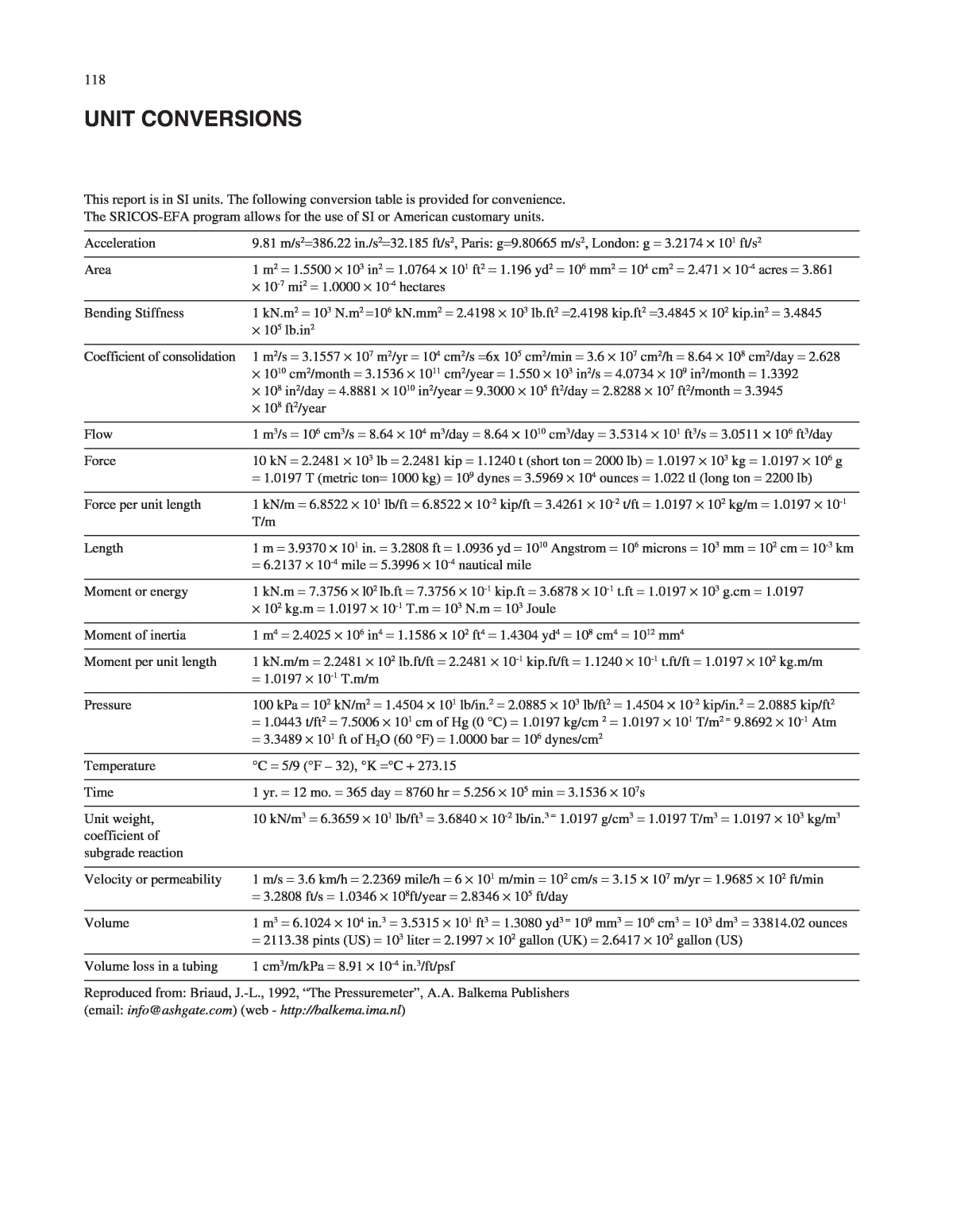
118 UNIT CONVERSIONS This report is in SI units. The following conversion table is provided for convenience. The SRICOS-EFA program allows for the use of SI or American customary units. Acceleration 9.81 m/s2=386.22 in./s2=32.185 ft/s2, Paris: g=9.80665 m/s2, London: g = 3.2174 × 101 ft/s2 Area 1 m2 = 1.5500 × 10³ in2 = 1.0764 × 101 ft2 = 1.196 yd2 = 106 mm2 = 104 cm2 = 2.471 × 10⁻⁴ acres = 3.861 × 10⁻⁷ mi2 = 1.0000 × 10⁻⁴ hectares Bending Stiffness 1 kN.m2 = 103 N.m2 =106 kN.mm2 = 2.4198 × 10³ lb.ft2 =2.4198 kip.ft2 =3.4845 × 10² kip.in2 = 3.4845 × 10⁵ lb.in2 Coefficient of consolidation 1 m2/s = 3.1557 × 10⁷ m2/yr = 104 cm2/s =6x 105 cm2/min = 3.6 × 107 cm2/h = 8.64 × 108 cm2/day = 2.628 × 1010 cm2/month = 3.1536 × 1011 cm2/year = 1.550 × 10³ in2/s = 4.0734 × 10⁹ in2/month = 1.3392 × 10⁸ in2/day = 4.8881 × 10¹⁰ in2/year = 9.3000 × 105 ft2/day = 2.8288 × 107 ft2/month = 3.3945 × 108 ft2/year Flow 1 m3/s = 106 cm3/s = 8.64 × 10⁴ m3/day = 8.64 × 1010 cm3/day = 3.5314 × 101 ft3/s = 3.0511 × 106 ft3/day Force 10 kN = 2.2481 × 10³ lb = 2.2481 kip = 1.1240 t (short ton = 2000 lb) = 1.0197 × 10³ kg = 1.0197 × 10⁶ g = 1.0197 T (metric ton= 1000 kg) = 109 dynes = 3.5969 × 10⁴ ounces = 1.022 tl (long ton = 2200 lb) Force per unit length 1 kN/m = 6.8522 × 101 lb/ft = 6.8522 × 10⁻² kip/ft = 3.4261 × 10⁻² t/ft = 1.0197 × 10² kg/m = 1.0197 × 10⁻¹ T/m Length 1 m = 3.9370 × 101 in. = 3.2808 ft = 1.0936 yd = 1010 Angstrom = 106 microns = 103 mm = 102 cm = 10-3 km = 6.2137 × 10⁻⁴ mile = 5.3996 × 10⁻⁴ nautical mile Moment or energy 1 kN.m = 7.3756 × l02 lb.ft = 7.3756 × 10⁻¹ kip.ft = 3.6878 × 10⁻¹ t.ft = 1.0197 × 10³ g.cm = 1.0197 × 10² kg.m = 1.0197 × 10⁻¹ T.m = 103 N.m = 103 Joule Moment of inertia 1 m4 = 2.4025 × 10⁶ in4 = 1.1586 × 102 ft4 = 1.4304 yd4 = 108 cm4 = 1012 mm4 Moment per unit length 1 kN.m/m = 2.2481 × 10² lb.ft/ft = 2.2481 × 10⁻¹ kip.ft/ft = 1.1240 × 10⁻¹ t.ft/ft = 1.0197 × 10² kg.m/m = 1.0197 × 10⁻¹ T.m/m Pressure 100 kPa = 102 kN/m2 = 1.4504 × 101 lb/in.2 = 2.0885 × 10³ lb/ft2 = 1.4504 × 10⁻² kip/in.2 = 2.0885 kip/ft2 = 1.0443 t/ft2 = 7.5006 × 101 cm of Hg (0 °C) = 1.0197 kg/cm 2 = 1.0197 × 101 T/m2 = 9.8692 × 10⁻¹ Atm = 3.3489 × 101 ft of H2O (60 °F) = 1.0000 bar = 106 dynes/cm2 Temperature °C = 5/9 (°F ­ 32), °K =°C + 273.15 Time 1 yr. = 12 mo. = 365 day = 8760 hr = 5.256 × 10⁵ min = 3.1536 × 10⁷s Unit weight, 10 kN/m3 = 6.3659 × 101 lb/ft3 = 3.6840 × 10⁻² lb/in.3 = 1.0197 g/cm3 = 1.0197 T/m3 = 1.0197 × 10³ kg/m3 coefficient of subgrade reaction Velocity or permeability 1 m/s = 3.6 km/h = 2.2369 mile/h = 6 × 101 m/min = 102 cm/s = 3.15 × 10⁷ m/yr = 1.9685 × 102 ft/min = 3.2808 ft/s = 1.0346 × 108ft/year = 2.8346 × 105 ft/day Volume 1 m3 = 6.1024 × 104 in.3 = 3.5315 × 101 ft3 = 1.3080 yd3 = 109 mm3 = 106 cm3 = 103 dm3 = 33814.02 ounces = 2113.38 pints (US) = 103 liter = 2.1997 × 10² gallon (UK) = 2.6417 × 10² gallon (US) Volume loss in a tubing 1 cm3/m/kPa = 8.91 × 10⁻⁴ in.3/ft/psf Reproduced from: Briaud, J.-L., 1992, "The Pressuremeter", A.A. Balkema Publishers (email: info@ashgate.com) (web - http://balkema.ima.nl)