


Below is the uncorrected machine-read text of this chapter, intended to provide our own search engines and external engines with highly rich, chapter-representative searchable text of each book. Because it is UNCORRECTED material, please consider the following text as a useful but insufficient proxy for the authoritative book pages.
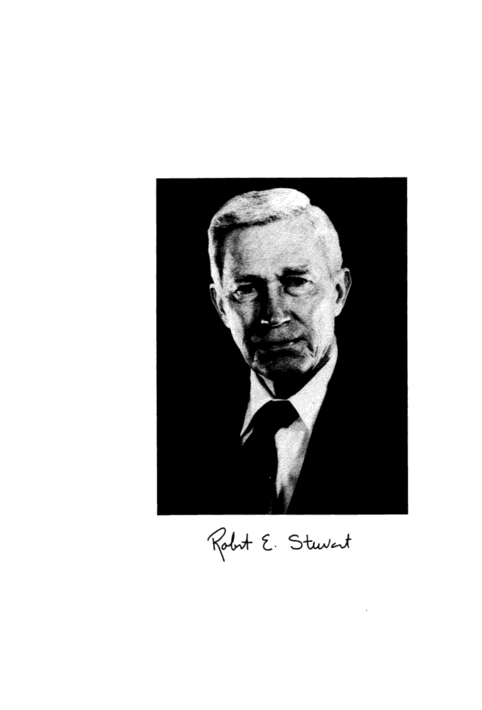
ROBERT E. STEWART 1915-1983 BY GORDON H. MILLAR ROBERT E STEWART a leading agricultural engineering re- searcher ant! a central figure in the clevelopment of agricul- tural engineering education, diect on November 13, 1983, at the age of sixty-eight. From 1968 until 1980, he was a pro- fessor at Texas A&M University and was namec! ctistin- guishec} professor emeritus in 1981. His contributions to the broact field of agriculture anct to agricultural engineering are recognized by every serious re- searcher in the United States anc! in many other countries. He was a strong leacler, a talentect educator, ant] a prolific writer. His principal research was in the area of animal envi- ronmental stresses and regulation. Moreover, his work has been appliect to substantially improve the animal-basect food production capabilities not only of the United States, but also of Inctia and Australia, countries in which major improve- ments in the fooct supply attest to his perceptiveness as well as to the accuracy anct detail of his research. Robert Stewart was born in Carthage, Missouri, anct re- ceived a B.S. (1948), an M.S. (1950), anct a Ph.D (1953), all from the University of Missouri. In 1970 he was presented with the University of Missouri Honor Award for ctistin- · · . . - gUlS nec ~ service in engineering. Robert Stewart is survived by his wife Bonnie; a daughter, Lillian Carl; two sisters; ant! two grandsons. He was clevoted 323
324 MEMORIAL TRIBUTES to his family, and despite the demands of his profession and the worldwide scope of his research activities, he always found enough time to participate in family activities. He was a past president of the American Society of Agri- cultural Engineers. Prior to joining the Agricultural Engi- neering Department of Texas A&M as distinguished profes- sor, he was chairman of the Department of Agricultural Engineering at Ohio State University. Robert Stewart served on the Board on Agriculture of the National Research Council for two three-year terms. He was also past chairman of the Engineers' Joint Council on Engi- neering Interactions in Biology and Medicine. He was elected to the National Academy of Engineering in 1978. Bob was very active in developing technical information leading to better and more economical dairy and meat pro- duction and was the author of numerous publications. In 1983 he received the Cyrus Hall McCormick Medal from the American Society of Agricultural Engineers for "exceptional and meritorious engineering achievement in agriculture." More than anyone else, Bob Stewart anticipated the trend in modern agriculture toward raising agricultural animals in engineered environments. Early in his career, he recognized the importance of the environment and, using sound engi- neering approaches, established criteria for agricultural structures and the methodology for controlling the animal environment. He ranks very close to the top of those in the agricultural professional world devoted to the study of envi- ronmental physiology. Despite his scientific and intellectual depth, Bob Stewart never forgot the fact that without engineering applications the science of agriculture would not reach its full contribu- tion potential. He maintained close associations with the American Society for Engineering Education and the Na- tional Society of Professional Engineers. Robert Stewart sus- tained an active career in engineering and was a registered · ~ engineer in severe states. Bob was both a scientist and an engineer, and he will be
ROBERT E. STEWART 325 greatly missed by his colleagues, his associates, and so many of his students. Just before his passing, he served as a mem- ber of the National Academy of Engineering Agricultural Peer Committee, which was organized to bring qualified ag- ricultural engineering candidates into the academy as mem- bers. Although he could not travel, he served on the commit- tee with great perception, wisdom, and talent. As a result of his work, several agricultural engineers are now members of the National Academy of Engineering. The nation and the world are better oh for Robert Stew- art's scientific and engineering contributions, which will be enjoyed by grateful populations in the many years ahead.
