




Below is the uncorrected machine-read text of this chapter, intended to provide our own search engines and external engines with highly rich, chapter-representative searchable text of each book. Because it is UNCORRECTED material, please consider the following text as a useful but insufficient proxy for the authoritative book pages.
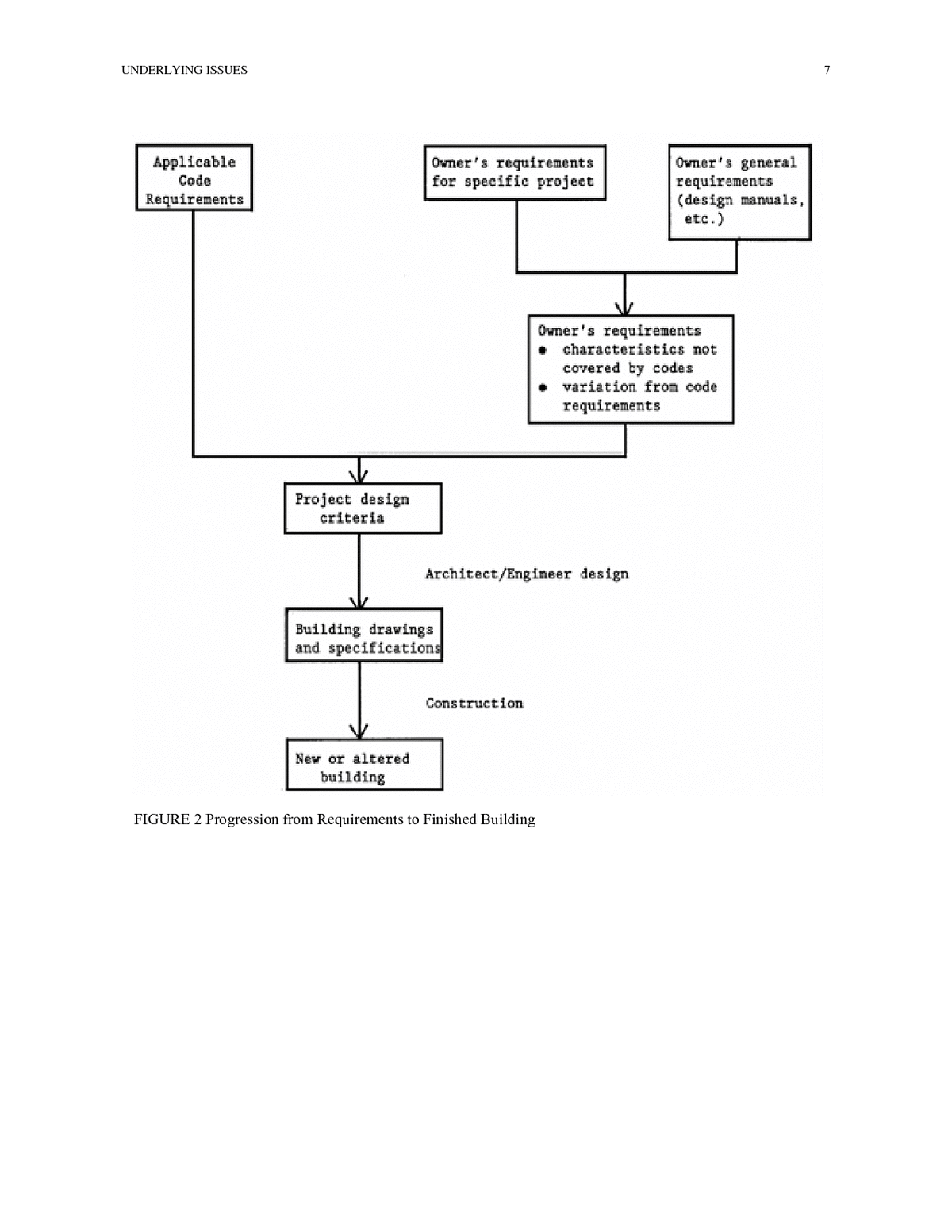
UNDERLYING ISSUES 5 2 UNDERLYING ISSUES The sometimes divergent interests of agencies at different levels of government (acting as building owners or as regulators of building design and construction), professional groups, and local communities give rise to a range of issues that must be weighed in discussions of building codes and design criteria. The committee discussed a number of such issues that have bearing on the questions posed in this study. EXTENSIVE SCOPE OF OWNER'S REQUIREMENTS In reviewing the scope of its charge and the origins of suggestions that federal agencies use building codes as design criteria, the committee perceived some confusion among building users regarding the scope of owners requirements and code requirements, and how these requirements influence design criteria. Design criteria address a broad range of concerns such as building comfort, economy, operating efficiency, visual appearance, durability, safety, health, and other qualities. Design criteria comprise the combined requirements of applicable building codes and owner's concerns that extend to areas not considered in codes. (Refer to Figure 1) Building codes address building characteristics that have direct implication for public safety, health, and welfare. These codes establish standards that the local jurisdiction or promulgating authority judge to be the minimum acceptable for protection of the public interest. Building owners, private or public, may choose to adopt design criteria that exceed the minimum requirements set in applicable codes. These owners' requirements reflect a balancing of economic and other concerns that may go beyond the public interest. Federal agencies may in principle elect to adopt design criteria that are below standards incorporated in a local code. Owner's requirements will in addition address matters beyond the scope of codes. Representatives of FCC member agencies whose design criteria are acknowledged to incorporate elements that duplicate model codes estimate that code items comprise approximately 20 percent of the overall scope of their owner's requirements. There are several steps in the progression from owner's and code requirements to finished buildings. (Refer to Figure 2) The design criteria, which are tailored to the specific project to be built, are
UNDERLYING ISSUES 6 FIGURE 1 Relationship of Code and Owner's Requirements that Comprise Building Design Criteria
UNDERLYING ISSUES 7 FIGURE 2 Progression from Requirements to Finished Building
UNDERLYING ISSUES 8 FEDERAL AGENCIES AS BUILDING OWNERS AND USERS Federal agencies are individually and as a group among the largest purchasers and managers of buildings in the United States. These agencies share a number of characteristics that have significant influence on their owner's requirements: ⢠As agencies of federal government, they are exempt from local government regulations and remain entirely responsible for establishing appropriate requirements of building performance for protection of safety, health, and welfare of building users and surrounding areas. ⢠Many agencies have responsibility for relatively unusual types of buildings such as military installations, scientific laboratory and testing facilities, and facilities intended to serve special populations (such as native Americans or disabled military veterans) or in especially hostile environments (such as arctic conditions). ⢠These agencies build facilities primarily for their own use, and so (in contrast to developers in the private sector) must live --throughout the building's life cycle -- with the consequences of design and construction. This characteristic is shared by many large private sector building owners.8 ⢠The federal government is self-insured with respect to building damage and loss, and thus these agencies have total concern for financial consequences of building performance. Federal agency owner's requirements have typically evolved over a period of many years to cover all elements of concern to each agency. Each agency has developed various guidelines and manuals to document their owner's requirements. These documents are sometimes voluminous and generally differ from one agency to another. While some agencies have referred to selected model codes or other voluntary standards in stating their building design criteria, others have stated explicitly the requirements they have developed themselves or adopted for their purposes. Changes, additions and deletions proposed for these federal documents must generally undergo extensive processes of agency review and approval prior to their adoption in agency building practice. Agency officials may be understandably hesitant to undertake making such changes unless they are warrented by changing mission requirements, potential 8However, in contrast to private sector owners, agencies are subject to congressional review of their decisions about appropriate design criteria.
UNDERLYING ISSUES 9 improvements in productivity, or new legislation. However, some agencies undertake periodic review and revision of their design criteria. SCOPE AND DIVERSITY IN FEDERAL AGENCY REQUIREMENTS While federal agency design criteria are well documented, designers and constructors must expend considerable effort to familiarize themselves with the specific criteria used by the agency they wish to serve. These private architects, engineers, and builders sometimes suggest that the effort required may restrict competition for agency work and diminish the potential economies of scale of firms that might work for several agencies. Some observers argue that the agencies themselves may expend excess effort developing their own requirements, when standards proposed by private sector groups or other agencies would serve the agency equally well. This latter observation underlies regulations and laws that encourage federal government agencies to rely to the greatest feasible extent on voluntary standards proposed by private sector bodies. (Refer to Chapter 4) The effort required to become familiar with agency criteria has led the National Institute of Building Sciences (NIBS), with agency support, to undertake development of a computerized library of selected federal agency construction guide specifications, standards, and manuals. This Construction Criteria Base (CCB) is contained on a single optical compact disk (CD-ROM) that may be accessed by an appropriately equipped microcomputer, and contains the full text of more than 50,000 pages of documents issued by the U.S. Naval Facilities Engineering Command (NAVFAC), U.S. Army Corps of Engineers (CoE), Veterans Administration (VA), and National Aeronautics and Space Administration (NASA). Data are updated quarterly, and additional agencies are to be added. The committee notes that such a system could over the long term encourage uniformity of agency criteria, simply by making it possible to compare quickly the latest criteria being used by each agency. However, diversity of agencies' missions and procedures underlies lack of uniformity of federal design criteria. Limited comparisons of agency criteria suggest there may in fact be a good deal of similarity, but that substantive differences do exist.9 For example, one agency was found to have a uniform 100 pounds per square foot required design load for automobile parking structures, twice that specified by five other agencies. Such differences generally result from unique agency requirements, but may sometimes be due to overly conservative judgments on the part of some agency personnel. 9Standardizingthe Structural Engineering Criteria of Federal Construction Agencies. Transactions of the Federal Construction Council for 1979-80, Building Research Advisory Board, Washington, DC.
UNDERLYING ISSUES 10 LOCAL GOVERNMENT CONCERNS ABOUT FEDERAL EXEMPTION FROM LOCAL CODES Local building codes are tailored, in principle, to reflect the unique problems and concerns of the local community, and local building officials are responsible for assuring that these problems and concerns are addressed in design and construction of buildings within their jurisdictions. Local government officials sometimes feel that federal agencies may fail to recognize these unique problems and concerns. The committee was told of cases in which designs for federal buildings were inappropriate to local conditions and resulted in costly difficulties during construction, that could have been avoided had local building code provisions been applied. Officials are said to question the safety of federal buildings in other cases in which design or renovations vary from requirements adopted in local building codes. LOCAL BUILDING CODES AND BUILDING INSPECTION Building codes operate in two ways: First, the requirements they contain establish minimum levels of performance that buildings and their constituent elements should achieve. The public is assured that all buildings meeting code provisions in a jurisdiction can withstand certain anticipated demands and hazards of use, such as the particular rooftop snow load, fire intensity and duration, and weight of people and equipment occupying the building, that the code specifies. In addition to these specific requirements, building codes require that building plans and construction be reviewed by local government officials who must certify that code provisions have been met. Building permits and occupancy permits are issued in most jurisdictions when, respectively, the building's plans and specifications are reviewed and approved and the finished construction is inspected and accepted. The adequacy and objectivity of each approval may depend on the thoroughness and judgement of the individual official, a factor that the committee observes has sometimes led to abuses of the code process. Local government agencies typically charge building designers and construction contractors permit fees to cover some portion of the costs of inspection and code enforcement. These costs may in turn be repaid by the building owner or recovered indirectly as part of the design fee or construction contract payment. Federal agencies, exempt from local review and permit requirements, avoid the costs associated not only with permit fees but also the time and labor required to accomplish the review process. However, the agencies may or may not expend greater effort -- relative to a private building owner who relies on the building code to deal with particular health and safety concerns -- to assure that their owner's criteria are met. DIVERSITY OF LOCAL CODE PROVISIONS Local building codes in the United States exhibit extraordinary diversity from one jurisdiction to another. While a relatively small
UNDERLYING ISSUES 11 number of prototypes have served as the point of departure for local code development, there are by some estimates more than 10,000 different local codes that a federal agency may encounter across the country. In the Philadelphia, Pennsylvania region alone, there are reported to be 220 political and administrative jurisdictions that have distinct code requirements.10 Professionals responsible for building design and construction in many jurisdictions face a large burden to remain aware of the distinct review processes and standards that govern in a particular location. This diversity of local codes springs from many sources: ⢠The conditions of climate, soils, and geology to which a building must accommodate vary from place to place. ⢠Communities may adopt different priorities toward the various aspects of safety, health, and welfare that building codes are intended to protect, or may have particular aesthetic or historic aspects of the community's design they wish to preserve. ⢠Historic precedent may have determined the basic framework and subsequent evolution of a community's code. ⢠Available budgets and professional staff capability prevent many communities from keeping their building codes up-to-date with new information made available by national standards and model code organizations. ⢠Public officials responsible for adopting building code revisions may not act to bring their local code into conformance with models proposed by other government bodies or national standards and model code organizations.11 The diversity is apparent both in the specific standards and procedures adopted in various codes and in the ways these codes are laid out. The lack of parallel structure often makes direct comparison of two code documents extremely difficult and time consuming, even for the nationally recognized model codes. Diversity of local codes is frequently cited by the building profession as a factor that fosters inappropriate regionalism and limits competition in building markets by requiring designers and builders to become familiar with potentially different regulations in every jurisdiction where they might wish to work. This situation also is said to retard innovation in building products and processes when new ideas require changes in existing codes. At least one commercial enterprise is addressing the difficulties this diversity of codes raises for the profession. Under an agreement with the National Conference of States on Building Codes and Standards (NCSBCS), a computerized database is being developed. This database 10Districtrequirements in any single jurisdiction may result from adoption and adaptation of provisions selected from the smaller number of model codes and historic precedents. 11Building codes typically are adopted by legislative process that cannot respond quickly to changes in model codes.
UNDERLYING ISSUES 12 includes provisions of the nationally recognized codes as well as officially adopted state and major city building codes. Users of the system may conduct searches of the codes contained in the documents included in the database. The committee observes that such a system, if complete in its coverage of a region where an agency intends to build, could assist comparison of any owner's design criteria with nationally recognized and local building codes. However, currently available systems are far from complete, and may be difficult to keep up-to-date. LOCAL CODES AS BARRIERS TO NATIONAL POLICY OR TECHNOLOGICAL INNOVATION To the extent that a local jurisdiction's building code contains provisions that respond to particular interests and concerns of the local community, the code may be viewed by outsiders as an inappropriate constraint on what is built or how buildings are designed in the community. Local building codes and zoning ordinances have been cited as barriers to development of low cost housing and to introduction of new building materials or products that could reduce costs or improve performance. Federal agencies, exempt from local building codes, retain the ability to be innovative or to implement federal policies in design and construction of their facilities. POTENTIAL ADVANTAGES OF INCREASED USE OF MODEL BUILDING CODES The committee observes that discussion of whether federal agencies should use building codes in place of their own design criteria inevitably expresses a desire by many people in the building professions for increased uniformity in building codes and design criteria throughout the nation. Proponents attribute to increasing uniformity a variety of benefits: Federal agencies and other building owners (or their architects and engineers) would, as a group, expend less effort developing and reviewing their individual project design criteria; builders and building products manufacturers would have access to expanded markets and associated economies of scale; government building regulatory agencies would expend less effort reviewing and maintaining their local building codes. Such arguments must be weighed against the diversity of geographic areas and owner' requirements that lead to variations. The committee acknowledged that some of the variation in codes and criteria is unavoidable and appropriate. Nevertheless, the committee members' experience suggests that the variation is greater than necessary, and that federal agencies can benefit from increased use of model codes: ⢠Agencies will find it easier to communicate their requirements to architectural and engineering firms seeking to undertake design work with an agency but unfamiliar with the agency's design criteria.
UNDERLYING ISSUES 13 ⢠Greater numbers of architects and engineers may consequently be attracted to compete for work with agencies, new to that firm, which can reduce agency design and construction costs or improve quality. ⢠Agencies may find it easier to justify their project designs within a budgetary process that can place severe pressure to reduce design criteria. In addition, the nation as a whole could benefit from the leadership that federal agencies can exert through greater use of model codes: ⢠Model code organizations (refer to Chapter 3) may be encouraged by federal agency participation to make greater efforts to reduce unnecessary differences among codes. ⢠Local communities throughout the nation may be encouraged to adopt current model codes as the basis for their local building codes.
UNDERLYING ISSUES 14
