


Below is the uncorrected machine-read text of this chapter, intended to provide our own search engines and external engines with highly rich, chapter-representative searchable text of each book. Because it is UNCORRECTED material, please consider the following text as a useful but insufficient proxy for the authoritative book pages.
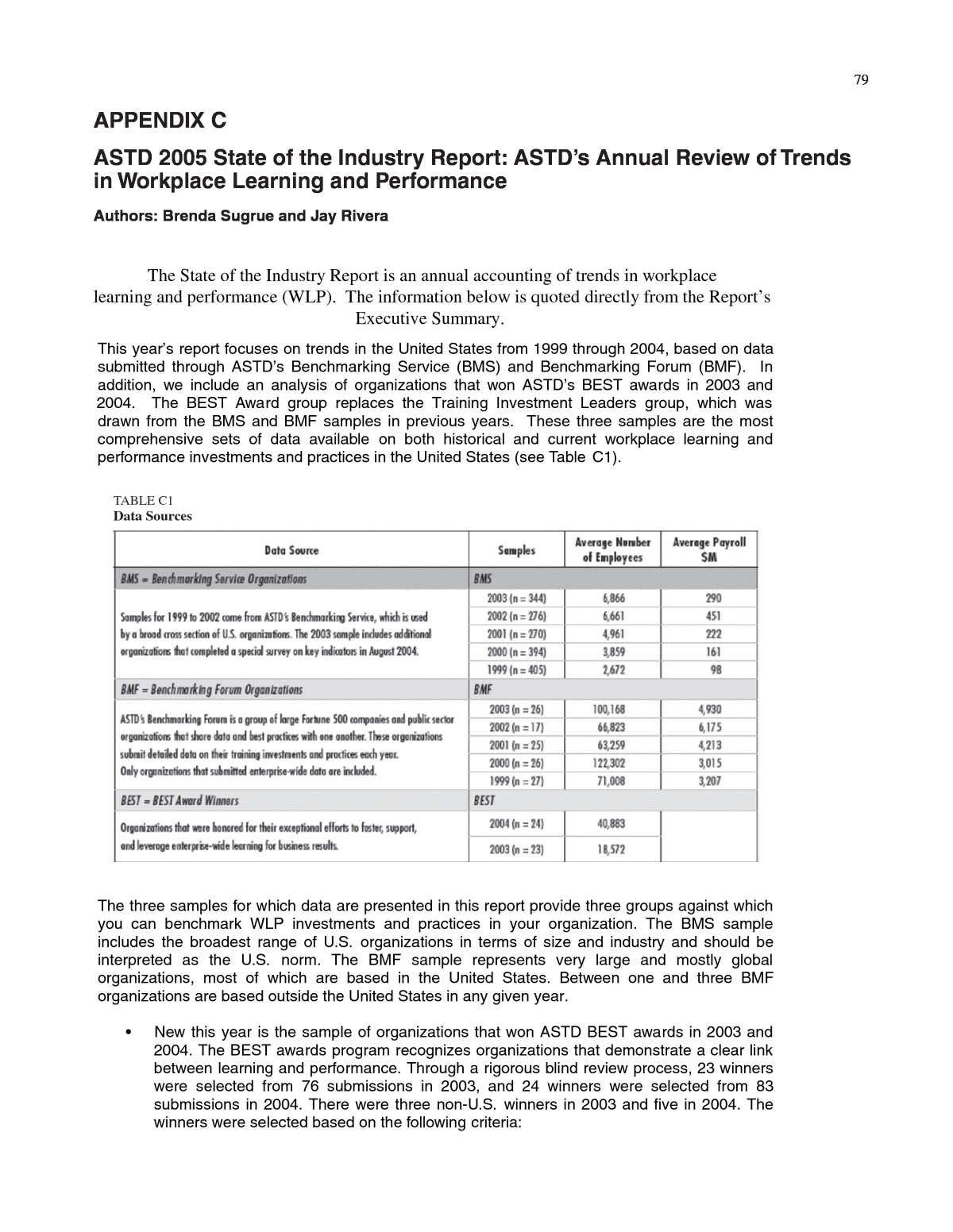
79 APPENDIX C ASTD 2005 State of the Industry Report: ASTDâs Annual Review of Trends in Workplace Learning and Performance Authors: Brenda Sugrue and Jay Rivera TABLE C1 Data Sources The State of the Industry Report is an annual accounting of trends in workplace learning and performance (WLP). The information below is quoted directly from the Reportâs Executive Summary. This yearâs report focuses on trends in the United States from 1999 through 2004, based on data submitted through ASTDâs Benchmarking Service (BMS) and Benchmarking Forum (BMF). In addition, we include an analysis of organizations that won ASTDâs BEST awards in 2003 and 2004. The BEST Award group replaces the Training Investment Leaders group, which was drawn from the BMS and BMF samples in previous years. These three samples are the most comprehensive sets of data available on both historical and current workplace learning and performance investments and practices in the United States (see Table C1). The three samples for which data are presented in this report provide three groups against which you can benchmark WLP investments and practices in your organization. The BMS sample includes the broadest range of U.S. organizations in terms of size and industry and should be interpreted as the U.S. norm. The BMF sample represents very large and mostly global organizations, most of which are based in the United States. Between one and three BMF organizations are based outside the United States in any given year. ⢠New this year is the sample of organizations that won ASTD BEST awards in 2003 and 2004. The BEST awards program recognizes organizations that demonstrate a clear link between learning and performance. Through a rigorous blind review process, 23 winners were selected from 76 submissions in 2003, and 24 winners were selected from 83 submissions in 2004. There were three non-U.S. winners in 2003 and five in 2004. The winners were selected based on the following criteria:
80 ⢠The number of hours of formal learning per employee has averaged about 28 h in BMS organizations and about 38 h in the larger BMF organizations from 2002 to 2004. ⢠The average number of employees per WLP staff member in 2004 was 194 in BMS organizations and 325 in BMF organizations in 2004. The average number of hours of content provided per WLP staff member was 541 in BMS organizations and 505 in BMF organizations in 2003. ⢠The average cost per learning hour provided was $596 per hour in BMS and $1,430 per hour in BMF organizations in 2003. However, the average cost per learning hour received was $56 in both BMS and BMF organizations, because BMF organizations, being larger, have greater reuse of each hour of learning that is provided. ⢠Expenditure per employee group was greatest for customer service employees in 2003, with an average of 18% of expenditure going to that single employee group. However, an average of 28% of learning expenditure went to employees with managerial responsibilities (first-line supervisors, middle and senior managers, and executives combined). ⢠In both BMS and BMF organizations, managerial and executive development combined were allocated the most learning content in 2003 and 2004, followed closely by information technology, business processes, and industry-specific content. Use of technology for delivering learning continued to increase in all samples (BMS, BMF, and BEST). ⢠The projections for 2004 are 29% in BMS, 35% in BMF, and at least 29% in BEST organizations. More than half of technology-based delivery was online in 2003 and 2004, and at least 75% of online learning was self-paced. ⢠The percentage of BMS organizations doing Level 1 evaluation in 2003 was about the same as in 2002 (74%), but the percentage doing Levels 2, 3, and 4 declined in 2003, to 31%, 14%, and 8%, respectively. The case is very different in BEST organizations; all BEST organizations are doing Level 4 evaluation to demonstrate the link between learning and organizational performance. ⢠Common characteristics of BEST winning organizations were â High level of investment in learning (although some spend less than the norm) â Measurement and demonstration of efficiency and effectiveness of the learning function Evidence that learning has value in the culture Evidence of a link between learning and performance Evidence that the organization has leveraged technology in learning Evidence of innovative learning initiatives. For this report, we reanalyzed the winnersâ data to identify commonalities in their learning investments, strategies, practices, and performance outcomes. ⢠The average annual expenditure per employee in ASTDâs broadest sample of organizations (BMS) has remained steady at about $820 since 2002. ⢠Average expenditure per employee in our sample of large organizations (BMF) was consistently higher, but decreased from $1,366 in 2002 to $1,190 in 2004. ⢠The average expenditure per employee in organizations that won ASTD BEST awards in 2003 and 2004 was more than $2,000 each year since 2002. ⢠The average percentage of payroll invested in learning increased from 2.2% in 2002 to 2.52% in 2004 in BMS organizations, but decreased from 2.47% in 2002 to 1.99% in 2004 in our sample of large organizations (BMF). The average expenditure as a percentage of payroll in BEST award winners was considerably higher, ranging from 3.2% in 2002 to 4.16% in 2004. ⢠The percentage of expenditure for external services has risen steadily since 2002, with the average now being 27% in BMS and BEST organizations, and 36% in BMF organizations.
81 ⢠We see these trends most clearly in the sample of ASTD BEST award winners. Not all BEST organizations spend more than the norm on learning, but all maximize and measure the efficiency and effectiveness of their investment, and align learning with business and individual employee competency needs. The BEST organizations also provide a broad range of internal and external learning opportunities for employees, going beyond traditional formal learning activities to begin formalizing the informal; for example, legitimizing and providing structures for knowledge sharing and coaching. ⢠The BEST learning organizations have C-level involvement and support, and systematically involve leaders as role models and teachers. The BEST learning organizations also embrace the integration of learning and other performance improvement strategies. The BEST attribute performance gains as much to non-learning solutions as to learning solutions. ⢠The focus of BEST learning organizations on coaching, knowledge sharing, non-learning performance improvement strategies, and measurement parallels and validates the inclusion of these as areas of expertise in ASTDâs new competency model for the WLP profession. ⢠While the BEST learning organizations lead the way, other organizations are still struggling with the transition from a position of entitlement or luxury to a position of criticality and scrutiny. In our largest and broadest sample of organizations (BMS), only 8% report that they are evaluating effectiveness in terms of business impact. On the other hand, the drive for efficiency is evident across the board as use of technology increases in all samples, at least for delivery of learning. If organizations take advantage of the integration and data collection capabilities of their technology-based learning management systems, then there is the potential for greater alignment and more measurement of learning and performance outcomes. â Alignment of learning with business needs and individual employee competency needs â Provision of a broad range of internal and external formal and informal learning opportunities â Chief-level (or C-level) involvement and support for learning â Combination of learning with other performance improvement solutions. Interpretation ⢠An increasingly competitive global economy and the realization that human capital is the key to organizational performance have been a mixed blessing for workplace learning and performance professionals in recent years. WLP professionalsâ stock has gone up as the perceived value of learning has increased. The status of the learning organization has been elevated as more and more organizations appoint a chief-level officer with responsibility for learning who reports directly to the CEO rather than through HR. But with elevated status come elevated expectations. These expectations are translated into mandates to ârun learning like a business,â âdemonstrate the value of learning,â and âdrive organizational performance. ⢠Organizations that really get the link between learning and performance have stepped up to the plate with, if not increased investment, at least increased efforts to align learning with business goals, target learning resources at mission-critical competencies, and measure both the effectiveness of learning and the efficiency of the learning organization in delivering improved performance outcomes.
82 ⢠There is variation in averages across the three samples included in this report (BMS, BMF, and BEST). For example, average expenditure per employee in 2003 was $818 in BMS, $1,299 in BMF, and $2,240 in BEST organizations. There is also variation within each sample. For example, expenditure per employee ranged from $290 to $2,766 in BMF organizations in 2003. Such variation may make it seem difficult to choose a suitable benchmark for any WLP indicator. Each organization has to determine appropriate levels of investment and learning practices primarily in light of current business needs and related workforce competency gaps. External benchmarks in the form of averages provide meaningful and useful norms, but there may be situations where it is appropriate to deviate from those norms. ⢠Any analysis of the state of the industry is only as good as the data on which it is based. While ASTD is confident that its samples are representative, its survey questions have not kept pace with changes in the industry. In 2005, ASTD will introduce a new set of metrics that will allow us to report on and connect more of the dots between a broader range of learning opportunities and individual, group, and organizational performance variables. ASTD plans to benchmark separately efficiency, effectiveness, alignment, and sustainability indicators and identify which indicators are most critical to each of those attributes of a learning organization. ⢠As the WLP industry and profession evolves, so too must the methods for monitoring and reporting its state on an annual basis. Meanwhile, we can say for sure that as the year 2004 ends, the state of workplace learning and performance is healthy and growing. ASTD 2004 State of the Industry Report, ASTD, Washington, D.C., 2005. Readers whowould like to read the remainder of the State of the Industry Report can go to www.astd.org and click on reports. You have to be a member to get free access to the full report.
