




Below is the uncorrected machine-read text of this chapter, intended to provide our own search engines and external engines with highly rich, chapter-representative searchable text of each book. Because it is UNCORRECTED material, please consider the following text as a useful but insufficient proxy for the authoritative book pages.
71 SCOPE Construction, inspection, post-construction integrity testing, and load testing of drilled shafts are related directly to de- sign and performance. These activities are carried out in the field and depend on the skill and experience of contractors, technicians, inspection personnel, and engineers. In this chapter an overview is presented of construction methods for rock sockets. Methods for load testing of rock-socketed shafts are reviewed, including several innovative methods that have made load testing more accessible to state trans- portation agencies. Illustrative examples demonstrate how load testing can contribute to the economical design of rock sockets. Constructability issues identified by the survey ques- tionnaire are discussed, and practices that can lead to quality construction are identified. Current practice for inspection and quality assurance methods for rock-socketed shafts are also reviewed and discussed. Finally, special geologic condi- tions that pose unique challenges for design and construction of rock sockets are described, and approaches for using rock sockets successfully in such environments are identified. CONSTRUCTION OF ROCK SOCKETS The art and science of drilled shaft construction are as im- portant to the success of a bridge foundation project as are the analytical methods used to design the shafts. Construc- tion of shafts in rock can be some of the most challenging and may require special expertise and equipment. Experience demonstrates that the key components of success are: (1) ad- equate knowledge of the subsurface conditions, for both design and construction; (2) a competent contractor with the proper equipment to do the job; and (3) a design that takes into account the constructability of rock sockets for the par- ticular job conditions. Publications that cover drilled shaft construction methods include Greer and Gardner (1986) and OâNeill and Reese (1999). Aspects of construction that are related to rock sockets are reviewed herein. Drilling Methods and Equipment Most rock-socketed shafts are excavated using rotary drilling equipment. A rotary drill may be mechanically driven or use hydraulic motors. Mechanically driven rigs deliver power to a stationary rotary table that rotates a kelly bar to which exca- vation tools are attached. Mechanically driven rigs can be truck-mounted or attached to a crane (Figure 48). Hydraulic drilling rigs are equipped with hydraulic motors that can be moved up and down the mast and are usually truck or crawler mounted. Smaller hydraulic units can be mounted on an exca- vator. Hydraulic drilling rigs with significantly increased power have appeared in the North American market in recent years. Drilling in rock, especially hard rock, generally requires machines with more power than for drilling in soil. Equipment with higher torque ratings and additional power has given more contractors the capability to install rock-socketed shafts than existed previously. This is a positive development for the U.S. market in that it promotes competition and expands the base of experienced contractors for rock-socket construction. Equipment developed in Europe and now being used by some North American contractors uses hydraulic rams con- figured to rotate or oscillate (rotate back and forth) a steel casing into the ground (Figure 49). Soil or rock is excavated from inside the casing using a hammergrab, a percussion tool that breaks and removes soil or rock. In most cases the rota- tor or oscillator is bolted to a crane for stability under the large torque that must be developed. The crane can also pro- vide hydraulic power to operate the rams that turn the casing. Rotators have the capability to cut through high-strength rock in the range of 100â150 MPa (15â22 ksi) depending on the degree of fracturing (J. Roe, Malcolm Drilling, personal communication, Oct. 3, 2005). A 3-m-diameter oscillator such as the one shown in Figure 49 is generally limited to cutting through weaker rock with strength less than 100 MPa. The lead casing on the oscillator must have teeth set in opposite directions to cut back and forth. Both methods are efficient in penetrating large cobbles and boulders, a situation com- mon to glacial till deposits and cemented sands and gravels. Rock Cutting Tools Selecting the proper cutting tool depends on many variables, including rock mass properties (strength, hardness, and struc- ture), type of drilling machine, socket depth and diameter, con- dition and cost of the tools, operator skill, previous experience in similar conditions, and judgment. There are no absolute rules and different contractors may take a completely different approach when faced with similar conditions. New tools and innovations are constantly being introduced. Following is a summary of some of the most common cutting tools used for rock-socket construction. CHAPTER FIVE CONSTRUCTION AND FIELD TESTING
72 of cutting and crushing. Rock augers may be stepped or tapered so that the initial penetration into rock requires less torque and crowd, or the socket may be drilled first by a smaller diameter tool such as the one shown in Figure 51, followed by a larger diameter auger. This releases some of the confinement and causes less wear and tear on the drilling tools. Replacement or reconditioning of rock auger teeth can be a major contractor cost, especially in highly abrasive rock. Self-rotating cutter bits combine a highly efficient cutting mechanism with the durability of some conical bits. A rock auger with self-rotating cutters, for excavating the face of the socket, and conical bits directed outward is shown in Figure 52. A contractor using this auger reported penetration rates two to three times higher than with conventional rock augers and in very hard (100 MPa or 15,000 psi) rock. At some combination of rock strength and socket diame- ter rock augers are no longer cost-effective. One contractor When relatively stiff soil or weak rock cannot be pene- trated efficiently with typical soil drilling tools (e.g., open helix augers), most contractors will attempt to use a rock auger. Rock augers are manufactured from thicker metal plate than soil augers and have cutting teeth. The teeth may be of the drag bit type, which are effective in cutting rock but wear rapidly and must be replaced frequently. As a rule of thumb, these types of teeth are limited to cutting rock of com- pressive strength up to approximately 48 MPa (7,000 psi), at which point they dull quickly. Conical-shaped teeth made of tungsten carbide or other alloys depend on crushing the rock and are more durable than drag bits, but require considerable downward force (crowd) to be effective. Figure 50 shows a rock auger with both types of teeth, to exploit both mechanisms FIGURE 48 Intact rock core removed using crane-mounted rotary drill and core barrel. FIGURE 49 Casing oscillator and hammergrab tool. FIGURE 50 Rock auger with drag bit and bullet-shaped cutting teeth. FIGURE 51 Small diameter rock auger for creating a pilot hole.
73 interviewed for this study stated that, for socket diameters up to approximately 1.8 m and rock strength up to 70 MPa (10,000 psi), initial cost estimates are based on the assump- tion that rock augers will be used. If the combination of socket diameter and rock strength exceeds those values, the job is bid on the assumption that rock will be cored. Of course, these rule-of-thumb criteria are subject to change on the basis of rock mass characteristics, experience, etc., and will vary between contractors. Use of a single parameter, such as uniaxial compressive strength of rock, does not cap- ture all of the variables that determine penetration rates for a given set of conditions. Coring is a widely used method when rock augers are no longer feasible. The basic concept is that coring reduces the volume of rock that is actually cut by the teeth. A simple con- figuration consists of a single cylindrical barrel with cutting teeth at the bottom edge (Figure 53). The teeth cut a clearance on the inside and outside of the barrel that is sufficient for re- moving cuttings and extraction of the core barrel. The core may break off at a discontinuity or it may require use of a rock chisel, a metal tool that is wedged between the barrel and the rock to fracture the core. The core will usually jam into the barrel and can be lifted out of the hole and then removed by hammering the suspended barrel (see Figure 48). If the rock is highly fractured, the core barrel may be removed, followed by excavation of the fractured rock from the hole. For deep sockets or for harder rock, double wall core barrels may be used. The outer barrel is set with teeth, typically roller bits (Figure 54), while the core is forced into the inner barrel. Compressed air is circulated between the barrels to remove cuttings. For very high strength rock (qu ⥠100 MPa) there are few tools that will excavate efficiently. In these rocks, however, even a small penetration can provide high axial, and in some cases lateral, resistance. A shot barrel, in which hard steel shot is fed into the annular space between the double walls of the core barrel, may work in such conditions. Grinding ac- tion of the shot excavates the rock and water is circulated for cooling the shot. Excavation rates with core barrels are typically slow. Al- though coring may be cost-effective because of the founda- tion performance benefits achieved, careful attention should be given to avoiding overly conservative designs that signif- icantly increase the cost of drilled shafts made by unneces- sary coring into rock. Hard rock can also be excavated using downhole hammer bits. The tool shown in Figure 55 has an array of button-bit hammers (called a cluster drill) operated independently by compressed air. Air pressure also lifts the cuttings which are collected in a calyx basket. On the tool shown in Figure 55, some of the bits can be rotated outward to create a larger diameter socket (under reaming) than the casing, and then retracted to remove the bit. This allows a casing to be installed directly behind the bit during drilling. Downhole hammers and cluster drills are generally expensive and require large air com- pressors to operate. Most contractors will rent this equipment when needed, which is only cost-effective in very hard rock.FIGURE 53 Typical single wall core barrel. FIGURE 54 Welding roller bits on a 4-m-diameter double- walled core barrel.FIGURE 52 Rock auger with conical teeth and rotating cutters (Courtesy: V. Jue, Champion Equipment, Inc.).
74 A technique used for drilling large rock sockets at the RichmondâSan Rafael Bridge (Byles 2004) is reverse circu- lation drilling with a âpile topâ rig. The unit consists of two main components. A top unit (Figure 56) is fixed to the top of a steel casing. The âbottom hole assemblyâ (Figure 57) is a drill bit lowered to the bottom of the hole through a casing, submerged in water or other drilling fluid. The bit is operated hydraulically through lines extending from the top unit (sometimes called a rodless drill), which is fixed to the top of the casing. Alternatively, a drill rod may be used to transmit torque from the top unit to the bit. The bit has a central hol- low orifice connected to a flexible line extending back up to the top unit. During drilling, a vacuum pump or air lift is used to draw the drilling fluid with the cuttings upward to a clean- ing plant, from where it is circulated back into the hole. The unit shown in Figure 56 was used to drill 3.35-m-diameter rock sockets in Franciscan Formation sandstone and ser- pentinite. Some manufacturers are now producing reverse circulation units that can be installed on a conventional rotary hydraulic drilling rig to provide similar capability, at a smaller diameter. It is likely that these units will become more common in North America for rock-socket drilling (D. Poland, Anderson Drilling, personal communication, Aug. 2, 2005). Reverse circulation drilling can also be car- ried out with any type of rotary drill rig equipped with a hol- low Kelly bar (drill stem) that allows circulation of the drilling fluid from the cutting surface up through the bar. FIELD LOAD TESTING The most direct method to determine the performance of full- scale rock-socketed drilled shafts is through field load test- ing. Clearly there have been advances in engineersâ ability to predict rock-socket behavior. However, there will always be sources of uncertainty in the applicability of analysis meth- ods, in the rock mass properties used in the analysis, and with respect to the unknown effects of construction. Load testing provides direct measurement of load displacement response for the particular conditions of the test foundation, and can also provide data against which analytical models can be evaluated and calibrated. Objectives Field load testing may be conducted with different objectives and this should determine the scope of testing, type of tests, and instrumentation. A partial listing of valid reasons for transportation agencies to undertake load testing of rock- socketed shafts includes: ⢠Confirm design assumptions, ⢠Evaluate rock resistance properties, ⢠Evaluate construction methods, ⢠Reduce foundation costs, and ⢠Research aimed at evaluating or improving design methods. More than one of these objectives can sometimes be achieved. For example, load tests conducted primarily for confirmation of design assumptions (proof test) for a partic- ular project can be useful to researchers by contributing ad- ditional data for evaluating empirical correlations proposed FIGURE 55 Downhole hammer tool for drilling in hard rock. FIGURE 56 Toredo T40-4 pile top unit being placed over casing for reverse circulation drilling, RichmondâSan Rafael Bridge (California) (Byles 2004).
75 for design. Load tests carried to ultimate capacity of the shaft are especially valuable not only to the agency conducting the test or for the specific bridge project, but to the entire deep foundation engineering community. The costs of conducting field load tests should be offset by its benefits. The most obvious costs include the dollar amount of contracts for conducting testing. Other costs that are not always as obvious include construction delays, delays in design schedule, and DOT person hours involved in the testing. Direct cost benefits may be possible if the testing leads to more economical designs. This requires testing prior to or during the design phase. Numerous case histories in the literature show that load testing almost always leads to savings. Lower factors of safety and higher resistance factors are allowed by AASHTO for deep foundation design when a load test has been conducted. Other benefits may not be so obvious or may occur over time. Construction of the test shaft provides the DOT and all subsequent bidders with valuable information on con- structability that can result in more competitive bids. Refine- ment in design methods resulting from information gained by load testing has economic benefits on future projects. Load test results provide the most benefit when they are accompanied by high-quality subsurface characterization. Knowledge of site stratigraphy, soil and rock mass properties, site variability, and groundwater conditions are essential for correct interpretation of load test results. The ability to apply load test results to other locations is enhanced when subsur- face conditions can be compared on the basis of reliable data. Construction factors and their potential effects on shaft behavior should be considered when using load test results as the basis for design of productions shafts. Items such as construction method (casing, slurry, dry), type of drilling fluid, cleanout techniques, and others may have influenced the behavior of the test shaft. If possible, the construction methods anticipated for production shafts should be used to construct test shafts. Axial Load Testing Conventional Axial Load Testing Until the early 1990s the most common procedure for con- ducting a static axial compression load test on a deep founda- tion followed the ASTM Standard Method D1143, referred to herein as a conventional axial load test. Several load applica- tion methods are possible, but the most common involves using either (1) a hydraulic jack acting against a reaction beam that is anchored against uplift by piles or (2) a loading platform over the pile top on which dead load is placed. Six states indicated that they have conducted conventional axial load tests on rock-socketed shafts. Conduct and interpretation of axial compression and uplift load tests specifically for drilled shafts is discussed in detail by Hirany and Kulhawy (1988). Axial load tests may be conducted for the purpose of con- firming the design load for a specific project, in which case it is typical to load the shaft to twice the anticipated design load to prove the shaft can support the load with an accept- able settlement (a proof load test). This type of test is nor- mally conducted under the construction contract and does not yield a measured ultimate capacity, unless the shaft fails, in which case the design must be adjusted. Proof tested shafts normally are not instrumented except to measure load and displacement at the head of the shaft. When the objective of FIGURE 57 Shrouded bottom hole assembly lifted for placement through the top unit (Byles 2004).
76 testing is to gain information on behavior of the shaft in terms of load transfer, the shaft should be instrumented to deter- mine the distribution of axial load as a function of depth and as a function of axial deformation. Common types of instrumentation for measuring axial load and deformation at specific points along the length of the shaft include sister bars and telltales. A sister bar is a sec- tion of reinforcing steel, typically 1.2 m in length, with a strain gage attached in the center. Either vibrating wire or electrical resistance-type gages can be used. The sister bar is tied to steel of the reinforcing cage and its lead wires are routed to the surface, where they are monitored by a com- puter-controlled data acquisition unit. The gage signals are converted to strain, which is assumed to be equal to the strain in the concrete and can be used to estimate load using the appropriate elastic modulus and section properties of the shaft. A telltale is a metal rod installed within a hollow tube embedded in the shaft. The bottom end of the rod is fixed at a predetermined depth in the shaft and is the only point on the rod in physical contact with the shaft. By measuring vertical deformation of the upper end of the telltale during loading, deformation of the shaft is determined for the depth at which the telltale is fixed. By measuring the relative displacement between two successive rods and distance between their bottom ends, the average strain in the shaft between the two telltales can be determined. Further information on these and other types of instrumentation is given by Hirany and Kulhawy (1988) and OâNeill and Reese (1999). The following case illustrates effective use of conven- tional axial load test on rock sockets. Zhan and Yin (2000) describe axial load tests on two shafts for the purpose of con- firming design allowable side and base resistance values in moderately weathered volcanic rock for a Hong Kong tran- sit project. The proposed design end bearing stress (7.5 MPa) exceeded the value allowed by the Hong Kong Building Code (5 MPa). One of the objectives of load testing was, therefore, to demonstrate that a higher base resistance could be used. The project involved 1,000 drilled shafts; therefore, proving the higher proposed values offered considerable potential cost savings. Figure 58 shows the load test arrangement, consisting of a loading platform for placement of dead load. Figure 59 shows details of one of the instrumented shafts. Strain gages were provided at 17 different levels, including 4 levels of gages in the rock socket. Two telltales were installed, one at the base of the socket and one at the top of the socket. Shafts were excavated through overburden soils using temporary casing to the top of rock. When weathered rock was encoun- tered, a 1.35-m-diameter reverse circulation drill (RCD) was used to advance to the bearing rock, followed by a 1.05-m- diameter RCD to form the rock socket. For the shaft shown in Figure 59, the socket was 2 m in length. A permanent, bitumen-coated casing (to reduce side resistance in the over- burden materials) was placed to the top of the socket. The bottom was cleaned by airlift and concrete placed by tremie (wet pour). FIGURE 58 Axial load testing setup (Zhan and Yin 2000).
77 Figure 60 shows the results in terms of mobilized unit side and base resistances versus load applied at the head of the shaft. Unit side resistance reached a value of 2.63 MPa, well exceeding the proposed design allowable value of 0.75 MPa. Zhan and Yin noted that this value agrees well with Eq. 30 in chapter three. Load transfer to the base was mobilized im- mediately upon loading, indicating excellent base conditions, and reached a value exceeding 10 MPa. In the other shaft (not shown) a unit base resistance of 20.8 MPa was reached with no sign of approaching failure. The case presented by Zhan and Yin demonstrates how a set of well-instrumented conventional axial load tests can be used to (1) achieve cost savings on a project with a large number of shafts, (2) confirm design allowable values of socket resistance, (3) demonstrate suitability of the construc- tion method, and (4) provide data against which design meth- ods can be evaluated. Conventional axial load testing has largely been replaced by methods that are easier to set up and conduct, require less equipment and space, are safer, less time consuming, and usually less expensive, especially in rock. These methods include the O-cell, Statnamic (STN), and dynamic impact load tests. NCHRP Project 21-08, entitled âInnovative Load Testing Systemsâ was undertaken to evaluate these and other methods for deep foundations and to recommend interim procedures for their use and interpretation. A draft final report by Paikowsky et al. (2004b) describes these methods in detail. The role of each of these tests for rock-socketed shafts is described here. Osterberg Load Cell The O-cell is a hydraulically operated jacking device that can be embedded in a drilled shaft by attachment to the reinforc- ing cage (Figure 61). After concrete placement and curing, a load test is conducted by expanding the cell against the por- tions of the shaft above and below it (Osterberg 1995). The load is applied through hydraulic piston-type jacks acting against the top and bottom cylindrical plates of the cell. The FIGURE 59 Details of instrumented rock-socketed shaft (Zhan and Yin 2000). FIGURE 60 Unit side and base resistance versus axial load (Zhan and Yin 2000). FIGURE 61 O-cell at bottom of reinforcing cage ready for placement in a drilled shaft. (OâNeill and Reese 1999).
78 maximum test load is limited to the ultimate capacity of either the section of shaft below the cell, the section above the cell, or the capacity of the cell. Pressure transducers are used to monitor hydraulic jack pressures and converted to load. Linear vibrating wire dis- placement transducers (LVWDTs) between the two plates measure total expansion of the cell and telltales are installed to measure vertical movements at the top and bottom of the test sections. The downward movement of the bottom plate is obtained by subtracting the upward movement of the top test section from the total extension of the O-cell as deter- mined by the LVWDTs. Telltale deformations are monitored with digital gages mounted on a reference beam. All of the instrumentation is electronic and readings are collected by a data acquisition unit. The O-cell testing method provides some important ad- vantages. There is no structural loading system at the ground surface. Load can be applied at or very close to the base of a socket for measurement of base resistance. In conventional top load testing, most or all of the side resistance must be mo- bilized before there is significant load transfer to the base. Some of the cited disadvantages are that the O-cell is sacri- ficial and requires prior installation, so it is not useful for test- ing existing foundations. Using a single O-cell, it is possible to mobilize the ultimate capacity of one portion of the shaft only, so that other sections of the shaft are not loaded to their ultimate capacity. According to DiMillio (1998), the majority of load tests on drilled shafts are now being done with the O-cell. This is supported by results of this study, in which 17 of 32 states re- sponding to the survey reported using the O-cell for axial load testing of rock-socketed shafts. Of these, 13 stated that ultimate side resistance was determined and 7 reported that the ultimate base resistance was determined. Five states in- dicated the test was used for proof load testing, in which de- sign values of shaft resistance were verified. These responses show that the O-cell has become a widely used method for axial load testing of rock sockets. A set of O-cell tests reported by Gunnink and Kiehne (2002) serves to illustrate the type of information that is ob- tained from a typical test in which a single O-cell is installed at the base of a rock socket. Figure 62 shows the test setup for three test shafts socketed into Burlington limestone. As shown, the shafts extended through soil before being sock- eted into limestone. All shafts were 0.46 m in diameter and socket lengths ranged from 3.45 m to 3.85 m. Depth of soil was approximately 4 m. Figure 63 shows test results for two of the shafts (Shaft Nos. 1 and 3), respectively. Each graph shows two curves, one of the O-cell load versus average mea- sured uplift of the upper portion of the shaft, and the other of the O-cell load versus downward displacement of the base of the cell. Both figures are typical of failure of the shaft in up- lift. At the maximum test load, it was not possible to main- tain or increase load without continuous upward deflection of the top of the shaft, whereas the average base displacement did not change. From these tests, it is not possible to deter- mine ultimate base resistance values. The base load dis- placement curves show an interesting difference. For Shaft No. 1, the downward base movement is small (around 1 mm) up to the maximum test load, suggesting a very stiff base and good contact between the concrete and underlying rock. However, the curve for Shaft No. 3 shows downward move- ment approaching 10 mm upon application of the load, fol- lowed by a flattening of the curve. This behavior suggests the presence of a compressible layer between the concrete and underlying rock, possibly the result of inadequate cleanout of the hole before pouring concrete. Both shafts were poured under dry conditions and both were cleaned using the same method, reported as ârapidly spinning the auger bit after the addition of water and then lifting out the rock cuttings.â Gunnink and Kiehne (2002) reported that it is common practice to design drilled shafts founded in sound Burlington limestone for base resistance only, using a presumptive al- lowable unit base resistance of 1.9 MPa. Side resistance is of- ten neglected for design. Even the lowest observed base re- sistance measured by the O-cell tests yielded an allowable unit base resistance of 5 MPa, assuming a factor of safety dial gages hydraulic lines placement channel O-cell Test shaft SOIL ROCK FIGURE 62 Shaft and O-cell test setup (adapted from Gunnink and Kiehne 2002).
79 of 3. The tests shown in Figure 63 yield ultimate unit side resistances of 2.34 and 2.28 MPa, respectively. These tests illustrate a typical outcome when field load testing is con- ducted; that is, measured unit side and base resistances exceed presumptive values, sometimes significantly. Load testing results make it possible to achieve more economical designs. The O-cell tests also identify construction deficien- cies, such as inadequate base cleanout (Figure 63 left). The tests reported by Gunnink and Kiehne also illustrate a limitation of testing with a single O-cell at the bottom of the socket. The values of ultimate unit side resistance re- ported by the authors are based on the assumption that all of the load was resisted by the rock socket, neglecting any contribution of the overlying soil. It is not known how sig- nificant the error is for this case, but testing with multiple O-cells makes it possible to isolate the section of shaft in rock for evaluation of average side resistance (however, multiple O-cells increase the cost of load testing). For example, if a second O-cell is located at the top of the rock socket, a test conducted with that cell can be used to determine the com- bined side resistance of all layers above the rock. An innova- tive approach based on this concept is illustrated in the testing sequence shown in Figure 64. The figure and description are from OâNeill et al. (1997) based on tests conducted by LOADTEST, Inc., for the Alabama DOT. Arrangement of the O-cells and the 4-step testing sequence depicted in the figure made it possible to measure ultimate base resistance, side re- sistance of the socket (in both directions), and side resistance of the cased portion of the shaft above the socket. It is noted that this arrangement made it possible to measure a total foundation resistance of 80 MN, compared with approxi- mately 11 MN for the largest standard surface jacks. Instal- lation of multiple O-cells makes it necessary to provide a tremie bypass line to facilitate placement of concrete below and around the upper cells. Interpretation of O-cell tests in rock sockets is typically based on the assumption that total applied load at the ultimate condition is distributed uniformly over the shaft/rock side interface, and used to calculate an average unit side resis- tance by (148)f QBDs oc = Ï -20 -15 -10 -5 0 5 10 15 20 25 30 0 500 1000 1500 2000 2500 3000 3500 4000 Load (kN) A ve ra ge D is pl ac em en t ( mm ) downward displacement of O-cell base plate upward displacement of shaft above O-cell -20 -15 -10 -5 0 5 10 15 20 25 30 0 500 1000 1500 2000 2500 3000 3500 4000 Load (kN) A ve ra ge d is pl ac em en t ( mm ) upward displ of shaft above O-cell downward displ of O-cell base plate FIGURE 63 Results of single O-cell load tests: (left) Shaft No. 1; (right) Shaft No. 3 (Gunnink and Kiehne 2002). FIGURE 64 Test setup and loading sequence with two O-cells (OâNeill et al. 1997).
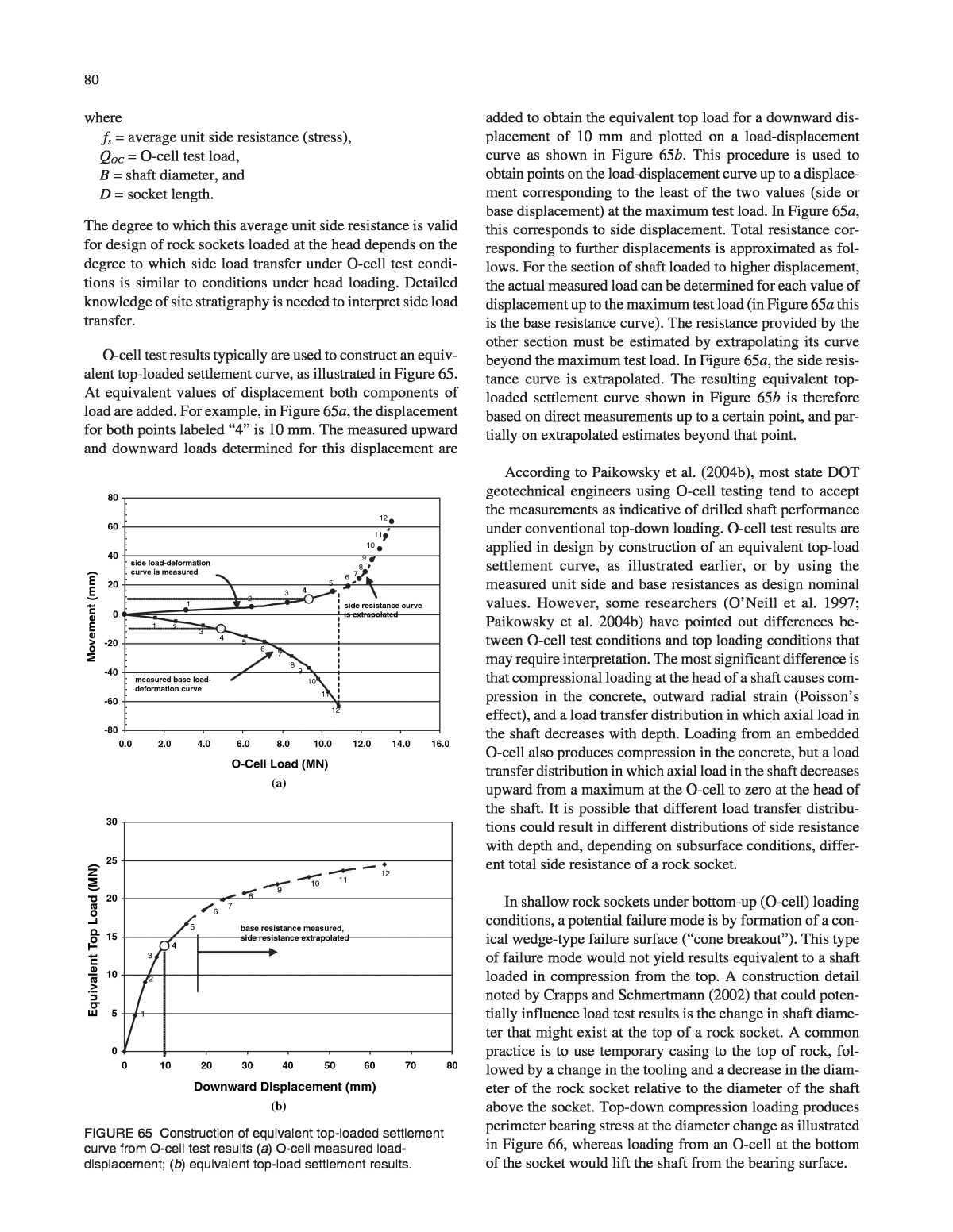
80 where fs = average unit side resistance (stress), QOC = O-cell test load, B = shaft diameter, and D = socket length. The degree to which this average unit side resistance is valid for design of rock sockets loaded at the head depends on the degree to which side load transfer under O-cell test condi- tions is similar to conditions under head loading. Detailed knowledge of site stratigraphy is needed to interpret side load transfer. O-cell test results typically are used to construct an equiv- alent top-loaded settlement curve, as illustrated in Figure 65. At equivalent values of displacement both components of load are added. For example, in Figure 65a, the displacement for both points labeled â4â is 10 mm. The measured upward and downward loads determined for this displacement are added to obtain the equivalent top load for a downward dis- placement of 10 mm and plotted on a load-displacement curve as shown in Figure 65b. This procedure is used to obtain points on the load-displacement curve up to a displace- ment corresponding to the least of the two values (side or base displacement) at the maximum test load. In Figure 65a, this corresponds to side displacement. Total resistance cor- responding to further displacements is approximated as fol- lows. For the section of shaft loaded to higher displacement, the actual measured load can be determined for each value of displacement up to the maximum test load (in Figure 65a this is the base resistance curve). The resistance provided by the other section must be estimated by extrapolating its curve beyond the maximum test load. In Figure 65a, the side resis- tance curve is extrapolated. The resulting equivalent top- loaded settlement curve shown in Figure 65b is therefore based on direct measurements up to a certain point, and par- tially on extrapolated estimates beyond that point. According to Paikowsky et al. (2004b), most state DOT geotechnical engineers using O-cell testing tend to accept the measurements as indicative of drilled shaft performance under conventional top-down loading. O-cell test results are applied in design by construction of an equivalent top-load settlement curve, as illustrated earlier, or by using the measured unit side and base resistances as design nominal values. However, some researchers (OâNeill et al. 1997; Paikowsky et al. 2004b) have pointed out differences be- tween O-cell test conditions and top loading conditions that may require interpretation. The most significant difference is that compressional loading at the head of a shaft causes com- pression in the concrete, outward radial strain (Poissonâs effect), and a load transfer distribution in which axial load in the shaft decreases with depth. Loading from an embedded O-cell also produces compression in the concrete, but a load transfer distribution in which axial load in the shaft decreases upward from a maximum at the O-cell to zero at the head of the shaft. It is possible that different load transfer distribu- tions could result in different distributions of side resistance with depth and, depending on subsurface conditions, differ- ent total side resistance of a rock socket. In shallow rock sockets under bottom-up (O-cell) loading conditions, a potential failure mode is by formation of a con- ical wedge-type failure surface (âcone breakoutâ). This type of failure mode would not yield results equivalent to a shaft loaded in compression from the top. A construction detail noted by Crapps and Schmertmann (2002) that could poten- tially influence load test results is the change in shaft diame- ter that might exist at the top of a rock socket. A common practice is to use temporary casing to the top of rock, fol- lowed by a change in the tooling and a decrease in the diam- eter of the rock socket relative to the diameter of the shaft above the socket. Top-down compression loading produces perimeter bearing stress at the diameter change as illustrated in Figure 66, whereas loading from an O-cell at the bottom of the socket would lift the shaft from the bearing surface. -80 -60 -40 -20 0 20 40 60 80 0.0 2.0 4.0 6.0 8.0 10.0 12.0 14.0 16.0 O-Cell Load (MN) M ov em en t ( mm ) side resistance curve is extrapolated side load-deformation curve is measured measured base load- deformation curve 1 2 3 4 5 6 8 9 11 10 12 7 1 2 3 4 5 76 8 12 10 9 11 (a) 0 5 10 15 20 25 30 0 10 20 30 40 50 60 70 80 Downward Displacement (mm) Eq ui va le nt T o p Lo ad (M N) 1 2 3 4 5 6 7 12 1110 9 8 base resistance measured, side resistance extrapolated (b) FIGURE 65 Construction of equivalent top-loaded settlement curve from O-cell test results (a) O-cell measured load- displacement; (b) equivalent top-load settlement results.
81 Paikowsky et al. (2004b) reviewed the available data that might allow direct comparisons between O-cell and conven- tional top-down loading tests on drilled shafts. Three sets of load tests reported in the literature and involving rock sockets were reviewed. However, in two of the cases the test sequence involved conventional top-down compression loading (Phase 1) followed by O-cell testing from the bottom up (Phase 2). Mobilization of side resistance in Phase 1 is believed to have caused a loss of bond, thereby influencing results of the O-cell tests and precluding any direct comparison. The third case in- volved STN and O-cell tests of shafts in Florida limestone. Paikowsky et al. stated that several factors, including highly variable site conditions and factors related to the tests, pre- vented a direct comparison of results. FEM reported by Paikowsky et al. (2004b) suggests that differences in rock-socket response between O-cell testing and top-load testing may be affected by (1) modulus of the rock mass, EM, and (2) interface friction angle, Ïi. Paikowsky first calibrated the FEM model to provide good agreement with the results of O-cell tests on full-scale rock-socketed shafts, including a test shaft socketed into shale in Wilsonville, Alabama, and a test shaft in claystone in Denver, Colorado, described by Abu-Hejleh et al. (2003). In the FEM, load was applied similarly to the field O-cell test; that is, loading from the bottom upward. The model was then used to predict be- havior of the test shafts under a compression load applied at the top and compared with the equivalent top-load settlement curve determined from O-cell test results. Figure 67 shows a comparison of the top-load versus displacement curves for the Alabama test, one as calculated from the O-cell test and the other as predicted by FEM analysis. The curves show good agreement at small displacement (<0.1 in. or 2.5 mm); however, the curve derived from FEM analysis is much stiffer at higher displacement. This exercise suggests that the equivalent top-load settlement curve derived from an O-cell load test may underpredict side resistance for higher dis- placements; that is, the O-cell derived curve is conservative. Further FEM analyses reported by Paikowsky et al. (2004b) suggest that the differences between loading from the bot- tom (O-cell) and loading in compression from the top are the result of differing normal stress conditions at the interface, and that these differences become more significant with in- creasing rock mass modulus and increasing interface friction angle. These numerical analyses suggest that differences in the response of rock sockets to O-cell test loading and top-down compression loading may warrant consideration in some cases. Ideally, side-by-side comparisons on identical test shafts constructed in the same manner and in rock with sim- ilar characteristics and properties are needed to assess differ- ences in response. However, it is expected that the potential differences, if any, will eventually be identified and incorpo- rated into interpretation methods for O-cell testing. In the meantime, the O-cell test is providing state transportation agencies with a practical and cost-effective tool for evaluat- ing the performance of rock sockets and it is expected that the O-cell test will continue to be used extensively. Instrumentation such as sister bars with strain gages makes it possible to better determine the load distribution and load transfer behavior during an O-cell load test. This infor- mation can then be used to make more refined predictions of load transfer behavior under head load conditions. In summary, some of the advantages of the O-cell for ax- ial load testing of rock-socketed shafts include: ⢠Ability to apply larger loads than any of the available methods (important for rock sockets) and ROCK SOIL change in diameter at soil/rock interface compression FIGURE 66 Perimeter bearing stress at diameter change under top loading. FIGURE 67 Comparison of load-displacement curves; O-cell versus FEM (Paikowsky et al. 2004b).
82 ⢠With multiple cells or proper instrumentation, it can isolate socket base and side resistances from resistance of other geomaterial layers. Limitations of the O-cell test for use by state DOTs include: ⢠Shaft to be tested must be predetermined, because it is not possible to test an existing shaft; ⢠For each installed device, test is limited to failure of one part of the shaft only; ⢠There are possible concerns using test shaft as a pro- duction shaft; ⢠Interpretation methods that account for differences in loading mode are not yet fully developed; and ⢠There are currently no ASTM or AASHTO standards specifically for O-cell load tests. Interviews with state DOT engineers for this study show that the O-cell test has been an integral tool in advancing the understanding and use of rock-socketed drilled shafts. The Kansas DOT (KDOT) experience is representative of several other states. The following is based on an interview with Robert Henthorne, KDOT Chief Geologist. The geology of the western half of Kansas, located in the High Plains physiographic province, is dominated by thick sequences of sedimentary rocks, mostly sandstone, shale, and limestone. Until approximately 1995, virtually all highway bridges were founded on shallow foundations or H-piles driven to refusal on rock. Drilled shafts were not considered a viable alterna- tive because of uncertainties associated with both design and construction. With encouragement from FHWA, KDOT engineers and geologists initiated a long-term program of training, education, and field load testing to better match foundation technologies with subsurface conditions. Work- shops on drilled shaft design, construction, inspection, and nondestructive testing (NDT), sponsored by FHWA and the International Association of Foundation Drilling (ADSC), were conducted at the invitation of KDOT. KDOT began us- ing drilled shafts as bridge foundations where appropriate. Several bridge sites in western Kansas were designed with rock-socketed shafts. To address the lack of experience with these conditions, O-cell testing was incorporated into the larger bridge projects. In almost every case, the O-cell test results showed side and base resistances considerably higher than the values used for preliminary sizing of the shafts, and valuable experience was gained with construction methods, effective cleanout strategies, NDT methods, etc. KDOT now has O-cell test results on rock-socketed shafts from nine projects and has developed in-house correlations between rock mass properties and design parameters for commonly encountered geological formations. Drilled shafts now comprise approximately 70% to 80% of new bridge foundations, and shaft designs are more economical because there is a high level of confidence in capacity predictions, based directly on the load tests. The approach taken by KDOT illustrates how field load testing, in this case with the O-cell, can be incorporated into an overall program leading to increased use and improved de- sign methods for rock-socketed foundations. The Colorado DOT has also used O-cell testing to improve its design procedures for rock-socketed shafts, as documented by Abu- Hejleh et al. (2003). Statnamic The STN load test was developed in the late 1980s by Berminghammer Foundation Equipment of Hamilton, On- tario. Its use in the U.S. transportation industry has been supported by FHWA through sponsorship of load testing programs, as well as tests conducted with an STN device owned by FHWA for research purposes. In this test, load is applied to the top of a deep foundation by igniting a high-energy, fast-burning solid fuel within a pressure chamber. As the fuel pressure increases, a set of re- action masses is accelerated upward, generating a downward force on the foundation element equal to the product of the reaction mass and the acceleration. Loading occurs over a period of approximately 100 to 200 ms, followed by venting of the pressure to control the unloading cycle. Load applied to the foundation is monitored by a load cell and displace- ment is monitored with a photovoltaic laser sensor. The con- cept is illustrated schematically in Figure 68. STN equipment is available for test loads as high as 30 MN. Processing of the load and displacement time histories is required to convert the STN measurements into an equivalent, static load-displacement curve. The analysis accounts for dynamic effects that may include damping and inertial effects. The unloading-point method as reported by Horvath et al. (1993) provides a relatively straightforward method for determining static resistance using measurements made at the top of the shaft during a STN test. Test interpretation is also discussed by Brown (1994) and El Naggar and Baldinelli (2000). FIGURE 68 Schematic of STN load test (OâNeill et al. 1997).
83 Mullins et al. (2002) recently introduced the segmental unloading point method, which uses top and toe measure- ments as well as strain measurements from along the length of the foundation. The segmental unloading point method enables determination of load transfer along various seg- ments of the foundation, an advantage for rock-socketed shafts to separate resistance developed in rock from that developed in portions of the shaft embedded in soil. The analy- sis is automated using software provided by the testing firm and equivalent static load-displacement graphs are produced immediately for evaluation. All data are stored for future analysis and reference. During the 1990s, FHWA performed or funded STN and correlation studies with conventional static load tests to develop standardized testing procedures and data interpreta- tion methods (Bermingham et al. 1994). Numerous other studies have further expanded the database of case histories and performance studies. The result is that STN testing is now a well-developed technology that is highly suitable for use by state DOTs for axial load testing of rock-socketed shafts. STN advantages identified by Brown (2000) include: ⢠Large load capacity, applied at top of shaft; ⢠Can test existing or production shaft; ⢠Economies of scale for multiple tests; ⢠Amenable to verification testing on production shafts; and ⢠Reaction system not needed. Disadvantages include: ⢠Capacity high, but still limited (30 MN); ⢠Rapid loading method, as rate effects can be significant in some soils (less in rock); ⢠Mobilization costs for reaction weights; and ⢠Not currently addressed by ASTM or AASHTO stan- dards. Mullins, as reported in Paikowsky et al. (2004b), analyzed a database of 34 sites at which both STN and static load tests were conducted on deep foundations. The data included load tests on four drilled shafts in rock at two sites, one site each in Florida and Taiwan. The objective of the study was to develop recommendations for LRFD resistance factors when axial compression capacity is based on STN testing. The au- thors recommend a resistance factor of 0.74 for all deep foun- dation types in rock (not specific to drilled shafts) when tested by STN. In addition, a rate effect factor (REF) is rec- ommended to account for rate effects when using STN results by the unloading point method. The REF varies with soil or rock type and recommendations are given here. If the segmental unloading point method is used (requiring strain gages), separate REF factors can be applied to each seg- ment to account for different soil or rock types. This analy- sis addresses the disadvantage cited previously regarding rate effects. Derived Static = REF*UP-derived capacity REF = 0.96 for rock 0.91 for sand 0.69 for silt 0.65 for clay. Dynamic Impact Testing A dynamic compression load test can be carried out by drop- ping a heavy weight onto the head of the shaft from various heights. The shaft is instrumented with strain gages and accelerometers to measure the force and impact velocity of the stress wave generated by the dynamic impact. The mea- surements are correlated to driving resistance to predict load capacity. A review of various available drop weight systems and evaluation of the method is given by Paikowsky et al. (2004c). A typical drop weight system consists of four components: (1) a frame or guide for the drop weight, (2) the drop weight (ram), (3) a trip mechanism to release the ram, and (4) a striker plate or cushion, as shown in Figure 69. Various configurations of modular weights can be used to provide ram weights as high as 265 kN (Hussein et al. 2004) and drop heights are adjustable up to 5 m (Paikowsky et al. 2004c). A rule of thumb given by Hussein et al. is that a ram weight of 1% to 2% of the expected shaft capacity be available on site. Drop weight load testing interpretation relies on analysis methods similar to those used in standard dynamic pile test- ing. Strain gage and accelerometer measurements at the top of the pile are used to evaluate characteristics of stress wave propagation. If sufficient shaft resistance is mobilized, it is possible in theory to relate the stress wave characteristics to shaft capacity using available PDA (Pile Driving Analyzer) technologies. Drop weight testing of drilled shafts has not been used extensively on bridge foundations in the United States, in part because other available methods (e.g., O-cell and STN) provide a more direct measurement of static resis- tance. According to DiMillio (1998), test results on FHWA projects have not demonstrated sufficiently good agreement between drop weight and other tests. The drop weight tests reportedly overpredicted measured capacities. Drop weight testing for rock sockets is suitable for post- construction tests at bridge sites where questions arise during construction regarding the performance of as-built founda- tions. This application is illustrated by the case of the Lee Roy Selmon Crosstown Expressway, in Tampa, Florida. The columns supporting an elevated section of roadway are founded on drilled shafts socketed into limestone. During construction of the superstructure, one of the columns sud- denly underwent more than 3 m (11 ft) of settlement as a result of the failure of the drilled shafts. Subsequent investi- gations determined that the failed shafts were not founded in sound limestone as believed, raising questions about the capacity of all 218 drilled shafts supporting the elevated roadway. As part of an investigation to determine how many
84 shafts might need remediation, dynamic load tests were con- ducted on 12 of the shafts supporting existing columns using the pile driving hammer shown in Figure 70. Testing proved the design capacity of 11 of the 12 shafts tested. This case also illustrates the need for thorough subsurface investiga- tion when socketing into limestone. In this case, rock eleva- tions were found to be highly variable. Seismic methods used in combination with borings in the post-failure inves- tigation provided a more detailed geologic model of site conditions. Interpretation Framework for Static Axial Load Tests Carter and Kulhawy (1988) and Kulhawy and Carter (1992b) proposed a method for interpretation of static axial load tests on rock-socketed shafts. The method involves analyzing a static axial load-displacement curve from a load test accord- ing to the analytical closed-form solutions presented in chap- ter three (Eqs. 69â95). The parameters back-calculated from the load test could then be used to evaluate effects of various design parameters on the load-displacement behavior of trial designs that differ from that of the test shaft. The method is applicable to shafts that satisfy the criteria for rigid behavior, given as (149) in which Ec = modulus of the reinforced-concrete shaft, Er = rock mass modulus, D = socket length, and B = socket diameter. The analysis is applied to two cases: (1) shear socket un- der compression or uplift and (2) complete socket under compression. The shape of a load-displacement curve from a load test is modeled in terms of constant slopes (S), which are related mathematically to the model parameters described in chapter three. Consider the load-displacement curve for a shear socket loaded in compression, as shown in Figure 71. Three parameters are required to idealize the geometry of the curve. S1 is the slope of the initial portion, S2 is the approximated slope of the full-slip portion of the curve, and Qi is the intercept on the vertical axis (wc = 0) of the line with slope S2. For a rigid shaft, the measured curve parameters E E D B c r 2 1 2⡠⣠â¢â¢â¢ ⤠⦠â¥â¥â¥ ⥠FIGURE 69 Schematic of drop weight system (Paikowsky et al. 2004c).
85 FIGURE 70 Dynamic load testing of shaft-supported column in Tampa, Florida. FIGURE 71 Interpretation of a side-shear-only test (Carter and Kulhawy 1988). theoretically are related to the elastic model parameters by the relationships given here (a): (a) Shear Socket â Compression or Uplift with (150) in which νr = Poissonâs ratio of the rock mass, Ï = interface friction angle, and Ï = interface angle of dilation, and c = in- terface cohesion. For a complete socket under compression in which the base load-displacement is determined (Figure 72), the load- displacement curve is approximated by S1, S2, Qi, and S3, the slope of the base load-displacement curve. The curve parame- ters are related to the elastic model parameters as given in (b), (b) Complete Socket â Compression in which Eb = modulus of the rock mass beneath the shaft base. Carter and Kulhawy (1988) applied the technique described to 25 axial load tests reported in the literature by back- calculating values of the model parameters Er, Eb, c, and (tanÏ tanÏ) from load-displacement curves using the equations given previously. A limitation of the model described earlier is that the assumption of rigidity may be less acceptable for shafts in harder rocks where the modulus values for the rock mass and the shaft material are closer. The reader is advised to review the original publications for further assumptions and derivations of the equations. Lateral Load Testing A significant number of states indicated in the questionnaire that lateral loading governs the design of rock-socketed E D S S E B r r b b = +â¡ â£â¢ ⤠â¦â¥ â( ) = +( )⡠⣠1 3 ( )1 1 2 ν Ï Ï Î½â¢â¢ ⤠⦠â¥â¥ = âââ ââ â â â ââ⢠S S S S S 3 2 3 1 2 tan tan 1 2 Ï Ï Ï â ââ â = +( )c QBD2 tan tan 1Ï Ï Ï Ï i Ï Î½= â( )â¡â£â¢ ⤠â¦â¥ln 5 1 r D B E D Sr r = +( )â¡ â£â¢ ⤠â¦â¥ = â ââ â â¢tan tan 1 2 1 1 ν Ï Ï Ï Ï Ïâ â â â ââ â â â = +( )⢠S S S c Q BD 2 1 2 2 tan tan 1Ï Ï Ï Ï i
86 shafts for a significant percentage of projects (Question 25). However, as noted in chapter four, very few lateral load tests have been conducted on rock-socketed shafts. Methods for conducting lateral load tests on deep foundations include conventional methods, Osterberg load cell, and STN. Conventional Lateral Load Test The conventional method for conducting a lateral load test is given in ASTM D3966 and involves pushing or pulling the head of the test shaft against one or more reaction piles or shafts. A variety of arrangements for the test shaft and reac- tion shaft are possible and these are given in detail in Reese (1984) and Hirany and Kulhawy (1988). One approach is to use two shafts and apply the load such that both shafts are tested simultaneously, providing a comparison between two shafts. A load cell is used to measure the applied lateral load and dial gages or displacement transducers attached to a ref- erence beam can be used to monitor lateral deformation. Thorough treatment of instrumentation for lateral load tests can be found in Reese (1984) and Hirany and Kulhawy (1988). Drilled shafts are often used where the designer wishes to take advantage of their large lateral load capacity, especially that of large-diameter shafts. Analysis often shows that the geomaterials in the upper part of the ground profile have the most significant influence on lateral deformations and lateral load transfer. A critical part of lateral load testing is to have detailed knowledge of the site stratigraphy, particularly at the FIGURE 72 Interpretation of a complete socket test (Carter and Kulhawy 1988). depths corresponding to approximately the first 10 diameters of the shaft. Other important points to consider when con- ducting conventional lateral load tests, as pointed out by OâNeill and Reese (1999) are summarized as follows. The test site conditions and test shaft should be selected and built to match as closely as possible the actual conditions to which they will be applied. Items such as overburden stresses acting in the resisting soil and rock layers, ground- water and surface water conditions, shaft dimensions and re- inforcing, and construction methods all can have a significant influence on the lateral load response of a drilled shaft. To the extent possible, these conditions should be matched by those of the load test. Analysis of the load test results will be interpreted using the analytical methods presented in chapter four. The most widely used method is the p-y curve method, in which p-y curves are fit to obtain agreement with the load test mea- surements. As a minimum, it is therefore necessary to have reliable measurements of ground line shear load, ground line deflection, and rotation (requires two deflection points sepa- rated by a known vertical distance). To define p-y curves ac- curately over the length of the shaft requires measurements of the deflected shape of the shaft, which can be done using slope inclinometer measurements. A more accurate method to determine p-y curves (or to evaluate any analytical method) is to establish bending moment as a function of depth, which can be done by installing a steel tube with closely spaced strain gages along the length of the shaft. This approach is most appropriate for tests conducted for applied research; for example, to develop new methods for estab- lishing p-y curves in rock. Boundary conditions must be considered carefully when back-fitting analytical models and then applying the model for design. In a lateral load test, the boundary conditions at the head of the shaft will normally be free of any rotational restraint and have zero applied moment and zero axial load. Service boundary head conditions are likely to include some head restraint and possibly axial load and moment. Also, the nonlinear momentâEI relationships must be accounted for both in the load test and in the analysis. Four states (California, Massachusetts, New Jersey, and North Carolina) reported the use of conventional lateral load tests on rock-socketed shafts. Although lateral load testing is not as common as axial testing, conventional testing has been the method of choice for lateral. Other methods have, so far, been used on a limited basis. These include lateral O-cell tests (at least two states, South Carolina and Minnesota) and lateral STN (Alabama, Florida, Kentucky, North Carolina, South Carolina, and Utah). Several states that did not respond to the survey are known to have conducted lateral STN (Ohio and Virginia).
87 Lateral Osterberg Load Test The O-cell can be embedded in a drilled shaft and oriented such that the load is applied in the horizontal direction. The method is described by OâNeill et al. (1997) for a case in which the Minnesota DOT required representative p-y curves for a stratum of friable sandstone situated beneath a thick layer of normally consolidated clay. Shafts socketed into the sandstone were to support a bridge undergoing ice loading. The test was conducted at a nearby location in which a 26.7 MN O-cell was positioned vertically within a 1.22-m-diameter socket, as depicted in Figure 73, and used to thrust the two halves of the socket against the rock. Lateral force and de- flection measurements were used to derive p-y curves. The authors point out that care must be taken in interpreting the results, because the stressâstrain conditions created by the test are not the same as in a laterally loaded socketed shaft that is loaded at its head and not split. Lateral O-cell testing of rock sockets offers some of the same advantages as for axial O-cell load testing, namely the elimination of a structural loading system at the ground level. Also, the test provides the ability to apply lateral loading at pre- determined depths, such as within the rock socket. Further re- search is needed to establish guidelines for proper procedures and to define correct analyses that account for the differences in boundary conditions, load transfer, and soil and rock resis- tance, compared with a shaft loaded at its head. It is also worth noting that the lateral split socket test may provide a means to measure the in situ rock mass modulus of deformation (EM). Lateral Statnamic The STN load test has also been adapted for lateral loading. The device is mounted on steel skids supported on the ground allowing the reaction masses to slide on rails, as shown in Figure 74. The lateral STN test can simulate lateral impact loading such as might occur against a bridge pier from a vessel. The lateral STN test can also be used to derive the static lateral response, but requires appropriate instrumentation and correct analysis of the test results. In tests described by Brown (2000), the following instrumentation was used: ⢠Load cell, ⢠Displacement transducers, ⢠Accelerometers on top of cap or shaft, ⢠Downhole motion sensors, ⢠Resistance-type strain gages, and ⢠Megadac Data Acquisition System. Figure 75a shows the measured dynamic response of the shaft in terms of force, acceleration, and lateral displacements versus time. The curves showing measured lateral displace- ment from three measurements are identical and cannot be distinguished in the figure. Dynamic response is separated into static, inertial, and damping components. A p-y analysis (using LPILE or FBPIER) is fit to obtain a reasonable match between the measured load-displacement response for each component of force (static, inertial, and damping). Load ver- sus displacement curves derived are shown in Figure 75b based on analysis of the dynamic response in Figure 75a. The lateral STN test is reported as to be safe, controlled, and economical. Its principal advantage lies in the ability to measure directly the dynamic lateral response and to provide a derived static response. This test is a valuable tool for the design of bridge foundations to withstand dynamic lateral loading from earthquakes, wind, and vessel impacts. The test may also be used in place of a conventional static test. Lateral loads up to 18 MN may be possible. FIGURE 73 Top view of O-cell arrangement for lateral split socket test (OâNeill 1997). FIGURE 74 Lateral STN load test (Courtesy: L. Fontaine).
88 CONSTRUCTABILITY, INSPECTION, AND QUALITY ASSURANCE These topics are considered together because they encom- pass activities having a single objective: construction of a high-quality, rock-socketed drilled shaft foundation that performs in accordance with the design assumptions. As illustrated in the flow chart diagram of Figure 3, chapter one, the final design is based on input from three general sources: (1) site characterization, (2) geotechnical analysis, and (3) structural analysis and modeling. Plans and specifications are developed that reflect generally accepted practices based on the collective experience of the construction and engi- neering communities. Examples of model specifications include those given in Chapter 15 of the FHWA Drilled Shaft Manual (OâNeill and Reese 1999), ACI Standard Specifica- tion for the Construction of Drilled Piers, ACI 336.1-98 (1998), and specifications developed by state and federal transportation agencies with extensive experience in drilled shaft use. In addition, effective specifications will address issues that are unique to the specific conditions that determine the final design, including constructability issues which, ide- ally, are accounted for in all three of the input categories iden- tified previously. In the following paragraphs, these topics are discussed individually, but in practice they must be integrated into the design concepts discussed in this synthesis. Constructability Much emphasis has been placed on constructability of drilled shafts by FHWA and through efforts of the International As- sociation of Foundation Drilling (ADSC). The FHWA Drilled Shaft Manual (OâNeill and Reese 1999) addresses constructability and its role in drilled shaft design. The man- ual also forms the basis of a National Highway Institute (NHI) course on drilled shafts that is available through FHWA. A separate NHI course that certifies inspectors for drilled shaft construction (Williams et al. 2002) also has a strong empha- sis on constructability and was developed with significant contractor input. ADSC provides short courses, workshops, and a library of publications focused on construction-related issues for drilled shafts. ADSC also provides âconstructabil- ity reviewsâ of individual projects in which independent con- tractors review the project plans and specifications and offer advice on its constructability. This step could be incorporated into the overall process depicted in Figure 3, as denoted in the flow chart by âconstructability review.â Integrating constructability into a drilled shaft project involves taking a common sense approach to design that accounts for the methods, tools, and equipment used by con- tractors to build the shafts. No attempt will be made here to identify all of these issues, but items identified by the survey and that relate specifically to rock sockets are discussed. Schmertmann et al. (1998) and Brown (2004) present guidelines for ensuring quality in drilled shaft construction and some recent advances in materials that have applications in both soil and rock. The key elements to be considered to avoid the most commonly observed construction problems are: 0.4 0.6 0.8 1.21 -2 -1.5 -1 -0.5 0 0.5 1 1.5 2 2.5 -800 -600 -400 -200 0 200 400 600 800 1000 seconds to ns Lo a d Time D is pl a ce m e n t / A cc el er a tio n in ch es / g 's Load, tons Statnamic Acceleration Lateral Translation, Top West Lateral Translation, Top East Lateral Translation, Top Center Shaft Group, Load 5 (E-W) (a) 0 0.5 1 1.5 2 2.5 3 0 100 200 300 400 500 600 700 0 20 40 60 80 100 120 140 inches Tlti Lo a d to ns % D a m pi ng Static Derived Statnamic % Damping Total Resistance (Static + Damping) Lateral Load versus Translation Static & Derived Statnamic - Shaft Group (b) FIGURE 75 Results of lateral STN test: (a) measured dynamic response; (b) derived static response.
89 ⢠Workability of concrete for the duration of the pour; ⢠Compatibility of congested rebar and concrete; ⢠Control of stability of the hole during excavation and concrete placement, especially with casing; ⢠Proper consideration and control of hydrostatic balance and seepage; ⢠Bottom cleaning techniques and inspection; and ⢠Drilling fluid that avoids contamination of the bond between concrete and bearing material or excessive suspended sediment. New developments in concrete mix design, in particular mixes described as self-consolidating concrete (SCC), can provide benefits for drilled shaft construction. The charac- teristic of SCC that is most beneficial is very high slump flow. Reinforcement cages with a high density of steel bars, often necessary especially for seismic design, make it diffi- cult to provide the necessary clear spacing between bars that will ensure flow of concrete to the outside of the cage. The flow properties of SCC have been shown to reduce potential defects associated with incomplete cover or voids caused by inadequate flow of concrete. Prompt placement of concrete is another construction practice that promotes quality in the as-built shaft. Delay in concrete placement increases the potential for slump loss and, in some cases, has been identified as a cause of reduced side resistance (Schmertmann et al. 1998). Several states identified problematic construction issues when the slurry method of construction is used in rock sock- ets. One issue is whether slurry has a detrimental effect on side resistance of rock sockets. Thirteen states indicated that they restrict the use of slurry in rock sockets and one state expressed âconcerns with use of drilling fluids instead of cas- ing.â In many situations, if casing is used to support the hole, the need to use slurry is eliminated. Typically, casing need only extend to the top of rock if the rock-socket portion of the hole will remain open without caving. If there is water in the overburden, the casing can be sealed into the rock, dewatered, and the socket can then be excavated without sup- port. However, there are situations where a contractor may deem it necessary to introduce slurry. For example, when rock is highly fractured it may not be possible to seal the cas- ing sufficiently to prevent water inflow, and a contractor may elect to use slurry. In this case, slurry may be used to balance the hydraulic head to prevent seepage into the hole that can disturb the material at the base of the shaft, an issue related directly to design decisions on whether to include base resis- tance in the design. For reverse circulation drilling, slurry may be used as the circulating fluid (e.g., the RichmondâSan Rafael Bridge shown in Figure 56). There are few data showing the effects of properly mixed and handled slurry on rock-socket side or base resistances. Slurry that does not possess the appropriate viscosity, density, and sediment content, or that is allowed to remain in the hole (and not agitated) long enough to form a thick filter cake, will almost certainly reduce side resistance compared with a shaft drilled and poured under dry conditions, in either soil or rock. However, if sound practices are followed by an experienced contractor and there is proper inspection, slurry drilling for rock sockets can be an effective construction method, assum- ing the slurry is handled in a manner that avoids contamina- tion of the interface bond or excessive suspended sediment. In certain rock types, there is evidence that use of polymer slurry may be beneficial to rock-socket side resistance. The Kentucky DOT requires polymer slurry for drilling in rock that exhibits low values of slake durability index. Typically, this is the case in certain shale formations in Kentucky. Slak- ing occurs when the shale is exposed to water, and can cause formation of a smear zone, reducing side resistance consid- erably, as demonstrated by Hassan and OâNeill (1997). Apparently, the polymer slurry prevents softening and the resulting smear zone, although there have not been load tests in which a direct comparison has been made. This issue deserves further research. One state DOT identified the following as a problematic construction issue: âvarious methods used to force a dry pour,â indicating that some measures taken to avoid placing concrete under water or slurry are more detrimental than allowing a wet pour. Both Schmertmann et al. (1998) and Brown (2004) describe a case that seems to contradict some commonly held ideas about casing versus wet hole construc- tion of rock sockets. A drilled shaft installed through 12 m of soil and socketed into rock was constructed using a full- length casing (to provide downhole visual inspection). A load test using the Osterberg load cell indicated a mobilized side resistance in the socket of 0.5 MN, much less than expected. A second shaft was constructed, but using a wet hole method with tremie placement of concrete and without casing into the rock. Load testing of this shaft indicated more than 10 MN of side resistance in the socket. The difference is attributed to a decrease in concrete workability during the time required to remove the casing after concrete placement, preventing formation of a good bond along the socket inter- face. Trapping of debris between the casing and rock could also have occurred and may have smeared cuttings along the sidewalls. The lesson of this case is that the construction method should be selected to provide the best product for the given conditions, and that in many situations a wet hole method is the most effective and will not adversely affect shaft behavior if done properly. Forcing a dry pour may cause more problems than it solves. Another good reason to review the ground conditions care- fully before allowing âdry holeâ construction is identified by Schmertmann et al. (1998). If the groundwater elevation is above the base of the hole, dry conditions inside the socket result in a hydraulic gradient causing inward seepage as illustrated in Figure 76. They describe several cases where seepage degraded side resistance and base resistance. Main- taining a slurry or water level inside the hole sufficient to bal- ance the groundwater pressure eliminates the inward gradient
90 and prevents base and side disturbance. The authors cite several cases in which comparisons of Osterberg load cell test results on shafts poured both wet and dry show this effect. The most common factor cited in construction claims asso- ciated with rock-socketed shafts is âdiffering site conditions,â that is, the subsurface conditions actually encountered during construction are claimed to be materially different from those shown in boring logs. Responses to the questionnaire did not indicate that claims were a major obstacle to the use of drilled shafts for most states. However, one state DOT gave the fol- lowing response when asked to comment on issues âpertain- ing to the use of rock-socketed drilled shafts by your agencyâ (Question 6): âMost result in claims due to the requirement to include âDiffering Site Conditionsâ on all contracts.â The same agency responded as follows to Question 36 pertaining to perceptions of construction problems: We design for low bidding contractors to get the contract and the construction problems that will result. Rock may be harder than the contractor thought when bidding and planning the job. Thus the drilling equipment brought out is often unable to drill or very slow to drill the rock. This results in costly contractor claims. Claims for differing site conditions are part of the geo- technical construction field, but measures can be taken to minimize them. For example, one contractor interviewed for this study noted that geotechnical reports often place strong emphasis on rock of the lowest strength, because these lay- ers may control side or base resistances for design. However, for estimating drilling costs, contractors need information on rock layers of the highest strength, because that will dictate the type of drilling and tools needed to bid the job accurately and to carry out the construction properly. Transportation agencies might consider surveying contractors to find out exactly what information contained in their boring logs is most helpful for bidding on rock-socket jobs, and what addi- tional information could improve their ability to perform the work. Another contractor interviewed for this study stated that the rock classification system of the ISRM is useful to determine what type of tool (rock auger, core barrel, or downhole hammer) will be most effective. The ISRM system places rock into one of seven categories (R0 through R6) based on strength, as described in chapter two (see Rock Material Descriptors). An issue identified by several states is the discrepancy that sometimes occurs between the elevation corresponding to top of rock as shown in boring logs and as encountered during construction. The Washington State DOT uses lan- guage in their special provision for rock sockets that report- edly works well and is summarized as follows. For shafts with a specified minimum penetration into the bearing layer and no specified base elevation, the contractor furnishes each reinforcing cage 20% longer than specified in the plans. The increased length is added to the bottom of the cage. The con- tractor then trims the reinforcing cage to the proper length before placement. The DOT assumes the cost of the excess steel, but believes that cost is offset by avoiding construction delays, disputes, and claims that may occur otherwise. Other specific issues identified by states in the questionnaire pertain to inadequate cleanout buckets, improper placement of concrete with pump trucks, and a case in which temporary casing to support the overburden with the same diameter as the rock socket resulted in the casing being dragged down into the socket, requiring additional socket drilling. There is a constructability lesson in each of these cases. Certain geologic conditions are associated with more challenging construction and may require more detailed in- vestigation and flexibility in the approach to construction. Some of the more notorious of these include: (1) karstic con- ditions associated with limestone and other rocks susceptible to solution, (2) rock with steeply dipping discontinuities, (3) well-developed residual soil deposits grading into partially weathered rock and then unweathered bedrock, (4) alternat- ing hard and soft layers of rock, and (5) glacial till. Each of these conditions presents its own unique set of construction challenges and different approaches are required to address them successfully. A question that often arises in some of these environments is âwhat is rock?,â or perhaps more im- portantly, âwhat is not rock?â On some projects, certain geo- materials may be rock for pay purposes, but not for design. If these issues can be addressed before construction and there is good communication between owners and contractors, a reasonable approach that results in a successful project can usually be developed. When the difficulties are not antici- pated but are encountered during construction, the likelihood of claims and disputes is much higher. Drilling of a trial in- stallation shaft (also referred to as a âmethodâ or âtechniqueâ shaft) before bid letting can identify many of the problems that will be encountered during production drilling and should be considered whenever there are major questions Zone of disturbed material at base caused by inward seepage casing FIGURE 76 Development of disturbed base caused by high seepage gradient toward bottom of a cased hole.
91 about the subsurface conditions and what is required to con- struct rock sockets successfully. Inspection and Quality Assurance Inspection is the primary method for assuring quality in the construction of drilled shafts. The philosophy and methods of drilled shaft inspection are covered in Chapter 16 of the FHWA Drilled Shaft Manual (OâNeill and Reese 1999) and are the subject of a video and a Drilled Shaft Inspectorâs Manual (Baker 1988) available from the ADSC. A certifica- tion course for drilled shaft inspectors is offered by the NHI of FHWA, and a Participants Manual was developed as part of the course (Williams et al. 2002). Table 21 is a partial list- ing of inspection issues pertaining specifically to rock-socket construction. Special emphasis is required in making a strong connec- tion between drilled shaft design and inspection. Practically, this involves providing inspection personnel with the knowl- edge and tools required to verify that drilled shafts are con- structed and tested in accordance with the design intent. The starting point for inspection personnel is to have a thorough understanding of (1) subsurface conditions, (2) the intent of the design, and (3) how items 1 and 2 are related. The in- spectorâs sources of information for subsurface conditions include the geotechnical report, boring logs, and communi- cation with the design engineer. For rock sockets, inspectors should be trained to understand the information presented in boring logs pertaining to rock. This includes being familiar with the site and geomaterial characterization methods de- scribed in chapter two. Inspectors require basic training in rock identification, testing, and classification, and should be familiar with rock coring procedures, the meaning of RQD, compressive strength of intact rock, and terminology for describing characteristics of discontinuities, degree of weath- ering, etc. Inspectors should be aware of design issues such as whether the shaft is designed for side resistance, base re- sistance, or lateral resistance, and in which rock layers the various components of resistance are derived. Before construction, inspectors should know how the con- tractor plans to construct the shafts. This requires knowledge of the tools and methods used for construction in rock. A valuable aid is the Drilled Shaft Installation Plan, a document describing in detail the contractorâs tools and methods of construction. OâNeill and Reese (1999) describe the mini- mum requirements of an installation plan and recommend that it be a required submittal by the contractor. A fundamental design issue is the degree to which the rock mass over the depth of the socket coincides with the conditions assumed for design. Therefore, some type of Inspection Responsibility Primary Items to Be Addressed Required Skills or Tools Knowledge of site conditions Rock types, depths, thicknesses, engineering properties (strength, RQD); groundwater conditions Competency in rock identification and classification; ability to read and interpret core logs Knowledge of design issues Rock units providing side, base, and lateral resistances Design parameters: shaft locations, socket depths and diameters, reinforcement details Basic understanding of design philosophy for drilled shafts under axial and lateral loading Familiarity with standard specifications, plans, special provisions, shop drawings, and contractor submittals Knowledge of contractorâs plan for socket construction Rock excavation tools (augers, coring, hammers, other) and methods (e.g., casing, slurry) Classification of rock for pay purposes Review of Drilled Shaft Installation Plan Observations and record keeping during socket excavation Identification and logging of excavated rock Tools used by contractor for each geomaterial (tool description, diameter, rate of excavation) Occurrence of obstructions, removal method Depth to top of rock Sidewall conditions (roughness, smearing) Roughening or grooving of sidewalls Use and handling of slurry and casing Inspection methods and devices (e.g., SID) Coring at the base Cleanout specs., verification method Competency in field identification of geomaterials; Appropriate forms*, including: Rock/Soil Excavation Log Rock Core Log Inspection Log Construction and Pay Summary Sampling and testing Sampling of rock for lab tests; Field tests on rock; e.g., point load, hardness; NDT/NDE Proper sampling/testing equipment and knowledge of procedures *See Williams et al. (2002) for descriptions of inspection forms. Notes: RQD = rock quality designation; SID = shaft inspection device; NDT = nondestructive testing; NDE = nondestructive evaluation. TABLE 21 INSPECTION ITEMS FOR ROCK SOCKETS
92 FIGURE 78 Shaft inspection device or SID. downhole inspection is needed. Responses to Question 11 of the survey reveal a wide variety of methods used for this purpose. Nine states reported that coring is required into rock below the bottom of the shaft after the excavation to base elevation is complete. Typical required depths range from 1.5 m to 10 m, three diameters, etc., although one state re- quires coring 15 m below the bottom of the shaft. Coring be- low the base during construction allows a determination to be made of the adequacy of rock below the base to (1) pro- vide the base resistance assumed in the design; (2) ensure that the base is bearing on bedrock and not an isolated boul- der (âfloaterâ); and (3) detect the presence of seams, voids, or other features that would require changes in the base elevation or other remedial actions. Five states reported using a probing tool to inspect core holes at the bottom of the completed excavation (Figure 77). This method, which in most cases requires downhole entry by the inspector, is most useful for detecting seams of soft material in discontinuities. It is most applicable in limestone and dolomite where the bedrock surface is highly weathered, irregular, and filled with slots and seams of clayey soil. Proper safety measures are paramount for downhole entry. Five states reported using fiber optic cameras for inspection of core holes, which is safer and provides visual evidence of seams, cavities, and fractures, but does not provide the âfeelâ of probing that may be useful in karstic formations. Four of the states reporting use of probe rods are in the Southeast where karstic conditions are most common. Most states include specifications for conditions at the bottom of the hole that must be satisfied before pouring concrete. Some distinguish between shafts designed for base resistance and those designed under the assumption of zero base resistance. A very typical specification (five states) is âminimum 50% of the base area to have less than 12 mm (0.5 in.) and maximum depth not to exceed 38 mm (1.5 in).â Some states allow up to 300 mm (6 in.) of loose material when base resistance is neglected. When sockets are poured under dry conditions, common inspection methods to verify bottom conditions are either visual inspection or downhole cameras. For wet pours (under slurry or water) the most common method is to lower a weighted tape (e.g., a piece of rebar on the end of a tape mea- sure) to the bottom of the hole and âfeelâ the bottom condi- tions by bobbing the weight against the bottom. Although somewhat subjective, an experienced inspector can differen- tiate between clean water or slurry and contaminated condi- tions. Downhole cameras are available that permit viewing of conditions under water or slurry. A device used by the Florida DOT referred to as a shaft inspection device or SID has been used successfully in slurry shafts (Crapps 1986). The device, shown in Figure 78, has a color television cam- Base of Socket Probe Rod FIGURE 77 Rock probing tool (after Brown 1990).
93 era encased in a watertight bell and equipped with a light source and a water jet for clearing sediment to provide clear pictures of the shaft sides and base. The SID was developed in Australia specifically for inspection of rock sockets under bentonite slurry. North Carolina also reported using a SID, and several other states use downhole cameras to inspect sockets under water or slurry. The survey shows that some states neglect socket-base re- sistance altogether if concrete is placed under slurry or water (Question 14). The rationale is that base conditions cannot be verified with sufficient reliability to be sure that a poor base, or âsoft bottom,â condition is avoided. This refers to a layer of disturbed soil, slurry, or contaminated concrete at the base, which may allow excessively large downward movement be- fore the resistance of the underlying rock can be mobilized. These concerns may be justified under some conditions. However, as described in chapter three (see Table 16 and Figure 23), there are good reasons to account for base resis- tance even for shafts constructed under wet-hole conditions. Construction and inspection practices that can be taken to avoid poor base conditions include appropriate specifications and quality control on properties of slurry at the bottom of the hole prior to concrete placement, cleanout of slurry contam- inated with cuttings or suspended particles before concrete placement, use of a weighted tape to âfeelâ the bottom of the hole as an inspection tool, downhole viewing devices for in- spection of bottom conditions (e.g., SID), and proper use of a pig or other device in the tremie pipe to prevent mixing of concrete and slurry. Post-grouting of the shaft base is a measure that could be incorporated into design and con- struction to provide quality base conditions in drilled shafts. It is instructive to observe that most states that have incorporated field load testing of rock sockets into their foun- dation programs, using a method that allows measurement of base load-displacement, now include both side and base resistances in their design calculations. This is based on load test results that show, when proper quality control is applied, that base resistance is a significant component of shaft resis- tance at service loads. Nondestructive Testing and Evaluation Field tests to evaluate the integrity of as-built drilled shafts are now used widely in the industry as part of overall quality assurance. Nondestructive methods for testing (NDT) and evaluation (NDE) are covered in Chapter 17 of the Drilled Shaft Manual (OâNeill and Reese 1999) and in several other publications. The survey for this study included a question asking respondents to identify any issues pertaining to NDT and NDE that are unique or important specifically for rock- socketed drill shafts. No issues were identified, other than the need to consider locating NDT access tubes in the reinforcing cage so that the entire assembly is able to fit into a socket that may be of a smaller diameter than the shaft above the socket. EXAMPLES OF DIFFICULT GEOLOGIC CONDITIONS Some of the most difficult conditions for drilled shaft con- struction and inspection are karstic limestone and residual profiles that grade from soil to weathered rock to intact rock. Experiences and approaches to these conditions identified by the literature review are summarized here. Shafts in Limestone Use of drilled shafts in karstic terrain is considered by Knott et al. (1993), Sowers (1994), and others. Brown (1990) describes design and construction challenges of using drilled shafts in hard pinnacled limestones and dolomites encountered in the Valley and Ridge and Cumberland Plateau physiographic provinces. Subsurface conditions are highly irregular owing to extensive weathering. Although intact rock strengths may be high (up to 70 MPa or 10,000 psi), numerous seams, slots, and cavities are typically filled with residual clayey soils (see Figure 79). Boulders and chert nodules are often embedded in the soils. Drilling through soil is often performed in the dry soil and then a casing set when rock is encountered. Drilling in the rock is difficult and can involve a combination of rock augers, drill and shoot methods, and core barrels. Sudden groundwater in- flow is common upon encountering soil seams and slots. In this environment of extreme variability the actual soil and rock conditions for a specific drilled shaft cannot be determined with any degree of accuracy before construction. Design, construction, and inspection have to be flexible enough to adjust to conditions actually encountered. For example, where shafts can be shown to bear at least partially on sound rock, base resistance is assumed, but highly FIGURE 79 Features of karstic terrain (Knott et al. 1993).
94 conservative values are used to account for the presence of seams at the base. This case is illustrated in Figure 80a, in which a probe rod placed down one or more probe holes drilled into the base can be used to determine the extent and nature of the seam. One criterion for acceptance is rock cov- erage of 75% or more of the base area and vertical seams. Figure 80b shows a nonvertical seam, which should be detectable by one of the probe holes and might necessitate additional drilling to preclude shear failure along the seam. Alternatively, the seam could be excavated and grouted. This technique would not be recommended if seepage is expected into the excavated seam. Where shafts are bearing on a sec- tion of rock bounded by vertical seams or slots and the pos- sibility of fracturing exists, rock anchors are sometimes used to transfer load across potential fracture planes, as illustrated in Figure 80c. Rock anchors or micropiles are also used to transfer load across horizontal seams filled with soft soil and detected by probing beneath the base. To provide the flexibility needed for design, inspection, and construction, creative contracting approaches are also needed. Brown (1990) reported that contracting such work on a unit cost basis provided the flexibility needed to deal with the unknown quantities of soil versus rock drilling, con- crete overpours, rock anchoring, drilling of probe holes, etc. The engineer estimates the unit quantities, but actual pay- ment is based on unit costs of material quantities actually used. This requires careful inspection and record keeping. Drilled Shafts in the Piedmont The Piedmont Physiographic Province of the eastern United States, extending from Alabama to New Jersey, is characterized by decomposed metamorphic rocks and a weathering profile characterized by unpredictable variability in the thickness and quality of the weathered materials. Drilled shafts are used ex- tensively for major structures in this region, primarily because it has been recognized that large axial loads can be supported if a shaft is extended to either decomposed or intact rock. Gardner (1987) identified three general weathering hori- zons in the Piedmont: (1) residual soil, representing advanced chemical alteration of the parent rock; (2) highly altered and leached soil-like material (saprolite) retaining some of the structure of the parent rock; and (3) decomposed rock (locally referred to as partially weathered rock), which is less altered but can usually be abraded to sand- and silt-sized particles. The underlying intact rock is typically fractured near its sur- face but increases in quality with depth. The thickness and characteristics of each zone vary considerably throughout the region and may vary over short horizontal distances, and boundaries between the horizons may not be distinct. Figure 81 shows a typical profile based on borings at one site. Factors that make drilled shafts challenging to design and build in the Piedmont are: ⢠Highly variable subsurface profiles, ⢠Presence of cobbles and boulders, ⢠Steeply dipping bedrock surfaces, and ⢠Difficulties in distinguishing between soil, partially weathered rock, and intact rock for pay purposes. The first of these makes it difficult to determine ahead of time what the final base elevation will be for shafts required to reach intact rock. At least one boring at each drilled shaft location can help to address this issue. Figure 82 illustrates two conditions that can cause ârefusalâ before the shaft (a) (b) (c) FIGURE 80 Commonly encountered conditions for shafts in pinnacled limestone (Brown 1990).
95 is drilled to its design base elevation. When refusal is en- countered on a boulder that is âfloating,â questions may arise concerning whether the boulder is an obstruction or constitutes drilling in rock. Similarly, when sloping bedrock is first encountered, the volume of material excavated to reach base elevation may be disputed as to whether it is soil or rock, and drilling into sloping rock can be difficult. One approach is to install casing until one edge of the casing hits rock, then drill a smaller diameter pilot hole into the rock followed by drilling to the design diameter and advancement of the casing. Gardner (1987) reviews design methods for axial load- ing of drilled shafts in Piedmont profiles, including recom- mendations for design side and base resistances in rock and methods used to determine relative load transfer between side and base. Harris and Mayne (1994) describe load tests in Piedmont residual soils. OâNeill et al. (1996) used the tests of Harris and Mayne to develop the recommendations for side resistance in cohesionless IGM from Standard Pen- etration Test results, as presented in chapter three. Both Gardner (1987) and Schwartz (1987) outline measures that can be taken to minimize construction delays and contract disputes when building rock-socketed shafts in Piedmont profiles. The principal requirements are: (1) thorough site investigation, (2) design and construction provisions that can accommodate the unpredictable variations in subsur- face materials and final base elevations, and (3) construc- tion specifications and contract documents that facilitate field changes in construction methods and shaft lengths. Successful construction also depends on highly qualified inspectors and clear communication between design engi- neers, contractors, and inspectors. These examples illustrate the challenges that can be en- countered in the design and construction of rock-socketed drilled shafts as a result of certain geologic conditions, as well as approaches that others have found successful for addressing such challenges. Every foundation site is unique geologically, and successful design and construction ap- proaches are those that are adapted to fit the ground condi- tions. Mother Nature is quite unforgiving to those who behave otherwise. SUMMARY Construction and issues related to constructability are inte- gral parts of drilled shaft foundation engineering. A review of rock drilling technologies is presented and shows that a wide variety of equipment and tools is available to contrac- tors for building drilled shafts in rock. The design, manufac- turing, and implementation of rock drilling tools is a field unto itself and it is important for foundation designers to be knowledgeable about the availability and capability of tools and drilling machines. Constructability issues are interrelated with all of the steps shown in the flowchart of Figure 3, de- picting the design and construction process for rock-socketed shafts. Beginning with site characterization and continuing through final inspection, constructability is taken into ac- count in foundation selection, in design methods through the effects of construction on side resistance, in critical design decisions such as whether base resistance will be included, in writing of specifications pertaining to use of slurry and bottom cleanout, and in matching inspection tools and pro- cedures to construction methods. The literature review iden- tified many aspects of constructability pertaining to rock HORIZONTAL SCALE (FT) 0 100 200 300 400 50/3" 50/4" 50/5" NX-15% RQD-0 NX-90% RQD-79 31 8 17 18 12 16 24 50/5" NX-87% RQD-10 NX-95% RQD-51 NX-18% RQD-0 NX-95% RQD-82 C.T. C.T. C.T. 10 10 11 11 18 16 10 19 53 10 8 6 12 55 50/3" B3 B2 ZONE II ZONE III ZONE I 900 910 920 930 870 880 890 860 850 B1 ZONE IV PARTIAL LEGEND C.T. CORING TERMINATED -10 PENETRATION RESISTANCE NX-18% CORE RECOVERY RQD-82 ROCK QUALITY DESIGNATION ZONE I FILL ZONE II RESIDUAL SOIL ZONE III PARTIALLY WEATHERED ROCK ZONE IV ROCK GROUNDWATER, TIME OF BORING 24-HR GROUNDWATER 500 ELEVATION (FT) FIGURE 81 Typical Piedmont subsurface profile (after Schwartz 1987).
96 sockets and these are summarized. Practices that can improve constructability; for example, the use of SCC and installation of method shafts are identified. Field load testing of rock sockets has increased since the advent of innovative load testing methods, especially the O-cell and the STN. The basic mechanics of these and other tests are described, followed by a review of current applica- tions of each to testing of rock-socketed shafts. The survey shows that many states are using the O-cell to verify, and also to improve, design methods of rock sockets. A description of the KDOT experience with O-cell testing in rock is presented as an example. Load testing is also shown to be a factor in increased use of rock-socketed drilled shafts by transporta- tion agencies. Finally, load testing with the O-cell has been a useful tool for identifying and evaluating poor versus good construction practices. The report by Schmertmann et al. (1998), referenced several times in this chapter, is a particu- larly useful source for that information. Inspection and field quality control are recognized in the drilled shaft industry as the critical link between design and construction. Excellent sources of information on inspection are available and these are identified. The NHI inspector certification course is highly recommended for all inspec- tion personnel. Some of the tools identified by the survey and literature review that can be most effective for rock- socket inspection are the SID, coring of rock beneath the socket-base, use of probing tools, and downhole fiber optic cameras. Two geologic environments in which rock-socket con- struction poses special challenges, karstic limestone and Piedmont residual profiles, are presented to illustrate some of the practices that lead to successful projects. Matching of design and construction strategies to ground conditions is the essence of constructability. FIGURE 82 Typical drilling in Piedmont soils and rock (Schwartz 1987).
