


Below is the uncorrected machine-read text of this chapter, intended to provide our own search engines and external engines with highly rich, chapter-representative searchable text of each book. Because it is UNCORRECTED material, please consider the following text as a useful but insufficient proxy for the authoritative book pages.
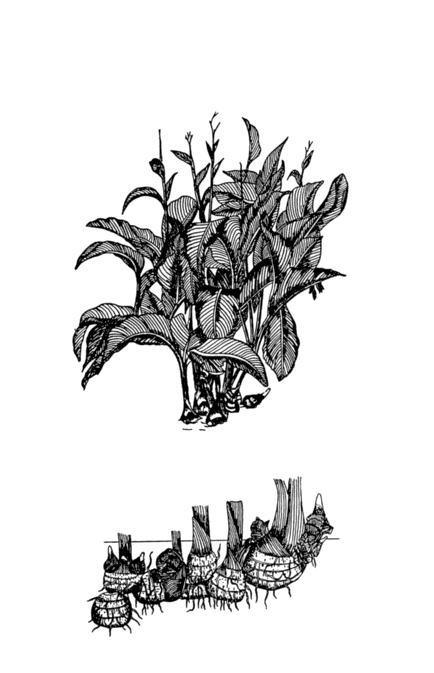
Achira it Achira (Canna edulis) looks somewhat like a large-leaved lily and s closely related to the ornamental cannas widely grown in both temperate and tropical zones.' It was probably one of the first plants to have been domesticated in the Andean region. Easy to plant and easy to grow, it develops huge, edible underground rhizomes2 some- times as long as a person's forearm. Although little studied by modern scientists, these starch-filled rhizomes are produced throughout a vast region that extends from Mexico and the West Indies to Venezuela, through the Andes and the Amazon basin to Argentina, and along the Pacific coast to northern Chile. In much of this area achira is a market vegetable, but only in Peru and southern Ecuador is it a substantial crop. Some achira is simply cooked and eaten. Most of the plants, however, are used to produce starch. In this process, the rhizomes are shredded, the grated material dumped into water, and the fibrous pulp separated from the heavy starch by decanting. The starch is then sold for use in foods as well as in other products such as sizing and laundry starch. This plant could have a much brighter future as both a food and a cash crop. Its starch has the largest granules ever measured. They can actually be seen with the naked eye and are three times the size of potato-starch granules, the current standard for starch-granule size. Because of its extraordinary proportions,3 the starch settles out of solution in a few minutes, freeing it from impurities in little time and with minimum expense. The starch is clear and, when cooked, is glossy and transparent, rather than opaque like that of potato, corn- starch, or common arrowroot.4 The cooked starch seems to be easily ' Indeed, some ornamental cannas are sold under the same botanic name as achira. However, the blossoms of true achira are much smaller than those of the ornamental cannas. 2 Strictly speaking, these are corms; their growing tips are at the stem end of the swollen underground parts. 3 Achira granules are about 125 micrometers long and 60 micrometers wide (see page 28). 4 Maranta arundinacea. 27
28 LOST CROPS OF THE INCAS digestible, an important feature for infants' invalids, the elderly, and people with digestive problems. These attributes could make achira one of the most interesting of all carbohydrate resources. Its unusual starch is a possible complement to other starches now used in foods and industry, and it has the potential to be produced in quantity. Australians have mechanized the planting, cultivation, harvesting, and milling of the crop, thereby demonstrating that achira need not be restricted to areas where labor costs are low. This adaptable plant is known and grown in a number of places outside Latin America. On the island of St. Kitts in the Caribbean, it has long been used and even exported. In Indonesia, Taiwan, the Philippines, and Australia, there has been small-scale commercial cultivation. In Madagascar, achira is common on the banks of rice paddies. It is also grown in Sri Lanka and Burma, and both Brazil and Hawaiis have produced it as fodder for cattle and pigs. However, in none of these widely scattered locations is it being taken seriously as an economic crop. With research, achira may broaden the base of agriculture. In many areas, it possibly could be incorporated into patches of marginal (especially damp) ground now little used for crop production. PROSPECTS The Ancies. Given current knowledge, achira seems unlikely ever to become a major food of the region, but even so, there are several niches where it will remain a contributor to local diets and economies. It is a particularly good "safety net" for use when other crops fail, and it should be more widely planted for this purpose. Future research may transform the region's use of this plant. It seems probable that current yields may be far surpassed. The appli- cation of fertilizer, alone, should boost production dramatically. In addition, the triploid forms (see laterJ may produce abundantly in now little-exploited locations. If the unique starch proves to have widespread commercial utility, an export trade could result, to the benefit of the Andean region. Other Developing Areas. Achira is unlikely to replace foods based on other starchy roots (such as cassava or common arrowroot) 5 in Hawaii it was formerly used in making "haupia," a traditional dessert (made of coconut milk, starch, sugar, and gelatin) served particularly at luaus.
ACHIRA 29 Loja, Ecuador. Achira being prepared for starch. (J. Horton) where these are staples and grow well.6 However, in future more and more Third World people will come to depend on marginal lands to grow their food. Here, achira could provide the difference between hunger and health. Thus, in appropriate climatic zones especially where prime land is already producing to its fullest or where conven- tional crops produce less than abundantlythe plant should be given immediate trials. Industrialized Regions. It seems unlikely that achira will become a major crop of economically advanced countries. However, research may uncover agricultural niches for this robust species, as well as markets for its unusual starch. Indeed, achira starch has a good chance of finding markets in industry and perhaps also in specialty food products such as baby food and livestock feed where its easy digestibility and huge granules would be economic assets. 6 In the lowland tropics, achira yields less than cassava, but at higher altitudes it yields more than cassava.
30 LOST CROPS OF THE INCAS Achira starch granules (top) are by far the largest ever measured twice the size of potato starch granules (bottom), the previous record holder. Along with its exceptional granule size, achira starch is unusually translucent. Other qualities of this promising carbohydrate probably await discovery. (R. Johnston)
ACHIRA (ISES 31 Although achira is one the few root vegetables that can be eaten raw, it is usually eaten cooked like potatoes, arrowroot, cassava, or tarot More often it is baked, whereupon it becomes translucent, mucilaginous, and sweet. A traditional Andean feast is baked achira, roast guinea pig, yacon, and quinoa beer.7 For use as starch, achira tubers are peeled, dried, and milled. In Colombia (notably in the departments of Huila and Tolima), the flour is used to make salted crackers in homes and in a factory for commercial distribution. It is also mixed with cheese (colaciones). In Vietnam, the flour is used to prepare a pastalike food.8 In addition to the tubers, the young shoots can be eaten as a green vegetable. In southern Ecuador, achira leaves are used to wrap foods for easy transport and for cooking. Livestock eat both the crushed rhizomes and the foliage. Pigs relish the entire plant, readily munching the tops and rooting up the rhizomes. Near Sao Paulo, Brazil, farmers grow the crop extensively as a pig feed. They prefer it for its hardiness, high yields, and capacity to remain in the field without decaying long after reaching maturity. In Ecuador, the achira plant, which grows 2 m tall or more, is commonly used as a living fence and as a windbreak to shelter other crops. NUTRITION Fresh tubers contain about 75 percent moisture. The dry matter contains 75-80 percent starch,9 6-14 percent sugar (mostly glucose and sucrose), and 1-3 percent protein. The potassium content is high; calcium and phosphorus, low. The leaves and shoots are quite nutritious, containing at least 10 percent protein.~° AGRONOMY One of the most robust of all root crops, edible canna grows well in a wide variety of climates, thrives in many soils unsuited to other tubers, and has few problems with diseases or pests. 7 Yacon and quinoa are described later; guinea pig is dealt with in the companion volume Microlivestock: L. 'e-Known Small Animals with a Promising Economic Future. ~ Tu and Tscheuschner, 1981. 9 The amylose content of the root starch is about 40 percent (Tu and Tscheuschner, 1981). ~° They contain 70 percent carbohydrate, 10-14 percent protein, 2.5-5.0 percent fat, 20- 25 percent fiber, and 12-17 percent ash. Information from J. Duke.
LOST CROPS OF THE INCAS ..~.. Los Banos, Ecuador. In many parts of the Andes, farmers commonly use the striking achira plant as a "living fence" that serves as a windbreak, a boundary marker, and a food supply. In cities such as Lima, achira and other cannas are common street ornamentals. (N. Vietmeyer) It is easy to propagate. Normally, rhizome tips (fairly large, immature segments bearing at least two healthy, unbruised buds) are merely stuck in the ground and covered over. (As a precaution against rotting, the segments are sometimes first dipped in a dilute copper sulfate solution.) Complete tubers also can be planted. The crop is usually planted in furrows that help retain moisture. The swelling rhizomes tend to emerge above the soil surface, so farmers often earth them up, as they do with potatoes. An initial weeding is usually necessary, but the spreading foliage quickly suppresses sub- sequent undergrowth.
ACHIRA llARVESTING AND HANDLING 33 Achira grows rapidly. It can be harvested starting about 6 months after planting, a point at which the tubers are most succulent and tender. Most of the crop, however, is harvested after 8-10 months, when about a third of the stems are flowering and the rhizomes have swollen to their maximum. At this time the milling qualities of the rhizomes are highest. Afterwards, there is little or no change in the tuber apart from an increase in fiber. Since achira shows no definite end-of-maturity, the plant can be left in the ground and harvested whenever needed. Yields, of course, vary with rainfall, soil types, and other conditions. However, in some places achira outyields the common starchy roots, such as cassava and common arrowroot. The measured yields have ranged from 23 tons per hectare at 4 months after planting to 85 tons per hectare after a year. Average yields are probably 22-50 tons" per hectare. Starch yields are generally 2-5 tons per hectare and may be as high as 10 tons per hectare. Achira is usually harvested by hand. However, in the 1940s, G.H. Burke of Queensland, Australia, developed a mechanical harvester. Its depth-controlled blade passed under the crowns, lifting rhizomes and soil via a conveyor to a cleaning drum. As the drum rotated, the "stool" of the plant was cleaned and the individual rhizomes broken off. This homemade implement could harvest about 5 tons per hour. LIMITATIONS Achira is affected by both heat and drought, but it is largely unaffected by excessive moisture, light frosts' or snow. For industrial use, the flour is traditionally obtained by grating the rhizomes under water. Thus, if achira is to be milled this way for starch, a plentiful supply of fresh water is needed. Grasshoppers and beetles may feed on the foliage, and cutworms have been known to attack the rhizome. In South America, achira is sometimes attacked by a leaf roller, which also occurs in other parts of the world. In Peru, fungal diseases (especially Puccinia cannae, Fusarium, and Rhizoctonia) affect the crop. " Throughout this report, measurements given in tons refer to metric tons. '2 Information from P. Lloyd.
34 RESEARCH NEEDS LOST CROPS OF THE INCAS Among the several research needs, the most important are a general assessment of the crop and its status, agronomic research, starch characterization, and genetic improvement. Assessment One of the first needs is to analyze the crop and its uses worldwide. Despite its widespread use, there has never been a global review of achira. Little agronomic development has been reported in the recent international literature, and only a score of papers have been published on it in the last two decades. ~3 Researchers should gather the experiences of various parts of the Andes, St. Kilts, Taiwan, Indonesia, Australia, Madagascar, Burma, and other areas. They should also assess the experiences of growing achira as a garden vegetable and an ornamental. Their published results could then be a basis for future judgment of the plant, its utility, and its prospects. Agronomic Research This plant has been so neglected by scientists that "everything" remains to be done, from basic physiology to modern genetics. For example: · Collections of the plant's variability and all potentially useful germplasm should be made. · Productive clones should be isolated and tested. · Tissue culture should be attempted to explore its potential for mass-propagating the plant and for removing any viruses that may now infect it. · The plant's pathology must be studied. Starch Characterization A fundamental research need is to further evaluate achira starch and its practical industrial and dietary uses. The starch needs to be tested in various products for palatability and market acceptability. Genetic Improvement Although the genetics and breeding of achira are poorly understood, the ornamental cannas (notably Canna generalis and Canna indica) have been intensively bred for horticultural traits. The insights of horticulturists could now be applied from these close relatives to improve this food crop. Although the most productive and "domesticated" types fail to produce seed, seed-producing achiras are known and represent a genetic reservoir for breeding purposes. Investigations into them would seem warranted. |3 An excellent series of reports was produced in Hawaii in the 1920s. Although they provide a baseline of scientific information, they were compiled prior to the development of many current methods of evaluating crops and nutrition.
ACHIRA 35 Triploid forms of achira have been identified. i4 Because their chro- mosomes cannot pair up, the plants are sterile, which is an advantage in a root crop because the plant wastes no energy producing seeds. Various kinds of polyploids should be developed by interspecific crossing between achira and closely related species, and their qualities assessed. is SPECIES INFORMATION Botanical Name Canna edulis Ker-Gawler Family Cannaceae Synonyms Canna achiras Gillies Common Namesi6 Quechua: achira Spanish: achira; achera (Argentina and Bolivia); capacho (Vene- zuela); sugu, chisqua, adura (Colombia); luano (Ecuador); gruya (Puerto Rico); toluman (Dominican Republic); tikas, punyapong, kaska, piriquitoya (Costa Rica); maraca, imocona, platanillo, canacoros (West Indies) Portuguese:'7 mew, biru manso, bery, imbiry, araruta bastarda, bandua de Uribe English: achira, edible canna, purple arrowroot, Queensland arrow- root French: tous-les-mois, toloman (West Indies), Conflor (Reunion) Bahasa (Indonesia): ganyong, lembong njeedra, seneetra Burmese: adalut Malay: ganyong, kenyong, ubi gereda Tagalog (Philippines): zembu Thai: sakhu chin Vietnamese: dong rieng Origin. When and where achira was domesticated is unknown, but "wild" specimens are seen throughout the midelevations of the Andes. (Most occur at the edges of moist thickets often in ditches.) |4 The triploids are potentially valuable because their starch content is almost three times higher than normal. There is, however, no information on their yield. Information from T.N. Khoshoo. |5 Achira itself might be a mixture of diploid, triploid, and tetraploid. Information from T. Koyama. |6 The lists of common names throughout this book are included as a general guide and are not meant to be comprehensive or definitive. Also, because of the centuries-long associations among Quechua, Aymara, and Spanish, much mixing and borrowing of names has occurred. We have not attempted to sort this out. |7 Throughout this book, the Portuguese names are in most cases Brazilian.
36 LOST CROPS OF THE INCAS Cooked tubers appear in dry coastal tombs dated at 2500 B.C., indicating both an ancient origin and the fact that the roots were esteemed highly enough to be carried all the way from the highlands. Description. Achira is a perennial monocotyledon with clumps of purple fleshy stems and multibranched subterranean rhizomes. The large (30 cm x 12 cm) leaves are entire with a thick midrib. They are dark green, tinged with reddish brown or with reddish brown veins on the upper surface and purple on the underside. Achira grows to about 2.5 m in height. Dwarf forms are also known. The beautiful, bright-red to orange bisexual flowers occur in long terminal clusters standing above the leaves. Some plants produce round, black seeds, but farmers propagate the plant exclusively by vegetative means. The rhizomes may reach more than 60 cm in length; a single stool has weighed 27 kg. A single rhizome may consist of 12 segments representing five generations of growth. If the plant is defoliated, the rhizome will put up new shoots and leaves. Horticultural Varieties. In the Andes, two types are recognized: verdes, which has off-white rhizomes and bright green foliage, and morados, which has rhizomes covered with violet-colored scales. There are many variations in foliage color, stem height, rhizome size, earliness of flowering, and amount of seed production. No cultivars have been selected outside the Andes. A collection of about 30 Peruvian clones is maintained at the University of Ayacucho. Environmental Requirements Daylength. The plant is apparently daylength neutral, and it appears to grow under a broad range of light environments.' Rainfall. The plant withstands rainfalls from 250 to 4,000 mm, a huge range. At the lower levels, however, plants may be stunted and low-yielding. Achira does best with moderate, evenly distributed rainfall, although its rhizomes can survive periods of either flooding or drought. In Hawaii, annual rainfall of 1,120 m is said to be adequate. Altitude. Sea level to 2,900 m (at the equator). Low Temperature. Normal growth occurs at temperatures above '8 Imai and Ichihashi, 1986.
ACHIRA 37 9°C, although the plant can tolerate brief periods of temperatures down to 0°C without apparent harm. Light frosts will shrivel the leaves and concentrate starch in the tubers. High Temperature. In Peru, achira is cultivated in the warm Andean valleys where temperatures of 20-25°C are normal. In the Brazilian plateau country (planalto), some achira cultivars survive at 30-32°C during the dry season. Soil Type. Achira grows in most types of soils, including those with acidities from pH 4.5 to 8.0. The plant tolerates heavy soils and, reportedly, weathered, acidic, tropical latosols as well. Like most root crops, however, achira does best in loose, well-watered, well-drained, and rich soils. The rhizomes form poorly in compacted clays. ~4
