




Below is the uncorrected machine-read text of this chapter, intended to provide our own search engines and external engines with highly rich, chapter-representative searchable text of each book. Because it is UNCORRECTED material, please consider the following text as a useful but insufficient proxy for the authoritative book pages.
Five case studies are presented in this chapter. These case studies highlight successful coordination efforts between bus transit service and land development planning. The case studies include the Central Florida Regional Transportation Authority (LYNX) in Orlando, Florida; the Centre Area Transportation Authority (CATA) in State College, Pennsyl- vania; Omnitrans in San Bernardino, California; Metro Tran- sit in Minneapolis, Minnesota; and GO Boulder in Boulder, Colorado. Potential case study areas were initially chosen based on the agenciesâ response to the survey and recommendations from the topic panel. The agencies were interviewed by telephone to verify information provided in the survey response and to determine their willingness to participate as a case study. Subsequent telephone interviews were con- ducted with the transit agency and other stakeholders, such as the local government entity, regional planning organiza- tion, local community organization, and developers. Each case study includes a description of projects that successfully coordinated bus transit service with a new development. The strategies that contributed to the success of the projects are also discussed. Table 5 shows the primary strategies that assisted in each agencyâs success. CENTRAL FLORIDA REGIONAL TRANSPORTATION AUTHORITY LYNX was founded in May 1972 as the OrangeâSeminoleâ Osceola Transportation Authority and has been doing busi- ness as âLYNXâ since 1992. The agency, headquartered in Orlando, Florida, became the Central Florida Regional Transportation Authority in March 1994. The LYNX service area is approximately 2,500 square miles and serves 3 counties (Orange, Osceola, and Semi- nole) and 29 municipalities. LYNX provides a number of services in addition to fixed-route service including LYMMO, a free downtown Orlando circulator; LYNX carpool and vanpool services; ACCESS LYNX, a door-to- door paratransit service; and Road Rangers, a roadside assistance program on Interstate Highway 4 (I-4). LYNX also provides one express service to Volusia County, which is a contiguous county to the northeast of the current service area. LYNX delivers more than 80,000 rides each weekday to a resident population of more than 1.8 million. 16 The state of Florida has 11 regional planning councils (RPCs), commissioned by state law, that provide compre- hensive planning and intergovernmental coordination for managed, responsible growth. Florida state legislation pro- vides that any development that would have a substantial impact on the health, safety, or welfare of citizens in more than one county is considered a Development of Regional Impact (DRI). The RPC has the lead role for coordinating the multi-agency review activities for a proposed DRI within its region. The RPC recommends conditions of approval for DRIs or it recommends denial of DRIs to the local govern- ment. The RPC process enables transit agencies to participate early in the review process for large developments. Successful Projects Altamonte Springs Altamonte Springs is located north of Orlando along I-4. In 1986, the business community of Altamonte Springs wanted to invigorate its business environment by creating a central business district and attracting more businesses to the area. To accomplish their goals, a Community Redevelopment Agency (CRA) was established for the Altamonte Springs downtown area, which is approximately 1,400 acres. The CRA is the cityâs economic development agency and an independent authority under Florida law. The city of Alta- monte Springs and the CRA, as the developer, applied to the RPC for approval as a DRI. The purpose of this action was to focus development on the creation of a central business district and provide an alternative to the strip development pattern that currently existed. The DRI and CRA together allow the city to more directly partner with the private sector than traditional regulatory agencies typically can. Individual developments within the CRA boundary do not have to apply individually as DRIs if they are in conformance with the CRA plan. In 1987, a traffic impact study conducted for the I-4 cor- ridor concluded that road congestion in Altamonte Springs and the surrounding area would continue to get worse. Faced with this conclusion, the city of Altamonte Springs and its neighboring communities began searching for a solution to future congestion. One of the proposed solutions is Flex Bus, a new transit system now in final design. Flex Bus represents a new concept in bus service. It will combine the advantages of dedicated bus lanes, Intelligent CHAPTER FOUR CASE STUDIES
17 Transportation Systems (ITS) technology, route deviation, and demand-response systems to deliver fast, economical, and convenient bus service to the community. Flex Bus will operate in dedicated lanes serving predefined primary bus stops. Secondary predefined bus stops located away from the dedicated bus lane will be served on request. Flex Bus cus- tomers will have the ability to schedule a trip on the Internet or by phone. The reserved trip is guaranteed to arrive within 12 min of the request. ITS technology will be used for vehi- cle monitoring, scheduling, and vehicle dispatching. Developers in Altamonte Springs have promised ease- ments for the Flex Bus exclusive right-of-way and space for shelters, as well as lobby space for Flex Bus reservation kiosks. Completion of the project is expected in 2009 and, to date, 21 developers have contributed to the project. Future developments in Altamonte Springs will provide similar provisions for Flex Bus. LYMMO LYMMO is a free circulator in downtown Orlando (see Figure 4). The impetus for the project was the cityâs desire to enhance the quality of life in the downtown area, reduce traf- fic congestion, and encourage additional growth in the down- town core. Florida state growth management regulations stipulate that new development is permitted only when the infrastructure can support new growth. To expand develop- ment in the downtown area, the state required the provision of a downtown transit system. To accomplish its goals, the city created a special taxing district for the downtown area administered by a Down- town Development Board (DDB). The purpose of the DDB is to encourage redevelopment, and tax monies are used for planning and programming. The DDB and the city of Orlando then worked together to create a downtown Com- munity Redevelopment Area that allows for the capture of future tax increments to be used for redevelopment projects and infrastructure improvements. With the formation of these two organizations, the city proceeded with plans to improve downtown transit. Throughout the 1980s the city experimented with two transit circulators. These experi- ments and a public development process produced the LYMMO concept in 1994. The stated goal of LYMMO was to help the downtown populace and out-of-town visitors park their cars once and then use transit to access downtown destinations. LYMMO began operations in 1997 and has been a suc- cess. It is designed to elicit a fun, whimsical transit expe- rience. The Orlando Museum of Art developed an initial âMoveum of Artâ promotional campaign that decorated LYMMO buses as moving works of art. To operate smoothly and reliably, it operates within dedicated bus lanes and takes advantage of ITS technology such as sig- nal priority. LYMMO operates on 5-min headways during rush periods and 10-min headways at other times. Elec- tronic kiosks at each stop show passengers the location of the next LYMMO bus on the 3-mi right-of-way. The ser- vice is operated by LYNX using ten 30-passenger, low- floor, compressed natural gas buses. The free service is LYNX CATA Omnitrans Metro Transit GO Boulder Legislative Framework X X X Zoning/Open Space X Supportive Local Officials/Champion X X X Municipal Financial Support X X Communications and Coordination X X X X X Staff Technical Knowledge and Negotiation Skills X X X TABLE 5 MATRIX OF SUCCESSFUL STRATEGIES IN CASE STUDIES FIGURE 4 LYNX LYMMO service. (Courtesy: LYNX Central Florida Transportation Authority.)
18 supported by revenues from approximately 9,000 down- town parking spaces. Plaza Collina Shopping Center The proposed Plaza Collina Shopping Center is located in Lake County just west of the Orange County border along State Highway 50. The proposed development is a 142- acre site that is currently vacant land. The development was approved in January 2006 and when completed will be composed of 1.2 million square feet of retail and office space and 200 condominium dwelling units. As a result of the recommendations made by the DRI process, the devel- oper will provide an on-site system of bikeways to be con- nected to adjoining external bicycle paths, covered bicycle parking, and employee shower facilities. Shaded pedes- trian circulation within the development is also required. Transit elements provided by the developer include $200,000 for an express bus service between Orange and Lake counties, and a four-bus-capacity superstop with ade- quate space for passenger shelters. The passenger shelters will be provided by LYNX and maintained by LYNX. Two additional bus stops equipped with a pole and bus sign will be provided on the property. Fifty commuter parking spaces will be provided within the development to encour- age transit use. Winter Garden Village The Winter Garden Village development is planned as a mixed-use commercial development of big box stores, town- houses, and condominiums. The 175-acre site is located in the city of Winter Garden west of Orlando and is currently used for agricultural purposes. The planned development features an open-air retail village that will include pedestrian-friendly amenities. Storefronts will be closer to the street, with on- street parking and wide sidewalks. The developer will provide circulation for pedestrians and bicycles with covered walk- ways in front of stores. The developer will also provide bicy- cle lockers or racks, bus passenger shelters, and bus parking bays within the development. In addition, the developer will provide $125,000 to fund 50% of the operation of one bus route for 2 years. Successful Strategies LYNX benefits from Florida laws that require a special plan- ning process for DRIs. The RPC receives all applications for DRIs. The Council then initiates a review process among all interested stakeholders, including the transit agency. The RPC requires the developer to forward copies of the applica- tion to all interested parties. In this way, LYNX receives plans for the large developments very early in the planning process. A site visit is conducted to discuss the developerâs proposal with all interested parties (education, water, police, etc.). A separate meeting is held to discuss transit and roadway issues. It is at this meeting that the transit agency presents needed transit improvements to the developer and county representa- tives. The RPC summarizes all comments and provides its recommendation to the county. The proposal then passes to the county for its approval process. All of the successful projects cited here provide transit amenities as a result of the Florida planning process and DRI requirements. The LYMMO project also provides an exam- ple of utilizing municipal parking revenues to support transit operations. The city of Orlando, through the DDB and the CRA, provided initial support to plan, design, and construct the physical facilities for LYMMO. The on-going operating costs to provide LYMMO service are funded through the use of downtown parking revenues. Over time, LYNX has learned to change its approach with developers. The agency requests operating assistance for specific service improvements that will enrich the devel- opment. It provides the developer with information on the proposed service improvements and how these services will positively affect the development. This has been a much more successful approach than asking for capital improve- ments, such as shelters, which can often be funded through other means. CENTRE AREA TRANSPORTATION AUTHORITY CATA, located in State College, Pennsylvania, is a joint municipal authority comprised of six municipalities. The ser- vice area is 133 square miles, with a population of approxi- mately 90,000. CATA operates an all CNG fleet of 50 vehicles. Annual ridership is more than 6 million, the third highest rid- ership of all transit systems in the state. State College is the home of Penn State University, where many students do not own automobiles. Unemployment in the service area is relatively low at 3.5%. The surrounding areas have higher unemployment and many residents outside the CATA area travel to State College for work. Despite this, there are no local ordinances requiring the consideration of transit or inclusion of transit amenities in developments. Everything that has been accomplished in terms of successful bus transit and land development integration has been through cooperation and negotiation. Successful Projects Colonnade Shopping Center Before development, the 70 acres occupied by the Colonnade Shopping Center was forested land. The neighboring com- munity appreciated the natural environment and used the area for recreation, even though the land had been zoned
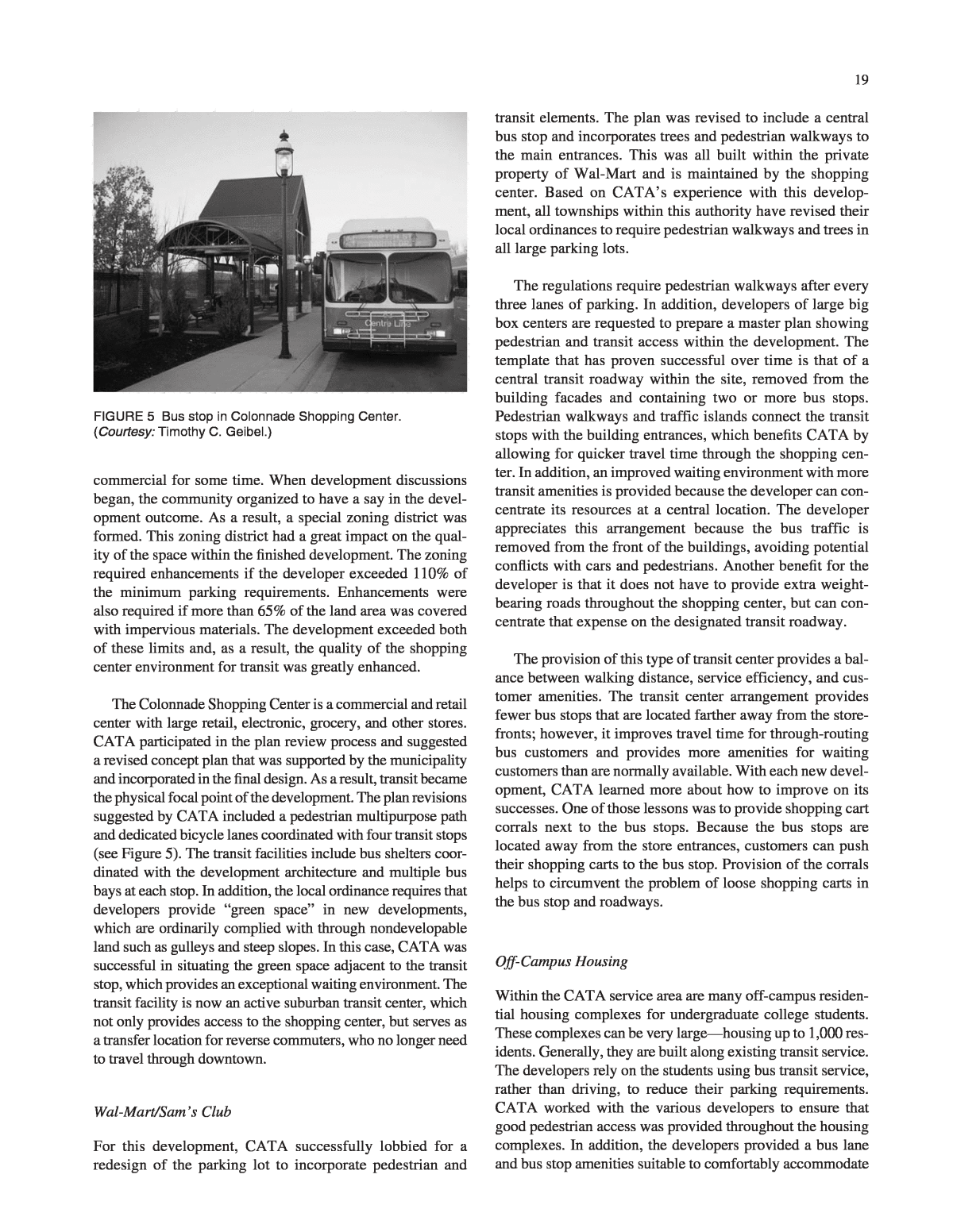
19 commercial for some time. When development discussions began, the community organized to have a say in the devel- opment outcome. As a result, a special zoning district was formed. This zoning district had a great impact on the qual- ity of the space within the finished development. The zoning required enhancements if the developer exceeded 110% of the minimum parking requirements. Enhancements were also required if more than 65% of the land area was covered with impervious materials. The development exceeded both of these limits and, as a result, the quality of the shopping center environment for transit was greatly enhanced. The Colonnade Shopping Center is a commercial and retail center with large retail, electronic, grocery, and other stores. CATA participated in the plan review process and suggested a revised concept plan that was supported by the municipality and incorporated in the final design. As a result, transit became the physical focal point of the development. The plan revisions suggested by CATA included a pedestrian multipurpose path and dedicated bicycle lanes coordinated with four transit stops (see Figure 5). The transit facilities include bus shelters coor- dinated with the development architecture and multiple bus bays at each stop. In addition, the local ordinance requires that developers provide âgreen spaceâ in new developments, which are ordinarily complied with through nondevelopable land such as gulleys and steep slopes. In this case, CATA was successful in situating the green space adjacent to the transit stop, which provides an exceptional waiting environment. The transit facility is now an active suburban transit center, which not only provides access to the shopping center, but serves as a transfer location for reverse commuters, who no longer need to travel through downtown. Wal-Mart/Samâs Club For this development, CATA successfully lobbied for a redesign of the parking lot to incorporate pedestrian and FIGURE 5 Bus stop in Colonnade Shopping Center. (Courtesy: Timothy C. Geibel.) transit elements. The plan was revised to include a central bus stop and incorporates trees and pedestrian walkways to the main entrances. This was all built within the private property of Wal-Mart and is maintained by the shopping center. Based on CATAâs experience with this develop- ment, all townships within this authority have revised their local ordinances to require pedestrian walkways and trees in all large parking lots. The regulations require pedestrian walkways after every three lanes of parking. In addition, developers of large big box centers are requested to prepare a master plan showing pedestrian and transit access within the development. The template that has proven successful over time is that of a central transit roadway within the site, removed from the building facades and containing two or more bus stops. Pedestrian walkways and traffic islands connect the transit stops with the building entrances, which benefits CATA by allowing for quicker travel time through the shopping cen- ter. In addition, an improved waiting environment with more transit amenities is provided because the developer can con- centrate its resources at a central location. The developer appreciates this arrangement because the bus traffic is removed from the front of the buildings, avoiding potential conflicts with cars and pedestrians. Another benefit for the developer is that it does not have to provide extra weight- bearing roads throughout the shopping center, but can con- centrate that expense on the designated transit roadway. The provision of this type of transit center provides a bal- ance between walking distance, service efficiency, and cus- tomer amenities. The transit center arrangement provides fewer bus stops that are located farther away from the store- fronts; however, it improves travel time for through-routing bus customers and provides more amenities for waiting customers than are normally available. With each new devel- opment, CATA learned more about how to improve on its successes. One of those lessons was to provide shopping cart corrals next to the bus stops. Because the bus stops are located away from the store entrances, customers can push their shopping carts to the bus stop. Provision of the corrals helps to circumvent the problem of loose shopping carts in the bus stop and roadways. Off-Campus Housing Within the CATA service area are many off-campus residen- tial housing complexes for undergraduate college students. These complexes can be very largeâhousing up to 1,000 res- idents. Generally, they are built along existing transit service. The developers rely on the students using bus transit service, rather than driving, to reduce their parking requirements. CATA worked with the various developers to ensure that good pedestrian access was provided throughout the housing complexes. In addition, the developers provided a bus lane and bus stop amenities suitable to comfortably accommodate
50 to 75 waiting bus passengers. Pull-off bus lanes to hold one or two 40-ft buses out of the traffic lanes are provided along with concrete pads, shelters, and benches. Developers are given the option of providing custom bus shelters, which they must maintain, or providing one of the standard CATA shel- ters, which would be maintained by the transportation author- ity. Most developers choose the standard shelter. Developers are willing to provide these amenities to avoid paying additional roadway impact fees. The provision of pedestrian sidewalks, pull-off lanes, and bus stop amenities is generally less expensive than fees associated with added turn lanes or signalization improvements. The operation of the adjacent bus routes is adjusted to pick up the 50 to 75 students who want to get to school at the same time in the morning, with one or two extra trips scheduled ahead of the regularly sched- uled service. The pull-off lanes allow the extra buses to remain out of the traffic lane while picking up the waiting students. Successful Strategies Projects that successfully combine bus transit and land devel- opment have a champion that persisted in voicing the need for transit considerations. In the CATA region, the local elected officials fill that role. Many of the elected officials in the CATA service area ride the transit system and therefore have a sense of transitâs value and are sympathetic to transit needs. Successful development in the CATA region depends on supportive local officials, who together with the regional planning agency are willing to forego a development rather than build an unsuccessful project. Early participation in the design process by transit plan- ning staff is a key strategy for successful integration of bus transit with land development. CATA has a unique opportu- nity to ensure this early participation. CATA and the CRPA share a transit planner who spends 20 h per week at each agency. It is through this planner that CATA becomes involved early in the development process. All development projects are reviewed by the CRPA. When a development proposal is received by the township or local municipality a copy of the plan is sent to the CRPA. This is a voluntary process and is made possible by the sup- port of local officials, as noted previously. It is also possible because many local governments have chosen to have smaller planning staffs, which can be accomplished by including the CRPA in all their planning activities. The CRPA planners provide support for plans within the local areas and also provide the local governments with a regional perspective. When a plan is received, the CRPA planner immediately consults with the CATA planner. The CRPA arranges meetings to include all of the various disciplines involved in the proposed development. This discussion is helpful and can sometimes provide opportunities for the various stakeholders to collaborate on a design idea. 20 For example, during discussions regarding the provision of open space it became known that providing the open space around the bus stop would also help to drain stormwater. The transit interest of providing a more pleasant waiting area at the bus stop was then supported by one of the other disci- plines, further strengthening the provision and location of the developmentâs open space (see Figure 6). This early participation in the process is critical to the suc- cessful coordination of bus transit and land development. Once a developer starts the design of a project and has deter- mined where the buildings will be located and how the stormwater will drain, incorporating transit is more difficult. The developer has already invested too much money in the project to be cooperative with transit interests. In addition to early participation, CATA provides valu- able technical expertise to the developer to solve problems associated with the incorporation of transit into the develop- ment. The provision of physical design details up front, together with on-going follow-up with the developer by CATA staff, has proven to be a small but influential catalyst in the process. The developers find that CATA is flexible in finding solutions to meet the needs of transit, and this is also a key strategy. Another meaningful ingredient to CATAâs success is related to the knowledgeable staffs at both CATA and CRPA, who have worked together for some time. Management has also been stable. In 18 years, CATA has had only two general managers and both have recognized and understood the rela- tionship between transit and land use. CATA staff has found that requesting reasonable transit elements, gaining respect and credibility among local stakeholders, and building on past accomplishments is a successful strategy. Developer experi- ence is also important. Most developers in the area are now experienced in the process and often expect to incorporate transit needs into the design of their developments. FIGURE 6 Open space adjacent to bus stop in Colonnade Shopping Center. (Courtesy: Timothy C. Geibel.)
Lastly, the CRPA has a Regional Growth Boundary. The Comprehensive Plan defines the Regional Growth Boundary and this directs where new growth will occur. Public funding for water and sewer are earmarked for projects within the growth boundary. The Regional Growth Boundary positively assists transit, because it encourages denser growth and defines where future growth can occur. This helps transit planners concentrate their efforts and resources, but does not specifically assist in the integration of bus transit service into land developments. Appropriate land uses and recognition of the importance of transit to serve developments are the pri- mary drivers to integrating transit with new developments. OMNITRANS Omnitrans is headquartered in San Bernardino, California. The service area is located approximately 25 mi west of Los Angeles and includes 15 cities and San Bernardino County. It was formed as a Joint Powers Authority in 1976. Omni- trans serves approximately 1.4 million people within 480 square miles and provides fixed-route service, parallel para- transit service, and two demand-response community shuttle services. Annual ridership is approximately 16 million. The state of California mandates an environmental review process for projects that can have a significant impact on the surrounding area. Through this process, cities will release a notice to public agencies, including Omnitrans, that a project will be undergoing environmental review. Comments are accepted throughout the stages of the process. In addition to the formal environmental review process, informal communi- cation regarding new developments occurs through contacts established at staff level. Omnitrans also approaches city/ county staff when it updates its Short Range Transit Plan to identify the developing areas and the need for transit service. Successful Projects Chino Preserve The Preserve is an area of approximately 5,500 acres located in the southwest corner of San Bernardino County approxi- mately 37 mi east of Los Angeles. The area was annexed to the city of Chino in July 2003. The Preserve development will be a mixture of residential neighborhoods focused around a community core and commercial center. Approxi- mately half of the area will remain as open space for natural, recreational, and agricultural uses. The development will also be integrated with the Chino Airport. Areas adjacent to the airport property to the north of the development are des- ignated for airport uses, light industrial, or public facilities. The Preserve Specific Plan was completed in March 2003 and lays out a vision for the community. The Plan includes development guidelines, a mobility plan, an infrastructure plan, and design guidelines to direct the type, style, and design of development. Residential construction within the development has already begun. Transit elements within the Preserve include a one- directional loop connected to a regional bus service planned along the developmentâs western boundary. The loop service will operate within a dedicated right-or-way on 10-min inter- vals (see Figure 7). FIGURE 7 Planned transit route in Preserve development. (Courtesy: City of Chino, California.) 21
Successful Strategies The commitment to provide dedicated rights-of-way for tran- sit service was made early in the design process. Early com- mitment is key to successfully integrating transit into this new development. Although sufficient densities to support transit service will not exist for several years, the land has been preserved for this future use. Incorporating the right-of- way into the development was easy to accommodate early in the process when streets, parks, subdivisions, and other major land uses were proposed. However, once this stage of the design process is passed, it would likely become signifi- cantly more difficult to include this right-of-way later in the process. In California, an environmental review planning process assists transit agencies in having input to new developments. The state of California Environment Quality Act requires a review process for projects that have the potential to physi- cally impact the environment. Most development proposals that require some type of government approval are subject to environment review. Examples of projects that are eligible for California Environment Quality Act review include the enactment of zoning ordinances, adoption of a general plan, issuance of conditional use permits, or approval of tentative subdivision maps. Omnitrans was involved in the environ- mental review process for the Preserve to ensure that future transit needs would not be âdeveloped-outâ of the rapidly growing area. The Preserve, proposed for development in the city of Chino, is part of a larger-scale greenfield development. The city of Ontario, northeast of Chino, has development plans for vacant land adjacent to the Preserve. The cities of Chino and Ontario each developed land use Specific Plans for their developments that were intended to promote transit use. However, the cities recognized that, despite good intentions, the Specific Plans were deficient. To address this, Chino and Ontario undertook a joint effort with Omnitrans to address transit service design, funding, and land use for all the new communities proposed for development. The effort culmi- nated in the June 2005 publication of the Community Based Transportation Plan (CBTP). The CBTP analyzed transit plans within the Preserve and neighboring communities and recommended changes to the operating details prepared in the Specific Plans. The CBTP builds on the transit right-of- way provided for in the Preserve Specific Plan. It expands the utility of the right-of-way by recommending additional bus routes to serve the Preserveâs community core, linking the Preserve to neighboring communities. The CBTP is a good example of interagency cooperation, where two cities and the transit authority jointly developed a plan to benefit future res- idents. The plan transcends municipal borders and integrates proposed new services with an existing network. As the area develops, the need for transit service will grow. Omnitrans and the cities of Chino and Ontario will monitor growth and implement services as necessary. 22 METRO TRANSIT Metro Transit serves the twin cities of Minneapolis and St. Paul, Minnesota, and the surrounding metropolitan areas in its seven-county service area. Metro Transit is one of the countryâs largest transit systems, providing approximately 70 million bus trips annually. Metro Transit operates the Hiawatha light-rail line, 129 bus routes, and 14 contract ser- vice routes, using a fleet of 878 buses. Metro Transit is part of the Metropolitan Council, the regional planning agency serving the Twin Cities seven- county metropolitan area, with a population of just over 2.6 million people. Inclusion of the transit agency within the regional planning agency is a fairly unique organiza- tional structure. The Metropolitan Reorganization Act of 1994 merged the functions of three agencies (the Metro- politan Transit Commission, the Regional Transit Board, and the Metropolitan Waste Control Commission) into the Metropolitan Council. The Metropolitan Council coordi- nates regional policy, services, and investments to provide transit service, wastewater treatment, community plan- ning, population forecasting, affordable housing, and parks planning. Successful Projects Midtown Exchange Midtown Exchange is the site of the former Sears property, located at Lake Street and Chicago Avenue in Minneapolis. Since Sears closed its doors in 1994, neighborhood groups, local government, and private-sector leaders have worked together to restore the site as a vibrant, mixed-use urban hub. When completed, the Midtown Exchange will contain rental apartments, condominiums, and town homes; the headquarters of Allina Hospitals and Clinics; a Hennepin County service center; a new Sheraton hotel; and the Mid- town Global Market. The Global Market will be the cityâs largest public market. The community adjacent to Midtown Exchange is expected to support the Global Market in large numbers because the marketâs retail mix was chosen with the neighborhoodâs ethnic make-up in mind. As of January 2006, the office space was occupied and residents had begun to move in. The Global Market is expected to open in spring 2006. As part of the Midtown Exchange development, the city of Minneapolis and Metro Transit collaborated on planning a new transit facility within the development. The new tran- sit facility solved many problems associated with the con- nection of two major bus routes at this intersection. Before the development of Midtown Exchange, the two routes made service stops on the street outside of the Sears complex, and transfers were made between the bus stops on the four street corners. This intersection is one of the busiest in the system,
23 with many passengers transferring at this location. The amount of space available at one of the bus stops was insuf- ficient for the large number of passengers who used that stop. To remedy the situation, one of the bus stops was split into two stops, creating a near-side stop and a far-side stop in the same direction. The sheer number of passengers using this intersection provided the impetus to design a new transfer terminal (see Figure 8). The transit center, which began operations on March 1, 2006, consolidates all five bus stops and makes transfers between the two bus routes more convenient. The amount of space for waiting customers has been expanded and cus- tomer amenities are much improved. Transfers between routes are safer and waiting customers are more protected from the possibility of street crime. The facility provides adequate space for buses and frees up space at the intersec- tion for turn lanes and additional street parking. The devel- opment also provides access to a large number of potential new customers, and ridership on the two routes serving the development is expected to increase (see Figure 9). Victoria Crossing Victoria Crossing is located at Grand and Victoria Streets in the city of St. Paul (see Figure 10). It is an infill devel- opment composed of a collection of small shops and spe- cialty stores anchoring the 100-plus other stores along Grand Avenueâs 26 blocks. The city and Metro Transit FIGURE 8 Rendering of transit center in Midtown Exchange. (Courtesy: Metro Transit, Minnesota.) FIGURE 9 Midtown Exchange transit center. (Courtesy: Metro Transit, Minnesota.) FIGURE 10 Victoria Crossing development. (Courtesy: Metro Transit, Minnesota.)
consulted on the impact of this development on the exist- ing transit service. As a result, existing bus stops were relocated. City Bella The City Bella development in the city of Richfield incor- porates high-density residential housing units, 18,000 square feet of commercial space, an underground parking garage, a surface parking lot behind the building, and a one- acre park. The city of Richfield understood the relationship between transit and high-density developments and brought Metro Transit into the discussions early in the planning process. This infill development is built on an existing tran- sit line and the existing bus stops were relocated to better serve the area. In addition, the development of City Bella coincided with the execution of a sector study by Metro Transit. A sector study is a comprehensive operational analysis of transit service within one of nine sectors and is conducted in partnership with the local governmental enti- ties. As a result of the sector study, Metro Transit improved the level of service along Lyndale serving the City Bella development. Successful Strategies Metro Transit noted that one of its most successful strategies is communication networks with local governments. Out- reach to the local municipalities is time-consuming; however, coordination becomes easier over time as communication net- works and relationships are formed. The eventual pay-off is a high level of cooperation among stakeholders over transit improvement needs. A second successful strategy is the legislative mandate for a coordinated Comprehensive Plan. The Metropolitan Council coordinates the comprehensive planning process, which pro- vides clear goals for the region. The 2030 Regional Develop- ment Framework includes a Transportation Policy Plan, a Water Resources Management Policy Plan, and a Parks Policy Plan. The Metropolitan Land Planning Act of 1976 requires local governments in the seven-county MinneapolisâSt. Paul area to develop local comprehensive plans. The local plans must be consistent with the Metropolitan Council regional plan. As part of the planning process, the Metropolitan Council pre- pares âsystem statementsâ for each community in the seven- county area. Preparation of system statements is intended to help communities prepare or update their local comprehensive plans, and informs local officials on how their community is affected by the Councilâs regional system plans. Local com- munities submit their local comprehensive plans for Council review at least once every 10 years. At the same time, the local governmentâs Capital Improvement Program and local con- trols, such as zoning ordinances, must be reviewed for consis- tency with the comprehensive plan. This process ensures that all plans in the region conform to the same overall goals and are compatible with one another. 24 The transit agencyâs unique position within the Metropol- itan Council is also a successful strategy to integrate bus tran- sit service with land development planning. As part of the overall planning process, the Metropolitan Council reviews all Environmental Assessment Worksheets, rezoning requests, and amendments to the Comprehensive Plan that are required for new developments. Planning staff reviews these to ensure that they comply with regional policy, and transit staff reviews them to provide comments related to transit. This affords the transit staff the opportunity to review devel- opment plans early in the development planning process. GO BOULDER GO Boulder is a division within the city of Boulder Trans- portation Department in Boulder, Colorado. GO Boulder is responsible for the development of alternative transportation programs to improve the mobility of residents, employees, and visitors within the city of Boulder. GO Boulder devel- oped the innovative Community Transit Network (CTN), which is comprised of high-frequency bus routes with fun names like HOP, SKIP, and JUMP. In addition to continuing the development of new bus routes for the CTN, GO Boul- der plans expansions to the extensive system of off-street bicycle paths, pedestrian paths, and underpasses in the city of Boulder. GO Boulderâs service area includes the city of Boulder, which has a population of approximately 100,000. The Uni- versity of Colorado contributes another 28,000 students to the population. GO Boulder does not directly operate tran- sit service. The CTN is operated by the Regional Trans- portation District (RTD) headquartered in Denver, except for the HOP service, which is operated by a private contrac- tor. The city of Boulder subsidizes the cost of CTN service that is over and above the service levels acceptable by RTD service standards. Successful Projects Twenty Ninth Street Development The Twenty Ninth Street Development is the site of the for- mer enclosed Crossroads Mall. The new development, scheduled to open in fall 2006, will be an open air mall offer- ing 850,000 square feet of shops, restaurants, and entertain- ment venues. The development will be separated into four distinct neighborhoods connected by streets, walkways, and plazas, as shown in Figure 11. The street plan includes a new 29th Street and extensions of Canyon and Walnut streets that will better connect the site with the rest of Boulder. Transit was considered very early in the developmentâs design. Transit amenities incorporated into the development include new bus stops along 29th Street, which runs east and west through the center of the development, a âsuper stopâ at 28th and Arapahoe with a queue jumper lane, and a HOP stop
25 at 29th and Canyon. More than 175 spaces will be provided for bicycles. The development will also incorporate special parking spaces for alternative fuel vehicles as well as pre- ferred parking for van and carpools. Boulder Transit Village To the northeast of the Twenty Ninth Street Development is the Boulder Transit Village, a planned joint development between the city of Boulder and RTD. The development is currently in the planning and public involvement phase. As currently envisioned, the development will become the trans- portation hub for the immediate area. The development will include a bus transit center, a small parking structure, and space for a future FasTracks rail station. The rest of the land will be developed as high-density residential with under- ground parking. Holiday Neighborhood The Holiday Neighborhood is a mixed-use, mixed-income development that incorporates many of the principles of new urban design (see Figure 12). In addition to the 330 homes for sale and rent, the neighborhood includes a two-acre park, a community garden, shops, restaurants, offices, and artist studios. The development was begun in 1998 when Boulder Housing Partners, the housing authority for the city of Boul- der, acquired the 27-acre site of the former Holiday drive-in theater in north Boulder. The first residents started moving into the development in February 2004, and the develop- ment was scheduled to be completed in the spring of 2006. Most residences within the development are within a one- quarter-mile walk of bus service, and all households receive neighborhood Eco Passes, a discounted annual bus pass that allows unlimited travel on RTD local, regional, express, and light-rail routes. Successful Strategies GO Boulder is not a transit agency, but a city department that is included as a case study because it provides an example of city government that directly supports transit through its policies, which encourage the use of transit and other alter- native travel modes. City policies regarding zoning, open space, and parking management all contribute to an environ- ment that is transit-supportive. In addition, the existence of FIGURE 11 Drawing of proposed Twenty Ninth Street Development. (Courtesy: Macerich Company.) FIGURE 12 Holiday Neighborhood street. (Courtesy: City of Boulder.)
A successful strategy to encourage transit use is parking management. In downtown Boulder, most on-street parking meters are 3-h meters. This discourages the use of on-street parking by downtown employees and provides short-term parking for shoppers. Boulder also offers downtown employ- ees an incentive to take transit to work by offering them an Eco Pass. Revenue from the downtown parking meters is used to fund transit passes for downtown employees. Boul- derâs downtown Eco Pass encourages transit ridership and provides commuter benefits to more than 8,000 employees. Parking management is also employed on the Colorado University campus. All parking on campus is paid parking. This encourages the use of transit and other alternative modes by the university population. In addition, students, faculty, and staff can receive Eco Passes for free, unlimited use of the bus system. Another successful strategy is the funding of CTN bus routes by the city of Boulder, Colorado University, and RTD. RTD supports the operating costs of each route up to the ser- vice levels contained in their service standards. In addition, RTD secured federal funds for initial pilot demonstration projects on most of the CTN bus routes. Colorado University subsidizes a portion of the operating costs for the HOP and STAMPEDE bus routes. In addition, the city of Boulder sub- sidizes the cost of CTN service that is over and above the service levels acceptable by RTD service standards. This partnership support of the CTN allows for higher service lev- els than would normally be available. This provides a more attractive service, which should draw more customers and increase bus ridership. 26 GO Boulder within the cityâs organization allows early par- ticipation by transit in the planning for new developments. GO Boulder promotes communication with RTD and other stakeholders to encourage partnerships and improve the tran- sit environment. The zoning within Boulder encourages mixed-use development, which in turn encourages the use of alterna- tive modes, including transit. The city has six mixed-use zoning districts. Since they were created, new develop- ments in Boulder are now more traditional mixed-use developments with multiple stories. The city is gradually becoming new urbanist in character, especially on the western side of the city. Boulder citizens have historically valued open space for the beauty of mountain vistas and the preservation of natural resources. In 1967, Boulder citizens voted for a sales tax of 0.4% to acquire, manage, and maintain open space. An addi- tional 0.33% was added in 1989. Today, more than 43,000 acres of land have been preserved to create a buffer between Boulder and neighboring communities and to preserve nat- ural areas and resources. Boulderâs open space program limits the amount of land available for development. This encourages higher-density developments capable of supporting high-frequency bus tran- sit service. With less land available for development, transit interests become a louder voice in the planning process. The higher-density land use requires the provision of transit service to alleviate congestion caused by an automobile-dominated environment.
