


Below is the uncorrected machine-read text of this chapter, intended to provide our own search engines and external engines with highly rich, chapter-representative searchable text of each book. Because it is UNCORRECTED material, please consider the following text as a useful but insufficient proxy for the authoritative book pages.
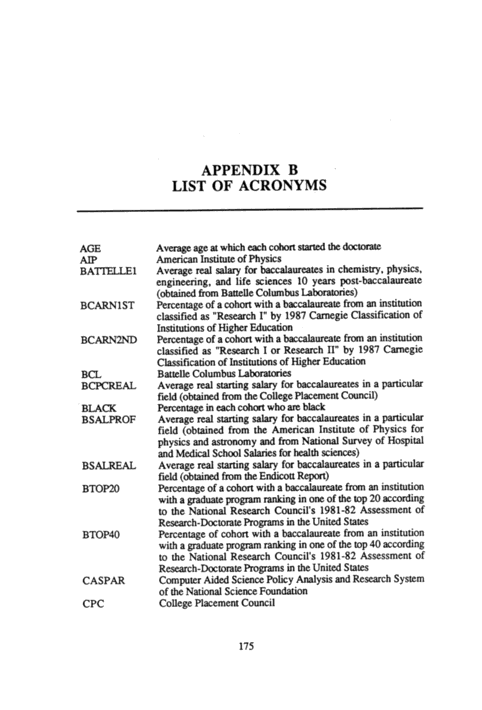
APPENDIX B LIST OF ACRONYMS - AGE Average age at which each cohort started the doctorate AIP American Institute of Physics BAl led LE1 Average real salary for baccalaureates in chemistry, physics, engineering, and life sciences 10 years post-baccalaureate (obtained from Battelle Columbus Laboratories) ~. ~ ~_ _ BCL BCPCREAL ~ BLAC:K BSALPROF BCARN1ST Percentage or a cohort W1U] a Baccalaureate from an ~nsu~unull classified as "Research I" by 1987 Carnegie Classification of Institutions of Higher Education BCARN2ND Percentage of a cohort with a baccalaureate from an institution classified as "Research I or Research II" by 1987 Carnegie Classification of Institutions of Higher Education Battelle Columbus Laboratories Average real starting salary for baccalaureates in a particular field (obtained from the College Placement Council) Percentage in each cohort who are black Average real starting salary for baccalaureates in a particular field (obtained from the American Institute of Physics for physics and astronomy and from National Survey of Hospital and Medical School Salaries for health sciences) BSALREAL Average real starting salary for baccalaureates in a particular field (obtained from the Endicott Report) BTOP20 Percentage of a cohort with a baccalaureate from an institution with a graduate program ranking in one of the top 20 according to the National Research Council's 1981-82 Assessment of Research-Doctorate Programs in the United States BTOP40 Percentage of cohort with a baccalaureate from an institution with a graduate program ranking in one of the top 40 according to the National Research Council's 1981-82 Assessment of Research-Doctorate Programs in the United States CASPAR Computer Aided Science Policy Analysis and Research System of the National Science Foundation CPC College Placement Council 175
DEAN DRF E EAM ER EXPENDST F FACULTY FORBACC GREQ GREV HISP I MARRED NSHMSS o P&A PCARN1ST PERPOP Percentage of the DRF cohort who had definite employment or postdoctorate study plans at the time that the survey was conducted Average number of dependents of the doctorate recipients in each cohort Doctorate Records File Market forces (i.e., SALRAT1, UNEMP4YR, SEEK) Earth, Atmospheric and Marine Sciences Endicott Report produced at the Northwestern University Federal expenditures on higher education per full-time equivalent student Family background characteristics (i.e., MARRIED, DEPEND, TEMP, WOMEN) Number of full-time equivalent faculty members Percentage of each cohort with a foreign baccalaureate degree Mean quantitative score from the Graduate Records Examination ; Mean verbal score from the Graduate Records Examination Percentage in each cohort who are Hispanic Student attributes (i.e., AGE, SAMEFLD, SELECT) Percentage of each doctorate cohort that are married National Survey of Hospital and Medical School Salaries produced at the University of Texas Institutional environment and policies (i.e., FORBACC, BTOP40, BCARN1ST, BCARN2ND, PTOP40, PCARN1ST, PCARN2ND, FACULTY, R&D) Physics and astronomy Percentage of a cohort with a doctorate from a "Research I" institution, based on 1987 Carnegie Classification of Institutions of Higher Education PCARN2ND Percentage of a cohort with a doctorate from a "Research I or Research II" institution, based on 1987 Carnegie Classification of Institutions of Higher Education Ratio of number of doctorates to the U.S. population 25-34 years of age having 16 or more years of education Percentage of a cohort with a doctorate from an institution with a graduate program ranking in one of the top 20 according to the National Research Council's 1981-82 Assessment of Research-Doctorate Programs in the United States Percentage of a cohort with a doctorate from an institution with a graduate program ranking in one of the top 40 according to the National Research Council's 1981-82 Assessment of Research-Doctorate Programs in the United States PrOP20 PTOP40 176
R&D RTD SALRAT1 SALRATIO SAMEFLD SDR SDRSAL SEEK SELECT SUPPED SUPOWN SUPPRIV SUPRA SUPTA TEMP TLFA TNEU TPGE loll' Tt~lllON I3NEMP UNEMP4YR WOMEN Research and development; ratio of real dollar value of government expenditures on university R&D to the number of science and engineering doctorate recipients Registered time to the doctorate (i.e., the length of time that a student is actually registered in graduate school) Ratio of SDRSALl0 to SDRSAL Ratio of doctorate salary to baccalaureate salary in a particular field Percentage of each cohort with a baccalaureate degree in the same field as the doctorate Survey of Doctorate Recipients Average real salary of recent doctorates in a particular field (based on SDR data) SDRSAL10 Average real doctorate salary for doctorates 10 years after receipt of the degree (based on SDR data) Percentage of those in a DRF cohort seeking employment or postdoctorate study Percentage of each cohort from selective undergraduate colleges and universities Percentage of each cohort with federal support Percentage of each cohort reporting own earnings as primary source of support Percentage of each cohort with private foundation support Percentage of each cohort with research assistantship Percentage of each cohort with a teaching assistantship Percentage of the total doctorates who hold temporary visas Tuition and financial aid (i.e., TUITION, SUPPED SUPPRIV, SUPTA, SI3PRA) Time not enrolled in the university after beginning graduate studies Time after receiving the baccalaureate but prior to graduate entrance Total time to doctorate (i.e., the time lapse from the year of receiving the baccalaureate until the doctorate is completed) Real average in-state tuition and fees paid by the cohort Overall unemployment rate for the U.S. labor force (obtained from the Bureau of Labor Statistics) Unemployment rate for persons with four or more years of college (obtained from the Bureau of Labor Statistics) Percentage in each cohort who are female 177
