




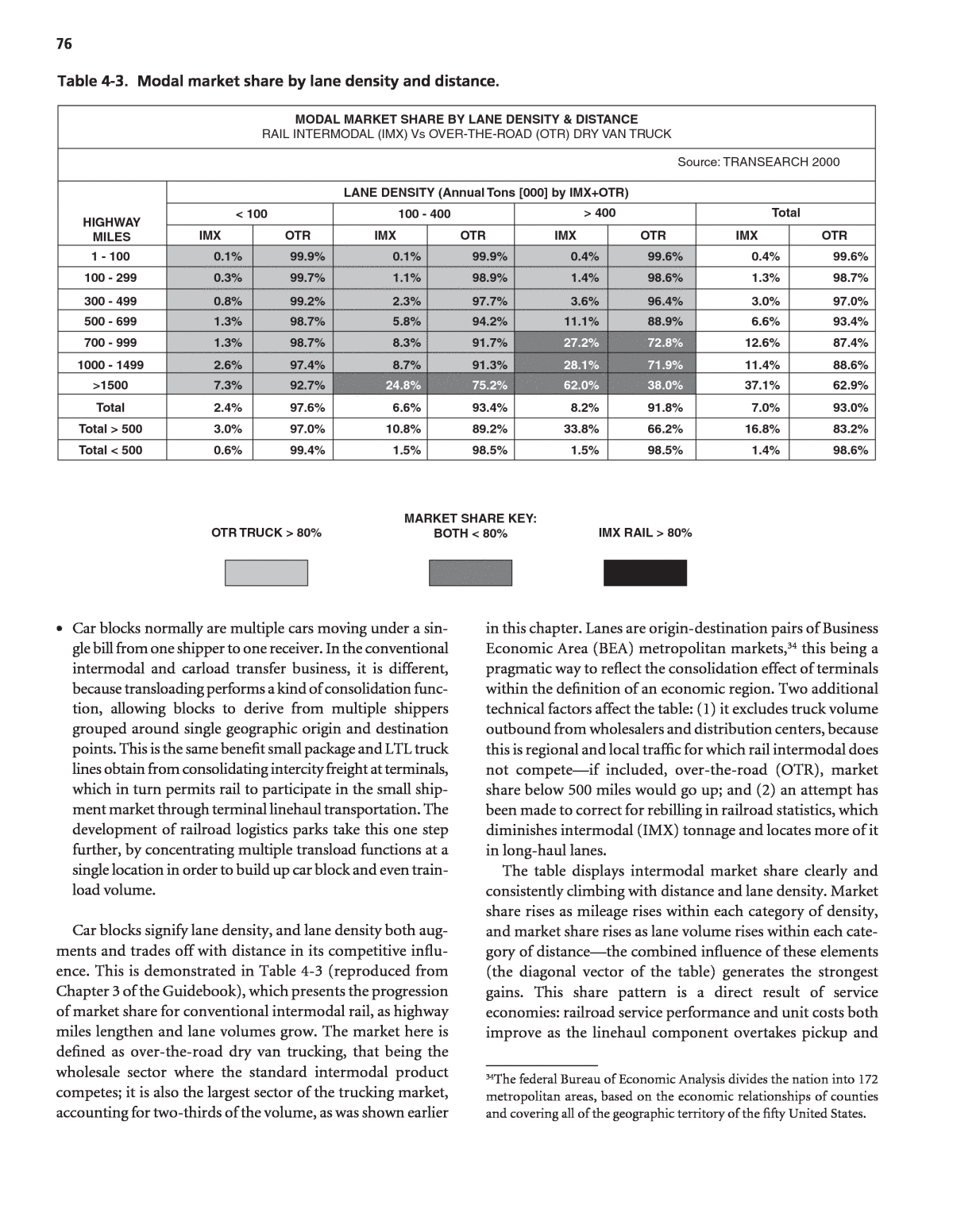
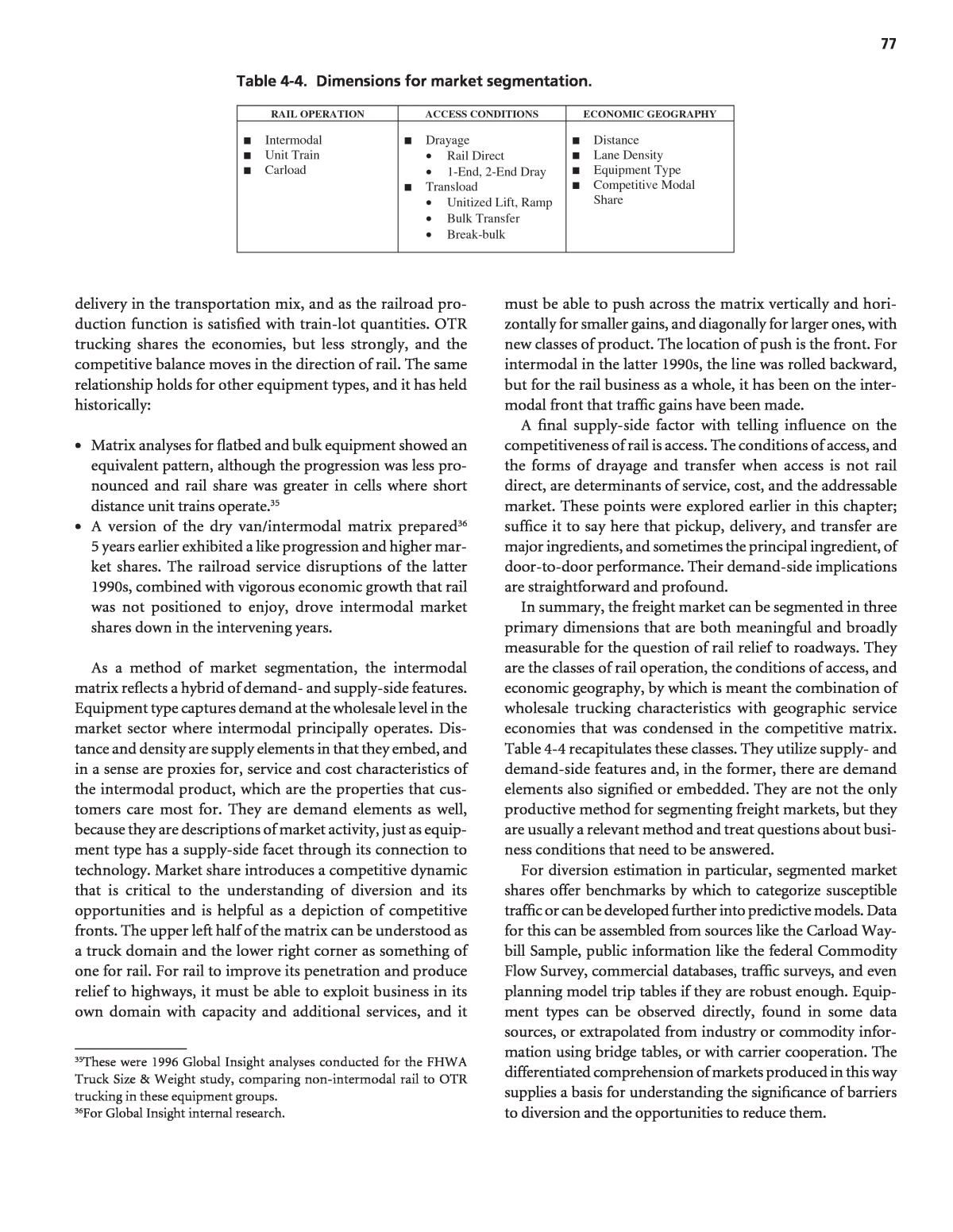

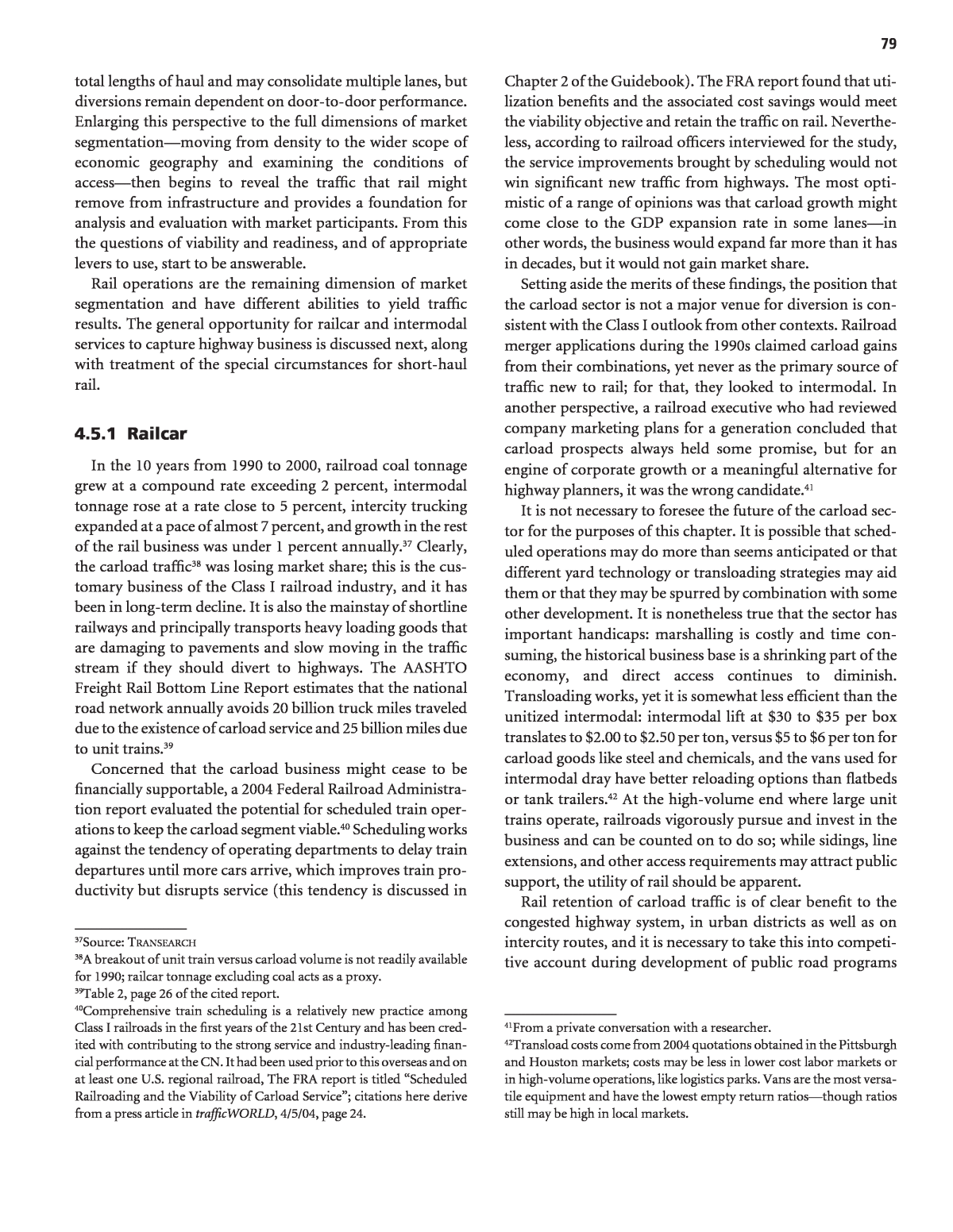


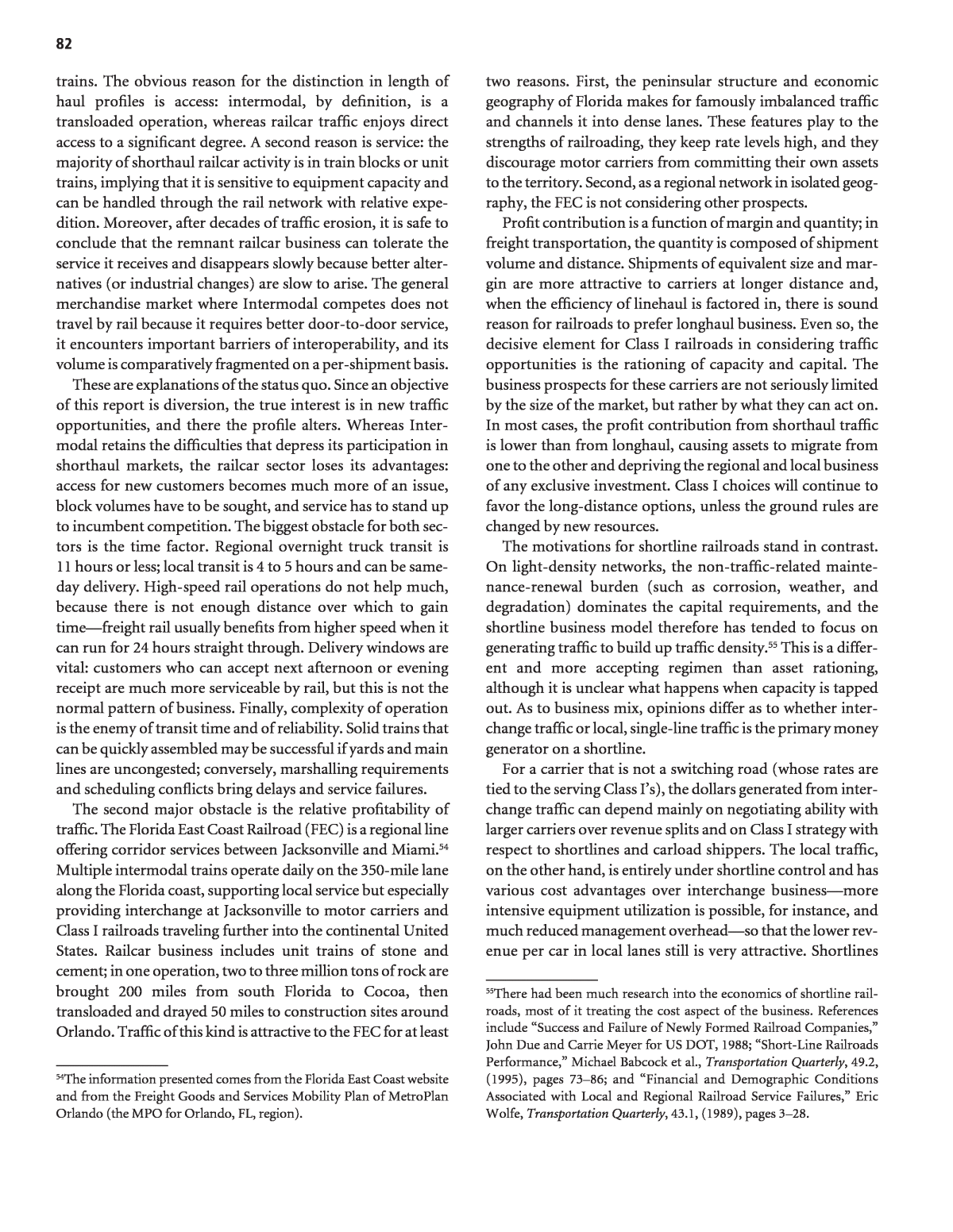
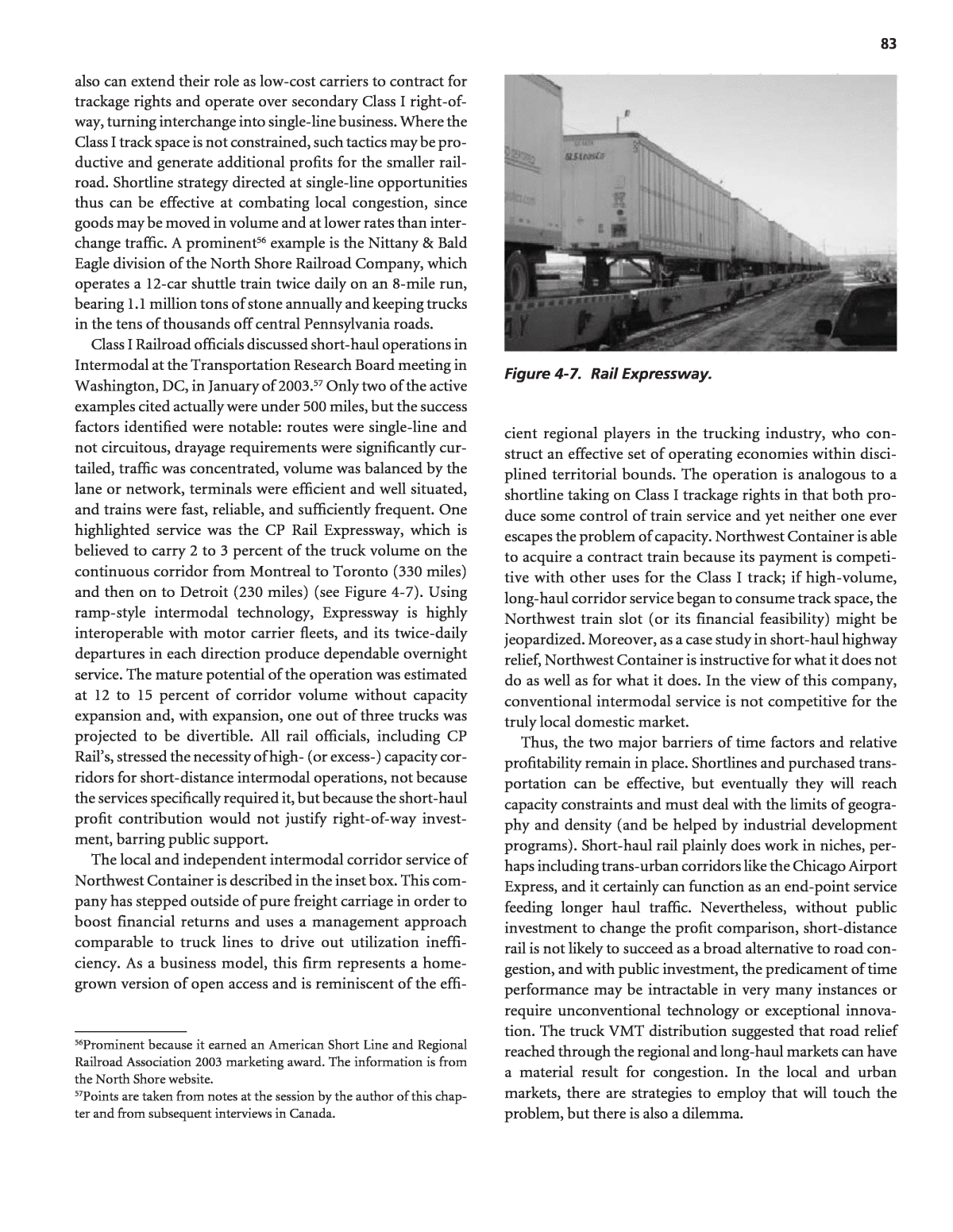

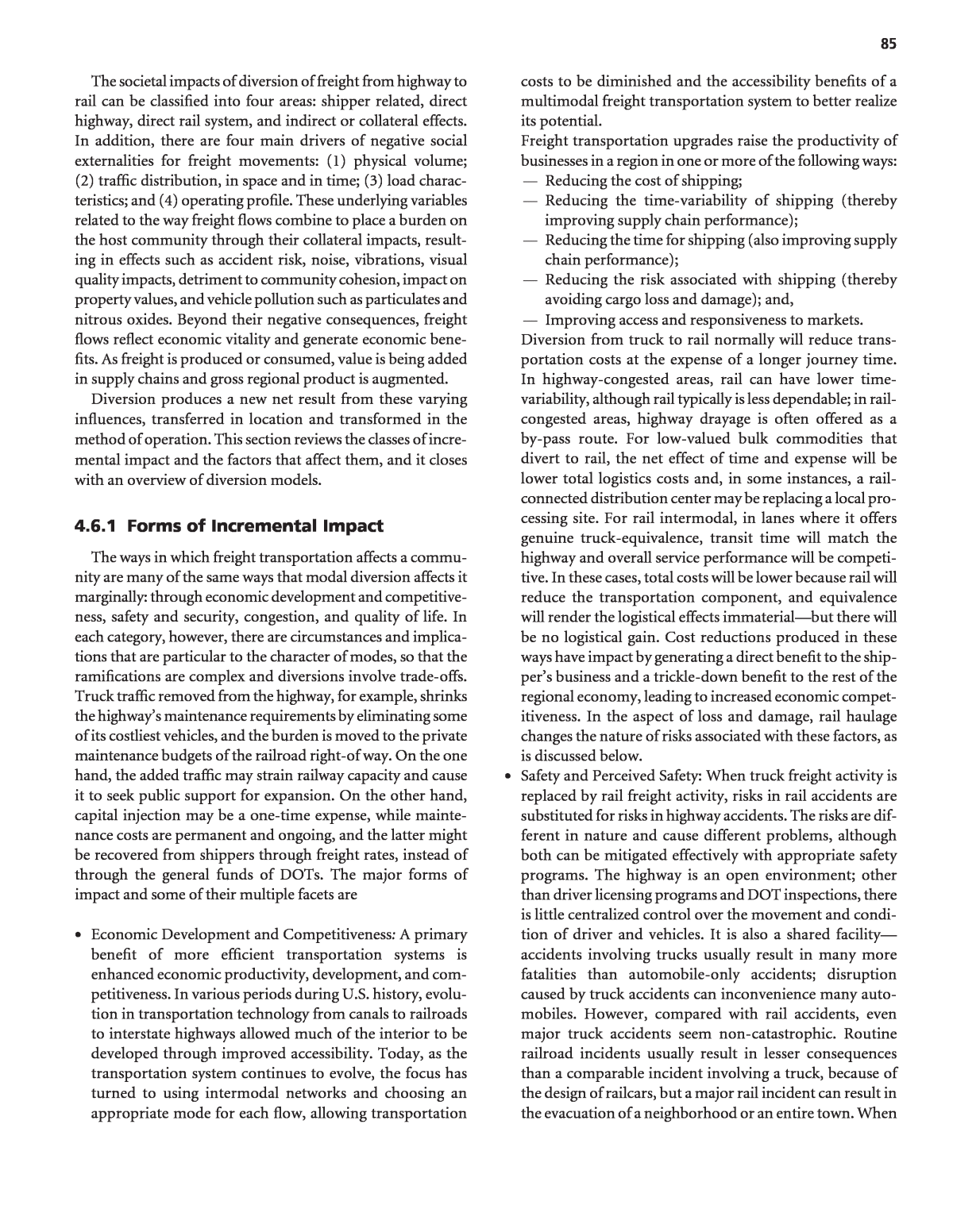
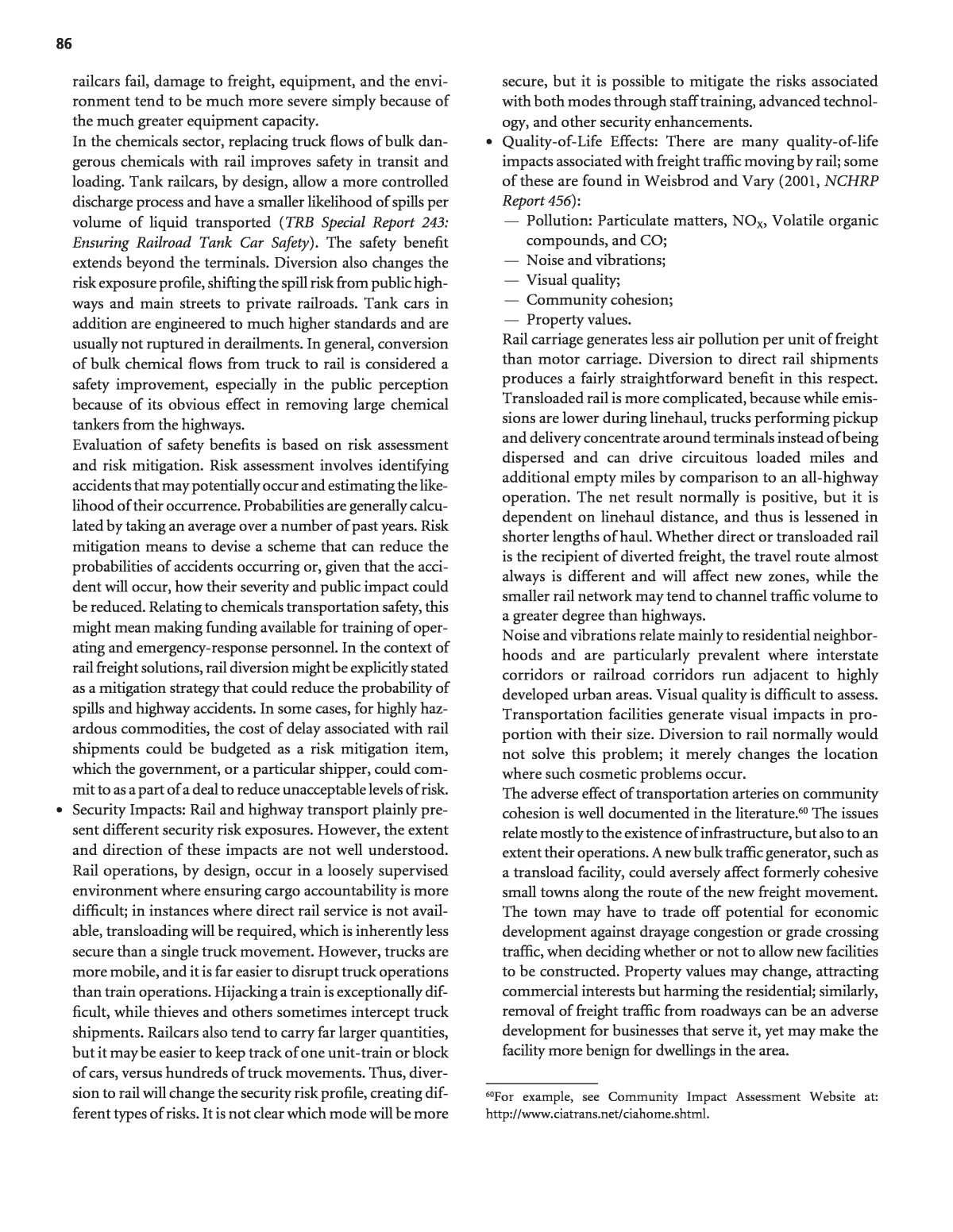
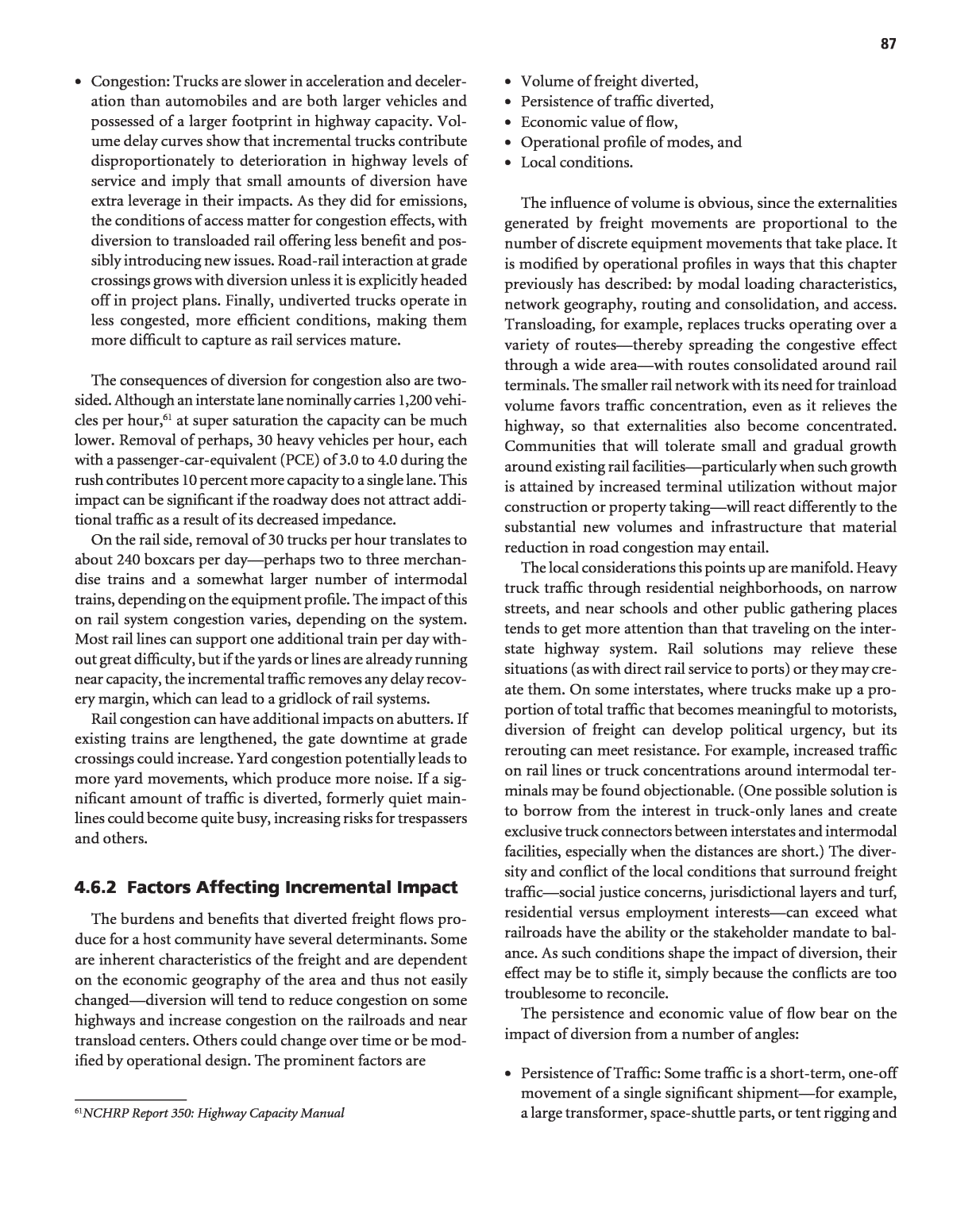

Below is the uncorrected machine-read text of this chapter, intended to provide our own search engines and external engines with highly rich, chapter-representative searchable text of each book. Because it is UNCORRECTED material, please consider the following text as a useful but insufficient proxy for the authoritative book pages.
60 4.1 Introduction For railways to produce material relief for the congested roads of the nation, the rail system must capture highway traffic. Therefore, in many ways, diversion of traffic from road to rail is the heart of the issue that forms the subject of this report. This chapter examines shipper needs and struc- tural factors that produce conditions favoring diversion or constraints that hamper it. The chief objective of this chapter is to assist planners in coming to a realistic judgment of the market and operating conditions that shape and show the probable payoff from rail solutions to congestion. Analysis of diversion options becomes quite complex when the analysis takes in the interaction of factors and motivations at the level of individual shipments. The purpose of this chap- ter is to reduce those factors to broad, true outlines that offer a compass to planners, by which they can navigate the forest from amid the trees. In a sense, diversion can be brought down to a simple proposition: good, low-cost service wins business from competitors, and the obstacles and advantages for rail in delivering this are what have to be understood. An evaluation in practice will not play out simply, yet this per- spective is important for testing whether a result makes sense: diversion analysis is competitive analysis, and strongly com- petitive service should succeed. Given that the overarching goal of this report is reduced congestion and greater effective capacity for the highway sys- tem, then preservation of rail traffic is important, because it prevents additional, often heavily laden volume from being introduced to the highways and further eroding their performance. It means that the problem of pickup and deliv- ery is important, because these trip-end services occur more frequently in urban areas. If pickup and delivery must operate by truck instead of direct rail, then there will be limited rail relief in urban areas, which are among the most congested. Incremental traffic has a greater detrimental effect on system performance in already congested networks. This implies that as freight traffic on the roadways continues to build, the value of diversion to rail grows greater. This chapter moves through five additional sections, beginning with a presentation of basic customer motivations, then builds toward an understanding of the limitations and opportunities for diversion, and concludes with a review of diversionâs effects. ⢠Section 4.2, Shipper Needs. Understanding of modal pref- erence starts from the foundation of customer needs. Their portrayal in this section ranges from service, cost, and other requirements to carrier selection. The market posi- tions of modes are indicated, and the discussion introduces the concepts of equivalence, conversion, and categorical distinctions in service. ⢠Section 4.3, Structural Factors. Important limitations to rail are posed by the conditions of access and the addressable extent of the highway market. The characteristics of truck fleets are described as modal competitors and intermodal partners, and the challenge of interoperability as well as the urban problem are highlighted in this section. ⢠Section 4.4, Market Segmentation. Recognition of the dif- ferential nature of market sectors helps to uncover diver- sion opportunities and to verify their realism. Markets are considered in this section from the demand and supply sides, in retail and wholesale aspects. A freight rail typology and market benchmarks are presented, and the discussion concludes with a framework for market segmentation, use- ful as a basis for diversion evaluation. ⢠Section 4.5, Diversion Opportunities. The prospects for highway diversion are different for the railcar and the intermodal businesses, while the short-haul freight market is large, significant for congestion relief, and difficult to approach. This section considers the singular qualities of opportunity in each of these areas, using case examples and distinguishing prospects of national magnitude from those with local promise. C H A P T E R 4 Shipper Needs and Structural Factors
⢠Section 4.6, Impacts of Diversion. Modal diversion alters the locational impact of freight, creating new traffic con- centrations on rail lines and around transload facilities, yet improving mobility for other traffic left on the roads. The marginal effects of diversion in economic and social dimensions are reviewed in this section, including conges- tion, economic development, and environmental, safety, and community consequences. 4.2 Shipper Needs Purchasers of freight transportation are motivated by a series of factors in their selection of providers. Chiefly they are concerned with performance specifications and value, within the overall context of the logistics of their business and its contribution to customer satisfaction. These factors are variously described as purchasing criteria or selection requirements, but are most simply called shipper needs (although the purchasers of transportation may be receivers or managers of freight and not properly shippers at all). Adopting simple terms for this discussion, the two primary needs of shippers are service and cost. 4.2.1 Service Service fundamentally means the reliability with which goods are picked up and delivered as scheduled or expected and the transit time or speed of that process. Reliability can be understood as the variability of performance versus a stan- dard, which typically is an appointment time and a tolerance range around it. An example of a reliability measurement would be â95% of deliveries on time,â where âon timeâ means within 1 hour of the appointed moment. Precision arises as an aspect of service when the tolerance range narrows to 15-minute windows around appointments, or with financial guarantees for a fixed, daily deadline. Service on the pickup end also entails equipment capacity to collect the shipment and the turnaround time for equipment to cycle back. Exam- ples would be the railcar supply during the harvest season or the availability of trucks around big retail distribution cen- ters, and it is routine for shippers to require commitments of equipment from their freight carriers. Finally, frequency of service effectively is a facet of transit time, because it adds to the hours elapsed between the point when a shipment is ready for pickup, and the point when it can be delivered. In irregu- lar route systems (like significant parts of the U.S. truckload business), frequency is a direct function of equipment supply, but in regular route operations the availability, number, and timing of departures is a major determinant of effective serv- ice. In railroading, departures correspond to the number of trains running per day and per week; in other planned route networks, the departures might be planes (in air freight) or linehaul trucks (in LTL and small package trucking). It is worth noting in these systems that departures have a high fixed cost component that tends to depress service frequency and creates a temptation to consolidate departures, thereby reducing costs but downgrading performance. Two additional points should be made about service. First, it is measured door-to-door, which means from the shipperâs door to the door of the receiver. This is a salient point for railroading in the context of highway relief, because in the commonplace absence of direct rail access to the customer facility, goods must be transloaded and drayed, and this can1 add to time and cost. Furthermore, the railroad and the drayage truck performing pickup and/or delivery normally are not under common operating control, implying that door- to-door service performance depends on the cooperation of independent agents. This issue of cooperation affecting service also exists for interline handoffs between the major rail systems prevailing today in the eastern U.S., the western U.S., Mexico, and Canada. Second, there is a common misperception that the speed of transit is not especially important so long as deliveries are predictable. Reliability or predictability is the most crucial feature of service, and shippers may exist who value it to the exclusion of transit time, but speed of transit is an essential factor in modern logistics: ⢠There is a well-documented movement in industrial man- agement to reduce the cash-to-cash cycle time of business, which refers to the time between the purchase of inputs or merchandise and the point when goods are sold and paid for. Time compression is sought in every aspect of the cycle, implying that speed is important everywhere. One core motivation for this trend is market responsiveness, whereby the productive capacity of a supply chain reacts swiftly and flexibly to local activity at the points of sale. Adoption of low-inventory, high-speed logistics systems is key to this capability. In a large survey of freight shippers released by Morgan Stanley Equity Research, the number one reason that shippers had not shifted more truck freight to rail intermodal was slow transit, followed closely by unpredictability of service.2 ⢠Truck lines form an important intermediate customer group for rail intermodal services, providing both the pickup and delivery operations and the retail marketing to shippers. In market research conducted for the Virginia I-81 corridor, motor carriers made the significance of tran- sit time performance quite clear. For fixed-route truck 61 1For customers with direct rail access, the switching of cars between the rail yard and their facilities also consumes time and expense. 2âFreight Pulse Survey: Second Round Insights,â 1/9/02, Morgan Stanley Equity Research.
lines that have published schedules, rail must meet or improve the schedule or it cannot be used; for irregular route truck lines, the standard of comparison is the over- the-road speed of a single driver, and the utility of rail is diminished if it cannot match or improve on the standard. An additional finding in this research was that transit time performance behaved as a step function measured in whole or half days. Speed improvements are significant when they cross this threshold, but are not very meaningful in smaller increments. Coupled with the fact that speed is evaluated door-to-door, this finding points up a competi- tive hindrance to rail in short-distance lanes, which will be explored later in this chapter. 4.2.2 Cost Cost considered narrowly is the price charged by the car- rier for the shipment, but more broadly and substantially it is the total set of costs attendant to doing business with the car- rier and mode. Like service, it must be totaled door-to-door and include any separate charges for pickup, delivery, and transfer. Costs are compared by unit shippedâper piece or per pound, for exampleâand thus are sensitive to the load- ing capacity of transport equipment and to the size of the shipment. Comparisons also have to be aligned by miles trav- eled (commonly called length of haul), first because distance is a primary and obvious driver of transportation costs, and second because of the changing proportion of pickup and delivery to linehaul costs, as miles lengthen. Pickup and deliv- ery tend to be time and therefore asset intensive; railroads in particular find their comparative advantage lies in the effi- ciency of linehaul. Total logistics cost is the most comprehensive way to view the sum of the expenses attached to doing business with a car- rier or mode. The term âlogisticsâ especially brings in the inventory carrying costs associated with the lot sizes, transit time, and service reliability offered by the carrier. The inven- tory itself expands into the building space, the staff, and the administrative expense required to support it. Provided the value of the goods shipped is known, the inventory financing charges for lot sizes and transit time are calculable; however, the cost of some of the other elements can be difficult to measure, notably for analysts (like public planners) who are not privy to shipperâs internal information. From a practical standpoint, there are two observations to make about logis- tics cost and its effect on carrier selection and diversion: ⢠Low-inventory logistics are a manifestation of a deeper business process. When just-in-time practices were intro- duced to industry, they were focused not so much on stock reduction as on eliminating the process failures that inventory covered over. As the evolution of supply chain strategies has turned the focus to market responsiveness, the value of that strategy to business overwhelms other considerations,3 and logistics practices are engineered to execute it. Shippers in this sense are seeking the right transportation products in terms of service performance and carrying capacity; while transportation costs matter, additional logistics factors have been obviated by the per- formance standard. In other words, if a transportation product imposes significant inventory burdens on the logistics system, it cannot meet the engineering require- ments and does not qualify for purchase. ⢠Apart from rates, the logistics cost differences between car- riers are largely a function of modal technology. Motor carriers certainly compete on service, but they are broadly substitutable one for another in terms of their logistics effects. The logistical implications of rail carload service can be significantly different from motor carriage, on the other hand, and are an impediment to diversion. Even so, the class of railroad service that competes most aggressively with highway transportation and is most likely to produce congestion relief is the intermodal product, which strives to emulate truck performance and offers the shipper equivalent loading characteristics. As the rail product becomes substitutable for all-highway service, supply chain effects start to become immaterial, and total logistics costs collapse to the difference in transportation costs. Transportation costs are structurally dependent on modal technology and are fundamentally influenced by two forms of volume efficiency: consolidation economies and economies of density. Consolidation (which is the ability to combine shipments into larger lots by grouping or unitizing them or by accumulating them to travel together) can be per- formed by the shipper in tendering larger amounts of freight or by the carrier or intermediary in combining freight from many shippers into quantities that will fill a truck or make up a block of cars on a train Density refers to the concentration of market volume in time and space. Its major components are ⢠Balanceâthe ratio of delivering (inbound) shipments to originating (outbound) shipments in an area; ⢠Proximityâthe distance between delivering and originat- ing shipments or the interval distance between sequential deliveries or pickups in a chain; 62 3 The âInternational Trade Flow Studyâ by the Fleet Management Depart- ment of TTX Corporation (9/03) describes retail importers stopping, strip- ping, and transloading international containers for the purpose of delaying a decision about the final destination for goods. This is done so as to react most optimally to point of sale information from stores. Market consider- ations in a case like this completely offset the added logistics expense.
⢠Vectorâthe direction of volume, often characterized as a lane; ⢠Confluenceâthe joining of vector volumes in common arterial sections of a network. Vector and confluence are critical to railroading, because its unit of productionâthe trainâdepends on directional traffic concentration; ⢠Frequencyâthe timing of volume, as it determines the immediate relationships of balance, proximity, vector, and confluence in a spatial zone. Consolidation and density both are concerned with the organization and dynamics of traffic flow and, in turn, are determinants of transportation asset utilization. Utilization measures the productive work of assetsâfacilities, right of way, and especially mobile equipmentâin terms such as revenue per day, cycle time, and loaded to empty proportions, and it keenly affects return on investment. A strong positive relation- ship usually exists between density and utilization on the one side and service performance on the other, such that quality and efficiency can be mutually reinforcing attributes. Because of this, the advantage of density can be thought of as conferring a service economy. Finally, carriers can control utilization by a variety of means; an important one is management of the dis- persion of assets across geographic territory, where less con- centration is detrimental. This is equivalent to the military principle, under which the effectiveness of armies is related to the force they exert, in ratio to the space in which they operate. 4.2.3 Other Needs Beyond the two primary requirements, shippers consider a series of additional factors in carrier selection: geographic coverage, affecting lane service and the ability to single- source; relationship, including customer communication and incumbency; and ease of doing business. Three of the most prominent are visibility, risk elimination, and specialization, which are discussed below. The relative significance of these factors varies with the shipperâs industry and can rise to the importance of service and cost in some cases. The chemical industry, for example, values risk elimination highly, while shippers of produce care about the equipment and knowl- edge specialization that delivers their products fresh and unbruised to the market. Visibility The movement to low-inventory, market-responsive sup- ply chains has caused the visibility of product inside the sys- tem to become vital. The objective ideally is to be able to locate and affect any item in real time anywhere in the chain: at the factory, the warehouse, the store, or aboard the freight carrier. The traditional role of inventory as a guarantee of goods to customers has been transferred to information systems, transportation systems, and integrated supplier management. Shipment tracking historically was a carrier support function for service assurance; under fast cycle logis- tics, it makes a crucial contribution to total supply chain management. Development and adoption of a range of mobile communications tracking technologies have created the ability to follow and direct the movement of power units; trailers, containers, or cars; and the goods inside them. A car- rier who provides visibility to a customer offers a combina- tion of technology (transponders, cellular devices, bar codes and radio tags are examples as this is written), data process- ing and communication systems (currently including web-based platforms for shippers to tap carrier data), and operational controls, all combining to produce actionable information about goods in transit. Risk Elimination The components of risk are safety, claims, and environmen- tal protection; equipment maintenance; insurance; security procedures; and the stability of finances and labor. They are directed at four issues: (1) the safe handling of goods, includ- ing hazardous goods, and the ability to respond and make rec- ompense in the event of incidents or loss; (2) the protection4 of goods from theft, vandalism, and violence, and of the trans- portation system from highjack and terrorism; (3) the safe conduct of transportation, and the avoidance of accidents harming people and property; and (4) the dependability of the carrier as a going concern, so that shipments tendered and logistics programs built around the company can be expected to proceed without disruption. Specialization Expertise in the shipperâs business is helpful to the client in many industrial segments and is critical in some. Specialized equipment is a prerequisite in numerous areas: temperature controlled goods, automobiles, apparel, and heavy machinery are examples. Equipment (specialized or not) may be dedi- cated to a shipper, or an entire operation may be contracted, including motive power and on-site staff. Training or simply experience in product handling and plant procedures turn carrier personnel into approximate extensions of the shipperâs staff. Where dedicated or specially trained work forces are used, the carrier may assume logistics functions such as preparing store-ready merchandise with tagging and displays. Specialization in these instances crosses into out-sourcing and third-party logistics. 63 4Railroads maintain private police forces that are licensed and armed as peace officers.
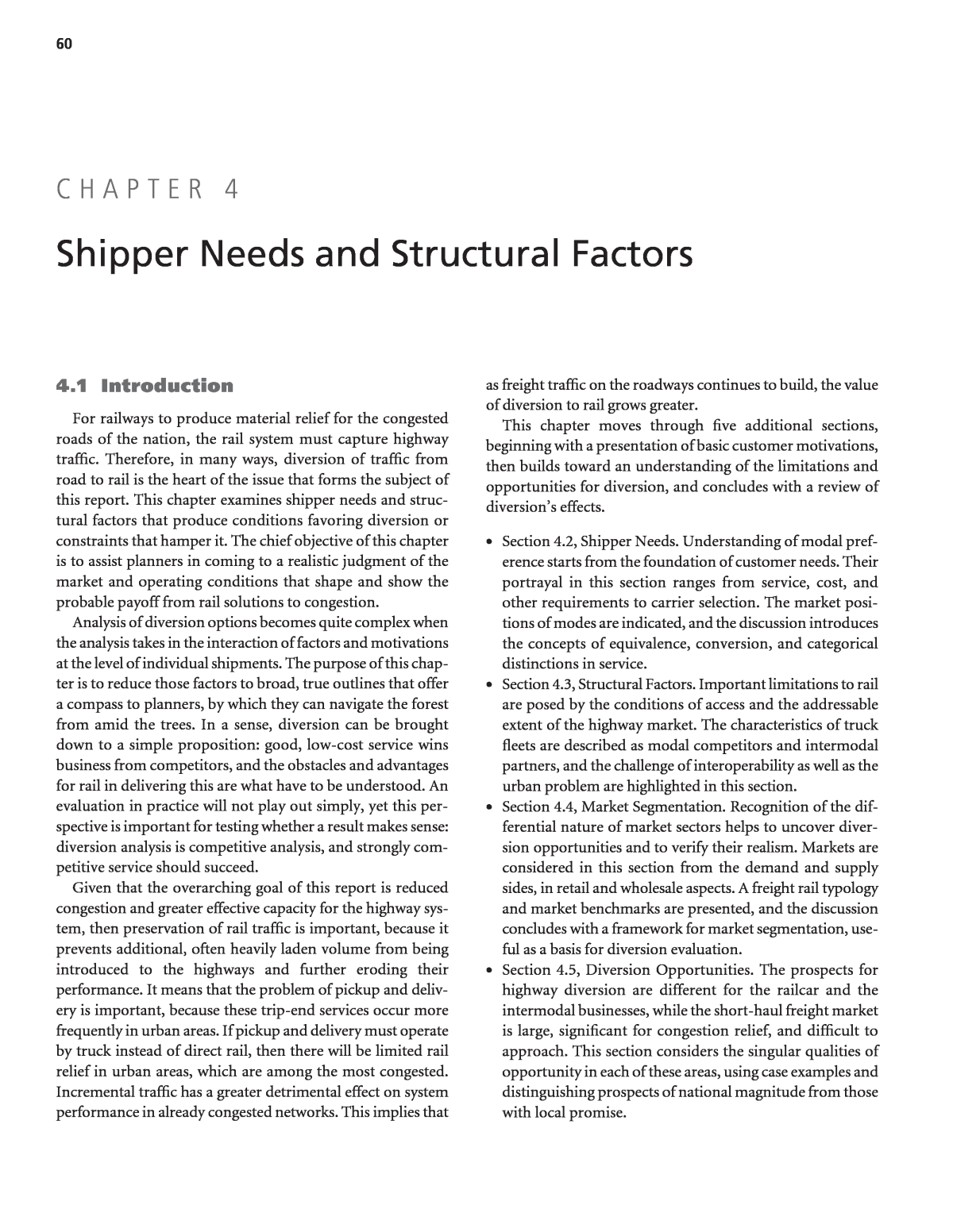
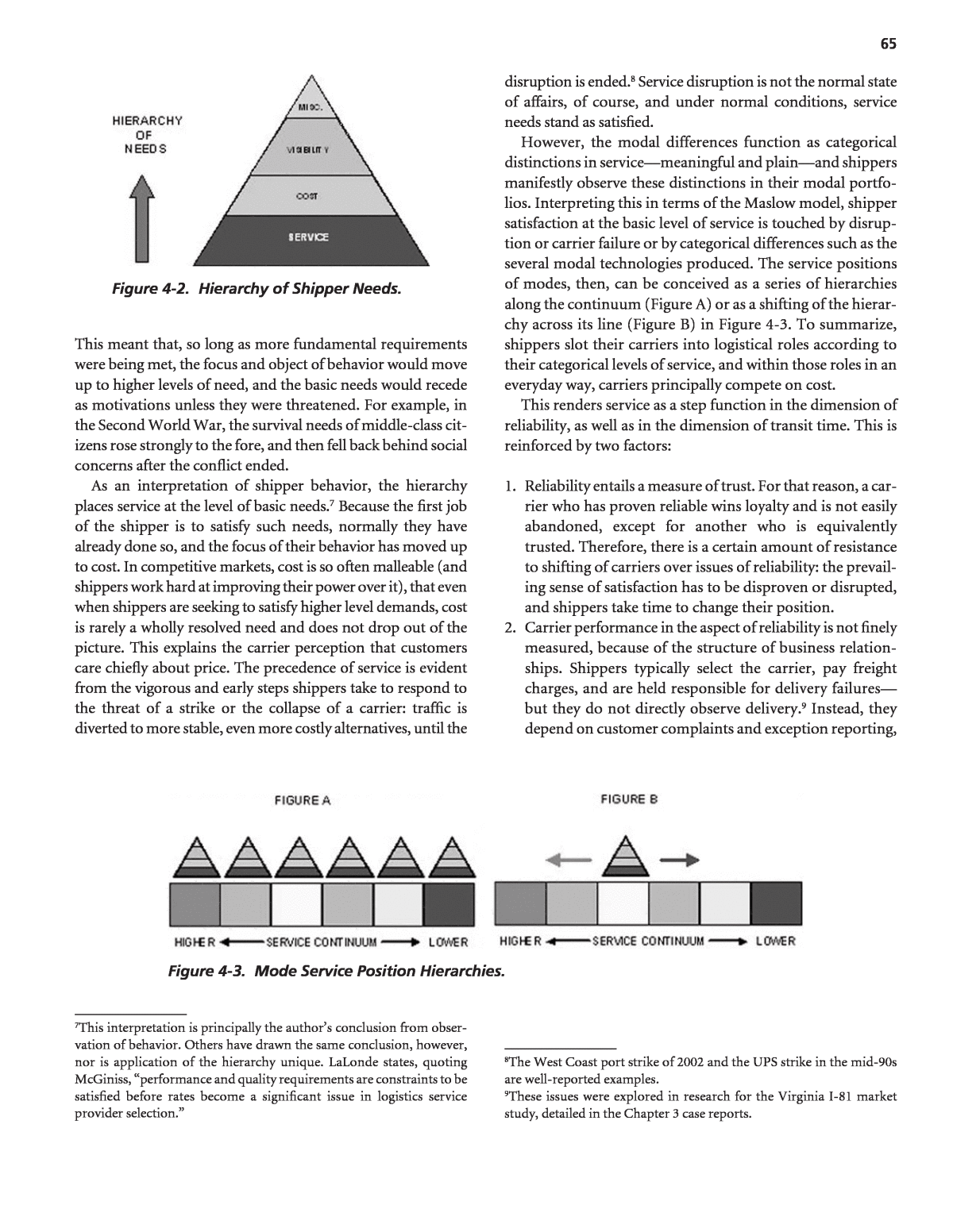
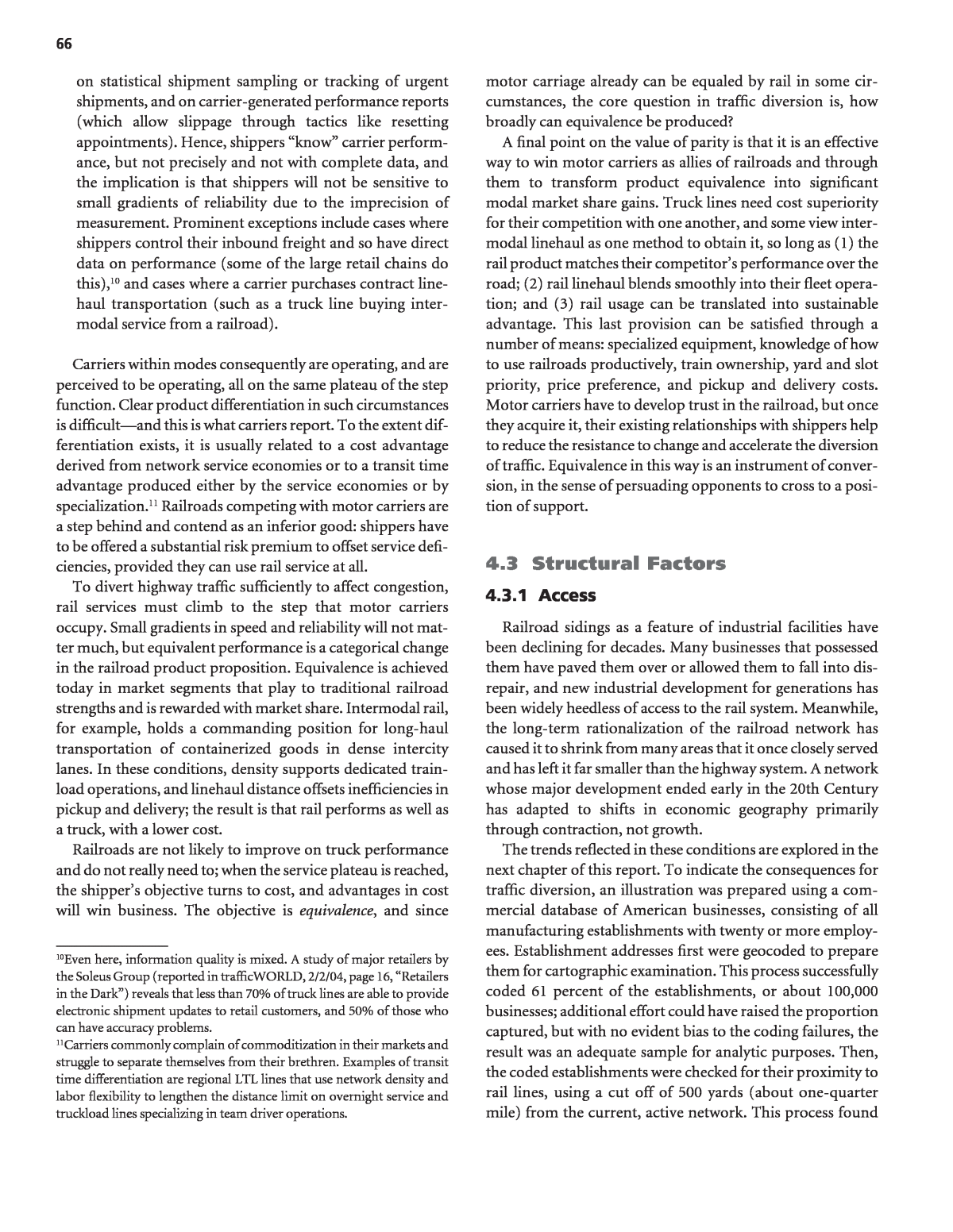
4.2.4 Carrier Selection Freight modes offer a characteristic mix of service and transportation cost advantages and can be arrayed in a con- tinuum as shown in the first chart of Figure 4-1. Individual carriers and operations may perform above or below the tendency of their mode, but it generally holds that motor carriage offers superior service to railroading and earns a higher price, while the intermodal product for rail is the closest to truck performance. The importance of service is borne out by modal growth rates in the 1990s, which directly correspond to position along the continuum (seen in the second chart of Figure 4-1). These illustrations sug- gest the fronts of modal competition and the areas of the market where traffic diversion is most apt to take place: intermodal versus highway, highway versus air, and barge versus carload rail. Two points should be acknowledged about this profile: 1. Shippers may employ a portfolio of carriers and modes, according to the span of their logistics requirements, geo- graphic exigencies, and movements in their markets. Their needs therefore may require a diversity of solution. 2. Freight carriers or companies seek to transfer the portfolio function from shippers to themselves by using multiple modes beyond the one they may be known for. A current expression for this is mode neutrality, indicating that carriers market certain performance specifications to shippers, while trying to reserve to themselves the respon- sibility for deciding the method of accomplishment. Of course, the selection of modes and sub-modes matters to the execution. In practice, some specifications are synonymous with a particular mode, and some shippers will penetrate the veil of neutrality if they are concerned for the risks that a mode may pose or want to assure themselves a share of a cost advantage. Shippers consistently rank their needs as service first and cost second. Numerous studies through the years5 demon- strate this and typically stress reliability or on-time delivery as the foremost feature, followed by transit time. Priorities after the cost feature fluctuate by industry group, as noted above, and individual shippers may deviate from the norms. Freight carriers react with cynicism to the primary ranking of service, because their competitive experience is that shippers care chiefly about cost.6 Understanding this apparent discrepancy is useful, because it points up dynamics that influence analy- sis of diversion. Figure 4-2 presents the prioritization of shipper needs in the terms of Maslowâs hierarchy. Abraham Maslow was an Amer- ican psychologist who posited a theory of human needs under which basic requirements such as food and shelter had prece- dence over emotional requirements such as social esteem, but each level of the hierarchy formed a threshold below the next. 64 5One particular reference is a 1996 paper âShipper Carrier Decision Making: Post Deregulation Quality Factorsâ by Professor Bud LaLonde, formerly of Ohio State University. LaLonde in turn references the find- ings of Michael McGiniss and others. A 1997 shipper survey by Cahners Publishing is another of many sources (Logistics Management, Septem- ber 1997, âThe High Rollers,â page 72.) Private research by the authors for railroads, motor carriers, and public agencies from the 1980s through 2003 show the same thing. 6This is the authorâs long-standing experience. Figure 4-1. Transportation Cost Advantage Continuum.
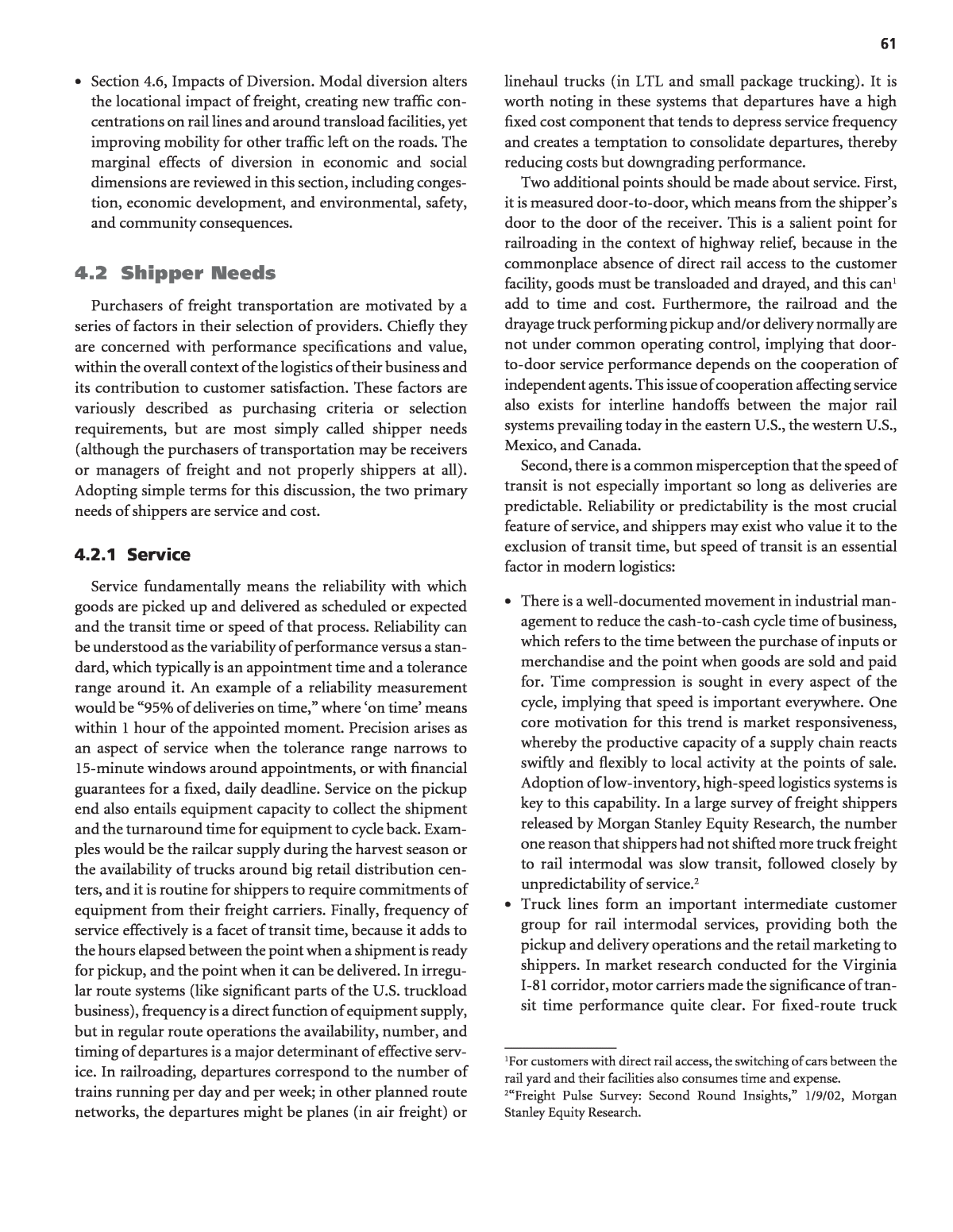
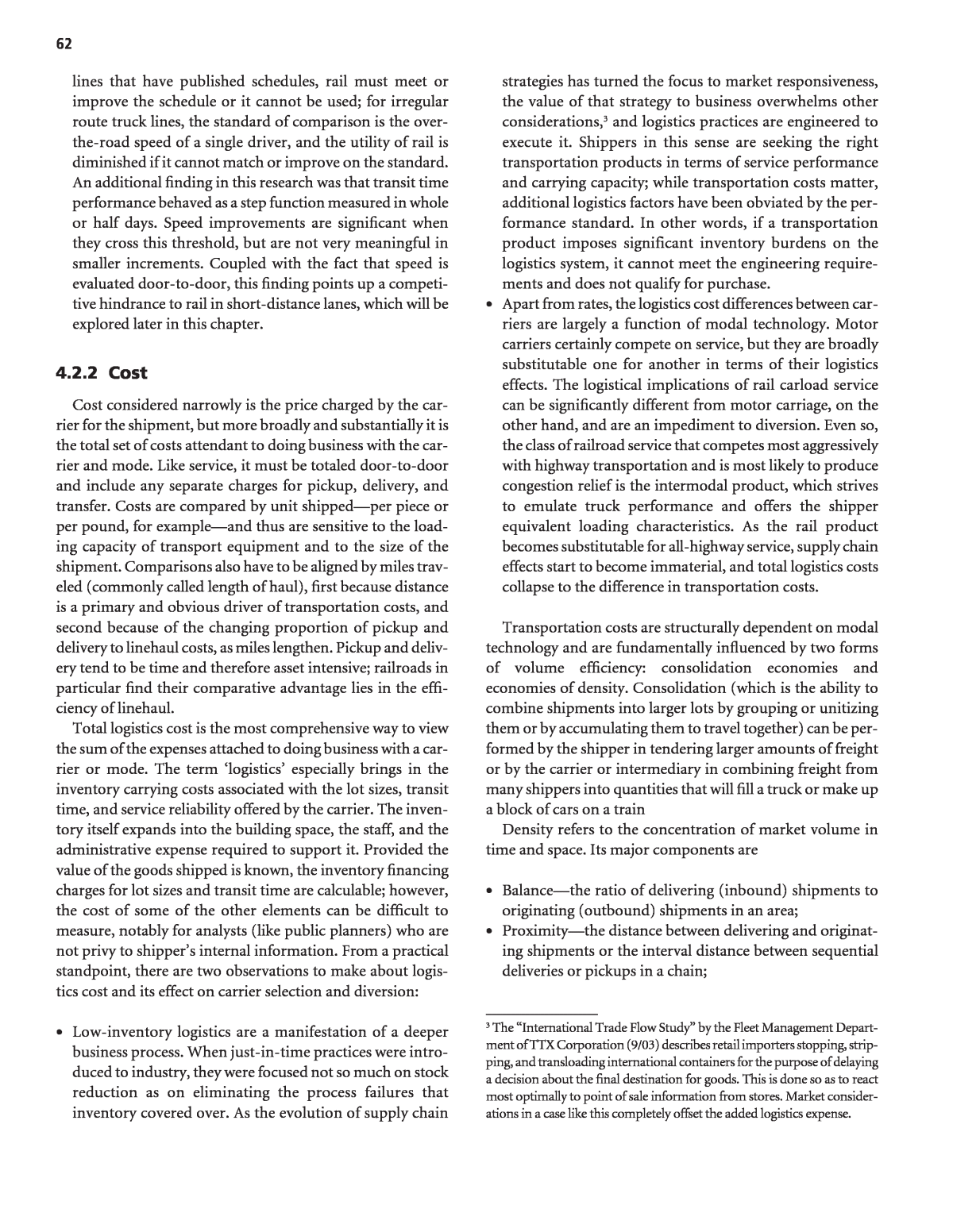
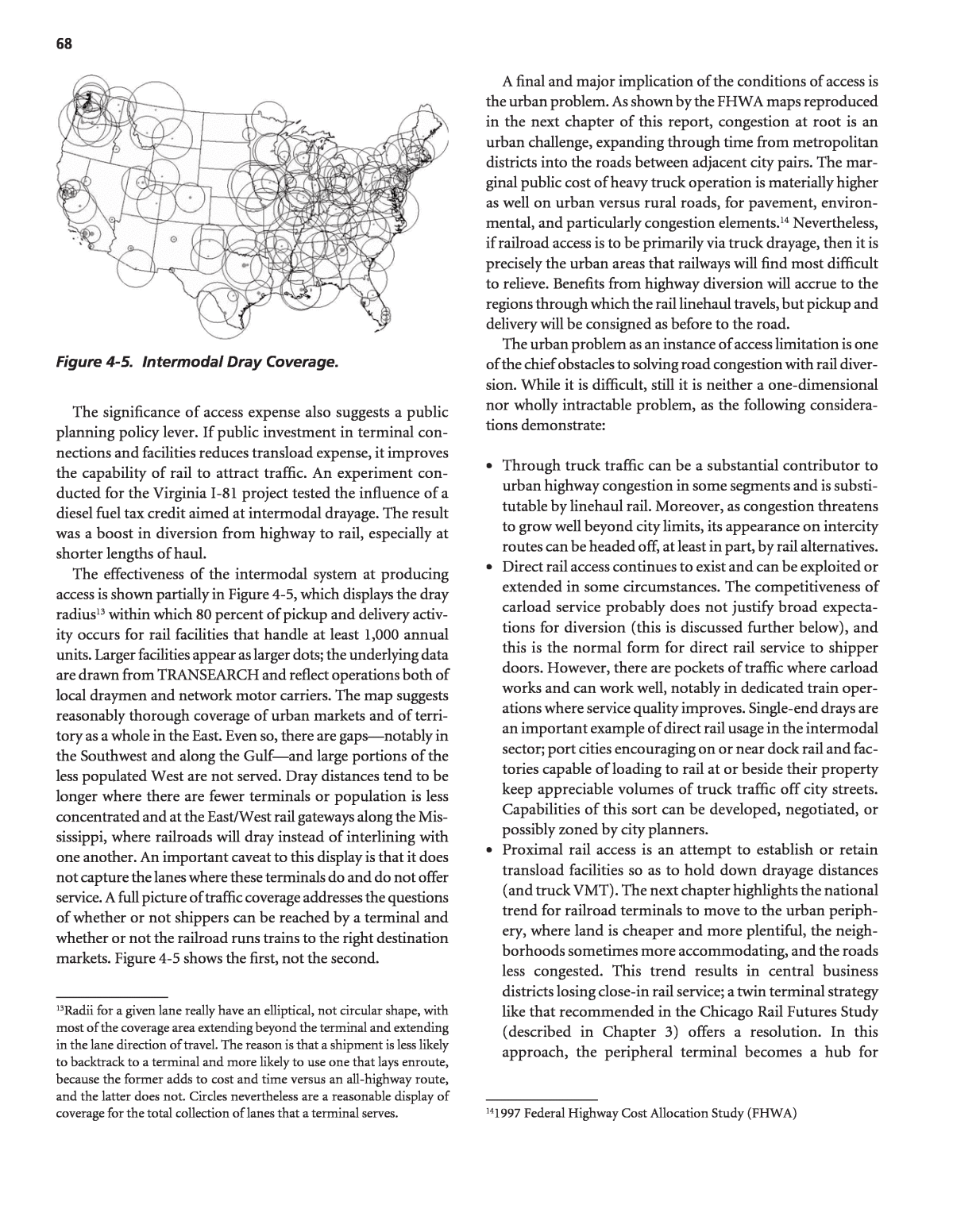
This meant that, so long as more fundamental requirements were being met, the focus and object of behavior would move up to higher levels of need, and the basic needs would recede as motivations unless they were threatened. For example, in the Second World War, the survival needs of middle-class cit- izens rose strongly to the fore, and then fell back behind social concerns after the conflict ended. As an interpretation of shipper behavior, the hierarchy places service at the level of basic needs.7 Because the first job of the shipper is to satisfy such needs, normally they have already done so, and the focus of their behavior has moved up to cost. In competitive markets, cost is so often malleable (and shippers work hard at improving their power over it), that even when shippers are seeking to satisfy higher level demands, cost is rarely a wholly resolved need and does not drop out of the picture. This explains the carrier perception that customers care chiefly about price. The precedence of service is evident from the vigorous and early steps shippers take to respond to the threat of a strike or the collapse of a carrier: traffic is diverted to more stable, even more costly alternatives, until the disruption is ended.8 Service disruption is not the normal state of affairs, of course, and under normal conditions, service needs stand as satisfied. However, the modal differences function as categorical distinctions in serviceâmeaningful and plainâand shippers manifestly observe these distinctions in their modal portfo- lios. Interpreting this in terms of the Maslow model, shipper satisfaction at the basic level of service is touched by disrup- tion or carrier failure or by categorical differences such as the several modal technologies produced. The service positions of modes, then, can be conceived as a series of hierarchies along the continuum (Figure A) or as a shifting of the hierar- chy across its line (Figure B) in Figure 4-3. To summarize, shippers slot their carriers into logistical roles according to their categorical levels of service, and within those roles in an everyday way, carriers principally compete on cost. This renders service as a step function in the dimension of reliability, as well as in the dimension of transit time. This is reinforced by two factors: 1. Reliability entails a measure of trust. For that reason, a car- rier who has proven reliable wins loyalty and is not easily abandoned, except for another who is equivalently trusted. Therefore, there is a certain amount of resistance to shifting of carriers over issues of reliability: the prevail- ing sense of satisfaction has to be disproven or disrupted, and shippers take time to change their position. 2. Carrier performance in the aspect of reliability is not finely measured, because of the structure of business relation- ships. Shippers typically select the carrier, pay freight charges, and are held responsible for delivery failuresâ but they do not directly observe delivery.9 Instead, they depend on customer complaints and exception reporting, 65 7This interpretation is principally the authorâs conclusion from obser- vation of behavior. Others have drawn the same conclusion, however, nor is application of the hierarchy unique. LaLonde states, quoting McGiniss, âperformance and quality requirements are constraints to be satisfied before rates become a significant issue in logistics service provider selection.â 8The West Coast port strike of 2002 and the UPS strike in the mid-90s are well-reported examples. 9These issues were explored in research for the Virginia I-81 market study, detailed in the Chapter 3 case reports. Figure 4-2. Hierarchy of Shipper Needs. Figure 4-3. Mode Service Position Hierarchies.
on statistical shipment sampling or tracking of urgent shipments, and on carrier-generated performance reports (which allow slippage through tactics like resetting appointments). Hence, shippers âknowâ carrier perform- ance, but not precisely and not with complete data, and the implication is that shippers will not be sensitive to small gradients of reliability due to the imprecision of measurement. Prominent exceptions include cases where shippers control their inbound freight and so have direct data on performance (some of the large retail chains do this),10 and cases where a carrier purchases contract line- haul transportation (such as a truck line buying inter- modal service from a railroad). Carriers within modes consequently are operating, and are perceived to be operating, all on the same plateau of the step function. Clear product differentiation in such circumstances is difficultâand this is what carriers report. To the extent dif- ferentiation exists, it is usually related to a cost advantage derived from network service economies or to a transit time advantage produced either by the service economies or by specialization.11 Railroads competing with motor carriers are a step behind and contend as an inferior good: shippers have to be offered a substantial risk premium to offset service defi- ciencies, provided they can use rail service at all. To divert highway traffic sufficiently to affect congestion, rail services must climb to the step that motor carriers occupy. Small gradients in speed and reliability will not mat- ter much, but equivalent performance is a categorical change in the railroad product proposition. Equivalence is achieved today in market segments that play to traditional railroad strengths and is rewarded with market share. Intermodal rail, for example, holds a commanding position for long-haul transportation of containerized goods in dense intercity lanes. In these conditions, density supports dedicated train- load operations, and linehaul distance offsets inefficiencies in pickup and delivery; the result is that rail performs as well as a truck, with a lower cost. Railroads are not likely to improve on truck performance and do not really need to; when the service plateau is reached, the shipperâs objective turns to cost, and advantages in cost will win business. The objective is equivalence, and since motor carriage already can be equaled by rail in some cir- cumstances, the core question in traffic diversion is, how broadly can equivalence be produced? A final point on the value of parity is that it is an effective way to win motor carriers as allies of railroads and through them to transform product equivalence into significant modal market share gains. Truck lines need cost superiority for their competition with one another, and some view inter- modal linehaul as one method to obtain it, so long as (1) the rail product matches their competitorâs performance over the road; (2) rail linehaul blends smoothly into their fleet opera- tion; and (3) rail usage can be translated into sustainable advantage. This last provision can be satisfied through a number of means: specialized equipment, knowledge of how to use railroads productively, train ownership, yard and slot priority, price preference, and pickup and delivery costs. Motor carriers have to develop trust in the railroad, but once they acquire it, their existing relationships with shippers help to reduce the resistance to change and accelerate the diversion of traffic. Equivalence in this way is an instrument of conver- sion, in the sense of persuading opponents to cross to a posi- tion of support. 4.3 Structural Factors 4.3.1 Access Railroad sidings as a feature of industrial facilities have been declining for decades. Many businesses that possessed them have paved them over or allowed them to fall into dis- repair, and new industrial development for generations has been widely heedless of access to the rail system. Meanwhile, the long-term rationalization of the railroad network has caused it to shrink from many areas that it once closely served and has left it far smaller than the highway system. A network whose major development ended early in the 20th Century has adapted to shifts in economic geography primarily through contraction, not growth. The trends reflected in these conditions are explored in the next chapter of this report. To indicate the consequences for traffic diversion, an illustration was prepared using a com- mercial database of American businesses, consisting of all manufacturing establishments with twenty or more employ- ees. Establishment addresses first were geocoded to prepare them for cartographic examination. This process successfully coded 61 percent of the establishments, or about 100,000 businesses; additional effort could have raised the proportion captured, but with no evident bias to the coding failures, the result was an adequate sample for analytic purposes. Then, the coded establishments were checked for their proximity to rail lines, using a cut off of 500 yards (about one-quarter mile) from the current, active network. This process found 66 10Even here, information quality is mixed. A study of major retailers by the Soleus Group (reported in trafficWORLD, 2/2/04, page 16, âRetailers in the Darkâ) reveals that less than 70% of truck lines are able to provide electronic shipment updates to retail customers, and 50% of those who can have accuracy problems. 11Carriers commonly complain of commoditization in their markets and struggle to separate themselves from their brethren. Examples of transit time differentiation are regional LTL lines that use network density and labor flexibility to lengthen the distance limit on overnight service and truckload lines specializing in team driver operations.
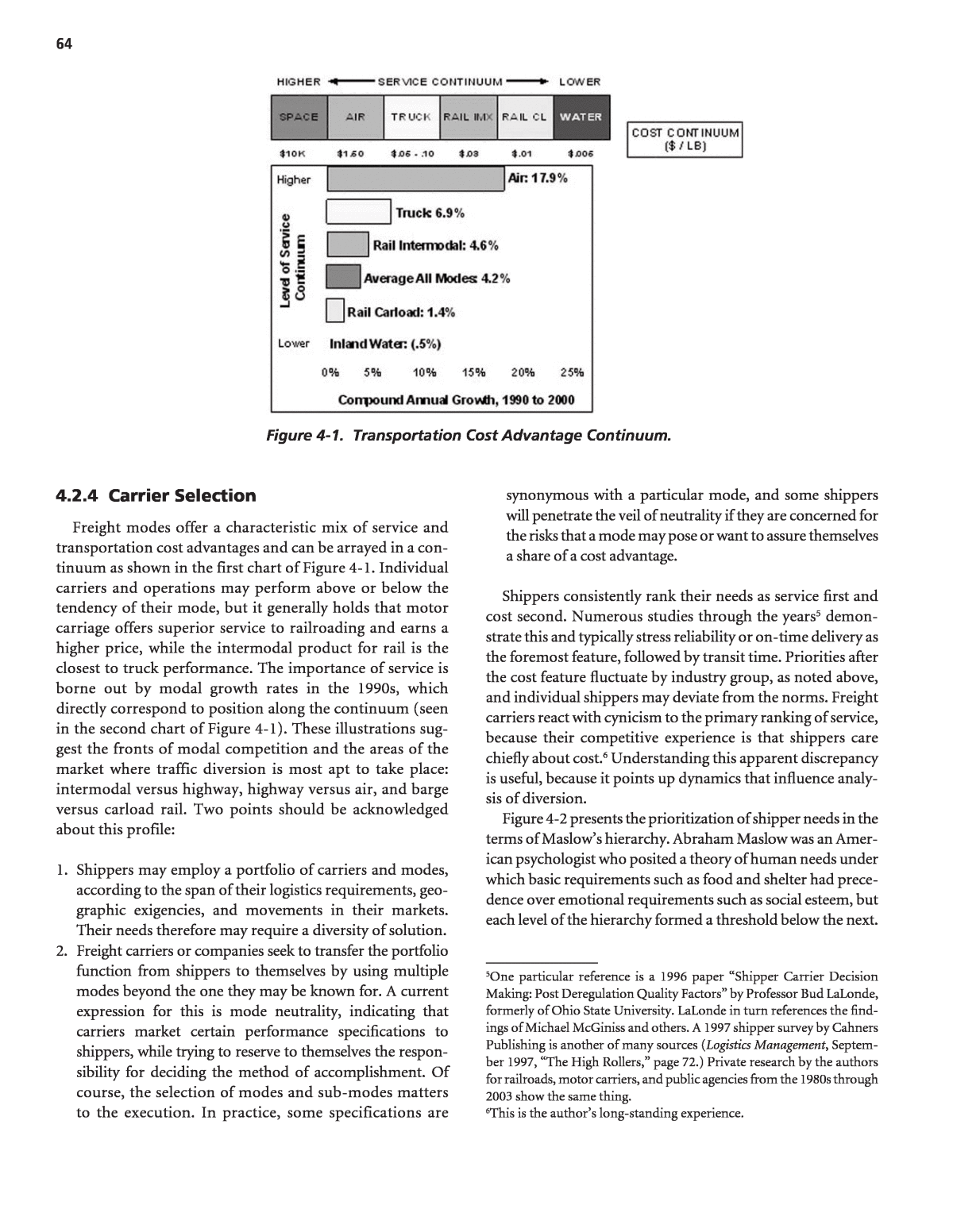
that just 34 percent of manufacturing businesses were within the cutoff distance, representing perhaps 35 percent of ship- ping volume. This assessment is not fine enough to identify the presence or absence of sidings,12 but it is safe to say that a number of these businesses near the network will not possess an active or indeed any spur. The conclusion suggested by this exercise is that at least two-thirds, and perhaps four-fifths of U.S. manufacturing sites have no on-line access to the rail- road system. The result is that most shippers require pick up and deliv- ery at their facility to be handled by a truck, and use of rail service is predicated on transloading between modes. There are two primary types of transload and many subtypes: 1. Conventional Intermodal involves the transfer of freight- carrying equipmentâtruck trailers or containersâ between a rail and a road unit. The rail unit usually is some variant of a platform like a flat car, and the road unit is either a truck tractor to which a trailer may be hitched or a tractor with trailing chassis onto which containers may be placed. In most cases, the equipment is designed or out- fitted to permit transfer via a lift or crane and thus is spe- cialized for the rail environment in ways unnecessary for road operation. Subtypes include bi-modal equipment (where the rail unit instead of a platform is a set of steel wheels swapped onto a modified trailer), Expressway-style equipment (where the rail car is a roll-on, roll-off platform that accepts standard, non-specialized highway trailers), and arrangements where tractors together with trailers ride on the rail platform (seen in some circumstances in Europe, but not currently in North America). 2. Carload Transfer involves the transloading of goods between an ordinary rail car and a standard highway trailer. Subtypes include bulk transfer (such as the transloading of liquids via hose from railroad tank cars to tank trailers), break-bulk (such as the movement of met- als via outdoor or indoor crane, from rail flatcars or gon- dolas to flatbed trailers), and finished automobiles (which are driven via ramp from railroad auto racks onto highway car trailers). This also is a form of intermodal transporta- tion in the pure sense of the word, but for ease of refer- ence, we will limit the term âintermodalâ to the transfer of equipment not goods. Provision of rail access via transloading requires networks of on-rail facilities equipped to conduct the various forms of transfer and trucking operations at each facility suited to han- dle the intermodal units or goods. The full spectrum of transload business demands multiple networks with distinct operations and few efficiencies of combination, and they need management and information support systems as well. Access costs are a major contributor to door-to-door trans- portation expense and are the primary component of cost at shorter distances. Figure 4-4 demonstrates this for inter- modal service. Extracted from the Virginia I-81 study and reproduced from the Chapter 2 case study, it displays lift costs plus pickup and delivery drayage as a percentage of total expense, by mileage door-to-door. As distance drops to 350 miles (the shortest haul examined in the study), access costs climb to 75 percent of the total. Two important implications should be drawn from this: 1. Given the importance of access cost, the requirement for transload and drayage at one end or both ends of a freight shipment becomes an essential consideration. Direct loading to rail in shipside or automobile plant environments, for example, produces one-end drays that improve the econom- ics for those shipments, and clearly single-end drays matter to the viability of short-haul rail. The carload transfer busi- ness is most often a one-end, destination dray. 2. The composition of access costs emerges as a critical factor. The absence of cranes and the heavy pavement to support them are an advantage to ramp-style terminals. The high rates of empty return associated with local intermodal drayage drive up its cost. An advantage to intermodal services with network motor carriers can be better load bal- ance, produced by the situation of intermodal inside a larger trucking operation and by the interchangeability of equipment. 67 12In other words, the GIS network does not capture sidings. The 500-yard figure is a reasonable limit, and it is imposed as the crow flies, so that track distance may be greater and still fall within the cutoff. Longer sidings exist (some stretch a couple of miles), but they require large traffic volumes to sustain them, and topographical problems grow with distance. When the Mercedes auto plant opened in Alabama, its siding was perhaps half a mile long, and track construction required major investment by the State for highway bridging. Figure 4-4. Intermodal Access Costs by Mile Block (2-End Dray).
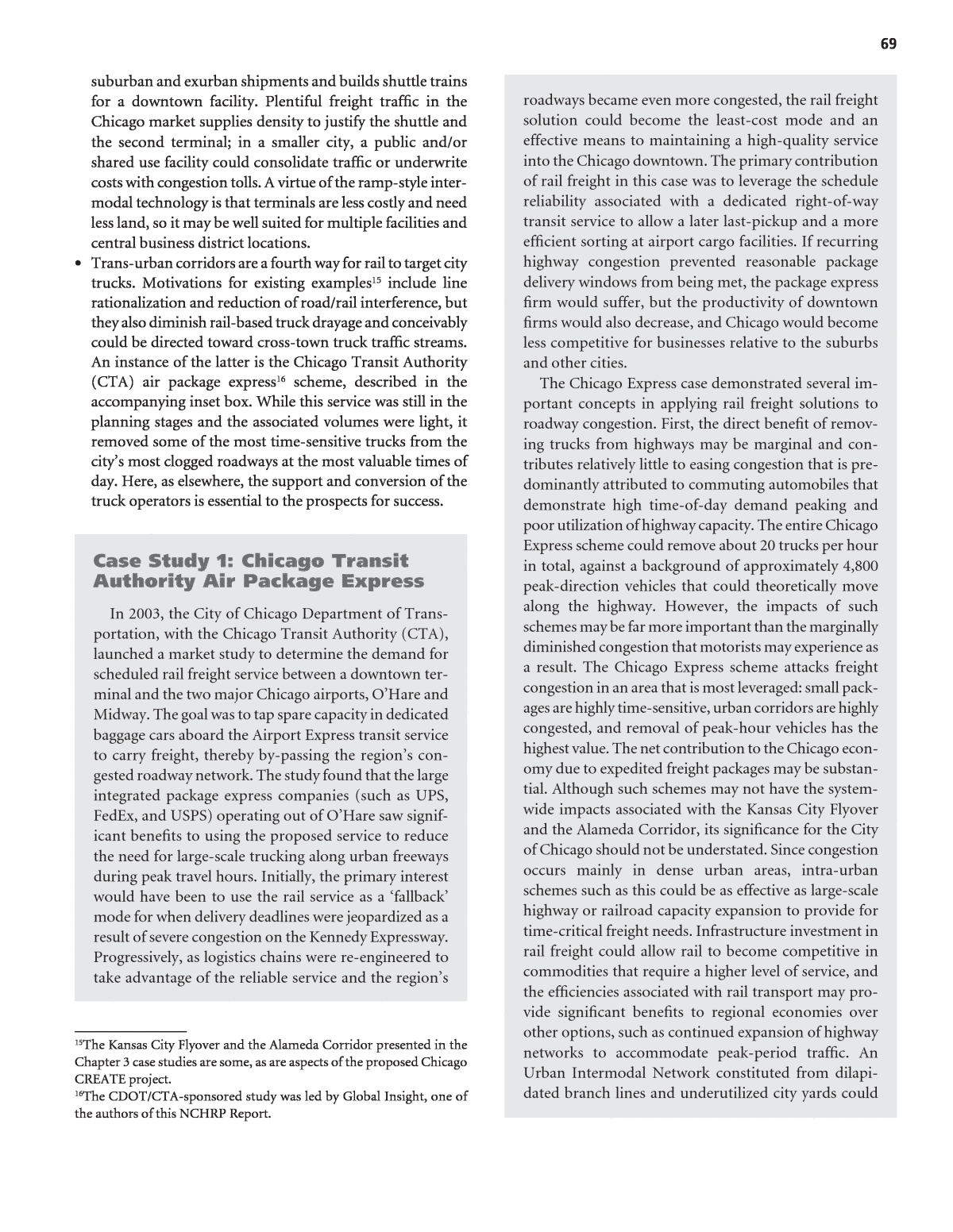
The significance of access expense also suggests a public planning policy lever. If public investment in terminal con- nections and facilities reduces transload expense, it improves the capability of rail to attract traffic. An experiment con- ducted for the Virginia I-81 project tested the influence of a diesel fuel tax credit aimed at intermodal drayage. The result was a boost in diversion from highway to rail, especially at shorter lengths of haul. The effectiveness of the intermodal system at producing access is shown partially in Figure 4-5, which displays the dray radius13 within which 80 percent of pickup and delivery activ- ity occurs for rail facilities that handle at least 1,000 annual units. Larger facilities appear as larger dots; the underlying data are drawn from TRANSEARCH and reflect operations both of local draymen and network motor carriers. The map suggests reasonably thorough coverage of urban markets and of terri- tory as a whole in the East. Even so, there are gapsânotably in the Southwest and along the Gulfâand large portions of the less populated West are not served. Dray distances tend to be longer where there are fewer terminals or population is less concentrated and at the East/West rail gateways along the Mis- sissippi, where railroads will dray instead of interlining with one another. An important caveat to this display is that it does not capture the lanes where these terminals do and do not offer service. A full picture of traffic coverage addresses the questions of whether or not shippers can be reached by a terminal and whether or not the railroad runs trains to the right destination markets. Figure 4-5 shows the first, not the second. A final and major implication of the conditions of access is the urban problem. As shown by the FHWA maps reproduced in the next chapter of this report, congestion at root is an urban challenge, expanding through time from metropolitan districts into the roads between adjacent city pairs. The mar- ginal public cost of heavy truck operation is materially higher as well on urban versus rural roads, for pavement, environ- mental, and particularly congestion elements.14 Nevertheless, if railroad access is to be primarily via truck drayage, then it is precisely the urban areas that railways will find most difficult to relieve. Benefits from highway diversion will accrue to the regions through which the rail linehaul travels, but pickup and delivery will be consigned as before to the road. The urban problem as an instance of access limitation is one of the chief obstacles to solving road congestion with rail diver- sion. While it is difficult, still it is neither a one-dimensional nor wholly intractable problem, as the following considera- tions demonstrate: ⢠Through truck traffic can be a substantial contributor to urban highway congestion in some segments and is substi- tutable by linehaul rail. Moreover, as congestion threatens to grow well beyond city limits, its appearance on intercity routes can be headed off, at least in part, by rail alternatives. ⢠Direct rail access continues to exist and can be exploited or extended in some circumstances. The competitiveness of carload service probably does not justify broad expecta- tions for diversion (this is discussed further below), and this is the normal form for direct rail service to shipper doors. However, there are pockets of traffic where carload works and can work well, notably in dedicated train oper- ations where service quality improves. Single-end drays are an important example of direct rail usage in the intermodal sector; port cities encouraging on or near dock rail and fac- tories capable of loading to rail at or beside their property keep appreciable volumes of truck traffic off city streets. Capabilities of this sort can be developed, negotiated, or possibly zoned by city planners. ⢠Proximal rail access is an attempt to establish or retain transload facilities so as to hold down drayage distances (and truck VMT). The next chapter highlights the national trend for railroad terminals to move to the urban periph- ery, where land is cheaper and more plentiful, the neigh- borhoods sometimes more accommodating, and the roads less congested. This trend results in central business districts losing close-in rail service; a twin terminal strategy like that recommended in the Chicago Rail Futures Study (described in Chapter 3) offers a resolution. In this approach, the peripheral terminal becomes a hub for 68 13Radii for a given lane really have an elliptical, not circular shape, with most of the coverage area extending beyond the terminal and extending in the lane direction of travel. The reason is that a shipment is less likely to backtrack to a terminal and more likely to use one that lays enroute, because the former adds to cost and time versus an all-highway route, and the latter does not. Circles nevertheless are a reasonable display of coverage for the total collection of lanes that a terminal serves. 141997 Federal Highway Cost Allocation Study (FHWA) Figure 4-5. Intermodal Dray Coverage.
suburban and exurban shipments and builds shuttle trains for a downtown facility. Plentiful freight traffic in the Chicago market supplies density to justify the shuttle and the second terminal; in a smaller city, a public and/or shared use facility could consolidate traffic or underwrite costs with congestion tolls. A virtue of the ramp-style inter- modal technology is that terminals are less costly and need less land, so it may be well suited for multiple facilities and central business district locations. ⢠Trans-urban corridors are a fourth way for rail to target city trucks. Motivations for existing examples15 include line rationalization and reduction of road/rail interference, but they also diminish rail-based truck drayage and conceivably could be directed toward cross-town truck traffic streams. An instance of the latter is the Chicago Transit Authority (CTA) air package express16 scheme, described in the accompanying inset box. While this service was still in the planning stages and the associated volumes were light, it removed some of the most time-sensitive trucks from the cityâs most clogged roadways at the most valuable times of day. Here, as elsewhere, the support and conversion of the truck operators is essential to the prospects for success. 69 15The Kansas City Flyover and the Alameda Corridor presented in the Chapter 3 case studies are some, as are aspects of the proposed Chicago CREATE project. 16The CDOT/CTA-sponsored study was led by Global Insight, one of the authors of this NCHRP Report. Case Study 1: Chicago Transit Authority Air Package Express In 2003, the City of Chicago Department of Trans- portation, with the Chicago Transit Authority (CTA), launched a market study to determine the demand for scheduled rail freight service between a downtown ter- minal and the two major Chicago airports, OâHare and Midway. The goal was to tap spare capacity in dedicated baggage cars aboard the Airport Express transit service to carry freight, thereby by-passing the regionâs con- gested roadway network. The study found that the large integrated package express companies (such as UPS, FedEx, and USPS) operating out of OâHare saw signif- icant benefits to using the proposed service to reduce the need for large-scale trucking along urban freeways during peak travel hours. Initially, the primary interest would have been to use the rail service as a âfallbackâ mode for when delivery deadlines were jeopardized as a result of severe congestion on the Kennedy Expressway. Progressively, as logistics chains were re-engineered to take advantage of the reliable service and the regionâs roadways became even more congested, the rail freight solution could become the least-cost mode and an effective means to maintaining a high-quality service into the Chicago downtown. The primary contribution of rail freight in this case was to leverage the schedule reliability associated with a dedicated right-of-way transit service to allow a later last-pickup and a more efficient sorting at airport cargo facilities. If recurring highway congestion prevented reasonable package delivery windows from being met, the package express firm would suffer, but the productivity of downtown firms would also decrease, and Chicago would become less competitive for businesses relative to the suburbs and other cities. The Chicago Express case demonstrated several im- portant concepts in applying rail freight solutions to roadway congestion. First, the direct benefit of remov- ing trucks from highways may be marginal and con- tributes relatively little to easing congestion that is pre- dominantly attributed to commuting automobiles that demonstrate high time-of-day demand peaking and poor utilization of highway capacity. The entire Chicago Express scheme could remove about 20 trucks per hour in total, against a background of approximately 4,800 peak-direction vehicles that could theoretically move along the highway. However, the impacts of such schemes may be far more important than the marginally diminished congestion that motorists may experience as a result. The Chicago Express scheme attacks freight congestion in an area that is most leveraged: small pack- ages are highly time-sensitive, urban corridors are highly congested, and removal of peak-hour vehicles has the highest value. The net contribution to the Chicago econ- omy due to expedited freight packages may be substan- tial. Although such schemes may not have the system- wide impacts associated with the Kansas City Flyover and the Alameda Corridor, its significance for the City of Chicago should not be understated. Since congestion occurs mainly in dense urban areas, intra-urban schemes such as this could be as effective as large-scale highway or railroad capacity expansion to provide for time-critical freight needs. Infrastructure investment in rail freight could allow rail to become competitive in commodities that require a higher level of service, and the efficiencies associated with rail transport may pro- vide significant benefits to regional economies over other options, such as continued expansion of highway networks to accommodate peak-period traffic. An Urban Intermodal Network constituted from dilapi- dated branch lines and underutilized city yards could
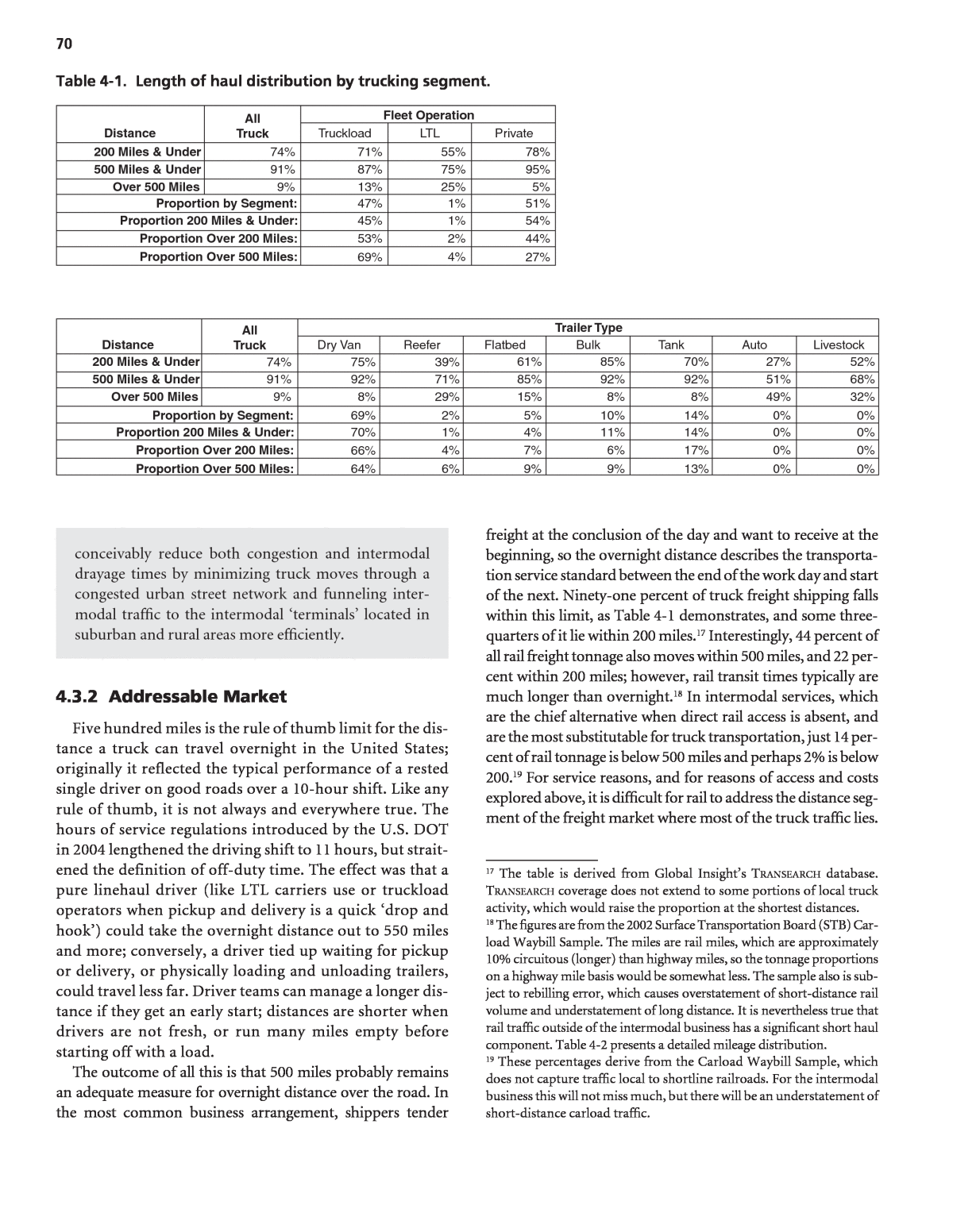
17 The table is derived from Global Insightâs TRANSEARCH database. TRANSEARCH coverage does not extend to some portions of local truck activity, which would raise the proportion at the shortest distances. 18 The figures are from the 2002 Surface Transportation Board (STB) Car- load Waybill Sample. The miles are rail miles, which are approximately 10% circuitous (longer) than highway miles, so the tonnage proportions on a highway mile basis would be somewhat less. The sample also is sub- ject to rebilling error, which causes overstatement of short-distance rail volume and understatement of long distance. It is nevertheless true that rail traffic outside of the intermodal business has a significant short haul component. Table 4-2 presents a detailed mileage distribution. 19 These percentages derive from the Carload Waybill Sample, which does not capture traffic local to shortline railroads. For the intermodal business this will not miss much, but there will be an understatement of short-distance carload traffic. 4.3.2 Addressable Market Five hundred miles is the rule of thumb limit for the dis- tance a truck can travel overnight in the United States; originally it reflected the typical performance of a rested single driver on good roads over a 10-hour shift. Like any rule of thumb, it is not always and everywhere true. The hours of service regulations introduced by the U.S. DOT in 2004 lengthened the driving shift to 11 hours, but strait- ened the definition of off-duty time. The effect was that a pure linehaul driver (like LTL carriers use or truckload operators when pickup and delivery is a quick âdrop and hookâ) could take the overnight distance out to 550 miles and more; conversely, a driver tied up waiting for pickup or delivery, or physically loading and unloading trailers, could travel less far. Driver teams can manage a longer dis- tance if they get an early start; distances are shorter when drivers are not fresh, or run many miles empty before starting off with a load. The outcome of all this is that 500 miles probably remains an adequate measure for overnight distance over the road. In the most common business arrangement, shippers tender freight at the conclusion of the day and want to receive at the beginning, so the overnight distance describes the transporta- tion service standard between the end of the work day and start of the next. Ninety-one percent of truck freight shipping falls within this limit, as Table 4-1 demonstrates, and some three- quarters of it lie within 200 miles.17 Interestingly, 44 percent of all rail freight tonnage also moves within 500 miles, and 22 per- cent within 200 miles; however, rail transit times typically are much longer than overnight.18 In intermodal services, which are the chief alternative when direct rail access is absent, and are the most substitutable for truck transportation, just 14 per- cent of rail tonnage is below 500 miles and perhaps 2% is below 200.19 For service reasons, and for reasons of access and costs explored above, it is difficult for rail to address the distance seg- ment of the freight market where most of the truck traffic lies. 70 Distance Fleet Operation Proportion by Segment: Proportion 200 Miles & Under: Proportion Over 200 Miles: Proportion Over 500 Miles: 47% 45% 53% 69% 51% 54% 44% 27% All Truck 200 Miles & Under 500 Miles & Under Over 500 Miles Distance Trailer Type Proportion by Segment: Proportion 200 Miles & Under: Proportion Over 200 Miles: Proportion Over 500 Miles: All Truck 200 Miles & Under 500 Miles & Under Over 500 Miles 74% Truckload LTL Private 91% 9% 74% 91% 9% 78% 95% 5% 71% 87% 13% 69% 70% 66% 64% Dry Van Reefer Flatbed Bulk Tank Auto Livestock 75% 92% 8% 2% 1% 4% 6% 39% 71% 29% 5% 4% 7% 9% 61% 85% 15% 10% 11% 6% 9% 85% 92% 8% 14% 14% 17% 13% 70% 92% 8% 0% 0% 0% 0% 27% 51% 49% 0% 0% 0% 0% 52% 68% 32% 55% 75% 25% 1% 1% 2% 4% Table 4-1. Length of haul distribution by trucking segment. conceivably reduce both congestion and intermodal drayage times by minimizing truck moves through a congested urban street network and funneling inter- modal traffic to the intermodal âterminalsâ located in suburban and rural areas more efficiently.
This explains the acute interest among public planners in short-haul rail; that subject is treated in detail later in this report. Of course, greater inroads by rail into the medium and long-distance markets still would reduce freight highway traffic by an appreciable amount and matter to congestion in many localities. However, there are meaningful ways that these markets, too, are not being addressed by prevalent rail technology and practice. Fifty-eight percent of intermodal unit volume in 2005 was international containers ultimately tied to international trade, according to figures from the Intermodal Association of North America (IANA).20 This proportion had climbed from 52% in 2000, and international units accounted for 78 percent of the intermodal volume growth during this period. Truck tonnage on U.S. highways, on the other hand, runs 95 percent domestic, and of the part that is international trade, about 40 percent is NAFTA traffic.21 While rail intermodal has done a very good job in absorbing the transportation bur- den of U.S. foreign trade, it has not been aggressively address- ing the domestic highway market. Domestic intermodal unit volume grew 14 percent from 2000 to 2005, compared with 49 percent for international units, again according to IANA. All of this growth was in domestic containers, since the trailer traffic dropped by 2 per- cent. Trailers accounted for only 19 percent of the intermodal business in 2005, down from 26 percent 5 years previously. The significance of these shifts is this: the domestic container is another specialized piece of intermodal equipment. It is designed to capture the cost saving of container stacking in linehaul train service; while the longer 53-ft-long units (which not all are)22 have the same carrying capacity as a stan- dard highway trailer, they have to be matched to and mounted on wheeled chasses to function over the road. The added expense, maintenance, and management of a separate chassis fleet renders containers an inferior option for highway operations, and motor carriers normally do not deploy them. In consequence, the standard truck equipment seen on the road is not compatible with the principal type of intermodal service. Highway trailers can be and are handled intermodally, but they require modification to suit the lift devices that transfer trailers onto railcars. Again, there is a need for specialized equipment. Moreover, and returning to information about trucking segments in the table, significant portions of trailer activity cannot be outfitted for intermodal lift: the box-type equipment (dry vans and refrigerated units) can be adapted, but 30 percent of truck traffic in medium- and long-haul lanes is flatbeds, tanks, and bulk trailers that cannot. Although there are alternativesâthe isotainer, for instance, is a tank rigged for handling as a containerâthe equipment is even more special- ized and less efficient. As a result, intermodal usage imposes a barrier of customized equipment, and even then there are important segments of the market it does not really address. One solution is the ramp-style intermodal railcar that accom- modates any style of highway trailer, without modification; while these cars see very limited service today, they substan- tially enlarge the addressable market for intermodal rail. The table also indicates the distinct characteristics of truck fleets: ⢠The private carriage of shippers and distributors that works mainly as a cost center in support of customer service and logistics strategy and is heavily short distance; ⢠The much lower volume LTL segment that consolidates and distributes small shipments through terminal net- works, runs full-load linehaul on regular routes between terminals, and is split between regional and long-haul serv- ice (although regional has grown more); ⢠The fragmented full truckload group, whose for-hire members range from national irregular route network car- riers, through small regional lines and draymen, to the freelance independent contractors (owner/operators), and is the principal form of long-haul motor carriage but also figures prominently in regional and local markets. The various segments also intermingle: truckload carriers make multiple stop pickups and deliveries and contract for LTL linehaul, while some LTL operators avoid terminals. The private fleet group is particularly fluid; it will add or subtract traffic with common carriers according to how its flows bal- ance, and it will outsource operations entirely to commercial fleets, whose dedicated carriage adopts the functions of the private truck line. The characteristics of truck fleets are pertinent for at least three reasons. First, to the extent that the intermodal cus- tomers are motor carriers whose linehaul is to be converted to rail, their business influences the requirements for opera- tional integration. For example, LTL volume is concentrated in nightly departures with a fixed schedule to which the rail- road must conform; truckload volume is spread during the day and has greater need for more frequent trains. Second, the traffic capture experience of railroads differs by segment. Private fleet business typically is difficult for railroads to attract, yet the Canadian Pacific has had success through its Expressway service; alternately, the outsourcing of private 71 20 From IANAâs âIntermodal Market Trends & Statistics,â fourth quar- ter publications for the corresponding years. 21 Based on a Reebie Associates analysis conducted for AASHTO, using 1998 FHWA Freight Analysis Framework tonnage data, further adjusted for the international portion of intermodal dray. The interna- tional contribution to truck tonnage may have risen since then. 22 International containers also appear in domestic service, but their smaller size (40-ft is the most common length) limit their utility against the standard 53-ft highway trailers.
traffic to commercial truck lines can produce greater oppor- tunity for rail participation.23 Third, utilization of intermodal services requires trucking capacity to be in place at the pickup and delivery ends. For an independent contractor with one or a handful of trucks, this is out of the question, unless the load is (improbably) interchanged with another operator. The equipment and driver deployment of regional and private fleets is similarly sparse, so that railroads cannot convert these loads and must win them away from their current carrier. One way this can be done,24 however, is truck-to-truck diver- sion: when large network carriers capture business from smaller operators, the deployment obstacle is reduced and the traffic becomes rail-convertible. From this perspective, defragmentation of the trucking industry is desirable for rail. Another, more subtle aspect of compatibility is concerned with the integration of rail with highway operations. Because intermodal services are dependent on trucks, they should be understood as a variant form of motor carriage, as much as they are a variant of rail, and they need to be effective as such. American intermodal trucking falls into two broad categories:25 ⢠Intermodal marketing companies (IMCs), who are spe- cialists in rail-based services, historically depended on equipment owned by other parties (but increasingly sup- ply some of their own), and provide pickup and delivery as draymen; and, ⢠Network motor carriers, who offer road-based services, own their equipment, and perform intermodal pickup and delivery as a subset of their larger operation. Inevitably there are ways these distinctions become blurred, but both categories need density to be efficient: loads must be balanced, and assets must be deployed in proximity to traffic sources. High rates of empty return are typical for rail-based services (as they are for most local trucking); for cost and per- formance reasons, this tends to keep equipment deployment near the ramp, and more remote business is not handled. Road-based operations have greater loading options and the balance advantage of an irregular route, non-local, multi- modal system. Equipment deployment tends to be more ubiq- uitous and so closer to more shippers, and empty return rates probably are better; it is certainly true that the serving radius from an intermodal ramp is longer with road-based than with rail-based operations.26 Highway operations also boost the feasibility of the extended length, en route dray. While the normal intermodal dray is under 100 miles, extended drays are run like a highway load, traveling hundreds of road miles toward the delivery point, then intercepting and using rail ramps along the way with little out-of-route27 mileage. The service area of intermodal ramps is orders of magnitude longer for the lanes that lie en route. Compatibility of equipment between intermodal and over- the-road operations becomes important, because the blending of highway with rail networks creates greater drayage efficiency and wider rail access. The stress on the word âoperationsâ is sig- nificant in distinction from âenvironmentâ: the specialized equipment that dominates the intermodal rail environment all functions on the road, yet it is not the equipment of choice for carriers in the highway network. In consequence, the special- ized units are leashed to the railway network, and fleet balance28 must be produced inside a system that is far smaller than the roadway and has many fewer balancing flows. Utilization of intermodal services thereby is constrained, and the size of the addressable market again is reduced;29 conversely, free flow of equipment between railroad and highway operations substan- tially releases this constraint. These considerations can be summarized as the issue of inter- operability between highway and rail, and it is another of the key barriers to traffic diversion. Equipment compatibility restrains the integration of networks, narrows the breadth of access, and limits the size of the market railroad solutions can target, with the result that intermodal as a class of truck opera- tion is less effective. Thus, there are strictures on the segments of the highway freight market that rail is able or else currently designed to address. They are due to the emphasis on interna- tional container trains and the problem of interoperability, the character of truck fleets, and to the effect of transloading on serviceable distance. The question of design is made more dif- ficult by the limits that also exist on railroad capacity and capi- tal, coupled with the fixed cost of train starts. The fact is that a container stack train can carry more revenue-producing boxes than a trailer train simply because of its second tier and so usu- 72 23 These conclusions come from conversations by researchers with rail- road officers and from direct observation. 24The obstacle also is eliminated when the tractor and driver travel by rail with the load, as some European services allow. 25American railroads for the most part do not supply intermodal truck- ing services. Currently, the most prominent exception is the Norfolk Southern Triple Crown division, which nevertheless accounts for a minority of NS intermodal business. 26Internal analysis by Global Insight from primary sources found the road-based intermodal serving radius to be 50-percent larger than the rail-based radius. 27Out-of-route mileage is deviation from the normal highway route of operation and is an inefficiency because of the added cost and time of extra, circuitous travel distance. 28These issues are prominent in the thinking of major network motor carriers working with rail: the carriers restrict their rail usage to ensure fleet balance, and they press their rail partners for expansion of the high- performance intermodal network to enlarge their options. 29Fleet balance is the way equipment is resupplied to a shipper after it departs with a load. Simplistically, the unit can come straight back empty or reloaded with a different shipment, or it can work its way back through triangulation or a more complex irregular route loading pattern.
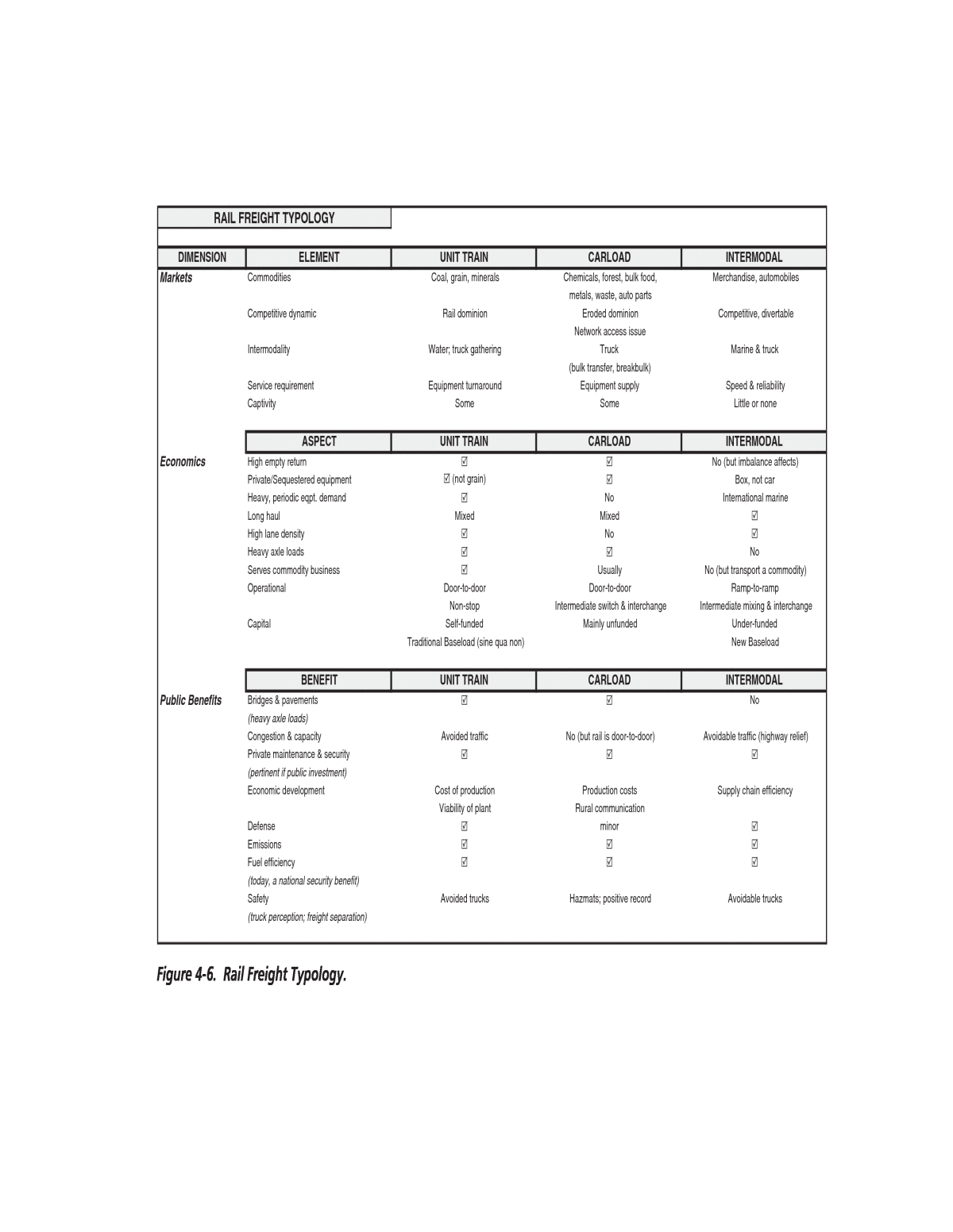
ally produces a better return per unit of capacity, capital, and train commitment. Stack trains then are favored for a good rea- son. However, railroad decisions about the market they prefer to address tend to institutionalize their preference in technol- ogy and methods of operation that are not the best suited to the domestic freight market. While the many containers hauled by rail should be appreciated as relief of the roads, they also denote an institutional barrier to diversion of the common highway trailer tied up in most of the traffic jams of the country.30 4.4 Market Segmentation Market segmentation is a basic approach to understanding buying behavior, establishing the differential requirements of customers, and determining where a product or service would or could find its best appeal. Buying behavior and serv- ice appeal, in a competitive context, lie at the core of diver- sion dynamics for any kind of business. The question becomes, what is a practical way to employ segmentation to describe the barriers and opportunities for the shifting of freight business between highway and rail. 4.4.1 Demand Side To this point, market and diversion issues have been dis- cussed in terms of shipper needs and trucking characteristics. These can be called the retail and the wholesale perspectives: ⢠Retail encompasses shipper supply chain factors, such as industrial, commodity, and geographic composition; time performance requirements; and the configuration of cus- tomer orders, because it is a determinant of the size, fre- quency, and volume of shipments. ⢠Wholesale takes in the service requirements, equipment specifications, and operational features of the carriers of goods, who may tender their loads to railroads: parcel, LTL, and full-load truck lines, independent contractors, private operators, steamship companies, and intermediaries. The retail perspective is a traditional level for market research and would seem to be basic for diversion analysis. However, information about its components is not systematically available from transportation sources and can be fragmented so as to be heteroskedastic for analytic purposes. This does not demean its value and there are ways to use it,31 but other meth- ods more readily produce planning guidance. Use of the wholesale perspective is one. It is informed and shaped by the retail (because wholesale needs incorporate and respond to retail needs) and captures aspects of service and shipment size through summary dimensions like equip- ment types, and it is the wholesale level at which major rail- roads for the most part try to do business. For example, temperature-controlled equipment (which includes refriger- ated vans or âreefersâ) describes a segment of the market that tenders mainly full loads outside of the local sphere can be adapted for intermodal loading, but has stringent service and monitoring requirements that are challenging for railroads to meet. Shippers in this market are not all alikeâfrozen goods and produce are more sensitive than chilled foods and differ from chemicals that need temperature protectionâbut they are broadly alike, and this forms a constructive way to distin- guish a sector of the market. The wholesale level also is quite effective for the competitive analysis essential for diversion estimation, because in a number of instances the wholesale customer is both a potential client and a modal rival, so that the clientâs needs from the railroad reflect the rivalâs per- formance characteristics. 4.4.2 Supply Side These are demand-side factors. There are benefits, too, from examining the supply side. The chief of these is that it gets at the operating economics critical both to the qualities of service and to the transportation costs on which customers are acutely focused. A primary analysis starts from division of rail operations into the three classes used elsewhere in this report: unit train, carload, and intermodal services. Figure 4-6 lays out these classes and shows how they differ in the dimensions of markets and economics. (Figure 4-6 also identifies differ- ences in public benefits as well, which will not be discussed here; the figure is reproduced from Chapter 3 of the Guide- book, which considers them). Like any set of generalizations, some elements of the typology will be found arguable by some observers; it is intended, however, as an overview of the major railroad business groups, and it is functional as such. The Unit Train business handles high-volume bulks like coal and grain in trainload quantities. Dedicated operations make time performance fairly good, and the emphasis of service principally is the turnaround time of equipment to keep shippers resupplied. Dense, non-stop, door-to-door transportation in imbalanced lanes conforms to railroad strengths, and this is the traditional baseload of the industry. 73 30This barrier may be undermined in some ways. A 2003 study by the railroad equipment cooperative TTX (TTX op cit) documented a trend toward container stripping at West Coast ports; the phenomenon has since grown, though on-dock and near-dock rail services may be hold- ing it in check. It signifies that containerized import goods are being transloaded and remixed with domestic product into highway trailers, and it reflects (a) an effort by retail chains to defer selection of the final destination of consumer goods, in order to respond to point-of-sale information; and (b) an effort by marine container lines to keep boxes close to port, by reducing free time and increasing fees. On the one hand, this development could stimulate a concentrated demand for trailer services; on the other, railroads have preferred to respond with domestic containers. 31The treatment of diversion modeling, below, shows one.
DIMENSION ELEMENT UNIT TRAIN CARLOAD INTERMODAL Markets Commodities Coal, grain, minerals Chemicals, forest, bulk food, Merchandise, automobiles metals, waste, auto parts Competitive dynamic Rail dominion Eroded dominion Competitive, divertable Network access issue Intermodality Water; truck gathering Truck Marine & truck (bulk transfer, breakbulk) Service requirement Equipment turnaround Equipment supply Speed & reliability Captivity Some Some Little or none ASPECT UNIT TRAIN CARLOAD INTERMODAL Economics High empty return No (but imbalance affects) Private/Sequestered equipment (not grain) Box, not car Heavy, periodic eqpt. demand No International marine Long haul Mixed Mixed High lane density No Heavy axle loads No Serves commodity business Usually No (but transport a commodity) Operational Door-to-door Door-to-door Ramp-to-ramp Non-stop Intermediate switch & interchange Intermediate mixing & interchange Capital Self-funded Mainly unfunded Under-funded Traditional Baseload (sine qua non) New Baseload BENEFIT UNIT TRAIN CARLOAD INTERMODAL Public Benefits Bridges & pavements No (heavy axle loads) Congestion & capacity Avoided traffic No (but rail is door-to-door) Avoidable traffic (highway relief) Private maintenance & security (pertinent if public investment) Economic development Cost of production Production costs Supply chain efficiency Viability of plant Rural communication Defense minor Emissions Fuel efficiency (today, a national security benefit) Safety Avoided trucks Hazmats; positive record Avoidable trucks (truck perception; freight separation) RAIL FREIGHT TYPOLOGY Figure 4-6. Rail Freight Typology.
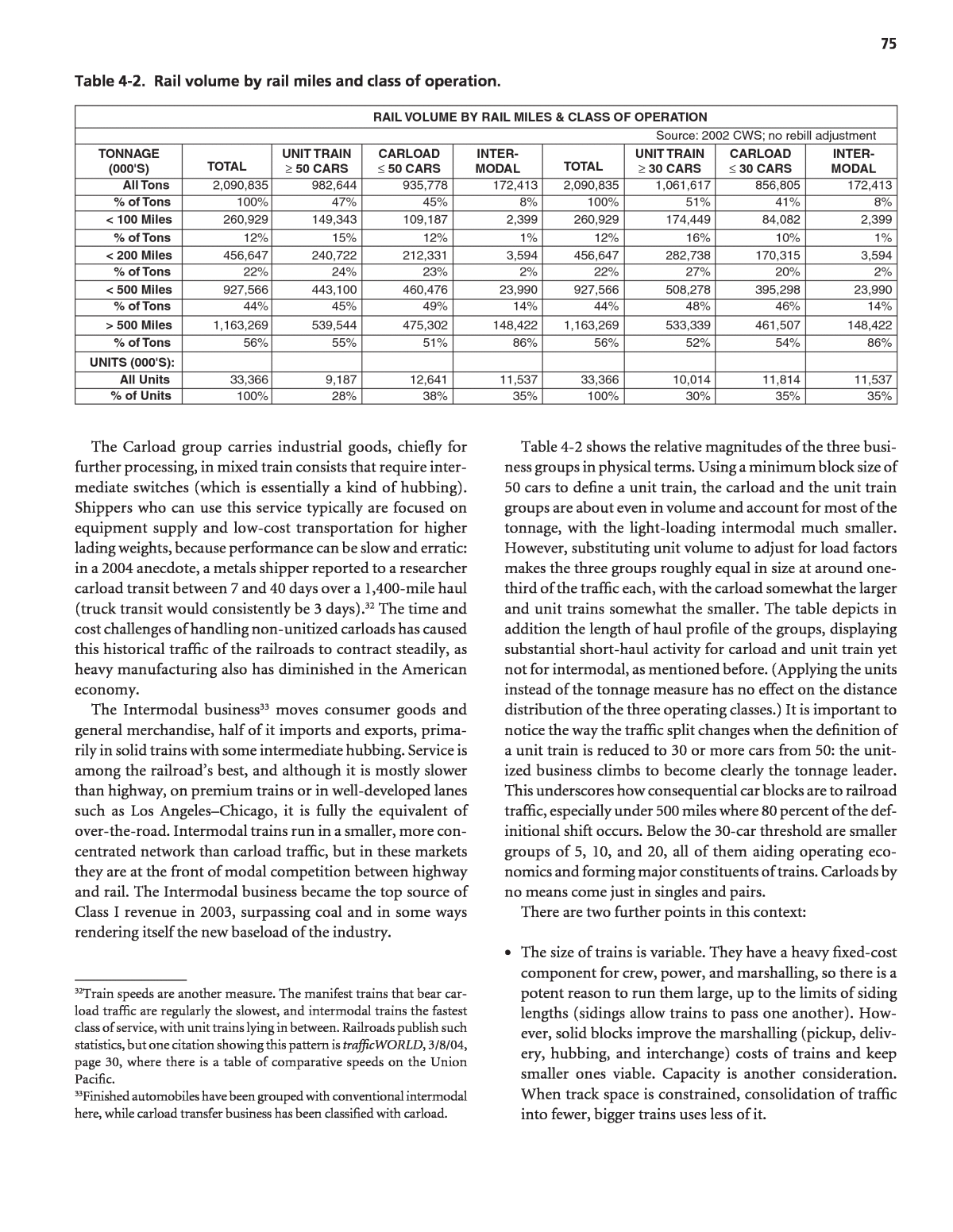
The Carload group carries industrial goods, chiefly for further processing, in mixed train consists that require inter- mediate switches (which is essentially a kind of hubbing). Shippers who can use this service typically are focused on equipment supply and low-cost transportation for higher lading weights, because performance can be slow and erratic: in a 2004 anecdote, a metals shipper reported to a researcher carload transit between 7 and 40 days over a 1,400-mile haul (truck transit would consistently be 3 days).32 The time and cost challenges of handling non-unitized carloads has caused this historical traffic of the railroads to contract steadily, as heavy manufacturing also has diminished in the American economy. The Intermodal business33 moves consumer goods and general merchandise, half of it imports and exports, prima- rily in solid trains with some intermediate hubbing. Service is among the railroadâs best, and although it is mostly slower than highway, on premium trains or in well-developed lanes such as Los AngelesâChicago, it is fully the equivalent of over-the-road. Intermodal trains run in a smaller, more con- centrated network than carload traffic, but in these markets they are at the front of modal competition between highway and rail. The Intermodal business became the top source of Class I revenue in 2003, surpassing coal and in some ways rendering itself the new baseload of the industry. Table 4-2 shows the relative magnitudes of the three busi- ness groups in physical terms. Using a minimum block size of 50 cars to define a unit train, the carload and the unit train groups are about even in volume and account for most of the tonnage, with the light-loading intermodal much smaller. However, substituting unit volume to adjust for load factors makes the three groups roughly equal in size at around one- third of the traffic each, with the carload somewhat the larger and unit trains somewhat the smaller. The table depicts in addition the length of haul profile of the groups, displaying substantial short-haul activity for carload and unit train yet not for intermodal, as mentioned before. (Applying the units instead of the tonnage measure has no effect on the distance distribution of the three operating classes.) It is important to notice the way the traffic split changes when the definition of a unit train is reduced to 30 or more cars from 50: the unit- ized business climbs to become clearly the tonnage leader. This underscores how consequential car blocks are to railroad traffic, especially under 500 miles where 80 percent of the def- initional shift occurs. Below the 30-car threshold are smaller groups of 5, 10, and 20, all of them aiding operating eco- nomics and forming major constituents of trains. Carloads by no means come just in singles and pairs. There are two further points in this context: ⢠The size of trains is variable. They have a heavy fixed-cost component for crew, power, and marshalling, so there is a potent reason to run them large, up to the limits of siding lengths (sidings allow trains to pass one another). How- ever, solid blocks improve the marshalling (pickup, deliv- ery, hubbing, and interchange) costs of trains and keep smaller ones viable. Capacity is another consideration. When track space is constrained, consolidation of traffic into fewer, bigger trains uses less of it. 75 32Train speeds are another measure. The manifest trains that bear car- load traffic are regularly the slowest, and intermodal trains the fastest class of service, with unit trains lying in between. Railroads publish such statistics, but one citation showing this pattern is trafficWORLD, 3/8/04, page 30, where there is a table of comparative speeds on the Union Pacific. 33Finished automobiles have been grouped with conventional intermodal here, while carload transfer business has been classified with carload. RAIL VOLUME BY RAIL MILES & CLASS OF OPERATION TONNAGE (000'S) UNITS (000'S): All Tons 2,090,835 100% 260,929 12% 456,647 22% 927,566 44% 1,163,269 56% 33,366 100% 2,090,835 100% 260,929 12% 456,647 22% 927,566 44% 1,163,269 56% 33,366 100% 982,644 47% 149,343 15% 240,722 24% 443,100 45% 539,544 55% 9,187 28% 935,778 45% 109,187 12% 212,331 23% 460,476 49% 475,302 51% 12,641 38% % of Tons % of Tons % of Tons % of Tons % of Tons % of Units All Units < 100 Miles < 200 Miles < 500 Miles > 500 Miles UNIT TRAIN ⥠50 CARS UNIT TRAIN ⥠30 CARS CARLOAD ⤠30 CARS INTER- MODAL INTER- MODAL CARLOAD ⤠50 CARSTOTAL TOTAL Source: 2002 CWS; no rebill adjustment 172,413 8% 2,399 1% 3,594 2% 23,990 14% 148,422 86% 11,537 35% 172,413 8% 2,399 1% 3,594 2% 23,990 14% 148,422 86% 11,537 35% 1,061,617 51% 174,449 16% 282,738 27% 508,278 48% 533,339 52% 10,014 30% 856,805 41% 84,082 10% 170,315 20% 395,298 46% 461,507 54% 11,814 35% Table 4-2. Rail volume by rail miles and class of operation.
34The federal Bureau of Economic Analysis divides the nation into 172 metropolitan areas, based on the economic relationships of counties and covering all of the geographic territory of the fifty United States. ⢠Car blocks normally are multiple cars moving under a sin- gle bill from one shipper to one receiver. In the conventional intermodal and carload transfer business, it is different, because transloading performs a kind of consolidation func- tion, allowing blocks to derive from multiple shippers grouped around single geographic origin and destination points. This is the same benefit small package and LTL truck lines obtain from consolidating intercity freight at terminals, which in turn permits rail to participate in the small ship- ment market through terminal linehaul transportation. The development of railroad logistics parks take this one step further, by concentrating multiple transload functions at a single location in order to build up car block and even train- load volume. Car blocks signify lane density, and lane density both aug- ments and trades off with distance in its competitive influ- ence. This is demonstrated in Table 4-3 (reproduced from Chapter 3 of the Guidebook), which presents the progression of market share for conventional intermodal rail, as highway miles lengthen and lane volumes grow. The market here is defined as over-the-road dry van trucking, that being the wholesale sector where the standard intermodal product competes; it is also the largest sector of the trucking market, accounting for two-thirds of the volume, as was shown earlier in this chapter. Lanes are origin-destination pairs of Business Economic Area (BEA) metropolitan markets,34 this being a pragmatic way to reflect the consolidation effect of terminals within the definition of an economic region. Two additional technical factors affect the table: (1) it excludes truck volume outbound from wholesalers and distribution centers, because this is regional and local traffic for which rail intermodal does not competeâif included, over-the-road (OTR), market share below 500 miles would go up; and (2) an attempt has been made to correct for rebilling in railroad statistics, which diminishes intermodal (IMX) tonnage and locates more of it in long-haul lanes. The table displays intermodal market share clearly and consistently climbing with distance and lane density. Market share rises as mileage rises within each category of density, and market share rises as lane volume rises within each cate- gory of distanceâthe combined influence of these elements (the diagonal vector of the table) generates the strongest gains. This share pattern is a direct result of service economies: railroad service performance and unit costs both improve as the linehaul component overtakes pickup and 76 MODAL MARKET SHARE BY LANE DENSITY & DISTANCE RAIL INTERMODAL (IMX) Vs OVER-THE-ROAD (OTR) DRY VAN TRUCK LANE DENSITY (Annual Tons [000] by IMX+OTR) HIGHWAY MILES IMX < 100 100 - 400 1 - 100 100 - 299 300 - 499 500 - 699 700 - 999 1000 - 1499 >1500 Total Total > 500 Total < 500 0.1% 0.3% 0.8% 1.3% 1.3% 2.6% 7.3% 2.4% 3.0% 0.6% 99.9% 99.7% 99.2% 98.7% 98.7% 97.4% 92.7% 97.6% 97.0% 99.4% 0.1% 1.1% 2.3% 5.8% 8.3% 8.7% 24.8% 6.6% 10.8% 1.5% 99.9% 98.9% 97.7% 94.2% 91.7% 91.3% 75.2% 93.4% 89.2% 98.5% 0.4% 1.4% 3.6% 11.1% 27.2% 28.1% 62.0% 8.2% 33.8% 1.5% 99.6% 98.6% 96.4% 88.9% 72.8% 71.9% 38.0% 91.8% 66.2% 98.5% 0.4% 1.3% 3.0% 6.6% 12.6% 11.4% 37.1% 7.0% 16.8% 1.4% 99.6% 98.7% 97.0% 93.4% 87.4% 88.6% 62.9% 93.0% 83.2% 98.6% > 400 Total OTR OTR TRUCK > 80% MARKET SHARE KEY: BOTH < 80% IMX RAIL > 80% IMX OTR IMX OTR IMX OTR Source: TRANSEARCH 2000 Table 4-3. Modal market share by lane density and distance.
delivery in the transportation mix, and as the railroad pro- duction function is satisfied with train-lot quantities. OTR trucking shares the economies, but less strongly, and the competitive balance moves in the direction of rail. The same relationship holds for other equipment types, and it has held historically: ⢠Matrix analyses for flatbed and bulk equipment showed an equivalent pattern, although the progression was less pro- nounced and rail share was greater in cells where short distance unit trains operate.35 ⢠A version of the dry van/intermodal matrix prepared36 5 years earlier exhibited a like progression and higher mar- ket shares. The railroad service disruptions of the latter 1990s, combined with vigorous economic growth that rail was not positioned to enjoy, drove intermodal market shares down in the intervening years. As a method of market segmentation, the intermodal matrix reflects a hybrid of demand- and supply-side features. Equipment type captures demand at the wholesale level in the market sector where intermodal principally operates. Dis- tance and density are supply elements in that they embed, and in a sense are proxies for, service and cost characteristics of the intermodal product, which are the properties that cus- tomers care most for. They are demand elements as well, because they are descriptions of market activity, just as equip- ment type has a supply-side facet through its connection to technology. Market share introduces a competitive dynamic that is critical to the understanding of diversion and its opportunities and is helpful as a depiction of competitive fronts. The upper left half of the matrix can be understood as a truck domain and the lower right corner as something of one for rail. For rail to improve its penetration and produce relief to highways, it must be able to exploit business in its own domain with capacity and additional services, and it must be able to push across the matrix vertically and hori- zontally for smaller gains, and diagonally for larger ones, with new classes of product. The location of push is the front. For intermodal in the latter 1990s, the line was rolled backward, but for the rail business as a whole, it has been on the inter- modal front that traffic gains have been made. A final supply-side factor with telling influence on the competitiveness of rail is access. The conditions of access, and the forms of drayage and transfer when access is not rail direct, are determinants of service, cost, and the addressable market. These points were explored earlier in this chapter; suffice it to say here that pickup, delivery, and transfer are major ingredients, and sometimes the principal ingredient, of door-to-door performance. Their demand-side implications are straightforward and profound. In summary, the freight market can be segmented in three primary dimensions that are both meaningful and broadly measurable for the question of rail relief to roadways. They are the classes of rail operation, the conditions of access, and economic geography, by which is meant the combination of wholesale trucking characteristics with geographic service economies that was condensed in the competitive matrix. Table 4-4 recapitulates these classes. They utilize supply- and demand-side features and, in the former, there are demand elements also signified or embedded. They are not the only productive method for segmenting freight markets, but they are usually a relevant method and treat questions about busi- ness conditions that need to be answered. For diversion estimation in particular, segmented market shares offer benchmarks by which to categorize susceptible traffic or can be developed further into predictive models. Data for this can be assembled from sources like the Carload Way- bill Sample, public information like the federal Commodity Flow Survey, commercial databases, traffic surveys, and even planning model trip tables if they are robust enough. Equip- ment types can be observed directly, found in some data sources, or extrapolated from industry or commodity infor- mation using bridge tables, or with carrier cooperation. The differentiated comprehension of markets produced in this way supplies a basis for understanding the significance of barriers to diversion and the opportunities to reduce them. 77 35These were 1996 Global Insight analyses conducted for the FHWA Truck Size & Weight study, comparing non-intermodal rail to OTR trucking in these equipment groups. 36For Global Insight internal research. RAIL OPERATION ACCESS CONDITIONS ECONOMIC GEOGRAPHY â Intermodal â Unit Train â Carload â Drayage ⢠Rail Direct ⢠1-End, 2-End Dray â Transload ⢠Unitized Lift, Ramp ⢠Bulk Transfer ⢠Break-bulk â Distance â Lane Density â Equipment Type â Competitive Modal Share Table 4-4. Dimensions for market segmentation.
4.5 Diversion Opportunities This chapter began with an examination of shipper needs and structural factors, developing from there a segmenta- tion scheme to consider rail projects in their market and operational contexts. There remains to review the opportu- nities that may exist for diversion and to classify them for planning purposes. Railroads typically approach this in terms of markets, lanes, and corridors, which is the terrain that terminals can cover and where trains will run. Public agencies are oriented to the elements of infrastructure, reflecting their mandate and the objects that congestion afflicts and railways may relieve. They can be defined as five types: ⢠Facilities and districts, like bridges and ports; ⢠Urban corridors, such as prime arteries; ⢠Citywide networks or the urban grid; ⢠Intercity corridors, like interstate highways; and, ⢠Regional networks, such as statewide or multi-state systems. Four of the five types appeared as categories of rail project in the Chapter 3 case studies, but they work equally well as classifications of congested roadways and road-dependent structures. The fifthâregional networksâis broader in scope than recent rail projects really have been, and it also points up the need for comprehensive, coordinated strategies in pursuit of road relief. While state rail plans do establish programs with more of a territory-wide purpose, the key consideration is that harmonized initiatives at multiple levelsâfacilities, cities, and corridorsânot only are mutually reinforcing, they can produce cumulative effects: within net- works, within markets by changing load availability, and upon fronts of competition. In this way regional networks are a kind of meta-category, because individual projects in ful- fillment of broader strategy may accomplish more than sen- sible, yet stand-alone, initiatives. For the mitigation of congestion on these classes of infra- structure, the questions are what sets of traffic can be removed (or prevented from appearing) and what forms of rail service will yield results. Traffic can be considered simply as originated/terminated or overhead, meaning freight that derives from the locale of the infrastructure, or freight between external points that passes through. Traffic can be further categorized or grouped in four ways, by utilizing vari- ations of density as a way to uncover diversion options: ⢠Lane volume is the basic form of traffic concentration. Suf- ficient volume between an origin and destination may sup- port train block or direct train operation, each representing a step up in competitive service performance. ⢠Confluent volume is intermediate or combinant concen- tration, supporting train operation where the strands of a network come together and before they part. This is pro- duced inside the rail system by the way traffic is marshaled and directed, or in the highway system by the dispatch routes of trucks. In the latter case, confluent volume can be intercepted in train or train block lots, provided efficient shipper door service is available through interoperability with motor carriage or through equivalence in direct rail. ⢠End-point density is concentration produced at the start or finish of a series of routes, by a common path prior to dis- persion or by funneling into a termination point. Examples might include all of the truck traffic leaving Houston for the Northeast or all of the highway freight destined to South Florida. End-point density can be generated by physical or network geography or by logistics strategies like forward distribution, and it supports train or train block operation through the juncture where traffic is dispersed. Like confluence, end-point concentration may be divert- ible, provided efficient service is available to the shipper door. ⢠Hub or terminal concentration is produced by logistical staging. One important type is truck traffic resulting from railroad systems. This occurs at some rail-to-rail inter- changes, where cross-town drayage substitutes for direct rail connection; at territorial gateways, where trucks instead of a connecting railroad carry shipments to and from the network border; and at end-point terminals, where dray trucks debouching from rail may travel an extra distance, because of the remote location of the transload facility. These cases are highly divertible to a continuous or extended rail haul, on the grounds that the business already supports train operations. On the other hand, there can be numerous difficulties in keeping the traffic on rail; for example, volume may be staged at the point of dispersion; land or land use obstacles may be prohibitive; or institu- tional structures may be impractical to overcome. Truck concentration at hubs and terminals can be created by other modes (such as ship lines or the motor carriers them- selves), by facilities (like an inland port), and by shippers (at distribution centers). While this can present a signifi- cant business prospect for rail, it will not always present one. Block or train lot volume typically exists either on the inbound or outbound side of the facility, but not on both, and in instances like a motor carrier hub, the rail opportu- nity may not be larger than single shipments that are fanned out in multiple directions. In each of these four groups, volume en route to market either offers density or is brought together to offer it, and this improves the likelihood that effective rail service will be pos- sible. Concentrated traffic sections may be shorter than the 78
total lengths of haul and may consolidate multiple lanes, but diversions remain dependent on door-to-door performance. Enlarging this perspective to the full dimensions of market segmentationâmoving from density to the wider scope of economic geography and examining the conditions of accessâthen begins to reveal the traffic that rail might remove from infrastructure and provides a foundation for analysis and evaluation with market participants. From this the questions of viability and readiness, and of appropriate levers to use, start to be answerable. Rail operations are the remaining dimension of market segmentation and have different abilities to yield traffic results. The general opportunity for railcar and intermodal services to capture highway business is discussed next, along with treatment of the special circumstances for short-haul rail. 4.5.1 Railcar In the 10 years from 1990 to 2000, railroad coal tonnage grew at a compound rate exceeding 2 percent, intermodal tonnage rose at a rate close to 5 percent, intercity trucking expanded at a pace of almost 7 percent, and growth in the rest of the rail business was under 1 percent annually.37 Clearly, the carload traffic38 was losing market share; this is the cus- tomary business of the Class I railroad industry, and it has been in long-term decline. It is also the mainstay of shortline railways and principally transports heavy loading goods that are damaging to pavements and slow moving in the traffic stream if they should divert to highways. The AASHTO Freight Rail Bottom Line Report estimates that the national road network annually avoids 20 billion truck miles traveled due to the existence of carload service and 25 billion miles due to unit trains.39 Concerned that the carload business might cease to be financially supportable, a 2004 Federal Railroad Administra- tion report evaluated the potential for scheduled train oper- ations to keep the carload segment viable.40 Scheduling works against the tendency of operating departments to delay train departures until more cars arrive, which improves train pro- ductivity but disrupts service (this tendency is discussed in Chapter 2 of the Guidebook). The FRA report found that uti- lization benefits and the associated cost savings would meet the viability objective and retain the traffic on rail. Neverthe- less, according to railroad officers interviewed for the study, the service improvements brought by scheduling would not win significant new traffic from highways. The most opti- mistic of a range of opinions was that carload growth might come close to the GDP expansion rate in some lanesâin other words, the business would expand far more than it has in decades, but it would not gain market share. Setting aside the merits of these findings, the position that the carload sector is not a major venue for diversion is con- sistent with the Class I outlook from other contexts. Railroad merger applications during the 1990s claimed carload gains from their combinations, yet never as the primary source of traffic new to rail; for that, they looked to intermodal. In another perspective, a railroad executive who had reviewed company marketing plans for a generation concluded that carload prospects always held some promise, but for an engine of corporate growth or a meaningful alternative for highway planners, it was the wrong candidate.41 It is not necessary to foresee the future of the carload sec- tor for the purposes of this chapter. It is possible that sched- uled operations may do more than seems anticipated or that different yard technology or transloading strategies may aid them or that they may be spurred by combination with some other development. It is nonetheless true that the sector has important handicaps: marshalling is costly and time con- suming, the historical business base is a shrinking part of the economy, and direct access continues to diminish. Transloading works, yet it is somewhat less efficient than the unitized intermodal: intermodal lift at $30 to $35 per box translates to $2.00 to $2.50 per ton, versus $5 to $6 per ton for carload goods like steel and chemicals, and the vans used for intermodal dray have better reloading options than flatbeds or tank trailers.42 At the high-volume end where large unit trains operate, railroads vigorously pursue and invest in the business and can be counted on to do so; while sidings, line extensions, and other access requirements may attract public support, the utility of rail should be apparent. Rail retention of carload traffic is of clear benefit to the congested highway system, in urban districts as well as on intercity routes, and it is necessary to take this into competi- tive account during development of public road programs 79 37Source: TRANSEARCH 38A breakout of unit train versus carload volume is not readily available for 1990; railcar tonnage excluding coal acts as a proxy. 39Table 2, page 26 of the cited report. 40Comprehensive train scheduling is a relatively new practice among Class I railroads in the first years of the 21st Century and has been cred- ited with contributing to the strong service and industry-leading finan- cial performance at the CN. It had been used prior to this overseas and on at least one U.S. regional railroad, The FRA report is titled âScheduled Railroading and the Viability of Carload Serviceâ; citations here derive from a press article in trafficWORLD, 4/5/04, page 24. 41From a private conversation with a researcher. 42Transload costs come from 2004 quotations obtained in the Pittsburgh and Houston markets; costs may be less in lower cost labor markets or in high-volume operations, like logistics parks. Vans are the most versa- tile equipment and have the lowest empty return ratiosâthough ratios still may be high in local markets.
and policies. As carloads segue into unit trains, the impor- tance of retention intensifies, and since rail can do well with trainload volumes of carload goods if access is solved, repeat- ing shipment lots starting from 2,000 to 3,000 tons apiece in a lane can become opportunities. Most substantially, the local outlook for diversion will vary from the national. If carload prospects seem underwhelming on the grand scale, their effect on an urban heavy truck corridor can be penetrating and deep. The shortline rail industry plainly has been suc- cessful at diverting or withholding bulk and other freight from congested urban areas and inadequate rural roads, and its influence primarily is on specific and local infrastructure. Three examples follow: ⢠The New Hampshire Northcoast (Conway Branch) oper- ation hauls aggregates from Ossipee, NH, to the Boston Sand & Gravel transloading terminal in Somerville, MA, a distance of 100 miles.43 In addition to removing an esti- mated 100 aggregate trucks per day from the parallel I-93 and I-95, the carrier also delivers plastic and propane to Rochester, NH, as needed. The line carries 8,950 carloads annually44 and benefits the region in two distinct ways: (1) removal of heavy trucks improves air quality and reduces congestion and (2) the lower cost of transportation allows New Hampshire quarries to be competitive in the Boston metropolitan area, lowering construction costs. ⢠Many short lines carry seasonal bulk traffic (particularly grain) in the Midwest. One such carrier is the Iowa Inter- state Railroad, owned by the Railroad Development Cor- poration. The 687-mile regional line carries 6.1 million tons per year45 or approximately 75,000 carloads. The IAIS trans- ports grain, steel, scrap, intermodal, chemicals, and forest products. In addition to handling âbridgeâ traffic that sub- stitutes for barges in the winter or providing access for bulk customers, IAIS switches many industries along its route, including major customers at Newton, Iowa City, Cedar Rapids, and Rock Island.46 Although the bridge traffic is an important source of revenue, chairman Posner claims, âour bread and butter really is serving private-siding customers with a local freight schedule. A lot of IAISâ traffic originates or terminates on branch lines served by short trains.â47 This type of operation can be very effective in removing trucks from local roads, and in the right circumstances may gen- erate substantial profit. ⢠On the West Coast, a 2003 study48 found that the 372-mile, 10,700 carloads per annum, grain-hauling system known as the Palouse River and Coulee City Railroad (PCC) is highly susceptible to abandonment in private ownership. However, the PCC saves shippers $2.2 million per year, in addition to keeping 29,000 heavy trucks off county roadwaysâcreating a benefit of $4.2 million per year in avoided highway dam- age. By all standards, this is a very light density line. How- ever, even at this level of density, substantial diversions and resulting benefits are generated. The core advantage of a shortline railroad is its low-cost function, gained from a combination of inexpensive equip- ment, flexible labor agreements, and light track. They act as efficient pickup and delivery networks that consolidate traf- fic for Class I roads, and they provide viable, light-volume local service on their own systems. Studies49 have demon- strated some lines can operate with significantly less than 50 loaded cars per mile per year. Shortlines operable at low traf- fic densities are able to compete for seasonal traffic or to focus on a single bulk commodity or even a single shipper. This kind of adaptability can be a powerful answer to particular traffic problems, so that reviving disused but intact shortline railroads or increasing traffic volumes on existing ones in a local setting may be highly productive for roadway relief. 4.5.2 Intermodal Standing on the front line of modal competition with the highway, the railroad intermodal business faces aggressive and routine rate pressure and is sometimes perceived as question- ably profitable. At Conrail in the 1990s,50 however, standard costing formulae were modified to unburden this business of expense allocations for features that Intermodal did not requireâheavyweight track and certain yards and branch line networks would be examples. The restated Intermodal finan- cial picture was then found to be one of the more profitable operations on the railroad and thereafter earned a higher pri- ority for capital usage. There is rich and ample opportunity for railroad expansion in the intermodal sector, more than the carriers have resources to pursue.51 If Intermodal did no more than recover the ten points in long-haul, dry van market share that it lost 80 43Blanchard (2003) http://www.rblanchard.com/resources/texts/NE% 20Railroads%2030900.html 44ANRP (2004) http://www.atlanticnortheast.com/regn/railroads.html 45RRDC (2002) http://www.rrdc.com/company_overview.html 46Atkinson (2001) http://www.drgw.net/iais/railguide/operations.html 47Posner (2003) http://www.rrdc.com/spch_london_rsa_2003_pg_1. html 48Tolliver (2003) http://www.wsdot.wa.gov/rail/plans/pdf/grainhauling _ rpt.pdf 49âThe Experience with New Small and Regional Railroads, 1997â2001â J.F. Due et al., Transportation Journal, Volume 42, Issue 1, pages 5â19, 2002. 50The source of this anecdote is a former Conrail executive who was on the scene at the time. There do not appear to be any published accounts. 51This at any rate was the opinion of one Intermodal officer who talked to researchers and was speaking just of immediate opportunities.
during the service disruptions of the latter 1990s,52 it would take six million trucks off the road. In the 800-mile, dense and mature traffic lane between Chicago and New York, Inter- modal carries 25 percent of the total traffic (intermodal plus all truck types combined); if it achieved such penetration across the board in long-haul, medium- and high-density lanes, fourteen million trucks would come off intercity roads. The Virginia I-81 study53 utilized alternative technology to resolve the problem of interoperability and called for major, corridor-wide public investment to improve capacity, termi- nal coverage, and track speeds. The study found that 14 per- cent of I-81 AADTT (average annual daily truck traffic) in Virginia could be diverted to Intermodal over 3 to 5 years and 30 percent in the longer term. However, the majority of I-81 truck traffic is overhead to Virginia and therefore longer haul; the rail services proposed for development did not address traffic shorter than 350 miles. Even so, employing interoper- able technology and applying the same distance-sensitive diversion rates to national traffic, Intermodal would attract 9 million highway loads in the medium term and 27 million loads when services reached maturity. The latter represents 2 to 3 percent of current nationwide truck volume, but a threefold increase in intermodal activity, and would require considerable new capacity in lines, terminals, systems, equip- ment, and crews. These are illustrations of possibilities. They focus mainly on longer distances, and they still leave dray trucks on the road. While short-haul options are reviewed in the next sec- tion, for the purposes of congestion reduction and roadway relief, the long-haul opportunities nevertheless have impact. Table 4-5 offers a different perspective on highway volumes: where three-quarters of truck trips are concentrated under 200 miles, just one-quarter of truck VMT (vehicle miles traveled) falls in this bracket. This profile comes from TRANSEARCH, and even allowing that this data source does not capture all local truck activity, it is plain that rail reduc- tion of medium- and long-haul truck traffic has real reper- cussions for road demand. The consequences for highway relief are clearer than the consequences for congestion: rural roads will account for a greater proportion of truck VMT than they will for over-capacity road miles. Diversion of through trucks certainly matters for congestion mitigation, but interior cities will derive more benefit than a metropolis like Los Angeles or Miami situated in a kind of geographic corner, and for all of them the urban problem looms large. It was stated earlier in this chapter that the core question in traffic diversion was, how broadly could equivalence be pro- duced? In fact this is a twofold question, because it is not only a matter of comparable product performance between rail and over-the-road services and of interoperability. It is also a matter of the breadth of deployment, and breadth requires capacity and capital beyond what is available as this is writ- ten. Public investment to moderate the capital intensity of railroading can lift the limits on possible opportunity and modify the markets to which rail services are introduced. The bottom line for traffic diversion lies in the twofold nature of this core question: can the product be good enough, and can enough of it come to market? 4.5.3 Shorthaul Rail Three out of four loaded truck trips travel within 200 miles, and nine out of ten within 500 miles. The shorthaul market draws the attention of planners because the truck volume is found there and because diversion of short city and intercity trips will relieve congestion where it is most common and where highways are most costly. The distance definition of shorthaul varies. To some interpreters, it is the 20 miles of the Alameda corridor; to others, it is many times longer. This chapter will use 500 miles for inclusiveness, on the grounds that it is the overnight distance for a truck. Within this, it will distinguish between local traffic up to 200 miles (which is the out-and-back distance for a truck in a work day) and regional traffic from 200 to 500 miles. As observed before, approximately one-fourth of the car- load and unit train business is local and another fourth is regional. The intermodal business is entirely different: only a bit over 10 percent is regional, and the local activity is minor. There is an assortment of caveats with these numbers, of course: rebills overstate the shorthaul tonnage, shortline traffic is under-represented, and Alameda Corridor volume is long haul because it is an end-point shuttle feeding inland 81 52Alluded to earlier, internal Global Insight reports show Intermodal with 30 percent of the 1995 dry van business over 500 miles, versus 17 percent 5 years later. The numbers are not entirely comparable because of corrections for rebills in the later and not the earlier figures, but share losses in the ten-point range are reasonable. Because of merger-related service disorders during this time frame, Intermodal grew only moderately, while the economy expanded with vigor and logistics requirements became more stringent, so that the volume went to trucks. Traffic data here and elsewhere in this section are from TRANSEARCH, and the term âlong-haulâ means beyond 500 miles. 53Referenced in the Chapter 3 case studies. LENGTH OF HAUL DISTRIBUTION: TRUCK VMT (Loads & Empties) All Truck VMTDistance 200 Miles & Under 500 Miles & Under Over 500 Miles 25% Source: TRANSEARCH 53% 47% Table 4-5. Length of haul distribution: Truck VMT.
trains. The obvious reason for the distinction in length of haul profiles is access: intermodal, by definition, is a transloaded operation, whereas railcar traffic enjoys direct access to a significant degree. A second reason is service: the majority of shorthaul railcar activity is in train blocks or unit trains, implying that it is sensitive to equipment capacity and can be handled through the rail network with relative expe- dition. Moreover, after decades of traffic erosion, it is safe to conclude that the remnant railcar business can tolerate the service it receives and disappears slowly because better alter- natives (or industrial changes) are slow to arise. The general merchandise market where Intermodal competes does not travel by rail because it requires better door-to-door service, it encounters important barriers of interoperability, and its volume is comparatively fragmented on a per-shipment basis. These are explanations of the status quo. Since an objective of this report is diversion, the true interest is in new traffic opportunities, and there the profile alters. Whereas Inter- modal retains the difficulties that depress its participation in shorthaul markets, the railcar sector loses its advantages: access for new customers becomes much more of an issue, block volumes have to be sought, and service has to stand up to incumbent competition. The biggest obstacle for both sec- tors is the time factor. Regional overnight truck transit is 11 hours or less; local transit is 4 to 5 hours and can be same- day delivery. High-speed rail operations do not help much, because there is not enough distance over which to gain timeâfreight rail usually benefits from higher speed when it can run for 24 hours straight through. Delivery windows are vital: customers who can accept next afternoon or evening receipt are much more serviceable by rail, but this is not the normal pattern of business. Finally, complexity of operation is the enemy of transit time and of reliability. Solid trains that can be quickly assembled may be successful if yards and main lines are uncongested; conversely, marshalling requirements and scheduling conflicts bring delays and service failures. The second major obstacle is the relative profitability of traffic. The Florida East Coast Railroad (FEC) is a regional line offering corridor services between Jacksonville and Miami.54 Multiple intermodal trains operate daily on the 350-mile lane along the Florida coast, supporting local service but especially providing interchange at Jacksonville to motor carriers and Class I railroads traveling further into the continental United States. Railcar business includes unit trains of stone and cement; in one operation, two to three million tons of rock are brought 200 miles from south Florida to Cocoa, then transloaded and drayed 50 miles to construction sites around Orlando. Traffic of this kind is attractive to the FEC for at least two reasons. First, the peninsular structure and economic geography of Florida makes for famously imbalanced traffic and channels it into dense lanes. These features play to the strengths of railroading, they keep rate levels high, and they discourage motor carriers from committing their own assets to the territory. Second, as a regional network in isolated geog- raphy, the FEC is not considering other prospects. Profit contribution is a function of margin and quantity; in freight transportation, the quantity is composed of shipment volume and distance. Shipments of equivalent size and mar- gin are more attractive to carriers at longer distance and, when the efficiency of linehaul is factored in, there is sound reason for railroads to prefer longhaul business. Even so, the decisive element for Class I railroads in considering traffic opportunities is the rationing of capacity and capital. The business prospects for these carriers are not seriously limited by the size of the market, but rather by what they can act on. In most cases, the profit contribution from shorthaul traffic is lower than from longhaul, causing assets to migrate from one to the other and depriving the regional and local business of any exclusive investment. Class I choices will continue to favor the long-distance options, unless the ground rules are changed by new resources. The motivations for shortline railroads stand in contrast. On light-density networks, the non-traffic-related mainte- nance-renewal burden (such as corrosion, weather, and degradation) dominates the capital requirements, and the shortline business model therefore has tended to focus on generating traffic to build up traffic density.55 This is a differ- ent and more accepting regimen than asset rationing, although it is unclear what happens when capacity is tapped out. As to business mix, opinions differ as to whether inter- change traffic or local, single-line traffic is the primary money generator on a shortline. For a carrier that is not a switching road (whose rates are tied to the serving Class Iâs), the dollars generated from inter- change traffic can depend mainly on negotiating ability with larger carriers over revenue splits and on Class I strategy with respect to shortlines and carload shippers. The local traffic, on the other hand, is entirely under shortline control and has various cost advantages over interchange businessâmore intensive equipment utilization is possible, for instance, and much reduced management overheadâso that the lower rev- enue per car in local lanes still is very attractive. Shortlines 82 54The information presented comes from the Florida East Coast website and from the Freight Goods and Services Mobility Plan of MetroPlan Orlando (the MPO for Orlando, FL, region). 55There had been much research into the economics of shortline rail- roads, most of it treating the cost aspect of the business. References include âSuccess and Failure of Newly Formed Railroad Companies,â John Due and Carrie Meyer for US DOT, 1988; âShort-Line Railroads Performance,â Michael Babcock et al., Transportation Quarterly, 49.2, (1995), pages 73â86; and âFinancial and Demographic Conditions Associated with Local and Regional Railroad Service Failures,â Eric Wolfe, Transportation Quarterly, 43.1, (1989), pages 3â28.
also can extend their role as low-cost carriers to contract for trackage rights and operate over secondary Class I right-of- way, turning interchange into single-line business. Where the Class I track space is not constrained, such tactics may be pro- ductive and generate additional profits for the smaller rail- road. Shortline strategy directed at single-line opportunities thus can be effective at combating local congestion, since goods may be moved in volume and at lower rates than inter- change traffic. A prominent56 example is the Nittany & Bald Eagle division of the North Shore Railroad Company, which operates a 12-car shuttle train twice daily on an 8-mile run, bearing 1.1 million tons of stone annually and keeping trucks in the tens of thousands off central Pennsylvania roads. Class I Railroad officials discussed short-haul operations in Intermodal at the Transportation Research Board meeting in Washington, DC, in January of 2003.57 Only two of the active examples cited actually were under 500 miles, but the success factors identified were notable: routes were single-line and not circuitous, drayage requirements were significantly cur- tailed, traffic was concentrated, volume was balanced by the lane or network, terminals were efficient and well situated, and trains were fast, reliable, and sufficiently frequent. One highlighted service was the CP Rail Expressway, which is believed to carry 2 to 3 percent of the truck volume on the continuous corridor from Montreal to Toronto (330 miles) and then on to Detroit (230 miles) (see Figure 4-7). Using ramp-style intermodal technology, Expressway is highly interoperable with motor carrier fleets, and its twice-daily departures in each direction produce dependable overnight service. The mature potential of the operation was estimated at 12 to 15 percent of corridor volume without capacity expansion and, with expansion, one out of three trucks was projected to be divertible. All rail officials, including CP Railâs, stressed the necessity of high- (or excess-) capacity cor- ridors for short-distance intermodal operations, not because the services specifically required it, but because the short-haul profit contribution would not justify right-of-way invest- ment, barring public support. The local and independent intermodal corridor service of Northwest Container is described in the inset box. This com- pany has stepped outside of pure freight carriage in order to boost financial returns and uses a management approach comparable to truck lines to drive out utilization ineffi- ciency. As a business model, this firm represents a home- grown version of open access and is reminiscent of the effi- cient regional players in the trucking industry, who con- struct an effective set of operating economies within disci- plined territorial bounds. The operation is analogous to a shortline taking on Class I trackage rights in that both pro- duce some control of train service and yet neither one ever escapes the problem of capacity. Northwest Container is able to acquire a contract train because its payment is competi- tive with other uses for the Class I track; if high-volume, long-haul corridor service began to consume track space, the Northwest train slot (or its financial feasibility) might be jeopardized. Moreover, as a case study in short-haul highway relief, Northwest Container is instructive for what it does not do as well as for what it does. In the view of this company, conventional intermodal service is not competitive for the truly local domestic market. Thus, the two major barriers of time factors and relative profitability remain in place. Shortlines and purchased trans- portation can be effective, but eventually they will reach capacity constraints and must deal with the limits of geogra- phy and density (and be helped by industrial development programs). Short-haul rail plainly does work in niches, per- haps including trans-urban corridors like the Chicago Airport Express, and it certainly can function as an end-point service feeding longer haul traffic. Nevertheless, without public investment to change the profit comparison, short-distance rail is not likely to succeed as a broad alternative to road con- gestion, and with public investment, the predicament of time performance may be intractable in very many instances or require unconventional technology or exceptional innova- tion. The truck VMT distribution suggested that road relief reached through the regional and long-haul markets can have a material result for congestion. In the local and urban markets, there are strategies to employ that will touch the problem, but there is also a dilemma. 83 56Prominent because it earned an American Short Line and Regional Railroad Association 2003 marketing award. The information is from the North Shore website. 57Points are taken from notes at the session by the author of this chap- ter and from subsequent interviews in Canada. Figure 4-7. Rail Expressway.
4.6 Social and Economic Impacts of Diversion Modal diversion changes the location and technology of freight carriage. This implies that its social and economic impacts mainly are incremental, modifying an incumbent body of traffic, rather than introducing a fresh influence59 to a region. Diversion brings more volume to rail routes and rail facilities, where the relatively favorable rail emissions profile, for example, may still mean more total emissions in the vicin- ity. Diversion reduces traffic on highway routes, providing a better operating environment for trucks that remain on the road, and safer, faster travel for passenger vehicles. Given the service characteristics and network density of the U.S. rail sys- tem, most opportunities for diversion from highway to rail will require transloading of freight; thus, trucks performing pickup and delivery will stay on the road and will acquire new patterns of traffic concentration. Analysis of the effects of modal shift thus requires a careful examination of the com- plete logistics chain, for direct and indirect impacts. 84 59Due to the configuration of the rail network and the way it is operated, traffic diversion of long-haul shipments sometimes moves the route of travel into a new region of the country, in contrast to the highway route. Case Study 2: Northwest Container Services58 The core operation of Northwest Container Services is a daily stack train supplied to the international trade, between the Portland, OR, market and the seaports at Seattle and Tacoma, WA. Containers drayed through a Portland terminal are railed 170 miles to Seattle piers. Trains run north and south 5 to 6 days a week, bearing 110 to 140 units and removing 60,000 trucks annually from the crowded I-5 highway corridor. The com- pany claims 99 percent on-time performance against container-ship cutoff times and backs up rail with over- the-road service if necessary. Northwest owns the ter- minal and the railroad wellcars used in the operation and purchases dedicated trainload service from the Union Pacific, which provides track (including mainte- nance and signaling), power, and crews. The firm is Oregon-based and privately held, receives no public funds, and is neither a railroad nor a motor carrier. The economic geography of the Pacific Northwest supports this operation by creating a north-south fun- nel for freight in a strong foreign trade basin. The call pattern of container ships has rendered Seattle/Tacoma a major load center port and has placed Portland in a feeder role, so that there is heavy traffic between the two. Containers are in ample supply because of trade imbalances, and those bearing the regionâs forest prod- ucts load above interstate highway weight limits, which rail is able to accommodate. These natural advantages help to establish a niche market, and stack train eco- nomics paired with a single-end dray help rail to con- tend for it, but the critical factor for this short-haul cor- ridor is the service window of the ship lines. Sailing schedules create slack time at either the origin or desti- nation of every load, covering for the terminal handling and dray delays attendant to rail, and allowing it com- pete against 4-hour highway drive times in a way the domestic market does not allow. Rail intermodal can meet the ship schedule without being as fast as a truck door-to-door, and according to the company, this is the key reason Northwest has stayed out of the domes- tic business. Beyond these market factors, the company succeeds for three critical reasons: ⢠A high degree of operational control is created by asset ownership and train purchase. The Union Pacific can change the time of train departures, but it does not decide whether a train will run. This is strengthened by local hands-on staff, motor carrier alliances, and good customer relationships, so that Northwest knows the full logistics detail for any load. ⢠The Northwest approach to managing train utiliza- tion is comparable to truck line tactics. Customer service representatives book loads and work with customers on individual container schedules, in order to keep trains full. The company also builds up inventories of loaded containers and uses them to balance trains. ⢠Northwest markets a full-service transportation pack- age, which has two important advantages. First, the product is a turnkey set of services, which together make it easier to do business intermodally. The firm inspects and maintains equipment, handles logistics, and offers complete container yard functions, with chasses, repair, storage, and pre-tripping. Second, the profitability of the operation derives from the cumu- lative contribution of the set of services, each of which has thin margins; the company believes that the rail service alone would be insufficient to sustain itself. 58Information presented here is taken from an on-site interview by the author with executives of the company. Conclusions about success fac- tors are those of the author, unless specifically attributed to Northwest.
The societal impacts of diversion of freight from highway to rail can be classified into four areas: shipper related, direct highway, direct rail system, and indirect or collateral effects. In addition, there are four main drivers of negative social externalities for freight movements: (1) physical volume; (2) traffic distribution, in space and in time; (3) load charac- teristics; and (4) operating profile. These underlying variables related to the way freight flows combine to place a burden on the host community through their collateral impacts, result- ing in effects such as accident risk, noise, vibrations, visual quality impacts, detriment to community cohesion, impact on property values, and vehicle pollution such as particulates and nitrous oxides. Beyond their negative consequences, freight flows reflect economic vitality and generate economic bene- fits. As freight is produced or consumed, value is being added in supply chains and gross regional product is augmented. Diversion produces a new net result from these varying influences, transferred in location and transformed in the method of operation. This section reviews the classes of incre- mental impact and the factors that affect them, and it closes with an overview of diversion models. 4.6.1 Forms of Incremental Impact The ways in which freight transportation affects a commu- nity are many of the same ways that modal diversion affects it marginally: through economic development and competitive- ness, safety and security, congestion, and quality of life. In each category, however, there are circumstances and implica- tions that are particular to the character of modes, so that the ramifications are complex and diversions involve trade-offs. Truck traffic removed from the highway, for example, shrinks the highwayâs maintenance requirements by eliminating some of its costliest vehicles, and the burden is moved to the private maintenance budgets of the railroad right-of way. On the one hand, the added traffic may strain railway capacity and cause it to seek public support for expansion. On the other hand, capital injection may be a one-time expense, while mainte- nance costs are permanent and ongoing, and the latter might be recovered from shippers through freight rates, instead of through the general funds of DOTs. The major forms of impact and some of their multiple facets are ⢠Economic Development and Competitiveness: A primary benefit of more efficient transportation systems is enhanced economic productivity, development, and com- petitiveness. In various periods during U.S. history, evolu- tion in transportation technology from canals to railroads to interstate highways allowed much of the interior to be developed through improved accessibility. Today, as the transportation system continues to evolve, the focus has turned to using intermodal networks and choosing an appropriate mode for each flow, allowing transportation costs to be diminished and the accessibility benefits of a multimodal freight transportation system to better realize its potential. Freight transportation upgrades raise the productivity of businesses in a region in one or more of the following ways: â Reducing the cost of shipping; â Reducing the time-variability of shipping (thereby improving supply chain performance); â Reducing the time for shipping (also improving supply chain performance); â Reducing the risk associated with shipping (thereby avoiding cargo loss and damage); and, â Improving access and responsiveness to markets. Diversion from truck to rail normally will reduce trans- portation costs at the expense of a longer journey time. In highway-congested areas, rail can have lower time- variability, although rail typically is less dependable; in rail- congested areas, highway drayage is often offered as a by-pass route. For low-valued bulk commodities that divert to rail, the net effect of time and expense will be lower total logistics costs and, in some instances, a rail- connected distribution center may be replacing a local pro- cessing site. For rail intermodal, in lanes where it offers genuine truck-equivalence, transit time will match the highway and overall service performance will be competi- tive. In these cases, total costs will be lower because rail will reduce the transportation component, and equivalence will render the logistical effects immaterialâbut there will be no logistical gain. Cost reductions produced in these ways have impact by generating a direct benefit to the ship- perâs business and a trickle-down benefit to the rest of the regional economy, leading to increased economic compet- itiveness. In the aspect of loss and damage, rail haulage changes the nature of risks associated with these factors, as is discussed below. ⢠Safety and Perceived Safety: When truck freight activity is replaced by rail freight activity, risks in rail accidents are substituted for risks in highway accidents. The risks are dif- ferent in nature and cause different problems, although both can be mitigated effectively with appropriate safety programs. The highway is an open environment; other than driver licensing programs and DOT inspections, there is little centralized control over the movement and condi- tion of driver and vehicles. It is also a shared facilityâ accidents involving trucks usually result in many more fatalities than automobile-only accidents; disruption caused by truck accidents can inconvenience many auto- mobiles. However, compared with rail accidents, even major truck accidents seem non-catastrophic. Routine railroad incidents usually result in lesser consequences than a comparable incident involving a truck, because of the design of railcars, but a major rail incident can result in the evacuation of a neighborhood or an entire town. When 85
railcars fail, damage to freight, equipment, and the envi- ronment tend to be much more severe simply because of the much greater equipment capacity. In the chemicals sector, replacing truck flows of bulk dan- gerous chemicals with rail improves safety in transit and loading. Tank railcars, by design, allow a more controlled discharge process and have a smaller likelihood of spills per volume of liquid transported (TRB Special Report 243: Ensuring Railroad Tank Car Safety). The safety benefit extends beyond the terminals. Diversion also changes the risk exposure profile, shifting the spill risk from public high- ways and main streets to private railroads. Tank cars in addition are engineered to much higher standards and are usually not ruptured in derailments. In general, conversion of bulk chemical flows from truck to rail is considered a safety improvement, especially in the public perception because of its obvious effect in removing large chemical tankers from the highways. Evaluation of safety benefits is based on risk assessment and risk mitigation. Risk assessment involves identifying accidents that may potentially occur and estimating the like- lihood of their occurrence. Probabilities are generally calcu- lated by taking an average over a number of past years. Risk mitigation means to devise a scheme that can reduce the probabilities of accidents occurring or, given that the acci- dent will occur, how their severity and public impact could be reduced. Relating to chemicals transportation safety, this might mean making funding available for training of oper- ating and emergency-response personnel. In the context of rail freight solutions, rail diversion might be explicitly stated as a mitigation strategy that could reduce the probability of spills and highway accidents. In some cases, for highly haz- ardous commodities, the cost of delay associated with rail shipments could be budgeted as a risk mitigation item, which the government, or a particular shipper, could com- mit to as a part of a deal to reduce unacceptable levels of risk. ⢠Security Impacts: Rail and highway transport plainly pre- sent different security risk exposures. However, the extent and direction of these impacts are not well understood. Rail operations, by design, occur in a loosely supervised environment where ensuring cargo accountability is more difficult; in instances where direct rail service is not avail- able, transloading will be required, which is inherently less secure than a single truck movement. However, trucks are more mobile, and it is far easier to disrupt truck operations than train operations. Hijacking a train is exceptionally dif- ficult, while thieves and others sometimes intercept truck shipments. Railcars also tend to carry far larger quantities, but it may be easier to keep track of one unit-train or block of cars, versus hundreds of truck movements. Thus, diver- sion to rail will change the security risk profile, creating dif- ferent types of risks. It is not clear which mode will be more secure, but it is possible to mitigate the risks associated with both modes through staff training, advanced technol- ogy, and other security enhancements. ⢠Quality-of-Life Effects: There are many quality-of-life impacts associated with freight traffic moving by rail; some of these are found in Weisbrod and Vary (2001, NCHRP Report 456): â Pollution: Particulate matters, NOX, Volatile organic compounds, and CO; â Noise and vibrations; â Visual quality; â Community cohesion; â Property values. Rail carriage generates less air pollution per unit of freight than motor carriage. Diversion to direct rail shipments produces a fairly straightforward benefit in this respect. Transloaded rail is more complicated, because while emis- sions are lower during linehaul, trucks performing pickup and delivery concentrate around terminals instead of being dispersed and can drive circuitous loaded miles and additional empty miles by comparison to an all-highway operation. The net result normally is positive, but it is dependent on linehaul distance, and thus is lessened in shorter lengths of haul. Whether direct or transloaded rail is the recipient of diverted freight, the travel route almost always is different and will affect new zones, while the smaller rail network may tend to channel traffic volume to a greater degree than highways. Noise and vibrations relate mainly to residential neighbor- hoods and are particularly prevalent where interstate corridors or railroad corridors run adjacent to highly developed urban areas. Visual quality is difficult to assess. Transportation facilities generate visual impacts in pro- portion with their size. Diversion to rail normally would not solve this problem; it merely changes the location where such cosmetic problems occur. The adverse effect of transportation arteries on community cohesion is well documented in the literature.60 The issues relate mostly to the existence of infrastructure, but also to an extent their operations. A new bulk traffic generator, such as a transload facility, could aversely affect formerly cohesive small towns along the route of the new freight movement. The town may have to trade off potential for economic development against drayage congestion or grade crossing traffic, when deciding whether or not to allow new facilities to be constructed. Property values may change, attracting commercial interests but harming the residential; similarly, removal of freight traffic from roadways can be an adverse development for businesses that serve it, yet may make the facility more benign for dwellings in the area. 86 60For example, see Community Impact Assessment Website at: http://www.ciatrans.net/ciahome.shtml.
⢠Congestion: Trucks are slower in acceleration and deceler- ation than automobiles and are both larger vehicles and possessed of a larger footprint in highway capacity. Vol- ume delay curves show that incremental trucks contribute disproportionately to deterioration in highway levels of service and imply that small amounts of diversion have extra leverage in their impacts. As they did for emissions, the conditions of access matter for congestion effects, with diversion to transloaded rail offering less benefit and pos- sibly introducing new issues. Road-rail interaction at grade crossings grows with diversion unless it is explicitly headed off in project plans. Finally, undiverted trucks operate in less congested, more efficient conditions, making them more difficult to capture as rail services mature. The consequences of diversion for congestion also are two- sided. Although an interstate lane nominally carries 1,200 vehi- cles per hour,61 at super saturation the capacity can be much lower. Removal of perhaps, 30 heavy vehicles per hour, each with a passenger-car-equivalent (PCE) of 3.0 to 4.0 during the rush contributes 10 percent more capacity to a single lane. This impact can be significant if the roadway does not attract addi- tional traffic as a result of its decreased impedance. On the rail side, removal of 30 trucks per hour translates to about 240 boxcars per dayâperhaps two to three merchan- dise trains and a somewhat larger number of intermodal trains, depending on the equipment profile. The impact of this on rail system congestion varies, depending on the system. Most rail lines can support one additional train per day with- out great difficulty, but if the yards or lines are already running near capacity, the incremental traffic removes any delay recov- ery margin, which can lead to a gridlock of rail systems. Rail congestion can have additional impacts on abutters. If existing trains are lengthened, the gate downtime at grade crossings could increase. Yard congestion potentially leads to more yard movements, which produce more noise. If a sig- nificant amount of traffic is diverted, formerly quiet main- lines could become quite busy, increasing risks for trespassers and others. 4.6.2 Factors Affecting Incremental Impact The burdens and benefits that diverted freight flows pro- duce for a host community have several determinants. Some are inherent characteristics of the freight and are dependent on the economic geography of the area and thus not easily changedâdiversion will tend to reduce congestion on some highways and increase congestion on the railroads and near transload centers. Others could change over time or be mod- ified by operational design. The prominent factors are ⢠Volume of freight diverted, ⢠Persistence of traffic diverted, ⢠Economic value of flow, ⢠Operational profile of modes, and ⢠Local conditions. The influence of volume is obvious, since the externalities generated by freight movements are proportional to the number of discrete equipment movements that take place. It is modified by operational profiles in ways that this chapter previously has described: by modal loading characteristics, network geography, routing and consolidation, and access. Transloading, for example, replaces trucks operating over a variety of routesâthereby spreading the congestive effect through a wide areaâwith routes consolidated around rail terminals. The smaller rail network with its need for trainload volume favors traffic concentration, even as it relieves the highway, so that externalities also become concentrated. Communities that will tolerate small and gradual growth around existing rail facilitiesâparticularly when such growth is attained by increased terminal utilization without major construction or property takingâwill react differently to the substantial new volumes and infrastructure that material reduction in road congestion may entail. The local considerations this points up are manifold. Heavy truck traffic through residential neighborhoods, on narrow streets, and near schools and other public gathering places tends to get more attention than that traveling on the inter- state highway system. Rail solutions may relieve these situations (as with direct rail service to ports) or they may cre- ate them. On some interstates, where trucks make up a pro- portion of total traffic that becomes meaningful to motorists, diversion of freight can develop political urgency, but its rerouting can meet resistance. For example, increased traffic on rail lines or truck concentrations around intermodal ter- minals may be found objectionable. (One possible solution is to borrow from the interest in truck-only lanes and create exclusive truck connectors between interstates and intermodal facilities, especially when the distances are short.) The diver- sity and conflict of the local conditions that surround freight trafficâsocial justice concerns, jurisdictional layers and turf, residential versus employment interestsâcan exceed what railroads have the ability or the stakeholder mandate to bal- ance. As such conditions shape the impact of diversion, their effect may be to stifle it, simply because the conflicts are too troublesome to reconcile. The persistence and economic value of flow bear on the impact of diversion from a number of angles: ⢠Persistence of Traffic: Some traffic is a short-term, one-off movement of a single significant shipmentâfor example, a large transformer, space-shuttle parts, or tent rigging and 87 61NCHRP Report 350: Highway Capacity Manual
scaffolding for a special event. Some traffic is of a one-off nature, but occurs over a number of months due to the vol- ume of material that requires shippingâsuch as a large construction project or the decommissioning of a nuclear plant. The remainder of traffic is broadly continuous and cyclicalâa flow expected to continue for an indefinite amount of time, fluctuating depending on marketing, sea- sonality, and other periodic factors, like the movement of grain after harvest, movement of ores for processing, coal going to power plants, imported apparel moving to stores, and manufactured parts or products moving from facto- ries to the consumer. The environmental damage done by large volumes moving in a short period or small volumes moving throughout the year might be the same, yet the public perception of the problem is likely to differ, and therefore evaluation of potential impacts of diversion should account for this per- ception factor. Since setting up rail access requires substan- tial infrastructure investment, traffic that could be ongoing is more likely to succeed than one-off moves, making rail diversion better suited to traffic that is sufficiently persist- ent to be considered consistently problematic. Investment could be effective for peak-level traffic that is highly sea- sonal, such as grain gathering or construction traffic that is concentrated in the summer months, as well as steady if cyclical traffic, such as container flows from large ports. ⢠Economic Value of Flow: Different commodities corre- spond to distinct industries and supply chains, with characteristic job densities, job features, and economic relationships. These variables in turn determine to what extent transportation infrastructure investments produce local development (or indeed, how diversion to slower modes or how lack of suitable capacity will retard local eco- nomic progress). Value of goods also is related to the risk of transportation failure: if a single truckload of seasonal goods does not arrive on time due to road or rail conges- tion, loss of revenues from a single 1-day delay can be sig- nificantâperishable goods may perish, fashionable goods may miss a day of their ephemeral market. Diversion from road to rail may increase such risk, since rail disruptions affect full trainloads of goods. An open question is the degree to which current logistics and supply-chain processes can be re-engineered to take advantage of rail; where this happens, it changes the influence of rail services. Private enterprises undertake such evaluations on their own and public planners may not be privy to them, but dialogue could be revealing. 4.6.3 Modal Diversion Models Modal diversion of freight traffic follows from the creation of a shift in the competitive balance. Typically this comes about through a change in the available door-to-door service or cost or through the lifting of a constraint. The shift will be greater if the change is structural, such as a rise in input costs, a techno- logical advance for service, or an expansion of network. More commonly, though, the change is the introduction of a grade of transportation that is offered in other markets but is new to the one in question or that sometimes represents a new gener- ation of product offering. Assessment of the diversion prospects for a project or program should examine first its competitive dynamics and the durability of the modal advan- tage it ought to produce. It should next consider the barriers to diversion, as they are relevant to the case, and how satisfacto- rily they will be answered. Projects that make sense in basic ways can then be subjected to deeper analysis. This chapter has reviewed the use of market segmenta- tion, traffic benchmarking, and classification of opportuni- ties to commence such analysis. Diversion models are tools for further and detailed assessment, at the level of individ- ual lanes and commodity, equipment, or industry groups. The latter function as a way to generalize retail or wholesale customer needs and the former to isolate and differentiate competitive performance, with volume reckoned in both dimensions. Three types of models in active use focus on logistics cost, market share, and customer preference. They are designed to construct quantitative estimates of traffic swings, and all of them in some form call for market data, establishment of algorithms, and the contrasting of rival transportation products. ⢠Total Logistics Cost models aim to compare the compre- hensive costs of modal choice alternatives, including direct transportation expense, and inventory dollars associated with modal lot sizes and service profiles. The models assume that customers rationally select the lowest cost option, and they require extensive information about logistical factors in transportation and industry to produce this comparison. They can be deterministic in that ship- ments become assigned to one mode or another, while retaining stochastic features to treat inventory risk and car- rier performance, or they can allow for probability in the modal choice itself. The FHWA has employed a model of this type in its truck size and weight studies. ⢠Market Share models develop a statistical correlation between modal performance factors and traffic capture, then project traffic swings when relative performance changes. The correlation is derived from historical traffic patterns and, in that sense, is experiential, reflecting the results of carrier behavior as embedded in share. Perfor- mance factors typically include comparative transportation but not total logistics costsâfirst because transportation costs by themselves produce strong correlations, and sec- 88
ond because logistics burdens can be regarded as accounted for, or âdiscountedâ in historical capture rates. The models assume that experience is a rational basis for projection, they require historical information for their preparation, and they produce probable shifts in share from the alter- ation of competitive position. A model of this type has been employed by Class I railroads in a number of merger applications.62 ⢠Stated Preference models are developed from structured interviews with transportation purchasers. Through an extended set of forced choice comparisons by which the buyer makes trade-offs between performance characteris- tics, the process seeks to reveal decision points for mode shift. Statistical analysis of interview results can then be applied to project probable traffic diversions in response to changes in competitive service offerings. The models assume that statements replicate decision conditions and behavior, they require a program of interviews for their preparation, and they can be targeted to retail or wholesale participants. Models of this type have been employed for customer research at some railroads and for public rail initiatives like the New York Cross Harbor major investment study. Freight flow is not a constant. In some circumstances, the traffic will evaporate due to factors outside the transportation arenaâfor example, local labor rates or exhaustion of natu- ral resources may force certain industries to relocate from the region, however much the transportation costs are mini- mized. For very-high-volume flows and modest investment, it is possible to set up rail flows that pay back the initial invest- ment within a short period. For more ambitious schemes, a more general local economic assessment is required, to ascertain whether the target flows will remain for the foresee- able future. 4.7 Summation This chapter has considered how shipper needs and struc- tural factors delimit the expansion of rail freight, how market analysis techniques can point toward promising segments where diversion challenges might be overcome, and where real opportunities are more and less likely to lie. It has summarized the effects of diversion when it occursâand these effects in turn may form the justification for programs that produce it. Railroad solutions clearly can be an effective method to reduce road congestion and just as clearly have their own limitations and consequences. 89 62One of the authors of this report provided the model referred to here.
