



Below is the uncorrected machine-read text of this chapter, intended to provide our own search engines and external engines with highly rich, chapter-representative searchable text of each book. Because it is UNCORRECTED material, please consider the following text as a useful but insufficient proxy for the authoritative book pages.
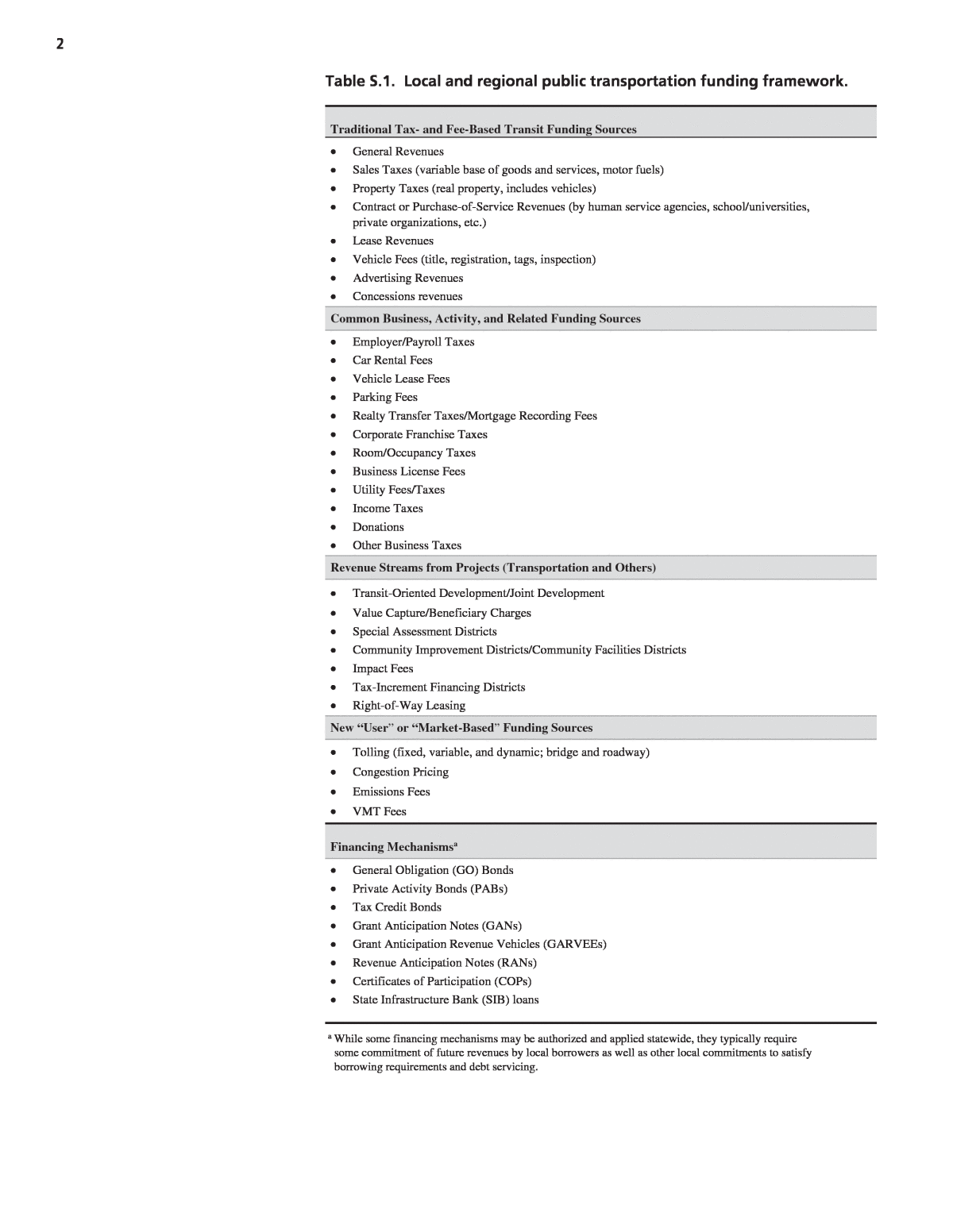
S U M M A R Y S.1 Purpose and Approach The purpose of TCRP Project H-34 was to compile a comprehensive list of funding sources that are in use or have the prospect of being used at the local and regional level to support public transportation. The results of the project are intended to serve as an updateable, interactive resource on local and regional funding sources for public transportation as well as a guide to the evalu- ation and enactment of new or expanded funding from local or regional sources. The project was carried out in two phases. The first phase focused on examining the litera- ture on local and regional transit funding sources and developing a typology to describe the fullest range of possible sources. To ensure as comprehensive a list of funding sources as pos- sible, the second phase of the project involved interviews with over 60 local and regional tran- sit agency managers and others with knowledge of local and regional transit funding sources and successful initiatives. Appendix A contains the interview guide and data elements that were sought in the interviews. S.2 A Typology of Local and Regional Funding Sources for Public Transportation Table S.1 presents five major categories of local and regional transit funding. Each category is described briefly in Section 3.0 of this report. The five categories are the following: ⢠Traditional tax- and fee-based transit funding sources. These include all traditional forms of broad-based tax- and fee-based and related revenue-raising mechanisms that have been avail- able or used for transit capital investment or to support transit operations since transit began to be transformed from a private business into a public service in the 1960s. These âtraditionalâ sources include those for which there is generally a direct and broadly accepted logic for mak- ing expenditures on transportation, including transit. ⢠Common business, activity, and related funding sources. This category of funding sources includes broad-based but somewhat less widely employed taxing and revenue-raising mecha- nisms that are used to support transit in various settings. The use of these revenue-raising mechanisms represents, in part, a recognition that funding public transportation is a broad responsibility and that meeting this responsibility requires contributions of funds from sources whose yield is significant and whose participation is politically acceptable. ⢠Revenue streams from projects. This category includes various arrangements that can be used to capture revenue primarily from the income streams of private business and related develop- ment activities benefiting from proximity to specific transit facilities and services. These include Local and Regional Funding Mechanisms for Public Transportation 1
2Traditional Tax- and Fee-Based Transit Funding Sources General Revenues Sales Taxes (variable base of goods and services, motor fuels) Property Taxes (real property, includes vehicles) Contract or Purchase-of-Service Revenues (by human service agencies, school/universities, private organizations, etc.) Lease Revenues Vehicle Fees (title, registration, tags, inspection) Advertising Revenues Concessions revenues Common Business, Activity, and Related Funding Sources Employer/Payroll Taxes Car Rental Fees Vehicle Lease Fees Parking Fees Realty Transfer Taxes/Mortgage Recording Fees Corporate Franchise Taxes Room/Occupancy Taxes Business License Fees Utility Fees/Taxes Income Taxes Donations Other Business Taxes Revenue Streams from Projects (Transportation and Others) Transit-Oriented Development/Joint Development Value Capture/Beneficiary Charges Special Assessment Districts Community Improvement Districts/Community Facilities Districts Impact Fees Tax-Increment Financing Districts Right-of-Way Leasing New âUserâ or âMarket-Basedâ Funding Sources Tolling (fixed, variable, and dynamic; bridge and roadway) Congestion Pricing Emissions Fees VMT Fees Financing Mechanismsa General Obligation (GO) Bonds Private Activity Bonds (PABs) Tax Credit Bonds Grant Anticipation Notes (GANs) Grant Anticipation Revenue Vehicles (GARVEEs) Revenue Anticipation Notes (RANs) Certificates of Participation (COPs) State Infrastructure Bank (SIB) loans a While some financing mechanisms may be authorized and applied statewide, they typically require some commitment of future revenues by local borrowers as well as other local commitments to satisfy borrowing requirements and debt servicing. Table S.1. Local and regional public transportation funding framework.
various forms of âjoint development,â âvalue capture,â and âbenefit assessment,â as well as newly emerging âpublic-private partnershipsâ (âPPPâ arrangements), all of which are described extensively in the literature and summarized in this report. ⢠New âuserâ or âmarket-basedâ funding sources. Expanded tolling, congestion pricing, emis- sion fees, and vehicle miles of travel (VMT) fees applied at the local and/or regional level have become the subject of greatly expanded research and analysis; however, implementation has been limited and revenue flows to transit rare, with the possible exception of âtoll creditsâ used as a local match based on state authority. ⢠Financing mechanisms. These refer to the growing variety of long-term âdebtâ instruments that are being issued increasingly to support major local and regional transit projects and programs. Financing mechanisms most often commit future streams of revenue from many of the types of sources noted in the categories described above for current investment. Financing mechanisms may more accurately be described as âproject delivery mechanismsâ than as pure âsourcesâ of funds. Nonetheless, financing mechanisms are included here because of their wide-ranging use and their dependence on more traditional sources to underwrite debt. TCRP Project H-34 is focused on the use of various forms of tax, fee, and related revenue raised broadly from local and regional residents and businesses. Therefore, the interview process used in the project and the report itself are focused on the first two categories described above: âtraditional tax- and fee-based transit funding sourcesâ and âcommon business, activity, and related funding sources.â Each of the three other major categories of local and regional fund- ing: ârevenue streams from projects,â ânew âuserâ or âmarket-basedâ sources,â and âfinancing mechanismsâ has been a long-standing major independent topic of TCRP and related research activity. Therefore, these categories have not been the direct subject of inquiry in the interviews for this project. Instead, the extensive literature on each has been used to briefly document the characteristics of these transit funding methods. Readers are encouraged to use the references noted throughout this report to explore these latter three funding categories in more detail. In addition, there are several local and regional funding sources that are used by some juris- dictions to support public transportation, but are not currently used widely. These are noted and described in Section 3.7, and their basic characteristics are noted in Tables 4.2 and 4.3. The database that accompanies this report (the Local and Regional Funding Database, available at http://trb.org/news/blurb_detail.asp?id=9599) provides additional detail about the use of local and regional funding mechanisms in the first two categories (Traditional Tax- and Fee-Based Transit Funding Sources and Common Business, Activity, and Related Funding Sources) by the transit agencies that were interviewed for the project. S.3 Overview of Current Local and Regional Public Transportation Funding The National Transit Database (NTD) provides a broad profile of what types of local and regional sources of funds are being used by systems of different sizes and by different types of agencies for both capital and operating expenditures. According to the NTD, nearly $26 bil- lion was made available for transit from local and regional sources in 2005, including nearly $6 billion for capital improvements and $20 billion for operations. With respect to individual local and regional sources, 2005 NTD data show the following: ⢠Fares and other earned income accounted for about 51 percent of revenue, and virtually all of these funds are used for operations. ⢠Local dedicated sources accounted for nearly 18 percent of revenue and came from the following: â Sales taxes (57.5 percent), â Property taxes (5.8 percent), 3
4â Gas taxes (3.8 percent), â Income taxes (2.0 percent), â Tolls (2.0 percent), and â âOtherâ (28.8 percent). ⢠Directly generated taxes accounted for approximately 16 percent of revenue and came from the following: â Sales taxes (45.5 percent), â Property taxes (7.0 percent), â Tolls (5.0 percent), â Gas taxes (0.2 percent), and â âOtherâ (42.1 percent). ⢠Local general funds accounted for about 10 percent of revenues. ⢠Other local sources accounted for about 5 percent of revenues. S.4 Local and Regional Public Transportation Funding by System Size U.S. transit investment and use is heavily concentrated in larger transit systems. The 50 largest systems accounted for 83 percent of trips in 2005, 79 percent of total operating expenditures, and 89 percent of total capital investment. Of the $26 billion in local and regional revenues bud- geted in 2005 by urbanized area systems, nearly 84 percent was budgeted within areas served by the 50 largest systems. NTD data indicate the following: ⢠Sales taxes serve as a major revenue source among systems of all sizes, ⢠Local general funds play a large role in systems serving areas with populations under a million, ⢠Fares and earned income are the largest sources of operating support drawn from local areas, ⢠Fares and earned income are predominantly used to support operations, ⢠Other directly generated dedicated funds are most prominent in the largest systems, and ⢠Property taxes for transit use are concentrated among smaller systems. S.5 Local and Regional Public Transportation Funding by Type of Agency Independent transit authorities and municipal or county governments differ in the latitude and authority they have in seeking increased revenues. Key distinctions in the use of local and regional funding between these two basic organizational structures include the following: ⢠Sales tax revenues are important to both types of agencies and are more often used (by both types of agencies) in support of capital programs than operating expenses. Nonetheless, sales tax revenues are particularly a feature of larger independent authoritiesâ capital funding schemes. ⢠Sales tax or directly generated revenue sources provide over 70 percent of capital investment by independent authorities. ⢠Independent authorities generally are empowered to tap larger proportions of directly gener- ated revenue. ⢠Fares and earned income (concessions, advertising, lease revenues, etc.) are a significant source of operating support regardless of agency type. ⢠Municipal and county government systems have a somewhat greater balance across sources than independent authorities have. ⢠The use of property taxes is concentrated among municipal and county systems.
5S.6 Criteria in Selecting and Evaluating Funding Sources Each of the sources mentioned and described in this report has potential applicability in a variety of settings. Whether a particular source is of potential use in a particular locale depends on a variety of factors, many of which are contextual and unique to individual locales. Contextual factors requiring review in the search for new funding sources are discussed more thoroughly in Section 4.0. These factors include the following: ⢠Local and state governance traditions and philosophies of taxation and spending, ⢠The types of transit agencies and services to be funded, ⢠The elements for which funding is being sought (e.g., ongoing agency programs or individual projects), ⢠The type of source that is desired and that is appropriate (e.g., pay-as-you-go funding or debt financing [bonding]), and ⢠Local and regional perspectives on the role of public transportation in the community now and in the future. A good understanding of these contextual factors is an important prerequisite in the search for enhanced transit funding. Once contextual factors are understood, all stake- holders must come to a similar understanding of the general advantages and disadvantages of alternative funding sources as well as an understanding of how the alternatives satisfy a set of widely used criteria. Among the most important of these criteria are the following: ⢠Revenue yield adequacy and stability, ⢠Cost efficiency in the application of sources, ⢠Equity in the application of the alternatives across demographic and income groups as well as regional jurisdictions, ⢠Economic efficiency in balancing who pays with who benefits from investments, ⢠Political and popular acceptability, and ⢠Technical feasibility. Among these criteria, revenue yield is a principal consideration. An enormous amount of effort is required to enact and sustain funding for any public service. When these efforts are undertaken, sponsors should be certain that the resulting flow of funds will be adequate to meet funding requirements, be reliable, and be predictable. Section 4.0 of this report also addresses the advantages, disadvantages, and performance of various funding sources against these criteria. S.7 Steps in Enacting New Funding Sources for Public Transportation There have been wide-ranging, successful efforts in recent years to raise funding for public transportation at the local and regional levels as the current and future importance of public transportation options have become more widely recognized. From these experiences, some of which are highlighted in Section 3.0, it is clear that raising funding for public transportation must be viewed as a âcampaignâ in all senses of the word. Virtually all of the successful public transportation funding campaigns have used the series of steps listed below: 1. Developing a consensus on the scope of current and future transportation and transit needs and on the importance of actions to address them;
62. Developing a specific program of investments for which additional funding is needed, pro- viding a clear and credible demonstration of the benefits expected, and detailing a campaign plan for pursuing enactment of new funding sources; 3. Identifying the roles, responsibilities, and procedures for carrying out the campaign plan and implementing the proposed improvements; 4. Describing in detail the proposed revenue sources to be enacted and the rationales for selec- tion and use; 5. Determining who must act officially and unofficially at the state, regional, and local level, through what processes, and on what timetables and further determine what their particular familiarity and interest is in advancing (or denying) a transit funding campaign; 6. Designing, raising resources for, and carrying out a comprehensive public education and advocacy campaign through multiple media, communications, and involvement strategies; 7. Developing broad-based community leadership and demonstrable sustained support for the initiative; and 8. Laying out a reasonable timetable, work program, and management scheme for action. To undertake these steps, particularly in pursuit of large, longer-term funding commit- ments, it has proven to be necessary to consult with, if not engage formally, an individual or firm experienced in directing public advocacy campaigns. Such expertise can be essential in framing stakeholder interests through polling and other public opinion processes, exploring varied political perspectives, understanding the precise and often arcane procedures for estab- lishing the legal authority to raise and invest public funds, and in shaping and delivering mes- sages that will both resonate with essential constituencies and counteract contrary opinions where necessary.
