





Below is the uncorrected machine-read text of this chapter, intended to provide our own search engines and external engines with highly rich, chapter-representative searchable text of each book. Because it is UNCORRECTED material, please consider the following text as a useful but insufficient proxy for the authoritative book pages.
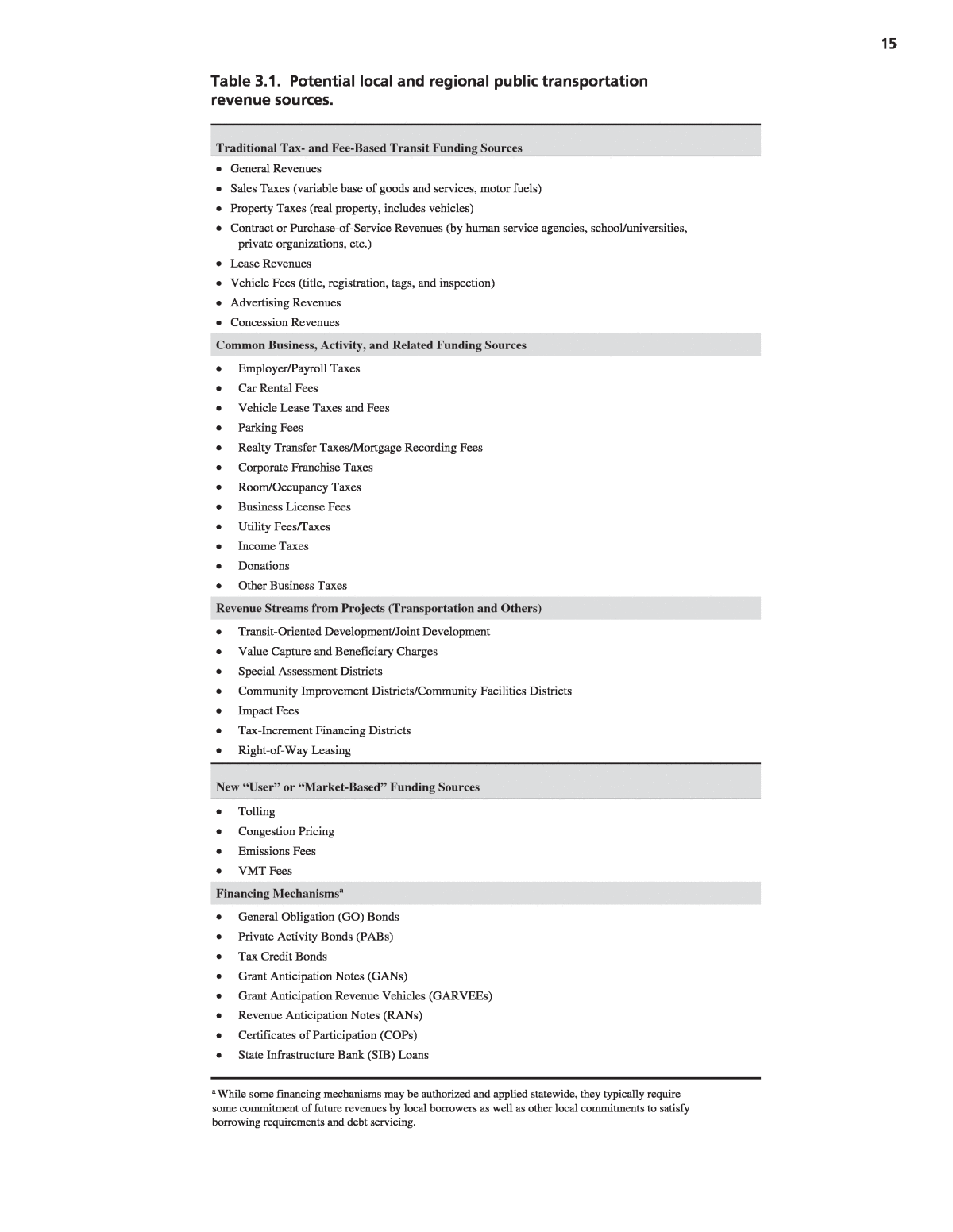
14 3.1 Local and Regional Public Transportation Funding Typology and Definitions While the NTD serves a very useful purpose in aggregating transit operating and financial data, it is somewhat less useful in informing users about the practical details surrounding local and regional funding and financing initiatives.3 From a broader literature review, a typology of local and regional transit funding sources has been developed and is presented in Table 3.1. The typology differentiates five major types of funding for the purposes of this project. The broad categories are described below, and brief descriptions of individual sources in Table 3.1 are provided in the sections that follow. ⢠Traditional tax- and fee-based transit funding sources. This category includes all traditional forms of broadly based, tax- and fee-based, and related revenue-raising mechanisms that have been available or used for transit capital invest- ment or to support transit operations since transit began to be transformed from a private business into a public service in the 1960s. These âtraditionalâ sources are those in which there is generally a direct and broadly accepted rationale for making expenditures on transportation, including public transportation. Section 3.2 describes these sources. ⢠Common business, activity, and related funding sources. This category includes broadly based tax- and revenue- raising mechanisms that are somewhat less widely used to support transit in various settings. The use of these revenue- raising mechanisms represents, in part, a recognition that funding public transportation is a responsibility that is shared broadly and that meeting this responsibility requires contributions of funds from sources whose yield is signifi- cant and whose participation is acceptable in a political sense. Section 3.3 describes these sources. ⢠Revenue streams from projects. This category includes various arrangements that can be used to capture revenue primarily from the income streams of private business and related development activities benefiting from proximity to specific transit facilities and services. These include var- ious forms of joint development, value capture, and bene- fit assessment, as well as newly emerging public-private partnerships (also called PPP arrangements)âall of which are described extensively in the literature and summarized below. Significant sources in the literature are provided for readersâ reference. ⢠New âuserâ or âmarket-basedâ funding sources. Expanded tolling, congestion pricing, emission fees, and VMT fees applied at the local and/or regional level have become the subject of greatly expanded research and analysis, although implementation has been limited and revenue flows to tran- sit rare, with the exception of âtoll creditsâ used as a local match based on state authority.4 References to this literature also are provided. ⢠Financing mechanisms. These are the growing variety of long-term âdebtâ instruments that are increasingly being issued to support major local and regional transit projects and programs. Financing mechanisms most often com- mit future streams of revenue from many of the types of S E C T I O N 3 . 0 Current and Potential Sources of Local and Regional Funding for Public Transportation 3 The limitations of the NTD in this regard are discussed in more detail in Appendix C. 4 In the glossary of terms for Financing Freight Improvements, toll credits are defined as follows: âSection 1044 of the Intermodal Surface Transportation Efficiency Act permitted states to apply the value of certain highway expen- ditures funded with toll revenues toward the required state match on current federal aid projects. States may only substitute toll credits for state match if they demonstrate that a stateâs prior year highway spending equaled or exceeded the average of the previous three yearsâ expenditures.â (Buxbaum, J., I. N. Ortiz, and C. Keenan. Financing Freight Improvements. FHWA- HOP-06-108. Prepared by Cambridge Systematics, Inc. for FHWA, U.S. DOT, 2007. Glossary available online at http://ops.fhwa.dot.gov/freight/ publications/freightfinancing/sect5.htm.).
15 Table 3.1. Potential local and regional public transportation revenue sources. Traditional Tax- and Fee-Based Transit Funding Sources General Revenues Sales Taxes (variable base of goods and services, motor fuels) Property Taxes (real property, includes vehicles) Contract or Purchase-of-Service Revenues (by human service agencies, school/universities, private organizations, etc.) Lease Revenues Vehicle Fees (title, registration, tags, and inspection) Advertising Revenues Concession Revenues Common Business, Activity, and Related Funding Sources Employer/Payroll Taxes Car Rental Fees Vehicle Lease Taxes and Fees Parking Fees Realty Transfer Taxes/Mortgage Recording Fees Corporate Franchise Taxes Room/Occupancy Taxes Business License Fees Utility Fees/Taxes Income Taxes Donations Other Business Taxes Revenue Streams from Projects (Transportation and Others) Transit-Oriented Development/Joint Development Value Capture and Beneficiary Charges Special Assessment Districts Community Improvement Districts/Community Facilities Districts Impact Fees Tax-Increment Financing Districts Right-of-Way Leasing New âUserâ or âMarket-Basedâ Funding Sources Tolling Congestion Pricing Emissions Fees VMT Fees Financing Mechanismsa General Obligation (GO) Bonds Private Activity Bonds (PABs) Tax Credit Bonds Grant Anticipation Notes (GANs) Grant Anticipation Revenue Vehicles (GARVEEs) Revenue Anticipation Notes (RANs) Certificates of Participation (COPs) State Infrastructure Bank (SIB) Loans a While some financing mechanisms may be authorized and applied statewide, they typically require some commitment of future revenues by local borrowers as well as other local commitments to satisfy borrowing requirements and debt servicing.
sources noted in the categories described above for current investment. These financing mechanisms may be more accurately described as âproject deliveryâ mechanisms rather than as sources of additional revenue because the use of debt financing allows faster implementation and related cost savings. Not all potential funding sources listed in Table 3.1 have been addressed in the same way in the material that follows. The focus of the current project is on the use of various forms of tax, fee, and related revenue raised broadly from local res- idents and businesses; therefore, individual agency experi- ences drawn from the interview process are focused on the traditional tax- and fee-based transit funding sources and common business, activity, and related funding sources listed in Table 3.1. Detailed documentation on the varied experiences of indi- vidual agencies with the remaining major categories of local and regional funding: revenue streams from projects, new âuserâ or âmarket-basedâ funding sources, and financing mechanisms can be found in the literature referenced in Section 3.6. Readers are encouraged to use the references pro- vided to learn about the use and application of these funding sources. For each of these broad categories of local and regional revenue, Section 3.3 provides key descriptions, selected exam- ples of their use, and additional references, along with other issues associated with their enactment and application. Section 3.7 identifies additional local and regional revenue sources not currently in widespread use to support public transportation. 3.2 Traditional Local and Regional Tax- and Fee-Based Funding Sources for Public Transportation The over 18,000 local units of government in the United States are overwhelmingly dependent on property tax rev- enues. According to the Tax Foundation, nearly 73 percent of total local tax collections come from property taxes.5 Support for public transportation derives from different sources, mostly likely to avoid competing with other basic public ser- vices such as health, education, police, and fire protection. Basic descriptions are provided below for the more traditional tax- and fee-based revenue sources used to support public transportation that are listed in Table 3.1. General Revenue The terms âgeneral revenuesâ and âgeneral fundsâ refer to revenues combined from any number of local and regional sources, including those described below. General funds serve as a resource to support any and all public purposes. Frequently, general funds are committed to support public transportation on an annual or biennial basis in amounts that can vary from budget cycle to budget cycle depending on local budget priori- ties. The sometimes uneven flow of general funds to transit on annual or biennial budget cycles is contrasted with the more predictable and reliable flow of revenues from specific sources dedicated all, or in part, to transit from sources such as those listed below. Sales Taxes As noted previously, sales taxes are the most widely used source of dedicated local and regional funding for transit. Generally, sales taxes provide the greatest yield and stability as well as being among the most broadly acceptable sources of funding for public transportation. State funding for pub- lic transportation frequently relies on this source: all but five states have state sales taxes with rates ranging from 4 to 7.25 percent. At the local and regional level, additional sales taxes enacted for transit typically range from 0.25 to 1 per- cent. Some sales taxes are perpetual; others require re- enactment or extension through periodic popular votes. Sales taxes typically exempt various combinations of food, cloth- ing, and prescription drugs or apply lower rates to selected goods and services. âUse taxâ is a term that describes the equivalent of a sales tax that is applied to items that may not typically be covered by sales taxes, including lease or rental transactions and items pur- chased outside the taxing jurisdiction. âExcise taxesâ also represent a type of sales tax, usually applied separately or in combination with sales taxes on specific goods or services. Excise taxes may be charged on an ad valorem basis as a percentage of the price, or as a fixed dollar amount per transaction. Examples are dis- cussed below, including motor fuel taxes and a variety of âsinâ taxes. Property Taxes Property taxes or ad valorem taxes on land and building value are generally the principal source of revenue for local governments and typically are unrestricted in their use. Portions of local property taxes are, however, also widely authorized for use by special districts and authorities, including transit authorities and school districts, and for other specific public functions like police and sanitation. 16 5 Sagoo, S. (ed.). Facts & Figures on Government Finance, 38th ed. Tax Foundation, Washington, DC, 2005. Available at www.taxfoundation.org/ publications/show/147.html.
17 Examples of Service and Revenue Arrangements with Colleges and Universities The availability of transit service has become an important element of student life and uni- versity economics across the country in recent years. Many colleges and universities have provided independent bus services for students, faculty, and workers and have invested heav- ily in surface and structured parking facilities. Over time, these costs have escalated, com- bined with growing enrollments, increased congestion, and related environmental effects. Many colleges and universities have turned to local public transit agencies to operate services of direct importance to their special communities. The result is a growing revenue source and expanded relevance in the community. Examples include the followinga: ⢠The Greensboro Transit Authority (North Carolina) serves 130,000 student passengers on their Higher Education Area Transit (HEAT) services that are specially operated to meet the needs of seven area educational institutions, each of which supports the pro- gram financially. ⢠The University of California at Riverside funds a U-Pass service in partnership with the Riverside Transit Agency as well as a free trolley shuttle for students who live off-campus. ⢠At Iowa State University in Ames, students are charged $52.50 each semester and the University contributes half the cost of CyRide in Ames. Eighteen percent of the remain- ing funding is provided by the city and the balance from other sources. ⢠Capital Area Transportation Authority (CATA), the transit system serving Lansing, Michigan, operates a bus service for Michigan State University at an annual cost of $2 mil- lion. With a student ID, students pay 50 cents a ride; without the ID the cost is $1.00. The balance of the cost of service is derived from housing and parking fees. ⢠HomeRide, a private firm in Blacksburg, Virginia, provides a regional link among four colleges and universities, as well as a link to outside destinations on weekends and hol- idays, under a joint contract with the schools. These are just a sampling of the arrangements that are being pursued to gain ridership and revenue for transit agencies while relieving travel congestion and budget constraints for colleges and universities. a The examples are taken from âTransit Finds Increasing Connections with Universities,â Passenger Transport, Vol. 65, No. 46, November 19, 2007, p. 8. Revenues are generated by applying a tax or âmill rateâ to the value of the property. So-called âfair marketâ values frequently are adjusted to determine the âassessed valueâ used as the basis for the mill rate. A mill is equivalent to 1/1,000 of a dollar. Although these taxes are assessed locally, states and localities act to control valuations or otherwise provide some type of property tax relief in the form of tar- geted exemptions, or âcircuit-breakers,â limiting the per- centage of income required to be paid via property taxes. âSpecial assessmentsâ and âlocal improvement leviesâ are also types of property tax that are applied in direct relation to a benefit received from their imposition and expenditure, typ- ically on local public improvements, as discussed in the sec- tion âValue Capture and Beneficiary Charges.â Contract or Purchase-of-Service Revenues Transit systems often provide transportation services in addition to their regularly scheduled services for which rev- enues are received based on agreed-upon levels of service and rates. Municipal government, individual businesses and indus- tries, health and social service agencies, and educational insti- tutions may purchase transit services. The revenues received may or may not cover âfully allocated costs,â or fully allocated costs plus an added amount. The rates charged may be calcu- lated and applied on a per-hour basis, a per-vehicle basis, or per-trip basis. New charter bus regulations issued by the FTA in May 2008 may serve as a constraint on contract or purchase- of-service arrangements.
Lease Revenues Transit systems often generate income through leasing (at market rates) portions of physical facilities, typically terminal, station, transfer, or parking facilities. Transit agencies with rail or other fixed rights-of-way also can lease these to private inter- ests, like telecommunications companies (typically for fiber- optic networks), and sometimes negotiate for free use for the agency for command and control. Leases can be annual, with rate adjustments, or multiyear. Vehicle Fees A variety of fees are charged to vehicle owners and oper- ators by state governments. These fees are based on vehicle value, weight, and/or age. The fees are charged for issuance of titles, licenses, registration, and/or inspection. The author- ity to collect vehicle fees is sometimes provided to local gov- ernments in the form of a local option. Revenues from these fees are typically dedicated to covering the cost of adminis- tering these activities, to enforcement, to transportation generally, or to general revenues. It is very seldom that rev- enues from vehicle fees are dedicated directly to public transportation. Advertising Most transit agencies solicit and accept advertising on their vehicles, facilities (such as stations and shelters), and materials (such as tickets, schedules, and maps). Advertising serves as a source of earned income and provides a means to establish broader community partnerships as well as a means to capture and maintain interest and support for transit and other public services. Print and electronic media are in use, as are âsponsorshipâ programs that fund partic- ular vehicles, services, or events. The majority of transit agencies contract advertising programs and their manage- ment to private media and advertising companies, although many advertising programs are managed by in-house staff in medium and smaller systems. Revenues from advertising flow directly or indirectly to the operating agencies from single or multiyear advertising contracts and agreements as well as from time-limited and event-based arrangements. Limitations are often placed on advertising content as well as on the types of organizations from which advertising is accepted. Revenue from advertising is typically modest, from 0.1 percent to over 3.0 percent of operating revenue. In dollar terms, however, advertising revenues are produc- ing $500 million for transit agencies annually, ranging from thousands of dollars to millions of dollars a year, depending on system size.6 Concessions Larger transit agencies with significant space in terminal and station facilities may enter into concession agreements (an income-generating strategy similar to leasing) with a variety of commercial and retail enterprises. These enterprises include newsstands, food stands, ATMs, gift shops, vending machine operations, music stores, florists, photo-processing stores, shoe repair and sales shops, and so forth. Concession agree- ments are typically multiyear and are bid on competitively, with payments received as revenue or in the form of direct con- tributions to capital improvements. As a measure of the poten- tial for concessions as a source of revenue, the New York Metropolitan Transit Authority (MTA) estimates that the min- imum threshold to support a single store is 5,000 passengers a day.7 Market analyses in settings outside New York may yield a different threshold. 3.3 Common Business, Activity, and Related Funding Sources for Public Transportation A wide range of additional local and regional revenue sources are being used to support public transportation, although their use may not be as widespread as the traditional sources noted above. Employer/Payroll Taxes Employer taxes enacted to support transit are typically imposed directly on the employer for the amount of gross payroll paid for services performed within the transit district. Employer taxes are usually administered by the state revenue agency on behalf of the transit agencies or jurisdictions authorized to raise and expend the revenue and typically are collected quarterly. Authorizing legislation along with asso- 18 6 Schaller, B. TCRP Synthesis 51: Transit Advertising Sales Agreements. Transportation Research Board of the National Academies, Washington, DC, 2004. Silverberg, B. R. TCRP Synthesis 32: Transit Advertising Revenue: Traditional and New Sources and Structures. Transportation Research Board, National Research Council, Washington, DC, 1998. âPractical Measures to Increase Transit Industry Advertising Revenues.â Research in Progress (data- base), Transportation Research Board of the National Academies. Available at http://rip.trb.org/browse/dproject.asp?n=11725. 7 Price Waterhouse, LLP; Multisystems, Inc.; and Mundle & Associates, Inc. TCRP Report 31: Funding Strategies for Public Transportation, Volumes 1 and 2. Transportation Research Board, National Research Council, Washington, DC, 1998.
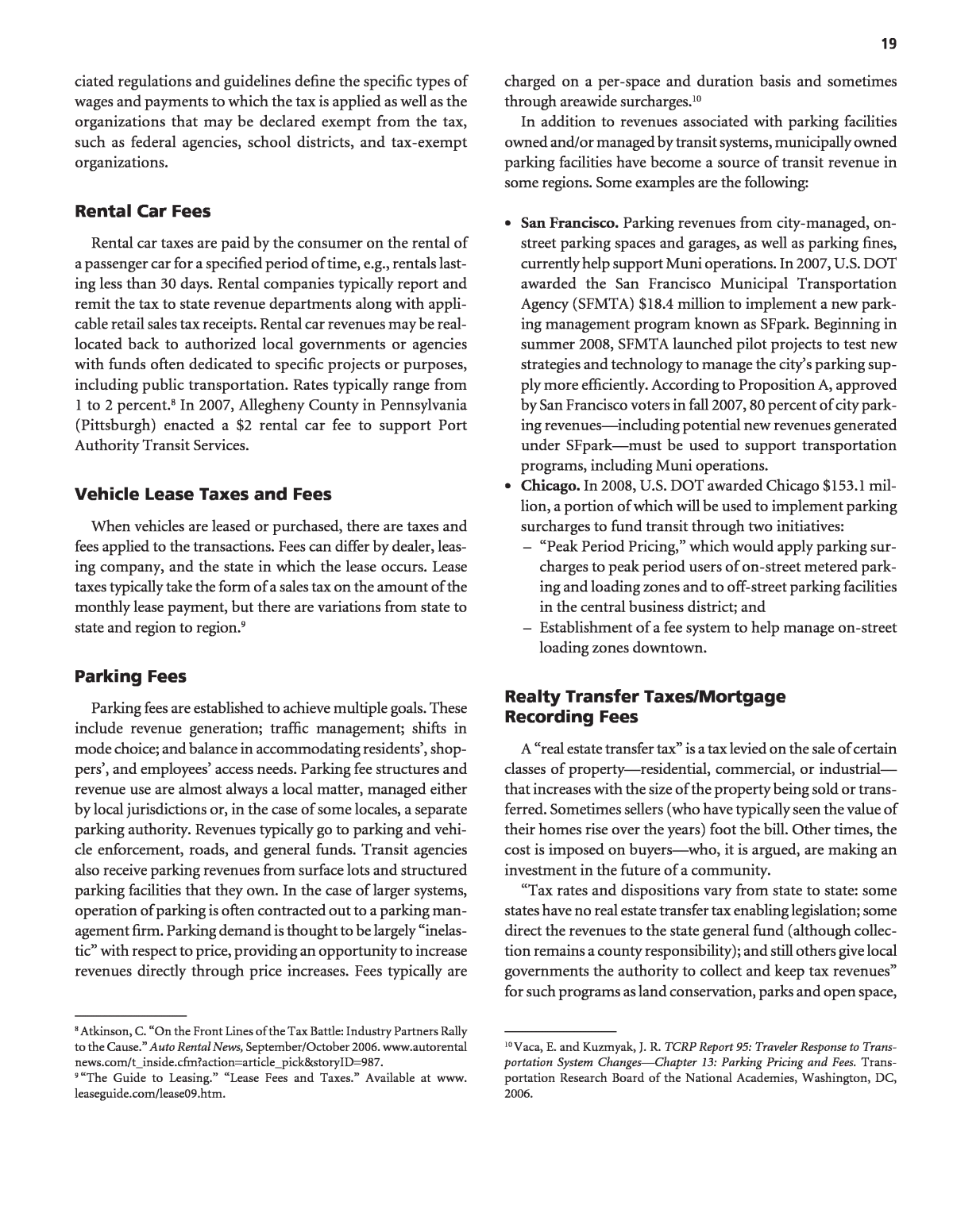
19 ciated regulations and guidelines define the specific types of wages and payments to which the tax is applied as well as the organizations that may be declared exempt from the tax, such as federal agencies, school districts, and tax-exempt organizations. Rental Car Fees Rental car taxes are paid by the consumer on the rental of a passenger car for a specified period of time, e.g., rentals last- ing less than 30 days. Rental companies typically report and remit the tax to state revenue departments along with appli- cable retail sales tax receipts. Rental car revenues may be real- located back to authorized local governments or agencies with funds often dedicated to specific projects or purposes, including public transportation. Rates typically range from 1 to 2 percent.8 In 2007, Allegheny County in Pennsylvania (Pittsburgh) enacted a $2 rental car fee to support Port Authority Transit Services. Vehicle Lease Taxes and Fees When vehicles are leased or purchased, there are taxes and fees applied to the transactions. Fees can differ by dealer, leas- ing company, and the state in which the lease occurs. Lease taxes typically take the form of a sales tax on the amount of the monthly lease payment, but there are variations from state to state and region to region.9 Parking Fees Parking fees are established to achieve multiple goals. These include revenue generation; traffic management; shifts in mode choice; and balance in accommodating residentsâ, shop- persâ, and employeesâ access needs. Parking fee structures and revenue use are almost always a local matter, managed either by local jurisdictions or, in the case of some locales, a separate parking authority. Revenues typically go to parking and vehi- cle enforcement, roads, and general funds. Transit agencies also receive parking revenues from surface lots and structured parking facilities that they own. In the case of larger systems, operation of parking is often contracted out to a parking man- agement firm. Parking demand is thought to be largely âinelas- ticâ with respect to price, providing an opportunity to increase revenues directly through price increases. Fees typically are charged on a per-space and duration basis and sometimes through areawide surcharges.10 In addition to revenues associated with parking facilities owned and/or managed by transit systems, municipally owned parking facilities have become a source of transit revenue in some regions. Some examples are the following: ⢠San Francisco. Parking revenues from city-managed, on- street parking spaces and garages, as well as parking fines, currently help support Muni operations. In 2007, U.S. DOT awarded the San Francisco Municipal Transportation Agency (SFMTA) $18.4 million to implement a new park- ing management program known as SFpark. Beginning in summer 2008, SFMTA launched pilot projects to test new strategies and technology to manage the cityâs parking sup- ply more efficiently. According to Proposition A, approved by San Francisco voters in fall 2007, 80 percent of city park- ing revenuesâincluding potential new revenues generated under SFparkâmust be used to support transportation programs, including Muni operations. ⢠Chicago. In 2008, U.S. DOT awarded Chicago $153.1 mil- lion, a portion of which will be used to implement parking surcharges to fund transit through two initiatives: â âPeak Period Pricing,â which would apply parking sur- charges to peak period users of on-street metered park- ing and loading zones and to off-street parking facilities in the central business district; and â Establishment of a fee system to help manage on-street loading zones downtown. Realty Transfer Taxes/Mortgage Recording Fees A âreal estate transfer taxâ is a tax levied on the sale of certain classes of propertyâresidential, commercial, or industrialâ that increases with the size of the property being sold or trans- ferred. Sometimes sellers (who have typically seen the value of their homes rise over the years) foot the bill. Other times, the cost is imposed on buyersâwho, it is argued, are making an investment in the future of a community. âTax rates and dispositions vary from state to state: some states have no real estate transfer tax enabling legislation; some direct the revenues to the state general fund (although collec- tion remains a county responsibility); and still others give local governments the authority to collect and keep tax revenuesâ for such programs as land conservation, parks and open space, 8 Atkinson, C. âOn the Front Lines of the Tax Battle: Industry Partners Rally to the Cause.â Auto Rental News, September/October 2006. www.autorental news.com/t_inside.cfm?action=article_pick&storyID=987. 9 âThe Guide to Leasing.â âLease Fees and Taxes.â Available at www. leaseguide.com/lease09.htm. 10 Vaca, E. and Kuzmyak, J. R. TCRP Report 95: Traveler Response to Trans- portation System ChangesâChapter 13: Parking Pricing and Fees. Trans- portation Research Board of the National Academies, Washington, DC, 2006.
and less frequently, public transportation.11 Rates are highly variable across types of property and property value, ranging from 1/100th of a cent to 2 percent.12 Corporate Franchise Taxes A franchise tax is a tax levied on the profit and taxable assets of a business or firm.13 Franchise taxes impose a tax on corpo- rations for doing business, employing capital, owning or leas- ing property, or maintaining an office. Franchise tax is a tax that corporations pay in advance for doing business within the state. Franchise tax is based on the âpar value of the corpora- tionâs outstanding shares and surplus.â This is defined as the âtotal assets or the par value of issued and outstanding capital stock, whichever is greater.â14 Franchise taxes often are targeted to specific industries and economic activities. A corporate franchise tax on transporta- tion and transmissions companies, or a âlong lines tax,â is one of several taxes supporting transit services in the 12-county New York MTA region.15 A franchise tax on oil companies applied in Pennsylvania imposes a cents-per-gallon tax on all taxable liquid fuels.16 Revenues are deposited in various restricted and unrestricted state funds. Room or Occupancy Taxes Sometimes called a hotel-motel tax, room or occupancy taxes are consumer taxes on the cost of lodging at hotels, motels, rooming houses, private campgrounds, RV parks, and similar facilities. They are frequently limited to a specified con- secutive period of days. Rates may vary depending on the size of the facility and/or by location. Revenues may be collected by the state and, where dedicated for local use, reallocated to the levying municipalities and counties. Alternatively, revenues may be collected by local jurisdictions where state authority is provided. Often these revenues are used for promotion of tourism or construction and operation of tourism-related facilities, as in counties throughout the state of Washington and in Allegheny County, Pennsylvania.17 Utility Fees Utility fees can encompass taxes on a wide range of pub- lic services and businesses, including telephone, sewer and water, electricity, gas, and garbage utilities. Revenues are typically provided to a jurisdictionâs general fund as well as to public works facilities. In Pullman, Washington, utilities are paid monthly by subscribers (households and busi- nesses). The prior monthâs fees are paid in turn to the city every month, i.e., there is a monthâs lag in city receipt of the fees. The tax is levied in lieu of a business and occupation tax and a sales tax. Rates vary by utility from 0.10 percent to 5 percent.18 Donations Support for public transportation may also be available through donations from various types of philanthropic, char- itable, service organizations like the United Way, as well as for- profit businesses. Typically, donations are directed toward a particular service, subarea, or client group. 3.4 Current Examples of Traditional or Common Local and Regional Funding Sources Table 3.2 lists the local and regional revenue sources cur- rently in use among over 60 public transportation systems that were interviewed for this project.19 The database that accom- panies this report contains additional information that relates the characteristics of each transit agency to the characteristics of each funding source used by that agency. Table 3.2 reinforces much of what was revealed in aggregate data from the NTD, particularly the dominance of sales taxes as the local and regional transit funding source of choice across the country. In addition, Table 3.2 reveals a number of other 20 11 Hopper, K. Local Parks, Local FinancingâVolume 1: Increasing Public Invest- ment in Parks and Open Space. The Trust for Public Land, San Francisco, CA, 1998. Available at http://www.tpl.org/tier3_cdl.cfm?content_item_id= 1048&folder_id=825. 12 National Conference of State Legislatures. âReal Estate Transfer Taxes.â Available at http://www.ncsl.org/programs/fiscal/realxfertax.htm. 13business franchise tax. BusinessDictionary.com. WebFinance, Inc. Available athttp://www.businessdictionary.com/definition/business-franchise-tax.html. 14 Missouri Department of Revenue at http://dor.mo.gov/tax/business/ franchise/. 15 City of New York Independent Budget Office. âA Review of the Metro- politan Transportation Authorityâs Financial Outlook and Options for Closing the Gaps.â New York, NY, June 1, 2007. 16 Pennsylvania Department of Revenue. âLiquid Fuels and Fuels Taxesâ (online article). 2005. Available at www.rev421.state.pa.us/revenue/cwp/ view.asp?A=11&Q=48877. 17 http://dor.wa.gov/content/findtaxesandrates/othertaxes/tax_hotelmotel. aspx. Allegheny County Pennsylvania, âHotel Occupancy Taxâ (online arti- cle). Available at www.alleghenycounty.us/treasure/hotel.aspx. 18 Price Waterhouse, LLP. âDedicated Local Taxes.â TCRP Report 31: Funding Strategies for Public TransportationâVolume 2: Casebook. Transportation Research Board, National Research Council, Washington, D.C. 1998. Available at http://onlinepubs.trb.org/Onlinepubs/tcrp/tcrp_rpt_31-2-a.pdf. 19 The list of transit systems interviewed for the projects is provided in Appendix C.
21 Table 3.2. Local and regional funding sources for public transportation. Selected Applications Funding Source Major Metro > 1.0 Million Large Metro 200,000â1.0 Million Small Urban 50,000â200,000 Rural < 50,000 Traditional Taxes and Fees General Revenues Chicago, IL (Pace) Miami-Dade County, FL Orlando, FL San Francisco, CA (MUNI) Virginia Beach/Hampton Roads, VA Washington, DC (PRTC) Allentown, PA Gulfport-Biloxi, MS Lubbock, TX Oklahoma City, OK Durant, OK Jefferson City, MO Licking County, OH Waterloo, IA Baldwin County, AL Eureka Springs, AR Ft. Morgan, CO Paducah, KY Sturgis, SD Sales Taxes Chicago, IL (RTA) Denver, CO Harris County/ Houston, TX Las Vegas, NV Miami-Dade County, FL New York, NY (MTA) San Francisco, CA (BART) San Francisco, CA (MUNI) St. Louis, MO (City) St. Louis, MO (St. Clair County, IL) Seattle/King County, WA Seattle, WA (Sound Transit) Tampa, FL Washington, DC (NVTA) Austin, TX Corpus Christi, TX Dayton, OH Reno, NV Salt Lake City, UT Spokane, WA Athens-Clark County, GA Durant, OK Jefferson City, MO St. Clair County, MO St. Joseph, MO Park City, UT Property Taxes Las Vegas, NV Minneapolis/St. Paul, MN (Metro Transit) San Francisco, CA (BART) Tampa, FL Ann Arbor, MI Flint, MI Grand Rapids, MI Lansing, MI Minneapolis/St. Paul, MN (Minnesota Valley Transit) Athens, Clark County, GA Lafayette, IN Licking County, OH Van Buren County, MI Hanover, NH Harper County, KS Hood River, OR Marshalltown, IA Ontonagon, MI Ottawa County, OH Van Buren, MI White River Junction, VT Contract/ Purchase-of- Service Revenues Chicago, IL (Pace, Metra) Denver, CO (RTD) Orlando, FL Austin, TX Allentown, PA Ann Arbor, MI Corpus Christi, TX Annapolis, MD Athens-Clark County, GA Durant, OK Eureka Springs, AR Ft. Morgan, CO Hanover, NH (continued on next page)
22 Table 3.2. (Continued). Selected Applications Funding Source Major Metro > 1.0 Million Large Metro 200,000â1.0 Million Small Urban 50,000â200,000 Rural < 50,000 San Francisco, CA (MUNI) Tampa, FL Virginia Beach/ Hampton Roads, VA Dayton, OH Flint, MI Grand Rapids, MI Oklahoma, City, OK Lansing, MI Louisville, KY Lubbock, TX Syracuse, NY Jefferson City, MO Lafayette, IN Licking County, OH Pullman, WA Waterloo, IA Hood River, OR Ontonagon, MI Ottawa County, OH Paducah, KY Park City, UT Sturgis, SD White River Junction, VT Lease Revenues Chicago, IL (CTA) Denver, CO Minneapolis/St. Paul, MN (Metro Transit) Orlando, FL San Francisco, CA (BART) Lansing, MI Grand Rapids, MI Vehicle Fees (title, registration, tags, and inspection) San Francisco, CA (BART) Seattle, WA (Sound Transit) Washington, DC (NVTA) White River Junction, VT Advertising Revenues Chicago, IL (CTA, Metra) Denver, CO Las Vegas, NV Minneapolis/St. Paul, MN (Minnesota Valley Transit) Orlando, FL Portland, OR San Francisco, CA (BART) San Francisco, CA (MUNI) Virginia Beach/ Hampton Roads, VA Corpus Christi, TX Dayton, OH Flint, MI Grand Rapids, MI Lubbock, TX Salt Lake City, UT Spokane, WA Syracuse, NY Lafayette, IN Baldwin County, AL Park City, UT Ontonagon, MI Concession Revenues Chicago, IL (CTA) New York, NY (MTA) San Francisco, CA (BART) Eureka Springs, AR Common Business, Activity, and Related Sources Employer/ Payroll Taxes Portland, OR Louisville, KY Hood River, OR Car Rental Fees Seattle, WA (Sound Transit) Washington, DC (NVTA) Eureka Springs, AR
23 Table 3.2. (Continued). Selected Applications Funding Source Major Metro > 1.0 Million Large Metro 200,000â1.0 Million Small Urban 50,000â200,000 Rural < 50,000 Vehicle Lease Fees Parking Fees at Transit Facilities Chicago, IL (CTA, Metra) Denver, CO Grand Rapids, MI Annapolis, MD Eureka Springs, AR Parking Fees at Municipal Facilities San Francisco, CA (BART) San Francisco, CA (MUNI) Mortgage Recording Taxes New York, NY (MTA) Syracuse, NY Realty Transfer Taxes Washington, DC (NVTA) Chicago, IL (CTA- 2008) Corporate Franchise Taxes (oil, transportation, transmission) New York, NY (MTA) Room/ Occupancy Taxes Park City, UT Business License Fees Louisville, KY Park City, UT Utility Fees/Taxes St. Joseph, MO Pullman, WA Income Taxes â Business Louisville, KY (corporate profits) Cigarette Taxes Portland, OR (State) Donations Lynx-Orlando, FL Grand Rapids, MI (foundation grants) Lubbock, TX Salt Lake City, UT Licking County, OH Park City, UT Ft. Morgan, CO Hanover, NH Sturgis, SD White River Junction, VT Other Business Taxes St. Louis, MO Grand Rapids, MI (pollution fines) Ottawa County, OH (Sr. Service Levy) Park City, UT (resort tax) Note: Entries are from interview results as well as other sources, e.g., U.S. GAO, Mass Transit Issues Related to Providing Dedicated Funding for the Washington Metropolitan Area Transit Authority, GAO-06-516. GAO, Washington, D.C., May 2006.
features about local and regional transit funding from around the country: ⢠General revenues, property tax revenues, and contract rev- enues all play a role in funding transit across areas of all sizes; ⢠Lease revenues are found predominantly in larger metro- politan areas, where extensive transit systems have termi- nal and station facilities capable of supporting auxiliary businesses; ⢠Relatively little direct use is made of various motor vehicleâ related taxes and fees in supporting transit, a situation that reflects the still dominant view that revenues from personal vehicle use should be directed exclusively to roadway improvements for those who drive, especially given the growing gap between roadway needs and avail- able revenues; and ⢠The use of broadly based taxes and fees (versus narrower âuserâ fees) to support public transit locally is firmly established, perhaps reflecting a recognition that transit availability and benefits are linked to pursuit of broader community goals and objectives. A Snapshot of Recent Public Transportation Funding Initiatives in Major Metropolitan Areas In recent years, there have been increasing efforts at both the state and local level to enact new funding for transit and trans- portation, generally. CFTE has tracked referenda and initia- tives all over the country in the past several years and regularly reports results on its website, www.cfte.org. The CFTE report, Transportation Finance at the Ballot Box, reports that of 202 transportation funding measures in 33 states from 2000 through 2005, more than 130 were successful.20 In 2006, a total of 47 transportation-related ballot measures were presented to voters, 30 of which were included in the November 2006 elec- tions. Twenty-nine of the 47 ballot measures were approved in 2006. Figure 3.1 shows states that had ballot measures for transportation in the years 2000 to 2006, based on the analysis by CFTE. During this same period, 2000 through 2006, specific funding measures supporting transit in whole or in part were passed in 87 locales (see Appendix F for a listing of locales).21 These experiences at the ballot box confirm continued strong reliance at the local and regional level on sales tax revenues and, to a lesser degree, property taxes to support local and regional investments in transit. Among the observations that are most significant from the 2006 ballot elections are these: ⢠Over 30 ballot initiatives raising funds for transportation, including transit, were voted on in 2006 with a 71-percent approval rating, including several in California that required a two-thirds (âsupermajorityâ) popular vote, based on 1986 state law. ⢠Of 23 local or county initiatives passed: â Ten featured sales taxes for terms of up to 30 years rang- ing in size from 0.10 to 0.50 percent; â Eleven featured property tax increases ranging in size from 0.33 mills to 0.75 mills, with all but one of these occurring in Michigan; and â One featured a tax on commercial parking, an employer tax, and a property tax increase. In recent years, funding initiatives in major metropolitan areas with substantial transit systems, services, and plans have reinforced the continuing reliance on local and regional sales taxes as major revenue sources, particularly for capital-intensive programs, as noted in the examples described below.22 San Diego, California. San Diego County has sustained one of the most successful programs for local and regional transit and multimodal transportation revenue-raising in the country. In 1987, under the leadership of the former Metropolitan Transit Development Board (MTDB), county voters enacted TransNet, a 20-year, one-half-cent sales tax yielding $3.3 bil- lion to support specific amounts and projects for transit expansion, highway expansion, and local street and roadway improvements. In 2003, long-range transit planning, program- ming, and funding decisions were consolidated within the San Diego Association of Governments (SANDAG), the regionâs metropolitan planning organization (MPO), to streamline decision-making in committing revenues to transportation improvements. Faced with continued rapid growth and the expiration in 2008 of the original TransNet measure, in November 2004, county voters approved a 40-year extension of the one-half-cent TransNet sales tax, which will generate $14 billion. Enactment occurred with over a 67-percent posi- tive vote, meeting the statutorily required two-thirds minimum for enactment of new tax measures. TransNet revenues will be 24 20 Ballot measures are generally of two types: initiatives and referenda. Initiatives are authorized by 24 states and require a citizen-led petition process. Referenda are proposals referred to voters by locally or regionally elected or appointed bodies for approval and are the most commonly used ballot measure. See Center for Transportation Excellence, Transportation Finance at the Ballot Box: Voters Support Increased Investment and Choice, Washington, D.C. 2006. Available at www.cfte.org/CFTE%20Election%20 Trends%20Report.pdf. 21 Center for Transportation Excellence. âPast Electionsâ (online docu- ment). Available at www.cfte.org/success/pastelections.asp. 22 The vignettes come from reporting and summaries of various yearsâ bal- lot initiatives available in large part from the individual year summaries found at the Center for Transportation Excellence, âPast Electionsâ (online document), www.cfte.org/success/pastelections.asp.
25 split into thirds: one-third for transit, one-third for highways, and one-third for local streets and roads, with specific amounts dedicated to bicycle and pedestrian improvements. Denver, Colorado. Denver, Colorado, also has a highly successful and cost-effective regional, multimodal, public transportation system in development. To support continued transit expansion in the region, citizens in November 2004 approved by a 58-to-42 margin, the new 12-year, $4.7-billion FasTracks program developed by the Denver Regional Trans- portation District (RTD), including a 0.4-cent increase in RTDâs existing 6-cent regional sales tax. The sales tax increase will be used, in part, to support bonding to leverage the full investment needed to carry out the FasTracks program. The FasTracks program will support 119 miles of new light rail and commuter rail, 18 miles of Bus Rapid Transit (BRT), 21,000 additional parking spaces at rail and bus stations, and expanded bus service in areas of the region. Phoenix, Arizona. In November 2004, voters in the Phoe- nix region passed Proposition 400, extending the Maricopa County one-half-cent dedicated sales tax for transit over 20 years. Revenues will be used to support creation of a multi- modal transit network through $16 billion to be invested in a 27.7-mile expansion of light rail, new and enhanced service on 30 bus routes, creation of 10 new routes, service enhancements on 26 existing express bus routes, introduction of 14 new BRT routes, and a tripling of paratransit service in the region. Even though there is a clear and continuing pattern in the nature of local and regional transit funding, there are increas- ing examples of unique and effective approaches that may be instructive to areas and decision makers looking to enhance local and regional support of transit. Las Vegas, Nevada, pro- vides an example. Las Vegas, Nevada. The Regional Transportation Com- mission of Southern Nevada (RTC) is a unique organization that serves as the regionâs MPOâguiding long-range plan- ning, the regionâs highway agency, and the regionâs major tran- sit operating agency. Since a voter initiative in 1991, the RTC has had available to support overall regional transportation improvements revenues from the following: (1) a county gas tax dedicated to street and highway improvements collected by the state and returned to the county, (2) a room tax (dedi- cated to improvements in the âresort corridorâ), (3) a develop- ment tax on both residential and commercial property (dedicated to Beltway construction), (4) a motor vehicle âpriv- ilege taxâ (also dedicated to construction of the Las Vegas Beltway), (5) a jet fuel tax (dedicated to airport-related improvements), and (6) a 0.25-percent sales and use tax ded- icated to public transit development. In 2002, Las Vegas citizens approved a second initiative that extended the 1991 0.25-percent sales tax dedicated to transit and added an additional 0.25-percent sales tax, half of which also is dedicated to transit. In addition, the 2002 vote expanded the types of projects eligible for funding from the sales tax. Part of the new funding will be used to support bonds and related debt service to speed up major regional projects. In addition to these sources, transit is supported by rev- enues coming to the RTC from county general funds. Finally, nearly 6 percent of the overall RTC transportation capital pro- gram is supported by developer funding negotiated for partic- ular projects. Transportation Elections 2000-2006 Figure 3.1. States with transportation ballot measures (2000â2006).
New York, New York. The scope, scale, and long history of public transportation in New York has given rise to a unique mix of funding to support the multimodal transit services pro- vided under the aegis of New York Stateâs Metropolitan Trans- portation Authority (MTA). These sources have been noted in Table 3.2, but are hardly âtraditionalâ in their use across the industry. Like most transit systems today, the MTA is facing an increasingly severe revenue gap. A recent analysis by the Inde- pendent Budget Office (IBO) of the City of New York noted (but did not recommend) these revenue-raising options: ⢠Fares and Tolls. With a $2 full cash fare and a 16.7-percent volume discount, the MTA currently funds over half its operating expenses from fares, a percentage that is signifi- cantly higher than most large systems. In addition, tolls from its seven bridges and two tunnels provide the MTA with over $700 million annually for transit operations and debt ser- vice on bonds used for capital projects. Increases averaging 36 percent would be required in the combination of fares and tolls to fill the projected gap. ⢠Dedicated Taxes and Subsidies. The MTA receives rev- enues from four categories of dedicated taxes and subsidies plus interest: â Four state taxes are imposed in the 12-county MTA region, including the Petroleum Business Tax, a 0.375-percent sales tax, a corporate franchise tax on transportation and transmission companies (Long Lines Tax), and a corporate surcharge that is applied on top of the corporate franchise tax. â A group of petroleum business taxes and fees deposited into a Statewide Dedicated Funds Pool, 34 percent of which is for the benefit of the MTA. â Two separate mortgage recording fees applied to borrow- ers and to lenders of 0.3 and 0.025 percent, respectively. â A two-tiered âUrban Taxâ composed of a real property transfer tax and a mortgage recording tax on commer- cial property transactions. The conclusion reached by the IBO did not involve specific recommendations for specific revenue sources. Rather, the IBO suggested what may be the bottom line revenue strategy for most transit agencies in the future, âit is likely that remedy- ing the problem will require a mix of actions and sources that will spread the burden across a broad range of the regionâs businesses and residents.â23 Local and Regional Public Transportation Funding Among Small Urban and Rural Systems Prior to 2006, the NTD did not require reporting from small urban and rural transit systems. Enactment of SAFETEA-LU in August 2006 changed this by requiring simplified reporting by these smaller systems. Future NTD reporting will, therefore, provide data containing funding information for small urban and rural systems. Concurrently with this project, TCRP Project F-12 exam- ined employee compensation levels among small urban and rural transit systems and provided a timely opportunity to inquire about local sources of funding through an already planned survey. The TCRP Project F-12 survey was useful to TCRP Project H-34 in two ways: (1) it provided a broad set of responses on the types of local funding sources in use among small urban and rural systems today, and (2) it provided a list of potential interview candidates that helped ensure that the widest possible range of experiences and potential sources were captured from current practice. Responses to the TCRP Project F-12 survey were received from 383 systems in 45 states. Findings indicate the following: ⢠53 percent use contract revenue from public or nonprofit agencies, ⢠18 percent use contract revenues from private agencies or organizations, ⢠10 percent use property tax revenues, ⢠9 percent use local sales tax revenues, ⢠Only five systems use parking or other vehicle fees and only one system uses employer taxes, and ⢠32 percent use âotherâ forms of revenue. Of the transit systems indicating they have âotherâ sources, examples cited included the following: ⢠Thirty-one systems indicated that they receive grants from local, county, and state programs; ⢠Fifteen cited donations/fund-raisers, including 12 that cited United Way contributions; ⢠Sixteen cited cash fares; ⢠Twelve cited United Way contributions; ⢠Eight cited advertising revenues; ⢠Seven cited Medicaid funding; ⢠Five cited university fees; ⢠Four cited programs on aging; ⢠One cited car rental fees; and ⢠One cited resort/business taxes and local property tax millage. 26 23 City of New York Independent Budget Office. âA Review of the Metropolitan Transportation Authorityâs Financial Outlook and Options for Closing the Gaps.â New York, NY, June 1, 2007.
27 While the TCRP Project F-12 results are sure to reflect some of the confusion about how revenue sources are defined that is noted in Section 2.2, the results provide a good base of infor- mation where none had been compiled previously. The results illustrate the generally heavy reliance of smaller transit systems on a wider variety of sources than large transit agencies rely on and the reliance of smaller transit systems on a range of con- tract revenues and âotherâ sources specifically, which may or may not be purely âlocalâ or âregionalâ in nature. Examples of Local and Regional Public Transportation Funding from Abroad As part of this project, a brief review was done of local and regional transit funding mechanisms outside the United States. The relevance of Canadian and European experiences with local funding is limited, however, because of the sub- stantial differences in government structures, processes, legal frameworks, and philosophical traditions in revenue raising and budgeting. Appendix D contains brief descriptions of local and regional revenue sources used for transit in eight major metropolitan regions of the world. Virtually all of the regions described have extensive and relatively mature tran- sit systems that have major financial challenges; furthermore, virtually all are located and operated around multiple transit modes and services, including fixed guideway systems. More importantly, the major sources of revenue at the local and regional level for these transit systems and U.S. transit sys- tems are generally the same. The major sources of revenue for Canadian and European transit systems include the following: ⢠Property taxes (Rome, Vancouver); ⢠Gas taxes (Toronto, Montreal, Vancouver); ⢠Motor vehicle fees (Montreal); ⢠Regional payroll taxes (Paris); ⢠Contract service fees (Montreal); ⢠Parking taxes (sales) (Vancouver); ⢠Income taxes (Barcelona, Madrid); ⢠Value-added tax (Barcelona, Madrid); ⢠Congestion fees (London); ⢠Various business taxes (Madrid); and ⢠Hydroelectricity tax (Vancouver). 3.5 Other Categories of Local and Regional Public Transportation Funding There are numerous potential revenue sources available to support public transportation other than the traditional taxes and fees highlighted above. The framework used here distin- guishes three additional broad categories of funding sources that may be used locally and regionally: ⢠Revenue streams from individual projects, ⢠New âuserâ or âmarket-basedâ sources, and ⢠Financing mechanisms. The sections that follow provide material excerpted from key literature sources in which each of these broad topics has been covered extensively in recent years. The material includes the following: ⢠Definitions to provide a clearer understanding of the respec- tive revenue sources and their characteristics; ⢠Brief vignettes from the literature describing how varied sources have been applied in specific circumstances and locales that can serve as a point of contact for readers who want to explore specific applications more thoroughly; and ⢠The most significant sources and references on each of these categories of funding. 3.6 Revenue Streams from Projects This category of revenue sources reflects a wide range of efforts by local jurisdictions, transit agencies, and private- sector partners to fund transit investments by either captur- ing the value to business and industry of proximity to specific transit facilities and services, or by estimating the costs imposed on local government by traffic from new development and directing some portion of development fees to mitigate these costs through transit investment. These funding mechanisms are used largely in relation to specific projects or facilities or within relatively small, defined geographic areas where the dollar value of enhanced access (or the public costs of accommodating increased traffic) can be esti- mated accurately and justifiably allocated to surrounding prop- erty. Primary examples include the following (discussed below): ⢠Transit-oriented development (TOD)/joint development, ⢠Value capture and beneficiary charges, and ⢠Impact fees or âexactions.â Transit-Oriented Development (TOD)/Joint Development24 Numerous definitions of TOD and joint development have been put forward in recent years. TCRP Research Results Digest 52: Transit-Oriented Development and Joint Development 24 Much of the following discussion is taken from the following: Cervero, R., C. Ferrell, and S. Murphy, TCRP Research Results Digest 52: Transit Oriented Development and Joint Development in the United States: A Literature Review, Transportation Research Board, National Research Council, Washington, DC, October 2002, p. 6.
in the United States: A Literature Review identified common elements in the various definitions of TOD: ⢠Mixed-use development, ⢠Development that is close to and well-served by nearby transit, ⢠Development that is conducive to transit riding, ⢠Compactness, ⢠Pedestrian- and cycle-friendly environs, ⢠Public and civic spaces near stations, and ⢠Stations as community hubs. It is in the pursuit of joint development, however, that sig- nificant opportunities arise to provide a new funding stream for public transit derived from the value to private businesses, developers, and real estate owners of proximity to transit ser- vices and the expected or planned mix of uses typically associ- ated with TOD. These revenue streams typically come in two forms. Research has shown that nearly two-thirds of joint development projects involve significant cost-sharing, one quarter involve new revenue generation to directly support transit services and facilities, and 40 percent of joint develop- ment projects involve some degree of both. There is considerable documentation of specific joint development activities and programs around the country. Some of these activities and programs include the following: ⢠Washington Metropolitan Area Transit Authority (WMATA) has collected among the largest amounts of revenueâover $10 million annuallyâand off-set the largest share of costs through joint development activities, with over 52 projects undertaken over 20 years.25 ⢠Miami-Dade County adopted a joint development ordi- nance in 1978, a full 6 years before its Metrorail system opened. In 1982, Miami-Dade Transit entered into its first joint development agreement at its Dadeland South station. Since that time, 21 joint development projects have been ini- tiated or completed.26 ⢠In 2004, it was reported that developers invested more than $4 billion in 30 projects around Los Angeles Metro Rail stationsâincluding projects in downtown Los Angeles, Chinatown, Long Beach, North Hollywood, Lincoln Heights, Hollywood, and Pasadena and mixed-use projects around Metro Gold Line stations between downtown Los Angeles and Pasadena and within the transit mall loop on the Blue Line.27 Value Capture and Beneficiary Charges Value capture and beneficiary charges refer to circumstances in which the provision of a public service or facilities such as public transportation increases the market value of surround- ing real estate, and measures are enacted to capture some or all of that increase to defray public expense. Various mechanisms are used to capture either the current or future value created by public investment.28 Impact Fees or âExactionsâ Development brings with it a sizeable demand for new public facilities and services, including added transporta- tion capacity. In urban settings particularly, it is increasingly important to satisfy the need for additional transportation capacity through multimodal strategies and investments, including additional public transportation services. Impact fees are frequently levied against new development to pro- vide the revenues to meet the public facility demands of new development. The use of impact fee revenue to support transit investment and operations, however, is not yet widespread. Impact fees are typically one-time âcharges on new devel- opment to pay for the construction or expansion of off-site capital improvements that are necessitated by and benefit the new development.â29 Impact fees are most effective in rapidly growing areas where development markets are strong. Since 1987, 26 states have passed impact-fee-enabling acts. Most of these states are located in the western United States, the Great Lakes region, and on the Atlantic coast. Unfortunately, many of these acts are as prohibitive as they are permissive. According to recent national surveys, about 60 percent of all cities with over 25,000 residents and almost 40 percent of all metropolitan counties use some form of impact fees. In California and Florida, 90 percent of cities and 83 percent of counties use impact fees. Impact fees have con- tinued to increase significantly in popularity and use. It is now 28 25 Cervero R. et al. TCRP Report 102: Transit-Oriented Development in the United States: Experiences, Challenges, and Prospects. Transportation Research Board of the National Academies, Washington, DC, 2004. 26 Miami-Dade County, âJoint Development Program.â Available at http:// www.miamidade.gov/transit/joint1.asp. Cervero R. et al. TCRP Report 102: Transit-Oriented Development in the United States: Experiences, Challenges, and Prospects. Transportation Research Board of the National Academies, Washington, DC, 2004. 27 âLos Angeles MTA Showcases Transit-Oriented Development Projects at Rail-Volution.â Progressive Railroading.com, September 20, 2004. Available at http://www.progressiverailroading.com/news/article.asp?id=11618. 28 Smith, J. J. and T. A. Gihring. Financing Transit Systems through Value Capture: An Annotated Bibliography. Victoria Transport Policy Institute, Victoria, BC, Canada, November 2006. Available at http://www.vpti.org/ smith.pdf. 29 See the category titled âGeneralâ under âFrequently Asked Questionsâ at ImpactFees.com. Available at http://www.impactfees.com/faq/general. php#.
29 San Francisco Transit Impact Development Fee (TIDF)a,b Significant new downtown development in San Francisco led the San Francisco Board of Supervisors to enact the TIDF ordinance in April 1981. Because âexactionsâ like the TIDF have been the subject of protracted legal battles, care is needed in assembling a proposal. The San Francisco TIDF was developed with the following elements carefully researched and constructed: ⢠A justification; ⢠A clear delineation of the area in which the fee is to be applied; ⢠A fair and defensible methodology for assessing the fee; ⢠A description of how the services supported by the fee will benefit those paying the fee; and ⢠Mechanics for administering the fee, e.g. timing, method, enforcement, etc. The one-time fee, recalculated annually but set at a maximum of $5 per square foot, is applied only to office building development in a particular area on the basis of the premise that it is additional new peak period work trips that would stress the existing system and dis- advantage existing riders the most; the impacts of other uses and users are considered inci- dental. Payment is due upon 50-percent building occupancy, and funds accruing are shifted to Muniâs operating revenue fund annually. As a one-time fee, the TIDF does not generate a consistent flow of funds for transit. Overall, annual amounts are smallâ$10 million/yearâ and variable year to year. a Price Waterhouse, LLP; Multisystems, Inc.; and Mundle & Associates, Inc. TCRP Report 31: Funding Strategies for Public Transportation, Volumes 1 and 2. Transportation Research Board, National Research Council, Washington, DC 1998. b SPUR Transportation Committee. Planning for Growth: A Proposal to Expand San Franciscoâs Transit Impact Development Fee. San Francisco Planning and Urban Research Association, San Francisco, CA, June 20, 2001. Legal Aspects in Establishing Project- or Area-Specific Revenuesa Local enactment of the types of revenue-raising mechanisms described above (transit- oriented development (TOD)/joint development, value capture and beneficiary charges, and impact fees or âexactionsâ) are based on either the general âpolice powerâ of local gov- ernments to protect the health, safety, and welfare of communities or on specific enabling legislation enacted at the state level on behalf of individual jurisdictions or classes of juris- dictions. The basis for raising revenues in these ways lies in the principle that development is a âprivilegeâ for which developers can be made to pay. One advantage of raising revenues in these ways is that it can be done outside general tax limitations and restrictions. Successful enactment of these mechanisms generally requires that several legal tests be met, however: ⢠The improvements to be funded must be clearly related to the protection of public health, safety, or welfare; (continued on next page)
30 ⢠The fee or exaction amount must be reasonably proportionate to the impacts of the activity being undertaken, based on factual analysis; ⢠The assessments must be equitably applied across like classes of projects/development; and ⢠Revenues must be used to mitigate the impacts created. In considering alternative means to capture revenues from projects or area-specific activities, state-enabling legislation and case law should be examined with the help of legal and financial experts. aNicholas, J., et al. Impact Fees in Florida: Their Evolution, Methodology, Current Issues and Comparisons with Other States. White Paper prepared for the Florida City and County Managers Association, September 19, 2005. much more common for communities to recover full facility costs than to discount them and charge less than full value. Finally, in recent years, it appears that there has been a greater use of creative methodologies (such as residential fees that vary by unit size).30 Most recent surveys indicate that impact fees currently are not a common source of funding, specifically for public trans- portation, largely because the fees are charged to specific new developments while transit services are traditionally operated and supported on an areawide or jurisdiction-wide basis.31 Right-of-Way Leasing Linear rights-of-way owned and maintained by transit agencies providing fixed guideway services have the poten- tial to serve a number of emerging private business needs. Development of cable and fiber-optic networks, in particular, can benefit from joint use of transit rights-of-way through lease arrangements, providing the transit agency with a new source of revenue on the local and regional level. In addi- tion, there is the possibility that the network provided for private-sector use and services marketed to the public can be utilized by the transit agency at a reduced cost for oper- ational communications. The Bi-State Development Agency (BSDA) in St. Louis, Missouri, the operator of the regionâs Metrolink rail transit service, entered into a partnership with WorldCom in 1991 for joint use of its right-of-way. The agreement provides BSDA with access to the network for operational purposes at a minimal cost and provides for projected lease payments from WorldCom on a linear foot basis over a 25-year period. New âUserâ or âMarket-Basedâ Sources Increasing emphasis is being placed on a variety of revenue sources with yields that are intended to vary based on market forces. These include the following: ⢠Expanded road and bridge tolling, ⢠Congestion pricing, ⢠Emission fees, and ⢠VMT fees. Tolling For 2005, FHWA estimated that there were 5,353 miles of tolled highways in the United States, split approximately 60/40 between rural and urban settings. Tolling has become a sub- ject of widespread interest around the country as the concept of managed lanes and the theory and practice of pricing has expanded into the metropolitan transportation arena and technologies have emerged that allow for variable or âdynamicâ pricing as traffic conditions change. In the process, tolling has become a two-pronged strategy to raise new rev- enues to support and expand highway infrastructure and to influence more efficient traffic flow under congested condi- tions. The notion of public-private partnerships in toll facility development and pricing has become a focus of attention as well within the broader rubric of âPublic-Private Partnerships (PPP) in transportation. Under the FHWA Value Pricing Pilot Program, pilot projects implemented to date include variable pricing of toll facilities in New York, New Jersey, and Florida as well as High-Occupancy/Toll (HOT) lanes in Texas and California.â32 In addition, FHWA data currently identify 32 Federal Highway Administration. Toll Facilities in the United States: Bridgesâ RoadsâTunnelsâFerries. FHWA-PL-05-018. U.S. DOT, Washington, DC, June 2005. 30 Ibid. 31 Duncan Associates. âNational Impact Fee Survey: 2007.â Austin, TX, August 2007. Available at http://www.impactfees.com/2006survey.pdf.
168 toll or related projects in 27 states, including 50 that are open, 25 that are under construction, and 90 in various stages of planning.33 In 2004, San Francisco Bay Area voters approved Regional Measure 2. The measure raised the toll on state-owned toll bridges in the San Francisco Bay Area to fund congestion relief projects, including new ferry service across the Bay, BART infrastructure, construction of the new Transbay Terminal, more express buses, and planning for better transit connec- tions. In addition to capital investments, the plan includes operating funds for commuter rail, express and enhanced bus service, and ferry service, in the recognition that covering oper- ating costs for regional transit is a critical element in improv- ing service. Typically, however, the use of revenues from highway, bridge, and tunnel tolls is carefully circumscribed through legal commitments that restrict the use of revenues to the facilities on which the tolls are collected and/or the programs directed by the independent, state-empowered authorities authorized to collect the tolls and administer the facilities. While newer, emerging proposals for toll facilities and pricing often include provision for, or special accommodation of, transit and other shared-ride vehicles, there are few examples of toll revenues being used to support public transportation in the broader regional sense. Noteworthy exceptions include the following: ⢠New York Stateâs MTA. Bridge and tunnel toll revenues col- lected by MTA Bridges and Tunnels, a subsidiary of MTA, are used to support elements of the MTA transit system; ⢠Virginia I-95/I-395 HOT Lanes. Although it is not yet final- ized, a master agreement between a private consortium and the Virginia Department of Transportation anticipates nearly $400 million to be invested in transit on the I-95/ I-395 corridor south of Washington, D.C. Details of the transit improvements are being developed in parallel with negotiation of the master HOT lane agreement.34 ⢠Maryland HOT Lanes. The Maryland Department of Transportation is proposing multimodal improvements, including accommodation of both rail and bus services, in its HOT lanes proposal for I-495, the stateâs portion of the beltway around Washington, D.C. ⢠I-15 (San Diego, California). The I-15 FasTrak Express Lanes are a two-lane reversible facility operated over 8 miles in the median of I-15 in San Diego County. Two- person carpools, vanpools, buses, and motorcycles use the facility for free. According to SANDAG, the project pro- duces $2.0 million in revenue a year and is currently self- supporting, providing $750,000 annually for operating costs and $60,000 for enforcement, with the balance of rev- enues going to support transit in the corridor as required by state law.35 Congestion Pricing Congestion pricing is a specific variant of tolling or pricing road, bridge, or tunnel use that is based on varying the cost to users depending on the volume of traffic and/or level of conges- tion being experienced and the performance goals for the route or area in question. The objective is generally to set prices higher in peak hours or to set prices dynamically through electronic means to ensure high speed and/or free flow along specific routes. A variation involves charging vehicles for access to and/ or through particular areas of a community to ensure that the local street system can function efficiently throughout the day. London, U.K. London instituted its congestion fee pro- gram in 2003, charging vehicles for weekday access to the cen- tral area between 7:00 a.m. and 6:30 p.m. Revenues are being used to improve transit services on a broad scale.36 New York, New York. PlaNYC, a long-term sustainability plan developed by New York City Mayor Bloomberg, included a proposal similar to Londonâs, including charges for vehicles entering Manhattan south of 86th Street between 6:00 a.m. and 6:00 p.m. Revenues would have been used to fund significant transit improvements as well as street maintenance; however, the New York State legislature failed to approve the plan.37 Other cities worldwide that have instituted similar con- gestion pricing schemes are Singapore; Bergen, Oslo, and Trondheim in Norway; and Stockholm, Sweden. Emissions Fees Converging concerns about congestion, energy consump- tion, and air quality have heightened interest in charging emis- 31 33 Federal Highway Administration. U.S. Department of Transportation. âPublic Private Partnershipsâ (online document). Available at www.fhwa. dot.gov/PPP/toll_survey.htm. Perez, B. and Lockwood, S. Current Toll Road Activity in the U.S.: A Survey and Analysis. Federal Highway Administration, U.S. Department of Transportation, Washington, D.C. August 2006. Available at http://www.fhwa.dot.gov/PPP/pdf/toll_survey_0906.pdf. 34 âFinancially Constrained Long-Range Plan for 2030 Project Description Form.â Draft. Metropolitan Washington Council of Governments, Washington, DC, March 15, 2007, p.3. 35 SANDAG. FasTrak Value Pricing® Fact Sheet. San Diego, CA, May 2007. Available at www.sandag.org/uploads/publicationid/publicationid_831_ 4185.pdf. 36 Littman, T. London Congestion Pricing: Implications for Other Cities. Vancouver Transport Policy Institute, Victoria, BC, January 10, 2006, p. 6. 37 PlaNYC, Office of the Mayor, New York City, May 2007. http://www. nyc.gov/html/planyc2030/html/home/home.shtml.
sion fees based on the amount of key âcriteria pollutantsâ (hydrocarbons [HC], carbon monoxide [CO], and nitrogen oxide [NOx]) released by individual vehicles. This effort can be thought of as part of a larger approachâcharging âcarbon feesââthat would be potentially applied to all business and industry, not just motor vehicles.38 Like congestion fees and other roadway pricing schemes, emission fees represent an approach to achieving air quality goals, energy independence goals, and congestion goals rooted in the application of eco- nomic incentives and disincentives. No applications of emissions fees have been attempted to date in the United States. To be implemented, emissions fees would certainly require federal and state authorization as well as application on a broader level than the local and regional level to be effective. VMT Fees The concept of basing fees on VMT is getting much greater attention as concern mounts over the inadequacy of federal and state motor fuel tax revenues as a continuing funding source for highway and transit investment. While a VMT fee also represents a direct way to reduce congestion through reduced vehicle use, opponents suggest that VMT fees are less directly effective in addressing other urgent problemsâsuch as vehicle emissions, energy use, and air qualityâbecause VMT fees donât directly address the wide variability that exists in vehicle performance due to vehicle age, make, and model.39 Beginning in 2007, six statesâCalifornia, Idaho, Iowa, Maryland, North Carolina, and Texasâembarked on a 2-year study of mechanisms and approaches to replacing fuel taxes with mileage fees under a $16.5-million federal project.40 In addition, the U.S. Chamber of Commerce has endorsed adop- tion, in the long term, of a two-tiered system of vehicle-mileage fees, including a state VMT fee as well as a local-option VMT fee to help ease metropolitan congestion.41 Ahead of the new federal initiative, Oregon has implemented a pilot project in the Portland region to demonstrate how a VMT concept might be implemented.42 Volunteers are using hybrid odometer/GPS technology on 280 vehicles as part of the Road User Fee Pilot Program to measure distance and assess costs at the pump. To gauge the impacts of the approach, three groups of participants are being evaluated: a group paying the regular motor fuels tax, a group paying a small VMT fee (1.2 cents per mile) for off-peak travel, and a third group pay- ing 10 cents per mile in congested areas.43 Model legislation for consideration by the state legislature is expected from the pilot program by 2009. The Oregon experience is being expanded through similar field demonstrations in Austin, Texas; Baltimore, Maryland; Boise, Idaho; Eastern Iowa; the Research Triangle Area of North Carolina; and in San Diego, California.44 Financing Mechanisms45 The current body of literature on âfinancingâ and âinnova- tive financeâ is also extensive, and the use of debt mechanisms to support transit investment is broadening as innovative financing mechanisms evolve. For the purposes of this study, the term âfinancingâ refers to any of a variety of borrowing or debt mechanisms (bonds or other types of debt instruments) to support current or planned spending on public projects. Repayment to bond purchasers typically is guaranteed from general funds or specific designated sources of future revenue. In essence, financing mechanisms move future streams of rev- enue forward to provide a source of capital for use in carrying out current projects on more expeditious timetables. From that standpoint, they may more accurately be considered proj- ect delivery rather than strict revenue-raising mechanisms. The interest earned on municipal bonds or other debt issued by units of government is generally not taxable (tax-exempt) at either the federal level or in the jurisdiction in which the bond or debt is issued, making municipal bonds or debt issued by units of government an attractive conservative investment for individuals as well as institutions. Transit systems of varying sizes and locations have benefited from debt financing. Nonetheless, the majority of debt financ- ing is done by the nationâs major transit systems, where capital investment needs as well as resources for repayment are largest. 32 38 Goldberg, L. Early Action Measures: Carbon Fee Phase-In. California Tax Reform Association, May 7, 2007. Available at http://www.caltaxreform. org/?p=42. 39 Cambridge Systematics, Inc. examined how to couple VMT and emissions charges through an emission-indexed VMT fee for Californiaâs South Coast Air Quality Management District in this study: Stanley, R. G., Sevigny, M., and Reno, A. T. âPositive Feedback Approach to Mobile Source Emissions Reduction in the South Coast Regionâ (Based on Final Report for the South Coast Air Quality Management District, under Contract AB2766/COO13). Presented at the 69th Annual Western Economic Association International Conference, Vancouver, B.C., 1994. 40 Kuhl, J. âRoad User Charge Study.â Public Policy Center, University of Iowa, Iowa City, 2007. Available at http://www.ppc.uiowa.edu/dnn4/ transportationpolicyresearch/roaduserchargestudy/tabid/65/default.aspx. 41 Cambridge Systematics, Inc. Future Highway and Public Transportation Financing. National Chamber Foundation, Washington, D.C., 2005. 42 Oregon Department of Transportation. Road User Fee Pilot Program. Oregon Administrative Rules, Division 80. Available at http://arcweb.sos. state.or.us/rules/OARS_700/OAR_731/731_080.html. 43 Texas Senate Research Center. âResearch Spotlight: Oregonâs Road User Fee Pilot Program.â Austin, TX, April 2006. 44 Public Policy Center. Project Overview: National Evaluation of a Mileage- Based Road User Charge. University of Iowa, Iowa City, November 1, 2007. Available at ppc.uiowa.edu/dnn4/Default.aspx?tabid=65. 45 Much of the information in this section is summarized from the follow- ing: TransTech Management, Inc. and PA Consulting, Inc., TCRP Report 89: Financing Capital Investment: A Primer for the Transit Practitioner, Transportation Research Board of the National Academies, Washington, DC, 2003.
A half dozen or so of the largest systems routinely undertake debt financing (or refinancing) with issuances typically rang- ing from $100 to $500 million. In addition, it is typical for sys- tems planning or implementing ânew startâ fixed guideway projects to fund them partially by issuing debt, typically backed by a specific stream of revenues from a specific tax or source, the most popular being local or regional sales taxes. In contrast, many medium and smaller bus-only transit systems find that their capital needs can be met adequately by a combination of federal and state grants (without the added complexity of issu- ing debt). The major types of debt or âfinancingâ mechanisms that have been used for transit improvements are described briefly below, along with additional sources of information. General Obligation (GO) Bonds GO bonds are issued by municipalities, counties, states, and special districts serving public purposes (âmunicipal bondsâ whether literally issued by municipalities or not). They are gen- erally long term and are repaid along with tax-exempt interest from general revenues of the issuing jurisdiction. GO bonds are secured by the âfull faith and creditâ of the issuing jurisdiction rather than through the dedication of a specific tax or revenue source, a commitment that mandates repayment of the debt with interest regardless of the source of funds. Proceeds from GO bonds can be used to match federal grant funds. Because repayment is made from general revenues of the issuing jurisdiction, states and municipalities generally oper- ate under legislated bond caps and debt ceilings and/or rely on specific authorizations that limit the amount of GO debt out- standing at any one time or the amount of new debt to be allowed. One effect of the caps is to sharpen the competition for GO bond funding between transit and competing public programs and projects such as schools. As a result, there has been limited use of GO bonds for transit improvements. Among the systems that have used GO bond financing are TriMet in Portland; Metro Transit, serving the Minneapolis- St. Paul region; and BART in San Francisco. Private Activity Bonds (PABs) PABs are a special category of borrowing that may also be tax exempt if certain conditions are met. PABs involve the private sector in projects or activities that serve specific public pur- poses where project implementation and management skills may provide advantages for the public sector. The use of PABs is subject to strict limitations in federal law, however, includ- ing the following: ⢠A total dollar limit per state and per capita on the amount that can be issued, ⢠A limit of 10 percent on the proceeds that may be used by private parties, and ⢠A limit of 10 percent on the debt service that may be backed by private resources. Tax Credit Bonds âTax-credit bonds allow bondholders to receive a credit against their Federal income tax liability instead of cash inter- est. . . . The range of potential issuers of tax-credit bonds spans both governmental and nongovernmental entities. State and local governments are candidates to use tax-credit bonds. Indeed, the only such bonds authorized to date . . . allowed state and local governments to issue up to $400 million bonds each year from 1998 through 2003 to finance school renova- tion and construction projects that met a set of qualifying cri- teria.â46 Although no use has been made of credit bonds at the local or state level for transit, the approach may gain relevance in the 2009 reauthorization cycle of federal highway and tran- sit programs, given the mounting investment needs. In all prior proposals to authorize tax credit bonds, however, their effect has been to provide a federal subsidy to entities outside the purview of the federal budget, a notion that is not univer- sally embraced. Short-Term Borrowing Mechanisms There are several alternative shorter term borrowing mecha- nisms that serve the same purpose as longer term bonds, i.e., to advance future streams of revenue for current use. Sometimes referred to as âlimited recourse non-system revenue bonds,â these typically rely for repayment on specific taxes or streams of revenue. Grant Anticipation Notes (GANs). GANs are a variety of debt whose purpose is to pledge funds from future federal or state grants in exchange for immediately available funds offered by the note purchasers. Recently, GAN funding arrangements have been covering a wider range of timeframes. GANs provide a potentially useful advantage in that they typically do not count against a jurisdictionâs local debt limitations. Approximately one-third of the BART San Francisco Airport Link was sup- ported by $500 million in GANs. Rail transit improvements in New Jersey, St. Louis, Salt Lake, and Dallas have also been sup- ported by GANs. 33 46 Much of the information provided below is summarized from the follow- ing: TransTech Management, Inc. and PA Consulting, Inc., TCRP Report 89: Financing Capital Investment: A Primer for the Transit Practitioner, Transportation Research Board of the National Academies, Washington, DC, 2003.
Grant Anticipation Revenue Vehicles (GARVEEs). GARVEEs are like GANs, but they have been largely restricted to use in financing highway improvements, generally in con- junction with advance construction to enable using federal- aid funds for future debt service payments. Fourteen states have issued GARVEE bonds, and authority to use GARVEEs has been established in nine more.47 Revenue Anticipation Notes (RANs). Flows of funds other than grant monies may be available to be borrowed against, depending on their strength, yield, and reliability. Although not in widespread use, a transit agencyâs earned income is available to be bonded against, including farebox revenues. New Yorkâs MTA; Los Angeles MTA; WMATA in Washington, D.C.; and Las Vegas all have issued RANs. Certificates of Participation (COPs) Acquiring the use of capital equipment through leasing instead of outright, large capital purchases represents a capital budgeting and programming action that lies within agenciesâ traditional administrative authority, providing transit agencies a way of avoiding long-term debt as well as the associated need for voter approval. COPs are tax-free securities that represent the right to purchase a future stream of revenue made up of lease payments for capital equipment. COPs have been used by local government agencies for a variety of projects, generally with mid-level time horizons (10 to 12 years). For transit sys- tems, COPs are most often used for the acquisition of rolling stockâbuses, subway cars, locomotives, and so forth. COPs have proven useful to large and small transit agencies for many years. The size of COP issues can vary widely, and they have supported leasing of a few buses (e.g., Los Angelesâ $1.6 mil- lion lease of six buses in 1991) as well as leasing of hundreds of buses. The Sacramento Regional Transit District partici- pated in a COPs transaction valued at $32 million in 1992 for the acquisition of 75 buses. The City of Culver City, California, participated in the sale of $10 million in COPs to support part of the cost of a municipal transportation maintenance and administration facility for the city-owned bus lines.48 State Infrastructure Bank (SIB) Loans SAFETEA-LU contains a provision authorizing every state to set up a state infrastructure bank (SIB) that can manage a revolving loan fund, provide credit enhancements, or issue bonds capitalized with seed money from federal and state sources. The use of SIB loans is included here because it rep- resents a means by which local transit agencies can exercise added leverage in attracting and using the full range of local and regional funding sources available. As of 2005, 33 states had SIBs in operation. In the aggregate, these states have entered into 457 loan agreements totaling over $5.0 million and have disbursed $3.7 million.49 3.7 Public Transportation Funding Mechanisms Not in Widespread Use Because of varying philosophies of governance and taxation across state and local governments, arriving at an acceptable mix of revenues to support public transportation has often resulted in combinations of unique revenue sources suited to the political and budgetary landscape of individual areas and jurisdictions. Among these combinations are some of the tra- ditional or common sources described above for which there may be established authority but little willingness on the part of local and/or regional jurisdictions to put them to use and other potential revenue sources that are only infrequently used to support public transit. Traditional Sources Authorized but Not UsedââLatent Sourcesâ There are several instances in which traditional (and non- traditional) funding sources have been authorized for local and regional use through state legislative action, but have not been enacted at the local level. State department of transporta- tion transit program managers and state transit association leaders were asked for examples of these âlatent sources.â Examples from Florida, Iowa, Missouri, New Hampshire, New Mexico, Oregon, Virginia, and Washington are discussed below. Florida âCharter Countyâ transit systems (those that came into exis- tence before 1984) are authorized to enact a 1-cent sales tax or âtransit system surtax.â To date, only MiamiâDade County has 34 47AASHTO. âGrant Anticipation Revenue Vehicles (GARVEES).â Innovative Finance for Surface Transportation.org (website). Available at http://www. innovativefinance.org/topics/finance_mechanisms/bonding/bonds_garvees. asp. 48 Collins, M. A. TCRP Legal Research Digest 13: Report on Innovative Financing Techniques for Transit Agencies. Transportation Research Board, National Research Council, Washington, DC, 1999. TransTech Management, Inc. and PA Consulting, Inc. TCRP Report 89: Financing Capital Investment: A Primer for the Transit Practitioner. Transportation Research Board of the National Academies, Washington, DC, 2003. 49 Federal Highway Administration, U.S. Department of Transportation. âSIB Highlights.â FHWAâs Innovative Finance Quarterly, Vol. 11, No. 1, Fall 2005. Available at www.fhwa.dot.gov/innovativefinance/ifq1101.htm#sib_ highlights.
done so, with proceeds available for all transportation, includ- ing transit. Consolidated local governments and small counties are authorized to enact a local option gas tax. Not all eligible juris- dictions have chosen to do so. Iowa All municipal transit systems are authorized to enact a prop- erty tax of 95 cents per $1,000 valuation for transit through a vote of city councils. Twenty of the 38 municipalities in Iowa make use of this authority, but none does so to the maximum authorized level. Missouri âFirst Class Countiesâ have the authority within their broader enabling legislation to enact up to a 1-percent sales tax for any transportation purpose. The one county transit agency formed under this authority has not chosen to enact the 1-percent sales tax as a result of the county boardâs unwill- ingness to do so. State law also enables creation of transportation develop- ment districts and transportation corporations, both of which have taxing authority, and both of which can provide for transit service delivery. No such organizations have yet been created. New Hampshire State law authorizes a local surcharge of up to $5 on vehi- cle registration fees. This surcharge was originally intended to support transit improvements. Subsequent changes broadened its use to all transportation projects. This cate- gory still includes transit, but use of this surcharge has been limited. New Mexico State law enables regional transit districts (RTDs) with more than two member jurisdictions to enact a 0.50-percent regional sales tax. Although four RTDs have been created under this provision, none has enacted the tax. Oregon The state of Oregon authorizes a number of local or regional taxes for supporting transit systems and services, including employer payroll taxes. Among those taxes authorized, how- ever, neither business license fees nor income taxes have been approved locally. Virginia Recent state enactment of a series of regional âself-helpâ transportation taxes has led to different strategies in the stateâs two largest metropolitan regionsâthe metro Washington, D.C., region (including Northern Virginia) and the Hampton Roads region. The authorized regional taxes include a real estate transfer tax, a 2-percent car rental tax, a 2-percent hotel- motel tax, a $10 safety inspection fee, a 1-percent initial regis- tration fee, a 5-percent auto repair sales tax, and a $10 vehicle registration fee. In Northern Virginia, all taxes have been enacted locally and will be used for a combination of transit and road projects. In Hampton Roads, the revenues will be used only for road improvements, at least initially. Washington A recent analysis suggests that significant revenues from authorized funding sources in the state of Washington are not being used, largely because of popular resistance to taxing at the local level. The analysis cited nearly $300 million in unused sales tax authority and nearly $50 million in commercial park- ing and employee taxes.50 Tax and Funding Sources Not Widely Used There are numerous tax and fee mechanisms in existence that traditionally have not been in widespread use as funding sources for public transit investment or have been used only infrequently. Some of these are reserved for and used at the state level as a matter of the primary role of states in the federal sys- tem, i.e., where general or specific state legislation or constitu- tional provisions are required to empower local governments to act. Other tax and fee mechanisms have been used infrequently at the local level with grants of special state authority. A number of these sources are described briefly below. Some may represent potential targets for new local and regional fundraising for transit. In other cases, however, enactment of these tax or fee mechanisms on a local or regional level would not make sense. Motor Fuel Taxes Motor fuel taxes are a type of sales tax or excise tax applied by all states to gasoline, diesel fuel, and gasohol at varying rates. State gasoline tax rates range from 4 to 36 cents per gallon on top of the 18.4-cent per gallon federal gas tax. Although it has 35 50 Richard, J. âRevenue Sources for Transportation Financing.â PowerPoint presentation. Available at http://www.discovery.org/scripts/viewDB/files DB-download.php?id=218#256,1,Revenues Sources for Transportation Financing.
not been a common source of transit revenue, a number of states have authorized local option gasoline taxes, including the following: Alabama (1 to 3 cents); Alaska, Florida, and Hawaii (8.8 to 18.0 cents); Illinois (5 cents in Chicago, 6 cents in Cook County); Mississippi and Nevada (4 to 9 cents); Oregon (1 to 3 cents); South Dakota (1 cent); Tennessee (1 cent); and Virginia and Washington (2 cents).51 In over 30 states, state constitutional provisions or state statutes preclude the direct use of state motor fuel tax revenues for purposes other than funding highways.52 Income Taxes (Personal and Corporate) State and federal income taxes, both personal and corporate, are well-known major revenue sources. Local income taxes are far less common. Rare examples are the three county-level, local option income taxes collected in some Indiana counties and used predominantly for property tax relief. In Lafayette, Indiana, these taxes are used for transit as well.53 A related revenue source is the business and occupation (B&O) tax. The B&O tax is a gross receipts tax assessed on the value of products, gross proceeds of sale, or gross income of the business. In Washington, one of seven states with no personal income tax, the B&O tax is calculated on gross income from business activities. Rates vary by business classification.54 âSinâ Taxes A number of taxing mechanisms, grouped under the head- ing of âsinâ taxes, have existed at the state level for hundreds of years, including cigarette taxes; liquor, beer, and wine taxes; gambling taxes; and lottery proceeds. These are typi- cally state-level taxing mechanisms, often with local analogs, that are used to support health and education programs and general spending, but are rarely used for transit investment. Exceptions include the use of state cigarette tax revenues to support Portlandâs MAX light rail transit system, the dedica- tion of state lottery proceeds to transit services for elderly per- sons in Pennsylvania, and the use of a Casino Revenue Fund to support paratransit in New Jersey. âSinâ taxes can provide considerable revenue along with providing a disincentive to engaging in behavior that is consid- ered undesirable by many. Cigarette Taxes. State excise taxes are charged on ciga- rettes in all 50 states at an average rate of $1.11 per pack and ranging from 17 cents in Missouri to $2.59 in New Jersey. In addition to state taxes, more than 460 local jurisdictions nationwide also tax cigarettes, bringing in over $500 million annually.55 States with the largest number of localities with cigarette taxes include Alabama (240 cities and 46 counties), Missouri (120 cities and 2 counties), and Virginia (50 cities and 2 counties). Typically, cigarette tax revenues go to state and local general funds as part of deficit reduction efforts, with significant amounts frequently supporting health care, education, and smoking prevention programs for children and adults. In addition to regular taxes on cigarettes, the 1998 multistate tobacco settlement is projected to yield $246 bil- lion in settlements to states over the first 25 years.56 TriMet in Portland, Oregon, is one of the few transit systems reporting revenues from state cigarette taxes, having reserved $844,000 in 2007. Liquor, Beer, and Wine Taxes. State excise taxes as well as sales taxes are imposed on liquor in various forms nationwide, generally based on some combination of alcohol content, price, and/or volume.57 It is less common for local taxes to be applied. For distilled spirits, state and local excise and sales taxes account for 21 percent of the cost consumers pay per bottle.58 State liquor tax rates in 2007 ranged from $1.50 to $12.80 per gallon, nationwide.59 While local liquor taxes are not as wide- spread, there are instances of liquor taxes being applied in des- ignated subareas of communities, e.g., special liquor taxes in the downtown area of Minneapolis, Minnesota.60 For beer, the combination of state and federal excise and sales taxes accounts 36 51 Federation of Tax Administrators. âMotor Fuel Excise Tax Rates: January 1, 2008.â Available at www.taxadmin.org/fta/rate/motor_fl.html. 52 Sundeen, M. and J. B. Reed. Surface Transportation Funding Options for States. National Conference of State Legislatures, Washington, DC, May 2006. 53 Purdue University, Department of Agricultural Economics, Cooperative Extension Service. Hot Topic: CAGIT, COIT, EDIT, Whatzit? Indianaâs Local Income Taxes (Online article). Available at http://www.agecon.purdue. edu/crd/Localgov/Topics/Hot_Topics/HotTopic_LocalIncomeTaxes.htm. 54 Other states include Alaska, Florida, Nevada, South Dakota, Texas, and Wyoming according to GovSpot, âWhich states have no personal income tax?â (online article), http://www.govspot.com/know/incometax.htm. Washington Department of Revenue, âBusiness & occupation tax,â http:// dor.wa.gov/content/FindTaxesandRates/BandOTax/default.aspx#whatis. 55 Boon, A. Top Combined State-Local Cigarette Tax Rates. Campaign for Tobacco-Free Kids, Washington, DC, August 1, 2008. Available at http:// tobaccofreekids.org/research/factsheets/pdf/0267.pdf. 56 Campaign for Tobacco-Free Kids. âA Broken Promise to Our Children: The 1998 Tobacco Settlement Nine Years Laterâ 2007. Available at www.tobacco freekids.org/reports/settlements/2008/fullreport.pdf. 57 National Institute on Alcohol Abuse and Alcoholism. Alcohol Policy Information System. âDiscontinued APIS Policy Topics.â Available at http://www.alcoholpolicy.niaaa.nih.gov/index.asp?Type=B_BASIC&SEC= {AB8BE556-BD09-4D82-AF6E-79FAEDC07329}. 58 âTax bites.âAmericans for Tax Reform website. http://www.atr.org/special/ taxbites/liquor.html (Accessed: Sept. 22, 2008). 59 Federation of Tax Administrators. âState Liquor Excise Tax Ratesâ (online document). Available at http://www.taxadmin.org/fta/rate/liquor.html. 60 âSpecial Local Taxes: Minneapolis, Rochester, St. Cloud, St. Paul.â Sales Tax Fact Sheet 164S. Minnesota Department of Revenue. Available at http:// www.taxes.state.mn.us/sales/publications/fact_sheets_by_name/content/ BAT_1100112.pdf.
for 20 percent of the consumer cost.61 State tax rates in 2007 ranged from 2 cents to $1.00 per gallon.62 In 2007, Allegheny County in Pennsylvania enacted a 10-percent tax on poured- alcoholic-drink revenues; this tax will support Port Authority Transit.63 For wine, state tax rates in 2007 ranged from 11 cents to $2.50 per gallon.64 There is little evidence of liquor taxes serving as a direct source of funding for public transportation. Lotteries and Gambling. Lotteries are established in 42 states, the District of Columbia, and the Virgin Islands. Typically, a significant portion of state lottery revenues are used to support state education programs and systems, although they frequently are used to support general fund expenditures.65 Several states use substantial portions of lot- tery proceeds to directly support public transportation. Pennsylvania dedicates lottery revenues to a Free Transit Program for persons over 65 years old traveling in off-peak hours as well as providing over $60 million to cover 85 per- cent of door-to-door, shared-ride trip costs for seniors. In New Jersey, 8 percent of casino gross revenues, roughly $30 million per month in 2007, is paid into the Casino Revenue Fund, a portion of which supports a Senior Citizens and Disabled Residents Transportation Assistance Program.66 Road Utility Fees The National Conference of State Legislatures describes the possible addition to utility bills of an âaccess chargeâ against properties that are accessed by the state trunk highway system, measured and sized in any of several ways, including trip gen- eration rates, amount of parking, number of employees, front footage, or a flat fee.67 Airport Passenger Facility Charges In 1990, the federal government authorized local and regional airport authorities (or other public agencies respon- sible for commercial airport ownership and operations) to collect fees on a sliding scale for each âenplaned passenger.â ACRP Synthesis 1 reported that over $2.2 billion is raised from passenger facility charges (PFCs) each year and used directly to fund FAA-approved projects that enhance safety, security, or capacity; reduce noise; or increase air carrier competition. These funds can also be used as leverage for debt to make such improvements. Because of overall levels of traffic congestion, âland-sideâ access to airports has become a major challenge, and increasing consideration is being given to using airport revenues in coordination with revenues from other agencies to support transit access to air- ports. Examples of these kinds of arrangements include the following: ⢠The Metropolitan Airports Commission in the Twin Cities provided $87 million to the Hiawatha Light Rail project that links to the MinneapolisâSt. Paul Inter- national Airport; ⢠The Port of Portland, Oregon, is a partner in the Airport MAX light rail extension to Portlandâs airport; and ⢠PFCs were used to support development of the Warwick, Rhode Island, Intermodal Station.68 Battery Tax The National Conference of State Legislatures reports that some states charge an excise tax on the sale of batteries; how- ever, those revenues are used to support battery disposal pro- grams. Instituting local option battery taxes to support transit projects might be possible, but it would likely be a poor rev- enue generator.69 Special Districts as Funding Sources Pressures to limit traditional local and regional taxation have given rise to the use of various special districts within which revenues can be raised to support necessary public services and facility improvements in the designated areas. California enacted the Mello-Roos Community Facilities Act in 1982, Arizona passed the Arizona Community Facilities District Act in 1988, and Florida has similar legislation on the books. The districts typically are created by local units of gov- ernment in advance of development and include the author- ity to issue various types of bonds that are serviced by charges 37 61 Americans for Tax Reform. âTax bites.â Available at http://www.atr.org/ special/taxbites/beer.html (Accessed: Sept. 22, 2008). 62 Federation of Tax Administrators. âState Liquor Excise Tax Ratesâ (online document). Available at http://www.taxadmin.org/fta/rate/liquor.html. 63 Pittsburgh Post-Gazette. âDrink Tax Would Have Significant Impact, Study Finds.â November 29, 2007. Available at www.post-gazette.com/pg/07333/ 837829-100.stm. 64 Federation of Tax Administrators. âState Liquor Excise Tax Ratesâ (online document). Available at http://www.taxadmin.org/fta/rate/liquor.html. 65 www.usa.gov/Topics/Lottery_Results.shtml and www.naspl.org 66 âCCC Announces March Casino Revenue.â Press release. New Jersey Casino Control Commission, Atlantic City, NJ, April 10, 2006. Available at http://www.nj.gov/casinos/home/news/pdf/2007marchrevenue.pdf. 67 Sundeen, M. and J. B. Reed. Surface Transportation Funding Options for States. National Conference of State Legislatures, Washington, DC, May 2006, p. 33. 68 Nichol, C. ACRP Synthesis 1: Innovative Finance and Alternative Sources of Revenue for Airports. Transportation Research Board of the National Acade- mies, Washington, DC, 2007, pp. 8â9. 69 Sundeen, M. and J. B. Reed. Surface Transportation Funding Options for States. National Conference of State Legislatures, Washington, DC, May 2006, p. 32.
to property calculated through formulas that incorporate a variety of factors.70 Transportation Development Districts Transportation Development Districts (TDDs) are a more specific form of community improvement or community facilities district intended to provide a means of raising funds for transportation improvements, typically through the use of bonding authority supported by tax increment procedures or dedicated sales taxes. State-enabling legislation authoriz- ing formation of TDDs typically allows investment in tran- sit facilities, but has been focused predominantly on highway and parking improvements. TDDs are established at the local level subject to processes and procedures established in state- enabling legislation. State departments of transportation play a large role in project planning, development, funding, and prioritization for improvements on the state highway system; local jurisdictions maintain control of projects on the local street and highway network. TDDs have been established in urban communities (areas with population over 50,000) and small urban communities (areas with pop- ulation under 50,000). Mercer County, New Jersey, and communities in Missouri and Kansas have used this tech- nique to support varied transportation investments.71 Special Assessment Districts. Revenue from special assessment districts represents âremuneration that a govern- mental unit may demand from property owners to fund a public project which creates a âbenefitâ in properties lying within a special geographic area known as a âspecial assess- ment district.â â72 State laws for the establishment of special assessment districts vary from state to state. While special assessment districts are in widespread use, there is little evi- dence of resulting revenues playing a major role in support of transit services. Tax-Increment Financing Districts. Tax-increment financing districts (TIFs) are a form of special district with the same purpose as special assessment districts; TIFs, however, are focused on capturing the added increment of a future stream of revenues from taxes that will rise as the value of the property increases in response to markets and public invest- ments of one type or another. Typically, the âtax incrementâ is used to repay bonds dedicated to fund the public improve- ments that led to the increase in value and tax returns. The City of Cedar Rapids, Iowa, used a TIF to help finance a ground transportation center that includes an intermodal terminal, a 500-space parking garage, a 15-story private office building, a 96-unit elderly and handicapped housing project, and other amenities. Tax-increment financing has detractors, however, who take issue with the diversion of added increments of tax rev- enue from community-wide programs and needs to site- specific improvements associated with new development. Detractors further dislike the use of site-specific revenues to advantage project sponsors and projects often located in affluent areas where there may be less need to spur economic development. 38 70 California Tax Data. âWhat is Mello-Roosâ (online fact sheet). Available at www.mello-roos.com/pdf/mrpdf.pdf. Froelich, C. âComparison of Improvement Districts and Community Facilities Districts.â Development Planning and Financing Group, Inc. Phoenix, AZ, November 2, 2004. Avail- able at http://www.dpfg.com/news/view_news.php?newsID=25. âArizona Community Facilities District Act Overview.â Development Planning and Financing Group, Inc., Phoenix, AZ, September 6, 2004. Available at http:// www.dpfg.com/news/view_news.php?newsID=17. 71 âFrequently Asked QuestionsâTransportation Development Districts (applies to âon state systemâ projects).â Missouri Department of Transpor- tation website, October 2004. Available at http://www.modot.org/services/ community/documents/tdd.pdf. 72 Dosedel vs. City of Ham Lake, Minn. App., 44 N.W.2d 751, 755.
