



Below is the uncorrected machine-read text of this chapter, intended to provide our own search engines and external engines with highly rich, chapter-representative searchable text of each book. Because it is UNCORRECTED material, please consider the following text as a useful but insufficient proxy for the authoritative book pages.
A transit agency making the choice to pursue a shared-track system will be able to provide service to a greater passenger base. As a starting point all shared-track projects require a will- ing freight partner. The tool-kit presented here is designed to create a map for the practitioner to navigate the steps to accomplish this goal more quickly and easily than might be otherwise possible: 1. Transit agencies that have already studied potential shared track operation provide a base- line of experience and lessons that can be used in the future for exploration of possible options. Some jurisdictions are exploring ways to allow a limited number of freight trains to operate during passenger service off-peak hours. These experiences are recounted here in Chapter 4. 2. The business case template section starts with a review of the costs and benefits of shared-track compared to other alternatives and lays out the analytical steps. What are the trade-offs between the shared-track alternative and other investments that could equally service mass-transit needs? For each of the alternatives, a detailed cost analysis is required. The worksheets provided here allow entry of data collected into eight broad categories of costs. 3. A template for risk analysis and its application to the safety case is described. Conclusions derived from the business and safety case templates are presented. 4. Another portion is devoted to shared-track transit systems in San Diego and Southern New Jersey as illustrations of what works, incremental progress, and an American approach to shared-track transit operations. 5. Specific guidelines that increase the likelihood of implementation success. Shared-Track OperationsâThe North American Experience The team was tasked to inventory North American agencies with planned or existing shared-track programs. No domestic entity runs a truly contemporaneous operation. Because of restrictions imposed by existing regulations, most of these are near shared-track operations. Nevertheless, results of their experience and lessons learned can be transferred to future projects. While their diverse operations and situations also offer a range of experience, a review of the results reveals common traits and challenges facing transit systems planning or operating service where light transit equipment shares track with conventional railroad trains. An extensive review of findings can be found in the report prepared for Task 5. Appendix 8 provides a status summary and oper- ating characteristics of 20 systems: those currently operating (7 systems), in final design (1 system), environmental impact study (5 systems), feasibility study (2 systems), and those that chose to avoid commingled operation (5 systems). 51 C H A P T E R 4 Shared-Track: A Handbook of Examples and Applications
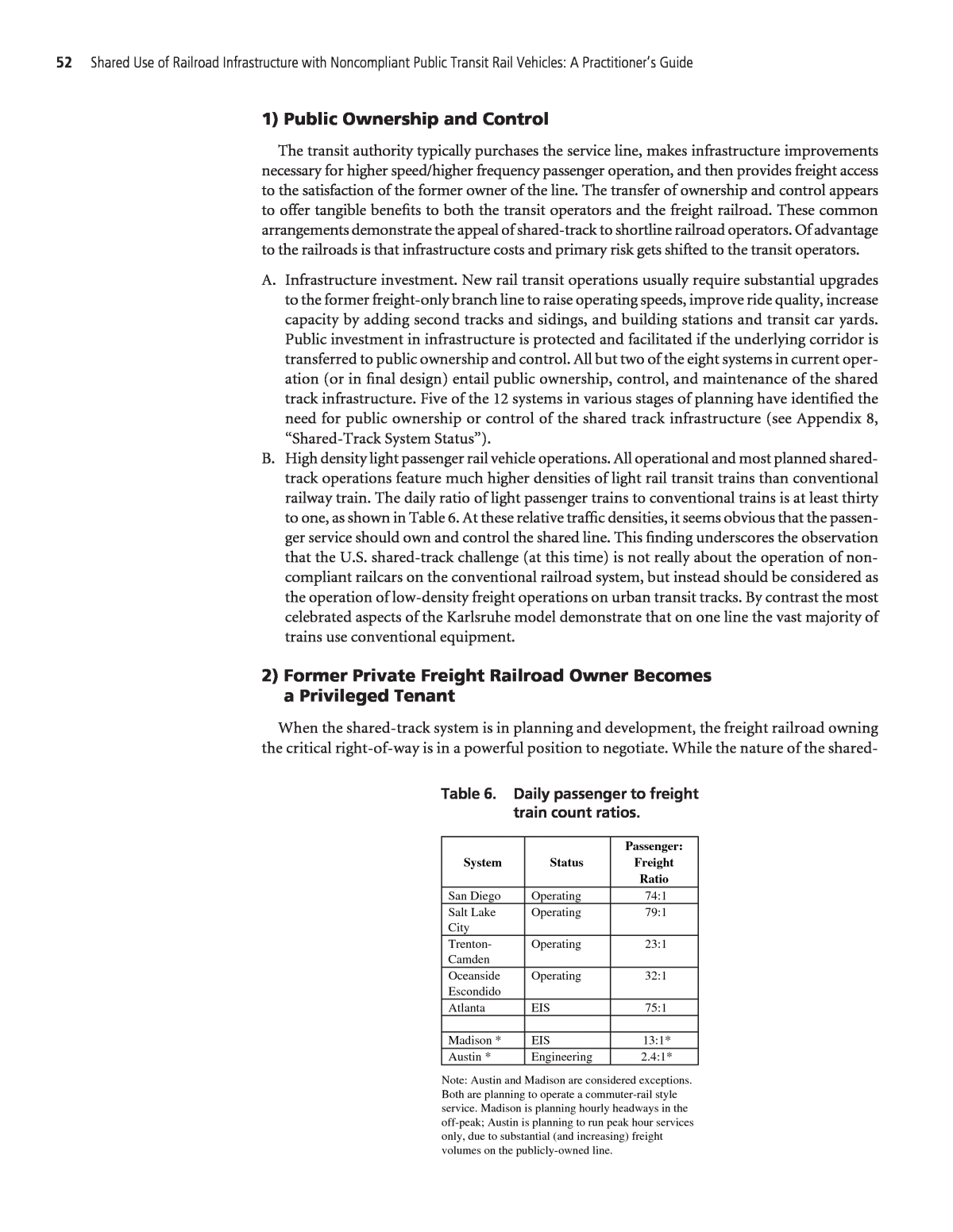
1) Public Ownership and Control The transit authority typically purchases the service line, makes infrastructure improvements necessary for higher speed/higher frequency passenger operation, and then provides freight access to the satisfaction of the former owner of the line. The transfer of ownership and control appears to offer tangible benefits to both the transit operators and the freight railroad. These common arrangements demonstrate the appeal of shared-track to shortline railroad operators. Of advantage to the railroads is that infrastructure costs and primary risk gets shifted to the transit operators. A. Infrastructure investment. New rail transit operations usually require substantial upgrades to the former freight-only branch line to raise operating speeds, improve ride quality, increase capacity by adding second tracks and sidings, and building stations and transit car yards. Public investment in infrastructure is protected and facilitated if the underlying corridor is transferred to public ownership and control. All but two of the eight systems in current oper- ation (or in final design) entail public ownership, control, and maintenance of the shared track infrastructure. Five of the 12 systems in various stages of planning have identified the need for public ownership or control of the shared track infrastructure (see Appendix 8, âShared-Track System Statusâ). B. High density light passenger rail vehicle operations. All operational and most planned shared- track operations feature much higher densities of light rail transit trains than conventional railway train. The daily ratio of light passenger trains to conventional trains is at least thirty to one, as shown in Table 6. At these relative traffic densities, it seems obvious that the passen- ger service should own and control the shared line. This finding underscores the observation that the U.S. shared-track challenge (at this time) is not really about the operation of non- compliant railcars on the conventional railroad system, but instead should be considered as the operation of low-density freight operations on urban transit tracks. By contrast the most celebrated aspects of the Karlsruhe model demonstrate that on one line the vast majority of trains use conventional equipment. 2) Former Private Freight Railroad Owner Becomes a Privileged Tenant When the shared-track system is in planning and development, the freight railroad owning the critical right-of-way is in a powerful position to negotiate. While the nature of the shared- 52 Shared Use of Railroad Infrastructure with Noncompliant Public Transit Rail Vehicles: A Practitionerâs Guide Table 6. Daily passenger to freight train count ratios. System Status Passenger: Freight Ratio San Diego Operating 74:1 Salt Lake City Operating 79:1 Trenton- Camden Operating 23:1 Oceanside Escondido Operating 32:1 Atlanta EIS 75:1 Madison * EIS 13:1* Austin * Engineering 2.4:1* Note: Austin and Madison are considered exceptions. Both are planning to operate a commuter-rail style service. Madison is planning hourly headways in the off-peak; Austin is planning to run peak hour services only, due to substantial (and increasing) freight volumes on the publicly-owned line.
track operation generally requires the freight railroad to relinquish dispatching and maintenance control, the participation of freight rail owners gives freight interests a strong voice in deter- mining when freight service will take precedence. Some freight service schedule adjustments may be necessary, but it is the transit authority that must attempt to accommodate the freight carrierâs needs, or else risk having the process stalled. This possibility arises from the FRA require- ment that conditional approval of any waiver petition requires the agreement of the prospective freight tenant. In several instances the transit system design shifted to require compliant vehicles to satisfy the service needs of the freight railroad, while avoiding conflict with federal regulations. In most cases, the compromise to use compliant equipment degraded the attractiveness of the transit service to the public agency and its customers. As a tenant of the transit system, the freight operator enjoys the use of a substantially upgraded facility while it is simultaneously relieved of the burden of maintaining and operating its former freight-only line. 3) Risks Are Managed by the Transit Agency Risk management and insurance are part of the general administration of the shared-track operator. Transit insurance packages generally cover all operations or all rail operations. For the systems reviewed, there are no instances where separate liability insurance is provided for shared-track, nor are there any where the freight railroad is required to carry liability insurance for the passenger operation. However, private owners of freight lines are generally concerned about the liability implications of introducing transit passenger operations on their freight-only line. Therefore, the transit agency usually insures freight carriers against increased liability risks due to the presence of passengers. In fact, two agencies (San Diego and NJ Transit) are self-insured. It appears that if ownership, control, and maintenance of the shared-track line pass to the pas- senger operator, the freight carrier may be better shielded from liability for accidents and injuries along the line. A. Agency liability is covered by existing agency insurance. In six out of eight currently opera- tional or soon-to-be operational systems, the risk of accident and injury claims is managed through an agencywide contract covering all aspects of the agencyâs operations. San Diego MTSâs insurance covers bus, trolley, and rail operations. San Diego NCTDâs agreement covers the proposed noncompliant service, as well as existing commuter rail and express bus service. New Jersey Transitâs (NJT) contract covers all aspects of NJTâs operations. Both San Diego and NJ Transit systems are self-insured. Maryland MTAâs policy covers both its light rail and subway operations. B. Transit agency insures against the perceived increased risks for freight operation. Despite research that shows the risks are minimal, many freight operators require extra indemnity against transit accidents. On the River LINE, NJ Transit pays Conrail explicitly for an increase in Conrailâs insurance fees due to the existence of a passenger operation on the Bordentown Secondary. On the San Diego Trolley, the agency names the freight operator as an insured party in their policy. On the San Diego NCTD, the agency is assigned most of the liability for mishaps, even when the freight operator is found to be negligent. The risk of the freight- passenger collisions is thus essentially insured through the agencyâs policy. 4) Pressure to Commingle Is Heaviest on Lines with Higher Freight Densities*âA Review of Different Solutions Where the route has strategic value as both a freight and transit corridor, and/or where the freight train service density is more than one roundtrip per day, there is likely to be greater pres- sure to commingle transit and freight trains. Shared-Track: A Handbook of Examples and Applications 53
A. NJ Transit River LINE. Although 19,440 freight carloads move over the line per year (average of 78 carloads per day based on annual non-holiday weekdays), Conrail was concerned about the need to divert trains on to the line in the event of a blockage. NJT was planning to operate passenger service later into the night, with the last trains running until 1 AM, instead of the current 10 PM. The 16/8 hour split between passenger and freight operations satisfied neither NJT nor Conrail. NJT is preparing to request a waiver allowing freight and passenger trains to share a 3,000 ft. single-track segment providing access to Pavonia Yard and would make signaling improvements to provide the safety equivalent to the procedures permitted on the Newark City Subwayâs shared-track segment. B. San Diego Trolley. Because of the length of the shared segment and increasing traffic, freight trains require more than the four hours of exclusive freight operations allotted to them. The 20-hour passenger period required by SDTI has contributed to the urgent need to obtain special waivers to allow limited nighttime joint operation. C. NJ Transit Northern Branch. Here, the freight operational patterns placed the onus on pub- lic officials to develop a strategy for commingling. As a result, compliant DMU rail vehicles are being considered (as opposed to noncompliant electric light rail trains) to permit flexible freight operations. This proposed change in the vehicle mode will result in less passenger con- venience, requiring an additional transfer at the North Bergen Station, instead of a one-seat ride on a through route via connection to the existing HBLR service. D. NJ Transit Newark City Subway.* Freight density is not significant on this line. In this case the freight line that serves one customer about once a week was ideally located for a service extension, hence the desire to share track. The shared section of track was sufficiently short to permit the entire segment to be designated as one interlocking. Specialized signaling equipment fulfills the fail-safe train separation requirement while allowing freight trains to operate between light rail trains, under the supervision of the Transit Authority. E. Austin, Texas Commuter Rail. Transit service may be suspended mid-day to allow freight services to operate. Overnight freight operations are not acceptable to the communities along the line. While viable, this approach limits operational flexibility, passenger convenience, and growth potential. 5) Public Transit Agencies Are Interested in Avoiding Shared-Track Arrangements In some cases, especially where the freight line is not currently active, transit agencies have expressed a desire to disallow freight operations as part of a line sale agreement. Transit oriented developers tend to see a freight operation or the future possibility of a freight operation as an impediment to successful property redevelopment. A. MARTA Belt Line. The lone customer (an urban sand and gravel plant) on the potential shared-track freight line is under pressure to relocate due to transit oriented development considerations. B. BART State Route 4. Although the freight line is currently in disuse, the railroad continues to seek an easement for development of future freight services along that corridor. However, the transit agency has expressed a desire to avoid the possible future restoration of freight service, since such easement may ultimately affect the vehicle technology and development options available for the corridor. 6) Transit Operators Choosing to Avoid Commingling Sacrificed Service Quality and Efficiency Designers of all systems choosing to avoid commingling initially considered the use of non- compliant equipment. Planners of three systems (Orlando, FL, northern NJ, and Oakland- 54 Shared Use of Railroad Infrastructure with Noncompliant Public Transit Rail Vehicles: A Practitionerâs Guide
Antioch, CA) wanted to operate noncompliant vehicles to allow for interoperability with existing systems. Promoters in two cities (Raleigh-Durham, NC and Portland, OR) desired a trolley-style service that they claimed would provide better service to the downtown areas. Madison ruled out using noncompliant vehicles at the Draft EIS stage, but the business case for commingling is so compelling that the question has been reopened at the Final EIS stage. Austin is planning for noncompliant vehicles in anticipation of a future expansion option that involves street-running. The decisions made by the five agencies to proceed with compliant vehicles generally degraded the transit service quality and efficiency for their systems as initially designed and/or increased the cost of development. The foremost reason for commingling (or sharing track) is interoperability in areas that could not otherwise justify, or do not have, space for separate alignments for two different vehicle types. A compliant vehicle capable of in-street operations that could negotiate the constrained geom- etry of a street-car network has yet to be designed. None of the U.S. systems surveyed replaced an existing conventional passenger rail service with a light rail vehicle to reduce costs or improve service. In the case of foreign shared-track operations, the focus has been on improving service quality by avoiding a transfer at the railroad/transit boundaries. Business Case Template The hypothetical business case presented identifies basic principles and traces a process for developing a transportation concept using light passenger rail cars in a concurrent operation with an existing freight operation. Using steps outlined here, planners can create a template to commence a project. The following example shows the application of the template and uses realistic values and quantities derived from databases or actual operations (a more detailed analy- sis is provided in the Task 10 Report, âHypothetical Case Studyâ). Preparatory steps for a demonstration project were outlined in Chapter 2 (and detailed in the report for Task 11). With some emendations they serve as an introduction to a business case tool kit, and have the merit of being familiar ground to most transportation practitioners. ⢠The project is the locally preferred alternative under federal and state planning regulations. ⢠The sponsor agency has the technical competence and know-how to implement a shared-track project. ⢠The selected corridor will generate sufficient ridership and economic benefits to deliver the cost-effectiveness goals. ⢠The project delivery team has the required discipline to manage potential issues, especially reg- ulatory and safety issues, and contain costs. ⢠The proposal has wide public support, particularly from riders, abutters, local government, and the freight operator. These five points listed acknowledge the unique environment or localness within which each agency exists. Evolution of any project will reflect the special needs and requirements of each undertaking and will undoubtedly require variations in following the recommendations con- tained in this section. A second imperative is to understand the significance the FRA plays in its regulatory capacity since it will be the final judge of whether a particular shared-track operation is safe to operate. Therefore, one of the more significant determinations to be made is the risk and safety analysis. Appendix 9: Shared-Track Configuration and Operational Alternatives, provides much of the following information in a tabular format that includes many of the qualitative considerations for each of the most likely alternatives. Shared-Track: A Handbook of Examples and Applications 55
Alternatives Analysis While the focus of the research is shared use of track (i.e., concurrent operations by light passenger rail cars and freight equipment), the nonconcurrent alternatives must be analyzed. Therefore, a component of the business case is completion of an âAlternatives Analysis that Accompanies a Major Investment Studyâ (MIS) and as a justification for the choice of shared- track. The MIS will evaluate the costs and benefits of shared-track compared to other alterna- tives, in order to reflect trade-offs between the shared-track and other investment options that could equally serve mass-transit needs. At a planning level, four distinct types of alternatives can be compared. ⢠Nonrail alternative: Likely scenarios range from the status quo to nonrail investments includ- ing carpooling facilities, bus route rationalization, transit priority lanes, or bus rapid transit investments. The FTA often requires a null alternative in the application process for federal funding. ⢠Separate System alternative requires construction of dedicated track for non-compliant rail vehicles. The service uses a new right-of-way, shares a right-of-way (but not track) with con- ventional trains, or uses the median of a highway. ⢠Compliant Vehicle alternative would establish commuter rail service on a railroad using FRA-compliant rolling stock. Modernization of signal systems and infrastructure, and new passenger facilities are required. Compliant equipment can share track without restrictions. However, high platforms could cause clearance issues for freight equipment and potential ADA (Americans with Disabilities Act) compliance issues. Downtown street running also may be precluded. ⢠Shared-track alternative entails seeking special regulatory approval to allow light rail vehicles to share track with conventional railway equipment. The infrastructure requirement can be similar to the compliant alternative, but the resulting service would be more flexible. Light rail passenger vehicles can continue off the railway alignment onto city streets. Low floor light rail passenger vehicles also avoid conflicts between freight and passenger operations, whereas high floor cars (and platforms) pose a new clearance constraint for freight operations. Costs for developing a transit service should be compared for the different operating regimes under consideration. The cost and investigation of those alternatives are outside the scope of this research, but planners should be acquainted with the analytical effort. For each operating regime the required plant, equipment, and operating plan must be described. This business case study template guides the analysis and development of capital and operating cost estimates based on physical characteristics. Subsequently, a risk analysis is necessary to show that safety requirements can be achieved for each alternative. Data collection for the cost analysis falls under a number of categories. â Physical characteristics of the existing and proposed corridor. â Planned service characteristics of the rail transit service. â Operating plan and structures. â Service comparison of different operations. â Cost analysis for signal system alternatives. â System capital cost assessment. â Ridership impacts. â Alternatives evaluation-ridership and cost estimates are used as output measures. â Risk analyses & modeling; model inputs. Each of these topics is described in some detail. Worksheet templates can be used to record the results. 56 Shared Use of Railroad Infrastructure with Noncompliant Public Transit Rail Vehicles: A Practitionerâs Guide
Physical Characteristics Data collection begins with a description of the physical characteristics of the existing and pro- posed new corridor. This includes length, grades, curves, grade crossings, bridges and tunnels, sidings, crossovers, terminals, stations, facilities and other salient features. Table 7 shows a sam- ple checklist: Freight Operations: Describe the time of day, number of pickups and deliveries, any special handling requirements, length of any sidings, crews, and number of cars. Rail Transit Service: Describe the planned service characteristics, routing and stations in broad terms, and the responsible entity for directing the project. Vehicle Design: Identify vehicle options on the basis of performance, capacity, and other desired features. The available choices at the outset are: 1. Push-Pull Commuter Rail Equipment (compliant locomotive and coaches); 2. MU Commuter Rail Equipment (compliant MU coaches either diesel or electric); and 3. Diesel or electric noncompliant light passenger rail cars. Reasons to Consider Noncompliant Equipment The underlying assumption for this research is that FRA compliant equipment is either imprac- tical or unnecessary and only noncompliant equipment will suffice. The primary reason to con- sider noncompliant equipment is the improved flexibility it offers. Because of the vehicleâs phys- ical characteristics, more routing options are possible. The constraints in curvature radius, grades, clearance envelopes, limits of acceleration, and deceleration make a lighter rail vehicle a superior choice for various environments. The following analysis explores the relative pros and cons of a temporally separated, a concurrent shared-track, and a shared-corridor light rail operation. Such an analysis should resolve whether or not a compliant vehicle is suitable for the applica- tion. Once it is determined that only noncompliant equipment will suffice, then the next step is an analysis of shared-track options. A typical example of choice 3 is a self-propelled rail car (SPRC), a passenger rail car with a self- contained, on-board source of motive power, making reliance on a locomotive or electric power distribution system unnecessary. The light SPRC is more flexible than a locomotive hauled train or an electric light rail passenger vehicle because it provides an economic means to operate pas- senger rail service over a mix of railroad environments. As one illustration (Figure 5), an SPRC Shared-Track: A Handbook of Examples and Applications 57 Table 7. Worksheet 1âSystem parameters existing condition. Route Miles FRA Track Class Class I Signal System Dark (Unsignaled) Connection to Freight Tracks Identify by milepost and type of connection, e.g., crossing, siding Major Structures Identify type, length and milepost Grade Crossings Identify milepost and type of warning system Speed Limits 10 mph for freight trains Passenger trains are not permitted Freight Operations Describe as âFreight train originatesâ¦â â Exchanges outbound for inbound cars at yard and returns to the point of originâ¦.â Freight Train Describe equipment, number of cars, speeds, locomotive fleet, cargo types Workforce List engineers, conductors and crews called per weekday Rule Book Northeast Operating Rules Advisory Committee (NORAC) Rules or whatever rule book applies
can use a radial mainline railway for line-haul transport from the suburbs, and then continue or switch to local street-running tracks to serve the downtown destinations, and other routing options are possible. Historically nearly all SPRCs have used on-board diesel engines for power, and have been capable of operation as a train with a single train or with multiple cars. SPRCs are commonly called DMUs. Additional economic advantages of concurrent track sharing can be realized if: ⢠There is an identified need to integrate transit service in a shared-track corridor with an exist- ing light rail system; ⢠Street running is necessary to access downtown districts and serve dispersed demands within a larger city; emergency stopping distances are more compatible with street running; ⢠There are community concerns about the noise, vibration, and visual impact of large commuter rail vehicles; and ⢠The selected rail car whether LRV and SPRC is able to perform express, line-speed line-haul functions on railroad tracks, and local multi-stop distribution functions on embedded street tracks with mixed vehicular traffic. Service Characteristics to Justify the Choice of a Light Rail System Concurrent shared-track with light rail and conventional railroad vehicles is typically con- sidered a fall-back option after it has been determined that the service requirements cannot be satisfied with FRA compliant passenger vehicles or a separate light rail system. It may then become necessary to conduct a feasibility study. If such a study concludes that a light rail sys- tem is the only viable alternative to satisfy local transit needs, then a shared-track project may be justifiable. The research for such a study should address four elements. 1. The travel forecasts. The rail transit should reach downtown to serve its primary market. 2. The pattern of development in downtown necessitates a street running transit service with stops at dispersed demand generators. In downtown, transit service also should support redevelop- ment objectives by improving mobility within the core. 3. The possibility of constructing a commuter railroad is an option that should be explored although such an alternative may be fraught with difficulties, high costs, and considered infeasible. a. All current FRA-compliant equipment is 85â long and has a minimum turning radius of 12 degrees (approximately 145 m or 480 feet radius). Constructing a suitable alignment at grade would necessitate substantial encroachment to traffic or land uses adjacent or prox- imate to the right-of-way, and may represent an unacceptable level of interference and dis- turbance to the local environment. 58 Shared Use of Railroad Infrastructure with Noncompliant Public Transit Rail Vehicles: A Practitionerâs Guide Figure 5. NJ Transit DMU Street running in Camden, NJ.
b. The lower acceleration and braking rates of compliant DMUs are not conducive to the frequent stops required for an effective downtown service design. This equipment also is unsuited to an operation that may require traffic light stops. c. The residents of downtown are concerned about the noise and vibration generated by a compliant commuter rail car operating in the street. A lighter rail car with a smaller diesel engine would generate substantially less noise (comparable to common motor vehicle or bus). d. The option to construct a new grade-separated railroad to reach the downtown was not considered due to its high expense and inability to serve multiple stops within the city. 4. Two other alternatives are to consider terminating a commuter rail service at a main station and serving the dispersed demands of downtown via a transfer; or to provide two-seat-rides. Two typical scenarios for the latter are: a. Hourly commuter rail service with bus connection. This is an economical option with much potential, requiring one push-pull trainset and a fleet of buses; b. Quarter-hourly commuter rail service with light rail connection. An option entailing high capital and operating costs compared to a shared-track option. Separate vehicle fleets and facilities are required for the street running and railroad portions of the routes respectively. The transfer penalty of five minutes represents an increase of 20% to 45% in journey time. A ridership decrease may result. A sample analysis worksheet is shown in Table 8. Overview of Shared-Track OptionsâOperating Plan Prepare a summary review of typical and most likely alternative operating regimes that would share track or ROW with a freight operator. The four listed cover the broadest range of choices. Other permutations are possible, perhaps modifying or combining aspects of the four shown below. For each operating regime, a different service plan, infrastructure, physical plant, and train control system is required. This approach can be tailored to site-specific circumstances. Table 9 summarizes the important systemic differences between the operating plans and the associated infrastructure, physical plant and systems for the four options. Structures Considerations If there are major structures on the route, then these structures must be inspected and rated for passenger service. In some scenarios, the structures must be expanded, replaced, or new structures erected. Structures affected could be none, some, or all of the following: ⢠Overbridges and overpasses; ⢠Elevated sections or viaducts; ⢠Grade separations; ⢠Shared ROW and retaining walls with highways; and ⢠Bridges over rivers or bodies of water. Typical structural changes should be identified and recorded on a worksheet similar to Table 10. Shared-Track: A Handbook of Examples and Applications 59 Table 8. Worksheet 2âRidership impacts of forced transfer. Inbound Boardings Outbound Disembarkations Suburban Originating Station Time to Downtown (Minutes) Increase in Travel Time Direct Service Forced Transfer Direct Service Forced Transfer Total Ridership Losses Total
Service Comparison Depending on the operating regime chosen, different service capabilities are possible. Option 1 is a Strict Temporal Separation Operation; Option 2 is Spatial Separation; Option 3 is Concurrent Single Track; and Option 4 is Concurrent Double Track. The parameters affected are: passenger service headways, hours of service, and freight blackout windows. The initial service design and maximum theoretical values under different operating regimes are summarized in Table 11. The values shown can be considered typical default scenarios, and should be modified to suit a par- ticular situation. Each option should be analyzed on the basis of its proposed ⢠Infrastructure; ⢠Passenger operations; ⢠Passenger distribution; and ⢠Freight operations. Appendix 9 summarizes features, characteristics, and capabilities of each of the four alternatives. Information contained in that table is representative of the factors that should be considered in the analysis. Cost and Ridership Analyses An important part of any project study is collection, comparison and analysis of data describing capital and operating costs for traditional transit development and for shared-track alternatives. 60 Shared Use of Railroad Infrastructure with Noncompliant Public Transit Rail Vehicles: A Practitionerâs Guide Table 9. Worksheet 3âSample operating plan infrastructure requirements. Option 1 2 3 4 Operating Regime Strict Temporal Separation Shared-Corridor Spatial Separation Concurrent Single Track Operation Concurrent Double Track Operation Station Platforms Grade Crossings Turnouts Passenger Freight Diamonds Signal System CTC ATS Cab signal Cab signal Onboard Cab Signal Device: Passenger Trains None ATS Cab signal Cab signal Freight Trains None None Cab signal Cab signal Special Signal System Features âMode Changeâ Control Software Intrusion Detection Intrusion Detection Derails Table 10. Worksheet 4âDisposition of major structures. Option 1 2 3 4 Operating Regime Strict Temporal Separation Shared Corridor Spatial Separation Concurrent Single Track Concurrent Double Track Overbridge Overpass Viaduct Grade Separation Shared ROW, Wall Bridge over water
The study should explore cost savings and other benefits to the community afforded by concur- rent shared-track choices as transit development options are evaluated. A bottom-up approach to costing is suggested. The transit system infrastructure and invest- ment options should be broken down into components. The unit cost of each component can be calculated based on construction contracts, engineersâ rules-of-thumb, and aggregate costs of labor and materials. To compute the unit cost of service delivery, take direct labor plus overhead using industry-average labor and overhead costs, and apportionment from known operating costs of comparable systems. Total cost is derived by summing component costs, then adding a percentage for indirect costs and contingencies. Electric light rail projects proposed for FTA New Starts are typically more expensive than the sample system considered here. Additional costs such as real estate acquisition, planning and permitting, and electric traction infrastructure are not considered in this desktop analysis. Nonetheless, the analysis underscores the magnitude of savings available to local transportation officials who consider a shared track alternative. Cost Analysis for Signal System Alternatives Rough cost comparisons can be made between generic families of signal systems when applied to the same operation. There are a variety of available sources to arrive at an approximate per-mile cost estimate for systems similar to a proposed shared-track operation. Each basic train control regime should be considered: ⢠Centralized traffic control (CTC) with wayside signals: A basic, traditional CTC railroad signal system with remote controlled power interlockings, cables, track circuits, control center console, insulated joints, impedance bonds, wayside automatic signals with 2.5 miles on average between interlockings, typical of configurations under temporal separation. Shared-Track: A Handbook of Examples and Applications 61 Table 11. Worksheet 5âTypical operating regime and corresponding service scenarios. Option 1 2 3 4 Operating Regime Strict Temporal Separation Spatial Separation Concurrent Single Track Concurrent Double Track Passenger Service Headways Initial: Peak Off-peak 15 30 15 30 15 30 15 30 Best Possible: Peak Off-peak 15 15 15 15 15 30 5 15 Maximum: Peak Off-peak Headways shorter than every âXâ min requires new sidings Headways shorter than every âYâ min requires double- tracking Off-peak headways of less than âZâ min require dedicated freight sidings Passenger Hours of Service Initial: First Train Out Last Train In 6:00 am 7:30 pm 5:00 am 1:30 am 5:00 am 1:30 am 5:00 am 1:30 am Maximum: First Train Out Last Train In 5:00 am 7:45 pm 24 hour service 24 hour service 24 hour service Freight Operating Windows Initial 7:30 pm â 5:59 am 24 hour 9:00 am â 3:59 pm 7:00 pm â 5:59 am 9:00 am â 3:59 pm 7:00 pm â 5:59 am X, Y and Z will vary to suit the circumstances.
⢠Automated train stop (intermittent, inductive implementation): Consists of a basic CTC signal system plus a two-aspect ATS system implemented as described in Option 2, based on block signaling principles. Freight train movement authorities are enforced by signal interlocked derails. ⢠Multi-aspect inductive intermittent speed supervision: A CTC signal system overlaid with a three-or-four-aspect Automatic Speed Control (ASC) system. Continuous supervision of train speeds is not provided, but trains are positively protected against signal overruns. It is sufficient for Options 3 and 4 if a suitable vehicle-borne apparatus can be installed on freight locomotives. ⢠Automated speed control with enforced digital cab signals (continuous, coded or audio frequency track circuit implementation): This technology is standard for modern light rail implementation. The system provides for continuous speed supervision based on cab signal aspects and may provide train-to-wayside data communication capabilities. Wayside signals are not installed except at interlockings. It is sufficient for Options 3 and 4. ⢠Communication-based train control with speed enforcement: This is an emerging technol- ogy for which no production examples have been fully implemented. Wayside signals are not installed except as backup. Systems adapted for Options 3 and 4 would have the same enforce- ment and display capabilities as a coded track-circuit system and would provide continuous supervision of speeds. A summary of average cost per track-mile for these systems is presented in Table 12. As shown in the table, commercial-off-the-shelf train control systems are perfectly suitable and more appropriate for shared-track rather than advanced state-of-the-art technology. A cursory examination of signal costs reveals that the two ASC options appear to cost between 25% and 100% more than the unprotected CTC options. Considering signal costs alone, both multi-aspect intermittent speed control and digital coded track-circuits with ASC capability seem to provide the necessary functionality at similar costs. The intermittent systems provide a cheaper per-signal cost but have a higher per-cab cost, whereas the coded track circuits require more expensive wayside infrastructure but the cab-borne equipment can be simpler and cheaper. Appendix 4 provides additional âRelative Cost of Train Control Systemsâ information. Intermittent systems (Row 3 in Table 12) are used on some rapid-transit cab signal territories: on New York City Transit, the NJ Transit River LINE, and some legacy commuter rail and rail- road lines in the Midwest. Both systems are proven and expertise to design and maintain both types of systems can readily be found in the United States The choice between these two families 62 Shared Use of Railroad Infrastructure with Noncompliant Public Transit Rail Vehicles: A Practitionerâs Guide Table 12. Range of unit costs for families of signal technology. Signaling Technology Average Total System Cost per Track Mile ($ Million) Cost per Signal or Block Cost per Passenger Cab 1 Centralized Traffic Control $1.6 $7,500 for wayside color light signals None 2 Two-Aspect Automated Train Stop $1.8 $7,500 for waysides + $6,000 per trip stop $60,000 3 Multi-Aspect Inductive Intermittent Speed Supervision $2.1 to $3.2 $7,500 for waysides + $10,500 to $15,000 per signal for transponders $80,000 to $120,000 4 Automated Speed Control enforced with Digital Cab Signals $1.9 to $3.0 No waysides $10,000 to $30,000 per âsignalâ $50,000 5 Communication-Based Train Control $2.1 to $5.0 No waysides Not signal based More than $100,000
of ASC systems must be done on a case-by-case basis, factoring in such variables as number of interlockings, vehicles to be equipped, track miles, and what other systems are in use regionally for interoperability reasons. Research emphasizes that it is preferable and less costly to use commercial-off-the-shelf sys- tems and components rather than advanced state-of-the-art technology. Highly advanced train control systems are not justified by the service application or benefits. System Capital Cost Assessment Railroad capital construction costs are generally estimated in categories. An example of a cost- ing methodology that can be used breaks the costs into six main categories. ⢠Roadbed, track, and special trackwork; ⢠Structures; ⢠Stations; ⢠Signals and communications; ⢠Engineering design, project management, and contingency (soft costs); and ⢠Vehicle and support facilities. Costs not explicitly accounted for in this costing methodology include: real estate acquisi- tion costs, allowance for planning studies and permitting, and various ancillary costs such as concessions to pacify certain route abutters. More detail for each category is provided in the Task 10 Report. Table 13 illustrates a summary cost format for each option. Soft costs are identified by shading. Detailed estimates for each work item appear in the Appendix to this report. While the actual amounts generated in the research example may not be directly transferable to all situations, some proportions may be reasonably extrapolated to similar circumstances, particularly if the methodology is duplicated. 1. The costs of planning, permitting, real estate, and right-of-way purchase can have a signifi- cant effect on the program. 2. The cost of adding the signal system for concurrent single-track operation (Option 3) is about 8% more than for a signal system for temporal separation (Option 1). The infrastructure for shared track is significantly less than for a stand-alone light rail transit system. The sig- nal system for a two-track concurrent operation (Option 4) is the most expensive of all Shared-Track: A Handbook of Examples and Applications 63 Table 13. Worksheet 6âCapital costs for initiating transit service. Option 1 2 3 4 Operating Regime Strict Temporal Separation Spatial Separation Concurrent Single Track Concurrent Double Track Roadbed, Track, and Special Trackwork Structures (Railway and Highway) Stations Signals and Communications Engineering Design and Project Management Contingency Vehicles and Support Facilities Total
options. Cost savings in shared track accrue mainly from subgrade, track, structures, and design work. Modest savings are available from stations. Signal system costs can increase or decrease, depending on implementation. Strict temporal separation remains the least costly option. No savings accrue in vehicle and facility procurements. Double-track shared use (for flexibility or safety reasons) negates most of the savings due to the sophisticated sig- nal system needed on both tracks. System Operating Cost Assessment Railroad service operating costs are generally estimated in three main categoriesâtransporta- tion, MOE, and trackage fees/MOW. A typical charge is 45 cents per car mile for track access, con- sistent with industry standard practice. The American Short Line and Regional Railroad Associ- ation (ASLRRA) and AAR can be a source of economic information about freight operations. Unit costs for transit can be derived from a review of the FTAâs 2003 (or latest edition) National Transit Database, including hourly wages and labor costs for equipment maintenance. The base case scenario includes a one-person operation for light rail passenger vehicles, and an operator and a conductor for the freight train (both common industry practices). A. Estimating transportation cost B. Estimating mechanical cost (MOE) C. Estimating MOW Cost. For the labor costs included in this category, assume supervisors, track, bridge and station maintainers, and signal maintainers appropriate for the system plan. The headcount will vary by such items as number of tracks, physical plant, length, and facilities. Planners are encouraged to check with existing shared-track systems or LRT systems to ascer- tain a reasonable âheadcountâ for staff. Estimating transit agency administrative cost. These costs may be estimated at 15% of the Transportation, MOE and MOW costs for an agency. Similar costs for the freight operator are a higher percentage of 17%, based on ASLRRA guidelines. Total estimated annual transit agency operating cost. Summarize the forecast annual agency operating expense for each of the options. The operating expenses estimated here notably omit negotiated costs for contracted services, including: emergency repair and recovery, insurance for the transit operation, cost to defray additional insurance premium for the freight operation, and capital rebuild or rehabilitation for major transit system components. Costs range from a low of $3.6 million to a high of $4.8 million annually. Revenues depend on fare policy, which should be defined. The transit operator usually receives an annual trackage fee from the freight railroad, depending upon the terms of an agreement. The agency also may receive revenue through noncore activities such as station concession leases, adver- tising rights, parking, and transit oriented development. Table 14 illustrates the cost categories. A table or spreadsheet structured like the worksheet should be prepared to reflect the planned project. It can identify the cost elements relative to each option and hours of service. Regardless of operating regime, 24-hour dispatching must be provided, and the short-term MOW and MOE expense is likely to remain approximately the same. Planners should estimate the volume and nature of freight traffic. Heavy freight is known to increase the long-term costs of track maintenance. At traffic densities of less than 1.0 million gross tons (MGT) per year, the differences in long-term maintenance costs are negligible. Soft- ware based techniques are available to estimate more accurately the effects of freight traffic on MOW expenses. Note also that the FRA track Class (typically Class 4 for LRT systems) affects the MOW cost. A higher track Class equates to more expensive maintenance. Since shared-track by definition serves freight traffic, FRA track maintenance classifications and practices are required. 64 Shared Use of Railroad Infrastructure with Noncompliant Public Transit Rail Vehicles: A Practitionerâs Guide
Estimated freight shortline revenues and operating expense. Table 15 allows for the compar- ison of a forecast of annual freight operating revenues and expense for four typical options and the status quo (i.e., null alternativeâno changes, no system). Operating expenses also should include a contingency for any contracted services (e.g., emergency repair and recovery, capital rebuild, and rehabilitation). The Operating Ratio on the last line of the worksheet was derived from the Task 10 Report. It may vary for a specific project, but the relationship between Options 1, 2, and 3 and 3 and 4 is realistic. Under the Status Quo, the freight entity may bear relatively high MOW and transportation expenses. MOW is entirely funded by freight and must support a track main- tenance crew and any materials from freight revenues alone. Additionally, the freight operator also must support a part-time dispatcher, and the traincrew. Revenues are based on fees for each car delivered. Shared-Track: A Handbook of Examples and Applications 65 Table 14. Worksheet 7âSample annual operating cost estimate. Option 1 2 3 4 Operating Regime Strict Temporal Separation Spatial Separation Concurrent Single Track Concurrent Double Track Operating Cost ($ thousands) Rail Transportation Train Operators Dispatching Supervision Fuel Mechanical (MOE) Direct Labor Materials Maintenance of Way (MOW) Direct Labor Materials Administration Annual Operating Cost Total Table 15. Worksheet 8âSample annual freight operating account projection. Option 0 1 2 3 4 Operating Regime Status Quo Temporal Separation Spatial Separation Concurrent Single Track Concurrent Double Track Operating Cost ($ thousands) Rail Transportation Train Operators Dispatching Supervision Fuel Car Hire Mechanical (MOE) Locomotives Freight Cars Maintenance of Way (MOW) Trackage Fees Overhead Annual Operating Cost Total Annual Revenue Estimation Operating Ratio 93% 94% 91% 70% 70%
Under Option 1, expenses are reduced due to higher speed train operations and transfer of dispatching and maintenance responsibilities to the passenger operation. However, the costs for supervision, locomotives, and some of the administration functions remain unchanged. The rel- ative cost impact/benefit of each option on the freight carrier must be assessed. Results may show little or no change to the prior financial situation (Status Quo). Under Option 2, costs and activities are similar to the Status Quo. Marginally lower MOW expenses result from transit-funded track rebuild. The freight operator remains responsible for dispatching and supervising its own railroad. Under Options 3 and 4, the freight entity could decrease costs without affecting traffic levels. MOW and dispatching functions are trans- ferred to the transit operator, and a lower trackage fee takes its place. For the freight operator, the mechanical, fuel, car hire, and supervision expenses remain the same, while the traincrew expenses are reduced, due to higher track speeds. Cost savings and retention of previous traffic result in a markedly healthier freight carrier, lowering the operating ratio to approximately 70%. Ridership Impacts Many established methods exist for measuring transit ridership. One method estimates rider- ship by station and by time-of-day using established survey methods. For temporal separation, ridership should be adjusted to reflect reduced span of service. The results of a desktop exercise was performed in the research for Task 10 Hypothetical Case Study, Table 16 shows how the data might be presented and compared. The principles may be logically extrapolated to similar circumstances. Temporal separation jettisons a percentage of total ridership by eliminating pre-peak, evening, and late night service. The research sample results showed that much of the loss occurs in the morning peak period and in the evening (the âOption 1 Lossesâ are shown in Table 16 as a rep- resentation of a likely outcome and were derived from the research calculation). Option 1 could not serve second shift workers returning home late at night and third shift workers going to work during the evening. This results in losses of corresponding return trips. About 20% of evening and late night trips are leisure trips. These riders may be diverted to other parts of the service day. Alternatives Evaluation Ridership and cost forecasts are integrated to provide three key performance measures to rank and evaluate the service options shown in Table 17. They may vary for different circumstances. Capital cost per weekday inbound passenger. Unless the proposed system is an extension of an existing shared-track system, virtually all of the forecast riders using the proposed service would be new. The forecast capital cost to divert these travelers from the highway would range between $13,000 and $17,000 per rider. This is comparable to the projected performance of similar shared- track projects currently in the FTA New Starts Program. The Oceanside-Escondido, CA project has a capital cost per daily boarding of $18,501. The corridor acquisition cost is addressed elsewhere. Operating cost per passenger trip. Planners should forecast the operating cost per passenger trip ranges. Typical values between $1.00 and $1.20 per boarding have been estimated in this 66 Shared Use of Railroad Infrastructure with Noncompliant Public Transit Rail Vehicles: A Practitionerâs Guide Table 16. Ridership impacts of temporal separation. Option 1 Options 2, 3, 4 Time Period In Out Total In Out Total Option 1 Losses Pre-Peak 5am-6am NA NA 100% Morning Peak 6am-9am 8% Midday 9am-4pm 5% Afternoon Peak 4pm-7pm 3% Evening 7pm-10pm NA NA 100% Late Night 10pm-1am NA NA 100% Total 17%
research. The difference is small between the alternatives. Shared-track operations of this nature achieve economy though savings in capital costs. Farebox recovery ratio. The percentage of operating costs covered by passenger fare revenue will come to between 65% and 71% for the four service options considered in this research. This ratio is fare dependent. This range is close to the reported farebox recovery ratios for the San Diego Trolley at 87% in 1985 and 67% in 1997. It is substantially higher than most smaller com- muter rail systems. Business Case Findings Findings of the business case template are shown here. The reader may wish to review the Task 10 Report âHypothetical Case Studyâ for a comprehensive analysis of all factors cited. 1. The compliant vehicle alternative may not satisfy local transit needs. 2. The temporally separated option may generate less ridership, while saving a percentage in capital cost and annual operating costs. 3. The spatially separated option may increase capital costs by a significant percentage, but generate the same level of ridership as the concurrent track sharing option. 4. The shared double track option increases capital costs by a significant percentage and operat- ing cost by a marginal percentage, but it also generates the same level of ridership. The benefit of double track includes reduced risk and improved flexibility. The decision is site specific, but the analysis demonstrates that double tracking at the outset seems to defeat the purpose of a low cost shared-track service. While affirmative indications of the business case are necessary, these are not solely sufficient justification to forge ahead. Most institutional concerns cited in the business case are addressed via legal agreements, financial arrangements, memoranda of understanding or other official and formal commitments. Risk analysis remains an outstanding and a major hurdle in the process. Risk analysis is a component of the safety case. And the safety case is essential to support the business case. Risk Analyses Template Introduction A simplified risk analysis is provided to estimate the relative risk of casualties to train occu- pants in train accidents for each of the four alternative options defined. The purpose of the analy- sis was to determine whether concurrent shared-track and shared corridor operations, as defined Shared-Track: A Handbook of Examples and Applications 67 Table 17. Worksheet 9âTypical key evaluation measures. Option 1 Option 2 Option 3 Option 4 Operating Regime Temporal Separation Spatial Separation Concurrent Single Track Concurrent Double Track Capital Cost ($ Millions) Annual Operating Cost ($ thousands) Daily Ridership Capital Cost per Weekday Boarding Operating Cost per Passenger Trip Farebox Recovery 65% 71% 71% 68% Mobility : Cost Index 69 59 77 59
for Options 2, 3, and 4, will deliver a safety performance equivalent to or better than for Option 1, with full temporal separation. Option 1 is comparable to several existing shared-track operations in the United States, notably those on the San Diego Trolley and the River LINE in southern New Jersey, and is used in this analysis as a base case that defines the standard of acceptability for safety performance. The risk analysis methodology shown is an adaptation of that used and fully described in a recently completed (but not yet published) report to the FRA, âITS Technologies for Integrated Rail Corridors.â The analysis is intended to convince a transit authority considering a concur- rent shared-track operation with light rail passenger cars and low density conventional freight that a safety performance acceptable to FRA can be achieved, and that such projects are worth further development. A much more exacting analysis would be required for submittal to regula- tory authorities in support of a waiver application and would have to include a more detailed ana- lytical back-up for model input parameters and a precise breakdown of accident scenarios. Risk analysis has been applied to the four shared track options as described in detail in the Task 10 report. All four options combine a basic passenger service with 15 minute intervals dur- ing peak hours and 30 minute intervals in off-peak hours with two freight round trips a day and en route switching at two locations along the shared track. The key differences among the options that affect safety performance are given in Table 18: The following sections describe elements of the risk modeling methodology, the inputs to the model and the results obtained. Risk Analysis and Modeling Methodology The risk analysis methodology used in this analysis is a comparative quantitative risk analysis: the conclusions from the analysis are based on a comparison between the analysis cases rather than the absolute results. Many inputs are common to all the analysis cases, and even where the inputs vary between analysis cases, common sources and approaches have been used to estimate input values. This means there can be higher confidence in the relative comparisons than in the absolute quantitative results. The basic steps and building blocks of all risk analyses are explained here and shown in Figure 6. Identify hazards. The first item in any risk analysis is to identify the hazards that will be the subject of analysis. In this case, the analysis is concerned with train accidents that can cause harm to passenger train occupants. While train operations on the shared corridor can result in harm 68 Shared Use of Railroad Infrastructure with Noncompliant Public Transit Rail Vehicles: A Practitionerâs Guide Table 18. Key safety features of the four options. Option Description Freight Operation Signal System Other Safety-Related Features 1 Full Temporal Separation Night Operations Only Conventional CTC Split Point Derails at Freight-Only Connections 2 Concurrent Separate Parallel Single Track Unrestricted Daytime on Separate Tracks Automatic Train Stop at Stop Signals Two Freight Diamonds Crossing Passenger Tracks with Split Point Derails and Full ATS Protection 3 Concurrent Shared Single Track In Passenger Off-Peak Hours Cab Signals with Speed Enforcement Split Point Derails at Freight-Only Connections 4 Concurrent Shared Double Track In Passenger Off-Peak Hours Cab Signals with Speed Enforcement Split Point Derails at Freight-Only Connections
to other parties, for example highway users at grade crossings or trespassers, the risks to these parties is minimally affected by the different forms of track sharing and have not been included in the analysis. There are two categories of specific hazards or accident scenarios described in this analysis: I. Shared Track Operationsâvariable by option, time of day and analytical focus: 1. Train-to-train collisions, whether between two passenger trains or between a passenger and freight train. 2. Intrusion collisions, where freight equipment intrudes on the active passenger track, either because of a freight derailment on an adjacent track, a shifted load or a roll-out event at a connecting switch. 3. Collisions at diamond crossings where freight movements cross active passenger tracks. Movements across a diamond are a feature of Option 2. II. All Railroad Operationsâcommon to all rail operations: 1. Passenger train derailments, regardless of cause; 2. Collisions with obstructions on the track other than with on-rail equipment or at a rail/ highway grade crossing; 3. Collisions with highway vehicles at rail/highway grade crossing. This permits isolating risks induced by Category I events from overall risks to train occupants (passenger and crew) from train accidents. Characterize hazards or scenarios. The primary inputs to a risk calculation are scenario char- acteristics, specifically the likelihood of the accident, usually quantified as accidents per million train-miles (or per million crossing passes in the case of grade crossings), and accident conse- quences, usually quantified as the number of casualties and financial losses associated with one accident. Measures used to quantify consequences must be aligned with measures used to quan- tify and evaluate risk. Accident likelihood and consequences are typically estimated from his- toric accident data, engineering analysis (for example collision crush and dynamics analysis) and simulations of rail operations. Specific methods used for this analysis are discussed in the model inputs section. Estimate risks. Risk is the product of multiplying frequency, consequences and a level of activ- ity on the system being analyzed, for example train-miles operated over 10 years. It is important Shared-Track: A Handbook of Examples and Applications 69 Figure 6. Basic risk analysis process. Acceptable Is It Adequately Safe? Estimate Risks Identify Hazards Estimate Likelihood Estimate Consequences Modify System Yes No
to select units of measurement for risk that properly represent the kinds of harm that underlie the motive for the risk analysis. In this case the primary concern is the chance of injuries and fatali- ties among train occupants as a result of train accidents. Thus accident consequences have been estimated in terms of injuries and fatalities per accident; and risk totals are the estimated total injuries and fatalities in FRA-reportable accidents over 10 years of operations of the shared cor- ridor. The longer period of 10 years was chosen because of the limited number of train miles operated each year. With total accident frequency for passenger train operations being about one accident per million train miles and annual train miles on this service being about 200,000, then accident and casualty numbers for each accident scenario will be small and hard to understand, but more meaningful to the reader over 10 years. Risk calculations themselves are carried out in a spreadsheet. The basic calculation is to multi- ply frequency, consequences per accident, and train-miles to obtain an estimate of injuries and fatalities for each accident scenario. Because accident frequency and consequences are affected by traffic density, whether or not freight trains are active on or near the shared-track and no matter the number of train occupants, this calculation is repeated for each of the following categories of passenger train trips: ⢠Peak period trips in the peak direction (i.e., heavily loaded trains); ⢠Peak period trips in the reverse direction; ⢠Trips in the midday period between peak periods; ⢠Early morning and evening trips (which have lower ridership than midday trips); ⢠Freight-exposed midday trips; and ⢠Freight-exposed early morning and evening trips. Freight-exposed means that the trip precedes, follows or passes an active freight train, either en route or actively switching a customer on the shared route. The model can provide for the higher frequency and consequences from collisions involving freight trains. The end product of this calculation is an estimate of risk measured by estimated injuries and fatalities over 10 yearâs operation of the defined service. Because total ridership in Option 1 is a few percent lower than in the other Options, a direct comparison between estimated fatalities could be slightly misleading, and the more meaningful comparison is between casualties per billion passenger miles. Both measures are calculated in the model. Assess safety adequacy. The final step in the risk analysis is to assess safety adequacy. As indicated earlier, the safety comparison is with Option 1, which represents a currently acceptable operation similar to those on the River LINE and the San Diego Trolley. If risk as measured by injuries and fatalities or injury and fatality rates for the other Options is equal to or less than for Option 1, then the equivalent safety requirement has been satisfied. Practically, however, it is unlikely that FRA and other regulatory authorities would be comfortable with a system that only marginally meets the criterion. Given the uncertainty of input parameters, there will be a significant prob- ability that a marginal system would not meet the criteria. Therefore we look for substantially reduced risk for Options 2, 3, and 4 as compared with Option 1, to be sure that the system will be acceptable. Model inputs. The most important activity and often the most time-consuming is defining all the inputs to the model. Inputs for accident frequencies, consequences, and any risk reduction factors applied to frequencies or consequences for safety improvements must be valid or the analysis results will not be meaningful. The following paragraphs summarize the inputs used in this analysis. Many of the inputs were obtained from the previously referenced FRA study, in which a very similar analysis was performed. All values and quantities cited herein are based on the Task 10 Report. The methodology is transferable when modified to fit project circum- stances. Those factors and considerations can be extrapolated to other projects. 70 Shared Use of Railroad Infrastructure with Noncompliant Public Transit Rail Vehicles: A Practitionerâs Guide
Route, traffic and ridership data. Basic route information was taken from the descriptions ear- lier in this chapter. The specific inputs to the model are given in Table 19. Note that the analysis is performed for nonholiday weekdays only. It is assumed that freight trains only will operate on these days, and risks to train occupants at weekends are not affected. However when a more advanced signal system is installed to reduce and offset the risks from freight operations, this also will reduce risks of collisions between passenger trains during any weekend and holiday operations. The numbers of passenger train trips/day are summarized in Table 20. Option 1 lacks early morning and evening trips, which are added in Options 2, 3, and 4. In Options 2, 3, and 4 some midday and evening trips are freight-exposed, in that they pre- cede, follow or pass an active freight train, including switching an en route industry track. Freight activity and the corresponding number of freight-exposed trips in Options 2, 3 and 4 are sum- marized in Table 21. In full temporal separation (Option 1), no passenger trips are exposed to risk from freight operations. The higher number of freight-exposed trips in Option 2 is due to the lower freight operating speed and the extra time needed to make the moves over diamonds. In this option the freight exposure is to intrusion accidents and the diamond crossing movements. Average train occupancy, needed in the calculation of injuries and fatalities, is displayed in Table 22 for each operating period. Accident frequency and consequences for train-train collisions were estimated from FRA acci- dent data for commuter rail collisions. Intrusion collision incidents are based on FRA data for existing mixed passenger and freight operations. Data for all other accident scenarios, including grade crossing collisions, derailment and obstruction also were derived from FRA studies. Results and Risk Analysis Findings Table 23 shows estimated numbers of accidents for each accident scenario. Tables 24 and 25 provide the injury rate and fatality rate per million passenger miles respectively. Details of the accident scenarios are in the Task 10 Report. Results show a slight increase in the number of collision accidents in Option 2 compared with Option 1 (due mainly to more trips), and a substantial reduction in collision accidents for Options 3 and 4, in spite of the increased train miles and the increase in intrusion collision risks that arise from concurrent passenger and freight operations. The change is primarily due to the Shared-Track: A Handbook of Examples and Applications 71 Table 19. Summary of basic route and service parameters. Parameter Units Value Days of Operation Days 250 Shared Route Length Miles 8.3 Number of Grade Crossings Number 8 Grade Crossings per Mile Number 0.96 Peak Service Interval Minutes 15 Off-Peak Service Interval Minutes 30 Table 20. Passenger trips by time of day. Traffic Parameter Option 1 Option 2, 3 and 4 Peak Service, Peak Direction 23 23 Peak Service Reverse Direction 23 23 Midday 28 28 Early Morning and Evening 0 24
Table 21. Exposure of passenger trips to freight activity. Parameter Option 2 Option 3 Option 4 Operating Regime Parallel operations Shared single track Shared double track Midday Freight Activity One round trip, no industry switching One round trip, switches one industry track Same as Option 3 Evening Freight Activity One round trip, switched both industry tracks One round trip, switches one industry track Same as Option 3 Midday Freight- Exposed Trips 12 8 8 Evening Freight- Exposed Trips 10 8 8 Table 22. Occupancy of passenger train by operating period. Total Occupants (Standees in Brackets) Operating Period Option 1 Option 2, 3, and 4 Peak Period Peak Direction 153 (18) 151 (11) Peak Period Reverse Direction 19 19 Midday 75 (2) 79 (3) Early Morning and Evening 0 29 Table 23. Estimated FRA-reportable train accidents over 10 years for each option. Option 1 Option 2 Option 3 Option 4 Accident Scenario Full Temporal Separation (Base Case) Concurrent Separate Single Tracks Concurrent Shared Single Track Concurrent Shared Double Track Train-Train Collisions 0.181 0.171 0.079 0.039 Intrusion Collisions 0.009 0.021 0.021 0.024 Diamond Collisions 0 0.023 0 0.014 All Train Collisions 0.190 0.215 0.099 0.077 Derailments 0.092 0.122 0.122 0.122 Obstructions 0.198 0.262 0.262 0.262 Grade Crossings 1.032 1.366 1.366 1.366 Total Accidents 1.51 1.94 1.85 1.81 Train-Miles (millions) 1.54 2.03 2.03 2.03 Accident Rate per million train miles 0.98 0.96 0.91 0.89 Table 24. Estimated rates of passenger injuries for each option. Option 1 Option 2 Option 3 Option 4 Accident Scenario Full Temporal Separation (Base Case) Concurrent Separate Single Tracks Concurrent Shared Single Track Concurrent Shared Double Track Train-Train Collisions 2.989 2.458 1.203 0.595 Intrusion Collisions 0.075 0.134 0.134 0.152 Diamond Collisions 0 0.007 0 0.004 All Train Collisions 3.064 2.60 1.34 0.75 Derailments 0.226 0.255 0.255 0.255 Obstructions 0.097 0.110 0.110 0.110 Grade Crossings 0 1.141 1.141 1.141 Total Accidents 4.40 4.09 2.84 2.23 Passenger miles (millions) 125.7 141.5 141.5 141.5 Injury Rate per million passenger miles 35.02 28.96 20.09 15.70
application of the ATS or ATC systems, which reduce the chance of train-to-train collisions for the entire passenger operation. The other point to note is that grade crossing collisions with highway vehicles dominate the accident counts, and are unchanged by either the train control system or the presence of concurrent freight operations. The numbers of injuries and fatalities change in tandem with changes in train control system and passenger and freight operations, and can be discussed together. The principal observations are: ⢠Train collisions are responsible for about 70% of injuries and fatalities in the base case, Option 1, but this reduces to only 35% in Option 4 due to the benefits from higher capability train control systems fully offsetting the added risks from freight train operations. ⢠As casualties from collisions are reduced, those from grade crossing collisions become domi- nant, emphasizing the importance of addressing crossing hazards. ⢠The best comparison between Option 1 and other Options is the injury and fatality rates given in the last line of each table. Using rates is the appropriate way of allowing for the effect of additional ridership exposed to accident risks in Options 2, 3, and 4. These rates show a steady decrease from Option 1 levels compared to Options 2, 3, and 4. Since Options 1 and 2 repre- sent operations that are currently accepted by FRA, then it is clear that the safety performance achieved by Options 3 and 4 would be entirely acceptable. Risk parameters used in the analysis properly represent the likely real-world performance of the system. However, it will be necessary to do more to convince regulatory authorities that this is so. Most importantly, a detailed analysis of the crash performance of typical light passenger rail vehicles in collisions with freight equipment must be performed, since this is the best way to understand the practical consequences of risk. Safety Case Findings The hypothetical case study determined that the following criteria have been met for the con- current single track operation (Option 3). The process that was summarized previously offers these results: ⢠Proposed operation exceeds safety requirements typical of the transit industry; and ⢠Proposed operation has a lower estimated risk than stand alone light rail system (Option 2) in terms of rate of injuries and fatalities per passenger mile. Shared-Track: A Handbook of Examples and Applications 73 Table 25. Estimated rates of passenger fatalities for each option. Option 1 Option 2 Option 3 Option 4 Accident Scenario Full Temporal Separation (Base Case) Concurrent Separate Single Tracks Concurrent Shared Single Track Concurrent Shared Double Track Train-Train Collisions 0.0448 0.037 0.0229 0.0113 Intrusion Collisions 0.0023 0.004 0.004 0.0040 Diamond Collisions 0 0.0002 0 0.0001 All Train Collisions 0.047 0.041 0.027 0.015 Derailments 0.0075 0.0085 0.0085 0.0085 Obstructions 0.0032 0.0037 0.0037 0.0037 Grade Crossings 0.0340 0.0380 0.0380 0.0380 Total Accidents 0.092 0.091 0.077 0.066 Passenger miles (millions) 125.7 141.5 141.5 141.5 Fatality Rate per million passenger miles 0.73 0.64 0.55 0.46
Results of the Sample Case Study In this example, congruent results of the business and safety cases are integral to concluding that a shared-track project is feasible for the defined circumstances. Positive indications are: ⢠In terms of capital cost, proposed shared track operation is more economical than a separate and parallel (stand-alone) light rail system sharing a corridor with the freight branch. ⢠Although the temporally separated operation (Option 1) requires lower capital investment than the proposed operation, it does not fulfill the service needs of either the freight railroad or the transit customers, and suppresses the expansion of business for both track users. The Business and Safety CasesâWhat Works in the Real World The approach that has succeeded is evidenced in projects that commenced service in accor- dance with the temporal separation policy. The evolution of rigid temporal separation to near shared-track is reflected in real-world examples. Each of the systems cited below was begun to serve a particular transit need. Each started out simple and added complexity in response to a need. This need was apparent to both the transit and freight operator and resulted in improved capacity and flexibility for both modes. Services modifications are achievable. System safety fea- tures are based on traditional railroad technology and verifiable and use practices easily under- stood by the FRA. Operating rules and procedures adopted by the transit system closely resem- ble those of the freight railroads. In both cases the transit agency calculated a reasonable cost benefit ratio that justified the improvement. The incremental changes to these systems were mer- ited by the business case and were deemed acceptable by the safety case. Some were in service long before the 1999 Joint FRA/FTA Policy. Others began after 1999. Progress made by current operating systems offers both guidance and confidence to prospective operators. The experience of operating these hybrid systems, in conformity with a policy that previ- ously was non-existent, required educating both operators and regulators. Regulators were and are knowledgeable about standard railroad technology, but at the inception of shared use, unfamiliar with noncompliant transit vehicles, their performance capabilities, and light rail operations. Additionally in 1999, the FRA introduced new and significantly revised regulation putting great emphasis on structural integrity and passenger safety, which influenced their per- ception of shared-track. San Diego Trolley 1981â1989: Commingled operation. San Diego Trolleyâs track-sharing practice is both the ear- liest and the most advanced example of a shared-track rail corridor operating in North Amer- ica. On both the Orange and Blue Lines in San Diego, freight trains operate almost every weeknight under FRA waivers. The San Diego Trolley, Inc. (SDTI) track sharing operation commenced in 1981, when trolley operations began on the Blue Line to the international border on half-hourly headways. Initially, the operation was fully commingled, with freight trains operating in the slots between light rail trains. This historic practice was extended to the Orange Line when trolley service began on that line in 1989. Neither of these commingled operations resulted in mishaps or injuries. The shared-track segment consists of 13.5 miles on the Blue Line, and 17.0 miles on the Orange Line. 1990s: Commingling terminated reversion to temporal separation. As transit service demand in the corridor increased during the mid-1990s, and headways were reduced from 30-minutes to 15-minutes, freight operations were moved to the early morning hours. Commingled oper- ations continued on the fringes of the transit service day, when light rail trains ran less 74 Shared Use of Railroad Infrastructure with Noncompliant Public Transit Rail Vehicles: A Practitionerâs Guide
frequently. Some time after the opening of the Orange Line, the FRA disallowed the freight operations while light rail vehicles were on-line, resulting in effective temporal separation. The commingled operations on the fringes of the service day were outlawed. 2001: Restricted parallel single track operation. FRA later relented somewhat and allowed movements on separate tracks under highly restricted conditions. In 2001, the FRA granted a waiver to SDTI to permit its continued operations under a petition for âgrandfatheringâ the previous practices. However, several aspects were restricted. This operating scenario was termed âlimited night-time joint operation.â It was not permitted for westbound movements on the Blue Line due to a potential single-track conflict. 2004: Scripted Temporal Separation. In 2004, a further waiver was granted to allow limited night-time joint operations for westbound movements on the Blue Line. Under the federally approved Standard Operating Procedure (SOP), one freight train is allowed to operate on one track while one trolley is allowed to operate on the other during the fringe period. The west- bound freight train must come to a complete stop at a predefined meeting place on the double- track mainline before the SDTI dispatcher can release an eastbound trolley from the yard with signal indication. The trolley must pass the standing freight train at no more than 20 mph. SOP reflects considerable caution regarding the possibility of overlapping authorities being granted by the train dispatcher, the possibility of trains exceeding movement authorities, and the possibility that freight train lading will intrude into the path of the passenger train. Under SOP, the two tracks are treated like two, almost independent, single track railways. During this carefully scripted mode of operation, the light and conventional rail vehicles remain spa- tially and temporally separated. NJ Transit Newark City Subway 2001: Temporal separation. One Diamond Crossing with a freight carrier; 19 hour passenger window; 5 hour freight window five nights per week; impacts late night passenger movements. 2004: Short interval temporal separation (one mode at a time separation). Added vital signal protection with automatic train stop and interlocking at diamond, and central control of movement. NJ Transit River LINE 1999: Temporal separation. Two Diamond Crossings with 24 hour access, then approximately 30 miles of mainline track; 16 hours passenger window; 8 hour freight window; transit vehicle equipped with automatic train stops (ATS), freight movement controlled by derail. 2007: Extended temporal separation. Added another 2.5 miles of shared track by using entrance/ exit control over three interlockings. Applied ATS and derails to permit use by one mode at a time. Achievable Incremental Steps The incremental approach now has a credible foundation. Furthermore as regulators and pol- icy makers gain more experience with sharing track, these examples can be replicated in other settings. The increments can be separate or combined: Scripted temporal separation: carefully defined procedures and scheduled movements; Short interval temporal separation: the period of temporal separation is not precisely defined by law, but it is implied. This technique positively restricts the train movements (i.e., separates them) for limited but shorter periods. These shorter operating windows are shifted from freight to passenger to freight more frequently within 24 hours, rather than only once; Extended temporal separation: applies vital train control technology to increasing portions of the route, thus enforcing fail-safe train separation over more track. Shared-Track: A Handbook of Examples and Applications 75
Practical Shortcuts For Shared-Track One goal of this research is to identify means to safely permit a limited cotemporaneous opera- tion via a combination of technology and procedures. To be acceptable, a concurrent operation of light rail passenger cars and freight cannot increase risks or hazards to the operation, employees, passengers or the public, above those experienced in an operation served by compliant passenger and freight equipment. The teamâs research indicates that shared-track methods may reduce the capital costs to develop a rail transit system by 40% to 66%. Concurrent shared-track light rail operations provide a mechanism to offer a higher frequency of service than commuter rail, while keeping the capital costs affordable and enhancing urban freight rail service. Valuable and cost-effective projects of opportunity are available in some of the larger urban and suburban areas in the United States. The underlying principle is that all measures and technology applied to shared-track operations should enhance safety, and be verifiable and achievable. The following guidelines are practi- cal and defensible, and condense the results of this research. The list below can be construed as a checklist for project implementation success. 1. The main reason to consider noncompliant equipment is the improved flexibility it offers. Constraints in curvature radius, grades, clearance envelopes, limits of acceleration, and deceleration make a lighter rail vehicle a superior choice for a regional service that traverses both urban and suburban environments. 2. A willing freight partner is essential. 3. Pursue near compliance wherever possible. The system has to look, feel and sound like a rail- road to the FRA, while applying transit technology and most important, assume that an FRA waiver will be necessary. 4. Control of movement authority is the key to safety and regulatory compliance. Consider that the choice of a train control system can contribute to a positive review of the Waiver Petition, improve the freight operation, and provide a faster, safer passenger operation. 5. A fail-safe train separation system with the capacity to override the train operator is neces- sary to prevent a potentially catastrophic collision and essential for concurrent operations. Cab signals can provide speed enforcement and reduce risk. 6. Where possible, incorporate CEM features on rail cars to reduce risk of potential injuries and fatalities. 7. Temporal separation, while adequate, limits both parties and can be unacceptable for freight customers and restrict special services for transit. It also is more difficult to schedule MOW windows on a temporally-separated system. 8. A strong oversight function and negotiation skill is essential. 9. Analyze nature of freight traffic and the physical configuration of track, modify track sep- aration and/or elevations to protect against derailment accidents where possible. 10. Local governments should deal with the railroads as peers in negotiations and in busi- ness transactions. However, state or local authorities may have the right of first refusal if abandonment is proposed by the freight owner. 11. As the project evolves, a transit agency should contemplate and pursue incremental progress and take small steps that maintain a successful track record, building FRA confidence in the operation. All planned improvements should benefit both the freight and passenger operator. 76 Shared Use of Railroad Infrastructure with Noncompliant Public Transit Rail Vehicles: A Practitionerâs Guide
