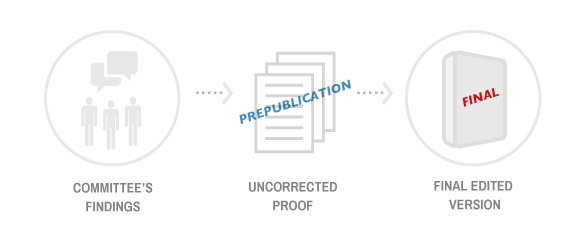
Below are the first 10 and last 10 pages of uncorrected machine-read text (when available) of this chapter, followed by the top 30 algorithmically extracted key phrases from the chapter as a whole.
Intended to provide our own search engines and external engines with highly rich, chapter-representative searchable text on the opening pages of each chapter.
Because it is UNCORRECTED material, please consider the following text as a useful but insufficient proxy for the authoritative book pages.
Do not use for reproduction, copying, pasting, or reading; exclusively for search engines.
OCR for page 1
I~ r] ~ ~ th
Council on
Health Care Technology
wihiam N. Hubbard, Ir.
The Council on Health Care Technology was established within the
National Academy of Sciences and Be Institute of Medicine in 1986.
The council is responding to selected problems that are related to technol-
ogy in heath care:
Improving the availability and interpretation of information al-
ready in the literature on technology assessments.
· Improving methodologies mat are used for health technology
assessments and the selection of appropriate mesons.
· Improving professional and public understanding of how the
outcomes of using specific technologies affect We benefits of
health care.
Improving the efficiency of technology assessment by develop-
ing a more systematic procedure for establishing national priori-
ties of technologies to be assessed and fostering their execution.
.
Many interested parties are concerned with the assessment of
health care technology. The perspective from which He council proceeds
is that me uniquely valid outcome marker is the weR-being of the individ-
ual patient. We do not, therefore, orient our concerns specifically to
entitlements or reimbursement patterns or organizational issues or even
technical safety and efficacy; rather, we orient our own concerns toward
demonstrations of the relationship of an intervention to the well-being of
the patient.
With these interests in mind, we have instituted this series of
public discussions He Health Care Technology Forum Series. The
theme Hat ties the initial meetings of the series together is the issue of
1
OCR for page 2
2
WILLIAM N. HUBBARD, JR.
quality in health care as it relates to assessment of the use of technology
and as it is defined by demonstrations of individual patient benefits. The
first forum of the series emphasized what may be obvious but certainly
has not been clearly pursued in practice the indivisibility of evaluations
of effectiveness and quality. These tend to be two different communities
of investigators. The interdependence of these two descriptors of technol-
ogy assessment was the focus of the first meeting held in May 1987.
The problem of appropriateness of use of an interventions by the
health professional in the patient's course comes down to selecting and
adapting that intervention to the individuality of the patient. This is
particularly pertinent, as we see technology becoming more and more
autonomous, under pressure to be more generally effective and its use
being cost controlled.
As we observe the operation of technology in care of the elderly—
the focus of this forum it becomes obvious that the overarching prin-
ciple of an interventions being individualized has a particular poignancy
when technology confronts the elderly. It is that confrontation and the
efforts that are appropriate and necessary in order to individualize inter-
vention that we win focus on today.
Representative terms from entire chapter:
individual patient