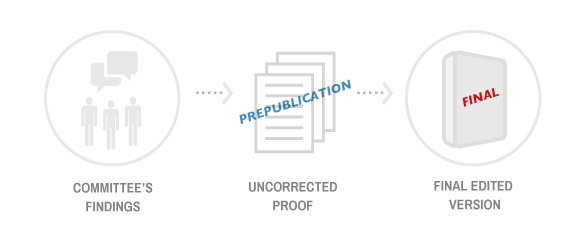
Below are the first 10 and last 10 pages of uncorrected machine-read text (when available) of this chapter, followed by the top 30 algorithmically extracted key phrases from the chapter as a whole.
Intended to provide our own search engines and external engines with highly rich, chapter-representative searchable text on the opening pages of each chapter.
Because it is UNCORRECTED material, please consider the following text as a useful but insufficient proxy for the authoritative book pages.
Do not use for reproduction, copying, pasting, or reading; exclusively for search engines.
OCR for page 109
Special Perspectives on
Acute Hospital Care
Joseph W. Westbrook
The National Education Association, Retired (NEA-R) is an affiliated
program of the National Education Association MEAD. Some 85,000
retired teachers and educational employees are members. AU are a part of
the I.~-miDion-member national organization that functions under the
leadership of President Mary Hatwood FutreU.
The major concern of the NEA-R, as wed as the NEA, in the health
care area is the provision of adequate and affordable health care for its
members. Therefore, availability, cost, and quality of services are most
important factors. Many of my observations and recommendations may
seem simplistic, but Hey are based on what members ten me. They are
worried, they are very concerned, and they want to fee} more secure about
their health care as Hey get older.
Many recipients and potential recipients of medical services are
covered by some type of insurance or by Medicare or both, and therefore
they do not or have not made direct payments for services. The average
rebred person looks at medical services as a right, not as something that is
provided as a welfare handout.
The tendency has been to forget that the health care industry is a
business. The profit motive is the force that drives the vehicle. The acute
care hospital, whether profit or not-for-proBt, concentrates on earning
returns on their investments. Development, research, expansion, and tech-
nology are at least pardy dependent on such returns. The escalating cost of
medical care in an acute hospital setting is of great concern to all. Cost-
containment measures seem to be one of the dominant forces in hospital
management. Medicare reimbursement changes and the advent of diagno-
sis-related groups (DRGs) have also contributed to this movement.
109
OCR for page 110
110
JOSEPH W. WES179ROOK
The impact of reimbursement by DRG guidelines on the sick and
elderly is not clear. Some reports are negative and some are not. My
understanding is that this system of reimbursement places a greater strain
on hospitals because elderly patients in a DRG may be sicker and require
more time and services than their younger counterparts. In addition,
elderly patients are becoming He majority in many acute care hospitals.
Some administrators report Hat more than 50 percent of their patients are
over age 65 and a percentage of these are age 85 and older. To the patient
and family, major research and emphasis needs to be placed on how to
care for the sick elderly patient more effectively.
NEEDS OF SICK ELDERLY IN HOSPITALS
I am told that the elderly require more services and time than
younger patients because they are usually sicker and are not able to
perfonn many normal functions for themselves. They require more
attention, supervision, and care by staff persons. In addition to the
prescription and administration of drugs, the sick elderly often need more
time with the professionals. Shad I say "tender, loving care?" Consulta-
tion, counseling, dealing with depression, management of pain, and drug
use are t~me-consuming areas in which doctors' and practitioners' serv-
ices are sorely needed, but often missing. It seems as if the present system
of reimbursement contributes to the absence of these services. Profes-
sionals, health care administrators, practitioners, and others need to con-
centrate on developing a comprehensive, geriatric treatment system and a
compensation model that will make participation in such a system attrac-
tive.
POST-HOSPITAL PROBLEMS OF THE SICK ELDERLY
In the post-hospital setting, many elderly persons are more afraid
of living than of dying. The position of the LEA that adequate and
affordable health care be available to its members throughout their life-
t~me becomes more acute during the retirement years. The cost in-
creases for health care have been disproportionately greater Can increases
in income and other benefits. Many people believe Hat one extended
hospital stay can reduce the average person or family to indigency. This
is why He greatest problem and concern of many older persons is long-
tenn care beyond He acute hospital phase.
OCR for page 111
SPECIAL PERSPECTlKES ON ACUTE HOSPITAL CARE
111
.
Data and feedback from NEA-R members verify this fear. When
say that the elderly are more afraid of living than of dying, ~ am referring
to the uncertainty of what might happen to them after they leave the
hospital.
.
.
Home care. Many patients do not have any suitable place to go
after discharge. Usually adequate home care is not available
because family members are absent or incapable of providing
care. The spouse may be too infirm, or no children or other
active relatives are available. A more tragic situation involves
hostility in the home, be it that of the patient, the spouse, the
children, or other relatives. This breeds neglect and even cruelty
or physical abuse. The patient is aware of these problems but is
helpless to do anything about them. Hospitals generally are not
prepared to deal with such situations.
Psychological problems. Two major areas in the post-acute-
care setting are alcohol and drug abuse caused by depression,
boredom, and loneliness. Pain, illness, or the feeling of sickness
cause me overuse of drugs that usually have been prescribed by
doctors because the patients complain about feeling sick or
hurting.
The need for nursing home care. The major trauma for the
patient revolves around the emotional impact of being removed
from the home setting and family if Here is one. It does not
matter how poor or meager these resources may be. It marks He
end of a way of life and, for many persons, an end of life.
The quality of care provided by most nursing homes. Neglect,
impersonal treatment, abusive, or hostile care are commonplace
in many facilities. Even where state standards exist, few facili-
ties meet them. Meeting Medicare and Medicaid guidelines
does not ensure the presence of a desirable level of quality of
care.
· The cost or economic impact. The financial effect on He pa-
tient, family, and estate makes the nursing home the least desir-
able and most traumatic of aD of the alternatives. According to
existing practices, one is reduced to indigency by a short stay in
a nursing home. A person's lifetime accumulation is quickly
consumed, and one is reduced to poverty in order to receive
long-term nursing care.
OCR for page 112
112
JOSEPH W. WESTBROOK
Victimization. Patients and families are too frequently victim-
ized by red tape, regulations, misinformation, and Me absence of
complete information about He availability of services and how
to obtain them. We have many examples of families that have
had all kinds of problems trying to get a difficult or unbearable
situation resolved. This might be one of the most widespread
problems reported to us by our constituency.
NEA RECOMMENDATIONS
Because the LEA is an action-or~ented organization, it is appropn-
ate to close with some recommendations.
I. AU acute-care hospitals should have geriatric teams or genatr~c
evaluation units to plan and direct He complete and comprehensive care
of the sick elderly patients.
2. All acute care hospitals should be required to have discharge
planning teams. Their responsibilities would include working win the
patient and family until adequate and suitable continuing care facilities
are available and the patient has been placed therein. Follow-up services
should ensure continued adequate care.
3. A system of not-for-profit nursing homes should be developed
by state and local heady agencies. Such facilities would be for persons
who are able to pay nominal fees out of their retirement income. Once
these facilities are established, they would be operated at minimal cost to
the state or local agencies but would be quality controlled. A person
would not have to become personally impoverished to gain admission.
4. Medicare and Social Security should assign health care infor-
mation specialists to every office. It would be advertised that these
persons are available to all families or persons who need information or
services. Their jobs would be to inform, direct, and procure needed
services for eligible persons who inquire, apply, or have been referred.
5. The health care community should universally support federal
legislation covering long-term heals care for He elderly.
In conclusion, He gap is wide between the "ought-ness" and the
"is-ness" in health care for the sick elderly. The `'ought-ness', has been
thoroughly discussed; ~ have touched on some of the "is-nesses" in this
paper. If the acute care hospital is to continue as He most viable link in
OCR for page 113
SPECIE P~SP~WES ON ACME HOST CARE
113
Me care and treatment of sick elderly patients, then it must bring the cost
of its services back In line wad what persons can pay. Altemative
treatment centers, such as heals maintenance organizations, preferred
provider organizations, and the like, are not un~versaBy reliable or desir-
able and should not represent me wave of the future ~ versal health
care.
Representative terms from entire chapter:
acute hospital