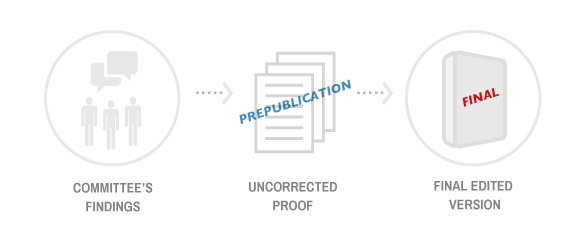
Below are the first 10 and last 10 pages of uncorrected machine-read text (when available) of this chapter, followed by the top 30 algorithmically extracted key phrases from the chapter as a whole.
Intended to provide our own search engines and external engines with highly rich, chapter-representative searchable text on the opening pages of each chapter.
Because it is UNCORRECTED material, please consider the following text as a useful but insufficient proxy for the authoritative book pages.
Do not use for reproduction, copying, pasting, or reading; exclusively for search engines.
OCR for page 114
Acute Hospital Care of
the Elclerly: Systems
Resources and Constraints
I. Alexander McMahon
T was asked to talk about system resources and constraints from the
~ point of view of the hospital, but ~ found it somewhat difficult to do
because ~ am not at all sure that my cohorts among the elderly do not need
representation as weU.
I would not hold myself out as especially qualified to speak,
because I have been neither a provider nor a user of long-term care
services. H. L. Mencken, the sage of Baltimore, was wont to say, "It is
not what we don't know that hurts us; it is what we do know that is
wrong." Nevertheless I am going to address myself to some aspects of the
issue of caring for Be sick elderly from the hospital perspective that bear
touching on. We should anticipate what errors of commission and omis-
sion are going to be made so that Hey can be challenged, at least on the
acute care side.
~ tried to anticipate the way He conversations at this forum might
go and ~ thought about the sick elderly patient. In the actuality of the
discussions, however, ~ became quite confused. In the first session of this
meeting we spent a good deal of time talking about some elderly people. ~
was not sure whether we were talking about elderly patients or, in the
social work lexicon, elderly clients. We did not draw a very good line
between medical care and social services care, and maybe this is an area
for some research. If we do not make a distinction, we are going to get
ourselves all messed up. We may mess up a very good sickness system, if
we try to ask too much of it, but as I thought of the sick elderly, I
recognized rather quickly that there are all kinds of sickness and all kinds
of elderly. So, we must avoid stereotypes in this area, and I think Hat we
need to disaggregate He group being discussed.
114
OCR for page 115
ACUTE HOSPITAL CARE: SYSTEM RESOURCES AND CONSTRAINTS
115
RESOURCES FOR ACUTE CARE
~ am not sure about resources for long-term and community care,
but there are plenty of resources in the acute care world lots of money,
lots of people, and lots of facilities. We spend a higher percentage of the
gross national product than any other country in the world. Do we spend
it wisely? Do we use the resources wisely? That is the issue, and it is not
only a matter for the elderly.
The federal government says that we spend too much. So do other
payers, particularly business. They are critical, ~ think appropnately, of
what we are doing. The providers, as you have heard, often say that we
spend too little. We could do such a much better job if we just had more
money. The courts often say, `'You didn't spend enough. Therefore, the
plaintiff is entitled to a judgment." No wonder people are confused.
Some of He confilsion is brought on by people outside the hospital world,
but we do add our contribution to Me confusion.
POSSIBLE SOLUTIONS
The issue is multifaceted, and the solutions vary accordingly; there
just is not one solution. To providers ~ would say that the resources could
be used more wisely, with sharper attention to different uses of resources
without changes in outcome, with more attention to care instead of to
cure, and with more doctor time instead of more procedures. The provid-
ers have got to get away from the "we need more" approach. It "ain't"
there. It is not there from government. It is not Were from business. We
are going to have to use what we have better.
With all of its faults (and some have been pointed out), people
from other countries still seek our system out, and ~ say, "For heavens
sake, don't mess it up for me when ~ need it." Every problem really does
not have a solution; this has been suggested by a number of forum
participants. It is another way of suggesting that we must avoid He errors
of the militate strategists who always prepare for the last war. To borrow
again from Mencken: for every complex problem, there is a solution that
is neat, simple, and wrong.
Now, to those ready to offer a quick solution, both on the provider
side and on the health-care system side, ~ offer some advice: don't just do
something, stand there. The health care system and the environment itself
are changing very rapidly and, remember, a moving target is hard to hit.
It has adequate resources, a SUIplUS of physicians, and, it is said, a surplus
OCR for page 116
116
J. ALEXANDER McMAHON
of hospital beds; patients have a choice. We are moving from shortage to
"overage"; and competition in turn win motivate much better than gov-
ernment direction, and it will encourage more appropA ate behavior.
CONSTRAINTS
I have suggested that the constraints are not financial, and I truly
believe it. ~ think, instead, that there are six constraints. You can make
your own list, but ~ have identified six. First is attitude. Caregivers must
focus on how they can do better. A market-dAven environment is going
to sharpen that focus remarkably, rewarding those who do better and
eliminating from the scene those who do not.
The second constraint is expectation. Patients and Heir families
must become much more realistic. AU medical problems cannot be cured.
Insistence on more procedures and on a malpractice suit when something
does not work out as wed as someone might have hoped are two engines
that dAve costs up.
The third constraint is emotional. We see the tendency to blame
someone, the view that "there ought to be a law," and the belief that for
every problem there is a solution. '`Tain't necessarily so."
A fourth constraint is ethical. How do we focus on what is light
when there are choices, and the patient and He family and He provider
community, particularly the physicians, may differ on which choice they
think is most appropA ate? Our lack of attention to this issue poses,
suggest, a real constraint.
The fifth constraint is governmental in nature. Lawmakers should
become a little more cautious. They cannot solve every problem, par~cu-
larly win their strong tendency to overpromise and underfund. Business
and He market are modifying the health care system today much more
effectively than law and regulation, and the U.S. Congress and the gover-
nors of Florida and Massachusetts might pay close attention to that.
One might note that Medicare's emphasis on paying only for acute
care services is part of our problem in the care of the sick and ache elderly
today. Think back 22 years to 1965 acute care was then the preferred
solution. There was no objection to it, except by those who did not want
any program at all, and acute care was what was needed. We did not have
the life expectancy in 1965 that we have today; this is due not so much to
the Medicare program itself as to other changes In life style. Nineteen
eighty-seven is different, and we have some new solutions, and ~ suggest
that 1997 is going to be different too.
OCR for page 117
ACUTE HOSPITAL CARE: SYSTEM RESOURCES AND CONSTRAINTS
~7
Finally, there is a constraint imposed by some of the mathematical
and statistical models that we are offers. Both mathematics and statistics
are based on the past, and ~ ten you that Me present is different. The
studies that ~ have seen that were printed in the early part of 1987 or 1986
were often done on 1983 data, and We world is different. Diagnosis-
related groups, business, modification of benefit packages, and what
people are doing for themselves in me weUness area (better diets, not
smoking, lower drinking habits) are changing things remarkably, so that
earlier mathematical and statistical models are inadequate, misleading,
and occasionally just dead wrong.
~ suggest to you that the lessons that might be drawn from an
analysis of these constraints, if ~ am right, are not the obvious ones—
reduce costs, increase quality of care, improve access. They are complex;
they are changing; they will be different tomorrow, and they suggest
caution and not boldness.
POLICY ISSUES AND RESEARCH OPPORTUNITIES
I do not see a single issue and, therefore, see no single solution.
We did, however, explore and come to agreement that attention to the
non-heal~-care needs of the non-sick or not-so-sick elderly~he long-
term care issue~probably are the biggest issues that face us. We need to
disaggregate, as ~ suggested at the outset, the sick elderly. Their solu-
tions, their homes, their communities are as different as their conditions,
and we need to understand that very thoroughly.
We need to track the resources in the private sector. I think I am
right in saying that mat is where a lot of very useful experimentation is
taking place, and more quickly than through hidebound government agen-
cies. It win not be not sexy, but we need to track those activities and
evaluate them. We win see some solutions, and by publishing those
different kinds of approaches, we will offer more help for local decisions,
where ~ am sure many of our problems will be solved.
T Wink that we need to recognize He limits of research. When a
piece of research is finished, it is likely Hat already the environment has
changed, so let us be careful. Finally, we need to recognize He limits of
some of the new policies proposed, when me present is not fully under-
stood. I am amazed how often people who offer a solution for the future
cannot describe adequately and accurately the present.
Once again, I suggest: don't just do something, stand there.
Representative terms from entire chapter:
sick elderly