



Below is the uncorrected machine-read text of this chapter, intended to provide our own search engines and external engines with highly rich, chapter-representative searchable text of each book. Because it is UNCORRECTED material, please consider the following text as a useful but insufficient proxy for the authoritative book pages.
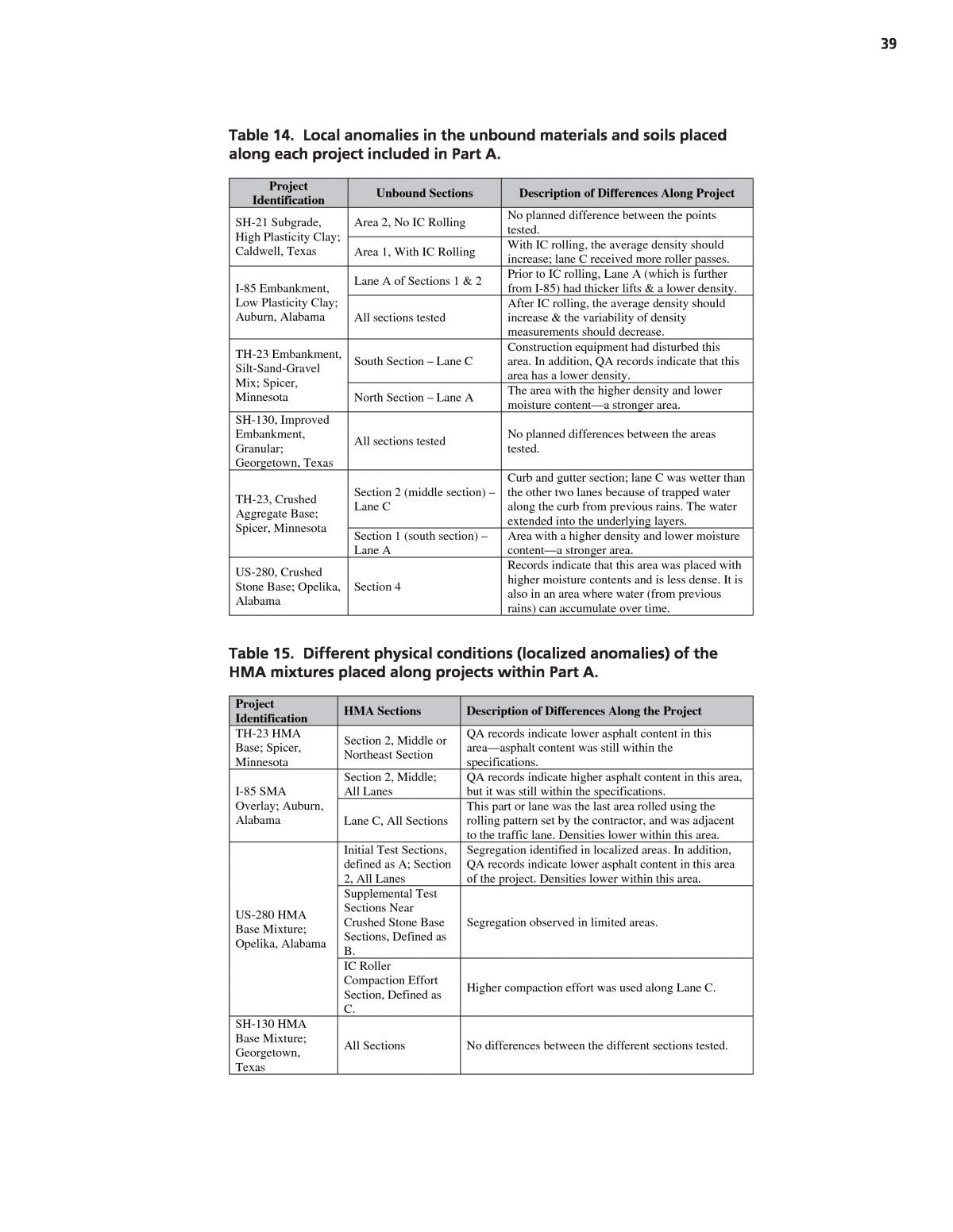
38 This chapter focuses on the effectiveness of the NDT tech- nology and device for measuring or judging the quality of construction of unbound materials and HMA mixtures. âEffectivenessâ is defined as the ability or capability of the NDT technology or device to detect changes in unbound materials or HMA mixtures. The research problem statement noted that, with the development of the MEPDG, layer modulus will become a more important property and should be considered a quality characteristic. Thus, the emphasis of the interpretation of data presented in Chapter 5 (available in NCHRP Web-Only Document 133) was on identifying those NDT devices that can consistently and accurately determine when changes occur within the construction process, as well as confirm the assumptions used in pavement structural design. 2.1 Identification of Material Anomalies and Differences The testing under the Part A field evaluation was to con- firm that the NDT technologies can identify differences in construction quality of unbound pavement layers and HMA mixtures. The specific hypothesis used for this part of the field evaluation was that the NDT technology and device can detect changes in the physical condition of pavement materials and soils that affect flexible pavement performance. Tables 14 and 15 present the anomalies and different conditions placed along each project. A standard t-test and the SNK mean separation procedure using a 95 percent confidence level were used to determine whether the areas with anomalies were significantly different from the other areas tested. The following subsections sum- marize the results from the statistical analyses of the data collected within Part A of the field evaluation. 2.1.1 Unbound Layers Table 16 tabulates the results for checking the hypothesis for the unbound material layers. The shaded cells in Table 16 designate those where the hypothesis was incorrectly rejected or accepted. The DSPA accurately identified most of the areas with anomalies or material differences. The GeoGauge did a reasonable identification of the areas, followed by the DCP and LWD. The EDG and GPR devices did a poor job in iden- tifying the different areas. Table 17 demonstrates the success rate by each device in identifying the physical differences of the unbound material within a project. The DSPA and GeoGauge have acceptable success rates, while the EDG and GPR have unacceptable rates. Significantly, the modulus measuring devices (DSPA, GeoGauge, DCP, and LWD) found all the hypotheses to be true for the crushed aggre- gate materials (TH-23 and US-280 projects), while the volumet- ric devices (GPR and EDG) rejected all the hypotheses. This observation suggests systematic differences between the tech- nologies. Some of the important differences observed between the technologies and devices and the reason for the higher suc- cess rates for the DSPA and GeoGauge are listed as follows: ⢠The DSPA and GeoGauge induce small dynamic stress waves into the material being tested. These small responses emphasize the effect of changes in the density and moisture content of the material being tested. Significantly, both devices measure the responses in a relatively limited area and depth. In fact, the sensors for the DSPA (refer to Fig- ures 2 and 3) were spaced so the measured responses would be confined to the layer being tested. The GeoGauge mea- surements have a deeper influence, so its results can be influenced by the supporting layer. The depth of influence depends on the thickness and stiffness of the material being tested. ⢠The DCP is a point-based test and estimates the modulus of the material from the average penetration rate through the material. The penetration rate is dependent on the dry density of the material. However, there are other physical properties that have a greater effect on the penetration rate. The amount and size of the aggregate particles can have a larger effect on the estimated modulus than for the DSPA or GeoGauge, especially for fine-grained soils with some aggregates. For example, the DCP found all the hypotheses C H A P T E R 2 Materials Testing for Construction Quality Determination
39 Project Identification Unbound Sections Description of Differences Along Project Area 2, No IC Rolling No planned difference between the points tested.SH-21 Subgrade, High Plasticity Clay; Caldwell, Texas Area 1, With IC Rolling With IC rolling, the average density should increase; lane C received more roller passes. Lane A of Sections 1 & 2 Prior to IC rolling, Lane A (which is further from I-85) had thicker lifts & a lower density. I-85 Embankment, Low Plasticity Clay; Auburn, Alabama All sections tested After IC rolling, the average density should increase & the variability of density measurements should decrease. South Section â Lane C Construction equipment had disturbed this area. In addition, QA records indicate that this area has a lower density. TH-23 Embankment, Silt-Sand-Gravel Mix; Spicer, Minnesota North Section â Lane A The area with the higher density and lower moisture contentâa stronger area. SH-130, Improved Embankment, Granular; Georgetown, Texas All sections tested No planned differences between the areas tested. Section 2 (middle section) â Lane C Curb and gutter section; lane C was wetter than the other two lanes because of trapped water along the curb from previous rains. The water extended into the underlying layers. TH-23, Crushed Aggregate Base; Spicer, Minnesota Section 1 (south section) â Lane A Area with a higher density and lower moisture contentâa stronger area. US-280, Crushed Stone Base; Opelika, Alabama Section 4 Records indicate that this area was placed with higher moisture contents and is less dense. It is also in an area where water (from previous rains) can accumulate over time. Table 14. Local anomalies in the unbound materials and soils placed along each project included in Part A. Project Identification HMA Sections Description of Differences Along the Project TH-23 HMA Base; Spicer, Minnesota Section 2, Middle or Northeast Section QA records indicate lower asphalt content in this areaâasphalt content was still within the specifications. Section 2, Middle; All Lanes QA records indicate higher asphalt content in this area, but it was still within the specifications. I-85 SMA Overlay; Auburn, Alabama Lane C, All Sections This part or lane was the last area rolled using the rolling pattern set by the contractor, and was adjacent to the traffic lane. Densities lower within this area. Initial Test Sections, defined as A; Section 2, All Lanes Segregation identified in localized areas. In addition, QA records indicate lower asphalt content in this area of the project. Densities lower within this area. Supplemental Test Sections Near Crushed Stone Base Sections, Defined as B. Segregation observed in limited areas. US-280 HMA Base Mixture; Opelika, Alabama IC Roller Compaction Effort Section, Defined as C. Higher compaction effort was used along Lane C. SH-130 HMA Base Mixture; Georgetown, Texas All Sections No differences between the different sections tested. Table 15. Different physical conditions (localized anomalies) of the HMA mixtures placed along projects within Part A.
40 NDT Device Project Hypothesis GPR EDG,pcf Geo., ksi DSPA, ksi DCP, ksi Defl., ksi Lane A 14.65 107.6 12.6 25.2 5.20 ---Pre-IC Rolling LanesB,C,D 15.99 108.1 16.3 34.0 5.62 --- Lane A is weaker No Yes Yes Yes No --- Area 1 21.61 108.3 17.1 39.4 6.93 9.99Post-IC Area 2 23.00 107.7 19.0 40.4 6.21 11.78 No Planned Difference Yes No No Yes Yes No Pre-IC 15.65 108.0 15.4 31.8 5.51 --- All areas Post-IC 22.31 108.0 17.7 39.9 6.57 --- I-85 Low Plasticity Soil Embankment Post-IC area is stronger Yes No Yes Yes Yes --- Area 2 No IC --- --- 19.6 23.6 11.9 --- Area 1 With IC --- --- 22.9 27.1 9.1 --- Area 1 is stronger --- --- Yes Yes No --- Lane C --- --- 20.1 30.4 9.9 12.9With IC Rolling Lanes A,B --- --- 24.4 25.4 8.7 8.00 SH-21 High Plasticity Clay Lane C is stronger --- --- No Yes No Yes So. Area Lanes A,B 18.24 122.7 10.5 43.6 15.16 5.65 No. Area Lanes B,C 29.16 124.1 10.1 35.7 19.01 4.77 No Planned Difference No No Yes No No No Lane C 19.33 122.9 7.5 31.1 11.47 5.58So. Area Lanes A,B 18.24 122.7 10.5 43.6 15.16 5.65 Lane C is weaker No No Yes Yes Yes No Lane A 20.32 123.9 12.6 51.7 18.52 4.69No. Area Lanes B,C 29.16 124.1 10.1 35.7 19.01 4.77 TH-23 Silt- Sand-Gravel Mix Embankment Lane A is stronger No No Yes Yes No No Lane A 10.29 123.2 25.4 33.9 21.60 24.2 Lane B 9.30 123.0 25.5 34.7 20.95 27.8All lanes Lane C 9.78 123.8 24.77 33.3 20.74 21.2 No Planned Difference Yes Yes Yes Yes Yes No Area 1,2 9.74 123.5 26.3 36.5 20.64 24.6 All areas Area 3 9.88 123.1 22.3 28.9 22.01 24.1 SH-130 Granular Improved Embankment No Planned Difference Yes Yes No No Yes Yes Lanes A,B 9.37 129.8 14.4 100.4 42.05 16.75 South & Middle Sections Lane C 10.62 129.8 10.8 50.7 21.33 8.31 Lane C is weaker No No Yes Yes Yes Yes So. Area Lanes A,B 9.79 129.9 15.0 110.7 46.45 19.38 Middle Section Lane C 10.38 129.8 9.8 28.0 18.55 7.95 All other areas 9.54 129.8 12.8 75.0 33.14 12.31 Lane C, middle section, is weaker No No Yes Yes Yes Yes TH-23 Crushed Aggregate Base Lanes A & B, south section, are stronger No No Yes Yes Yes Yes Lane 4 11.57 148.2 35.1 117.4 34.31 18.53 All areas Lanes 1,2,3 11.95 147.4 47.9 198.6 50.29 46.46 US-280 Crushed Stone Base Lane 4 is weaker No No Yes Yes Yes Yes NOTE: The results in the shaded or black cells represent areas where the hypothesis was rejected based on a 95 percent confidence interval, and are inconsistent with the construction records and experimental plan. Table 16. Effectiveness of NDT devices to identify areas of unbound layers with anomalies or different physical conditions. NDT Device DSPA GeoGauge DCP LWD GPR EDG Success Rate, % 86 79 64 64 33 25 Table 17. Success rate demonstrated by each device in identifying the physical differences of the unbound material.
to be true for the coarse-grained materials and rejected many of the hypotheses for the fine-grained embankment materials with varying amounts of coarse aggregate. ⢠The LWD induces larger strains into the underlying materials. The measured deflections or responses are affected by a much larger area and depth than for the DSPA, GeoGauge, and DCP. The modulus calculated from the deflections is dependent on the thickness and stiffness of the material being tested, as well as the thickness and stiffness of the supporting layers. In fact, some resulting modulus values were lower than expected for the type of material being tested (TH-23 embankment and areas of the US-280 crushed stone). The LWD found all the hypotheses to be true where the layer thicknesses were well defined, but rejected many of the hypotheses for the materials where the layer thickness was less definedâthe embankments. ⢠Both the GPR and EDG devices are dependent on the den- sity and water content measurements made with other tra- ditional test methods. Any errors within those traditional methods are included in the GPR and EDG results. Average water contents were assumed for each area in calculating the wet densities from the dielectric values measured with the GPR. Obviously, water contents are not constant within a specific area. Errors in the water content will be reflected in the wet density for a specific test. In addition, varying plasticity of the fines and in the gradation of the material is difficult to identify with the GPR and EDG by themselves. ⢠Variability of the measurements is another reason for the outcome. The GeoGauge had lower variability, followed by the DSPA and DCP. The deflection-based methods had the greatest variability. The lower the variability, the higher the probability to identify a difference, if a difference exists, given the same number of tests (refer to Section 2.3). In summary, the DSPA and GeoGauge are considered acceptable in identifying localized differences in the physical condition of unbound materials. 2.1.2 HMA Layers Table 18 contains the results of checking the hypotheses for the HMA layers. The shaded cells in Table 18 designate those 41 NDT DeviceProject Hypothesis PSPA FWD GPR PQI Section 2 Lanes A,B 285.0 568.9 6.18 149.9 Sections 1,3 Lanes A,B 262.0 405.4 10.14 146.6 Section 2 is Stronger or Stiffer Yes Yes Yes Yes Lane C Section 2,3 288.5 NA 8.51 141.6 Lane C Sections 1 215.4 NA 8.62 140.3 I-85 SMA Overlay Section 1 is Weaker/Less Dense Yes NA No Yes Section 2 All Lanes 454.4 NA 7.04 145.2 Sections 1,3 All Lanes 489.8 NA 6.64 146.6 Section 2 is Weaker Yes NA Yes Yes Section 4 All Lanes 499.5 NA NA 143.9 TH-23 HMA Base No Planned Difference; Sections 1,3,4 Yes NA NA No Initial Sections Section 1 499.9 203.3 7.03 148.0 Supplemental Sections Sections 1,2 555.0 877.2 5.50 140.4US-280HMA Base Supplemental Area is Stronger/Denser Yes Yes Yes No Section 1 All Lanes 499.9 203.3 7.03 148.0 Section 2 All Lanes 423.9 125.9 6.81 154.5 Section 1 is Stronger/Denser Yes Yes No No Longitudinal Joints Confined Joint 305.8 125.5 7.70 145.7 Joints are Less Dense/Weaker Yes No Yes Yes Segregated Areas All Lanes 329.9 144.5 7.28 147.1 US-280 HMA Base, Initial Sections Segregated Areas are Less Dense/Stiff Yes No No Yes Section 1 All Lanes 559.8 569.0 5.55 140.4 Section 2 All Lanes 550.2 1185.3 5.45 140.5 No Planned Difference Yes No Yes Yes Longitudinal Joints All Lanes 596.0 379.0 5.78 135.8 Joints are Les Dense/Weaker No Yes No Yes Segregated Areas All Lanes 391.3 707.0 5.64 136.6 US-280 HMA Base, Supplemental Sections Segregated Areas are Less Dense/Stiff Yes No No Yes Section 1 All Lanes 384.9 NA 5.95 126.5 Section 2 All Lanes 292.6 NA 5.61 124.0 Section 3 All Lanes 461.7 NA NA 125.1 Section 2 is Weaker/Less Dense Yes NA Yes Yes Joints All Lanes 297.5 NA 5.08 118.8 I-35/SH-130 HMA Base Joints are Less Dense/Stiff Yes NA No Yes Table 18. Effectiveness of NDT devices to identify areas of HMA layers with anomalies or different physical conditions.
areas where the hypothesis was incorrectly rejected. Another difference that was found but not planned (so it was excluded from Table 18) was the difference between the initial and supplemental sections of the US-280 project (see Chapter 5 of NCHRP Web-Only Document 133). All NDT devices found a significant difference between these two areasâthe supple- mental section had the higher dynamic modulus, which was confirmed with laboratory dynamic modulus tests. Both the PSPA and FWD resulted in higher modulus values and the GPR estimated lower air voids, but the PQI resulted in much lower densities. The PSPA did identify all but one of the areas with anom- alies or differences. The non-nuclear density gauge did a rea- sonable job, while the GPR and FWD only identified slightly more than 50 percent of the areas with differences. The GPR, however, did measure the HMA lift thickness placed, which was confirmed through field cores. Table 19 contains the suc- cess rates for identifying the physical differences of the HMA mixtures within a project. The PSPA had an excellent success rate, while the PQI had an acceptable rate. The GPR and FWD had lower rates that are considered unacceptable. Some of the important differences observed between the technologies and devices and the reasons for the lower success rates of the GPR and FWD are listed as follows: ⢠The FWD is believed to have been influenced by the sup- porting layers creating noise and additional variability making it more difficult to identify the localized areas. In addition, its loading plate probably bridged some of the localized anomalies making it difficult to detect differences near the surface of the layer evaluated (e.g., segregation). ⢠The dielectric values measured by the GPR are minimally affected by some of the properties that can change within a project, and its success is heavily dependent on the num- ber of cores taken for calibration purposesâsimilar to that for unbound materials. In summary, the PSPA and non-nuclear density gauges (PQI) are considered acceptable in identifying localized dif- ferences in the physical condition of HMA mixtures. 2.2 Estimating Target Modulus Values Laboratory measured modulus of a material is an input parameter for all layers in the MEPDG. Resilient modulus is the input for unbound layers and soils, while the dynamic modulus is used for all HMA layers. None of the NDT devices accurately predicted the modulus values that were measured in the laboratory for the unbound materials and HMA mixtures (see Figures 17-1 and 17-2). All of the modulus estimating NDT devices, however, did show a trend of increasing mod- uli with increasing laboratory measured moduli. The follow- ing subsections describe the use of adjustment factors for confirming the assumptions used for structural design. 2.2.1 Unbound Layers It has been previously reported that layer moduli calculated from deflection basins must be adjusted (multiplied) by a factor for pavement structural design procedures that are based on laboratory derived values at the same stress state (AASHTO 1993; Von Quintus and Killingsworth 1998). In the 1993 AASHTO Pavement Design Manual, the adjustment factor is referred to as the âC-factor,â and the value recom- mended for use is 0.33. Thus, there are differences between the field and laboratory conditions that can cause significant bias when using NDT modulus values. Von Quintus and Killingsworth found that this adjustment factor was structure or layer dependent but not material type dependent. Adjustment factors were determined for different types of structures. The C-factor found for embankment or subgrade soils ranged from 0.35 to 0.75 and averaged 0.62 for aggregate base materials. However, none of the deflection basins measured in this study was measured on the surface of the unbound layers themselves. Conversely, all testing under this study was directly on the surface of the layer being evaluated. To compensate for differences between the laboratory and field conditions, an adjustment procedure was used to estimate the laboratory resilient modulus from the different NDT technologies for making relative comparisons. The adjustment procedure assumes that the NDT response and modulus of laboratory prepared test specimens are directly related and proportional to changes in density and water content of the material. Figures 18, 19, and 20 compare the seismic (PSPA) modulus measured on the samples used in preparing an M-D relationship. The PSPA modulus-water content relationship follows the M-D relationship. Thus, the assumption is believed to be valid. For simplicity, the adjustment factors were derived using the same methodology within the FHWA-LTPP study, with the exception that a constant, low stress state was used to determine the adjustment factor. In other words, the average 42 NDT Device PSPA PQI GPR FWD Success Rate, % 93 71 54 56 Table 19. Success rates for identifying the physical differences of the HMA mixtures within a project.
43 0 50 100 150 200 0 10 20 30 40 50 60 Laboratory Resilient Modulus, ksi El as tic M od ul us fr om N DT D ev ic es , k si DSPA, Fine-Grained DSPA, Coarse-Grained Line of Equality Geo., Fine-Grained Geo., Coarse-Grained (a) DSPA and the GeoGauge. 0 10 20 30 40 50 60 0 10 20 30 40 50 60 Laboratory Resilient Modulus, ksi El as tic M od ul us fr om N DT D ev ic es , k si LWD, Fine-Grained LWD, Coarse-Grained DCP, Fine-Grained DCP, Coarse-Grained Line of Equality (b) Deflection-Based and DCP methods. 0 500 1000 1500 2000 0 500 1000 1500 2000 Laboratory Measured Dynamic Modulus (In-Place Temperature and 5 Hz.), ksi N D T Es tim at ed M od ul us , ks i Line of Equality FWD Modulus PSPA Modulus - Part A PSPA Modulus - Part B (a) Entire data set. 100 200 300 400 500 600 700 800 900 900800700600500400300200100 Laboratory Measured Dynamic Modulus (In-Place Temperature and 5 Hz.), ksi N D T Es tim at ed M od ul us , ks i Line of Equality FWD Modulus PSPA Modulus - Part A PSPA Modulus - Part B (b) Excludes data point for very stiff HMA mixture placed along SH-130. Figure 17-1. Comparison of laboratory resilient modulus and the elastic modulus values estimated with different NDT technologies and devices. Figure 17-2. Comparison of laboratory dynamic modulus and the elastic modulus values estimated with differ- ent NDT technologies and devices.
44 100 102 104 106 108 110 112 114 116 8.5 10 12 14.5 16 18 20 Moisture Content, I-85 Embankment, percent D ry D en si ty , p cf 0 10 20 30 40 50 60 70 80 90 Se is m ic M od ul us , k si Seismic Modulus, ksi Dry Density, pcfi Poly. (Seismic Modulus, ksi) Poly. (Dry Density, pcfi) Figure 18. Comparison of the PSPA modulus to the M-D relationship for the I-85 low plasticity soil embankment. 114 116 118 120 122 124 126 128 7.5 8.5 9.6 10.5 12 13 14 15 16 Moisture Content, SH-130 Embankment, percent D ry D en si ty , p cf 0 10 20 30 40 50 60 70 80 90 100 Se is m ic M od ul us , k is Dry Density Seismic Modulus Poly. (Seismic Modulus) Poly. (Dry Density) Figure 19. Comparison of the PSPA modulus to the M-D relationship for the SH-130 improved granular embankment. 127 127.5 128 128.5 129 129.5 130 130.5 131 3.8 4.8 5.8 7 8 9 10 Moisture Content, US-280 Crushed Stone, percent D ry D en si ty , p cf 0 20 40 60 80 100 120 140 Se is m ic M od ul us , k si Dry Density Seismic Modulus Poly. (Seismic Modulus) Poly. (Dry Density) Figure 20. Comparison of the PSPA modulus to the M-D relationship for the US-280 crushed stone base.
laboratory measured modulus (triplicate repeated load resilient modulus tests were performed) was divided by the average moduli estimated with each NDT device. Table 20 contains the adjustment factors equating the NDT moduli to the resilient modulus measured in the lab- oratory (see Tables 21 and 22) for the Part A field evaluation projects. The adjustment factors do not appear to be related to the percent compaction, percent of optimum water content, or material type. The adjustment factors for the deflection-based 45 Ratio or Adjustment Factor Project Material PercentCompaction Percent of Optimum Moisture Geo. DSPA DCP LWD I-85 Embankment Low Plasticity Clay 91 165 0.19 0.087 0.53 0.39 TH-23 Embankment Silt-Sand-Gravel Mix 100 132 0.90 0.41 0.95 3.13 SH-21 Subgrade High Plasticity Clay 99 84 1.16 0.99 2.94 2.78 TH-23 Base Crushed Aggregate 104 55 0.71 0.30 0.68 1.69 SH-130 Embankment Improved Granular Mix 105 101 1.39 1.04 1.67 1.43 US-280 Base Crushed Stone 101 52 1.01 0.24 0.96 1.04 The adjustment ratio or factor was determined by dividing the average resilient modulus measured in the laboratory by the average modulus from the NDT device (for a specific stress state, see Table 21). Table 20. Adjustment factors or ratios applied to the NDT modulus values to represent laboratory conditions or values at low stress states; Part A projects. Project & Materials Area Dry Density, pcf Moisture Content, % Percent Maximum Density, % Laboratory Resilient Modulus, ksi Before IC Rolling Section 1, Lanes B,C,D 103.0 21.6 0.91 2.5 I-85 Low Plasticity Clay Embankment After IC Rolling Section 1, Lanes B,C,D 108.0 16.9 0.96 4.0 NCAT; Oklahoma High Plasticity Clay 96.7 21.3 0.97 6.9 NCAT; South Carolina Crushed Granite Base 130.0 4.7 0.94 14.3 South Section Lanes A,B 121.0 8.2 0.98 16.0 TH-23 Embankment, Silt-Sand- Gravel Mix North Section Lane B,C 122.4 9.1 1.00 16.4 US-2 Embankment; Soil-Aggregate Mix 123.1 12.1 0.96 19.0 NCAT; Missouri Crushed Limestone Base 124.4 9.0 0.96 19.2 SH-21 High Plasticity Clay Area 1, with IC rolling Lanes A,B 107.3 18.4 0.99 26.8 Middle Area Lane B 139.4 4.3 1.04 24.0 TH-23 Crushed Aggregate Base South Area All Lanes 141.1 4.2 1.03 24.6 US-53 Crushed Aggregate Base, Type 304 136.0 9.1 1.01 27.5 NCAT; Florida Limerock Base 110.5 13.4 0.95 28.6 US-2 Class 5 Crushed Aggregate Base 134.4 5.9 0.95 32.4 SH-130 Improved Granular Sections 2, 3 Lanes A,B 128.7 9.1 1.05 35.3 US-280 Crushed Stone Areas 1,2,3 150.6 3.2 1.01 48.4 NOTES: Resilient modulus values for the fine-grained soils and embankments are for a low confining pressure (2 psi) and repeated stress of 4 psi, while a confining pressure of 6 psi and repeated stress of 6 psi was used for the granular base materials. These low stress conditions are not based on any theoretical analysis. One stress state for the embankment soils and one for aggregate base layers were selected for consistency in comparing the field estimated elastic modulus values from each NDT device to values measured in the laboratory, which were considered the target values. Percent maximum density is based on the maximum dry unit weight or density from the moisture-density relationship (the maximum dry densities are included in Table 23 for each material tested). Table 21. Average repeated load resilient modulus values measured in the laboratory at a specific stress state.
devices are approximately the inverse of the values reported from the FHWA-LTPP study. Thus, the adjustment factors derived from testing on bound pavement surfaces should not be used when testing directly on the unbound layer being evaluated. Another important observation from the Part A projects is that the adjustment factors for all NDT devices for the I-85 low plasticity clay embankment prior to IC rolling are significantly lower than for any of the other materials. This observation sug- gests that the resilient moduli measured in the laboratory are much lower than for any of the other soils and materials. The reason for the low values is unknown. This embankment soil had the lowest dry density and highest water content relative to its maximum dry density and optimum water content also see Table 23). However, these data were excluded from developing the adjustment factors and selection of an NDT device that can be used to confirm the structural design parameters because they were consistent across all NDT devices. Table 24 contains the adjustment factors for all projects included in the field evaluation (Parts A and B). The LWD is not included in Table 24 because it was excluded from the Part B projects. On average, the GeoGauge and DCP pro- vided a reasonable estimate to the laboratory measured val- ues, with the exception of the fine-grained, clay soils. The GeoGauge deviated significantly from the laboratory values for the fine-grained soils. The results also show that both the GeoGauge and DCP over- or under-predicted the laboratory measured values for the same material, with a few exceptions. These ratios were compared to the percent compaction, per- cent of optimum water content, and material type, but no rela- tionship could be found. The GeoGauge and DSPA adjustment ratios appear to be related to the amount of fines in the mate- rial (percent passing number 200 sieve), as shown in Figure 21. In summary, the GeoGauge can be used to estimate the resilient modulus measured in the laboratory for aggregate base materials and coarse-graded soil-aggregate embankments, while the DCP provided a closer estimate for the fine-grained soils. However, the ratios for both of these devices were variableâeven within the same soil or material group. The DSPA resulted in a positive bias (over-predicted the laboratory resilient modulus) with variable ratios. It is suggested that repeated load resilient modulus tests be performed to deter- mine the target or design value and that those results be used to calibrate the NDT devices for a specific soil or aggregate base, because of the variability of these ratios. The resilient modulus test should be performed on bulk material sampled 46 Modulus, ksi Project Material Area Lab.* GeoGauge DSPA DCP LWD Section 2, Lane A 2.2 10.6 24.1 5.0 --- Section 1, All Lanes 2.5 15.4 30.0 5.9 --- I-85 Embankment Before IC Rolling Low Plasticity Clay Section 2, Lanes B, C, D 2.5 17.0 36.6 5.2 --- Section 1 4.0 16.8 30.4 6.9 9.99 I-85 Embankment After IC Rolling Low Plasticity Clay Section 2 4.5 19.0 40.4 6.2 11.78 So. Section, Lane C 15.0 13.2 31.1 11.5 5.6 So. Sect., Lanes A,B 16.0 18.3 43.6 15.2 5.7 No. Sect., Lanes B,C 16.4 17.8 35.7 19.0 4.7 TH-23 Embankment Silt-Sand- Gravel Mix No. Sect., Lane A 17.0 22.0 51.7 18.5 4.7 No IC Rolling 22.0 19.6 23.6 11.9 --- SH-21 Subgrade High Plasticity Clay After IC Rolling 26.8 22.9 27.1 8.8 9.6 Middle Sect., Lane C 19.5 21.6 28.0 18.6 8.0 North Section, All Lanes; Middle Section Lanes A, B 24.6 28.2 79.3 33.1 12.3 TH-23 Base Crushed Aggregate Base South Section, Lanes A, B 26.0 33.0 110.7 46.4 19.4 Section 3 34.5 19.4 33.3 20.7 24.1 SH-130 Improved Embankment Granular Sections 1, 2 35.3 26.4 34.3 21.3 24.6 Area 4 40.0 35.1 117.4 34.3 18.5 US-280 Base Crushed Stone Areas 1, 2, 3 48.4 47.9 198.6 50.3 46.5 NOTES: * The repeated load resilient modulus values measured in the laboratory, but corrected to the actual dry density and moisture content measured for the specific section, in accordance with the LTPP procedure and regression equations. Table 22. Elastic modulus values estimated from the NDT technologies and devices, without adjustments, in comparison to resilient modulus values measured in the laboratory.
from the stockpiles or the roadway during construction (control strips). Most state agencies do not have a resilient modulus test- ing capability, so other procedures will need to be used to establish the design or target value during construction (Darter et al. 1997). The resilient modulus was calculated at the same stress state shown in Table 21 using the regression equations that were developed from an FHWA-LTPP study (Yau and Von Quintus). The following regression equations were used: Where: θ = Bulk Stress, psi Ï = Octahedral shear stress, psi pa = Atmospheric pressure, 14.7 psi Ï Ï Ï Ï Ï Ï Ï = â ( ) + â ( ) + â ( )( )1 2 2 2 3 2 3 1 2 0 5 3 . (3) θ Ï Ï Ï= + +1 2 3 (2) M k p p p R a a k oct a k = ( )âââ â â â + â ââ â â â1 2 3 1 θ Ï (1) Ï1,2,3 = Principal stress, psi. k1,2,3 = Regression constants from laboratory resilient mod- ulus test results. The k regression constants are material specific. The fol- lowing defines the regression constants for the different materials that were tested within the field evaluation proj- ects. These relationships for these regression constants were developed from the FHWA-LTPP study (Von Quintus and Killingsworth). k LL ws dry3 1 1720 0 0082 0 0014 0 0005= â â â ( )+. . ( ) . . γ (6) k P LL ws2 3 82 2159 0 0016 0 0008 0 038= â ( )+ â ( ) â . . . ( ) . 0 0006 0 00000024 2 40 . . # γ γ dry dry P ( )+ âââ â â â (5) Crushed Stone Base Materials k1 0 7632 0 008= +. . P LL ws dry 3 8 0 0088 0 037 0 0001 ( )+ â ( ) â ( ) . ( ) . . γ (4) 47 Project Material Maximum Dry Unit Weight, pcf Optimum Water Content, % Average Dry Density, pcf Average Water Content, % NCAT, Oklahoma High Plasticity Clay 99.9 21.8 96.7 21.3 SH-21, TX High Plasticity Clay 108.0 21.9 107.3 18.4 Low Plasticity Soil; Pre-IC 107.98 16.9 I-85, AL Low Plasticity Soil; Post-IC 112.7 13.1 107.98 16.9 SH-130, TX Improved Granular Embankment 122.0 9 123.3 8.32 Silt-Sand-Gravel Mix â South Area 122.77 8.69 TH-23, MN Silt-Sand-Gravel Mix â North Area 122.6 12 123.80 7.87 US-2, ND Soil-Aggregate,Embankment 128.0 9.0 123.1 12.1 NCAT, FL Limerock Base 116.1 12.5 110.5 13.4 CR-103 Caliche Base 127.5 10.0 125.0 9.5 NCAT, MO Crushed Limestone 130.0 10.0 124.4 9.0 TH-23, MN Crushed Aggregate Base 135.3 7.8 129.82 4.3 US-53, OH Crushed Aggregate Base 134.1 8.5 136.0 9.1 NCAT, SC Crushed Granite Base 138.1 5.0 130.0 4.7 US-2, ND Crushed Gravel Base 141.1 6.0 134.4 5.9 US-280, AL Crushed Stone Base 148.5 6.2 147.58 3.9 NOTE: The maximum dry density and optimum water content for most of the materials and layers were determined using AASHTO T 180. The exception is the high plasticity clay from the Texas project and the North Dakota embankment material. Table 23. Maximum dry density and optimum water content for the unbound materials and soils, as compared to the average test results from the EDG.
k P P2 4 2000 4951 0 0141 0 0061 1 3941= â ( )â ( )+. . . .# # γ dryγ Max â ââ â â â (11) Embankments, Soil-Aggregate Mixture,Fine-Grained k P P1 40 2000 7668 0 0051 0 0128= + ( )+ ( ). . .# # + â ( )+ âââ â â 0 0030 0 051 1 179 . ( ) . . LL wopt dry Max γ γ â (10) k P P opt 3 200 2 4 0 1906 0 0026 0 00000081= â â ( )+. . .# # γ 0 â ââ â â â (9) k P PI M2 2000 7833 0 0060 0 0081 0 0001= â ( )â +. . . ( ) .# γ ax s opt dryw w P ( ) â â ââ â â â +0 1483 0 00000027 2 4 . . # γ 0 â ââ â â â (8) Embankments, Soil-Aggregate Mixture, Coarse-Grained k P P1 3 8 40 5856 0 0130 0 0174= + ( )â ( )+. . . # 0 0027 0 0149 0 0000016 0 200. . ( ) . #P PI ( ) + + ( )âγ max . . . 0426 1 6456 0 3932 w w w s dry s ( ) + â ââ â â â + γ γ Max Max âââ ââ â â â ââ â â â0 00000082 2 40 . # γ Max P (7) Figure 22 compares the laboratory measured resilient modulus values and those calculated from the regression equations (see Table 24). Use of the regression equations, on average, resulted in a reasonable prediction of the labora- tory measured values. Yau and Von Quintus, however, reported that the regression equations can result in significant error and recommended that repeated load resilient modulus tests be performed. k P P P3 4 401 4258 0 0288 0 0303 0 0521= â ( )+ ( )â. . . .# # #200 0 025 0 0535 0 0672 ( ) + + â ( ) â . ( ) . ( ) .Silt LL wopt 0 0026 0 0025 0 6055. . .γ γmax dry( )+ ( )â âââ âw w s opt â â (15) k P P P2 4 400 5193 0 0073 0 0095 0 0027= â ( )+ ( )â. . . .# # #200 0 0030 0 0049 ( ) â â ( ). ( ) .LL ws (14) Fine-Grained Clay Soil k Clay1 1 3577 0 0106= + (. . )â ( )0 0437. ws (13) k P LL dry 3 3 80 9303 0 0293 0 0036 3 8903= + ( )+ â. . . ( ) . γγ Max â ââ â â â (12) 48 Resilient Modulus, ksi Adjustment Factors Relating Laboratory Values to NDT Values Project Identification Laboratory Measured Value Predicted with LTPP Equations Geo Gauge DSPA DCP Fine-Grained Clay Soils Before IC Rolling 2.5 10.5 0.154 .0751 0.446 I-85 Low- Plastic Soil After IC Rolling 4.0 13.1 0.223 0.113 0.606 NCAT; OK High Plastic Clay 6.9 19.7 0.266 0.166 0.802 SH-21, TX High Plastic Clay 26.8 19.6 1.170 0.989 3.045 Average Ratios for Fine-Grained Soil 0.454 0.336 1.225 Embankment Materials; Soil-Aggregate Mixture South Embankment 16.0 15.7 0.696 0.367 1.053 TH-23, MN North Embankment 16.4 16.3 0.735 0.459 0.863 US-2, ND Embankment 19.0 19.5 1.450 0.574 0.856 SH-130, TX Improved Soil 35.3 21.9 1.337 1.029 1.657 Average Ratios for Soil-Aggregate Mixtures; Embankments 1.055 0.607 1.107 Aggregate Base Materials Co. 103, TX Caliche Base --- 32.3 1.214 --- 1.436 NCAT, SC Crushed Granite 14.3 36.1 0.947 0.156 --- NCAT, MO Crushed Limestone 19.2 40.9 0.747 0.198 --- Crushed Stone, Middle 24.0 29.9 0.851 0.303 0.725 TH-23, MN Crushed Stone, South 26.0 35.6 0.788 0.235 0.560 US-53, OH Crushed Stone 27.5 38.3 1.170 0.449 0.862 NCAT, FL Limerock 28.6 28.1 0.574 0.324 0.619 US-2, ND Crushed Aggregate 32.4 39.8 1.884 0.623 1.129 US-280, AL Crushed Stone 48.4 49.3 1.010 0.244 0.962 Average Ratios for Aggregate Base Materials 1.021 0.316 0.899 Overall Average Values 0.942 0.422 1.084 NOTES: 1. The adjustment ratio is determined by dividing the resilient modulus measured in the laboratory at a specific stress state by the NDT estimated modulus. 2. The average ratios listed exclude the data from the I-85 low plasticity clay prior to IC rolling. The resilient modulus regression equations are provided in Equations 1 through 15. Table 24. Adjustment factors applied to the NDT modulus values to represent laboratory conditions or values at low stress states, all projects.
49 2.2.2 HMA Layers Table 25 lists the laboratory dynamic moduli measured at a loading frequency of 5.0 Hz for the in-place average mixture temperature measured during NDT. As for the unbound materials, it is expected that the modulus values determined from the deflection-based methods are affected by the sup- porting materials. To compensate for differences between the laboratory and field conditions, an adjustment procedure was used to estimate the modulus values from the PSPA and FWD for making relative comparisons. This field adjustment pro- cedure is the same as that used for the unbound materials. The adjustment ratios were determined for the areas without any anomalies or physical differences from the target proper- ties and are given in Table 26. The PSPA adjustment ratios were found to be relatively close to unity, with the exception of the I-35/SH-130 HMA base mixture. This HMA base mixture is a very stiff mixture in the 0 0.5 1 1.5 2 0 20 40 60 80 100 Percent Passing Number 200 Sieve, % A dju stm en t R ati o f or G eo G au ge Fine-Grained Soil Aggregate-Soil Mixture Crushed Aggregate Base (a) GeoGauge. (b) DSPA. A dju stm en t R ati o f or D SP A Fine-Grained Soil Soil-Aggregate Mixture Crushed Aggregate Base 0 20 40 60 80 100 Percent Passing Number 200 Sieve, % 0 0.2 0.4 0.6 0.8 1 1.2 Figure 21. Effect of the amount of fines on the adjustment ratio for the GeoGauge and DSPA devices. 0 10 20 30 40 50 0 10 20 30 40 50 Resilient Modulus Measured in Laboratory, ksi R es ili en t M od ul us C al cu la te d fro m L TP P Eq ua tio ns , k si Line of Equality Fine-Grained Soils Embankment Soils; Coarse-Grained Granular Base Figure 22. Comparison of the resilient modulus values measured in the laboratory to the resilient modulus values predicted with the LTPP regression equations.
50 Laboratory Values, ksi NDT Values, ksi Part ProjectIdentification Layer/Mixture 130 °F & 5 Hz In Place Temp. & 5 Hz PSPA FWD B I-75, Michigan Dense-Graded; Type 3-C 190 400 435.2 --- B NCAT, Florida Base, Mix; PG67 203 390 447.1 --- B NCAT, S. Carolina Base Mix; PG67 214 410 495.2 --- B I-75, Michigan Fine-Graded Surface; Type E10 255 590 676.3 --- A I-85, Alabama SMA Mixture 230 250 237 450 B NCAT, Alabama 45% RAP; Sect. E-5, PG67 250 450 510.7 --- B US-47, Missouri Fine-Graded Surface 276 530 457.6 --- A TH-23,Minnesota HMA Base Mixture 319 810 480 --- A US-280,Alabama HMA Base; Initial Area 330 650 462 165 B US-47, Missouri Coarse-Graded Base 344 420 605.3 --- B US-2, N. Dakota Coarse-Graded Base; PG58-28 356 510 344.3 --- B NCAT, Florida Base Mix, SBS, PG76 366 590 475.8 --- B NCAT, Alabama 45% RAP, Sect. E-7; PG76 (Sasobit) 421 610 444.3 --- B NCAT, Alabama 45% RAP, Sect. E-6; PG76 (SBS) 427 640 473.4 --- B US-53, Ohio Coarse-graded Binder Mix 479 850 666.7 --- B I-20, Texas HMA Base, CMHB 520 340 435.5 --- A US-280,Alabama HMA Base; Supplemental Area 613 780 558 310 A SH-130, Texas HMA Base 965 1,750 342 725 Table 25. Elastic modulus values estimated from NDT devices, without any adjustments, in comparison to dynamic modulus values measured in the laboratory. Ratio or Adjustment Factor Project/Mixture DynamicModulus, ksi PSPA FWD I-85 AL, SMA Overlay 250 1.055 0.556 TH-23 MN, HMA Base 810 1.688 NA US-280 AL, HMA Base; Initial Area 650 1.407 3.939 US-280 AL, HMA Base; Supplemental Area 780 1.398 2.516 I-35/SH-130 TX, HMA Base 1,750 5.117 3.253 I-75 MI, Dense-Graded Type 3-C 400 0.919 NA I-75 MI, Dense-Graded Type E-10 590 0.756 NA US-47 MO, Fine-Graded Surface 530 1.158 NA US-47 MO, Coarse-Graded Base Mix 420 0.694 NA I-20 TX, HMA Base, CMHB 340 0.799 NA US-53 OH, Coarse-Graded Base 850 1.275 NA US-2 ND, Coarse-Graded Base, PG58-28 510 1.482 NA NCAT SC, PG67 Base Mix 410 0.828 NA NCAT FL, PG67 Base Mix 390 0.872 NA NCAT FL, PG76 Base Mix 590 1.240 NA NCAT AL, PG76 with RAP and Sasobit 610 1.3760 NA NCAT AL, PG76 with RAP and SBS 640 1.352 NA NCAT AL, PG67 with RAP 450 0.881 NA Overall Average Ratio or Adjustment Factor 1.128 2.566 NOTES: 1. The adjustment factor or ratio was determined by dividing the dynamic modulus measured in the laboratory for the in-place temperature at a loading frequency of 5 Hz by the modulus estimated with the NDT device. 2. The laboratory dynamic modulus values listed are for a test temperature of a loading frequency of 5 Hz at the temperature of the mixture when the NDT was performed (see Table 25). 3. The overall average adjustment factor excludes the SH-130 mixture (shaded in the table) because it was found to be significantly different than any other mixture tested. Table 26. Dynamic modulus values measured in the laboratory and adjustment factors for the modulus estimating NDT devices.
laboratory but was estimated to be similar to the US-2 HMA base with the PSPA (see Table 25). The reason for the large dif- ference between the laboratory and field deviation from unity for this one mixture is unknown. Conversely, the FWD adjust- ment factors are significantly different from unity. The FWD overestimated the SMA modulus for the overlay project and underestimated the HMA base modulus for the reconstruction projects suggesting that the calculated values from the deflec- tion basins are being influenced by the supporting materials. On the average, the PSPA can be used to estimate the dynamic modulus measured in the laboratory HMA mixtures, while the FWD was found to be extremely variable. The PSPA ratios are variable, but that variability is less than the ratios for the unbound materials. These ratios were compared to the binder type, gradation, and other volumetric properties but no relationship was found. It is suggested that dynamic modulus tests be performed to determine the target or design value and that those results be used to calibrate the PSPA for a specific mixture. The dynamic modulus test can be performed on bulk mixture compacted to the expected in-place density during the mixture verification process or during construction of a control strip. 2.3 Accuracy and Precision Important parameters in QA are the accuracy and precision of a test method. The higher the precision of a test method, the fewer tests need to be completed at some confidence level for estimating properties of the population or lot and making the ârightâ decision regarding the quality of the lot. This section evaluates and compares the variability measured within the field evaluation projects with different NDT devices. The more precise result, however, does not automatically imply that the test method can identify physical differences or informa- tion about the population related to performance. 2.3.1 NDT Devices for Unbound Layers 2.3.1.1 Variability of Response Measurements Figures 23 through 26 compare the COV to the average modulus measured by each device. All COV point com- parisons were for the same test area. Thus, the material variance should be the same between the different NDT devices. The GeoGauge consistently had the lower COV, and that value decreases with increasing material stiffness (Figure 26). The variations of the GeoGauge measurements were found to be less dependent on type and size of aggregate, as well as less dependent on the underlying materials for the thicker layers tested. The reason for the higher COV values for the other devices is that the DCP penetration rate is dependent on the amount and size of coarse aggregate particles, while the LWD modulus values are more dependent on the under- lying materials. The DSPA is dependent on the water content variations nearer the surface (water content-density gradi- ents) and the amount of fines in coarse-gained materials. The DSPA had higher variability when testing stiff mate- rials that had water contents significantly below the opti- mum value or where the surface had been primed. Some layers tested had a significant modulus gradient near the sur- face, which had a much larger effect on the DSPA responses. Some sites had a positive gradient (modulus increases with depth), while other sites had a negative gradient. Those sites with positive modulus gradients generally had higher adjust- ment ratios, while those with negative gradients had lower ratios. These modulus gradients were confirmed with the DCPâthe only device that could readily measure these gra- dients in real time. Figure 27 shows some examples of the change in modulus with depth, as calculated from the pene- tration rate (see Equation 16). 51 0 10 20 30 40 50 60 70 0 10 20 30 40 50 60 Mean Elastic Modulus, DCP, ksi Co ef fic ie nt o f V ar ia tio n, % Fine-Grained Coarse-Grained Figure 23. Coefficient of variation versus the mean modulus calculated from the DCP penetration rates.
52 0 50 100 150 200 250 Mean Elastic Modulus, DSPA, ksi 0 10 20 30 40 50 60 80 90 70 Co ef fic ie nt o f V ar ia tio n, % Fine-Grained Coarse-Grained Figure 25. Coefficient of variation versus the mean modulus determined from the DSPA responses. Fine-Grained Coarse-Grained Log. (Coarse-Grained) 0 5 10 15 20 25 30 0 10 20 30 40 50 60 Mean Elastic Modulus, GeoGauge, ksi Co ef fic ie nt o f V ar ia tio n, % Figure 26. Coefficient of variation versus the mean modulus determined from the GeoGauge responses. Fine-Grained Coarse-Grained Log. (Coarse-Grained) 0 10 20 30 40 50 60 80 90 70 0 10 20 30 40 50 60 Mean Elastic Modulus, LWD, ksi Co ef fic ie nt o f V ar ia tio n, % Figure 24. Coefficient of variation versus the mean modulus calculated from the LWD deflections.
53 10 20 30 40 50 60 0 4 82 6 10 12 14 Depth Below Surface, inches R es ili en t M od ul us Ca lc ul at ed fr om D CP Pe ne tr at io n Ra te , k si Ohio Crushed Stone North Dakota Crushed Stone Florida Limerock Base (a) Aggregate Base Materials/Layers. 0 4 82 6 10 12 14 Depth Below Surface, inches 0 5 10 15 20 25 R es ili en t M od ul us Ca lc ul at ed fr om D CP Pe ne tr at io n Ra te , k si Oklahoma High PI Clay North Dakota Embankment (b) Subgrade and Embankment Materials/Layers. Figure 27. Modulus gradients in unbound layers, as determined with the DCP. Where: ER = Resilient modulus, MPa. DPI = Penetration rate or index, mm/blow. The DSPA was also placed in different directions relative to the roller direction for measuring modulus; the other NDT devices do not have this capabilityâonly an equivalent or average modulus value is reported for all directions. Figure 28 compares the difference between the modulus values parallel and perpendicular to the rollerâs direction to the modulus measured parallel to roller direction. For less stiff materials (especially fine-grained materials), there is no difference between the two readings. For stiffer, coarse-grained materials, however, there is a slight bias. The moduli measured parallel to roller direction were slightly higher, on the average. This difference and bias resulted in a higher COV for the clustered measurements. E DPI R = âââ ââ â17 6 292 1 12 0 64 . ( ) . . (16) The LWD had higher variability in test results and lower success rates. The higher COV value is related to the variability in the underlying layers and their influence on the measured response with the deflection measuring devices, as well as thickness variations of the layer being evaluated. A constant layer thickness and subsurface con- dition were used. The variability of the GPR and EDG for measuring the vol- umetric properties (density and fluids content) was found to be significantly different from each other, as well as from the agenciesâ QA data, when available. Both of these devices had very poor success rates in identifying physical differences between different sections. The EDG resulted in very low variability in its estimates of dry density and water content within a specific area or test section. Most of the COV values for both properties were less than 2 percent (see Tables 27 and 28). Thus, the average values determined at a test point and within a test section did not deviate significantly from the project average that was determined from nuclear density gauges and/or sand-cone tests.
54 Conversely, the GPR resulted in high variability of the dielectric values (see Table 29), as well as for the dry densities. The dry densities determined in some areas exceeded 160 pcf (see Figure 29)âan unlikely value. The reason for the improb- ably high as well as low values within a project was the assump- tion used to convert the dielectric values to dry densitiesâa constant water content for all areas within a lot was assumed. As a result, the GPR data interpretation technique needs to be improved to determine the dry density and water content along the project prior to day-to-day use in QA programs. Project Identification Area A B C D Mean, pcf 107.92 108.9 108.6 107.7 I-85 Embankment, Silty Clay; Section 1, Before IC Rolling COV, % 1.3 0.5 1.1 1.7 Mean, pcf 107.2 107.5 108.9 107.2 I-85 Embankment, Silty Clay; Section 2, Before IC Rolling COV, % 0.8 0.8 1.1 1.9 Mean, pcf 108.1 108.2 108.5 108.4 I-85 Embankment, Silty Clay; Section 1, After IC Rolling COV, % 1.0 0.5 0.7 0.3 Mean, pcf 107.4 107.7 108.0 107.6 I-85 Embankment, Silty Clay; Section 2, After IC Rolling COV, % 0.5 0.5 0.8 1.3 Mean, pcf 123.9 123.7 124.4 --- TH-23 Embankment, Silt-Sand- Gravel Mix; North Section COV, % 0.4 0.1 1.0 --- Mean, pcf 122.5 122.9 122.9 ---TH-23 Embankment, Silt-Sand- Gravel Mix; South Section COV, % 1.8 1.8 0.8 --- Mean, pcf 123.7 123.7 124.9 --- SH-130 Improved Embankment; Section 1 COV, % 0.3 0.1 0.6 --- Mean, pcf 122.6 123.1 122.7 --- SH-130 Improved Embankment; Section 2 COV, % 2.0 2.0 0.8 --- Mean, pcf 123.3 122.3 123.7 SH-130 Improved Embankment; Section 3 COV, % 1.4 0.1 0.2 Mean, pcf 129.9 129.8 129.8 --- TH-23 Crushed Aggregate; North Section COV, % 0 0 0 --- Mean, pcf 129.8 129.8 129.8 ---TH-23 Crushed Aggregate; Middle Section COV, % 0 0 0 --- Mean, pcf 129.8 129.9 129.8 --- TH-23 Crushed Aggregate; South Section COV, % 0.1 0.1 0 --- Mean, pcf 147.4 US-280 Crushed Stone; Section 1 COV, % 0.7 Mean, pcf 148.8 US-280 Crushed Stone; Section 2 COV, % 0.3 Mean, pcf 145.9 US-280 Crushed Stone; Section 3 COV, % 0.5 Mean, pcf 148.2US-280 Crushed Stone; Section 4 COV, % 0.3 Note: The shaded cells designate those areas with anomalies (refer to Table 14); the black cells denote the weaker areas, while the gray cells denote the stronger areas tested within a specific project. Table 27. Dry densities measured with the EDG, pcf. -40 -30 -20 -10 0 10 20 30 40 0 10 20 30 40 50 60 70 80 Adjusted Seismic Modulus Parallel to Roller Direction, DSPA, ksi R es id ua l (E , P ar all el - E , Pe rp en di cu la r), ks i Coarse-Grained Fine-Grained Zero Residual Line Figure 28. DSPA modulus values measured parallel to roller direction versus the difference between modulus values parallel and perpendicular to roller direction.
55 2.3.1.2 Standard Error Another reason for using the adjustment ratios in evaluat- ing each NDT device is to eliminate or reduce bias by assum- ing that the target value is the laboratory resilient modulus measured at a specific stress state. Figure 30 compares the lab- oratory measured resilient modulus values to those estimated with different NDT devices but adjusted to laboratory con- ditions, while Figure 31 presents the residuals (laboratory resilient modulus minus the NDT modulus), assuming that the laboratory value is the target value. On the average, the adjusted elastic modulus from all devices compare reasonably well with the laboratory measured resilient modulus. Table 30 contains the tabulation of the mean of the residuals and stan- dard error for the NDT devices that provide a direct measure of material stiffness. In summary, the GeoGauge, DSPA, and DCP all provide good estimates with negligible bias (effect of adjustment ratios) of the laboratory measured resilient modulus val- ues. The GeoGauge has the lower standard error. The LWD has a higher bias and over two times the standard error, in comparison to the GeoGauge. 2.3.2 NDT Devices for HMA Mixtures 2.3.2.1 Variability of Response Measurements Figure 32 compares the COV between different tech- nologies and devices (PSPA, FWD, PQI, and GPR). The PQI consistently had a low COV relative to the other devices, while the FWD had the largest value. It should be noted that a low COV does not necessarily mean that the device is providing an accurate measure of the HMA mix- ture property and variability. One reason for the lower COV values for the PQI relative to the other devices is that five tests were performed at each test point. In other words, the testing and sampling error or differences get averaged out through the testing sequence. Two versions of the GPR air-coupled antennas were used. The first version was a single-antenna method, which was only used in Part A of the field evaluation. The second version included the use of multiple antennas and the EPIC Hyper Optics⢠proprietary data interpretation system. The EPIC GPR system was supposed to be used along the NCAT, Mis- souri (US-47), and Texas (I-20) sections; however, weather Project Identification Area A B C D Mean, % 16.9 16.8 16.9 16.9 I-85 Embankment, Silty Clay; Section 1, Before IC Rolling COV, % 0.8 0.3 0.3 1.0 Mean, % 16.9 16.9 16.8 17.0 I-85 Embankment, Silty Clay; Section 2; Before IC Rolling COV, % 0.7 0.3 0.3 1.5 Mean, % 16.9 16.9 16.9 16.9 I-85 Embankment, Silty Clay; Section 1, After IC Rolling COV, % 0.5 0.3 0.4 0 Mean, % 17.0 16.9 16.9 16.9 I-85 Embankment, Silty Clay; Section 2, After IC Rolling COV, % 0.5 0.3 0 0.7 Mean, % 8.0 8.0 7.6 TH-23 Embankment, Silt-Sand- Gravel Mix; North Section COV, % 5.1 1.1 11.9 Mean, % 9.8 8.7 7.6TH-23 Embankment, Silt-Sand- Gravel Mix; South Section COV, % 7.5 7.3 15.8 Mean, % 8.1 8.05 7.23 SH-130 Improved Embankment; Section 1 COV, % 4.4 1.2 6.8 Mean, % 8.85 8.43 8.7 SH-130 Improved Embankment; Section 2 COV, % 19.8 21.6 8.4 Mean, % 8.35 9.1 8.05 SH-130 Improved Embankment; Section 3 COV, % 14.4 1.6 0.9 Mean, % 4.26 4.28 4.34 TH-23 Crushed Aggregate; North Section COV, % 1.3 1.0 2.1 Mean, % 4.24 4.28 4.30TH-23 Crushed Aggregate; Middle Section COV, % 1.3 2.0 1.6 Mean, % 4.18 4.18 4.38 TH-23 Crushed Aggregate; South Section COV, % 3.9 3.9 1.0 Mean, % 3.92 US-280 Crushed Stone; Section 1 COV, % 3.1 Mean, % 4.18 US-280 Crushed Stone; Section 2 COV, % 2.9 Mean, % 3.77 US-280 Crushed Stone; Section 3 COV, % 2.9 Mean, % 4.06US-280 Crushed Stone; Section 4 COV, % 2.6 Note: The shaded cells designate those areas with anomalies (refer to Table 14); the black cells denote weaker areas, while the gray cells denote the stronger areas tested within a specific project. Table 28. Water content measured with the EDG, percent.
56 delays and equipment/plant problems resulted in changes to the testing schedule. These schedule changes resulted in con- flicts with other projects, so ultimately, this system was used only on the NCAT test sections. Data were made available for use from other projects in Florida, which were not included in the original field evalu- ation (Greene 2007; Greene and Hammons 2006). The EPIC system is reported to have much more accurate and repeat- able estimates of HMA volumetric properties. One reason for this increased accuracy and precision is that it does not rely on the assumptions that were included in the single antenna method used along the Part A projects. The preci- sion and bias for both devices and systems are provided in the next section. 2.3.2.2 Standard Error As for the unbound materials, the adjustment ratios were used in evaluating the PSPA and FWD to reduce bias by assuming that the target value is the laboratory dynamic modulus measured at a specific load frequency and an aver- age in-place mix temperature. Figure 33 compares the PSPA and FWD modulus values that have been adjusted to laboratory conditions using the factors or ratios listed in Table 26. On the average, the adjusted modulus values compare reasonably well to one another. Table 31 contains the mean of the residuals (laboratory dynamic modulus minus the NDT modulus) and standard error from the expected laboratory valueâexcluding all measurements taken in areas with anomalies, segregation, and along lon- gitudinal joints. While the difference between the two NDT devices is small, the PSPA had the lower residual and standard error. 2.3.3 Summary Tables 32, 33, and 34 contain the statistical analyses of the NDT devices included in the field evaluation projects. This Project Identification Area A B C D Mean 15.38 15.79 14.29 15.19 I-85 Embankment, Silty Clay; Section 1, Before Rolling COV, % 17.8 23.3 53.6 25.7 Mean 13.91 17.47 16.82 16.38 I-85 Embankment, Silty Clay; Section 2, Before IC Rolling COV, % 29.0 20.5 30.7 24.1 Mean 20.37 21.23 21.61 23.23 I-85 Embankment, Silty Clay; Section 1, After IC Rolling COV, % 15.8 10.6 15.0 12.6 Mean 19.13 23.75 23.77 25.36 I-85 Embankment, Silty Clay; Section 2; After IC Rolling COV 10.2 10.7 17.6 8.4 Mean 23.004 13.468 19.334 ---TH-23 Embankment, Silt-Sand- Gravel Mix; South Section COV, % 11.3 7.0 14.4 --- Mean 20.324 34.438 23.882 --- TH-23 Embankment, Silt-Sand- Gravel Mix; North Section COV, % 22.2 32.7 22.7 --- Mean 9.225 10.00 7.65 --- SH-130 Improved Embankment; Section 1 COV 33.1 42.3 42.9 --- Mean 12.875 8.875 9.825 --- SH-130 Improved Embankment; Section 2 COV 90.3 47.4 20.1 Mean 8.775 9.025 11.85 SH-130 Improved Embankment; Section 3 COV, % 51.5 50.8 48.7 --- Mean --- 8.796 10.042 --- TH-23 Crushed Aggregate; North Section COV, % --- 1.6 5.4 --- Mean --- 8.950 10.87 ---TH-23 Crushed Aggregate; Middle Section COV, % --- 6.1 10.9 --- Mean --- 9.792 10.378 --- TH-23 Crushed Aggregate; South Section COV, % --- 8.2 4.3 --- Mean 11.723 US-280 Crushed Stone; Section 1 COV, % 8.3 Mean 12.222 US-280 Crushed Stone; Section 2 COV, % 11.4 Mean 11.919 US-280 Crushed Stone; Section 3 COV, % 7.3 Mean 11.569US-280 Crushed Stone; Section 4 COV, % 7.0 Notes: The shaded cells designate those areas with anomalies (refer to Table 14); the black cells denote the weaker areas, while the gray cells denote the stronger areas tested within a specific project. Due to construction sequencing, lane A of the TH-23 crushed aggregate base sections could not be tested with the GPR after it arrived on site. Table 29. Dielectric values measured with the GPR on the unbound layers.
information is grouped into two areasâthose NDT devices with an acceptable to excellent success rate and those with poor success rates in identifying material/layer differences. 2.4 Comparison of Results Between NDT Technologies This section provides a brief evaluation and comparison of the test results between different technologies to determine the reasons for the low success rates of the DCP, LWD, GPR, and EDG. 2.4.1 NDT Modulus Comparisons Figure 34 compares the NDT modulus values used to identify areas with physical differences in the unbound lay- ers, except that the NDT values have been adjusted to lab- oratory conditions with the adjustment ratios listed in Table 24. Figure 34(a) includes a comparison of the indi- vidual test points, while Figure 34(b) compares the data on a project basis. Figure 33 compared the adjusted PSPA and FWD modulus for the HMA layers using the adjustment ratios listed in Table 25. The adjustment procedure reduced the bias between the different devices, but not the dispersion. Thus, any of these NDT modulus estimating devices can be used to estimate the resilient modulus of the material with proper calibration at the beginning of the project, with some exceptions. ⢠Deflection-Based Devices: The calculated modulus values from the deflection-based devices can be affected greatly by the underlying materials and soils. For example, the crushed stone base material placed in area 4 along US-280 near Opelika, Alabama, is a stiff and dense material, even though 57 200.0 300.0 400.0 500.0 600.0 110 120 130 140 150 160 170 D en si ty (p cf) 7956+00.4 7957+00 7958+00 7959+00 7959+99.4 1800.0 1900.0 2000.0 2100.0 Distance from S Catch Basin (ft.) 110 120 130 140 150 160 170 D ep th (in .) GPS Stations 7971+23.3 7972+23.4 7973+22.3 7974+21.9 7975+21.9 Base Sections - Base Density INFRASENSE, Inc. TH23 - Spicer, MN Arlington, MA 02476 Sheet: 1 of 1 Analyzed by: GLM Date: 10/21/04 Checked by: KRM Date: 10/22/04 800.0 900.0 1000.0 1100.0 1200.0 110 120 130 140 150 160 170 D en si ty (p cf) 7962+00.5 7963+02.1 7964+02.5 7965+04 7966+04.2 Moisture Content Assumed Constant at 4.12% Figure 29. Density profiles generated from the GPR test results for the crushed aggregate base layer placed along the TH-23 reconstruction project.
58 Geo., Fine-Grained Geo., Coarse-Grained Line of Equality DSPA, Fine-Grained DSPA, Coarse-Grained (b) Deflection-Based and DCP methods. 0 10 20 30 40 50 60 A dju ste d E las tic M od ulu s fro m N DT D ev ic es , k si 0 10 20 30 40 50 60 Laboratory Resilient Modulus, ksi (a) DSPA and the GeoGauge. 0 10 20 30 40 50 60 Laboratory Resilient Modulus, ksi 0 10 20 30 40 50 60 A dju ste d E las tic M od ulu s fro m N DT D ev ic es , k si DCP, Fine-Grained DCP, Coarse-Grained Line of Equality LWD, Fine-Grained LWD, Coarse-Grained Figure 30. Laboratory resilient modulus versus adjusted NDT modulus. -15 -10 -5 0 5 10 15 0 10 20 30 40 50 60 Laboratory Resilient Modulus,Target Value, ksi R es id ua l f ro m T ar ge t V al ue , ks i GeoGauge DSPA Zero Residual (a) GeoGauge and DSPA. -15 -10 -5 0 5 10 15 20 25 0 10 20 30 40 50 60 Laboratory Resilient Modulus, Target Value, ksi R es id ua l f ro m T ar ge t V al ue , ks i DCP LWD Zero Residual (b) DCP and LWD. Figure 31. Residuals (laboratory minus NDT modulus values) versus adjusted NDT modulus.
the deflection-based devices found it to be weaker than the other areas tested with a value less than 20 ksi. All other NDT devices estimated the modulus for area 4 to be about 35 ksi or higher. An in-place modulus of 20 ksi for this material is too low. Thus, variations in the subsurface layers or materials/soils can incorrectly result in significant bias in the resilient modulus. ⢠DSPA: The DSPA can significantly overestimate the labo- ratory measured resilient modulus values. The US-280 crushed stone base was dry or significantly below the opti- mum water content during testing in some areas. It is believed that the surface of this dense, dry crushed stone is responding like a bound layerâresulting in a much higher modulus of the entire layer. In fact, the surface of this material actually exhibited radial cracks during the seating drop of the DCP. Figure 35 shows the estimated modulus with depth from the DCP. 2.4.2 NDT Volumetric Property Comparisons 2.4.2.1 Unbound Layers The EDG and GPR were used to estimate the volumetric properties of the unbound materials. The following list pro- vides a summary of the response measurements to the dry 59 NDT Device GeoGauge DSPA DCP LWD Mean Residual, ksi -0.117 0.149 -0.078 0.614 Standard Error, ksi 2.419 4.486 3.768 5.884 Table 30. Tabulation of the mean of the residuals and standard error for NDT devices. 0 5 10 15 20 25 30 35 0 5 10 15 20 25 30 35 PSPA Coefficient of Variation, percent Co ef fic ie nt o f V ar ia tio n, O th er D ev ic es , p er ce nt FWD PQI GPR Line of Equality Figure 32. Comparison of coefficients of variation of different NDT devices. 100 200 300 400 500 600 700 100 200 300 400 500 600 700 Adjusted Seismic Modulus, PSPA, ksi A dju ste d E las tic M od ulu s, FW D , k si Adjusted to Laboratory Conditions Line of Equality Figure 33. Comparison of the PSPA and FWD modulus values adjusted to laboratory conditions. NDT Device PSPA FWD Mean Residual, ksi 13.5 39.0 Standard Error, ksi 76 87 Table 31. Tabulation of the mean of the residuals and standard error for NDT devices from the expected laboratory value.
60 Material/Layer Property Structural VolumetricMaterial NDTDevices Thickness, in. Modulus, ksi Density, pcf Air Voids, % Fluids Content NDT Devices with Good Success Rates Based on Modulus or Volumetric Properties; see Section 2.1.1 GeoGauge NA 2.5 NA NA NAFine-Grained Soils DSPA NA 4.5 NA NA NA GeoGauge NA 2.5 NA NA NACoarse-Grained Soils & Aggregate Base DSPA NA 4.5 NA NA NA PSPA NA 76 NA NA NAHMA Mixtures PQI & PT NA NA 1.7 NA NA NDT Devices with Poor Success Rates Based on Modulus or Volumetric Properties; see Section 2.1.2 DCP NA 3.8 NA NA NA LWD NA 5.9 NA NA NA GPR NA NA NA NA NAFine-Grained Soils EDG NA NA 0.8 NA 0.2 DCP NA 3.8 NA NA NA LWD NA 5.9 NA NA NA GPR 0.8 NA 3.4 NA NA Coarse-Grained Soils & Aggregate Base EDG NA NA 1.0 NA 0.2 FWD NA 87 NA NA NA GPR; Single 0.25 NA NA 0.40 NAHMA GPR; Multiple 0.27 NA 1.6 0.22 0.18 NOTES: 1. The standard error for the modulus estimating devices is based on the adjusted modulus values that have been adjusted to laboratory conditions. 2. The US-280 project with the PATB was removed for the GPR (single antenna) thickness dataâit was the only site that resulted in a significant bias of layer thickness and the only one with a PATB layer directly beneath the layer tested. Table 32. NDT device and technology variability analysis; standard error. Material/Layer Property Structural VolumetricMaterial NDTDevices Thickness, in. Modulus, ksi Density, pcf Air Voids, % Fluids Content NDT Devices with Good Success Rates Based on Modulus or Volumetric Properties; see Section 2.1.1 GeoGauge NA 4.9 NA NA NAFine-Grained Soils DSPA NA 8.8 NA NA NA GeoGauge NA 4.9 NA NA NACoarse-Grained Soils & Aggregate Base DSPA NA 8.8 NA NA NA PSPA NA 150 NA NA NAHMA Mixtures PQI & PT NA NA 3.4 NA NA NDT Devices with Poor Success Rates Based on Modulus or Volumetric Properties; see Section 2.1.2 DCP NA 7.4 NA NA NA LWD NA 11.6 NA NA NA GPR NA NA NA NA NAFine-Grained Soils EDG NA NA 1.6 NA 0.4 DCP NA 7.4 NA NA NA LWD NA 11.6 NA NA NA GPR 1.5 NA 6.7 NA NA Coarse-Grained Soils & Aggregate Base EDG NA NA 2.0 NA 0.4 FWD NA 170.5 NA NA NA GPR; Single 0.49 NA NA 0.8 NAHMA GPR; Multiple 0.55 NA 3.1 0.4 0.36 NOTES: 1. The precision tolerance for the modulus estimating devices is based on the adjusted modulus values that have been adjusted to laboratory conditions. 2. The US-280 project with the PATB was removed for the GPR (single antenna) thickness dataâit was the only site that resulted in a significant bias of layer thickness and the only one with a PATB layer directly beneath the layer tested. Table 33. NDT device and technology variability analysis; 95 percent precision tolerance.
Material/Layer Property Structural VolumetricMaterial NDTDevices Thickness, in. Modulus, ksi Density, pcf Air Voids, % Fluids Content NDT Devices with Good Success Rates Based on Modulus or Volumetric Properties; see Section 2.1.1 GeoGauge NA 1.1 NA NA NAFine-Grained Soils DSPA NA 1.2 NA NA NA GeoGauge NA 1.8 NA NA NACoarse-Grained Soils & Aggregate Base DSPA NA 1.5 NA NA NA PSPA NA 56 NA NA NA HMA Mixtures PQI & PaveTracker NA NA 2.5 NA NA NDT Devices with Poor Success Rates Based on Modulus or Volumetric Properties; see Section 2.1.2 DCP NA 1.9 NA NA NA LWD NA 2.0 NA NA NA GPR NA NA 4.2 NA NAFine-Grained Soils EDG NA NA 0.7 NA 0.5 DCP NA 5.3 NA NA NA LWD NA 2.0 NA NA NA GPR 0.6 NA 3.0 NA NA Coarse-Grained Soils & Aggregate Base EDG NA NA 0.8 NA 0.6 FWD NA 55 NA NA NA GPR; Single 0.3 NA NA 2.1 NAHMA GPR; Multiple NA NA NA NA NA NOTES: 1. The pooled standard deviations for the modulus estimating devices are based on the adjusted modulus values that have been adjusted to laboratory conditions. 2. The US-280 project with the PATB was removed for the GPR (single antenna) thickness dataâit was the only site that resulted in a significant bias of layer thickness and the only one with a PATB layer directly beneath the layer tested. Table 34. NDT device and technology variability analysis; combined or pooled standard deviation. 0 10 20 30 40 50 60 0 10 20 30 40 50 60 Elastic Modulus, GeoGauge, ksi El as tic M od ul us fr om O th er N DT D ev ic es , k si DSPA DCP LWD Line of Equality (b) Comparison of adjusted modulus values on a project basis. 0 10 20 30 40 50 60 70 80 90 100 0 10 20 30 40 50 60 Elastic Modulus, GeoGauge, ksi El as tic M od ul us fr om O th er N D T D ev ic es , k si DCP DSPA LWD Line of Equality (a) Comparison of adjusted modulus values on a point-by-point basis. Figure 34. Comparison of adjusted modulus values determined from different NDT devices.
62 0 10 20 30 40 50 60 0 42 6 8 10 12 Depth Below the Surface, inches R es ili en t M od ul us E st im at ed fro m th e DC P Pe ne tra tio n R at e, k si US-280 Base; Area 1-C US-280; Area 1-A Figure 35. Modulus gradient measured with the DCP for the US-280 crushed stone base material. 0 10 20 30 40 50 100 110 120 130 140 150 Dry Density, EDG, pcf D ie le ct ric V al ue s, G PR I-85 Embankment TH-23 Embankment SH-130 Subgrade TH-23 Base US-280 Base Figure 36. GPR dielectric values versus the EDG dry densities measured along different projects. densities obtained from construction records and traditional volumetric tests. ⢠Figure 36 compares the dielectric values to the dry densities measured with the EDG. No good correlation was found between the different materials tested. In addition, no defined relationship was found between the two response measurements for the same material. This observation suggests that there are different properties affecting the EDG and GPR resultsânone of which could identify the physical differences at a reasonable success rate. ⢠Figure 37 compares the GPR dielectric values to the dry density measured with different devicesâthe EDG, nuclear density gauges, and sand-cone tests. No good correlation was found; only a trend was identified between the GPR results and the densities obtained from construction records. As the dry density increased, the GPR dielectric values decreased, but across significantly different materials. Changes in material density along the same project were poorly correlated to changes in the dielectric value. ⢠Figure 38 compares the dry densities measured with the EDG to those measured with a traditional nuclear den- sity gauge. There are two definite groups of dataâone for fine-grained soils and the other for crushed aggregate base materials. As the dry density increased between dif- ferent materials, the density from the EDG also increased. Within each group, however, no reasonable relationship was found. 2.4.2.2 HMA Layers Figure 39 compares the air voids measured with the GPR to the results from other devices and methods. Figure 39(a) com- pares the densities measured directly with the nuclear density
63 90 100 110 120 130 140 150 0 10 20 30 40 50 GPR Dielectric Values D ry D en si ty , p cf Electrical Density Gauge Nuclear Density Gauge Power (Nuclear Density Gauge) Figure 37. GPR dielectric values versus dry densities measured with nuclear and non-nuclear density gauges. 90 95 100 105 110 115 120 125 130 135 140 90 95 100 105 110 115 120 125 130 140135 Dry Density, EDG, pcf Dr y De ns ity , Nu cl ea r De ns ity G au ge Series1 Line of Equality Figure 38. Dry densities measured with the EDG and nuclear density gauges. gauge and PQI. There is a general trend between the air void measurements and densitiesâas air voids increase, the density decreases, but any correlation is poor. There are significant dif- ferences between the volumetric properties measured with these different devices. Figure 39(b) compares the air voids cal- culated from the maximum theoretical density provided for each mixture to the air voids estimated from the GPR dielec- tric values. As shown, no correlation exists between the devices from the field evaluation projects included in this study. Figure 40 compares the densities measured with the nuclear density gauge and the PQI along the longitudinal joints and in areas with localized segregation. These densities are compared with the values measured away from the joints and outside any noticeable segregation. There is a greater variation in density measured with the nuclear device than with the PQI. However, the wet surface may have affected the PQI readings when the measurements were recorded. 2.4.3 VolumetricâModulus Comparisons 2.4.3.1 Unbound Layers The in-place modulus of the unbound materials is depen- dent on its density. The FHWA-LTPP study reported that the laboratory resilient modulus was dependent on dry density for all unbound materials (Yau and Von Quintus). In fact, density and water content are two volumetric properties that have a significant affect on the modulus of the material. Thus, it follows that the NDT devices resulting in a material modu- lus should be related to the density and/or water content of the material. Dry densities and water contents were extracted from the QA reports for the different projects included in the field evaluation. Figure 41 compares the average modulus values esti- mated from the different NDT devices and dry densities reported by the individual agencies during construction.
64 120 130 140 150 160 170 120 140 160130 150 170 Density, nuclear, pcf D en si ty , P QI , p cf Joint Readings Segregated Areas HMA Mixture Line of Equality Figure 40. Nuclear density gauge measurements compared to the PQI values along longitudinal joints and in areas with segregation. 130 140 150 160 170 4 6 8 10 12 14 16 Air Voids, GPR, percent D en si ty , p cf PQI - TH-23 Base PQI - SMA Overlay PQI - US-280 Base PQI - US-280 Base Nuclear - SMA Overlay Nuclear - US-280 Base (a) Density measured with the different devices. 0 2 4 6 8 10 12 14 0 2 4 6 8 10 12 14 Air Voids, GPR, percent A ir Vo id s, O th er D ev ic es , pe rc en t PQI, TH-23 PQI, SMA Nuclear, SMA PQI, US-280 Nuclear, US-280 PQI, US-280 Line of Equality (b) Air voids calculated from the maximum theoretical density for the mixture. Figure 39. Air voids measured with the GPR versus densities measured with the PQI and nuclear density gauges for different HMA mixtures.
65 (a) Unadjusted modulus values. 0 10 20 30 40 50 60 M od ul us fr om N DT T es ts , Un ad jus ted , k si GeoGauge DCP LWD Poly. (DCP) Poly. (GeoGauge) 100 110 120 130 140 150 160 Dry Density, QA Records, pcf 0 10 20 30 40 50 60 100 110 120 130 140 150 160 Dry Density, QA Records, pcf A dju ste d M od ulu s f ro m N D T Te st s, k si GeoGauge DCP LWD DSPA Poly. (GeoGauge) Poly. (DCP) (b) Modulus values adjusted to laboratory conditions. Figure 41. Dry density versus NDT adjusted modulus values for different materials. The important observation from this comparison is that there is a good relationship between dry density and the DCP estimated modulus, prior to adjusting the modulus values to laboratory conditions (Figure 41[a]). The resilient modulus from the GeoGauge is also related to the dry den- sity of the material, but appears to become insensitive to dry density for less dense, fine-grained soils with high water content. The resilient modulus from the LWD is related to dry density but has the greatest variation because of the influence of the underlying materials. Figure 41(b) graphically presents the same comparison included in Figure 40(a), but using the adjusted modulus values. The GeoGauge and DSPA have similar relationships to dry density for both conditions. The relationship for the DCP becomes less defined and it is improved for the LWD. Overall, the modulus values resulting from each NDT device are related to the dry density across a wide range material. The GeoGauge has the better correlation to dry density using the adjusted values, followed by the DSPA and DCP. Thus, the GeoGauge was the primary device used in comparing the elastic modulus to the EDG and GPR results. The dry density and water contents from the QA records were fairly dispersed and were not taken at each NDT test location or individual area. As such, the QA data can only be used to evaluate the results for different types of materials, rather than actual density variations within a project or lot. The EDG was used to measure the density and water content at specific test locations for the other NDT devices. Figure 42 compares the dry densities measured with the EDG and modulus values estimated from the GeoGauge and DCP. The NDT modulus increases with increasing dry density over a wide range of material types, which is consistent with previous experience. However, there are clusters of data for the EDG that correspond to similar unbound materials that were tested. Within each data cluster, the correspondence between dry density and NDT modulus is poor for both devices. This observation suggests that there are other factors that impact the modulus within a specific area; for example, water content and amount of coarse aggregate varying within each data cluster. The EDG did not measure large variations in water content within each area. In summary,
66 the within-project area variation of the modulus values appears to be more dependent on properties other than dry density (e.g., water content, gradation)âassuming that the EDG is providing an accurate estimate of the in-place dry density. That assumption is questionable based on the data accumulated to date. Figure 43 compares the GeoGauge modulus to the GPR dielectric values. No clear correspondence was found between the dielectric values and modulus values. Specifically, a wide range of dielectric values and moduli were measured, but no consistent relationship was found between the two properties. Thus, material/layer properties that affect modulus within an area have little effect on the dielectric values. 2.4.3.2 HMA Layers Figure 44 compares the PSPA modulus and the GPR air voids. There is a general trend within this data setâdecreasing air voids and increasing PSPA modulus, but no good corre- lation. All NDT devices did correctly identify the difference between the US-280 initial and supplemental sections, with the exception of the PQI. This difference was not planned but was confirmed through the use of laboratory dynamic mod- ulus tests. The state agencyâs and contractorâs QA data did not identify any difference between these two areas or time periods. Figure 45 compares the PSPA modulus and the PQI den- sity. A general trend exists for a specific mixture, but no cor- relation exists between these devices that can be used in day-to-day construction operations for control or accept- ance. A more important observation is that the volumetric measuring devices are not being influenced by those proper- ties that affect the modulus measuring NDT devices. As an example, changes in the asphalt content and gradation in relation to density, air voids, and stiffness changes do not affect density measurements as they do modulus measure- 0 10 20 30 40 50 60 70 80 100 110 120 130 140 150 160 Dry Density, EDG, pcf A dju ste d E las tic M od ulu s, ks i GeoGauge DCP Poly. (DCP) Figure 42. NDT modulus values versus dry density measured by the EDG. 0 10 20 30 40 50 60 0 10 20 30 40 50 GPR Dielectric Values R es ili en t M od ul us , G eo G au ge , ks i Figure 43. GPR dielectric values versus the GeoGauge modulus.
ments. This finding is applicable to all the NDT devices used to test the HMA mixtures. 2.5 Supplemental Comparisons This section provides an overview of three areas of supple- mentary information and data that were collected during the Part B field evaluation projects: (1) modulus and density growth relationships for monitoring the rolling operations, (2) multiple operators and NDT devices, and (3) agency and contractor use of NDT devices. 2.5.1 Modulus and Density-Growth Relationships for Monitoring the Rolling Operation Instrumented rollers were used on projects to monitor the increase in density and stiffness of the unbound and HMA layers, where the rollers could be scheduled for use. In a couple of cases, Asphalt Manager was on the project site, but it exhibited hardware or software problems. In other cases, the unbound base layer had already been compacted by the contractor, and the instrumented roller was only used to test the surface. The contractor did not want to take the risk of potentially disturbing the aggregate base, requiring it to be re- compacted and tested. Figures 46 through 48 present some of the IC roller data, as related to HMA densities measured with other devices. Overall, the densities and stiffness measured with other devices correlated well with the output from the instrumented rollers in the areas without localized anomalies. The instrumented rollers did not identify differences caused by localized anomalies (i.e., anomalies significantly less than the width of the roller). Different NDT devices were also used to monitor the compaction operation of HMA and unbound layers to demonstrate the value of these devices in real time. The PSPA, DSPA, GeoGauge, and PaveTracker devices were used on some of the Part A and most of the Part B field evaluation projects. The following subsection contains important observations from the use of selected NDT devices for con- trolling the placement and compaction of both unbound and HMA layers in real time. 67 130 135 140 145 150 155 160 165 100 300 500200 400 600 700 PSPA Seismic Modulus, ksi PQ I D en si ty , p cf TH-23 Base SMA Overlay US-280 Base, InitialUS-280 Base, Supp. Figure 45. PSPA modulus versus PQI density of HMA mixtures. 0 2 4 6 8 10 12 14 16 100 300200 400 500 600 700 PSPA Seismic Modulus, ksi G PR A ir Vo id s, p er ce nt TH-23 Base SMA Overlay US-280 Base, InitialUS-280 Base, Supp. Figure 44. PSPA modulus versus GPR air voids.
2.5.1.1 Unbound Materials and Layers Overall, the GeoGauge, DCP, and DSPA were successful in monitoring the build up of modulus with the number of roller passes for the unbound materials placed within the field evaluation, and they were beneficial in assisting the contractor in making decisions on the compaction operation used along the project. Some examples follow. ⢠Figure 49 presents data collected on a caliche base material placed along an entrance roadway from County Road 103 near Pecos, Texas. Both the GeoGauge and DCP were used to determine the increase in material modulus with com- paction. The DCP was used along this project because it was on a private facility, and delaying the compaction of this base material was not an issue. Both devices found an increase in modulus with an increasing number of roller passes. ⢠Figure 50 presents data collected during the compaction of a Missouri crushed limestone base material. The first roller pass within this figure is after the material had been pre- liminarily compacted from other construction equipment and roller passes. The maximum modulus for this material was achieved at about eight passes of the roller over a spe- cific area. The number of passes obviously is dependent on 68 U.S. 280 19.0 mm NMAS y = 0.0819x + 131.94 R2 = 0.47 130 135 140 145 150 155 160 0 50 150 250200100 300 Evib * 100, psi N uc le ar D en si ty , l b/ ft^ 3 Figure 46. Comparison of the nuclear density gauge readings to the Evib values measured with the IC roller. U.S. 280 19.0 mm NMAS y = 0.0328x + 134.31 R2 = 0.24 120 125 130 135 140 145 150 0 50 150 250200100 300 Evib * 100, psi PQ I D en si ty , l b/ ft^ 3 Figure 47. Comparison of the PQI density readings to the Evib values measured with the IC roller.
69 Location 3 130 135 140 145 150 155 160 0 1 2 3 4 4.53.52.51.50.5 Roller Passes D en si ty , l b/ ft^ 3 0 50 100 150 200 250 300 Density Site 6 Density Site 7 Evib Site 6 Evib Site 7 Figure 48. Example of a density growth curve prepared from the IC roller demonstration and NDT results. 5 10 15 20 25 30 0 42 6 8 10 12 Number of Roller Passes R es ili en t M od ul us fr om N D T D ev ic es , k si DCP GeoGauge Log. (GeoGauge) Log. (DCP) Figure 49. Modulus-growth relationships for a caliche base along an entrance roadway to a facility from County Road 103 near Pecos, Texas. the water content of the in-place material; for the Missouri crushed limestone, the in-place water content was just below the optimum value. ⢠Figure 51 presents data collected during the compaction of a South Carolina crushed granite base material. This crushed granite base material was difficult to compact with the roller on the project site when compaction was initi- ated. In addition, the water content of this base material was well below the optimum value. Both the DSPA and the GeoGauge modulus values did not increase with the num- ber of roller passes. A nuclear density gauge was also used along the project, and it also showed no increase in density with the number of roller passes. Thus, rather than waste additional compaction effort, the contractor had to use a heavier roller and had to increase the water content of the material to obtain the specified density. This example shows the benefit and advantage of using the GeoGauge or DSPA to make decisions in real time. These examples show the benefit of developing modulus- growth curves using the DSPA or GeoGauge during con- struction for monitoring and optimizing the rolling pattern. 2.5.1.2 HMA Mixtures and Layers Overall, the PSPA and PaveTracker were successful in monitoring the build up of modulus and density with the number of roller passes for the HMA layers placed within the field evaluation projects. Some examples follow. ⢠Figure 52 presents data collected along the Missouri widen- ing project (US-47) for two different areas. Figure 52(a) compares the densities measured using the contractorâs nuclear density gauge on site for QC to those values mea- sured with the PaveTracker. The densities from the nuclear gauge were related to the non-nuclear density gauge values with mixture specific calibration values. The contractor was using one-test point readings with the nuclear gauge, while four readings at a test point were made with the PaveTracker within the same time. The contractor was using the cold-side pinch method for compacting the longitudinal joint adjacent to the old pavement. This HMA was tender based on visual observa- tions of its behavior under the rollerâshoving of the mat was observed in front of, as well as across, the rollerâs direction. Rollers marks were also present after the last pass of the finish roller. The HMA was being pushed away
10 12 14 16 18 20 22 24 26 28 0 2 4 6 81 3 5 7 9 10 11 12 Number of Roller Passes G eo G au ge M od ul us , k si Missouri Crushed Limestone Base 0 10 20 30 40 50 60 70 80 90 0 42 6 8 10 12 Number of Roller Passes D SP A M od ul us , k si 0 5 10 15 20 25 30 G eo G au ge M od ul us , ks i DSPA Modulus GeoGauge Modulus Figure 50. Modulus-growth relationships for a Missouri crushed limestone base material for two different areas. 40 45 50 55 60 65 70 0 1 2 3 4 5 6 7 8 9 10 11 12 13 14 15 16 17 Number of Roller Passes D SP A M od ul us , k si 6 7 8 9 10 11 DSPA Modulus GeoGauge Modulus 5 6 7 8 9 10 0 4 2 6 8 10 12 14 Number of Roller Passes G eo G au ge M od ul us , k si South Carolina Crushed Granite Figure 51. Modulus-growth relationships for a South Car- olina crushed granite base material for two different areas. 70
from the confined longitudinal joint, rather than being pushed down into the joint. Joint densities were made with both the nuclear and non-nuclear density gauges along the joint, and the densities were found to be very lowâabout 5 to 10 pcf below the densities measured within the center of the mat. The contractor was asked to change the rolling pattern for the confined longitudinal joint using the hot-side method. With this method, the first pass of the roller is along the confined longitudinal joint, with about a 6-in. overhang off the hot mat. Densi- ties were measured with both devices after changing the rolling pattern. Figure 52(b) shows the densities along the longitudinal joint, as compared to those in the center of the mat. The densities significantly increased after elimi- nating the roller pass on the cold side of the joint. Thus, the contractor was able to use the non-nuclear density gauge in real time to significantly increase the joint den- sity by slightly revising the rolling pattern of the joint. The PSPA was also used along this project, but the results were erratic during or immediately after compaction of the matâthe wave form was not consistent with HMA mixtures. The mixture was found to be too tender to obtain reliable readings, until the mix cooled below about 150°F. This HMA mixture was being used as the base for the shoulder or in a non-critical area. It was initially believed that the PSPA had been damaged in transport, but that was found to be incorrect from latter testing of the HMA after it had cooled down. At lower temperatures, the PSPA provided reasonable results. Thus, its use would have been a benefit in identifying a tender mix, if this mix had been used in a critical area under heavy traffic. Attempts were made to use the PSPA on a couple of other projects, but the temperature of those mixtures was too high to obtain reli- able results. Mix temperature is a limitation on testing HMA mixtures during rolling. ⢠Figure 53 presents density data collected on a Missouri HMA base mixture that was not tender, but was rolled within the temperature sensitive zone. The first pass of the rubber-tired roller increased the density, but additional passes of that roller significantly decreased the density of the mat. The nuclear density gauge being used on site for QC gave the same results. The nuclear gauge, however, was not being used after each roller pass. This mixture did not exhibit the traditional mix âcheckingâ or tearing under the rollers, but the non-nuclear density gauge did identify the detrimental effect of rolling within the temperature sensi- tive zone. More roller passes were required to regain the density that was lost by rolling within the temperature sen- sitive zone. Many of the other HMA mixtures that were included within the field evaluation projects also exhibited this temperature sensitivity under the rollers. Selecting HMA mixtures that checked and tore for the field evalua- tion was not planned. ⢠The I-75 Michigan overlay project was another project where a HMA mixture was rolled within its temperature sensitive zone. With three passes of a SAKAI vibratory roller in the primary roller position, the HMA mixture density was greater than the specified value (see Figure 54). However, an intermediate roller continued to roll the mix, and was followed by two additional rollers. The use of the PaveTracker determined that the contractor was rolling in the temperature sensitive zoneâthe density began to decrease. By monitoring the density of the mat during rolling, the result was that the contractor could eliminate two of the rollers and use fewer passes to obtain the required density, as long as the rollers stayed out of the temperature sensitive zone. ⢠Figure 55 shows an example for polymer modified asphalt (PMA) and conventional neat asphalt mixtures. These mix- tures were placed during the same time period. The conven- tional neat asphalt mixture exhibited the traditional checking and tearing of the mat when it was rolled within the temper- ature sensitive zone, while the PMA mixture did not exhibit tearing or checking. After pass 3 for the neat asphalt mix and after pass 5 for the PMA mix, the densities decreased. The mix tearing and checking was observed under the roller to confirm that the mix was rolled within the temperature zone. Thus, the mat had to be rolled much more to increase den- sity to the specified value for both mixtures. Similar to the benefit for unbound layers, the non-nuclear density gauges provide significant benefit to a contractor to optimize the rolling pattern within the center of the mat, as well as along longitudinal joints. The non-nuclear gauges can also be used to determine when the rollers are being operated within the temperature sensitive zone, so a contractor does not waste compaction effort or time and does not tear or damage the HMA mix by operating the rollers within the temperature sensitive zone. 2.5.2 Multiple Operators and NDT Gauges For most of the Part B projects, multiple GeoGauges and PaveTrackers were used by different operators to determine the effects of multiple operators on the variability of the devices. Figure 56 compares the measured responses from the two GeoGauges that were used for testing unbound materials, while Figure 57 compares the measured densities from the two PaveTracker devices used to monitor HMA mixtures. At the end of the field evaluation testing for each project, one of each 71
72 140 141 142 143 144 145 146 147 148 149 150 0 4 82 6 10 12 14 16 Number of Roller Passes D en si ty M ea su re d w ith Pa ve Tr ac ke r, pc f Missouri HMA Mixture Compaction Operation:Pass 1-2; Vibratory Roller Pass 3-4; Static Steel Wheel Pass 5-6; Vibratory Roller Pass 7-11; Rubber Tired Pass 12-14; Finish Roller Figure 53. Density-growth relationship for an HMA base mixture from Missouri. (a) PaveTracker versus nuclear gauge density measurements. (b) PaveTracker density measurements made along a confined joint and within the center of the mat. 145 147 149 151 153 155 157 159 161 163 165 0 2 41 3 5 Number of Roller Passes D en si ty M ea su re d w ith P av eT ra ck er , p cf 170 180 190 200 210 220 230 Te m pe ra tu re o f M ix tu re , °° F Mat Density Joint Density Mat Temperature Joint Temperature 136 138 140 142 144 146 148 150 152 154 0 2 41 3 5 Number of Roller Passes H M A M at D en si ty , p cf 0 50 100 150 200 250 M at T em pe ra tu re , °° F PaveTracker Density Nuclear Gauge Density Temperature Figure 52. Typical density-growth curve measured with PaveTracker and nuclear density gauge for the Missouri US-47 project.
device was left with the agency and contractor personnel. The following are observations from this comparative testing. ⢠Use of different GeoGauges and operators resulted in some bias that was modulus dependent for some materials; more bias was exhibited for the higher modulus values or stiffer material. Material specific calibration or adjustment factors should be determined and used for each material tested (see Table 24). This material specific calibration with a sufficient number of replicate tests should minimize the bias between the different gauges. The variability between different gauges, however, will still exist. ⢠Use of different PaveTrackers and operators resulted in almost no bias between the two gauges, with the exception of dense or high specific gravity mixtures. Material specific adjustments should be determined for these devices for each mixture tested. The mixture specific factors should minimize bias, but the variability between different gauges will still exist. 2.5.3 Agency and Contractor Use of NDT Devices During Part B of the field evaluation, one of the multiple gauges being used on a project was left with agency and contractor construction personnel for continued use on a day-to-day QA basis. Those NDT devices left with the con- struction personnel included the GeoGauge, PSPA, and PaveTracker. Data from this additional use were included in the comparison of multiple operators and devices at spe- cific project sites. This information was used in the evalua- tion described in Chapter 3, in determining the parameters needed to set up control and acceptance plans when using these NDT devices. The projects where construction personnel continued to use the devices included Missouri, North Dakota, and Texas. The NDT devices were going to be left at the Michi- gan I-75 project, but issues with the HMA mixture resulted in the project being stopped for a short term, so the con- 73 146.0 148.0 150.0 152.0 154.0 156.0 158.0 0 42 6 8 10 12 Number of Passes of the Rollers D en si ty o f M at M ea su re d w ith Pa ve Tr ac ke r, pc f 200 210 220 230 240 250 260 Te m pe ra tu re o f M ix tu re , °° F Density Temperature 142.0 144.0 146.0 148.0 150.0 152.0 154.0 0 42 6 8 10 12 Number of Roller Passes D en si ty o f M at M ea su re d w ith Pa ve Tr ac ke r, pc f 210 220 230 240 250 260 270 Te m pe ra tu re o f M ix tu re , ° ° F SAKAI Vibratory SAKAI Pneumatic & Other Rollers Temperature Vibratory Breakdown Roller Intermediate & Finish Rollers Figure 54. Density-growth curves for the Michigan mixture measured with PaveTracker and effects of rolling within the temperature sensitive zone; two different areas.
struction personnel did not actually use the devices. For the Missouri project, weather delays resulted in the contractor moving to a different project so the devices were not used on the same project, as that included in the Part B field evaluation. The devices were used for more than 2 weeks on the North Dakota and Texas projects. In actuality, the con- tractor had already been using the PaveTracker and PSPA on the Texas I-20 project. The PaveTracker was a part of the contractorâs standard or day-to-day QC plan, while the PSPA had been used on a research basis. 2.6 Summary of Evaluations In summary, the steady-state vibratory (GeoGauge) and seismic (DSPA) technologies are suggested for use in judging the quality of unbound layers, while the seismic (PSPA) and non-nuclear density gauges (the PaveTracker was used in Part B) are suggested for use on HMA layers. The GPR is sug- gested for layer thickness acceptance, while the IC rollers are suggested for use on a control basis for compacting unbound and HMA layers. The following sections provide some of the reasons for these determinations. 2.6.1 NDT Devices for Unbound Layers and Materials ⢠The DSPA and GeoGauge devices had the highest success rates for identifying an area with anomalies, rates of 86 and 79 percent, respectively. The DCP and LWD identified about two-thirds of the anomalies, while the GPR and EDG had unacceptable rates, below 50 percent. ⢠Three to five repeat measurements were made at each test point with the NDT devices, with the exception of the DCP. â The LWD exhibited low standard deviations that were less dependent on material stiffness with a pooled stan- dard deviation less than 0.5 ksi. One reason for the low values is that the moduli were less than for the other devices. The COV, however, was higher. It is expected that the supporting layers had an effect on the results by reducing the modulus. â The GeoGauge had a standard deviation for repeatabil- ity measurements varying from 0.3 to 3.5 ksi and were material dependent. â The DSPA had the lowest repeatability with a stan- dard deviation varying from 1.5 to 21.5 ksi. The rea- son for this higher variation in repeat readings is that 74 132 134 136 138 140 142 144 0 42 6 8 10 Number of Roller Passes D en si ty M ea su re d w ith Pa ve Tr ac ke r, pc f Florida PMA Base Mix 132 134 136 138 140 142 144 0 2 4 6 8 10 12 Number of Roller Passes D en si ty M ea su re d w ith Pa ve Tr ac ke r, pc f Florida Neat Base Mix Compaction Operation: Pass 1-4; Vibratory Roller Pass 5; Static Steel Drum Pass 6-8; Vibratory Roller Pass 9; Finish Roller Compaction Operation: Pass 1-4; Static Steel Drum Pass 5-7; Rubber Tired Roller Pass 8-10; Finish Roller (a) Conventional Neat HMA Mixture (b) PMA Mixture Figure 55. Density-growth curves for two Florida mixtures measured with PaveTracker and effects of rolling within the temperature sensitive zone.
the DSPA sensor bar was rotated relative to the direc- tion of the roller, while the other devices were kept stationary or did not have the capability to detect anisotropic conditions. No significant difference was found relative to the direction of testing for fine- grained soils, but there was a slight bias for the stiffer coarse-grained materials. â The EDG was highly repeatable with a standard deviation in density measurements less than 1 pcf, while the GPR had poor repeatabilityâbased on point measurements. Triplicate runs of the GPR were made over the same area or sublot. For comparison to the other NDT devices, the values measured at a specific point, as close as possi- ble, were used. Use of point specific values from succes- sive runs could be a reason for the lower repeatability, which were probably driver specific. One driver was used for all testing with the GPR. ⢠The COV was used to compare the normalized dispersion measured with different NDT devices. The EDG consis- tently had the lowest COV with values less than 1 percent. 75 Comparison between GeoGauge B 24C and B 25C (All Part B test data) y = 0.9025x + 1.6607 R2 = 0.7615 0 5 10 15 20 25 30 35 40 45 0 5 10 15 20 25 30 35 40 45 GeoGauge, B 24C; Modulus, ksi G eo G au ge , B 2 5C ; M od ul us , k si Comparison of GeoGauge B 24C and B 25C (By Section) 15 16 17 18 19 20 21 22 23 24 25 26 27 28 15 16 17 18 19 20 21 22 23 24 25 26 27 28 GeoGauge, B 24C; Modulus, ksi G eo G au ge , B 2 5C ; M od ul us , k si (a) Comparison on a point-by-point basis. (b) Comparison on a project basis. Comparison between GeoGauge B 24C and B 25C (Modulus, ksi) 5 10 15 20 25 30 35 40 45 5 10 15 20 25 30 35 40 45 GeoGauge, B 24C; Modulus, ksi G eo G au ge , B 25 C; M od ul us , k si ND US-2 Base NCAT, Missouri N10, Base NCAT, Oklahoma, N8&N9, Subgrade OH, SR-53, Base Linear (ND US-2 Base) Linear (NCAT, Missouri N10, Base) Linear (NCAT, Oklahoma, N8&N9, Subgrade) Linear (OH,SR-53, Base) (c) Comparison on a material basis. Figure 56. Comparison of modulus measurement with two independent GeoGauges.
The GeoGauge had a value of 15 percent, followed by the DSPA, LWD, DCP, and GPR. The GPR and EDG are dependent on the accuracy of other tests in estimating vol- umetric properties (density and moisture contents). Any error in the calibration of these devices for the specific material is directly reflected in the resulting values. This could be a probable reason why the GPR and EDG devices did not consistently identify the areas with anomalies or physical differences. ⢠Repeated load resilient modulus tests were performed in the laboratory for characterizing and determining the target resilient modulus for each material. Adjustment ratios were determined based on uniform conditions. The overall average ratio for the GeoGauge for the stiffer coarse-grained materials was near unity (1.05). For the fine-grained, less stiff soils, the ratio was about 0.5. After adjusting for laboratory conditions, all NDT devices that estimate resilient modulus resulted in low residuals (labo- ratory resilient modulus minus the NDT elastic modulus). However, the GeoGauge and DCP resulted in the lowest standard error. The LWD had the highest residuals and standard error. ⢠The DSPA and DCP measured responses represent the specific material being tested. The DCP, however, can be significantly affected by the varying amounts of aggregate particles in fine-grained soils and the size of the aggregate in coarse-grained soils. The GeoGauge measured responses are minimally affected by the supporting materials, while the LWD can be significantly affected by the supporting materials and thickness of the layer being tested. Thickness 76 Comparison between PaveTracker 10232 and 10233 (All Density Data) y = 1.1315x - 17.635 R2 = 0.2007 110 120 130 140 150 160 170 110 120 130 140 150 160 170 PaveTracker 10232; Density, pcf Pa ve Tr ac ke r 1 02 33 ; D en si ty , p cf Comparison of PaveTracker 10232 and 10233 (Average Density, pcf) 120 125 130 135 140 145 150 155 160 165 170 120 130 140 150 160 170 PaveTracker 10232; Density, pcf Pa ve Tr ac ke r 1 02 33 ; D en sit y, p cf (a) Comparison on a point-by-point basis. (b) Comparison on a project basis. Comparison between PaveTracker 10232 and 10233 (Density, pcf) 110 120 130 140 150 160 170 110 120 130 140 150 160 170 PaveTracker 10232; Density, pcf Pa ve Tr ac ke r 1 02 33 ; D en si ty , p cf MI I-75 Surface MO US-47 Surface ND US-2 Surface OH SR-53 Base OH SR-53 Surface (c) Comparison on a material or mixture basis. y = 0.9506x + 7.1232 R2 = 0.9179 Figure 57. Comparison of the density measurements with two non-nuclear PaveTracker devices used within the Part B field evaluation.
deviations and variable supporting layers are reasons that the LWD had a low success rate in identifying areas with anomalies or physical differences. ⢠No good or reasonable correlation was found between the NDT devices that estimate modulus and those devices that estimate volumetric properties. ⢠The instrumented rollers were used on too few projects for a detailed comparison to the other NDT devices. The rollers were used to monitor the increase in density and stiffness with an increasing number of roller passes. One potential disadvantage with these rollers is that they may bridge local- ized soft areas. However, based on the results obtained, their ability of provide uniform compaction was verified and these rollers are believed to be worth future investment in monitoring the compaction of unbound materials. ⢠The GPR resulted in reasonably accurate estimates to the thickness of aggregate base layers. None of the other NDT devices had the capability or same accuracy to determine the thickness of the unbound layer. 2.6.2 NDT Devices for HMA Mixtures and Layers ⢠The PSPA had the highest success rate for identifying an area with anomalies, 93 percent. The PQI identified about three-fourths of the anomalies, while the FWD and GPR identified about one-half of those areas. The seismic and non-nuclear gauges were the only technologies that consis- tently identified differences between the areas with and without segregation. These two technologies also consis- tently found differences between the longitudinal joint and interior of the mat. ⢠The non-nuclear density gauges (PaveTracker) were able to identify and measure the detrimental effect of rolling the HMA mat within the temperature sensitive zone. This technology was beneficial on some of the Part B projects for optimizing the rolling pattern initially used by the contractor. ⢠Three to four repeat measurements were made at each test point with the NDT devices. â The PSPA had a repeatability value, a median or pooled standard deviation, of about 30 ksi for most mixtures, with the exception of the US-280 supplemental mix- ture, which was much higher. â The FWD resulted in comparable value for the SMA mixture (55 ksi), but had a higher value for the US-280 mixture (275 ksi). â The non-nuclear density gauges had repeatability values similar to nuclear density gauges, a value less than 1.5 pcf. â The repeatability for the GPR device was found to be good and repeatable, with values of 0.5 percent for air voids and 0.05 in. for thickness. ⢠The PSPA moduli were comparable to the dynamic moduli measured in the laboratory on test specimens compacted to the in-place density at a loading frequency of 5 Hz and the in-place mixture temperature, with the exception of one mixtureâthe US-280 supplemental mixture. In fact, the overall average ratio or adjustment factor for the PSPA was close to unity (1.1). This was not the case for the FWD. Without making any corrections for volumetric differ- ences to the laboratory dynamic modulus values, the stan- dard error for the PSPA was 76 ksi (laboratory values assumed to be the target values). The PSPA was used on HMA surfaces after compaction and the day following placement. The PSPA modulus values measured immedi- ately following compaction were found to be similar to the values 1 or 2 days after placementâmaking proper tem- perature corrections in accordance with the master curves measured in the laboratory. ⢠A measure of the mixture density or air voids is required to judge the acceptability of the modulus value from a dura- bility standpoint. The non-nuclear gauges were found to be acceptable, assuming that the gauges had been properly calibrated to the specific mixtureâas for the PSPA. ⢠Use of the GPR single antenna method, even with mixture calibration, requires assumptions on specific volumetric properties that do vary along a project. As the mixture properties change, the dielectric values may or may not be affected. Use of the proprietary GPR analysis method on other projects was found to be acceptable for the air void or relative compaction method. This proprietary and multiple antenna system, however, was not used within Part A of the field evaluation to determine its success rate in identifying localized anomalies and physical differences between differ- ent areas. Both GPR systems were found to be very good for measuring layer thickness along the roadway. ⢠Water can have a definite affect on the HMA density mea- sured with the non-nuclear density gauges (PQI). The man- ufacturerâs recommendation is to measure the density immediately after compaction, before allowing any traffic on the HMA surface. Within this project, the effect of water was observed on the PQI readings, as compared to dry sur- faces. The measured density of wet surfaces did increase, compared to dry surfaces. From the limited testing com- pleted with wet and dry surfaces, the PaveTracker was less affected by surface conditions. However, wet versus dry surfaces were not included in the field evaluation plan for different devices. Based on the data collected within the field evaluation, wet surfaces did result in a bias of the den- sity measurements with this technology. ⢠Another important condition is the effect of time and vary- ing water content on the properties of the HMA mixture during construction. There have been various studies com- pleted on using the PSPA to detect stripping and moisture 77
damage in HMA mixtures. For example, Hammons et al. (2005) used the PSPA (in combination with GPR) to locate areas with stripping along selected interstate highways in Georgia. The testing completed within this study also sup- ports the use of the seismic-based technology to identify such anomalies. ⢠The instrumented rollers used to establish the increase in stiffness with number of passes was correlated to the increases in density, as measured by different devices. These rollers were used on too few projects to develop or confirm any correlation between the NDT response and the instrumented rollerâs response. One issue that will need to be addressed is the effect of decreasing temperature on the stiffness of the mixture and how the IC roller per- ceives that increase in stiffness related to increases in den- sity of the mat. A potential disadvantage with these rollers is that they will bridge segregated areas and may not accu- rately identify cold spots in the HMA mat. However, based on the results obtained, the ability to provide uniform compaction was verified, and the rollers are believed to be worth future investments in monitoring the compaction of HMA mixtures. 2.6.3 Limitations and Boundary Conditions The following lists the limitations and boundary conditions observed during the field evaluation for the NDT devices suggested for QA application on an immediate, effective, and practical basis. ⢠All NDT devices suggested for QA application, with the exception of the GPR and IC rollers, are point-specific tests. Point-specific tests are considered a limitation because of the number of samples required to identify localized anom- alies that deviate from the population distribution. â Ultrasonic scanners are currently under development. Relatively continuous measurements can be made with this technology. These scanners are still considered to be in the research and development stage and are not ready for immediate and practical use in a QA program. â GPR technology to estimate the volumetric properties of HMA mixtures is available for use on a commercial basis, but the proprietary system has only had limited verification of its potential use in QA applications and validation of all volumetric properties determined with the system. â Similarly, the IC rollers take continuous measurements of density or stiffness of the material being compacted. During the field evaluation, some of these rollers had both hardware and software problems. Thus, these devices were not considered immediately ready for use in a day-to-day QA program. The equipment, however, has been improved and its reliability has increased. The technology is suggested for use on a control basis but not for acceptance. ⢠Ultrasonic technology (PSPA) for HMA layers and materi- als is suggested for use in control and acceptance plans. â Test temperature is the main boundary condition for the use of the PSPA. Elevated temperatures during mix placement can result in erratic response measurements. Thus, the gauge may not provide reliable responses for monitoring the compaction of HMA layers or for determining when the rollers are operating within the temperature sensitive zone for the specific mixture. â These gauges need to be calibrated to the specific mix- ture being tested. However, this technology can be used in the laboratory to measure the seismic modulus on test specimens during mixture design or verification prior to measuring the dynamic modulus in the laboratory. â A limitation of this technology is that the results (material moduli) do not provide an indication on the durability of the HMA mixture. Density or air void mea- surements are needed to define durability estimates. â The DSPA for testing unbound layers is influenced by the condition of the surface. High modulus values near the surface of the layer will increase the modulus esti- mated with the DSPA. Thus, the DSPA also needs to be calibrated to the specific material being evaluated. ⢠Steady-state vibratory technology (GeoGauge) for unbound layers and materials is suggested for use in control and acceptance plans. â This technology or device should be used with caution when testing fine-grained soils with high water con- tents. In addition, it should not be used to test well- graded, non-cohesive sands that are dry. â The condition of the surface of the layer is important and should be free of loose particles. A layer of moist sand should also be placed to fill the surface voids and ensure that the gaugeâs ring is in contact with about 75 percent of the materialâs surface. Placing this thin layer of moist sand takes time and increases the time needed for testing. â These gauges need to be calibrated to the specific material being evaluated. They are influenced by the underlying layer when testing layers that are less than 8 in. thick. â These gauges are not applicable for use in the labora- tory during the preparation of M-D relationships that will be used for monitoring compaction. The DSPA technology is applicable for laboratory use to test the samples used to determine the M-D relationship. â A relative calibration process is available for use on a day-to-day basis. However, if the gauge does go out of calibration, it must be returned to the manufacturer for internal adjustments and calibration. 78
â These gauges do not determine the density and water content of the material. The water content and density of the unbound layer should be measured with other devices. ⢠Non-nuclear density gauges (electric technology) for HMA layers and materials are suggested for use in control and acceptance plans. â The results from these non-nuclear density gauges can be dependent on the condition of the layerâs surfaceâwet versus dry conditions. It is recommended that the gauges be used on relatively dry surfaces until additional data become available relative to this limitation. Free water should be removed from the surface to minimize any affect on the density readings. However, water penetrat- ing the surface voids in segregated areas will probably affect the readingsâincorrect or high density readings, compared with the actual density from a core. The PSPA was able to identify areas with segregation. â These gauges need to be calibrated to the specific material under evaluation. ⢠GPR technology for thickness determination of HMA and unbound layers is suggested for use in acceptance plans. â The data analysis or interpretation is a limitation of this technology. The GPR data requires some time to estimate the material propertyâthe time for layer thickness estimates is much less than those for other layer properties. â This technology requires the use of cores for calibration purposes. Cores need to be taken periodically to confirm the calibration factors used to estimate the properties. â Use of this technology, even to estimate layer thickness, should be used with caution when measuring the thick- ness of the first lift placed above PATB layers. â GPR can be used to estimate the volumetric properties of HMA mats, but that technology has yet to be verified on a global basis. â Measurements using this technology and associated devices cannot be calibrated using laboratory data. ⢠IC rollers are suggested for use in a control plan, but not in an acceptance plan. â The instrumented rollers may not identify localized anomalies in the layer being evaluated. These rollers can bridge some defects, that is, they lack the level of sensitivity required to identify defects that are confined to local areas. â Temperature is an issue with the use of IC rollers for compacting HMA layers. Although most of these rollers have the capability to measure the surface temperature of the mat, the effect of temperature on the mat stiffness is an issueâas temperature decreases, the mat stiffness will increase, not necessarily because of an increase in the density of the mat. Delaying the compaction would increase the stiffness of the mat measured under the rollers because of the decrease in temperature. â The instrumented rollers also did not properly identify when checking and tearing of the mat occurred during rolling. The non-nuclear density gauges (PaveTracker) did identify this detrimental condition. â Measurements using this technology and associated devices cannot be calibrated using laboratory data. 79
