




Below is the uncorrected machine-read text of this chapter, intended to provide our own search engines and external engines with highly rich, chapter-representative searchable text of each book. Because it is UNCORRECTED material, please consider the following text as a useful but insufficient proxy for the authoritative book pages.
148 The main-gear engagement active arresting system con- cept was evaluated in two major respects. First, a loading model was developed to determine the decelerations possi- ble and the load effects on the landing gear. This model assumed that a cable-based arrestor system had successfully engaged the main-gear struts of the aircraft. The second part of the evaluation assessed the performance require- ments to successfully engage the landing gear of a fast-moving aircraft. 14.1. Overview of Active System Deployment Three issues complicate the deployment of a cable-based arrestor: aircraft identification, overrun event detection, and timing of deployment. First, the type of aircraft must be determined prior to the arrest. Civil aircraft in service at U.S. airports have a variety of main landing gear ge- ometries. Therefore, the type of aircraft would have to be known prior to deployment. This issue could be resolved with a dedicated transponder or a video-based recognition system. Second, unlike an EMAS, which passively arrests aircraft, the net or cable that engages the main gear must be acti- vated to be erected in the event of an overrun. Under nor- mal circumstances, the net or cable will be retracted and level with the runway. Activation depends on detection of an overrun. This issue could be addressed by locating sen- sors at or near the threshold of a runway. When the aircraft crosses the threshold, the system could automatically arm itself. With the correct detection sensors, the need for a ground operator to manually activate the system could be eliminated. The third issue is the timing of deployment. Erecting an engagement device to capture the main gear must be done while avoiding contact with the aircraft engines. As shown in Figure 14-1, the main landing gear and the engines are in similar longitudinal positions on the aircraft. Conse- quently, any device that would propel the arresting cable up to engage the main landing gear would have to be timed to activate after the nose gear and engine nacelles had passed by. 14.2. Prediction of Arresting Loads 14.2.1. Predictive Tool An analytical spreadsheet model was developed to calcu- late a time-marching aircraft deceleration. The mechanical input variables and output responses included in the model are shown in Table 14-1. The predictive tool assumed the geometry shown in Fig- ure 14-1. Figure 14-2 is a detail of the main landing gear engaged by the cable with tension. As shown, the initial decel- eration tension in the cables, which the brake units create, produces a secondary tension between the main-gear struts. The primary and secondary cable tensions produce a rear- ward deceleration load on the struts and an inward lateral load. The lateral load depends on the coefficient of friction between the cable and the strut. As the plane rolls further past the arresting engines, the angle θ decreases, which increases the lateral load on the struts. The limiting lateral and longitudinal loads were determined from FAR part 25 for a Boeing 737-800. 14.2.2. Arrestment Simulations Arrestment simulations were made for a B737-800 that was initially travelling at 70 knots. The aircraft was assumed to have a 0.25 braking coefficient during the arrest. During the simulation, the cable tension was set to maxi- mize the deceleration without exceeding the main-gear limit loads. The total load on the strut due to the cable force and the braking force summed to equal the longitudinal limit load. Due to the angle change for the cable, the tension was C H A P T E R 1 4 Main-Gear Engagement Active System Concept
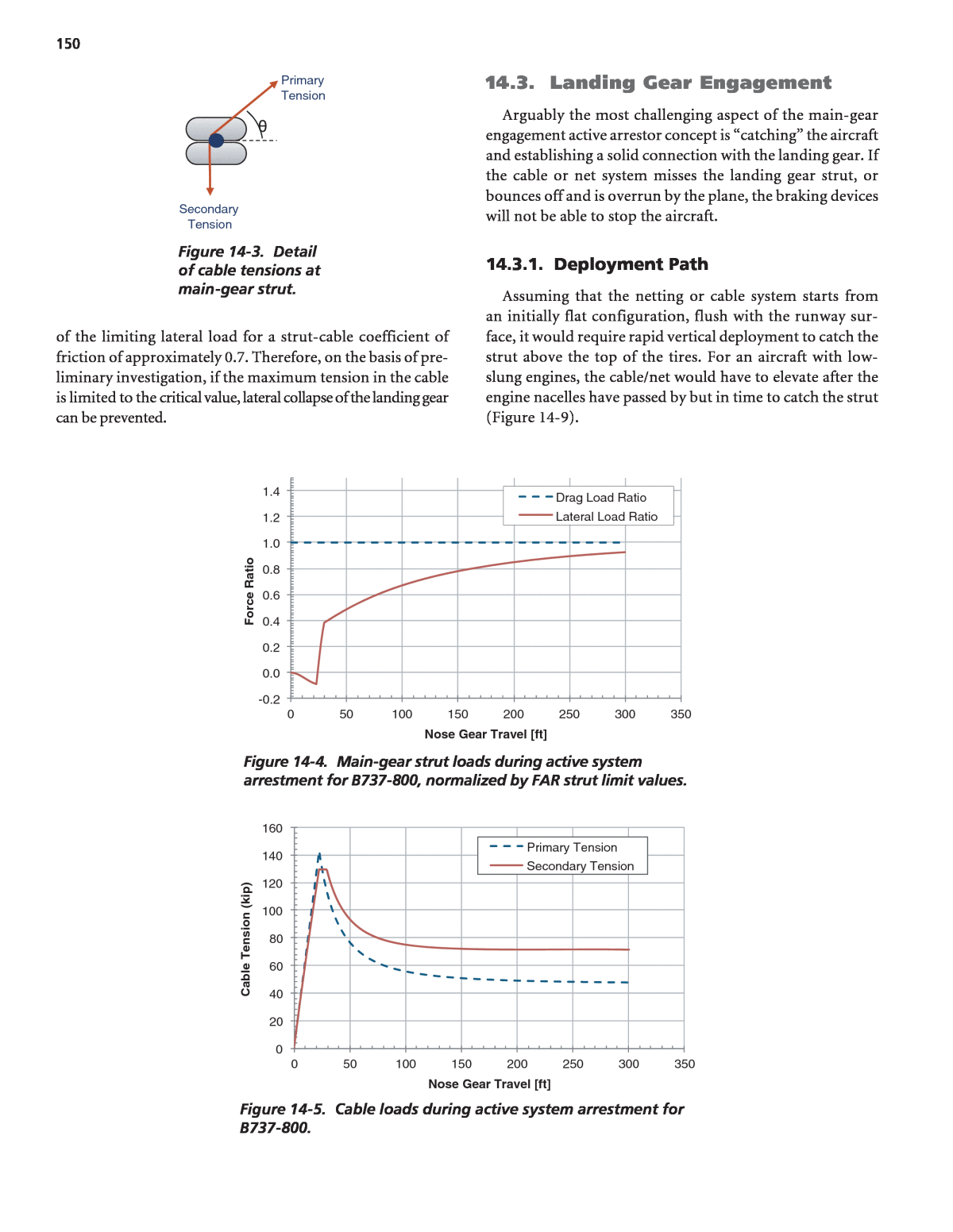
149 continually adjusted to maintain the total overall load. This was done dynamically during an arrest to simulate an active feedback control for the arrestor system. Because the deceleration was designed to maximize the drag loading on the main gear, a fairly low coefficient of friction (μ = 0.3) was used between the main strut and the cable. With this configuration, the strut loads were calcu- lated to be as shown in Figure 14-4. The struts are loaded maximally in the longitudinal (drag) direction, and the lat- eral strut loads climb steadily until the end of the arrest- ment. If the friction between the strut and the cable is higher, the lateral load becomes the limiting factor, and the cable tension must be reduced, lengthening the stopping process. For the B737-800, the cable tensions are given by Figure 14-5. For the 140 kip tension shown, the cable would need to be composed of high-strength steel with a diameter of 1.4 in. or more, depending on strength. This cable size presents compli- cations, especially when dealing with large and small aircraft. Strong decelerations of a large aircraft will require a thick, heavy cable. When a small aircraft is arrested by such a system, the weight of the cable itself could be sufficient to cause dam- age to the landing gear. The aircraft speed and deceleration are shown in Figure 14-6 and Figure 14-7, respectively. This deceleration essentially represents a best-case solution for the aircraft, assuming the longitudinal FAR limit load criterion for the main gear. As Figure 14-7 shows, the system concept is capable of providing ideal constant decelerations. 14.2.3. Additional Friction Study Simulations were conducted to determine whether, for a typical arrest case, the lateral load on the landing gear would reach a limiting value. Preliminary simulations showed that if the maximum tension in the cable were kept below a critical value, the lateral load on the landing gear remained below the limiting lateral load implied by FAR Section 25.485. For a braking coefficient of 0.25 and no reverse thrust, sim- ulations were run for a B737-800 in which the strut-cable coefficient of friction was varied and the maximum lateral load on the landing gear was recorded. These maximum lateral loads were normalized by the limiting lateral load. As shown in Figure 14-8, the maximum lateral load nearly reached 90% Figure 14-1. B737-800 main landing gear and aircraft engine (42). Input Variables Output Responses Geometry ⢠Distance between brake units ⢠Slack in cable Maximum tension in cable Coefficient of friction between strut and cable Aircraft type (B737-800) ⢠Limiting lateral load ⢠Limiting longitudinal load Aircraft braking condition ⢠Braking ⢠Free-rolling Stopping distance Max lateral load Max longitudinal load Table 14-1. Cable-based arrestor model parameters. Primary Tension Primary Tension Landing Gear Braking Unit Braking Unit Figure 14-2. Cable-based aircraft arrestment.
150 14.3. Landing Gear Engagement Arguably the most challenging aspect of the main-gear engagement active arrestor concept is âcatchingâ the aircraft and establishing a solid connection with the landing gear. If the cable or net system misses the landing gear strut, or bounces off and is overrun by the plane, the braking devices will not be able to stop the aircraft. 14.3.1. Deployment Path Assuming that the netting or cable system starts from an initially flat configuration, flush with the runway sur- face, it would require rapid vertical deployment to catch the strut above the top of the tires. For an aircraft with low- slung engines, the cable/net would have to elevate after the engine nacelles have passed by but in time to catch the strut (Figure 14-9). Primary Tension Secondary Tension Figure 14-3. Detail of cable tensions at main-gear strut. -0.2 0.0 0.2 0.4 0.6 0.8 1.0 1.2 1.4 0 50 100 150 200 250 300 350 Fo rc e R at io Nose Gear Travel [ft] Drag Load Ratio Lateral Load Ratio Figure 14-4. Main-gear strut loads during active system arrestment for B737-800, normalized by FAR strut limit values. 0 50 100 150 200 250 300 350 Nose Gear Travel [ft] 0 20 40 60 80 100 120 140 160 Ca bl e Te ns io n (ki p) Primary Tension Secondary Tension Figure 14-5. Cable loads during active system arrestment for B737-800. of the limiting lateral load for a strut-cable coefficient of friction of approximately 0.7. Therefore, on the basis of pre- liminary investigation, if the maximum tension in the cable is limited to the critical value, lateral collapse of the landing gear can be prevented.
151 0 10 20 30 40 50 60 70 80 A irc ra ft Sp ee d (kn ot s) Aircraft Speed 0 50 100 150 200 250 300 350 Nose Gear Travel [ft] Figure 14-6. Aircraft speed during active system arrestment for B737-800. -0.2 0.0 0.2 0.4 0.6 0.8 1.0 0 50 100 150 200 250 300 350 D ec el er at io n (g ) Nose Gear Travel [ft] Deceleration Figure 14-7. Deceleration during active system arrestment for B737-800. 0.0 0.1 0.2 0.3 0.4 0.5 0.6 0.7 0.8 0.9 1.0 0.0 0.1 0.2 0.3 0.4 0.5 0.6 0.7 0.8 0.9 1.0 N or m al iz ed L at er al L oa d Strut-Cable Coefficient of Friction Braking Coefficient = 0.25 R/T = 0 Figure 14-8. Dependence of lateral load on strut-cable coefficient of friction.
152 Assuming that the aircraft would be rolling forward at 70 knots, the necessary deployment timing was calculated. Because the aircraftâs lateral location with respect to the run- way centerline could vary, it was assumed that the cable for the system would be elevated uniformly across the entire run- way width. The test aircraft in this case was a B737-800. Using manufac- turer-published dimensions, the required cable path is given in Figure 14-10. The illustration gives an upper and lower bound- ary to the cable path, as well as an optimal path. The path appears sloped because the aircraft is moving forward relative to the cable location. However, the calculations assume that the cable moves directly upward from its location on the runway. 14.3.2. Deployment Timing Table 14-2 summarizes the timing and speed requirements for the deployment. The time to launch is essentially the delay in deployment after the nose wheel passes the arrestor cable. The tolerance shows that the initialization of the deploy- ment must take place within about 8 milliseconds of the tar- geted time. Overall, the velocities and timing tolerances in this example are feasible for a mechanical design. For each aircraft, these values would be different, which would require that a deploy- ment system be capable of identifying the aircraft type. It would then need to make a timing determination based on a database of aircraft information. One important feature of these calculations is the upward velocity, which would be nominally 40 ft/sec (27 mph) on ini- tialization, and nearly that fast on contact with the strut. This means that the cable would still be moving upward. Depend- ing on the nature of the mechanical deployment system, slack in the cable combined with the upward motion could cause it to slap against the bottom of the aircraft and the landing gear bay doors. Location of Arrestor Cable/Net at Initial Deployment Target Point: On Strut Above Tire By the Time of Main Strut Arrival, Cable/Net has Moved Vertically to Target Point Figure 14-9. Cable deployment concept (42). 0 5 10 15 20 25 30 35 40 45 50 -100 -80 -60 -40 -20 0 Horizontal Distance (in) Lower Bound Optimal Launch Upper Bound Plane Bottom Vertical Distance (in) Figure 14-10. Path calculation plot for active system B737 landing gear capture.
153 14.3.3. Landing Gear Features One of the more problematic issues with this concept is the varied nature of main landing gear features for different aircraft. On the main struts of many passenger aircraft, a variety of smaller hydraulic, electrical, and mechanical com- ponents are exposed on the front and outboard sides of the struts. If the struts of these aircraft were engaged with a cable or net and subjected to substantial load, these compo- nents would likely be damaged. In the case of some aircraft, such as the A380, which has a secondary strut forward of the main-gear strut, cable engagement could result in structural failure of the main-gear assembly. Although it is possible that engagement geometries could be developed that reduce the risk of structural damage to the landing gear, some degree of damage to the gear is likely under any arresting conditions. 14.3.4. Infeasible Aircraft During the investigation, it became apparent that some aircraft would not have a deployment path solution as that discussed in Section 14.3.1. Figure 14-11 shows that the shorter B737-200 has engine locations that preclude engag- ing the target point on the strut. Although a broad survey of infeasible aircraft was not undertaken, this case illustrates that there would be at least some aircraft for which this arrestor concept would not work. 14.4. Summary The main-gear engagement active system concept offered multiple advantages not available in surface-based arrestor beds. Feedback control offered the potential for ideal decel- eration of aircraft. The friction brakes could adjust auto- matically to apply less load on a small plane than a large one, enabling one arrestor to treat all aircraft equally. The overall effect of these advantages would be shorter arrest- ing distances for the entire design fleet of aircraft. The load calculations undertaken confirm that the essen- tial mechanics for the arrestor system would function as anticipated. Tension regulation in the cable would be essen- tial to prevent lateral overloading of the landing gear toward the end of the arrestment. Despite these promising features, a number of complicat- ing issues remain for the active system concept: ⢠Aircraft identification and speed calculation would be required for the system to function correctly. Systems to accomplish both could likely be developed, although research of such facets has not yet been undertaken. ⢠Cable sizes are of concern because the thicker cables required for rapidly arresting large planes could be heavy enough to damage smaller ones. ⢠The cable engagement process would likely result in dam- age to landing gear doors, actuators, wiring, and hydraulic features on the front side of the main struts. ⢠The window of time for deploying the system could be nar- row when the aircraft has low-slung engines because the vertical path of the cable or net must miss the engine nacelles yet engage the main strut above the tires. ⢠Due to the longitudinal overlap of the engines and main struts, some aircraft would not have a feasible solution Lower Bound Optimal Launch Upper Bound Time to Launch 50 ms 80 ms 110 ms Tolerance ±4.78 ms ±7.80 ms ±11.03 ms Initial Velocity 67.73 ft/s 42.33 ft/s 31.36 ft/s Tolerance ±3.08 ft/s ±2.71 ft/s ±2.22 ft/s Terminal Velocity 66.12 ft/s 39.75 ft/s 27.82 ft/s Table 14-2. Path calculation data for active system B737-800 landing gear capture. Infeasible Geometry: Target Point Blocked by Engine Figure 14-11. Infeasible geometry for landing gear engagement: B737-200.
154 path for cable deployment. These aircraft could not be engaged and arrested by a main-gear cable/net system. For these reasons, the active system approach is feasible for stopping aircraft, but the main-gear engagement concept should perhaps be eliminated from consideration. Barrier net systems have been developed in the past, and they may still offer the best overall engagement approach. Past activation issues for the nets could be resolved using automation con- cepts as discussed, thereby eliminating the need for direct triggering by airport personnel. However, potential obstruc- tion of aircraft exits and damage to the aircraft continue to remain obstacles to implementation.
