



Below is the uncorrected machine-read text of this chapter, intended to provide our own search engines and external engines with highly rich, chapter-representative searchable text of each book. Because it is UNCORRECTED material, please consider the following text as a useful but insufficient proxy for the authoritative book pages.
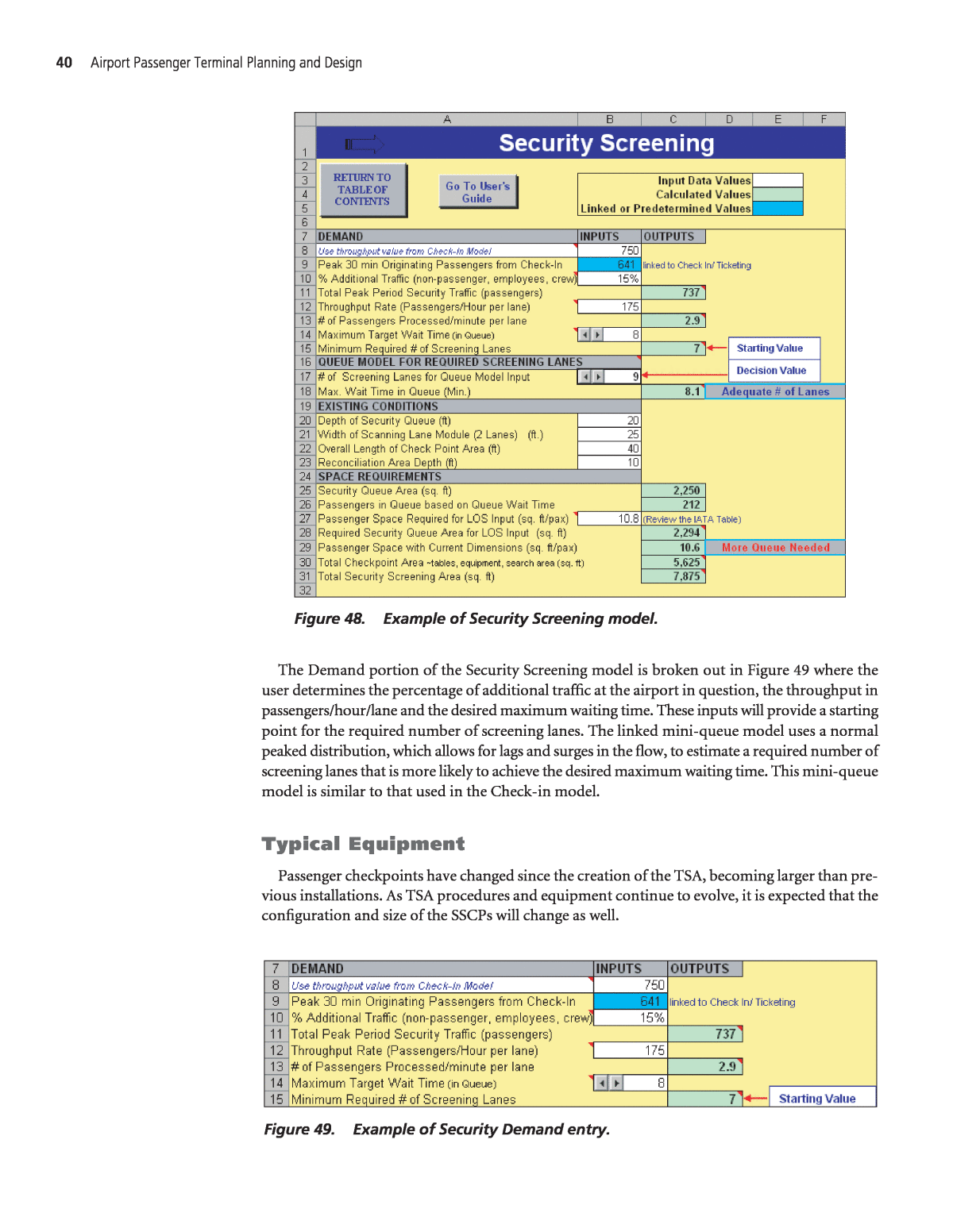
Security screening requirements for passengers are subject to FAA/TSA regulations and the level of security may be changed by FAA directive if unusual levels of threat are perceived. When specific direction or counsel is needed, requests must be made directly to TSA. The Security Screening model is designed to provide a view of the passenger experience in the queue in relation to wait times and queue area. The user defines the processing rates and number of lanes, and inputs the existing or desired screening lane dimensions and queue dimensions. Figure 48 is a screenshot of the model. The cells are color-coded in the same manner as the other models in the spreadsheet. The user makes the inputs into the white cells and can perform a sensitivity analysis of the screening process by adjusting the inputs and observing the changes to the wait times and passenger space values. Additional information about the inputs or calculations in the user cells is provided by way of cell comments that will pop up when the userâs cursor is placed over the cell. Estimating Demand Processing rates for security screening checkpoints (SSCP) have been observed to vary signif- icantly at different sized airports with rates ranging from approximately 100 passengers per hour per lane to over 200 passengers per hour per lane. A lane is typically a walk-through metal detector (WTMD) plus an X-ray machine for carry-on bags. Based on current TSA procedures requiring passengers to remove computers and some other electronics from passenger bags, to remove their shoes, etc., the bag X-ray machine usually determines the capacity of the SSCP. A combination of two X-ray machines paired with a single WTMD for better TSA staff utilization is currently the preferred configuration. Passenger characteristics typically determine the SSCP throughput, with less frequent travelers (who are unfamiliar with TSA rules and procedures) taking longer than frequent flyers. Changing TSA rules (such as the ban on liquids and gels) can also slow down processing rates until all passengers become familiar with new procedures. It is very important that each airport measure its average processing rates during different seasons and times of day to determine a reasonable range of rates to use for planning. It is also recommended that actual throughputs be observed rather than relying on TSA hourly WTMD counts. These counts will overstate the passenger throughput as it counts each person who passes through the WTMD, including TSA officers and passengers who set off the alarm and are allowed to take off probable metal items and walk through again. The TSA also collects alarm rates for each WTMD. These alarm rates tend to vary depending upon the mix of passengers at the checkpoint. 39 Security Screening Model
The Demand portion of the Security Screening model is broken out in Figure 49 where the user determines the percentage of additional traffic at the airport in question, the throughput in passengers/hour/lane and the desired maximum waiting time. These inputs will provide a starting point for the required number of screening lanes. The linked mini-queue model uses a normal peaked distribution, which allows for lags and surges in the flow, to estimate a required number of screening lanes that is more likely to achieve the desired maximum waiting time. This mini-queue model is similar to that used in the Check-in model. Typical Equipment Passenger checkpoints have changed since the creation of the TSA, becoming larger than pre- vious installations. As TSA procedures and equipment continue to evolve, it is expected that the configuration and size of the SSCPs will change as well. 40 Airport Passenger Terminal Planning and Design Figure 48. Example of Security Screening model. Figure 49. Example of Security Demand entry.
As of this writing (2009), a standard SSCP contains five major components (See Figure 50): ⢠X-ray for carry-on bags ⢠Walk-through metal detector (WTMD) ⢠A search area for passengers who set off the WTMD ⢠Explosives Trace Detection (ETD) for checking bags ⢠Whole Body Image (WBI) Additional equipment that has been tested in the recent past includes a separate X-ray for shoes, passenger ETD portals (âpuffersâ), WBI, and other equipment currently undergoing testing. The TSAâs ultimate goal is to have fewer pieces of equipment with better capabilities to speed up passenger processing. However, it is also likely that SSCPs will become larger and slower before they reduce in size and become faster. A typical standard configuration has one X-ray for each WTMD and is approximately 25 feet wide for a pair of lanes. At some airports, a different configuration consisting of two X-rays for one WTMD has been installed. This can result in a slightly narrower footprint. Non-standard configu- rations are also used where physical constraints do not allow a typical line of inspection lanes. Additional width may be associated with Americans with Disabilities Act (ADA) accessible lanes. The length of the SSCP varies depending on a number of factors, but is primarily related to the length of the divestment tables prior to the X-ray for passengers to unpack laptop comput- ers, take off jackets and shoes, and remove metal objects from pockets. Similarly the length of roller beds and collection tables and seats after the SSCP, to put clothing back on, and re-pack bags can vary. Airports are experimenting with these functions and there is no standard for these tables at present. Forty feet is considered an absolute minimum length for an SSCP. TSA recom- mends a 60-foot length since the longer length increases checkpoint throughput. Security Screening Model 41 Source: Checkpoint Design Guide (CDG), Revision 1, February 11, 2009, Transportation Security Administration Figure 50. SSCP equipment configurations.
It is recommended that planners coordinate with the TSA on current equipment and procedures at the time of design. However, flexibility to re-configure SSCPs should be a goal. In the next section of the model, the user selects and inputs the current configuration and dimensions of the security screening and queuing area. Figure 51 is taken from the model and shows how the user can adjust the number of screening lanes being used in the mini-queue model to see the impact on the maximum waiting time in the queue. The preliminary calculation for the number of required screening lanes in Row 15 (as shown in Figure 49) was determined by opti- mizing the process potential, and thus the real number of screening lanes must be greater, with time lost during periods of flow that are below the process capability. Queuing The size of the passenger queue area prior to the inspection lanes will be determined by the number of passengers anticipated to be in the queue at peak times. Serpentine queues are rec- ommended. The width of the queue lines is recommended to be a minimum of 4 feet, with 5 feet to allow traveling parties to stand next to each other. The last section of the model (as represented in Figure 52) looks at the queuing area and deter- mines the passenger space within the queue. A pop-up IATA Table (Figure 53) is included for the user to adjust the area per passenger LOS and see the required changes to the dimension of the queue. By making adjustments and performing a sensitivity analysis, the user can better understand how to use the space and configuration available to provide their passengers with the LOS that is desired. Total checkpoint area and total security screening area are also calculated for future comparison of space/passenger values with other airports. 42 Airport Passenger Terminal Planning and Design Figure 51. Existing Conditions and Queue model. Figure 52. Example of queuing area in model. Figure 53. Pop-up of IATA space standards.
