


Below is the uncorrected machine-read text of this chapter, intended to provide our own search engines and external engines with highly rich, chapter-representative searchable text of each book. Because it is UNCORRECTED material, please consider the following text as a useful but insufficient proxy for the authoritative book pages.
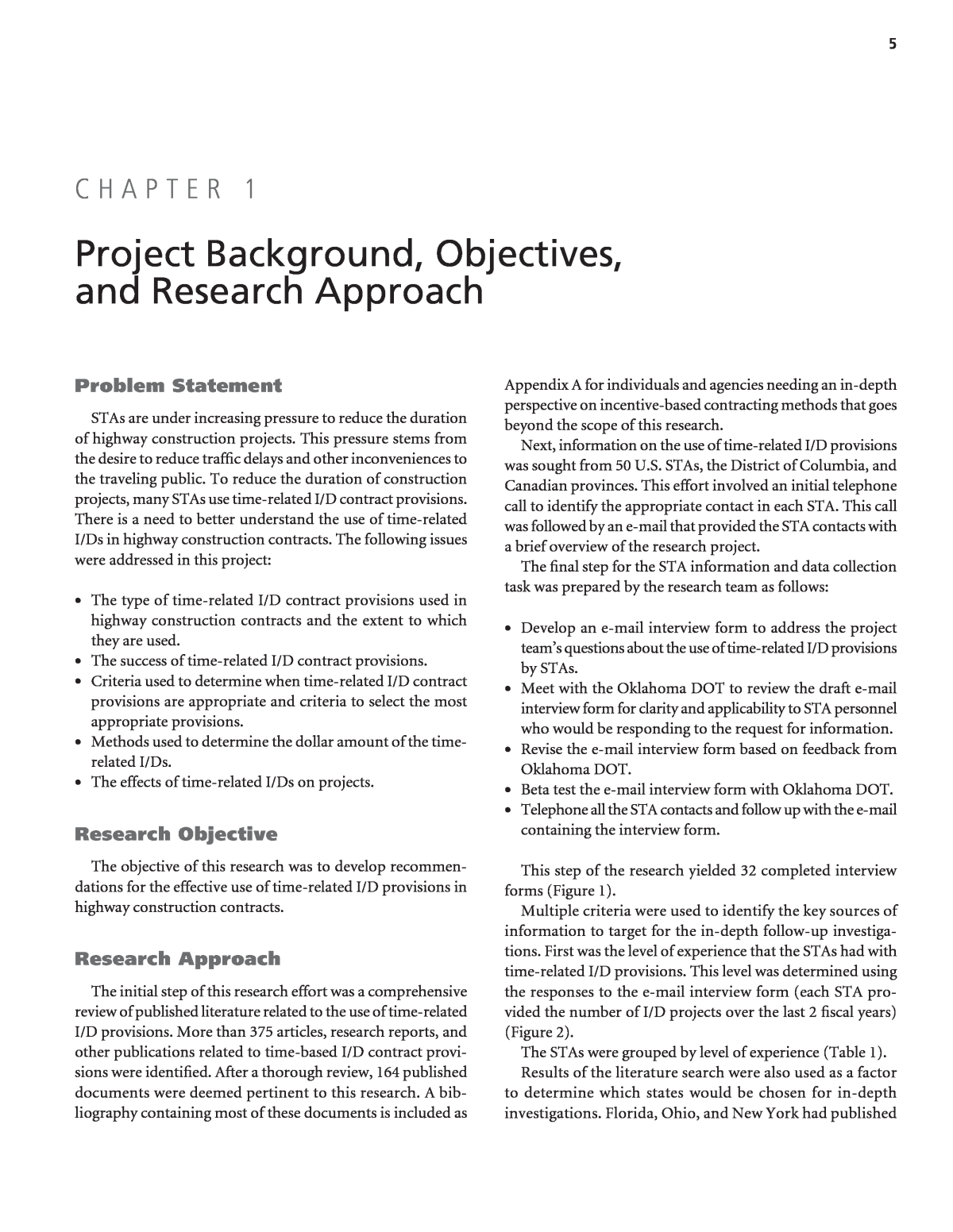
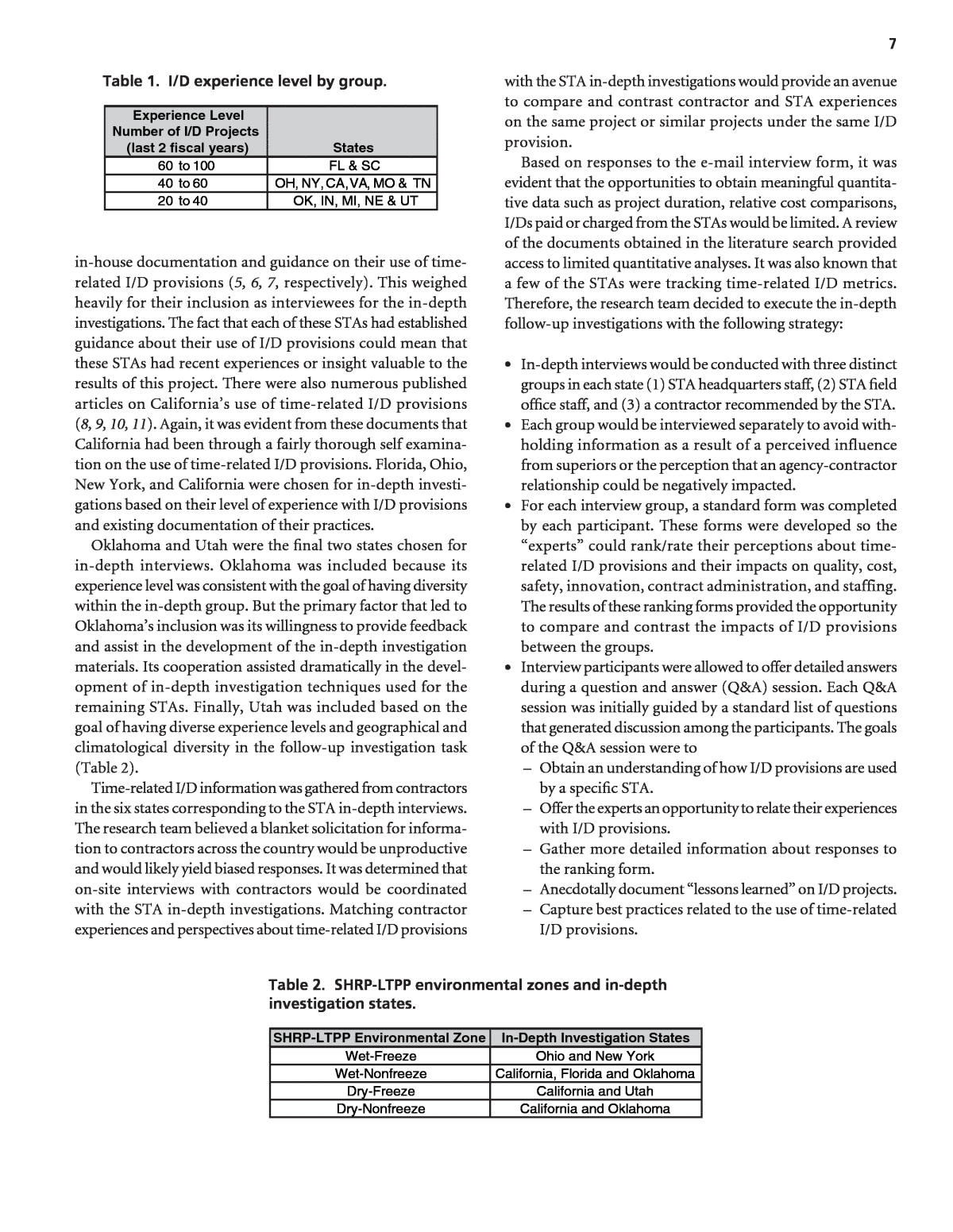
5Problem Statement STAs are under increasing pressure to reduce the duration of highway construction projects. This pressure stems from the desire to reduce traffic delays and other inconveniences to the traveling public. To reduce the duration of construction projects, many STAs use time-related I/D contract provisions. There is a need to better understand the use of time-related I/Ds in highway construction contracts. The following issues were addressed in this project: ⢠The type of time-related I/D contract provisions used in highway construction contracts and the extent to which they are used. ⢠The success of time-related I/D contract provisions. ⢠Criteria used to determine when time-related I/D contract provisions are appropriate and criteria to select the most appropriate provisions. ⢠Methods used to determine the dollar amount of the time- related I/Ds. ⢠The effects of time-related I/Ds on projects. Research Objective The objective of this research was to develop recommen- dations for the effective use of time-related I/D provisions in highway construction contracts. Research Approach The initial step of this research effort was a comprehensive review of published literature related to the use of time-related I/D provisions. More than 375 articles, research reports, and other publications related to time-based I/D contract provi- sions were identified. After a thorough review, 164 published documents were deemed pertinent to this research. A bib- liography containing most of these documents is included as Appendix A for individuals and agencies needing an in-depth perspective on incentive-based contracting methods that goes beyond the scope of this research. Next, information on the use of time-related I/D provisions was sought from 50 U.S. STAs, the District of Columbia, and Canadian provinces. This effort involved an initial telephone call to identify the appropriate contact in each STA. This call was followed by an e-mail that provided the STA contacts with a brief overview of the research project. The final step for the STA information and data collection task was prepared by the research team as follows: ⢠Develop an e-mail interview form to address the project teamâs questions about the use of time-related I/D provisions by STAs. ⢠Meet with the Oklahoma DOT to review the draft e-mail interview form for clarity and applicability to STA personnel who would be responding to the request for information. ⢠Revise the e-mail interview form based on feedback from Oklahoma DOT. ⢠Beta test the e-mail interview form with Oklahoma DOT. ⢠Telephone all the STA contacts and follow up with the e-mail containing the interview form. This step of the research yielded 32 completed interview forms (Figure 1). Multiple criteria were used to identify the key sources of information to target for the in-depth follow-up investiga- tions. First was the level of experience that the STAs had with time-related I/D provisions. This level was determined using the responses to the e-mail interview form (each STA pro- vided the number of I/D projects over the last 2 fiscal years) (Figure 2). The STAs were grouped by level of experience (Table 1). Results of the literature search were also used as a factor to determine which states would be chosen for in-depth investigations. Florida, Ohio, and New York had published C H A P T E R 1 Project Background, Objectives, and Research Approach
6STA Interview Responses Figure 1. Province and states responding to the time-related I/D e-mail interview. 100 65 56 53 50 50 43 40 39 24 24 20 20 16 15 13 10 7 7 7 6 6 5 4 3 3 3 2 2 1 0 20 40 60 80 100 120 FL SC OH NY CA VA MO TN OK IN MI NE UT AR MN VT PA DE GA LA IA MD ND OR CO KS NV ID ME RI TX ON N u m be r o f P ro jec ts State Transportation Agency Figure 2. Number of I/D projects by STA (last 2 fiscal years).
in-house documentation and guidance on their use of time- related I/D provisions (5, 6, 7, respectively). This weighed heavily for their inclusion as interviewees for the in-depth investigations. The fact that each of these STAs had established guidance about their use of I/D provisions could mean that these STAs had recent experiences or insight valuable to the results of this project. There were also numerous published articles on Californiaâs use of time-related I/D provisions (8, 9, 10, 11). Again, it was evident from these documents that California had been through a fairly thorough self examina- tion on the use of time-related I/D provisions. Florida, Ohio, New York, and California were chosen for in-depth investi- gations based on their level of experience with I/D provisions and existing documentation of their practices. Oklahoma and Utah were the final two states chosen for in-depth interviews. Oklahoma was included because its experience level was consistent with the goal of having diversity within the in-depth group. But the primary factor that led to Oklahomaâs inclusion was its willingness to provide feedback and assist in the development of the in-depth investigation materials. Its cooperation assisted dramatically in the devel- opment of in-depth investigation techniques used for the remaining STAs. Finally, Utah was included based on the goal of having diverse experience levels and geographical and climatological diversity in the follow-up investigation task (Table 2). Time-related I/D information was gathered from contractors in the six states corresponding to the STA in-depth interviews. The research team believed a blanket solicitation for informa- tion to contractors across the country would be unproductive and would likely yield biased responses. It was determined that on-site interviews with contractors would be coordinated with the STA in-depth investigations. Matching contractor experiences and perspectives about time-related I/D provisions with the STA in-depth investigations would provide an avenue to compare and contrast contractor and STA experiences on the same project or similar projects under the same I/D provision. Based on responses to the e-mail interview form, it was evident that the opportunities to obtain meaningful quantita- tive data such as project duration, relative cost comparisons, I/Ds paid or charged from the STAs would be limited. A review of the documents obtained in the literature search provided access to limited quantitative analyses. It was also known that a few of the STAs were tracking time-related I/D metrics. Therefore, the research team decided to execute the in-depth follow-up investigations with the following strategy: ⢠In-depth interviews would be conducted with three distinct groups in each state (1) STA headquarters staff, (2) STA field office staff, and (3) a contractor recommended by the STA. ⢠Each group would be interviewed separately to avoid with- holding information as a result of a perceived influence from superiors or the perception that an agency-contractor relationship could be negatively impacted. ⢠For each interview group, a standard form was completed by each participant. These forms were developed so the âexpertsâ could rank/rate their perceptions about time- related I/D provisions and their impacts on quality, cost, safety, innovation, contract administration, and staffing. The results of these ranking forms provided the opportunity to compare and contrast the impacts of I/D provisions between the groups. ⢠Interview participants were allowed to offer detailed answers during a question and answer (Q&A) session. Each Q&A session was initially guided by a standard list of questions that generated discussion among the participants. The goals of the Q&A session were to â Obtain an understanding of how I/D provisions are used by a specific STA. â Offer the experts an opportunity to relate their experiences with I/D provisions. â Gather more detailed information about responses to the ranking form. â Anecdotally document âlessons learnedâ on I/D projects. â Capture best practices related to the use of time-related I/D provisions. 7 Experience Level Number of I/D Projects (last 2 fiscal years) States 60 to 100 FL & SC 40 to 60 OH, NY, CA, VA, MO & TN 20 to 40 OK, IN, MI, NE & UT Table 1. I/D experience level by group. SHRP-LTPP Environmental Zone In-Depth Investigation States Wet-Freeze Ohio and New York Wet-Nonfreeze California, Florida and Oklahoma Dry-Freeze California and Utah Dry-Nonfreeze California and Oklahoma Table 2. SHRP-LTPP environmental zones and in-depth investigation states.
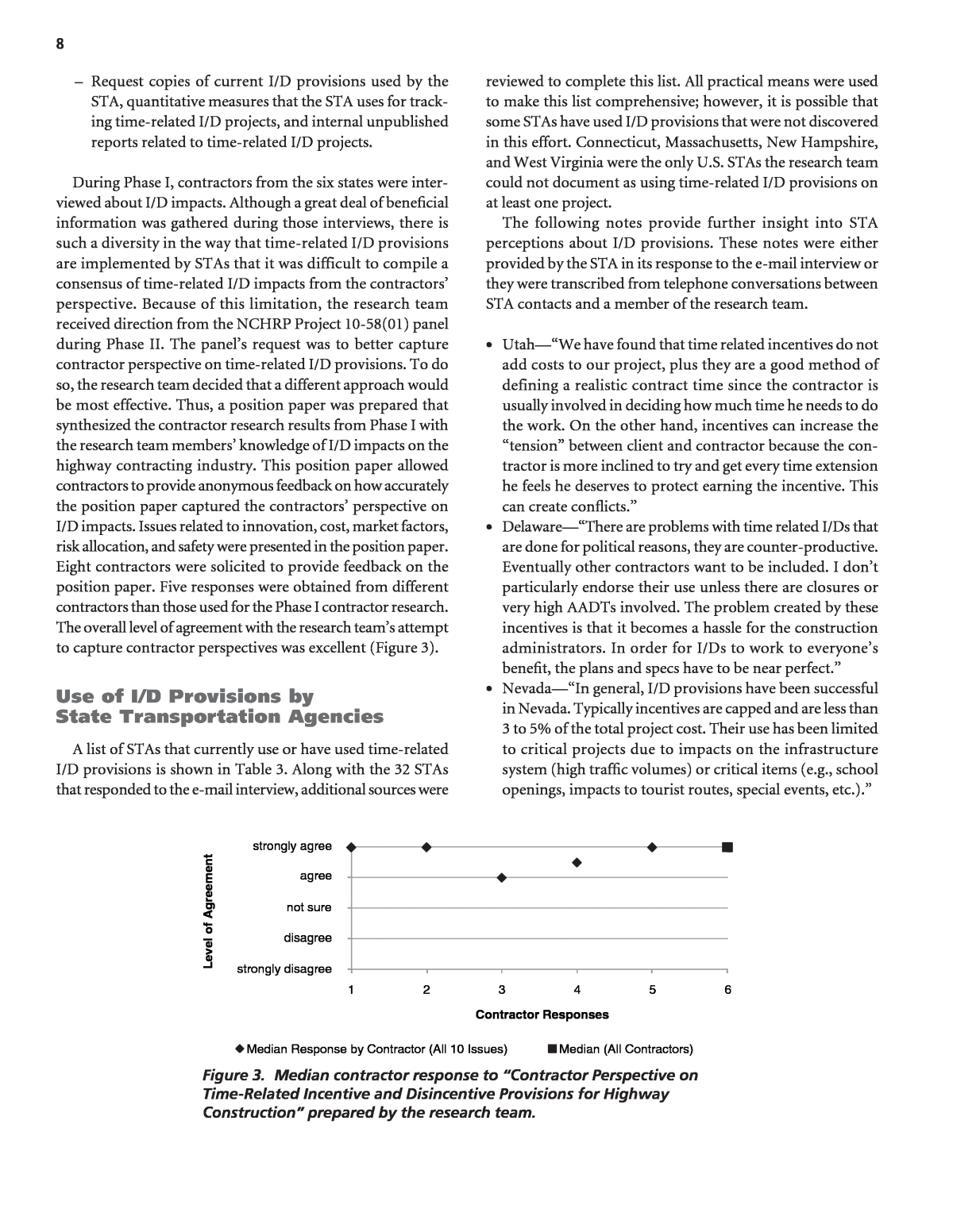
â Request copies of current I/D provisions used by the STA, quantitative measures that the STA uses for track- ing time-related I/D projects, and internal unpublished reports related to time-related I/D projects. During Phase I, contractors from the six states were inter- viewed about I/D impacts. Although a great deal of beneficial information was gathered during those interviews, there is such a diversity in the way that time-related I/D provisions are implemented by STAs that it was difficult to compile a consensus of time-related I/D impacts from the contractorsâ perspective. Because of this limitation, the research team received direction from the NCHRP Project 10-58(01) panel during Phase II. The panelâs request was to better capture contractor perspective on time-related I/D provisions. To do so, the research team decided that a different approach would be most effective. Thus, a position paper was prepared that synthesized the contractor research results from Phase I with the research team membersâ knowledge of I/D impacts on the highway contracting industry. This position paper allowed contractors to provide anonymous feedback on how accurately the position paper captured the contractorsâ perspective on I/D impacts. Issues related to innovation, cost, market factors, risk allocation, and safety were presented in the position paper. Eight contractors were solicited to provide feedback on the position paper. Five responses were obtained from different contractors than those used for the Phase I contractor research. The overall level of agreement with the research teamâs attempt to capture contractor perspectives was excellent (Figure 3). Use of I/D Provisions by State Transportation Agencies A list of STAs that currently use or have used time-related I/D provisions is shown in Table 3. Along with the 32 STAs that responded to the e-mail interview, additional sources were reviewed to complete this list. All practical means were used to make this list comprehensive; however, it is possible that some STAs have used I/D provisions that were not discovered in this effort. Connecticut, Massachusetts, New Hampshire, and West Virginia were the only U.S. STAs the research team could not document as using time-related I/D provisions on at least one project. The following notes provide further insight into STA perceptions about I/D provisions. These notes were either provided by the STA in its response to the e-mail interview or they were transcribed from telephone conversations between STA contacts and a member of the research team. ⢠UtahââWe have found that time related incentives do not add costs to our project, plus they are a good method of defining a realistic contract time since the contractor is usually involved in deciding how much time he needs to do the work. On the other hand, incentives can increase the âtensionâ between client and contractor because the con- tractor is more inclined to try and get every time extension he feels he deserves to protect earning the incentive. This can create conflicts.â ⢠DelawareââThere are problems with time related I/Ds that are done for political reasons, they are counter-productive. Eventually other contractors want to be included. I donât particularly endorse their use unless there are closures or very high AADTs involved. The problem created by these incentives is that it becomes a hassle for the construction administrators. In order for I/Ds to work to everyoneâs benefit, the plans and specs have to be near perfect.â ⢠NevadaââIn general, I/D provisions have been successful in Nevada. Typically incentives are capped and are less than 3 to 5% of the total project cost. Their use has been limited to critical projects due to impacts on the infrastructure system (high traffic volumes) or critical items (e.g., school openings, impacts to tourist routes, special events, etc.).â 8 1 2 3 4 5 6 Le ve l o f A gr ee m en t Contractor Responses Median Response by Contractor (All 10 Issues) Median (All Contractors) strongly agree agree strongly disagree disagree not sure Figure 3. Median contractor response to âContractor Perspective on Time-Related Incentive and Disincentive Provisions for Highway Constructionâ prepared by the research team.
⢠Ontario, CanadaââThe Ministry of Transportation of Ontario generally does not use incentive/disincentive for contract completion. Instead we rely almost exclusively on Liquidated Damage provisions both for working day and completion date contracts. However, we do use incentive/ disincentive for many interim dates and time constraints, occasionally with multiple incentive/disincentive within the same contract. Example is attached; however we have many for many different situations.â ⢠KansasââDonât use incentives much because payment comes out of their general budget.â ⢠MarylandââBeen using for years but often loopholes.â Further details of the findings from this research project are provided throughout the report. Additionally, the I/D discussion and guidelines presented herein are the product of synthesizing information from published literature, research findings, and the researcher teamâs expertise. 9 State/Province Source State/Province Source Alabam a in ternet se ar ch Nebraska e-mail in te rv ie w fo rm Alaska te le ph on e co nt act Nevada e-mail in te rv ie w fo rm Ariz on a literature search (12) New Jersey literature search (13) Arkansa s e-mail in te rv ie w fo rm New Mexico literature search (13) Calif or ni a e-mail in te rv ie w fo rm New York e-mail in te rv ie w fo rm Col ora do e-mail in te rv ie w fo rm North Carolina literature search (13) Delaware e-mail in te rv ie w fo rm North Dakota e-mail in te rv ie w fo rm Florida e-mail in te rv ie w fo rm Ohio e-mail in te rv ie w fo rm Georgia e-mail in te rv ie w fo rm Oklahoma e-mail in te rv ie w fo rm Hawaii internet search Oregon e-mail in te rv ie w fo rm Idaho e-mail in te rv ie w fo rm Pennsylvania e-mail in te rv ie w fo rm Illinois literature search (13) Rhode Island e-mail in te rv ie w fo rm Indiana e-mail in te rv ie w fo rm South Carolina e-mail in te rv ie w fo rm Io wa e-mail in te rv ie w fo rm South Dakota literature search (13) Kansas e-mail in te rv ie w fo rm Tennessee e-mail in te rv ie w fo rm Kentucky literature search (13) Texas e-mail in te rv ie w fo rm Louisiana e-mail in te rv ie w fo rm Ut ah e-mail in te rv ie w fo rm Maine e-mail in te rv ie w fo rm Ver mo nt e-mail in te rv ie w fo rm Maryland e-mail in te rv ie w fo rm Vi rg in ia e-mail in te rv ie w fo rm Michigan e-mail in te rv ie w fo rm Washington literature search (14) Minnesota e-mail in te rv ie w fo rm Wisconsin literature search (13) Mississippi literature search (13) Wy om in g literature search (15) Missouri e-mail in te rv ie w fo rm District of Columbia te le ph on e co nt act Montana in ternet search Ontario, Canada e-mail in te rv ie w fo rm Table 3. States and province with documented use of time-related I/D provisions (June 2007).
