



Below is the uncorrected machine-read text of this chapter, intended to provide our own search engines and external engines with highly rich, chapter-representative searchable text of each book. Because it is UNCORRECTED material, please consider the following text as a useful but insufficient proxy for the authoritative book pages.
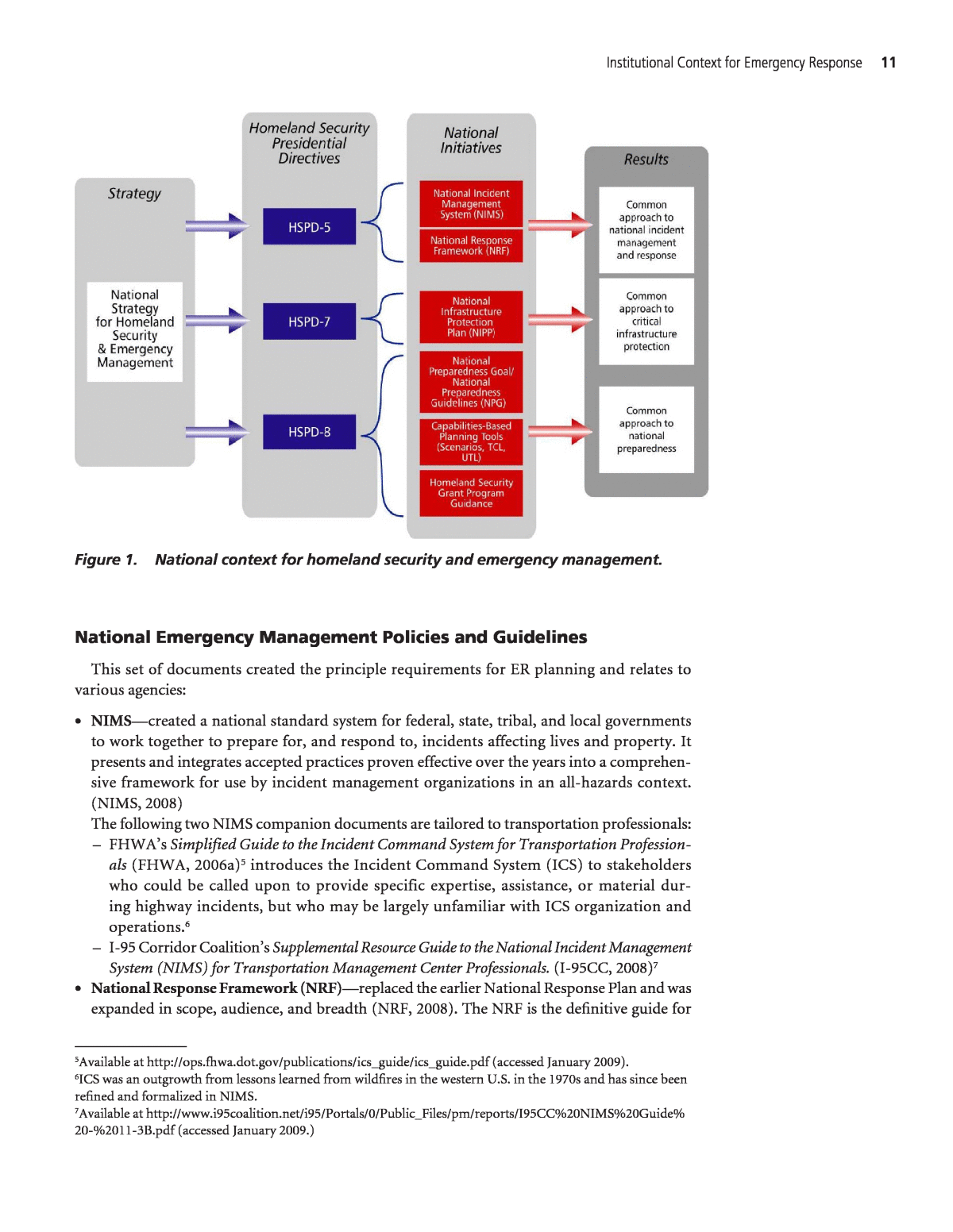
10 Emergency Response Authorities At the federal level, public laws are the governing authorities for other directives, policies, and guidance. Figure 1 illustrates this relationship. Public Laws Governing Homeland Security and Emergency Management The key laws implementing Homeland Security policy are as follows (see Appendix B for more details): ⢠Homeland Security Act of 2002 (6 U.S.C. 101), ⢠Robert T. Stafford Disaster Relief and Emergency Assistance Act (42 U.S.C. 5122), ⢠USA PATRIOT Act of 2001 (42 U.S.C. 5195c[e]), and ⢠Emergency Management Assistance Compact (EMAC) (PL-104-321, 1996).4 Numerous other laws are cited as authorities for various Homeland Security Presidential Directives (HSPDs) and other policy documents, but the four identified above are the key ones. The List of Authorities and References component of the National Response Framework (NRF, 2008) provides a more complete list. Homeland Security Presidential Directives The HSPDs are directive in nature and must be implemented in other formats, generally policy documents and/or guidelines. The requirements of these directives and implementing mechanisms are voluntary to state, territorial, tribal, and local governments (but note that typically the entity must comply to qualify for federal disaster relief compensation). Indeed, the HSPDs provide spe- cific schedules for incremental compliance. The three relevant HSPDs are as follows: ⢠HSPD-5, Management of Domestic Incidentsâcreated the National Incident Management System and the National Response Plan (the latter was later replaced by the National Response Framework), as shown in Figure 1. ⢠HSPD-7, Infrastructure Identification, Prioritization, and Protectionâled to the National Infrastructure Protection Plan (NIPP). ⢠HSPD-8, National Preparednessâled to creation of a National Preparedness Goal, which was implemented in the form of the National Preparedness Guidelines (NPG) document and several other guidelines. S E C T I O N 2 Institutional Context for Emergency Response 4For more information on EMAC, see (EMAC, 2008) and (NEMA, 2008).
National Emergency Management Policies and Guidelines This set of documents created the principle requirements for ER planning and relates to various agencies: ⢠NIMSâcreated a national standard system for federal, state, tribal, and local governments to work together to prepare for, and respond to, incidents affecting lives and property. It presents and integrates accepted practices proven effective over the years into a comprehen- sive framework for use by incident management organizations in an all-hazards context. (NIMS, 2008) The following two NIMS companion documents are tailored to transportation professionals: â FHWAâs Simplified Guide to the Incident Command System for Transportation Profession- als (FHWA, 2006a)5 introduces the Incident Command System (ICS) to stakeholders who could be called upon to provide specific expertise, assistance, or material dur- ing highway incidents, but who may be largely unfamiliar with ICS organization and operations.6 â I-95 Corridor Coalitionâs Supplemental Resource Guide to the National Incident Management System (NIMS) for Transportation Management Center Professionals. (I-95CC, 2008)7 ⢠National Response Framework (NRF)âreplaced the earlier National Response Plan and was expanded in scope, audience, and breadth (NRF, 2008). The NRF is the definitive guide for Institutional Context for Emergency Response 11 Figure 1. National context for homeland security and emergency management. 5Available at http://ops.fhwa.dot.gov/publications/ics_guide/ics_guide.pdf (accessed January 2009). 6ICS was an outgrowth from lessons learned from wildfires in the western U.S. in the 1970s and has since been refined and formalized in NIMS. 7Available at http://www.i95coalition.net/i95/Portals/0/Public_Files/pm/reports/I95CC%20NIMS%20Guide% 20-%2011-3B.pdf (accessed January 2009.)
ER and delineates the nationâs response doctrines, responsibilities, and structures. It embraces NIMS and updates the Emergency Support Function (ESF) descriptions. There are several important companion documents to the NRF:8 â ESF Annexes define the stakeholders and their roles and responsibilities, purpose, capabil- ities, and concept of operations for the 15 ESFs. These are critical to effective ER planning; state/local versions adapted to state and local conditions are typically included in EOPs. â Support Annexes are a separate set of annexes that describe how federal departments and agencies; state, territorial, tribal, and local entities; the private sector; volunteer organiza- tions; and nongovernmental organizations (NGOs) coordinate and execute the common functional processes and administrative requirements for efficient and effective incident management. They may support several ESFs. â Incident Annexes are a separate set of annexes that describe the concept of operations to address specific contingency or hazard situations or an element of an incident requiring specialized application of the Framework. ⢠National Infrastructure Protection Plan (NIPP)âmeets HSPD-7, Infrastructure Identifica- tion, Prioritization, and Protection (DHS, 2006) requirements. The NIPP provides the coor- dinated approach used to establish national priorities, goals, and requirements for Critical Infrastructure and Key Resources (CI/KR) protection so that federal funding and resources are applied in the most effective manner to reduce vulnerability, deter threats, and minimize the consequences of attacks and other incidents. ⢠National Preparedness Guidelines (NPG)âimplements the National Preparedness Goal called out in HSPD-8, National Preparedness (NPG, 2007). It introduces a number of capabilities- based planning tools, including9 â National Planning Scenarios are a diverse set of 15 high-consequence threat scenarios for potential terrorist attacks and natural disasters that form the basis for coordinated federal planning, training, exercises, and grant investments needed to prepare for emer- gencies of all types. The scenarios include 12 chemical, biological, radiation, nuclear, and explosive weapons (CBRNE) threats; a cyber attack; a Category 5 hurricane; and an earthquake. â Target Capabilities List (TCL) defines 37 specific capabilities that communities, the private sector, nongovernment agencies, and all levels of government should collectively possess in order to respond effectively to disasters. â Universal Task List (UTL) is a series of 1,600 unique tasks that can facilitate efforts to pre- vent, protect against, respond to, and recover from the events represented by the National Planning Scenarios. It presents a common vocabulary and identifies key tasks that support development of essential capabilities among organizations at all levels. No entity will per- form every task. NOTE: These authoritiesâthe documents and their requirementsâare continually changing, some frequently, others over longer intervals. Results of the research teamâs 2008 survey of state transportation agencies show that 43% of respondents had difficulty keeping up with changing NIMS and National Response Plan/National Response Framework requirements from DHS. Even more (56%) indicated they had difficulty interpreting or understanding NIMS. 12 A Guide to Emergency Response Planning at State Transportation Agencies 8The following text was adapted from several Annex documents. The list of annexes is included in the Appen- dix K description of the NRF. 9Descriptions adapted from the NPG. The NPG components are security-sensitive and are not available on the public website. Appendix K discusses how homeland security and EM personnel can access secure documents.
National Transportation Policy There is considerable FHWA guidance on traffic incident management using an all-hazards approach. The following are two relevant transportation documents: ⢠The FHWA Manual on Uniform Traffic Control Devices (MUTCD). (MUTCD, 2003) The pri- mary purpose of the MUTCD is to establish standardized signing, markings, signaling, traffic con- trol for various facilities, and, more germane to this 2010 Guide, temporary traffic control devices. The relevance is that Chapter 6I of the MUTCD 2003 edition, âControl of Traffic Through Traf- fic Incident Management Areas,â requires that incident scenes must have maintenance of traffic (MOT), or temporary traffic control (TTC), as it is called in the MUTCD, deployed to ensure the safety of responders, victims, and the passing public. This applies to any incident that blocks any part of any roadway for more than 30 minutes, whether it is a traffic crash or other traffic inci- dent, or another natural or human-made incident that affects the roadway. ⢠National Unified Goal (NUG) for Traffic Incident Management.10 Unlike the foregoing doc- uments, the NUG is just thatâa goal, but one increasingly adopted by the TIM community and by EM responders, as appropriate. The NUG for TIM is â Responder Safety; â Safe, Quick Clearance; and â Prompt, Reliable, Interoperable Communications. The NUG for TIM was developed through a consensus process led by the National Traffic Inci- dent Management Coalition (NTIMC) and it has been endorsed by over 18 national organizations. The major goals above have 18 strategies for achieving those goals. The challenge is to propagate the National Unified Goal down from the national association level to practicing responders. The MUTCD is a transportation-agency document (required by law),11 but its requirements are not widely known in some public safety agencies. In the process of participating in EM/ER planning with their counterparts, state and other transportation agencies should educate their colleagues in these requirements. Organizations like NTIMC have been successful in educating other agencies at the association level, particularly through creation and adoption of the National Unified Goal. Institutional Architecture of Emergency Response Two contexts explain the institutional architecture of EM/ER: the authorities for EM/ER and the organizational relationships. Institutional Authority Context The underlying bases for this process are HSPD-5, -7, and -8. Figures 2 through 4 illustrate how DHS has implemented the three HSPDs. These documents are effectively mandatory for any agency wishing to receive Federal Disaster Relief funds. Many, if not all states have enacted legislation requiring the use of NIMS, and thus all other pertinent policies and guidelines within their states; this includes local governments. Institutional Context for Emergency Response 13 10Available at http://timcoalition.org/?siteid=41. 11The Highway Safety Act of 1966 decreed that traffic control devices on all streets and highways open to pub- lic travel in accordance with 23 U.S.C. 109(d) and 402(a) in each state shall be in substantial conformance with the Standards issued or endorsed by FHWA. Public Law 23 CFR 655.603 adopted the MUTCD as the national standard for any street, highway, or bicycle trail open to public travel in accordance with 23 U.S.C. 109(d) and 402(a). The Uniform Vehicle Code (UVC) is one of the publications referenced in the MUTCD. Adapted from MUTCD, 2003.
14 A Guide to Emergency Response Planning at State Transportation Agencies Figure 2. Implementation of HSPD-5, Management of Domestic Incidents. Figure 3. Implementation of HSPD-7, Infrastructure Identification, Prioritization, and Protection.
Figure 5 demonstrates how agencies can use the 2010 Guide in conjunction with CPG 101 to comply with federal policies and guidelines. The Guide provides a filter to help transportation agencies identify new or changed requirements for the EOP (EM and agency versions). Refer to CPG 101 for the actual updating steps. Emergency response planning is an ongoing process for state transportation agencies. The first pass through it, which most state transportation agencies have largely accomplished, is the most challenging. The remainder of this 2010 Guide thus focuses on the ER planning process itself. Agencies should recognize, however, that there will never be a perfect, all-encompassing EOP. Rather, the 2010 Guideâs primary intent is to help the agencies prioritize and implement their ER planning efforts. What is required is that the agencies, working together, be nimble to react to exigencies not expressly addressed in the EOP. The ability to adapt to a wide range of emer- gencies is probably more useful because the hazards/threat matrix is infinite, as are the turns an emergency can take as it unfolds. Organizational Context The state transportation agency is clearly an important player in the EM/ER arena. Table 1 summarizes the stakeholders. Appendix C further describes the roles and responsibilities of these entities. Guiding Principles The 2010 Guide is itself tempered by several overarching principles, or tenets, as follows: ⢠State transportation agencies should stay within principles of contemporary emergency man- agement thinking unless there is good reason to do otherwise. These principles include that the agency will â Play a support role to the State Emergency Management Agency (SEMA), play an active role in developing and exercising the State EOP, and should be the lead agency for ESF #1â Transportation and play a significant role in other ESFs; Institutional Context for Emergency Response 15 Figure 4. Implementation of HSPD-8, National Preparedness.
16 A Guide to Emergency Response Planning at State Transportation Agencies Figure 5. State transportation agency emergency response planning process using CPG 101.
Institutional Context for Emergency Response 17 Category Stakeholder U.S. Department of Transportation (U.S.DOT) Federal Highway Administration (FHWA) Federal Transit Administration (FTA) Other U.S.DOT modal administrations as appropriate Department of Homeland Security (DHS) Federal Emergency Management Agency (FEMA) Federal Agencies Transportation Security Administration (TSA) Other DHS security agencies as appropriate Regional Coalitions Ad hoc regional coalitions; see Appendix C for details State Transportation Agency or Territorial/Tribal Equivalent: Emergency Management Office Traffic Operations Office/ITS Section Planning Office Maintenance Office Safety Office Motor Vehicle Compliance Office State Emergency Management Agency (SEMA) State Patrol (SP) Department of Military or National Guard Department of Law Enforcement (DLE) Department of Environmental Protection (DEP) Emergency Operations Center (EOC) Intelligence Fusion Center (FC), also regional Joint Telecommunications Centers State, Territorial, and Tribal Agencies (including statewide authorities) Authorities, such as Expressway Authorities Emergency Management Agency (EMA), EOC, and Public Safety Answering Points (PSAPs) Law Enforcement (Police and Sheriffs) Fire/Rescue Local Agencies Emergency Medical Services (EMS) Medical Examiner/Coroner City and County Public Works and Traffic Engineering Transit Agencies (public or private, including school buses) Towing and Recovery Operators HAZMAT Contractors Asset Maintenance/Management Contractors Motor Carrier Companies Insurance Companies Private Partners Traffic Media Table 1. Emergency management stakeholders. (continued on next page)
â Have an agencywide emergency operations plan (which all agencies do not as yet have); â Ensure plans and procedures complement the stateâs overall emergency structure and plan(s); â Ensure plans adhere to an all-hazards approach; â Use the CPG 101 emergency management planning cycle (plan, prepare, respond, recover), and within that framework, prepare for specific response activities; and â Actively participate in Unified Command during incidents. ⢠Acknowledge that different state transportation agencies view their response roles differently and recognize these different perspectives and approaches. ⢠Recognize the need for transportation agencies to understand the basic concepts of the Inci- dent Command System (ICS), including Unified Command (UC), as defined in NIMS. ⢠Encourage transportation agencies to be full players within their state emergency management community and their role in providing the support needed for all applicable functions, partic- ipating actively in unified command, and participating in multi-agency communications and coordination. In most major incidents, the state transportation agency will fulfill a support role in the emergency response effort and receive direction from the state or some higher govern- ment authority. Using this 2010 Guide, a transportation agency can assess how well its existing agency proto- cols and procedures align with NIMS/NRF and within the context of transportation-accepted practices. Some of the issues addressed in the Guide include ⢠Part of the NIMS compliance regimen includes training. Do NIMS training requirements cover the needs of transportation agency responders? How should an agency training program be structured? ⢠What does NIMS compliance mean for state transportation agenciesâbeyond training? ⢠Transportation agencies operate within a complex of institutional relationships. How does an agency typically relate to, and interact with, other state agencies in an emergency, as well as with federal and local agencies? ⢠What are the response considerations between state transportation agencies in states that bor- der one another? Or for agencies in states that border Canada or Mexico? ⢠How do the different modal interests in state transportation agencies coordinate within the agency and with their modal clients? ⢠What is the role of headquarters versus the districts or other nonheadquarters offices when it comes to response? Are senior headquarters staff sufficiently briefed and trained to understand the agencyâs response roles and responsibilities? 18 A Guide to Emergency Response Planning at State Transportation Agencies Category Stakeholder Volunteer Organizations (see Appendix C for details) Automobile Associations Technical Societies (ITS State Chapter, State Section ITE) Associations of Cities, Counties, Sheriffs, Police, EMS, etc. Community/Corridor Traffic Safety Teams (CTSTs) Associations Chambers of Commerce Citizens for Better Transportation (state-by-state) Citizensâ Groups Other Organizations and People Individuals and Families Table 1. (Continued).
⢠Similarly, are the respective roles and responsibilities of the state/territorial/ tribal transportation agency vis-à -vis local agencies clearly defined and accounted for in state and agency EOCs? ⢠Is a transportation agencyâs public information program adequate for appropriate response? ⢠Is the state and transportation agency level of communications interoper- ability adequate? ⢠How does the response program relate to a broader emergency transporta- tion operations program or a traffic incident management program? ⢠Is evacuation/shelter-in-place/quarantine planning adequate? ⢠Is the response program properly correlated with the need to protect the agencyâs critical assets? How can a solid response program be part of the protection of critical assets? ⢠Where is the funding for emergency response? Is the funding adequate? ⢠Is the state agency internally aware, and are other agencies aware, of how transportation agen- cies can contribute to emergency response? Are assets inventoried? ⢠How can ITS, transportation management centers, and other functional equivalents be used for response? ⢠How can Traffic Incident Management Teams be effectively used for ER? Key Definitions The various documents identified in Section 1, Introduction, generally contain glossaries. As these are mostly DHS or FEMA emergency management documents, they define terminology used in the Homeland Security (HS)/EM community. The terminology is not always consistent among the documents. See Appendix D for an annotated glossary of general HS/EM terminol- ogy. Key emergency management terms included in the Appendix D glossary follow: ⢠Catastrophic incident ⢠Incident, traffic ⢠Emergency ⢠First responder ⢠Emergency management ⢠Fusion Center ⢠Emergency Management Assistance Compact ⢠Incident Command System (ICS) (EMAC) ⢠Major disaster ⢠Emergency management/response personnel ⢠Security countermeasures ⢠Emergency response ⢠Traffic incident ⢠Emergency Transportation Operations (ETO) ⢠Traffic incident management ⢠Incident (see below) ⢠Unified Command (UC) Additionally, Appendix E contains a discussion of traffic incident terminology, including MUTCD definitions of minor, moderate, and major incidents. Emergency Incident Characteristics and Terminology The more severe categories of incidents are those more commonly associated with emergen- cies caused by nature or persons acting as terrorists. As the degree of complexity of an incident increases, so does the typical response. Figure 6 illustrates this point. Table 2 summarizes the characteristics of these incident levels. The final category, catastrophic, was not included in Figure 6, but is added Table 2 because in EM, it is considered the highest level of incident, generally garnering the greatest response. Examples are 9/11, Hurricane Katrina, and the Asian tsunami. Institutional Context for Emergency Response 19 The importance of Unified Com- mand is not to have a single Inci- dent Commander, but rather to operate under a single Incident Action Plan (IAP). (Paraphrased from NIMS)
Section 5, Nature and Degree of Hazards/Threats, details these incidents and the responses to them. The comments above also point out the scalability of the NIMS ICS. At a minor traf- fic incident, the Incident Commander could be a single police officer working the scene alone, but the principles of NIMS should be followed as appropriate. As the severity of incidents increases, the response in terms of ICS grows, including application of Unified Command and ultimately Multiagency Coordination (MAC). The key point is to use the ICS structure for all incidents. This is why all respondersâincluding transportation personnelâare trained in NIMS/ICS. 20 A Guide to Emergency Response Planning at State Transportation Agencies Source: Adapted from NCHRP Report 525, Volume 6, 2005. Figure 6. The complexity of emergencies and response.
Institutional Context for Emergency Response 21 Level Definition Ty pical Cause Ty pical Duration Comment Planned Activities Planned special events, recurring or nonrecurring Entertainment, sports, social, political Hours to weeks Generally a controlled event, serious incidents may be a by- product becoming one of the next levels Minor Incident An incident generally resolved by local agencies Minor-moderate traffic, minor flooding or fires Minutes to several hours ICS should be followed, albeit in these cases generally on a small-scale basis. This would include traffic incidents at the 1â2 levels. Major Incident An incident requiring multiple jurisdictions/ agencies Major traffic, suicide attempt, major non- HAZMAT spill Hours to days This would likely warrant a scaled-up response, including the formal creation of a command post and strict ICS/UC. This would include traffic incidents at levels 2â3 HAZMAT Incident Any incident involving a HAZMAT-qualified response HAZMAT spill Hours to days This is a special category and may have long-term effects if contamination is involved Natural Disaster Any naturally occurring major emergency Weather, agricultural, earthquake, pandemic, wildfires Days to months These will generally require the full implementation of ICS with activation of EOC(s), perhaps even State EOC(s) Terrorist Incident A human-perpetrated major emergency CBRNE Days to months Same as above. Catastrophic Extraordinary levels of mass casualties, damage, or disruption severely affecting the population, infrastructure, environment, economy, national morale, and/or government functions Any of th e foregoing on a massively destructive or threatening scale Months to years These may have any of the previous levels as the genesis. Multiple state EOC activations are probable as well as a highly populated ICS Table 2. General incident characteristics.
