

Below is the uncorrected machine-read text of this chapter, intended to provide our own search engines and external engines with highly rich, chapter-representative searchable text of each book. Because it is UNCORRECTED material, please consider the following text as a useful but insufficient proxy for the authoritative book pages.
54 L I S T O F A C R O N Y M S A N D S Y M B O L S AAR Association of American Railroads API American Petroleum Institute ATSDR Agency for Toxic Substances & Disease Registry BTEX benzene, toluene, ethylbenzene, and xylene BTS Bureau of Transportation Statistics CAMEO Computer-Aided Management of Emergency Operations CAS # Chemical Abstract Service registry number, which is unique identification for chemicals. It is also referred to as CAS RN. CFS Commodity Flow Survey CHEMTREC Chemical Transportation Emergency Center DGAC Dangerous Goods Advisory Council DNAPL Dense Non-aqueous Phase Liquid DOE U.S. Department of Energy DOT U.S. Department of Transportation EAWAG Swiss Federal Institute for Environmental Science and Technology EPA U.S. Environmental Protection Agency EPIWIN Estimation Program Interface Suite FDEP Florida Department of Environmental Protection FGCU Florida Gulf Coast University HAZMAT Hazardous Materials HMCRP Hazardous Materials Cooperative Research Program HSDB Hazardous Substance Data Bank HSSM Hydrocarbon spill screening model IAFC International Association of Fire Chiefs IRIS Integrated Risk Information System ISI Institute for Scientific Information IUPAC International Union of Pure and Applied Chemistry KOPT Kinematic Oily Pollutant Transport LFER Linear Free Energy Relationship LNAPL Light non-aqueous phase liquids LSER Linear Solvation Energy Relationship LSST Linear Solvation Strength Theory MHMI Managing Hazardous Materials Incident MIT Massachusetts Institute of Technology MOFAT Multiphase Flow & Multicomponent Transport Model MSDS Material Safety Data Sheets NAPL Non-aqueous Phase Liquid
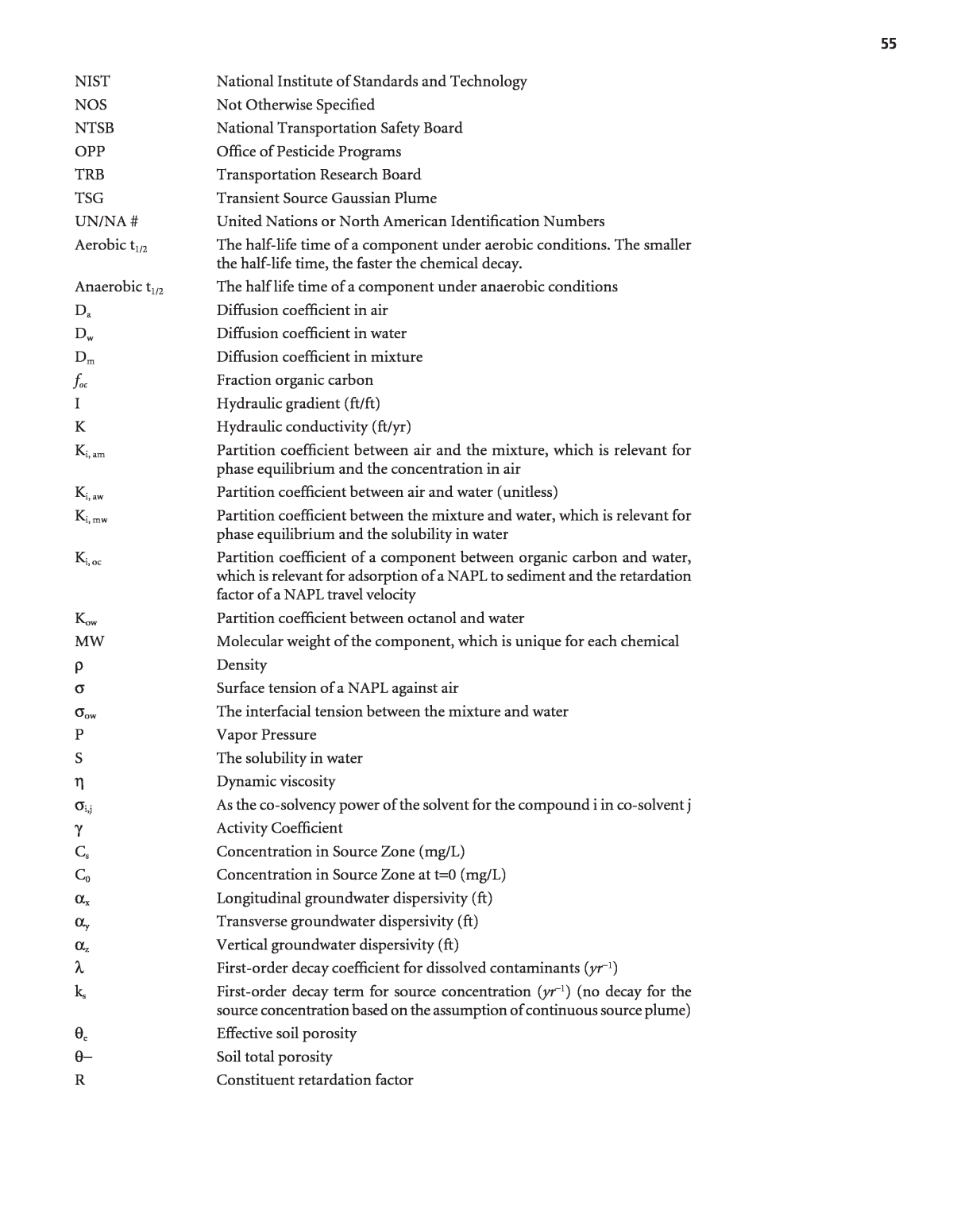
55 NIST National Institute of Standards and Technology NOS Not Otherwise Specified NTSB National Transportation Safety Board OPP Office of Pesticide Programs TRB Transportation Research Board TSG Transient Source Gaussian Plume UN/NA # United Nations or North American Identification Numbers Aerobic t1/2 The half-life time of a component under aerobic conditions. The smaller the half-life time, the faster the chemical decay. Anaerobic t1/2 The half life time of a component under anaerobic conditions Da Diffusion coefficient in air Dw Diffusion coefficient in water Dm Diffusion coefficient in mixture foc Fraction organic carbon I Hydraulic gradient (ft/ft) K Hydraulic conductivity (ft/yr) Ki, am Partition coefficient between air and the mixture, which is relevant for phase equilibrium and the concentration in air Ki, aw Partition coefficient between air and water (unitless) Ki, mw Partition coefficient between the mixture and water, which is relevant for phase equilibrium and the solubility in water Ki, oc Partition coefficient of a component between organic carbon and water, which is relevant for adsorption of a NAPL to sediment and the retardation factor of a NAPL travel velocity Kow Partition coefficient between octanol and water MW Molecular weight of the component, which is unique for each chemical Ï Density Ï Surface tension of a NAPL against air Ïow The interfacial tension between the mixture and water P Vapor Pressure S The solubility in water η Dynamic viscosity Ïi,j As the co-solvency power of the solvent for the compound i in co-solvent j γ Activity Coefficient Cs Concentration in Source Zone (mg/L) C0 Concentration in Source Zone at t=0 (mg/L) αx Longitudinal groundwater dispersivity (ft) αy Transverse groundwater dispersivity (ft) αz Vertical groundwater dispersivity (ft) λ First-order decay coefficient for dissolved contaminants (yrâ1) ks First-order decay term for source concentration (yrâ1) (no decay for the source concentration based on the assumption of continuous source plume) θe Effective soil porosity θâ Soil total porosity R Constituent retardation factor
