



Below is the uncorrected machine-read text of this chapter, intended to provide our own search engines and external engines with highly rich, chapter-representative searchable text of each book. Because it is UNCORRECTED material, please consider the following text as a useful but insufficient proxy for the authoritative book pages.
It is useful to consider the distinction between the cost of a transportation service and the price transportation providers charge their customers, particularly when those customers are human service agencies. âCostâ means the total cost of producing transportation services (which can be considered as completed one-way trips). These costs include the salaries and benefits of drivers, administrators, and dispatch and maintenance personnel; fuel; vehicles; space; supplies; insurance; taxes; and all other costs attributable to producing the service. On the other hand, âpriceâ refers to a rate of payment that may be negotiated and specified in a contract between the transportation provider and those persons purchasing the trips. (Those per- sons purchasing the trips may be the riders themselves or representatives of the riders, such as human service agencies acting on behalf of the riders.) Price can be specified as a cost per trip, per mile, per hour, or some combination of these; additions to the price might be allowed for special or extraordinary services or assistance, such as transporting someone by stretcher. Costs tend to vary from time to time and may change rapidly; prices tend to be fixed for a spec- ified contractual period of time, such as 6 months or 1 year, although mid-course corrections are sometimes allowed in certain contracts. Prices Charged Should Be Equitable and Understandable A typical question is, âAm I paying my fair share of the costs?â In coordinated transportation systems with different types of passengers, different kinds of trips, and different trip sponsors, this is an excellent but perhaps not easily resolved question. Not all trips are the same length, take the same amount of time, or require the same level of passenger assistance; in short, different kinds of trips require different amounts of resources to provide. When different kinds of passengers mak- ing different kinds of trips ride on the same vehicle for at least part of a trip, figuring out the âfair shareâ of everyoneâs cost can be a challenge. Because gaining greater efficiencies by coordinating transportation services and spreading costs over a broad base of agencies in a coordinated trans- portation system remains a very attractive option, the fairness challenge must be addressed explic- itly to ensure equity and thus promote coordination. It is a challenge that has been resolved in numerous communities. All Stakeholders Should Pay Their Fair Share Understanding How Costs Are Incurred Although prices for services can be based on many factors, a fundamental premise of this cost sharing report is that prices for transportation services should be based, at least to some extent, on 23 C H A P T E R 7 Whatâs the Right Price for That Transportation Service?
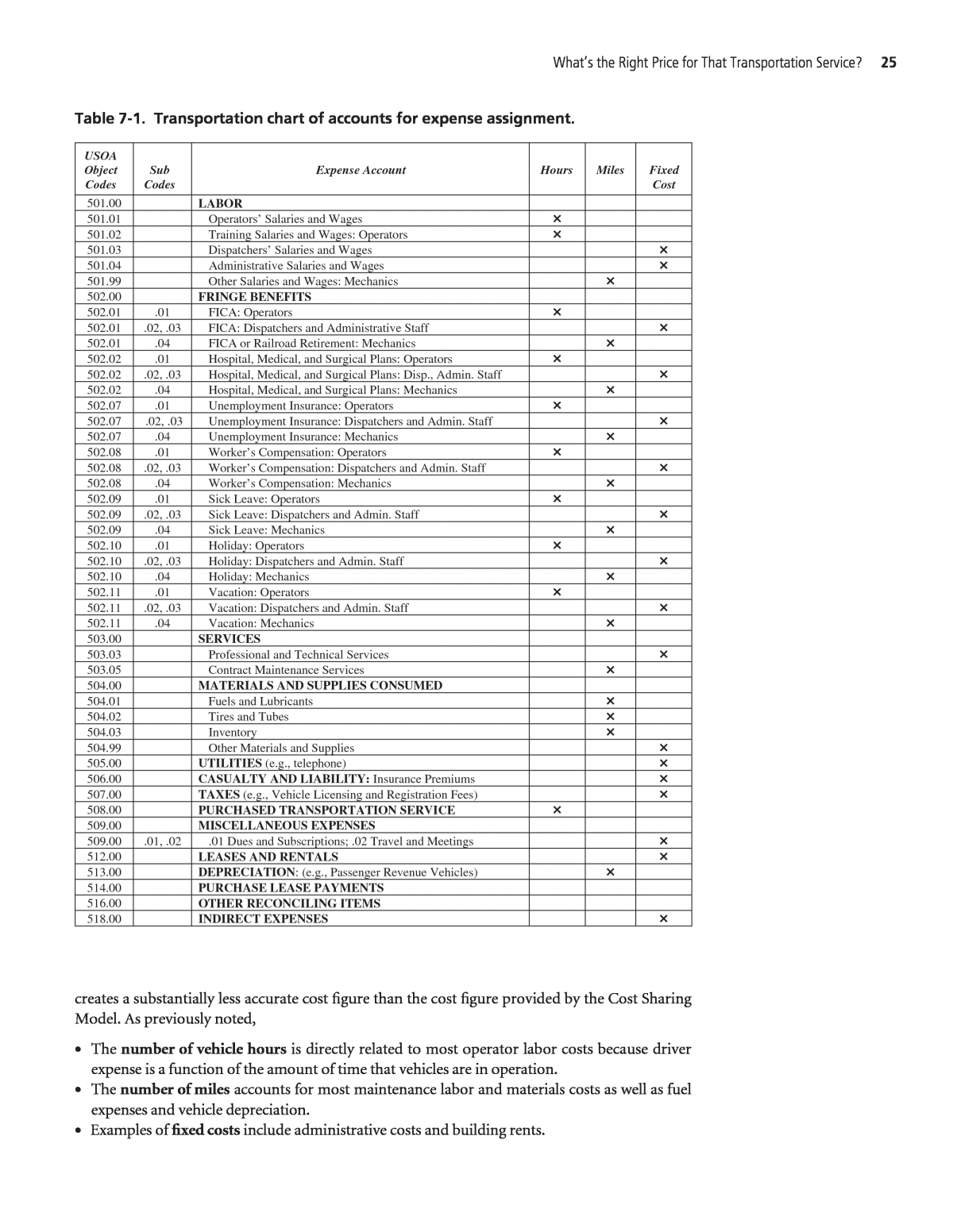
what it actually costs to provide those services. The process of determining how much a specific transportation service costs has the following steps: 1. Assembling data on all services provided and all expenses required to provide those services. 2. Assigning the expenses to cost categories that explain how these costs vary according to the resources required to produce these services. 3. Calculating average unit costs on a per mile, per hour, or per trip basis. 4. Allocating the costs of services among the parties receiving the services in proportion to the services that they have actually received. Assigning Costs to Respective Cost Categories: Variable or Fixed Costs The distinction between fixed and variable costs is extremely useful in understanding the costs of transportation services. The assumption that each line item expense can be expressed as either a variable cost or a fixed cost is a fundamental underpinning of our Cost Sharing Model. ⢠Variable costs can be logically linked to either one of two service variables: hours or miles. For example, the number of vehicle hours is directly related to most of the operator labor costs because driver expense is a function of the amount of time that vehicles are in operation. The number of miles accounts for most maintenance labor and materials costs as well as the cost of fuel consumed and vehicle depreciation. ⢠Fixed costs are the expense items that do not vary with the number of miles or hours of oper- ation but, instead, reflect the scale or size of the agency. Examples include administration and building rents. There are no hard and steadfast rules for classifying expenses as fixed or variable costs, but good judgment and an understanding of how expenses are incurred will suggest appropriate designations. For example, a line item expense entitled âDispatcherâs Salaries and Wagesâ arguably could be assigned to the variable cost category of hours of operation because salaries and wages generally are paid on an hourly basis. A line item expense account entitled âPurchased Transportation Servicesâ might be split between the variable costs for hours and miles, because purchased transportation reflects back-up transportation. (This split could be done several waysâone way would be according to the percent of variable costs for hours and the percent of variable costs per mile.) Hard and steadfast rules for classifying expenses as fixed or variable costs (or splitting them) do not exist. Instead, good common sense is needed. A good expenses assignment should be ⢠Logical and understood by all. ⢠Defensible and able to pass scrutiny from an outside observer. ⢠Clearly expressed in writing. ⢠Consistent so that it is useful for watching cost trends over time. Other methods for assigning expenses can be used provided that they meet these four objec- tives. An example of the assignment of expenses to specific categories is shown in Table 7-1. Calculating Average Unit Costs The first step in applying the Cost Sharing Model is to assign individual line item expenses (e.g., wages, fuel, and administrative costs) to hours, miles, or fixed costs, depending on what kinds of actions create each kind of expense. Because different actions create different kinds of expenses, the âshortcutâ of dividing total annual expenses by just one figureâlike miles, hours, or tripsâ 24 Sharing the Costs of Human Services Transportation
creates a substantially less accurate cost figure than the cost figure provided by the Cost Sharing Model. As previously noted, ⢠The number of vehicle hours is directly related to most operator labor costs because driver expense is a function of the amount of time that vehicles are in operation. ⢠The number of miles accounts for most maintenance labor and materials costs as well as fuel expenses and vehicle depreciation. ⢠Examples of fixed costs include administrative costs and building rents. Whatâs the Right Price for That Transportation Service? 25 Table 7-1. Transportation chart of accounts for expense assignment. USOA Object Codes Sub Codes Expense Account Hours Miles Fixed Cost 501.00 LABOR 501.01 Operatorsâ Salaries and Wages 501.02 Training Salaries and Wages: Operators 501.03 Dispatchersâ Salaries and Wages 501.04 Administrative Salaries and Wages 501.99 Other Salaries and Wages: Mechanics 502.00 FRINGE BENEFITS 502.01 .01 FICA: Operators 502.01 .02, .03 FICA: Dispatchers and Administrative Staff 502.01 .04 FICA or Railroad Retirement: Mechanics 502.02 .01 Hospital, Medical, and Surgical Plans: Operators 502.02 .02, .03 Hospital, Medical, and Surgical Plans: Disp., Admin. Staff 502.02 .04 Hospital, Medical, and Surgical Plans: Mechanics 502.07 .01 Unemployment Insurance: Operators 502.07 .02, .03 Unemployment Insurance: Dispatchers and Admin. Staff 502.07 .04 Unemployment Insurance: Mechanics 502.08 .01 Workerâs Compensation: Operators 502.08 .02, .03 Workerâs Compensation: Dispatchers and Admin. Staff 502.08 .04 Workerâs Compensation: Mechanics 502.09 .01 Sick Leave: Operators 502.09 .02, .03 Sick Leave: Dispatchers and Admin. Staff 502.09 .04 Sick Leave: Mechanics 502.10 .01 Holiday: Operators 502.10 .02, .03 Holiday: Dispatchers and Admin. Staff 502.10 .04 Holiday: Mechanics 502.11 .01 Vacation: Operators 502.11 .02, .03 Vacation: Dispatchers and Admin. Staff 502.11 .04 Vacation: Mechanics 503.00 SERVICES 503.03 Professional and Technical Services 503.05 Contract Maintenance Services 504.00 MATERIALS AND SUPPLIES CONSUMED 504.01 Fuels and Lubricants 504.02 Tires and Tubes 504.03 Inventory 504.99 Other Materials and Supplies 505.00 UTILITIES (e.g., telephone) 506.00 CASUALTY AND LIABILITY: Insurance Premiums 507.00 TAXES (e.g., Vehicle Licensing and Registration Fees) 508.00 PURCHASED TRANSPORTATION SERVICE 509.00 MISCELLANEOUS EXPENSES 509.00 .01, .02 .01 Dues and Subscriptions; .02 Travel and Meetings 512.00 LEASES AND RENTALS 513.00 DEPRECIATION: (e.g., Passenger Revenue Vehicles) 514.00 PURCHASE LEASE PAYMENTS 516.00 OTHER RECONCILING ITEMS 518.00 INDIRECT EXPENSES
The second step is to compute average unit costs over a particular time period. The usual time period is 1 year; shorter time periods may be recommended if costs are changing quickly or if there are other unique considerations. Unit costs are expressed as follows: ⢠The average hourly cost is calculated as the total costs associated with hours of operation divided by the number of hours of operation during that time. This number is expressed as dollars per hour. ⢠The average mileage cost is calculated as the total costs associated with miles of operation divided by the number of miles of operation during that time. This number is expressed as dol- lars per mile. ⢠The fixed cost ratio is found by dividing the total fixed costs by the sum of the total hourly costs plus the mileage costs. This number is expressed as a percentage. Deriving Total Overall Costs from Unit Costs The third step in applying the Cost Sharing Model is that of calculating the total costs of a particular service (e.g., trips provided to a senior center for an area agency on aging) from the average unit costs as determined previously. This step should be replicated for each of the dis- crete services offered by the transportation provider. To ensure that all costs have been calcu- lated accurately, the costs of all discrete services should be added together as a validity check on the work to date; their sum should equal the total annual expenses of the transportation provider. The mathematical expression of the Cost Sharing Model is a relatively straightforward equation involving multiplication and addition. This model uses variable and fixed costs to express the total costs of a specific service or program (see Chapter 4). TOTAL ANNUAL COST (for Service A) = The Transportation Systemâs Fixed Cost Factor times the sum of Service Aâs ANNUAL HOURLY COST and ANNUAL MILEAGE COST. Where ANNUAL HOURLY COST (for Service A) = The Transportation Systemâs Cost per Hour times Service Aâs Annual Hours of Operation. ANNUAL MILEAGE COST (for Service A) = The Transportation Systemâs Cost per Mile times Service Aâs Annual Miles of Operation. FIXED COST FACTOR = 1 + the ratio of all of the transportation systemâs fixed costs to all of the transporta- tion serviceâs variable costs = 1 + [Total system fixed expenses divided by (Total system hourly costs + total system mileage costs)]. Again, the outputs of the Cost Sharing Model should be calculated for each specific service and then their individual costs should be summed to express the total annual costs of all trans- portation services. This kind of cost allocation model is popular with transportation providers for the following reasons: ⢠The model is relatively simple. Each line item expense is expressed either as a variable or a fixed cost. Variable costs are derived by examining costs associated with two key service factorsâ vehicle hours and vehicle miles. Fixed costs are those cost elements that do not vary accord- ing to the level of services provided. Thus, the model is easy to understand, develop, and apply and is compatible with transportation operating environments common throughout the 26 Sharing the Costs of Human Services Transportation
country. In most cases, model calculations can be generated in only a few hours even by rela- tively non-technical personnel. ⢠The model is all-inclusive. The model takes into account all of the explicit costs contained in a typical revenue and expense statement. Moreover, the model can easily accommodate implicit costs. ⢠The model is extremely flexible and can be used to analyze various categories of total cost as needs dictate. Budgetary impacts can be readily ascertained by focusing on the variable costs of service. The cost model also is quite adaptable: A model for operating costs alone can be devel- oped by omitting depreciation expenses from the analysis. Applying the Model: Allocating the Costs to a Particular Service or Agency The several ways to share the costs of a service or program among the participating stakehold- ers include a cost-based approach, a benefits-based approach, or a risk-based approach. The cost- based approach to cost sharingâwhat can be defined as proportionate cost allocationâis simpler and much more widely used than the alternative cost allocation techniques. The cost-based approach finds one participantâs share of the overall cost of a service by calculat- ing the cost of the service they received in proportion to all the costs of producing the service for everyone. Use of the cost-based approach means that, if services to Agency A require 25 percent of the annual costs of a transportation providerâs services, then Agency A should pay 25 percent of the transportation providerâs annual costs. These are the steps in allocating the costs of services to the stakeholders who benefit from those services: 1. Determine the number of miles and number of hours delivered to Agency A, Agency B, Agency C, and so on. 2. Enter this information into the Cost Sharing Model. 3. Using the Cost Sharing Model, calculate each agencyâs respective share of the total costs. (Note that the model apportions fixed costs to each agency based on their proportions of overall vari- able costs as determined by miles and hours of service.) 4. Bill each agency based on their proportional share of the total costs. Chapter 8 presents a number of examples of the results of applying the cost allocation model in various situations. Another Use: Forecasting the Costs of Service Changes The previous example should be used to calculate the proportional shares of costs for services being delivered at the present time. Transportation providers also are often interested in forecast- ing the cost effects of service changes. Such changes can include providing services to agencies that previously did not purchase service or the possibility of cutting services. This requires the consid- eration of variable costsâthe costs that will change if the service change (the service increase or decrease) is implemented. The cost sharing equation can be modified to estimate the costs of ser- vice changes by omitting the fixed cost factor because the fixed costs will not change. Service changes, increases or decreases, can be estimated by the following cost change equation: COST CHANGE = CHANGED ANNUAL HOURLY COST + CHANGED ANNUAL MILEAGE COST Where CHANGED ANNUAL HOURLY COST = Cost per hour times the changed Annual Hours of Operation CHANGED ANNUAL MILEAGE COST = Cost per mile times the changed Annual Miles of Operation. Whatâs the Right Price for That Transportation Service? 27
Summary Determining the distinction between the cost of a transportation service and the price that the transportation provider charges its customers is a particularly useful task, especially when those customers are human service agencies. Prices that are determined from a detailed cost analysis ben- efit the transportation provider by ensuring sufficient income for operations and benefit the pur- chaser by ensuring an equitable price. A model that clearly specifies fixed costs and operating costs (both those operating costs attributable to hours devoted to service and those costs attributable to miles of service) can be used to create detailed cost information. 28 Sharing the Costs of Human Services Transportation
