



Below is the uncorrected machine-read text of this chapter, intended to provide our own search engines and external engines with highly rich, chapter-representative searchable text of each book. Because it is UNCORRECTED material, please consider the following text as a useful but insufficient proxy for the authoritative book pages.
98 Table 2. San Francisco Bay Area HOT lanesâplanning. A P P E N D I X E Interview Summaries Related to Planning for Road Pricing Location and Project San Francisco Bay Area, Metropolitan Transportation Commission, Regional HOT Network RP Emergence Factors HOT concept gaining in acceptance in Bay Area by virtue of acceptable HOT project proposals (relatively near term in 4 corridors authorized under current state law: 580 Tri Valley, 680 Sunol, 85 & 101 in Santa Clara); work of Alameda County CMA especially vital; 680 important stepping stone, deriving in large part from Alameda County CMA work and 1990 VP grant; interest emerging in some other corridors (I-80 in Solano County) but not currently authorized under state law HOT network pivots off acceptance and familiarity from individual HOTs to stitch together what was becoming piecemeal approach; also projected to bring on line new capacity 20â30 years faster than traditional state and local tax funding would allow State of economy not deterrent for near-term projects listed above, which are mostly funded through traditional sources, but may affect financing prospects for the larger network; stimulus package not playing role; greenhouse gas emissions weighs more in emergence discussions; some fear from environmental community ânew highways in sheepâs clothingâ surrounds network; enabling legislation AB744 is still pending with discussions ongoing about the amount and timing of net revenue that may be committed to transit RP Relation to Planning Processes MTC groundwork in studies since 2006 on operations, finance, revenues and air quality impacts helps get âducks in orderâ prior to adoption into LRP, April â09, all aided by general âphilosophyâ at MTC dating back 20 years to encourage congestion pricing, whenever possible, and land use oriented toward transit The previous plan (adopted 2005) had network at conceptual level (last two RTPs attended to network); the network is a central focus of the current plan (adopted April 2009), with foundation set by âtargetsâ in them for delay, CO2; Performance Measurement report supplemental to MTP sets out measures key to pricing justification Important part of plan are âprincipalsâ adopted with plan for corridor investment focus, revenue back to source, maximum use of existing right of way, best technology, common system of marketing and branding to encourage uniformity Corridor studies now next step to specify exact configurations, cost/revenue picture, operations Role of Air Quality, CMP, Planning Regulation and Guidance for RP Plan âAir quality planningâ refers to general work behind the regional plan where pricing generally supports air quality goals; âconformity analysisâ refers to specific analysis prescribed by Fed for region as non-attainment area showing funded projects getting into TIP are not increasing pollutants beyond âemission budgetâ; HOTs as they are funded become part of conformity analysis; air quality planning is not a difficult process, but conformity is much more demanding and time consuming
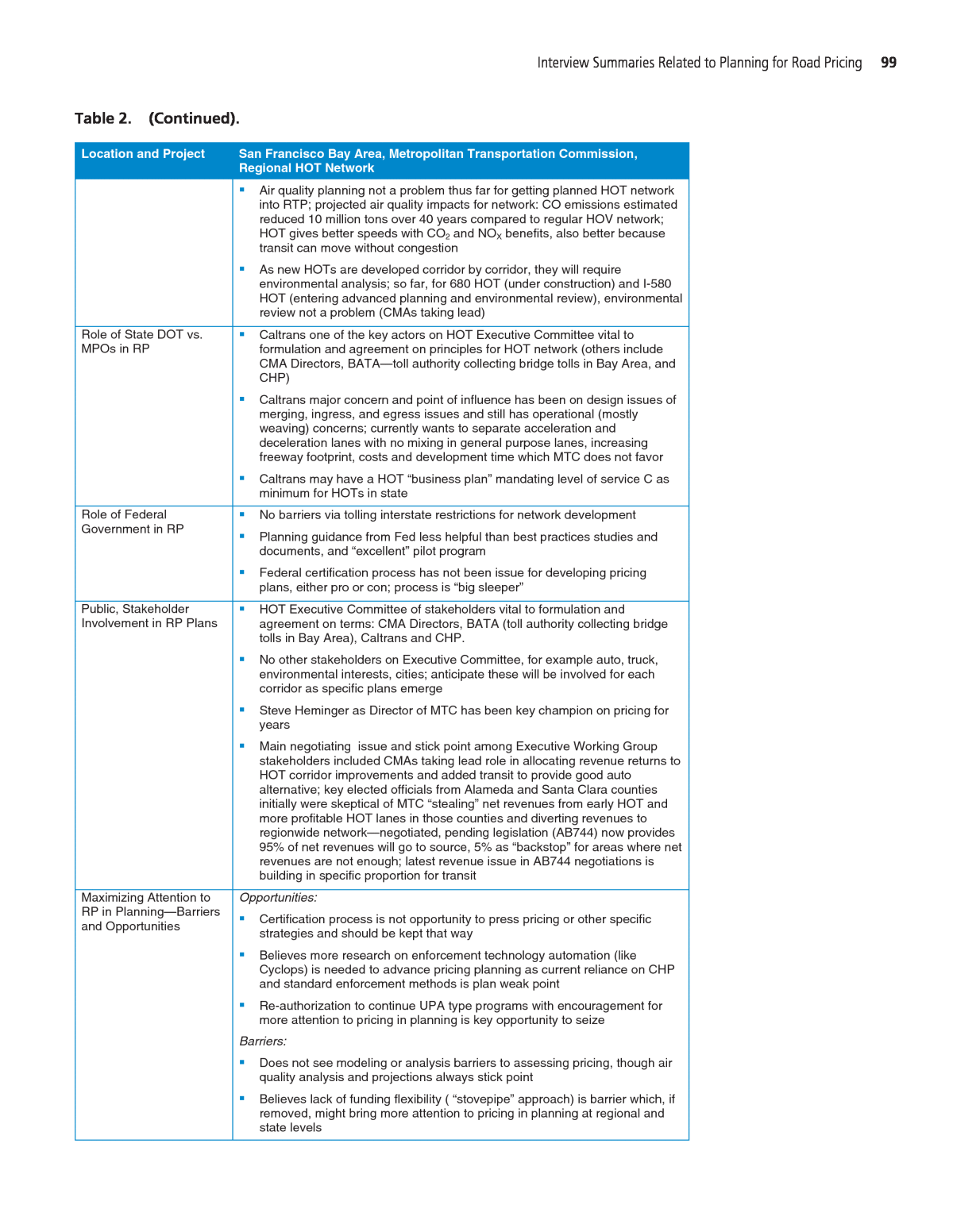
Interview Summaries Related to Planning for Road Pricing 99 Table 2. (Continued). Location and Project San Francisco Bay Area, Metropolitan Transportation Commission, Regional HOT Network Role of Federal Government in RP No barriers via tolling interstate restrictions for network development Planning guidance from Fed less helpful than best practices studies and documents, and âexcellentâ pilot program Federal certification process has not been issue for developing pricing plans, either pro or con; process is âbig sleeperâ Public, Stakeholder Involvement in RP Plans HOT Executive Committee of stakeholders vital to formulation and agreement on terms: CMA Directors, BATA (toll authority collecting bridge tolls in Bay Area), Caltrans and CHP. No other stakeholders on Executive Committee, for example auto, truck, environmental interests, cities; anticipate these will be involved for each corridor as specific plans emerge Steve Heminger as Director of MTC has been key champion on pricing for years Main negotiating issue and stick point among Executive Working Group stakeholders included CMAs taking lead role in allocating revenue returns to HOT corridor improvements and added transit to provide good auto alternative; key elected officials from Alameda and Santa Clara counties initially were skeptical of MTC âstealingâ net revenues from early HOT and more profitable HOT lanes in those counties and diverting revenues to regionwide networkânegotiated, pending legislation (AB744) now provides 95% of net revenues will go to source, 5% as âbackstopâ for areas where net revenues are not enough; latest revenue issue in AB744 negotiations is building in specific proportion for transit Maximizing Attention to RP in PlanningâBarriers and Opportunities Opportunities: Certification process is not opportunity to press pricing or other specific strategies and should be kept that way Believes more research on enforcement technology automation (like Cyclops) is needed to advance pricing planning as current reliance on CHP and standard enforcement methods is plan weak point Re-authorization to continue UPA type programs with encouragement for more attention to pricing in planning is key opportunity to seize Barriers: Does not see modeling or analysis barriers to assessing pricing, though air quality analysis and projections always stick point Believes lack of funding flexibility ( âstovepipeâ approach) is barrier which, if removed, might bring more attention to pricing in planning at regional and state levels Air quality planning not a problem thus far for getting planned HOT network into RTP; projected air quality impacts for network: CO emissions estimated reduced 10 million tons over 40 years compared to regular HOV network; HOT gives better speeds with CO2 and NOX benefits, also better because transit can move without congestion As new HOTs are developed corridor by corridor, they will require environmental analysis; so far, for 680 HOT (under construction) and I-580 HOT (entering advanced planning and environmental review), environmental review not a problem (CMAs taking lead) Role of State DOT vs. MPOs in RP Caltrans one of the key actors on HOT Executive Committee vital to formulation and agreement on principles for HOT network (others include CMA Directors, BATAâtoll authority collecting bridge tolls in Bay Area, and CHP) Caltrans major concern and point of influence has been on design issues of merging, ingress, and egress issues and still has operational (mostly weaving) concerns; currently wants to separate acceleration and deceleration lanes with no mixing in general purpose lanes, increasing freeway footprint, costs and development time which MTC does not favor Caltrans may have a HOT âbusiness planâ mandating level of service C as minimum for HOTs in state
100 Road Pricing: Public Perceptions and Program Development Table 3. DallasâFort Worth area managed lanesâplanning. Location and Project Dallas, SH 121 (in operation), SH 161, I-635, DallasâFort Worth Connector, and North Tarrant Expressway (planned), I-30, I-35E, Southwest Parkway RP Emergence Factors Upfront funding from local toll authority, North Texas Tollway Authority; provided upfront payment of $3.2 billion for SH 121, first toll project and will provide $200 million for SH 161 in 2010 for new right-of-way Major 3-step policy adopted by MPO North Central Texas Council of Governments (NCTCOG) in early nineties: (1) all facilities on new ROW must be tested for toll road feasibility and built as such if warranted because of limited funds to meet regionâs capacity needs; (2) for existing freeways being reconstructed, test if trip length justifies express lane and if tolls are warranted on express lane; (3) free lanes already paid for by gas tax revenues will not be tolled. Bottom line: if additional capacity is necessary and it can be tolled, it will be tolled due to anticipated revenue needs for maintenance and reconstruction Presence of local toll authority meant that no further authority was needed from the state to start tolling, so MPO was free to plan Fiscal constraint provision added to ISTEA in 1991 led to realization that gas tax funds would fall short in the future I-635, Dallas-Fort Worth Connector, and North Tarrant expressway are existing freeways being expanded to include central tolled/managed lanes, often with more free lanes than before expansion In 2009, economic trends have led to media support from sources earlier opposed to pricing, given the stateâs lack of revenues RP Relation to Planning Processes The MPO, NCTCOG has successfully integrated tolling/pricing into the planning process since 1991 MPO has been using detailed simulation models to include new toll roads, toll road conversions, and express lanes in their plan Do not use the term HOT lanes, but managed lanes or tolled express lanes because their facilities are dynamically priced, with guaranteed speeds, flexible operations, and incident management capabilities; therefore they are more comprehensive while HOT lanes imply only two key featuresâhigh occupancy and tolls Have gone through full Environmental Impact Review process for managed lanes, including special Environmental Justice component not just for overall plan but for each toll road; addressed equity impacts, e.g., by building 20-mile new passenger rail line on the SH 121 project, being built by public sector from revenues obtained from an upfront toll road payment For most toll road projects, revenues will go to roadway improvements, a significant share of revenues will go to air quality improvements, and another for a 20-mile passenger rail system Only one increase in gas tax in the 1990s in Texas and the money was diverted to other purposes; no current push to increase it, therefore MPO is working in public-private partnerships in design-build or design- build finance arrangements For the PPP projects, tolls will be used to pay back operating costs and to pay the upfront payment to construct the road; 30-40% of total construction cost is being paid by public sector through gas tax money and 60-70% by private sector through revenues obtained from the managed lane Role of Air Quality, CMP, Planning Regulation and Guidance for RP Plan All above toll facilities were included in the long-range MTP in the mid-90s Once fiscal constraint provision was added, any new freeways went into the plan as toll roads; because the region is large, trip lengths typically justify express lanes Dallas is in an air-quality non-attainment region, so all air quality conformity plans and mobile source emissions inventories are totally integrated into RP/managed lane planning
Interview Summaries Related to Planning for Road Pricing 101 Table 3. (Continued). Location and Project Dallas, SH 121 (in operation), SH 161, I-635, DallasâFort Worth Connector, and North Tarrant Expressway (planned), I-30, I-35E, Southwest Parkway RP is policy principle in Dallas CMP (see mobility plan & CMP on NCTCOG website)âcompletely internalized since mid-1990s Role of State DOT vs. MPOs in RP State DOT got involved in a major way 5 years ago; credit goes to late Rick Williamson, former Chairman of TxDOT, who listened to NCTCOG planners, agreed that funding was not sufficient, and helped pass legislation to create publicâprivate partnerships for toll roads or Comprehensive Development Agreements (CDAs); he coined the phrase, âSlow Roads, No Roads, or Toll Roadsâ that is now becoming more widely understood Stateâs biggest concern is institutionalâi.e. using private sector for constructing toll roads; SH 121 and 161 are being built by public sector toll authority, but 635, DFW connector and North Tarrant Express are through PPPsâmainly an issue in rural areas State has some opposition to toll roads and managed lanes, but also realizes that it has not come up with funding on its own, especially for fast-growing regions like Dallas State is now backing away from some commitments to inter-city toll roads because of opposition from rural parts of Texas (not because of tolls but because of impact on land owners owning large tracts of land that would need to be fragmented) Role of Federal Government in RP Federal support is important; federal ISTEA legislation that introduced financial constraint requirement in 1991 considered most important Believes that all MPOs would come up with innovative funding means of transportation investment if they followed the procedures of this requirement and did due diligence Federal programs such as Value Pricing Pilot Program and Express Lanes Demonstration Program have been importantâNCTCOG pursued every such innovative federal program, winning some bids and losing some NCTCOG won an innovative FHWA grant to get funding for I-30 that will be used as a permanent managed lane test corridor comprising 8-lane freeway and 4-lane tolled expressway in the middle, with plans to test any policy first in this corridor before applying it to all othersâe.g., providing frequent flier miles to travelers as incentive to car pool and use express lanes Federal air quality standards (conformity with ozone requirement) support managed lane innovations and increasing auto occupancyâ idea of converting HOV to managed lanes âwould not have got its wings if we couldnât pin it back to ozone problem.â On relationship of RP to federal planning requirements and CMP, âfelt that feds were late to the game and we were plowing ground by ourselves for a long time before thatâ Public, Stakeholder Involvement in RP Plans All of NCTCOGâs 40 elected officials are unanimous in supporting pricing, given the absence of leadership and revenues at federal or state levelâmost likely the result of strong, focused monthly communication on rationale and purpose of pricing from NCTCOG targeted at these officials Initial opposition (in 1995) was from all stakeholder groupsâ neighborhood groups, conservative tax people, libertarians, state legislators, local elected officials, Chambers of Commerce. NCTCOG was involved in constant communication on merits of RP Constantly use radios and talk shows to clear misconceptions about managed lanes, explaining benefits to all types of users Congestion Management Process (CMP) is used well and aggressively followed through because dynamic pricing is considered good for managing congestion and for air quality/ozone attainment (continued on next page)
102 Road Pricing: Public Perceptions and Program Development Table 3. (Continued). Location and Project Dallas, SH 121 (in operation), SH 161, I-635, DallasâFort Worth Connector, and North Tarrant Expressway (planned), I-30, I-35E, Southwest Parkway âWell-orchestrated bottom-up approachâ that uses a very strong analytical/modeling and planning process showing performance measures about real costs of the transportation system and how much people are under-payingâsustainability is a key message, before the need for revenues Maximizing Attention to RP in PlanningâBarriers and Opportunities Opportunities: New transportation bill should continue to support and lay framework for alternative funding mechanismsâjust as fed fiscal constraint requirement provided an opportunity A federal policy that is explicit about the lack of revenues to solve problems in urban regions will help MPOs when they approach state legislature for approval to implement pricing and other ways to raise funds Believes it is harder to build toll roads and managed lanes without an integrated plan that is communicated well and constantly Because toll roads have existed in the region, people are familiar with the concept and the critics donât have much of an argument because the toll roads are successful Barriers: State opposition to PPPs likely due to involvement of international firms as concessionaires (âsome sort of xenophobiaâ) What can and cannot be done on Interstate highways is an issue: e.g., can managed lanes be introduced and under what conditions? Federal planning requirements are considered behind the curve with respect to current MPO needs, planning approaches, and strategies Most important group to involve is state legislators who do not necessarily have answers when the public is critical, but must defend their position, especially because lack of money from fed or state is why toll roads are being built anyway Framed equity discussion around value of time being function of out-of- pocket opportunity costs (late arrival at work, daycare for blue collar workers), not wage rate as typically consideredâidea has received support because people understand these situations Table 4. Los Angeles metropolitan area HOT lanesâplanning. Location and Project Los Angeles, I-10 and I-110 Express Lanes Demonstration Projects (1-year long) RP Emergence Factors Severe, persistent Los Angeles congestion RP experience elsewhere proving workability Engagement and persuasiveness of specific federal actor (Tyler). Also, LACMTA project management to first get approval of immediate supervisors and then the LACMTA Board of Directors. Inviting Tyler to present to the LACMTA Board part of the logistics/strategies set by MTA project management. Persuaded board buy-in and direction to staff Availability of federal pilot money and use by other cities Short time frame for pilot grant and available proven RP conceptâHOT Failed application (freight-focused) for U.S.DOT UPA grant (December 2006) started debate and awareness; successful application for U.S.DOT Congestion Reduction Demonstration Initiative (2008) resulted from greater attention to RP as desired by feds
Interview Summaries Related to Planning for Road Pricing 103 (continued on next page) Table 4. (Continued). Location and Project Los Angeles, I-10 and I-110 Express Lanes Demonstration Projects (1-year long) helping gain local and state support Role of federal demo application: an application âraises debateâ/brings focus, once LA application didnât make it, LACMTA formed the Ad-Hoc Congestion Pricing Committee to manage future opportunities Public, Stakeholder Involvement in RP Plans LACMTA Board representatives supported RP and influenced state legislature Creation of Ad-Hoc Congestion Pricing Committee after first failed grant was helpful and has ongoing involvement Transit operators are partners because of the inclusion of transit in project No objection to U.S.DOT grant application from LACMTA Board and minor opposition in state legislature, partly because of strong fed role in RP Relation to Planning Processes Adopted 2001 Long-Range Transportation Plan (LRTP) analyzed pricing and concluded it was the best alternative. However, pricing alternative was limited to increasing gas prices Current 2009 draft LRTP mentions RP; politicians and executive management no longer afraid to discuss RP Downtown parking pricing plan was already included under TDM in the 2001 LRTP SAFETEA-LU gives 5 states authority to approve exemptions to the environmental process, but Caltrans (project partner) did not use this to avoid criticism later, so projects are going through the normal EIR process Role of Air Quality, CMP, Planning Regulation and Guidance for RP Plan To access funding, projects must be included in LRTP, the Regional Plan, and TIP; so adopted 2001 plan was amended to include I-10 and I-110 projects, and I-210 project contingent on availability of financing No challenges to 2001 amendment that introduced RP into the plan LACMTA is the Congestion Management Agency, so it included pricing in LRTP Role of State DOT vs. MPOs in RP State tolling authority required by U.S.DOT to be approved within 6 months of U.S.DOT award State limited the number of HOT lanes that could be implemented Per state law, net revenue must be reinvested in the corridor where revenues are generated. The use of excess toll revenue includes transit or carpool lane improvements New state legislation passed in 2006 allowed implementation of HOT lane projects and required approval from the California Transportation Commission (CTC) prior to approval from state legislature Parking pricing program for downtown is led by LA city State DOT director supported RP from the start and this was essential for moving the project forward. State DOT helped with technical analysis Role of Federal Government in RP Federal UPA grant initiated the process, then U.S.DOT grant required increased focus on pricing, leading to consideration of RP Feds funded value pricing study in 1995, determining that HOT lanes were the most feasible RP project, but no funding available Fed role enhanced at Oct 2007 LACMTA regular Board Meeting where Asst. Director of Policy (Tyler) spoke and helped gain support As part of the strategies set by LACMTA project management, Fed supported LACMTA request to organize a symposium for professionals, decision makers, and politicians in June 2008, inviting speakers from successful RP locations (Stockholm, Seattle, Texas) whose presentations helped gain support from state legislature
104 Road Pricing: Public Perceptions and Program Development Table 4. (Continued). Location and Project Los Angeles, I-10 and I-110 Express Lanes Demonstration Projects (1-year long) No organized opposition Original concern from congressional reps and legislators about environmental justice issues were addressed in the implementation plan; transit component included to benefit lower-income commuters Support of major facilities along the corridors and community grassroots organizations was sought by providing opportunity for revenues to be returned to the corridors along with transit improvements LACMTA project management staff gave presentations to representatives of elected officials, South Bay Council of Governments, San Gabriel Valley of Governments, and agencies to explain the project. This helped because all COG member cities have representative decision makers in the LACMTA Board of Directors Formed Corridor Advisory Groups with stakeholders in the 2 corridors (residents, businesses, employees at facilities along the corridors), elected officials, and other agencies like Highways Patrol. Also formed Technical Advisory Group with representatives from partner agencies and other stakeholders Maximizing Attention to RP in PlanningâBarriers and Opportunities Opportunities: U.S.DOT grant opportunity provided incentive for change Short timeline for implementation led to choice of practical, focused strategies Part of grant funds used to purchase transit buses to begin operation before tolling began Planning and pilot implementation, role of key federal actor who was a good communicator, role of LACMTA project management staff who recommended to the Board to support congestion pricing Project was consistent with the Governorâs Strategic Plan for implementation of HOT lanes HOT lanes were not approached as individual projects, but included transit and parking pricing in an integrated approach for managing congestion in LA HOT lanes controversial by themselves; so transit component was built into project to encourage mode shift and gain public support. Also, it was emphasized that the aim of the project was congestion mitigation, not revenue generation Barriers: Public perception of âdouble taxationâ and attitudinal barriers because of no existing models of HOT concept in LA. Only nearby HOT lane is SR-91 in Orange County There are limited options to charge tolls on Interstatesâcannot charge on a lane that is not currently priced or that is not an HOT lane, though conversion of existing HOV lanes into HOT lanes is legal
Interview Summaries Related to Planning for Road Pricing 105 Table 5. Washington, D.C. metropolitan area HOT lanesâplanning. Location and Project Washington D.C. Region, Maryland Intercounty Connector (ICCâunder construction), Virginia I-495 Beltway HOT Lanes (under construction) and I-395/95 HOT Lanes (proposed) RP Emergence Factors Highly congested major state highways in the metropolitan Washington region; region ranked high nationally in congestion (TTI rank is #2); significant revenue shortfalls under traditional âgas taxâ funding mechanisms Past, recent, and ongoing studies of road and parking pricing initiatives and future prospects; past successes and failures with attempts to implement RP on state highways Trend of multiple RP projects currently underwayânew variably priced ICC expressway (has been on the agenda and facing legal scrutiny for 2 decades), HOT lane on I-55, inclusion of HOT lane alternatives on I-270 corridor; 3 other flat-tolled bridges and tunnels in Maryland Numerous think tank studies of road and parking pricing applications since 1970s (aimed at congestion reduction, revenues, and emissions), but these never moved forward toward implementation In 2004, Maryland DOT and State Highway Administration (SHA) developed a vision program for express toll lanes for all of the major MD highways. The ICC was the first such facility to be given a firm go ahead and the project was adopted In response to rapidly worsening congestion and funding shortfalls to address it, in mid-2000s, Virginia DOT opted to pursue privateâpublic partnership route for the two most congested corridors in the region, I-495 beltway and I-395/I-95; VDOT is now implementing these 2 PPP projects RP Relation to Planning Processes While not initially considered in the plan, now all three projects have been adopted in the regionâs long-range plan In early 2000s, Metropolitan Washington Council of Governments/National Capital Region Transportation Planning Board (MWCOG/TPB) modified their regional travel/traffic forecasting models to enable assessment of impacts of HOT lane projects in the region; updated model system is now being used for assessing numerous regional pricing studies Maryland DOT is currently conducting a corridor planning study in the I-270 corridor in which pricing options are under consideration Use of well-developed and highly respected land use and transportation and air quality modeling tools with ability to input different values of time saved; models have been updated to address HOT lane issues Role of Air Quality, CMP, Planning Regulation and Guidance for RP Plan RP was not directly considered in regional transportation or long-range plan or air quality plan, though there are vague references to it under discussion of future tools needed for addressing endemic and worsening congestion, perennial funding shortfalls, and increasing facility needs; role of planning processes has been peripheral and marginal overall All 3 RP projects were later adopted in MTP via plan updates (MD/ICC in 2004, VA/I-495 in 2005 and VA/I-395, I-95 in 2007) Long-range âvision plans,â documents addressing âA system in crisis,â âMarylandâs Statewide Express Toll Lanes Network Initiative,â and Washington metropolitan regionâs brochures on âsustainabilityâ and âgreen futureâ all make indirect references to âtollingâ and âpricingâ as options that need to be more visible in the transportation âtool boxâ Role of State DOT vs. MPOs in RP Three state DOTs were involved in planning and developing the 3 pricing projects; the TPB comprises the 3 DOTs and several local jurisdictions; states come to the TPB with project proposals and decisions are made together on whether project meets federal, state, and other requirements (funding, AQ, CMP, etc.) and how the project fits in with shared regional goals and priorities (continued on next page)
106 Road Pricing: Public Perceptions and Program Development Table 5. (Continued). Location and Project Washington D.C. Region, Maryland Intercounty Connector (ICCâunder construction), Virginia I-495 Beltway HOT Lanes (under construction) and I-395/95 HOT Lanes (proposed) Role of Federal Government in RP The ICC in suburban Maryland evolved outside of the federal VPPP In 2000s, FHWA VPPP grant funded preliminary exploration of the potential for pricing in the region and a workshop highlighting key pricing issues and U.S. experience; this was meant to inform stakeholders and is believed to have opened the door for further exploratory studies and discussions by VDOT, eventually leading to the PPP agreement for Beltway/I-495 HOT lane project VDOT received another FHWA VPPP grant to further develop project design and impact estimates. The federal programs that fund feasibility studies (VPPP, climate change initiatives, clean air initiatives, planning requirements, etc.) are seen by the states as major catalysts for in-depth exploration of pricing strategies in the region; states âfollow the moneyâ The VPPP also supported a regional evaluation of alternative scenarios for a network of variably priced highway lanes in the MWCOG region Public, Stakeholder Involvement in RP Plans Public has been involved from the start of deliberations with continued involvement throughout, key stakeholders have been listened to carefully and continuously, and elected officials and decision makers have been kept fully informed Maryland ICC project has been supported by the SHA, businesses (chambers of commerce, etc.), trucking interests and a majority of the regionâs planners; opposed by many, but not all, of the environmental community and corridor residents; environmental community sees these projects as a surreptitious way of adding highway capacity Stakeholder reaction to the two Northern VA HOT lane projects has been quite similar to that in MD in the context of ICC States conducted extensive (multiple) public information meetings and public hearings; established project information website and means of responding to individual queries, held stakeholder meetings, the TPB held public hearings and workshops, consulted with TPB Transit Advisory Committee, conducted citizens meetings during EIR process, held marketing campaigns, disseminated information at retail kiosks, and engaged the press; used well-established state and TPB practices and procedures for outreach HOT lanes were framed as allowing choice to pay and avoid congestion, producing some congestion relief on mixed traffic lanes, and making more congestion free lanes available to transit; priced new ICC lanes were presented as providing a fast by-pass shortcut between two heavily congested freeways Evidence based on surveys of perceptions of users and actual travel patterns by different population segments from other RP projects like San Diego I-15 and Orange County SR-91 was cited often to dispel public concerns regarding âequityâ Feasibility studies were also carefully carried out and modeling results were shown to support the case for projects Environmental community sees these projects as a surreptitious way of adding highway capacity Each state and jurisdiction has its well-established community outreach and consultation strategies: community meetings, websites, newspaper ads, public hearings, etc; for RP, the states also carried out focus groups and surveys Maryland DOT involves other state agencies like the MD Toll Authority and relevant MPOs in planning and outreach State provides guidance with established outreach procedures and technical support through high-quality modeling tools
Interview Summaries Related to Planning for Road Pricing 107 Table 5. (Continued). Location and Project Washington D.C. Region, Maryland Intercounty Connector (ICCâunder construction), Virginia I-495 Beltway HOT Lanes (under construction) and I-395/95 HOT Lanes (proposed) a means of congestion relief Barriers: VA I-395/95 HOT lane construction postponed because of concerns about revenues falling short of planning projections (perhaps due to future effects of the current economic downturn); additional concerns relate to likely requirement of HOV-2 being tolled Current economic downturn probably makes it more difficult to generate support for road pricing in the short term Need more planning funds and grants to nurture political support and pursue outreach with media and stakeholder groups In MD, they believe that a financial or operational calamity is needed to pursue RP vigorously and they are not there yet In recent years, as congestion has worsened and the promise of âlargely self-financingâ new highway capacity has surfaced, level of support for RP has increased as both a potential funding source and as Maximizing Attention to RP in PlanningâBarriers and Opportunities Opportunities: Believes federal planning regulations could ask for consideration of RP alternatives in all plan developments with adequate funding made available to analyze the impacts of and issues surrounding RP alternatives The context is ripe for consideration of RP because congestion continues to spread and intensify Location and Project Minneapolis, I-394 MnPASS Lanes and New I-35W Project RP Emergence Factors HOT lanes first proposed as demonstration project on I-394 in 1997, but there was no political support so proposal was withdrawn by governor; idea that âit could be implemented and people would support it afterwardsâ led to failure of earlier proposals In early 2000s, despite lack of political support, MnDOT was in favor of implementing RP and contracted with Univ. of Minnesotaâs Humphrey Institute to get it implemented Value Pricing Advisory Task Force comprising political figures (state legislators, city officials) was set up in 2000/2001 with goal of seeking and identifying an appropriate demonstration project; Humphrey Institute was tasked with public education and outreach geared towards implementation. MnDOT received value pricing grant to implement the recommendation of the task force; thus in 2003 the idea of converting underutilized HOV lane to HOT lane on 11-mile corridor on I-394 was presented to state legislature Because of public acceptance of I-394, MnDOT applied for and won $133 million UPA grant for HOV-HOT conversion on I-35W, which will also include bus rapid transit (BRT) on shoulder lanes and promotion of teleworking as part of overall plan; project will be completed in 2010 Twin cities region has high technological expertise in ramp metering and use of cameras for managing and improving operations Table 6. MinneapolisâSt. Paul HOT lanesâplanning. (continued on next page)
108 Road Pricing: Public Perceptions and Program Development Location and Project Minneapolis, I-394 MnPASS Lanes and New I-35W Project MnDOT to quickly identify and implement project Role of Federal Government in RP Strong roleâfederal Value Pricing Program provided support for I-394 and UPA grant is driving work on the new I-35W highway New federal UPA grant is also imposing collaboration between state and local agencies (MnDOT and Metro Transit) as a condition of the grant, which is a positive thing going into the future, even in the absence of federal incentives Overall, federal engagement (FHWA), funding, and encouragement of a learning process have been important Public, Stakeholder Involvement in RP Plans MnDOT and project team set up a Community Task Force that operated over 2004â2005 until opening of MnPASS Lanes in 2005. Task force involved key leadersârepresentatives from 6 city councils, citizen representatives, AAA, trucking association, transit-oriented groups, and state legislators, met monthly and visited Californiaâs SR-91 and I-15 projects to guide project design Diverse project teamâpartnership was established between the local team, MnDOT, and Humphrey Institute that presented a neutral face to get community support for implementation State passed legislation in 2003 that allowed charging tolls on I-394; interest from state legislators brought governor on board and allowed RP Relation to Planning Processes Pricing ideas were first introduced in 1993 long-range plan and there has been a policy position supporting RP in the regional plan since then; while primary driver was improving mobility, pricing is consistent with other goals of supporting transit and improving air quality RP first emerged from outside the planning process in the twin cities region; VPPP provided opportunity for I-394 MnPASS lanes which emerged from a corridor study; this then led to preparation of MnPASS System Plan that included the new I-35W project In Phase 2 of I-394 MnPASS lanes, MnDOT is considering improvements and has been trying to integrate pricing into the regionâs Comprehensive Land Use Plan; but the realization is that this is a disruptive process; planners do not know how to deal with the institutional/political issues and are not familiar with how RP will work in a community Planning processes are not âin-syncâ and trying to integrate the different processes for transit, land use, highways gets complicated Ongoing relationship between local MPO and state DOT with regard to other projects is important for planning purposes Role of Air Quality, CMP, Planning Regulation and Guidance for RP Plan Having a fiscally constrained plan forced a closer look at regional resources and at the aging transportation system, enabling pricing to come up in discussions New 2009 Revised Transportation Policy Plan projects needs and capabilities of highway system 50 years on; resulted from policymaker workshops and debates on future of transportation; has pricing and managed lanes as important component Plan recommends 4â5 priced corridors, similar to the UPA project of managed lanes combined with transit improvements, BRT investments; since Metro runs the regionâs bus system, it was more sensitive to having HOV/transit lanes with RP as a policy Metropolitan Council (MPO) is justifying and planning for pricing/demand management through Congestion Management Plan RP revenues are not and should not be the main focus in planning; rather efficiency, mobility, and congestion reduction should be Role of State DOT vs. MPOs in RP MnDOT has had a sustained interest in congestion pricing and always had staff working on it; group of people working on ITS introduced the idea of RP, conducted studies, and worked with the Humphrey Institute; had been waiting for the right opportunity Table 6. (Continued).
Interview Summaries Related to Planning for Road Pricing 109 Location and Project Minneapolis, I-394 MnPASS Lanes and New I-35W Project Early issues: no toll roads in Minnesota when the MnPASS lanes were proposed, so no experience; funding for a series of pilot projects failed to come through; a publicâprivate partnership proposal similar to SR-91 failed because the community vetoed it Not much public communication or education prior to I-394 proposal which faced major political opposition; so MnDOT and project team realized need to improve communication strategies and hired a communications consultant Lack of funding; Metro has done studies to show where DOT can implement low-medium cost improvements to regionâs highway systems using pricing and demand management, but these cannot be funded because of the need to fund other high-cost projects 2010 Revised Transportation Policy Plan will include a more significant role for RP with a 50-year vision Barriers Community Task Force influenced project featuresâe.g., minimum toll was lowered from $0.50 to $0.25 for political acceptability Key feature of strategy involved âgrasstops approachâ (reaching out to elected officials and community leaders who can then communicate with their constituents) to first get support of elected officials before the general public; communicated with media Recent survey work to evaluate I-394 showed broad-based support from 75% of the population Univ. of Minnesota and MnDOT sponsored public roundtables on âRethinking Transportation Finance,â organized legislative seminars on RP, held stakeholder workshops twice a year with presentations from MnDOT; tried to leave no question unanswered Effect of HOT lanes on transit was a key public concernâallayed by communicating research and findings after project was built; evaluation surveys for I-394 found that lanes were benefitting transit and there was not much effect in HOVs/carpools. For new I-35W project, focused on individual components of project for different interest groups, rather than on whole package No âorganizedâ opposition, but trucking association has been an opponent and has sought state legislation prohibiting tolling projects except for HOV conversions and shoulder projects Very little public involvement in the regional plan because it is difficult to include them in a 20-year plan Maximizing Attention to RP in PlanningâBarriers and Opportunities Opportunities: Believes that without federal financial incentive offered through VPPP, RP would not have reached this level of implementation anywhere in the country Federal position on long-range plans is important and next role of feds should be to give incentives to projects that include RP Believes even with pricing project, more impact will be seen when people change behavior and shift to transit; therefore transit projects must include incentives for congestion pricing as a next step and institutions should work together Success of I-394 has been a major driver in moving the I-35W project forward at a fast pace; also because it is an add-on lane that does not take away free lanes More encouragement of pricing should be built into federal planning guidance Table 6. (Continued).
110 Road Pricing: Public Perceptions and Program Development Location and Project New York City, Areawide Pricing (proposed pilot program) RP Emergence Factors Discussion on effects of congestion in NYC began in 2000 with several studies including the Growth or Gridlock study by Partnership for NYC (a business organization); study estimated congestion to cost $13 billion in terms of lost economic productivity Mayor Bloomberg proposed congestion pricing in 2007 as part of sustainability plan for 2030, PlaNYC; State Legislature set up Traffic Congestion Mitigation Commission with members appointed by the governor, legislature, mayor, and city council MTA was awarded a $354 million Urban Partnerships Agreement (UPA) grant, conditional upon city adopting congestion pricing to address short-term transit needs; UPA set a deadline for legislative action; UPA application proposed a 3-year pilot program for congestion pricing with an interim evaluation after 18 months Commission issued recommendations in 2007; city council passed resolution in favor of the proposal but state legislature did not act In 2009, with MTA still in fiscal trouble, need for revenues was raised again; Ravitch Commission set up to ensure long-term fiscal health of MTA considering Manhattan-wide Mobility Tax (0.34% of payroll) and tolls on city-owned East River and Harlem River bridges; legislature adopted payroll tax but not the tolls RP Relation to Planning Processes In 2007, Mayor Bloomberg unveiled a sustainability plan for NYC for 2030 that took land use, transportation, and climate change into account; this plan PlaNYC included the congestion pricing policy (London-style areawide charge, south of 86th street) PlaNYC is more than a transportation plan; it is a policy framework for infrastructure initiatives with a set of interlocking policies aimed at sustainability; pricing was included, recognizing other levels of government would need to approve No direct link between MPOâs regional transportation plan and cityâs PlaNYC; the two entities coordinate on large transportation investments but MPO does not guide what the city implements MPOâs RTP has general language supporting pricing in principle; 2006 plan called for closer look at using pricing for transportation improvements, including solving congestion and expanding transit Overall, congestion pricing emerged from outside the MPOâs long-range planning process Role of Air Quality, CMP, Planning Regulation and Guidance for RP Plan Transportation and environmental goals were the major drivers for the project; plan addressed congestion and population and economic growth Since UPA funds were involved, the city had to satisfy NEPA requirements; project got stalled at state assembly when preparatory/scoping work for EIS had already begun EIS requirements and NEPA process can be burdensome Formal air quality conformity process had no role in RP, though GHG emissions reduction was a broad goal of the plan Congestion Management Process played no role in this pricing project; CMP is updated every 2 years and represents regional consensus on problems that MPO and DOT need to address, but congestion locations and facility needs are not very accurate at local city level because MPOâs regional model was designed for highway travel Addressing climate change is a goal in PlaNYC; RP was one part of larger set of plans addressing climate issues Role of State DOT vs. MPOs in RP The city (NYCDOT and the Mayorâs Office) led all planning for the project, not the state State DOT provided staff support to NYCDOT and was a very supportive partner in the implementation of the plan in an engineering/technical role Table 7. New York City areawide pricingâplanning.
Interview Summaries Related to Planning for Road Pricing 111 Location and Project New York City, Areawide Pricing (proposed pilot program) overall improvement in mobility on arterial system State had minimal implementation role because very few roads in NYC are state owned; most are city/locally owned Role of Federal Government in RP UPA grant did not drive consideration of RP; analysis of the feasibility of congestion pricing started before UPA grant was on the table but was helped forward by prospect of UPA funds. UPA grant paid for consulting work and early implementation studies (about $2â3 million) and also would have funded BRT routes UPA grant set deadline that kept the project moving Public, Stakeholder Involvement in RP Plans NYCDOT and Mayorâs Office framed issues and tailored communication for specific stakeholdersâseparate meetings were organized with transit and traffic communities, with general public, constant community meetings with community boards, small and large businesses, and outreach to environmental organizations and environmental justice constituenciesâused âevery communication tool in the bookâ for public outreach Major concern was that congestion pricing would hurt outer borough commuters, so transit improvement was a key message of the project; low-income groups heavily depend on transit, do not typically drive into Manhattan, and some low-income neighborhoods need better transit access and options; therefore RP revenues were proposed to fund a special Transit Capital Improvements account London areawide pricing example and quantitative results were referenced a great deal; used to show air quality improvements and neutral impacts on business Large businesses were generally supportive of project, but some small businesses were concerned about impacts on delivery/wholesale businesses; many residents of âauto-dependentâ areas of Queens and Brooklyn were opposed to the project Maximizing Attention to RP in PlanningâBarriers and Opportunities Opportunities: The lack of capital funding could be instrumental in bringing back congestion pricingâto solve the problem of funding MTA Capital Plan. Barriers: City needs legal authority from state to implement congestion pricing or tolls on previously untolled roads Tolling could be allowed on Interstate highways and waivers guaranteed to local governments to implement tolls on facilities that received federal funding; local governments are less likely to propose a project that may face a future roadblock Political upheavalsâresignation of supportive governor at critical time, one month before bill came up for vote in state assembly Powerful opponents in state assemblyâissues were skepticism about MTAâs use of funds, potential parking impacts outside the pricing zone, drivers not wanting to pay, privacy concerns due to installation of cameras, and impacts on occasional trips to hospitals and medical facilities; UPA deadline pushed the project forward; no such deadline now and focus has shifted to current fiscal situation Federal environmental review process made prospective environmental review more demanding but not a major obstacle; the additional rules can be a barrier Equity arguments hard to refute since âequityâ means different things to different peopleâoften meant why do âIâ have to pay but not someone else State DOT worked with MPO on planning and with city on impact analysis; involvement of high-level policy staff at state DOT was helpful; state assessed regional impacts beyond cityâs borders and found Table 7. (Continued). (continued on next page)
Location and Project New York City, Areawide Pricing (proposed pilot program) policy No champion exists for the project because supporting RP is still perceived as a risky political position With current economic recession, capital funding for MTA is a huge issue to solve but after two major battles, there is little appetite to revisit congestion pricing or bridge tolls; additionally, in an economic downturn data shows that traffic and transit ridership both go down, making congestion and crowding on transit less acute problems Congestion pricing cannot be formalized in the planning process unless it is politically accepted as a legitimate transportation option; political barrier must be passed for planners to be able to effectively analyze the Table 7. (Continued). 112 Road Pricing: Public Perceptions and Program Development Location and Project New York City, Park Smart Parking Pricing (under implementation) RP Emergence Factors NYCDOT Division of Planning and Sustainability has received funding for six pilot Park Smart programs through the Value Pricing Pilot Program RP Relation to Planning Processes Periodic studies on parking pricing, justification, and synchronization with goals of PlaNYC was done to keep parking pricing on the radar NYCDOTâs Sustainable Streets Strategic Plan to improve curb management was an important impetus for Park Smart program No relationship of parking pricing with the regional plan Role of Air Quality, CMP, Planning Regulation and Guidance for RP Plan The NYCDOT Sustainable Streets plan includes curb management in one of its goals and Parking Pricing as a strategy No role of NEPA process or air quality assessments in the parking pricing program, but required for the congestion pricing plan Role of State DOT vs. MPOs in RP State DOT not directly involved Role of Federal Government in RP Federal funding through the VPPP for pilot program evaluation Public, Stakeholder Involvement in RP Plans Agency worked with delivery businesses to understand how their businesses work (which ones depend on peak vs. off-peak deliveries) and show that the program would not negatively impact their finances; face-to-face interactions with businesses NYCDOT conducted a sidewalk survey in response to business concerns that parking fees would discourage clientele arriving at stores by motor vehicles; instead survey found that most customers were arriving at stores by foot or subway or bus or bikes and thus relatively few of their customers would be impacted by parking fees NYCDOT worked closely with neighborhoods, community boards, and business districts; sought inputs, and responded by including strategies in program design that addressed community issues; agency developed credibility and buy-in by doing this All evaluations of parking, traffic, etc. were shared with affected parties 6-month pilot programs were only implemented in neighborhoods that were open to a pilot project; agency emphasized that continuation of the program at the end of 6 months would be based on evaluations and further consultation NYCDOT gained allies in each neighborhood who helped build support and generate more interest early in the outreach effort The agency also set up an informative Park Smart website to communicate details about the program In conjunction with program, NYCDOT worked with merchants to create AM âdelivery windowsâ to better accommodate goods deliveries. Table 8. New York City parking pricingâplanning.
Interview Summaries Related to Planning for Road Pricing 113 Location and Project New York City, Park Smart Parking Pricing (under implementation) Maximizing Attention to RP in PlanningâBarriers and Opportunities Opportunities: Park Smart is a voluntary program with no regulation or obligation to participate; areas can opt in or stay out and this helps acceptance NYCDOT plans to use a combination of pricing strategies and incorporate emerging technology into program logistics Barriers: Businesses must be convinced that customers will face minimal negative impacts from peak-period parking fees Table 8. (Continued). Location and Project Portland, Oregon, Road User Fee Pilot Program (2006â2007) RP Emergence Factors The direction for starting a pilot and creation of a Road User Fee (RUF) Task Force came through the legislature in 2001 Pilot project would not have emerged if the bill had not passedâ Senator Bruce Starr played a visionary role and sponsored the initial bill; Oregon governor has championed RP in the state RUF Task Force decided on an integrated mileage-fee and congestion pricing program RP Relation to Planning Processes Initial legislative direction for the pilot program (2001) did not reference any state planning processes The ideas of mileage fees, congestion pricing, and tolling new capacity entered the planning process in 2002 and the legislature influenced ODOTâs planning work through vision statements, etc. Role of Air Quality, CMP, Planning Regulation and Guidance for RP Plan Planning process less relevant in implementing pilot program, but for the next pilot project or an implementation of RP, it may become more relevant because state planners now want to be involved, given the new legislative direction for implementing RP Role of State DOT vs. MPOs in RP Passed HB 2001A (2009) with two key provisionsâ(1) allow ODOT to make the mileage-feeâbased RP pilot program permanent, and (2) direct ODOT to implement a congestion pricing pilot within 3 years ODOT worked with the RUF Task Force to design the program; ODOT was the key implementing agency through Office of Innovative Partnerships and Alternative Funding and worked with Portland State University to survey traveler reactions and Oregon State University to design technology for the system State contributed $771,000 in matching funds to supplement FHWAâs grant from the Value Pricing Pilot Program (VPPP) Role of Federal Government in RP The bulk of the funding for the pilot program came from the FHWAâs VPPP through three targeted grants, totaling $2.1 million over 6 years; the congestion pricing component was incorporated into the pilot program as a requirement of this funding grant Setting technical standards, supporting technical research, and providing national funding and oversight to state-level mileage fee programs is important Public, Stakeholder Involvement in RP Plans 12-member Task Force was independent and structured to include different interest groupsâwas set up by the governor and comprised 4 legislators, 2 from state, 6 others representing cities and communities, highway user groups and academics; AAA and local petroleum industry were brought in as advisers Table 9. Portland, Oregon, Road User Fee Pilot Programâplanning. (continued on next page)
114 Road Pricing: Public Perceptions and Program Development Location and Project Portland, Oregon, Road User Fee Pilot Program (2006â2007) agency choose for them. Equity concerns came up with respect to urban vs. rural populationsâ people typically do not perceive how much they pay for the gas tax and that can be a significant amount Learned that all project design details must be worked out and nothing should be unknown before public communication begins Maximizing Attention to RP in PlanningâBarriers and Opportunities Opportunities: Believes that a national mileage-fee system could be designed and implemented by volunteer states, with a policy oversight body to direct pilot projects Limited gas tax resources at state level are driving interest in Oregonâs experiment from all around the country; structural problems with gas tax are similar in most states Believes the initial implementations should be small and partial, starting with electric vehicles and conditional voluntary adoptions where people can elect to be in a mileage-fee system. Over time, the system should become mandatory ODOT has talked with U.S.DOT (RITA) about future pilot programs Believes feds should play a stronger role in technical research, federal funding of state pilot programs and implementations, and setting up a national policy oversight body Additional development and testing is on for flexible open platform technology for future pilots, so that technologies or devices are not specified; instead, standards are set for type of device that must be used and how data must be transferred ODOTâs strong engagement with national policymaking bodies and actors will help in future implementation plans as several major implementation issues and policy questions have been addressed Barriers: State resources are typically limited, so charging systems should not emerge state by state; instead system design should be at the national scale coordinates of travelers (these would be erased from the tracking devices and not transferred to billing system). For a future implementation, motorists will receive the opportunity to choose the mileage counting device they prefer rather than have a government Three public hearings were held in first year of project planning; formal presentations made to U.S.DOT, legislative committees of several states, two national transportation commissions, and U.S. Secretary of Transportation Mary Peters. ODOT also presented to citizen groups, state DOTs, MPOs, and transportation advocacy groups inside and outside Oregon A reactive approach of âlearn and modifyâ was used; in future, plan to conduct focus groups first to see how the public would react to the marketing messages Media support or criticism depended on how well they were informed about the key issues such as privacy; turned from critic to proponent of the pilot program as ODOT responded to each one of the media and public comments The public was concerned about privacy and double paying; the original plan called for a central billing system which was changed to billing at the gas pump because of public fear of double paying To deal with privacy issue (raised in the media), alterations were made such that only mileage counts would be recorded and not actual Table 9. (Continued).
Interview Summaries Related to Planning for Road Pricing 115 Location and Project Puget Sound Region (Seattle), SR-167 HOT Lanes (opened in 2008) and SR-520 (planned) RP Emergence Factors Washington State Transportation Commission (appointed by governor) authorized 7 potential tolling corridors; the legislation set up commission with authority to set rates and charge tolls for revenue and traffic management purposes, which would be implemented by state DOT Urban Partnerships Agreement (UPA) and legislation authorizing tolling; severe gap in funding for new SR-520 bridge led to decision to implement tolls on existing bridge while new bridge is built SR-520 tolls partly driven by slow revenues in economy and uncertain trust fund; state gas tax has been raised multiple times, so tolling appears to be the only way to raise funds RP Relation to Planning Processes PSRC has its own pricing task force that came into existence in late 1990s when previous transportation plan was being developed; task force was reinvigorated for the current round of planning and it introduced pricing options into the latest plan Region has a Vision 2040 plan that focuses on mobility and demand management to reduce need for capital improvements 2001 regional transportation plan included some discussion on tolling and direction to explore potential but was not pursued further; currently with Tacoma Narrows project running successfully, decline in gas tax revenues, deterioration of infrastructure, and sustainability of transportation being a key issue in 2040 plan, there is more support for tolling Important criteria/âattention-gettersâ in regional plan that support tolling: (1) sustainable funding, (2) environmental issues, specifically climate change, (3) congestion and mobility; plan sets out pricing and other non-pricing options Role of Air Quality, CMP, Planning Regulation and Guidance for RP Plan Current Moving Washington 10-year state plan includes SR-520 bridge toll project to provide revenue for âstrategic capacityâ and for traffic management; also includes language about funding projects using non- traditional sources As part of environmental review process, several pricing options for SR- 520 have been analyzed using integrated land use and transportation models and benefitâcost analysis with updated values of time, and toll optimization models; revenues, air quality impacts, and traffic diversion impacts were considered. Key criteria in Moving Washington plan include reliability, travel time savings, accident reduction, commuter choice, and emissions control; both state and region have goals to reduce greenhouse gas emissions and drive-alone VMT Draft Environmental Impact Statement (DEIS) for SR-520 released and receiving public comment; no preferred alternative yet Table 10. Puget Sound Region HOT lanesâplanning. (continued on next page) Location and Project Portland, Oregon, Road User Fee Pilot Program (2006â2007) Public perceptions of ODOT are mixed because it is a government agency; it made strong efforts to not politicize the mileage-fee experiment and enter the tangle of right vs. left GPS-based mileage counting devices were given by ODOT to people who participated in the pilot program; public perception of and familiarity with GPS tracking technology required much more explanation; public opinion is negative on the idea of imposing a mileage counter that also acts as a transponder for congestion Timing and state of the economy is important and affects how public will respond; currently there is much more public scrutiny of how government dollars are spent Table 9. (Continued).
116 Road Pricing: Public Perceptions and Program Development Location and Project Puget Sound Region (Seattle), SR-167 HOT Lanes (opened in 2008) and SR-520 (planned) Public, Stakeholder Involvement in RP Plans SR-520 Tolling Implementation Committee has presented information to more than 40 elected officials, jurisdictions, and stakeholder groups during 2008, including meetings with community and civic groups, local city councils and elected representatives; heavy media coverage; public opinion generally in favor of tolling to fund new SR-520 bridge Meetings targeted at low-income, minority, and âspecial needsâ groups to address environmental justice issues Issue of âpaying twiceâ has come up, raising questions about replacing sales tax with user fees âScoping Processâ on regional plan involved asking public and interest groups for reactions to alternatives; over 1,000 comments were received SR-520 outreach also involved and pitched a model peer review group to bolster the credibility of the planning process model Issue of revenues has arisenâi.e., spending revenues where they are raised (corridor) or across general transportation system, including transit Maximizing Attention to RP in PlanningâBarriers and Opportunities Opportunities: Public familiarity and success of new Tacoma Narrows bridge that opened in 2007 with flat tolls was helpful for discussions on tolling on SR-520 and elsewhere in state Current economic climate has drawn attention to critical funding needs and increased support for tolling Barriers: Concerns about âpaying twiceâ and model credibility Role of State DOT vs. MPOs in RP For SR-520, legislature created Toll Implementation Committee (including MPO head, secretary of transportation, chair of transportation commission) and gave authority to proceed with variable pricing schemes (peak-period tolling) Legislature has asked DOT to do tolling analysis similar to study done for SR-520 to assess impacts on 4 additional tolling projects; along with public outreach and engagement State and PSRC (MPO) cooperated in planning for SR-520 Role of Federal Government in RP Federal UPA grant has been important and will support tolling infrastructure (active traffic management, toll collection system on existing bridge, transit); no other federal role or barriers. All options in regional plan have different costs and are tied to adopted revenue sources; PSRC is responsive to federal guidance for financial constraint in the regional plan (while âunconstrainedâ projects can exist outside the plan) Table 10. (Continued).
