



Below is the uncorrected machine-read text of this chapter, intended to provide our own search engines and external engines with highly rich, chapter-representative searchable text of each book. Because it is UNCORRECTED material, please consider the following text as a useful but insufficient proxy for the authoritative book pages.
18 This chapter highlights the significance of NRC and the level of conventional strategy applications deployed to date. It identifies the business process needs of effective SO&M and develops a hypothesis about the relationship with institutional architecture. Focus on NRC Over the last decade, new metropolitan highway capacity increases have averaged less than 2% per year, outpaced by growth in vehicle miles traveled (VMT). Highway level-of- service (LOS) continues to deteriorate in major metropolitan areas in most states, as growing demand exceeds available capacity. These capacity shortfalls result in increasing, recur- ring (peak) congestion. Given current budgets, as well as environmental and energy constraints, there is little likelihood that new capacity will be made available at the network level to substantially relieve this type of congestion. At the same time, NRC related to crashes, bad weather, high- way construction/maintenance, and special events produce additional delays and disruptions that are largely independent of the capacity situation. Table 2.1 presents the causes of conges- tion by level of urbanization. NRC is responsible for more than half of the total delay and most of the lack of reliability experi- enced on the U.S. highway system. The negative impact of NRC on highway operations is even more pronounced in smaller urban and rural areas. This unpredictability is of special concern in a society that values reliability and just-in-time service. NRC also heightens crash potential. Every minute of lane blockage from crashes, breakdowns, or weather can translate into 3 to 7 min of flow recovery after the lanes are cleared. Secondary crash likelihood increases by 2 to 3% for each minute of queue continuation. Effective Strategy Applications to Reduce NRC Specific effective strategy applications to reduce the impacts of NRC are known but are nowhere near being used to their potential. Minimizing the causes of NRC involves reducing the incidence or the causes of unreliability through either pre-event actions (e.g., speed control, advisories, deicer application) or postevent minimization of the impact of the incidence (e.g., rapid crash clearance, rapid snow removal). The strategy applications themselves combine the following: ⢠ITS applicationsâtypically a control device and communi- cations infrastructure or software-based platforms (capital projects that need to be engineered); ⢠Related procedures and protocols (that need to be devel- oped and documented)âactions are taken in real time by participants in conjunction with the ITS applications; and ⢠Development of concepts of operations as a tool to identify roles, infrastructure, and information transfer (requiring agreement among participants), upon which the procedures and protocols are based. The strategy applications that have been developed for NRC are typically centered within the larger highway jurisdictionsâ state DOTs, toll entities, and the large local government transportation agenciesâtogether with their public safety partners. Although the focus is often on expressways, the applications are also used for major arterials and rural routes. These conventional strategy applications include the following: ⢠Incident management, including multijurisdictional inte- grated corridor management in response to crashes, break- downs, hazardous materials spills, and other emergencies; ⢠Road weather management in response to heavy rain and wind, snow, and ice; ⢠Work zone traffic management focused on traffic control plans to minimize the impacts of reduced capacity; ⢠Special events planning and management to accommodate event patrons with minimum traffic disruption; and ⢠Active traffic management using lane use and speed con- trol to minimize flow disruption and incidents, as well as managing diversions and the operation of diversion routes. C H A P T E R 2 Background, Hypothesis, and Methodology
19 Table 2.1. Percentage of Contribution to Total Delay in Urban and Nonurban Areas Large Urban Areas Small Urban Areas >1 Million Population 0.1â1.0 Million Population Rural Recurring Causes Network Demand > Capacity 29â37 20â26 0 Poor Signal Timing 4â5 6â10 2 Total Recurring 33â42 26â36 2 Nonrecurring Causes Crashes 35â36 19â26 26 Breakdowns 6â7 6â10 25 Work Zones 8â19 26â27 39 Weather 5â6 7â10 7 Special Events/Poor Information 1 <1 0 Total Nonrecurring 55â69 58â73 97 Source: Summarized in Lockwood, 2006. From FHWA table combining recurring congestion data (TTI) and nonrecurring congestion data (ORNL). Cause of Delay 80 60 40 20 0 A ve ra ge R ed uc tio n in In ci de nt D ur at io n (% ) Fai rfax , V A Ma ryla nd Atla nta , GA Alb uqu erq ue, NM San An ton io, TX Source: FHWA, ITS Benefits and Costs Database. Figure 2.1. Best practice incident management reduction. The first four strategy applications to improve reliability are well understood, and best practices are visible in a several locations. However, active traffic managementâthe most aggressive approach to avoiding disruption and managing when it happensâis in the early stages of development in both the United States and Western Europe. The Potential of SO&M Regarding NRC As suggested in Figure 2.1 and Table 2.2, the best practice examples provide convincing evidence that these strategy applications can have significant impacts on otherwise deteri- orating service, while providing visible evidence of the agencyâs commitment to addressing the mobility challenges facing its customers. Figure 2.1 illustrates a range of impacts on the duration of delaysâover 50% reduction in one caseâas a result of incident management. Table 2.2 illustrates the broad range of other strategy applications and their impacts. Safety service patrols reduce incident clearance times and related accidents; up-to-date traveler information systems provide improvements in trip reliability; ramp and lane operations management increases throughput; and work zone management minimizes dis- ruption. Of special importance are the high benefitâcost of these strategy applications and the potential for networkwide improvement, compared with the more focused and expen- sive investments in capacity. Systems Operations and Management The concept of SO&M has evolved since the 1991 Intermodal Surface Transportation Efficiency Act (ISTEA). SO&M refers to the broad notion that transportation agencies can apply a set of known strategy applications to maintain and improve highway service in the face of recurring peak-period conges- tion and nonrecurring events such as major crashes, weather, and special event disruptions. There are several excellent best practice examples of SO&M applications on the part of state DOTs in a few major metropolitan areas in the United States. They include highly integrated incident management, well- managed work zone control, and innovative traveler infor- mation programs. However, these examples obscure a more general reality: at the statewide level (even in states with the well-known examples), best practice is confined to one or two congested metropolitan areas, and even in those areas, only a narrow range of strategy applications is applied. Therefore, there is significant opportunity for improving this generally low level of implementation.
20 Table 2.2. Systems Operations Benefits Energy/Environmental Benefits and BenefitâCost Ratios Safety Impact Mobility Impact Impact Traffic incident management Incident duration reduced 30â50% High High High ⢠Safety service patrols 2:1 to 42:1 High High High ⢠Surveillance and detection 8:1 High High High Road weather information systems 2:1 to 10:1; crash rates reduced High High High from 7â80% Traveler information dynamic 3% decrease in crashes; Low High Low message signs 5â15% improvement in on-time performance Work zone management 2:1 to 40:1; system delays reduced High Medium Medium up to 50% Active Traffic Management Throughput increased by 3â7%; High High Medium decrease in incidents of 3â30% Source: U.S. Department of Transportation, Intelligent Transportation Systems Joint Program Office, 2009. Best practice indicates that important improvements in sys- tem reliability depend largely on the noncapital, noncapacity measures that are at the core of SO&M, and that this is an arena in which transportation agencies can make significant gains even as travel demand growsâdespite current financial and construction constraints. Furthermore, the barriers are no longer technical, since most SO&M strategies, systems, and technologies are well understood, even commoditized. What appears to be lacking are features that are normal for other transportation agency (state or local) core programs, such as construction and maintenance (e.g., comprehensive plans and programs, effective technical processes, consistent technology, and robust performance orientation). As can be seen in construction and maintenance, these basic business processes must be supported by a clear mission commitment, visible leadership, organizational alignment, technical capaci- ties, aligned partnerships, and a supportive professional culture. In this project, these nontechnical considerations are defined as the institutional architecture. The Level of SO&M Deployment Related to NRC Over the last 15 years, many states have built transportation management centers (TMCs), installed ITS technologies over increasing segments of their major networks, deployed safety service patrols, and developed interagency approaches to incident management and traveler information. Several states have established benchmarks for the state of the prac- tice in certain of the basic NRC-oriented strategy applications (see Table 2.3). Nevertheless, the state of the practice is uneven. Several states with major metropolitan congestion have made modest progress with only nominal SO&M applications. In many states, some ITS technology has been deployed, but there is a limited commitment to the improvement and implementa- tion of the procedures and development of the partnerships required to capitalize on the technology. Even within individual states, the levels of application are uneven across metropolitan areas, reflecting the limited commitment at the statewide policy level. Furthermore, the level of investment seems to be plateauing. For example, according to the Texas Transportation Institute 2009 Urban Mobility Report, only 74 of 90 cities surveyed have an incident management activityâcovering on aver- age less than two-thirds of the highway system. Figure 2.2 indicates the deployment level of basic ITS systems in the top 70 metropolitan areas as determined by a 2008 Bureau of Transportation Statistics survey (U.S. Department of Transportation, Research and Innovative Technology Admin- istration, 2009b). From an investment point of view, few states spend as much as 2% of their total DOT budgets on SO&M and, even in those states, recent financial shortfalls have led to program cuts in some of the most cost-effective activities such as safety service patrols. Meanwhile, the gap between both RC and NRC, and trans- portation agency efforts to manage that congestion and asso- ciated disruptions, is growing. Commitment to Improving SO&M It is apparent that the larger transportation agenciesâespecially state DOTsâexhibit a strong capital program orientation with a civil engineering culture, organizational structure, internal business processes, and resources that have evolved to support
Table 2.3. Examples of Institutional Best Practice ⢠An increasing number of states have quick clearance laws to support the removal of stopped vehicles from obstructing the road. Florida DOT (FDOT), for example, carried out an aggressive statewide campaign of signage, radio spots, billboards, and brochures to inform the public about the law and its benefits. ⢠Both the FDOT Rapid Incident Scene Clearance (RISC) program and Georgia DOT Towing and Recovery Incentive Program (TRIP) are publicâ private partnerships that use both incentive payments and disincentive liquidated damages to ensure shortened clearance times for heavy vehicle wrecks; these programs have reduced the average clearance times by 100%. ⢠Oregon DOT has used a set of unique contractor requirements (staged tow trucks, traffic supervision, and public advisories) as part of effective work zone traffic control. ⢠Detroit metropolitan area transportation agencies are part of a regional multiagency coalition that tracks and manages weather problems and treatment strategies, including flexible inter-jurisdictional boundaries for efficient operations. ⢠The 16-state I-95 Corridor Coalition has supported an operations academy, which is a 2-week residential program designed to provide middle and upper managers in state DOTs with a thorough grounding in various aspects of SO&M state of the practice. ⢠The Maryland DOT Coordinated Highways Action Response Team (CHART) program is a formal, multiyear budgeted ITS and operations program with an advisory board that provides oversight and strategic direction. It is chaired by the deputy administrator/chief engineer for operations and including district engineers, the director of the Office of Traffic and Safety, the director of the Office of Maintenance, the Maryland State Police, the Maryland Transportation Authority, the Federal Highway Administration, the University of Maryland Center for Advanced Transportation Technology, and various local governments. ⢠Washington State DOT (WSDOT) has formalized interactions among units and managers involved in its SO&M program. TMC managers from around the state meet every 6 weeks to coordinate with regional Incident Response Program managers, who in turn meet quarterly for operations coordination with the state patrol. TMC managers and incident response managers coordinate activities and issues by meeting with the statewide traffic engineers group and the maintenance engineers group. ⢠The Oregon Transportation Commission moved some capacity funding to the operations program to create an Operations Innovation Program that awards funding to projects selected on a competitive basis for their potential to demonstrate innovative operations concepts related to congestion mitigation and freight mobility. ⢠Virginia DOT has reorganized its senior management to include a deputy director for operations and maintenance responsible for all SO&M activities, as well as maintenance resources. ⢠WSDOT has made a strong and transparent commitment to performance measurement as evidenced by the quarterly Gray Notebook, which tracks performance based on five WSDOT legislative goals, including mobility/congestion, and includes regular updates on progress in the application of operations strategies such as incident management and HOT lanes. 0 10 20 30 40 50 60 1997 2002 2007 Fwy Service Patrol VMS Safety Service Patrol Arterial Surveillance/Detctn Traffic Info Dissemination Closed Loop Signalization Color version of this figure: www.trb.org/Main/Blurbs/165285.aspx. Figure 2.2. Percentage of relevant deployment in urban areas. capacity development and maintenance. This orientation is strongly supported by external constituencies and by a near-complete span of control over the resources necessary to deliver on-time and on-budget capital and maintenance programs. This is not a reflection of transportation agency competence. For example, on average, state DOTs manage large programs with complex processes and make continuous improvements in technology, process, and outcomes. Over the past several decades, transportation agency management has subjected both the project development process and asset management to self-conscious and deliberate reengineering that has supported continuous improvement in competencies, efficiency, and effectiveness. By contrast, SO&M has not yet evolved the same kind of tailored program, business processes, 21
22 relationships, and measures that are required for improved efficiency and effectiveness. Unique Process and Institutional Demands of SO&M Implementing effective congestion management applications makes demands on a transportation agencyâs institutional envi- ronment that are at odds with those of capacity development, safety, and maintenance that constitute the legacy context. These demands reflect common and characteristic features of SO&M applications that determine their effectiveness. SO&M applications are typically ⢠Reactive and responsive to unpredictable events on an around-the-clock basis; ⢠Dependent on situational awareness and communications technology; ⢠Applied at the corridor scale or network level; ⢠Based on teamwork and communications intensive; ⢠Dependent on performance monitoring and evaluated through the impact on system performance measured in real time; ⢠Based on the use of dynamic high technology and systems engineering; and ⢠Dependent on outsidersâpartners who are not under the control of a transportation agency, including PSAs and local government. Figure 2.3 illustrates these features and the requirements they place on specialized infrastructure, custom-tailored busi- ness processes, and various institutional arrangements. Institutional Reality The failure to capitalize on the potential of SO&M is not for lack of concepts, technology, or even money. Institutional issues are a significant part of this phenomenon. With only some notable exceptions, few transportation agencies have business models committed to making the most effective use of existing capacity. FHWA administers an annual traffic incident manage- ment self-assessment of (TIM SA) for 86 urban jurisdictions (states, regions). This one of the few sources that rate trans- portation agency practices and progress in the program and institutional areas (called âstrategicâ in the FHWA survey), as well as the more tactical and support-oriented areas related to incident management-specific procedures and protocols. In the strategic area, respondents rate progress in how inci- dent management programs are organized, resourced, tracked supported and sustained. Since incident management is a core strategic for SO&M in general, the assessment provides a useful reflection of current state progress. The self assess- ments indicated that, at the program level, SO&M remains substantially informal regarding program status, formal inter- agency relationships and performance tracking. As reported in the 2009 assessment, âDespite progress in the Strategic Scoping & Performance Monitoring Situation Status Communications and Reporting (Internal and External) Interagency Coordinated Execution of Event Response Activities Real-Time Mobilization of Equipment/ PersonnelSystems Operations & Performance Monitoring Operations Actions Taking Place in Real Time Asset ManagementMaintenance Infrastructure for Control Infrastructure for Situational Awareness Technology and Systems Deployment Systems EngineeringPlan and Program Interagency Coordination Accommodate Program in Portfolio Business Processes Conventional Agency Processes Taking Place in Administrative Time Figure 2.3. Essential process and capabilities to realize SO&M strategy application effectiveness.
area, the five questions receiving the lowest mean score in the TIM SA are in this sectionâ (U.S. Department of Transporta- tion, FHWA, 2009a). The interviews with state DOTs and other transportation managers conducted as part of this project and anecdotal sources indicated that the barriers are substantially institu- tional and are related to the embedded civil engineering culture in transportation agencies; limited understanding of outside stakeholders and decision-makers; state DOT leader- ship with other priorities; organization and staffing oriented to project development and maintenance; funding commit- ments; and unaligned partners. The Importance of Institutional Architecture There has been considerable speculation about the slow pace of mainstreaming SO&M as a formal, state transportation agency core program, especially given its low cost and effectiveness. Even though the concepts and technologies are increasingly well understood, there remains a substantial gap between best practice and average practice within and among states. The slow uptake on this potential by transportation agencies is, therefore, not a result of lack of technical understandingâ or from an absence of available best practice models. It is increasingly clear that the current modest focus on SO&M is substantially a product of the conventional legacy context of many transportation agencies todayâa civil engineering culture and an inherited organization structured for con- struction and maintenanceâthe existing capital programsâ claims on scarce resources and difficulties in forging the necessary partnerships with outside entities. These factors of culture, leadership, priorities, organization and staffing, resources, and relationships constitute the institutional setting for change in the existing transportation agenciesâboth state DOTs and other major highway entities. The term âinstitutional architectureâ has been applied to the overall configuration of these elements in a transportation entity context. However, until institutional architecture is defined and analyzed by its components and until the dynamics of, and relationships among, those components are clarified, it cannot become the subject for useful discussion or manage- ment. A major focus of this project, therefore, is to define and describe institutional architecture, so that it can be subject to change management. In this project, institutional architecture focuses on the substantial nontechnical features that describe whether, how, and with whom an agency pursues SO&M. It is there- fore important to distinguish institutional architecture from technical and business processes (such as planning/program- ming, systems development, and performance measurement) and from the program of SO&M applicationsâsuch as incident management or road weather information. The research in this report does include determination of the common aspects of the programs and technical and business processes of the states that have more effective oper- ations but only to the extent that those processes identify the needed institutional architecture. For example, an effec- tive incident management program requires an interrelated sequence of planning, systems engineering, resource allocation, procurement, project development and implementation, procedural coordination, and so forth. All these processes, in turn, depend on key elements of a supportive institutional settingâleadership, legal authorization, organized responsi- bilities, staff capabilities, available resources, and working partnerships. This report focuses on the institutional impli- cations; it does not provide program or process guidance. Institutional architecture encompasses more than just agency organization. It includes leadership, staffing, resources, partnerships, and the prevailing culture. Culture, in partic- ular, is a key element of institutional architecture as it refers to the values, assumptions, and priorities of the agency, agency staff and leadership, the expectations of users, and the policy environment. It is the pervasive legacy culture of transportation agencies that is least susceptible to management and it is the slowest component of institutional architecture to change. It is the premise of this project to capitalize on the full potential of SO&M, which is substantially dependent on the level of support provided by theses institutional features. Basic Hypothesis of the Report As indicated, the business process characteristics needed for an effective SO&M program are substantially different from those associated with the traditional transportation agency capital programs. It is a reasonable assumption that these characteristic processes make special institutional demands on leadership, organization, staffing, resources, and relation- ships. These demands might be different from those around which transportation agency conventions and configurations have formed, especially if the needed business processes are to be mainstreamed within the agencyâs normal activities on a continuing basis. To develop a more structured understanding of these relationships, this research was conducted in three parts: ⢠Identification of the apparently more effective transportation agency programs via known program characteristics; ⢠Determination of the technical and business process fea- tures that are needed to support program effectiveness (through interview and secondary materials); and 23
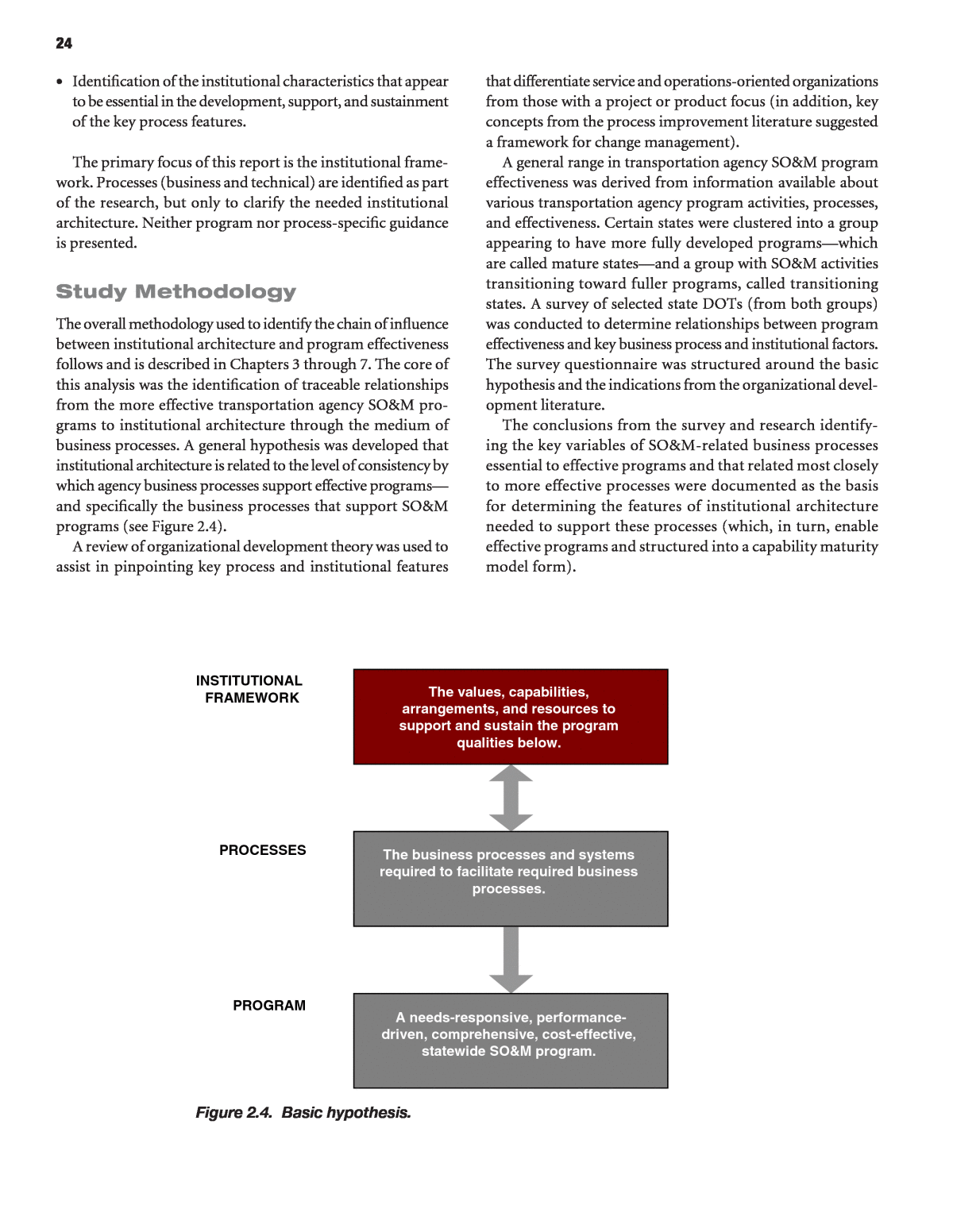
24 ⢠Identification of the institutional characteristics that appear to be essential in the development, support, and sustainment of the key process features. The primary focus of this report is the institutional frame- work. Processes (business and technical) are identified as part of the research, but only to clarify the needed institutional architecture. Neither program nor process-specific guidance is presented. Study Methodology The overall methodology used to identify the chain of influence between institutional architecture and program effectiveness follows and is described in Chapters 3 through 7. The core of this analysis was the identification of traceable relationships from the more effective transportation agency SO&M pro- grams to institutional architecture through the medium of business processes. A general hypothesis was developed that institutional architecture is related to the level of consistency by which agency business processes support effective programsâ and specifically the business processes that support SO&M programs (see Figure 2.4). A review of organizational development theory was used to assist in pinpointing key process and institutional features that differentiate service and operations-oriented organizations from those with a project or product focus (in addition, key concepts from the process improvement literature suggested a framework for change management). A general range in transportation agency SO&M program effectiveness was derived from information available about various transportation agency program activities, processes, and effectiveness. Certain states were clustered into a group appearing to have more fully developed programsâwhich are called mature statesâand a group with SO&M activities transitioning toward fuller programs, called transitioning states. A survey of selected state DOTs (from both groups) was conducted to determine relationships between program effectiveness and key business process and institutional factors. The survey questionnaire was structured around the basic hypothesis and the indications from the organizational devel- opment literature. The conclusions from the survey and research identify- ing the key variables of SO&M-related business processes essential to effective programs and that related most closely to more effective processes were documented as the basis for determining the features of institutional architecture needed to support these processes (which, in turn, enable effective programs and structured into a capability maturity model form). FRAMEWORK PROCESSES PROGRAM INSTITUTIONAL The values, capabilities, arrangements, and resources to support and sustain the program qualities below. The business processes and systems required to facilitate required business processes. A needs-responsive, performance- driven, comprehensive, cost-effective, statewide SO&M program. Figure 2.4. Basic hypothesis.
Self- Assessments and Interviews A Institutional rchitecture Findings Managing Institutional Change Guidance The Capability Maturity Model Process Findings Organizational and Change Management Theory Alternative Institutional Models Background Hypothesis & Methodology Report Figure 2.5. Study methodology. The process levels indicated were then used in combination with interview indications and the insights of organization development theory and relevant international practice to identify and structure institutional elements into incremental capability maturity model processes. A guidance framework for institutional change, based on self-evaluation and change management opportunities, was developed. Overall, change management scenarios were defined and illustrated in which the guidance can be applied ranging from incremental to event driven (Chapter 8). Alternative institutional models to incremental change were reviewed and detailed guidance was prepared that focused on the specific set of strategies needed to transition each of the four key elements to the next level of maturity. These strategies are presented in the accompanying guide. See Figure 2.5 for an illustration of this methodology. 25