



Below is the uncorrected machine-read text of this chapter, intended to provide our own search engines and external engines with highly rich, chapter-representative searchable text of each book. Because it is UNCORRECTED material, please consider the following text as a useful but insufficient proxy for the authoritative book pages.
28 Because about 85% of the volume of dense-graded HMA is made up of aggregates, HMA pave- ment performance is greatly inï¬uenced by the characteristics of the aggregates. Aggregates in HMA can be divided into three types according to their size: coarse aggregates, ï¬ne aggregates, and mineral ï¬ller. Coarse aggregates are generally deï¬ned as those retained on the 2.36-mm sieve. Fine aggregates are those that pass through the 2.36-mm sieve and are retained on the 0.075-mm sieve. Mineral ï¬ller is deï¬ned as that portion of the aggregate passing the 0.075-mm sieve. Mineral ï¬ller is a very ï¬ne material with the consistency of ï¬our and is also referred to as mineral dust or rock dust. Gravel refers to a coarse aggregate made up mostly of rounded particles. Gravels are often dredged from rivers and are sometimes mined from deposits. Because of the rounded particle size, gravels are not suitable for use in HMA mixtures unless they are well crushed. Poorly crushed gravels will not interlock when used in HMA, and the resulting mixture will have poor strength and rut resistance. Crushed stone is coarse aggregate that is mined and processed by mechanical crushing. It tends to be a very angular material and, depending on its other properties, can be well suited for use in HMA pavements. One potential problem with crushed stone is that the particles sometimes will tend to be ï¬at, elongated, or both, which can cause problems in HMA mixtures. Ideally, the particles in crushed stone aggregate should be cubicle and highly angular. The ï¬ne aggregate, or sand, used in HMA can be natural sand, manufactured sand, or a mixture of both types. Natural sand is dredged from rivers or mined from deposits and is then processed by sieving to produce a ï¬ne aggregate having the desired particle size distribution. Manufactured sand is produced by crushing quarried stone and, like natural sand, sieving to produce the desired grada- tion. The particles in manufactured sands tend to be more angular than those in natural sand and often will produce HMA mixtures having greater strength and rut resistance compared to those made with natural sand. However, this is not always true, and care is needed when selecting ï¬ne aggregate for use in HMA mixtures. The ï¬ne aggregate angularity test described later in this chapter, although not always reliable, can help to evaluate the angularity of both natural and manufactured sands. Pavement engineers have worked for many years to relate speciï¬c aggregate properties to HMA performance. Rutting, raveling, fatigue cracking, skid resistance, and moisture resistance have all been related to aggregate properties. It is essential that engineers and technicians responsible for HMA mix design thoroughly understand aggregate properties, how they relate to HMA pave- ment performance, and how aggregate properties are speciï¬ed and controlled as part of the mix design process. Aggregate Particle Size Distribution Perhaps the most widely speciï¬ed aggregate property is particle size distribution. Although only indirectly related to HMA performance, controlling particle size distribution, also called aggregate gradation, is critical to developing an effective mix design. The maximum aggregate C H A P T E R 4 Aggregates
size in an aggregate must be matched to the lift thickness used during construction, otherwise the pavement will be difï¬cult to place and compact properly. The distribution of particle sizes in an aggregate must have just the right density so that the resulting HMA will contain the optimum amount of asphalt binder and air voids. Because the shape and texture of aggregate particles vary signiï¬cantly depending on the aggregate type and the way it is mined and processed, speciï¬cation limits for aggregate gradation tend to be very broad. This breadth helps technicians and engineers achieve the right blend of aggregates for different applications. The section below describes general terminology used when discussing aggregate particle size distribution and the relationship between aggregate gradation and different HMA mix types. Because suggested limits for aggregate gradation vary depending on the type of mix design being developed, only a few examples are given hereâ a complete listing of aggregate gradation requirements are given in the various chapters discussing mix design procedures for the various HMA mix types: dense-graded HMA, gap-graded HMA, and open-graded friction courses. Nominal Maximum Aggregate Size Nominal maximum aggregate size (NMAS) is a way of specifying the largest aggregate size in an aggregate. In the mix design procedure described in this manual, as in the Superpave system, NMAS is deï¬ned as one sieve-size larger than the ï¬rst sieve size to retain 10% or more of the total aggregate by mass. Aggregate Sieve Analysis The particle size distribution of construction aggregates is usually determined and specified by performing a sieve analysis. In this test, an aggregate is passed through a stack of sieves of decreasing size. The amount of aggregate on each sieve is weighed, and the percent passing each sieve size is calculated as a percent by weight. Sometimes, for aggregates made up of different minerals or rocks having widely different speciï¬c gravities, the results of the sieve analysis are given as percent passing by volume. For HMA mix design and analysis, an aggregate sieve analysis uses the following standard sieve sizes: 37.5 mm, 25.0 mm, 19.0 mm, 12.5 mm, 9.5 mm, 4.75 mm, 2.36 mm, 1.18 mm, 0.60 mm, 0.30 mm, 0.15 mm, and 0.075 mm. Other sieve sizes are sometimes used for special purposes or in other aggregate test procedures. A schematic of a simplified sieve analysis is shown in Figure 4-1. An aggregate sample is collected and placed through a stack of sieves. The sieves are usually shaken mechanically, until the aggregate has been separated completely on the various sieves. At the bottom of the sieve stack is a pan, in which material is collected that has completely passed through the stack of sieves. The aggregate on each sieve is then weighed, and calculations are performed to determine the percent passing for each sieve. In performing a sieve analysis, there are several important considerations: ⢠The weight of the test sample must be large enough to produce reliable test results. Larger aggregate sizes will require larger sample sizes. Table 4-1 lists minimum weights for test samples for sieve analysis for different NMAS values. ⢠The sieve opening sizes selected should be appropriate for the aggregate being tested. Past data or the gradation speciï¬cation for the aggregate being tested can be used to determine the sieves needed for a given aggregate. ⢠The physical size of the sievesâthe diameter or areaâincreases with increasing aggregate size. For ï¬ne aggregate, 203-mm-diameter sieves are often used. The maximum amount of aggregate retained on sieves of this size should be limited to about 194 g; larger amounts may result in inaccurate sieve analyses because the aggregate can longer ï¬ow freely through the stack of sieves. Aggregates 29
⢠Overloading sieves can sometimes be prevented by placing intermediate sieve sizes in a stack of sieves. For example, a speciï¬cation may only require the determination of percent passing the 9.5- and 19-mm-diameter sieves, but using these sieves only might overload the 9.5-mm sieve. Inserting a 12.5-mm-diameter sieve between the 9.5- and 19-mm-diameter sieves will help prevent overloading of the 9.5-mm-diameter sieve. ⢠The amount of time a stack of sieves is shaken should be long enough to ensure that the aggre- gate particles have been completely sorted through the stack, but not so long that signiï¬cant aggregate degradation might occur. ⢠Accurate determination of mineral ï¬llerâmaterial ï¬ner than 0.075 mmâwill in general require a washed sieve analysis. Figure 4-2 shows a stack of sieves for ï¬ne aggregate assembled in a mechanical sieve shaker. Engineers and technicians should refer to appropriate speciï¬cations for details on performing aggregate sieve analyses: AASHTO T 27, Sieve Analysis of Fine and Coarse Aggregate; AASHTO T 11, Materials Finer than 75-μm Sieve in Mineral Aggregates by Washing; and AASHTO T 30, Mechan- ical Analysis of Extracted Aggregates. Calculations for Aggregate Sieve Analyses The results of an aggregate sieve analysis in HMA technology are usually presented as weight percent passing. Calculation of percent passing from the results of a sieve analysis is straight- forward and is best explained through an example. Table 4-2 gives the results of a sieve analysis of a ï¬ne aggregate, along with the calculations of percent retained, cumulative percent retained, and 30 A Manual for Design of Hot Mix Asphalt with Commentary Figure 4-1. Schematic of an aggregate sieve analysis. Nominal Maximum Aggregate Size, mm Minimum Weight for Test Sample, kg 9.5 1 12.5 2 19.0 5 25.0 10 37.5 15 Table 4-1. Minimum test sample size for sieve analysis of aggregate as a function of nominal maximum aggregate size.
percent passing. The weight retained, as shown in Column 2, is the weight in grams of the aggregate separated onto each sieve. The total of these values, 1143.6 g, is slightly less than the original sample weight of 1146.0 g. The difference is due to material lost, either as dust lost to the air, particles trapped within the mesh of the sieves, or particles fallen from the sieves without being weighed. The percent error is calculated as the difference between the total weight retained and the original sample weight, expressed as a percent of the original sample weight: The % retained is calculated by dividing the weight retained for each sieve by the original sample weight and, again, expressing the result as a weight percentage. For the 2.36-mm-diameter sieve % . . . % . %retained mm sieve2 36 231 7 1146 0 100 20 2= Ã = ( )4 2- Error = â Ã = 1146 0 1143 6 1146 0 100 0 21 4 1 . . . % . % ( )- Aggregates 31 Figure 4-2. Stack of sieves for fine aggregate assembled in a mechanical sieve shaker. (1) Sieve Size, mm (2) Weight Retained, g (3) % Retained, Wt. % (4) Cumulative % Retained, Wt. % (5) % Passing, Wt. % 19.0 0.0 0.0 0.0 100.0 12.5 0.0 0.0 0.0 100.0 9.5 97.5 8.5 8.5 91.5 4.75 214.6 18.7 27.2 72.8 2.36 231.7 20.2 47.5 52.5 1.18 215.8 18.8 66.3 33.7 0.60 116.3 10.1 76.4 23.6 0.30 90.4 7.9 84.3 15.7 0.15 75.2 6.6 90.9 9.1 0.075 57.8 5.0 95.9 4.1 pan 44.3 3.9 99.8 --- Total: 1143.6 99.8 Original Sample Size: 1146.0 Error, Wt. %: 0.21 Table 4-2. Example sieve analysis.
The cumulative % retained is calculated by summing all the values for % retained up to the given sieve size. For the 0.60-mm sieve: The % passing is calculated as 100%âthe cumulative % retained. For the 0.60-mm-diameter sieve, for example, the % passing is calculated as 100 â 76.4 = 23.6%. It should be pointed out that there are slightly different ways of calculating these values for sieve analyses, and those responsible for HMA mix design and associated testing should follow the procedures as required by their state agencies. The results of aggregate sieve analyses are usually presented graphically, by plotting percent passing against sieve size in mm. Sieve size is often plotted on a logarithmic scale. Figure 4-3 is a plot of the results of the example sieve analysis given in Table 4-2. Aggregate Gradation The plot given in Figure 4-3 is an example of an aggregate gradation. For purposes of classifying HMA mix types, there are four types of aggregate gradation: dense-graded, ï¬ne-graded, coarse- graded, and open-graded. As explained in Chapter 8, when designing HMA, two, three, four, or even more aggregates are combined in speciï¬c proportions to create an aggregate blend to which asphalt binder is added forming an HMA mixture. Because ï¬ne and coarse aggregate gradations as used in HMA are really slight variations of dense gradations, a more accurate description of these would be dense/ï¬ne and dense/coarse aggregate gradations or blends. The densest possible aggregate gradation, called the maximum density gradation (or sometimes the Fuller maximum density curve), can be approximately calculated using the following formula: where % PMD = % passing, maximum density gradation d = sieve size in question, mm D = maximum sieve size, mm Figure 4-4 illustrates the different types of HMA aggregate gradations and includes the maximum density gradation calculated using Equation 4-4 for a maximum aggregate size of % % ( ) . PMD d D = âââ ââ â à 0 45 100 4 4- cumulative retained mm sieve% . . . .0 60 8 5 18 7 20= + + 2 18 8 10 1 76 4 4 3+ + =. . . % ( )- 32 A Manual for Design of Hot Mix Asphalt with Commentary 0 20 40 60 80 100 0.010 0.100 1.000 10.000 100.000 Sieve Size, mm W ei gh t % P as si ng Figure 4-3. % passing plotted against sieve size for example sieve analysis given in table 4-2.
12.5 mm. Coarse-graded and gap-graded aggregates for HMA mixes can be very similar; the main difference is that gap-graded aggregate blends tend to contain more large aggregate particles compared to coarse gradations, but they also contain larger amounts of very ï¬ne material, especially mineral ï¬ller. Methods for blending aggregates in HMA mix design are discussed in detail in Chapter 8 of this manual. Specifications for Aggregate Gradation There are two types of gradation specifications or requirements used in HMA technology: (1) speciï¬cations for the gradation of processed aggregate, as supplied by aggregate producers and (2) requirements for blends of aggregate developed as part of the HMA mix design process and used in the production of HMA. Requirements for aggregate blends are listed in the chapters of this manual speciï¬cally dealing with HMA mix design: Chapter 8 for dense-graded mixtures, Chapter 10 for gap-graded mixtures, and Chapter 11 for open-graded friction course mixtures. AASHTO M 43, Standard Speciï¬cation for Sizes of Aggregate for Road and Bridge Construction, gives the gradation requirements for a wide range of coarse aggregate sizes used in the development of HMA mix designs. Table 4-3 is a shortened version of these requirements, listing the most commonly used aggregate gradations. Table 4-4 lists AASHTO speciï¬cations for ï¬ne aggregates for bituminous paving mixtures, as given in AASHTO M 29, Fine Aggregate for Bituminous Paving Mixtures. It should be noted that although many agencies may follow the AASHTO grading requirements listed in Tables 4-3 and 4-4, some agencies may use different speciï¬cations. In some cases, there may be minor modiï¬cations to the AASHTO requirements; in other cases, the speciï¬cations may be signiï¬cantly different. Engineers and technicians responsible for developing HMA mix designs should obtain current speciï¬cations for aggregate gradations from the applicable state highway department (or other agency as appropriate). Aggregate Specific Gravity and Absorption When designing HMA, both the mass and volume of the aggregates and asphalt binder going into the mixture must be known. The mass and volume of a material are related through the values of density or specific gravity. Density refers to the mass of a material per unit volume. Density values for most construction materials, including aggregates, are usually reported in Aggregates 33 fine-graded maximum density gap-graded coarse-graded dense-graded 0 20 40 60 80 100 0.010 0.100 1.000 10.000 100.000 Sieve Size, mm W ei gh t % P as si ng Figure 4-4. Types of HMA aggregate gradations; heavy black line represents maximum density gradation as calculated using equation 4-4.
units of g/cm3; density values for HMA and other types of concrete are often reported in units of kg/m3. High-density materials feel heavy for their size. Water has a density of about 1.0 g/cm3, while many construction aggregates have density values between 2.5 and 3.0 g/cm3. Steel has a density of about 7.8 g/cm3. Table 4-5 lists density values for various materials, including common construction aggregates. The term speciï¬c gravity is often used interchangeably with density, but has a different meaning. Speciï¬c gravity is deï¬ned as the ratio of the mass of a material to the mass of an equal volume of water. It can also be deï¬ned as the ratio of the density of a material to the density of water. Because water has a density of 1.0 g/cm3 at room temperature, the values of density in units of g/cm3 are equal to specific gravity values. However, these terms should be used carefully. It is especially important to make sure that the units are included when reporting density values. Because speciï¬c gravity values are ratios of two numbers with the same units, speciï¬c gravity is dimensionless. The typical density of granite is 2.65 g/cm3, while the typical value for the specific gravity of granite is 2.65. 34 A Manual for Design of Hot Mix Asphalt with Commentary % Passing (mass %) for Sieve Size: AASHTO Size No. 50 mm 37.5 mm 25.0 mm 19.0 mm 12.5 mm 9.5 mm 4.75 mm 2.36 mm 1.18 mm 0.300 mm 4 100 90 to 100 20 to 55 0 to 15 --- 0 to 5 --- --- --- --- 467 100 90 to 100 --- 35 to 70 --- 10 to 30 0 to 5 --- --- --- 5 --- 100 90 to 100 20 to 55 0 to 10 0 to 5 --- --- --- --- 56 --- 100 95 to 100 40 to 85 10 to 40 0 to 15 0 to 5 --- --- --- 57 --- 100 100 --- 25 to 60 --- 0 to 10 0 to 5 --- --- 6 --- --- 100 90 to 100 20 to 55 0 to 15 0 to 5 --- --- --- 67 --- --- 100 90 to 100 --- 20 to 55 0 to 10 0 to 5 --- --- 68 --- --- --- 90 to 100 --- 30 to 65 5 to 25 0 to 10 0 to 5 --- 7 --- --- --- 100 90 to 100 40 to 70 0 to 15 0 to 5 --- --- 78 --- --- --- 100 90 to 100 40 to 75 5 to 25 0 to 10 0 to 5 --- 8 --- --- --- --- 100 85 to 100 10 to 30 0 to 10 0 to 5 --- 89 --- --- --- --- 100 90 to 100 20 to 55 5 to 30 0 to 10 0 to 5 9 --- --- --- --- --- 100 85 to 100 10 to 40 0 to 10 0 to 5 Table 4-3. Standard sizes of coarse aggregates for road and bridge construction as adapted from AASHTO M 43. % Passing (mass %) for Sieve Size: AASHTO Grading No. 9.5 mm 4.75 mm 2.36 mm 1.18 mm 0.60 mm 0.30 mm 0.150 mm 0.075 mm 1 100 95 to 100 70 to 100 40 to 80 20 to 65 7 to 40 2 to 20 0 to 10 2 --- 100 75 to 100 50 to 74 28 to 52 8 to 30 0 to 12 0 to 5 3 --- 100 95 to 100 85 to 100 65 to 90 30 to 60 5 to 25 0 to 5 4 100 80 to 100 65 to 100 40 to 80 20 to 65 7 to 40 2 to 20 0 to 10 5 100 80 to 100 65 to 100 40 to 80 20 to 65 7 to 46 2 to 30 --- Table 4-4. Standard sizes of fine aggregates for bituminous paving mixtures as adapted from AASHTO M 29.
Aggregate speciï¬c gravity is determined using different techniques for coarse and ï¬ne aggregate. Obtaining accurate specific gravity values for aggregates prior to performing an HMA mix design is essential, and engineers and technicians responsible for mix designs must develop proper laboratory techniques for these procedures. For coarse aggregate, speciï¬c gravity is determined using the weight-in-water method. In this procedure, coarse aggregate is weighed in air, and then in water, in a mesh basket suspended from a balance. A sketch of a weight-in-water apparatus is shown in Figure 4-5. The bulk speciï¬c gravity of a sample of coarse aggregate is calculated using the following equation: Bulk Sp Gr A B C -. . ( )= â( ) 4 5 Aggregates 35 Material Density, g/cm3 Aluminum 2.71 Asphalt binder 1.03 Basalt 2.86 Concrete 2.40 Diabase 2.96 Dolomite 2.70 Glass 2.50 Gneiss 2.74 Granite 2.65 Iron 7.87 Lead 11.35 Limestone 2.66 Marble 2.63 Nylon 1.14 Portland cement 3.15 Quartz 2.65 Quartzite 2.69 Sandstone 2.54 Shale 1.85-2.50 Steel 7.80 Teflon 2.17 Wood 0.50 Table 4-5. Typical density values for various materials, including common construction aggregates. Electronic balance Wire hook Mesh basket Tub filled with distilled water Aggregate Figure 4-5. Weight-in-water apparatus for determining specific gravity of coarse aggregate.
where Bulk Sp. Gr. = bulk speciï¬c gravity A = weight of dry aggregate in air, g B = weight of saturated, surface-dry aggregate in air, g C = weight of saturated aggregate in water, g The term saturated, surface-dry (SSD) as used in Equation 4-5 means that the aggregate specimen has been saturated with water (usually by overnight soaking in water) and then quickly dried with a clean cloth or towel just until the aggregate surfaces are no longer visibly wet and shiny. Aggregate particles contain a large number of microscopic voids or pores, both within the aggregate particle and on and near the aggregate surface. Voids that connect to the surface become ï¬lled with water when saturated, while internal voids do not. When a saturated aggregate particle is quickly dried with a cloth or towel, water remains in the permeable voids, while the surface is dry, as shown in Figure 4-6. The SSD condition is important in HMA mix design because this approximately represents the condition of the aggregate in HMA mixtures, except that the permeable voids are now ï¬lled with asphalt binder instead of water. Sometimes, two other speciï¬c gravity values are reported: bulk speciï¬c gravity, SSD basis, and apparent speciï¬c gravity. These two speciï¬c gravity values are sometimes used in the design and analysis of portland cement concrete mixtures, but are rarely used in HMA technology, where the term âspeciï¬c gravity,â when applied to aggregates, should be taken to mean bulk speciï¬c gravity. Because ï¬ne aggregate would fall through the wire mesh basket used in determining weight- in-water, this approach cannot be used in speciï¬c gravity measurements. Instead, the pycnometer method is used. This technique requires the use of a pycnometer, which is simply a container that can be repeatedly filled with the sameâor nearly the sameâvolume of water. Usually, a volumetric ï¬ask is used for performing ï¬ne aggregate speciï¬c gravity measurements. The ï¬ask is partially ï¬lled with distilled water and then about 500 g of saturated sand is placed in the ï¬ask. The ï¬ask is rolled and gently shaken to remove all air bubbles and then more water is added until the ï¬ask is ï¬lled just to the calibration mark. The ï¬ask is weighed, and the contents carefully poured into a metal pan which is then dried in an oven. The bulk speciï¬c gravity of the ï¬ne aggregate is then calculated using the following equation: Bulk Sp Gr A B W C. . ( )= + â( ) 4 6- 36 A Manual for Design of Hot Mix Asphalt with Commentary Permeable voids filled with water Aggregate surface dry Impermeable voids contain no water Figure 4-6. Sketch showing saturated, surface-dry condition in an aggregate particle.
where Bulk Sp. Gr. = bulk speciï¬c gravity A = weight of oven-dry aggregate in air, g B = weight of pycnometer ï¬lled with water to calibration mark, g W = weight of saturated, surface-dry aggregate in air, g C = weight of pycnometer with aggregate and ï¬lled with water to calibration mark, g Figure 4-7 is a diagram of a volumetric ï¬ask as used in determining the speciï¬c gravity of ï¬ne aggregate. Just as is done for coarse aggregate, part of the speciï¬c gravity test for ï¬ne aggregate involves weighing the aggregate in air in the SSD condition. This is much more difï¬cult for ï¬ne aggregate than for coarse aggregateâthe surfaces of ï¬ne aggregate particles cannot be quickly dried with a cloth or towel because the particles are too ï¬ne. Traditionally, the cone test has been used to determine if a ï¬ne aggregate is in the SSD condition. In this procedure, saturated ï¬ne aggregate is dried using a blow dryer. Every few minutes, a small conical metal mold is filled with fine aggregate and tamped down. The mold is then removed; when the sand ï¬rst slumps when the mold is removed, it is assumed to be in the SSD condition. Unfortunately, the cone test is not very accurate. Engineers have been working on developing alternative procedures, but at this time, none are yet being implemented. For both coarse aggregate and ï¬ne aggregate, absorption is an important property. It is calculated using the following equation: where Absorption = water absorption in weight, % A = weight of saturated, surface-dry aggregate in air, g B = weight of dry (air-dry or oven-dry) aggregate in air, g The absorption calculated using Equation 4-7 is the amount of water absorbed into the permeable voids of the aggregate. When aggregate is mixed with asphalt binder to produce HMA, asphalt will be absorbed into the permeable voids in the same way that water is. However, the amount of asphalt binder absorbed by the aggregate will in general not be as great as the water Absorption A B B= â( ) Ã100 4 7% ( )- Aggregates 37 Calibration mark Water Pycnometer (volumetric flask) Fine aggregate Figure 4-7. Pycnometer method of determining fine aggregate specific gravity.
absorption. In HMA mix design it is often assumed that asphalt absorption will be one-half of the water absorption. It is important to account for this absorption, since asphalt absorbed into the permeable voids of the aggregate will not be available to ï¬ll the voids between the aggregate particles. For this reason, the asphalt binder content for HMA mixtures made using aggregates having high absorption values will tend to be signiï¬cantly higher than those made using aggregates with lower absorption values. Aggregate Specification Properties Angular and rough-textured aggregates are desirable within HMA to resist permanent deformation and fatigue cracking. Very angular and rough-textured aggregates provide better interlock between the aggregate particles which helps prevent plastic deformation (rutting) within HMA layers. Angular and rough-textured aggregates also help improve the strength of HMA mixtures, which can help prevent fatigue cracking. Angular aggregates with good surface texture also improve the frictional properties of pavement layers, an important safety consideration in the design of HMA for pavements. The presence of ï¬at or elongated particles within HMA is undesirable because these particles tend to break down during production and construction. Aggregates that break during production and construction will reduce the durability of the HMA layer, leading to raveling, pop-outs, and potholes. Another aggregate characteristic related to performance is cleanliness and the presence of deleterious materials. Cleanliness is a term used to characterize the coatings on some aggregate particles. These coatings are often very ï¬ne clay-like materials and can affect the adhesion between the asphalt binder and aggregate particles leading to an increased potential for moisture damage. Deleterious materials are particles in an aggregate stockpile that are weak, prone to freeze-thaw damage or damage through repeated wetting and drying, or that otherwise can cause a pavement to deteriorate. Some examples of deleterious materials are clay lumps, friable particles, shale, coal, free mica, and vegetation. These types of materials are not as strong as mineral aggregates and break down during the life of a pavement layer. When this happens, pop-outs and potholes can occur. Aggregate toughness and abrasion resistance have also been shown to be related to pavement performance. Aggregate particles that are tough and resistant to abrasion will not break down during the construction process, which helps ensure that an HMA mix can be properly constructed, placed, and compacted. Tough, abrasion-resistant aggregates also tend to produce a mix that is resistant to pop-outs and raveling. Because aggregate pop-outs and broken aggregate particles near the pavement surface make it easier for water to ï¬ow into a pavement, tough and abrasion- resistant aggregates help improve the moisture resistance of HMA pavements. Aggregates with poor abrasion resistance can also polish under the action of trafï¬c. This can cause the pavement surface to lose skid resistance, especially when wet. Another aggregate property that is closely related to toughness and abrasion resistance is durability and soundness. Freeze-thaw cycles and alternate periods of wetting and drying in a pavement can weaken poor-quality aggregates, causing pop-outs and raveling. Aggregates that possess good durability and soundness will resist the actions of wet-dry and freeze-thaw cycles during the life of the pavement. Superpave Consensus and Source Aggregate Properties During the development of the Superpave mix design system for dense-graded HMA, aggregate requirements were specified based on the experiences of a group of experts. Properties that 38 A Manual for Design of Hot Mix Asphalt with Commentary
were identiï¬ed as important within HMA included the angularity of coarse and ï¬ne aggregates, aggregate shape, cleanliness of the aggregates, toughness, soundness, and the proportion of dust within the mixture. After some discussion, these experts reached an agreement, or consensus, that four aggregate properties were most important to HMA performance and should be speciï¬ed as part of the Superpave system. A test method and speciï¬cation limits were identiï¬ed for each of these consensus properties. The four Superpave consensus aggregate properties are coarse aggregate angularity (CAA), ï¬ne aggregate angularity (FAA), clay content, and ï¬at and elongated particles. The expert panel identiï¬ed several other aggregate properties as important to HMA pavement performance, but could not reach agreement on the speciï¬cation limits. These aggregate prop- erties are toughness (Los Angeles Abrasion test), soundness (Sodium or Magnesium Sulfate Soundness test), and deleterious materials. Test values for these properties vary significantly across the United States and Canada, depending on the type of aggregates locally available. The panel of experts therefore labeled these aggregate properties as âsource aggregate propertiesâ and recommended that specification values for these properties be developed by individual highway agencies. The group of experts developed the aggregate requirements for HMA without the beneï¬t of a formalized research program. Since the early 1990s, when the group of experts met to develop the aggregate requirements for the Superpave mix design system, a signiï¬cant amount of work has been conducted to evaluate various aggregate tests and their relationship with pavement performance. This chapter provides aggregate requirements for the design of dense-graded HMA. These requirements build on both the experiences of the group of experts and research that has been conducted since the Superpave mix design system was developed. Because the Superpave consensus aggregate properties are now ï¬rmly grounded in both experience and research, rather than simply the consensus of an expert panel, the term âconsensus propertiesâ is no longer accurate. For this reason, the term âprimary aggregate speciï¬cation propertiesâ is used herein to describe these four critical characteristics. The term source aggregate properties is still appropriate for the other aggregate tests, since speciï¬cation values for these are still to be determined by individual agencies. Speciï¬cation limits for the various primary aggregate speciï¬cation properties are not uniform for all HMA mixtures. Insteadâas in the Superpave systemâthe specification requirements for these test values are based on the expected amount of trafï¬c over a 20-year pavement life, the position of the layer being designed within the pavement structure, or both. Trafï¬c is characterized as equivalent single-axle loads (ESALs) and more stringent speciï¬cation limits are provided for pavements that will be subjected to higher trafï¬c loads. Pavement layers that will encounter lower traffic volumes or are within the lower portion of the pavement structure have less stringent requirements. The primary aggregate speciï¬cation properties are designed to evaluate four critical charac- teristics for aggregates used in HMA mixtures. These four characteristics are coarse aggregate angularity, ï¬ne aggregate angularity, coarse aggregate particle shape, and cleanliness. Just as in the Superpave system, requirements for these characteristics are intended to be enforced on the aggregate blend and not on individual stockpiles. The following sections summarize the test methods and speciï¬cation limits for the four primary aggregate speciï¬cation properties. Coarse Aggregate Fractured Faces Several research studies have shown that increasing the number of particles in an aggregate blend that have been mechanically crushed increases resistance to permanent deformation. The test recommended in this manual is the same as that used in the Superpave systemâ a simple âcrush count.â The term coarse aggregate fractured faces (CAFF) is used instead of coarse Aggregates 39
aggregate angularity because âfractured facesâ is simpler and clearer, since it is the common term used for this type of test. The procedure is described in ASTM D 5821, Standard Test Method for Determining the Percentage of Fractured Particles in Coarse Aggregate. Aggregate particles larger than 4.75 mm are visually examined to determine the percentage of particles that has at least one fractured face, and the percentage that has at least two. A CAFF value of 76/53, for example, means that 76% of the particles in a coarse aggregate have at least one fractured face, and 53% have at least two fractured faces. Table 4-6 outlines the required minimum values for CAFF as a function of trafï¬c level and depth within the pavement structure. Note that the values given in Table 4-6 are slightly different from the values currently speciï¬ed within the Superpave system; for the highest trafï¬c level, the values for all mixtures are 98/98, whereas in the Superpave system the required values for coarse aggregate angularity are 100/100. A footnote allows further reduction of the CAFF requirement for this trafï¬c level to 95/95 if local experience suggests that the resulting HMA will have adequate rut resistance under very heavy trafï¬c. These slightly lower requirements for CAFF mean that high-quality crushed gravel can be used in HMA for high traffic applications. In the Superpave system, because of the very high requirements for CAFF at the highest trafï¬c level, only crushed stone could be used for these applications. Experience over the past 5 to 10 years suggests that high-quality crushed gravels will usually perform quite well in properly designed HMA mixtures, even under extremely high trafï¬c levels. Furthermore, the mix design system described in this manual includes performance testing for HMA mixtures designed for trafï¬c levels of 10 million ESALs and greater. This performance testing provides additional assurance that HMA mixtures will have adequate rut resistance. The slightly lower values for CAFF recommended here should not be used unless performance testing is included as part of the mix design process. Fine Aggregate Angularity The angularity of the fine aggregate fraction is as important as the angularity of the coarse aggregate fraction to the performance of dense-graded HMA. In combination, the coarse and fine aggregates provide strength to HMA, which helps minimize the potential for permanent deformation. AASHTO T 304, Method A, Uncompacted Void Content of Fine Aggregate, is used to measure ï¬ne aggregate angularity. A graded sample of ï¬ne aggregate (passing the 2.36-mm sieve) is placed within a specially made funnel which allows the aggregate particles to freely drop into a cylinder of known volume (Figure 4-8). Using the combined bulk specific gravity of the fine aggregate blend, the percent voids between the aggregate particles is determined. Results from the ï¬ne aggregate angularity test represent this percent of uncompacted voids in the ï¬ne aggregate; higher values of uncompacted voids indicate greater angularity of the ï¬ne aggregate. Requirements 40 A Manual for Design of Hot Mix Asphalt with Commentary Percentage of Particles with at Least One/Two Fractured Faces, for Depth of Pavement LayerA, mm Design ESALs (million) 0 to 100 Below 100 < 0.30 55 / --- --- / --- 0.3 to < 3 75 / --- 50 / --- 3 to < 10 85 / 80 60 / --- 10 to < 30 95 / 90 80 / 75 30 or more 98 / 98B 98/ 98B ADepth of pavement layer is measured from pavement surface to top of pavement layer within the pavement containing the given mixture. BThe CAFF requirement for design traffic levels of 30 million ESALs or more may be reduced to 95/95 if experience with local conditions and materials indicate that this would provide HMA mixtures with adequate rut resistance under very heavy traffic. Table 4-6. Coarse aggregate fractured faces requirements.
for ï¬ne aggregate angularity are given in Table 4-7. The requirements in this table are nearly identical to those given in the Superpave system. The only exception is that in Table 4-7 where the minimum FAA value is 45, it can be lowered to 43 if experience with local conditions and materials suggests that this will produce mixtures with adequate rut resistance. Flat and Elongated Particles The percentage of flat and elongated particles in a coarse aggregate is determined using procedures described in ASTM D 4791, Flat Particles, Elongated Particles, or Flat and Elongated Particles. As in the Superpave system, this manual recommends a maximum value of 10% for ï¬at and elongated particles exceeding a 5:1 ratio. To conduct this test, aggregate particles are measured with a proportional caliper (Figure 4-9) using a speciï¬ed ratio of 5:1. The larger caliper opening is set to the particle length; if the width of the particle can fit within the smaller opening, it is considered ï¬at and elongated. Coarse aggregates that fail this requirement are rare. Some state agencies use slightly different versions of this testâusing different limits, or specifying a maximum value for ï¬at or elongated particles for coarse aggregates. Technicians should check the applicable speciï¬cations to make sure they are using the proper test and limits when evaluating aggregates for an HMA mix design. Aggregates 41 Fine aggregate sample Funnel Cylinder of known volume Figure 4-8. Fine aggregate angularity test. Depth of Pavement Layer from SurfaceA, mm Design ESALs (million) 0 to 100 Below 100 < 0.30 ---B --- 0.3 to < 3 40 --- 3 to < 10 45C 40 10 to < 30 45C 40 30 or more 45C 45C Criteria are presented as percent air voids in loosely compacted fine aggregate. ADepth of pavement layer is measured from pavement surface to top of pavement layer within the pavement containing the given mixture. BAlthough there is no FAA requirement for design traffic levels below 0.30 million ESALS, consideration should be given to requiring a minimum uncompacted void content of 40 % for 4.75-mm nominal maximum aggregate size mixes. CThe FAA requirement of 45 may be reduced to 43 if experience with local conditions and materials indicate that this would produce HMA mixtures with adequate rut resistance under the given design traffic level. Table 4-7. Fine aggregate angularity requirements.
Requirements for flat and elongated particles are not based on the traffic level or the antic- ipated depth within the pavement structure. Flat and elongated particles are considered to be detrimental within an HMA mixture during production and construction, irrespective of traffic loadings or depth within the pavement; therefore, a single maximum percentage of flat and elongated particles is required. Table 4-8 presents the requirements for flat and elongated particles. Clay Content The presence of dust or clay coatings on aggregates can prevent the asphalt binder from prop- erly coating the aggregates within an HMA. This can lead to water penetrating the asphalt binder ï¬lm and, therefore, stripping of the asphalt binder from the aggregate. The Sand Equivalent test (AASHTO T 176, Plastic Fines in Graded Aggregates and Soils by Use of the Sand Equivalent Test) is used to evaluate the cleanliness of aggregates to identify when harmful clay-sized particles exist in an aggregate blend. The procedure is conducted on the aggregate fraction of the blend that passes the 4.75-mm sieve. If hydrated lime is used in the mixture, it should not be included in the fine aggregate used during the sand equivalent test. The aggregate sample is placed within a graduated, transparent cylinder that is filled with a mixture of water and flocculating agent. The combination of aggregate, water, and ï¬occulating agent is then agitated for 45±5 seconds. After agitation, the combination is allowed to sit at room temperature for 20 minutes. After the 20 minutes, the heights of the sand particles and the sand plus clay particles are measured (Figure 4-10). The sand equivalent value is then calculated as the ratio of the height of the sand to the height of sand plus clay, expressed as a percentage. High sand equivalent values are desirable, since this indicates that the aggregate is relatively free of dust and clay particles. Therefore, minimum values for sand equivalency are specified. These minimum values do not change with depth within the pavement, but do vary somewhat with design trafï¬c level. Table 4-9 summarizes the requirements for the sand equivalent test. 42 A Manual for Design of Hot Mix Asphalt with Commentary 5:1 pivot point swinging armfixed post (A) fixed post (B) Figure 4-9. Flat or elongated test. Design ESALs (million) Maximum Percentage of Flat and Elongated Particles at 5:1 < 0.30 --- 0.3 to < 3 10 3 to < 10 10 10 to < 30 10 30 or more 10 Criteria are presented as percent flat and elongated particles by mass. Table 4-8. Criteria for flat and elongated particles.
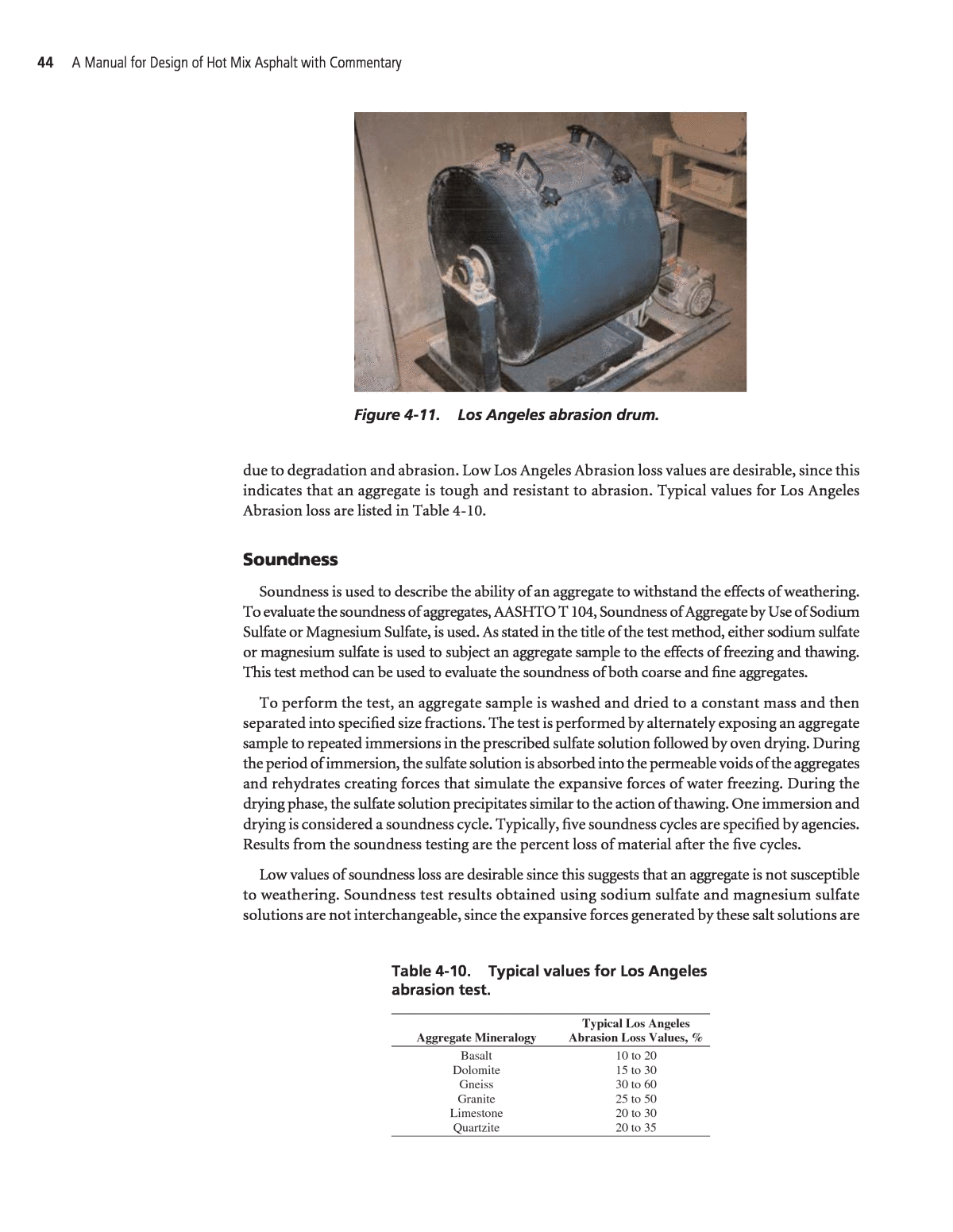
Source Aggregate Properties Some aggregate properties were identiï¬ed by the expert group as important, but about which a consensus could not be reached on speciï¬cation limits. These aggregate properties were called âSource Properties.â Test methods were recommended; however, development of speciï¬cation limits was left to local agencies that had experience with area materials. These properties are generally used during source approval and, therefore, requirements are not applied to the aggregate blend as with the then consensus properties. Source properties deemed important include ⢠Toughness, ⢠Soundness, and ⢠Deleterious materials. Toughness The term toughness is used to describe the ability of an aggregate to withstand the abrasion and degradation that occurs during handling, production, construction, and in-service use. Toughness is measured using the Los Angeles Abrasion Test, described in AASHTO T 96, Resistance to Degradation of Small-Size Coarse Aggregate by Abrasion and Impact in the Los Angeles Machine. In performing the Los Angeles Abrasion test, a graded sample of aggregate is placed in a large steel drum (Figure 4-11). Six to twelve steel charges (depending on gradation of the aggregate stockpile) are placed within the drum in addition to the aggregate sample. The drum is then rotated which subjects the aggregates to impact and abrasion by the steel balls. Results from the test are reported as a percent loss, which is the mass percentage of aggregate lost during the test Aggregates 43 suspended clay sand plus clay reading graduated cylinder flocculating solution sand reading settled aggregate Figure 4-10. Sand equivalent test. Design ESALs (million) Minimum Sand Equivalency Value < 0.30 40 0.3 to < 3 40 3 to < 10 45 10 to < 30 45 30 or more 50 Criteria are presented as Sand Equivalent Value. Table 4-9. Clay content requirements.
due to degradation and abrasion. Low Los Angeles Abrasion loss values are desirable, since this indicates that an aggregate is tough and resistant to abrasion. Typical values for Los Angeles Abrasion loss are listed in Table 4-10. Soundness Soundness is used to describe the ability of an aggregate to withstand the effects of weathering. To evaluate the soundness of aggregates, AASHTO T 104, Soundness of Aggregate by Use of Sodium Sulfate or Magnesium Sulfate, is used. As stated in the title of the test method, either sodium sulfate or magnesium sulfate is used to subject an aggregate sample to the effects of freezing and thawing. This test method can be used to evaluate the soundness of both coarse and ï¬ne aggregates. To perform the test, an aggregate sample is washed and dried to a constant mass and then separated into speciï¬ed size fractions. The test is performed by alternately exposing an aggregate sample to repeated immersions in the prescribed sulfate solution followed by oven drying. During the period of immersion, the sulfate solution is absorbed into the permeable voids of the aggregates and rehydrates creating forces that simulate the expansive forces of water freezing. During the drying phase, the sulfate solution precipitates similar to the action of thawing. One immersion and drying is considered a soundness cycle. Typically, ï¬ve soundness cycles are speciï¬ed by agencies. Results from the soundness testing are the percent loss of material after the ï¬ve cycles. Low values of soundness loss are desirable since this suggests that an aggregate is not susceptible to weathering. Soundness test results obtained using sodium sulfate and magnesium sulfate solutions are not interchangeable, since the expansive forces generated by these salt solutions are 44 A Manual for Design of Hot Mix Asphalt with Commentary Figure 4-11. Los Angeles abrasion drum. Aggregate Mineralogy Typical Los Angeles Abrasion Loss Values, % Basalt 10 to 20 Dolomite 15 to 30 Gneiss 30 to 60 Granite 25 to 50 Limestone 20 to 30 Quartzite 20 to 35 Table 4-10. Typical values for Los Angeles abrasion test.
different. Generally, use of magnesium sulfate solution will result in slightly higher loss values than use of sodium sulfate solution. As such, typical speciï¬cation limits are a maximum of 10% loss when sodium sulfate is used and a maximum of 15% when magnesium sulfate is used, though speciï¬cation limits can vary by agency. Deleterious Materials Deleterious materials are those materials within an aggregate stockpile that are weak, reactive, or unsound. Examples of materials that can be considered deleterious include clay lumps, friable particles, shale, coal, free mica, and vegetation. The test method for evaluating deleterious materials is AASHTO T 112, Clay Lumps and Friable Particles in Aggregate. In this test, fractions of aggregates are wet sieved over prescribed sieves. The mass percentage of material lost as a result of the wet sieving is reported as the percent of clay lumps and friable particles. High mass percentages of clay lumps and friable particles are detrimental to an HMA mixture; therefore, maximum values are generally speciï¬ed. A wide range of permissible percentages of clay lumps and friable particles are speciï¬ed by different agencies. Bibliography AASHTO Standards M 29, Fine Aggregate for Bituminous Paving Mixtures M 43, Standard Speciï¬cation for Sizes of Aggregate for Road and Bridge Construction M 323, Superpave Volumetric Mix Design R 35, Superpave Volumetric Design for Hot-Mix Asphalt T 2, Sampling of Aggregates T 11, Materials Finer than 75-μm (No. 200) Sieve in Mineral Aggregates by Washing T 19M/T 19, Bulk Density (âUnit Weightâ) and Voids in Aggregate T 27, Sieve Analysis of Fine and Coarse Aggregate T 30, Mechanical Analysis of Extracted Aggregates T 84, Speciï¬c Gravity and Absorption of Fine Aggregate T 85, Speciï¬c Gravity and Absorption of Coarse Aggregate T 96, Resistance to Degradation of Small-Size Coarse Aggregate by Abrasion and Impact in the Los Angeles Machine T 104, Soundness of Aggregate by Use of Sodium Sulfate or Magnesium Sulfate T 112, Clay Lumps and Friable Particles in Aggregate T 176, Plastic Fines in Graded Aggregates and Soils by Use of the Sand Equivalent Test T 248, Reducing Samples of Aggregate to Testing Size T 304, Uncompacted Void Content of Fine Aggregate Other Standards ASTM D 4791, Flat Particles, Elongated Particles, or Flat and Elongated Particles ASTM D 5821, Standard Test Method for Determining the Percentage of Fractured Particles in Coarse Aggregate Other Publications Cominsky, R. J., R. B. Leahy, and E. T. Harrigan (1994) Level One Mix Design: Materials Selection, Compaction and Conditions. Report SHRP-A-408, TRB, National Research Council, Washington, DC. Kandhal, P. S., and F. Parker, Jr. (1998) NCHRP Report 405: Aggregate Tests Related to Asphalt Concrete Performance in Pavements, TRB, National Research Council, Washington, DC. McGennis, R. B., et al. (1994) Background of SUPERPAVE Asphalt Mixture Design & Analysis. National Asphalt Training Center Demonstration Project 101, FHWA-SA-95-003, Washington, DC, FHWA, November. Prowell, B. D., J. Zhang, and E. R. Brown (2005) NCHRP Report 539: Aggregate Properties and the Performance of Superpave-Designed Hot-Mix Asphalt, TRB, National Research Council, Washington, DC, 101 pp. White, T. D., J. E. Haddock, and E. Rismantojo (2006) NCHRP Report 557: Aggregate Tests for Hot-Mix Asphalt Mixtures Used in Pavements, TRB, National Research Council, Washington, DC, 48 pp. Aggregates 45
