


Below is the uncorrected machine-read text of this chapter, intended to provide our own search engines and external engines with highly rich, chapter-representative searchable text of each book. Because it is UNCORRECTED material, please consider the following text as a useful but insufficient proxy for the authoritative book pages.
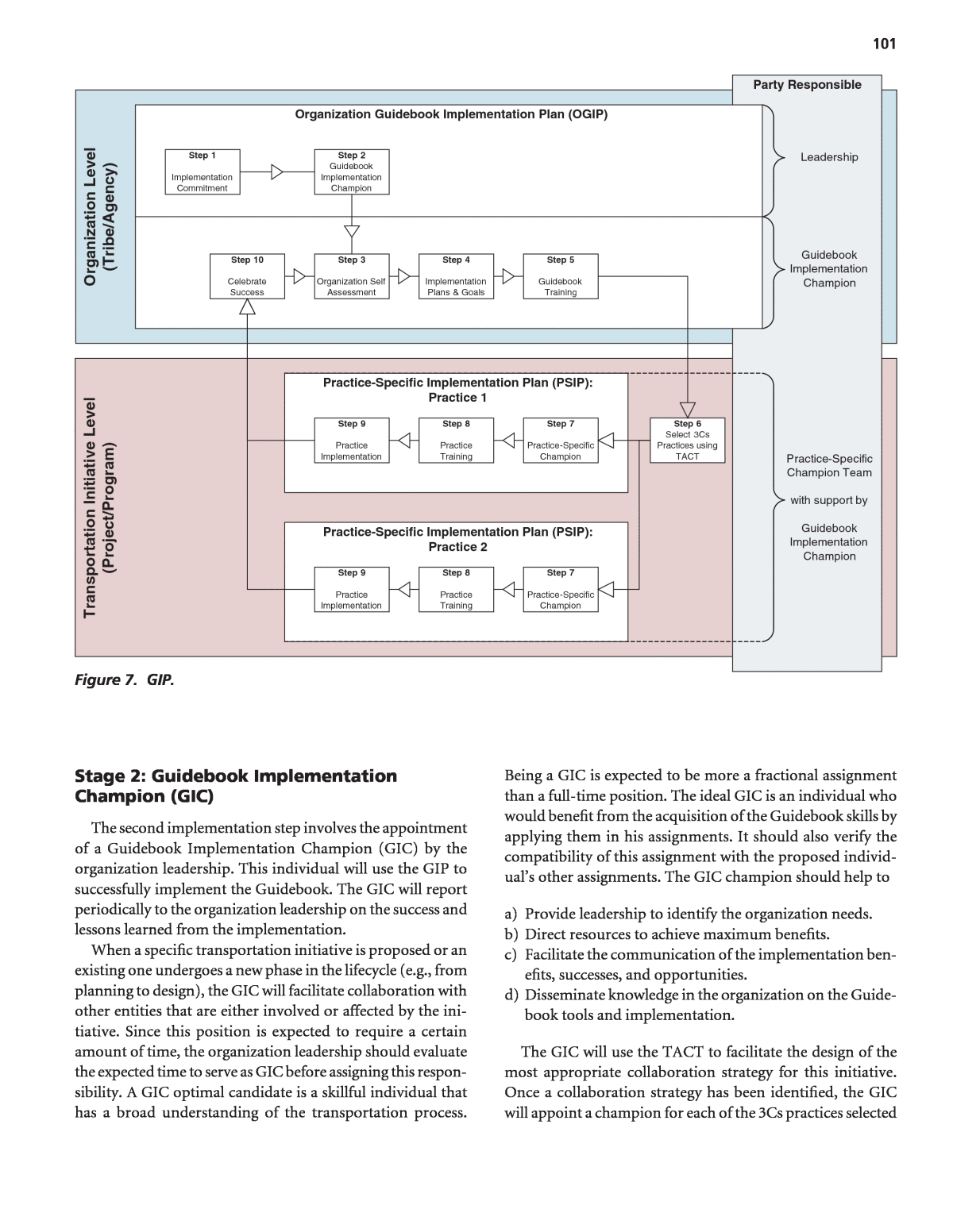
100 D.1: Implementation Overview The overall implementation plan describes the methodol- ogy to implement the Guidebook and its practices for their best outcome. A 10 step process, represented in Figure 7, is used to explain the implementation at both the organization level and the project level. In fact, this Guidebook Implemen- tation Process (GIP) is divided into two blocks, an organiza- tion guidebook implementation plan (OGIP) (Stages 1 to 5 and 10), and a project/program specific application of TACT with several practice-specific implementation plans (PSIPs) (Stages 6 to 9). The following sections describe the Overall Guidebook Implementation Plan, including procedures on how to implement the guidebook by explaining the steps to be followed for its successful execution. PSIPs are included in Appendix C. As shown in Figure 2, the tribe or agency leadership will need to make a commitment toward using the Guidebook (Step 1) and appoint a champion for its implementation (Step 2). This individual, the guidebook implementation champion (GIC) will act as the caretaker for the GIP. Initially, this individual will: (i) perform an assessment on the orga- nization capabilities (Step 3); (ii) develop a conceptual imple- mentation plan (Step 4); and undergo appropriate training on the Guidebook content and 3Cs practices (Step 5). Once a transportation initiative is initiated or is ready to go toward a new phase of its lifecycle, the GIC will use TACT to design a collaboration strategy (Step 6). As a result, a set of 3Cs prac- tices will be selected. For each of these practices, a practice- specific implementation plan will be carried out (Step 7 to 9). Lastly, lessons learned and success stories from each imple- mentation will be compiled and shared within and outside the organization (Step 10). This experiential knowledge will be used to close the loop. Therefore, the process will continue by providing a revised assessment of the organization capabil- ities (Step 3). Exhibit D.2: Organization Guidebook Implementation Plan (OGIP) Stage 1: Guidebook Implementation Commitment For the effective implementation of the Guidebook, the organizational leadership11 should be strongly committed to using the Guidebook as a tool for facilitating collaboration with other stakeholders on transportation initiatives (either projects or programs). Leadership should be expressly com- mitted to support the activities and the resources needed for success. To reinforce the commitment the following scenario must be executed: ⢠Develop a formal commitment statement for using the Guidebook at overall level with specific lower-level com- mitment statements for each 3Cs practice. If leaders intend to exclude some practice, they should express this intent in the statement. Given that certain practices are the only ones that are successful in certain situations, the exclusion of certain practices should be finalized only after analyzing the practice selection matrix that is included in Step 4 of TACT. ⢠Use implementation process as a guide. ⢠Review organization level and project/program level imple- mentation plans. A P P E N D I X D Guidebook Implementation Process (GIP) 11Here, leadership is intended as the individuals who have the authority to make decisions (or manage the decision-making process in case of collaborative decision-making) on transportation projects and/or programs within the agency (agencies) and the tribe(s).
101 Stage 2: Guidebook Implementation Champion (GIC) The second implementation step involves the appointment of a Guidebook Implementation Champion (GIC) by the organization leadership. This individual will use the GIP to successfully implement the Guidebook. The GIC will report periodically to the organization leadership on the success and lessons learned from the implementation. When a specific transportation initiative is proposed or an existing one undergoes a new phase in the lifecycle (e.g., from planning to design), the GIC will facilitate collaboration with other entities that are either involved or affected by the ini- tiative. Since this position is expected to require a certain amount of time, the organization leadership should evaluate the expected time to serve as GIC before assigning this respon- sibility. A GIC optimal candidate is a skillful individual that has a broad understanding of the transportation process. Being a GIC is expected to be more a fractional assignment than a full-time position. The ideal GIC is an individual who would benefit from the acquisition of the Guidebook skills by applying them in his assignments. It should also verify the compatibility of this assignment with the proposed individ- ualâs other assignments. The GIC champion should help to a) Provide leadership to identify the organization needs. b) Direct resources to achieve maximum benefits. c) Facilitate the communication of the implementation ben- efits, successes, and opportunities. d) Disseminate knowledge in the organization on the Guide- book tools and implementation. The GIC will use the TACT to facilitate the design of the most appropriate collaboration strategy for this initiative. Once a collaboration strategy has been identified, the GIC will appoint a champion for each of the 3Cs practices selected Tr an sp or ta tio n In iti at iv e Le ve l (P ro jec t/P ro gr am ) O rg an iz at io n Le ve l (T rib e/A ge nc y) Practice-Specific Implementation Plan (PSIP): Practice 1 Party Responsible Organization Guidebook Implementation Plan (OGIP) Step 4 Implementation Plans & Goals Step 5 Guidebook Training Step 9 Practice Implementation Step 8 Practice Training Step 7 Practice-Specific Champion Step 10 Celebrate Success Practice-Specific Implementation Plan (PSIP): Practice 2 Step 9 Practice Implementation Step 8 Practice Training Step 7 Practice-Specific Champion Leadership Guidebook Implementation Champion Practice-Specific Champion Team with support by Guidebook Implementation Champion Step 1 Implementation Commitment Step 3 Organization Self Assessment Step 2 Guidebook Implementation Champion Step 6 Select 3Cs Practices using TACT Figure 7. GIP.
to carry on the collaboration strategy. These practice-specific implementation champions (PSIC) working together as a team will implement the collaboration strategy with the sup- port of the GIC (Stages 6B to 10). Step 3: Organization Self-assessment This step is a self-assessment process that should be per- formed periodically during the implementation process to determine what practices have been successfully imple- mented against what have not. This helps to identify oppor- tunities for improving the process. The GIC will conduct the self-assessment periodically during the implementation process of the guidebook. Self-assessment tools, such as ran- dom checks, should be used to make the process efficient and consistent. Stage 4: Implementation Plans and Goals An organization-specific implementation plan should be developed, and the targeted goals should be selected to mea- sure the success of the Implementation process. The goals setup for the successful implementation processes should be a part of the organization commitment. Therefore, the GIC should report this information to the organization leadership for approval. Stage 5: Guidebook Training For the Implementation Process to be a success, proper training should be given to the GIC about the different stages of the process. It is expected that webinars and workshop on the Guidebook implementation will be delivered by NCHRP with the support of the TTAP centers. Stage 10: Celebrate Success Celebration of success and sharing of lessons learned should be pursued throughout the implementation. This step of the GIP aims at reinforcing the usefulness of the process and the participantsâ commitment. Successes and lessons learned should be celebrated by sharing them in newsletters, intranet websites, team meetings, handouts, and organizational events and conferences to publicize successful implementation and share organization lessons learned. Several events are available at the state and regional level that may provide the right audi- ence for such activities. If these events are co-attended by both tribal and agency staff, it is possible to envision a complex approach (see 3Cs practices that are related to conferences, presentations, training). D.3: Practice-Specific Implementation Plans (PSIPS) Stage 6: Select 3Cs Practices using TACT This stage has been described in the Guidebook. It is intended that the GIC will facilitate this process and seek input by other involved parties. Stage 7: Practice Champion Once a set of 3C practices has been selected, the GIC will need to identify team members who will carry on the im- plementation of these practices. These individuals, the Prac- tice Champions, will serve as the overall managers of the implementation process for the selected practices. Practice champions should be selected early in the process to facil- itate the understanding of the practices and its issues. The practice champion is responsible for the execution of the process and for reporting successes and lessons learned to the GIC. The duties of the practice champion are the same as the GIC but at the practice level. In addition, the Practice Champions will constitute the project-level implementation team that will work with the support of the GIC. Stage 8: Practice Training To effectively implement any practice, training should be developed and provided to the practice-specific champion who will implement it. The training should be given to the practice champion by the GIC or any other sources for better implementation. Training is the most important process because it will result in the Practice Implementation process. The training should: a. Provide knowledge necessary for successful implemen- tation. b. Include all key stakeholders of the project team impacted by the practices being implemented. c. Have adequate resources available to support training. Stage 9: Practice Implementation This is the most important of all the steps to be performed. The Practice Implementation should be performed with good mechanisms that give the good results. The Practice Champi- ons should review information laid out in the practice-specific implementation plan. The GIC should check every step of the implementation process to achieve the required goals of the process. The implementation team should also identify possi- ble barriers and plan enablers to counter barriers. 102
