



Below is the uncorrected machine-read text of this chapter, intended to provide our own search engines and external engines with highly rich, chapter-representative searchable text of each book. Because it is UNCORRECTED material, please consider the following text as a useful but insufficient proxy for the authoritative book pages.
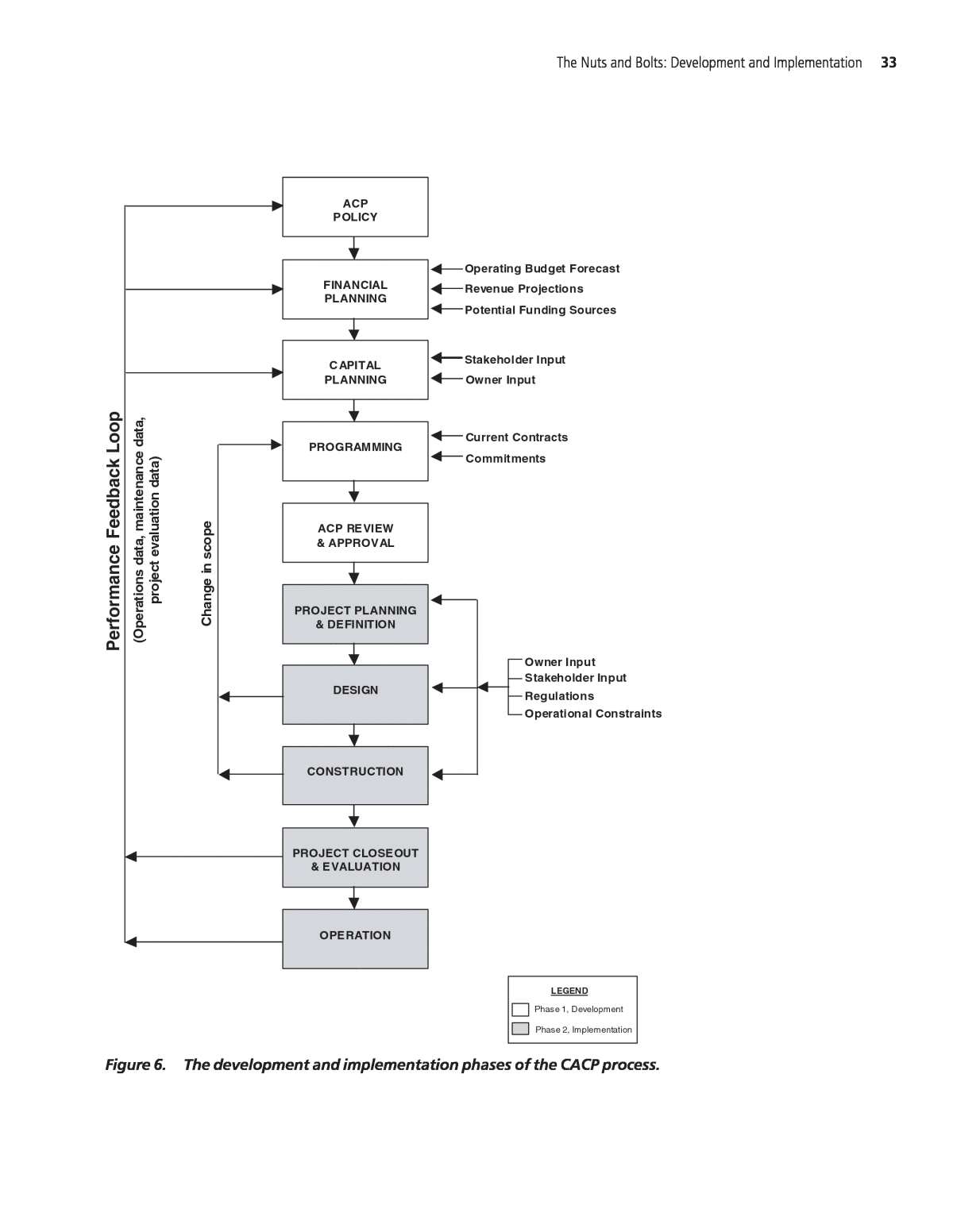
32 Development Phase The second component of the CACP process details the Nuts and Bolts of the process to develop and to implement the ACP. The first phase is Development, which is a system- atic approach to multi-year financial and capital planning. This phase is critical because it defines the content of the ACP that will be executed by the agency. Sound capital plan- ning as described herein is good organizational and financial management because ⢠Good infrastructure management and investment are needed to ensure the basic safety, security and opera- tional efficiency of an airport. ⢠Carefully planned infrastructure investment can maxi- mize the economic potential of an airport. ⢠Prudent management of facilities and investments can reduce future operating costs, help avoid higher replacement costs, and minimize unexpected infrastructure crises. ⢠A more systematic approach to multi-year financial and capital planning can also benefit the airport by improving the basis for intergovernmental cooperation decisions, by increas- ing opportunities for lower-cost financing, and by improving access to state and federal aid programs. The five steps of the Development Phase described in this section are 1) ACP Policy: translate the agencyâs mission and goals into specific direction for the collabora- tive execution of the ACP process. 2) Financial Planning and Management: analyze and evaluate the financial metrics, define the financial models, and establish ACP financial policies. 3) Capital Planning and Management: generate the all-inclusive Project Request List (a draft list of all potential projects) including scope, cost, schedule and operating budget impacts for all projects. 4) Programming: prioritize and evaluate the Project Request List, run the financial model sce- narios to analyze the list against agency goals and financial targets, and develop a draft ACP. 5) Airport Capital Plan: seek buy-in from all stakeholders and approval from the Approving Authorities. The steps of the Development and Implementation Phases are described in more detail below and illustrated in Figure 6. C H A P T E R 5 The Nuts and Bolts: Development and Implementation CHAPTER 5 AT-A-GLANCE This chapter includes ⢠Collaboration and communication techniques; ⢠Process outlining and calendar setting for the CACP process; ⢠Financial planning and management; ⢠System for merit-based project prioritization; ⢠Guidance to scope projects, develop cost estimates and schedule projects; ⢠Calculate operating benefit and impact of capital projects; ⢠Long-term business viability analysis; and ⢠Project risk assessments.
The Nuts and Bolts: Development and Implementation 33 Ch a n ge in s co pe ACP POLICY ACP REVIEW & APPROVAL PROJECT PLANNING & DEFINITION DESIGN CONSTRUCTION PROJECT CLOSEOUT & EVALUATION OPERATION LEGEND Phase 1, Development Phase 2, Implementation Pe rfo rm an ce F ee db ac k Lo op (O pe ra tio n s da ta , m a in te n an ce da ta , pr o jec t e v al u a tio n da ta ) CAPITAL PLANNING Stakeholder Input Owner Input PROGRAMMING Current Contracts Commitments Stakeholder Input Owner Input Regulations Operational Constraints FINANCIAL PLANNING Operating Budget Forecast Revenue Projections Potential Funding Sources Figure 6. The development and implementation phases of the CACP process.
34 Collaborative Airport Capital Planning Handbook Step 1: ACP Policy Goals: The goals of Step 1 are to 1. Translate agency mission and goals into specific direction to agency staff for the collaborative execution of the ACP process. 2. Identify needs and establish priorities for the ACP. 3. Obtain buy-in from Approving Authorities and Internal and External Stakeholders to support the ACP. Actions: The following is a list of actions, activities, or tasks that should be completed during this step: ⢠The CMT: Identify members of the CMT and their roles and responsibilities. ⢠Standards for Collaborating: Establish the parameters for communicating, coordinating, and collaborating among the Leadership Team and CMT. ⢠Responsibility Matrix: Develop a responsibility matrix that defines the roles and responsibil- ities of key participants. See Figure 4 in Chapter 3 for an example of a responsibility matrix. ⢠The ACP Process: Define the goals and objectives of the ACP process, relate and connect them to the agencyâs mission and goals, outline the basic ACP process, high- light ACP initiatives, set priorities for the ACP process, and delineate the ground rules. ⢠Financial Assumptions: Outline financial assumptions including goals for financial metrics such as airport rates and charges, funding and spending targets, revenue pro- jections, and operating expense forecasts. ⢠ACP Calendar: Set schedule/calendar for the ACP process. This can be developed with specific dates each year, as a list of activities by the month, or as a list of activities with start dates and duration. See page C-3 of Appendix C for Massportâs example of a Capital Pro- gramming Calendar, page C-4 for BCADâs CIP Process flowchart and pages C-5 and C-6 for PHXâs CIP Project Planning Process flowchart. When: The ACP Policy should be issued before the ACP process begins. Leader: Executive Leader (See Agency Policy in Chapter 4 for a description of Executive Leader.) Partner: Leadership Team Methods: The following is a list of techniques that should be used to communicate and col- laborate with partners during this step: ⢠Collaborate with Partner in meetings and/or via collaboration technology to â Gain consensus on financial goals, including funding and spending targets, financial met- ric targets, revenue projections and operating expense forecasts. â Set the ACP Policy. â Sign partnership agreement committing to collaboration during development and imple- mentation of the ACP. (See Agency Policy in Chapter 4.) ⢠Communicate with the agency in meetings and in writing on â The ACP policy. Products: The following is a list of written documents, processes, data, events, and/or other benefits that will be produced during this step: Compelling Practice #5 Innovation for ACP Process Broward County Aviation Department (BCAD) has âtollgatesâ between steps of the ACP development process at which the CIP Review Committee, consist- ing of all Division Directors, evaluates the project and allows it to move into the next phase of the ACP development process. These âtollgatesâ encourage evaluation and buy-in/consensus building among the departments that have a vested interest in a project as the ACP develops.
⢠Memo to Agency setting ACP Policy. ⢠Executed Partnership Agreements. Results: The following are the results an agency can expect in terms of targets achieved, benefits realized and value added when an agency follows the recommended step outlined above: 1. All parties involved in development of ACP reach consensus on the policy and commit to collaboration. 2. Expectations are set and ownership and accountability established among the Leadership Team and throughout the agency. Step 2: Financial Planning and Management Goal: The goal of Step 2 is to develop a sound financial plan that standardizes financial calcu- lations for the agency, sets reasonable targets for financial metrics, maximizes revenue and the economic potential of the airport, and enhances opportunities for lower-cost financing and access to state and federal aid programs. Actions: The following is a list of actions, activities or tasks that should be completed during this step. ⢠Financial Targets: Evaluate and define targets for financial metrics and airport rates and charges such as cost per enplaned passenger, debt coverage, days of operating cash available, and operating ratio (operating expenses/operating revenues). These should be discussed and debated prior to evaluating a proposed ACP. ⢠Financial Model: Develop an airport financial model to assess methods for recovering oper- ating expenses and capital expenditures using the approach outlined in the airline agreement or as imposed by the airport by ordinance or regulation. ⢠Budget Allocations: Define budget allocations so that project costs are appropriated to the proper budget allocation in individual project cost estimates developed in the next step. ⢠Standards for Financial Calculations: Develop standards for calculating the annual revenues and operating expenses to be used in analyzing the operating impact of a project. ⢠Revenue Projections: Generate a list of all potential revenue streams and limitations on their use. ⢠Operating Expenses: Generate a list of all operating expenses, including risks associated with line items that are uncertain or could change significantly. ⢠Potential Funding Sources: Generate a list of all potential funding sources including, but not limited to, cash reserves, Alternate Minimum Tax (AMT) and non-AMT airport bonds, passenger facility charges (PFCs: a local fee charged to each boarding passenger), customer facility charges (CFCs), local and state grants, FAA AIP grants (entitlement, discretionary and letter of intent programs), TSA grants, airport operating revenue and other potential funding sources. ⢠Financial Allocation Standards: Develop standards for the allocation of scarce financial resources across cost centers and goals, as well as trade-offs between capital and operating costs. ⢠Capital Plan Revisions: Develop a process for how and when the capital plan will be revisited if or when something major happens like the loss of a carrier, a major decline in air service or passengers, infusion of new funding, an airline bankruptcy, the advent of a recession, or when conditions change such that projects are delayed, deferred, or cancelled. When: Financial Planning should happen at the beginning of the ACP process, before the Capital Planning step when the technical and financial estimating and analyses will be conducted. The Nuts and Bolts: Development and Implementation 35
Leader: Finance Department ⢠Knowledge: The Financial Department Leader must understand the following: â Financial planning and management. â Airport finance, funding sources, finance codes and budget allocations. â Airport rates and charges and cost recovery methods. â Public finance. â Bond issuance. â Capital and operating budget development and management techniques. â FAA rules and regulations on AIP grants â Grant reimbursement policies and procedures. â Grant assurances. ⢠Skills: The Financial Department Leader must be skilled at the following: â Developing and running financial models and developing operating and capital budgets. â Calculating and assessing airport rates and charges. â Overseeing staff conducting financial planning activities. â Collaborating to engage partners. â Setting the example for others to follow. â Team building and being able to work productively with others. ⢠Potential Departments: The Financial Department Leader could be found in a department where 1) financial strategies are developed, 2) budgets are developed and monitored, and 3) funding sources are identified and secured. The Financial Department Leader might be in a finance department, an administrative and finance department, executive administration department or a properties and/or concessions department. Partner: CMT Methods: The following is a list of techniques that should be used to communicate and col- laborate with Partners during this step: ⢠Collaborate with the CMT in meetings and/or via collaboration technology to â Generate targets for financial metrics. â Generate standards for budget allocations to be used to develop all projects. â Generate standards for allocation of resources. â Develop a process for reevaluating the plan in the event of major financial crisis or hardship. ⢠Communicate with the Lead Technical Department in meetings and/or via collaboration technology: â Standards for revenue forecast and operating impact analysis to be used to develop all projects. ⢠Communicate with the Leadership Team in meetings and/or via collaboration technology: â The financial plan Products: The following is a list of written documents, processes, data, events, and/or other benefits that will be produced during this step: ⢠A financial plan, including target for financial metrics, potential funding sources, standards for allocation of resources and process for reevaluating the plan in the event of major finan- cial crisis or hardship. ⢠Financial model for use in Step 4 (Programming). ⢠Budget allocation definitions. ⢠Standards for calculating revenue and expenses of projects. ⢠Revenue projections. ⢠Operating expense forecast. ⢠Process for capital plan revisions. 36 Collaborative Airport Capital Planning Handbook
The Nuts and Bolts: Development and Implementation 37 Result: The following is the result an agency can expect in terms of targets achieved, benefits realized and value added when an agency follows the recommended step outlined above: 1. A sound financial plan that standardizes financial calculations for the agency, sets reason- able targets for financial metrics, maximizes revenue and the economic potential of the air- port, and enhances opportunities for lower-cost financing and access to state and federal aid programs. Step 3: Capital Planning and Management Goals: The goals of Step 3 are to 1. Identify all new and revised projects for the maintenance and improvement of all facilities to meet the agencyâs goals and to accommodate priorities set by the ACP Policy in Step 1. 2. Quantify the scope, cost, schedule and operating budget impacts for all projects. Actions: The following is a list of actions, activities or tasks that should be completed during this step: ⢠Existing Condition Surveys: Monitor facility conditions and conduct existing facility condi- tion survey, as necessary. ⢠Facility Needs Assessment: Regularly assess facility needs with respect to maintenance and improvement. ⢠Alternatives Analysis: Identify and evaluate alternatives to meet identified facility needs. Eval- uate how those alternatives will meet agencyâs goals. ⢠Life-Cycle Cost Analysis (LCCA): Conduct LCCA of feasible alternatives. LCCA assesses the total cost of facility ownership, including initial costs and operating costs. It enables an agency to compare alternatives from a net savings perspective and determine if higher initial invest- ment will pay off in lower operating costs. ⢠Project Definition Standards: Establish and define standards for project phases and milestones to be used in developing budget estimates and project schedules. ⢠Project Worksheets: Develop a draft scope, cost, and schedule for the preferred alternatives. Pre- pare a descriptive worksheet for each project that contains all the critical project information such as project description, alternatives, cost, schedule, funding source, operating budget impact (revenue and expenses) contribution to agency goals and objectives, environmen- tal impacts, and project risk factors. See pages D-5 and D-6 in Appendix D for a sample project data worksheet. ⢠Operating Benefit: Quantify the operating benefit and/or revenue associated with all projects, as appropriate. ⢠Operating Impact: Assess the operational impacts of the project (e.g., loss of auto or aircraft parking) and quan- tify the expense or financial impact associated with it. See page C-7 of Appendix C for PHXâs CIP Project Impacts on Operating Budget form. ⢠Long-Term Business Viability Analysis: Analyze the long- term business viability of a project using Internal Rate of Return (IRR), Benefit-Cost Analysis (BCA) and/or Return on Investment (ROI) analyses, as appropriate. See page C-8 of Appendix C for BCADâs Business Case Form. The purpose of this analysis is to determine how the benefits (such as cost savings and offsetting revenues and/or user charges) justify the expense of a project. Compelling Practice #6âCalculating CIP Project Impact to Operating Budget PHXâs Capital Budgeting Return on Investment (ROI) Analysis Form requires the project sponsor to quan- tify the âbenefit drivers,â which include savings in labor or expenses as well as projected revenue, and to compare that to the project costs to identify when the project will pay for itself. In addition, PHX requires the project sponsor to fill out a âCIP Project Impacts on Operating Budgetâ form to quantify what labor and expense costs might be associated with the project once it is operational. Similar to the BCAD Project Business Case, these two elements are critical to understanding the long-term business viability of the project.
38 Collaborative Airport Capital Planning Handbook ⢠Cost Centers: Categorize projects by cost centers or facility type where cost recovery for oper- ating and capital expenditures for the facilities are similar (e.g., airfield, terminals, parking, etc.) in a manner that helps staff understand what is being funded and what types of trade-offs might need to be made. Examples of categories include â Normal replacement, maintenance, state of good repair, system improvement and expansion. â Airside, landside, and nonaeronautical. â Safety and security, aeronautical, sustainability, and community mitigation. â Eligibility by funding sources such as bonds, retained earnings, PFCs, CFCs, and so forth. ⢠Major versus Smaller Capital Programs: Differentiate between major capital improvement programs and diverse programs that include a mix of renovation and rehab work and smaller initiatives. Massive programs like major airport expansion programs will have con- siderable management focus, will be funded over a series of years and bond issues, and will typically track the same set of a few large projects over 3 to 6 years. Other programs will have a long list of diverse smaller projects in various cost centers with only one or two larger projects. These types of programs require numerous trade-offs and funding shifts as the rehab projects encounter unforeseen conditions that increase costs and force staff to find new funding sources. ⢠List of Proposed Projects: Generate the Project Request List, a comprehensive list of projects that staff have requested be included in the ACP. When: Capital Planning should happen at the beginning of the ACP process after the finan- cial plan has been developed, before the Programming step when the technical and financial analyses will be conducted. Leader: Lead Technical Department ⢠Knowledge: The Technical Department Leader must understand the following: â Planning techniques and tasks. â Phases of design and the sequencing of tasks. â Horizontal and vertical construction. â Project bidding. â Cost estimating techniques and (software) tools. â Sequencing of projects and developing project schedules. â Contracting tools and techniques for planning, design and construction. â Operation and maintenance of an airport and its facilities. â Extensive knowledge of planning, technical and engineering principles, techniques, meth- ods, protocols and precedents. ⢠Skills: The Technical Department Leader must be skilled at the following: â Developing schedules and budget/cost estimates and using the software tools to create them. â Defining the scope of project. â Preparing a cost estimate for planning study, design or construction project. â Negotiating contracts for scope, cost and schedule. â Overseeing staff conducting planning, design and construction activities. â Collaborating to engage partners. â Setting the example for others to follow. â Team building and ability to work productively with others. ⢠Potential Departments: The Technical Department Leader could be found in a department where 1) projects are scoped, planned, designed and/or constructed; 2) budgets or costs are estimated; and 3) schedules are prepared. The Technical Department Leader might be in an engineering department, planning department, capital programming/planning department, or capital management department.
Partner: CMT Methods: The following is a list of techniques that should be used to communicate and collabo- rate with Partners during this step: ⢠Collaborate with the CMT by means of in-person meetings and/or via collaboration tech- nology to â Generate standards for project milestones to be used to develop all projects. â Create categories of projects for the ACP. â Generate a list of all projects proposed for the maintenance and improvement of all facilities. â Reach consensus on the Project Request List to be evaluated in the next step. ⢠Communicate with Finance Department by means of in-person meetings and/or via collabo- ration technology on â The scope, cost, schedule and operating costs for all proposed projects for discussion once projects are identified. The Lead Technical Department will revise, as necessary. â On an ongoing basis throughout the process as scope, cost and schedule are revised and updated. ⢠Communicate with Finance Department and CMT by means of in-person meetings and/or via collaboration technology on the â Project Request List. Products: The following is a list of written documents, processes, data, events, and/or other benefits that will be produced during this step: ⢠The Project Request List categorized by projects, by program, by facility, by funding source, and by fiscal year. ⢠Completed project data worksheet that describes the scope, cost and schedule for each proj- ect on the Project Request List, updated and/or revised when necessary. ⢠Existing facility condition survey reports. ⢠LCCA reports. ⢠Alternatives Analysis reports. ⢠Completed CIP Project Impact on Operating Budget forms. ⢠Long-Term Business Viability Analyses using ROI, IRR and/or Benefit Cost Analysis (BCA) methods, as appropriate. Result: The following are the results an agency can expect in terms of targets achieved, benefits realized and value added when an agency follows the recommended step outlined above: 1. All parties involved in development of the Project Request List agree on the content of the Project Request List before the Programming step begins. Step 4: Programming Goals: The goals of Step 4 are to 1. Analyze, evaluate and prioritize the Project Request List against agency goals and objectives, funding targets, revenue and operating expense projections, and rates and charges goals, using defined operational, financial and technical criteria. 2. Produce a draft ACP. Actions: The following is a list of actions, activities or tasks that should be completed during this step: ⢠Roles and Responsibilities: Define the roles and responsibilities of the two Leaders (Financial and Lead Technical Department) for this step. The two Leaders should agree on a commit- ment to work together on the actions outlined in this step. The Nuts and Bolts: Development and Implementation 39
40 Collaborative Airport Capital Planning Handbook ⢠Prioritization Factors: Translate strategic direction provided in Step 1 above into prioritiza- tion factors, planning and evaluation criteria, and performance indicators. See page C-14 of Appendix C for PHXâs CIP Priority Ranking Worksheet. Categories of prioritization factors and/or evaluation criteria may include â Regulatory mandateâis it required to meet a code or regulatory compliance directive? â Safetyâwill it improve or enhance safety? â Securityâwill it improve or enhance security? â Level of serviceâwill it improve customer service or enhance facility capacity? â Revenue generation/cost reductionâwill it create revenue or reduce a current operat- ing expense? â Environmental or community impactsâis it a commitment for environmental or commu- nity mitigation? Will it improve community relations? Might it cause negative environmen- tal or community impacts? â Sustainable developmentâis it an initiative to meet sustainable development or Leader- ship in Environmental Design (LEED) goals? â Asset preservation/maintain existing facilitiesâis it required to preserve or maintain an existing facility? â Goals and objectivesâdoes it contribute to meeting the agencyâs defined goals and objectives? â Risk factorsâare there any environmental, financial, schedule, or operational risk associ- ated with this project? ⢠Project Rating Criteria: Qualitatively (low, medium, high ratings) and/or quantitatively (numerical ratings such as â100, 50, 30â or â1 to 10â) to prioritize, rank or rate the proj- Compelling Practice #7 Project Rating and Prioritization The Port Authority of New York and New Jersey (PANYNJ) Aviation collaborative project rating process is conducted by a committee of staff from the Aviation, Project Management and Engineering departments. It is a four-step process using an Excel spreadsheet that includes: 1) Rating the importance of the asset that calculates a weighted âImportance Factorâ (IF); 2) Rating the condition of the asset that calculates a âCondition Indexâ (CI), which is the average of the life cycle and condition ratings; 3) Calculating priority and cost effectiveness factors to produce a âPriority Factorâ (PF) that equals the IF times the CI, and a âBudget Effectiveness Factorâ (BEF) that takes into account the total project cost minus the cost recovery; and 4) Prioritizing the projects based on their âPriority Factorâ and âBudget Effec- tivenessâ Ratio. The process uses weighted rating scales from 1 to 5 in criteria categories that include the 1) Importance of the asset, including life safety, operational impact, customer service impact, and revenue impact in step one above and 2) Condition of the asset, including life cycle criteria, condition criteria, service- ability, level of maintenance required and maintainability in step two above.
ects in the Project Request List using operational, financial, technical, environmental, and risk criteria. This will facilitate difficult decision making when funding becomes con- strained or limited. ⢠Prioritize Projects: Analyze, evaluate and prioritize the projects on the Project Request List. ⢠Financial Modeling: Run financial models of various project and funding scenarios. This is an iterative process, so the model should be rerun each time a scenario changes. ⢠Operating Budget Impact Analysis: Determine the overall impact each ACP scenario will have on the operating budget and on airport rates and charges. Recalculate the impact each time the scenario is revised. ⢠Trade-Off Analysis: Conduct a trade-off analysis for all projectsâchoose between projects (e.g., can discretionary projects be delayed in order to afford projects that address other urgent facility needs?), sequence projects according to urgency (i.e., what projects âneedâ to be done first?), and sequence projects according to financial impact (i.e., can the project order be rearranged to increase or decrease a financial impact within or between fiscal years?). ⢠Additional Financial Modeling: Continue to run financial models of various project and fund- ing scenarios until the airport reaches an ACP that advances the agencyâs goals and objectives, accommodates the priorities and initiatives set by the ACP Policy in Step 1, is affordable, and meets the financial goals or metrics defined in the agencyâs strategic financial plan and/or in the ACP Policy issued in Step 1. When: Programming should occur after the Financial and Capital Planning is completed and prior to vetting it with stakeholders and presenting it to the Approving Authority for approval and/or authorization. Leaders: Finance and Lead Technical Departments (See Step 2 of the Development phase for a description of a Finance Department and Step 3 of the Development phase for a description of a Lead Technical Department.) Partner: CMT Methods: The following is a list of techniques that should be used to communicate and col- laborate with Partners during this step: â Collaborate with the CMT in developing prioritization factors, planning and evaluation criteria and performance indicators. â Discuss the prioritized list of projects in the Project Request List. â Conduct trade-off analysis. â Reach consensus on the ACP to be vetted and approved in the next step. ⢠Collaborate between the two Leaders (Financial and Lead Technical Departments) to â Define roles and responsibilities of each. â Develop process to resolve conflict and/or disagreement. â Work together to execute the tasks of this step. ⢠Communicate in meetings and in writing with the Executive Leader and Leadership Team on â Prioritized Project Request List. â The draft ACP. Products: The following is a list of written documents, processes, data, events, and/or other benefits that will be produced during this step: ⢠Defined roles and responsibilities for Step Leaders. ⢠List of formalized, comprehensive prioritization factors. ⢠Prioritized Project Request List. The Nuts and Bolts: Development and Implementation 41
42 Collaborative Airport Capital Planning Handbook ⢠Spreadsheets that show the various funding scenarios from the financial modeling. ⢠A memo describing the trade-offs made as part of the programming that describes what decisions were made, how they were made, and which projects were not funded and why. ⢠The draft multi-year ACP that includes all projects pro- posed to be funded with funding sources by fiscal year and its impact to the Operating Budget. Result: The following is the result an agency can expect in terms of targets achieved, benefits realized and value added when an agency follows the recommended step outlined above: 1. All parties involved in the ACP process agree on the draft ACP to be vetted and approved in the next step. Step 5: Airport Capital Plan Goal: The goal of Step 5 is to obtain buy-in from all stake- holders and obtain approval or authorization from Approv- ing Authorities. Actions: The following is a list of actions, activities or tasks that should be completed during this step: ⢠ACP Meets Goals and Objectives: Document how the proposed draft ACP advances the agencyâs goals and objectives, accommodates the priorities and initiatives set by the ACP Policy in Step 1, is affordable and meets the financial goals or metrics defined in the agencyâs strategic financial plan developed in Step 2. ⢠Trade-Off Documentation: Document the ACP process that was followed and major decisions (trade-offs) made during the ACP process. ⢠Unfunded Projects: Document those projects that were not funded in the current draft ACP and why. ⢠ACP Funding and Financial Plan: Document how the draft ACP will be funded and describe how the agency arrived at that financial plan, including funding sources (bonds, cash, PFCs) and what impact the proposed ACP will have on the airportâs financial metrics [e.g., cost per enplaned passenger, debt coverage, days operating cash and operating ratio (operating expenses/ operating revenues)]. ⢠Operating Budget Impact: Document how the draft ACP will impact the operating budget and rates and charges. ⢠Stakeholder Input: Vet the draft ACP with Internal Stake- holders such as the leadership of the operating depart- ments (e.g., Aviation), as necessary, External Stakeholders such as the tenants, governmental agencies, as necessary, and Approving Authorities prior to seeking final approval. ⢠ACP Approval: Seek approval of the ACP from Approv- ing Authorities. When: Approval of the ACP should be sought when the ACP is balanced, and prior to beginning implementation. Leader: Executive Leader (See Agency Policy in Chapter 4 for a description of Executive Leader.) Partner: Leadership Team and CMT Compelling Practice #8 Project Execution Flexibility Massport includes an âunfundedâ list of projects in the ACP that is needed but did not have the finan- cial resources to fund. This âunfundedâ list is voted and authorized by the Board of Directors every year. During the fiscal year, a project from the âunfundedâ list can be added to the âfundedâ list by the Director of Capital Programs and the Direc- tor of Finance if another project is delayed or canceled, as long as the funding source is the same and adequate funds are available. This practice enables Massport to be nimble and flexible with executing projects when unforeseen situations delay or defer projects. Compelling Practice #9 Stakeholder Participation The Metropolitan Washington Airport Authority (MWAA) has an on-site airline coordinator that is funded by the carriers. This individual is co-located with the Planning and Engineering departments so that when MWAA has an issue that needs input from the carriers, the coordinator can obtain the input and give the feedback to MWAA very quickly. This practice expedites MWAAâs ability to get feedback from the carriers when they need it.
Methods: The following is a list of techniques that should be used to communicate and col- laborate with Partners during this step: ⢠Collaborate in meetings and/or via collaboration technology with the Leadership Team and CMT to â Discuss the draft ACP. ⢠Collaborate in meetings and/or via collaboration technology with the Leadership Team, CMT and Approving Authorities to â Reach consensus and approve the draft ACP. ⢠Communicate in meetings and in writing with the Agency on â The approved ACP for implementation. ⢠Communicate using press releases and website postings with the general public on â The approved ACP for informational purposes. Product: The following is a list of written documents, processes, data, events, and/or other benefits that will be produced during this step: ⢠The ACP Funding and Financial Plan. ⢠The multi-year ACP. Result: The following is the result an agency can expect in terms of targets achieved, benefits realized and value added when an agency follows the recommended step outlined above: 1. The agency publishes a multi-year ACP that all Stakeholders agree with, support and are will- ing to implement. Implementation Phase The second phase of the Nuts and Bolts component of the CACP process is Implementation, which is the road map for project execution, from project planning and definition through design, construction and ultimately operation. This section outlines the procedures recom- mended for the successful execution of projects. Defining and standardizing project implemen- tation functions and procedures as described herein are valuable because an agency can ⢠Repeat good project delivery methods and techniques every time, regardless of the department or individual managing the project. ⢠Make use of lessons learned from other project delivery experiences and improve the processes and procedures over time. ⢠Reduce project delivery time because agency staff will not have to create or define a new process every time a project is implemented. ⢠Reduce project costs by increasing efficiency and effectiveness. ⢠Improve and standardize quality. The five steps of the Implementation Phase described in this section are 1) Project Planning and Definition: Define in detail the scope, cost, schedule, funding source and operating impact of the projects. 2) Design: Design the project to meet the ownerâs needs within the scope, cost and schedule con- straints developed during the project definition phase, such that it meets the agencyâs goals and objectives. 3) Construction: Build the project to meet the ownerâs needs within the scope, cost and sched- ule developed in the design step, such that it meets the agencyâs goals and objectives. 4) Project Closeout and Evaluation: Quickly and effectively close out the project and evaluate the performance of the staff and departments involved in the planning, design and/or construc- tion of a project/facility. The Nuts and Bolts: Development and Implementation 43
44 Collaborative Airport Capital Planning Handbook 5) Operation: The owner successfully operates the facility using the features and elements included in the design and constructed into the facility for the benefit of the owner consistent with the agencyâs mission and goals. The steps of the Implementation Phase are described in more detail below and are illustrated in Figure 6 earlier in this Chapter. Step 1: Project Planning and Definition Goal: The goals of Step 1 are to 1. Develop more detail on the scope, cost, schedule, funding source and operating impact of the projects included in the approved ACP before design, construction and/or implementation of the projects begins. 2. Establish an ownerâs expectations for project scope, budget and schedule, which will in turn provide guidance to the Leader who is managing the project team and stakeholders during the life of the project. Actions: The following is a list of actions, activities or tasks that should be completed during this step: ⢠Identify Stakeholders: Identify major players and stakeholders internal and external to the agency, their interest in the project, and their roles and responsibilities. ⢠Stakeholder Input: Solicit and obtain input and feedback from owner and other appropriate stakeholders on project scope and functional requirements at the beginning of the project def- inition phase and throughout the project planning process. ⢠Goals and Objectives: Define project goals and objectives with the owner and other appropri- ate stakeholders at the beginning of the process. These will be used as decision criteria during the alternatives analysis described below. ⢠Procure Consultant: Determine if the agency has internal resources to execute a project. If not, procure professional services, as necessary. ⢠Manage Consultant: Manage professional services firm, if necessary. ⢠Problem Definition: Examine and determine the cause of the problem that is driving the need for the project. Assess whether the project is really bigger or smaller than originally defined in the Development Phase. Assess the problem from multiple perspectives. For example, evalu- ate a terminal improvement project from the perspectives of the traveling public, the tenant and the maintenance department. ⢠Project Scope Development: With the owner and appropriate stakeholders, develop project scope in more detail to address the problem defined above. Ensure the project scope will meet the stakeholdersâ needs and the agencyâs goals and objectives. Reconcile the ownerâs needs and expectations if they are not in synch. Define the project benefits, objectives, approach, effects and interrelationships. ⢠Alternatives Development: Create a list of all possible solutions that address the defined prob- lem and of options to execute the project that meet the agencyâs goals and objectives, even those that may seem âout of the boxâ at first. Narrow the list down to the best alternatives that warrant formal assessment. ⢠Alternatives Analysis: Evaluate the list of best project alternatives against the decision criteria. Include a quantitative analysis of expenses, cost savings and risks, a qualitative analysis of cus- tomer needs, case studies of alternatives implementation at other airports, and the economic and operational feasibility of each alternative. ⢠Project Delivery Alternatives: For each project, evaluate project delivery options, identify the most appropriate option and document the logic behind the option selected. This deci- sion will be driven by the project aspect of greatest importance, scope, schedule or budget.
See the Additional Resources section at the end of this chapter for documents to assist with this task. ⢠Additional Data: Gather supplemental information to support project definition, budget esti- mation, project schedule and analysis of operating budget impact and long term business via- bility of a project, if required. ⢠Budget Estimate: Prepare a more detailed budget estimate using the detailed scope developed in this step. At a minimum, budget estimates should include categories as shown below in Figure 7. â Budget/Cost estimating techniques for soft costs include 1. Simply calculating each cost as a percentage of construction, which will vary based on size and complexity of the project. 2. Calculating the number of drawings required for construction documents and multi- plying that times labor hours required to produce one sheet. 3. An agencyâs historic fees for similar projects or projects of similar size and complexity. 4. Historical median fee curves, scales and graphs published by organizations such as the American Society of Civil Engineers. â Estimates of hard costs can be calculated using 1. Averages (by unit price) calculated from an agencyâs historical construction bids (averaged over a 3- to 5-year period in which the bidding climate remained relatively unchanged). 2. Unit prices for materials and equipment, assembly rates, square footage costs, labor and productivity rates, and overhead and markup data from sources such as RSMeans Con- struction Cost Data Books published by Reed Construction Data annually. ⢠Schedule: Prepare a more detailed schedule using the more detailed scope developed in this step. The schedule should include everything that is needed to successfully execute a proj- ect, including â A list of functional, technical, administrative, testing and training tasks by project phase that need to be completed in an ordered sequence with begin and end dates, duration, and resources needed (including personnel, equipment and funding). â The interdependencies between tasks (e.g., if one task cannot begin until another task ends). â Key project meetings (with project team, owner and stakeholders) and important commu- nications (regular status updates, milestone updates, updates to approving authorities, etc.), at the appropriate times. The Nuts and Bolts: Development and Implementation 45 Soft costs Hard costs Escalation Contingency Include pre-design and planning services, survey, testing and investigations, basic design services, construction management and inspection services, environmental analysis and permitting, police or fire details, professional liability insurance, financing costs, advertising, legal fees, reimbursable expenses such as travel or printing, and post-construction expenses such as fees for building commissioning. Include construction, furniture and equipment such as communication and/or computer systems. Account for inflation for projects that will be completed at a future date. Account for changes to project cost as a result of insufficient knowledge and/or unforeseen challenges. Can be calculated as a percentage of the entire project budget or of the construction cost estimate, which will decrease over time as more detail becomes available during design. Figure 7. Categories for budget estimates.
46 Collaborative Airport Capital Planning Handbook The schedule can be as simple as a table or a bar graph timeline produced with Microsoft Excel or as sophisticated as a Gantt chart produced with Microsoft Office Project or a cost-loaded sched- ule produced with Primavera P6. All are scalable to any size project for any size organization. ⢠Operating Budget Impact: Calculate the approximate impact a project will have on the oper- ating budget and airport rates and charges. New and expanded facilities require additional labor, materials, energy and equipment to operate and maintain as well as debt service for bonds to finance the project. These are all impacts to the annual operating budget that must be quantified and which will impact airport rates and charges. ⢠Long-Term Business Viability Analysis: Calculate the approximate long-term business viability of a project. This can be calculated by doing an IRR, ROI, and BCA or other analyses used to determine the long-term business viability of a project. See pages C-8 to C-13 of Appendix C for BCADâs Business Case Form. The purpose of this analysis is to determine how the benefits (such as cost savings and offsetting revenues and/or user charges) justify the expense of a project. ⢠Potential Funding Sources: Evaluate all potential funding sources and identify the optimum funding sources. Funding sources could include, but are not limited to, cash reserves, AMT and non-AMT airport bonds, PFCs, CFCs, local and state grants, FAA AIP grants (entitlement, discretionary and letter of intent programs), TSA grants, airport operating revenue and other potential funding sources. Every airport uses a different combination of these funding sources depending on the individual airportâs financial situation and the type of project being considered. Small airports (GA, non-hub and small-hub) are more dependent on AIP grants than large- or medium-hub airports. The larger airports, where projects tend to be more expensive, are more likely to participate in the tax-exempt bond market or finance capital projects with PFCs. ⢠Project Risk Assessment: Define and assess the risks associated with the scope, cost and sched- ule developed for the project and develop measures to mitigate those risks, including calcu- lating a contingency fund, if necessary. A project risk assessment consists of risk identification followed by probability and impact assessment. There are five steps in a project risk assess- ment as described below: 1. The project team, the owner and the appropriate stakeholders together identify all the likely sources of risk affecting quality, safety, performance, technology, project duration, and cost that could occur on a project and the impact these risks could have on achieving the project goals and objectives. A Risk Register is created to monitor and track those risks. A Risk Register is a table of all the risks affecting the project and the impact they could have on the project. The register is a spreadsheet that calculates a risk rating for each risk that is equal to the likelihood the event will happen (likely, possible or remote) multiplied by the severity of the impact (from none to severe or catastrophic). 2. Assess the likelihood (e.g., probability) of each event happening. 3. Estimate the Minimum, Most Likely and Maximum for the cost and time of each risk iden- tified. These elements, in conjunction with the probability of the event happening (Step 2), are needed to complete the Monte Carlo simulation and generate the Risk Register that ranks the risks by a combination of highest probability and impact on the project, high to low. The simulation further computes the overall project upset cost and time to com- plete based on the information provided. This provides a basis for the level of contingency that may be needed to accommodate these events should they not be mitigated. 4. Prepare a Mitigation and Management Plan for each sig- nificant risk item to eliminate the risk as early as possible, minimize risk that cannot be completely eliminated, and address any new risks that become apparent throughout the project. Compelling Practice #10 Project Risk Assessments PANYNJ conducts project risk assessments regularly. PANYNJ uses risk assessments to allocate project risk and establish contingencies for projects so that funds are available in the event the cost goes up or the schedule gets extended or delayed.
5. Formalize the monitoring of the Plan into a risk management activity, establish systematic reviews in the project schedule, establish metrics, and track your top 10 risks week by week. ⢠Coordination: Solicit and obtain input and feedback from the owner and other appropriate stakeholders throughout the project planning and definition process. ⢠Invoices: Review and approve invoices and change orders for the consultant(s). Coordinate with Finance to ensure proper coding for funding and cost recovery. ⢠Cash Flow: Prepare and submit realistic cash flow projections on project expenditures to the Finance Department, quarterly at a minimum and monthly where possible. ⢠Progress Reporting: Track and report on progress of project planning and definition to the appropriate stakeholders monthly. See page D-7 of Appendix D for a sample project status report. ⢠Final Funding Approval: Identify potential funding sources and amounts and confirm fund- ing with the Finance Department before proceeding to the next step, Design. ⢠Authorization: Obtain authorization to proceed to next step from the appropriate party or parties (Implementation Step 2: Design). When: Project planning and definition occurs after the ACP is approved and prior to design, construction and/or implementation of a project in the ACP. Leader: Lead Technical Department (See Step 3 of the Development phase for a description of a Lead Technical Department.) Partner: CMT Methods: The following is a list of techniques that should be used to communicate and col- laborate with Partners during this step: ⢠Collaborate in meetings and/or via collaboration technology with â The owner to define and agree upon the scope of the project. â Other Technical Departments to refine and agree upon the project definition, as needed. â The Finance Department to discuss and confirm project funding. ⢠Communicate with the CMT in writing on â A project definition memorandum or manual prior to design commencing in the next step, as appropriate. â A memo that identifies the Project Manager and his or her role and responsibilities. ⢠Communicate with Finance in writing to â Transmit cash flow projections. ⢠Communicate with the Executive Leader in writing on â Documentation required to seek approval from Approving Authorities for expenditures like project authorizations Products: The following is a list of written documents, processes, data, events, and/or other benefits that will be produced during this step: ⢠A memo identifying the project manager, when appropriate. ⢠Defined goals and objectives developed collaboratively with stakeholders for each project in the ACP. ⢠A revised Project Scope for each project in the ACP. ⢠Contract(s) with professional services firm, as required. ⢠Alternatives Analysis reports. ⢠A revised Project Budget Estimate for each project in the ACP. ⢠A revised Project Schedule for each project in the ACP. ⢠Completed CIP Project Impact on Operating Budget forms. ⢠Long-Term Business Viability Analyses using ROI, IRR and/or BCA methods, as appropriate. ⢠Project Risk Assessment for each project in the ACP. The Nuts and Bolts: Development and Implementation 47
48 Collaborative Airport Capital Planning Handbook ⢠A project definition/description form or memorandum for each project in the ACP (a proj- ect definition manual may be needed for larger, more complex projects). ⢠Monthly project status reports. ⢠Monthly cash flow projections. Result: The following is the result an agency can expect in terms of targets achieved, benefits realized and value added when an agency follows the recommended step outlined above: 1. All parties involved in defining the project agree upon the scope, cost, funding and schedule for the project before beginning design in the next step. Step 2: Design Goal: The goal of Step 2 is to design a project that meets the ownerâs needs and expectations within the scope, cost and schedule developed during the project definition phase (Implemen- tation Step 1), and that meets the agencyâs goals and objectives. Actions: The following is a list of actions, activities or tasks that should be completed during this step: ⢠Stakeholder Input: Solicit and obtain input and feedback from the owner and other appropri- ate stakeholders on project scope and functional design requirements at the beginning and throughout the design process. ⢠Procure Consultant: Determine if the agency has internal resources to design a project. If not, procure professional design services, as necessary. ⢠Manage Consultant: Manage professional design services firm, if necessary. ⢠Partnering: Partner with professional design services firm, owner and Stakeholders, if desired. ⢠Project Management Plan: For larger projects, develop a project management plan that outlines the projectâs goals, the technical requirements, roles and responsibilities, resources, budget and schedule. ⢠Quality Control: Develop a quality control (QC) plan that outlines the QC objectives, the QC manager and his or her responsibilities, the types and frequency of QC reviews, and the required QC reporting and documentation required for successful completion of the design activities. ⢠Design: Design project with professional design services firm to meet the needs of the owner and meet the agencyâs goals and objectives. ⢠Value Engineering: Evaluate and analyze selected materials, systems, processes and equipment during design to ensure the required functions are being realized at the lowest total cost of ownership, as needed. ⢠Risk Management: As design progresses, revisit the Risk Management Plan to track and mon- itor the risks identified in Implementation Step 1 above, update the Risk Register and Risk Man- agement Plan as needed, and revise contingency funding amounts, as appropriate. ⢠Change Management: Monitor and track changes to the scope, budget estimate and sched- ule during design and document the reason for the changes. Changes need to be reviewed during regular meetings and evaluated against goals, targets and performance metrics (see Chapter 6). ⢠Budget Estimate: Prepare a more detailed budget estimate based on more detailed design. See the details related to budget estimating included in Implementation Step 1. ⢠Schedule: Prepare a more detailed schedule based on more detailed design. See the details related to scheduling included in Implementation Step 1. ⢠Coordination: Solicit and obtain input and feedback from the owner and other appropriate stakeholders throughout the design process. ⢠Invoices: Review and approve invoices and change orders for the consultant(s). Coordinate with Finance to ensure proper coding for funding and cost recovery.
⢠Cash Flow: Prepare and submit realistic cash flow projec- tions on project expenditures to the Finance Department, quarterly at a minimum and monthly where possible. ⢠Progress Reporting: Track and report on progress of design (scope, cost and schedule) to the appropriate stakeholders monthly. See page D-7 of Appendix D for a sample project status report. ⢠Monitoring Progress: Monitor, track and refine scope, budget estimate and schedule as design progresses. ⢠Document Control: Follow and administer document control procedures. Agencies without an archiving or document management policy should develop one in accordance with applicable federal and state requirements and/or guidelines that includes policies for both electronic and hard copy documents. ⢠Final Funding Approval: Confirm funding source(s) and amount(s) with the Finance Department before proceed- ing to the next step, Construction. See the details related to funding sources included in Implementation Step 1. ⢠Authorization: Obtain authorization to proceed to next step from the appropriate party or parties (Implementation Step 3: Construction). ⢠Designer Evaluation: Evaluate the designer for the design services provided. See page D-8 to D-9 of Appendix D for a sample designer evaluation form for design services. When: Design should begin after the project has been well defined, funding is secured, and before beginning construction. Leader: Lead Technical Department (See Step 3 of the Development phase for a description of a Lead Technical Department.) Partner: CMT Methods: The following is a list of techniques that should be used to communicate and col- laborate with Partners during this step: ⢠Collaborate in meetings and/or via collaboration technology with â The owner to refine and agree upon the project scope and functional design requirements. â Other Technical Departments to refine and agree upon the design of projects, as needed. â External Stakeholders to solicit input and feedback, as necessary. â Finance Department to discuss and confirm project funding. ⢠Communicate with the CMT in writing on â The design documents once complete and prior to beginning project bidding and construction. ⢠Communicate with Finance in writing on â Cash flow projections and provide any other financial information and required data as needed. ⢠Communicate with the Executive Leader in writing on â Documentation required to seek approval from Approving Authorities for expenditures such as project authorizations. Products: The following is a list of written documents, processes, data, events, and/or other benefits that will be produced during this step: ⢠Contract(s) with professional services firm(s), as required, and contract amendments if scope changes. The Nuts and Bolts: Development and Implementation 49 Compelling Practice #11 Project Authorization Massport has individual Project Budget Board authorizations that establish a complete project budget for all expenses related to a project, includ- ing all project phases. Once this project budget is authorized by the Board of Directors, the Capital Programs department has the flexibility to move funds between project phases to cover overruns with underruns as long as the total project budget does not go up and as long as those overruns do not trigger other defined Board authorization requirements.
⢠Project Management Plan. ⢠QC Plan. ⢠Final budget/cost estimate. ⢠Final project schedule. ⢠Monthly project status reports. ⢠Monthly cash flow projections. ⢠Funding Plan. ⢠Document control procedures. ⢠Design documents for construction bidding. ⢠Memo that documents the changes made during the design process, including agreements reached on how any cost increases would be funded as well as the financial impacts that fund- ing change may have on other projects in the ACP. ⢠Designer evaluation. Results: The following are the results an agency can expect in terms of targets achieved, ben- efits realized and value added when an agency follows the recommended step outlined above: 1. All parties involved in designing the project agree upon the scope, cost, funding and sched- ule for the project before beginning in the next step, construction. 2. All parties involved in the design agree upon what other projects, if any, are delayed, deferred or reduced in scope in order to afford the project if the project as designed exceeds the orig- inal project funding in the approved ACP. Step 3: Construction Goal: The goal of Implementation Step 3 is to build a project that meets the ownerâs needs within the scope, cost and schedule developed in the design step, and that meets the agencyâs goals and objectives. Actions: The following is a list of actions, activities or tasks that should be completed during this step: ⢠Procure Consultant: Determine if the agency has the internal resources to oversee the con- struction of a project. If not, procure a professional construction oversight firm, as necessary. ⢠Manage Consultant: Manage the professional services firm to oversee construction, if necessary. ⢠Construction Procurement: Procure and contract for construction services with a contractor to build the project through appropriate bidding process. ⢠Contractor Management: Manage and oversee the contractor and administer the contract. ⢠Partnering: Partner with the owner, Stakeholder, designer, professional services firm and the contractor, if desired. ⢠Quality Control: Develop a QC Plan that outlines the QC objectives, the QC manager and his or her responsibilities, the types and frequencies of QC reviews and the required QC report- ing and documentation required for successful completion of the construction activities. ⢠Risk Management: As construction progresses, revisit the Risk Management Plan to track and monitor the risks identified in Implementation Step 1 above, update the risk register and Risk Management Plan as needed, and revise contingency funding amounts, as appropriate. ⢠Change Management: Monitor and track changes to the scope, cost to complete and sched- ule during design and document the reason for the changes. Changes need to be reviewed during regular meetings and evaluated against goals, targets and performance metrics (see Chapter 6). ⢠Field Inspection: Identify and assign field staff for overseeing the contractor in the field. Main- tain the appropriate number of staff in the field to adequately oversee the contractor. Docu- ment daily in a Field Log. 50 Collaborative Airport Capital Planning Handbook
⢠Job Meetings: Conduct job meetings, ensuring that the appropriate stakeholders are invited and participate. Document action items and decisions made in meeting minutes. ⢠Operations Meetings: Conduct meetings to discuss project aspects and issues that affect facil- ity operations, ensuring that the appropriate stakeholders are invited and participate. Docu- ment action items and decisions made in meeting minutes. ⢠As-Built Drawings: Ensure project as-built drawings are being maintained and regularly submitted to the designer. ⢠Coordination: Coordinate with the owner and the appropriate Internal and External Stake- holders during construction, as necessary. ⢠Progress Reporting: Track and report on progress of construction (scope, cost and schedule) to the appropriate stakeholders monthly. See page D-7 of Appendix D for a sample project status report. ⢠Invoices: Review and approve invoices and change orders for consultant and contractor. Coordinate with Finance to ensure proper coding for funding and cost recovery if budget increases. ⢠Design Changes: Address changes in design, as needed. Review and approve consultant con- tract amendments, as needed. Coordinate with Finance to ensure proper coding for funding and cost recovery if budget increases. ⢠Change Orders: Address changes in field conditions, as needed. Review and approve change orders for contractor, as needed. Coordinate with Finance to ensure proper coding for fund- ing and cost recovery if budget increases. ⢠Safety and Security: Develop a Safety and Security Plan to ensure contractor maintains a safe and secure jobsite. ⢠Cash Flow: Prepare and submit realistic cash flow projections on project expenditures to the Finance Department, quarterly at a minimum and monthly where possible. ⢠Document Control: Follow and administer document control procedures. ⢠Commissioning: Develop and implement facility commissioning schedule and methods. ⢠Designer Evaluation: Evaluate the designer for the construction phase services provided. See pages D-10 and D-11 of Appendix D for a sample designer evaluation form for construction phase services. When: Construction should begin after the project has been designed, funding is secured, appropriate bidding is conducted, and before the facility is turned over for full operation. Leader: Lead Technical Department (See Step 3 of the Development phase for a description of a Lead Technical Department.) Partner: CMT Methods: The following is a list of techniques that should be used to communicate and col- laborate with Partners during this step: ⢠Collaborate in meetings and/or via collaboration technology with â The owner to discuss construction issues, to agree upon decisions to address unforeseen or changed site conditions, to adjust the project design if necessary, and so forth. â External stakeholders to solicit input and feedback as necessary. â Finance Department to discuss and confirm original project funding as well as funding for change orders on an ongoing basis. â All interested parties to resolve any changes in scope, cost and schedule. ⢠Communicate in writing with â Finance to transmit cash flow projections and provide any other financial information and required data as needed. â The Executive Leader to transmit documentation required to seek approval from Approv- ing Authorities for expenditures such as project authorizations. The Nuts and Bolts: Development and Implementation 51
Products: The following is a list of written documents, processes, data, events, and/or other benefits that will be produced during this step: ⢠Contract(s) with professional services firm(s), as required, and contract amendments if scope changes. ⢠Contract with the construction contractor and contract amendments, as required. ⢠QC Plan. ⢠Memo that documents the changes made during construction, including agreements reached on how any cost increases would be funded as well as the financial impacts that funding change may have on other projects in the ACP. ⢠Daily field log. ⢠Minutes from Job and Operations meetings. ⢠Monthly project status reports. ⢠Change orders on construction contract. ⢠Safety and Security Plan. ⢠Monthly cash flow projections. ⢠Document control procedures. ⢠Facility commissioning schedule. ⢠Designer evaluation. ⢠Documented guarantee and warranty information. ⢠Training and O&M manuals for the owner that will operate the facility. ⢠A completed facility that meets scope, cost and schedule constraints. ⢠A completed facility that meets the ownerâs expectations and the agencyâs goals and objectives. Result: The following is the result an agency can expect in terms of targets achieved, benefits realized and value added when an agency follows the recommended step outlined above: 1. A satisfied owner, pleased with the facility constructed and delivered within scope, cost and schedule constraints and that meets the agencyâs goals and objectives. Step 4: Project Closeout and Evaluation Goal: The goal of Step 4 is to quickly and effectively close out a project and evaluate the per- formance of the staff and departments involved in the planning, design and/or construction of a project/facility. Actions: The following is a list of actions, activities or tasks that should be completed during this step: ⢠Construction Closeout: Conduct preliminary inspection of completed project/facility for con- struction closeout. See page C-15 of Appendix C for a Massportâs Construction Closeout Checklist and page C-16 for Massportâs Construction Closeout Flowchart. ⢠Punch List: Prepare the punch list of outstanding items to be completed. ⢠Substantial Completion: Recognize substantial completion as defined by the agency. ⢠Certificate of Occupancy: Obtain the certificate of occupancy for the facility from the appro- priate External Stakeholder, if applicable, and transmit to the facility user/owner. ⢠As-Built Drawings/Record Drawings: Receive as-built drawings for the facility from the con- tractor and transmit to the consultant for preparation of record drawings. ⢠O&M Manuals: Receive training and O&M manuals for the facility from the contractor and provide to the facility user/owner. ⢠Guarantees and Warranties: Receive guarantees and warranties for the facility from the con- tractor and provide to the facility user/owner. ⢠Contractor Access: Retrieve from the contractor any facility access permits granted by the agency during construction. 52 Collaborative Airport Capital Planning Handbook
⢠Final Clean Up and Inspection: Conduct final clean up then conduct final inspection of proj- ect site. ⢠Certificate of Final Inspection: Issue certificate of final inspection, release and acceptance to the contractor. ⢠Final Payment: Pay the contractorâs final payment requisition. ⢠Grant Closeout: Prepare and submit grant closeout paperwork to the appropriate External Stakeholder, if necessary. ⢠Financial Closeout: Identify outstanding encumbrances and confirm final balance, liquidate encumbrances, determine actual annual operating costs, book assets and expenses, and com- plete hard close-out. Ensure all facility costs that can be capitalized are properly coded to the asset so that they can be properly reflected in the financial statements and recovered through airline rates and charges. This will complete retirement of the asset for the purpose of collect- ing rates and charges. ⢠Ribbon Cutting: Conduct ribbon cutting ceremony, if desired. ⢠Contractor Evaluation: Evaluate the contractor for the construction of the project. See pages D-12 to D-14 of Appendix D for a sample contractor evaluation form. ⢠Owner Evaluation: Request evaluation and solicit feedback from the owner on the Lead Tech- nical Departmentâs performance in delivering the project/facility. See page D-15 of Appendix D for a sample evaluation form that can be used for internal feedback. ⢠Partner Evaluation: Request evaluation and solicit feedback from the Partners on the Lead Technical Departmentâs performance in delivering the project/facility. See page D-15 of Appendix D for a sample internal project evaluation form. When: Project closeout and evaluation should occur within the first 6 to 8 months of the facil- ity commencing operation. Leader: Lead Technical Department (See Step 3 of the Development phase for a description of a Lead Technical Department.) Partner: CMT Methods: The following is a list of techniques that should be used to communicate and col- laborate with Partners during this step: ⢠Collaborate in meetings and/or via collaboration technology with â Contractor to monitor progress on the punch list until it is completed. â Design consultant to monitor project closeout documentation until it is completed. â Owner to discuss closeout process and monitor progress until it is completed. â Owner to assist with transition into operation, to ensure that all features are performing as designed, and to ensure that commissioning was satisfactorily completed. â Finance to ensure that all assets of the facility are properly coded to retire the asset and add it to the rates and charges asset base. â O&M Department to ensure that all assets of the facility are properly coded for future expenditure tracking. â O&M Department and External Stakeholders using the facility (e.g., the airlines) to solicit feedback on facility operation. â CMT to discuss results of evaluations conducted and summarize lessons learned and best practices (see Chapter 6). ⢠Communicate in writing with â Finance to transmit appropriate paperwork to retire the asset and include the facility in rates and charges. â The professional design services firm to produce record drawings for the facility once the project is constructed. The Nuts and Bolts: Development and Implementation 53
â The owner to transmit the record drawings for the facility provided by the design firm. â The owner to transmit guarantee and warranty information as well as Training and O&M manuals that the owner will use to operate the facility in the next step. â The owner and Partners to solicit input and feedback on the performance of the Lead Tech- nical Department in delivering the project/facility via an evaluation form. â The Executive Leader and O&M Department to schedule and conduct a ribbon cutting ceremony. Products: The following is a list of documents, manuals, and other written material that will be produced during this step (see Appendix C for Model Documents and Appendix D for Sample Forms): ⢠Punch List. ⢠Project closeout documents. ⢠Certificate of Occupancy. ⢠As-Built Drawings from the contractor. ⢠Record drawings for the facility. ⢠Training and O&M manuals. ⢠Guarantee and warranty data and information. ⢠Grant closeout paperwork. ⢠Contractor evaluation. ⢠Owner evaluation. ⢠Partner evaluation. ⢠Monthly project status reports. Results: The following are the results an agency can expect in terms of targets achieved, ben- efits realized and value added when an agency follows the recommended step outlined above: 1. A satisfied contractor, professional services firm, owner and facility user. 2. Leadership Team and CMT satisfied with the final product and the successful collaboration among all participants during implementation of the project. Step 5: Operation Goal: The goal of Step 5 is for the owner to successfully operate a facility using the features and elements included in the design (Step 2 of this phase) and constructed (Step 3 of this phase) into the facility, consistent with the criteria provided during the project definition step (Step 1 of this phase) for the benefit of the agency consistent with the agencyâs mission and goals. Actions: The following is a list of actions, activities or tasks that should be completed during this step: ⢠Operation: Operate the facility in accordance with the O&M manuals provided by the con- tractor. Modify size and complexity of internal organization to ensure that performance of new facility can be maintained according to design. ⢠Operating Contracts: Procure and secure contracts for the day-to-day services required to operate and maintain the facility, if not provided by internal staff. ⢠Guarantee and Warranty Issues: Request assistance from Lead Technical Department for guarantee and warranty issues during first year of operation. ⢠Preventative Maintenance: Develop a comprehensive maintenance program. Conduct proper preventative maintenance of facility when the warranties expire. ⢠Facility Management: Implement asset management and/or facility management system to optimize preventative maintenance methods and maximize limited resources. ⢠Expenditure Coding and Recovery: Track expenditures and coordinate with Finance to ensure they are properly coded for cost recovery. 54 Collaborative Airport Capital Planning Handbook
⢠Operations Monitoring: Monitor operations of the facility to identify best practices and les- sons learned (see Chapter 6). When: Operation begins after substantial completion is issued, certificate of occupancy is granted, if applicable, and the asset is retired for rates and charges purposes. The facility is oper- ated by the appropriate O&M Department. Operation of a facility does not need to wait for the punch list in Step 4 to be complete. Leader: Appropriate O&M Department ⢠Knowledge. The O&M Department Leader must understand the following: â Efficient and safe operation and maintenance of facilities and equipment. â Management of building equipment, systems and structures. â Inspection and maintenance frequency and corrective measures. â Operating performance standards. â Airfield operations. â Staff training needs. â Performance of building systems. â Energy consumption and conservation. â Facilities management staff and functions and organization. â Facilities planning. â Housekeeping requirements for large, complex facilities. â Proper preventative, predictive, routine, and corrective maintenance procedures. â Maintenance and management of materials and parts inventory. ⢠Skills: The O&M Department Leader must be skilled at the following: â Reading and interpreting O&M manuals. â Defining the scope of maintenance assignment. â Overseeing operations and maintenance activities. â Organizing a department to provide O&M functions efficiently and cost-effectively. â Scheduling and managing staff from multiple disciplines potentially working in the same area. â Preparing and overseeing operating and capital budgets. â Negotiating skills to contract for services. â Hiring qualified staff or contractors to perform work. â Collaborating to engage Partners. â Setting the example for others to follow. â Team building and being able to work productively with others. ⢠Potential Departments: The O&M Department Leader could be found in a department where facilities are operated or maintained. The O&M Department Leader might be in an Opera- tions department or Maintenance department. Partner: CMT Methods: The following is a list of techniques that should be used to communicate and col- laborate with Partners during this step: ⢠Collaborate in meetings and/or via collaboration technology with â Lead Technical Department to monitor and track maintenance repairs and determine when other major capital projects are needed in the future. â Other Technical Departments to implement, manage and maintain asset and facility man- agement systems. â External Stakeholders using the facility (i.e., the airlines) to solicit feedback on facility oper- ation and address ongoing maintenance needs. â Finance to ensure that ongoing maintenance and improvement expenditures are being properly coded for cost recovery. The Nuts and Bolts: Development and Implementation 55
⢠Communicate in writing with Lead Technical Department with â A memo when assistance with maintenance repairs or when other major capital projects are needed. Products: The following is a list of written documents, processes, data, events, and/or other benefits that will be produced during this step: ⢠A fully functional facility being operated by the owner in accordance with manuals provided by the contractor. Results: The following are the results an agency can expect in terms of targets achieved, benefits realized and value added when an agency follows the recommended step outlined above: 1. A satisfied owner that is pleased with the facility as it operates. 2. A satisfied facility user. 3. Increased confidence of Stakeholders and funding entities. Additional Resources Airport Consultants Council/Federal Aviation Administration Best Practices Update Task Force, Improving the Quality of Airport Projects: ACC/FAA Best Practices, Airport Consultant Council (ACC)/Federal Aviation Administration (FAA) (2008) 20 pp. Gordon, Christopher M., âChoosing Appropriate Construction Contracting Method.â Journal of Construction Engineering, Vol. 120, No. 1 (March 1994) pp. 196â210. Nichol, Cindy, ACRP Synthesis 1: Innovative Finance and Alternative Sources of Revenue for Airports, Transporta- tion Research Board of the National Academies, Washington, D.C. (2007) 51 pp. Touran, Ali et al., ACRP Report 21: A Guidebook for Selecting Airport Capital Project Delivery Methods, Trans- portation Research Board of the National Academies, Washington, D.C. (2009) 101 pp. US Government Accountability Office, GAO Cost Estimating and Assessment Guide. US Government Account- ability Office (March 2009). Reed Construction Data, RSMeans Cost Books for Detailed Cost Estimation http://rsmeans.reedconstruction data.com Airport Consultants Council, Airport Owners Guide to Project Delivery Systems, Prepared by The Joint Commit- tee of ACI-NA, ACC & AGC (October, 2006). 56 Collaborative Airport Capital Planning Handbook CHAPTER 5 SUMMARY The following topics were covered in this chapter: ⢠Capital financial planning; ⢠Scoping projects, and developing cost estimates and schedules for projects; ⢠Prioritizing projects; ⢠Trade-off analysis; ⢠Project execution; ⢠Project risk assessments; ⢠Change management; ⢠Project closeout; ⢠Project evaluation; and ⢠Collaborating and communicating with your Leader and Partners.
