




Below is the uncorrected machine-read text of this chapter, intended to provide our own search engines and external engines with highly rich, chapter-representative searchable text of each book. Because it is UNCORRECTED material, please consider the following text as a useful but insufficient proxy for the authoritative book pages.
6.1 Implications of Retiring and Trading Environmental Instruments 51 C H A P T E R 6 Trading Offset Credits and RECs Key Takeaways for Airports ⢠An airport that sells its offset credits or RECs loses the ability to claim the environ- mental attributes of that power. ⢠Airports must weigh the value associated with being an environmental steward against the monetary value from selling offset credits or RECs. As was discussed earlier in the Primer, there are two primary sources of value that can be created for airport operators by hosting carbon offset and renewable energy projects. The first is monetaryâdevelopers of projects can sell the environmental benefits of their projects in the form of offset credits or RECs. The second is reputational valueâan entity that wishes to reduce their carbon footprint or comply with an environmental regulation can retain the environmen- tal benefits from a project by retiring the credit. Generally a credit is retired through whatever standard body, regulatory body, or tracking system issued it in the first place. The act of retiring a credit effectively locks in the environmental attributes to the person or entity that elected to retire the credit. However, if an airport project host elects to sell the associated credits, the airport sponsor loses the ability to claim the environmental attributes of that project. This can be a difficult idea to conceptualize and it is worth considering the following example: If an airport operator installs solar panels at its facility to generate electricity to serve the air- port, and sells the RECs associated with it, they cannot claim that their airport is being powered by solar energy. Even though the electricity the airport is consuming came from a solar panel, the definition of a REC encompasses all of the environmental attributes of the renewable energy. In the eyes of the environmental market, they are consuming non-renewable power. If an air- port was, at least in part, motivated to host a renewable energy or offset project to reduce their carbon footprint, then careful consideration should be made before selling the environmental attributes of that project in the form of an offset credit or REC. The decision to sell RECs in order to create additional revenue streams must be balanced against the benefits of consuming renewable or âgreenâ power. The value of the REC can vary significantly based on the market into which it is being sold, ranging from approximately $1 to $40/MWh for traditional RECs. Solar RECs can be priced as high as $600/MWh in select markets.
Similar considerations should be made with offset credits. Offset credits represent one tonne of CO2e avoided. If an airport sponsors an offset project to lower their own carbon footprint, they must retain and retire that offset credit. Selling the offset credit gives credit from the reduc- tion achieved by the project to the purchaser of the offset credit. 6.2 Overview of Carbon and Environmental Instrument Trading 52 The Carbon Market: A Primer for Airports Key Takeaways for Airports ⢠Airport owners and managers need to identify potential avenues for selling their offset credits and RECs. ⢠Entering into a bilateral contract with a REC or offset credit purchaser can provide an airport with a fixed or guaranteed revenue stream. If the decision is made to sell environmental credits associated with a project, several options exist for doing so. The prominent methods to trade environmental instruments are: ⢠Exchanges, ⢠Wholesale brokers, ⢠Retail brokers, and ⢠Bi-lateral transactions. The optimal means to transact the environmental credits will largely hinge on (1) the total vol- ume of credits to be sold, (2) the type of environmental instrument (i.e., offset credit, REC, white tag, etc.) and (3) the presence or absence of a known buyer (typically called an âoff takerâ). There is no minimum transaction volume per se, but the economic benefits of monetizing should be weighed against transaction costs. Table 11 presents a summary of the applicability of different paths to sell environmental instruments. This table should be interpreted as ârules of thumb,â noting that every project has unique characteristics that may not directly align with these recommendations. Transaction Method Best Use Pros Cons Exchange Large transaction volumes of commonly traded instruments (greater than 1,000 carbon offset credits or 100 RECs) Low per unit cost to transact for large volumes, efficient Does not support volumes less than 1,000 carbon offset credits or 100 RECs Wholesale Broker Moderate to large volumes of a wide variety of environmental instruments Customized transaction support at moderate cost Not an option for small volumes (less than 1,000 carbon offset credits or RECs) Retail Broker Small volumes (less than 1,000 carbon offset credits or RECs) Option for small volumes Costly on a âper unitâ basis Bi-lateral (direct) Off taker pre-defined, any volume or instrument No transaction fees May need outside guidance for off taker identification and contract execution Table 11. Best uses of environmental instrument transaction methods.
A more detailed overview of the different trading methods, including examples of providers, is presented in the following section. 6.2.1 Exchanges Exchanges offer efficient, informed, and low-cost platforms for transacting commodities, futures, and derivatives. These electronic platforms have long been used to transact in agriculture, energy, and mineral markets and are increasingly being developed to support environmental markets. Exchanges are electronic platforms that offer market price data and low cost as well as secure transaction services including trading and clearing. The aim is to both increase trans- parency of market pricing and to increase liquidity in global and regional markets. The two most prominent exchanges generally for commodities and related products in the United States are the New York Mercantile Exchange (NYMEX) and the Intercontinental Exchange (ICE). Many exchanges have been expanding their market coverage to include environmental mar- kets. The European Climate Exchange (EEX) for example, is largely used to trade carbon instru- ments associated with the EU ETS, largely EUAs and CERs. The use of exchanges in environ- mental markets both increases market pricing transparency and liquidity and is anticipated to continue to increase market volumes. A number of United Statesâbased and global exchanges that may be of interest to airports both for monetization of environmental instruments and to reference for market pricing data are summarized in Table 12. It should be noted that other international exchanges focus on specific regional markets, including Envex that offers REC and pre-compliance carbon trading in Aus- tralian markets. The open interest and volumes cleared vary significantly across exchanges and are particularly limited for voluntary market commodities. It is anticipated, however, that as the environmental markets mature, the use of exchanges to sell these instruments will grow. 6.2.2 Wholesale Brokers Wholesale brokers and brokerage services facilitate bi-lateral environmental market transac- tions for a fee. Brokers generally do not take title to commodities; rather they link buyers and sellers and also may assist with negotiating terms and conditions of the transaction. Energy trans- actions have long used broker services and many of the prominent energy brokerage houses are now expanding to serve environmental markets. Broker fees for environmental transactions gen- erally range from 3% to 6% of total transaction cost, although other fee-based services may be offered by individual brokerage houses. This transaction fee would be additional to any addi- tional monitoring and verification costs of carbon offset projects. Wholesale brokers generally work best for larger volume or higher value price trades as they offer a lower cost per unit transacted Trading Offset Credits and RECs 53 Exchange (Parent Company) Commodities Volume Requirements Additional Comments CAR-CRT, CFI-US, RGGI, compliance RECs for MA, CT and NJ and Green-e eligible voluntary market RECs 1,000 tonnes Carbon offset credit and REC commodities applicable to airports GreenX (NYMEX) EUA, CER, RGGI, CAR offset credits 1,000 tonnes Carbon offsets applicable to airports Chicago Climate Futures Exchange (ICE) Table 12. Summary of prominent environmental market exchanges.
than retail broker services. Given that any airport offset credit holdings are expected to be in rel- atively low volumes, wholesale broker services may not be ideal for airports. Wholesale brokers offer more customized transaction support services than exchanges, often accommodating a wider variety of environmental instruments. A limitation of transacting in some more niche environmental markets is that both a buyer and seller are required to transact, which sometimes poses a challenge in less liquid markets Table 13 presents a summary of some of the larger wholesale brokers and environmental markets served. 6.2.3 Retail Brokers Retail brokers or retail providers of environmental instruments cater to small volume trans- actions but often have the highest transaction fee on a per unit basis. Unlike wholesale brokers, retail providers will often take ownership of environmental instruments and bear risk of mone- tization. On the sell side, retail providers will offer small purchase volumes. For example, retail providers offer airline passengers the ability to offset the emissions associated with a plane trip by selling just a few carbon offset credits at a time. Many different retail brokers exist, offering a wide range of market services. Table 14 presents a summary of some of the larger retail brokers and providers. 54 The Carbon Market: A Primer for Airports Broker Commodities (U.S. Based) Additional Comments CantorCO2e RGGI, all voluntary U.S. carbon, RECs in all U.S. compliance markets, Green-e eligible voluntary market RECs Carbon offset credit and REC commodities applicable to airports Evolution Markets RGGI, all voluntary U.S. carbon, RECs in all U.S. compliance markets, Green-e eligible voluntary market RECs, white tag Carbon offset credit and REC commodities applicable to airports Spectron RGGI, all voluntary U.S. carbon, RECs in all U.S. compliance markets, Green-e eligible voluntary market RECs Carbon offset credit and REC commodities applicable to airports TFS Green RGGI, all voluntary U.S. carbon, RECs in all U.S. compliance markets, Green-e eligible voluntary market RECs Carbon offset credit and REC commodities applicable to airports Retail Broker / Provider Commodities Additional Comments Atmosclear VERs, other offset credits Retail brokers all serve different niche markets and their focuses can change from time to time. It is recommended that several be contacted to find the ideal broker for instrument transaction. Bonneville Environmental Foundation Offset credits and RECs Carbonfund.org Offset credits Climate Trust Offset credits Native Energy Offset credits and RECs Sterling Planet Offset credits, RECs, white tags Terrapass Offset credits and RECs 3Degrees Offset credits and RECs Table 13. Summary of prominent wholesale brokers. Table 14. Summary of prominent retail brokers and providers.
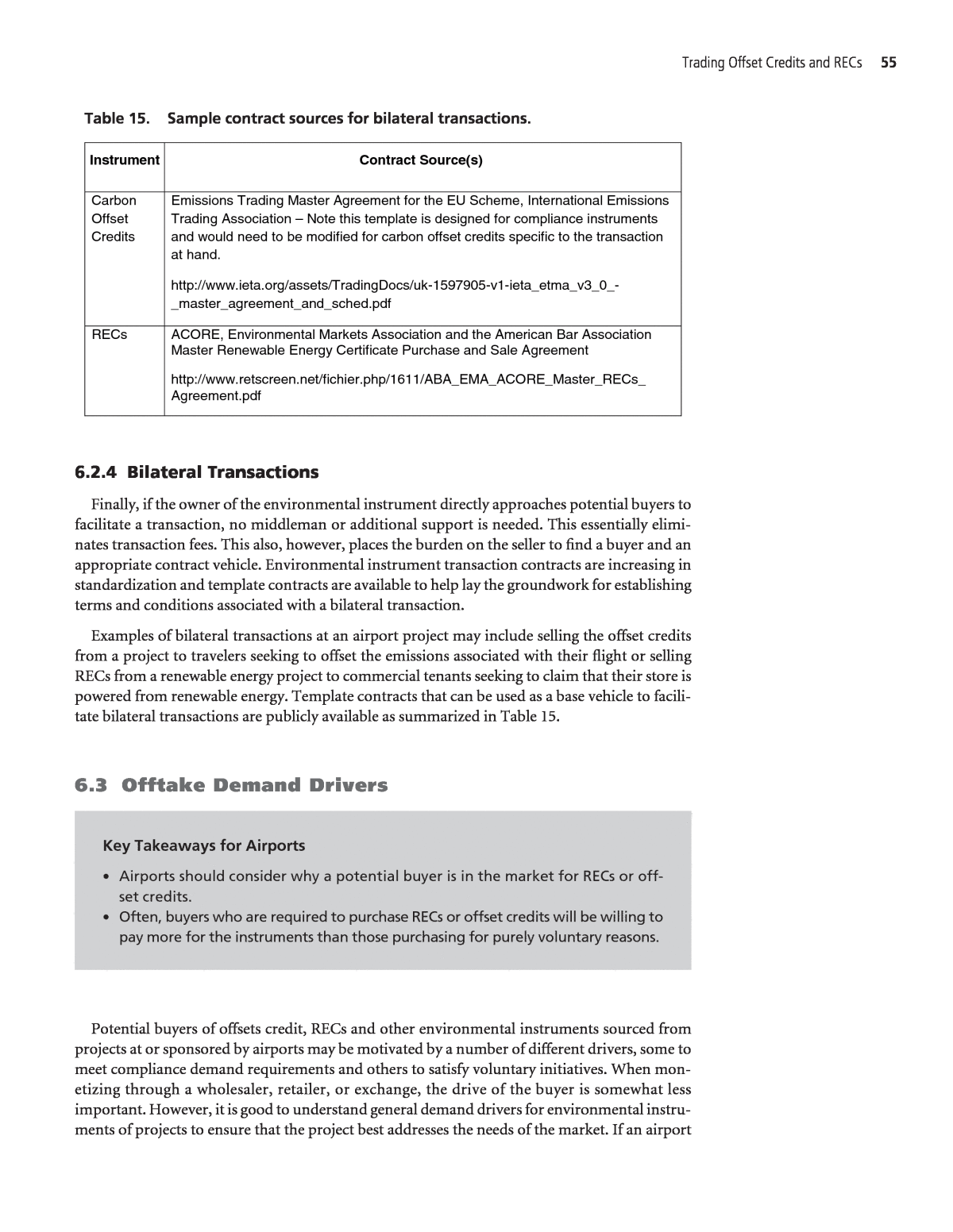
6.2.4 Bilateral Transactions Finally, if the owner of the environmental instrument directly approaches potential buyers to facilitate a transaction, no middleman or additional support is needed. This essentially elimi- nates transaction fees. This also, however, places the burden on the seller to find a buyer and an appropriate contract vehicle. Environmental instrument transaction contracts are increasing in standardization and template contracts are available to help lay the groundwork for establishing terms and conditions associated with a bilateral transaction. Examples of bilateral transactions at an airport project may include selling the offset credits from a project to travelers seeking to offset the emissions associated with their flight or selling RECs from a renewable energy project to commercial tenants seeking to claim that their store is powered from renewable energy. Template contracts that can be used as a base vehicle to facili- tate bilateral transactions are publicly available as summarized in Table 15. 6.3 Offtake Demand Drivers Trading Offset Credits and RECs 55 Instrument Contract Source(s) Carbon Offset Credits Emissions Trading Master Agreement for the EU Scheme, International Emissions Trading Association â Note this template is designed for compliance instruments and would need to be modified for carbon offset credits specific to the transaction at hand. http://www.ieta.org/assets/TradingDocs/uk-1597905-v1-ieta_etma_v3_0_- _master_agreement_and_sched.pdf RECs ACORE, Environmental Markets Association and the American Bar Association Master Renewable Energy Certificate Purchase and Sale Agreement http://www.retscreen.net/fichier.php/1611/ABA_EMA_ACORE_Master_RECs_ Agreement.pdf Table 15. Sample contract sources for bilateral transactions. Key Takeaways for Airports ⢠Airports should consider why a potential buyer is in the market for RECs or off- set credits. ⢠Often, buyers who are required to purchase RECs or offset credits will be willing to pay more for the instruments than those purchasing for purely voluntary reasons. Potential buyers of offsets credit, RECs and other environmental instruments sourced from projects at or sponsored by airports may be motivated by a number of different drivers, some to meet compliance demand requirements and others to satisfy voluntary initiatives. When mon- etizing through a wholesaler, retailer, or exchange, the drive of the buyer is somewhat less important. However, it is good to understand general demand drivers for environmental instru- ments of projects to ensure that the project best addresses the needs of the market. If an airport
operator is looking to bilaterally source an off taker for environmental instruments of a project, then what drives buyer interest is very important and needs to be considered in the selection process. Because there are no specific requirements for voluntary instrument purchases, the characteristics of instruments sought are completely up to the buyer based on what they want to claim. For example, a buyer may want to source instruments locally, so seeking off takers nearby may be a good option. Table 16 summarizes likely demand side entities, both compliance and voluntary, for differ- ent project types. With the exception of regional compliance programs, the United States carbon market demand is voluntary at this time. Many businesses and institutions are very interested in reducing their carbon footprint and purchasing verified offset credits is one way to do this. Voluntary market demand is largely driven by the story that the buyer wants to convey through their off- set credit purchase. Some buyers may be interested in offset credits from a certain project cate- gory or from specific geographic location. In some instances, a buyer may be willing to pay a premium for a certain type of offset credit. For example, a tenant in an airport may like to claim that the operations of their business are carbon neutral through the purchase of offset credits from a project on airport property or another location. Regardless of the offset project type and buyer, it is important to ensure the credibility of the offset credit by having it verified in confor- mance with the requirements of a reputable standard. A significant demand for voluntary market RECs exists at this time, in addition to compliance market demand. The primary standard for voluntary REC market certification is the Green-e standard. Many utilities source voluntary market RECs to retire on behalf of individual cus- tomers opting into their green energy programs. Like carbon offset credits, many corporations and institutions find value in claiming green energy consumption for some or all of their energy use that further stimulates voluntary REC demand. Likewise, some buyers may want to claim a particular renewable energy technology or location and may be willing to pay a premium to pur- chase specific subsets of RECs to tell this story. Finally, voluntary demand for white tags exists, largely by entities that want to claim a reduc- tion in GHG footprint. Several different standards exist for validating white tags, but it is impor- tant to ensure that these efficiency reductions are verified before selling to the market. 56 The Carbon Market: A Primer for Airports Project Type Instrument Compliance Demand Voluntary Demand Carbon Offset Project Carbon Offset Credit RGGI and California pre-compliance market players Businesses, institutions, and individuals seeking to reduce their carbon footprint (i.e., âgreenâ companies, schools, or airline passengers) Renewable â Solar Solar REC, aka âSRECâ Utilities and energy providers in states with solar tier requirements in RPS Businesses, institutions, and individuals seeking to claim solar renewable energy consumption Renewable â Wind, Biomass, Other REC Utilities and energy providers in states with an RPS Businesses, institutions, and individuals seeking to claim renewable energy consumption Energy Efficiency White Tag Utilities and energy providers in states with efficiency requirements in RPS Businesses, institutions, and individuals seeking to claim lower energy usage and/or reduction of emissions and externalities associated with traditional energy production Table 16. Summary of demand side entities by project type.
Trading Offset Credits and RECs 57 Airport Offset Example: Carbon Kiosks at San Francisco International Airport In 2009, San Francisco International Airport was the first airport in the United States to introduce a passenger offset program, called Climate Passport, which allows pas- sengers to calculate and reduce the carbon footprint of their air travel by support- ing carbon offset projects based in California. Three Climate Passport kiosks are available at the airport after the security checkpoint on both sides of the Interna- tional Terminal and in Terminal 3. Travelers can also access the Climate Passport through SFOâs website at: http://www.sfo.3degreesinc.com. Using the kiosks or the website, travelers can calculate the carbon footprint of their flights to determine the amount of carbon offset credits or Verified Emission Reductions needed to address the GHG impact. 3Degrees is a local San Francisco carbon and renewable energy marketing firm that manages the Climate Passport kiosks. 3Degrees sources carbon offset credits from The Conservation Fundâs Garcia River Forest Project and the San Francisco Carbon Fund to reduce GHGs emitted into the atmosphere by an amount equivalent to that passengerâs trip. The carbon offset credits for Cli- mate Passport are sourced from projects that result in real, quantifiable, and per- manent GHG emission reductions and are third-party verified against the Climate Action Reserveâa rigorous, objective, and transparent standard for offset credits from forestry projects. Climate Passport also allocates $1.50 per tonne of all offset credit sales to the San Francisco Carbon Fund, a city-run fund that invests in GHG reduction projects within San Francisco. The primary airport expense of the Climate Passport system is development of the three kiosks, which cost $190,000 in total.
