



Below is the uncorrected machine-read text of this chapter, intended to provide our own search engines and external engines with highly rich, chapter-representative searchable text of each book. Because it is UNCORRECTED material, please consider the following text as a useful but insufficient proxy for the authoritative book pages.
42 The 11 carrier case studies in this chapter are based on phone or in-person interviews with motor carrier safety managers or other carrier officials with similar job titles and responsibilities. Most companies and interviewees were identified through the project safety-manager surveys, although some were already known to the report authors. Interviewees were selected based on the number and variety of their carriersâ innovative opera- tional practices as indicated on their survey forms. The Sampling Approach section in chapter three described the interview process and listed some supplemental questions asked as follow-ups to the respondentsâ written survey responses. As noted there, interviewees were recruited from the survey questionnaires; respondents were asked if they wished also to participate in a phone interview on innovative carrier practices. Each interview followed the same general topic sequence, but specific questions varied in response to inter- viewee answers and carrier practices discussed. The case stud- ies summarize interviewee answers and highlight operational practices believed to be safety-effective by each carrier. Inter- view data were supplemented by a review of the carriersâ web- site content relating to its operations and practices. Companies are identified only as âCarrier A,â âCarrier B,â and so on. The 11 companies interviewed included large fleets (>1,000 vehicles), medium fleets (100â1,000 vehicles), and small fleets (<100 vehicles). They are further classified as follows: ⢠Large for-hire truckload carriers (AâD); ⢠Medium for-hire truckload carriers (EâF); ⢠Large private truck fleets (GâH); ⢠Medium private truck fleet (I); and ⢠Small bus fleets (JâK). The authors believe that all of the carriers included here are well-run operations with excellent safety programs. Never- theless, project resources did not permit formal evaluation of any operational practice of any carrier. The examples given are to be considered as suggested practices for consideration by readers, not as scientifically proven methods. For consistency, all interviewees are termed safety man- agers or safety directors, regardless of their actual job titles. Each case study includes a textbox with five notable carrier efficiencies with likely safety benefits. Practices were chosen for the textboxes based on the SMsâ enthusiasm for them, and to present the widest possible range of worthwhile practices. Note also that, within each case study, qualitative statements made (e.g., regarding operational risk factors or practices to reduce risk) reflect the opinions of the SM interviewee and not necessarily the conclusions of this report. CASE STUDY A: LARGE TRUCKLOAD CARRIER Carrier A is a large truckload carrier providing refrigerated, flatbed, and tanker services. Its safety director has decades of experience in carrier safety and operations, and is active in several national truck safety-related organizations. In the project survey, the safety director rated the following opera- tional practices as having the greatest benefits to safety: ⢠Reducing loading and unloading delays; ⢠Maximizing travel on Interstates and other freeways; ⢠Avoiding urban rush hours and other heavy traffic situ- ations; ⢠Avoiding adverse weather and slick roads; ⢠Avoiding construction zones; and ⢠Assigning familiar routes to drivers when possible. The safety director believed that efficient carriers tended to be safer carriers because of âa thousand little things.â Inef- ficient carriers âlet things go,â such as postponing PMs or not replacing old equipment. Company A replaces its trucks after approximately 3 years of service, which reduces mechanical problems with possible safety effects. The companyâs website says it provides computerized mapping and routing directions âto driver associates to ensure that loads get from point A to point B in the quickest, safest and most efficient manner. The greatest benefit of this tech- nology is reducing the time driver associates spend searching for shippersâ docks, especially in remote locations or con- gested industrial areas.â This technology also reduces driver cell phone use and provides a delivery tracking system. Division operational managers are considered to be safety managers as well, and this is incorporated into their perfor- mance evaluations. This concept strengthens the link between operational efficiency and safety. The company uses com- mercial software to plan and manage their PMs. Trucks are equipped with EOBRs, though the safety director stated that they decrease productivity by 3% to 5%. EOBRs do, however, provide operational managers with better data on CHAPTER FOUR CASE STUDIES
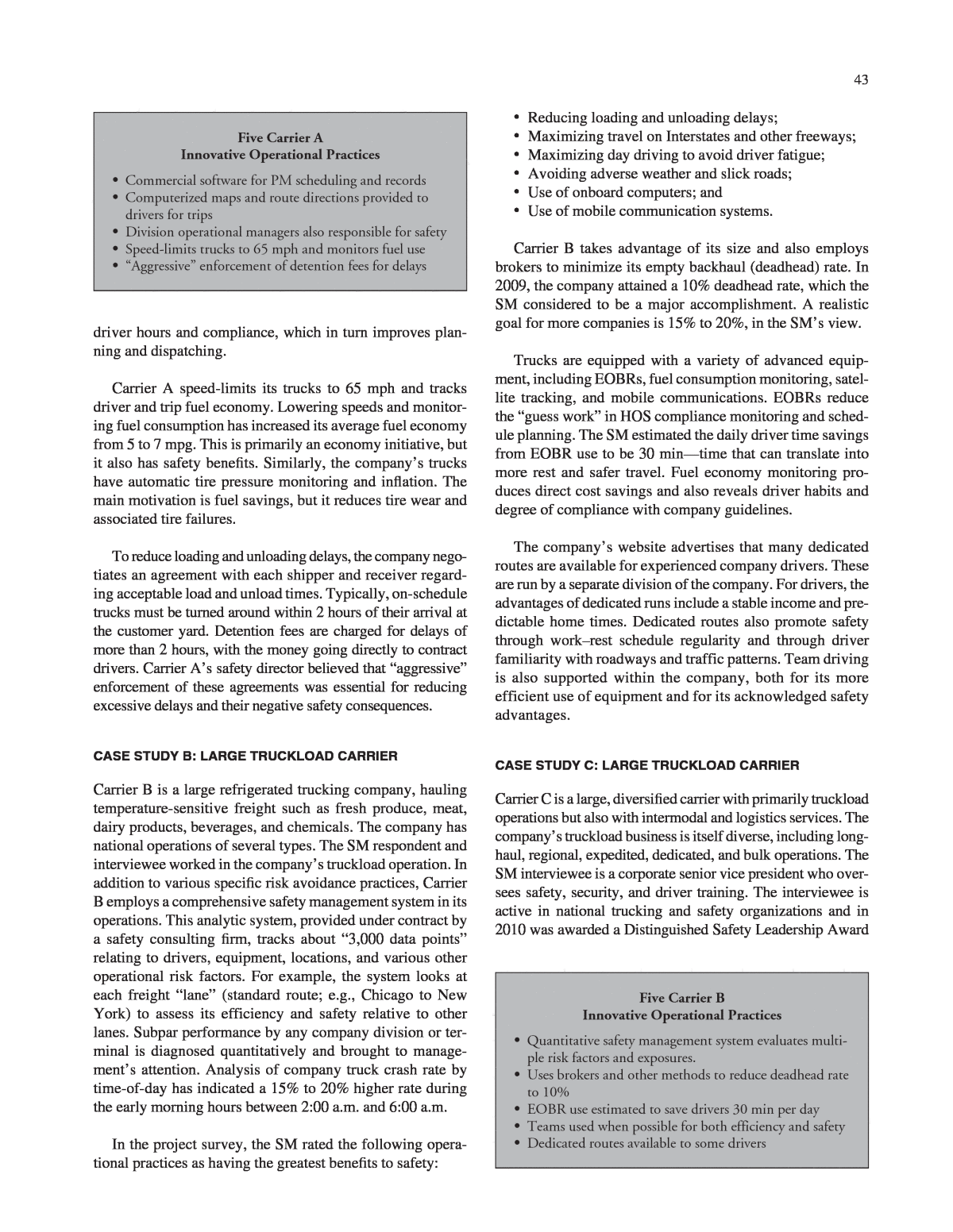
43 driver hours and compliance, which in turn improves plan- ning and dispatching. Carrier A speed-limits its trucks to 65 mph and tracks driver and trip fuel economy. Lowering speeds and monitor- ing fuel consumption has increased its average fuel economy from 5 to 7 mpg. This is primarily an economy initiative, but it also has safety benefits. Similarly, the companyâs trucks have automatic tire pressure monitoring and inflation. The main motivation is fuel savings, but it reduces tire wear and associated tire failures. To reduce loading and unloading delays, the company nego- tiates an agreement with each shipper and receiver regard- ing acceptable load and unload times. Typically, on-schedule trucks must be turned around within 2 hours of their arrival at the customer yard. Detention fees are charged for delays of more than 2 hours, with the money going directly to contract drivers. Carrier Aâs safety director believed that âaggressiveâ enforcement of these agreements was essential for reducing excessive delays and their negative safety consequences. CASE STUDY B: LARGE TRUCKLOAD CARRIER Carrier B is a large refrigerated trucking company, hauling temperature-sensitive freight such as fresh produce, meat, dairy products, beverages, and chemicals. The company has national operations of several types. The SM respondent and interviewee worked in the companyâs truckload operation. In addition to various specific risk avoidance practices, Carrier B employs a comprehensive safety management system in its operations. This analytic system, provided under contract by a safety consulting firm, tracks about â3,000 data pointsâ relating to drivers, equipment, locations, and various other operational risk factors. For example, the system looks at each freight âlaneâ (standard route; e.g., Chicago to New York) to assess its efficiency and safety relative to other lanes. Subpar performance by any company division or ter- minal is diagnosed quantitatively and brought to manage- mentâs attention. Analysis of company truck crash rate by time-of-day has indicated a 15% to 20% higher rate during the early morning hours between 2:00 a.m. and 6:00 a.m. In the project survey, the SM rated the following opera- tional practices as having the greatest benefits to safety: ⢠Reducing loading and unloading delays; ⢠Maximizing travel on Interstates and other freeways; ⢠Maximizing day driving to avoid driver fatigue; ⢠Avoiding adverse weather and slick roads; ⢠Use of onboard computers; and ⢠Use of mobile communication systems. Carrier B takes advantage of its size and also employs brokers to minimize its empty backhaul (deadhead) rate. In 2009, the company attained a 10% deadhead rate, which the SM considered to be a major accomplishment. A realistic goal for more companies is 15% to 20%, in the SMâs view. Trucks are equipped with a variety of advanced equip- ment, including EOBRs, fuel consumption monitoring, satel- lite tracking, and mobile communications. EOBRs reduce the âguess workâ in HOS compliance monitoring and sched- ule planning. The SM estimated the daily driver time savings from EOBR use to be 30 minâtime that can translate into more rest and safer travel. Fuel economy monitoring pro- duces direct cost savings and also reveals driver habits and degree of compliance with company guidelines. The companyâs website advertises that many dedicated routes are available for experienced company drivers. These are run by a separate division of the company. For drivers, the advantages of dedicated runs include a stable income and pre- dictable home times. Dedicated routes also promote safety through workârest schedule regularity and through driver familiarity with roadways and traffic patterns. Team driving is also supported within the company, both for its more efficient use of equipment and for its acknowledged safety advantages. CASE STUDY C: LARGE TRUCKLOAD CARRIER Carrier C is a large, diversified carrier with primarily truckload operations but also with intermodal and logistics services. The companyâs truckload business is itself diverse, including long- haul, regional, expedited, dedicated, and bulk operations. The SM interviewee is a corporate senior vice president who over- sees safety, security, and driver training. The interviewee is active in national trucking and safety organizations and in 2010 was awarded a Distinguished Safety Leadership Award Five Carrier A Innovative Operational Practices ⢠Commercial software for PM scheduling and records ⢠Computerized maps and route directions provided to drivers for trips ⢠Division operational managers also responsible for safety ⢠Speed-limits trucks to 65 mph and monitors fuel use ⢠âAggressiveâ enforcement of detention fees for delays Five Carrier B Innovative Operational Practices ⢠Quantitative safety management system evaluates multi- ple risk factors and exposures. ⢠Uses brokers and other methods to reduce deadhead rate to 10% ⢠EOBR use estimated to save drivers 30 min per day ⢠Teams used when possible for both efficiency and safety ⢠Dedicated routes available to some drivers
44 by the Truck Safety Coalition, a partnership of truck safety advocacy organizations. Of 15 operational practices rated in the project survey, the SM rated maximizing travel on Interstates and other freeways as most benefiting fleet safety. Other routing and schedul- ing practices rated highly included maximizing day driving, assigning familiar routes, and avoiding urban traffic and con- struction zones. This carrier uses nine of the 11 operational practices and tools probed in the project survey. This includes use of PM schedules and software, brokers and other methods to reduce empty backhauls, detention fees for loading and unloading delays, and a requirement that drivers prepare trip plans before driving. The SM noted that detention fees are necessary because, without them, customers have little incentive to reduce delays. Drivers are paid by the mile and delays have a low perceived cost to customers, posing an efficiency and safety challenge to the supply chain. With regard to onboard computers and communications, the SM believed that the key challenge was in providing informa- tion and communications without increasing driver distraction. The company does not use general-purpose computers in its cabs because their potential for distraction is too great. It does use communications and navigational aids, but without provid- ing visual displays when vehicles are in motion. Displays auto- matically go blank and are locked out-of-use when vehicles are in motion. The routing interface converts text to voice when the vehicle is moving. The companyâs routing software uses a zip- code-centerâtoâzip-code-center routing algorithm to identify the miles associated with a given load run by the shortest route. Minimizing the out-of-route mileage by this metric is one com- ponent of a quarterly driver pay bonus system. The company is considering improvements to this approach by giving greater weight to travel efficiency and safety (e.g., by routing through Interstates even if distances are longer). The carrier conducts extensive and probing analyses of its safety risk factors and crash causes. The SM regarded driving in construction zones as among the most important conditions elevating crash risk. The company has âdramatically higherâ crash rates in construction zones than in other settings. The SM believes this to be the result of two factors: mis-engineering of the zones and, more importantly, car drivers trying to pass trucks and cut in front of them before a zone. Schedule fac- tors associated with severe crashes include time-of-day, hours since last break, and day of the work cycle. The SM would like to be able to factor crash risk into company pricing models so that the costs of transporting goods under higher- risk conditions are passed along to customers demanding such services. The company is equipping many of its new trucks with automated transmissions to make them easier to operate and to reduce driver distraction from shifting gears. âAutomatedâ transmissions are not fully automatic, but they require much less shifting skill, attention, and work than a truck manual transmission (Knipling 2009). The safety rationale is that reducing driver physical and mental workload from shifting will permit greater and more continuous attention to driving. The company conducted an experiment in which a group of new drivers was trained and fielded with automated trans- mission vehicles, whereas a control group used standard gears. New drivers using automated transmissions had slightly increased fuel use, but this was more than offset by a 26% lower first-year crash rate than that of the control group. They also completed their training sooner on average, and had a 35% higher 1-year retention rate (Knipling 2009). The carrierâs trucks are electronically monitored to track driver work and driving times, and those driven by employee drivers are speed-limited. Electronic work time monitoring starts with the automatically detected first movement of the vehicle on a driverâs tour-of-duty. The system is programmed to assume that the driverâs on-duty period started 30 min ear- lier. If a driver has not shut down well within HOS limits, the system sends him or her update messages on approaching time limits. The system tabulates the number of messages sent to each driver, along with the driverâs daily and weekly miles. CASE STUDY D: LARGE TRUCKLOAD CARRIER Carrier D is a large common and contract carrier specializ- ing in truckload quantities of general commodities. The com- pany is located in the central United States and runs primarily medium-distance dry van and flatbed hauls. In the project survey, Carrier Dâs SM rated the following operational prac- tices as having the greatest benefits to safety: ⢠Maximizing travel on Interstates and other freeways; ⢠Maximizing day driving; ⢠Avoiding urban peak hours and other heavy traffic sit- uations; ⢠Avoiding adverse weather and slick roads; ⢠Avoiding construction zones; and ⢠Assigning familiar routes to drivers when possible. Five Carrier C Innovative Operational Practices ⢠Detention fees for excessive loading and unloading delays ⢠Routing communications provided only when vehicle is stationary ⢠Extensive crash and exposure analyses have identified risky conditions such as work zones. ⢠Many trucks equipped with automated transmissions for ease-of-use and safety ⢠Electronic monitoring of vehicle movements with auto- matic messages sent to drivers nearing HOS limits
45 Carrier D has a systematic, software-based PM program that schedules each truck for about 2 hours of PM every 20,000 miles of travel. This is supplemented by remote elec- tronic monitoring of engine performance. The company does not provide GPS routing systems free to drivers, but does sell them to drivers for a discounted price. These systems have truck-specific routing information. The SM told of two incidents of mishaps involving truck drivers using general- driving GPS navigation systems. In one, a truck driver fol- lowed GPS directions under a low-clearance bridge, resulting in a crash. In the other, a driver followed GPS directions down a narrow dirt road and rolled the truck. Assigning drivers ded- icated runs when possible is another way to reduce driving on unfamiliar roads. Remote monitoring of trucks through wireless communica- tions includes fuel economy monitoring. A general, company- wide, and driver-specific goal is 6 mpg. Although the primary motivation was economic, the SM believed that the moni- toring had safety benefits as well. The same âpatterns of behaviorâ and care while driving were reflected in both high fuel economy and low-risk driving. The same system moni- tors driver hard-braking and roll-stabilityârelated events. Carrier D does not use EOBRs for HOS compliance, but the SM believed that their use would be an operational and safety enhancement. This view was based more on potential safety management benefits of EOBRs than on their HOS compliance and fatigue reduction benefits per se. EOBRs would give the carrier safety department more knowledge of operations, help to make better use of available driver hours, and quickly highlight compliance problems. They would reduce driver fatigue and drowsiness as well, but âthat wouldnât be my sales pitchâ in arguing for their use. Carrier D analyzes its operations extensively; for exam- ple, it closely examines and compares safety and productiv- ity data on its many individual fleets (divisions). It has the capability to conduct relative crash risk analyses of opera- tional factors such as time-of-day, day-of-week, month-of- year, and driving location. A limitation of such analyses, in the view of the SM, is that there is usually not enough oper- ational flexibility to apply lessons learned fully. CASE STUDY E: MEDIUM-SIZED REGIONAL TRUCKLOAD CARRIER Carrier E is a medium-sized truckload carrier in eastern Canada. The company owns several hundred tractors and more than 1,000 trailers. The company offers logistics and ware- housing services in addition to truckload haulage. Truckload capabilities include refrigeration and Hazmat. Most runs are regional trips of less than 500 miles (one way) between Ontario and the northeastern United States, or in the upper Midwest. The company recently received International Standards Organization (ISO) certification under Standard ISO 9001: 2008 encompassing its transportation, warehousing, and logistics operations. The company also received the Shipperâs Choice Award from Canadian Transportation & Logistics magazine, based on a poll of shippers. Evaluation areas for the award include âOn Time Performance,â âEquipment and Operations,â âInformation Technology,â âCompetitive Pric- ing,â âCustomer Service,â âProblem Solving,â and âValue- Added Services.â Carrier E participates in a consortium of 18 Canadian motor carriers striving to improve their safety and reduce losses. The group meets quarterly to share best safety prac- tices and materials, including those related to operational efficiencies. Carrier Eâs 5 years of participation in this group has resulted in steady declines in the companyâs loss ratios. Just over half of Carrier Eâs runs are out-and-back trips to two U.S. states. Because of the predictability of its runs, Car- rier E is able to book back-haul loads for a high percentage of its trips. Their current empty truck rate is 12%. This low rate benefits both efficiency and safety, and has enabled the com- pany to pay drivers by the mile equally for full and empty trips. Paying drivers for empty trips eliminates a possible source of driver unhappiness, stress, and schedule pressure. Carrier E has its own truck maintenance facility and man- ages preventive maintenance using TRANSMAN® software. The company owns many more trailers than tractors, so trail- ers can easily be scheduled for regular maintenance. Carrier E is equipping its new trucks with EOBRs and tran- sitioning to E-logs. The SM is enthusiastic about this change. E-logs âget rid of paperâ and improve real-time management of operations. Drivers like the E-logs, and their use positions the company to deal better with CSA 2010. The companyâs HOS compliance was already high with paper logs, so EOBRsâ ben- efits are from âeasier compliance, not better compliance.â The SM believed that the companyâs communications system was an important element in operational safety. The system facilitates trip pre-planning (required for every trip) and efficient deployment of drivers and vehicles. The system does not provide continuous navigation guidance to drivers, Five Carrier D Innovative Operational Practices ⢠Performs PM on each truck every 20,000 mi (2- to 3-month intervals) ⢠Provides truck-specific GPS routing system to drivers (at discounted price) ⢠Assigns drivers dedicated runs when possible ⢠Monitors individual driver fuel economy with goal of 6 mpg ⢠Charges detention fees for excessive loading and unload- ing delays
46 but drivers may access PC*MILER® directions on their truck units when needed. The system also monitors vehicle speeds and hard braking, though Carrier E does not empha- size the onboard monitoring aspects. Instead, the company talks to drivers directly about their driving behaviors and seeks to intervene if drivers appear under undue operational or per- sonal stress. CASE STUDY F: MEDIUM-SIZED TRUCKLOAD CARRIER WITH HAZMAT OPERATIONS Carrier F is a truckload carrier primarily serving the Midwest and eastern United States. The company has several hundred trucks and hauls both Hazmat and non-Hazmat cargo. Its web- site states that its performance and safety follow International Standards Organization (ISO) processes. The ISO approach includes regular statistical process analysis, including both internal and external audits. Per its website, the companyâs safety culture is âby the book,â but also strives to exceed reg- ulatory requirements. The companyâs safety director, inter- viewed for this project and case study, was recently recognized as âSafety Director of the Yearâ by the Missouri Motor Carri- ers Association. In the project survey, the SM rated the following opera- tional practices as having the greatest benefits to safety: ⢠Increasing routing efficiency using navigation aids; ⢠Maximizing travel on Interstates and other freeways; ⢠Maximizing day driving; ⢠Avoiding urban rush hours and other heavy traffic situ- ations; ⢠Assigning familiar routes to drivers when possible; and ⢠Using mobile communications. With regard to day versus night driving, the SM noted that both have inherent risks and crash threats. For day driving it is other traffic, and for night driving it is driver fatigue. Evenings between 6:00 p.m. and midnight were regarded as an optimal time period. Driving after midnight was not encouraged, and drivers were urged to stop for rest whenever they were tired. Operations require some driving during the overnight hours, however. Carrier F emphasizes load and schedule planning and truck tracking. It uses commercial software to match drivers to shipments based on driver HOS status and load require- ments. Every truck and shipment is tracked by means of satellite communications. Brokers are employed to reduce empty backhauls. The company charges detention fees to shippers and receivers for excessive loading and unloading delays. The company provides truck-specific GPS navigation systems to its drivers. The SM noted, however, that even truck-specific GPS routing may not always be optimal or legal. The shortest route, for example, may be slower and riskier. Trip planning and driver judgment and experience were still critical for efficient operations. Carrier F has equipped some of its trucks with EOBRs and is moving to equip more. Benefits are primarily from effi- cient management, not from HOS compliance per se. EOBRs enable a âbetter fitâ within HOS constraints. EOBR drivers actually get more miles because they are more efficient. Car- rier F monitors individual driver fuel use, motivated primar- ily by cost savings. CASE STUDY G: LARGE RETAIL CHAIN PRIVATE FLEET Carrier G is the private fleet serving a large, national retail chain store. The company is actually served both by its private fleet and for-hire carriers. The safety manager interviewed is the national manager of safety and compliance for the private fleet, which consists of regional divisions. Each divi- sion makes local (<100-mile) and regional (>100-mile) deliv- eries within its area. The SMâs job responsibilities encompass qualifications and safety, operations, and risk analysis and control. Carrier G is a recent recipient of the American Truck- ing Associations (ATA) Presidentâs Award for Best Overall Safety Program for fleets in its size category. It has also been recognized for its low crash rate and low driver-injury rate. Carrier G uses two different truck-routing programs (Road- show and Trucks) to optimize both its truck routing and deliv- ery schedules. Routing factors in the products being shipped, their package size (âcubeâ), and delivery time windows for the stores being served. The software considers traffic character- istics in the vicinity of stores and whether store entrances or Five Carrier E Innovative Operational Practices ⢠Participation in safety consortium of 18 motor carriers ⢠Reduction of empty truck rate to 12%. Drivers are paid for empty trips. ⢠Commercial software for PM planning and record- keeping ⢠Transitioning to EOBRs for âeasier complianceâ ⢠Satellite truck tracking and communications Five Carrier F Innovative Operational Practices ⢠ISO process analysis ⢠Load planning with driver and delivery schedule matching ⢠Satellite tracking and communications ⢠Truck-specific GPS navigation aids ⢠Detention fees for excessive delays
47 window access are blocked by deliveries. The software opti- mizes outbound delivery times and driving distances, but the Carrier G private fleet does not do backhauls. âEmptyâ trailers contain considerable packing material, further reducing the practicality of backhauls. Carrier Gâs division fleets are partially maintained by its own employees and partially by its truck leasing firm. Both are aided by commercial PM software. Carrier Gâs trucks are equipped with onboard computers that capture and record rapid decelerations and other indicators of driver risk. Rapid decelerations (e.g., a 7-mph drop in 1 s or less) usually indi- cate driver tailgating or other at-risk behavior. Because traf- fic density and other driving conditions vary so much across the country, different regional divisions may have tenfold differences in average frequencies of rapid decelerations. A goal is established for each distribution center, and indi- vidual drivers are evaluated in relation to other drivers in their division. Across the entire fleet, a typical goal for drivers would be a rate of one event per 900 miles. Trucks are also equipped with electronic logs, which permit rapid identifica- tion of violations and follow-up inquiries. Sometimes viola- tions are âtechnicalâ rather than substantial; for example, a driver caught in a traffic jam at the end of a trip may have to terminate his or her trip as soon as possible, but still go over on driving time. Such minor violations do not result in enforcement consequences, because they are infrequent and explainable. Carrier Gâs trucks are both speed limited and speed mon- itored. Trucks are limited to 63 mph when under power. Because trucks going downhill can accelerate to higher rolling speeds, they are monitored for any speeds greater than 68 mph. These measures control speeds and also improve fuel economy. Individual driver fuel economy also is moni- tored. These combined measures have allowed Carrier G to improve its fuel economy by more than 1 mpg. Carrier G has analyzed its crashes in terms of location, vehicle movements, and other risk factors. Few of its crashes occur on Interstates or other freeways. Most actu- ally occur at store locations, and many of these involve truck backing maneuvers. Many also occur within closed distribution center yards. Carrier Gâs analyses of yard crashes has led to changes in yard design (e.g., parking lines, other markers, and signs) resulting in a 44% reduction in these crashes. On the survey form and in the interview, the SM empha- sized the many roadway factors affecting crash risk. These include divided versus undivided roadways, traffic, work zones, loading dock and yard design, and, of course, traf- fic density. With regard to work zones, it was pointed out that some highway work projects appear to result in lane closures of unnecessarily long durations. Such extended closures elevate crash risks because of their constricted driving space. CASE STUDY H: LARGE UTILITY PRIVATE FLEET Carrier H is a large utility with a private fleet of trucks. These trucks deliver equipment items, both very large and small, to company locations. Most tractors are equipped with an onboard hydraulic âKnuckle Boomâ crane, which is used to unload equipment from the trailer and to load used equip- ment for return trips. Most backhauls are loaded with equip- ment needing repair or to be scrapped. The interviewee has decades of experience with the company, and functions as a senior safety consultant and advisor with company-wide, national responsibilities. Carrier H has very stable and predictable delivery opera- tions. Its distribution center and terminal locations are estab- lished and rarely change. Its drivers and trucks deliver the same cargo items to multiple terminals, which are similar in size and operations. Drivers know their routes and the vagaries of traffic patterns along the way. Almost all daily trips begin and end within 12 hours at the equipment distribution center. Employee drivers work a 4-day week. Thus, many issues con- fronting other fleets are not concerns to Carrier H. These include empty backhauls, loading and unloading delays, HOS compliance challenges, route optimization, and navigation. The regularity of delivery routes, locations, and operations contributes greatly to driving safety. Most crashes involve trucksâ close interactions with other traffic, as in a âpinchâ sce- nario when light vehicles cut in front of trucks. Carrier H has its own maintenance facilities but also out- sources maintenance. It uses commercial maintenance man- agement software to manage PM schedules, parts inventory, fuel and tire usage, and other maintenance schedules and records. Carrier H emphasizes trip planning and preparation. The supervisor of the prior shift prepares a daily ârun sheetâ for each driver that specifies delivery points and includes paper- work for each delivery. Because drivers are familiar with their routes, they are granted the flexibility to modify them when needed, based on traffic conditions or other exigencies. Supervisors closely monitor both pre- and post-trip vehicle inspections, which include the truck, trailer, and the onboard Five Carrier G Innovative Operational Practices ⢠Software for PM scheduling and records ⢠Routes and deliveries optimized in relation to road, traf- fic, and delivery location factors ⢠Onboard computers with monitoring of rapid decelera- tions with analysis of regional rates ⢠Truck speed-limiting with monitoring of top speeds and fuel usage ⢠Analysis of crash factors and resulting yard redesigns
48 âKnuckle Boom.â The company is experimenting with an Electronic Vehicle Inspection Report system from Zonar. The system uses radio-frequency identification tags attached to key vehicle inspection points to ensure full compliance with inspection requirements and recording of inspection steps. The SM emphasizes, however, that it is people and man- agement that ensure safety, not electronic aids. Vehicles are equipped with Qualcomm mobile tracking and communications units. Supervisors do not monitor them continuously, however, because most daily operations are routine. Vehicles are equipped with onboard computers capable of recording driving indicators such as engine speed, idling, hard braking, and overspeeding. The company has purchased the software needed to collect and analyze these vehicle and driving data, and is beginning to implement onboard monitoring. Often crashes and safety problems that appear to be the result of driver error are actually traceable to âsystemâ defi- ciencies. The SM cited the example of a crash in which a company truck ripped down a terminal gate. The crash was at first attributed to driver carelessness, but investigation revealed that the electronic gate opening device did not allow sufficient time for the driver to activate it from outside the vehicle, return to the vehicle, and then drive through. Many crashes and employee injuries are the result of problems with loading dock and yard physical layout. They can also be related to terminal supervisorsâ and employeesâ failure to maintain a clean and orderly workspace. Terminal managers are evaluated and compared based on detailed and consistent record-keeping on accidents and injuries. Most often, an effi- cient terminal is a safe one, although there is a caveat. Some terminal managers push productivity too hard at the expense of safety. CASE STUDY I: MEDIUM-SIZED PRIVATE AND FOR-HIRE FOOD AND GENERAL CARGO CARRIER Carrier I is a medium-sized, short- and medium-distance trans- porter and logistics service provider serving the Mid-Atlantic, Northeast, and Southeast United States. The company had spe- cialized in temperature-controlled food shipments, but now also hauls other types of cargo, including live animals. It func- tions largely as a private carrier because its primary operations are under a long-term dedicated contract with a food producer and shipper. It is also licensed as a for-hire carrier with truck- load and scheduled LTL operations. The intervieweeâs title is general manager, with duties encompassing driver hiring, training, supervision, equipment, and operations. Carrier I has its own truck maintenance facility and man- ages PM using TMT Fleet Maintenance software, commer- cially available from TMW Systems. This software is used to manage PM schedules, parts inventory, fuel and tire usage, and other maintenance schedules and records. Equipment asset and maintenance activity data are entered once and then integrated by the software into various user-formatted reports as an aid to equipment management and budgeting. Carrier I strives to minimize deadheads (empty backhauls) using brokers, load boards, and established contracts. It books backhauls for 95% of its longer-distance trips. Carrier I charges detention fees to receivers for unloading times greater than 3 hours, though the SM believed that such fees did not result in significant safety benefits; they âadd complexityâ to the business process without solving the problem of excessive delays. Drivers are reimbursed for tolls, and generally encouraged to use freeways. Dispatchers are usually aware of driversâ trip experience, and work with drivers to make sure they have maps and directions for unfamiliar trips. Drivers can buy their own GPS navigation systems. More drivers use general-purpose systems than truck-specific navigation systems because the former are considerably less expensive (roughly $150 versus roughly $500). Carrier Iâs trucks are equipped with onboard communica- tions systems, and some vehicle engines have monitoring capabilities for fuel usage and idling time. Carrier I is cur- rently in âvendor evaluationâ to add onboard computers to its entire fleet. This will uniformly equip vehicles with commu- nications, electronic logs, engine monitoring, and driver per- formance monitoring (e.g., speeds, rapid decelerations). The SM believed that electronic logs would improve compliance, reduce driver fatigue, and improve the safety oversight of drivers. Efficient and successful companies were believed to be safer companies, in part because they had the resources to invest in better safety equipment and processes. Efficiencies result in more company profits to invest in safety and in more available time to focus on safety. Currently the company pays most local-delivery drivers by the hour, but pays longer-haul drivers by the mile. The SM raised the idea that vehicle onboard monitoring equipment might make it possible to shift long-haul drivers partially from pay-by-the-mile to hourly pay, or to a system combin- ing the two pay methods. That is because onboard monitors could be used by management to ensure that drivers were Five Carrier H Innovative Operational Practices ⢠Commercial software for PM scheduling and records ⢠Trucks equipped with E-Z Pass transponders; drivers use most efficient roads ⢠Supervisor prepares daily ârun sheetâ for drivers. ⢠Daily management monitoring of pre- and post-trip vehicle inspections ⢠Vehicles equipped with mobile tracking and communications
49 indeed using their time productively, one of the concerns motivating carriers to pay long-haul drivers only by the mile. CASE STUDY J: SMALL CHARTER BUS SERVICE Carrier J is a small, family-owned charter bus service located in New York state. Most of its trips are to New York City and other major attractions in the region. Its SM, interviewed for this case study, has 20 yearsâ experience in the position and 15 yearsâ prior experience as a driver. The SM regarded driver enduring traits and roadway and traffic characteris- tics to be the biggest crash risk factors. These choices show insight into two strong sources of risk variation, as indicated by naturalistic driving studies. Chapter two of this report reviewed the evidence that different highway characteristics such as road type (e.g., undivided roads versus divided highways), construction zones, and traffic density can be associated with marked differences in incident risk. Most of Carrier Jâs trips are to a number of Northeast cities, tourist attractions, and recreational areas. Because the company serves a limited number of destinations, it can pre- scribe a route for almost every trip. The SM regards this as a significant safety advantage because the prescribed routing can maximize travel on Interstates and on less congested roads. This also means that drivers are almost always famil- iar with their routes. When drivers are familiar with their routes, they can plan stops, turns, lane changes, and other maneuvers in advance. They anticipate potential trouble spots and may learn alternate routes to take when there are unforeseen backups. Drivers have access to a computer at the home office with a catalog of routes for almost all charter destinations. They can also see daily traffic alerts from New York and other state DOTs in their travel area. Carrier J has equipped its motor coaches with a multifunc- tion electronic monitoring system provided by a major ven- dor. The system provides OBSM as well as EOBR. The OBSM system records and reports âoverspeedâ time (i.e., above a specified top speed), highest observed speed, hard braking incidence, fuel use, and other indicators of safe or unsafe driving. It calculates a âDriver Report Cardâ for each trip. Driver acceptance of the monitoring is surprisingly good; indeed, they âmake it a competitionâ to see who can earn the best scores. EOBRs are more accurate than paper logs and increase safety by improving HOS compliance. EOBR bene- fits are not limited to fatigue reduction, however. They make operational planning and safety management more efficient, and enable quick identification of problems. The systemâs GPS real-time mapping feature can provide a location-by-time âcookie trailâ for any trip, vehicle, or driver. The Carrier J SM believed that efficient carriers were gen- erally safer carriers. One exception cited, however, was from previous experience with pickup and delivery operations. Too tight monitoring of delivery times forces drivers to rush, leading to potential errors, mishaps, and even crashes. CASE STUDY K: SMALL CHARTER AND SCHEDULED BUS SERVICE Carrier K operates about 50 motor coaches in the Midwest. These buses carry 29 to 56 passengers, and originate from three company terminals. Services include charters, tours, shuttles, airport transfers, casino runs, and daily scheduled routes. The company carries more than 750,000 passengers annually. The companyâs SM and interviewee for this sum- mary holds the dual title of director of safety and training. In the study survey, the SM rated maximizing day driving, avoiding adverse weather, and assigning familiar routes to drivers as the most safety-effective operational practices of those presented. The company had conducted no statistical studies of crash rate by hour-of-day, but regarded overnight driving, particularly between 2:00 a.m. and 6:00 a.m., as the most dangerous. Long trips ending in these early morning hours were especially to be avoided. Evenings between 6:00 p.m. and midnight, on the other hand, were regarded as among the safer time periods for driving. Company buses on scheduled routes have lower crash rates than those on char- ters, reflecting, in the SMâs opinion, driversâ greater famil- iarity with routes and traffic patterns. Carrier K performs PM conscientiously, using commer- cially purchased PM scheduling and tracking software. General, nonâcommercial-vehicle GPS navigation aids are provided to drivers. Although the company works from three Five Carrier I Innovative Operational Practices ⢠Commercial software for PM scheduling and records ⢠Use of multiple methods to reduce deadheads to 5% of return trips ⢠Maps and route directions provided to drivers for trips ⢠Mobile communications ⢠Moving to electronic logs and multifunction vehicle onboard monitoring Five Carrier J Innovative Operational Practices ⢠Software for PM scheduling and records ⢠File of optimal routes for almost all trips ⢠Provides state daily traffic alerts to drivers ⢠EOBRs assist trip planning as well as HOS compliance. ⢠OBSM monitors fuel use and driving patterns. Prints trip âReport Cardâ
50 terminals, dispatching is from a single location, using a computerized system. Vehicles are OBSM-equipped to record vehicle speeds, fuel use, and idling times. SmarTire® provides automated pressure monitoring and inflation. These applications are motivated primarily by efficiency and cost- reduction, but their safety benefits are recognized. The SM believes that efficient carriers are usually safer carriers, because of their established and continuous procedures and expecta- tions. These systems allow for quicker correction of devia- tions and problems. A concern, however, is that proliferation of in-vehicle safety- and efficiency-related devices could lead to greater driver distraction and information overload. Five Carrier K Innovative Operational Practices ⢠Commercial software for PM scheduling and records ⢠Avoids long trips ending in the early morning ⢠Computer-aided dispatching from single location ⢠OBSM records speeds, fuel use, and idling times. ⢠Automatic tire pressure monitoring and inflation
