





Below is the uncorrected machine-read text of this chapter, intended to provide our own search engines and external engines with highly rich, chapter-representative searchable text of each book. Because it is UNCORRECTED material, please consider the following text as a useful but insufficient proxy for the authoritative book pages.
TCRP TRANSIT COOPERATIVE RESEARCH PROGRAM SYNTHESIS 96 Off-Board Fare Payment Using Proof-of-Payment Verification Sponsored by the Federal Transit Administration A Synthesis of Transit Practice
ACRP OVERSIGHT COMMITTEE* TRANSPORTATION RESEARCH BOARD 2009 EXECUTIVE COMMITTE CHAIR OFFICERS James Wilding CHAIR: Adib K. Kanafani, Cahill Professor of Civil Engineering, University of California, Berkeley Independent Consultant VICE CHAIR: Michael R. Morris, Director of Transportation, North Central Texas Council of Governments, Arlington VICE CHAIR EXECUTIVE DIRECTOR: Robert E. Skinner, Jr., Transportation Research Board Jeff Hamiel MinneapolisSt. Paul MEMBERS Metropolitan Airports Commission J. Barry Barker, Executive Director, Transit Authority of River City, Louisville, KY MEMBERS Allen D. Biehler, Secretary, Pennsylvania DOT, Harrisburg James Crites Larry L. Brown, Sr., Executive Director, Mississippi DOT, Jackson DallasFort Worth International Airport Deborah H. Butler, Executive Vice President, Planning, and CIO, Norfolk Southern Corporation, Richard de Neufville Norfolk, VA Massachusetts Institute of Technology William A.V. Clark, Professor, Department of Geography, University of California, Los Angeles Kevin C. Dolliole Unison Consulting David S. Ekern, Commissioner, Virginia DOT, Richmond John K. Duval Nicholas J. Garber, Henry L. Kinnier Professor, Department of Civil Engineering, University of Beverly Municipal Airport Virginia, Charlottesville Kitty Freidheim Jeffrey W. Hamiel, Executive Director, Metropolitan Airports Commission, Minneapolis, MN Freidheim Consulting Edward A. (Ned) Helme, President, Center for Clean Air Policy, Washington, DC Steve Grossman Jacksonville Aviation Authority Randell H. Iwasaki, Director, California DOT, Sacramento Tom Jensen Susan Martinovich, Director, Nevada DOT, Carson City National Safe Skies Alliance Debra L. Miller, Secretary, Kansas DOT, Topeka Catherine M. Lang Neil J. Pedersen, Administrator, Maryland State Highway Administration, Baltimore Federal Aviation Administration Pete K. Rahn, Director, Missouri DOT, Jefferson City Gina Marie Lindsey Los Angeles World Airports Sandra Rosenbloom, Professor of Planning, University of Arizona, Tucson Carolyn Motz Tracy L. Rosser, Vice President, Regional General Manager, Wal-Mart Stores, Inc., Mandeville, LA Hagerstown Regional Airport Rosa Clausell Rountree, CEOGeneral Manager, Transroute International Canada Services, Inc., Richard Tucker Pitt Meadows, BC Huntsville International Airport Steven T. Scalzo, Chief Operating Officer, Marine Resources Group, Seattle, WA Henry G. (Gerry) Schwartz, Jr., Chairman (retired), Jacobs/Sverdrup Civil, Inc., St. Louis, MO EX OFFICIO MEMBERS C. Michael Walton, Ernest H. Cockrell Centennial Chair in Engineering, University of Texas, Austi Sabrina Johnson Linda S. Watson, CEO, LYNXCentral Florida Regional Transportation Authority, Orlando U.S. Environmental Protection Agency Steve Williams, Chairman and CEO, Maverick Transportation, Inc., Little Rock, AR Richard Marchi Airports Council International--North America Laura McKee EX OFFICIO MEMBERS Air Transport Association of America Thad Allen (Adm., U.S. Coast Guard), Commandant, U.S. Coast Guard, Washington, DC Henry Ogrodzinski National Association of State Aviation Officials Peter H. Appel, Administrator, Research and Innovative Technology Administration, U.S.DOT Melissa Sabatine J. Randolph Babbitt, Administrator, Federal Aviation Administration, U.S.DOT American Association of Airport Executives Rebecca M. Brewster, President and COO, American Transportation Research Institute, Smyrna, G Robert E. Skinner, Jr. George Bugliarello, President Emeritus and University Professor, Polytechnic Institute of New York Transportation Research Board University, Brooklyn; Foreign Secretary, National Academy of Engineering, Washington, DC James E. Caponiti, Acting Deputy Administrator, Maritime Administration, U.S.DOT SECRETARY Cynthia Douglass, Acting Deputy Administrator, Pipeline and Hazardous Materials Safety Christopher W. Jenks Administration, U.S.DOT Transportation Research Board LeRoy Gishi, Chief, Division of Transportation, Bureau of Indian Affairs, U.S. Department of the Interior, Washington, DC Edward R. Hamberger, President and CEO, Association of American Railroads, Washington, DC John C. Horsley, Executive Director, American Association of State Highway and Transportation Officials, Washington, DC Rose A. McMurry, Acting Deputy Administrator, Federal Motor Carrier Safety Administration, U.S.D Ronald Medford, Acting Deputy Administrator, National Highway Traffic Safety Administration, U.S.DOT Victor M. Mendez, Administrator, Federal Highway Administration, U.S.DOT William W. Millar, President, American Public Transportation Association, Washington, DC Peter M. Rogoff, Administrator, Federal Transit Administration, U.S.DOT Joseph C. Szabo, Administrator, Federal Railroad Administration, U.S.DOT Polly Trottenberg, Assistant Secretary for Transportation Policy, U.S.DOT Robert L. Van Antwerp (Lt. Gen., U.S. Army), Chief of Engineers and Commanding General, U.S. Army Corps of Engineers, Washington, DC *Membership as of October 2009. *Membership as of October 2009.
TRANSIT COOPERATIVE RESEARCH PROGRAM TCRP SYNTHESIS 96 Off-Board Fare Payment Using Proof-of-Payment Verification A Synthesis of Transit Practice Consultants THOMAS F. LARWIN Lee Engineering San Diego, California and YUNG KOPROWSKI Lee Engineering Phoenix, Arizona S ubscriber C ategories Public Transportation · Finance Research Sponsored by the Federal Transit Administration in Cooperation with the Transit Development Corporation TRANSPORTATION RESEARCH BOARD WASHINGTON, D.C. 2012 www.TRB.org
TRANSIT COOPERATIVE RESEARCH PROGRAM TCRP SYNTHESIS 96 The nation's growth and the need to meet mobility, environmental, and Project J-7, Topic SA-27 energy objectives place demands on public transit systems. Current ISSN 1073-4880 systems, some of which are old and in need of upgrading, must expand ISBN 978-0-309-22341-6 service area, increase service frequency, and improve efficiency to Library of Congress Control Number 2011941918 serve these demands. Research is necessary to solve operating prob- lems, to adapt appropriate new technologies from other industries, and © 2012 Transportation Research Board to introduce innovations into the transit industry. The Transit Coopera- tive Research Program (TCRP) serves as one of the principal means by which the transit industry can develop innovative near-term solutions COPYRIGHT INFORMATION to meet demands placed on it. Authors herein are responsible for the authenticity of their materials The need for TCRP was originally identified in TRB Special Report and for obtaining written permissions from publishers or persons who 213--Research for Public Transit: New Directions, published in 1987 own the copyright to any previously published or copyrighted material and based on a study sponsored by the Federal Transit Administra- used herein. tion (FTA). A report by the American Public Transportation Associa- Cooperative Research Programs (CRP) grants permission to repro- tion (APTA), Transportation 2000, also recognized the need for local, duce material in this publication for classroom and not-for-profit pur- problem-solving research. TCRP, modeled after the longstanding and poses. Permission is given with the understanding that none of the successful National Cooperative Highway Research Program, under- material will be used to imply TRB, AASHTO, FAA, FHWA, FMCSA, takes research and other technical activities in response to the needs FTA, or Transit Development Corporation endorsement of a particu- of transit service providers. The scope of TCRP includes a variety of lar product, method, or practice. It is expected that those reproducing transit research fields including planning, service configuration, equip- the material in this document for educational and not-for-profit uses ment, facilities, operations, human resources, maintenance, policy, and will give appropriate acknowledgment of the source of any reprinted or administrative practices. reproduced material. For other uses of the material, request permission TCRP was established under FTA sponsorship in July 1992. Pro- from CRP. posed by the U.S. Department of Transportation, TCRP was autho- rized as part of the Intermodal Surface Transportation Efficiency Act NOTICE of 1991 (ISTEA). On May 13, 1992, a memorandum agreement outlin- ing TCRP operating procedures was executed bythe three cooperating The project that is the subject of this report was a part of the Tran- organizations: FTA, the National Academy of Sciences, acting through sit Cooperative Research Program conducted by the Transportation the Transportation Research Board (TRB); and the Transit Develop- Research Board with the approval of the Governing Board of the ment Corporation, Inc. (TDC), a nonprofit educational and research National Research Council. Such approval reflects the Governing organization established by APTA. TDC is responsible for forming the Board's judgment that the project concerned is appropriate with respect independent governing board, designated as the TCRP Oversight and to both the purposes and resources of the National Research Council. Project Selection (TOPS) Committee. The members of the technical advisory panel selected to monitor this Research problem statements for TCRP are solicited periodically project and to review this report were chosen for recognized scholarly but may be submitted to TRB by anyone at any time. It is the respon- competence and with due consideration for the balance of disciplines sibility of the TOPS Committee to formulate the research program by appropriate to the project. The opinions and conclusions expressed or identifying the highest priority projects. As part of the evaluation, the implied are those of the research agency that performed the research, TOPS Committee defines funding levels and expected products. and while they have been accepted as appropriate by the technical Once selected, each project is assigned to an expert panel, appointed panel, they are not necessarily those of the Transportation Research by TRB. The panels prepare project statements (requests for propos- Board, the Transit Development Corporation, the National Research als), select contractors, and provide technical guidance and counsel Council, or the Federal Transit Administration of the U.S. Department throughout the life of the project. The process for developing research of Transportation. problem statements and selecting research agencies has been used by Each report is reviewed and accepted for publication by the tech- TRB in managing cooperative research programs since 1962. As in nical panel according to procedures established and monitored by the other TRB activities, TCRP project panels serve voluntarily without Transportation Research Board Executive Committee and the Govern- compensation. ing Board of the National Research Council. Because research cannot have the desired impact if products fail to The Transportation Research Board of The National Academies, the reach the intended audience, special emphasis is placed on dissemi- Transit Development Corporation, the National Research Council, and nating TCRP results to the intended end users of the research: transit the Federal Transit Administration (sponsor of the Transit Cooperative agencies, service providers, and suppliers. TRB provides a series of Research Program) do not endorse products or manufacturers. Trade or research reports, syntheses of transit practice, and other supporting manufacturers' names appear herein solely because they are considered material developed by TCRP research. APTA will arrange for work- essential to the clarity and completeness of the project reporting. shops, training aids, field visits, and other activities to ensure that results are implemented by urban and rural transit industry practitioners. Published reports of the The TCRP provides a forum where transit agencies can cooperatively address common operational problems. The TCRP results support and TRANSIT COOPERATIVE RESEARCH PROGRAM complement other ongoing transit research and training programs. are available from: Transportation Research Board Business Office 500 Fifth Street, NW Washington, DC 20001 and can be ordered through the Internet at: http://www.national-academies.org/trb/bookstore Printed in the United States of America
THE NATIONAL ACADEMIES Advisers to the Nation on Science, Engineering, and Medicine The National Academy of Sciences is a private, nonprofit, self-perpetuating society of distinguished scholars engaged in scientific and engineering research, dedicated to the furtherance of science and technology and to their use for the general welfare. On the authority of the charter granted to it by the Congress in 1863, the Academy has a mandate that requires it to advise the federal government on scientific and technical matters. Dr. Ralph J. Cicerone is president of the National Academy of Sciences. The National Academy of Engineering was established in 1964, under the charter of the National Academy of Sciences, as a parallel organization of outstanding engineers. It is autonomous in its administration and in the selection of its members, sharing with the National Academy of Sciences the responsibility for advising the federal government. The National Academy of Engineering also sponsors engineering programs aimed at meeting national needs, encourages education and research, and recognizes the superior achievements of engineers. Dr. Charles M. Vest is president of the National Academy of Engineering. The Institute of Medicine was established in 1970 by the National Academy of Sciences to secure the ser- vices of eminent members of appropriate professions in the examination of policy matters pertaining to the health of the public. The Institute acts under the responsibility given to the National Academy of Sciences by its congressional charter to be an adviser to the federal government and, on its own initiative, to identify issues of medical care, research, and education. Dr. Harvey V. Fineberg is president of the Institute of Medicine. The National Research Council was organized by the National Academy of Sciences in 1916 to associate the broad community of science and technology with the Academy's purposes of furthering knowledge and advising the federal government. Functioning in accordance with general policies determined by the Acad- emy, the Council has become the principal operating agency of both the National Academy of Sciences and the National Academy of Engineering in providing services to the government, the public, and the scientific and engineering communities. The Council is administered jointly by both Academies and the Institute of Medicine. Dr. Ralph J. Cicerone and Dr. Charles M. Vest are chair and vice chair, respectively, of the National Research Council. The Transportation Research Board is one of six major divisions of the National Research Council. The mission of the Transportation Research Board is to provide leadership in transportation innovation and prog- ress through research and information exchange, conducted within a setting that is objective, interdisciplinary, and multimodal. The Board's varied activities annually engage about 7,000 engineers, scientists, and other transportation researchers and practitioners from the public and private sectors and academia, all of whom contribute their expertise in the public interest. The program is supported by state transportation departments, federal agencies including the component administrations of the U.S. Department of Transportation, and other organizations and individuals interested in the development of transportation. www.TRB.org www.national-academies.org
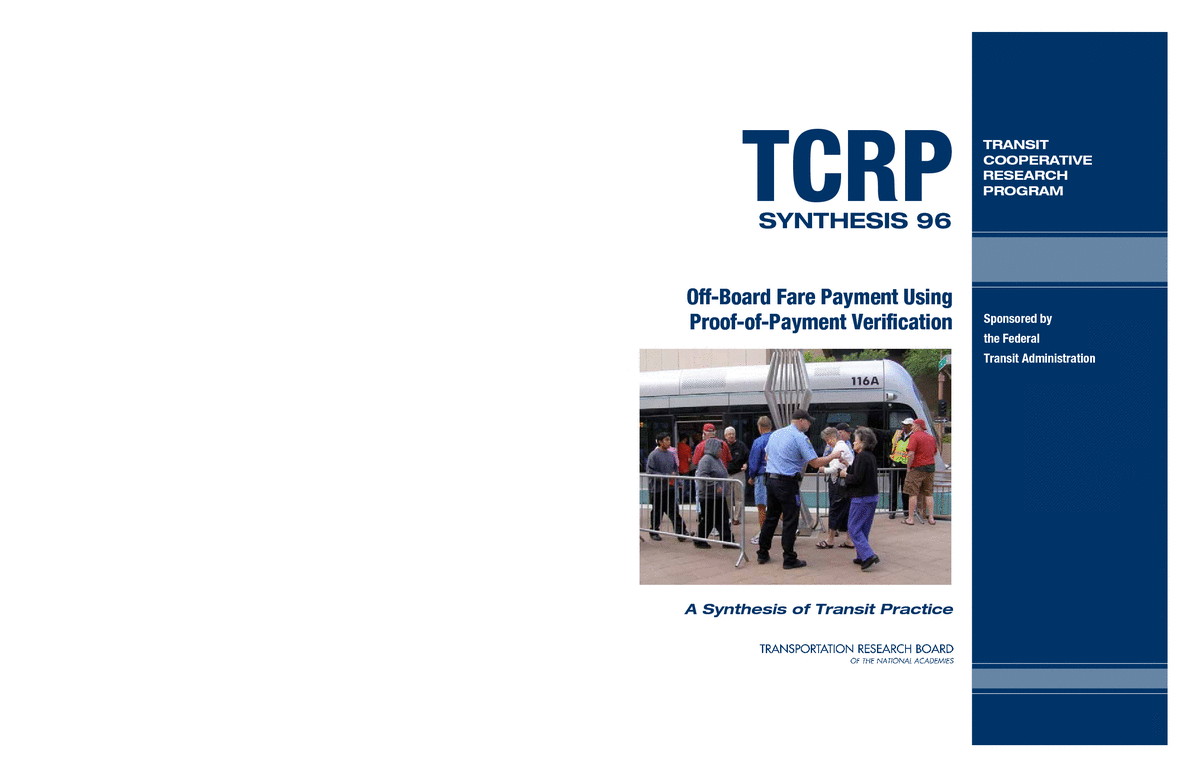
TCRP COMMITTEE FOR PROJECT J-7 COOPERATIVE RESEARCH PROGRAMS STAFF CHRISTOPHER W. JENKS, Director, Cooperative CHAIR Research Programs DWIGHT A. FERRELL CRAWFORD F. JENCKS, Deputy Director, Cooperative Metropolitan Atlanta Rapid Transit Authority, Atlanta, GA Research Programs GWEN CHISHOLM SMITH, Senior Program Officer MEMBERS EILEEN P. DELANEY, Director of Publications DEBRA W. ALEXANDER Capital Area Transportation Authority, Lansing, MI SYNTHESIS STUDIES STAFF DONNA DeMARTINO STEPHEN R. GODWIN, Director for Studies and San Joaquin Regional Transit District, Stockton, CA Special Programs MARK W. FUHRMANN JON M. WILLIAMS, Program Director, IDEA and Metro Transit--Minneapolis/St. Paul, MN Synthesis Studies ROBERT H. IRWIN JO ALLEN GAUSE, Senior Program Officer GAIL R. STABA, Senior Program Officer Consultant, Sooke, BC, Canada DONNA L. VLASAK, Senior Program Officer JEANNE KRIEG DON TIPPMAN, Senior Editor Eastern Contra Costa Transit Authority, Antioch, CA CHERYL KEITH, Senior Program Assistant PAUL J. LARROUSSE DEMISHA WILLIAMS, Senior Program Assistant National Transit Institute, New Brunswick, NJ DEBBIE IRVIN, Program Associate DAVID A. LEE Connecticut Transit, Hartford, CT TOPIC PANEL FRANK T. MARTIN DAVID A. LEE, Connecticut Transit, Hartford, CT Atkins, Tallahassee, FL JASON LEE, San Francisco Municipal Transportation Agency BRADFORD J. MILLER PAUL O'BRIEN, Utah Transit Authority, Midvale Pinellas Suncoast Transit Authority (PSTA), St. Petersburg, FL TED OROSZ, MTA New York City Transit HAYWARD M. SEYMORE, III THOMAS RANDALL, Metro TransitMinneapolis/St. Paul Kitsap Transit, Bremerton, WA JENNIFER A. ROSALES, Transportation Research Board FRANK TOBEY DOROTHY M. SCHULZ, Interactive Elements, Inc., First Transit, Inc., Moscow, TN New York, NY GREGORY L. THOMPSON, Florida State University--Dept. of PAM WARD Urban and Regional Planning, Tallahassee Consultant, Ottumwa, IA PATRICK CENTOLANZI, Federal Transit Administration (Liaison) FTA LIAISON CHRISTOPHER PANGILINAN, Research and Innovative MICHAEL BALTES Technology Administration, U.S. DOT (Liaison) Federal Transit Administration JARRETT STOLTZFUS Federal Transit Administration APTA LIAISON KEVIN DOW American Public Transportation Association TRB LIAISON JENNIFER A. ROSALES Transportation Research Board Cover Figure: Phoenix Valley METRO light rail special event fare inspection shown using temporary queuing bar- riers (Courtesy: Phoenix Valley METRO).
FOREWORD Transit administrators, engineers, and researchers often face problems for which informa- tion already exists, either in documented form or as undocumented experience and prac- tice. This information may be fragmented, scattered, and unevaluated. As a consequence, full knowledge of what has been learned about a problem may not be brought to bear on its solution. Costly research findings may go unused, valuable experience may be overlooked, and due consideration may not be given to recommended practices for solving or alleviat- ing the problem. There is information on nearly every subject of concern to the transit industry. Much of it derives from research or from the work of practitioners faced with problems in their day-to-day work. To provide a systematic means for assembling and evaluating such useful information and to make it available to the entire transit community, the Transit Coopera- tive Research Program Oversight and Project Selection (TOPS) Committee authorized the Transportation Research Board to undertake a continuing study. This study, TCRP Project J-7, "Synthesis of Information Related to Transit Problems," searches out and synthesizes useful knowledge from all available sources and prepares concise, documented reports on specific topics. Reports from this endeavor constitute a TCRP report series, Synthesis of Transit Practice. This synthesis series reports on current knowledge and practice, in a compact format, without the detailed directions usually found in handbooks or design manuals. Each report in the series provides a compendium of the best knowledge available on those measures found to be the most successful in resolving specific problems. PREFACE The objective of this synthesis was to document the state of the practice in terms of expe- riences related to the application of proof-of-payment (PoP) on transit systems in North By Donna L. Vlasak America and internationally, updating the information provided in the 2002 TCRP Report Senior Program Officer 80: A Toolkit for Self-Service, Barrier-Free Fare Collection. Transportation The subject is more complex than evasion rates. It involves related subjects such as Research Board inspection rates, enforcement techniques, duties of fare inspection personnel, adjudication processes, and the kinds of penalties involved for evasion. In addition, there is the need for acquiring capital equipment and, perhaps, handheld verification devices if smartcards are used. PoP fare collection has evolved to where it can be found on bus rapid transit, regular bus service, heavy rail transit, streetcars, passenger ferries, and commuter rail. A literature review, organized into five issue groupings related to PoP fare collection, is provided, as well as the results of a selected, on-line survey of transit agencies in the United States and Canada that yielded a 100% response rate (33 of 33 responses). Seven case studies offer detailed reviews of transit agency PoP fare collection experiences in Buffalo and New York City, New York; Dallas, Texas; Los Angeles and San Francisco, California; Minneapolis, Minnesota; and Phoenix, Arizona. Six areas deserving future study are identified as well. Thomas F. Larwin, Lee Engineering, San Diego, California, and Yung Koprowski, Lee Engineering, Phoenix, Arizona, collected and synthesized the information and wrote the report, under the guidance of a panel of experts in the subject area. The members of the topic panel are acknowledged on the preceding page. This synthesis is an immediately useful document that records the practices that were acceptable within the limitations of the knowledge available at the time of its preparation. As progress in research and practice continues, new knowledge will be added to that now at hand.
CONTENTS 1SUMMARY 5 CHAPTER ONE INTRODUCTION Proof-of-Payment Fare Collection in North America, 5 Study Objectives, 5 Study Process and Technical Approach, 5 Report Organization, 8 10 CHAPTER TWO LITERATURE REVIEW Experiences with Proof-of-Payment Implementation, 10 Bus Rapid Transit Applications, 11 Measuring Fare Evasion, 11 Managing Proof-of-Payment Within the Transit Organization, 12 Fare Collection and Fare Evasion in the Media, 13 14 CHAPTER THREE SURVEY OF TRANSIT OPERATORS USING PROOF-OF-PAYMENT FARE COLLECTION Organizational and Personnel Aspects of the Fare Enforcement Function, 14 Monitoring and Inspecting for Fare Payment, 15 Measuring Performance, 16 Legal Aspects and Adjudication, 21 Proof-of-Payment Fare Collection Operations, 23 Fare Media and Fare Purchase Options, 25 Ticket Vending Machines, 26 Smart Cards and Stored-Value Cards, 27 Transit Industry Pulse Regarding Proof-of-Payment Fare Collection, 27 29 CHAPTER FOUR CASE STUDIES Buffalo, New York--Niagara Frontier Transportation Authority (NFTA), 29 Dallas, Texas--Dallas Area Rapid Transit (DART), 33 Los Angeles, California--Los Angeles County Metropolitan Transportation Authority, (LA Metro), 38 MinneapolisSt. Paul, Minnesota--Metro Transit, 45 New York City, New York--New York City Transit (NYCT), 51 Phoenix, Arizona--Valley Metro Rail, Inc. (METRO Light Rail), 56 San Francisco, California--San Francisco Municipal Transportation Agency (SFMTA, Muni), 61 Summary of Case Study Operators, 69 72 CHAPTER FIVE CONCLUSIONS Summary: Literature Search, 72 Summary: Survey of Proof-of-Payment Operators, 72 Summary: Common Practices from Case Studies, 73 Suggestions for Additional Research, 74 Note: Many of the photographs, figures, and tables in this report have been converted from color to grayscale for printing. The electronic version of the report (posted on the web at www.trb.org) retains the color versions.
76ACRONYMS 78REFERENCES 80BIBLIOGRAPHY 82 APPENDIX A SURVEY INSTRUMENT 96 APPENDIX B PARTICIPATING AGENCIES 98 APPENDIX C EXAMPLE OF STATUTORY PROVISIONS CONCERNING FARE EVASION ENFORCEMENT 102 APPENDIX D EXAMPLE PERFORMANCE REPORT 103 APPENDIX E EXAMPLE OF A MANUAL AND STANDARD OPERATING PROCEDURES (SOPS) 117 APPENDIX F EXAMPLE OF ENFORCEMENT/INSPECTOR JOB DESCRIPTION
OFF-BOARD FARE PAYMENT USING PROOF-OF-PAYMENT VERIFICATION SUMMARY In the transit industry, if the subject of off-board fare payment and proof-of-payment (PoP) verification comes up, what follows normally are inquiries related to fare evasion. These inquiries typically start with an interest in learning how much evasion occurs and wonder- ing out loud about the honesty of most people. However, the subject is significantly more complex than evasion rates. It involves related subjects such as inspection rates, enforcement techniques, duties of fare inspection person- nel, adjudication processes, and the sort of penalties involved for evasion. Plus, there is a need for acquiring capital equipment, mainly ticket vending machines (TVMs) and, per- haps, handheld verification devices if the operator uses smart cards as part of its fare media. Use of off-board PoP fare collection allows convenient, quick, all-door passenger board- ing for transit systems. Generally, there are no conductors on board the transit vehicle, it is typically not possible to purchase a fare on board, and there are no barriers or gates to restrict entry onto a station platform. Transit customers typically purchase fare media at TVMs on the station platform, online, or at retail outlets, and carry their valid ticket or pass while riding. To enforce fare payment, inspection personnel check riders throughout the system, request that they show their proof of fare payment, and issue citations imposing a fine to riders without a valid ticket or pass. North American experience with PoP fare collection began with the SeaBus passenger ferry service in Vancouver, British Columbia, and then, in 19801981, with the light rail transit (LRT) systems in Edmonton and Calgary, Alberta, and San Diego, California. Most early applications of PoP that followed were limited to LRT systems. However, gradually, PoP fare collection has evolved to being used on bus rapid transit (BRT) and regular bus services, heavy rail transit, streetcars, passenger ferries, and commuter rail. Research on the subject of PoP fare collection was somewhat limited until 2002, when another TCRP report was published: TCRP Report 80: A Toolkit for Self-Service, Barrier- Free Fare Collection. The report provided a thorough summary of experiences related to application of PoP fare collection on transit systems in North America and internationally as well. TCRP Report 80 continues to be a worthwhile reference for any transit operator using PoP fare collection, and especially, for any operator considering use of PoP. Although some of the data in the report are out-of-date, its guidelines remain useful resource material. The basis for this study's scope of effort is to assess the North American state of practice concerning the sort of inquiries that were noted at the outset above and an update on the experiences reported in TCRP Report 80. This synthesis reports on the state of practice of PoP fare collection, including a literature review, a survey of transit agencies with PoP experience, and interviews with seven transit agencies. The focus of available research literature was implementation of PoP fare collection, BRT applications, and fare evasion. A summary of the findings follows:
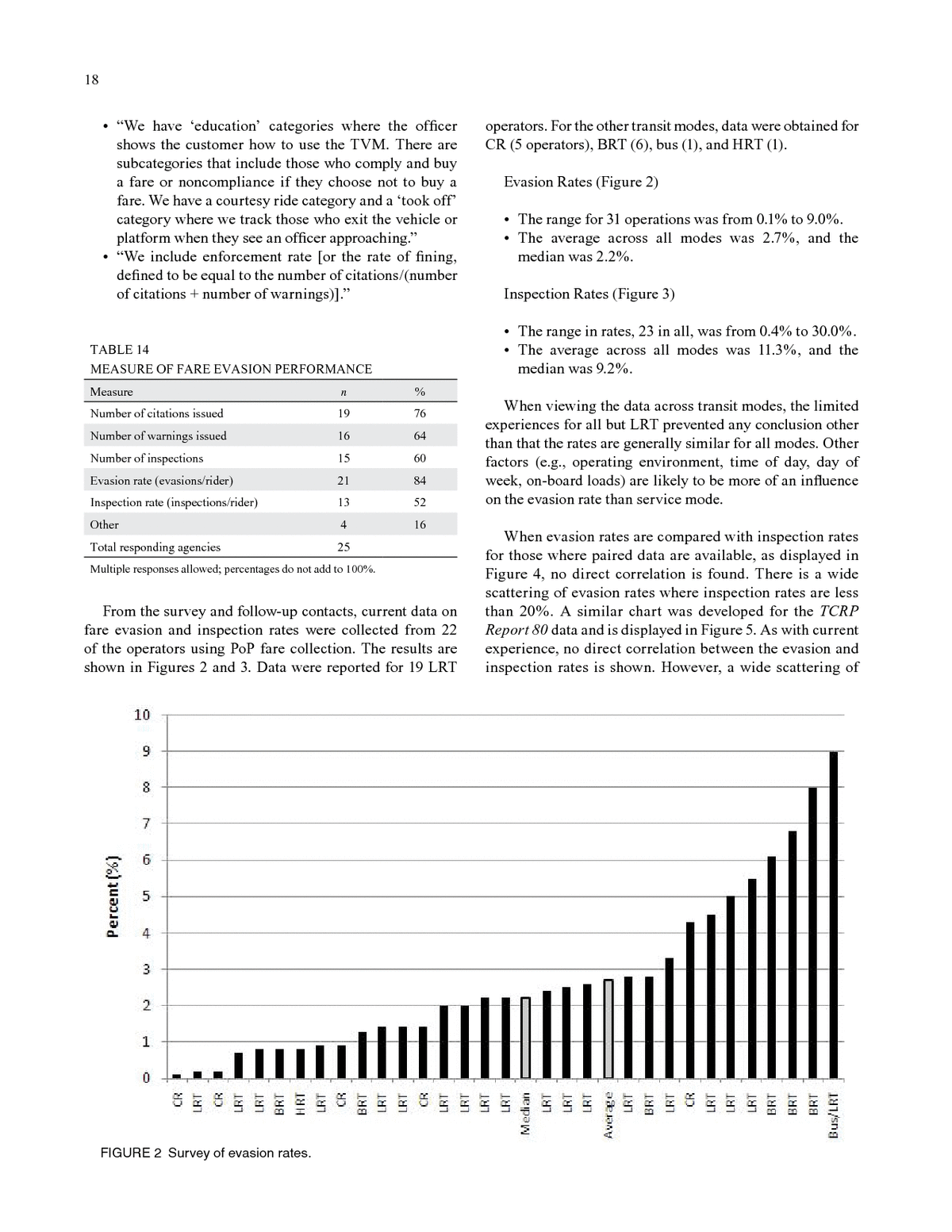
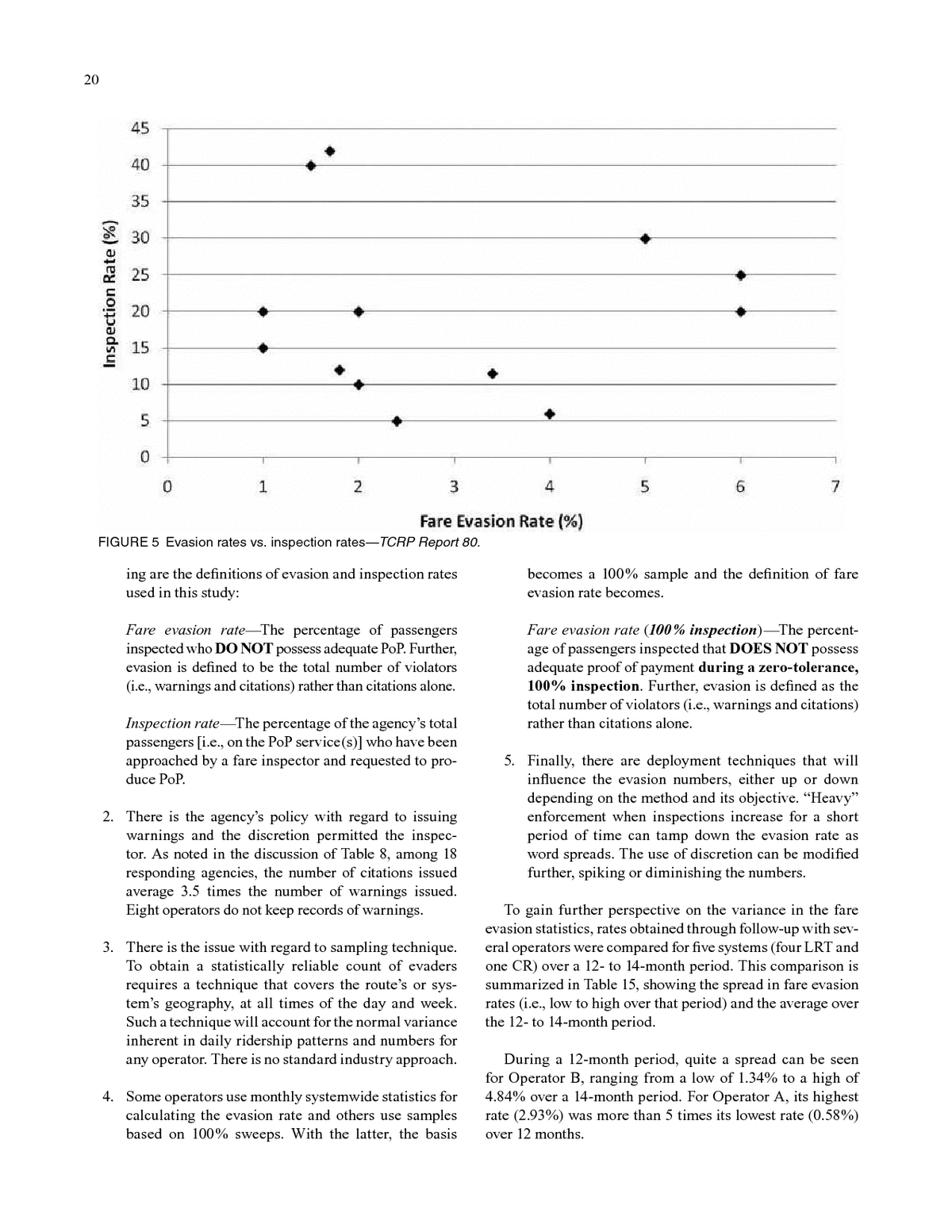
2 · Enforcement practices are an essential part of the PoP fare collection function and, as such, operators must address the role of discretion in issuing citations for fare evasion. · Conversion of a traditional pay-on-boarding fare collection system to PoP fare collec- tion faces different issues than starting PoP on a new service. For cases involving a conversion, an incremental approach toward PoP implementation is a practical alterna- tive to doing it in a single shot. · The regular presence of uniformed officers on transit vehicles is likely to be seen by riders as the best way to provide them with a safe feeling while riding. · PoP fare collection has been found to have application for BRT services, but whether it will prove to be cost-effective will largely depend on the loading volumes at the BRT stops/stations and the need for boarding at the rear doors to ensure a relatively high bus operating speed. · The management of the fare inspection function and control of fare evasion will sig- nificantly benefit from collection of fare evasion data to permit disaggregate analysis (i.e., by time of day, day of week, and location). · A wealth of material was found to be available from transit operators that use PoP fare collection, such as policies and ordinances, performance reports, standard operating procedures, manuals, audits, and special reports. These materials are generally avail- able to other operators and provide a source of research not often available in the public forum. As a product of this study, a reference and resource base has been established within the TRB Committee on Light Rail Transit (Standing Committee AP075) web- site at http://research.lctr.org/trblrt/. · Fare evasion and fare abuses make for popular headlines in the local news media. It is important for PoP operators to be proactive and have a program and strategy for deal- ing with the media on fare abuse issues, including preparation of a regular manage- ment report that presents the data and trends related to fare evasion and a summary of enforcement efforts. The second major task of this study was to conduct an online survey. The survey was transmitted to 33 transit agencies, 27 in the United States and six in Canada. A 100% return resulted. Of these operators, 30 (90.9%) employed PoP fare collection for one or more their services in 20102011. Further, 29 of the 30 were either not considering any changes to PoP use (17 of them) or were in the process of implementing PoP on more services (12). Of the three operators not using PoP, two were considering using PoP for future services. A summary of the significant results from survey responses is provided here: · A majority of PoP fare enforcement personnel are directly employed by the public transit agency (60%) and have police powers (58%). · Almost all operators allow inspectors to issue warnings when warranted (96.5%), and the average number of citations issued were 3.5 more than the numbers of warnings. Thirty-nine percent of the operators issue more warnings than citations. The majority of agencies indicated that they were satisfied with the accuracy of their measured fare evasion rate--86.2% were either satisfied or better. · Almost two-thirds (62.1%) of the operators do not set fare evasion goals, and 72.4% do not set inspection goals. The predominant actions taken by operators to curb fare eva- sion spikes are special "sweep" tactics during which 100% of the riders are inspected during a specific period of time and at a specific location. · Across all modes, the range of fare evasion rates observed was from 0.1% to 9.0%, with an average of 2.7% and a median of 2.2%. For inspection, the rates ranged from 0.4% to 30.0%, with an average of 11.3% and a median of 9.2%. There can be substantial fluctuation in the fare evasion rates for an operator. Examination of variance in fare evasion rates over a 12- to 14-month period for five operators found that the highest monthly rate was as much as 5 times as large as the lowest.
3 · The fine for a first fare evasion offense averaged $121; for repeat offenses, the maxi- mum averaged $314. For repeat offenders, there are also nonfinancial penalties, the three main ones being that the penalty escalates to a misdemeanor, a summons is issued to appear in court, or the individual is excluded from using the system for a period of time. Most operators (58.6%) treat the first fare evasion as a civil offense as opposed to a criminal offense. · To facilitate enforcement of fare payment, 70% of the operators designate the station platform areas as "paid zones." · Almost all of the operators' TVMs issue single-ride tickets (96.6%), and the majority issue day passes (69%) and monthly passes (55.2%) as well. · Smart cards are used by 13 of the 30 operators in either contactless (11 operators) or magnetic-stripe (2 operators) versions. Of those with smart cards, 10 operators have cards that are reloadable (i.e., can be reloaded with additional value). For smart card fare payment verification purposes, 11 operators rely on handheld verification devices. · A small majority (56.3%) of the respondents expressed being moderately or very satisfied with the cost-effectiveness of their PoP fare collection operation. The third study task involved a detailed review of the PoP fare collection experiences of seven case study operators: Buffalo, New York--Niagara Frontier Transportation Authority Dallas, Texas--Dallas Area Rapid Transit Los Angeles, California--Los Angeles County Metropolitan Transportation Authority MinneapolisSt. Paul, Minnesota--Metro Transit New York City, New York--New York City Transit Phoenix, Arizona--Valley Metro Rail, Inc. San Francisco, California--San Francisco Municipal Transportation Agency Interviews with each of the seven resulted in identifying a set of common experiences. These experiences form a group of practices for other operators to consider, whether they use PoP fare collection today or are considering its future use: · Using a customer-oriented enforcement to fare payment rather than a traditional policing approach, · Implementing an agency-administered adjudication process, · Instituting an administrative process for payment of the fare evasion penalty, · Creating a focused fare inspection team with nonsworn officers, · Adding smart cards to the menu of fare media available for fare payment, · Employing PoP fare collection on BRT services, · Using independent management audits as an aid in reviewing an agency's PoP experience, · Expanding the provision of public information via the Internet and the YouTube online video, · Deploying a "show of force" on a new service using PoP fare collection, · Using sweeps (also referred to as blitzes, surges, or enhanced fare enforcement) to demonstrate uniformed presence on the system in a serious way, and · Using temporary barriers and turnstiles for crowd control at special events.
The case study interviews along with survey responses and the literature review produced questions for which no answers were found in available research. As a result, six areas deserv- ing of additional research were identified: · The range of loading volumes that would result in PoP fare collection being a cost- effective alternative; · The relationship among the evasion rate, rates of inspection, and penalty amounts; · A manual or guidelines for statistical analysis of fare evasion; · A transit smart card forum for PoP operators; · The cost-effectiveness of alternative adjudication processes; · The costs--capital, operating, and maintenance--of alternative off-board PoP fare collection and enforcement approaches.
5 CHAPTER ONE INTRODUCTION PROOF-OF-PAYMENT FARE COLLECTION IN NORTH have been many changes to how PoP fare collection has been AMERICA carried out. Comparison of transit operators employing PoP will uncover many variations in operating practices and adju- Off-board proof-of-payment (PoP) fare collection is a rela- dication procedures. The emergence of smart cards for basic tively recent application in North America. Typically, the fare media has made it more convenient for riders to pay their majority of PoP operations require a transit customer to pur- fares but, at the same time, has added a challenge for opera- chase fare media off-board the transit vehicle. For instance, tors with respect to effective enforcement of fare payment. purchase could be at a ticket vending machine (TVM) on a station platform, via the Internet, or at a retail outlet. With In addition to the LRT experiences, in recent years, PoP a valid ticket or pass in hand, the customer is permitted to has been extended to other transit modes: regular bus, bus board the transit vehicle through any door. The customer rapid transit (BRT), heavy rail transit (HRT), modern street- does not have to show the proof-of-payment to the driver, cars, and commuter rail (CR). and there are no conductors on board. As a result, enforcement of fare payment through inspec- STUDY OBJECTIVES tion is a necessary function of PoP to ensure fare compliance. The enforcement relies on fare enforcement/inspection per- This synthesis collected data on existing transit operations sonnel who randomly ask riders to show proof-of-payment. using PoP verification in North America. The objective of the Passengers unable to do so may be issued citations imposing synthesis was to provide a state-of-the-practice report that can a fine as a deterrent to fare evasion. be used as a resource by public transit agencies and operators on the subject of PoP. It is intended to be of practical use for PoP fare collection is also referred to as self-service, those operators in the development process of a new transit barrier-free (SSBF) fare collection and sometimes as the service, especially a high-capacity service. However, as a "honor system." For purposes of this study, the focus is on resource on the practices and experiences of current transit off-board fare payment and PoP fare verification. For con- operators using PoP fare collection, the report can be of prac- sistency and simplicity, "PoP" is used throughout this report tical benefit to those same operators by providing an exchange to represent the broader subject of self-service and stations of ideas on ways to improve their fare collection operation. with or without barriers. A common component is the need for enforcement to verify that passengers possess valid fare The scope of the study was broadly outlined to include payment. As for the term "honor system," strictly defined, the following aspects of PoP fare collection: the types of fare it involves no PoP verification, that is, no enforcement, and media used, the inspection function, measuring of perfor- is not employed by any transit operators in North America. mance of the function, legal bases and adjudication options, the types of TVMs needed to support PoP, and policies and PoP fare collection had its North American beginnings procedures used to manage the function on a daily basis. with SeaBus ferry services in Vancouver, British Columbia. However, the introduction of PoP on ground transit services began with the start of Edmonton and Calgary, Alberta, and STUDY PROCESS AND TECHNICAL APPROACH San Diego, California, light rail transit (LRT) services in 19781981. Edmonton LRT, which initiated service in 1978, The work plan involved three primary tasks: a literature actually did not use PoP fare collection until 1980. Calgary review, a survey of North American transit operators using and San Diego LRT services followed in succession in 1981 PoP fare collection, and detailed case studies of seven of with use of PoP from the start of revenue service in each case. the operators. From those beginnings, PoP has essentially become the The resulting survey was conducted of 33 North Ameri- standard fare collection method on subsequently developed can transit properties, 27 in the United States and six in Can- North American LRT lines. Over these 30-plus years, there ada. The geographic locations of these properties are shown
6 in Figure 1. All 33 properties responded to the questionnaire Table 1 also shows the number of routes in each region on for a 100% response rate. which PoP is applied (except for the non-BRT bus routes). As of early 2011, there were a total of 30 transit properties A tabular summary of the study's 33 survey respon- operating 91 routes in North America in which off-board dents indicating each agency's use of PoP is shown in Table PoP fare collection was used. Thirty years earlier, there were 1. There are 30 of the operators that presently use PoP. A three operators with a single route each. breakdown by service mode shows that these operators use PoP on seven different modes: The study's survey was also used to find out whether any of the operators were considering changes to their fare col- Number of Number of lection system. The results are shown in Table 2, which pro- Operators Routes vides an update on the future anticipated use of PoP by each of the 33 transit operators. Bus rapid transit 9 21 Light rail transit 23 56 Of the 33 operators surveyed, 29 (88%) employ PoP and either are not contemplating any significant change or are Streetcar (modern, vintage) 2 2 considering adding more routes under their agency's PoP Heavy rail transit 2 3 fare collection function. Commuter rail 7 8 Table 2 shows that three of the 33 operators have never Passenger ferry 1 1 used PoP (Honolulu, Memphis, and Pittsburgh). Two of them, Honolulu and Pittsburgh, are considering future use Bus (non-BRT) 5 on one or more routes. One operator, Vancouver TransLink, is planning to eliminate PoP on its services and go to a bar- NOTE: These bus operators use PoP in a modified or rier enforcement system. hybrid way with the combination of fare inspection and front-door fare collection. FIGURE 1 Locations of 33 North American transit operators participating in the survey.
7 TABLE 1 SUMMARY OF TRANSIT OPERATORS PARTICIPATING IN THE STUDY Principal Transit Modes Operated Bus Region Operator (non-BRT) BRT LRT MS/VT HRT CR Ferry Baltimore, Maryland Maryland Mass Transit Administration · 2 · · Buffalo, New York Niagara Frontier Transportation Authority · 1 Calgary, Alberta Calgary Transit · · 3 Charlotte, North Carolina Charlotte Area Transit System · 1 Cleveland, Ohio Greater Cleveland Regional Transit Authority · 1 1 Dallas, Texas Dallas Area Rapid Transit · 3 1 Denver, Colorado Regional Transit District # 7 Edmonton, Alberta Edmonton Transit System · · 1 Eugene, Oregon Lane Transit District · 1 Everett, Washington Community Transit · 1 Honolulu, Hawaii Honolulu DTS Rapid Transit Division · Houston, Texas Metropolitan Transit Authority of Harris County · · 1 Las Vegas, Nevada Regional Transit Commission of Southern Nevada # 2 Los Angeles, California Los Angeles County Metropolitan Transportation Authority · 1 3 2 Memphis, Tennessee Memphis Area Transit Authority · · MinneapolisSt. Paul, Minnesota Metro Transit · 1 1 Newark, New Jersey NJ Transit · 3 · New York City, New York MTANew York City Transit · 2 · Oceanside, California North San Diego County Transit District · 1 1 Ottawa, Ontario Ottawa Regional Transit Commission · 7 1 Phoenix, Arizona METRO Light Rail 1 Pittsburgh, Pennsylvania Port Authority of Allegheny County · · Portland, Oregon Tri-County Metropolitan District of Oregon # 4 1 Sacramento, California Sacramento Regional Transit District · 2 Salt Lake City, Utah Utah Transit Authority · 1 3 1 San Diego, California San Diego Metropolitan Transit System · · 3 San Francisco, California San Francisco Municipal Transportation Agency # 6 1 San Jose, California Santa Clara Valley Transportation Authority · 3 Seattle, Washington Sound Transit · 1 2 St. Louis, Missouri Bi-State Development Agency · 2 Toronto, Ontario Toronto Transit Commission · · 1 · Vancouver, British Columbia TransLink/SkyTrain # 3 1 1 York, Ontario York Region Transit/Viva · 5 BRT--bus rapid transit, LRT--light rail transit, MS--modern streetcar, VT--vintage trolley, HRT--heavy rail transit, CR--commuter rail. · indicates a transit service mode operated by this operator, but PoP is not employed. 1 indicates a service that uses PoP fare collection and the number of PoP routes. indicates a service that uses PoP fare collection and is one of the seven case studies. # indicates fare/ticket inspectors are deployed on buses in combination with on-board fare collection.
8 TABLE 2 SUMMARY OF FUTURE ANTICIPATED USE OF POP FARE COLLECTION Regarding PoP in the Future Use PoP Now Never Used Not Considering Considering Considering/ Considering on Any Significant Adding More Planning Its One or More Not Operator Change Routes Elimination Routes Considering Baltimore--Maryland Mass Transit Administration 1 Buffalo--Niagara Frontier Transportation Authority 1 Calgary Transit 1 - Charlotte Area Transit System 1 Cleveland--Greater Cleveland Regional Transit Authority 1 - Dallas Area Rapid Transit 1 - Denver--Regional Transit District 1 Edmonton Transit System 1 - Eugene--Lane Transit District 1 Everett--Community Transit 1 Honolulu DTS Rapid Transit Division - 1 Houston--Metropolitan Transit Authority of Harris County 1 Las Vegas--Regional Transit Commission of Southern 1 Nevada Los Angeles County Metropolitan Transportation Authority 1 Memphis Area Transit Authority 1 MinneapolisSt. Paul--Metro Transit 1 Newark--NJ Transit 1 New York City--MTANew York City Transit 1 Oceanside--North San Diego County Transit District 1 Ottawa Regional Transit Commission 1 Phoenix--METRO Light Rail 1 Pittsburgh--Port Authority of Allegheny County 1 Portland--Tri-County Metropolitan District of Oregon 1 Sacramento Regional Transit District 1 Salt Lake City--Utah Transit Authority 1 - San Diego Metropolitan Transit System 1 - San Francisco Municipal Transportation Agency 1 San JoseSanta Clara Valley Transportation Authority 1 Seattle--Sound Transit 1 St. Louis--Bi-State Development Agency 1 Toronto Transit Commission 1 Vancouver TransLink/SkyTrain 1 York Region Transit/Viva 1 Total 17 12 1 2 1 REPORT ORGANIZATION Chapter two covers a literature review with a focus on TCRP Report 80: A Toolkit for Self-Service, Barrier-Free Fare The synthesis is organized as a summary of each of the fol- Collection. TCRP Report 80 was the most thorough research lowing three main tasks in chapters two, three, and four, effort on the subject of PoP fare collection when published respectively. The last chapter presents a summary and con- in 2002. Some of its relevance may be diminished not only clusions, followed by appendixes. because of the time that has passed but the breadth and inten-
9 sity of experiences that have been accumulated with the U.S. · MinneapolisSt. Paul, Minnesota--Metro Transit; and Canadian transit operators that employ PoP fare collec- · New York City, New York--Metropolitan Transportation tion. In addition, this chapter summarizes significant findings Authority (MTA)New York City Transit (NYCT); from current research on the subject of PoP fare collection. · Phoenix, Arizona--Valley Metro Rail, Inc. (METRO Light Rail); and Related to the literature search, in the report contains · San Francisco, California--San Francisco Municipal a bibliography that includes an annotated portion of refer- Transportation Agency (SFMTA, Muni). ences plus a section where special resources collected from participating transit operators are listed and made available Chapter five is a summary of the conclusions reached on the TRB website. from the prior three chapters. These include conclusions reached about the current state of the practice, trends related Chapter three provides a summary of a survey of North to how the PoP function is carried out among the transit American transit operators employing off-board PoP fare col- operators, and gaps in available data and information that lection. Introduced above, the survey was sent to 33 North suggest the need for additional study. American operators. Responses were tabulated, and the chap- ter comprises 32 tables to display resulting summaries of key The five chapters comprise the body of the report. However, statistics, relationships, and findings from the surveys. significant information is included in appendixes to the report: Chapter four presents in-depth summaries of what is hap- Appendix A: Survey Instrument pening with seven transit operators that use PoP for one or more routes in their respective systems. These seven cases Appendix B: Participating Agencies were selected to represent a sampling of regions having a diverse range of conditions with PoP fare collection experi- Appendix C: Example of Statutory Provisions Concern- ences to include bus and rail modes, differing geographical ing Fare Evasion Enforcement areas of North America, and a range in the length of time PoP has been in operation. They are as follows: Appendix D: Example Performance Report · Buffalo, New York--Niagara Frontier Transportation Appendix E: Example Manual and Standard Operating Authority (NFTA); Procedures (SOPs) · Dallas, Texas--Dallas Area Rapid Transit (DART); · Los Angeles, California--Los Angeles County Metro Appendix F: Example Enforcement/Inspector Job politan Transportation Authority (LA Metro); Description
10 CHAPTER TWO LITERATURE REVIEW This chapter summarizes findings from a literature review report are from 20002001 and, as a result, some of its rel- related to off-board transit fare payment using PoP verifi- evance has been diminished. Even so, the report addresses cation. The primary sources of material reviewed include the full range of issues and parameters that an agency must the following: transportation-related databases (e.g., TRB's consider in determining the applicability of PoP, including Transportation Research Information Services and the those related to policy and enforcement issues, operational Organisation for Economic Co-operation and Development issues, and capital and equipment issues. At the time, the Joint Transport Research Centre's International Transport report noted that the number of North American systems Research Documentation, APTA, California Partners for using PoP totaled 28, with the services being predominately Advanced Transportation Technology); U.S. DOT- and LRT lines (15 of the 28) and CR lines (nine of the 28). There TCRP-sponsored research; individual reports prepared by were also two HRT and two BRT services. or for transit agencies; and magazine/journal articles, media news articles/reports, and Internet blogs. The objective of the report was to "develop a set of guide- lines for use by transit agencies implementing or considering The materials reviewed from the above sources have use of SSFC [self-service fare collection]" and to "provide been organized into five groups as an aid to practitioners practical guidance to policy makers, planners, researchers, who have to deal with the variety of issues related to PoP and operating managers." In retrospect, TCRP 80 has been fare collection: found to accomplish this objective. It provides guidance that covers major aspects of PoP operations and enforcement, · Experiences with implementation, such as use of special field audits or surveys to augment · BRT applications, monitoring of evasion rates, development of inspection strat- · Measuring fare evasion, egies to supplement the normal inspection process with tar- · Managing PoP within the organization, and geted 100% sweeps, practices with regard to discretionary · Fare collection and fare evasion coverage in the media. powers concerning issuance of citations, passenger informa- tion strategies, and dealing with the complexities associated In aggregate, the items reviewed as part of this study rep- with different forms of fare media. resent a comprehensive research resource on the subject of PoP fare collection. Not all of the material that was gathered DeMarino discusses a more recent application of PoP has been summarized in this chapter. However, as part of having to do with its implementation on a new BRT service this study, a reference and resource base has been established for NYCT (2). The report provides a thorough history of within the TRB Committee on Light Rail Transit (Stand- the development of PoP fare collection for NYCT's Select ing Committee AP075). The majority of resources collected Bus Service (SBS), the underlying enforcement philosophy, have been transferred to the committee and are available on enforcement tactics and strategy, how to measure effective- the committee's website at http://research.lctr.org/trblrt/. ness, and the "art and science of proper discretion" in "fair" enforcement. This reference is useful for an operator prepar- ing to organize a fare enforcement function as well as opera- EXPERIENCES WITH PROOF-OF-PAYMENT tors who want to review their existing PoP function and take IMPLEMENTATION advantage of NYCT's experiences. The 2002 TCRP Report 80 remains a relevant and thorough A different implementation scope is covered in a paper research document on the subject of PoP fare collection (1). by Watry and Straus from 2000, which deals with conver- In addition, reports from New York City, San Francisco, and sion from traditional fare collection to PoP (3). The authors Vancouver provide a range of experiences on the real-world, provide a comprehensive summary of the experiences of the practical aspects of operating PoP. first system in the United States, San Francisco Muni's LRT, to undertake such a conversion. The conversion process TCRP Report 80 contains a wealth of data and informa- was faced with unique problems associated with a mixture tion on the subject of PoP fare collection. The data in the of right-of-way types, station and platform configurations,
11 and operating environments. Unique was the combination Votaw authored a report presenting detailed compari- of on-board and off-board fare collection necessitated by the sons of fare payment operations on BRT services (6 ). The street-running portion of its light rail system where TVM issue addressed by the research was whether "off-board fare placement was not practical. The authors discuss the incre- collection involving ticket vending machines and proof-of- mental nature of the conversion process. The process cre- payment enforcement" is the most appropriate form of fare ated special problems related to the enforcement function collection for Santa Clara Valley Transportation Authority's and with regard to providing clear public information to the (VTA) future BRT services. Four case studies were evaluated riders. Because the transition to PoP represented change to as part of the research effort: Cleveland Healthline, Boston the riders and to the operators, resistance was encountered. Silver Line, Las Vegas Metropolitan Area Express and ACE The riders were concerned that crime would escalate on the Gold Line, and Santa Clara VTA future lines. Each of the multicar trains without Muni personnel on board the trail- case studies includes a summary of lessons learned from the ing cars. The labor union representing the operators feared interviews and reports. In addition, the author interviewed layoffs and job reductions. transit operators from other U.S. areas. In 2008, the NRG Research Group prepared a study for TCRP Report 90 from 2003 contains a useful discussion Vancouver TransLink's SkyTrain system (the brand name of of fare collection considerations in planning and design of its automated rail transit system) that examined a variety of BRT projects (7 ). Data related to passenger service times issues related to PoP (4). An extensive telephone interview and station dwell times for different fare payment options survey combined with a survey of TransLink's "Listens" are offered. For single-door channel, the suggested default online panel resulted in substantial statistical summaries times are as follows: of four related issues: attitudes toward implementing con- trolled access at SkyTrain stations, perceptions regarding Time/Passenger (s) the frequency and severity of fare evasion on the SkyTrain system, passengers' feelings of personal security on board Prepayment2.5 SkyTrain and at SkyTrain stations, and passengers' views of Single ticket or token 3.5 the smart card concept. Key findings were Smart cards 3.5 · Strong support for a smart card system, Exact change 4.0 · Overestimation of fare evasion by transit riders and nonriders alike, and Swipe or dip cards 4.2 · Passengers' feeling generally secure when riding SkyTrain. NOTE: Add 0.5 s/passenger to boarding times when stand- ees are present. Subtract 0.5 s/passenger from boarding BUS RAPID TRANSIT APPLICATIONS times and 1.0 s/passenger from front-door alighting times on low-floor buses. Application of off-board fare collection is one of the key quality-of-service considerations for BRT development For two boarding streams, the passenger service times are in North America. As has been found for LRT operations, 1.8 s for prepayment and 2.4 s for smart cards. allowing for quick multidoor boarding and eliminating on- board fare collection can help shave significant time off a transit vehicle's journey. MEASURING FARE EVASION The National BRT Institute 2009 report prepared for the When the subject of PoP fare collection comes up, fare eva- FTA includes a thorough discussion of the service charac- sion inevitably seems to be part of the discussion. Accurate teristics of BRT (5). Included in chapter two, "Major Ele- analysis of fare evasion is difficult. Even in the best analyses, ments of BRT," is a 19-page section on fare collection. This there is some amount of error. Research efforts in Edmonton, report is especially relevant for purposes of comparing and San Francisco, Los Angeles, and New York City were found evaluating PoP fare collection with alternative approaches. to deal with the complexities of measuring fare evasion. It includes comparative information regarding capital costs and operating and maintenance costs associated with alter- Clarke et al. reported on a research effort in Edmonton native fare collection approaches. Mentioned are "hybrid" that evaluated 3 years of fare evasion data (8). In 2005, the approaches to PoP such as a case in which passengers with fare evasion rate for the LRT was 6%, and there was a gen- prepaid fares are allowed to board through the rear door of eral feeling among city officials that the rate was too high. the vehicle. This would also be a case in which there might In that same year, the city redeployed the security staff to be limited off-board TVMs available. There is also a review serve the buses as well. This meant that fewer ticket checks of the different types of fare media and associated costs. could be made on the LRT. In early 2007, it was decided to
12 issue more fines and fewer warnings for evading fares on cies, performance reports, management audits, manuals and the LRT--a decision that was not publicized. Using weekly SOPs, and fare inspector job descriptions. data for 163 weeks, the researchers examined the effect of the lower inspection rates and the higher fining rate on LRT Statutes, Ordinances, Policies fare evasion and found that the largest change in fare evasion rates--a reduction of 21% (from 5.3% to 4.2%)--was when Statutes related to fare enforcement, officer authorities, the chance of receiving a citation (rather than a warning) was penalties, and adjudication were reviewed from California, substantially increased. Minnesota, New Jersey, New York, Texas, and Washington. Several local policies and ordinances related to PoP and fare Lee reported on the results of a comprehensive sampling evasion were also available from New Jersey Transit, Salt of fare evasion in San Francisco (9). The work was performed Lake City Utah Transit Authority (UTA), San Diego Met- by SFMTA in 2009 and involved a survey of 41,239 customers ropolitan Transit System (MTS), Tempe (Arizona), and on 1,141 transit vehicle runs, bus and light rail. SFMTA uses Seattle. As examples, two California statutes that cover a a hybrid or modified PoP fare collection system for its system range of fare enforcement and adjudication definitions and of bus and light rail services. At subway light rail stations, functions can be found in Appendix C. faregates are used; at light rail surface stops, prepaid custom- ers can board at any door, whereas cash-paying riders must Agency Performance Reports pay at the front door and obtain a transfer/fare receipt. Results from the survey provided disaggregated data with regard to Sample reports have been received from transit agencies in specific modes and routes, time periods, level of enforcement, Buffalo (NFTA), Dallas (DART), Denver Regional Transit use of rear-door boarding, and transit vehicle occupancy. The District (RTD), Edmonton Transit System, Los Angeles (LA average fare evasion systemwide was found to be 9.5%. Metro), MinneapolisSt. Paul (Metro Transit), New Jersey Transit (NJT), Salt Lake City (UTA), San Diego (MTS), San In 2007, Transportation Management & Design, Inc., Francisco (SFMTA), Seattle (Sound Transit), and St. Louis undertook a systematic sampling of fare payment on LA Met- (Bi-State). They range from formal to informal, and from ro's rail transit lines and the Orange Line BRT (10). The sam- one page to 15 to 20 pages. An example of a concise monthly pling was 100% of the patrons on each vehicle boarded. The report is included in Appendix D. This sample is from the inspection was performed in "plain clothes," and citations or UTA in Salt Lake City. It is one page, titled "Public Safety warnings were not issued. The resulting analysis provided Monthly Report," and contains key statistics for the month: fare evasion statistics by line, time of day, and weekdays and total ridership, passengers checked, violations, citations, and weekend days. Overall, the evasion rate ranged from 3.5% to violator percentage. 6.9% for the lines, with the Orange Line BRT at 5.6%. Management Audits Reddy et al. reported on substantive research on the sub- ject of fare evasion in the NYCT subway operation (11). Four audits were reviewed: two conducted by the Metropoli- The authors discussed NYCT's multipronged approach for tan Council (MinneapolisSt. Paul) for the Hiawatha LRT managing subway fare evasion, an approach that also can and Northstar Commuter Rail lines, respectively; one for be applied where PoP fare collection is employed. The SFMTA; and one for Vancouver TransLink. The Vancouver approach includes advanced automated fare collection turn- audit is discussed below, and the MinneapolisSt. Paul and stiles designed with security features to physically prevent San Francisco audits are reviewed in their respective case abuse and facilitate audits, a legal framework that gives tran- studies in chapter four. The audits are rather lengthy and for sit police tools to enforce law and order, data collection and that reason are not reproduced in this report's appendixes, analysis that keep an accurate picture of evasion trends and but all are available on the LRT Committee website (http:// TVM vandalism, and a comprehensive press strategy that research.lctr.org/trblrt/). ensures that NYCT's efforts in clamping down on evasion are publicly communicated. Although Vancouver was not selected as a case study can- didate, it is the only operator in this study that uses PoP fare collection and indicated that it was planning to move away MANAGING PROOF-OF-PAYMENT WITHIN THE from PoP and implement a barrier system. This audit was TRANSIT ORGANIZATION performed in 2007 for Vancouver TransLink by PriceWater- houseCoopers (12). The scope of work of the audit included An objective of this study was to assemble materials related reviewing and offering recommendations with regard to the to PoP operations from the transit operators. These materials methodology for estimating the amount fare evasion and the can provide a foundation for agencies considering PoP fare processes and procedures for fare checking and fare enforce- collection and for those desiring to benefit from the practices ment. A summary of recommendations from the audit is of others. These materials include statutes/ordinances/poli- listed here:
13 · Strengthen fare enforcement by pursuing ways to link sit operations. This loss of income can, in turn, be directly violation tickets with other governmental functions related to an equal amount of subsidy that is required from (e.g., driver license renewal) to create significantly taxpayer sources. enhanced consequences of evasion. · Shift the TransLink security group to a risk-based allo- As a consequence, the media attention is deserved, and cation of fare checking to focus on stations and routes the performance reports and independent audits mentioned with higher potential revenue loss. above are ways that transit management gives the subject · Strengthen fare enforcement by implementing more its attention. A search of news reports in late 2010 and early significant consequences to evaders, including removal 2011--newspaper articles, television reports, Internet blogs-- from the property. provides a sample of how transit fare evasion is reported by the media. The reports show that there is no standard when it Manuals and Standard Operating Procedures Pertaining comes to treating information dealing with revenue loss, and to Proof-of-Payment any dollar lost is a significant matter to taxpayers. A variety of manuals and SOPs have been developed by The point of this discussion is to note the importance of transit properties for carrying out the operation of PoP fare the subject and recognize the legitimate media interest in the collection. There is no standard pattern, and each agency subject. Public information on fare compliance--and fare develops its unique approach to its individual functions. abuses--needs to be recognized as an integral part of the fare collection function, especially as related to PoP and its · Fare Enforcement Manual--Denver RTD, 14 pages. reliance on inspection to monitor compliance. As an example, this manual is included in Appendix F. · Guidelines and Procedures for Fare Collection System-- Following is a random list of headlines from news media Metro Transit (MinneapolisSt. Paul), 21 pages. reports that were observed between December 2010 and · SOP-Fare Enforcement--Metro Transit (Minneapolis June 2011. A scan provides a sampling of the range of issues St. Paul), two pages. As an example, this document is associated with fare collection--and the public attention that included in Appendix E. fare evasion receives: · Fare Enforcement Process Manual--NJT, 14 pages. · Standard Operating Procedures for Fare Inspectors -- · "RTA board approves $50 fine for juveniles who ride NJT, 13 pages. without paying"--Cleveland · SOP-Proof of Payment Light Rail Fare Inspection -- · "Fare cheats cost city millions"--Edmonton Santa Clara VTA, seven pages. · "Zero-tolerance fare inspection begins Monday on · SOP-Authority and Limitations for Code Compliance Metro Light Rail"--Phoenix Personnel--San Diego MTS, five pages. · "Investigation: RTD letting many riders travel for · SOP-On train and Station Operations for Code free"--Denver Compliance Personnel--San Diego MTS, two pages. · "Fare evasion crackdown won't solve all of TTC's problems"--Toronto Each of these documents is available on the TRB LRT · "Muni employee punched while writing fare evasion Committee website (http://research.lctr.org/trblrt/). citation"--San Francisco · "It's like Christmas in June for some Calgary C-Train Fare Inspector Job Description riders"--Calgary · "MTA bus fare evaders beware: $100 fine awaits"-- Job descriptions for a fare inspector position (or similarly New York City titled position) were obtained from NFTA, NJT, NYCT, · "Metro's new fare card system to cost extra $2.4 mil- Phoenix Valley METRO, Santa Clara VTA, and Sound Tran- lion"--St. Louis sit. An example included in Appendix F is the job descrip- · "T seeks to sharply raise fines for fare evaders"--Boston tion for a "fare inspector" from Santa Clara VTA. · "ABC 4 investigation: Riding UTA for free"--Salt Lake City · "TransLink looks to crack down on fare evasion. Are FARE COLLECTION AND FARE EVASION IN THE MEDIA turnstiles really needed?"--Vancouver · "Patco may test open-payment fare collection" Transit fare evasion and fare abuses are a common focus of --Philadelphia media attention. Fare evasion is a form of fraud and a vio- · "SD fare fraud probe reaches south of the border"-- lation or crime, and it reduces revenue available for tran- San Diego.
14 CHAPTER THREE SURVEY OF TRANSIT OPERATORS USING PROOF-OF-PAYMENT FARE COLLECTION A survey was sent to the 33 agencies described in chapter one 9. Transit Industry Pulse Regarding Proof-of-Payment for purposes of canvassing transit operators employing PoP Fare Collection. fare collection in North America. All 33 responded (a 100% response rate). This chapter discusses the results of the survey. ORGANIZATIONAL AND PERSONNEL ASPECTS OF Table 1, in chapter one, listed the survey respondents and THE FARE ENFORCEMENT FUNCTION showed the diversity of services on which PoP fare collec- tion is used by the 30 North American transit operators that The fare enforcement function was found to be largely car- were surveyed. Each of the 30 operators relies on off-board ried out by agency employees, in some cases with assistance fare collection for at least part of its services where PoP is from other local agencies or through contracts with private used. However, some systems use fare inspectors on services forces. Table 3 shows the predominant use of agency employ- where a modified or hybrid form of PoP is used. ees for fare enforcement by 26 of the respondents (86.7%). Even so, a variety of employercontract arrangements were Modified or hybrid PoP is defined as a situation in which found. Eighteen (60%) of the operators use agency employ- there is a combination of off-board and on-board fare collec- ees only for fare enforcement, whereas in seven cases secu- tion along with random fare inspection on the transit vehicle. rity contractors provide fare enforcement assistance. For example, SFMTA uses PoP on all its services but is not using completely off-board fare payment, requiring front- TABLE 3 door boarding on buses, with the driver being involved in FARE INSPECTOR EMPLOYER ARRANGEMENTS fare collection and inspection. Other operators, especially Arrangement n % with buses, operate in similar ways, with their buses being Agency employees 18 60.0 equipped with fareboxes to allow single-ride on-board pur- chase. The primary reasons for using fare inspectors in these Agency employees + city/county jurisdiction 4 13.3 situations are rear-door boarding by pass users and the use of Agency employees + private contractor 3 10.0 smart card fare media. Agency employees + city/county jurisdiction + 1 3.3 private contractor Responses to the survey questions in the paragraphs that Private contractor 2 6.7 follow are organized into nine sections: Private contractor + city/county jurisdiction 1 3.3 City/county jurisdiction 1 3.3 1. Organizational and Personnel Aspects of the Fare Total responding agencies 30 100.0 Enforcement Function, 2. Monitoring and Inspecting for Fare Payment, As might be expected, the fare enforcement function typically resides within a transit agency's police or security 3. Measuring Performance, department. Of the 30 operators responding, for 83% (25 of 30), the fare enforcement function is within the police 4. Legal Aspects and Adjudication, or security department. In four of the cases, the function is within the operations department or is in a shared function 5. Proof-of-Payment Fare Collection Operations, between operations and security. In one case, the function is under the risk management department. 6. Fare Media and Fare Purchase Options, It was found that 58.6% (17 operators) of the fare inspec- 7. Ticket Vending Machines, tion forces have police powers (see Table 4). In 10 of the 17 instances, 100% of the fare inspection force possesses such 8. Smart Cards and Stored-Value Cards, and powers. Thus, slightly more than one-third (34.4%) of the 29
15 operators employ fare inspection officers who are all quali- resent a limited data set, the numbers provide an incentive fied with police powers. to dig deeper on the subject in future research. TABLE 4 The productivity of inspectors was also measured in FARE INSPECTORS WITH LAW ENFORCEMENT POLICE terms of inspectors per 1,000 daily riders and is shown in POWERS Table 6. The average and median were 0.51 and 0.39, respec- Power n % tively, and there was quite a large range in the numbers, from Yes, officers have police powers 17 58.6 0.04 inspectors per 1,000 riders to 2.00. No 12 41.4 Total responding agencies 29 100.0 MONITORING AND INSPECTING FOR FARE PAYMENT Table 5 shows what other functions the fare inspection Each operator has internal procedures, written or perhaps force carries out. Most of the officers also provide basic unwritten, that deal with fare evaders. In many instances policing and security services (79.3%) and enforce agency when an inspector encounters a rider without valid proof of ordinances (58.6%). For five operators (17.2%), the fare fare payment, there is some discretion involved in whether to inspection force assists with passenger counts. issue a citation. In most situations, the fare inspection force is authorized to issue warnings. As noted in chapter two, exam- TABLE 5 ples of SOPs from various properties are available at the TRB ADDITIONAL DUTIES OF FARE INSPECTORS LRT Committee's website (http://research.lctr.org/trblrt/). Duty n % With regard to issuing citations, as indicated in Table 7, Policing/security 23 79.3 nearly all of the 29 respondents authorize their inspectors to Passenger counts 5 17.2 issue warnings (96.5%). Two-thirds (19 of 29) of the respon- Enforce other ordinances of the agency 17 58.6 dents issue written and oral warnings, whereas in nine cases Other 8 27.6 only oral warnings are permitted. None 2 6.9 Multiple responses allowed; percentages do not add to 100%. TABLE 7 TYPES OF WARNINGS AUTHORIZED FOR FARE EVASION In Table 6, the number of inspectors [full-time equiva- Warning n % lents (FTEs)] employed by the operators was compared Written and oral 19 65.5 on a financial basis and productivity basis. The data were Oral only 9 31.0 judged to not be sufficiently reliable to allow for an evalu- None 1 3.4 ation by mode. For the respondents, the average number Total responding agencies 29 of employees per $100,000 was found to be 1.15 and the Percentages to do not add to 100% because of rounding. median 1.43. TABLE 6 Of the 28 agencies that issue warnings, 26 provided data NUMBER OF INSPECTORS RELATED TO COSTS AND on the number of annual citations and warnings issued and, RIDERSHIP of those, eight do not keep records of the number of warn- Duty Number of Inspectors (FTEs) ings issued. For the remaining 18 operators, the relationship Per $100,000 Annual between the numbers of citations issued compared with Inspection Budget Per 1,000 Daily Riders warnings showed a wide range. In Table 8, a comparison Average 1.15 0.51 between citations issued with warnings issued is summa- rized for these 18 operators. If citations equal warnings, then Median 1.43 0.39 the value would be 1.00. As shown in Table 8, seven agencies Total responding agencies = 24 have values less than 1.00, indicating that they issue more warnings than citations over the course of a year. For the 18 The data were examined to determine whether differ- responding agencies, the average is 3.5 more citations than ences exist between agencies using their own employees for warnings and the median is 1.1. fare enforcement and agencies employing contract private employees. The average number of inspectors per $100,000 When it comes to monitoring fare evasion, counts are con- for the two operators with contract private employees ducted in a variety of ways. As shown in Table 9, the most was found to be substantially higher than the average and common is by way of the fare inspection force; 65.5% of median, at a rate of 2.58. So, although the two samples rep- the agencies use inspector counts. Internal agency samples
16 (37.9%) and audits (31.0%) are other common methods for (11) have set fare evasion goals and 27.6% (8) have set making the counts. In one case, a formula is used based on the inspection goals. The goals average 4% for fare evasion and percentage of the type of revenue collected and total ridership. 10% for inspection. One agency has a goal of 1,000 inspec- tions each day. A summary of respondents follows: TABLE 8 COMPARISON OF RATIO OF CITATIONS TO WARNINGS No. Agencies ISSUED That Set Goals Range Average Ratio of Number of Citations to Number of Warnings Issued n % Fare evasion rate goals 11 2.15% to 15% 3.8% 10.0 or over 2 11.1 4.09.9 4 22.2 Inspection rate goals 8 3.5% to 25% 9.6% 1.03.9 5 27.8 The survey inquired as to recent actions taken to reduce Less than 1.0 7 38.9 fare evasion. Table 11 indicates that the primary action Total responding agencies 18 100.0 is implementation of a special sweep involving 100% inspection of riders; 75.9% (22 of 29) employ this action. Hiring more inspectors (34.5%) is the second likeliest tac- TABLE 9 tic, and engaging the assistance of local law enforcement HOW FARE EVASION IS SURVEYED agencies (27.6%) is the third likeliest. Other reported tac- Method n % tics include Inspector counts 19 65.5 Internal agency audit function 9 31.0 · Redeployed, saturated, and focused on customer education/assistance; Independent audits by contractor 2 6.9 · Addressed attendance issues with inspectors and focus Periodic samples by agency staff 11 37.9 on increasing the inspection rate; Periodic samples by another public entity 1 3.4 · Added TVMs at one high-volume station and also Automatic passenger counters 7 24.1 added bolder, clearer graphics on the machines; Other 1 3.4 · Engaged and educated passengers; · Expanded duties of field operations personnel to pro- Total responding agencies 29 vide authority to inspect fares; Multiple responses allowed; percentages do not add to 100%. · Varied fare inspection schedules; and · Implemented special sweep tactics, but then had to The survey found that most operators are satisfied with scale them back because of community concerns. the accuracy of their estimates of fare evasion. As shown in Table 10, 86.2% of respondents indicated being satisfied or better. One of 29 expressed extreme dissatisfaction with the TABLE 11 accuracy of its fare evasion counts. ACTION(S) TAKEN TO REDUCE FARE EVASION Action n % TABLE 10 Increased budget 4 13.8 SATISFACTION WITH FARE EVASION STATISTICS Hired more inspectors 10 34.5 Level n % Implemented special sweep tactics 22 75.9 Extremely satisfied 5 17.2 Increased overtime for inspectors 4 13.8 Very satisfied 10 34.5 Engaged the assistance of local law 8 27.6 Satisfied 10 34.5 enforcement agencies Not satisfied 3 10.3 Added turnstiles/gates at some stations 1 3.4 Extremely dissatisfied 1 3.4 Other 8 27.6 Total responding agencies 29 100.0 No special actions taken 1 3.4 Total responding agencies 29 Multiple responses allowed; percentages do not add to 100%. MEASURING PERFORMANCE The 11 agencies that set inspection goals were asked The survey found that a majority of agencies do not have whether the goal is adjusted on a regular basis. Table 12 either evasion or inspection goals. Of 29 respondents, 37.9% shows the results: Two agencies indicated yes--one noted
17 that the rate was adjusted at least monthly and another Reporting on fare evasion was found to be a normal part responded that it varies on the basis of changes in the eva- of the agency's performance reports for 86.2% (25 of 29) of sion rate. the operators. Table 13 shows that, of the 25 that regularly report on performance, the most common report (60%) is TABLE 12 monthly. Another 28% of the operators report quarterly. The INSPECTION RATE ADJUSTMENT BASED ON THE table can also be used as a guide for operators wishing to MEASURED EVASION RATE view example reports from any of the agencies. Adjustment n % Yes, on a regular basis, at least monthly 1 9.1 Fare evasion statistics are reported in different ways, Yes, varies depending on evasion rate trend 1 9.1 as shown in Table 14. A vast majority include evasion rate (84%, or 21 of 25). Most also report numbers of citations and No 9 81.8 warnings issued (76% and 64%, respectively). In addition, Total responding agencies 11 100.0 two operators noted the following: TABLE 13 SUMMARY OF FARE ENFORCEMENT PERFORMANCE REPORTING BY OPERATOR Operator Regular Report Made? Weekly Monthly Quarterly Annual Other Baltimore--Maryland Mass Transit Administration Yes l l l Buffalo--Niagara Frontier Transportation Authority Yes l Calgary Transit Yes l Charlotte Area Transit System Yes l Greater Cleveland Regional Transit Authority No Dallas Area Rapid Transit Yes l Denver--Regional Transit District Yes l Edmonton Transit System Yes l Eugene--Lane Transit District Yes l Everett--Community Transit No Houston--Metropolitan Transit Authority of Harris County Yes l Las Vegas--Regional Transit Commission of Southern Nevada Yes 1 1 1 1 Los Angeles County Metropolitan Transit Authority Yes 1 MinneapolisSt. Paul--Metro Transit Yes 1 Newark--NJ Transit Yes 1 1 New York City--MTANew York City Transit Yes l OceansideNorth San Diego County Transit District No Ottawa Regional Transit Commission Yes 1 Phoenix--METRO Light Rail Yes 1 Portland--Tri-County Metropolitan District of Oregon Yes 1 Sacramento Regional Transit District Yes 1 Salt Lake City--Utah Transit Authority Yes l San Diego Metropolitan Transit System Yes l San Francisco Municipal Transportation Agency Yes l San Jose--Santa Clara Valley Transportation Authority Yes l Seattle--Sound Transit Yes l St. Louis--Bi-State Development Agency Yes l Vancouver--TransLink/SkyTrain No York Region Transit/Viva Yes l l Total 25Yes 3 15 7 5 2 4No There were 29 responding agencies; "Other" were (1) New York City "as requested" and (2) San Diego MTS "semiannual."
18 · "We have `education' categories where the officer operators. For the other transit modes, data were obtained for shows the customer how to use the TVM. There are CR (5 operators), BRT (6), bus (1), and HRT (1). subcategories that include those who comply and buy a fare or noncompliance if they choose not to buy a Evasion Rates (Figure 2) fare. We have a courtesy ride category and a `took off' category where we track those who exit the vehicle or · The range for 31 operations was from 0.1% to 9.0%. platform when they see an officer approaching." · The average across all modes was 2.7%, and the · "We include enforcement rate [or the rate of fining, median was 2.2%. defined to be equal to the number of citations/(number of citations + number of warnings)]." Inspection Rates (Figure 3) · The range in rates, 23 in all, was from 0.4% to 30.0%. TABLE 14 · The average across all modes was 11.3%, and the MEASURE OF FARE EVASION PERFORMANCE median was 9.2%. Measure n % Number of citations issued 19 76 When viewing the data across transit modes, the limited experiences for all but LRT prevented any conclusion other Number of warnings issued 16 64 than that the rates are generally similar for all modes. Other Number of inspections 15 60 factors (e.g., operating environment, time of day, day of Evasion rate (evasions/rider) 21 84 week, on-board loads) are likely to be more of an influence Inspection rate (inspections/rider) 13 52 on the evasion rate than service mode. Other 4 16 When evasion rates are compared with inspection rates Total responding agencies 25 for those where paired data are available, as displayed in Multiple responses allowed; percentages do not add to 100%. Figure 4, no direct correlation is found. There is a wide scattering of evasion rates where inspection rates are less From the survey and follow-up contacts, current data on than 20%. A similar chart was developed for the TCRP fare evasion and inspection rates were collected from 22 Report 80 data and is displayed in Figure 5. As with current of the operators using PoP fare collection. The results are experience, no direct correlation between the evasion and shown in Figures 2 and 3. Data were reported for 19 LRT inspection rates is shown. However, a wide scattering of FIGURE 2 Survey of evasion rates.
19 FIGURE 3 Survey of inspection rates. FIGURE 4 Evasion rates vs. inspection rates--2011. evasion rates is shown, mostly for inspection rates greater reporting issues related to measuring fare evasion that than 15%. compromise transferability: Operators and researchers making use of the evasion 1. There are definitional issues on what is included as and inspection data are advised to be careful about the "evasion." The definition used in the TCRP Report 80 transferability of any of the data. There are a number of and in this study includes warnings issued. Follow-
20 FIGURE 5 Evasion rates vs. inspection rates--TCRP Report 80. ing are the definitions of evasion and inspection rates becomes a 100% sample and the definition of fare used in this study: evasion rate becomes. Fare evasion rate--The percentage of passengers Fare evasion rate (100% inspection)--The percent- inspected who DO NOT possess adequate PoP. Further, age of passengers inspected that DOES NOT possess evasion is defined to be the total number of violators adequate proof of payment during a zero-tolerance, (i.e., warnings and citations) rather than citations alone. 100% inspection. Further, evasion is defined as the total number of violators (i.e., warnings and citations) Inspection rate --The percentage of the agency's total rather than citations alone. passengers [i.e., on the PoP service(s)] who have been approached by a fare inspector and requested to pro- 5. Finally, there are deployment techniques that will duce PoP. influence the evasion numbers, either up or down depending on the method and its objective. "Heavy" 2. There is the agency's policy with regard to issuing enforcement when inspections increase for a short warnings and the discretion permitted the inspec- period of time can tamp down the evasion rate as tor. As noted in the discussion of Table 8, among 18 word spreads. The use of discretion can be modified responding agencies, the number of citations issued further, spiking or diminishing the numbers. average 3.5 times the number of warnings issued. Eight operators do not keep records of warnings. To gain further perspective on the variance in the fare evasion statistics, rates obtained through follow-up with sev- 3. There is the issue with regard to sampling technique. eral operators were compared for five systems (four LRT and To obtain a statistically reliable count of evaders one CR) over a 12- to 14-month period. This comparison is requires a technique that covers the route's or sys- summarized in Table 15, showing the spread in fare evasion tem's geography, at all times of the day and week. rates (i.e., low to high over that period) and the average over Such a technique will account for the normal variance the 12- to 14-month period. inherent in daily ridership patterns and numbers for any operator. There is no standard industry approach. During a 12-month period, quite a spread can be seen for Operator B, ranging from a low of 1.34% to a high of 4. Some operators use monthly systemwide statistics for 4.84% over a 14-month period. For Operator A, its highest calculating the evasion rate and others use samples rate (2.93%) was more than 5 times its lowest rate (0.58%) based on 100% sweeps. With the latter, the basis over 12 months.
21 TABLE 15 COMPARISON OF THE VARIATION IN FARE EVASION RATES OVER AN EXTENDED PERIOD OF TIME Range Spread Ratio Average Operator Low High (HighLow) (High/ Low) Span Over Span A (LRT) 0.58 2.93 2.35 5.05 Jan.Dec. 2010 0.99 B (LRT) 1.34 4.84 3.50 3.61 Jan. 2010Feb. 2011 2.31 C (CR) 0.65 1.19 0.54 1.83 Jan.Dec. 2010 0.87 D (LRT) 1.52 2.85 1.33 1.88 Jan.Dec. 2010 2.19 E (LRT) 1.26 1.60 0.34 1.27 Jan.Dec. 2010 1.40 All numbers are percentages. LEGAL ASPECTS AND ADJUDICATION TABLE 17 FARE EVASION CITATION ADJUDICATION The 30-plus years of North American experience with Adjudicator n % PoP have demonstrated the increasingly significant role of Superior court 5 16.7 the adjudication function. Included here is a discussion of Municipal court 11 36.7 these subjects: the different legal authorities underlying fare enforcement, penalty schedules for evasion, percentage of County/province court 9 30.0 fine revenue received by the operator, procedures for issuing Agency 8 26.7 warnings and citations, and the use of judicial and adminis- Total responding agencies 29 trative procedures to adjudicate citations issued. Multiple responses allowed; percentages do not add to 100%. For most operators, either the state/province or a regional/ county/local jurisdiction provides the legal basis for the fare Each agency operates with either an approved policy enforcement of fare payment. As indicated in Table 16, 69.0% statement or a set of administrative procedures, or both. (20 of 29) of the operators are legally authorized to enforce All 29 respondents indicated that they have a policy and/ fare payment by a state or province, and 51.7% (15) by a local or an administrative procedure that provides guidance to political entity. There were six (20.6%) of the operators that the enforcement function. Table 18 shows the distribution; showed up in each category as they have a combination of of the total, 18 operators (62.1%) indicated that they have a both the state and local laws providing their legal basis. policy or administrative procedure. Further, of the total, nine (31.0%) have a combination of both. TABLE 16 LEGAL BASIS OR AUTHORITY FOR ENFORCEMENT OF TABLE 18 FARE PAYMENT POLICY OR PROCEDURES USED IN ADMINISTERING POP Authority n % INSPECTION Federal law 1 3.4 Type n % State/provincial law 20 69.0 Adopted policy 18 62.1 Regional/county/local ordinance 15 51.7 Administrative procedures 18 62.1 Total responding agencies 29 Other 3 10.3 Multiple responses allowed; percentages do not add to 100%. Total responding agencies 29 Multiple responses allowed; percentages do not add to 100%. The survey results show that the adjudication process for fare evasion does not find its home in any single type The survey found that in almost every case the penalty of court. Table 17 shows that a municipal/local court serves schedules for each of the operators differ. As shown in Table the largest number of operators, 11 (36.7%). Eight (26.7%) 19, the experiences are balanced among agency policies and of the agencies have their own agency adjudication process ordinances, state or provincial laws, and regional or local and another one is in process. As indicated in chapter four, ordinances, with 11 of the respondents for each of the three LA Metro expects to have an in-house adjudication process categories. In addition, however, four (13.8%) operators implemented by the end of 2011. have a penalty schedule from a combination of the regional/
22 county/local ordinance and either the state or agency policy/ · In one case, the penalty is court fees of $220 plus an ordinance. amount that ranges from $25 (first offense) to $75 (maximum). In a similar case, a flat cost of $50 is added to the court fees. TABLE 19 · One operator determines the cost of the fine as 2 times HOW BASIC PARAMETERS OF THE PENALTY SCHEDULE the amount of the adult monthly pass. FOR FARE EVASION ARE SET · For another operator, the maximum penalty is "theft Source n % in the 3rd degree," which carries with it a maximum Agency policy/ordinance 11 37.9 penalty of 1 year in jail and/or $5,000 fine. State/provincial law 11 37.9 Regional/county/local ordinance 11 37.9 There were several comments about fare evasion uniquely related to a particular system: Total responding agencies 29 Multiple responses allowed; percentages do not add to 100%. · "We use an exclusion process. The customer is removed from the vehicle and shown how to use the The survey sought information pertaining to the penalty TVM. Subsequent violations result in longer exclu- and fine schedules for fare evasion offenses. A summary of sions. Once excluded, if they return to a vehicle or the results is provided in Table 20, and key findings follow: transit property, they are cited by law enforcement for trespass." · Unlike some international practices, there were no · "Our PoP tickets are automatically validated with time reported instances where riders without PoP could pay and direction of travel when they are issued. The fare at the time of the offense. payment officers issue summonses to customers at · Three operators only provide warnings for a first offense. their discretion on a case-by-case basis." · The average fine for a first offense is $121, and the · "Another violation is when the passenger does not pos- median is between $100 and $110. sess a proper ID card to utilize a reduced fare or student · Of the 26 respondents, five operators increase the pen- ticket." alty for a second offense. · "In some cases, fare inspectors may issue two cita- · The average fine for second offense is $142, 17% tions (e.g., counterfeit pass or misused senior or youth greater than the average fine for a first offense. passes)--one citation would be for failure to display · The maximum fines average $314, and the median is $250. valid proof of payment while the other citation would The average does not include two operators that have be for a misused pass." maximum fines of $5,000 and up to $25,000, respectively. · For nine of the 26 respondents, the maximum fine is There was also interest in whether there is any penalty applied to the first offense and any repeat offense. difference for different offenses. The numbers in Table 20 are for a basic situation when the passenger has no valid form of fare payment. The following additional situations were TABLE 20 examined to find out whether operators have different fines SUMMARY OF FINES FOR FARE EVASION OFFENSES for more specific offenses. The results show that there are For a 1st For a 2nd Maximum virtually no differences for any of the following offenses, Offense Offense Fine with one exception as noted: Fine n % n % n % $0 or warning only 3 11.5 0 0 0 0 · Passenger had ticket...but failed to validate-- no difference. $50$99 10 38.5 6 28.6 2 8.3 · Passenger had ticket...but was not valid for trip or $100$199 9 34.6 11 52.4 5 20.8 day--no difference. $200$299 4 15.4 4 19.0 7 29.2 · Passenger had ticket...but time was expired-- no $300 and up 0 0.0 0 0 10 41.7 difference. Average $121 $142 $314* · Passenger had ticket...but wrong fare type-- one of 26 Median $100$110 $124 $250 respondents indicated that this offense has a higher fine. · Passenger had monthly pass...but was expired-- no Total responding agencies = 26; no distinction made between U.S. and Canadian currencies. difference. *This average excludes data from two operators with a $5,000 and $25,000 · Passenger had stored-value card...but failed to "tap in" maximum, respectively. or swipe--no difference. · Passenger had stored-value card...but there was no Some other comments regarding fines: value remaining--no difference.
23 It was also of interest to learn the severity of the fare · The penalty escalates to a gross misdemeanor with evasion offense for each operator. The agencies were asked involvement by transit police. whether the penalty for a first-time offense is considered · If the violator defaults on payment of the fine, the fare civil (i.e., the offense is not made part of a criminal record) evasion becomes a criminal offense. or criminal. The most severe penalty imposed for fare eva- · Theft of service is filed. sion is a misdemeanor, when the offense can be made part · Options include community service hours. of a criminal record and confinement could be part of the · Options include civil assessment, collection agency, punishment. An infraction is of lesser severity and normally and Department of Motor Vehicles lien. requires only payment of a fine, similar to a parking citation. · In Canada, it can become a criminal offense. The majority of the 29 operators consider the first fare eva- The revenue resulting from payment of fines is not sion offense to be less than a criminal penalty, and nearly 60% expected to make up for the fare revenue loss due to eva- treat the offense with an administrative penalty (i.e., a fine): sion. It was found that for 57.6% of the operators, no fine revenue is received. However, six operators receive 100% n % of the revenue because they have an in-house adjudication process. Another six operators receive between 50% and Civil...an administrative action 17 58.6 89% of the total fine revenue. Because of Texas state law, DART and the Metropolitan Transit Authority of Harris Criminal...it is an infraction 8 27.6 County (Houston Metro) benefit from having an admin- istrative process that offers evaders 30 days to decide Criminal...it is a misdemeanor 4 13.8 whether to choose an "administrative option." With this option, the operator handles the adjudication process and the evader pays $75 to the operator. More on this Texas For the same seven types of offenses discussed above state law is included in the chapter four case study review with regard to whether there are differing penalties, the sur- of DART. vey sought to find out whether the severity of the penalty changes by offense type. What was learned was that there are no differences in how severity is treated among the seven PROOF-OF-PAYMENT FARE COLLECTION OPERATIONS types of offenses with any of the operators. Other than enforcement, two particular operational aspects Related to the civil versus criminal aspects was how repeat of PoP were of interest in the survey: ways the operators offenders are treated. The operators have various nonfinancial inform customers of the need for possessing proof of valid ways of dealing with repeat offenders, as shown in Table 21. fare payment and ways the operators deal with special events Seven of the 29 respondents (24.1%) indicated that they have and crush loads. no specific nonfinancial actions available. For the 22 opera- tors that use nonfinancial actions for repeat offenders, there are Off-Board and On-Vehicle Ways of Informing Patrons of no dominant common actions: Summons to appear in court Proof-of-Payment Required are used by 37.9% (11 of 29) of the operators; the offense is escalated to a misdemeanor (34.5%, 10); and the individual is One way to assist in fare enforcement is the designation of excluded from the system for some period of time (34.5%, 10). station platform areas as "paid zones." In such zones, all people on the platform are subject to receiving a citation if TABLE 21 they do not have proof of fare payment in their possession. ACTIONS FOR REPEAT OFFENDERS As shown in Table 22, the survey found that 70% of the 30 Action n % respondents have designated all or part of their station plat- form areas as paid zones. Escalates to a misdemeanor 10 34.5 Summons to appear in court 11 37.9 Excluded from using the system for some period of time 10 34.5 TABLE 22 Other 6 20.7 OFF-BOARD PLATFORM AREAS AT STATIONS/STOPS CONSIDERED "PAID ZONES" None 7 24.1 "Paid zone" n % Total responding agencies 29 Yes, all include "paid zones" 12 40 Multiple responses allowed; percentages do not add to 100%. Yes, but not all include "paid zones" 9 30 No 9 30 Related to nonfinancial actions enforced against repeat Total responding agencies 30 100 offenders, respondents offered these comments:
24 Table 23 shows that of the 21 operators with paid zones Markings noted in Table 22, 18 employ various means to help inform individuals as they arrive on the platform area, mainly sign- · "Proof of payment required beyond this point," ing (17, or 81% of the 21). Other techniques used are mark- · Lines on platform, ings, barriers, and turnstiles. · Plastic adhesive markings on the platform, and · Floor tile stripe as entering zone. TABLE 23 METHODS TO INFORM PATRONS OF THE PAID ZONES The survey also pursued practices with regard to on- vehicle information pertaining to the need for proof of valid Method n % payment. Of the 30 operators, 83.3% (25) have signs on their Signing 17 81.0 vehicles alerting passengers to the need for PoP. Markings 4 19.0 Barriers (e.g., fencing, walls) 3 14.3 Special Events and Crush Loads Turnstiles 2 9.5 The survey inquired as to the procedures used for special Total responding agencies 21 events when peak crowding occurs over a short period of Multiple responses allowed; percentages do not add to 100%. time. As shown in Table 24, 64% of the 25 respondents indicated that they use ticket sales personnel handling cash PoP operators use a variety of sign messages alerting custom- transactions. The other two primary means of handling spe- ers to the need for PoP. Examples from various operators are cial events crowds are use of temporary barriers (52%) and shown in Figure 6, and a sampling of the signs and markings temporary kiosks or ticket booths (44%). reported by survey respondents as "other" includes the following: Signage TABLE 24 PROCEDURES FOR SPECIAL EVENTS · Signage in all underground stations indicate "Must Procedure n % Have Valid Proof of Payment Beyond This Point," Use of portable ticket issuing machine 2 8 · The agency has signage at every bus shelter stop, Temporary kiosk/ticket booth 11 44 · "Proof of Payment required beyond this point," Temporary queuing barriers 13 52 · Signage as entering "Paid Fare Zone" and on platforms, · Signs saying "Now entering Proof-of-Payment Area," Temporary turnstiles 2 8 · Metal signs in the paid area and TVM markings, Use of ticket sales personnel handling cash 16 64 · Small signs with "Paid Fare Zone" and citing the rel- Allow free rides 2 8 evant laws, Other 9 36 · Signs at beginning and end of platforms, Total responding agencies 25 · "Paid fare required beyond this point," and Multiple responses allowed; percentages do not add to 100%. · Signs mark fare paid areas (but only in subway stations). FIGURE 6 Examples of sign messages informing patrons of paid zones.
25 Some of the miscellaneous special event procedures TABLE 26 reported in the survey were FARE MEDIA AVAILABLE Medium n % · Fare inspectors assisting patrons, Single-ride ticket 29 100.0 · Staffing fareboxes in stations, Round trip 10 34.5 · Suspending fare inspection for the event...riders are still required to have proper fare, Day pass 24 82.8 · Offering special "family" passes available on TVMs, Monthly pass 26 89.7 · Ticketing agreement with the event venue, and Multiple-day pass 12 41.4 · Providing customer assistance with TVMs. Multiple-ride pass 6 20.7 Stored-value fare card 7 24.1 Table 25 reports on ways fare inspection is handled when there are crush loading conditions. The majority, 52% (13 of Other 12 41.4 25), indicated that they position their inspection force at the Total responding agencies 29 vehicle doors and inspect entering passengers. Another 36% Multiple responses allowed; percentages do not add to 100%. of the operators wait and do not proceed through the vehicle until the crowd begins to thin out. Below are several other measures that respondents reported: · Student pass, college or university passes, semester passes; · Having street supervisors assist; · 31-day, 30-day, 14-day passes; · Conducting fare blitzes with sufficient staff to check · Corporate pass; passengers on board a train at a specific station as well · Weekly pass; as everyone who gets off the train at that station; · Annual pass; · Positioning inspectors at platform entrance; · Employer passes (in some areas called Ecopasses); · Placing portable turnstiles at a distance from the board- · Transfer slips; ing location, then having the crowd feed through tem- · Special day passes (e.g., for classroom trips, jury porary queuing barriers to reach boarding platform; members); · Relaxing inspection; and · Wristbands available for purchase for special events. · Pretending to get on and see whether fare evaders exit, and then citing them. With regard to transfers, as indicated in Table 27, 86.2% of the operators allow transfers. Of the 25 responding opera- tors, 41.4% issue free transfers and 44.8% require an addi- TABLE 25 tional charge when making a transfer. SPECIAL VERIFICATION TECHNIQUES FOR CRUSH VEHICLE LOADS Technique n % TABLE 27 Position inspectors at doors and inspect entering passengers 13 52 NETWORK TRANSFERS ALLOWED Proceed through vehicle as crowd thins out 9 36 Transfer n % Other 11 44 Yes, all transfers are free 12 41.4 Total responding agencies 25 Yes; however, there is a charge 3 10.3 Multiple responses allowed; percentages do not add to 100%. Yes; however, there are differing charges 10 34.5 depending on route transferring to No 4 13.8 Total responding agencies 29 100.0 FARE MEDIA AND FARE PURCHASE OPTIONS Table 26 is a summary of the fare media that are available for With regard to off-board fare payment, all 29 respon- the operators in their PoP operations. The vast majority of dents indicated that they provide one or more ways to pur- operators offer the following fare media: single-ride ticket, chase fare media in this manner. Table 28 indicates that monthly pass, and day pass. in 44.8% of the cases, some type of on-vehicle purchase is also available as well. Relatively large proportions of As the table suggests, a wide variety of fare media types the operators rely on third-party outlets (86.2%), internal are used. In addition, the comments offered by respondents agency sales centers (62.1%), and the Internet (58.6%) for found an even wider base of fare media types: off-board sales.
26 TABLE 28 Survey respondents noted some other transactions avail- METHODS OF PURCHASING FARE MEDIA able on their TVMs: Method n % · Accept tokens, At station: ticket vending machine(s) on platform 28 96.6 · Accept paper coupons, At station: sales booth with agency personnel 10 34.5 · Accept MetroCards, At station: in third-party commercial outlet 2 6.9 · Validate vouchers, and On-board transit vehicle 13 44.8 · Reload smart cards. By U.S. mail 11 37.9 The versatility of the TVMs is demonstrated by the Via Internet 17 58.6 range of fare media issued, as reported by 29 operators At third-party outlets throughout region 25 86.2 and shown in Table 30. Various passes and stored-value Electronic transit funds transfer 1 3.4 cards can all be issued. Next to single-ride tickets (96.6% Agency office(s) 18 62.1 of the operators' TVMs issue), day passes (69.0%) and Other 3 10.3 monthly passes (55.2%) are the most common forms of fare media issued. Total responding agencies 29 Multiple responses allowed; percentages do not add to 100%. TABLE 30 FARE MEDIA ISSUED BY TVMS Medium n % TICKET VENDING MACHINES Single ride 28 96.6 TVMs are a common part of PoP and off-board fare payment. Round trip 12 41.4 The TVMs associated with the first modern LRT operations Day pass 20 69.0 in the late 1970s and early 1980s bear no resemblance to Monthly pass 16 55.2 today's TVMs. In San Diego, for example, the TVMs did not Multiple-day pass 8 27.6 even accept bills. Fares were approaching $1 for most opera- tions, and the Susan B. Anthony dollar coin was expected to Multiple-ride pass 3 10.3 effectively replace the dollar bill. The Anthony coin and the Stored-value fare card--new 2 6.9 quarter were expected to be the basis for cash fare payment Stored-value fare card--reload 4 13.8 for the foreseeable future. The other expectation, at least Other 1 3.4 in San Diego, was that payment by passes would become Total responding agencies 29 increasingly predominant. To a large extent, this occurred. Multiple responses allowed; percentages do not add to 100%. Today's TVMs, as judged by the results of the survey, are much more versatile than those of 30-plus years ago. The survey inquired about practices related to the num- Table 29 shows the range of transactions performed by the ber of TVMs at a station. As indicated in Table 31, 24 of TVMs. There are still some TVMs that accept only coins, the respondents have a formal requirement to maintain at but they represent 24.1% of the operators and are second- least one TVM at a station. Further, seven of those operators ary machines in every case. The operators with TVMs that require two or more at each station. There was one operator accept bills and coins number 25 (86.2%), and 22 (75.9%) with some stations with no off-board TVM. have TVMs that accept credit cards. TABLE 29 TABLE 31 TRANSACTIONS HANDLED BY TVMS REQUIREMENTS FOR TVMS AT A STATION Transaction n % Requirement n % Accept coins only 7 24.1 At least 1 TVM at each station 17 60.7 Accept bills and coins 25 86.2 2 or more at each station 7 25.0 Accept credit cards 22 75.9 No formal requirement, but at least 1 at each 2 7.1 station Accept debit cards 16 55.2 No formal requirement, some stations have no 1 3.6 Make bill change 14 48.3 TVM Other 7 24.1 No formal requirement 1 3.6 Total responding agencies 29 Total responding agencies 28 100.0 Multiple responses allowed; percentages do not add to 100%.
27 SMART CARDS AND STORED-VALUE CARDS be either off-board or on-board the vehicle. For instance, SFMTA has some buses with door-mounted verification Smart fare cards are becoming increasingly prominent for devices inside the bus on the stanchion nearest the doors. North American metropolitan transit operators. This survey In the subway stations, the verification devices are at the found that 13 (43%) of the 30 PoP operators have smart card platform entrances. Systems with bus and LRT opera- fare media, either contactless or magnetic stripe. More than tions would likely have a combination, as in San Fran- two-thirds of these operators use contactless, reloadable cisco. Seven of the 11 respondents indicated that their cards. The resulting breakdown of type of card by number of patrons must tag-in or swipe at an off-board platform operators is as follows: verification device. Contactless, reloadable 9 Ten of the 12 (83.3%) respondents indicated that their rid- ers do not have to tag-off or swipe at a verification device Contactless, nonreloadable 2 when exiting the vehicle or platform. Magnetic stripe, reloadable 1 For inspection purposes and fare payment verifica- tion, there are two ways to validate fare payment. One way Magnetic stripe, nonreloadable 1 is through a verification unit mounted on the vehicle near the driver. This on-vehicle method would be mainly used As shown in Table 32, these smart cards can be purchased on buses and would not be common on rail services. For in various ways, with the most prevalent being at third-party rail services, the verification is by inspection personnel outlets throughout the region [72.7% (8 of the 11 respon- with handheld verification devices. Most of the operators dents)] and at the transit agency's office (63.6%). responded that their inspection force has handheld equip- ment (11 of the 13). TABLE 32 HOW STORED-VALUE CARDS ARE PURCHASED TRANSIT INDUSTRY PULSE REGARDING Method n % PROOF-OF-PAYMENT FARE COLLECTION At station: ticket vending machine(s) on platform 3 27.3 The survey also sought to gain a qualitative perspective At station: sales booth with agency personnel 2 18.2 on how well PoP is working in North America. The results At station: in third-party commercial outlet 1 9.1 are contained in Tables 33 through 36, and are summa- rized here: By U.S. mail 2 18.2 Via Internet 6 54.5 · The fare evasion trend for their transit property was At third-party outlets throughout region 8 72.7 acknowledged to be generally stable (Table 33)-- Agency office(s) 7 63.6 64.5% (20 of 31) indicated that the trend is stable and Other 4 36.4 another 19.4% indicated that it is rising. Total responding agencies 11 Multiple responses allowed; percentages do not add to 100%. TABLE 33 FARE EVASION TREND None of the operators' cards have anything printed on the Trend n % cards after purchase to indicate the card's validity. Only in Rising 6 19.4 one case, for New York City Transit's SBS, was it found that Generally stable 20 64.5 printed receipts are issued when accessing the system with Decreasing 5 16.1 their MetroCards. These two items (i.e., that normally there Total responding agencies 31 100.0 is nothing printed on the smart card nor a receipt issued) mean that some external means to confirm validity of the smart card is required. · The respondents' feeling toward the cost-effec- tiveness of PoP can be characterized as generally With smart cards in a PoP operation, at least an opera- neutral to positive (Table 34) --56.3% (18 of 32) tion without barriers and turnstiles, there is the issue of expressed themselves as being moderately to very how the riders check into the system and "pay" the appro- satisfied, and 31.3% (10 of 32) are not significantly priate fare for their trip (i.e., have the fare deducted). For positive or negative. Four operators expressed being the contactless cards, this checking in is normally done by moderately to very dissatisfied with the cost-effec- tapping a verification device. This verification device can tiveness of PoP.
28 TABLE 34 to be generally comfortable (Table 35)--77.4% (24 of OPINIONS OF THE COST-EFFECTIVENESS OF POP 31) respondents indicated that they judge the riders to be moderately comfortable to very comfortable. Three Level n % respondents indicated some concern about safety and Very satisfied 8 25.0 security and rate their feelings as not very comfortable Moderately satisfied 10 31.2 to very uncomfortable. Not significantly positive nor negative 10 31.2 Moderately dissatisfied 2 6.3 · The respondents rate the feelings of the general public toward PoP to be slightly less positive than the rid- Very dissatisfied 2 6.3 ers' (Table 36)--59.4% (19 of 32) expressed judgments Total responding agencies 32 100.0 that the public is moderately to very positive about PoP services. On the negative side, 18.8% (6) of the respon- TABLE 35 dents believe that the public's overall feelings are mod- RIDERS' FEELINGS OF SAFETY AND SECURITY erately negative toward PoP fare collection. Feeling n % TABLE 36 Very comfortable 9 29.0 THE GENERAL PUBLIC'S OVERALL PERCEPTION OF POP Moderately comfortable 15 48.4 Perception n % Not too comfortable or uncomfortable 4 12.9 Very positive 6 18.8 Not very comfortable 2 6.5 Moderately positive 13 40.6 Very uncomfortable 1 3.2 Not significantly positive or negative 7 21.9 Total responding agencies 31 100.0 Moderately negative 6 18.8 Total responding agencies 32 100.0 · The respondents rate the riders' feelings about their Percentages to do not add to 100% because of rounding. safety and security while on-board the PoP services
29 CHAPTER FOUR CASE STUDIES Seven transit operators were selected to examine current in the age of the systems. The comparative characteristics of practices of North American off-board PoP fare collection the seven operators are provided in Table 37. in more detail: Buffalo, New York--Niagara Frontier Transportation BUFFALO, NEW YORK--NIAGARA FRONTIER Authority; TRANSPORTATION AUTHORITY (NFTA) Dallas, Texas--Dallas Area Rapid Transit; Public transportation has existed in Buffalo for more than 170 years. In 1967, NFTA was created by the New York State Los Angeles, California--Los Angeles County Metro- Legislature. Its LRRT (light rail rapid transit, which is the politan Transportation Authority; formal term applied in Buffalo to its line) service followed San Diego as one of the early "new starts" in the United MinneapolisSt. Paul, Minnesota--Metro Transit; States beginning Metro Rail revenue service in May 1985. New York City, New York--New York City Transit; NFTA Metro Rail is unique compared with the other new starts in that the portion of the line in downtown Buffalo is Phoenix, Arizona--Valley Metro Rail, Inc.; and at-grade in a pedestriantransit mall and the outlying por- tion is underground. NFTA Metro Rail is a 6.2-mi (10-km) San Francisco, California--San Francisco Municipal line consisting of 15 stations connecting downtown Buffalo Transportation Agency. to northern portions of Buffalo (see Figure 7). These operators were selected to represent a cross-section Although Metro Rail ridership has generally declined over of regions having a diverse range of conditions, with PoP the past 20 years, there has been a modest upswing in usage fare collection experiences to include bus and rail modes, since 2005. The average weekday ridership in 2010 was 21,585. differing geographical areas of North America, and a range Compared with other U.S. LRT lines, the ridership is low; how- TABLE 37 CASE STUDY OPERATOR SYSTEM CHARACTERISTICS Annual Ridership Location Operator PoP Initiated Modes Route Length (mi/km) Stations (n) (1,000s) Buffalo, New York Niagara Frontier Transportation Authority 1984 LRT 6.2/9.9 15 6,216 LRT 72/115 55 17,799 Dallas, Texas Dallas Area Rapid Transit 1996 CR 34/54 10 2,469 BRT 14/22.5 13 7,043 Los Angeles County Metropolitan Los Angeles, California 1990 LRT 61.7/98.7 57 46,650 Transportation Authority HRT 17.4/27.8 16 47,900 MinneapolisSt. Paul, 2004 LRT 12.3/19.7 19 10,322 Metro Transit Minnesota 2009 CR 40/64 6 710 New York City, New York MTANew York City Transit 2008 BRT 17/27.2 69 21,200 Phoenix, Arizona METRO Light Rail 2008 LRT 20/32 28 12,600 Bus n/a n/a 167,333 San Francisco Municipal San Francisco, California 1993 LRT 35.5/57 33 42,447 Transportation Agency Streetcar 6/9.6 8 7,002
30 A number of factors were considered including, primarily, compatibility with the design of the system's surface section (a transitpedestrian mall) with street-level boarding, capital and operating costs, and the implementation of similar fare collection systems on other new light rail projects. In 1982, the NFTA Board of Commissioners approved the staff recommendation for an off-board barrier-free PoP fare collection system. Prior to construction of Buffalo's LRRT, eastwest cross- town bus routes that crossed Main Street diverted via Main Street into the downtown area to provide direct service. With the new frequent, high-capacity service on the LRRT, it was decided to end downtown service on the crosstown routes and force transfers onto the LRRT to complete these trips into downtown. To avoid forcing these passengers to pay extra for this transfer, NFTA adopted a concept of free trans- fers on and off rail to/from bus. In September 2010, NFTA restructured its routes and fare schedule, resulting in "one zone, one fare, one system." The new plan eliminated zones and transfers, reduced the need for 12 types of passes, and instituted a $4 one-day pass; monthly systemwide passes were reduced from $77 to $64. Day and monthly passes can be used on both rail and bus. Fare Media Used and Availability Metro Rail travels on Main Street in downtown Buffalo, and all passengers who use only this portion travel free. Travel to and from the subway portion (and within) relies on PoP fare collection. Metro Rail tickets and passes are available at all rail stations. Transfers have been eliminated systemwide, but free bus-to-rail PoP tickets (similar to transfers) are available from bus operators and are valid for continuing a bus trip on Metro Rail or Route #8 Main buses to maintain these free transfers. Examination of fare media proportional usage on Metro Rail indicates that 31% of the riders primarily rely on monthly passes (an example is shown in Figure 8). At 29%, single- ride fares make up the second largest category of fare media used. These one-way tickets are good for one ride in one direction within 1 h of purchase and on connecting buses. Other passes that can be used include day passes, round-trip tickets, and student passes. NFTA employees, police, fire, FIGURE 7 NFTA Metro Rail route map. and mail carriers in uniform ride free. ever, this figure masks the line's service productivity as mea- sured in passengers per line-mile, which is relatively high and second to Houston among the new starts post-1980 (13). Basis for Decision to Use Proof-of-Payment Fare Collection As part of the design of Buffalo's LRRT system, a wide array of fare collection systems and technologies was evaluated. FIGURE 8 NFTA Metro monthly pass.
31 NFTA Metro's College/University Unlimited Access NFTA Fare Collection Study Pass program allows students of participating colleges and universities unlimited access to the Metro Bus and Rail sys- The Main Street transitpedestrian mall is 1.2 mi (1.9 km) tem. These passes have a magnetic stripe that is swiped on long and its function is under review. An evaluation is being bus fare boxes and is a flash pass on Metro Rail. conducted about opening portions of the street to traffic to bring back more activity to the street. From the begin- The Buffalo Board of Education provides transportation ning in 1985, this downtown portion of the LRRT system for high schools and some charter schools via NFTA Metro has been a free-fare zone. As a transitpedestrian mall, as well. These student IDs are valid only on trips to/from the Metro Rail stations are part of the sidewalk system. home and school using the most direct routing. Each school Thus, any redesign of the street cross-section necessitates issues cards with school name, student photo, and home reviewing the entire station design, its integration with the address. sidewalk, and placement of the associated fare collection system. In addition, the rail car door entrances are above The TVMs that were part of the initial 1985 operation street level, so a boarding platform must be maintained at were very simple compared with today's TVMs. They every station. accepted coins and tokens only. There were three types of machines during those initial years: coins only, tokens only, As part of the redesign evaluation, a parallel consultant and dollar bill change makers. study is under way that will evaluate introduction of smart card technology and involves the following tasks: Some original TVMs are still in use, but the newer TVMs also accept $1, $5, $10, and $20 bills. Two or more TVMs · Evaluating the feasibility of a system whereby rail pas- are required at each station in case one should malfunction; sengers will have to pass through turnstiles on entering examples are shown in Figure 9. There are 55 TVMs for the and exiting the rail system, and entire system. In addition, monthly passes can be purchased · Reviewing technology options to "tighten" control in at third-party outlets throughout the region. lieu of eliminating the PoP fare collection system. FIGURE 9 NFTA patrons purchasing fares from TVMs.
32 Public Information Regarding Proof-of-Payment System to purchase one before you board the train. A token is not accepted as `proof-of-payment.'" Information on fare collection and need for PoP is included "At some time during your journey, you may be in the agency website, on rail timetables, and in each light asked to show your proof of payment to a Metro rail vehicle. Signage in all underground stations indicates Ticket Inspector. If you do not have it, you'll be "Must Have Valid Proof of Payment Beyond This Point." issued a summons, similar to that given for a park- ing violation. To avoid unnecessary expense and On the Metro Rail timetable there is substantial emphasis embarrassment, remember to purchase a ticket, or on PoP information in two places: have your transfer or pass handy before you ride." · Under a box described as "Transfers-Tokens-Fareboxes" Fare Enforcement Function is the following statement: "Free bus-to-rail proof-of- payment tickets are available from bus operators and NFTA created the Transit Authority Police Department are valid for continuing your trip on Metro Rail or #8 (TAPD) in 1984. The TAPD is responsible for law enforce- Main Street buses only." ment on the NFTA Metro system, as well as the NFTA Boat · Under another box entitled "FARE COLLECTION" Harbor, the Buffalo Niagara International Airport, and there is a list of six advisories, three of which directly Niagara Falls International Airport. The department cur- alert passengers to proof-of-payment: rently has an authorized strength of 86 sworn officers with "Metro Rail features self-service fare collection. To three civilian personnel. Transit police officers have the speed you on your way, there are no turnstiles or authority to exercise police powers and duties, as provided ticket takers, but you must carry proof that you paid for law enforcement, in traffic and criminal matters within your fare. This is called `proof of payment.'" the NFTA's jurisdiction. Police substations are located at all "`Proof of payment' can be a bus-to-rail proof-of- underground Metro Rail stations. payment ticket, Metro day pass, monthly Metro pass or your rail ticket. Tickets may be purchased NFTA police officers in train patrol units inspect the from vending machines at any station, but be sure Metro Rail stations and platforms, enforce rules and regula- FIGURE 10 NFTA Metro fare inspectors checking customers for PoP.
33 tions, and detect and deter crime. Officers are assigned to decisions can be made, the hearing process, and the appeal uniformed and plainclothes details. process; and give the bureau power to enforce civil penalties for violations of laws, rules, and regulations. Fare inspection is largely handled by Metro fare inspec- tors. These inspectors are employees within the Niagara Initially, some 25 years ago, the fine for fare evasion Frontier Transportation Metro System Rail Department. An was set at $20. Currently, the penalty is $50, which is less on-duty inspector checking for payment on a Metro Rail than the price of the $64 adult monthly pass. Although this platform is shown in Figure 10. Fare inspector positions are amount is generally low compared with other agencies, there open to all NFTA Metro employees and are represented by is a progressive nature to the penalty that will occur if not Local 1342 of the Amalgamated Transit Union. paid within a certain period of time, for example, NFTA Metro provides this description of the job for a · If paid within 11 and 39 days, $100 --If it is not paid in Metro fare inspector: part or a hearing is not requested within 10 days, then the penalty will increase to $100. The job involves checking and enforcement activities relative to the self-service fare collection system. It · If paid between 40 and 70 days, $180 --If no action is consists of checking patrons for valid evidence of fare taken within an additional 30 days, then the penalty payment, issuing citations to violators, assisting the will reach $180. public in understanding fare payment procedures and · If paid between 71 and 101 days, $280 --Another 30 Metro service, observing for and reporting of unsafe and irregular conditions, exercising sound judgment relative days of nonpayment or a request for a hearing will raise to all aspects of assigned duties, and the protecting of the penalty to the maximum of $280. Company property. (14 ) The Niagara Transit Adjudication Bureau is the adju- There are five FTE Metro fare inspectors. They do not dication unit for summonses issued to individuals alleged have police powers and are considered to be "transit ambas- to have violated New York Codes, Rules and Regulations sadors" as part of NFTA's Customer Appreciation Program. Title 21 Miscellaneous, Chapter XXIII Niagara Frontier They are authorized to issue oral warnings instead of cita- Transportation Authority. Section 1151.21 "Fare Evasion" tions to fare evaders in certain situations. Metro fare inspec- (16 ) describes what constitutes a fare evasion offense. Sec- tors routinely perform "blitzes" in combination with NFTA tion 1151.22 "Attempted Fare Evasion" (17 ) shares identical police officers, and these blitzes form the basis for keeping wording but applies to "a person who shall enter upon the track of the agency's fare evasion trend. paid zone" instead of rail transit vehicle. Fare Compliance and Inspection Fare evasion is a civil penalty until an individual has two or more unpaid "active" fare evasion violations; then A Metro Rail fare evasion rate chart is presented every month it becomes a criminal offense. The individual can then be to the board. "Fare evasion" is determined by "blitzes" dur- arrested and charged with "theft of service" at Buffalo City ing which Metro fare inspectors inspect 100% of the riders Court. If an individual defaults on payment, the bureau can in a concentrated period of time. Trends from April 2008 file a civil judgment as long as the address on file is accurate through December 2010 show a relatively wide fluctuation and mail is not returned. After 2 years, if an address does not in fare evasion by month, ranging from 0.29% (December exist, those records are purged from the system. 2008) to 4.00% (January 2010). The stated objective of the chart is to keep a management watch on the fare evasion rate About 10% of fare evasion summons are dismissed or trend and, in particular, to be prepared to take action when voided. For more than 10 years, the bureau has accepted the rate moves above 2.00%. monthly payment as low as $5 per month until the penalty is paid in full. More tickets have been paid since this option There is no target percentage for the number of passen- was implemented. NFTA receives all citation revenue and gers who are inspected on a daily basis, but in general, Metro applies it back to transit operations. Citations for fare eva- fare inspectors check about 8.6% of underground passengers sion numbered 4,526 last year. on board trains in rail stations. Transit Adjudication Function DALLAS, TEXAS--DALLAS AREA RAPID TRANSIT (DART) Fare enforcement adjudication takes place at the NFTA Tran- sit Police Headquarters. The Niagara Transit Adjudication Authorized by state legislation, DART is a regional agency Bureau was created in 1984 by New York Public Authorities created when following approval by local vote in 1983. It is Title 11-A - Section 1299-EEE (15). There are 10 sections a transit development entity as well as the operator for bus that define the role of the authority; explain when default and rail services and high-occupancy vehicle (HOV) lanes
34 in the Dallas area. DART's service area includes Dallas Authority (The T) and links downtown Dallas with down- and 12 suburban jurisdictions. The agency is governed by town Fort Worth with stations in the midcities. Figure 11 a 15-member board of directors appointed by the city coun- shows the DART rail network and the TRE route. cils, eight from the city of Dallas and seven appointed by the suburban cities. The initial LRT start-up was in 1996, and the system has grown incrementally since, with the most recent addition an Off-board PoP is used for fare collection on the regional extension to the Green Line in December 2010. The present commuter rail, Trinity Railway Express (TRE), and all of system totals 72 mi (116 km). More LRT service expansion is DART's LRT lines: Red, Blue, and Green. The TRE is a planned, with additional extensions scheduled to open as early joint operation of DART and the Fort Worth Transportation mid-FY 2012 and to continue over the next 20-plus years. FIGURE 11 DART rail system map.
35 In 2010, annual ridership on the TRE was 2,469,000, or · Local--covers all local bus and LRT services. approximately 10,900 daily. For DART's LRT lines, annual · System --includes all local services, plus DART ridership was 17.8 million, or 57,800 on an average weekday. express bus services, and TRE train service between However, with the addition of the expanded Green Line ser- downtown Dallas and the DallasFort Worth (DFW) vice, the average weekday ridership for January 2011 rose to regional airport TRE station. 72,700, an increase of 26%. · Regional--includes all DART services and Fort Worth Transportation Authority services (The T), TRE ser- Use of Proof-of-Payment Fare Collection and Evaluation vices, and Denton County Transportation Authority of Barrier Fare Collection System commuter express services. · Reduced --includes reduced-fare programs for dis- As with most modern LRT systems in North America, the abled, seniors (65+), children (514), and other special case for use of PoP fare collection was generally assumed fare programs. to be a complementary feature. The predominant at-grade nature of the system being planned seemingly dictated a PoP experience on DART's rail line indicates that 78% barrier-free system. of its riders primarily rely on day passes. At 14%, single- ride fares make up the second-largest category of fare media However, as with other systems, policymakers expressed used. These are valid for 90 min from the time of purchase an interest in the feasibility of having a barrier system to and cannot be used as a transfer. There are also passes that deal with the real (and perceived) matter of fare evasion. As include monthly, multiple days, employer corporate passes, a result, in 2002 an "LRT Station Fare Barrier Study" was annual passes, college student passes, and vouchers for non- performed for DART (18). profit organizations. The purpose of the study was to determine the possibilities DART uses two types of TVMs: for providing greater control of access to the system through use of a barrier system as a way to increase revenue by reduc- · Type A (shown in Figure 12)--These TVMs dispense ing or eliminating the number of people riding trains without single-ride tickets and day passes (both for all four cat- paying. The analysis assumed turnstiles and fencing would be egories of service) that are valid only on the date of added, plus additional TVMs near station entrances. purchase. The machines accept coins and bills only. · Type B (shown in Figure 13)--These are the newer The analysis found some unique problems associated with TVMs and offer more versatility by allowing use of the physical nature of DART's then-existing LRT system: credit and debit cards. In addition to single-ride tick- ets and day passes, the Type B TVMs allow purchase · Existing stations with adjacent bus drop-off areas typi- of 7-day and 31-day passes (except for reduced-fare cally do not have adequate space for TVMs, a fence, users). These TVMs have contactless smart card read- and pedestrian movement inside the fence. ing devices for possible use in the future. · Generally, there is inadequate space at most stations to provide for a fence and pedestrian movement. Public Information Regarding Proof-of-Payment System · Fencing would be virtually impossible to install at the downtown transit mall stations because of the sidewalk "How to Use a DART Ticket Vending Machine (TVM)" on nature of the stations. the DART website has a prominent paragraph that states, · The trackway cannot be fenced at at-grade stations, Note: Hold on to your ticket or pass and be prepared thus permitting unauthorized access to the platform to show them to a DART Fare Enforcement Officer, around the end of the fencing. DART Police Officer or other uniformed DART or TRE personnel. The cost for installing a barrier fare collection system (not including five stations due to infeasibility) for 59 sta- Step 5 on a DART web page titled "Six Easy Steps to tions (existing and buildout) was estimated to be $46 mil- Riding a DART Train" states, "Hold on to Your Ticket. Fare lion (2002 dollars). Management concluded that the cost was inspectors may inspect your ticket as proof-of-payment." prohibitive and the project was not undertaken. For customers, there are public information signs Fare Media Used and Availability announcing PoP on arrival at the station platform, on the platform, and on the train. An example of a post-mounted DART's fare structure is divided into four categories defined sign is shown in Figure 14. One of the in-vehicle signs is by the quality of its basic services: shown in Figure 15.
36 FIGURE 14 Post-mounted "Proof-of- Payment Required" sign at entrance to DART platform. FIGURE 15 DART PoP information sign posted in light rail vehicle. Fare Enforcement Function DART maintains its own police department, which includes responsibilities for police services over the TRE, bus, HOV FIGURE 12 DART TVM Type A. lanes, and LRT. Within the DART organizational structure, the chief of police reports directly to the executive vice presi- dent of operations. DART police officers are designated as special-purpose peace officers by state statute to provide police services on the transit system. State Legislation Related to Fare Enforcement and Evasion In 2003, DART was the beneficiary of state legislation that created two statutes related to fare enforcement: One deals with the enforcement of fares, including definition of a fare evasion offense and the associated penalty; the second allows the agency to employ civilian fare enforcement offi- cers with specific prescribed authorities. A summary of the two statutes is provided here: (a) Texas Transportation Code (TTC) Section 452.0611, "Enforcement of Fares and Other Charges; Penalties" (19)--There are seven subsections that deal with the role and authority of an executive com- mittee, the need to post signs alerting passengers to each area where possession of a fare is required, and the definition and various aspects of what constitutes a fare evasion offense. In this section, the offense is classified as a Class C misdemeanor (i.e., least severe) and is not a crime of moral turpitude (i.e., it does not go on the individual's criminal record). (b) Texas Transportation Code Section 452.0612, "Fare FIGURE 13 DART TVM Type B. Enforcement Officers" (20 )--There are six sub-
37 sections that define the employment of, duties, and Guidelines for Fare Enforcement Officers authorities of a fare enforcement officer. The section also prescribes that the officer must complete a 40-h Upon passage of the state legislation in 2003, DART's chief training course, be uniformed, and not carry a weapon of police developed a general order with its purpose to pro- while performing duties. Further, the fare enforcement vide "guidelines for the fare inspector position" (21). officer is not a peace officer and has no authority to enforce criminal law. In addition to a statement of purpose, the general order has six sections: DART's Fare Enforcement Function 1. Overview --Describes the fare inspectors' responsi- The implementation of the provisions contained in the above bility: to inspect passengers' tickets and/or passes to statutes enabled DART to hire and train civilians specifi- ensure that they are in compliance with DART PoP cally for fare enforcement. Until 2003, the fare inspection requirements. "Fair and impartial inspections will and enforcement had been carried out solely by DART's instill trust, appreciation, and continued use of DART police officers. as a means of safe and reliable transportation." Today, law enforcement of DART's rail services is carried 2. Fare Media--Lists valid fare media. out by police officers (with police powers) and fare enforce- ment officers (FEOs), who are nonsworn personnel with no 3. Procedures --Deals with fare inspection, enforce- police powers. The FEOs were created as a direct result of ment, dealing with passengers with disabilities, TTC Section 452.0612. FEOs are uniformed, as required by service interruptions, counterfeit passes, and other the same code section. crimes and offenses. DART has more than 45 FEOs assigned to support TRE 4. Uniforms and Appearance --Lists what is expected and LRT fare enforcement efforts. Although FEOs are lim- and any items that are prohibited. ited to issuing fare evasion citations, DART police officers are readily available for assistance with disruptive patrons 5. Prohibited Conduct--Identifies the consequences of or issues requiring police intervention. Similarly, the FEOs engaging in prohibited conduct. know that their only function is fare enforcement. The pres- ence of FEOs for fare enforcement allows DART police 6. Court Appearance --States that FEOs have to appear management to reallocate police officers to address other in court in support of a citation that was issued. crimes and "hot spots." DART police deployment of a com- bination of police officers and FEOs on TRE and LRT proves DART Adjudication Process effective in customer service and increased police visibility and passenger sense of security. The 2003 state legislation, in particular TTC Section 452.0611, included provisions that authorized DART to To effectively oversee the rail services, the police depart- handle fare evasions by either an administrative or judicial ment has divided the system into 10 geographic sectors. resolution process. As a result, DART has developed an During daily operations, a team of police officers and FEOs adjudication process that allows an individual who receives is assigned to each sector. DART police officers' response a fare evasion citations two choices: time to situations on the LRT requiring police attention on average is 5 to 7 min. 1. Administrative Resolution--This an administrative procedure managed by DART that permits a person DART police have executed signed memoranda of under- to pay a $75 "administrative fee" within 30 days and standing with each city that DART rail lines and buses avoid a criminal court proceeding. The individual can pass through to delineate DART police officers' duties and pay in person at DART offices, by mail, or by using the responsibilities with regard to traffic enforcement, incidents, DART store (DARTstore.org). However, this adminis- and accidents affecting DART assets and operations. In trative procedure is for fare evasion citations only and addition, the DART chief of police meets with service area not for other violations. Further, persons who choose chiefs of police a minimum of once a year. this option can no longer contest the citation. DART police also maintain a contract with a private secu- 2. Judicial Resolution--In this case, the person proceeds rity firm that provides armed guard services with distinctive through a court procedure and may offer a "not guilty" uniforms at DART transit centers, park-and-ride lots, and plea. If found guilty, the individual is subject to a pen- bus operations facilities. alty fine from $150 to a maximum of $500. In addition,
38 the violation would be considered a Class C misde- qualified to ride on a reduced fare)--About 26% of meanor (i.e., a relatively minor offense in the same cat- the LRT and 32% of the TRE fare evasions were for egory as a traffic ticket). For citations that go through these violations. judicial resolution, DART receives $5 for each citation. For both LRT and TRE services, DART bases its fare eva- There are three primary features of DART's in-house sion measurements on the 100% saturation counts within a administrative remedy: given LRT/TRE sector. Examining LRT services only, the January 2011 saturation data indicated a rate that averaged 1. The administrative choice decriminalizes fare eva- about 3%, which was within the agency's goal. sion --Prior to 2003, juvenile fare evaders were charged with "theft of service," and if they did not pay A record is not kept of inspections or passenger contacts the fine, the offense was made part of their criminal involved with the FEOs checking for PoP. However, based record. This is no longer the case. on extrapolation of the 3% fare evasion rate, it appears that the overall inspection rate is roughly about 7% of DART's 2. There is a financial incentive for the rider to select the total LRT ridership [i.e., calculated assuming 3,080 evasions administrative choice --If the administrative choice per average month in 2010 (the number of evasion citations is followed then an "administrative fee" of $75 is issued was 29,929 and the number of warnings, 6,177, for charged. In comparison, the minimum fine of $150-- a total of 36,106, or 3,080 per month) and an average 2010 and ranging up to $500--would be the cost for being monthly ridership of 1,500,000]. found guilty if the judicial alternative is chosen. Future Smart Card Project Under Way 3. There is a revenue return to DART--All the revenue from the administrative process is kept by DART and A smart card procurement process is under way, with a helps offset the costs of the process and fare inspec- late 2011 award scheduled. The resulting project will be tion. From 2004 to 2010, the annual fine revenue broad and will evaluate alternatives of acquiring replace- returned to DART from this process has increased ment TVMs or procuring accessories to the existing TVMs. from $48,000 to $182,000. DART has two primary objectives with its smart card proj- ect: to minimize the number of fare media and to achieve a DART estimates that 20% to 30% of the citations issued goal of 80% noncash card users. are resolved via the administrative alternative. DART tries to make it relatively easy to select this option: First, it is less expensive, and second, it does not require an appearance at LOS ANGELES, CALIFORNIA--LOS ANGELES the Justice of the Peace Court with the possibility of criminal COUNTY METROPOLITAN TRANSPORTATION charges and a possible fine of more than $500. The DART AUTHORITY (LA METRO) Store website devotes five pages to the subject of fare eva- sion citations, with instructions for payment and 14 frequently The third-largest public transportation system in the United asked questions. States, Los Angeles Metro operates a system of bus and rail services that includes the following high-capacity services Fare Compliance and Inspection (see Figure 16): For FY 2011, the police department established a goal of hav- · Orange Line --BRT, also referred to as "Metro Liner"; ing an LRT evasion rate no greater than 3.75% (22). Satura- · Blue, Gold, and Green Lines --LRT; tion inspections conducted in mid-January 2011 found the · Red and Purple Lines --HRT subway. These lines and following fare evasion characteristics: the Blue, Gold, and Green Lines are also collectively referred to as "Metro Rail." · LRT had generally lower evasion than the TRE -- During the day, the range for LRT was 2.1% to 3.9%, These high-capacity services combine to form a network whereas the TRE ranged between 2.7% and 6.3%. of 73 mi (117 km) of rail transit and 14 mi (22.4 km) of BRT · The off-peak period experienced higher evasion rates service. The rail and BRT lines overlay an extensive system than peak periods --For LRT, the range was 2.7% to of bus routes (Metro Local, Metro Express, Metro Rapid). 3.9%; for the TRE, it was 4.9% to 6.3%. In addition, LA Metro coordinates county-wide transit plans · Fare evasion was lowest during the a.m. peak period-- and policies for 16 bus operations provided by municipal LRT was 2.1%, and the TRE was 2.7%. operators. Including special shuttles, expresses, and para- · A substantial number of evasions were for "reduced transit services, 46 municipal bus operations are coordinated pass violations" (i.e., where the individual was not under the LA Metro "umbrella" of transit services.
39 FIGURE 16 LA Metro high-capacity transit network map. LA Metro was created by state legislation and has other core The Orange Line is located in the San Fernando Valley responsibilities besides operation of transit services, including of Los Angeles and runs from the northern terminus of the responsibility for planning and developing highway and mass Metro Red Line in North Hollywood to the Warner Center transit facilities and services in Los Angeles County. in Woodland Hills. This eastwest line is operated over a landscaped 13-mi (20.8-km) exclusive transit facility con- Orange Line BRT structed in the former Southern Pacific Railroad right-of- way and 1.0 mi (1.6 km) of city streets using 60-ft (18.3-m) Of interest as a case study is LA Metro's use of PoP across articulated low-floor buses, branded as "Metro Liners." all modes--BRT, LRT, and HRT. In particular, the Metro Weekday ridership on the Orange Line in December 2010 Orange line is of interest because it is an example of BRT ser- was 23,957; for Saturdays, it was 14,369, and Sunday/holi- vice operated in a primarily reserved off-street right-of-way. days, 9,130.
40 Thirteen stations are provided along the line, spaced · Improved fare integration with bus and light rail, approximately 1 mi apart and generally serving major activity · Improvement in fare equipment reliability, and centers such as the Van Nuys Government Center; the Warner · Reductions in system operating and maintenance costs. Center, which is the third-largest employment center in Los Angeles County; and two colleges. There are park-and-ride The report also cited "favorable acceptance" of barrier- lots at five stations, totaling about 3,000 parking spaces. The free systems in North America, noting that "San Diego, Cal- stations feature signage displaying operating information and gary and Edmonton are successfully using barrier-free fare such amenities as public telephones, bicycle racks, TVMs, collection on their light rail lines" and "Buffalo, Portland security cameras, and distinctive original art. Operational and Vancouver have successfully implemented barrier-free enhancements include traffic signal priority on the city street fare collection on their light rail and automated guideway portion, stations with raised platforms to allow for faster bus systems." loading and deboarding, and intelligent transportation system technologies that include the ability to maintain constant dis- At the same time, SCRTD decided to design its Red Line tances between buses and to provide passengers with visual for barrier equipment to preserve the option of converting to displays telling them when the next bus will arrive. a barrier system in the future. It was also noted that the Red Line stations, as well as the LACTC's Blue Line stations, Basis for Decision to Use Proof-of-Payment Fare were to be designated "paid areas" with the TVMs placed Collection off-platform. Proof-of-payment fare collection was initially decided on as Now, 25 years later, all of LA's high-capacity transit lines part of the early development decisions related to LA Met- have been designed to use PoP fare collection. However, as ro's first high-capacity line, the Blue Line, which opened for noted above, the Red Line was also designed to incorporate revenue service in 1990. The other high-capacity lines fol- gates and turnstiles in the future. The topic of whether to lowed: Red Line in 1993, Green Line in 1995, Gold Line in add gates has been brought up regularly over the years, espe- 2003, and Orange Line in 2005. cially after the Red Line opened in 1993. Currently, as dis- cussed later in this case study, a capital improvement project In the 1980s when the rail transit development pro- to install gates at all Red Line stations and many of the Blue, cess was under way in Los Angeles, two organizations Gold, and Green Line stations is under way. were involved: Southern California Rapid Transit District (SCRTD) and Los Angeles County Transportation Commis- Fare Media Used and Availability sion (LACTC). The two agencies were combined in 1993 to form the present-day LA Metro. At 25%, single-ride fares make up the second-largest cat- egory of fare media used. LA Metro riders primarily (39%) SCRTD was responsible for the eventual Red Line HRT rely on other fare media such as weekly passes, transfers project, and LACTC was responsible for the Blue Line LRT (to transfer to municipal operators), freeway express tick- project. From the start of its development process, LACTC ets and upgrades, tokens, and student monthly passes. Day essentially assumed that the Blue Line would use PoP fare passes (see Figure 17) and monthly passes are also available, collection. However, in a 1982 action by the SCRTD Board including an EZ transit pass that permits travel on most other of Directors, a barrier system was recommended for the Red local operators. Line. The staff report noted, "The primary reason for not selecting barrier-free was the lack of experience with it on In 2001, LA Metro adopted smart card technology as its a North American high-volume heavy-rail system and the future multimodal, multioperator fare media system. The associated risk it was felt that SCRTD would be taking with objective was to allow seamless travel on all LA Metro ser- an unproven concept" (23). vices as well as on Metrolink (the regional commuter rail system) and the municipal operator systems (also referred to Subsequently, in 1986, the SCRTD board changed its as "Munis"). The system was called Transit Access Pass, or position and decided to use PoP on the Red Line. The staff TAP. The acronym is also used in a variety of ways to describe report cited above included a review of experience with bar- how to use the new card (e.g., to "TAP" on to the system). rier-free fare collection in North America and internation- ally. It also considered fraud rates in Los Angeles associated Riders who purchase TAP cards and use them in the PoP with other industries. In the report, SCRTD staff built a case portion of the system must tap on the target of a stand-alone for the use of PoP, noting these benefits of proceeding with a verification device or TVM located on the station platform barrier-free system: or on the target located on the right side of a turnstile. If transferring, then the user must repeat the tap before board- · A significant reduction in the procurement cost of the ing the next line. There is no visible printing added to the fare collection equipment, TAP card. The cards can be used to store value or to pur-
41 chase a time period, such as a month. They are durable plas- tic with an electronic chip inside to permit reuse once the time has expired or the value has gotten low. Currently, six of the 16 Munis also use the TAP cards. The various fare idio- syncrasies represented by LA Metro and the Munis present a complicated set of interoperator fares and transfer condi- tions. This set of complexities has slowed the pace of prog- ress toward having all operators accept the TAP card. The TVMs total 333 for the 92 stations on the combination of Orange Line and rail network. They can issue single-ride tickets and day passes and "reload" TAP cards. The machines accept credit and debit cards and bills and can provide bill change. Public Information Regarding Proof-of-Payment System LA Metro makes considerable public information available about its fare collection system, mainly as related to its rela- tively new TAP card. There are signs on-vehicle, and there are signs on all station platforms noting that PoP is required (as shown in Figures 18 and 19 from Orange Line BRT sta- tions). The signs, which state "Ticket Required Beyond This Point," are on the approaches to all stations and above the gates in stations where there are gates past a certain point. As shown in Figure 20, on trains there are also post- ers reminding riders about tapping the TAP card that read "Don't Forget to TAP. It's Required!" Compared with other operators, LA Metro maintains FIGURE 17 LA Metro reduced-fare day pass. a diverse set of information brochures on various aspects FIGURE 18 LA Metro column-posted public information sign alerting passengers to PoP on Orange Line at entrance to BRT platform.
42 FIGURE 19 LA Metro overhead public information sign alerting passengers to PoP on Orange Line BRT platform. FIGURE 20 LA Metro public information sign reminding users to TAP.
43 of its fare collection system. For instance, examples of LA LA Metro to be 5.5%, with the Orange Line essentially at the Metro's printed public information materials include the fol- average (5.6%) (10 ). Key findings from this 2007 assessment lowing brochures: include the following: · Metro Bus and Metro Rail Rider's Guide --Fares, · Fifteen percent of the riders without valid fares had TAP Cards, Safety Tips, Disabled Services, Contact incorrect fares; that is, these were riders with PoP but Information, and More! In this brochure there is a sec- who were short the required fare for their rides (e.g., tion on "Paying your fare," which describes the need to age-ineligible). pay the fare before boarding along with a warning that · Fare evasion rates differed by day of the week: 5% "Failure to pay the proper fare is a violation of Section weekdays, 6% Saturdays, 7% Sundays. 640 Penal Code and may result in a fine up to $250 and · Evenings had the highest evasion rates of 8% to 10%. 48 hours community service." · The lowest evasion rates, 3% to 5%, were observed · TAP User's Guide. during the morning and afternoon peak periods. · Metro Rail turnstiles have new lighted alerts. · Switch to Direct Deposit on a TAP ReadyCARD. LA Metro's monthly fare enforcement summaries routinely · One Card for Everything, The benefits of a prepaid show lower evasion rates than the 2007 study. The sheriff's Visa card plus a TAP card--use it everywhere! TSB prepares monthly crime analysis summaries in which · College/Vocational TAP Card Application. detailed fare inspection and evasion statistics are recorded. · Seniors: Apply for your TAP card now. For 2010 (11 months through November), total fare evasion, · TAP is replacing Disabled ID cards, stamps & passes. including warnings, reflected the following evasion rates: · Don't forget to TAP. It's required! Fare Enforcement Function LRT LA Metro has had a contract with the Los Angeles County Blue Line 0.7% Sheriff's Department for all law enforcement services related to transit. For this purpose, the sheriff's department Gold Line 0.6% has set up a separate Transit Services Bureau (TSB), which is located within LA Metro's offices. Green Line 0.9% With 300 law enforcement personnel providing service BRT to LA Metro, the TSB is the second-largest transit policing force in the United States. Of this total force, 71 (or 24%) Orange Line 0.8% are sheriff's security assistants and are the personnel largely responsible for fare enforcement on the rail transit lines and HRT the Orange Line. The 229 uniformed deputies have broader responsibilities and aid fare enforcement as required (e.g., Red Line 0.8% when sweeps are performed). The vast majority (90%) of the force have full police powers. "Modified" Proof-of-Payment Fare Collection Fare Compliance and Inspection PoP continues as the fare collection system for these high- When the region's first modern rail line, the Blue Line, capacity lines. However, in 2008, LA Metro proceeded with opened for service in 1990, the board wanted to make sure a project to install gates/turnstiles at most of the stations on that a strong enforcement message was sent to the riders. its high-capacity network. The objective was to have 85% of Consequently, the board mandated an inspection rate of all high-capacity system riders pass through gates. Further, 25%. Over time, this inspection rate has been moderated and all future LA Metro rail lines are to be designed for gates. today stands at 10%. As of December 2010, the inspection As a result, most of Metro's rail stations today have a "modi- rate was below that level, ranging from just over 9% on the fied" PoP fare collection system in place. There is still fare Red Line to 23% on the Gold Line. The inspection rates are inspection and PoP in force in addition to the gates. 17.5% for the rail lines (i.e., both LRT and HRT) and 16.4% for the Orange Line. The basis for going to a modified PoP system was con- firmed by the LA Metro Board of Directors in February The board's policy objective is to limit fare evasion to less 2008, when it approved a Metro Rail Gating project in which than 2%. Related to the subject of fare evasion, an October all Red and Green Line stations would have gates added, 2007 study found fare evasion for all high-capacity lines for plus some strategic stations on the Blue and Gold Lines (24).
44 With all stations at grade level, the Orange Line is not part standard TAP card and two transactions on a limited of the gating project. The staff report made the case for the use ticket. gating program as a · Installation of Closed Circuit TV (CCTV) Cameras -- These new cameras focus on the gated areas to ...positive business case for cost recovery through increased fare collection and reductions in contracted complement the gated system and also provide a com- fare checking personnel has also been demonstrated. munication assist to patrons. The recommended gating alternative facilitates the continued successful operation and expansion of Metro heavy and light rail system and plays an integral role in the anticipated success of the Universal Fare System and TAP smart card implementation. The report provided a list of four "tenets" for gating most Metro Rail stations: 1. Public safety is improved by gating. 2. Gating improves rail station security and is a deter- rent to crime. 3. Gating is not a deterrent to the cash-paying public. 4. The proposed gating alternative presents a positive business case. In addition, the staff report noted that there were other benefits to gating: "accurate, exact time boarding/disembar- kation data; facilitation of fully functional distance based- fare programs; facilitation of new programs and revenue opportunities in combination with national credit card issu- ers." By early 2011, the gates were in place but were open in both directions. Several associated smaller capital projects have accompanied the gating: FIGURE 21 Handheld verification device used by LA Metro sheriff's deputy assistants for fare inspection of TAP cards. · Alert Gating Program --A colored lighted alert is located on each gate and registers whether the entering With the addition of gates to 70% of the rail stations, fare patron has a valid fare, insufficient value of the TAP enforcement has benefited by controlled entrances. However, card, or did not tap. The light shows a red or green random fare inspection at stations and on-board remain. The indication depending on whether valid fare is indi- result is a "modified" PoP fare collection system. cated. Fare inspectors may be present and can appre- hend people who pass through when a red indication Creation of a LA Metro Transit Court is displayed. · Acquisition of Handheld Verification Devices (LA Sponsored by San Francisco, a California state law that took Metro refers to these devices as Mobile Phone effect in 2007 [and is chaptered in California Penal Code Validators, MPVs) --Three hundred of these units have 640 (25)] authorized LA Metro to adjudicate fare evasion been issued to fare inspectors and uniformed officers and other minor transit violations through administrative in the field. These are lighter weight and smaller than review rather than through the court system. the prior handhelds and are less expensive. An example of one of the handheld devices is shown in Figure 21. However, in contrast to SFMTA, LA Metro has decided The new handheld devices also permit the inspector/ not to decriminalize the process. The LA Metro procedure officer to verify fare payment for TAP users. The units will have two alternatives: can communicate over the 3G data network and are adapting near field communication to interface with · An administrative review available for 45 days --The the TAP card. As a result, the application developed fare violator will be given an opportunity for an admin- on the phone can validate, read, and display TAP card istrative review by an LA Metro Transit Court within content, and can store the last eight transactions on a 45 days of receiving the citation.
45 · A Superior Court proceeding --If the individual region's Metropolitan Planning Organization. Metro Tran- chooses to not use the administrative remedy available sit is the largest provider of fixed-route transit service in the by either not paying the penalty for the citation or failing MinneapolisSt. Paul region. It directly operates Metro Tran- to request an administrative review within 45 days, then sit Bus and Metro Transit Rail, with 78 million rides in 2010. the citation will be forwarded to the Superior Court. In addition, Metropolitan Transportation Services (MTS) A Transit Court would be developed consistent with the is a division of the Metropolitan Council responsible for provisions of Section 640 (c) and (e), which state the defini- transportation planning and for providing contract opera- tion and various aspects of what constitutes a fare evasion tions of a portion of the regional transit system. Suburban offense and enforcement aspects. The ordinance for impos- transit authorities also provide regular-route transit service, ing and enforcing the administrative penalty is governed by totaling about 10% of all regional rides. All providers use a Chapter 8 (commencing with Section 99580) of Part 11 of common fare structure and fare media. Division 10 of the Public Utilities Code and shall not apply to minors. (The entire Penal Code statute and the Sections Of interest in this case study are two services on which 99580 through 99582 of the California Public Utilities Code PoP fare collection is employed: the Hiawatha LRT line and are contained in Appendix D.) the Northstar CR service. Based on the enabling provisions of this law, LA Metro The 12.3-mi (19.7-km) Hiawatha Line offers light-rail scheduled board action in early 2011 to consider creation of service to 19 stations between downtown Minneapolis a Transit Adjudication Bureau (Transit Court) by the end of and the Mall of America. The route map of the Hiawatha 2011. The staff report indicated the following: Line is shown in Figure 22. Dozens of bus routes are timed to connect with trains at Hiawatha Line stations. Reve- The purpose of the Transit Court is to have a program that benefits its customers by providing a more direct, simpler nue service was initiated in 2004. Major activity centers process for resolving citations issued for transit related served include downtown Minneapolis, the airport, the violations, while also benefiting Metro by combining the Metrodome (home to Minnesota's professional football introduction of the Transit Court with the implementation team), Target Field (home to Minnesota's professional of the updated Customer Code of Conduct. The Transit Court will also benefit the Los Angeles County Courts by baseball team), and Mall of America, a tourist destination reducing the number of cases that are currently required with more than 40 million visitors each year. Annual rid- to be adjudicated in the Superior Courts. (26 ) ership was 10,322,000 in 2010, with 35,000 riders on an average weekday. Key milestones related to the implementation of the Tran- sit Court include The Northstar Commuter Rail Line offers service between Big Lake, northwest of Minneapolis, and down- · Adopt a bail schedule, town Minneapolis, stopping at six stations in six cities over · Issue a request for proposals for citation processing its 40 mi (64 km) of service. Figure 23 displays the Northstar services, Line system map. · Create the hearing examiner pool, · Create public outreach and communication plan for Northstar CR was opened in November 2009. Major Metro's customers, and activity centers served include downtown Minneapolis and · Train staff. Target Field. The Hiawatha Line and Northstar Line have termini at Target Field in downtown Minneapolis. The ter- Presently the staff is in the process of building the Transit minals are on separate levels, with Northstar arriving below Court infrastructure, which includes the Hiawatha Line. Passengers ascend to the stadium and Hiawatha Line level. Annual ridership was 710,400 in 2010. · Requesting proposals for vendor citation processing, · Scheduling the remodel of the Transit Court location, Basis for Decision to Use Proof-of-Payment Fare · Coordinating citation issuance and processing with the Collection sheriff's department, and · Developing a complementary community service program. As was typical for modern LRT projects in North Amer- ica, the decision to use barrier-free PoP was a consensus by Metro Transit's executives and governing board based on MINNEAPOLISST. PAUL, MINNESOTA--METRO factors in the industry at the time of planning. During the TRANSIT Hiawatha project development process, TCRP Report 80 became available and was relied on to a certain extent for Metro Transit is an operating division of the Metropoli- guidance. No independent analysis of PoP fare collection tan Council, which also serves as the MinneapolisSt. Paul was undertaken.
46 FIGURE 22 Metro Transit Hiawatha LRT line map.
47 FIGURE 23 Metro Transit Northstar Commuter Rail route map. Fare Media Used and Availability The Metro Transit fare structure includes a wide variety of fare media used on the Hiawatha LRT and Northstar ser- vices. These include magnetic-stripe tickets and Go-To smart cards, which can be used as stored-value cards, and various passes (e.g., 31 days, college, and corporate). Pricing of bus and light-rail single-ride fare media (see Figure 24 for an example) is dependent on time of day, FIGURE 24 Metro Transit single-ride ticket. except for downtown zones, which are $0.50 at all times. Children younger than 5 years of age and service-related media, including day passes, event passes, and Northstar disabled vets ride free at all times. There are other fare roundtrip family passes.
48 Off-Board Fare Purchase Required Before boarding the LRT or a CR train, the rider must pur- chase a fare using one of the above-listed fare media. All rail station platforms are defined as "paid-fare zones," and are reserved for those who are purchasing tickets or for ticketed customers who are waiting for or getting off trains. Cash or a credit card can be used to buy a magnetic-stripe ticket from the TVM on the station platform or a Go-To Card, or a pass must be validated at a card reader on the platform. Language options on the TVMs include English, Spanish, Hmong, and FIGURE 26 Metro Transit Rider tapping Somali, both in text and audio. The faceplate of a TVM is Go-To Card prior to boarding. shown in Figure 25. Fare Collection System Details All in One Place Metro Transit publishes a 21-page booklet for service pro- viders and users called "Guidelines and Procedures for Fare Collection System" (27 ). The booklet contains all of the details associated with Metro Transit's fare collection sys- tem. Below is an outline of the contents: · Regional fare structure --Lists fares for regional ser- vices and definitions of the numerous terms associated with the structure (e.g., rush/nonrush hours, youth, seniors, and persons with disabilities). The different fare collection equipment is also described, including FIGURE 25 Metro Transit TVM. farebox, ticket reading and issuing machine (TRiM), TVM, and rail and bus card readers. The "Smart" Go-To Cards · Fare media restrictions --Explains eligible uses and restrictions for the Go-To Card and the various passes Go-To Cards are the most commonly used fare payment that are available for using transit in the region. medium, owing to speed and convenience of use. Go-To · Transfers --Lists numerous conditions affecting the Cards are "smart cards" that hold multiday passes, stored use of transfers (e.g., they expire 2.5 h after issuance). value, or both, and are valid on bus, light rail, and Northstar. Transfers offer a convenience to riders but can be a They can be recharged (or reloaded) with additional value, challenge to control. or can be loaded with a pass good for a specified number of · Go-To Card fare payment types --Explains the use days (i.e., 7-day pass, 31-day pass), and are made of durable and pricing of the Go-To Card, along with conditions plastic to facilitate long-term use. They can be protected affecting group travel. against theft and loss if registered with Metro Transit. · General Go-To Card guidelines --Describes mainte- nance and registration of the Go-To Cards. The "smart" portion of the card is exemplified by how it · Refunds and exchanges --Covers how to deal with lost, is used for seniors, customers with disabilities, and students; damaged, or disabled Go-To Cards. the cards are specially programmed so the reader will auto- · Go-To Card terms and conditions--An appendix spell- matically deduct the correct fare in effect at that time. The ing out various legal conditions. cards also permit one individual to pay for multiple riders with the one card. Public Information Regarding Proof-of-Payment System Go-To Cards can be ordered online or by mail, and are On the Metro Transit website one can click on the YouTube also available at Metro Transit stores and Go-To Card retail icon and get connected with "mymetrotransit," a series of outlets. Value can be added at Metro Transit Stores, Go-To instructional videos. Each video is about 2 min long, and Card retail outlets, online, by phone, or at ticket machines. those that relate to the fare collection function include Go-To Card readers allow users to check card balances. "About Metro Transit," "How to Ride Light Rail," "How Card balances may also be checked remotely via phone or to Ride the Northstar Line," "About Go-To Cards," "Ticket website. Metro Transit Go-To Card readers are shown in Machines," "Types of Fares," "Transfers," "Paying for Your Figures 25 (on the TVM face) and 26 (a stand-alone Go-To Fare," "Paying for a Group," "Day and Event Passes," and Card reader). "Customers with Disabilities."
49 There are various messages to alert the riding public to On Northstar, both police officers and conductors inspect for PoP fare collection being in effect on Metro Transit's rail fare payment. However, only the officers can issue a fare lines. There are warnings that Metro Transit police officers evasion citation. Conductors can ask passengers to pay at will randomly ask to see proof of fare payment on trains and the destination station or may ask them to disembark at the stations. These warnings also are posted on the Metro Tran- next station. The latter is rarely used because of the relatively sit website and in its videos. In addition, each LRT and CR long intervals between train arrivals. The conductors will platform is considered a "paid zone." As a person approaches also take the name of any fare evader and then share it with the platform, signs call attention to the need for PoP. Metro Transit police to track repeat offenders. Fare Enforcement Function Typically, a citation will not be issued if riders with a Go-To Card Pass (vs. stored value) do not tap in. Inspec- Metro Transit has an 87-person police department headed tors will walk them off the train to tap their card. All by a chief of police who reports to the Metro Transit general warnings are to be recorded with the rider's name. Metro manager. Fare inspection on the rail services is carried out Transit would like to increase the number of passengers by 18 FTE transit patrol officers who make up about 37% of who tap in. the total number of FTE assigned patrol duties. These transit patrol officers have police and arrest powers and are comple- Independent Program Evaluation and Audits mented by use of part-time officers from local communities. Assisting Metro Transit, the regional Metropolitan Coun- When Metro Transit decided to have a policing function, it cil provides an independent audit function. In March 2008 started by using off-duty municipal police officers. Off-duty and in October 2010, the council performed separate "pro- officers worked full time for a municipality, so scheduling of gram evaluation and audits" for light rail and commuter rail, "off-duty" hours became a problem because municipal priori- respectively. ties came first. This was further accentuated with heightened municipal scheduling following the terrorist attacks of 9/11. The 2008 report was devoted to the Hiawatha Light Rail line and the 2010 report concerned Northstar Commuter Rail In 2002, Metro Transit created its own police force, and (29, 30 ). The purpose of the two audits was generally the today all of Metro Transit's law enforcement function is same: an evaluation of fare compliance issues. The specific managed within its police department. purposes of the 2008 Hiawatha Line audit were to determine how much enforcement occurs (i.e., inspection rate) and the Related to fare enforcement duties, Metro Transit has actual rate of fare compliance. The purposes of the 2010 developed a clear statement of an SOP titled "Fare Enforce- Northstar Audit were to verify the accuracy of the ridership ment," which notes the following: counts and assess the fare compliance. Metro Transit Officers will be the primary point of contact with all passengers. As such, the highest The outline of the 2008 audit report for the Hiawatha Line standards of professional demeanor will be expected of offers a good idea of the process that was used and its man- them. In terms of public acceptance and enforcement agement and policy function: of the proof-of-payment system, the fare inspectors are essential to the success of the system. The philosophy for fare inspection will be high visibility, with pleasant yet · Introduction --Background, purpose, scope, method- firm enforcement. This philosophy dictates that Metro ology, assurances. Transit Police Officers apply interpersonal relationship · Observations --Fare inspection, fare compliance, fare skills and law enforcement authority to gain acceptance media, handheld devices, Go-To Card data. of and compliance with the proof-of-payment system. (28 ) · Conclusions. · Recommendations --Each recommendation is catego- Usually two-person teams work Northstar in 8-h shifts, rized by one of the following: "essential, significant, and two-person teams on the Hiawatha LRT work three considerations, verbal recommendation." shifts during the day beginning at 6:00 a.m., 11:00 a.m., · Appendixes --Statistical methods, train fare media. and 6:00 p.m. Saturation inspections are also regularly scheduled, at which time a police team inspects all patrons Fare Compliance at a selected station, those on the platform as well as those deboarding trains. Hiawatha Line --For the Hiawatha light-rail line, Metro Tran- sit has set a "compliance goal" of 95%; in the first 5 months Fare Compliance and Inspection of 2011 operations exceeded the goal, with an average 99.3% fare compliance. Whereas most agencies report on the num- Transit police officers carry handheld verification devices bers of evaders, or fare evasion, Metro's use of the term "com- (also referred to as MPVs) to verify payment by Go-To Cards. pliance" provides a positive slant to describing evasion.
50 Although the 2008 audit is somewhat dated, its findings dations to management; they are repeated here mainly as are pertinent. The auditors found that the compliance rate for examples. Some recommendations from the audits are out- the Hiawatha Line was somewhat lower than that reported of-date and others have been acted on. The recommenda- by Metro Transit police at the time (99% in 2007), ranging tions were as follows: between 89.0% and 93.5%, depending on how one classi- fies riders with untagged monthly passes. Patrons using a Hiawatha (2008) pass fare product (College Pass, UPASS, Metro Pass, etc.) but not validating (i.e., not tapping their Go-To Card to the 1. (Significant) The council should add identifying reader/verification device prior to boarding) are currently information to U-Passes and College Passes, includ- considered valid as these passes are still a "prepaid fare" as ing the name of the valid cardholder and possibly a the current statute is interpreted, although not in compliance picture. with agency policy for use of that type of media. The audit observed a relatively high number of Go-To Card users not 2. (Significant) The council should include handheld validating their cards before boarding the train. inspection terminals (HITs) machine maintenance in future supplier contracts. Northstar Commuter Rail--For the Northstar service, the compliance rate for January and February 2011 aver- 3. (Significant) Use of a transfer with stored-value cards aged 99.9%. The 2010 audit found a modestly lower compli- on light rail needs to be enforced more strictly. ance rate of 98%. The audit considered only Go-To Cards, which are considered to have higher compliance rates than 4. (Consideration) The council should consider cam- the other fare media. However, the audit found that the com- paigns or incentives to encourage passengers to tag pliance rate was lower on weekends, about 93%. Two sub- their Go-To Cards prior to boarding light rail. sequent weekend 100% saturation inspections found 100% compliance during those weekends. Northstar (2010) Fare Inspection 1. (Consideration) Program the TVMs to require the purchaser of group fares, such as family passes, to Hiawatha Line--Metro Transit has set a goal of inspecting 10% input the number of riders using the group fare. of LRT customers. In 2007, the reported rate by Metro Police was 10.9%. For the JanuaryMay 2011 period, the Hiawatha 2. (Consideration) Signage on board the trains should Line inspection rate averaged 8.8%. However, relative to the inform passengers of the fare structure and fines. 2011 figures, Metro reports that the inspection rate increased significantly April through December related to increased Adjudication Process enforcement associated with baseball and football events. Minnesota Statute Section 609.855, "Crimes Involving Tran- The inspection rate determined in the 2008 audit was found sit," identifies fare evasion as a misdemeanor and describes the to be somewhat lower than 10%, too. However, the audit sam- various aspects of what constitutes a fare evasion offense (31). pling method did not include the "directed" enforcement patrols, when attention is devoted to high-risk stations and to Administrative arbitrators hear the initial appearance in special events when fare evasion may be known to be higher. fare evasion cases when an individual appears on a misde- meanor citation. These "hearing officers" have the authority Northstar Commuter Rail--Metro's goal for Northstar is to to levy a fine if the individual admits responsibility. Alter- inspect at least 25% of the passengers. For the JanuaryMay natively, the hearing officers can dismiss the ticket if they 2011 period, Northstar recorded an inspection rate of 30.0%. determine circumstances warrant such action. If the case cannot be settled in this manner, then it goes to court and the The Metropolitan Council Audit confirmed a similar person can enter a plea of not guilty and request a trial. Cita- rate, finding that 30% of Go-To Card users were inspected tions are $180 for first- and second-time offenders. Penalties on Northstar, 25% by police officers and 5% by conductors. can reach up to $1,000. Court costs add $11. If the case goes On weekends, the inspection rate was found to be lower, to court for resolution, then any revenue received is kept by about 14% combined. the court. 2008 and 2010 Audit Recommendations During the early years of PoP enforcement, Metro Tran- sit was concerned that the courts were being too lenient The two audits provide management and policymakers with with fare evaders, in general. Management learned that the useful independent confirmation of the fare compliance for courts became more serious about upholding fines after the LRT and CR services. The audits provide recommen- they took a few rides with Metro Transit staff. Even so,
51 Metro Transit found that the juvenile courts do not treat fare evasion very seriously, with few consequences to the individual for the crime. Special Event Operations The Hiawatha Light Rail Line provides access to Target Field, the Metrodome, the University of Minnesota, and the Mall of America, making special event ridership high. Dur- ing these high-volume times, ticket booths are open with personnel selling paper tickets. They also assist unfamiliar passengers when necessary. For Northstar, usually all fares are inspected as passengers board the train after special sports events. Future Changes Under Way or Under Consideration Metro Transit is considering acquisition of new handheld verification devices for its officers, ones that would be faster, more robust, and store data about frequent offenders. NEW YORK CITY, NEW YORK--NEW YORK CITY TRANSIT (NYCT) NYCT is an affiliate of Metropolitan Transportation Authority (MTA). The focus of this case study is NYCT's SBS. The SBS is the brand name given to NYCT's BRT services. Two SBS routes are presently operating in two arterial street corridors: Bx12 SBS route (Fordham Road/Pelham Parkway) link- ing the northern part of Manhattan with the Bronx. The Bx12 was the initial SBS route, with service implemented in June 2008. Daily ridership on this service is approxi- mately 28,000 over 27 stops. In addition to the SBS ser- vice, there is a parallel Bx12 local service. This route is shown in Figure 27. M15 SBS route (First Avenue/Second Avenue) operating on the east side of Manhattan. This upgraded BRT service was initiated in October 2010. Approximately 34,000 aver- age daily riders use this route over 40 stops. There is also a local M15 bus route that operates in the same corridor. The M15 SBS route is shown in Figure 28. The branding of the SBS goes beyond its name: The buses FIGURE 27 NYCT Bx12 SBS route map. are three-door, low-floor, articulated, and are "wrapped" in a unique design displaying "+selectbusservice." The fronts Application of Proof-of-Payment Fare Collection of the buses have blue lights (instead of amber) that flash on both sides of the destination sign. The SBS stops have A decision to use PoP for SBS routes was based on the objective special shelters with TVMs (locally called MetroCard Fare of enhancing the operating speed of the service by allowing Collectors, or MFCs). The buses operate in exclusive bus all-door boarding and eliminating the necessity of fare collec- lanes that are painted red and marked "Bus Only" on over- tion and inspection by the driver. Thus, for the Bx12 and M15 head gantry signs. routes, boarding passengers can use all three doors of the artic-
52 mining whether the SBS routes would achieve its objectives. Also recognized were challenges presented with application of PoP and the off-board fare collection process: PoP was a new concept for New Yorkers. The PoP fare collection process with off-board fare purchase and random inspection was a new concept for NYCT customers. There was a mix of transit operations in the two corri- dors. The PoP fare collection applied to the SBS routes but not to the local routes. All SBS riders required a printed receipt. Even riders with valid monthly or weekly MetroCards were required to approach an MFC and have a PoP receipt printed. MetroCards and Proof-of-Payment Application Of these challenges, the one of most concern was how to handle MetroCards because they are the medium by which fares are paid in New York City. The first MFCs that were used for SBS were engineered to read and deduct fare from MetroCards. Subway station MetroCard recharge machines (known as MetroCard Express Machines, or MEMs) were repurposed to replicate a bus farebox. Printed paper receipts were given as PoP because NYCT did not want to use hand- held verification devices, which could have been stolen and private information retrieved. The result was that NYCT required that all fares be paid off-board for every ride, and that a printed receipt indicating the time and date be in the possession of the boarding passenger. Ticket Vending Machines/MetroCard Fare Collectors To assist with off-board fare payment, there are MFCs at each of the SBS bus stops. For the two SBS routes, there are a total of 140 MFCs, typically two at each stop. There can be up to five MFCs at the busiest stops and just one machine at the final boarding location in a particular direction. The MFCs have no utility to someone without a MetroCard. Dis- cussed below are the two types of PoP machines: The MetroCard Fare Collection machine (approximately $27,000 each) accepts MetroCards, electronic paper transfers, and single-ride tickets. It is important to note that customers with MetroCards must insert their card into the MFC, acting strictly as a validator, to acquire a PoP receipt. It takes 3 to 5 s for a MetroCard user to process the card and get a receipt. FIGURE 28 NYCT M15 SBS route map. MetroCards are not sold on BRT platforms. The MFC machines use AC power and have an internal heater. Trenching 100200 ulated bus if they have valid PoP. However, passengers paying ft for power made installation of these machines challenging. cash and needing a transfer must pass by the driver, show their PoP receipt, and request a paper transfer receipt from the driver. The Coin Fare Collection (CFC) machine (approximately $7,000 each) accepts exact fare payment in coins for full fare, For these new services, the effective use of PoP fare col- reduced fare, and the half-fare student MetroCard. There is lection was recognized by NYCT as a key factor in deter- typically one CFC at each stop and a total of 72 in use. Accept-
53 ing coins only without change capabilities has not presented a problem because only approximately 5% of riders on SBS use cash. Those who pay cash are likely on reduced fares. These machines are solar-powered, which made installation at stops easier than for theAC-powered MFCs. An early problem with the MFCs was caused by their not being weatherproof. Thus, shelters for the MFCs had to be constructed. The shelters caused a different set of problems during rain and snow conditions when there was often conges- tion among passengers trying to retrieve their PoP receipt and those waiting for the bus. These problems have been resolved as NYCT has procured new MFCs that are weatherized. Issues with Parallel Local Routes FIGURE 30 NYCT SBS An SBS bus operator's duty is to drive, operate bus doors, and MetroCard payment receipt. issue transfer receipts for cash customers. Generally, the local bus service stops near every SBS station. An unexpected situ- Public Information Regarding Proof-of-Payment System ation has occurred at these joint stops. Some SBS riders will take the bus that arrives first. This situation has been resolved Prior to beginning revenue service on the two SBS routes, by NYCT having a verbal policy that the local bus service will extensive public information efforts were put into place. accept PoP receipts as payment; there are about 400 cases of A campaign was launched to inform riders of the new off- this each day of the 60,000-plus SBS riders. board PoP fare collection system that would accompany the SBS routes, including the fines for evasion of fare payment. Fare Media Used and Availability A "show of force" was also part of the initial weeks of The fare media used on the SBS routes are divided into two dis- service. There were two facets to this "show": Partly, it was tinct MetroCard groups, plus a modest number of cash riders: to demonstrate heavy use of inspection/enforcement person- nel on the routes, and partly, it was to provide information Approximately 50% of SBS riders use 7-day or 30-day to riders through use of "customer ambassadors" who were unlimited ride MetroCards. stationed in SBS stop platform areas. These ambassadors were used during the first 2 weeks of service to help with Approximately 43% of SBS users use a pay-per-ride introduce PoP and to explain the benefits of the faster, more (stored-value) MetroCard. These can be used to ride all reliable BRT service to riders. On the Bx12 route, a third subways, local buses, and express buses. An automatic free week was added when school started because a high number transfer is given between subway and bus or between buses of students ride this route. within 2 h of paying a fare. There are no transfers from sub- way to subway or to the bus route on which a rider starts. On the M15 line, a greater number of customer ambassa- dors were required because there were more SBS stops than Cash fare payment comprises about 5% on the two SBSs, on the Bx12 SBS line, along with differing characteristics a percentage that is lower by about one-third than that for the of the corridor. It was not possible for one person to moni- entire NYCT bus system. tor both a north- and southbound stop. One thousand shifts were covered over 15 days. In contrast to the experience Figures 29 and 30 display two types of PoP receipts for a with the Bx12 route, riders on the M15 route expressed more coin payment and for a MetroCard user, respectively. resistance to the new service and the changes it brought. A primary issue was related to high passenger volumes at key stops, forcing customers to stand in queues at the MFCs and CFC machines. As riders have become more familiar with the machines, the processing times have improved and the queuing has been less of an issue. There are ongoing efforts to provide information to riders about PoP with signs on and in the buses to alert and remind FIGURE 29 NYCT SBS coin passengers that PoP is required before boarding. Plus, all the payment receipt. SBS MFCs are wrapped with clear instructions about how
54 to use PoP (in English, Spanish, and Chinese). The wraps pronounce the message in bold fashion (see Figure 31): Speed Your Ride PAY BEFORE YOU BOARD Use all 3 doors to board the bus Keep your receipt. FIGURE 32 NYCT "Eagle Team" fare inspectors on duty. monses would be issued. Thus, the people NYCT eventu- ally hired were experienced law enforcement personnel with FIGURE 31 PoP information on NYCT MetroCard fare good communication skills and with a demonstrated ability collectors. to de-escalate problems when they arose. Fare Enforcement Function Over the first 3 years of SBS operation, NYCT found that one supervisor is required for every five inspectors. The NYCT Department of Security manages the fare Regular daily fare inspection consists of two 8-h shifts enforcement for the SBS routes. The initial request for fare with two "Eagle Teams" of three inspectors, one for each enforcement assistance was to the New York City Police door. Fare inspectors can issue summonses on either the Department (NYPD), which declined. Next, the MTA Police bus or sidewalk stop area as long as fare evasion was Department was surveyed and also declined. In both cases, directly observed. If someone is boarding the bus without insufficient resource availability was the primary reason for PoP, fare inspectors will typically provide assistance and declining the requests. educate the passenger. Fare inspectors engage an average of 3,500 to 4,500 riders per day. With the PoP concentrated As a result, the NYCT Department of Security was on two routes, the inspectors have become familiar with directed to develop a plan for fare enforcement and decided many of the regular riders as well as with any trouble spots to expand its successful "Eagle Team" for this purpose. This along the routes. team had been assembled initially to combat graffiti vandal- ism and other crimes of mischief directed at transit property. No summons are issued to anyone under the age of 16 The inspectors do not carry firearms and call the MTA or years. If a minor is caught without proof of valid fare pay- NYPD if help is needed. Figure 32 shows two inspectors ment, then the youth is taken off the bus, sometimes police from NYCT's Eagle Team. are called, and other times the parents are called. NYCT's process of creating a fare inspection force was Heavy loads are experienced on the SBS routes every day, arduous and included recruiting, interviews, and background and the inspectors have developed ways to inspect despite checks for each potential candidate. The new hires had to the crowds. One method is for the fare inspectors to remain have law enforcement, security, or military experience that on the bus and travel two or three stops away from the maxi- was consistent with the duties expected for fare inspection mum load point and resume inspection as the crowding and enforcement. There also was an emphasis on hiring indi- diminishes. Another technique is for the inspector to check viduals who, from experience, were expected to understand passengers as they disembark the bus. An example of "Eagle how to deal with the public in situations during which sum- Team" inspectors boarding a bus is shown in Figure 33.
55 also lower than the systemwide average. The highest evasion rate during the day was 8.6% and occurred in the afternoon between 1 p.m. and 4 p.m. After Studies In August 2010, fare evasion was studied for the Bx12 SBS route. The result showed a fare evasion rate of 6.1% as com- pared with the before rate of 13%, which reflects more than a 50% improvement. In spring 2011, an after study of the M15 SBS was conducted. Fare Evasion Methodology An approach to measuring fare evasion was developed with a 95% confidence level and an error range of ±2.6%. The approach, developed with the help of the MTA audits staff, uses a "surge" deployment of inspectors. During a surge, a team of inspectors in plainclothes boards a bus, has all doors closed, and asks to see PoP of all passengers. No summonses FIGURE 33 NYCT "Eagle Team" fare inspectors boarding are issued in order not to unduly delay the bus. The fare eva- NYCT's SBS. sion rate is then calculated by dividing the total number of passengers inspected by the number of passengers without Fare Evasion valid PoP. Before Studies Fare Inspection and the Use of Discretion For purposes of measuring performance, NYCT completed The NYCT prepared an SOP on the "Use of Discretion When special studies of fare evasion rates on the SBS routes prior Enforcing Fare Evasion Rules on MTA NYCT Bus Routes." to PoP implementation (32, 33). The philosophy underlying this SOP is to "skillfully educate the public on proper fare payment" and "get passengers into Bx12 Fare Evasion Results --About 82% of all Bx12 rid- the habit of paying their fare" (2). ers observed in June 2008 (i.e., pre-SBS implementation) paid a valid fare (accepted by farebox), and another 5% of The SOP is designed to address the use of discretion and the riders boarded under miscellaneous categories (e.g., cases in which no discretion is permitted. Training includes flash pass, uniform, badge, broken farebox, dispatcher per- specific, illustrative scenarios known to have been encountered mitted boarding with no fare payment). The remaining 13% by inspectors. Included is a NYCT definition of fare evasion: boarded under illegal circumstances, paying either a partial fare, an invalid fare, or no fare at all. This 13% fare evasion Fare evasion is the act of purposely attempting to ride a rate was found to be high compared with the bus systemwide New York City Transit transportation device without having average of 8.6%. paid for said ride. When disaggregating the data, it was found that about Transit Adjudication Bureau half of all Bx12 evaders were concentrated in five locations, indicating that fare evasion counts tend to be higher at cer- The MTANYCT Transit Adjudication Bureau (TAB) has tain busy locations. With regard to time of day, the highest existed since the 1980s with the objective to deal with graf- evasion rate, approximately 18%, was observed during the fiti, turnstile jumpers, and illegal parking near facilities. peak hours of 3 p.m.7 p.m. New York State Public Authorities law established TAB in Title 9--Section 1209-A (34). There are 10 sections that M15 Fare Evasion Results--About 93% of all M15 riders define the role of the authority; explain when default deci- observed in June 2010 (i.e., preoperation of SBS) paid a valid sions can be made, the hearing process, and the appeal pro- fare. About 0.5% of the riders boarded under miscellaneous cess; and give the bureau power to enforce civil penalties for circumstances (flash pass, uniform, badge), and the remain- violations of laws, rules, and regulations. ing 6.5% boarded under illegal circumstances, paying either a partial fare, an invalid fare, or no fare at all. Compared Initially, fines for fare evasion were set at a minimum with the Bx12, this evasion rate was lower by one-half and of $65. With introduction of PoP in 2008, the penalty was
56 increased to $100 (to reflect inflation and cost of monthly profit public corporation and comprises five cities: Phoenix, pass). Fare evasion is a civil penalty. Today, TAB is the adju- Tempe, Mesa, Glendale, and Chandler. The METRO Board of dication unit for summonses issued to individuals alleged to Directors comprises a representative appointed from each of have violated NYCT's Rules of Conduct, which, for example, the participating cities, most often an elected official. include fare evasion. The rules are very broad; the following is a representative list: METRO is responsible for the development and operation of the region's high-capacity transit system and opened LRT · Refuse to present special fare card to police officer or revenue service in December 2008. At present, this initial transit employee; 20-mi (32-km) line is the only service METRO operates. · Place one's foot on the seat of a bus, occupy more than However, the region's Regional Transportation Plan defines one seat; a 57-mi (91.2-km) high-capacity transit system to be built · Fail to pay the proper fare; by 2031. This future system contains six extensions, two of · Panhandle or beg; which have been adopted as LRT corridors, one to the north- · Play a radio audible to others or use amplified devices west and one farther east in Mesa. There is also a modern on platforms; streetcar project planned in the city of Tempe that would feed · Drink alcoholic beverages; into the LRT line and would be operated by METRO. · Carry any liquid in an open container on a bus; · Engage in unauthorized commercial activity; Shown in Figure 34, the METRO Light Rail line links · Damage bus property, including graffiti or scratchitti; central Phoenix with the city's eastern side and the eastern · Litter or create unsanitary conditions; and communities of Tempe and Mesa [15 mi (24 km) are within · Smoke anywhere on NYCT property, including out- the Phoenix and 5 mi (8 km) are within Tempe and Mesa]. door stations. Among the major activity centers served are the Central Avenue employment and business corridor, downtown Phoe- In 2010, 6,521 summonses and 5,516 warnings for fare nix, US Airways Center, Bank One Ballpark, Sky Harbor evasion associated with PoP services were issued. Of those Airport [which is a little over a 1.0-mi (1.6-km) shuttle bus summonses, 90% were convicted and 65% to 75% of the pen- ride from METRO], and the Arizona State University cam- alties were collected. Over time, nearly all fines are recov- pus in Tempe. The line carried 12.6 million riders in 2010, an ered, because an unpaid summons restricts ability to register increase of 11% over its initial year of service in 2009. The a vehicle or obtain a marriage license. Penalties collected are average weekday ridership in 2010 was 39,335; on Saturdays paid to the authority to the credit of a transit crime fund. and Sundays, it was 29,329 and 19,170, respectively. NYPD can and does issue summonses for fare evasion as Basis for Decision to Use Proof-of-Payment Fare well, but NYPD enforcement is primarily in the subway system. Collection Ancillary Benefits Arising from Proof-of-Payment Within the Phoenix region, the Regional Public Transpor- tation Authority (RPTA) has the responsibility for regional NYCT has found benefits associated with use of PoP fare public transportation services and for maintaining the Tran- collection on its SBS routes. The improved speed arising sit Life Cycle Program. Under this program, the RPTA is from off-board fare collection and the special traffic man- charged with administering the fund of regional sales tax agement features provide an operational productivity ben- monies approved in 2004 for public transportation purposes. efit, and the reduced fare evasion rate provides a revenue The RPTA board serves as a unifying umbrella agency for enhancement benefit. In addition, NYCT has found that the transit operations and has adopted "Valley Metro" as the presence of uniformed personnel riding the buses (i.e., the identity for all public transportation services in the greater fare inspectors) and their interaction with the passengers Phoenix area. For example, the fare structure is a policy have had a substantial positive public relations effect. Fur- decision of the RPTA board, but the methods and equipment thermore, "Statistically, both the SBS Bx12 and M15 buses for fare collection are left to the operators. have become the safest, and most crime-free, bus lines in all of New York City" (2). However, the decision to use PoP for the fare collection function for the LRT line was part of the development work before there was a METRO Board of Directors. The use of PHOENIX, ARIZONA--VALLEY METRO RAIL, INC. PoP fare collection was decided on several years into the (METRO LIGHT RAIL) LRT development process and years prior to start of revenue service. No formal action was taken by any policy body. The The light rail transit operation in the Phoenix region is the team's decision was based on what was found to be a stan- responsibility of Valley Metro Rail, Inc., locally referred to as dard practice for new LRT systems to use PoP. The design of METRO Light Rail. The agency was formed in 2002 as a non- the fare collection system then took form from the develop-
57 FIGURE 34 Phoenix Valley METRO Light Rail Transit route map. ment team's visits to nearby San Diego as well as to several and in Europe. Further, there was no significant media atten- other western U.S. LRT operations to learn from and build tion on the subject. on their various experiences. The development team also relied on TCRP Report 80 for guidance. Fare Media Used and Availability As for fare collection system alternatives, no formal anal- PoP experience on METRO Light Rail indicates that 38% ysis was performed. The development team recognized that of the riders primarily rely on day passes. At 18%, monthly a significant capital cost would accompany a barrier system. employer-issued "platinum passes" make up the second- It was also acknowledged that a barrier-free fare collection largest category of fare media. At 17%, 3-day passes make was "pedestrian-friendly" with Phoenix's at-grade system up the third-largest category. Single-ride and multiple-day and with its numerous sidewalk and street median stations. passes in 3- and 7-day increments are also available. The The team discarded use of an on-board fare collection sys- Valley Metro regional system does not issue transfers. tem because that would result in boarding delays and longer Therefore, the pricing of the all-day passes at double the one- travel times. way fare facilitates its higher usage. The system uses tick- ets with a magnetic stripe for all-day passes, 3-day passes, In general, the recollections of staff who were on the 7-day passes, and 31-day passes. development team in the late 1990s and early 2000s confirm that there was little attention to fare collection system alter- A unique feature of the process to purchase passes at natives, as PoP systems were used both in the United States TVMs is that they need to be activated prior to boarding. The
58 customer has the option to activate immediately or wait until · Proof of Payment--An alert is noting that there is ran- another time. All-day passes and multiple-day passes can be dom fare inspection and that there are penalties for not used for both rail and bus. However, the one-ride fare is valid possessing valid fare. for a single trip on bus or light rail, not both. A single-ride ticket purchased at a TVM can be used on LRT only and is Signs alerting patrons to the need to have proof of a valid activated immediately on purchase. fare in their possession are apparent on station platforms and in the light rail vehicles (LRVs); most are in both English and In addition to tickets and passes available for purchase Spanish. There are numerous signs to alert the passengers and at the TVMs, there are monthly employer-issued platinum to remind them "Valid Transit Pass Required." There are also passes, Arizona State University (ASU)-issued U-passes, signs specifically directed to platinum pass and U-pass riders flash passes for other college students (e.g., full-time stu- reminding them, "Before each ride...Touch, Hold, and Go." dents enrolled in technical, trade, college, or graduate The station platforms are designated as "paid zones," and courses at participating schools), and Tempe-issued youth there are signs alerting passengers that they need valid tickets passes. The platinum passes were developed as a way to to be on the platform. A platform sign reminding patrons of track use through an employee rideshare program. ASU the need to "Tap" their card is displayed in Figure 35. U-passes are subsidized by ASU Parking and Transit Ser- vices, a self-funded auxiliary unit of the university. Fare Enforcement Function Tempe-based youth ages 618 can obtain a free Tempe youth Oversight Management by METRO pass, bearing their photo. The youth pass is subsidized by the city of Tempe. For these passes, riders tap in on an orange-col- The enforcement function is managed by METRO's Chief ored target on the TVM or on a stand-alone verification device. of Safety/Security. Enforcement for Valley METRO is com- plicated because of the multijurisdictional nature of the line. There are 100 TVMs for the 28 stations and transit METRO does not have its own transit police department and, centers, with a minimum of two at each station entry. The instead, manages the function by contract with two separate machines accept bills and coins, credit and debit cards, and organizations: enforcement within the city of Phoenix is provide coin change. performed by the city of Phoenix Police Transit Bureau; for the two East Valley cities, it is performed by a private con- Public Information Regarding Proof-of-Payment System tractor. In both Tempe and Mesa, the city ordinances were updated to authorize "transit enforcement aides" (employed The METRO Ride Guide is widely available, including on by the contractor) to enforce fare violations. Photos of the the Valley METRO website, and includes information on the two forces on duty inspecting fares aboard a train are shown schedule, a map showing station locations, and details on in Figures 36 and 37. how to use the LRT line. Prominent in these details are sec- tions designed to inform patrons about various facets of the The chief of safety/security for METRO schedules reg- fare payment process, for example, ular meetings with each of the units and then meets with the private contractor for Tempe and Mesa and the Phoenix · How to Ride --Where to buy passes and how to activate Police Transit Bureau once a month. passes. · Fares --The prices of the various fare media. METRO does not set the job descriptions for the police · Fare Vending Machines--A step-by-step procedure on assistants in Phoenix. METRO established the job descrip- how to use the TVMs. tions for the fare inspectors in the East Valley and provides FIGURE 35 METRO public information message reminding riders to tap their pass.
59 FIGURE 36 Phoenix Transit Bureau Police assistant inspecting for PoP on METRO Light Rail. FIGURE 37 Fare inspector within the East Valley cities inspecting for PoP on METRO Light Rail.
60 uniform written procedures to both. Each of the forces has developed fare inspection manuals to guide operations. As an example, the fare inspection manual for the private con- tractor includes this introduction: This Fare Inspection manual is intended to serve as a guide of the professional discharge of Fare Inspection duties within the Metro East Valley Light Rail. The duties of a Fare Inspector encompass all activities related to enforcement of the "The Proof of Payment Fare System" (POP) employed by the Metro Light Rail System. It is incumbent upon each Custom Protection Officer (CPO) acting as a Fare Inspector to be thoroughly familiar with these instructions, rules, procedures, and responsibilities. The Fare Inspector has responsibilities that are "pseudo law enforcement in nature". However, CPO's are never to portray or conduct themselves as law enforcement officers. (35) City of Phoenix Police In the Phoenix portion of the METRO line, fare inspection is performed by "police assistants" in the Transit Bureau of the Phoenix Police Department who are used primarily for fare enforcement and patrol of park-and-ride facilities. They do not have police powers. They wear light blue uniforms, carry pepper spray, and always perform fare inspection in groups of two, sometimes boarding opposite ends of an LRV and working toward each other. Other tactics are employed, FIGURE 38 METRO Light Rail handheld verification device. such as "sweeping" the platforms prior to a train's arrival and inspecting fares as passengers exit trains. Sometimes a pair Fare inspection sweeps are performed randomly every consists of one police assistant and one police officer. All fare week for 2 h at one station. Department of Homeland Security enforcement personnel carry handheld verification devices officers usually assist, unarmed, wearing polo shirts. A small and issue paper citations. number of warnings are issued at the beginning of the ASU semester; however, the vast majority of evaders are issued To provide additional security on the trains, police officers citations during sweeps. from the city's Transit Bureau will often ride the trains alone but normally not check for fare payment. Police assistants City Codes Provide Enforcement Basis operate on the precinct channel consistent with their location and a shared talk channel with METRO. Fare sweeps/surges Each of the three cities is governed by a city code that allows occur twice a week, during which sergeants lead individual for the enactment of a local law, or ordinance, that deals with teams of officers and police assistants to check passes on fare enforcement. platforms before passengers board. If ridership is light, they perform a reversal during which passengers are checked as Because the city of Phoenix fare enforcement is through they disembark. its Transit Bureau, no changes were required to allow police assistants to enforce fares on METRO Light Rail. How- Private Security for the Cities of Mesa and Tempe ever, both the cities of Tempe and Mesa revised their city ordinances to allow fare enforcement by a private company Within the East Valley cities of Tempe and Mesa, the inspec- other than their police. tion is performed under contract with a private security firm. If backup is required, the city of Tempe or city of Mesa Police Tempe, for example, has enacted an ordinance that deals will be called. In contrast to the Phoenix officers on the line, solely with transit (36 ) and describes a "transit enforcement these officers for the East Valley cities wear white uniform aide" (37 ) as "a paid employee of the police department or shirts and are limited to fare inspection functions. They are an employee of a private entity which has entered into a con- not armed but carry pepper spray. They also use handheld tract with either the police department or a transit provider verification devices shown in Figure 38. Within the city of on behalf of the city." In Tempe's City code Chapter 22, Mesa, they issue paper citations; they use an electronic cita- Article VIII on Transit, there are four sections that describe tion writer in the city of Tempe. when a passenger can be removed from a transit vehicle, the
61 various aspects of what constitutes a fare evasion offense Special Event Operations (civil), and authority to give citations. METRO's LRT line provides service to Chase Field (major Although there is no formal training program, METRO league baseball) and US Airways Center (indoor home to management has updated its directives to the fare enforce- professional basketball and other special events). With ment supervisors to place more emphasis on customer regard to the latter, admission tickets sold for events held in engagement as opposed to issuing citations. This new US Airways Center can be used as valid light rail fare on the emphasis does not alter the main objective--to maintain as day of the event for 4 h prior to the start of the event through close to 100% fare compliance as practical--but redirects the end of the transit day. The center pays a fixed amount for the officer's approach to "Engage, Educate, and Enforce," every attendee at the event. Based on automatic passenger tagged as the "3 Es." Thus, the inspection rate has not been counters, METRO estimates that 12% to 15% of the gate altered with this revised approach and remains targeted at uses LRT for access to the events. about 20%. In addition, special procedures used to handle crowds at Fare Compliance and Inspection sporting events at the two venues include temporary queuing barriers (shown in Figure 39) and positioning fare inspectors The fare inspection rates vary on the two geographic sectors at the station entries to inspect for fare payment before an of the LRT line. The TempeMesa officers averaged 14.9% individual enters the station. For special event ingress, ser- in 2010; for the Phoenix police assistants, the rate was 10.9% geants position two police officers and four police assistants in 2010. METRO's average inspection rate for the entire line on two stations to perform fare inspection. Special event works out to 12.4%. During this period, METRO reports egress has crush load inspections at which passengers hold that the fare evasion rate was about 1.0%, with little varia- up their fare media before boarding the train instead of being tion between the Phoenix and East Valley sectors. In 2010, checked individually with HHVs. METRO issued 3,779 citations and 11,743 warnings, which equates to a rate of 0.32 citations for every warning issued. Changes Under Way or Under Consideration In October 2010, handheld verification devices (called Although no significant changes are being considered for handheld verifiers, or HHVs, by METRO) were acquired the PoP operation, some smaller projects are under way. and distributed to fare enforcement personnel; an example For example, METRO is working with its TVM supplier to is shown in Figure 38. The technology in the new verifica- obtain screens that are more readable in bright sunlight. tion devices allows magnetic-stripe fare media and plati- num passes to be electronically inspected to ensure fare An effort is under way by management to review the payment. Subsequent to the October 2010 introduction of functions of fare collection within METRO. Similar to HHVs, higher evasion rates, averaging about 5%, have been other transit organizations, there are overlapping objectives observed. Management believes that this increase in the eva- among various functions within METRO: sion rate resulted from noncompliant rides not being identi- fied in the handwritten logs that were previously used. · Revenue production--Finance Department, · Speed and productivity of the system--Operations Penalties and Fines Department, · Customer service--Public Relations Department, The penalty schedule ranges from $50 to $500. There is · Communication and marketing of the service (e.g., no automatic increase in the financial penalty on a second print media)--Marketing Department, offense; however, repeat offenders can be excluded from · Security--money processing and fare media control. using the system, and the offense can graduate to a misde- meanor. Those receiving a citation can either remit payment or show up at court. METRO does not receive any revenue SAN FRANCISCO, CALIFORNIA--SAN FRANCISCO from the fines paid by fare evaders. In the city of Phoenix, MUNICIPAL TRANSPORTATION AGENCY (SFMTA, MUNI) if someone defaults on a citation, it goes to collections and the state can recover payment by garnishing the individual's In November 1999, San Francisco voters passed a proposi- tax refund check. tion that amended the City Charter and called for the creation of SFMTA through consolidation of the city's Municipal There is a concern on management's part that the penalty Railway and its Department of Parking and Traffic on July schedule for a first offense is too low in comparison with the 1, 2002. Although SFMTA has been in existence nearly 10 $55 cost of a monthly pass. It is felt that the comparatively years, the city's transit system is still often referred to locally low penalty of $50 does not provide significant incentive to as "Muni," short for "Municipal Railway." SFMTA oper- encourage fare payment. ates the entire surface transportation network, encompass-
62 FIGURE 39 METRO Light Rail special event fare inspection using temporary queuing barriers. ing pedestrians, bicycling, transit, traffic, and parking, and service, SFMTA converted from what was a standard fare is also responsible for regulating the taxi industry. SFMTA collection system on a rail system dating back to the early also connects with other regional transit systems, includ- 20th century to a PoP system. This conversion took place ing Bay Area Rapid Transit (BART), Caltrain, AC Transit, incrementally beginning in 1993, with off-board fare pay- Golden Gate Transit, and SamTrans. In 1973, the city and ment being available at several light rail stations. At the time, county of San Francisco adopted a "Transit First" policy; PoP was not extended to its light rail lines but gradually was the formation of SFMTA was, in large measure, an effort expanded to include all light rail lines, and now includes the to improve the coordination of transportation and parking. entire system of motor and trolley buses (approximately 65 lines). However, it is a modified form of PoP, with front-door Annual ridership on the various Muni services for its boarding required on most buses. most recent fiscal year (FY 2010) was as follows: Within Muni and for the transit-riding public, there was · Electric Trolley Coach 67.0 million total no substantive controversy with regard to moving toward passengers PoP. In the operating ranks, it was generally accepted, · Motor Coach 91.6 million especially by the bus drivers who, as a group, did not resist · Light Rail (LRT, also locally diminishing their fare collection responsibility. referred to as "Muni Metro") 42.5 million · Historic streetcars 7.0 million Complicating the PoP fare collection for SFMTA has · Cable cars 8.0 million been the transition to the Clipper smart card system. In 2010, SFMTA introduced smart card-compatible Muni Metro fare- This annual total of 216 million equates to about 700,000 gates and began the conversion of paper passes to the Clip- transit trips on an average weekday--one of the highest tran- per Card. Clipper Cards allow stored value as well as passes sit utilization rates in the United States. The Muni Metro (e.g., a month), and can be used on other regional services LRT network is shown in Figure 40. such as BART, AC Transit in the East Bay, Caltrain pen- insula commuter rail, and Golden Gate Transit services to Basis for Decision to Use Proof-of-Payment Fare Collection Marin and Sonoma counties. By June 2011, nearly all paper monthly passes had transitioned to the Clipper Card. The Unlike the other transit properties surveyed in this synthe- Clipper Card is sold in a plastic form (currently free, but will sis, all of which started PoP at the same time they initiated cost $5 by 2012) and as a paper "limited use" ticket with an
63 FIGURE 40 SFMTA Muni Metro system map. embedded chip (these are free). These fare media are sold at vending machines located at the eight Muni Metro light rail underground stations. In both cases, the card can be reloaded with increased value. Customers can reuse the "limited use" ticket for a 90-day period. One of the potential operational benefits of going to PoP for the entire system was the possibility of officially allow- ing rear-door boarding on some of the bus routes for Clipper Card holders. From an operational view, there are two sides to the use of rear doors for boarding: The positive side is that PoP can greatly help reduce boarding times at bus stops and thus increase the speed of some of the Muni's busiest routes. Riders with a valid Clipper Card (or other form of PoP) would be allowed to use the rear doors, and they would be required to tag their card on a stanchion-mounted verification device (these devices are already operational on all doors of Muni's buses). An example of such a device is shown in Figure 41. However, countering the positive effect on bus speed, rear-door boarding could pose additional challenges with regard to fare compliance. Over the years, a culture of rear- door boarding has developed, particularly at busy stops. SFMTA has reported that approximately half of the people boarding through the rear doors do not have valid PoP. Fig- ure 42 provides an example of the illegal boarding taking place on one of SFMTA's buses. SFMTA is aware of this evasion issue and has posted signs on all rear doors of buses at eye level: "STOP, ENTER THROUGH FRONT DOOR ONLY." In addition, SFMTA has implemented enforcement FIGURE 41 Rear-door stanchion-mounted verification device initiatives to control the problem. on SFMTA bus for tagging Clipper Cards.
64 FIGURE 42 Illegal rear-door boarding on SFMTA bus. Fare Media Because Muni's entire transit network uses a PoP fare col- lection system, all patrons must have some form of proof In 2009, SFMTA conducted a comprehensive survey to of having paid a fare. Muni has 41 off-board ticket TVMs, determine fare payment patterns throughout the system. all located at the Muni Metro subway stations. Thus, the SFMTA updated this initial study with a smaller follow- absence of off-board TVMs at surface stops (i.e., bus, street- up survey in 2010, which indicated that Muni riders use car, and light rail) requires all riders paying for a single ride monthly passes (47%) as their primary fare media. Adult on the surface bus and rail lines to board at the front door, "A" passes available on the Clipper Card allow use on Muni pay a fare, and request a transfer/fare receipt, even if the and BART, but within San Francisco only. Adult "M" and rider does not intend to transfer to another route. In its public reduced-fare passes available on the Clipper Card are valid information, SFMTA notes that "it is not just a transfer, it is only on Muni. also a fare receipt." The 2010 survey also found that approximately 33% of When entering a light rail subway station, the faregates are customers paid cash and received either a paper transfer/fare activated by tagging with the Clipper Card. Passengers with receipt from the operator as PoP (on buses and at light rail a paper transfer/fare receipt must pass by the station agent, surface stops) or a "limited use" ticket with an embedded who will release the faregate on visual inspection of the PoP. chip from a vending machine (at a Muni Metro subway sta- tion). During the survey, 6% of customers used the Clipper Public Information Regarding Proof-of-Payment System Card as either stored valued or a pass, but this number has risen substantially as the Clipper Card has replaced paper Because PoP is a fundamental part of the Muni system, there passes. As of mid-2011, SFMTA was registering approxi- are numerous audio and visual reminders on Muni buses, the mately 300,000 Clipper "tags" on an average weekday. SFMTA website, and in public information materials. For Other fare media include visitor passports, ticket books, city example, the web page on "POP in brief" includes a mes- passes, and regional discounted tickets with other transit sage at the top of the page that "Proof of Payment is required providers. The survey found that approximately 9% of cus- throughout the Muni system. Make sure you have your pass, tomers do not possess valid PoP. payment card or transfer good for 90 minutes."
65 SFMTA's website also includes "detailed information Fare Enforcement Function about Proof of Payment" with a list of 13 questions: In the initial years of PoP, the enforcement function was car- · When do you need Proof of Payment? ried out by the San Francisco Police Department (SFPD) as · Do I need a transfer if I'm not going to transfer? part of normal policing duties. · How can POP speed up your Metro ride and everyone else's? In 1999, 6 years after the initial limited introduction of · What constitutes Proof of Payment? PoP, the SFMTA Board of Directors decided to transfer · What does not constitute Proof of Payment? the fare inspection and enforcement function to the transit · How and when do you get your Proof of Payment? organization. The first step in this transition was hiring a · How do you board a Muni vehicle on the street or at an Muni manager of the PoP function who initially visited outside Muni station, excluding West Portal Station? several LRT properties and met with fare enforcement · How do you enter a Muni subway station that is con- managers to craft a plan based on the experiences of these trolled by faregates? other operators. · What if you lose your Proof of Payment? · What if your Proof of Payment expires during your trip? In 2000, following a 6-week class, Muni's first class · How is POP policy enforced? of 21 fare inspectors graduated. There have been mod- · What are the penalties for not having Proof of Payment? est organizational changes since then, and currently · What do you do if you receive a Muni transit violation? fare enforcement is part of the SFMTA's Security and Enforcement Division. Transit fare inspectors are primar- Public information signs are located at entrances to all ily responsible for fare enforcement. There are currently subway and LRT surface stations, as exemplified by the sign 42 filled full-time positions, plus five supervisors, in in Figure 43. SFMTA's FY 2011 budget. The inspectors are uniformed and have a shield displayed. They are trained to be POST- certified (Police Officers Standards and Training is a stan- dard curriculum for police officers) but do not possess police powers and are not armed. The job description for the position is as follows: Under general supervision, performs a variety of duties related to the enforcement of fare policies of the Municipal Railway (MUNI) Proof of Payment Program, and to the enforcement of other applicable civil and administrative codes, and MUNI regulations and policies. (38 ) The transition from city police officers to transit fare inspectors occurred smoothly. With in-house staff, there is now a more focused approach to curbing fare evasion and a training commitment toward more customer assistance using what Muni management refers to as a "soft" approach to fare compliance. An example management cited was hav- ing the inspectors sometimes assist people to pay by escort- ing them to TVMs without issuing citations. Muni buses carry some of the heaviest crowds in the country; on average, Muni buses board nearly 70 passengers per hour systemwide, with boardings exceeding 100 passen- gers per hour on some routes. Under these conditions, the staff uses several inspection techniques: · Position inspectors at doors and inspect entering passengers, · Proceed through the vehicle as the crowd thins out, and · "Pretend" to board the vehicle and then question exit- ing passengers. FIGURE 43 SFMTA PoP sign at Muni Metro surface station entrance.
66 Management Audit of SFMTA Proof-of-Payment 5. Fare Inspection Safety --eight recommendations Program: 20082009 related to enhancing the value of incident reports and revising SOPs to better ensure the safety and security In 2008, a management audit of SFMTA's PoP program was of fare inspectors. initiated by the city and county of San Francisco's budget analyst at the direction of the Board of Supervisors. The 6. Muni Response Team and Station Agents --five purpose of the audit was to evaluate the program's effec- recommendations related to services, staffing, tiveness and efficiency. The scope was comprehensive and and training of the SFPD Muni Response Team, included the program's "planning and evaluation; staffing Metro station agents, and SFMTA fare inspec- and deployment; internal controls related to citations; pas- tors "to ensure appropriate and timely law enforce senger service reports, and staff incident reports; and other ment practices." issues related to fare enforcement." 7. Fare Evasion Fine Structure --six recommendations The 105-page audit report also included a 29-page let- related to enhancing the penalties to create greater ter with 59 specific recommendations (39). SFMTA's reply disincentive for fare evasion. was 25 pages and included a point-by-point response to each recommendation. Although it is not appropriate in this study 8. Citation Processing and Collection --eight recom- to comment on the recommendations, the nature of the audit mendations related to seeking legislative changes and is instructive because it reflects an outside review (in this increasing the reliability of citation data. case by an internal audit function) of PoP enforcement and administrative details normally reserved for those actively 9. PoP on Buses --seven recommendations related to engaged in managing the PoP function. expanding PoP to the Muni bus fleet. The 59 recommendations were divided into nine catego- In response to the 59 recommendations, SFMTA man- ries, and each was assigned a priority: agement prepared a detailed matrix indicating whether they were in agreement with each recommendation and any Priority 1--immediate implementation. action being taken in response to the recommendation. One of SFMTA's significant actions was to conduct a compre- Priority 2--achieve significant progress by December 31, hensive fare compliance study. This survey and analysis are 2009 (i.e., within 7 months). discussed below. Priority 3--longer term implementation to have a sched- Fare Compliance and Inspection: 2009 Study ule for completion by June 30, 2010 (i.e., within 13 months) or be included as part of the next annual budget. Fare evasion on Muni's services has received prominent public attention. Evasion, especially rear-door boarding, The nine categories were as follows: is evident to anyone using many of Muni's services. Plus, as noted above, the inspection rate is rather low com- 1. PoP Performance Management--seven recommen- pared with other systems. In 2009, the local newspaper dations that broadly related to PoP program perfor- conducted an in-house study and over a 4-day period mance (e.g., developing performance objectives, "boarded 16 different bus and light rail lines without calculating and communicating inspection and fare exhibiting a monthly pass or transfer. On 27 of those rides, evasion rates on a monthly basis, and determining reporters weren't asked to show proof of payment" (40 ). performance measures and standards). During that same period in 2009, SFMTA conducted its own analysis of fare evasion using a carefully controlled 2. PoP Staffing Needs --five recommendations related sampling process covering 1,141 vehicle runs. The pur- to achieving appropriate staffing levels and evaluat- pose was to learn as much as possible about fare evasion, ing inspector productivity. specifically, the amount and when and where rates tended to be higher (41). 3. Transit Fare Inspector Deployment--eight recom- mendations related to improving inspector produc- The survey found the observed overall systemwide fare tivity, maximizing the number of inspections, and evasion rate to be 9.5%, with an estimated statistical margin bolstering the 100% sweeps. of error of ±0.3%. On a disaggregated basis, SFMTA found the differences by mode and route, time of day, day of week, 4. Complaints and Complaint Handling--five recommen- amount of inspection, and loads aboard the transit vehicles dations related to handling passenger service reports. shown below:
67 Rate Margin of Error · 7%--Age-ineligible adults with a discount senior or youth pass; Mode · 2%--Disabled users without proper card or without valid sticker on their card; · 4.5% to 19.9% for top · 1%--Counterfeit passes or transfers; 10 bus routes ±0.8% to ±2.7% · 14%--Individuals with other invalid PoP; for exam- · 12.0% historic streetcar ±1.6% ple, unvalidated youth ticket (4%), wrong month's pass · 2.4% to 5.6% light rail (2%), observed underpays (2%), other unvalidated (except T Line) ±0.8% to ±1.6% ticket (2%), other (4%). · 15.2% T Line light rail ±2.7% Fare Compliance and Inspection: 2011 Time of Day, Day of Week Examination of weekly counts performed by inspection staff · 6.2% weekday (morning peak) ±0.5% during January 2011 reflected an inspection rate of 0.75%. · 9.5% to 9.8% weekday (midday) ±0.7% This rate is significantly lower than for all other North · 10.3% weekday (afternoon peak) ±0.6% American transit properties surveyed. However, the size and · 14.5% weekday (evening) ±1.3% complexity of the San Francisco system accounts for the dif- · 12.3% weekend ±1.3% ference--a 10% inspection rate, for instance, would mean approximately 70,000 inspections each day, 12.5 times what Level of Enforcement is being carried out today. · 4.7% heavy (light rail system) ±0.5% Based on January 2011 data, inspection staff found cor- · 10.5% light (buses and historic responding fare evasion rates (i.e., citations plus warnings) streetcars) ±0.3% of 4.3% on Muni Metro station platforms, 3.2% on buses, and 5.1% at light rail surface stops, for an overall average Vehicle Occupancy of 3.9%. These figures vary significantly from the approxi- mately 9% systemwide rate found in the comprehensive · 9.2% less than 50% seated loads ±0.8% internal 2009 audit and 2010 update. The variance is due to · 9.3% to 9.5% 50% to 125% of a different sampling methodology: Whereas the 2009 audit seated loads ±0.5% and 2010 update covered the entire Muni service area and · 10.5% more than 125% of seated collected representative samples based on route ridership, loads ±0.9% time of day, day of week, and stop location, the January 2011 audits were based on data collected from specific inspector Based on these disaggregated data, the following gen- assignments. These assignments were concentrated at cer- eral conclusions can be reached concerning Muni's fare tain stops, routes, and times of day, and thus do not constitute evasion rate: a representative system sample but do reflect the conditions in which the inspectors were performing their duties. · It is more related to geographic location of the service than to the mode. Introduction of New Clipper Card · It increases over the course of the day, and is more than double in the evening compared with the morning Introduction of the Clipper Card has brought with it the peak hours. normal complications associated with this technology. For · It decreases with a greater level of enforcement. stored-value users, a key concern is that nothing is printed · Higher passenger loads do not significantly contribute on the card or limited use ticket to indicate when a single- to an increased fare evasion rate. ride purchase has expired. A cash fare purchase entitles the user to unlimited rides within a 90-min period; after 90 The survey also investigated the types of invalid PoP; of min, customers technically could be cited if they are still those comprising the 9.5% evasion rate, the breakdown is riding a vehicle and are unaware that their time has expired. as follows: On the other hand, misuse of the monthly paper passes, including use of discounted senior and youth passes by · 50% --No transfer or fare receipt (comprises 41% age-ineligible adults and counterfeiting, is being curtailed actually observed with no transfer or fare receipt and as the Clipper Card phases out paper passes in 2011. Senior 9% who were presumed not to have any because they and youth Clipper Card customers are required to submit walked away and departed vehicle); documentation to receive special Clipper Cards that entitle · 26%--Invalid transfer or fare receipt; them to a discount.
68 To aid customers using the new Clipper Card, SFMTA "write" the updated stored value information on the indi- has published several public information brochures that have vidual's card, thereby automatically updating it. been widely distributed among stations and in their informa- tion offices (two are shown in Figure 44). The transition from visual to electronic inspection has also affected fare inspector productivity. Fare inspectors Some people have attempted to avoid paying a fare by must now approach customers and tag their cards with their not "tagging" the card when entering a Muni vehicle. They reader. Particularly on crowded vehicles, this process takes may have some stored value on the card, but not "tagging" longer than asking people to hold up their PoP and perform- prevents Muni from collecting the appropriate fare. ing a visual check. Smart card technology also is limited by the inability of Fare Enforcement Policy Changes Being Considered Clipper Card readers on vehicles to communicate wirelessly in real time with card databases. If customers add value Based on the 2009 in-depth analysis of fare evasion, a num- online to their cards, the new value cannot be updated auto- ber of management practices have been, or are being, imple- matically on the card or the card readers on vehicles. The mented by Muni: vehicles must enter the storage yard to be updated wirelessly, resulting in up to a 72-h lag before updated account balances · Increasing the focus of inspection to buses and historic are accurately reflected when a customer tags a card reader. streetcars --From the beginning of Muni's PoP pro- Therefore, customers may not be able to use their cards after gram, the light rail lines received the bulk of attention. loading value online for up to 3 days. Hardwired faregates This focus carried over when the modified PoP went and TVMs at Muni Metro and BART stations do not have into effect to include the buses and historic streetcars. that issue. They are updated on a real-time basis and will Recent efforts have been geared toward increasing fare enforcement on buses and historic streetcars. · Increasing fare inspection on routes and at times expe- riencing greater fare evasion rates --The 2009 study identified locations where fare evasion issues are sub- stantial, and these areas are scheduled for inspection more frequently than in the past. · Initiating "enhanced fare enforcement" at bus stops-- During enhanced fare enforcement, up to six inspec- tors check on-board and alighting customers while the vehicle waits at the stop. This technique focuses on major stops but is conducted throughout the system on a random basis so that passengers can expect enforce- ment at any time throughout system. · Contemplating a program to "officially" allow rear- door boarding on certain routes --There are four bus corridors with a combined weekday ridership of 150,000. The productivity gains with rear-door board- ing would be expected to bring major cost efficiencies. · Implementing a multilingual outreach program to dis- courage fare evasion --SFMTA has placed public advertisement displays with an attention-grabbing graphic and a message in three languages (English, Spanish, and Chinese): "When it comes to fare eva- sion, we've seen every trick in the book." In addition, to aid inspection productivity, Muni has acquired handheld verification devices to allow inspectors to verify the payment status on Clipper Cards. Self-Administered Adjudication Process Discussed in the LA Metro case study was a California state FIGURE 44 SFMTA brochures regarding how to use the law that took effect in 2007, referred to as California Penal Clipper Card. Code 640 (included in Appendix C). This statute authorized
69 the city and county of San Francisco (and others) to adjudi- Level 2--Administrative Hearing. This hearing is normally cate fare evasion and other minor transit violations through conducted in person with an adjudication staff, but administrative review rather than through the court system-- a mail review can be requested. If denied at this essentially decriminalizing the fare violations. The purpose level, an appeal may be requested in the Superior of the new law was to improve enforcement of fare evasion Court within 30 days of the decision. and other minor transit violations, allowing SFMTA to treat such infractions like parking tickets. The implementing pro- Level 3--San Francisco Superior Court De Novo Hearing. The visions of the law are contained in San Francisco Traffic Code request for a de novo hearing must be accompanied Sections 7.2 and 7.3 and spell out the local legal basis for deal- with a $25 filing fee (note: "de novo" means the court ing with fare evasion within the city and county: considers the case anew and no deference is given to the hearing officer's decision, although the SFMTA · Section 7.2.101. Fare Evasion Regulations. This sub- Hearing Section's files are received as evidence). The section covers various aspects of fare evasion: the appeal can be done in person or by mail. If the appeal requirement to have PoP, what constitutes a PoP area, is upheld, then the filing fee and penalty are refunded. misuse of fare media, location, and unauthorized use of discount fares. The area of enforcement is defined as Repeat offenders do not face increasing penalties. How- ever, if someone supplies false information to a fare inspec- ...in or about any public transit station (including an outdoor high-level boarding platform or station operated tor, the fine can be up to $500. Also, in some cases, fare by the Bay Area Rapid Transit District), streetcar, cable car, inspectors may issue two citations (e.g., counterfeit passes motor coach, trolley coach or public transit vehicle to evade and misused senior or youth passes). any fare collection system or proof of payment program instituted by the Municipal Transportation Agency. Special Event Operations · Section 7.2.102. Passenger Conduct Regulations. In this subsection, the regulations cover committing SFMTA provides special services for sporting and special various acts while on transit premises, such as playing events, such as the "Bay to Breakers" annual run. For San sound equipment, smoking, willfully disturbing oth- Francisco Giants baseball games at AT&T Park, there are ers, carrying an explosive, and willfully blocking the special ticket sales personnel and queuing barriers are set up movement of others in a facility or on a vehicle. to organize fans on the sidewalk so as not to block the street, · Section 7.2.103. Conversing with Operating Personnel as the stations are in the street median. Prohibited. Conversation with any operator of a transit vehicle, except for the purpose of procuring necessary information, is prohibited. SUMMARY OF CASE STUDY OPERATORS · Section 7.3. Misdemeanors. This subsection indicates that the prohibitions shall be a misdemeanor; however, Evasion and Inspection Aspects the court or issuing officer can have the charge reduced to an infraction. Base ridership, evasion, and enforcement results related to the · Section 7.3.1. Other Fare Evasion and Passenger seven case study operators are compared in Table 38. As dis- Conduct Regulations. This subsection deals with such cussed in this chapter, the operators represent a diverse set of offenses as knowingly providing false identification to operating conditions and a variety of modes. Six of the seven a transit representative when engaged in enforcement, agencies operate an LRT mode, two have BRT modes, and two interfering with a turnstile or fare register, meddling have CR operations. In one case, Phoenix, its agency essen- with any of the transit system's facilities or structures, tially has sole operating responsibility over one LRT route. The and duplicating fare media (42). others have multiple services and multiple modes. For three of the entities (Buffalo, New York City, and Phoenix), PoP is With regard to adjudication procedures, an individual applied on only a small part of the overall regional system. with a fare citation who wants to pay the fine without con- testing it can pay $75 by any of four options: by mail, in per- Five of the operators have fare evasion goals and, except son, by phone, or on the Internet. The person has 21 calendar for the Dallas TRE commuter rail, the fare evasion rates days to pay the fine. If the individual wants to protest the experienced are within the goal. NYCT's goal, at least citation, the process has three levels: initially, is to achieve fare evasion rates below what it had incurred prior to implementation of BRT SBS. Level 1--Administrative Review. A protest must be received within 21 calendar days. If the protest is denied and Three of the agencies set inspection goals for their services: the individual wants to further the protest, he or two were set at 10% (LA Metro and MinneapolisSt. Paul she must request an administrative hearing within Metro Transit LRT), one at 20% (Phoenix METRO), and one 21 calendar days of the denial and pay the $75 fine. at 25% (MinneapolisSt. Paul Metro Transit Northstar CR).
70 TABLE 38 CASE STUDY OPERATOR FARE EVASION AND INSPECTION STATISTICS Annual Annual Fare Evasion Rate (%) Number of Inspection Rate (%) Ridership Citations + Inspectors Operator Modes (1,000s) Warnings Goal Actual (FTEs) Goal Actual Niagara Frontier Transportation LRT 6,216 4,526 2.00 <2.0 5 None 8.6 Authority (Buffalo) LRT 17,799 2.6 Dallas Area Rapid Transit 36,106 3.75% 48 None n/a CR 2,469 4.3 BRT 7,043 0.8 16.4 Los Angeles County Metropolitan LRT 46,650 84,700 2.005.00 0.8 300 10 20.2 Transportation Authority HRT 47,900 0.8 9.0 Metro Transit (MinneapolisSt. LRT 10,322 0.7 10 8.8 Paul) 4,907 5.00 18 CR 710 0.1 25 30.0 MTANew York City Transit BRT 21,200 12,037 No worse 6.1 42 None 7.0 than before implementa- tion (13.00) METRO Light Rail (Phoenix) LRT 12,600 3,779 None 4.0-6.0 17 20 12.4 Bus 167,333 San Francisco Municipal LRT 42,447 57,000 None 9.0 42 None 0.8 Transportation Agency Streetcar 7,002 n/a = data not available. TABLE 39 CASE STUDY OPERATORS: SUMMARY OF ENFORCEMENT AND ADJUDICATION ASPECTS Fare Enforcement Fine Amounts Personnel for Evasion, Is Fare Evasion Fine Revenue Department/ Entity Adjudication First Offense/ Offense Civil Retained by Responsible for Police Operator Forum Maximum or Criminal? Operator (%) Fare Enforcement Position Title Powers? Niagara Frontier Transportation Niagara $50/$280; Civil; criminal 100% NFTA Rail Opera- Metro fare No Authority (Buffalo) Transit escalates after two or tions and Transit inspectors Adjudication dependent on more unpaid Police Bureau how soon citations paid Dallas Area Rapid Transit DART $75/$500 Civil if paid 100% if paid DART Police Fare enforce- No within 30 days; administratively Department ment officers Class C misde- within initial 30 meanor after 30 days; otherwise, days with a $5 received per court procedure citation Los Angeles County Metropoli- LA Metro Fine schedule Civil if paid 0%* Los Angeles Sheriff's Yes tan Transportation Authority Transit not approved within initial 45 County Sheriff deputies Court* yet* days; after 45 Transit Services days, criminal* Bureau Sheriff's secu- No rity assistants Metro Transit (MinneapolisSt. County court $190/$1,000 Civil if paid; if 0% Metro Transit Metro Transit Yes Paul) defaults, then Police Department patrol officers becomes mis- demeanor; two or more offenses are misdemeanor MTANew York City Transit MTA $100/$100 Civil 100% NYCT Department Special No NYCT Tran- of Security inspectors sit Adjudica- tion Bureau Table 39 continued on p.71
71 Table 39 continued from p.70 Fare Enforcement Fine Amounts Personnel for Evasion, Is Fare Evasion Fine Revenue Department/ Entity Adjudication First Offense/ Offense Civil Retained by Responsible for Police Operator Forum Maximum or Criminal? Operator (%) Fare Enforcement Position Title Powers? METRO Light Rail (Phoenix) Municipal/ $50/$500 Civil 0% METRO Depart- City of Phoe- No county ment of Safety and nix police courts Security assistants Transit No enforcement aides (private) San Francisco Municipal Trans- SFMTA $75/$75 Civil 100% if paid SFMTA Security Transit fare No portation Agency Customer administratively and Enforcement inspectors Service through the ser- Department Center vice center *The Transit Court is expected to be operational by end of 2011. In comparison to the overall evasion and inspection sta- · All of the operators employ forces specifically desig- tistics displayed in Figures 2 and 3, the case study operators nated for fare enforcement. However, each force has generally were found to have different titled positions for what amounts to similar functions, mainly focused on fare enforcement. · A modestly higher inspection rate, on average 12.4% · Fare enforcement personnel with six of seven of the compared with 11.3%. operators do not possess police powers. · An average fare evasion rate in the same general range, · The first fare evasion offense is treated as a civil or 2.2% compared with 2.7% overall. administrative matter. In four of the cases, the offense becomes a misdemeanor or criminal offense in differ- Enforcement and Adjudication Aspects ing situations (e.g., based on whether the initial fines were paid, how fast they were paid, or how many times As shown in Table 39, four of the seven case study operators the person received a citation). administer their own court, and one operator (LA Metro) will have its own transit court by 2012. One of the inconsistencies was related to the penalty schedule. The fine for the first evasion offense ranges from Although there are some unique differences as to how the $50 for Buffalo to $190 for Metro Transit. The maximum adjudication process works among the seven operators, there amount has an even larger range: $75 to $1,000. are numerous consistencies:
72 CHAPTER FIVE CONCLUSIONS For purposes of confirming the state of practice of off- A wealth of material is available from transit opera- board PoP fare collection, three primary efforts were tors that use PoP fare collection, such as policies and ordi- undertaken: a literature review including reports prepared nances, performance reports, SOPs, manuals, audits, and by or for transit operators, a survey of operators using or special reports. These materials are generally available to considering use of PoP fare collection, and detailed case other operators and provide a source of research not often studies of seven operators that use PoP for one or more available in the public forum. As a product of this study, a services within their system. reference and resource base has been established within the TRB Committee on Light Rail Transit (Standing Committee This chapter summarizes the results of these three efforts, AP075). The majority of resources collected in this study including lessons from the literature search, findings from and listed in the bibliography have been transferred to the the survey, and some common practices presented from the committee and are available on the committee's website: case study operators. Following these summaries are recom- http://research.lctr.org/trblrt/. mendations for additional research. Fare evasion and fare abuses make for popular headlines in the local news media. It is important for PoP operators SUMMARY: LITERATURE SEARCH to be proactive and have a program and strategy for deal- ing with the media on fare abuse issues. Such a strategy can The literature search was based on five themes: experiences include preparation of a regular management report that with implementation, BRT applications, measuring evasion, presents the data and trends related to fare evasion and a managing for PoP, and facing media attention. summary of enforcement efforts being undertaken. With regard to implementation, the 2002 document TCRP Report 80: A Toolkit for Self-Service, Barrier- SUMMARY: SURVEY OF PROOF-OF-PAYMENT Free Fare Collection remains a valuable resource for any OPERATORS transit operator using PoP fare collection, and especially, for any operator considering its use. Although the data For this study, an online survey was prepared and distributed in the report are generally dated, most of the guidelines to 33 transit operators in North America. A 100% response in the toolkit remain practical. Enforcement practices rate was obtained. Of these operators, 30 (90.9%) employed are an essential part of the PoP fare collection function PoP fare collection for one or more of their services in 2010 and, as such, must address the role of discretion in issu- 2011. Further, 29 of the 30 are either not considering any ing citations for fare evasion. The regular presence of uni- changes to PoP use (17) or are in the process of implementing formed officers on transit vehicles is likely to be seen by PoP on more services (12). Of the three operators not using riders as the best way to provide them with a safe feeling PoP, two were considering using PoP for future services. while riding. When PoP fare collection was initiated in the late 1970s On the matter of BRT, PoP fare collection has been found and early 1980s in North America, its application was largely to have application, especially when ridership numbers are limited to LRT operations. In this study's survey, the range high enough. Whether it will prove to be cost-effective will of transit modes using PoP was found to be diverse: LRT, largely depend on the loading volumes at the BRT stops/sta- BRT, heavy rail transit, commuter rail, bus (non-BRT), pas- tions and the need for boarding at the rear doors to ensure a senger ferry, and streetcars. The survey found that the 30 relatively high operating speed. properties operate 91 routes that use PoP fare collection. The management of the fare inspection function and the The survey results are organized into nine functional areas: control of fare evasion will significantly benefit from collec- tion of sufficient fare evasion data to permit disaggregate 1. Organizational and Personnel Aspects of the Fare analysis (i.e., by time of day, day of week, and location). Inspection Function --Sixty percent of PoP fare
73 enforcement personnel are directly employed by the 8. Smart Cards and Stored-Value Cards --Smart cards transit agency, and 58% have police powers. are used by 13 of the 30 operators in either contact- less (11 operators) or magnetic-stripe (2) versions. Of 2. Monitoring and Inspecting for Fare Payment -- those with smart cards, 10 operators have cards that Almost all operators (96.5%) allow warnings to be are reloadable (i.e., can be reloaded with additional issued by inspectors when warranted, and the average value). For smart card fare payment verification pur- number of citations issued are 3.5 more than the num- poses, 11 operators rely on handheld mobile devices. ber of warnings. It was found that 39.0% of the opera- tors issue more warnings than citations. The majority 9. Transit Industry Pulse Regarding Proof-of-Payment of agencies indicated that they are satisfied with the Fare Collection --A small majority of operators accuracy of their measured fare evasion rate--86.2% (56.3%) expressed being moderately or very satisfied were either satisfied or better. with the cost-effectiveness of their PoP fare collection operation. 3. Measuring Performance --A majority of operators (62.1%) do not set fare evasion goals, and even more (72.4%) do not set inspection goals. The predomi- SUMMARY: COMMON PRACTICES FROM CASE nant action taken by operators to curb fare evasion STUDIES spikes are special "sweep" tactics during which 100% of the riders are inspected during a specific From the detailed review of the PoP experiences of the seven time and at a specific location. Across all modes, case study operators, common experiences can be combined the range of fare evasion rates is from 0.1% to 9.0%, into practices for other operators to consider, whether they with an average of 2.7% and a median of 2.2%. For have PoP fare collection today or are considering its future inspection, the rates range from 0.4% to 30.0%, use. A summary of these practices follows: with the average at 11.3% and the median at 9.2%. Substantial fluctuations in the fare evasion rates Using a customer-oriented enforcement to fare pay- were observed when viewed over a 12- to 14-month ment rather than a traditional policing approach --Phoenix period; data from five operators found that in one METRO reported that its fare enforcement training stresses case the highest monthly rate was 5 times the low- the three Es: "Engage, Educate, and Enforce." For NYCT, the est rate. philosophy is to "skillfully educate the public on proper fare payment" and "get the passengers into the habit of paying 4. Legal Aspects and Adjudication --The fine for a their fare." San Francisco Muni characterizes its approach first fare evasion offense averages $121; for repeat as a "soft" approach to fare compliance, assisting people to offenses, the maximum averages $314. For repeat pay by escorting them to TVMs without issuing citations. offenders, there are also nonfinancial penalties, the three main ones being that the offense escalates to a Implementing an agency-administered adjudication pro- misdemeanor, a summons is issued to appear in court, cess--Eight of the 30 PoP operators retain the adjudication or the individual is excluded from using the system process in house. Los Angeles Metro is in the process of for a period of time. For most operators (58.6%), the going that route by the end of 2011. In a board report, LA first fare evasion offense is treated as a civil penalty Metro notes that having a transit court "benefits its custom- rather than a criminal penalty. ers by providing a more direct, simpler method for resolving citations issued for transit related violations...and by reduc- 5. Proof-of-Payment Fare Collection Operations --To ing the number of cases that are currently required to be facilitate enforcement of fare payment, 70% of the adjudicated in the Superior Courts." operators designate the station platform areas as "paid zones." Instituting an administrative process for payment of the fare evasion penalty --Consistent with an in-house adjudi- 6. Fare Media and Fare Purchase Options --All the cation process, the same operators offer an administrative operators accept single-ride tickets on their PoP ser- process for payment of the fare evasion penalty. A good vices; less used but prominent are monthly passes example is DART: Its process permits a person to pay a $75 (89.7%) and day passes (82.8%); 86.2% of the opera- "administrative fee" within 30 days and avoid a criminal tors issue transfers free or for a charge. court proceeding. DART makes payment very convenient, too. The individual can pay in person at DART offices, by 7. Ticket Vending Machines (TVMs) --Almost all of the mail, or by using the DART store (DARTstore.org). operators' TVMs issue single-ride tickets (96.6%), and the majority issue day passes (69%) and monthly Creating a focused fare inspection team with nonsworn passes (55.2%) as well. officers--Six of the seven case study operators use person-
74 nel for fare inspection who do not possess police powers: a step further and had a series of short--roughly 2 min in Buffalo Metro fare inspectors, DART fare enforcement length--YouTube videos on a range of subjects related to officers, Los Angeles sheriff's security assistants, NYCT using the system, including fare payment. "Eagle Team" special inspectors, Phoenix police assistants and private security, and SFMTA/Muni transit fare inspec- Deploying a "show of force" on a new service using PoP tors. The two primary advantages of this approach are labor fare collection--As demonstrated in Los Angeles and New cost savings and a force dedicated to one primary purpose, York City, heavy use of inspection enforcement as a show of fare enforcement. In each case, the inspectors are uniformed force can be a valuable part of educating users exposed to PoP but not armed. For incidents that require police support, the fare collection for the first time. However, the show of force is inspectors have radio contact with either transit police or not limited to enforcement activities. In its case study, NYCT municipal police. provided an example of a customer focus on its two new BRT routes, where it placed "customer ambassadors" at BRT stops Adding smart cards to the menu of fare media available along the routes for first 2 to 3 weeks of service. for fare payment--LA Metro, MinneapolisSt. Paul Metro, Phoenix METRO, and SFMTA have smart cards as part of Using sweeps (also referred to as blitzes, surges, enhanced their fare payment mix, and DART is in the process of adding fare enforcement) to demonstrate uniformed presence on the them. Smart cards are a popular medium for fare payment but system in a serious way --Fare-paying passengers want to add complications to the PoP fare collection process. The pri- see inspectors. These sweeps, randomly deployed, also send mary issue for PoP is related to there being nothing printed on a message to evaders, keeping them guessing as to where the card to allow visual inspection of PoP. Although NYCT's and when a sweep may be called. is not a smart card, NYCT handled this issue by requiring its MetroCard users to access special TVMs, insert their card, Using temporary barriers and turnstiles for crowd con- and acquire a printed receipt. Most operators provide their trol at special events--MinneapolisSt. Paul Metro Transit, inspectors with handheld verification devices. Smart cards Phoenix METRO, and SFMTA serve major sporting venues have provided a new fare evasion offense whereby a patron and rely on special techniques for managing crowds, espe- with a card with value on it does not "tap in" to the system to cially post event. Use of temporary barriers and turnstiles pay a fare (and have it deducted). Knowingly or not, without also helps with PoP fare inspection, which can be done off- "tapping" the person has avoided paying a fare. board rather than on crowded trains. Employing PoP fare collection on BRT services--LA Met- ro's Orange Line and the two NYCT Select Bus Service routes SUGGESTIONS FOR ADDITIONAL RESEARCH have shown that PoP can beneficially work for BRT--just as it does for LRT. The daily ridership on the Orange Line is about Based on the literature review, surveys, and case study inter- 24,000, and both NYCT routes exceed 30,000. Use of the rear views, there are various gaps in data and questions that could doors for passenger boarding is necessary to minimize station not be answered within the scope of this study. These gaps dwell times for those services and provide a high operating and questions led to areas identified for further research: speed. However, for BRT services where station loading vol- umes may not be sufficient to warrant use of the rear doors in The range of loading volumes that would result in PoP boarding, it may not be cost-effective to use PoP. fare collection being a cost-effective alternative. At what range of loading volumes at stations/stops is all-door board- Using independent management audits as an aid in ing necessary to attain a high operating speed? The evalu- reviewing an agency's PoP experience --As part of the ation of the cost-effectiveness of alternative fare collection study, audits for two case study operators, MinneapolisSt. strategies and whether to implement off-board fare payment Paul Metro Transit and SFMTA, were reviewed. Another and use PoP fare collection depends on whether all-door study, performed for LA Metro in 2007 but not called an boarding is necessary. audit, had objectives similar to those of an audit and pro- vided a useful review of fare evasion on Metro's high-capac- The relationship among the evasion rate, rates of inspec- ity routes. However, to be useful, the audit needs to provide tion, and penalty amounts. The relationship among these practical and constructive assistance and not merely search three factors is unclear. How high does a financial penalty for problems. have to be set to significantly influence the evasion rate? Which is more important to curbing fare evasion, higher Expanding the provision of public information via the penalties or higher rates of inspection? What is the best Internet and YouTube --All of the operators provided some balance between financial penalties and inspection rates? information on their websites regarding how to pay fares How much discretion is tolerable when it comes to issuing and the PoP process. Several sites were fairly minimal. On warnings, and what influence, if any, does the rate of issuing the positive side, MinneapolisSt. Paul Metro Transit went warnings have on evasion?
75 A manual or guidelines for statistical analysis of fare The cost-effectiveness of alternative adjudication pro- evasion. Would there be industry benefit to having a tech- cesses. Are the local agency processes more cost-effective nical manual that would provide elements of a sampling than the court-oriented approaches? An evaluation of alter- method for measuring fare evasion and a common defini- native adjudication processes now in operation would con- tion? Such a manual would help practitioners--most of firm advantages and disadvantages, as well as costs and whom are not schooled in statistics--with statistical analy- benefits. Such an evaluation would include reviewing the sis to ensure a reasonable level of accuracy (i.e., number details of the administrative processes, the associated costs of samples to obtain, inspection techniques, sampling and revenue return to the operator, and the effectiveness in approaches to ensure representativeness, levels of disaggre- discouraging repeat fare evasion offenses. gation, and frequency). The costs--capital, operating, and maintenance--of A transit smart card forum for PoP operators. How does alternative off-board PoP fare collection and enforcement the industry keep up with the rapidly changing technologi- approaches. One of the primary data gaps uncovered in this cal aspects of smart cards? How effective are the handheld synthesis was related to costs (i.e., the capital, operating and verification devices, and in what ways can they be used to maintenance associated with TVMs, verification devices, be increasingly cost-effective? There is currently no forum and inspection forces). In addition, some transit proper- that would facilitate ongoing communication and transfer of ties are implementing fencing and gating to assist in fare experiences among PoP users. enforcement. What are the added costs--as well as any cost savings--associated with these measures?
76 ACRONYMS ACE Gold Line--Brand name given to a BRT line in MEM--MetroCard Express Machine (NYCT SBS) Las Vegas METRO, Metro--various: Los Angeles County Met- ASU--Arizona State University (Tempe, Arizona) ropolitan Transportation Authority, Valley Metro Rail, Inc. (Phoenix), Niagara Frontier Transportation BART--San Francisco Bay Area Rapid Transit Authority (Buffalo) Bi-State--Bi-State Development Agency (St. Louis) METRO Rail, Metro Rail--various: Valley Metro Rail (Phoenix), Niagara Frontier Transportation Authority BRT--Bus rapid transit (Buffalo) Caltrain--Commuter rail train service in the San Metro Transit--an operating division of the Metro- FranciscoSan Jose peninsula politan Council (MinneapolisSt. Paul) CCTV--Closed-circuit television MFC--MetroCard Fare Collector (name for NYCT's ticket vending machine) CFC--Coin fare collection (NYCT) MPV--Mobile phone validators CPO--Custom Protection Officer: the title of the posi- tion used for fare enforcement by the private security MTA--Los Angeles County Metropolitan Transpor- firm in Phoenix tation Authority, New York City Metropolitan Trans- portation Authority CR--Commuter rail MTS--San Diego Metropolitan Transit System; Metro- DART--Dallas Area Rapid Transit politan Transportation Services (MinneapolisSt. Paul) DFW--DallasFort Worth Muni/MUNI--San Francisco Municipal Railway FEOs--Fare enforcement officers Munis--Short name for the municipal operators in the Los Angeles region FTE--Full-time equivalent NFTA--Niagara Frontier Transportation Authority HHV--Handheld verifier (Buffalo) HIT--Handheld inspection terminals NJT--New Jersey Transit HOV--High-occupancy vehicle NYCT--New York City Transit HRT--Heavy rail transit NYPD--New York Police Department LACTC--Los Angeles County Transit Commission PoP--Proof-of-payment fare collection LA Metro--Los Angeles County Metropolitan Trans- POST--Police Officers Standards and Training certi- portation Authority fication program LRT--Light rail transit RPTA--Regional Public Transportation Authority (Phoenix), also called Valley METRO LRRT--Light rail rapid transit (terminology as is used in Buffalo) RTD--Regional Transit District (Denver and Sacramento) LRV--Light rail vehicle
77 SBS--Select Bus Service, brand name of BRT routes The T--Fort Worth Transportation Authority operated by NYCT TRE--Trinity Railway Express (commuter rail in the SCRTD--Southern California Rapid Transit District DallasFort Worth region) SFMTA--San Francisco Municipal Transportation TRiM--Ticket reading and issuing machine Agency TSB--Transit Service Bureau (Los Angeles County SFPD--San Francisco Police Department Sheriff) SOP--Standard operating procedure TTC--Texas Transportation Code SSBF--Self-service, barrier-free fare collection TVM--Ticket vending machine, or also referred to as fare vending machine TAB--Transit Adjudication Bureau (MTANYCT) UTA--Utah Transit Authority (Salt Lake City, Utah) TAP--Transit Access Pass smart card (LACMTA) VTA--Santa Clara Valley Transportation Authority TAPD-- Transit Authority Police Department (San Jose, California) (Buffalo)
78 REFERENCES 1. Multisystems, Inc., with Mundle Associates and Parsons Research Board of the National Academies, Washington, Transportation Group, Inc., TCRP Report 80: A Toolkit D.C., Jan. 2327, 2011, 27 pp. for Self-Service, Barrier-Free Fare Collection, Trans- 12.PriceWaterhouseCoopers, Fare Evasion Internal Audit, portation Research Board, National Research Council, prepared for Vancouver TransLink, Sep. 2007, 23 pp. Washington, D.C., 2002, 219 pp. 13.Schumann, J.W., "Status of North American Light Rail 2. DeMarino, V.A., "NYC Transit Select Bus Service (SBS) Transit Systems, Year 2009 Update," Joint International and the Role of NYCT Department of Security--Fare Light Rail Conference, Growth and Renewal, Transporta- Enforcement," Memorandum to Robert Bergen, Feb. 5, tion Research Board of the National Academies, Wash- 2011, 11 pp. ington, D.C., July 2010, pp. 314. 3. Watry, D.J. and P. Straus, "Muni Metro Goes POP: Imple- 14.Niagara Frontier Transportation Metro System, Inc., "Job menting Proof of Payment Fare Collection on Muni Description, Metro Fare Inspector," Revised Dec. 7, 1983. Metro," Light Rail: Investment for the Future--8th Joint Conference on Light Rail Transit, Dallas, Tex., Nov. 15.State of New York, New York Public Authorities Title 1115, 2000, 14 pp. 11-A - Section 1299-EEE, 1984. 4.NRG Research Group, Transit Smart Card, SkyTrain 16.State of New York, New York Codes, Rules and Regula- Controlled Access, and Security Research, prepared for tions Title 21 Miscellaneous, Chapter XXIII Niagara Vancouver TransLink, June 18, 2008, 115 pp. Frontier Transportation Authority, Section 1151.21, "Fare Evasion." 5. National BRT Institute, "Fare Collection," In Character- istics of Bus Rapid Transit for Decision-Making, National 17.State of New York, New York Codes, Rules and Regula- BRT Institute, Tampa, Fla., Feb. 2009, pp. 2-612-79. tions Title 21 Miscellaneous, Chapter XXIII Niagara Fron- tier Transportation Authority, Section 1151.22, "Attempted 6.Votaw, N.J., Does Off-Board Fare Collection Using Fare Evasion." Ticket Vending Machines and Proof-of-Payment Make the Most Sense Along Planned VTA Bus Rapid Transit 18.ACT21, "LRT Station Fare Barrier Study," letter report Lines 522 and 523 in Santa Clara County?, A Planning prepared for DART, Bruce S. Russell to Eduardo Ugarte, Report Submitted to the Faculty of the Department of Nov. 13, 2002, 7 pp. Urban and Regional Planning, San Jose State University, 19.State of Texas, Texas Transportation Code, Section 452.0611, Dec. 2010, 172 pp. Enforcement of Fares and Other Charges; Penalties, added 7. Levinson, H.S., et al., "Fare Collection Options," In by Acts 2003, 78th Leg., Ch. 1113, Section 1, eff. Sep. 1, TCRP Report 90 Bus Rapid Transit Volume 2: Implemen- 2003. tation Guidelines, 2003, Section 8.3, Transportation 20.State of Texas, Texas Transportation Code, Section 452.0612, Research Board of the National Academies, Washington, Fare Enforcement Officers, added by Acts 2003, 78th Leg., D.C., pp. 8-68-11. Ch. 1113, Section 1, eff. Sep. 1, 2003. 8. Clarke, R.V., S. Contre, and G. Petrossian, "Deterrence 21.DART Police Department, General Order Number 03-29, and Fare Evasion: Results of a Natural Experiment," Effective Date Dec. 1, 2003, 7 pp. Security Journal, Vol. 23, No. 1, Oct. 2009, pp. 517. 22.DART, Proposed FY 2011 Business Plan, Aug. 6, 2010, p. 9. Lee, J., "Uncovering San Francisco Muni's Proof-of-Pay- AW-5. ment Patterns to Help Reduce Fare Evasion," prepared for the 2011 Annual Meeting of the Transportation Research 23.SCRTD Board Agenda Report, Consider Approval of the Board, Washington, D.C., Jan. 2327, 2011, 17 pp. Use of a Barrier-Free Fare System for the MOS-1 Seg- ment of Metro Rail, Southern California Rapid Transit 10.Transportation Management & Design, Inc., LA Metro District, Los Angeles, Nov. 19, 1986. Fare Evasion Assessment, prepared for LA Metro Board, Oct. 25, 2007, 16 pp. 24.Metro Board Meeting Agenda Report 36, "Metro Rail Gating," Feb. 28, 2008. 11.Reddy, A., J. Kuhls, and A. Lu, "Measuring and Control- ling Subway Fare Evasion: Improving the Safety and 25.State of California Penal Code Section 640. Security at New York City Transit Authority," prepared 26.Metro Operations Committee Meeting Agenda Report, for the 2011 Annual Meeting of the Transportation "Transit Adjudication Bureau (Transit Court)," Feb. 11, 2011.
79 27.Metro Transit, "Guidelines and Procedures for Fare Col- 35.METRO East Valley Light Rail, "Fare Inspection Officer lection System," July 2010, 19 pp. Duties," June 1, 2010. 28.Metro Transit, Light Rail SOP #1100.01, "Fare Enforce- 36.City of Tempe Ordinance, Chapter 22, Article VIII, ment," May 2009. "Transit." 29.Metropolitan Council, Hiawatha Light Rail Fare Compli- 37.City of Tempe Ordinance, Chapter 26, Article I. ance, Program Evaluation and Audit, Mar. 21, 2008, 22 pp. 38.SFMTA Finance and Information Technology Division, 30.Metropolitan Council, Northstar Commuter Rail Fare "Transit Fare Inspector Job Description," undated. Compliance and Ridership Estimates, Program Evalua- 39.San Francisco Budget Analyst, "Management Audit of tion and Audit, St. Paul, Minn., Oct. 4, 2010, 22 pp. the San Francisco Transportation Agency Proof of Pay- 31.State of Minnesota, "Crimes Involving Transit," Minne- ment Program," May 27, 2009, 172 pp. sota Statute Section 609.855, latest revision as of 2004. 40.San Francisco Examiner, "Higher Muni Fare-Evasion 32.N YCT, "Understanding Fare Evasion on NYCT Bus Fines Pitched," May 18, 2009. Route Bx12 Prior to Select Bus Service Implementation: 41.San Francisco Municipal Transportation Agency, Finance Brief," Aug. 8, 2008. and Information Technology Division, Proof-of-Payment 33.N YCT, "Understanding Fare Evasion on NYCT Bus Study: Buses, Light Rail Vehicles and Streetcars, Oct. 20, Route M15 Prior to Select Bus Service Implementation: 2009, 42 pp. Brief," June 23, 2010. 42.San Francisco Traffic Code Sections 7.2 and 7.3, relevant 34.State of New York, NYS Public Authorities Law, Article transit provisions. 5, Title 9 New York Transit Authority Section 1209-a.
80 BIBLIOGRAPHY Agency Materials: Performance Reports New Jersey Transit, "Career Opportunity Announcement, Fare Inspector," July 2003, 8 pp. Bi-State Development Agency (St. Louis), METRO--Transit Operations Division Report to the President/CEO, New York City Transit, "Job Vacancy Announcement, Spe- FY2011, 1st Quarter, 21 pp. cial Inspector," July 2010, 1 p. Dallas Area Rapid Transit, "Fare Evasion Statistics," Feb. Niagara Frontier Transportation Authority Metro System, 2011, 11 pp. Inc. (Buffalo), "Job Description, Metro Fare Inspector," Dec. 1983, 3 pp. Denver Regional Transit District, RTD Monthly Fare Inspec- tion Report, Dec. 2010, 1 p. Santa Clara Valley Transportation Authority, "Class Specifi- cation Bulletin, Fare Inspector," Dec. 2008, 2 pp. Edmonton Transit System, "Security Incident Summary," Nov. 2010, 21 pp. Sound Transit, prepared by Securitas, Security Services USA, Inc., "Job Description, Fare Enforcement Officer," Los Angeles County Sheriff's Department Transit Service undated, 3 pp. Bureau, MTA Monthly Report, Dec. 2010, 15 pp. Metro Transit (MinneapolisSt. Paul), "LRT Line Activity," Agency Materials: Management Audits Mar. 2011, 1 p. LA Metro (Los Angeles), prepared by Transportation Man- Metro Transit (MinneapolisSt. Paul), "Northstar Line agement & Design, Inc., Fare Evasion Assessment, Oct. Activity," Mar. 2011, 1 p. 2007, 16 pp. New Jersey Transit, "Fare Inspection Statistics, 20102011," Metropolitan Council (MinneapolisSt. Paul), Program Feb. 2011, 2 pp. Evaluation and Audit, Hiawatha Light Rail Fare Compli- ance, Mar. 2008, 23 pp. Niagara Frontier Transportation Authority (Buffalo), "Metro Rail Fare Evasion Rate (Trend)," Feb. 2011, 1 p. Metropolitan Council (MinneapolisSt. Paul), Program Evaluation and Audit, Northstar Commuter Rail Fare OC Transpo (Ottawa), "Fare Enforcement, Bus Routes, Compliance and Ridership Estimates, Oct. 2010, 22 pp. 20092010," Jan. 2011, 1 p. San Francisco Budget Analyst, Management Audit San OC Transpo (Ottawa), "Fare Enforcement, O-Train 2009 Francisco Municipal Transportation Agency Proof of 2010," Jan. 2011, 1 p. Payment Program, May 2009, 173 pp. San Diego Metropolitan Transit System, "Passengers Inspected, TransLink (Vancouver), prepared by PriceWaterhouseCoo- Fiscal Year 2010," 2010, 3 pp. pers, Fare Evasion Internal Audit, Sep. 2007, 29 pp. San Francisco Municipal Transportation Agency, "Weekly Totals: Proof of Payment Units (All Squads)," Feb. 2011, Agency Materials: Manuals and Standard Operating 1 p. Procedures (SOPs) Sound Transit, "2010 YTD Monthly Totals for Warnings/ Denver Regional Transit District, Fare Enforcement Man- Citations by Age, Race, Gender," Aug. 2011, 1 p. ual, Dec. 2010, 14 pp. Sound Transit, "Fare Inspection Data YTD 2010," Mar. 2011, Metro Transit (MinneapolisSt. Paul), "Standard Operating 1 p. Procedure #1100.01, Fare Enforcement," May 2009, 2 pp. Utah Transit Authority (Salt Lake City), Public Safety METRO (Valley Metro Phoenix), "Fare Inspector Proce- Monthly Report, Jan. 2011, 1 p. dures," Dec. 2008, 9 pp. New Jersey Transit, Fare Enforcement Process Manual, Agency Materials: Inspector Job Descriptions Nov. 2009, 18 pp. METRO (Valley Metro Phoenix), prepared by G4S Security New Jersey Transit, "Standard Operating Procedures for Solutions, "Fare Inspector Officer Duties," June 2010, 2 Fare Inspectors," Jan. 2010, 14 pp. pp. San Diego Trolley, Inc., "Standard Operating Procedure New Jersey Transit, "Assessment of Performance, Fare #100.1, Authority and Limitations, All Code Compliance Inspector," undated, 1 p. Personnel," Dec. 1997, 5 pp.
81 San Diego Trolley, Inc., "Standard Operating Procedure Code Compliance Supervisors, the Code Compliance #200.1, On-train and Station Operations, All Code Com- Inspection Supervisor, and Taxicab Inspectors I & II, 3 pp. pliance Personnel," Oct. 2004, 2 pp. Sound Transit, Resolution No. R2009-02, "Transit Fare Santa Clara Valley Transportation Authority, "Protective Enforcement Policy for Commuter Rail and Light Rail Services, Proof of Payment-Light Rail Fare Inspection," Facilities," 1 p. Dec. 2004, 7 pp. Tempe, City of, Chapter 22, Offenses, Miscellaneous, Arti- cle VIII, Transit, 6 pp. Agency Materials: Proof-of-Payment Legislation- Statutes and Ordinances Texas Transportation Code, Section 452.0611, Enforcement of Fares and Other Charges; Penalties, 2 pp. California Penal Code, Section 640, Administrative Penal- ties for Offenses Conducted on a Facility or Vehicle of a Texas Transportation Code, Section 452.0612, Fare Enforce- Public Transportation System, 2 pp. ment Officers, 2 pp. California Public Utilities Code, Section 99580-99582: Utah Transportation Authority, Amended and Restated Chapter 8, Administrative Enforcement for Fare Evasion Ordinances, May 2009, 24 pp. and Prohibited Contacts, 4 pp. Washington, Revised Code of Washington 81.112.210-230, California Public Utilities Code, Section 120450120452, Fare Payment--Fines and Penalties Established-- Fare Evasion Penalties, 1 p. Enforcement; Fare Payment--Proof of Payment--Civil Infractions; Fare Payment--Prosecution for Theft, Tres- Minnesota Statutes, Section 609.855, Crimes Involving pass, or Other Charges, 2 pp. Transit; Shooting at Transit Vehicle, 3 pp. New Jersey, Chapter 87, "Proof of Payment," 2 pp. Technical Reports New York Department of State, Administrative Rules, New Caltrans, "Case Study 4: Los Angeles MTA Orange Line York Codes, Rules and Regulations, Section 1151.21, BRT," Bus Rapid Transit: A Handbook for Partners, Feb. Fare Evasion, 1 p. 2007, pp. 3031. New York Department of State, Administrative Rules, New Cubic Transportation Systems Inc., "Cubic Puts the `Express' York Codes, Rules and Regulations, Section 1151.22, in New York's Select Bus Service Ticketing System," Attempted Fare Evasion, 1 p. Collection Point, Issue 9, Feb. 2010, pp. 2627. New York Department of State Administrative Rules, New York Cubic Transportation Systems Inc., "LA Fare Inspectors Foil Codes, Rules and Regulations, Section 1151.23, Enforcement Evaders with Cubic's Cell Phone Application," Collec- of Laws, Ordinances, Rules and Regulations, 1 p. tion Point, Issue 11, Sep. 2010, pp. 1011. New York State Public Authorities Law, Article 5, Title 9, Green, Kim, "As Challenges Continue, Transit Systems Seek New York Transit Authority, Section 1209-a, "Transit Solutions," Passenger Transport, Dec. 20, 2010, p. 17. Adjudication Bureau," 7 pp. Multisystems, Inc., with Mundle & Associates, Inc., Simon San Diego Metropolitan Transit Development Board, Ordi- & Simon Research Associates, Inc., TCRP Report 94: nance No. 2, An Ordinance Requiring Proof of Fare Pay- Fare Policies, Structures and Technologies: Update, ment by Passengers Using the San Diego Trolley, 3 pp. 2003, 236 pp. San Diego Metropolitan Transit Development Board, Ordi- National BRT Institute, "Fare Collection," in Characteris- nance No. 5, An Ordinance Related to Enforcement tics of Bus Rapid Transit for Decision-Making, National Authorities of Code Compliance Inspectors, Assistant BRT Institute, Tampa, Fla., Feb. 2009, pp. 2-612-79.
82 APPENDIX A Survey Instrument SA-27 OFF-BOARD TRANSIT FARE PAYMENT USING PROOF-OF-PAYMENT VERIFICATION WELCOME...and THANKS! PROJECT PURPOSE Under the auspices of the Transportation Research Board (TRB) the Transit Cooperative Research Program (TCRP) is con- ducting a Synthesis of Current Practice among transit agencies in the United States and Canada now employing off-board transit fare payment using proof-of-payment. (The acronym PoP will be used to describe this form of fare collection.) The study will develop a factual understanding of the current state-of-practice for PoP fare collection. Its purpose is to make practical information available to transit operators using PoP fare collection and to those considering its use. To assist TCRP in this study, please complete the following questionnaire regarding PoP operations within your agency. Although we ask you to identify yourself in the event information requires clarification, no agency will be specifically identified in the final report without your approval. DEADLINE FOR SUBMISSION Deadline for returning your completed survey is Friday, January 21, 2011. SAVING AND CONTINUING A PARTIALLY COMPLETED SURVEY Please be aware that you will be able to continue working on your survey in segments if you wish. On the bottom of every page you will see an option - Save and continue survey later. Clicking on this will bring a box with a query for an email address. Provide the desired email address, and click on "Save and continue survey". An email will be sent to that address with a link to the survey. Clicking on the link will bring you to the first page of the partially completed survey. You will need to scroll down the uncompleted portion. Note- During the life of the survey, you will be sent an email with a link to the uncompleted survey only one time to a particular email. That link, however, remains active throughout the survey. COMMENTS OR QUESTIONS? TCRP has engaged Lee Engineering to conduct this study. If you have any questions or need clarification on aspect of the survey, please feel free to contact TCRP's consultant for the study: Tom Larwin 619.251.0419 tlarwin@lee-eng.com
83 BASIC INFORMATION ABOUT YOU AND YOUR TRANSIT SYSTEM 1. Please provide your contact information Agency: _______________________________________ Name: ________________________________________ Position Title: __________________________________ Phone number: _________________________________ e-mail address: _________________________________ 2. What modes does your agency operate? (Select all that apply) [ ] Bus (non-BRT) [ ] Bus rapid transit (BRT) [ ] Vintage or modern streetcar [ ] Light rail transit (LRT) [ ] Commuter rail [ ] Heavy rail [ ] Passenger ferry [ ] Other (please specify): 3. What is your agency's experience with PoP fare collection? (Select single most appropriate answer) [ ] We use on one or more routes and are not considering any significant changes [ ] We use on one or more routes and are considering adding more routes [ ] We use on one or more routes but are considering/planning its elimination [ ] In the past we have used on one or more routes but have eliminated its use [ ] We have never used but are seriously considering it on one or more routes [ ] We have never used and are not considering its use INFORMATION ABOUT PoP ROUTES IN YOUR SYSTEM 4. Enter the number of routes using PoP payment by mode. (Select all that apply) Bus (non-BRT): _________________________________ Bus rapid transit (BRT): __________________________ Vintage or modern streetcar: ______________________ Light rail transit (LRT): __________________________ Commuter rail: _________________________________ Heavy rail: _____________________________________ Passenger ferry: ________________________________ Other: ________________________________________
84 5. Please provide the following descriptive data about the route(s) using PoP. (Note: the term "stations" as used here is characteristic of an LRT station, for example, as distinguished from a normal bus stop.) Length Stations Annual ridership (in 1,000s, as reported (miles) (number) in last budget year) Bus (non-BRT) Bus rapid transit (BRT) Vintage or modern streetcar Light rail transit (LRT) Commuter rail Heavy rail Passenger ferry Other (please specify): RESPONSIBILITIES FOR FARE INSPECTION 6. Who provides your agency's fare inspectors? (Select all that apply) [ ] Your agency [ ] A single city/municipality/county [ ] Multiple cities/municipalities/counties [ ] Private contractor [ ] Other (please specify): 7. What department in your agency is responsible for policing or security of your system? ______________________________________________ 8. Is this the same department functionally responsible for enforcement of PoP fare verification (i.e., inspection)? [ ] Yes [ ] No (indicate which department is responsible) 9. Does any other department participate in the actual enforcement of fare payment inspection? [ ] Yes (please identify) [ ] No FARE INSPECTION CHARACTERISTICS 10. How many inspectors are used for PoP fare enforcement (i.e., full-time equivalents in your agency's budget)? ______________________________________________ 11. What is your agency's total annual budget for your fare inspection force? (in $1,000s) ______________________________________________ 12. Do your agency's fare inspectors have any level of law enforcement officer status or police powers? [ ] Yes (please indicate the % who do) [ ] No
85 13. What other duties do your fare inspectors have besides fare verification? (Select all that apply) [ ] Policing/security [ ] Passenger counts [ ] Enforce other ordinances [ ] Other (please describe): [ ] None WAYS TO ALERT PASSENGERS THAT THEY NEED TO HAVE PROOF-OF-PAYMENT 14. Are the off-board platform areas at your stations/stops designated as `Paid Zones' (i.e., where a passenger is required to have valid PoP)? [ ] Yes-all include `Paid Zones' [ ] Yes-but not all include `Paid Zones' [ ] No 15. If `Yes,' and excluding special events, to inform patrons of the paid zones do you employ (select all that apply): [ ] Signing...if Yes, please describe [ ] Markings...if Yes, please describe [ ] Barriers (e.g., fencing, walls) [ ] Turnstiles [ ] Nothing unique 16. Are there signs on your transit vehicles to alert/warn that all passengers must have proof-of-payment? [ ] Yes [ ] No ENFORCEMENT-AUTHORITIES 17. For your system, what provides the legal basis or authority for enforcement of fare payment? [ ] Federal law [ ] State/provincial law [ ] Regional/county/local ordinance [ ] Other (please identify): 18. Who adjudicates the citations given for fare evasion? [ ] Superior Court [ ] Municipal Court [ ] County Court [ ] Agency [ ] Other (please identify):
86 19. In administering PoP inspection does your agency use a special policy, adopted by a policy board of directors, or set of administrative procedures essentially approved by the agency General Manager/CEO? (Select all that apply) [ ] Adopted policy [ ] Administrative procedures [ ] Other (please describe): 20. What sets the basic parameters of the penalty schedule for fare evasion (e.g., maximum amount, type of penalty)? [ ] Agency policy/ordinance [ ] State/provincial law [ ] Regional/county/local ordinance [ ] Other (please describe): ENFORCEMENT AND PENALTIES--Part 1 21. What are the financial penalties for fare evasion offenses (including court costs)? 1st offense $ 2nd offense $ Maximum $ Passenger had no valid form of fare payment Passenger had ticket...but, failed to validate Passenger had ticket...but was not valid for trip, or day Passenger had ticket...but time was expired Passenger had ticket...but wrong fare type Passenger had monthly pass...but was expired Passenger had stored-value card...but failed to "tap in" or swipe Passenger had stored-value card...but there was no value remaining Other...enter the answers and describe the violation in the next question 22. In the preceding question if the violation was indicated as "other" then please describe. ______________________________________________ ENFORCEMENT AND PENALTIES--Part 2 23. In the case where a citation is issued for a first time fare evasion offense, is the penalty considered a civil or criminal action? Type of Penalty Passenger had no valid form of fare payment Passenger had ticket...but, failed to validate Passenger had ticket...but was not valid for trip, or day Passenger had ticket...but time was expired Passenger had ticket...but wrong fare type Passenger had monthly pass...but was expired Passenger had stored-value card...but failed to "tap in" or swipe Passenger had stored-value card...but there was no value remaining Other (as described in the preceding question):
87 ENFORCEMENT AND PENALTIES--Part 3 24. With regard to repeat offenders are there other non-financial actions that are enforced after a certain number of offenses? (Select all that apply) [ ] Escalates to a misdemeanor [ ] Summons to appear in court [ ] Excluded from using the system for some period of time [ ] Other (please describe): [ ] None 25. Who receives the revenue from these fare evasion penalties? (Select all that apply) [ ] Courts [ ] State/province [ ] City/municipality [ ] Other (please identify): [ ] Your agency 26. How much of the fare evasion citation/fine revenue does your agency receive? (Answer one or more) This % of annual total citation/fine revenue: __________ This dollar amount per citation: ____________________ Other (please describe): __________________________ FARE EVASION FOR PoP ROUTES--Part 1 PLEASE NOTE: We understand the nature of certain sensitive data being collected. The majority of tabulations resulting from this survey will be aggregations so that specific data cannot be linked to your agency. For any deviation from this practice we will seek your approval. 27. How many annual citations for fare evasion (associated with the PoP services only) were issued (consistent with your last full budget year)? ______________________________________________ 28. Does your agency authorize your inspectors to issue warnings to fare evaders in certain situations? [ ] Yes, written and oral [ ] Yes, but oral only [ ] No 29. How many annual warnings for fare evasion were issued (consistent with your last full budget year)? ______________________________________________ 30. How is the count of fare evasion surveyed in your agency? (Select all that apply) [ ] Inspector counts [ ] Internal agency audit function [ ] Independent audits by contractor [ ] Periodic samples by agency staff
88 [ ] Periodic samples by another public entity [ ] Automatic passenger counters [ ] Other (please describe): 31. How satisfied are you that your fare evasion statistics represent a reasonably accurate measurement of the actual rate of evasion (i.e., the % that you report is within a range of +2% to -2% accuracy)? [ ] Extremely satisfied [ ] Very satisfied [ ] Satisfied [ ] Not satisfied [ ] Extremely dissatisfied FARE EVASION FOR PoP ROUTES--Part 2 32. Is a regular fare evasion performance report provided to your agency's management and/or policy board? [ ] Yes [ ] No 33. If `Yes,' how often is a report made? (Select all that apply) [ ] Monthly [ ] Weekly [ ] Quarterly [ ] Annual [ ] Other (please describe): 34. If a regular report is prepared what are the measures regarding fare evasion performance? (Select all that apply) [ ] Number of citations Issued [ ] Number of warnings Issued [ ] Number of inspections [ ] Evasion rate (evasions/rider) [ ] Inspection rate (inspections/rider) [ ] Other (please describe): FARE EVASION FOR PoP ROUTES--Part 3 35. Does your agency (either management of policy board or both) have fare evasion goals or targets that, if exceeded, prompt corrective action(s)? [ ] Yes...the % goal/target is: [ ] No 36. What action(s) have been taken by your agency in the last year or so to reduce fare evasion? (Select all that apply) [ ] Increased budget [ ] Hired more inspectors
89 [ ] Implemented special sweep tactics [ ] Increased overtime for inspectors [ ] Engaged the assistance of local law enforcement agencies [ ] Added turnstiles/gates at some stations [ ] Added turnstiles/gates at all stations [ ] Other (please describe): [ ] No special actions taken 37. Does your agency use a target or goal for the number of passengers who are to be inspected on a daily basis? [ ] Yes...a % (indicate the % used) [ ] Yes...a number (indicate the number used) [ ] No 38. If `Yes,' does the %, or number, get adjusted on a regular basis based upon the measured evasion rate? [ ] Yes...on a regular basis, daily [ ] Yes...on a regular basis, weekly [ ] Yes...on a regular basis, at least monthly [ ] Yes...varies depending upon evasion rate trend [ ] No TYPES OF FARE MEDIA USED 39. What types of fare media are available to be used for PoP? (Select all that apply) [ ] Single ride ticket (paper) [ ] Round trip (paper) [ ] Day pass (paper) [ ] Monthly pass (paper) [ ] Multiple day pass (paper) [ ] Multiple ride pass (paper) [ ] Stored-value fare card [ ] Other (please describe): 40. What percentage of PoP riders purchase a fare by each of these media categories (please fill in a % for those types used...note: the sum cannot exceed 100%)? Single ride ticket (paper) Round trip (paper) Day pass (paper) Monthly pass (paper) Multiple day pass (paper) Multiple ride pass (paper) Stored-value fare card Other
90 41. Can riders on a PoP route transfer to other routes (i.e., non-PoP routes) in your system or network? [ ] Yes...all transfers are free [ ] Yes...however, there is a charge [ ] Yes...however, there are differing charges depending upon route transferring to [ ] No FARE MEDIA PURCHASE OPTIONS 42. In what ways can fare media be purchased? (Select all that apply) [ ] At station...ticket vending machine(s) on platform [ ] At station...sales booth with agency personnel [ ] At station...in third party commercial outlet [ ] On-board transit vehicle [ ] By U.S. mail [ ] Via Internet [ ] At third party outlets throughout region [ ] Electronic Transit Funds transfer [ ] Agency office(s) [ ] Other 43. What percentage of PoP riders purchase their fare media from each of these sites (please enter a % for each applicable site...note: the sum cannot exceed 100%)? At station...ticket vending machine(s) on platform At station...sales booth with agency personnel At station...in third party commercial outlet On-board transit vehicle By U.S. mail Via Internet At third party outlets throughout region Electronic Transit Funds transfer Agency office(s) Other STORED-VALUE CARDS PLEASE NOTE: The subject of this page is stored-value cards. If your agency does NOT use them then you can skip to the next page. 44. Which kind of a stored-value card does your agency use? [ ] Contactless...reloadable [ ] Contactless...non-reloadable [ ] Magnetic stripe...reloadable [ ] Magnetic stripe...non-reloadable
91 45. In what ways can one of your stored-value cards be purchased? (Select all that apply) [ ] At station...ticket vending machine(s) on platform [ ] At station...sales booth with agency personnel [ ] At station...in third party commercial outlet [ ] On-board transit vehicle [ ] By U.S. mail [ ] Via Internet [ ] At third party outlets throughout region [ ] Electronic Transit Funds transfer [ ] Agency office(s) [ ] Other (please describe): 46. Other than information that is printed on your stored-value card when it is manufactured, is there anything printed after its purchase by your agency to indicate its value or validity (e.g., printed on it at time of purchase, or when re-loaded, or when a fare is being paid, or when going through a turnstile)? [ ] No, there is nothing printed on the card at any time [ ] Yes, the value remaining on the card is printed [ ] Yes, something other than value is printed on the card at the time of purchase 47. If your agency uses stored-value cards do your transit passengers receive a printed receipt when accessing your system (i.e., on routes using PoP fare collection)? [ ] Yes, at station on platform [ ] Yes, on-vehicle [ ] Yes, both at station and on-vehicle [ ] No 48. How do riders using stored-value cards enter your transit vehicles? [ ] Receive printed receipt on station platform [ ] Receive printed receipt on-vehicle [ ] `Tap in' or swipe at a platform receptacle [ ] `Tap in' or swipe at an in-vehicle receptacle [ ] Other (please describe): 49. Do riders using stored-value cards have to `tap out' or swipe when exiting your system? [ ] Yes [ ] No 50. Do your fare inspectors carry handheld devices to verify fare payment for those riders using stored-value cards? [ ] NONE carry [ ] SOME carry [ ] ALL carry
92 TICKET VENDING MACHINES (TVMs) 51. What is the total number of TVMs (ticket vending machines) in operation (i.e., on station platforms or at stops) for the routes that use PoP? ______________________________________________ 52. Does your agency require a minimum number of TVMs at any one station or stop? [ ] Yes, at least 1 [ ] Yes, 2 or more [ ] No formal requirement, but we have at least 1 at each stop [ ] No formal requirement, some stops have no TVM [ ] No formal requirement 53. What fare media are issued by your agency's TVMs? (Select all that apply) [ ] Single ride [ ] Round trip [ ] Day pass [ ] Monthly pass [ ] Multiple day pass [ ] Multiple ride pass [ ] Stored value fare card--new [ ] Stored value fare card--reload [ ] Other 54. What types of transactions do your agency's TVMs handle? (Select all that apply) [ ] Accept coins only [ ] Accept bills and coins [ ] Accept credit cards [ ] Accept debit cards [ ] Make bill change [ ] Other (please describe): SPECIAL EVENTS 55. For special events (i.e., where there are crowded, crush load conditions on your transit vehicles) what unique procedures do you add to your operation? (Select all that apply) [ ] Use of portable ticket issuing machine [ ] Temporary kiosk/ticket booth [ ] Temporary queuing barriers [ ] Temporary turnstiles [ ] Use of ticket sales personnel handling cash [ ] Allow free rides [ ] Other (please describe):
93 56. Under crush vehicle loads what special verification techniques are employed, if any? (Select all that apply) [ ] Position inspectors at doors and inspect entering passengers [ ] Proceed through vehicle as crowd thins out [ ] Other (please describe): QUESTIONS FOR SYSTEMS WHICH NO LONGER USE PoP PLEASE NOTE: The questions on this page apply ONLY to those transit properties no longer using proof-of-payment fare collection on any of its services. If your property uses proof-of-payment then you can SKIP to the next page. 57. Identify the mode(s) which used PoP payment? (Select all that apply) [ ] Bus (non-BRT) [ ] Bus rapid transit (BRT) [ ] Vintage or modern streetcar [ ] Light rail transit (LRT) [ ] Commuter rail [ ] Heavy rail [ ] Passenger ferry [ ] Other (please specify): 58. How many years were PoP used? ______________________________________________ 59. What were the reasons that PoP was abandoned? (Rank high to low...note: not all answers have to be selected) Fare evasion rate increasing Security concerns expressed by passengers System image was suffering in the media Passenger perceptions that there was little or no enforcement Revenue loss Policy makers lost confidence in effectiveness of PoP Cost-effectiveness was eroding Passenger volumes were too high Passenger volumes were too low OBSERVATIONS/OPINIONS REGARDING PoP 60. What is your opinion of the cost-effectiveness of PoP? [ ] Very satisfied [ ] Moderately satisfied [ ] Not significantly positive nor negative [ ] Moderately dissatisfied [ ] Very dissatisfied
94 61. What is your judgment as to the riders' feelings of safety and security on those routes using PoP fare collection? [ ] Very comfortable [ ] Moderately comfortable [ ] Not too comfortable nor uncomfortable [ ] Not very comfortable [ ] Very uncomfortable 62. In general, what has been the fare evasion % trend in the past two years? [ ] Rising [ ] Generally stable [ ] Decreasing 63. Are there reports or surveys available that summarize the opinions and perceptions of PoP fare collection? (Select all that apply) [ ] Yes...general public [ ] Yes...riders [ ] Yes...non-riders [ ] Yes...operating personnel [ ] Yes...other (please identify) [ ] No 64. In your judgment how would you describe the public's overall feelings or perceptions of PoP fare collection? [ ] Very positive [ ] Moderately positive [ ] Not significantly positive or negative [ ] Moderately negative [ ] Very negative TECHNICAL REFERENCES ARE REQUESTED For purposes of this TCRP project, and for development of a reference library that will be available through the website of TRB's Committee on Light Rail Transit, we would appreciate receiving copies of the following reference materials from your agency: · Laws, statutes, and ordinances that provide the legal basis for fare enforcement. · Policies and internal operating procedures for administering PoP fare enforcement. · Technical reports, internal audits, and surveys performed by your agency (or for your agency) on the subject of PoP fare collection. 65. If you have reports and documents relevant to the subject of "off-board transit fare payment using proof-of-payment verification" are you willing to share them in order for them to be available for transit planning and operations research and development activities? [ ] Yes...I will upload as part of this survey (see below this question) [ ] Yes...separately from this survey I will transmit to TLarwin@lee-eng.com [ ] Yes...feel free to contact me [ ] No
95 REVIEW/PRINT YOUR RESPONSES Thank You! On behalf of TRB and TCRP thank you for completing this survey. We realize that answering the questions in this survey takes time, and perhaps some digging for information on your part. However, the results of your answers will be compiled with those from other transit properties into a document that will help others, as well as your agency. When complete, this Synthesis will provide the most up-to-date information on the state-of-practice in North America with regard to proof-of- payment fare collection. We will make sure that you receive a copy of the final report. Your cooperation, and time and effort are sincerely appreciated. If you have any questions or need clarification on aspect of the survey, please feel free to contact TCRP's consultant for the study: Tom Larwin 619.251.0419 TLarwin@lee-eng.com
96 APPENDIX B Participating Agencies Baltimore, Maryland--Maryland Mass Transit Administration Buffalo, New York--Niagara Frontier Transportation Authority Calgary, Alberta--Calgary Transit Charlotte, North Carolina--Charlotte Area Transit System Cleveland, Ohio--Greater Cleveland Regional Transit Authority Dallas, Texas--Dallas Area Rapid Transit Denver, Colorado--Regional Transportation District Edmonton, Alberta--Edmonton Transit System Eugene, Oregon--Lane Transit District Everett, Washington--Community Transit Honolulu, Hawaii--Honolulu DTS Rapid Transit Division Houston, Texas--Metropolitan Transit Authority of Harris County Las Vegas, Nevada--Regional Transit Commission of Southern Nevada Los Angeles, California--Los Angeles County Metropolitan Transportation Authority Memphis, Tennessee, Memphis Area Transit Authority MinneapolisSt. Paul, Minnesota--Metro Transit Newark, New Jersey--NJ Transit New York City, New York--MTANew York City Transit Oceanside, California--North San Diego County Transit District Ottawa, Ontario--Ottawa Regional Transit Commission Phoenix, Arizona--METRO Light Rail Pittsburgh, Pennsylvania--Port Authority of Allegheny County Portland, Oregon--Tri-County Metropolitan District of Oregon Sacramento, California--Sacramento Regional Transit District Salt Lake City, Utah--Utah Transit Authority San Diego, California--San Diego Metropolitan Transit System
97 San Francisco, California--San Francisco Municipal Transportation Agency San Jose, California--Santa Clara Valley Transportation Authority Seattle, Washington--Sound Transit St. Louis, Missouri--Bi-State Development Agency Toronto, Ontario--Toronto Transit Commission Vancouver, British Columbia--TransLink/SkyTrain York, Ontario--York Region Transit/Viva
98 APPENDIX C Example of Statutory Provisions Concerning Fare Evasion Enforcement CALIFORNIA PENAL CODE SECTION 640: ACTS COMMITTED IN OR ON OR TRANSIT VEHICLES AND FACILITIES 640. (a) (1) Any of the acts described in paragraphs (1) to (5), inclusive, of subdivision (b) is an infraction punishable by a fine not to exceed two hundred fifty dollars ($250) and by community service for a total time not to exceed 48 hours over a period not to exceed 30 days, during a time other than during the violator's hours of school attendance or employment. Any of the acts described in paragraphs (1) to (3), inclusive, of subdivision (c), upon a first or second violation, is an infraction punishable by a fine not to exceed two hundred fifty dollars ($250) and by community service for a total time not to exceed 48 hours over a period not to exceed 30 days, during a time other than during the violator's hours of school attendance or employment. A third or subsequent violation of any of the acts described in paragraphs (1) to (3), inclusive, of subdivision (c) is a misdemeanor punishable by a fine of not more than four hundred dollars ($400) or by imprisonment in a county jail for a period of not more than 90 days, or by both that fine and imprisonment. Any of the acts described in subdivision (d) shall be punishable by a fine of not more than four hundred dollars ($400), by imprisonment in a county jail for a period of not more than 90 days, or by both that fine and imprisonment. (2) This section shall apply only to acts committed on or in a facility or vehicle of a public transportation system. (b)(1) Eating or drinking in or on a system facility or vehicle in areas where those activities are prohibited by that system. (2) Disturbing another person by loud or unreasonable noise. (3) Smoking in or on a system facility or vehicle in areas where those activities are prohibited by that system. (4) Expectorating upon a system facility or vehicle. (5) Skateboarding, roller skating, bicycle riding, roller blading, or operating a motorized scooter or similar device, as defined in Section 407.5 of the Vehicle Code in a system facility, vehicle, or parking structure. This paragraph does not apply to an activity that is necessary for utilization of the transit facility by a bicyclist, including, but not limited to, an activity that is necessary for parking a bicycle or transporting a bicycle aboard a transit vehicle, if that activity is conducted with the permission of the transit agency in a manner that does not interfere with the safety of the bicyclist or other patrons of the transit facility. (c) (1) Evasion of the payment of a fare of the system. For purposes of this section, fare evasion includes entering an enclosed area of a public transit facility beyond posted signs prohibiting entrance without obtaining valid fare, in addition to entering a transit vehicle without valid fare. (2) Misuse of a transfer, pass, ticket, or token with the intent to evade the payment of a fare. (3) (A) Unauthorized use of a discount ticket or failure to present, upon request from a transit system representative, acceptable proof of eligibility to use a discount ticket, in accordance with Section 99155 of the Public Utilities Code and posted system identification policies when entering or exiting a transit station or vehicle. Acceptable proof of eligibility must be clearly defined in the posting. (B) In the event that an eligible discount ticket user is not in possession of acceptable proof at the time of request, any citation issued shall be held for a period of 72 hours to allow the user to produce acceptable proof. If the proof is provided, the citation shall be voided. If the proof is not produced within that time period, the citation shall be processed. (d) (1) Willfully disturbing others on or in a system facility or vehicle by engaging in boisterous or unruly behavior. (2) Carrying an explosive, acid, or flammable liquid in a public transit facility or vehicle. (3) Urinating or defecating in a system facility or vehicle, except in a lavatory. However, this paragraph shall not apply to a person who cannot comply with this paragraph as a result of a disability, age, or a medical condition. (4) Willfully blocking the free movement of another person in a system facility or vehicle. This paragraph shall not be interpreted to affect any lawful activities permitted or First Amendment rights protected under the laws of this state or applicable federal law, including, but not limited to, laws related to collective bargaining, labor relations, or labor disputes.
99 (5) Willfully tampering with, removing, displacing, injuring, or destroying any part of any facility or vehicle of a public transportation system. (e) Notwithstanding subdivision (a), the City and County of San Francisco, the Los Angeles County Metropolitan Transportation Authority, the Santa Clara Valley Transportation Authority, the Sacramento Regional Transit District, Long Beach Transit, Foothill Transit, and the Alameda-Contra Costa Transit District may enact and enforce an ordinance providing that any of the acts described in subdivision (b) or (c) on or in a facility or vehicle described in subdivision (a) for which the City and County of San Francisco, the Los Angeles County Metropolitan Transportation Authority, the Santa Clara Valley Transportation Authority, the Sacramento Regional Transit District, Long Beach Transit, Foothill Transit, or the Alameda-Contra Costa Transit District has jurisdiction shall be subject only to an administrative penalty imposed and enforced in a civil proceeding. The ordinance for imposing and enforcing the administrative penalty shall be governed by Chapter 8 (commencing with Section 99580) of Part 11 of Division 10 of the Public Utilities Code and shall not apply to minors. (f) For purposes of this section, a "facility or vehicle of a public transportation system" means any of the following: (1) A facility or vehicle of a public transportation system as defined by Section 99211 of the Public Utilities Code. (2) A facility of, or vehicle operated by any entity subsidized by, the Department of Transportation. (3) A leased or rented facility or vehicle for which any of the entities described in paragraph (1) or (2) incurs costs of cleanup, repair, or replacement as a result of any of those acts. CALIFORNIA PUBLIC UTILITIES CODE - SECTION 99580-99582: CHAPTER 8. ADMINISTRATIVE ENFORCEMENT FOR FARE EVASION AND PROHIBITED CONDUCTS 99580. (a) Pursuant to subdivision (c) of Section 640 of the Penal Code, the City and County of San Francisco and the Los Angeles County Metropolitan Transportation Authority may enact and enforce an ordinance to impose and enforce an admin- istrative penalty for any of the acts described in subdivision (b). The ordinance shall include the provisions of this chapter and shall not apply to minors. (b) (1) Evasion of the payment of a fare of the system. (2) Misuse of a transfer, pass, ticket, or token with the intent to evade the payment of a fare. (3) Playing sound equipment on or in a system facility or vehicle. (4) Smoking, eating, or drinking in or on a system facility or vehicle in those areas where those activities are prohibited by that system. (5) Expectorating upon a system facility or vehicle. (6) Willfully disturbing others on or in a system facility or vehicle by engaging in boisterous or unruly behavior. (7) Carrying an explosive or acid, flammable liquid, or toxic or hazardous material in a system facility or vehicle. (8) Urinating or defecating in a system facility or vehicle, except in a lavatory. However, this paragraph shall not apply to a person who cannot comply with this paragraph as a result of a disability, age, or a medical condition. (9) (A) Willfully blocking the free movement of another person in a system facility or vehicle. (B) This paragraph shall not be interpreted to affect any lawful activities permitted or first amendment rights protected under the laws of this state or applicable federal law, including, but not limited to, laws related to collective bargaining, labor relations, or labor disputes. (10) Skateboarding, roller skating, bicycle riding, or roller blading in a system facility, including a parking structure, or in a system vehicle. This paragraph does not apply to an activity that is necessary for utilization of a system facility by a bicyclist, including, but not limited to, an activity that is necessary for parking a bicycle or transporting a bicycle aboard a system vehicle, if that activity is conducted with the permission of the agency of the system in a manner that does not interfere with the safety of the bicyclist or other patrons of the system facility. (11) (A) Unauthorized use of a discount ticket or failure to present, upon request from a system representative, acceptable proof of eligibility to use a discount ticket, in accordance with Section 99155, and posted system
100 identification policies when entering or exiting a system station or vehicle. Acceptable proof of eligibility must be clearly defined in the posting. (B) In the event that an eligible discount ticket user is not in possession of acceptable proof at the time of request, an issued notice of fare evasion or passenger conduct violation shall be held for a period of 72 hours to allow the user to produce acceptable proof. If the proof is provided, that notice shall be voided. If the proof is not produced within that time period, that notice shall be processed. (c) (1) The City and County of San Francisco and the Los Angeles County Metropolitan Transportation Authority may contract with a private vendor for the processing of notices of fare evasion or passenger conduct violation, and notices of delinquent fare evasion or passenger conduct violation pursuant to Section 99581. (2) For the purpose of this chapter, "processing agency" means either of the following: (A) The agency issuing the notice of fare evasion or passenger conduct violation and the notice of delinquent fare evasion or passenger conduct violation. (B) The party responsible for processing the notice of fare evasion or passenger conduct violation and the notice of delinquent violation, if a contract is entered into pursuant to paragraph (1). (3) For the purpose of this chapter, "fare evasion or passenger conduct violation penalty" includes, but is not limited to, a late payment penalty, administrative fee, fine, assessment, and costs of collection as provided for in the ordinance. (4) All fare evasion and passenger conduct violation penalties collected by the processing agency in the City and County of San Francisco shall be deposited to the general fund of the City and County of San Francisco. (5) All fare evasion and passenger conduct violation penalties collected by the Los Angeles County Metropolitan Transportation Authority shall be deposited in the general fund of the County of Los Angeles. (d) (1) If a fare evasion or passenger conduct violation is observed by a person authorized to enforce the ordinance, a notice of fare evasion or passenger conduct violation shall be issued. The notice shall set forth the violation, including reference to the ordinance setting forth the administrative penalty, the date of the violation, the approximate time, and the location where the violation occurred. The notice shall include a printed statement indicating the date payment is required to be made, and the procedure for contesting the notice. The notice shall be served by personal service upon the violator. The notice, or copy of the notice, shall be considered a record kept in the ordinary course of business of the issuing agency and the processing agency, and shall be prima facie evidence of the facts contained in the notice establishing a rebuttable presumption affecting the burden of producing evidence. (2) When a notice of fare evasion or passenger conduct violation has been served, the person issuing the notice shall file the notice with the processing agency. (3) If a person contests a notice of fare evasion or passenger conduct violation, the issuing agency shall proceed in accordance with Section 99581. 99581. (a) For a period of 21 calendar days from the issuance to a person of the notice of fare evasion or passenger conduct vio- lation, the person may request an initial review of the violation by the issuing agency. The request may be made by telephone, in writing, or in person. There shall be no charge for this review. If, following the initial review, the issuing agency is satisfied that the violation did not occur or that extenuating circumstances make dismissal of the administrative penalty appropriate in the interest of justice, the issuing agency shall cancel the notice. The issuing agency shall advise the processing agency, if any, of the cancellation. The issuing agency or the processing agency shall mail the results of the initial review to the person contesting the notice. (b) If the person is dissatisfied with the results of the initial review, the person may request an administrative hearing of the violation no later than 21 calendar days following the mailing of the results of the issuing agency's initial review. The request may be made by telephone, in writing, or in person. The person requesting an administrative hearing shall deposit with the processing agency the amount due under the notice for which the administrative hearing is requested. The issuing agency shall provide a written procedure to allow a person to request an administrative hearing without payment of the amount due upon satisfactory proof of an inability to pay the amount due. Notice of this procedure shall be provided to all persons requesting an administrative hearing. An administrative hearing shall be held within 90 calendar days following the receipt of a request for an administrative
101 hearing, excluding time tolled pursuant to this chapter. The person requesting the hearing may request one continuance, not to exceed 21 calendar days. (c) The administrative hearing process shall include all of the following: (1) The person requesting a hearing shall have the choice of a hearing by mail or in person. An in-person hearing shall be conducted within the jurisdiction of the issuing agency. If an issuing agency contracts with a private vendor pursuant to paragraph (1) of subdivision (c) of Section 99580, hearings shall be held within the jurisdiction of the issuing agency. (2) The administrative hearing shall be conducted in accordance with written procedures established by the issuing agency and approved by the governing body or chief executive officer of the issuing agency. The hearing shall provide an independent, objective, fair, and impartial review of contested violations. (3) The administrative review shall be conducted before a hearing officer designated to conduct the review by the issuing agency's governing body or chief executive officer. In addition to any other requirements of employment, a hearing officer shall demonstrate those qualifications, training, and objectivity prescribed by the issuing agency's governing body or chief executive as are necessary and which are consistent with the duties and responsibilities set forth in this chapter. The hearing officer's continued employment, performance evaluation, compensation, and benefits shall not be directly or indirectly linked to the amount of fare evasion or passenger conduct violation penalties imposed by the hearing officer. (4) The person who issued the notice of fare evasion or passenger conduct violation shall not be required to participate in an administrative hearing. The issuing agency shall not be required to produce any evidence other than the notice of fare evasion or passenger conduct violation. The documentation in proper form shall be prima facie evidence of the violation pursuant to paragraph (1) of subdivision (d) of Section 99580. (5) The hearing officer's decision following the administrative hearing may be personally delivered to the person by the hearing officer or sent by first-class mail. (6) Following a determination by the hearing officer that a person committed the violation, the hearing officer may allow payment of the fare evasion or passenger conduct penalty in installments or deferred payment if the person provides satisfactory evidence of an inability to pay the fare evasion or passenger conduct penalty in full. If authorized by the issuing agency, the hearing officer may permit the performance of community service in lieu of payment of the fare evasion or passenger conduct penalty. 99582. (a) Within 30 calendar days after the mailing or personal delivery of the decision described in subdivision (c) of Sec- tion 99581, the person may seek review by filing an appeal to be heard by the superior court where the same shall be heard de novo, except that the contents of the processing agency's file in the case shall be received in evidence. A copy of the notice of fare evasion or passenger conduct violation shall be admitted into evidence as prima facie evidence of the facts stated therein establishing a rebuttable presumption affecting the burden of producing evidence. A copy of the notice of appeal shall be served in person or by first-class mail upon the processing agency by the person filing the appeal. For purposes of computing the 30-calendar-day period, Section 1013 of the Code of Civil Procedure shall be applicable. A proceeding under this subdivi- sion is a limited civil case. (b) Notwithstanding any other provision of law, the fee for filing the notice of appeal shall be as provided in Section 70615 of the Government Code. The court shall request that the processing agency's file on the case be forwarded to the court, to be received within 15 calendar days of the request. The court shall notify the appellant of the appearance date by mail or personal delivery. The court shall retain the fee regardless of the outcome of the appeal. If the court finds in favor of the appellant, the amount of the filing fee shall be reimbursed to the appellant by the processing agency. Any deposit of fare evasion or passenger conduct penalty shall be refunded by the processing agency in accordance with the judgment of the court. (c) The conduct of the appeal under this section is a subordinate judicial duty that may be performed by a commissioner and other subordinate judicial officers at the direction of the presiding judge of the court. (d) If a notice of appeal of the processing agency's decision described in subdivision (c) of Section 99581 is not filed within the period set forth in subdivision (a), that decision shall be deemed final.
102 APPENDIX D Example Performance Report
103 APPENDIX E Example of a Manual and Standard Operating Procedures (SOPs)
104
105
106
107
