




Below is the uncorrected machine-read text of this chapter, intended to provide our own search engines and external engines with highly rich, chapter-representative searchable text of each book. Because it is UNCORRECTED material, please consider the following text as a useful but insufficient proxy for the authoritative book pages.
FOREWORD Highway administrators, engineers, and researchers often face problems for which infor- mation already exists, either in documented form or as undocumented experience and prac- tice. This information may be fragmented, scattered, and unevaluated. As a consequence, full knowledge of what has been learned about a problem may not be brought to bear on its solution. Costly research findings may go unused, valuable experience may be overlooked, and due consideration may not be given to recommended practices for solving or alleviat- ing the problem. There is information on nearly every subject of concern to highway administrators and engineers. Much of it derives from research or from the work of practitioners faced with problems in their day-to-day work. To provide a systematic means for assembling and evaluating such useful information and to make it available to the entire highway commu- nity, the American Association of State Highway and Transportation Officials--through the mechanism of the National Cooperative Highway Research Program--authorized the Transportation Research Board to undertake a continuing study. This study, NCHRP Proj- ect 20-05, "Synthesis of Information Related to Highway Problems," searches out and synthesizes useful knowledge from all available sources and prepares concise, documented reports on specific topics. Reports from this endeavor constitute an NCHRP report series, Synthesis of Highway Practice. This synthesis series reports on current knowledge and practice, in a compact format, without the detailed directions usually found in handbooks or design manuals. Each report in the series provides a compendium of the best knowledge available on those measures found to be the most successful in resolving specific problems. PREFACE The objective of this synthesis study was to update NCHRP Synthesis of Highway Prac- tice 220: Waterproofing Membranes for Concrete Bridge Decks, a report on the same By Jo Allen Gause topic published in 1995. This synthesis documents information on materials, specifica- Senior Program Officer tion requirements, design details, application methods, system performance, and costs of Transportation waterproofing membranes used on new and existing bridge decks since 1995. The synthesis Research Board focuses on North American practices with some information provided about systems used in Europe and Asia. Information used in this study was acquired through a review of the literature and sur- veys of state departments of transportation and Canadian provincial transportation agen- cies. For additional details, follow-up interviews were conducted with several agencies. Henry G. Russell, Henry G. Russell, Inc., Glenview, Illinois, collected and synthesized the information and wrote the report. The members of the topic panel are acknowledged on the preceding page. This synthesis is an immediately useful document that records the practices that were acceptable within the limitations of the knowledge available at the time of its preparation. As progress in research and practice continues, new knowledge will be added to that now at hand.
CONTENTS 1SUMMARY 3 CHAPTER ONE INTRODUCTION Background and History, 3 Membrane Systems, 4 Recent Usage, 4 Scope, 6 7 CHAPTER TWO WATERPROOFING MEMBRANE SYSTEMS Materials, 7 Specifications and Standards, 8 Selection Criteria, 12 Design Details, 12 Construction and Inspection, 17 Performance, 20 Costs, 22 Repairs, 23 24 CHAPTER THREE TESTING AND RESEARCH Laboratory Testing, 24 Evaluating Field Installations, 24 Recent Research, 26 27 CHAPTER FOUR CONCLUSIONS AND RESEARCH NEEDS Conclusions, 27 Future Research, 28 30REFERENCES 33 APPENDIX A SURVEY QUESTIONNAIRE 40 APPENDIX B SUMMARY OF RESPONSES TO SURVEY QUESTIONNAIRE Note: Many of the photographs, figures, and tables in this report have been converted from color to grayscale for printing. The electronic version of the report (posted on the web at www.trb.org) retains the color versions.
WATERPROOFING MEMBRANES FOR CONCRETE BRIDGE DECKS SUMMARY Concrete bridge deck deterioration is one of the most extensive bridge maintenance prob- lems affecting the service life of bridges. One cause of the deterioration is the penetration of moisture and chlorides into the concrete with subsequent corrosion of the steel rein- forcement. The use of waterproofing membranes is one strategy to prevent moisture and chlorides from reaching the concrete by providing a barrier on the top of the concrete deck. The waterproofing membrane is then protected from the traffic by an asphalt overlay. The objective of this synthesis is to update NCHRP Synthesis of Highway Practice 220: Waterproofing Membranes for Concrete Bridge Decks on the same topic published in 1995. This synthesis documents information on materials, specification requirements, design details, application methods, system performance, and costs of waterproofing membranes used on new and existing bridge decks since 1995. The synthesis focuses on North Ameri- can practices with some information provided about systems used in Europe and Asia. Information for the synthesis was gathered from a survey sent to all U.S. state depart- ments of transportation (DOTs) and all Canadian provincial transportation agencies. The DOT survey achieved an 84% response rate (42 responses); the Canadian survey response rate was 83% (10 responses). Several agencies were contacted after the survey for addi- tional details. Information was also obtained from U.S. national specifications, state and provincial specifications, a literature review, and manufacturers' literature. Key findings are described in the following paragraphs. Based on information collected for this synthesis, waterproofing membrane systems gen- erally consist of either preformed sheet systems or liquid systems. Preformed sheet systems are often rolled into place and bonded to the concrete deck using a pressure-sensitive adhe- sive on the sheet or through the use of heat to bond the membrane to the concrete deck. Liquid systems are applied as either hot or cold liquids and may include a layer of reinforcing fabric. All waterproofing systems use proprietary products; the agencies identified at least 23 differ- ent proprietary products used in the last 16 years. After installation, the membrane is covered with a layer of asphalt to protect the membrane and provide a riding surface. Primers are applied to the concrete deck to increase the bond between the concrete and the waterproofing membrane. A tack coat is used between the membrane and the asphalt overlay to increase the bond between these two materials. This report includes a list of practices that are used for the installation of waterproofing membranes (see chapter two). The survey and literature review found that most Canadian provinces and many Euro- pean countries require the use of waterproofing membranes on all new bridge decks. In contrast, only 60% of U.S. state agencies reported the use of waterproofing membranes. More states reported using them on existing bridge decks to prolong the service life rather than installing them on new bridge decks at the time of construction. The reasons agencies do not use waterproofing membranes include nonuse of deicing salts, poor performance of membranes in the past, the use of alternative deck protection strategies, and the preference for having an exposed concrete deck to observe any deterioration. However, many agencies
2 that do use them believe they provide a reliable protection strategy. The types of membranes used and the states that use them have not changed much since the 1994 survey. The survey identified that agencies have a broad range of criteria for when membranes are used, ranging from standard practices to temporary fixes. Waterproofing membrane types are selected for a variety of reasons, with the primary reasons being track record of previous installations, cost, and desired service life. Yet approximately 50% of the agencies that use waterproofing membranes do not have standard details relating to their installation. In many cases, the installation is required to conform to the manufacturer's procedures. Agencies that used waterproofing membranes expect them to last 16 to 20 years when installed on new bridge decks and 6 to 20 years when installed on existing bridge decks. This expectation is often dictated by the service life of the asphalt wearing surface, which includes one resurfacing of the asphalt. Information obtained from the survey and additional contact with several agencies that have used multiple systems revealed little unbiased literature and data about the performance of different systems. Although there are reports about products failing to work properly on individual bridges, there does not appear to be a general consensus across North America about the best materials to use. The Canadian provinces, however, appear to have a prefer- ence for using rubberized asphalt membranes. The survey respondents identified several types of defects observed with waterproofing membranes. The predominant ones are a lack of adhesion between the membrane and the concrete deck, lack of adhesion between the membrane and the asphalt surface, and mois- ture penetrating through the membrane. All types of defects were more prominent with membranes applied to existing bridge decks than with membranes applied to new bridge decks. Most manufacturers recommend a primer on the concrete deck and a tack coat on the waterproofing membrane to improve the adhesion between the layers. The literature review identified only a limited number of articles about the use of water- proofing membranes published since NCHRP Synthesis 220 in 1995. Consequently, this synthesis relies heavily on analyses of information obtained from the survey and state and provincial specifications. The literature review and survey also identified that limited research on waterproofing membranes has been performed since 1995. This synthesis indentified gaps in the knowledge base that could be filled with the fol- lowing research: · Conduct a more in-depth investigation of existing systems used in the United States and Canada, including site visits and meetings with owners who have installed mem- branes successfully and believe in their use as a deck protection strategy. · Develop standard test methods to evaluate the overall performance of waterproofing membrane systems, to assess the quality of the installed system, and to determine whether the membrane is deteriorating during its service life.
3 CHAPTER ONE INTRODUCTION BACKGROUND AND HISTORY and only 11% selected membranes as one of the first three options for deck repair (5). Concrete bridge deck deterioration is one of the most extensive maintenance problems affecting the service life NCHRP Report 297: Evaluation of Bridge Deck Protec- of bridges. Moisture and chloride intrusion can accelerate tive Strategies (6 ) reported the results of an investigation concrete bridge deck distress through corrosion of the steel of five strategies for preventing corrosion in bridge decks. reinforcement. A 2009 International Scan, Assuring Bridge Waterproofing membranes with asphalt overlays were Safety and Serviceability in Europe (1), found that European found to be effective in preventing salt intrusion into the agencies consistently reported success incorporating water- underlying deck. Nevertheless, after 10 to 15 years of ser- proofing membranes into concrete bridge deck construction vice, membranes had deteriorated as a result of aging and to both extend service life and delay the need to rehabilitate traffic. The report concluded that such membranes, when or replace bridge decks. In contrast, their general use in the properly constructed, can prevent salt infiltration indefi- United States remains limited. nitely, but their service life depended on the rate at which the membrane deteriorated. The first NCHRP synthesis report on bridge deck dura- bility, NCHRP Synthesis of Highway Practice 4: Concrete Babaie and Hawkins (6 ) explained that the accumulation Bridge Durability (2), reported that bridge deck deteriora- of water above the membrane in the bottom portion of the tion was a major maintenance item, with the most commonly asphaltic concrete was the primary cause of deterioration. reported conditions being cracking, scaling, and spalling. This phenomenon, combined with freezing and thawing and Spalling was considered to be the most serious defect, with repeated hydraulic pressure from traffic, weakens both the the cause attributed to corrosion of the reinforcing steel. bottom layer of the asphalt and the bond between the asphal- The same report stated that the use of an impermeable inter- tic concrete and the membrane. layer membrane had won favor throughout the country, with Maine, Massachusetts, New Hampshire, and Rhode Island NCHRP Synthesis of Highway Practice 220: Waterproof- specifying it for all important bridges. California, Illinois, ing Membranes for Concrete Bridge Decks (5) stated that Michigan, Ohio, and Tennessee were specifying membranes 25% of state highway agencies reported using membranes on selected bridges. on new bridge decks. The synthesis also reported that agencies are sharply divided on the merits of waterproof- In 1976, the FHWA published a policy requiring all fed- ing bridge decks. Reasons given for not using membranes eral-aid system structures that might be damaged by deicing included the inability to inspect the top surface of the deck, salts to apply a deck protective system (3). One option was to poor performance of experimental installations, and short use a waterproofing membrane. The market for waterproof- service life of asphalt overlays. Other agencies reported that ing systems expanded as new products were introduced and membranes were cost-effective in new construction, and put to use. especially so in rehabilitation. A second NCHRP synthesis dealing with durability of In a survey for NCHRP Synthesis 333: Concrete Bridge concrete bridges, NCHRP Synthesis of Highway Practice Deck Performance (7 ), respondents were asked to identify 57: Durability of Concrete Bridge Decks (4 ), reported that which waterproofing membrane systems they had used concrete bridge deck durability continued to be a problem in the past and which they were using in 2004. The infor- because of corrosion of steel reinforcement. Membranes mation identified that the only major change in the use of were reported to be available in a variety of systems; membranes had been a reduction in the number of agencies however, field experience had been highly variable, lead- using preformed systems with asphalt-impregnated fab- ing to doubt about their long-term performance. In a 1977 ric, asphalt-laminated board, and polymers. The number survey, only 19% of the respondents indicated that mem- of agencies using elastomer preformed systems and liquid branes were the preferred protective system on new decks, systems remained about the same. In a rating of 1 to 5 for
4 systems performance, where 1 = excellent and 5 = poor, all laminated board systems (5). A 2003 survey indicated that membranes received an average rating between 2.6 and 3.3. the most frequently used materials were bituminous for con- structed-in-place systems and asphalt-impregnated fabric for preformed systems. MEMBRANE SYSTEMS A membrane is a barrier placed on top of the concrete and then RECENT USAGE protected by another material that functions as the riding sur- face. As such, the waterproofing membrane is only one com- In the survey for this synthesis, 34 of the 53 respondents ponent in a waterproofing system (5). Other components are reported that they have installed waterproofing membranes used to improve adhesion of the membrane to the deck and to on concrete bridge decks since 1994. Of the 34, 3 respon- the protective riding surface. Inadequate performance by any dents have discontinued their use, 4 continue to specify them component can result in poor performance of the system, which only for new concrete bridge decks, 11 specify them for only adds to the complexity of the system and its specifications. existing bridge decks, and 16 specify them for both. Overall, more respondents use them on existing bridge decks than In general, waterproofing membrane systems can be new bridge decks. Most respondents indicated that the use of divided into constructed-in-place systems or preformed waterproofing membranes is about the same as in previous membrane systems. Constructed-in-place systems can be years. Based on the survey, the reported use on new decks subdivided into bituminous and resinous liquid-sprayed sys- only, existing decks only, or both types in the United States tems. Preformed membrane systems can be subdivided into is illustrated in Figure 1. Figure 2 shows similar data from asphalt-impregnated fabric, polymer, elastomer, and asphalt- NCHRP Synthesis 220. FIGURE 1 Current usage of waterproofing membranes in the United States.
5 FIGURE 2 Usage of waterproofing membranes in the United States, 1992 [Source: Adapted from Manning 1995 (5 )]. The three states that have discontinued the use of water- Texas reported that it does not recommend placing asphalt proofing membranes provided various reasons. New Jersey on bridge decks and does not use proprietary waterproofing indicated that it has discontinued the use of waterproofing systems. Its waterproofing system consists of an asphalt oil membranes in favor of an impervious bridge deck water- followed by the application of two courses of rock. proofing surface course. The specification does not permit the use of dynamic rollers to compact the hot mix asphalt In Canada, New Brunswick reported that it discontin- overlay on bridge decks, which has created some issues ued the use of two self-adhesive preformed systems after about the porosity of the overlay. The use of a bridge deck concerns were raised about a number of debonding fail- waterproofing surface course avoids the issue because it can ures. Quebec reported that it discontinued the use of cer- be compacted using a static roller. tain spray-applied liquid systems because of the difficulty of maintaining the required thickness. Both provinces continue New Mexico reported that membranes have not worked to use other types of membranes. well, resulting in water and salt being trapped between the asphalt and the deck. With subsequent freeze-thaw cycles, NCHRP Synthesis 220 contained a table showing the the asphalt spalls off and the deck deteriorates. When used results of four surveys between 1974 and 1994 about the on adjacent box beam bridges, the membranes cracked at the use of waterproofing membranes on new or existing bridge interface between the box beams, allowing water and salt to decks. Table 1 reproduces a portion of this table, along with penetrate. New Mexico now prefers to use a concrete deck data obtained from the synthesis survey. In 1994, it was con- with reinforcement on these types of structures. cluded that the use of waterproofing membranes had declined
6 TABLE 1 STATE AGENCY RESPONSE TO VARIOUS SURVEYS ON THE USE OF MEMBRANES New Construction Existing Bridge Decks 19741 19771 19861 19941 20112 19771 19891 19941 20112 Membrane use % 74 69 53 25 26 58 51 46 47 No. of Responses 42 48 45 48 43 48 47 48 43 1 From NCHRP Synthesis 220 (Manning 1995). 2 From survey for this synthesis. in the previous 20 years. It now appears that the decline has Membranes for Concrete Bridge Decks (5). Consequently, bottomed out for both new and existing bridge decks, as the it mainly includes information that has been published percentages for 2011 and 1994 are almost identical. It is also since 1994. The synthesis documents information related evident that more states continue to use waterproofing mem- to materials, specification requirements, design details, branes on existing bridge decks than new bridge decks. application methods, construction inspection, system per- formance, and costs of waterproofing membranes for both One observation from the survey is that waterproofing new and existing bridge decks. In particular, it identifies membranes are used proportionately more in Canada than domestically available materials, processes, specifications, in the United States. Nine of 10 respondents from Canada and installation practices that have been reported. It is reported their use on either new or existing bridge decks, com- intended to help practitioners and bridge owners determine pared with 25 of 43 respondents (58%) in the United States. the appropriate use of membranes as an alternative to other A similar observation was made in NCHRP Synthesis 220. bridge deck protection strategies. Agencies that do not use or have discontinued their use The information in the synthesis was gathered from of waterproofing membranes provided numerous reasons for literature reviews and surveys of highway agencies in the their decision, including the following: United States through the AASHTO Highway Subcommit- tee on Bridges and Structures and in the Canadian provinces · Do not use deicing salts on bridge decks or experience through the Transportation Association of Canada. Some only a few freeze-thaw cycles and, therefore, see no information about European and Asian systems and prac- benefit to using a waterproofing membrane. tices is included. · Have experienced poor performance of waterproofing membranes in the past. The remaining text of this synthesis is organized as · Have adopted the use of alternative deck protection follows. strategies such as concrete overlays or full-depth low permeability concrete. Chapter two identifies and discusses items related to the · Prefer to have an exposed concrete deck for easy visual use of waterproofing membrane systems with new construc- inspection of any deterioration. With a waterproof- tion and existing bridge decks. These include materials used ing membrane, the concrete deck surface cannot be in membrane systems, materials and construction specifica- inspected. tions, design issues, construction and inspection details and practices, observed performance, and costs. Some agencies responded that they limit the use of water- proofing membranes to certain types of superstructures such as Chapter three describes laboratory testing methods, field voided slabs or deck bulb-tees or only use waterproofing mem- evaluation methods, and recent research. branes to extend the life of an existing bridge for a few years. Chapter four summarizes the findings from the informa- tion collected for this synthesis. It includes a list of the prac- SCOPE tices that are used with waterproofing membrane systems for concrete bridge decks. Important knowledge gaps that are For the purpose of this synthesis, a waterproofing mem- worthy of research are identified. brane is defined as a thin impermeable layer that is used in conjunction with a hot mix asphalt wearing surface. Appendix A provides the survey questionnaire, and This study updates NCHRP Synthesis 220: Waterproofing Appendix B summarizes the responses to the questionnaire.
7 CHAPTER TWO WATERPROOFING MEMBRANE SYSTEMS MATERIALS As depicted in Figure 4, liquid systems generally consist of application of a primer followed by application of the membrane. As part of the survey for this synthesis, respondents were The membrane may be placed using either spray equipment or asked to identify what waterproofing products they had used rollers and squeegees. The membranes are applied either hot since 1994. At least 23 different proprietary products from or cold depending on the manufacturer's requirements. Liquid 19 companies have been used as waterproofing membrane systems may or may not contain a reinforcing fabric. systems on bridge decks in the United States and Canada since 1994. In the 1992 survey for NCHRP Synthesis 220, 22 If a reinforcing fabric is used, one layer of liquid is different proprietary products were identified (5). In general, sprayed. The fabric is then placed on the liquid and a second the systems can be classified as either preformed sheet sys- layer of liquid placed on top. A tack coat is generally used tems or liquid systems, with approximately an equal number with liquid systems before placement of the asphalt overlay. of products of each type. Various manufacturers describe the materials used for the liquid systems as rubberized asphalt, two-component poly- As depicted in Figure 3, preformed sheet systems involve mer, polyurethane, methyl methacrylate, rubber polymer, the application of a primer to the clean concrete deck to polymer-modified asphalt, or rubberized bitumen. improve the adhesion of the membrane to the deck. This is followed by installation of the membrane. Most preformed Twelve states reported information on the products they have systems identified in the survey included a self-adhesive used. Six states have used only preformed systems, two have backing on the membrane sheet. These sheets can be rolled used only liquid systems, and four have used both systems. In into place and then bonded to the deck primer using a roller. Canada, two provinces reported using only preformed systems, In other systems, the membrane is bonded to the deck by two used only liquid systems, and three used both systems. heating the membrane using either a hand torch or a machine. After the membrane is installed, a tack coat is applied to the According to Kepler et al. (8), three types of waterproof- top surface to increase bond with the asphalt overlay. ing membranes were used in North America in 2000: pre- formed sheets, liquid membranes, and built-up systems. Materials used to form the sheet membranes are described Preformed sheets were most often used in the United States, by the various manufacturers as rubberized asphalt, bitumi- while a liquid membrane of hot applied rubberized asphalt nous membrane, polymer-modified asphalt, modified bitu- was used exclusively in Canada. It was also the most com- men, polymeric membrane, or bitumen and polymers. mon liquid membrane used in North America. FIGURE 3 Schematic of possible components of preformed systems.
8 FIGURE 4 Schematic of possible components of liquid systems. SPECIFICATIONS AND STANDARDS · Tensile strength in machine direction per ASTM D882 Method A of 50 lb/in. for rubberized asphalt and 40 lb/ AASHTO Specifications in. for modified bitumen. · Percentage elongation at breach in machine direction Waterproofing of concrete bridge decks is addressed as part per ASTM D882 Method A of 15% for rubberized of Section 21 of the AASHTO LRFD Bridge Construction asphalt and 10% for bitumen at 73.4°F. Specifications (9). Waterproofing is defined as either a con- · Pliability per ASTM D146 based on 180-degree bend structed-in-place asphalt membrane system or a preformed over a 4-in. diameter mandrel at 10°F with no cracks. membrane system, both of which include appropriate prim- · Minimum thickness of 65 mils for rubberized asphalt ing materials and, when required, protective coverings. and 70 mils for modified bitumen. · Softening point per ASTM D36 of 165°F for rubber- An asphalt membrane system consists of a coat of primer ized asphalt bitumen and 210°F for modified bitumen. applied to the prepared surface, a firmly bonded membrane composed of two layers of saturated fabric, and three mop- All materials are required to be tested before shipment. pings of waterproofing asphalt with a protective cover when required. Materials listed for use with asphalt membrane For roadway surfaces of bridge decks, the protective cover systems are required to conform to one or more of the fol- to the waterproofing system is required to consist of a layer of lowing ASTM specifications published by ASTM Interna- special asphalt concrete as specified in the contract documents. tional, West Conshohocken, Pennsylvania: The AASHTO specifications require that all concrete sur- · D41 Standard Specification for Asphalt Primer Used in faces to be waterproofed shall be reasonably smooth and free Roofing, Dampproofing, and Waterproofing (used for of foreign matter, projections, or holes. The surface shall be the primer) dry and have a temperature not less than 35°F or that recom- · D173 Standard Specification for Bitumen-Saturated mended by the manufacturer, unless otherwise approved by the Cotton Fabrics Used in Roofing Waterproofing (used engineer. The specifications contain specific detailed instruc- for the reinforcing fabric) tions for the installation of asphalt membrane waterproofing · D449 Standard Specification for Asphalt Used in systems and preformed membrane waterproofing systems. Dampproofing and Waterproofing (used for the asphalt) · D3515 Standard Specifications for Woven Glass Fabric State Specifications Treated with Asphalt (used for the reinforcing fabric). State specifications for waterproofing membranes are simi- According to the AASHTO specifications, a pre- lar to the AASHTO specifications. Table 2 reviews the dif- formed membrane system consists of a primer applied to ferences identified in the state specifications. the prepared surface, a single layer of adhering preformed membrane sheet, and a protective cover when required. Pre- Some states specify more details than the AASHTO speci- formed membrane sheets consist of either the rubberized fications; others specify fewer. Some of the states with fewer asphalt system or the modified bitumen type. Both types are details rely heavily on the manufacturer's recommended instal- required by the specifications to conform to minimum val- lation procedures and the state's approved products list. Some ues for the following properties: state specifications are very specific about the generic type of
9 TABLE 2 Based on the results of the survey and review of state SUMMARY OF STATE SPECIFICATION REQUIREMENTS specifications, the following is a summary of practices that Property AASHTO States are followed: Minimum thickness for rubberized 65 50 and 60 asphalt, mil. 1. Pre-installation Minimum thickness for modified bitu- 70 50 and 60 men, mil. · Require a manufacturer's representative to be pres- Minimum deck or air temperature, °F 35 40, 45, and 50 ent when work is performed. One state's specifi- cations require that the representative be readily Puncture resistance, lb -- 40 and 200 identified with a photo ID badge. Maximum permeance, perms -- 0.10 · Require that all work be performed by the manu- Minimum longitudinal overlap, in. 2.0 2.0, 2.5, 3.0, 4.0, facturer's certified personnel. It is important that and 6.0 the certified personnel and the manufacturer's rep- -- = Not specified. resentative not be the same person. materials that may be used. For example, the Massachusetts 2. Surface Preparation specifications allow the use of three types of membranes: · Ensure that the concrete surface is free of protru- 1. Coal tar emulsion reinforced with two plies of coated sions and rough edges. glass fabric · Use abrasive blasting to remove all contamination from the deck, including all material from the pre- 2. Hot applied rubberized asphalt membrane vious membrane. · Do not use water to clean the deck, as the surface 3. Preformed sheet systems, either reinforced rubber- must be dry before the primer is applied. ized asphalt or reinforced tar and resin. · Clean surface with brooms, vacuum, or compressed air to remove all loose material before applying the System 2 is not used on grades steeper than 3%, and Sys- membrane system. Some specifications require tem 3 is the only system acceptable for butted deck beams inspection and approval by the engineer before and adjacent box beams. For the two plies of coated glass priming. Other states delegate the responsibility to fabric, the first ply is laid transverse to the center line of the manufacturer's representative. the bridge and the second layer parallel to the center line. · Reinforce or repair cracks before placing the The bituminous concrete protective course is to be applied membrane. within 24 hours after the membrane is installed. 3. Installation of Waterproofing System Virginia DOT specifications permit five systems: · Specify a minimum deck and/or air temperature 1. System A--A primer and prefabricated membrane before applying the membrane. Specified values consisting of a laminate formed with suitably plasti- range from 35°F to 50°F. For heat-welded mem- cized coal tar and reinforced with nonwoven synthetic branes, one state requires the substrate temperature fibers or glass fibers. to be at least 5°F above the dew point. · Specify a dry deck and application only in dry 2. System B--A primer, mastic, and prefabricated mem- weather. One state specifies a surface moisture con- brane consisting of a laminate formed with rubberized tent of less than 6% and requires the contractor to asphalt and reinforced with synthetic fibers or mesh. have a calibrated electronic surface moisture meter. · Use a primer to enhance the bond between the con- 3. System C--A primer and prefabricated membrane crete deck and the membrane, where required by consisting of a laminate formed with suitably plasti- the specifications or the manufacturer. cized asphalt, reinforced with open-weave fiberglass · Install reinforcing membrane over cold joints and mesh and having a thin polyester top surface film. cracks in the concrete deck. · Make a complete seal with the curb up to the depth 4. System D--A hot-poured liquid elastomeric mem- of the asphaltic concrete overlay. brane with protective covering. · Begin placement of preformed membranes on the low point of the deck and provide adequate lap 5. System E--A surface conditioner and a hot-applied between adjacent strips. This permits water to rubberized asphalt membrane with protective covering. drain without accumulating against the seams. The
10 specified minimum overlap for longitudinal seams 4. Quality Control ranges from 2 to 6 in. · Stagger membrane overlaps in the transverse direc- · Conduct adhesion bond testing for spray-applied tion so that transverse seams do not line up. One membranes. state requires that end laps be in the direction of the · Perform leak testing after the overlay is placed. paving operation. The easiest time to do this is during a rainstorm. · Repair any blisters that appear in the membrane However, the United States does not have a stan- before the overlay is placed, per the manufacturer's dard test procedure for leak testing. recommendations. · Prohibit or minimize traffic on the membrane and ASTM Standards allow only rubber-tired vehicles until the overlay is placed, or use protection boards. The AASHTO and state specifications reference numerous · Specify a minimum and maximum time between ASTM standards for material specifications and test meth- membrane application and the first layer of over- ods. Table 3 lists the relevant standards identified from the lay placement. The minimum time allows for the survey and review of state specifications during the develop- membrane to cure properly and depends on the ment of this synthesis. manufacturer's recommendations. The maximum time reduces the length of time that the membrane ASTM D4071 covers liquid applied, preformed, and built- is exposed to potential damage. Specified values up membrane systems and their application, including the range from 1 to 5 days. bituminous wearing course. The practice provides a guide · Use a tack coat to enhance the bond between the for the factors to be considered prior to waterproofing bridge membrane and the overlay. decks with a membrane system. Guidance for the specifi- TABLE 3 ASTM STANDARDS RELATED TO WATERPROOFING MEMBRANES ASTM Designation Title D5 Standard Test Method for Penetration of Bituminous Materials D36/D36M Standard Test Method for Softening Point of Bitumen (Ring-and-Ball Apparatus) D41/D41M Standard Specification for Asphalt Primer Used in Roofing, Dampproofing, and Waterproofing D146 Standard Test Methods for Sampling and Testing Bitumen-Saturated Felts and Woven Fabrics for Roofing and Waterproofing D173 Standard Specification for Bitumen-Saturated Cotton Fabrics Used in Roofing and Waterproofing D449 Standard Specification for Asphalt Used in Dampproofing and Waterproofing D517 Standard Specification for Asphalt Plank D882 Standard Test Method for Tensile Properties of Thin Plastic Sheeting D1228 Methods of Testing Asphalt Insulating Siding Surfaced with Mineral Granules (Withdrawn 1982) Withdrawn Standard D1668 Standard Specification for Glass Fabrics (Woven and Treated) for Roofing and Waterproofing D1777 Standard Test Method for Thickness of Textile Materials D3236 Standard Test Method for Apparent Viscosity of Hot Melt Adhesives and Coating Materials D3515 Standard Specification for Hot-Mixed, Hot-Laid Bituminous Paving Mixtures Historical Standard D4071 Standard Practice for Use of Portland Cement Concrete Bridge Deck Water Barrier Membrane System D4541 Standard Test Method for Pull-Off Strength of Coatings Using Portable Adhesion Testers D4632 Standard Test Method for Grab Breaking Load and Elongation of Geotextiles D4787 Standard Practice for Continuity Verification of Liquid or Sheet Linings Applied to Concrete Substrates D6153 Standard Specification for Materials for Bridge Deck Waterproofing Membrane Systems D6690 Standard Specification for Joint and Crack Sealants, Hot Applied, for Concrete and Asphalt Pavements E96/E96M Standard Test Methods for Water Vapor Transmission of Materials E154 Standard Test Method for Water Vapor Retarders Used in Contact with Earth Under Concrete Slabs, on Walls, or as Ground Cover
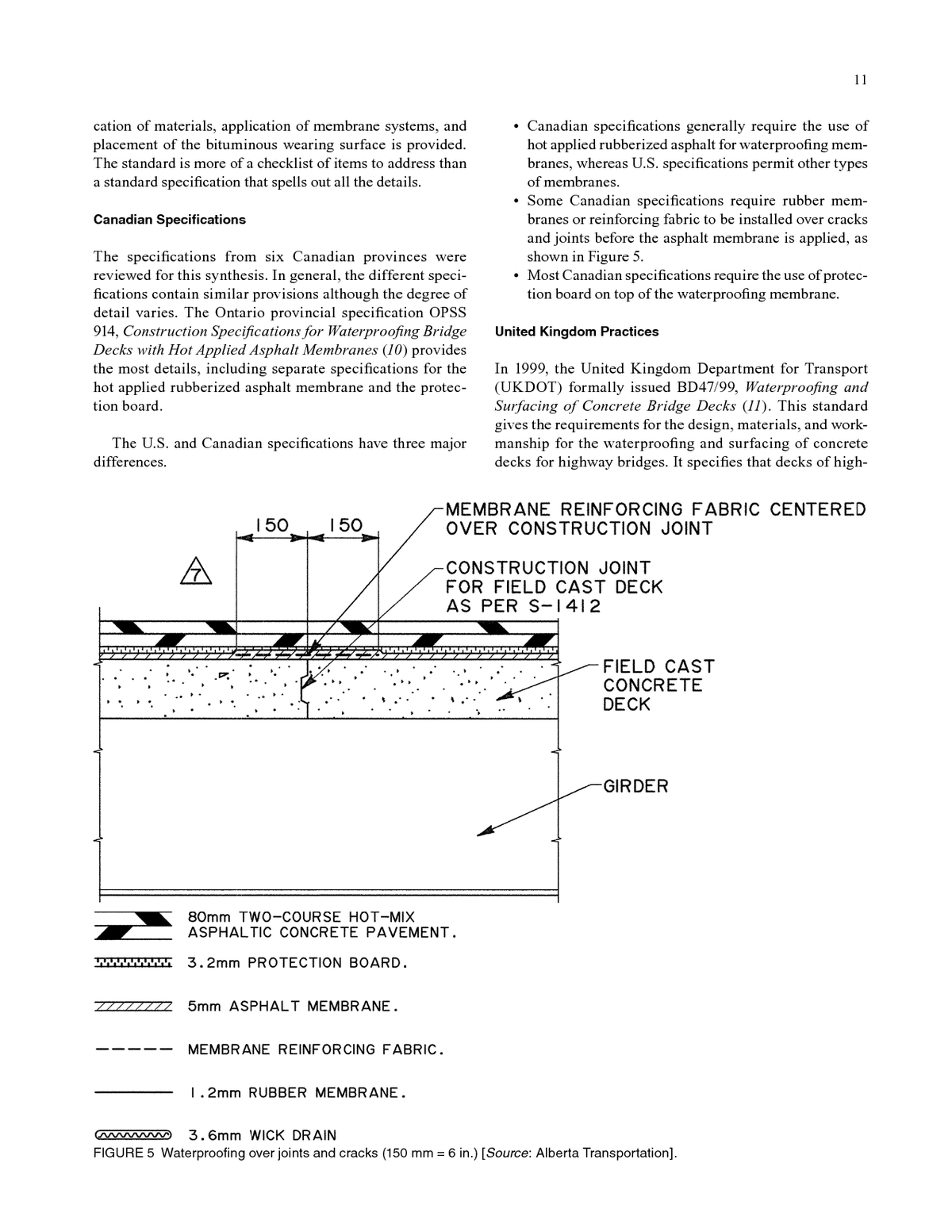
11 cation of materials, application of membrane systems, and · Canadian specifications generally require the use of placement of the bituminous wearing surface is provided. hot applied rubberized asphalt for waterproofing mem- The standard is more of a checklist of items to address than branes, whereas U.S. specifications permit other types a standard specification that spells out all the details. of membranes. · Some Canadian specifications require rubber mem- Canadian Specifications branes or reinforcing fabric to be installed over cracks and joints before the asphalt membrane is applied, as The specifications from six Canadian provinces were shown in Figure 5. reviewed for this synthesis. In general, the different speci- · Most Canadian specifications require the use of protec- fications contain similar provisions although the degree of tion board on top of the waterproofing membrane. detail varies. The Ontario provincial specification OPSS 914, Construction Specifications for Waterproofing Bridge United Kingdom Practices Decks with Hot Applied Asphalt Membranes (10 ) provides the most details, including separate specifications for the In 1999, the United Kingdom Department for Transport hot applied rubberized asphalt membrane and the protec- (UKDOT) formally issued BD47/99, Waterproofing and tion board. Surfacing of Concrete Bridge Decks (11). This standard gives the requirements for the design, materials, and work- The U.S. and Canadian specifications have three major manship for the waterproofing and surfacing of concrete differences. decks for highway bridges. It specifies that decks of high- FIGURE 5 Waterproofing over joints and cracks (150 mm = 6 in.) [Source : Alberta Transportation].
12 way bridges be protected to prevent surface water from · Whenever an asphalt overlay is used. coming into direct contact with the structural deck. This · When replacing an asphalt overlay on an existing is achieved by providing adequate drainage and by water- bridge at a location with freeze-thaw cycles. proofing the upper surface of the deck. The waterproofing · Not allowed on bridges with average daily traffic more has to be sufficiently robust to resist transient vehicle load- than 10,000 vehicles or interstate bridges. ing, maintain good adhesion to the deck and the surfacing, · Temporary overlay on existing bridge deck until funds be resistant to deicing salts, and possess long-term durabil- are available to replace the deck. ity. Waterproofing systems are required to have a British · Only for new construction using adjacent box beams Board of Agrément Roads and Bridges Agrément Certifi- or cored slabs and average daily traffic less than 1,000 cate or European equivalent before they may be installed vehicles. on concrete bridge decks. The required tests for certifica- · When bridge deck condition rating is less than 6, tion include tests on unbonded sheets, boards, and the film chloride content is minimal, and an asphalt overlay is of liquid-applied membranes and tests on waterproofing practical. membranes or systems bonded to concrete. In addition, a · Standard practice for all new bridge decks. site trial is required after all laboratory tests have been suc- · Standard practice for rehabilitating existing bridge cessfully completed. BD47/99 (11) gives details of the tests decks. and site trials. In summary, the criteria range from standard practice for The standard does not permit the use of ventilating layers, all new or existing bridge decks to temporary fixes for exist- partial bonding, or bond breakers with the waterproofing ing bridge decks. system. All systems are to be terminated in a chase. Where a prefabricated system is terminated in a chase, the rebate Agencies were asked in the survey if they had specific (return) is to be filled with a compatible sealant. Where a liq- reasons for selecting a particular membrane system. Twenty- uid-applied membrane is used, the membrane is to be taken two of 31 agencies (71%) replied that they did. Figure 6 sum- into the chase but a sealant is not required. The membrane marizes their reasons. is to be protected from subsequent construction operations with a 20-mm (0.8-in.) nominal thickness of additional pro- The predominant reasons for selecting a particular mem- tective layer consisting of bituminous material. The stan- brane were track record of previous installations, cost, and dard also requires that new bridge decks be protected by desired service life. a designed total minimum thickness of 100 mm (4 in.) of asphalt, excluding the thickness of the waterproofing system In response to the survey, New Hampshire reported that and the additional protective layer. from the 1970s until about 2000, it used peel-and-stick bar- rier systems. Since then, heat-applied membranes have been According to the United Kingdom Waterproofing Asso- used on essentially every bridge deck built or rehabilitated. ciation website (12), the use of sheet membrane systems has Spray-applied membranes were used from 1997 to 2005, but been superseded by more modern liquid sprayed systems. contractors now use heat-applied membranes. For bridges It reports that the liquid systems consist of three elements: longer than about 100 ft, the machine method of applying the membrane is used. Otherwise, the membrane is manu- · Primer used to penetrate and seal the concrete surface ally rolled out and heated with a torch to apply enough heat and enhance the bond of the membrane; to develop adequate bond. · Membrane applied in one or two coats; and · Tack or bond coat to enhance the bond to the riding surface material. DESIGN DETAILS The association states that systems based on methyl meth- North America acrylate and polyurethane resins have proved successful. In the survey for this synthesis, agencies were asked what standard details they have relating to the installa- SELECTION CRITERIA tion of waterproofing membranes. Figure 7 presents their responses. Fourteen of the 25 U.S. state agencies (56%) In the survey for this synthesis, 17 of 32 agencies (53%) that that responded to this question indicated that they had no use membranes reported that they have criteria for when standard details for the items listed. In contrast, only two waterproofing membranes are used on new bridge decks. of nine Canadian provinces (Prince Edward Island and The corresponding response for existing bridge decks was Saskatchewan) reported not having any. Several provinces 20 of 33 (61%). The range of criteria was broad, and included have details available as part of their standard drawings, as the following: illustrated in Figure 8.
13 Percentage Response FIGURE 6 Reasons for selecting a particular membrane system. a.Cost b. Speed of installation c. Staged construction options d. Surface preparation e. Track record of previous installations f. Desired service life g. Availability h. Coordination requirements i. Product support j. Other Agencies were also asked what products were used in Europe and Asia conjunction with waterproofing membranes. Figure 9 pres- ents their responses. More than 60% of the respondents use A 1995 scanning review of European bridge structures iden- primers applied to the concrete and a tack coat before appli- tified the use of bridge deck waterproofing systems as a sig- cation of the asphalt. The products included under "Other" nificant observation (13). The following system from top to in Figure 9 were manufacturer's recommendations, bleeder bottom was reported to be used in Denmark: pipes, wick drains, and membrane reinforcing fabric. · 40-mm (1.6-in.) thick wearing course of asphalt con- No respondents used venting layers, and only a few used crete or stone mastic asphalt, separate adhesive to bond the membranes. Only one respon- · 40-mm (1.6-in.) thick binder course of modified asphalt dent reported the use of seepage layers to allow water that concrete, penetrates through the asphalt to drain more easily. Although · 15- to 20-mm (0.6- to 0.8-in.) thick drainage layer of 29% of the respondents indicate the use of protection board, open-graded asphalt concrete, 25% were Canadian provinces. Only one U.S. state (New · Two polymer-modified bitumen sheets fully bonded to Hampshire) reported its use, indicating a major difference the concrete, and between U.S. and Canadian practices.
