
Since the 1970s, hundreds of billions of dollars have been invested by federal, state, and local government agencies as well as responsible parties to mitigate the human health and ecological risks posed by chemicals released to the subsurface environment. Many of the contaminants common to these hazardous waste sites, such as metals and volatile organic compounds, are known or suspected to cause cancer or adverse neurological, reproductive, or developmental conditions. Over the past 30 years, some progress in meeting mitigation and remediation goals at hazardous waste sites has been achieved. For example, of the 1,723 sites ever listed on the National Priorities List (NPL), which are considered by the U.S. Environmental Protection Agency (EPA) to present the most significant risks, 360 have been permanently removed from the list because EPA deemed that no further response was needed to protect human health or the environment (EPA, 2012). Seventy percent of the 3,747 hazardous waste sites regulated under the Resource Conservation and Recovery Act (RCRA) corrective action program have achieved “control of human exposure to contamination,” and 686 have been designated as “corrective action completed” (EPA, 2011a). The Underground Storage Tank (UST) program also reports successes, including closure of over 1.7 million USTs since the program was initiated in 1984 (EPA, 2010). The cumulative cost associated with these national efforts underscores the importance of pollution prevention and serves as a powerful incentive to reduce the discharge or release of
hazardous substances to the environment, particularly when a groundwater resource is threatened.
Although some of the success stories described above were challenging in terms of contaminants present and underlying hydrogeology, the majority of sites that have been closed were relatively simple (e.g., shallow, localized petroleum contamination from USTs) compared to the remaining caseload. Indeed, hundreds of thousands of sites across both state and federal programs are thought to still have contamination remaining in place at levels above those allowing for unlimited land and groundwater use and unrestricted exposure (see Chapter 2).1 According to its most recent assessment, EPA estimates that more than $209 billion dollars (in constant 2004 dollars) will be needed over the next 30 years to mitigate hazards at between 235,000 to 355,000 sites (EPA, 2004). This cost estimate, however, does not include continued expenditures at sites where remediation is already in progress, or where remediation has transitioned to long-term management.2 It is widely agreed that long-term management will be needed at many sites for the foreseeable future, particularly for the more complex sites that have recalcitrant contaminants, large amounts of contamination, and/or subsurface conditions known to be difficult to remediate (e.g., low-permeability strata, fractured media, deep contamination). Box 1-1 describes the characteristics of complex sites, where long-term management is a likely outcome given the difficulty of remediating the groundwater to conditions allowing for unlimited use and unrestricted exposure.
The Department of Defense (DoD) exemplifies a responsible party that has made large financial investments to address past legacies of their industrial operations. According to the most recent annual report to Congress (OUSD, 2011), the DoD currently has almost 26,000 active sites under its Installation Restoration Program where soil and groundwater remediation is either planned or under way. Of these, approximately 13,000 sites are the responsibility of the Army, the sponsor of this report. The estimated cost to complete cleanup at all DoD sites is approximately $12.8 billion. (Note that these estimates do not include sites containing unexploded ordnance.)
DoD has set a procedural goal for each of the Services stating that all sites will reach the response-complete or remedy-in-place milestone by 2014. Remedy in place means that a remedial strategy has been implemented and is in the performance assessment stage of the site’s life cycle, while response complete means that remedial actions have been completed,
__________________
1 “Contamination remaining in place,” as used in this report, is consistent with the interagency definition of hazardous substances, pollutants, or contaminants remaining at the site above levels that allow for unlimited use and unrestricted exposure (UU/UE) (EPA, 2001; DoD, 2012).
2 Long-term management is defined as requiring decades to centuries, well beyond the typical 30 years used to discount remedial costs.
although contamination at levels above those allowing for unlimited use and unrestricted exposure may still remain on-site. In addition, the DoD has directed 90 percent of sites at active installations to achieve response complete by the end of FY 2018, and 95 percent by the end of FY 2021 (Conger, 2011). These goals will be extremely challenging to meet because at many of the military’s remaining sites that have groundwater contamination, one can anticipate the need for long-term management that may take many decades to resolve.
In this context, the Water Science and Technology Board, under auspices of the National Research Council (NRC), initiated a study to assess the future of the nation’s subsurface remediation efforts, with a particular focus on technical, economic, and institutional challenges facing the Army and other responsible parties as they pursue aggressive programmatic goals for site closure. It should be noted that there is no single definition of “site closure,” nor was the Committee able to agree on a precise consensus definition of the term that would be applicable to all state and federal programs. The term is often used to mean that “no further action” is required at a site (except for various institutional controls)—a connotation that the Committee is comfortable with. However, “no further action” does not mean that site contaminants have been reduced to levels below those allowing for unlimited use and unrestricted exposure. Whenever possible throughout this report, the term “site closure” is replaced with the more specific designations for success used by the various federal and state remediation programs. Chapter 7 abandons the terms “site closure” and “no further action” entirely and instead presents three end states, one of which all sites will achieve: active long-term management, passive long-term management, and achievement of unlimited use and unrestricted exposure levels. The central theme of this report is how the nation will deal with the complex hazardous waste sites where contamination remains in place at levels above those allowing for unlimited use and unrestricted exposure.
REGULATORY RESPONSE TO GROUNDWATER CONTAMINATION
The federal regulatory regime for responding to groundwater contamination consists of several key statutes and regulations enforced primarily by the EPA’s Office of Solid Waste and Emergency Response (see Box 1-2 for an overview of the major U.S. cleanup programs). Designed to address problems related to municipal and industrial waste, RCRA was passed in 1976 and promoted recovery methods and techniques to reduce waste generation while also outlining environmentally sound management of hazardous and nonhazardous wastes. In 1980, Congress passed the Superfund Law (Comprehensive Environmental Response, Compensation,
BOX 1-1
Complex Contaminated Sites
Although progress has been made in remediating many hazardous waste sites, there remains a sizeable population of complex sites, where restoration is likely not achievable in the next 50-100 years. Although there is no formal definition of complexity, most remediation professionals agree that attributes include areally extensive groundwater contamination, heterogeneous geology, large releases and/or source zones, multiple and/or recalcitrant contaminants, heterogeneous contaminant distribution in the subsurface, and long time frames since releases occurred. Additional factors that contribute to complexity include restrictions on the physical placement or operation of remedial technologies and challenging expectations (e.g., regulatory requirements, cleanup goals, community expectations). The complexity of a site increases with the number of these characteristics present.
Complexity is most intimately tied to limitations on the fundamental contaminant removal and/or destruction processes inherent to all remediation approaches, and the severity of these limitations at any given site is directly related to geology and contaminant distribution. Thus, the more varied the geologic media or lithology, the more complex the flow patterns of contaminants and injected solutions are. The simplest geology is uniform media, like well-sorted sand (called homogeneous), while more complex heterogeneous geology includes such varied media as poorly sorted sand with lenses of silt and clay. Fractured media are often considered the most heterogeneous (see Chapter 6 and NRC, 2005a, for more details on hydrogeologic types). Heterogeneous media not only yield intricate contaminant plumes, but also limit the effectiveness of remedial technologies that
TABLE 1-1 Relative Ease of Remediating Contaminated Aquifers as a Function of Contaminant Chemistry and Hydrology
| Contaminant Chemistry | ||
| Hydrogeology | Mobile, Dissolved (degrades/volatilizes) | Mobile, Dissolved |
| Homogeneous, single layer | 1a | 1-2 |
| Homogeneous, multiple layers | 1 | 1-2 |
| Heterogeneous, single layer | 2 | 2 |
| Heterogeneous, multiple layers | 2 | 2 |
| Fractured | 3 | 3 |
a Relative ease of cleanup, where 1 is easiest and 4 is most difficult.
rely on moving fluid through the subsurface (e.g., injection of surfactants, oxidants, or carbon sources). Heterogeneities can make these technologies less effective due to bypass and/or limited contaminant contact time.
Complexity is also directly tied to the contaminants present at hazardous waste sites, which can vary widely and include organics, metals, explosives, and radionuclides. Some of the most challenging to remediate are dense nonaqueous phase liquids (DNAPLs), including chlorinated solvents. In general, different types of contaminants require different types of treatment and perhaps different remedial approaches altogether. Thus, the more types of contaminants found at a site, the more complex the site. Additionally, some contaminants are more resistant to natural biodegradation processes than others.
NRC (1994) provided a matrix that outlined the difficulty of groundwater remediation on a scale of 1 to 4 (with 4 representing the most difficult to remediate) as a function of hydrogeology and contaminant chemistry, including contaminant distribution in the subsurface (see Table 1-1). Ratings of 3 and 4 in Table 1-1 represent “complex sites” and include
• Sites having contamination in fractured media,
• Dissolved plumes extending more than 1000 m down-gradient of a source,
• Sites impacted by radioactive contaminants,
• Sites with DNAPL impacts extending to depths of 100 ft or greater, and
• Sites with residual NAPL that has diffused into fine-grained units.
Note that Table 1-1 does not factor in some of the topics discussed above (such as the size of the release and regulatory expectations) that can contribute to complexity.
| Strongly Sorbed, Dissolved (degrades/volatilizes) | Strongly Sorbed, Dissolved | Separate Phase LNAPL | Separate Phase DNAPL |
| 2 | 2-3 | 2-3 | 3 |
| 2 | 2-3 | 2-3 | 3 |
| 3 | 3 | 3 | 4 |
| 3 | 3 | 3 | 4 |
| 3 | 3 | 4 | 4 |
BOX 1-2
Brief Overview of U.S. Cleanup Programs and Regulatory Terms Found in this Report
CERCLA: The CERCLA program (established in 1980 and also known as Superfund) locates, investigates, and cleans up the most problematic hazardous waste sites throughout the United States. At private sector sites, the EPA may perform the cleanup with federal funds and seek cost reimbursement from the responsible party or may issue orders or enter a judicially enforceable consent decree and oversee the implementation of long-term cleanups, short-term cleanups (“removal actions”), and other responses. At federal CERCLA sites, the federal party is primarily responsible for cleanup.
RCRA Corrective Action: RCRA is the primary federal statute regulating how wastes (solid and hazardous wastes) must be managed at facilities that treat, store, or dispose of hazardous wastes to avoid potential threats to human health and the environment. However, RCRA also provides corrective action order authority that governs the cleanup of solid waste management units at RCRA permitted facilities (including federal facilities). It is similar to CERCLA, but is primarily implemented by the states. EPA’s policy is that the RCRA and CERCLA remedial programs should operate consistently and result in similar environmental solutions when faced with similar circumstances.
UST: The Underground Storage Tank program, which is part of RCRA, governs the cleanup of the nation’s large numbers of leaking underground tanks. The sites are individually smaller in scope than a typical site regulated under CERCLA or RCRA corrective action. The UST program focuses on removing products (petroleum or industrial or dry cleaning chemicals) that have leaked out of the tanks, removal of soil, cleanup of the groundwater, and replacement of the tanks.
Brownfields: Brownfields are defined as real properties, the expansion, redevelopment, or reuse of which may be complicated by the presence or potential presence of a hazardous substance, pollutant, or contaminant. EPA’s Brownfields program provides funds and technical assistance to states, communities, and
and Liability Act or CERCLA), which authorized broad federal authority to respond directly to the release of hazardous substances that endanger public health or the environment, in addition to taxing the chemical and petroleum industries to establish the Superfund Trust Fund. The NPL of the most contaminated sites was established under CERCLA.
Not long after CERCLA was enacted, it became clear that additional measures would be needed to combat the nation’s burden of contaminated sites. In 1984, Congress amended RCRA (via the Hazardous and Solid
other stakeholders in economic redevelopment to work together to assess, safely clean up, and sustainably reuse Brownfields.
Federal Facilities Programs: A number of separate programs exist to address hazardous waste remediation on federal facilities. These include DoD’s Military Munitions Response Program, the Installation Restoration Program, which addresses active bases, the Base Realignment and Closure facilities, and Formerly Used Defense Sites. The Department of Energy’s Environmental Management program is another example (see Chapter 2). All such sites are variously regulated under CERCLA, RCRA, UST, or state regulations.
Maximum Contaminant Level Goals (MCLGs) are the health-based drinking water concentrations set in EPA’s Safe Drinking Water program at a one-in-one million lifetime risk level for carcinogens and, for noncarcinogenic effects, at a concentration at which no adverse health effect are likely from long-term exposure. MCLGs are not enforceable under the Safe Drinking Water Act.
Maximum Contaminant Levels (MCLs) are the legally enforceable drinking water concentration limits for U.S. public drinking water supplies (i.e., supplies to more than 25 people). They are based on a balancing of the residual risk from ingesting the water, the feasibility of treatment to remove the chemical, the detection limit, and the costs to water suppliers. MCLs are enforced under the Safe Drinking Water Act.
Applicable or Relevant and Appropriate Requirements (ARARs) include two separate types of requirements. Applicable Requirements are any federal or duly promulgated state standard, requirement, criterion, or limitation under any other federal environmental law that would legally apply to a site. Relevant and Appropriate Requirements are any Federal or duly promulgated state standard, requirement, criterion, or limitation under any other federal environmental law that addresses problems or situations similar to the conditions at a site and that is “well suited” to a site. MCLs promulgated under the Safe Drinking Water Act are considered to be ARARs for sites regulated under CERCLA because of the potential for people to ingest the groundwater derived from a contaminated aquifer.
Waste Amendments) to implement more stringent standards for hazardous waste management, to impose restrictions that curbed the practice of land disposal of untreated hazardous waste, and to add authority for EPA and the states to remediate contamination on active RCRA permitted facilities. In 1986, the Superfund Amendments and Reauthorization Act (SARA) amended CERCLA to stress the importance of permanent or innovative solutions, incorporate a more rigorous process to define the goals of remediation that EPA has proposed in its regulations, provide new enforcement
authorities and settlement tools, increase state involvement in CERCLA activities, and increase focus on the human health impacts of hazardous waste sites. SARA also established the Defense Environmental Restoration Program and its regulatory underpinnings.
The early years of both programs’ implementation were marked by site studies rather than actual remediation. In 1988, EPA released interim measures for RCRA to allow action to be taken sooner to prevent exposure to contamination, and the agency began focusing on completing remedy construction, in particular pump-and-treat practices for groundwater containment and remediation. As more remediation began, it became clear that reaching drinking water standards such as maximum contaminant levels (MCLs), which were the applicable or relevant and appropriate requirements (ARARs) for many sites, was not always feasible, especially at sites with complicated hydrogeology and/or recalcitrant contaminants (see Box 1-2 for definitions of these terms). Thus, during the 1990s EPA continued to revisit and revise its policies for groundwater restoration. For those sites where restoration is impracticable for the foreseeable future given site conditions and the limitations of technologies, the agency created the Technical Impracticability (TI) Waiver (EPA, 1993). As specified in SARA, the TI Waiver was one of six waiver options that allowed for alternative remedial goals other than ARARs in specified portions of a site. For groundwater TI waivers, this required the designation of a “TI Zone” in which a specific ARAR (e.g., an MCL) would be waived. Outside of this zone, the original ARARs still need to be met.
By 1999, the CERCLA program was increasingly finding success in achieving remedy construction milestones on many of the less complex sites. Nonetheless, a 2001 report from Resources for the Future (Probst and Konisky, 2001) stated that most complex sites still had contamination in place at levels above those allowing for unlimited use and unrestricted exposure. Despite these findings, the dedicated taxes supporting the CERCLA program expired in 1995 and have not been reinstated, such that the trust fund was depleted in 2003 (although appropriations to the program continue). Other programs have fared better, such as the Brownfields program (which allows voluntary remediation of sites to promote the redevelopment and reclamation of properties where hazardous substances had been detected or are potentially present) to which $250 million per year was authorized in 2002. RCRA’s UST program received additional support from the 2005 Energy Policy Act. In 2009, the American Recovery and Reinvestment Act boosted funding for all remediation-related programs
at EPA by $800 million and for other federal remediation programs by $5 billion3 (EPA, 2011b).
Today, EPA directives on groundwater remedies continue to evolve. In June 2009, the Office of Solid Waste and Emergency Response compiled all existing EPA groundwater policies into one singular directive (EPA, 2009). It reported that CERCLA action is only needed where groundwater contamination exceeds drinking water standards. The directive identified the role of institutional controls, which are non-engineered instruments such as administrative and legal controls that help minimize the potential for human exposure to contamination and/or protect the integrity of the remedy, and determined they are generally not to be the sole basis for a remedy. Classification of groundwater (i.e., whether an aquifer is a current or potential source of drinking water) is to be conducted only by EPA unless there is a state regulatory requirement to do so. And finally the directive acknowledged that EPA policy on point of compliance is to restore groundwater to the maximum extent practicable for beneficial reuse (see also Box 3-2). The report noted that in selecting remedial goals EPA is to consider an array of criteria, including drinking water standards, site-specific risk assessment, and land use.
THE LIFE CYCLE OF A CONTAMINATED SITE
The process for remediation of contaminated sites, from discovery to closure, was first documented in the National Contingency Plan (40 CFR 300 et seq.) in 1980 to reflect the needs of CERCLA. Other regulatory programs provide similar remedial guidance for active sites, including those with underground storage tanks. The Departments of Energy and Defense have developed their own processes that mirror the remedial process found within CERCLA, but using different terminology, while the states implement the federal laws over which they have primacy as well as state programs that encompass additional contaminated sites.
The life-cycle components of the various federal and state remedial programs are similar to one another and listed in Table 1-2 along with approximate time frames for their completion. Following discovery of contamination, a site must be characterized to determine the nature and extent of the contamination, a process that can extend for years into the future for some sites. One of the most important components of the site characterization step is the creation of an accurate conceptual site model (discussed at length in NRC, 2005a). If chemicals of concern are found to exceed certain regulatory limits, and/or a risk characterization indicates that unacceptable
__________________
3http://www.recovery.gov/Transparency/fundingoverview/Pages/contractsgrantsloans-details.aspx#EnergyEnvironment.
TABLE 1-2 Components and Approximate Time Frames in the Life Cycle of a Remediation Program
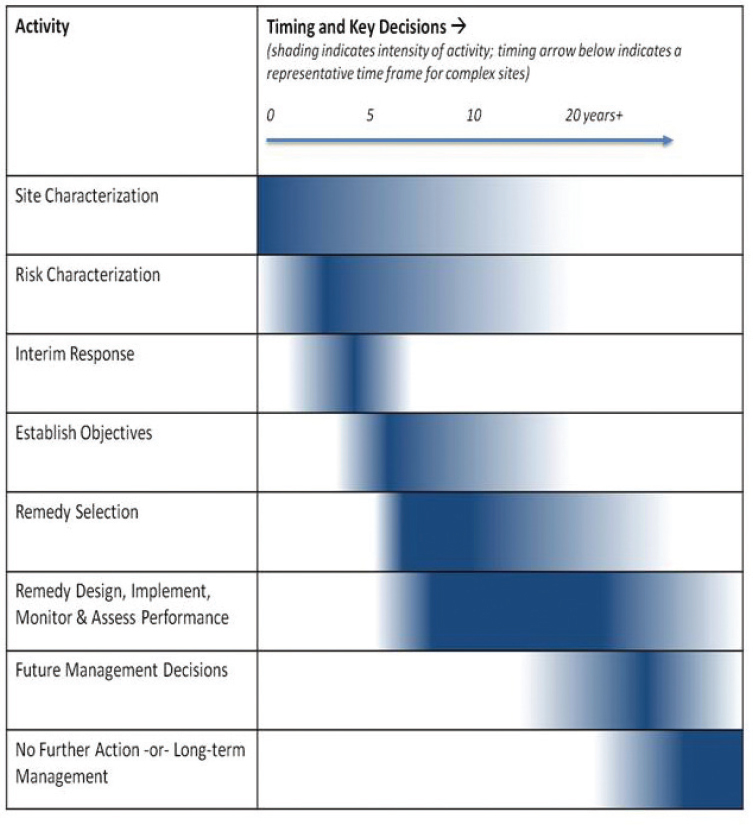
conditions exist, then several activities are possible. Interim responses may be necessary to reduce immediate threats. Once these are in place, remedial action objectives are set, and then remedial alternatives are evaluated and a remedy selected that will meet those objectives within a “reasonable”4 time
__________________
4 The definition of “reasonable” has been debated for many years at EPA and in state regulatory agencies. There are no statutory or regulatory definitions of this term in the context of soil and groundwater cleanup. EPA explicitly adopted no single definition for all sites because a “timeframe of 100 years may be reasonable for some sites and excessively long for others”
frame. Once the remedy has been designed and installed, monitoring of the impacted media and performance assessment of the remedial technology commence. Information from the monitoring program is used to inform future decision making, including the decision to continue remediation or transition to more passive management. From here, actions can lead to either site closure (including no further action required) or to long-term management. If residual contamination persists at levels above those allowing for unlimited use and unrestricted exposure, engineering and/or institutional controls will be needed. For example, institutional controls like deed restrictions are often necessary for long-term management at sites where physical or hydraulic containment of the contamination is a component of the final solution. Whether long-term management sites will ever attain contamination levels below those allowing for unlimited use and unrestricted exposure is often uncertain; at many sites, perpetual management may be necessary, particularly those with recalcitrant contaminants.
In practice, the process of moving a site from investigation to closure has been much more complex than implied in Table 1-2, and virtually all phases of remediation take more time and resources than originally contemplated. At NPL sites the time lapse from discovery to remedy implementation can exceed two decades. For example, two sites at Letterkenny Army Depot were listed on the NPL in 1987 and 1989, but as of 2011 neither had reached the point of having a final remedy selected (although interim actions have been taken to reduce risk including provision of alternative water supplies). There are numerous reasons for the long time lags between site discovery and closure, including the fact that remedial systems often require modification during implementation due to uncertainties in technology performance. Limited and shrinking resources (particularly at the state level) have also increased the time period between site discovery and eventual remediation.
Some states have proposed changes to their remediation programs in order to expedite moving sites through the system. For example, in 2009 New Jersey created a Licensed Site Remediation Professional (LSRP) Program to address a backlog of relatively simple sites that were not yet closed. Modeled after a similar program in Massachusetts, the New Jersey program transfers responsibility for remediation from the state Department of Environmental Protection (NJDEP) to private contractors licensed by the state in order to reduce the backlog of cases that need to be reviewed and approved by NJDEP. As of July 2010, a total of 392 LSRPs had been
(EPA, 1996). Because “reasonable” includes not just scientific judgments, but also values, risk tolerances, and preferences for discounting effects on future generations, definitions can vary by individual (Weitzman, 2001). The Committee, therefore, does not provide its own definition of “reasonable.”
licensed within New Jersey, presumably allowing the NJDEP staff to dedicate its resources to the high priority, complex cases and manage cases more efficiently (NJDEP, 2011). Similarly, in California the State Water Resources Control Board has begun to allow closure of thousands of “low-threat” USTs even when groundwater contaminant concentrations exceed MCLs in some portion of the site (SWRCB, 2012). Sites are eligible if remediation has been attempted, the dissolved plume is shrinking, and the groundwater has no future as a drinking water source. California’s Regional Water Quality Control Board (RWQCB) in Region 2 (San Francisco Bay area) has attempted to put forth a similar policy for low-threat chlorinated solvent sites (CA Region 2 RWQCB, 2009). Both California policies reflect the belief that at certain sites with low long-term risks to human health or the environment, closure could be granted despite some contaminant levels exceeding regulatory limits. Whether this approach for closure of “low-risk” of “low-threat” sites will be adopted by other regulatory agencies responsible for groundwater remediation is uncertain.
At sites regulated under CERCLA, the desired goal of the remedial process is to reach site closure as defined by unlimited use and unrestricted exposure (a goal which may or may not be practical to attain for decades). For non-CERCLA sites, site closure is often accompanied by a designation of “no further action.” Within each of the major federal programs addressing subsurface contamination (CERCLA, RCRA, and RCRA UST) some proportion of the site population has reached this final stage. However, as mentioned before, a no-further-action designation does not necessarily mean that the site is contaminant-free. Indeed, many sites closed under the UST program have residual contamination left in place, some at levels above those allowing for unlimited use and unrestricted exposure. In the case of Superfund, an NPL delisting does not necessarily have to be based on the attainment of MCLs if the human health and environmental risk of the remaining contamination is minimal, groundwater migration is controlled, and remediation is technically impracticable (see Chapter 2). Sites that have residual contamination and require long-term management result in continued remediation costs and liability for the responsible parties or, in the case of “orphan” sites,5 cost to taxpayers.
__________________
5 Orphan sites are those private (thus, not military) Superfund facilities for which no viable potentially responsible party has been identified. These are transferred to state agencies for further management ten years after reaching the construction completion milestone (see Chapter 2).
Over the past two decades, the NRC has published several reports on the technical, economic, institutional, and policy challenges arising from contamination of the nation’s subsurface resources, with a particular focus on whether or not groundwater restoration is feasible or practicable (Box 1-3). Each of the NRC studies has, in one form or another, recognized that in almost all cases, complete restoration of contaminated groundwater is difficult, and in a substantial fraction of contaminated sites, not likely to be achieved in less than 100 years. The most difficult sites to remediate are characterized by their large size, heterogeneous hydrogeology, and/or multiple (and recalcitrant) contaminants. As suggested in Figure 1-1, sites contaminated with dense nonaqueous phase liquids (DNAPLs) like trichloroethene (TCE) and tetrachloroethene are particularly challenging to restore because of their complex contaminant distribution in the subsurface. At most complex sites, contamination will persist in the groundwater for a long time at levels above those allowing for unlimited use and unrestricted exposure. This reality, combined with the need to use the affected groundwater in some cases, has led to a considerable debate about the relative costs and benefits of remediating the sources of groundwater contamination as opposed to pathway interruption (e.g., vapor mitigation and wellhead treatment in the contaminant plumes).
Figure 1-2 shows four possible trajectories of post-remediation dissolved plume behavior at sites causing groundwater impacts. The first trajectory assumes no remedial action, such that the state of the plume remains as is and the regulatory goal at the receptor is never reached until the source naturally depletes. The second trajectory represents ineffective remediation where, after remediation stops, the dissolved plume returns to the original state or to one with a bigger footprint and higher concentrations resulting from source mass redistribution during the remediation attempt (e.g., the DNAPL pools were mobilized during remediation). The third trajectory shows a partially effective remedial action, but one in which the system will not reach an acceptable state for a very long time (e.g., because of matrix mass rebound after the removal of a DNAPL source that results in long-term plume persistence). In this situation, the question of whether to continue active remediation versus some more passive management like containment becomes paramount. The fourth trajectory, which might be called the best practicably achievable trajectory, represents a case where the remediation has resulted in a post-remediation dissolved plume where the remediation goals are achievable. Whether this trajectory can achieve remedial goals in a reasonable length of time is not known and depends on the scale of the x axis. Our ability to predict these trajectories for complex sites is highly uncertain, because of imprecise knowledge of source zone mass
BOX 1-3
Select NRC Studies Relevant to Groundwater Remediation at Sites with Persistent Contamination
The following five NRC reports have particular relevance to this report, as they address the feasibility of subsurface remediation from various perspectives:
Alternatives for Groundwater Cleanupa (NRC, 1994) reviewed extensive data from 77 pump-and-treat sites and found that ease of remediation depended on the nature of the contamination present and the site hydrogeology. Only two of 77 sites were rated as easy to clean up, and only eight of the 77 sites reached remedial goals, like obtaining MCLs in groundwater. The report suggested that an infeasibility fee be charged to potentially responsible parties (PRPs) to further research and development of new technologies to remediate such sites.
Groundwater and Soil Cleanup: Improving Management of Persistent Contaminants (NRC, 1999) provided a comprehensive review of groundwater and soil remediation technologies, focusing on three classes of contaminants that have proven very difficult to treat once released to the subsurface: metals, radionuclides, and DNAPLs, such as chlorinated solvents. The report concluded that “removing all sources of groundwater contamination, particularly DNAPLs, will be technically impracticable at many Department of Energy sites, and long-term containment systems will be necessary for these sites.”
Natural Attenuation for Groundwater Remediation (NRC, 2000) focused on monitored natural attenuation (MNA) and considered when and where MNA will work. Prompted by the increasing use of MNA as a remedy at hazardous waste sites (from less than 5 percent of Records of Decision in 1985 to more than 25 percent in 1995), it evaluated the likelihood of success of MNA for many contaminant classes. The report found that the likelihood of MNA success for most compounds is low, despite the increase in its use at Superfund facilities. None of the 14 protocols reviewed in the report was completely adequate in its treatment of the important scientific and technological, implementation, and community concerns inherent to MNA. Thus, EPA was advised to provide new guidance on protocols.
and its distribution (sometimes referred to as “source zone architecture”6) and due to the diversity of opinions on the anticipated cost, effectiveness, and robustness of various remediation technologies.
__________________
6 Source zone architecture refers to the distribution of DNAPL as either residual saturation (immobile ganglia and blobs) in more permeable media or as pools on tops of low-permeability layers. Residual DNAPL has a higher surface area, which provides greater exposure to flowing groundwater, contributing significantly to downgradient contaminant mass flux. In contrast, pools usually contain more DNAPL mass but have lower surface area exposed to clean groundwater and a correspondingly lower contribution to mass flux. See Figure 1-1.
Environmental Cleanup of Navy Facilities: Adaptive Site Management (NRC, 2003) developed the concept of adaptive site management (ASM) to deal with sites where remedial goals have not been reached after some significant amount of time operating the remedy (the so-called asymptote effect). The hallmark of ASM is doing things while a remedy is ongoing that will inform the process if the remedy fails. The report describes several management decision points at which new information from parallel activities could be incorporated to allow site remedies to be reconsidered over time.
Contaminants in the Subsurface (NRC, 2005a) responded to another trend in hazardous waste remediation—the use of aggressive source removal. Source removal via such technologies as in situ chemical oxidation, thermal treatment, and surfactant-enhanced flushing was often attempted without a clear understanding of whether those actions would in fact remove mass or lead to substantial changes in contaminant concentration in groundwater. The report defined five hydrogeologic settings, based on the degree of heterogeneity and permeability found in subsurface soils. In addition, it created a table for each source remediation technology discussing the extent to which that technology could meet five different goals in each of the five hydrogeologic settings. The goals included mass removal, concentration reduction, mass flux reduction, reduction of source migration potential, and a change in toxicity. The report concluded that available data from field studies do not demonstrate what effect source remediation is likely to have on water quality.
______________________
a Although sometimes used synonymously, there is an important difference between the terms remediation and cleanup. Remediation is the “removal of pollutants or contaminants from environmental media such as soil, groundwater, sediment, or surface water for the general protection of human health and the environment” (http://sis.nlm.nih.gov/enviro/iupacglossary/glossaryr.html); it does not imply removal or destruction of all contaminants. Cleanup is the restoration of the affected site to a condition allowing for UU/UE which generally implies meeting drinking water standards in the case of contaminated groundwater. This report primarily uses the term remediation to avoid confusion.
Key Challenges for Subsurface Remediation at DoD Facilities
The DoD has invested over $30 billion to address contamination of the soil and groundwater at military bases in the United States and abroad (OUSD, 2011). Under the Installation Restoration Program, many individual sites have been closed with no further action required. However, at complex sites characterized by multiple contaminant sources, large past releases of chemicals, or highly complex geologic environments, meeting the DoD’s ambitious programmatic goals for remedy in place/response complete seems unlikely and site closure almost an impossibility. The recent
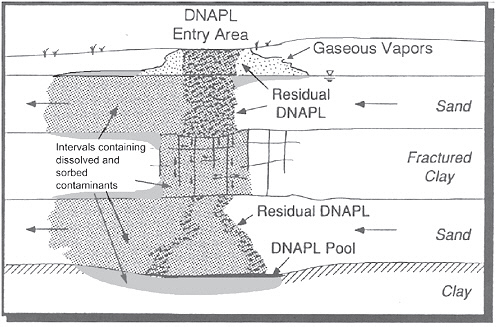
FIGURE 1-1 Hypothetical DNAPL release site. In addition to residual and pooled DNAPL sources, the figure depicts vapor-phase contaminants in the unsaturated zone and a plume of dissolved and sorbed contamination in the saturated zone downgradient of the DNAPL. Note that the residual DNAPL is more likely to occur in sparse pools and fingers, rather than in the massive bodies inferred in the picture.
SOURCE: NRC (2005a); adapted from Cohen et al. (1993).
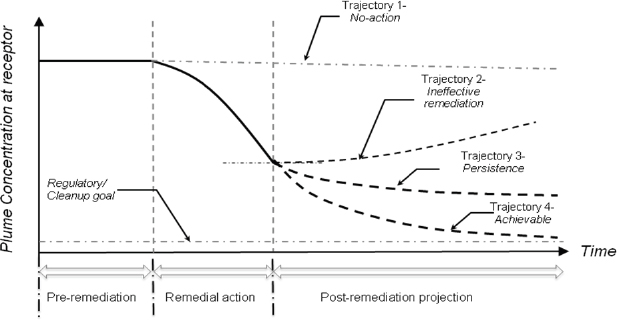
FIGURE 1-2 Schematic of possible post-remediation trajectories for plume behavior. The y axis could be any decision variable used to measure the remedial objective (e.g., the contaminant concentration at a point of compliance).
policy memorandum from the Air Force (Yonkers, 2011) regarding the new milestone of accelerated site completion does not appear to clarify or simplify military remediation requirements.
An example of the array of challenges faced by the DoD is provided by the Anniston Army Depot, where groundwater is contaminated with chlorinated solvents (as much as 27 million pounds of TCE [ATSDR, 2008]) and inorganic compounds. TCE and other contaminants are thought to be migrating vertically and horizontally from the source areas, affecting groundwater downgradient of the base including the potable water supply to the City of Anniston, Alabama. The interim Record of Decision called for a groundwater extraction and treatment system, which has resulted in the removal of TCE in extracted water to levels below drinking water standards. Because the treatment system is not significantly reducing the extent or mobility of the groundwater contaminants in the subsurface, the current interim remedy is considered “not protective.” Therefore, additional efforts have been made to remove greater quantities of TCE from the subsurface, and no end is in sight. Modeling studies suggest that the time to reach the TCE MCL in the groundwater beneath the source areas ranges from 1,200 to 10,000 years, and that partial source removal will shorten those times to 830–7,900 years (Tetra Tech, 2011). Although Anniston is a strong candidate for a TI wavier, DoD officials have struggled to convince regulators of the need for alternative remedial objectives (at this and other complex military sites).
In part, the delays and transaction costs experienced at complex sites have led to the use of alternative contracting mechanisms for site remediation within the DoD, including performance-based contracting. In some cases, this has involved requesting guaranteed fixed-price proposals to achieve certain milestones within specified schedule deadlines. The intent of these contracting procedures is to accelerate remediation and reduce the overall life-cycle costs (Army, 2010). Anecdotal stories suggest that this process has indeed accelerated transition of sites to the status of remedy in place, but not to site closure.
It appears that future liabilities for the DoD are unknown because of the uncertain time frames to achieve remedial action objectives at the more complex sites. It is probable that these sites will require significantly longer remediation times than mandated, and thus, continued financial demands for monitoring, maintenance, and reporting. In addition, the tension between remedial strategies involving long-term containment compared to contaminant removal from the subsurface will likely continue, with a lack of efficient protocols that could potentially reduce overall life-cycle costs. Finally, consistent with DoD goals of achieving a greater level of environmental sustainability in all environmental programs (DoD, 2009), increased
incorporation of sustainability metrics in remedial decision making appears likely.
STATEMENT OF TASK AND REPORT ROADMAP
Although technologies capable of removing substantial amounts of contaminants from groundwater have evolved significantly over the last 40 years, our ability to predict remediation performance, and its associated groundwater quality improvement, with adequate certainty is limited. Additional questions must be answered before management of sites can proceed in a way that is protective in an era of limited financial resources. The following questions guided the work of this NRC committee.
1. Size of the Problem
At how many sites does residual contamination remain such that site closure is not yet possible? At what percentage of these sites does residual contamination in groundwater threaten public water systems?
2. Current Capabilities to Remove Contamination
What is technically feasible in terms of removing a certain percentage of the total contaminant mass? What percent removal would be needed to reach unrestricted use or to be able to extract and treat groundwater for potable reuse? What should be the definition of “to the extent practicable” when discussing contaminant mass removal?
3. Correlating Source Removal with Risks
How can progress of source remediation be measured to best correlate with site-specific risks? Recognizing the long-term nature of many problems, what near-term endpoints for remediation might be established? Are there regulatory barriers that make it impossible to close sites even when the site-specific risk is negligible and can they be overcome?
4. The Future of Treatment Technologies
The intractable nature of subsurface contamination suggests the need to discourage future contaminant releases, encourage the use of innovative and multiple technologies, modify remedies when new information becomes available, and clean up sites sustainably. What progress has been made in these areas and what additional research is needed?
5. Better Decision Making
Can adaptive site management lead to better decisions about how to spend limited resources while taking into consideration the concerns of stakeholders? Should life-cycle assessment become a standard component of the decision process? How can a greater understanding of the limited current (but not necessarily future) potential to restore groundwater be communicated to the public?
Although the focus of the study was on military sites, particularly those of the U.S. Army, the conclusions and recommendations are relevant to both public and private hazardous waste sites.
The study was intended to focus on those recalcitrant contaminants occurring most frequently at the most complex sites, in particular organic compounds present as DNAPLs. In addition, groundwater cleanup, as opposed to soil remediation, poses the greatest remediation challenge and was thus the primary focus of this study. Other topics relevant to the nation’s subsurface remediation efforts that are not reviewed here include the impacts of agricultural activities on groundwater quality, abandoned mine sites, and impacts from municipal and solid waste landfills. Finally, although Department of Energy sites also illustrate the challenges of recalcitrant contamination requiring long-term management, because a number of NRC reports have reviewed sites with radioactive contaminants (NRC, 2005b, 2007, 2009) they are not discussed further here.
The questions in the statement of task are addressed variously throughout the report. Thus, Chapter 2 attempts to bound the size of the problem (first task item), including federal sites under the jurisdiction of EPA (CERCLA, RCRA, and UST programs), the military, the Department of Energy, and state remediation programs. For all programs, the Committee sought information on the total number of sites, the costs expended to date and to clean up remaining sites, and the number of sites affecting a drinking water supply. Chapter 2 (and Appendix C) also discusses sites that have been “closed” and characterized as successes to illustrate the point that many “closed” sites are still contaminated (though they are protective of human health and the environment).
Chapter 3 discusses elements primarily from the third task item but also from the second and fourth. With regards to the third task item, it outlines common remedial objectives (stemming from regulatory programs) including the use of MCLs and other risk-based objectives. It demonstrates the flexibility inherent in CERCLA for defining measurable remedial objectives that protect human health and the environment and prevent the spread of contamination, in the most cost-efficient way. It also discusses a suite of alternative remedial objectives that could be considered for sites slated for long-term management and the barriers that prevent more frequent use of these alternatives. The chapter introduces the concept of sustainability in remediation and its role as a remedial objective (from the fourth task item), and it provides the regulatory definition of “maximum extent practicable” (from the second task item).
Chapter 4 focuses on the current capabilities of technologies to remove or contain subsurface contamination (the second task item). For the major classes of removal technologies, including extraction, thermal, chemical, and biological technologies, as well as containment, the chapter updates the
NRC (2005a) report in addressing what is technically feasible in terms of removing contaminant mass. Case studies for the technologies are included both within the chapter and in Appendix B to illustrate the capabilities of existing technologies for removing mass from the subsurface. It should be noted that the percent contaminant removal that would be needed to reach unrestricted use, or to be able to extract and treat groundwater for potable reuse, can only be determined on a site-specific basis and is not addressed further in this report. It depends on knowing the amount of contamination present at a site as well as the removal capabilities of the chosen well-head treatment technologies.
Although not explicitly called for in the statement of task, the risks of leaving residual contamination in place in the subsurface are discussed comprehensively in Chapter 5. These include technological risks such as the failure of hydraulic containment or barrier technologies, or the inability of current treatment and containment systems to handle unregulated and unanticipated contaminants. Chapter 5 also discusses institutional issues that arise when contamination remains in place, such as economic and litigation risks like possible natural resource damage and trespass suits and the failure of institutional controls. The consequences of leaving contamination in place for water utilities and domestic wells are discussed.
Chapter 6 focuses on the future of treatment technologies (fourth task item). It provides a targeted discussion of those areas of technology development relevant to the problem of leaving contamination in place, but is not meant to be a comprehensive cataloging of remediation technologies (see Chapter 4). In addition to remediation technologies, it speaks to advances in our understanding of hydrogeology and contaminant transport pathways, improved diagnostics and new geophysical methods, and the use of sensors for monitoring long-term management. It should be noted that the report does not comprehensively discuss the need to discourage future contaminant releases, as significant progress has been made in this area. That is, it is now so expensive to manage contaminated sites that potentially responsible parties will go to great lengths to avoid causing groundwater contamination.
The report ends with a chapter on how better decision making can help manage sites with residual contamination (addressing the fifth task item, as well as the call for near-term endpoints in the third task item). This includes the introduction of several important decision points and a transition assessment to help move sites to one of three end states. The transition assessment is akin to the adaptive site management concept first developed in NRC (2003), but focuses specifically on complex sites where long-term management is likely needed. The chapter discusses the economic, risk assessment, and risk communication implications of this transition assess-
ment. Life-cycle assessment is not discussed further because it goes beyond the issues presented by groundwater sites with residual contamination.
The Committee reached consensus on all conclusions and recommendations in the report except regarding a proposal for a public/private partnership that could be established to manage portfolios of sites in a manner similar to initiatives undertaken by private responsible parties (e.g., separate companies to manage legacy sites) or public agencies (e.g., Minnesota Pollution Control Agency’s Closed Landfill Program). In these entities, liability and long-term responsibility for contaminated sites are transferred from the responsible party to a new entity. In the case of the Minnesota Pollution Control Agency, owners of sanitary landfills pay a fee to the program in exchange for transfer of all future liability and management costs. The Committee considered the concept of an industry/government/public organization that could be formed to assume management for a portfolio of sites, called the “environmental liability management organization (ELMO).” PRPs would pay ELMO to assume liability and site management, and the payment would cover expected damages and management costs for as long as the contamination remains above levels allowing for unlimited use and unrestricted exposure. The Committee could not agree on the details of such a proposed entity, but all members agreed that future consideration of such an organization could potentially provide a number of advantages to all parties, especially in the context of long-term management of sites.
Throughout the report are case studies of complex sites where it is most likely that contamination will remain in place after remedy operation. These sites are the most important to the Army in terms of being able to reach its 2014 goal of remedy in place/response complete and the updated goals of DoD, and in determining its future remediation liability. A list of the complex sites studied in depth by the Committee is found in Appendix B.
Army. 2010. Use of Performance-Based Acquisition in the Army Environmental Cleanup Program.
ATSDR (Agency for Toxic Substance & Disease Registry). 2008. Follow-up Health Consultation: Anniston Army Depot. September 30, 2008.
CA Region 2 RWQCB. 2009. Assessment Tool for Closure of Low-Threat Chlorinated Solvent Sites. Groundwater Committee of the California RWQCB San Francisco Bay Region.
Cohen, R. M., J. W. Mercer, and J. Matthews. 1993. DNAPL Site Evaluation. Boca Raton, FL: C. K. Smoley Books, CRC Press.
Conger, J. 2011. Memo: New Goals for DERP. July 18, 2011.
DoD (Department of Defense). 2009. Consideration of Green and Sustainable Remediation Practices in the Defense Environmental Restoration Program. Office of the Secretary of Defense. August 10.
DoD. 2012. Manual, Defense Environmental Restoration Program No. 4715.20. March 9. Washington, DC: DoD Under Secretary of Defense for Acquisition, Technology & Logistics. http://www.dtic.mil/whs/directives/corres/pdf/471520m.pdf.
EPA (U.S. Environmental Protection Agency). 1993. Guidance for Evaluating Technical Impracticability of Ground-Water Restoration. Directive 9234.2-25. Washington, DC: EPA OSWER.
EPA. 1996. Presumptive Response Strategy and Ex-Situ Treatment Technologies for Contaminated Ground Water at CERCLA Sites. OSWER Directive 9283.1-12. EPA 540/R-96/023. Washington, DC: EPA OSWER.
EPA. 2001. Comprehensive Five-Year Review Guidance. EPA 540-R-01-007. OSWER Directive 9355.7-03B-P. Washington, DC: EPA OSWER.
EPA. 2004. Cleaning up the Nation’s Waste Sites: Markets and Technology Trends. 2004 Edition.
EPA. 2009. Summary of Key Existing EPA CERCLA Policies for Groundwater Restoration. OSWER Directive 9823.1-33. Washington, DC: EPA OSWER.
EPA. 2010. Semiannual Report of UST Performance Measures, Mid-Fiscal Year 2010. Washington, DC: EPA Office of Underground Storage Tanks. http://www.epa.gov/oust/cat/ca_10_12.pdf.
EPA. 2011a. Facility Information: 2020 Corrective Action Universe. http://www.epa.gov/osw/hazard/correctiveaction/facility/index.htm#2020 [accessed November 8, 2011].
EPA. 2011b. American Recovery and Reinvestment Act, Quarterly Performance Report, Quarter 4, Cumulative Results as of September 30, 2011. http://www.epa.gov/recovery/pdfs/2011_Q4_Perf_Rpt.pdf.
EPA. 2012. National Priorities List. http://www.epa.gov/superfund/sites/npl/ [accessed August 17, 2012].
NJDEP (New Jersey Department of Environmental Protection). 2011. Site Remediation Reform Act. http://www.nj.gov/dep/srp/srra/ [accessed November 8, 2011].
NRC (National Research Council). 1994. Alternatives for Groundwater Cleanup. Washington, DC: National Academy Press.
NRC. 1999. Groundwater and Soil Cleanup: Improving Management of Persistent Contaminants. Washington, DC: National Academy Press.
NRC. 2000. Natural Attenuation for Groundwater Remediation. Washington, DC: National Academy Press.
NRC. 2003. Environmental Cleanup at Navy Facilities: Adaptive Site Management. Washington, DC: The National Academies Press.
NRC. 2005a. Contaminants in the Subsurface. Washington, DC: The National Academies Press.
NRC. 2005b. Improving the Characterization and Treatment of Radioactive Wastes for the Department of Energy’s Accelerated Site Cleanup Program. Washington, DC: The National Academies Press.
NRC. 2007. Plans and Practices for Groundwater Protection at the Los Alamos National Laboratory. Washington, DC: The National Academies Press.
NRC. 2009. Advice on the Department of Energy’s Cleanup Technology Roadmap: Gaps and Bridges. Washington, DC: The National Academies Press.
OUSD (Office of the Under Secretary of Defense for Acquisition, Technology and Logistics). 2011. FY2010 Annual Report to Congress.
Probst, K. N., and D. M. Konisky. 2001. Superfund’s Future: What Will it Cost? Washington, DC: Resources for the Future.
SWRCB (State Water Resource Control Board). 2012. Low-Threat Underground Storage Tank Case Closure Policy (Effective August 17, 2012). Memo of August 24.
Tetra Tech. 2011. Focused Feasibility Study for Southeast Industrial Area OU1 of ANAD, Draft, May.
Weitzman, M. L. 2001. Gamma discounting. American Economic Review 91(1):260-271.
Yonkers, T. 2011. Policy for Refocusing the Air Force Environmental Restoration Program. February 24.


