




Below is the uncorrected machine-read text of this chapter, intended to provide our own search engines and external engines with highly rich, chapter-representative searchable text of each book. Because it is UNCORRECTED material, please consider the following text as a useful but insufficient proxy for the authoritative book pages.
Evidence Part I for Human-Caused Climate Change T he overwhelming But how has this conclusion been reached? Climate science, majority of climate like all science, is a process of collective learning that scientists agree that relies on the careful gathering and analyses of data, the formulation of hypotheses, the development of human activities, models to study key processes and make testable predictions, and the combined use of observations especially the burning and models to test scientific understanding. of fossil fuels (coal, oil, Scientific knowledge builds over time as new and gas), are responsible observations and data become available. Confidence in our understanding grows if multiple for most of the climate lines of evidence lead to the same conclusions, or change currently being if other explanations can be ruled out. In the case of observed. climate change, scientists have understood for more than a century that emissions from the burning of fossil fuels could lead to increases in the Earth's average surface temperature. Decades of research have confirmed and extended this understanding. 2
How do we know that Earth has warmed? S cientists have been taking widespread measure- ments of Earth's surface temperature since around 1880. These data have steadily improved changes in the instruments taking the measure- ments or by other factors that affect local tempera- ture, such as additional heat that has come from and, today, temperatures are recorded by ther- the gradual growth of cities. mometers at many thousands of locations, both on These analyses all show that Earth's average the land and over the oceans. Different research surface temperature has increased by more than groups, including the NASA Goddard Institute for 1.4°F (0.8°C) over the past 100 years, with much Space Studies, Britain's Hadley Centre for Climate of this increase taking place over the past 35 years. Change, the Japan Meteorological Agency, and A temperature change of 1.4°F may not seem like NOAA's National Climate Data Center have used much if you're thinking about a daily or seasonal these raw measurements to produce records of fluctuation, but it is a significant change when long-term global surface temperature change you think about a permanent increase averaged (Figure 1). These groups work carefully to make across the entire planet. Consider, for example, sure the data aren't skewed by such things as that 1.4°F is greater than the average annual E v i d e n c e f o r H u m a n - C a u s e d C l i m at e C h a n g e FIGURE 1 FIGURE 2 NASA's Global Surface Temperature Record Esti- (bottom left) Climate monitoring stations on land and sea, mates of global surface temperature change, relative such as the moored buoys of NOAA's Tropical Atmosphere to the average global surface temperature for the Ocean (TAO) project, provide real-time data on tempera- period from 1951 to 1980, which is about 14°C (57°F) ture, humidity, winds, and other atmospheric properties. from NASA Goddard Institute for Space Studies show Image courtesy of TAO Project Office, NOAA Pacific Marine a warming trend over the 20th century. The esti- Environmental Laboratory. (right) Weather balloons, which mates are based on surface air temperature measure- carry instruments known as radiosondes, provide verti- ments at meteorological stations and on sea surface cal profiles of some of these same properties throughout temperature measurements from ships and satellites. the lower atmosphere. Image © University Corporation for The black curve shows average annual temperatures, Atmospheric Research. (top left) The NOAA-N spacecraft, and the red curve is a 5-year running average. The launched in 2005, is the fifteenth in a series of polar- green bars indicate the margin of error, which has orbiting satellites dating back to 1978. The satellites carry been reduced over time. Source: National Research instruments that measure global surface temperature and Council 2010a other climate variables. Image courtesy NASA 3
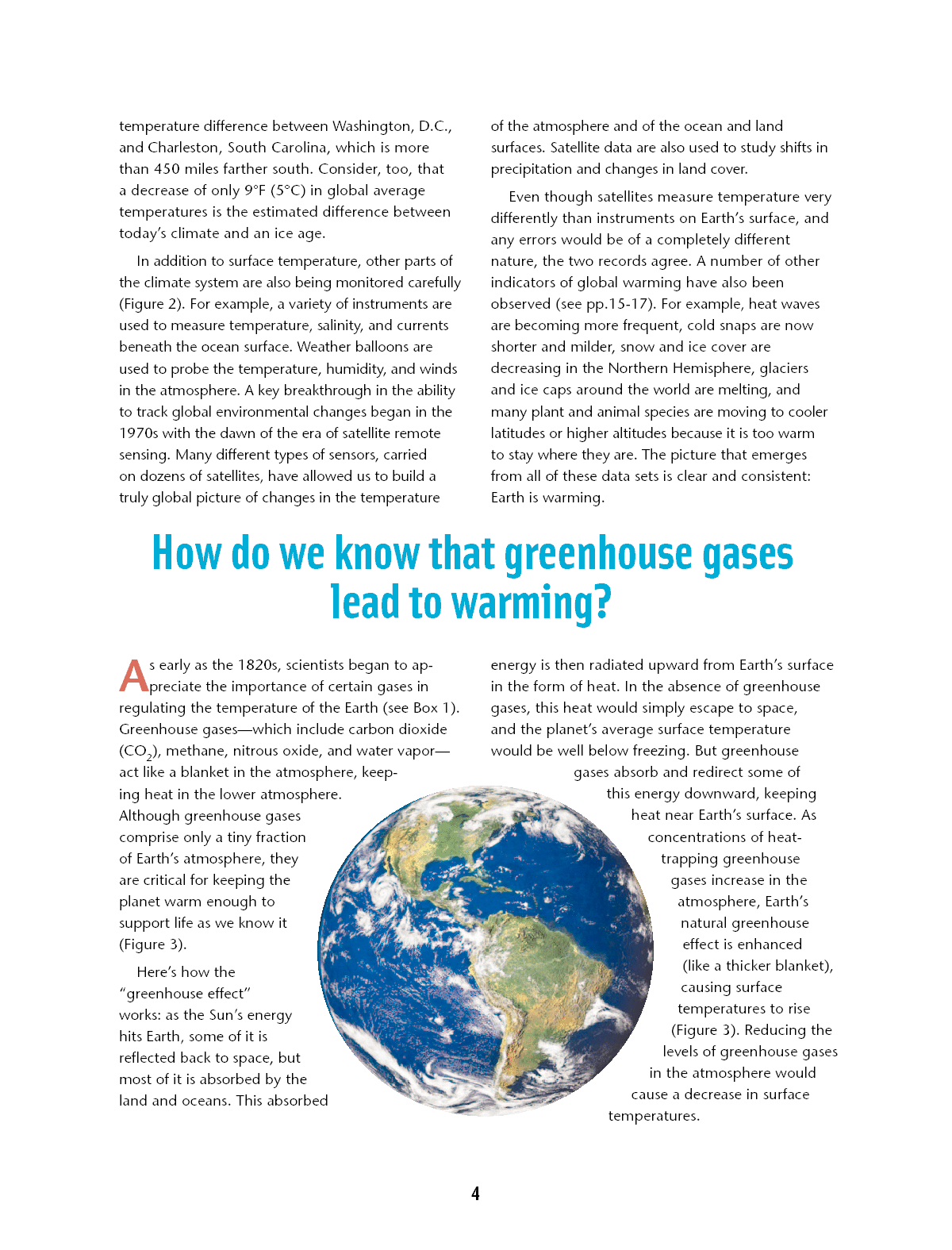
temperature difference between Washington, D.C., of the atmosphere and of the ocean and land and Charleston, South Carolina, which is more surfaces. Satellite data are also used to study shifts in than 450 miles farther south. Consider, too, that precipitation and changes in land cover. a decrease of only 9°F (5°C) in global average Even though satellites measure temperature very temperatures is the estimated difference between differently than instruments on Earth's surface, and today's climate and an ice age. any errors would be of a completely different In addition to surface temperature, other parts of nature, the two records agree. A number of other the climate system are also being monitored carefully indicators of global warming have also been (Figure 2). For example, a variety of instruments are observed (see pp.15-17). For example, heat waves used to measure temperature, salinity, and currents are becoming more frequent, cold snaps are now beneath the ocean surface. Weather balloons are shorter and milder, snow and ice cover are used to probe the temperature, humidity, and winds decreasing in the Northern Hemisphere, glaciers in the atmosphere. A key breakthrough in the ability and ice caps around the world are melting, and to track global environmental changes began in the many plant and animal species are moving to cooler 1970s with the dawn of the era of satellite remote latitudes or higher altitudes because it is too warm sensing. Many different types of sensors, carried to stay where they are. The picture that emerges on dozens of satellites, have allowed us to build a from all of these data sets is clear and consistent: truly global picture of changes in the temperature Earth is warming. How do we know that greenhouse gases lead to warming? A s early as the 1820s, scientists began to ap- preciate the importance of certain gases in regulating the temperature of the Earth (see Box 1). energy is then radiated upward from Earth's surface in the form of heat. In the absence of greenhouse gases, this heat would simply escape to space, Greenhouse gases--which include carbon dioxide and the planet's average surface temperature (CO2), methane, nitrous oxide, and water vapor-- would be well below freezing. But greenhouse act like a blanket in the atmosphere, keep- gases absorb and redirect some of ing heat in the lower atmosphere. this energy downward, keeping Although greenhouse gases heat near Earth's surface. As comprise only a tiny fraction concentrations of heat- of Earth's atmosphere, they trapping greenhouse are critical for keeping the gases increase in the planet warm enough to atmosphere, Earth's support life as we know it natural greenhouse (Figure 3). effect is enhanced Here's how the (like a thicker blanket), "greenhouse effect" causing surface works: as the Sun's energy temperatures to rise hits Earth, some of it is (Figure 3). Reducing the reflected back to space, but levels of greenhouse gases most of it is absorbed by the in the atmosphere would land and oceans. This absorbed cause a decrease in surface temperatures. 4
FIGURE 3 Amplification of the Greenhouse Effect The greenhouse effect is a natural phenomenon that is essential to E v i d e n c e f o r H u m a n - C a u s e d C l i m at e C h a n g e keeping the Earth's surface warm. Like a greenhouse window, greenhouse gases allow sunlight to enter and then prevent heat from leaving the atmosphere. These gases include carbon dioxide (CO2), methane (CH4), nitrous oxide (N2O), and water vapor. Human activities--especially burning fossil fuels--are increasing the concentrations of many of these gases, amplifying the natural greenhouse effect. Image courtesy of the Marian Koshland Science Museum of the National Academy of Sciences Box 1 Early Understanding of Greenhouse Gases In 1824, French physicist Joseph Fourier (top) was the first to suggest that the Earth's atmosphere might act as an insulator of some kind--the first proposal of what was later called the greenhouse effect. In the 1850s, Irish- born physicist John Tyndall (middle) was the first to demonstrate the greenhouse effect by showing that water vapor and other atmospheric gases absorbed Earth's radiant heat. In 1896, Swedish scientist Svante Arrhenius (bottom) was the first to calculate the warming power of excess carbon dioxide (CO2). From his calculations, Arrhenius predicted that if human activities increased CO2 levels in the atmosphere, a warming trend would result. 5
FIGURE 4 The Carbon Cycle Carbon is continually exchanged between the atmosphere, ocean, biosphere, and land on a variety of timescales. In the short term, CO2 is exchanged continuously among plants, trees, animals, and the air through respiration and photosynthesis, and between the ocean and the atmosphere through gas exchange. Other parts of the carbon cycle, such as the weathering of rocks and the formation of fossil fuels, are much slower pro- cesses occurring over many centuries. For example, most of the world's oil reserves were formed when the remains of plants and animals were buried in sediment at the bottom of shallow seas hundreds of millions of years ago, and then exposed to heat and pressure over many millions of years. A small amount of this carbon is released naturally back into the atmosphere each year by volcanoes, completing the long-term carbon cycle. Human activities, espe- cially the digging up and burning of coal, oil, and natural gas for energy, are disrupting the natural carbon cycle by releasing large amounts of "fossil" carbon over a relatively short time period. Source: National Research Council How do we know that humans are causing greenhouse gas concentrations to increase? D iscerning the human influence on greenhouse gas concentrations is challenging because many greenhouse gases occur naturally in Earth's atmo- tional CO2 began to be released into the atmosphere much more rapidly than in the natural carbon cycle. Other human activities, such as cement production sphere. Carbon dioxide (CO2 ) is produced and con- and cutting down and burning of forests (deforesta- sumed in many natural processes that are part of the tion), also add CO2 to the atmosphere. carbon cycle (see Figure 4). However, once humans Until the 1950s, many scientists thought the began digging up long-buried forms of carbon such oceans would absorb most of the excess CO2 as coal and oil and burning them for energy, addi- released by human activities. Then a series of 6
FIGURE 5 FIGURE 6 Measurements of Atmospheric Carbon Dioxide Greenhouse Gas Concentrations for 2,000 Years The "Keeling Curve" is a set of careful measurements Analysis of air bubbles trapped in Antarctic ice cores of atmospheric CO2 that Charles David Keeling show that, along with carbon dioxide, atmospheric began collecting in 1958. The data show a steady concentrations of methane (CH4) and nitrous oxide annual increase in CO2 plus a small up-and-down (N2O) were relatively constant until they started to rise sawtooth pattern each year that reflects seasonal in the Industrial era. Atmospheric concentration units changes in plant activity (plants take up CO2 during indicate the number of molecules of the greenhouse spring and summer in the Northern Hemisphere, gas per million molecules of air for carbon dioxide E v i d e n c e f o r H u m a n - C a u s e d C l i m at e C h a n g e where most of the planet's land mass and land and nitrous oxide, and per billion molecules of air for ecosystems reside, and release it in fall and winter). methane. Image courtesy: U.S. Global Climate Research Source: National Research Council, 2010a Program scientific papers were published that examined the the Industrial Revolution, atmospheric CO2 dynamics of carbon dioxide exchange between concentrations were steady and then began to rise the ocean and atmosphere, including a paper by sharply beginning in the late 1800s (Figure 6). oceanographer Roger Revelle and Hans Seuss in Today, atmospheric CO2 concentrations exceed 390 1957 and another by Bert Bolin and Erik Eriksson parts per million--nearly 40% higher than in 1959. This work led scientists to the hypothesis preindustrial levels, and, according to ice core data, that the oceans could not absorb all of the CO2 higher than at any point in the past 800,000 years being emitted. To test this hypothesis, Revelle's (see Figure 14, p.18). colleague Charles David Keeling began collecting Human activities have increased the atmospheric air samples at the Mauna Loa Observatory in Hawaii concentrations of other important greenhouse to track changes in CO2 concentrations. Today, gases as well. Methane, which is produced by such measurements are made at many sites around the burning of fossil fuels, the raising of livestock, the world. The data reveal a steady increase in the decay of landfill wastes, the production and atmospheric CO2 (Figure 5). transport of natural gas, and other activities, To determine how CO2 concentrations varied increased sharply through the 1980s before prior to such modern measurements, scientists have starting to level off at about two-and-a-half studied the composition of air bubbles trapped in times its preindustrial level (Figure 6). Nitrous ice cores extracted from Greenland and Antarctica. oxide has increased by roughly 15% since 1750 These data show that, for at least 2,000 years before (Figure 6), mainly as a result of agricultural 7
+ = Land Sink Emissions Atmospheric Concentration Growth Ocean Sink FIGURE 7 Emissions Exceed Nature's CO2 Drain Emissions of CO2 due to fossil fuel burning and cement manufacture are increasing, while the capacity of "sinks" that take up CO2--for example, plants on land and in the ocean--are decreasing. Atmospheric CO2 is increasing as a result. Source: National Research Council, 2011a fertilizer use, but also from fossil fuel burning and analyses show that about 45% of the CO2 emitted certain industrial processes. Certain industrial by human activities remains in the atmosphere. chemicals, such as chlorofluorocarbons (CFCs), Just as a sink will fill up if water is entering it faster act as potent greenhouse gases and are long-lived than it can drain, human production of CO2 is in the atmosphere. Because CFCs do not have outstripping Earth's natural ability to remove it natural sources, their increases can be attributed from the air. As a result, atmospheric CO2 levels are unambiguously to human activities. increasing (see Figure 7) and will remain elevated In addition to direct measurements of CO2 for many centuries. Furthermore, a forensic-style concentrations in the atmosphere, scientists have analysis of the CO2 in the atmosphere reveals the amassed detailed records of how much coal, oil, chemical "fingerprint" of carbon from fossil fuels and natural gas is burned each year. They also (see Box 2). Together, these lines of evidence prove estimate how much CO2 is being absorbed, on conclusively that the elevated CO2 concentration in average, by the oceans and the land surface. These the atmosphere is the result of human activities. Box 2 Clues from the "fingerprint" of carbon dioxide. In a process that takes place over millions of years, carbon from the decay of plants and animals is stored deep in the Earth's crust in the form of coal, oil, and natural gas (see Figure 4). Because this "fossil" carbon is so old, it contains very little of the radioisotope carbon-14--a form of the carbon that decays naturally over long time periods. When scientists measure carbon-14 levels in the atmosphere, they find that it is much lower than the levels in living ecosystems, indicating that there is an abundance of "old" carbon. While a small fraction of this old carbon can be attributed to volcanic eruptions, the overwhelming majority comes from the burning of fossil fuels. Average CO2 emissions from volcanoes are about 200 million tons per year, while humans are emitting an estimated 36 billion tons of CO2 each year, 80-85% of which are from fossil fuels. 8
How much are human activities heating Earth? G reenhouse gases are referred to as "forcing agents" because of their ability to change the planet's a cooling effect because they scatter a portion of incoming sunlight back into space (see Box 3). Human activities, energy balance. A forcing agent especially the burning of fossil fuels, can "push" Earth's temperature have increased the number of up or down. Greenhouse gases aerosol particles in the atmosphere, differ in their forcing power. especially over and around major For example, a single methane urban and industrial areas. molecule has about 25 times Changes in land use and land the warming power of a single cover are another way that human CO2 molecule. However, CO2 has a activities are influencing Earth's climate. much larger overall warming effect than Deforestation is responsible for 10% to 20% of methane because it is much more abundant and the excess CO2 emitted to the atmosphere each stays in the atmosphere for much longer periods year, and, as has already been discussed, agriculture of time. Scientists can calculate the forcing power contributes nitrous oxide and methane. Changes in of greenhouse gases based on the changes in their land use and land cover also modify the reflectivity concentrations over time and on physically based of Earth's surface; the more reflective a surface, the calculations of how they transfer energy through the more sunlight is sent back into space. Cropland is E v i d e n c e f o r H u m a n - C a u s e d C l i m at e C h a n g e atmosphere. generally more reflective than an undisturbed forest, Some forcing agents push Earth's energy balance while urban areas often reflect less energy than toward cooling, offsetting some of the heating undisturbed land. Globally, human land use changes associated with greenhouse gases. For example, are estimated to have a slight cooling effect. some aerosols--which are tiny liquid or solid When all human and natural forcing agents are particles suspended in the atmosphere, such as those considered together, scientists have calculated that that make up most of the visible air pollution--have the net climate forcing between 1750 and 2005 is Box 3 Warming and Cooling Effects of Aerosols Aerosols are tiny liquid or solid particles suspended in the atmosphere that come from a number of human activities, such as fossil fuel combustion, as well as natural processes, such as dust storms, volcanic eruptions, and sea spray emissions from the ocean. Most of our visible air pollution is made up of aerosols. Most aerosols have a cooling effect, because they scatter a portion of incoming sunlight back into space, although some particles, such as dust and soot, actually absorb some solar energy and thus act as warming agents. Many aerosols also enhance the reflection of sunlight back to space by making clouds brighter, which results in additional cooling. Many nations, states, and communities have taken action to reduce the concentrations of certain air pollutants such as the sulfate aerosols responsible for acid rain. Unlike most of the greenhouse gases released by human activities, aerosols only remain in the atmosphere for a short time--typically a few weeks. 9
pushing Earth toward warming (Figure 8). The extra energy is about 1.6 Watts per square meter of Earth's surface. When multiplied by the surface area of Earth, this energy represents more than 800 trillion Watts (Terawatts)--on a per year basis, that's about 50 times the amount of power produced by all the power plants of the world combined! This extra energy is being added to Earth's climate system every second of every day. The total amount of warming that will occur in response to a climate forcing is determined by a variety of feedbacks, which either amplify or dampen the initial warming. For example, as Earth warms, polar snow and ice melt, allowing the darker colored Energy (Watts/m2) land and oceans to absorb more heat--causing Earth to become even warmer, which leads to more snow FIGURE 8 and ice melt, and so on (see Figure 9). Another impor- Warming and Cooling Influences on Earth Since 1750 The warming and cooling influences tant feedback involves water vapor. The amount of (measured in Watts per square meter) of various cli- water vapor in the atmosphere increases as the ocean mate forcing agents during the Industrial Age (from surface and the lower atmosphere warm up; warm- about 1750) from human and natural sources has been calculated. Human forcing agents include increases in ing of 1°C (1.8°F) increases water vapor by about greenhouse gases and aerosols, and changes in land 7%. Because water vapor is also a greenhouse gas, use. Major volcanic eruptions produce a temporary this increase causes additional warming. Feedbacks cooling effect, but the Sun is the only major natural factor with a long-term effect on climate. The net ef- that reinforce the initial climate forcing are referred fect of human activities is a strong warming influence to in the scientific community as positive, or ampli- of more than 1.6 Watts per square meter. Source: Na- fying, feedbacks. tional Research Council, 2010a (Depiction courtesy U.S. Global Climate Research Program) There is an inherent time lag in the warming that is caused by a given climate forcing. This lag occurs TEMPERATURES RISE because it takes time for parts of Earth's climate systems--especially the massive oceans--to warm or cool. Even if we could hold all human-produced forcing agents at present-day values, Earth would continue to warm well beyond the 1.4°F already ob- served because of human emissions to date. Climate Feedback Loops The amount of warming ARCTIC SEA that occurs because of increased greenhouse gas AS REFLECTIVE ICE MELTS emissions depends in part on feedback loops. ICE DISAPPEARS, Positive (amplifying) feedback loops increase the DARKER OCEAN net temperature change from a given forcing, while WATER ABSORBS MORE HEAT negative (damping) feedbacks offset some of the temperature change associated with a climate forcing. The melting of Arctic sea ice is an example of a positive feedback loop. As the ice melts, less sunlight is reflected back to space and more is absorbed into the dark ocean, causing further warming and further melting of FIGURE 9 ice. Source: National Research Council, 2011d 10
How do we know the current warming trend isn't caused by the Sun? A nother way to test a scientific theory is to in- vestigate alternative explanations. Because the Sun's output has a strong influence on Earth's the Sun's output has not shown a net increase dur- ing the past 30 years (Figure 10) and thus cannot be responsible for the warming during that period. temperature, scientists have examined records of Prior to the satellite era, solar energy output had solar activity to determine if changes in solar output to be estimated by more indirect methods, such as might be responsible for the observed global warm- records of the number of sunspots observed each ing trend. The most direct measurements of solar year, which is an indicator of solar activity. These output are satellite readings, which have been avail- indirect methods suggest there was a slight increase able since 1979. These satellite records show that in solar energy reaching Earth during the first few Measures of the Sun's Energy Satellite measurements of the Sun's energy incident on Earth, available since 1979, show no net increase in solar forcing during the past 30 years. They E v i d e n c e f o r H u m a n - C a u s e d C l i m at e C h a n g e show only small periodic variations associated with the 11-year solar cycle. Source: National Research Council, 2010a FIGURE 10 Warming Patterns in the Layers of the Atmosphere Data from weather balloons and satellites show a warming trend in the troposphere, the lower layer of the atmosphere, which extends up about 10 miles (lower graph), and a cooling trend in the stratosphere, which is the layer immediately above the troposphere (upper graph). This is exactly the pattern expected from increased greenhouse gases, which trap energy closer to the Earth's surface. Source: National Research Council, 2010a FIGURE 11 11
decades of the 20th century. This increase may have atmosphere since the late 1970s. Both of these data contributed to global temperature increases during sets have been heavily scrutinized, and both show a that period, but does not explain warming in the warming trend in the lower layer of the atmosphere latter part of the century. (the troposphere) and a cooling trend in the Further evidence that current warming is not upper layer (the stratosphere) (Figure 11). This is a result of solar changes can be found in the exactly the vertical pattern of temperature changes temperature trends in the different layers of the expected from increased greenhouse gases, atmosphere. These data come from two sources: which trap energy closer to the Earth's surface. If weather balloons, which have been launched an increase in solar output were responsible for twice daily from hundreds of sites worldwide the recent warming trend, the vertical pattern of since the late 1950s, and satellites, which have warming would be more uniform through the monitored the temperature of different layers of the layers of the atmosphere. How do we know that the current warming trend is not caused by natural cycles? D etecting climate trends is complicated by the fact that there are many natural temperatures tend to be higher during El Niño periods, such as 1998, and lower during La variations in temperature, Niña years, such as 2008. precipitation, and other However, these up-and- climate variables. These down fluctuations are natural variations are smaller than the 20th cen- caused by many different tury warming trend; 2008 processes that can occur was still quite a warm year across a wide range of in the long-term record. timescales--from a particularly Natural climate variations can warm summer or snowy winter also be forced by slow changes in to changes over many millions of the Earth's orbit around the Sun that years. affect the solar energy received by Earth, as Among the most well-known short-term cli- is the case with the Ice Age cycle (see pp. 18-19) matic fluctuations are El Niño and La Niña, which or by short-term changes in the amount of volca- are periods of natural warming and cooling in the nic aerosols in the atmosphere. Major eruptions, tropical Pacific Ocean. Strong El Niño and La Niña like that of Mount Pinatubo in 1991, spew huge events are associated with significant year-to-year amounts of particles into the stratosphere that changes in temperature and rainfall patterns across cool Earth. However, surface temperatures typically many parts of the planet, including the United rebound in 2-5 years as the particles settle out of States. These events have been linked to a number the atmosphere. The short-term cooling effects of of extreme weather events, such as the 1992 flood- several large volcanic eruptions can be seen in the ing in midwestern states and the severe droughts 20th century temperature record, as can the global in southeastern states in 2006 and 2007. Globally, temperature variations associated with several 12
strong El Niño and La Niña events, but an overall warming trend is still evident (Figure 12). In order to put El Niño and La Niña events and other short-term natural fluctuations into perspec- tive, climate scientists examine trends over several decades or longer when assessing the human influ- ence on the climate system. Based on a rigorous as- sessment of available temperature records, climate forcing estimates, and sources of natural climate variability, scientists have concluded that there is a more than 90% chance that most of the observed global warming trend over the past 50 to 60 years can be attributed to emissions from the burning of fossil fuels and other human activities. Such statements that attribute climate change to human activities also rely on information from Short-term Temperature Effects of Natural Climate Variations Natural factors, such as volcanic eruptions and El Niño and La Niña events, can cause average global temperatures to vary from one year E v i d e n c e f o r H u m a n - C a u s e d C l i m at e C h a n g e to the next, but cannot explain the long-term warming trend over the past 60 years. Image courtesy of the Marian Koshland Science Museum FIGURE 12 Model Runs With and Without Human Influences Model simulations of 20th-century surface temperatures more closely match observed temperature when both natural and human influences are included in the simulations. The black line shows an estimate of observed surface temperatures changes. The blue line shows results from models that only include natural forcings (solar activity and volcanoes). The red-shaded regions show results from models that include both natural and human forcings. Source: Meehl et al, 2011 FIGURE 13 13
CLOUD S & WATE R VAPOR RADIATIVE EXCHANGE EXCHANGE OF HEAT & WIN D GAS ES BETWEEN ATMOS P HERE, S EA ICE & OCEAN E VAPOTRAN SPIRATION EVAPORATION CONDENSATION & CONV ECTION WAT E R S TORAGE AIR POLLUTION I N I C E & SNOW GLACIER MELT TERRES TRIAL CARBON CYCLE S U R FAC E R U N-OFF OCEAN OCEAN CARBON CYCLE CIRCULATION Box 4 What are climate models? For several decades, scientists have used the world's most ad- vanced computers to simulate the Earth's climate. These models are based on a series of mathemati- cal equations representing the basic laws of physics--laws that govern the behavior of the atmo- sphere, the oceans, the land surface, and other parts of the climate system, as well as the interactions among different parts of the system. Climate models are important tools for understanding past, present, and future climate change. Climate models are tested against observations so that scientists can see if the models correctly simulate what actually happened in the recent or distant past. Image courtesy Marian Koshland Science Museum climate models (see Box 4). Scientists have used turbed Earth" simulations predict that, in the ab- these models to simulate what would have happened sence of human activities, there would have been if humans had not modified Earth's climate during negligible warming, or even a slight cooling, over the 20th century--that is, how global tempera- the 20th century. When greenhouse gas emissions tures would have evolved if only natural factors and other activities are included in the models, how- (volcanoes, the Sun, and internal climate variability) ever, the resulting surface temperature changes more were influencing the climate system. These "undis- closely resemble the observed changes (Figure 13). 14
What other climate changes and impacts have already been observed? R ising temperatures due to increasing greenhouse gas concentrations have produced distinct pat- terns of warming on Earth's surface, with stronger lite monitoring began in 1978 (Figure 16). This melting has been especially strong in late summer, leaving large parts of the Arctic Ocean ice-free for warming over most land areas and in the Arctic. weeks at a time and raising questions about effects There have also been significant seasonal differences on ecosystems, commercial shipping routes, oil in observed warming. For example, the second half and gas exploration, and national defense. Many of the 20th century saw intense winter warming of the world's glaciers and ice sheets are melting in across parts of Canada, Alaska, and northern Europe response to the warming trend, and long-term av- and Asia, while summer warming was particularly erage winter snowfall and snowpack have declined strong across the Mediterranean and Middle East in many regions as well, such as the Sierra Nevada and some other places, including parts of the U.S. mountain range in the western United States. west (Figure 15). Heat waves and record high tem- Much of the excess heat caused by human-emit- peratures have increased across most regions of the ted greenhouse gases has warmed the world's world, while cold snaps and record cold tempera- oceans during the past several decades. Water ex- tures have decreased. pands when it warms, which leads to sea-level rise. Global warming is also having a significant im- Water from melting glaciers, ice sheets, and ice caps pact on snow and ice, especially in response to the also contributes to rising sea levels. Measurements E v i d e n c e f o r H u m a n - C a u s e d C l i m at e C h a n g e strong warming across the Arctic. For example, made with tide gauges and augmented by satellites the average annual extent of Arctic sea ice has show that, since 1870, global average sea level has dropped by roughly 10% per decade since satel- risen by about 8 inches (0.2 meters). It is estimated FIGURE 15 Patterns of Warming in Winter and Summer Twenty-year average temperatures for 1986-2005 compared to 1955-1974 show a distinct pattern of winter and summer warming. Winter warming has been intense across parts of Canada, Alaska, northern Europe, and Asia, and summers have warmed across the Mediterranean and Middle East and some other places, including parts of the U.S. west. Projections for the 21st century show a similar pattern. Source: National Research Council, 2011a 15
FIGURE 16 Loss of Arctic Sea Ice Satellite-based measurements show a steady decline in the amount of September (end of summer) Arctic sea ice extent from 1979 to 2009 (expressed as a percentage difference from 1979- 2000 average sea ice extent, which was 7.0 million square miles). The data show substantial year-to-year variability, but a long-term decline in sea ice of more than 10% per decade is clearly evident, highlighted by the dashed line. Source: National Research Council, 2010a that roughly one-third of the total sea-level rise over the past four decades can be attributed to ocean FIGURE 17 expansion, with most of the remainder due to ice Contributors to Sea-Level Rise melt (Figure 17). Sea level has risen steadily over the past few decades due to various contributors: thermal expansion in the Because CO2 reacts in seawater to form carbonic upper 700 meters of ocean (red) and deeper ocean acid, the acidification of the world's oceans is an- layers (orange), meltwater from Antarctic and Green- land ice sheets (blue), meltwater from glaciers and other certain outcome of elevated CO2 concentra- ice caps (purple), and water storage on land (green). tions in the atmosphere (Figure 18). It is estimated Source: National Research Council, 2011a that the oceans have absorbed between one-quarter and one-third of the excess CO2 from human activi- ties, becoming nearly 30% more acidic than during the frequency and distribution of precipitation. Total preindustrial times. Geologically speaking, this large precipitation in the United States has increased by change has happened over a very short timeframe, about 5% over the past 50 years, but this has not and mounting evidence indicates it has the poten- been geographically uniform--conditions are gener- tial to radically alter marine ecosystems, as well as ally wetter in the Northeast, drier in the Southeast, the health of coral reefs, shellfish, and fisheries. and much drier in the Southwest. Another example of a climate change observed Warmer air holds more water vapor, which has led during the past several decades has been changes in to a measurable increase in the intensity of precipita- 16
Evidence of Ocean Acidification With excess CO2 building up in the atmo- sphere, scientists wanted to know if it was also accumulating in the ocean. Studies that began in the mid-1980s show that the concentration of CO2 in ocean water (in blue, calculated from the partial pressure of CO2 in seawater) has risen in parallel with the increase in atmospheric CO2 (in red, part of the Keeling curve). At the same time, the ocean has become more acidic, because the CO2 reacts with seawater to form carbonic acid. The orange dots are direct measurements of pH in surface seawater (lower pH being more acidic), and the green dots are calculated based on the chemical properties of seawater. Source: National Research Council, 2010d FIGURE 18 tion events. In the United States, for example, the earlier, while other species are altering their seasonal fraction of total precipitation falling in the heaviest breeding patterns. Global analyses show these 1% of rainstorm increased by about 20% over the behaviors occurred an average of 5 days earlier past century, with the northeastern states experienc- per decade from 1970 to 2000. Such changes can ing an increase of 54%. This change has increased disrupt feeding patterns, pollination, and other vital the risk of flooding and puts additional stress on interactions between species, and they also affect E v i d e n c e f o r H u m a n - C a u s e d C l i m at e C h a n g e sewer and stormwater management systems. the timing and severity of insects, disease outbreaks, As the climate has changed, many species have and other disturbances. In the western United shifted their range toward the poles and to higher States, climate change has increased the population altitudes as they try to stay in areas with the same of forest pests such as the pine beetle. ambient temperatures. The timing of different The next section describes how observed climate seasonal activities is also changing. Several plant trends and impacts are predicted to continue if species are blooming earlier in Spring, and some emissions of human-produced greenhouse gases are birds, mammals, fish, and insects are migrating maintained during the next century and beyond. Climate change has increased the population of forest pests in the western United States. The red trees in this photo of Dillon Reservoir in Colorado have died from an infestation of mountain pine beetle. 17
The Ice Ages Perhaps the most dramatic example of natural climate variability over long time periods is the Ice Age cycle. Detailed analyses of ocean sediments, ice cores, and other data show that for at least 800,000 years, and probably for the past 4 to 5 million years, the Earth has gone through extended periods when temperatures were much lower than today and thick blankets of ice covered large areas of the Northern Hemisphere. These long cold spells, which typically lasted for around 100,000 years, were interrupted by shorter warm "interglacial" periods, including the past 10,000 years (Figure 14). Through a convergence of theory, observations, and modeling, scientists have deduced that the ice ages are caused by slight recurring variations in Earth's orbit that alter the amount and seasonal distribution of solar energy reaching the Northern Hemisphere. These relatively small changes in solar energy are reinforced over thousands of years by gradual changes in Earth's ice cover (the cryosphere) and ecosystems (the biosphere), eventually leading to large changes in global 800,000 Years of Temperature and Carbon Dioxide Records As ice core records from Vostok, Antarctica, show, the tempera- ture near the South Pole has varied by as much as 20°F (11°C) during the past 800,000 years. The cyclical pattern of tempera- ture variations constitutes the ice age/interglacial cycles. During these cycles, changes in carbon dioxide concentrations (in red) track closely with changes in temperature (in blue), with CO2 lagging behind temperature changes. Because it takes a while for snow to compress into ice, ice core data are not yet available much beyond the 18th century at most locations. However, atmo- spheric carbon dioxide levels, as measured in air, are higher today than at any time during the past 800,000 years. Source: National Research Council, 2010a FIGURE 14 18
temperature. The average global temperature change during an ice age cycle, which occur over about 100,000 years, is on the order of 9°F ± 2°F (5°C ± 1°C). The data show that in past ice age cycles, changes in temperature have led--that is, started prior to--changes in CO2. This is because the changes in temperature induced by changes in Earth's orbit around the Sun lead to gradual changes in the biosphere and the carbon cycle, and thus CO2, reinforcing the initial temperature trend. In contrast, the relatively rapid release of CO2 and other greenhouse gases since the start of the Industrial Revolution from the burning of fossil fuel has, E v i d e n c e f o r H u m a n - C a u s e d C l i m at e C h a n g e in essence, reversed the pattern: the additional CO2 is acting as a climate forcing, with temperatures increasing afterward. The ice age cycles nicely illustrate how climate forcing and feedback The U.S. Geological Survey National Ice Core Lab stores ice cores samples taken from polar ice caps effects can alter Earth's temperature, but and mountain glaciers. Ice cores provide clues there is also direct evidence from past about changes in Earth's climate and atmosphere going back hundreds of thousands of years. climates that large releases of carbon dioxide have caused global warming. One of the largest known events of this type is called the Paleocene-Eocene Thermal Maximum, or PETM, which occurred about 55 million years ago, when Earth's climate was much warmer than today. Chemical indicators point to a huge release of carbon dioxide that warmed Earth by another 9°F and caused widespread ocean acidification. These climatic changes were accompanied by massive ecosystem changes, such as the emergence of many new types of mammals on land and the extinction of many bottom- dwelling species in the oceans. 19
