
2
The Basis of Pain
This chapter reviews the basis of pain in animals from a comparative perspective and uses the definitions of pain and nociception provided in Chapter 1. Scientific understanding of pain in animals has been derived in part from comparative studies and from studies in animals in which pain was the experimental variable. Much of what we know about the central nervous system (CNS) mechanisms of pain is derived from animal studies, and they will continue to be important in increasing our understanding of pain mechanisms in both humans and animals (Kitchell et al., 1983). This chapter therefore makes comparisons between humans and animals and refers to experimental pain paradigms in animals as a model for discussing avoidance, recognition, and alleviation of pain.
PERIPHERAL MECHANISMS OF NOCICEPTION
An understanding of how the pain sensing system works is critical for controlling pain. There is a long-standing controversy about how signals related to tissue damage are transmitted to the CNS (Dubner et al., 1978). Earlier theories proposed that pain resulted from the excessive stimulation of all types of peripheral receptors and that the brain merely received information about the threat of tissue damage (for review, see Melzack and Wall, 1965). An alternative theory proposed that specialized receptors in peripheral tissues encoded features of tissue-damaging stimuli—their quality, location, intensity, and duration. The theory of neuronal specialization in the pain sensing system has received considerable support from the finding of specialized receptors that signal tissue damage (Dubner and Bennett,
1983; Willis, 1985) or intense stimulation of muscle or visceral tissue. Those peripheral receptors are called nociceptors, and they can be classified according to how they respond to intense mechanical, thermal, or chemical stimuli. With minor exceptions, nociceptive fibers have finely myelinated or unmyelinated axons. Most, if not all, mammalian species have such nociceptors. The most extensively studied nociceptors are the ones that have myelinated axons and respond only to intense mechanical or mechanical and thermal stimuli and the so-called polymodal nociceptors, which have unmyelinated axons and respond to mechanical, thermal, and chemical stimuli. The myelinated nociceptors appear to encode signals related to pricking first-pain sensations produced by noxious mechanical or thermal stimuli. Second-pain sensations, which follow first-pain sensations and have a burning quality, appear to be encoded by signals arising from unmyelinated nociceptors (Price et al., 1977).
Tissue injury produces a state of hyperalgesia (excessive sensitivity to pain) at the site of injury with increased sensitivity to stimuli and sometimes spontaneous pain sensations. Those alterations have distinct parallels to a phenomenon called sensitization observed in nociceptors. After repeated exposure to noxious heat stimuli, nociceptors exhibit lower thresholds, increased sensitivity to stimuli that exceed their thresholds, and spontaneous activity. Both mechanical-thermal nociceptors and polymodal nociceptors mediate, in part, the hyperalgesia produced by mild thermal injury in humans (Meyer et al., 1985).
MEDIATORS OF INFLAMMATION AND PAIN
Sensitization and hyperalgesia involve the release of various chemical mediators (Hargreaves and Dubner, 1991). A simplification of this process is as follows: Cell injury results in the release of prostaglandins, leukotrienes, bradykinin, substance P, and other autacoids. These products, acting in concert with one another, contribute to inflammation and associated sensitivity and pain, as evidenced by increased vascular permeability, increased leukocyte migration, and increased sensitivity of nociceptors.
Products of arachidonic acid metabolism are mediators of inflammation. Arachidonic acid is released after cell injury from phospholipids embedded in cell membranes. Metabolism proceeds in two directions: The enzyme cyclo-oxygenase converts arachidonic acid to prostaglandins, which increase vascular permeability, activate leukocyte migration, and sensitize nociceptors; and the enzyme lipoxygenase results in the formation of leukotrienes, some of which increase vascular permeability and chemotaxis of polymorphonuclear leukocytes. Leukotriene B4 results in the release from leukocytes of chemicals that produce sensitization of nociceptors.
Another important inflammatory mediator is bradykinin. The precursors of bradykinin circulate in the blood and are released into the tissue whenever there is damage. Injury results in an increase in tissue acidity and in the conversion of the enzyme prekallikrein to kallikrein. Kallikrein then acts on the bradykinin precursor
kininogen to release bradykinin into the tissue. Bradykinin increases vascular permeability, promotes vasodilatation, induces leukocyte chemotaxis, and activates nociceptors. The action of bradykinin on nociceptors is potentiated by prostaglandins present in injured tissue.
A third important inflammatory mediator, substance P, released from the peripheral endings of nociceptors after injury, results in plasma extravasation and induces the release of histamine from mast cells and of serotonin from platelets.
The various mediators of inflammation not only increase the excitability of nociceptors in the tissue space, but also result in the release from nerve endings of neuropeptides, such as substance P and calcitonin gene-related peptide, that participate in the development of the inflammatory process. The clinical significance is that blockage of the development of the mediators can reduce pain; the most notable example is the effectiveness of nonsteroidal anti-inflammatory drugs (e.g., aspirin) in inhibiting the conversion of arachidonic acid to prostaglandins and thereby producing analgesia. (See Chapter 4 for additional information on biochemical mediators of pain and stress.)
DORSAL HORN NOCICEPTIVE MECHANISMS
Two general classes of neurons in the spinal and medullary dorsal horns receive input from peripheral nociceptors (reviewed by Dubner and Bennett, 1983). One class, nociceptive-specific neurons, respond only to intense forms of mechanical, thermal, and other noxious stimuli and receive input exclusively from nociceptors. The second class, wide-dynamic-range neurons, are activated by hair movement and weak mechanical stimuli, but respond maximally to intense stimulation, such as a pinch or pinprick. Many wide-dynamic-range neurons respond to noxious heat; they receive input from low-threshold mechanoreceptors, as well as from nociceptors. Recent studies have shown that wide-dynamic-range neurons, but not nociceptive-specific neurons, participate in the encoding process by which monkeys perceive the intensity of noxious stimuli (Dubner et al., 1989).
Some wide-dynamic-range and nociceptive-specific neurons are components of long projection pathways that relay information to the thalamus and from there to the cerebral cortex. Others are local-circuit neurons whose axons are confined to the dorsal horn. Four major long projection pathways appear to be important in nociceptive transmission (Figure 2-1): the spinothalamic tract, the spinocervical tract, the spinomesencephalic tract, and the dorsal column postsynaptic spinomedullary system (Dubner and Bennett, 1983). The relative importance of each system is not entirely clear and likely depends on the species. The evidence of a role in pain transmission is most extensive for the spinothalamic tract, which for a long time was considered the only long projection system encoding information about actual or potential tissue damage. In humans, the importance of the spinothalamic tract is demonstrated by the profound, short-term analgesia that occurs caudal to its transection. That the analgesia is often not complete suggests
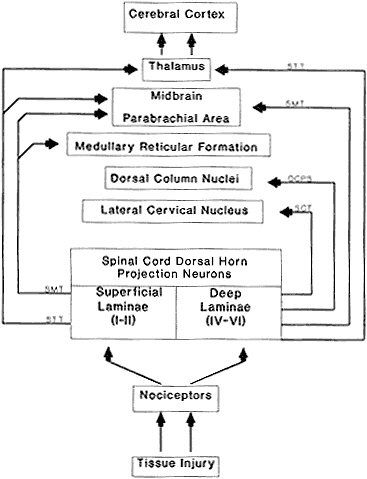
Figure 2-1 Diagram of ascending nociceptive pathways originating in spinal cord and medullary dorsal horns. Four major long projection pathways are spinothalamic tract (STT), spinocervical tract (SCT), spinomesencephalic tract (SMT), and dorsal column postsynaptic spinomedullary system (DCPS). Origins and terminations are shown.
that other systems are also involved in nociceptive transmission. The spinocervical tract is variable from species to species, larger in cats and much smaller in monkeys and humans. Spinocervical tract neurons are mainly low-threshold mechanoreceptive neurons, responding best to light touch or hair stimulation; a few are nociceptive neurons almost entirely of the wide-dynamic-range type. The spinomesencephalic tract is known to be present in rats, cats, and monkeys and sends bilateral projections
to the parabrachial region of the midbrain that includes the parabrachial nuclei, nucleus cuneiformis, and the lateral part of the ventral periaqueductal gray (Hylden et al., 1989). The dorsal column postsynaptic spinomedullary system has axons ascending mainly in the ipsilateral dorsal funiculus and terminates in the dorsal column nuclei in the medulla. In the lumbar enlargement of cats and monkeys, dorsal column postsynaptic spinomedullary system neurons are as numerous as cat lumbar spinocervical tract neurons. Most dorsal column postsynaptic spinomedullary system neurons are in the same lamina IV band as spinocervical tract neurons. The dorsal column postsynaptic spinomedullary system is composed mainly of wide-dynamic-range and low-threshold mechanoreceptive neurons with a few nociceptive-specific neurons.
Neurotransmitters that participate in the processing of nociceptive information have been studied extensively in the dorsal horn (Dubner, 1985; Ruda et al., 1986). Enkephalin and dynorphin, two opioid peptides that are the products of different genes, are found in the dorsal horn. Opioid-containing neurons can function as inhibitory or excitatory chemical mediators in local-circuit and long projection neurons. During inflammation, there is an increase in synthesis and content of both dynorphin and enkephalin in the dorsal horn (Iadarola et al., 1988; Draisci and Iadarola, 1989), and these changes involve both long projection neurons and local-circuit neurons (Nahin et al., 1989). The opioid neural circuitry in the dorsal horn is related to one mechanism of analgesic action of morphine, the most widely used opioid drug. It appears that opioid drugs alter the perceived intensity of noxious stimuli at the level of the dorsal horn by suppressing the activity of nociceptive wide-dynamic-range neurons (Oliveras et al., 1986). The ability of morphine and other opioids to act directly on the dorsal horn has led to their epidural and intrathecal administration in clinical situations (Yaksh and Rudy, 1978).
THALAMOCORTICAL MECHANISMS
The presence of terminations of the spinothalamic track is the ventrobasal and medial thalamus leaves little doubt that the thalamus plays an important role in pain (Willis, 1985). There is considerable evidence that neurons in the ventrobasal thalamus respond to tissue-damaging stimuli and have characteristics similar to those of the wide-dynamic-range and nociceptive-specific neurons in the spinal dorsal horn. It is now accepted that most neurons in the posterior nucleus of the thalamus respond to tactile inputs, but the role of this nucleus in nociception is not clear. The medial thalamus also receives input from the spinothalamic tract, and cells in this region have been reported to respond to noxious stimuli. The more medial nuclei project to wide areas of the cerebral cortex and to parts of the limbic system involved in motivation and affect; therefore, they probably play a role in the motivational-affective aspects of pain, rather than in its sensory-discriminative aspects. However, nociceptive neurons in the ventral posterior thalamic nuclei project to the primary somatosensory cortex, and that suggests their participation in
the processing of the sensory features of noxious stimuli. More recently, it has been shown in trained monkeys that wide-dynamic-range neurons in the cerebral cortex participate in the encoding process by which monkeys perceive the intensity of noxious heat stimuli (Kenshalo et al., 1988). Earlier findings in humans that lesions of the postcentral gyrus reduce pain and that stimulation of the exposed somatosensory cerebral cortex can sometimes produce pain constitute additional evidence of a role of the cerebral cortex in the elaboration of pain sensations.
DESCENDING CONTROL MECHANISMS
The above findings support the involvement of specialized neural pathways in the encoding of pain sensations. However, those pathways are not immutable and are subject to considerable modulation by descending control systems from many other brain sites (reviewed by Dubner and Bennett, 1983).
Electric stimulation in the midbrain periaqueductal gray and the midline raphe nuclei in the medulla (Figure 2-2) inhibits the activity of dorsal horn wide-dynamic-range and nociceptive-specific neurons (Mayer et al., 1971; reviewed by Mayer and Price, 1976; Wolfle and Liebeskind, 1983). Stimulation in those sites inhibits a wide variety of behaviors and reflexes induced by noxious stimuli. The direct administration of opioids at the sites with microinjection also suppresses dorsal horn activity and behaviors and reflexes produced by noxious stimuli. The
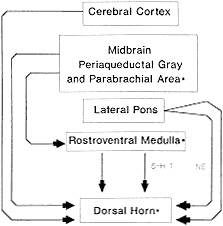
Figure 2-2 Diagram of some major descending pathways that modulate nociceptive output from dorsal horn. Neurochemical specificity of some pathways is known. NE, norepinephrine; 5-HT, serotonin (5-hydroxytryptamine). Some sites (*opioid-containing local neurons present) contain opioid-rich local-circuit neurons involved in modulatory effects.
administration of naloxone, a specific opioid antagonist, can block the effects of both electric stimulation and opioid administration. In humans, electric stimulation in periaqueductal and periventricular structures produces an analgesia that can be attenuated by the administration of naloxone (e.g., Hosobuchi et al., 1977).
On the basis of such findings, it was proposed and later established that the CNS has its own naturally occurring opioids. It is now known that there are three major families of endogenous opioid peptides, each the product of a different gene: the enkephalins, the dynorphins, and the endorphins. In addition to the opioid peptides, which probably contribute to analgesic processes in the CNS in a more localized fashion via relatively short neural circuits, longer, chemically specific descending neural systems containing norepinephrine or serotonin play major roles in the modulation of pain (Figure 2-2). Descending norepinophrine- or serotonin-containing pathways, originating in the medulla and pons, affect the output of wide-dynamic-range and nociceptive-specific neurons and alter responsiveness to noxious inputs.
The multiple descending circuits, probably interacting with opioid peptide-containing neurons in the spinal cord or brainstem, underlie the behavioral modulation of pain. In a more general sense, the descending and local circuits are mechanisms by which an organism extracts useful information from its environment. The identification of the multiple pain-suppressing pathways has led to a search for their physiologic role under natural conditions. Some forms of stress, fear, exercise, and disease states (e.g., hypertension), including pain itself, appear to activate the pathways. However, we still have only a few clues as to the role of the descending control systems in the processing of sensory information under ordinary behavioral conditions.


