
3
A Model for Disability and Disability Prevention
A common understanding of such terms as injury, impairment, handicap, functional limitation, and disability is essential to building effective, coherent prevention programs. Several frameworks have been advanced to describe disability-related concepts, but none has been universally adopted. The lack of a uniformly accepted conceptual foundation is an obstacle to epidemiological research and surveillance and to other elements critical to effective disability prevention programs. This chapter describes a conceptual framework of disability that is derived primarily from the works of Saad Nagi (1965; Appendix A, this volume) and the World Health Organization (1980). The framework is used as the basis upon which to build a model of the interacting influences involved in a stagelike disabling process that can lead to disability and that includes risk factors and quality of life.
CONCEPTUAL FRAMEWORK
There are two major conceptual frameworks in the field of disability: the International Classification of Impairments, Disabilities, and Handicaps (ICIDH), and the "functional limitation," or Nagi, framework, which is not accompanied by a classification system. The ICIDH is a trial supplement to the World Health Organization's International Classification of Diseases; it has stimulated extensive discussions of disability concepts, received both positive and negative reviews in the literature, and is used widely around the world. Several European countries including France and the Netherlands have adopted the ICIDH and use it extensively in administrative systems and clinical settings. As a classification system that has received broad international sponsorship the ICIDH deserves considerable attention, and the WHO is to be commended for its efforts in developing a system that has met with such success. As has
been pointed out in the literature, however, the ICIDH is neither a classification of persons nor a research tool.
The original intent of the ICIDH was to provide a framework to organize information about the consequences of disease (Haber, 1990). As such, the ICIDH has been considered by some as an intrusion of the medical profession into the social aspects of life—as a "medicalization of disablement" (Badley, 1987). The WHO is planning a revision of the ICIDH in the near future, however, which will provide opportunities for significant improvements.
Both frameworks (i.e., the ICIDH and the Nagi) have four basic concepts. In the ICIDH the four concepts are disease, impairment, disability, and handicap. In the Nagi framework the four concepts are pathology, impairment, functional limitation, and disability. Several authors have compared the two frameworks, and most have noted similarities, particularly between Nagi's concept of pathology and ICIDH's concept of disease and between the two frameworks' characterizations of impairment (Nagi, Appendix A, this volume; Duckworth, 1984; Frey, 1984; Granger, 1984; Haber, 1990).
The more important distinctions between the Nagi framework and the ICIDH occur in the last two conceptual categories and go beyond simple terminology. The ICIDH concept of disability seems to correspond to Nagi's concept of functional limitation, or "activities of daily living" (as used in the National Health Interview Survey), and the ICIDH concept of handicap (which subsumes role limitations) seems to correspond to Nagi's concept of disability. Both frameworks recognize that whether a person performs a socially expected activity depends not simply on the characteristics of the person, but also on the larger context of social and physical environments. Conceptual clarity, however, seems to be a problem with some of the classifications in the ICIDH. As Haber (1990) points out, for example, some of the classifications in the ICIDH are confusing, such as classifying certain social role limitations (e.g., family role, occupational role) under "behavior disabilities," instead of "occupation handicaps'' or "social integration handicaps." Another example (Haber, 1990) is the distinction between "orientation handicaps" and disabilities associated with self-awareness, postural, or environmental problems.
In considering the options for a conceptual framework, the committee was faced with the fact that the ICIDH includes the term handicap in its classification. Traditionally, handicap has meant limitations in performance, placing an individual at a disadvantage. Handicap sometimes has been used to imply an absolute limitation that does not require for its actualization any interaction with external social circumstances. In recent years, the term has fallen into disuse in the United States, primarily as a result of a feeling on the part of people with disabling conditions that handicap is a negative term.
Although the term handicap is used often as a synonym for disability in American legislation, at least three federal agencies have changed their
names to use the term disability instead of handicap: the former National Council on the Handicapped became the National Council on Disability in January 1989, the National Institute of Handicapped Research was redesignated the National Institute on Disability and Rehabilitation Research in 1986, and the President's Committee on Employment of the Handicapped was renamed the President's Committee on Employment of People with Disabilities in 1988. Mostly out of deference to those who feel that handicap is a denigrating term when used to describe a person, this committee decided not to use it. Yet the shadow of handicap as a commonly used term hovers behind the concept of "quality of life" and has the effect of reducing quality of life even though impairment, functional limitation, and even disability do not necessarily do so. Much as the term "cripple" has gone out of style, "handicap" seems to be approaching obsolescence, at least among people with disabilities in the United States.
The committee concurs with those who have noted internal inconsistencies and lack of clarity in the ICIDH concepts of disability and handicap (Nagi, Appendix A, this volume; Haber, 1990). It notes the opportunity and calls attention to the need for its pending revision, prefers not to use the term handicap in this context, and offers an alternative framework that does not focus on the consequences of disease. The committee's alternative framework draws on the widespread acceptance and success of the ICIDH and the conceptual clarity and terminology of the Nagi framework, and then adds risk factors and quality of life into a model of the disabling process. The committee found this framework and model to be useful in understanding and describing the relationships that exist among and between components of the disabling process as well as in identifying strategic points for preventive intervention. It is hoped that this will be considered as a viable alternative in the revisions of the WHO/ICIDH.
The conceptual framework used in this report is composed of four related but distinct stages: pathology, impairment, functional limitation, and disability. In the course of a chronic disorder, one stage can progress to the next. But depending on the circumstances, progressively greater loss of function need not occur, and the progression can be halted or reversed. Thus disability prevention efforts can be directed at any of the three stages that precede disability, as well as at the disability stage itself, where efforts can focus on reversal of disability, restoration of function, or prevention of complications (secondary conditions) that can greatly exacerbate existing limitations and lead to new ones. The four stages of the framework are summarized in Figure 3-1 and are briefly discussed below. A more detailed discussion and description of Nagi's concepts and terminology, vis-à-vis the alternative approach developed by the WHO (1980), appear in Appendix A. A recent editorial by Mervyn Susser (1990) adds considerable insight into the historical development of related concepts.
|
PATHOLOGY |
→ |
IMPAIRMENT |
→ |
FUNCTIONAL LIMITATION |
→ |
DISABILITY |
|
Interruption or interference of normal bodily processes or structures |
|
Loss and/or abnormality of mental, emotional, physiological, or anatomical structure or function; includes all losses or abnormalities, not just those attributable to active pathology; also includes pain |
|
Restriction or lack of ability to perform an action or activity in the manner or within the range considered normal that results from impairment |
|
Inability or limitation in performing socially defined activities and roles expected of individuals within a social and physical environment |
|
Level of reference |
|
|
|
|
|
|
|
Cells and tissues |
|
Organs and organ systems |
|
Organism—action or activity performance (consistent with the purpose or function of the organ or organ system) |
|
Society—task performance within the social and cultural context |
|
Example |
|
|
|
|
|
|
|
Denervated muscle in arm due to trauma |
|
Atrophy of muscle |
|
Cannot pull with arm |
|
Change of job; can no longer swim recreationally |
FIGURE 3-1 An overview of the concepts of pathology, impairment, functional limitation, and disability.
Pathology
Pathology refers to cellular and tissue and changes caused by disease, infection, trauma, congenital conditions, or other agents. Much pathology is a reflection of the mobilization of the body's defenses against abnormalities. In the case of acute diseases, destruction of the normal cell architecture may result in particular manifestations (some combination of signs and symptoms) that aid identification of the underlying cause, or etiology. Many chronic diseases have multiple or uncertain etiologies. High serum cholesterol, hypertension, and smoking, for example, all increase the risk of heart disease, but not all people with these traits develop heart disease.
Predisposing factors that can lead to pathology are called risk factors. In the committee's model, risk factors can be biological, lifestyle and behavioral, or environmental (physical or social). Risk factors are discussed in greater detail later in the chapter.
Impairment
Impairment is defined as a discrete loss or abnormality of mental, physiological, or biochemical function. Impairment includes losses caused by all forms of pathology. A specific impairment might have different etiologies and different types of pathology. All pathologies, however, are accompanied by impairments (Figure 3-2).
Impairments include anomalies, defects, or losses and relate to the specific functioning of an organ or organ system but not to the organism as a whole. Examples of impairments are absence or displacement of body parts, reduced blood flow, mechanical problems of joints, paralysis, stiffness, and numbness. The severity of impairment varies by condition, by the tissues and organs affected, and by the extent to which tissues and organs are damaged. For example, the human immunodeficiency virus (HIV) attacks T-cells, compromising the immunity of the infected person. Compromised immune function is but one impairment associated with HIV exposure. Depending on the extent of immune system suppression, several other conditions and impairments may occur. In contrast, other diseases such as arthritis are more specific in terms of the type and location of impairments they cause.
Functional Limitation
Functional limitation is the term proposed by Nagi to describe effects manifested in the performance or performance capacity of the person as a whole. An example of a functional limitation is the inability to lift a 25-pound box and carry it 25 feet. This type of limitation may be caused by impairment of any one of several body systems, including reduction of pulmonary function (emphysema), denervation of muscle tissue (amyotrophic lateral sclerosis), or restriction in range of joint motion (arthritis).
All functional limitations result from impairments, but not all impairments lead to functional limitation (Figure 3-2). Several factors other than the nature and degree of impairment affect functional performance. For example, of two individuals with the same level of pulmonary function, one may be able to complete an activity such as walking upstairs, whereas the other cannot. Only the latter individual has a functional limitation as a result of this particular impairment. Such variation may be related to the capacities of the individual's other body systems (e.g., cardiovascular fitness, muscular strength, or pain tolerance).
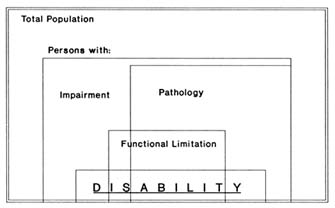
FIGURE 3-2 According to the Nagi framework, all pathology is associated with impairment, but not all impairments lead to functional limitations. Similarly, all functional limitation and disability is associated with impairment, but not all functional limitations lead to disability. Disability can also exist in the absence of functional limitation (e.g., disfigurement). (This diagram serves to illustrate the conceptual relationship among the categories in Nagi's framework; the sizes of the boxes do not reflect the relative size of that category in the U.S. population.)
Disability
Disability is the expression of a physical or mental limitation in a social context—the gap between a person's capabilities and the demands of the environment. People with such functional limitations are not inherently disabled, that is, incapable of carrying out their personal, familial, and social responsibilities. It is the interaction of their physical or mental limitations with social and environmental factors that determines whether they have a disability. Most disability is thus preventable, which not only will significantly improve the quality of life for millions of Americans but also could save many billions of dollars in costs resulting from dependence, lost productivity, and medical care.
Pathology, impairment, and functional limitation all involve different levels of organismic function. Disability, however, refers to social rather than organismic function. According to Nagi (Appendix A, this volume):
[Disability is a] limitation in performing socially defined roles and tasks expected of an individual within a sociocultural and physical environment. These roles and tasks are organized in spheres of life activities such as those of the family or other interpersonal relations; work, employment, and other economic pursuits; and education, recreation, and self-care. Not all impairments or functional limitations precipitate disability, and similar patterns of disability may result from different types
of impairments and limitations in function. Furthermore, identical types of impairments and similar functional limitations may result in different patterns of disability. Several other factors contribute to shaping the dimensions and severity of disability. These include (a) the individual's definition of the situation and reactions, which at times compound the limitations; (b) the definition of the situation by others, and their reactions and expectations—especially those who are significant in the lives of the person with the disabling condition (e.g., family members, friends and associates, employers and co-workers, and organizations and professions that provide services and benefits); and (c) characteristics of the environment and the degree to which it is free from, or encumbered with, physical and sociocultural barriers.
Thus one way in which disability differs from pathology, impairment, and functional limitation is in the role of factors external to the individual. Disability is defined by the attributes and interactions of the individual and the environment, whereas the preceding stages are defined solely by characteristics of the individual. For example, whether a person with an impairment is able to work depends not only on the nature and severity of his or her impairment and resulting functional limitation but also on such factors as the state of the economy, characteristics of the workplace, availability of transportation, and the individual's particular work skills and training. Whether a person with a functional limitation lives independently may be determined by supportive social contacts and the architectural features of his or her home.
Pathology, impairment, and functional limitation can be determined by examination and testing of the individual, but disability is a relational attribute—the interaction of an individual's functional limitation with the demands of expected tasks and roles and with the environmental conditions under which roles and tasks are to be performed. Referring to specific pathologies or impairments as disabilities ignores the interactive nature of the process that can lead to disability.
To understand disability as it is defined here, one must also understand the concepts of roles and tasks, and how they relate to each other. The concept of task is best understood in relation to the concept of role. Simply put, roles—such as being a teacher, researcher, parent, or civic leader—are organized according to how individuals participate in a social system (Parsons, 1958). Tasks are specific physical and mental actions through which an individual (not a subsystem of an individual, which would be at the impairment level) interacts with the physical and social world and performs his or her roles. One task does not define a role; roles are made up of many tasks, which are modifiable and somewhat interchangeable.
Finally, although disability can be prevented by improving the functional capacity of the individual—the traditional aim of rehabilitation—this is not
the only nor perhaps even the most effective method. Disability can be prevented by changing societal attitudes that now restrict employment opportunities for persons with functional limitations, by modifying the buildings in which such people work, or by providing accessible modes of transportation (all of which are components of the Americans with Disabilities Act). Disability can be prevented by building living quarters, parks, and other facilities with fewer obstacles restricting access and use by persons with functional limitations. The opportunity to prevent disability by manipulating characteristics external to the individual greatly expands the traditional medical notions of disability and the consequent approaches to treatment and services, and reflects more of a public health approach.
Personally and socially expected activities can be accomplished by changing the means to the ends. Capacities are the means; expected activities are the ends. One reason why impairments and functional limitations do not necessarily lead to disability is that individuals with a given impairment may overcome specific functional limitations by compensating with other functional capacities to avoid disability. Installing ramps in buildings, for example, enables people with mobility limitations to perform activities that would otherwise be denied to them.
In summary, disability begins with physical or mental health conditions that limit the performance of individuals in personally, socially, and culturally expected roles. The limitation may be total, rendering an activity unperformable, or it may be partial, restricting the amount or kind of an activity a person can perform. Although conceptually distinct, disability is often confused with disease and impairment. For example, specific diagnostic conditions and impairments, such as mental retardation, cerebral palsy, or multiple sclerosis, are erroneously referred to as disabilities. But depending on various factors, these conditions may or may not lead to disability (although the risk of disability is high for each of the examples given). Moreover, the scope and severity of limitation that follows even the most physiologically damaging disorders—those that pose the greatest risk of physical disability—vary among individuals, including those with the same condition.
MODEL OF DISABILITY
Building on the conceptual frameworks of Nagi and the WHO, and placing disability within the appropriate context of health and social issues, the committee developed a model for disability. The model, shown in Figure 3-3, depicts the interactive effects of biological, environmental (physical and social), and lifestyle and behavioral risk factors that influence each stage of the disabling process; the relationship of the disabling process to quality of life; and the stages of the disabling process that often precede disability. Each component
of the model (i.e., risk factors, quality of life, and the disabling process) is discussed below.
Risk Factors
Risk factors are biological, environmental (social and physical), and lifestyle or behavioral characteristics that are causally associated with health-related conditions (Lalonde, 1974; Last, 1988). They can be identified by comparing the frequency of a condition's occurrence, such as disability, in a group having some specific trait with the frequency of the same condition in another group without that trait. Identifying such factors can be a first step toward identifying a mechanism of action, and then developing preventive interventions. For example, workers in a factory where there is high exposure to dust may have higher rates of respiratory disease than other factory workers. In this case, exposure to dust-borne hazardous particles may be identified as a cause, the mode of biological action elucidated, and appropriate preventive measures identified.
Some risk factors are implicated in a variety of chronic diseases, resulting in what has been termed general susceptibility (Syme and Berkman, 1976). Socioeconomic status is important among these risk factors. Epidemiologists have also called attention to changes in the nature and distribution of disease as nations develop economically and standards of living change accordingly (Omran, 1979). Such changes have engendered debate on the relative importance of lifestyle, sanitation, nutrition, and public health in the changing incidence and prevalence of chronic diseases.
Similarly, there are many risk factors and causal routes associated with disability. Marge (1988) lists the following 16 causes of disabling conditions:
|
• |
Genetic disorders |
• |
Perinatal complications |
|
• |
Acute and chronic illness |
• |
Unintentional and intentional injuries |
|
• |
Violence |
• |
Environmental quality problems |
|
• |
Lack of physical fitness |
• |
Alcohol and drug abuse |
|
• |
Tobacco use |
• |
Nutritional disorders |
|
• |
Educational deficiency |
• |
Deleterious child-rearing practices |
|
• |
Familial-cultural deleterious beliefs |
• |
Unsanitary living conditions |
|
• |
Inaccessibility to adequate health care |
• |
Stress |
Whether through injury, disease, personal-choice behaviors, genetic traits, or some other causal mechanism, multiple risk factors of various types can converge to predispose an individual to the disabling process, as shown in Figure 3-3. In addition, risk factors interact at the different stages of the disabling process (note the circles between the stages that represent the
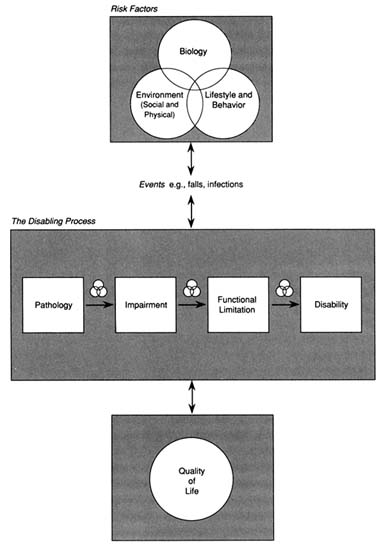
FIGURE 3-3 Model of disability showing the interaction among the disabling process, quality of life, and risk factors. Three types of risk factors are included: biological (e.g., Rh type); environmental (e.g., lead paint [physical environment], access to care [social environment]); and lifestyle and behavior (e.g., tobacco consumption). Bidirectional arrows indicate the potential for "feedback." The potential for additional risk factors to affect the progression toward disability is shown between the stages of the model. These additional risk factors might include diagnosis, treatment, therapy, adequacy of rehabilitation, age of onset, financial resources, expectations, and environmental barriers, depending on the stage of the model.
various risk factors), and these are often different risk factors than those that precipitate the initial condition. In addition, risk factors exist internally (e.g., through individual choices) and externally (e.g., through the physical and social environment).
The disability research and service communities have not yet adopted a systematic, comprehensive conceptual model for understanding risk factors for disability. This committee, however, believes that the model described in this report, incorporating three risk factor categories—biological, environmental (physical and social), and lifestyle and behavioral—will help move the disability research and service communities closer to a more unified understanding of disability and disability prevention. Although many disability risks cannot be neatly categorized, and many occur at the intersection of two or three categories, this model presents an initial framework for exploring possible points for preventive interventions. The scope of each risk category is discussed briefly below.
Biological Factors
Biological risk factors are those that develop within the body as part of one's basic biology and organic makeup. They include genetic and other inborn or inherited characteristics as well as the metabolic aspects of maturation, growth, aging, and the interactions of the varied and complex systems of the body.
Biological risk factors associated with disabling conditions are often the same as those associated with specific diseases because the disabling condition often results from the disease (e.g., arthritis, diabetes, atherosclerosis). Many biological risk factors are genetic, as in the case of Tay-Sachs disease, a condition that causes progressive retardation, paralysis, blindness, and death by age 3 or 4.
Preventive strategies directed toward decreasing biological risk factors include pharmaceutical prophylaxis and treatment, nutritional modification, exercise, and prenatal care.
Environmental Factors
The defining characteristic of environmental risk factors is that they are health-related risks that exist outside the person and over which the individual has little or no control. There are two types: social and physical. The social-environmental risk factors overlap to some extent with the lifestyle and behavioral risk factors, but are primarily the product of societal structures. The physical-environmental risk factors are primarily the product of the built (i.e., human-made) environment.
The social (i.e., social-environmental) risks for disability are a function
of the expectations and opportunities that accompany specific sociocultural environments. Attitudes, assumptions, preferences, and prejudices encountered throughout society help create social-environmental disability risks. For example, in agricultural occupational settings individuals are expected to have certain physical skills, abilities, and characteristics. Because of the physical demands and sociocultural expectations of that environment, the likelihood or risk of a functional limitation becoming a disability is greater than in a cultural setting that assigns less value to these characteristics. Thus job settings can create a social-environmental risk for disability when individuals are required to perform tasks that exceed their physical (or mental) abilities.
Individuals with disabling conditions often report that their independence of action is significantly influenced by the attitudes of those in their environment. These attitudes are reflected both in the way individuals relate to those with disabling conditions and in the public policies that are adopted by society. Paternalism, for example, whereby individuals provide resources but not freedom of choice in the use of those resources, is not uncommon. This practice requires a compliance on the part of those with disabling conditions that affects self-esteem negatively and encourages dependent roles—a result that can contribute to a lack of initiative and independence in social and work situations. It also is not uncommon for persons with disabling conditions to encounter discriminatory attitudes and behavior—for example, being prejudged as unable to assume roles such as worker, spouse, sports participant, or independent resident. It is also not uncommon for those with physically disabling conditions to be treated as though they had mental impairment as well.
Much as social-environmental risk factors stem from sociocultural expectations and opportunities, physical-environmental risk factors have their source in the physical places in which people conduct their daily lives. Like social-environmental risk factors, physical-environmental risk factors also occur in a variety of forms. The risk can occur as a direct result of the physical design of public places or of the individual's workplace or living arrangements. These environments can put an individual at risk for injury or disease, which can trigger a process that leads to disability; they also can place individuals in circumstances in which impairments and functional limitations become disabling. Examples of the former risk include workplaces in which employees are not protected from dangerous machinery, households with slippery floors (or other problems that promote injuries), or exposure to toxicants (e.g., lead paint) and other disease-causing agents. Examples of the latter include inadequate access to the built environment for individuals who use wheelchairs, prostheses, orthosis, or guide or hearing dogs. Inadequate public transportation also can put individuals with impairments or functional limitations at increased risk for disability.
Designing intervention strategies for environmental risks can be difficult. There often is not a clear-cut option between modifying the environment or targeting the intervention to the individual with the disabling condition. In some cases, such as the inaccessibility of public accommodations, a legislative approach—one that requires modification of the environment—is the solution. The recent passage of the landmark Americans with Disabilities Act is an excellent example. Unfortunately, not every environmental risk lends itself to such a solution. In many cases interventions require a careful balance of modifications to the physical and social environments (e.g., altering the workplace and increasing educational efforts) and interventions designed to assist people with disabling conditions in adjusting to the environment (e.g., rehabilitation and retraining). These issues are discussed in more detail in Chapter 7.
Lifestyle and Behavioral Factors
Lifestyle and behavioral risk factors consist of personal decisions and habits that affect one's health and over which one has considerable control. Lifestyles and behaviors that are detrimental to health create self-imposed risks. Research has made it clear that unhealthy lifestyles contribute to mortality and morbidity in affluent, industrialized countries. The Centers for Disease Control has estimated that 50 percent of the deaths attributed to the 10 leading causes of mortality can be directly related to ''lifestyles." Foremost among these behavioral risk factors, according to Hamburg (1984), are smoking, excessive alcohol intake, illicit drug use, poor dietary habits, insufficient exercise, reckless driving, noncompliance with medication regimens, and maladaptive responses to stressful experience. As Hamburg notes, "A new awareness has dawned: much of disease and disability is related to human behavior, and therefore the role of behavior in keeping people healthy must be understood scientifically. In this direction lies the possibility of preventing much disease and promoting health. This promising approach affects the well being of people everywhere."
Because Hamburg's list of risk factors was published in 1984, it did not include unsafe sexual behavior as a major contributor to mortality and morbidity. With the AIDS (acquired immune deficiency syndrome) epidemic, however, unsafe sexual behavior must be added to the list of behaviors that contribute to disability and mortality in the United States. Moreover, Hamburg points to cigarette smoking as the most important environmental factor and alcohol abuse as the most serious drug problem in America, but the toll taken by cocaine abuse also now must be taken into account. For example, Hahnemann University Hospital in Philadelphia reports that 40 percent of a consecutive series of 500 mothers who delivered babies and who were insured by Medicaid had evidence of cocaine in urine or blood samples at the time of
delivery (M. R. Spence, Department of Obstetrics and Gynecology, Hahnemann University Hospital, personal communication, 1990). Cocaine use during pregnancy and the consequent intrauterine exposure of cocaine to the developing fetal brain increases the risk of reduced learning and socializing abilities and the development of disabling conditions.
Many health-damaging behaviors, such as smoking, overeating, and alcohol and drug abuse, are extremely resistant to permanent change (Matarazzo et al., 1984). It is therefore time- and resource-consuming to try to effect change in these behaviors. Matarazzo and coauthors conclude that public health programs designed to change health-related behaviors should be undertaken only after careful pilot studies. To do otherwise, they warn, is to risk damaging society's willingness to invest fiscal and human resources in prevention. Nonetheless, it is increasingly obvious that successful programs have the potential to yield large returns to individuals and to society.
Belloc (1973) identified seven specific personal health practices that were highly correlated with the physical health of some 7,000 Americans. These health practices included sleeping 7 to 8 hours daily; eating breakfast almost every day; never or rarely eating between meals; currently being at or near a prescribed height-adjusted weight; never smoking cigarettes; moderate or no use of alcohol; and regular physical activity. A correlation was found between long survival and an increase in the number of health-related behaviors adopted. These behaviors also resulted in a decrease in the morbidity associated with many disorders, such as heart disease, lung cancer, and hypertension—illnesses that cost society substantial medical care dollars and losses resulting from forgone productivity.
Health-related behaviors such as those described above greatly influence the onset and progression of disabling conditions. Physical fitness, for example, can affect both the severity of an injury sustained from a fall and the recovery from it. Fitness and exercise are also major factors in maintaining maximal functioning in people with paraplegia, for example, to prevent progression in the disabling process and the development of secondary conditions.
Finally, many risk factors exist at the intersection of the three risk factor categories described above. Personality, for instance, is probably a product of all three—biological, behavioral, and environmental.
Quality of Life
Quality of life generally corresponds to total well-being, encompassing both physical and psychosocial determinants (Wenger et al., 1984). So defined, quality of life closely approximates the World Health Organization's definition of health as a state of complete physical, mental, and social well-being, and not merely the absence of disease or infirmity (WHO, 1947). Components of quality of life include performance of social roles, physical
status, emotional status, social interactions, intellectual functioning, economic status, and self-perceived or subjective health status (Wenger et al., 1984; Patrick and Erickson, 1988; Levine and Croog, 1984). Indicators of quality of life have included standard of living, economic status, life satisfaction, quality of housing and the neighborhood in which one lives, self-esteem, and job satisfaction. Quality of life is also clearly the product of broad social forces that influence, for example, education and employment opportunities or that result in differential treatment of groups within the population.
The concept of quality of life subsumes many aspects of personal well-being that are not directly related to health. It is becoming increasingly clear, however, that health is the product of a complex array of factors, many of which fall outside the traditional province of health care. Similarly, the health of the population has commercial, economic, and social importance. Thus, quality of life is assuming greater importance in the practice and evaluation of medicine (Levine, 1987), and its enhancement, in addition to curing disease or improving survival, is becoming an accepted goal of the health care professions. Concerns of health care providers now include, for example, whether a patient's physical state or treatment modality causes depression or dependency, limits role performance, or creates poor perceptions of health. Indeed, functioning and role performance are considered important, if not central, variables in applying the quality of life concept in health assessments.
Quality of life is relevant to all stages of the disabling process, beginning with pathology. Indeed, gradual deterioration in function, as in the case of some chronic diseases, or the sudden occurrence of disability, as in the case of serious injuries, must be viewed in the context of how quality of life is affected. For people facing such circumstances, preventing deterioration in function is tantamount to maintaining their lives at a certain level of quality. In turn, conditions within society greatly affect the health and well-being of these individuals. Those who have functional limitations may not have the opportunity to participate in society if it does not accommodate their limitations. Affected individuals may be healthy in the sense that their residual impairments have stabilized and they are free of pathology, but they are not healthy in a social sense. If the essence of health is, as some have maintained, the ability to perform personally valued activities, then disability is a social definition of ill health.
As depicted in Figure 3-3, quality of life affects and is affected by the outcomes of each stage of the disabling process. Within the disabling process, each stage interacts with an individual's quality of life; it is not an endpoint of the model but rather an integral part. There is no universal threshold—no particular level of impairment or functional limitation—at which people perceive themselves as having lost their personal autonomy
and diminished the quality of their lives. Perceptions of personal independence and quality of life, however, are clearly important in determining how individuals respond to challenges at each of the four stages of the disabling process. (A similar theoretical model for health status and quality of life is described by Patrick and Bergner, 1990.)
In addition, social roles are valued differently by individuals and social groups. In the evaluation of disabling conditions, considerable attention is often paid to the socially valued roles, principally work. To the individual, however, other roles and activities may be more important and rewarding than work. Thus, it is important to assess both the objective aspects of quality of life, such as whether a person has changed jobs because of an impairment or health problem, and the subjective aspects, such as the individual's satisfaction with the job.
Quality of life for persons with disabling conditions can be enhanced or at least maintained even if functioning cannot be improved. Modification of the environment, such as the construction of a ramp into a building or the reduction of negative attitudes and stereotypes, can help to improve an individual's quality of life as well as prevent disability by restoring role performance even when functional limitations cannot be redressed.
Improved measures of quality of life are needed for use in assessments of health and disability.
The Disabling Process
At the center of the model is the disabling process. Although it seems to indicate a unidirectional progression from pathology to impairment to functional limitation to disability, and although a stepwise progression often occurs, progression from one stage to another is not always the case. An individual with a disabling condition might skip over components of the model, for example, when the public's attitude toward a disfiguring impairment causes no functional limitation but does impose a disability by affecting social interaction. It is also important to note that the effects of specific stages in the model can be moderated by such interventions as assistive devices. Similarly, environmental modification (e.g., elimination of physical obstacles and barriers) is an important form of disability prevention, as is legislation such as the recently enacted Americans with Disabilities Act—a landmark in antidiscrimination legislation directed toward ensuring the rights of people with disabling conditions.
An important feature of the disabling process is its interaction with risk factors—a feature that is essential to the development of preventive interventions. For example, the outcome of heart disease is not predetermined at the time of diagnosis, and changes in diet, regular exercise, adoption of less
stressful work habits, and other health-promoting practices may actually result in improved functioning, even though the underlying condition will persist. In addition, risk factors can interact with so-called protective factors (not shown) to increase or decrease the likelihood of further change in health status. Thus there are "feedback loops" in the disabling process that can hasten, slow, or prevent the progression to disability.
Implicit in the model is the influence of important social and medical variables, such as the timely availability of appropriate medical and rehabilitative care, employment opportunities, and adequate housing. High rates of disability among low socioeconomic groups and low rates of disability among people with advanced educations are but two of many pieces of compelling evidence demonstrating the significant influences of social variables, which generally are not addressed in traditional medical approaches to treating people with disabling conditions.
Thus a variety of personal, societal, and environmental factors can influence the progression of a potentially disabling condition from pathology to disability, the degree of limitation or disability, and the occurrence of secondary conditions. Several of these factors are discussed below.
Health Status
Health status prior to the onset of a potentially disabling condition, as well as after the initiation of the disabling process, can significantly influence the degree of limitation and the ability to avoid the development of secondary conditions. Obesity, for example, can limit the amount of ambulation by an individual with neurological impairment, making that person more susceptible to skin infections or joint and muscle contractures. Skin infections and contractures, in turn, can lead to additional impairment and functional limitation.
Psychological Status
Successful management of potentially disabling conditions and prevention of secondary conditions depends greatly on the psychological status of the individual with the condition. Thus the realization and acceptance of a potentially disabling condition, combined with a focus on adaptation, are necessary components of preventive interventions as they apply to primary and secondary conditions. In addition, an individual's attitudes toward solving problems and functioning independently become important in minimizing both primary and secondary conditions. Also, coping skills as demonstrated prior to the onset of a disabling condition are important to those facing a major disabling event, particularly those skills relating to flexibility
in coping with change. Motivation for adaptation is poorly understood but is uniformly seen as necessary for successful rehabilitation.
Socioeconomic Status
Socioeconomic status and the risk of disability are inversely related. In part, this relationship is explained by the income-suppressing effects of disability (Luft, 1978). The same inverse relationship is found, however, between disability risk and level of educational attainment (LaPlante, 1988), which is less sensitive to such income effects. Clearly, there are factors associated with being poor that powerfully increase the risk of pathology and the progression to disability. Differences in personal expectations, demands of the social and living environments, ability to control personal and social circumstances, access to adequate health care, and individual behavior have all been hypothesized to play a role.
Although we know that rates of disability are higher among lower socioeconomic groups, we do not know precisely why. People in low socioeconomic groups are at higher-than-average risk for a variety of chronic diseases and injuries (Susser et al., 1985; Syme and Berkman, 1976), and they are more likely to work in physically demanding occupations that afford little control over the conditions of their jobs and work sites. Moreover, they are less likely than those in higher socioeconomic groups to get the health care they need to avoid impairment and functional limitation. Although health and welfare programs defray expenses and help offset income losses for persons with disabling conditions, they do so only for those with the most severe disabilities. Even for these people, however, some acute and long-term care needs go unaddressed.
Educational Status and Vocational Training
On average, earnings rise in tandem with levels of educational attainment, and higher levels of earnings perhaps are an incentive for returning to work following the onset of disability. Indeed, among the population of people with disabling conditions, those with college-level educations are less likely to be unemployed or underemployed than those with lower levels of educational training. Moreover, education is believed to be correlated with flexibility and adaptability, which are necessary for adjusting to the changes imposed by a potentially disabling condition. Nevertheless, after taking into consideration these obvious factors, the reason why people with higher levels of education have lower levels of disease and disability remains largely unexplained (Sagan, 1987). More knowledge about this topic is important to understanding disability causation and prevention.
Previous job experience also tends to increase the options available to an
individual with functional limitations. Experience and training serve as the basis for occupational planning. Those with easily transferable skills are more likely to return to work than those who have narrow job experience and who, because of their functional limitations, cannot return to their previous employment. Thus people who were involved in physically demanding occupations usually are less able to return to their former job than those who were engaged in sedentary, white-collar jobs prior to the initiation of the disabling condition. Another key variable influencing employability is the attitude of the previous employer. Some employers are willing to make major work-site modifications, whereas others are quite rigid in their requirements for conformance to usual job descriptions.
Climate
The opportunity for independent community living and access to work for people with disabling conditions often are influenced by the characteristics of the climate (e.g., typical weather patterns), as well as of the social environment (e.g., social attitudes and programs). Frequent snow and limitations in its removal, for example, can influence the mobility of a physically restricted individual. Another example is the fact that urban areas often have social support programs for persons with major disabling conditions than do relatively isolated rural areas.
Some advocacy groups have noted an apparent migration of individuals with disabling conditions from relatively rural to more urban areas that offer more support and opportunity. At times, those with disabling conditions are able to enhance their independence by moving to an area with a different and less restrictive environment or climate. However, the net effect of such moves is a function of many variables, including the individual's social support system, as well as factors related to the regional environment.
The relationship between risk factors, such as health, education, socioeconomic status, and psychosocial status, and the disabling process needs to be elucidated.
Multiplicity of Conditions and Disabilities
In considering the disabling process, it is important to recognize that persons can have multiple chronic conditions, multiple functional problems, and even multiple disabilities because each role that an individual normally performs produces an opportunity for disability to manifest. Thus an independent disabling condition can develop in a person who already has one. A more likely situation, however, is one in which additional disabling conditions result as a consequence of a primary disabling condition. An example
is the disuse syndrome, in which a person with paralysis (primary condition) develops pressure sores (secondary condition). In this example, an impairment (paralysis) causes the development of other conditions (pressure sores) and additional losses of capability. In addition, the risk of progression from impairment to functional limitation to disability will increase if other conditions are present (Guralnik et al., 1989b). Similarly, the risk of progression from functional limitation to disability can be expected to increase in the presence of multiple functional limitations in such a way that a previously low risk of disability is elevated to high probability.
Thus multiple disabling conditions arise in many different ways and may or may not be causally related. If there is neither a direct nor an indirect linkage between conditions, that is, if they are independent, then the two conditions would be expected to occur no more frequently than by chance alone. Analysis of National Health Interview Survey (NHIS) data, however, shows that several combinations of disabling conditions, including hypertension with arthritis and hypertension with heart disease, occur more frequently than would be expected by chance alone. In addition, persons with multiple disabling conditions are more likely to have severe limitations in activity. Thus prevention of secondary conditions is an important aspect of reducing disability and improving the quality of life. (Prevention of secondary conditions is discussed in more detail in Chapter 7.)
THE NEED FOR EPIDEMIOLOGY
Epidemiology is the study of the distributions and determinants of states of health in human populations. Despite the significance of disability as a health and social issue, it has received little attention from the epidemiological community (Nagi, 1976; Appendix A, this volume). Nagi (1976) attributes this seeming lack of interest to the preoccupation of epidemiology with pathology and impairment, the conceptual confusion surrounding the meaning of disability and related terms, and problems in the reliability and validity of available measures. As discussed later in this chapter in relation to the need for surveillance, the available epidemiologic data are mostly prevalence data. Incidence data on disability are more difficult to obtain and are lacking. The purpose of this section is to discuss the need for epidemiologic studies of disability, that is, beyond pathology and impairment. The need applies to all of the elements in the conceptual framework of disability, including risk factors, quality of life factors, pathology, impairment, functional limitation, disability, and levels of functional performance in everyday living.
As noted previously, disability refers to limitations in carrying out activities that people are generally expected to be able to perform (Haber, 1988; Nagi, 1965; Appendix A, this volume). Human activities vary in many
ways, including whether they are necessary, the degree to which an individual is expected by others to perform them, and the degree to which the individual desires to perform them. In addition, disease, injury, and congenital and developmental conditions limit human behavior; the distribution of these limitations is not random in human populations; and epidemiological principles can be used to study health-related limitations in human activity and how they might be prevented.
Epidemiologists traditionally study the distribution of disease in a population and attempt to understand the determinants of that distribution. The usefulness of this approach for the study of disability is somewhat limited because the concept of disability does not fit the traditional disease model. For example, a developmental condition, injury, or disease does not necessarily lead to disability. Whether it does depends on many factors, including the level of functional limitation associated with the condition, the activities the person with the condition is expected to perform or may want to do, and features of the living and work environments.
In much traditional epidemiological research, it is necessary only to identify the existence of a disease, condition, or injury. In epidemiological research on disability, however, social and behavioral variables must be taken into consideration. Nonetheless, the same principles that guide epidemiological research on disease are relevant to research on disability. For example, a fundamental premise of epidemiological research is that disease does not occur randomly in the population. Disabilities, like diseases, also are not randomly distributed. In addition, as with diseases, rates of disability vary among population groups. Epidemiological methods can be used to describe these distributions, help identify risk factors, and, in turn, guide development of disability prevention programs. The challenge is to recognize the shortcomings of traditional methods for addressing disability and then develop the tools and data networks necessary to identify the causes of disabilities and their associated risk factors. Gathering this information will require studying social and behavioral variables that were once considered to be outside the domain of epidemiology and even public health.
This task will be speeded by the broader epidemiological perspective that appears to be evolving today in the field of public health. For example, public health interest in AIDS has helped pave the way for a more sophisticated epidemiology of disability by targeting efforts toward the behaviors and events that result in the transmission of the HIV and the onset of AIDS. As the life spans of people with AIDS are prolonged, however, the field of public health will need to direct additional attention to issues of long-term disability management.
Although the relationship between some risk factors and certain disabilities is well understood, much remains unknown. Some needed information can be obtained by organizing and analyzing data that are already available.
But much of the available information on people with disabling conditions has been collected piecemeal by many agencies, each with the aim of meeting its own particular needs. Thus large voids remain that cannot be filled with existing data, and a more comprehensive approach to data collection is needed to develop an adequate knowledge base on the risk of disability.
Standard terminology and conceptual clarity are essential to meaningful discourse, productive research, and effective prevention efforts. As mentioned above, conceptual confusion surrounding the meaning of disability and related terms has hindered epidemiologic research on disability, and an underlying obstacle to data collection and analysis continues to be the lack of a widely accepted, uniformly applied conceptual framework. During the past 10 to 15 years two major options have emerged: the Nagi and the ICIDH model frameworks. The ICIDH has become the de facto international standard, but neither framework is dominant in the United States, and scientific consensus is lacking.
The need for conceptual clarity and uniform terminology in the field of disability prevention is essential and immediate. The model developed by this committee reflects its recommendation for standardized concepts and terminology that can serve as the basis for developing preventive interventions and an epidemiology of disability.
Once a nationally accepted framework is in place, future survey research efforts related to disability should be required to demonstrate that the concepts, terms, and questions used in the survey are anchored within the agreed-upon framework. Such a grounding would increase the probability that the results from one survey could be compared with those of another, thereby improving the utility of survey data.
Data Needs
Disability prevention requires continuing population surveillance. To be effective, such surveillance should be more thorough than the existing patchwork system, be based on an improved understanding of the causes of disabilities and associated risk factors, and reflect greater knowledge of the economic and social consequences of disability, including the effects of disability on quality of life. In short, the paths of the model in Figure 3-3 must be explored and quantified, the mechanisms described, and intervention strategies developed. Questions that must be addressed if we are to set priorities for disability prevention include the following: Do conditions with the highest risks of disability also pose the highest risks of functional limitation and impairment? To what extent do behavioral factors combine with impairment and functional limitation to determine disability outcomes? How does
the environment affect disability outcome, and does the effect of the environment depend on the nature of the impairment and functional limitation?
The following sections discuss data and research needs that should be addressed to ensure that basic epidemiological elements of effective prevention efforts are in place.
Risk Factors
Research on biological, environmental (physical and social), and behavioral risk factors is one of the cornerstones of epidemiology and, consequently, of health promotion and disease prevention. As the model of the disabling process illustrates, knowledge of risk factors is central to disability prevention. Indeed, a comprehensive understanding of risks is critical to answering three fundamental questions:
-
Given exposure to environmental agents or other provocations, why do some persons develop potentially disabling conditions and others do not?
-
Given such exposure and the occurrence of pathology or injury, why does one person develop a disability and another does not? That is, what determines the progression toward functional limitation and disability?
-
At the aggregate level, why do some population groups have higher rates of disability than others?
At each stage in the disabling process, biological and behavioral characteristics and features of the social and physical environment have determinative effects on individual outcomes. The genetically determined healthy or unhealthy nature of an individual's body systems is not the sole factor in the development of disease or disability. For example, not all people with abnormal glucose levels develop diabetes, and not all diabetics develop functional limitations or disabilities. An epidemiology of disability requires an expanded perspective on risk factors because any specific type of disability can be the product of many different kinds of pathology, impairment, and functional limitations. Moreover, a complex array of variables, many of them outside the bounds of the usually emphasized biological risk factors, can speed, slow, halt, or reverse the stage-to-stage progression to disability. Such variables include the adequacy and availability of social and medical services, socioeconomic status, marital status, job experience, and amount of educational and vocational training.
Research has demonstrated the importance of psychosocial risk factors in disability (Haan et al., 1989), but the findings thus far are largely in the form of leads for further research. Critically important details remain to be identified—for example, the influence of social support, a concept that refers to the quality and breadth of one's relationships with a mate, other
family members, friends, and others. Lack of social support has been associated with an increased risk of heart disease, complications of pregnancy and delivery, suicide, and other conditions (Dutton and Levine, 1989; U.S. Department of Health, Education, and Welfare, 1979). An important question is, what underlying biological mechanisms are affected by social support? The answer to the question of underlying biological mechanisms may not emerge if the focus of investigation is limited to only one condition. Perhaps the most productive way to detect the underlying mechanism in this case is to study all health consequences associated with inadequate social support (Haan et al., 1989).
Although the condition-specific approach of epidemiology has increased our understanding of diseases and their prevention, it may lead to overly narrow perspectives on prevention, corresponding to disease classifications (see Table 3-1). An alternative approach would be based on risk factors that predispose an individual to several disease conditions that can lead to disability, such as those shown in Table 3-2. From the viewpoint of public health, a classification scheme that identifies causative features common to several disabling conditions may foster more efficient prevention programs, focusing on risk factors implicated in multiple conditions that predispose an individual to disability. This strategy might offer opportunities to achieve benefits that are larger than the sum of the returns to individual disorder-specific initiatives.
Although epidemiology is essential to disability prevention, very little epidemiological research on risk factors for disability or on disability per se has been done, and few studies have been conducted to identify populations at increased risk of disability. Most relevant data relate to clinical conditions, which correspond most closely to the pathology and impairment stages of the committee's model. Some functional limitation and disability information can be extrapolated from the NHIS data (see Chapter 2), but this methodology does not produce very precise measures. In addition, although potentially disabling conditions are dynamic and can improve as well as deteriorate, existing data systems can neither measure the dynamics of disability progression nor identify risk factors that accelerate progression from impairment to functional limitation to disability.
More specific epidemiological data are needed on the incidence and prevalence of functional limitation and disability and their attendant risk factors. Populations at higher risk for disability need to be identified and their risk factors assessed to develop interventions to prevent disability. Longitudinal studies are needed to help define the dynamic nature of impairment, functional limitation, and disability and to describe the natural history of chronic conditions and aging in terms of these functional outcomes.
TABLE 3-1 Major Causes of Death and Associated Risk Factors, United States, 1977
|
Cause |
Percentage of All Deaths |
Risk Factors |
|
Heart disease |
37.8 |
Smoking, hypertension, elevated serum cholesterol, diet, lack of exercise, diabetes, stress, family history |
|
Malignant neoplasms |
20.4 |
Smoking, work-site carcinogens, environmental carcinogens, alcohol, diet |
|
Stroke |
9.6 |
Hypertension, smoking, elevated serum cholesterol, stress |
|
Non-vehicular injuries |
2.8 |
Alcohol, drug abuse, smoking (fires), product design, handgun availability |
|
Influenza and pneumonia |
2.7 |
Smoking, vaccination status |
|
Motor vehicle crashes |
2.6 |
Alcohol, no seat belts, speed, roadway design, vehicle engineering |
|
Diabetes |
1.7 |
Obesity |
|
Cirrhosis of the liver |
1.6 |
Alcohol abuse |
|
Arteriosclerosis |
1.5 |
Elevated serum cholesterol |
|
Suicide |
1.5 |
Stress, alcohol and drug abuse, gun availability |
|
SOURCE: Matarazzo, 1984. Reprinted with permission. |
||
The Need for Surveillance
The changing demographic profile of the U.S. population and the associated patterns of disability risk demonstrate the necessity of continued surveillance of the incidence and prevalence of chronic physical and mental health conditions, injury, and disability. Some research indicates that the risk of disability has been increasing for all population age cohorts, although there is considerable debate about the reasons for this trend. There has also been a noticeable increase in work disability rates (Chirikos, 1989). In addition, the aging of the population may bring increased risks of disability.
Existing national data sets that track the prevalence of chronic conditions over time are useful for disability surveillance. The lack of data on incidence rates, however, is a serious void in disability surveillance and an impediment to fundamental understanding of the disabling process. Incidence data provide a measure of the rate at which a population develops a chronic
condition, impairment, functional limitation, or disability and thereby yield estimates of the probability or risk of these events. Most existing data, however, provide information only on prevalence, not incidence. Prevalence is the net result of changes in incidence and the duration of time a person has a condition. Duration is determined by rates of recovery and mortality. When one compares population groups, only incidence data provide a clear picture of how risks differ among populations. Prevalence data, on the other hand, reflect not only these risks but also differences in rates of recovery and mortality. Thus populations with equal risks of developing
TABLE 3-2 Risk Factors in Chronic Disease and Disability
|
Risk Factor |
Some Related Conditions |
|
Smoking |
Lung cancer |
|
|
Emphysema |
|
|
Bronchitis |
|
|
Other respiratory diseases |
|
|
Coronary artery disease |
|
|
Burns (especially home fires) |
|
Alcohol abuse |
Injuries sustained in motor vehicle accidents, especially head injuries and pedestrian injuries |
|
|
Cirrhosis |
|
|
Fetal alcohol syndrome |
|
Lack of prenatal care |
Mental retardation |
|
|
Cerebral palsy |
|
|
Congenital heart abnormalities (via rubella) |
|
|
Various congenital anomalies (e.g., through failure to control blood sugar in pregnant diabetic women) |
|
|
Other developmental disabilities |
|
Socioeconomic status |
Low birthweight |
|
|
Injury |
|
|
Coronary heart disease |
|
|
Lung cancer |
|
|
Osteoarthritis |
|
|
Death |
|
|
Diabetes mellitus |
|
|
Cervical cancer |
disability may differ in prevalence because of differences in access to medical and rehabilitative care. Information on incidence is therefore critical to understanding the causes of disability. Data on duration, however, are useful to gauge rates of recovery and mortality. Only when incidence and duration are known can one understand what causes disability and what determines its course. Collecting data on the incidence and duration of pathology, impairment, and functional limitation as well as secondary conditions is an important component of the disability surveillance effort that is needed.
Although the NHIS includes some disability-related questions, it is quite limited in scope because it is a general-purpose survey of the health of the nation and not designed to investigate efficiently the causes and risks of disability. To conduct such an investigation requires a comprehensive longitudinal survey that could address each path of the model displayed in Figure 3-3, particularly the biological, lifestyle and behavioral, and physical and social environmental factors influencing transitions from pathology to impairment and on to functional limitation and disability.
A longitudinal survey of disability is needed to assist in determining the causes and rate of transition between pathology, impairment, functional limitation, and disability. The survey should make use of data linkages to existing agency data sets on need, use, and costs of services; be responsive as a policy development resource tool; and evaluate the causal relationship between socioeconomic status and disability. The development and implementation of this survey should be a collaborative effort involving the U.S. Census Bureau, the Centers for Disease Control, the National Center for Health Statistics, the National Institute on Disability and Rehabilitation Research, the National Institute on Aging, the Health Care Financing Administration, the Social Security Administration (SSA), and other relevant agencies.
Before conducting a new survey, however, consideration should be given to the utility of longitudinal analysis of existing data sources such as the SSA 1971-1974 disability survey, the Boston University project of the Framingham Study, the SSA 1969-1970 Retirement History Survey, the Census Bureau's SIPP, and the Department of Labor manpower mobility surveys.
The Need for Priorities
In terms of goals and implementation, disability prevention is usually thought to mean primary prevention—averting the onset of a potentially disabling pathology or an impairment that leads to a disability (see section on primary prevention that follows). The model set forth in this chapter, however, underscores the fact that well after the onset of a potentially
disabling condition, multiple points of intervention exist at which to prevent disability or diminish its severity. Although this model can help lead to many new opportunities for prevention, it does not specify what priorities to place on the possible points of intervention. Priority setting must include an analysis of epidemiological data pertaining to the causes and natural history of various disabling conditions.
As noted in Chapter 2, some of the less prevalent potentially disabling conditions (e.g., spinal cord injury) have a high risk of disability, whereas some of the more prevalent conditions (e.g., arthritis) have a fairly low risk of disability. The inverse relationship between the prevalence of a condition and the risk of disability presents an enormous challenge in forging prevention strategies. Primary prevention strategies are normally targeted to higher-than-average risk groups in the general population, even though the overall risk of acquiring a disabling condition is very small. Secondary prevention strategies are targeted to those who have already acquired a condition but may not be experiencing its disabling effects. Neither course of action may be necessarily efficient or cost-effective.
The committee considered several competing and overlapping principles and criteria on which priorities for prevention could be based. These included the following:
-
prevalence of specific conditions that can cause disability;
-
number of persons who are likely to experience some degree of limitation or disability associated with a particular condition;
-
severity of disabling conditions and their probable impact on the individual, the family, and society;
-
the number of expected disability years (not merely the prevalence of a condition or its limitations); and
-
how the prevalence and severity of selected conditions are likely to grow in future years.
As discussed in the recent National Research Council report on disability statistics (NRC, 1990), a study is needed in which a combination of the above-mentioned principles and criteria is used to conduct an objective analysis that will lead to alternative indexes of disability risk and public health impact. These indexes can then be used to set priorities for prevention efforts among all conditions.
A disability index or group of indexes is needed to help establish priorities for disability prevention among conditions and to gauge and monitor the magnitude of disability as a public health issue. This index or group of indexes should include measures of independence, productive life expectancy (both paid and unpaid), and quality of life.
In the absence of such an index, the committee is reluctant to recommend prevention strategies that favor one disabling condition over another. However, in succeeding chapters the committee cites some of the needs and issues related to several categories of individual disabling conditions.
Major gaps exist in the data and knowledge about risk factors associated with disability. One reason for these gaps is that most disability-related data are oriented toward clinical categories or impairments. Such categories may have clinical utility for addressing the treatment needs of persons with specific impairments, but they are not useful in fostering an epidemiology based on risk factors such as those related to the social and physical environment.
As discussed earlier (under the section on risk factors), the committee believes that specific conditions may not always be the most appropriate or effective means for setting priorities or identifying targets for the development of preventive intervention strategies. An alternative method for consideration is to focus on risk factors or causes that are generic to the etiology of several disabling conditions. Some examples include smoking, alcohol abuse, drug abuse, socioeconomic status, and lack of prenatal care (see Table 3-2). These risk factors are already associated with many of the nation's leading health problems. Less understood is their relationship to disability.
Cause-oriented disability data need to be considered possible alternatives in the development of approaches to identifying priorities in disability prevention.
APPLYING TRADITIONAL PREVENTION STRATEGIES TO DISABILITY
The standard public health model delineates three categories of prevention efforts—primary, secondary, and tertiary—each one focusing on distinct stages in the natural history of diseases. This same model is applicable to the prevention of disability. And, as is true for all prevention programs, epidemiological data and analyses are the cornerstones of effective planning and evaluation. Thus the quality and quantity of the available epidemiological data, as discussed in the previous section, will be critical to the development of effective intervention strategies. Here, the committee briefly summarizes the primary, secondary, and tertiary approaches to prevention and how they might be applied to disability (see Patrick and Peach [1989] for additional information). Prevention efforts that are specific to various disabling conditions are discussed in more detail in succeeding chapters.
Primary Prevention
Primary prevention focuses on healthy persons, seeking to avoid the onset of pathological processes by reducing susceptibility, controlling exposure
to disease-causing agents, and eliminating or at least minimizing behaviors and environmental factors that increase the risk of illness, injury, or disability. Interventions include (1) health promotion and education, which are largely tailored to fostering adoption of healthy lifestyles; (2) health protection, such as measures designed to improve air quality or food safety; and (3) preventive health services, such as immunization or counseling.
Most public health efforts fall into the category of primary prevention. Unfortunately, and incorrectly, people with potentially disabling conditions often are not recognized as a target population for primary prevention efforts, despite the fact that having a potentially disabling condition frequently increases the need for good health promotion and disease prevention practices. With respect to disability, primary prevention usually means preventing the initiation of a potentially disabling condition such as spinal cord injury. However, having a disabling condition does not preclude the need for other primary prevention activities such as exercise and immunization. Primary prevention of disabling conditions is a focus of attention in this report, but additional emphasis is focused on people who already have potentially disabling conditions, i.e., secondary and tertiary prevention.
Health-promoting practices, appropriate medical care, and other measures that help ensure good health and a reasonable quality of life are as important to people with disabling conditions as they are to people without them. Similarly, they are as important to the elderly as they are to the young. It is never too late to benefit from quitting smoking, adopting good dietary practices, or engaging in regular exercise, as illustrated in the report on the benefits of smoking cessation for those with coronary heart disease who are over 55 years of age (Hermanson et al., 1988). These and other health-promoting measures pay health dividends to all. Indeed, health promotion directed toward older adults has great potential for impact because the benefits of healthy behaviors may be achieved relatively quickly. Given that the prevalence of chronic diseases rises sharply in this age group and that this segment of the population is growing rapidly, the societal benefits of health promotion and disability prevention during later life may be great (Institute of Medicine, 1990a).
Moreover, the purpose of health promotion is not simply to extend life but also to improve the quality of life and to extend active life free of disability (Fries, 1988; Katz et al., 1983). Health promotion is applicable to all age groups and although the messages might change for different ages, the major themes with respect to exercise, diet, substance abuse, and injury prevention are often the same. Reinforcing messages in the community, at schools, at the workplace, and in the doctor's office provides the social context that can facilitate behavior change. Health promotion for children should help establish lifelong habits for maintaining health. For adults, the emphasis should be on modifying risk factors related to disease and disability and maintaining healthy behaviors (Institute of Medicine, 1990a; Keil et al., 1989; Pinsky et al., 1985).
Secondary Prevention
Secondary prevention activities include early detection and treatment of persons with early or asymptomatic disease, reduction in risk factors, vocational and educational counseling, and social interventions. Common approaches include periodic screening of high-risk individuals and subsequent treatment of the pathology. Secondary prevention can in many cases cure a specific pathology, but in other cases secondary prevention merely slows the progression of a pathology toward becoming a clinical condition. People with chronic diseases and those with disabling conditions can benefit significantly from secondary prevention efforts, and, as noted earlier, much of this report focuses on secondary and tertiary prevention.
Not all diseases and disabling conditions, however, can be prevented. Examples include conditions that are strongly related to the process of aging (Fries and Crapo, 1981). Aging-related conditions include arteriosclerosis, non-insulin-dependent diabetes, cancer, osteoarthritis, emphysema, and cirrhosis, as well as numerous other conditions that are less prevalent. Prevention measures are applied differently to aging-related conditions because individuals are seldom observed to be totally free of pathogenic changes. Plaque deposits in arteries, for example, can be found in most individuals, even at very young ages. Fries and Crapo (1981) argue, therefore, that it is better to think of controlling (or eliminating) risk factors to affect the progression of these conditions rather than to prevent the onset of the underlying pathological process. They maintain that primary prevention of aging-related conditions is not possible because such conditions are a part of aging and occur in all individuals. However, the rate at which such universal conditions progress can be reduced so that clinically significant symptoms can be avoided or delayed.
Thus prevention of many aging-related conditions begins with secondary prevention that aims to reduce the progression of these universal pathological processes. In some instances, although the condition may not disappear, secondary prevention is considered successful if from the standpoint of the affected individual the symptoms are not noticeable and do not require clinical treatment. In such cases the condition in essence has been prevented. What are often considered to be primary prevention activities, such as not smoking, are often secondary interventions for many aging-related, and potentially disabling, conditions because the condition has already been initiated.
Tertiary Prevention
Tertiary prevention strategies concentrate on arresting the progression of a condition and on preventing or limiting additional impairment, functional
limitation, and disability. These strategies can be directed toward the person, his or her environment, or society as a whole. Rehabilitation efforts, which attempt to restore function and the capacity to perform one's roles, are in the domain of tertiary prevention. Rehabilitation can address not only the individual with a functional limitation or disability but also elements of the physical and social environments that preclude participation in the activities of society by people with disabling conditions. Modifying or eliminating social and physical obstacles to personal autonomy and societal participation present opportunities for prevention strategies that are not often enough accepted into the traditional province of public health. Measures designed to foster independent living and help ensure a reasonable quality of life should clearly be major elements of disability prevention policies and strategies.
Tertiary prevention, as well as secondary prevention, has not received as much emphasis in public health as the health-promoting, disease-preventing measures of primary prevention. However, the fact that more than 35 million people already have some type of disabling condition underscores the need to develop and implement secondary and tertiary prevention strategies that are directed toward people with disabling conditions, and that will reduce the risks of additional limitation and prevent disability and secondary conditions. With the aging of the population there is growing interest in the prevention of age-related chronic disease and disability and the secondary and tertiary strategies that are designed to prevent them (Patrick and Peach, 1989).
Given the dynamics of the disabling process and the variety of interacting risk factors, primary, secondary, and tertiary preventive measures will often be required in concert. To take AIDS as an example, primary prevention is needed in the form of educating individuals about high-risk behaviors. Testing for exposure to HIV, especially in high-risk populations, and treatment to postpone the progression of the disease to AIDS or the characteristic set of symptoms known as AIDS-related complex (ARC) constitute secondary prevention. Tertiary prevention includes rehabilitation programs and social services that seek to reduce the effects of AIDS or ARC so that affected people can perform desired roles and live independently.
Another example is people who use wheelchairs and therefore have increased risk of developing pressure sores. Preventive intervention strategies would include passive restraints that prevent spinal cord injury in automobile crashes (primary prevention), modifying wheelchairs or teaching the individual who uses the wheelchair how to relieve pressure to reduce the likelihood of pressure sores (secondary prevention), and treating the sores to prevent infection and promote healing (tertiary prevention). In this, as in other cases, there are many opportunities to interrupt the disabling process and the progression toward disability.
Finally, although tertiary prevention might be where most prevention of disability itself occurs, primary and secondary strategies are essential elements of disability prevention because they intervene in the disabling process to reduce the likelihood of progression of predisposing conditions toward disability. Thus the public health and medical aspects of disability prevention are important, but should not overshadow or undercut the essential understanding of the social context of disability, as described throughout this report. Given the existence of predisposing functional limitations, the predominant means of disability prevention and amelioration are often social and economic.


