
1
The Need for New Approaches to Fishing Vessel Safety
Fishermen throughout the world are exposed to risks in nature like those faced by all seafarers—heavy seas, high winds, and poor visibility. In addition, they face hazards unique to their occupation—operating near dangerous shoal waters, handling moving gear on rolling decks, and opening the holds of their vessels at sea to stow the fish they catch (Pizzo and Jaeger, 1974; Murray, 1962; Yoder, 1990). Some fishermen are capable mariners whose abilities are well matched to the operating limitations of their vessels; others are not. Still others, capable enough under ordinary conditions, may be overwhelmed by circumstances beyond their control. Depressed economic conditions and fishery management regimes increase the pressures on fishermen to earn their living. They may risk fishing in foul weather during short seasons, overload boats, install gear or operate on fishing grounds for which a vessel is not designed, or simply disregard principles of good seamanship.
Though people have fished for their livelihood since earliest times (some fishing boats, gear, and methods can be traced back centuries), fishermen today must cope with changing technology and the risks that accompany it (deCarteret et al., 1980). Some innovative fishermen modify boats, gear, and deck layouts to improve their ability to harvest, especially when fishing opportunities are perceived as only fair to poor (Dewees and Hawkes, 1988; Levine and McCay, 1987; Browning, 1980). Such modifications, however, can change a vessel's operating characteristics and stability, causing great variability among even similarly designed boats and creating new safety problems.
Added to wind, waves, vessels, and equipment is the human factor. Who are these men and women who go to sea to fish for a living? How do they cope
|
SOME TERMS USED IN THIS REPORT Captain is the title of the person or officer in charge of a vessel and responsible for its navigation and direction of its operation regardless of official rank or license held. Often used as a courtesy title, particularly for unlicensed individuals. In the fishing industry, denotes the person in charge of underway procedures, fishing operations, and supervision of the crew. Certification refers to a process through which a document is issued testifying that one has fulfilled certain requirements (as of a course or school), but does not by itself impart legal permission to an individual to engage in a business, occupation, or activity. Crew/crewmen are the body of seamen other than the captain (and licensed officers) who man the vessel. Includes processing-line workers aboard catcher/processors and processors. Education refers to instruction to develop and cultivate knowledge. Relevant to the fishing industry, education applies generally to theory and concepts that form the foundation and framework for technical training. Frequently used together with “training” to denote the interrelationship of knowledge and practical skills. Fishermen are the captain, licensed officers, and all members of the crew engaged in service on deck or in engineering departments aboard a fishing industry vessel. Principal occupational activities include vessel, fishing, harvesting, and delivery operations. Individual in charge/vessel operator are generic terms used in lieu of “captain” or “master” for the person on board who is in charge of a vessel and responsible for its navigation and direction of its operation regardless of official rank or license held. License refers to a document that imparts legal permission for a vessel to engage in a trade or activity or for an individual to engage in a business, occupation, or activity. Licensing refers to a process leading to issuance of a license to an individual. A Coast Guard-issued license attests that certain prerequisites have been met (e.g., accumulated experience, certification of training, demonstration of skills) and that a formal examination, normally written, has been passed. The Coast Guard license, once issued, is used to fix responsibility and enforce discipline among license holders. Master is the legal title for the merchant marine officer who is licensed and qualified for command and is serving as captain of a merchant ship. Sometimes used generically to refer to the individual in charge of a vessel. Processing-line workers are individuals performing industrial functions aboard fish processing vessels. Training refers to specific instruction to impart technical knowledge and develop practical skills in the application of knowledge. Watchkeeper refers to a member of a vessel's crew responsible for operating the vessel during a period of time. On small fishing vessels, generally the person assigned by the individual in charge to operate the vessel for a specified period of time. |
|
Processing-line workers are individuals performing industrial functions aboard fish processing vessels. Training refers to specific instruction to impart technical knowledge and develop practical skills in the application of knowledge. Watchkeeper refers to a member of a vessel's crew responsible for operating the vessel during a period of time. On small fishing vessels, generally the person assigned by the individual in charge to operate the vessel for a specified period of time. |
with the long hours and bruising working conditions? How are they educated, trained, and motivated? What do they perceive as risks? Many of these factors are poorly understood. What is known is that risks associated with human behavior are a principal cause of vessel losses and damage, and human fatalities and injuries. More specific discussion of the dangers of commercial fishing, their causes, and what may be done to overcome them follows in ensuing chapters. First, we look at the magnitude of safety problems in the commercial fishing industry and what has been done to try to alleviate them.
COMMERCIAL FISHING ACCIDENTS
Vessels and Lives Lost
Evidence of safety problems exists throughout the commercial fishing industry—inshore and offshore—and on board about 30,000 fishing vessels “documented” by the U.S. Coast Guard and approximately 80,000 registered and “numbered” by the states (see box). The Coast Guard annually investigates about 1,100 fishing vessel casualties. These are incidents involving vessel damage exceeding $25,000, a fatality, or serious injury. The agency's main casualty (CASMAIN) records for federally documented fishing vessels indicate that between 1982 and 1987, 6,558 reported casualties resulted in 1,298 vessel total losses and nearly $378 million in damages. At the same time, the Coast Guard recorded 648 commercial fishing fatalities; 439 were vessel related (associated with capsizing, fires, groundings, or collisions) and 209 were non-vessel related (falls on deck, man overboard, or people entangled in machinery).
During fiscal years 1982-1987 (FY 82-87), the Coast Guard also recorded on average over 3,100 search and rescue (SAR) cases each year for commercial fishing vessels. Over 80 percent of them occurred within 20 nautical miles of the coast and 50 percent within 3 nautical miles of shore or in inland waters. In FY 88, over 4,400 fishing vessel SAR cases were recorded. The Coast Guard expends significant federal funds annually responding to SAR cases involving
|
FISHING VESSEL CLASSIFICATIONS Fishing vessel is a vessel that commercially engages in the catching, taking, or harvesting of fish or an activity that can reasonably be expected to result in the catching, taking, or harvesting of fish. (46 U.S.C.A. §2101(11a)) Fish processing vessel under federal regulations means a vessel that commercially prepares fish or fish products other than by gutting, decapitating, gilling, skinning, shucking, icing, freezing, or brine chilling. (46 U.S.C.A. §2101(11b)) At the state level, fish processors are treated more broadly and include preparations that freeze products without boxing them. Fish tender vessel means a vessel that commercially supplies, stores, refrigerates, or transports fish, fish products, or materials directly related to fishing or the preparation of fish to or from a fishing, fish processing, or fish tender vessel or a fish processing facility. (46 U.S.C.A. §2101(11c)) Fishing industry vessel refers to any or all of the above—fishing, fish processing, or fish tender vessels, including those that have combined or convert between uses. Inspected vessels are those subject to statutory certification under Title 46 of the U.S. Code, in which certain vessels must be certificated by the Coast Guard before they may be legally operated. A formal inspection for compliance with design, construction, and operating equipment standards is required. It applies to fish processing vessels over 5,000 gross tons and fish tender vessels over 500 gross tons. A Certificate of Inspection (COI) is issued upon satisfactory completion of the inspection. The COI is accepted as compliance with applicable laws and regulations, barring significant deficiencies. Uninspected vessels are commercial vessels not subject to formal Coast Guard inspection. Uninspected fishing industry vessels make up over 99 percent of the national fishing fleet. Uninspected fishing industry vessels over 200 gross tons are required to have licensed officers. One purpose of this study is to provide technical information to the Coast Guard to determine whether formal inspection should be required for all or parts of the uninspected fishing industry fleet. Documented commercial fishing industry vessels are those with admeasurement of at least 5 net tons for which a Certificate of Documentation has been issued by the Coast Guard. |
|
State-numbered commercial fishing vessels are those undocumented vessels under 5 net tons (approximately 32 feet or smaller), which are registered with the states under a federally prescribed numbering system. In this report, state numbered also refers to vessels bearing Alaska numbers that are administered by the Coast Guard, since Alaska does not have a state numbering system. SOURCES: 46 U.S. Code Annotated; U.S. Coast Guard Marine Safety ManualVolume III. |
commercial fishing vessels. Incidents in which emergency assistance does not involve the Coast Guard are not recorded, but the number is believed to be significant.
Personal Injuries
Nonfatal injuries are a serious safety issue because of the human suffering injuries cause and the financial burden they represent to fishermen, the industry, and society (Nixon and Fairfield, 1986; Rice, MacKenzie, and Associates, 1989). The full nature and scope of injuries are often recorded only partially or not at all. Available statistical data only hint at the problem. Coast Guard injury records —though incomplete—totalled 13,916 injuries nationwide between 1982 and 1987, a yearly average of 2,319. Alaska alone (one of the few states that provide injury compensation for fishermen) recorded 2,363 personal injury claims in FY 87, representing about 1 in 20 fishermen eligible for assistance under the state's Fishermen's Fund. Compensation for these claims has an upper limit of $2,500 per individual per claim (Alaska Department of Labor, 1988).
Defining the Population at Risk and Determining Who Is Responsible
Primary responsibility for safety traditionally rests with those at risk. Government generally intervenes only when those at risk are unable or unwilling to effectively address safety in their work environments. Federal laws, regulations, and court decisions definitively allocate responsibility for safety of uninspected fishing vessels. Owners are responsible for providing and maintaining a safe workplace without limits to liability (liability is discussed in Chapter 2). Operators are required to observe applicable navigation, fisheries management, marine pollution, and safety and survival equipment regulations. However, there are presently no federal requirements for professional competency in safety, sur
vival, navigation, seamanship, fire fighting, maintaining vessel stability, or first aid skills for over 99 percent of the uninspected fishing fleet. The Coast Guard is considering rulemaking in these areas under the Commercial Fishing Industry Vessel Safety Act of 1988 (CFIVSA).
Despite the efforts of trade associations and industry organizations, the U.S. commercial fishing industry has no effective system to promote, monitor, or require accountability of those responsible for operational and occupational safety at sea. The industry and government have relied on a combination of tradition, common sense, voluntary measures, informal guidance, marine surveys (generally for insurance), and some basic safety laws and regulations. Direct safety intervention by the federal government is coincidental with enforcement of maritime laws and regulations (particularly fisheries management regulations) and responses to emergencies. Safety performance is otherwise left to owners.
Some people in the industry have developed a sense of professional responsibility for safety. These include vessel owners or operators who have adopted safety procedures as standard practice (W. A. Adler, Massachusetts Lobstermen's Association, Inc., personal communication, 1989), trade or other industry association leaders who promote safety (Melteff, 1988; Jones, 1987; Sabella, 1987; J. Costakes, Seafood Producers Association, personal communication, 1989), and segments of the industry in which large capital investment and potentially high liability force safety programs as a protective measure. Some vessel and fleet owners have established voluntary self-inspection programs, such as annual inspections or surveys, or routine pre-or post-trip equipment or maintenance checks (see Zapata Haynie Corporation, 1989). In other cases, insurance underwriters have preconditions to issuing insurance (Nixon et al., 1987; Pacific Fisheries Consultants, 1987; McCay et al., 1989). They may require marine surveys or navigation and safety equipment checks. These requirements vary from cursory to thorough; basic checkoff lists are available from some trade associations and vendors, but data on the overall effectiveness of such programs are not available.
On a broader scale, standards of professional responsibility for safe operation have not been universally accepted and are largely nonexistent among the majority of fishing industry vessels. These include, for example, workplace procedures, regular inspections, safety meetings, training programs, protective clothing, environmental protection programs, accident investigation procedures, emergency response procedures, fire-fighting training, and—to a lesser degree —safety and survival training. Although vessel operators are required to comply with federal navigation, safety, and marine environmental protection regulations, insofar as performance can be estimated, a large number of violations in these areas are recorded annually by the Coast Guard.
Inattention to safety appears more prevalent where fisheries are depressed or where the fishermen are marginal producers. In these instances, investments in safety training and equipment may be regarded as prohibitively expensive,
and fishermen may resist safety initiatives—even those that have demonstrated positive economic returns.
PRIOR SAFETY IMPROVEMENT EFFORTS
Although numbers of vessel and personnel accidents have remained consistently high in the data reviewed, safety is not a forgotten issue. Since the late 1960s, safety issues have been discussed nationally and internationally, research has been done, and programs have been developed—albeit with undetermined effectiveness. What is emerging nationally, however, is a tentative willingness within the industry to objectively consider meaningful, workable, and affordable solutions to safety problems.
Federal Safety Programs
The U.S. government has historically addressed safety in the fishing industry through the Coast Guard and the National Oceanic and Atmospheric Administration's (NOAA) National Marine Fisheries Service (NMFS) and National Sea Grant College Program (see box). Various government-supported efforts—including the present study—have considered the problem and identified possible solutions (USCG, 1983, 1971; Pizzo and Jaeger, 1974; Ecker, 1978; National Transportation Safety Board [NTSB], 1987).
Principal Coast Guard activities have focused on SAR and voluntary programs directed toward material conditions and operating procedures (Piche et al., 1987; Nixon, 1986). This does not mean that the Coast Guard has neglected human factors; however, there is greater understanding and experience treating technical systems. This is an area in which the Coast Guard participated in developing international standards for fishing vessel design and construction. There are few specific safety requirements for uninspected vessels, however, and they are primarily focused on equipment requirements.
Licenses or permits are required to operate most uninspected commercial vessels except for fishing vessels weighing less than 200 gross tons (46 U.S.C.A. §8304, 8701, 8901-8904). For documented vessels of 200 gross tons or larger operating on the high seas or otherwise subject to formal inspections, there are also requirements for officer competency and minimum manning levels for deck and engineering officers (46 U.S.C.A. §7101, 7313, 8101, 8304). Qualifications are attested to through examinations leading to a license or other documents.
In 1971 the Coast Guard completed a cost-benefit analysis of commercial fishing vessel safety programs. It considered fatalities and vessel losses for 10 selected fisheries covering 13,000 documented vessels, about two-thirds of the 1967 documented fleet (equivalent to 40 percent of the 1990 documented fleet). The agency's report found that “a full program of materiel standards, inspection, and licensing masters” would prevent 72 percent of the fatalities and 78 percent
|
GOVERNMENT ROLES IN FISHING VESSEL SAFETY
|
of the property damage. However, it also found that the industry could not sustain such a program without causing many fishermen financial hardship. The report instead recommended mandatory standards for emergency equipment for documented vessels, required relatively low-cost items for preventing personal injuries, and proposed mandatory licensing of masters, to be phased in over an extended period. It also recommended a Coast Guard advisory and enforcement role that would include annual vessel compliance inspections and offer advice on maintenance and repair (USCG, 1971).
In 1974 the NMFS Northwest Regional Office studied safety and loss-prevention alternatives for Pacific Northwest and Alaska fisheries. The study—though out of date in some respects—is remarkably current concerning information gaps and causes of accidents and ways to prevent them. The study concluded that human error was an overriding cause of fishing industry accidents. It also found that:
-
the data are inadequate for accident analysis;
-
the industry lacks cohesiveness and continuity;
-
understanding of cause-and-effect relationships relevant to accident prevention programs is poor;
-
there are no explicit mandates for government programs;
-
agency budgets and personnel resources are inadequate to implement effective accident reduction programs; and
-
there is a strong need to alter safety-related attitudes and behavior among fishermen.
The study recommended on-site training and awareness programs as a primary method for communicating and transferring information and techniques to fishermen (Pizzo and Jaeger, 1974).
There is no effective national coordination of training and education for the fishing industry, though there are some regional efforts. Congress did not authorize or appropriate funds to implement most of the recommendations in the 1971 Coast Guard report, but discretionary funds have been available for certain Coast Guard and NOAA programs. Through them, the agencies have employed voluntary and promotional techniques to advance safety (Piche et al., 1987). These include:
-
printed materials, such as safety booklets, flyers, handbooks and manuals, fishermen's digests, and newsletters;
-
promotional campaigns;
-
conferences (and conference reports) and safety booths at fishing trade shows;
-
law enforcement boarding programs;
-
voluntary design and construction guidelines; and
-
cooperative ventures with industry to develop up-to-date safety manuals for the North Pacific, Gulf, and Atlantic coasts.
A Coast Guard/DOT fishing vessel safety initiative was a major voluntary safety effort. In 1986 the Coast Guard developed Navigation and Vessel Inspection Safety Circular 5-86 (NVIC 5-86) to provide voluntary vessel design, construction, operation, lifesaving, and fire equipment guidelines. These guidelines, coupled with promotion of local education programs, were actively promoted to help the industry improve its safety record. The NMFS funded and the Coast Guard assisted in developing the North Pacific Fishing Vessel Owners' Association Vessel Safety Handbook, which has served as the model for a Gulf Coast handbook as well as one currently under development for the Atlantic Coast (Sabella, 1986; Hollister and Carr, eds., 1990).
A formal Coast Guard voluntary fishing vessel safety program was established with publication of a commandant's instruction charging all district commanders with a proactive district fishing vessel safety program, including assigning a safety coordinator to work with fishing interests to promote safety. The voluntary program (including NVIC 5-86) and the Vessel Safety Handbook were favorably received by the International Maritime Organization (IMO) Maritime Safety Committee and its technical subcommittee. U.S. delegates to IMO subcommittees actively participated in revising the technical provisions of the Torremolinos International Convention for the Safety of Fishing Vessels (1977) (discussed later in this chapter). At this time, the effectiveness of the Coast Guard's uninspected fishing vessel safety improvement activities cannot
be determined, because complete data and cogent measurement criteria have not been developed.
Federal Regulation and Compliance
On the regulatory side, there are longstanding requirements for basic safety equipment (such as fire extinguishers) and lifesaving devices. These are principally enforced through underway law enforcement boardings of vessels while they are engaged in fishing. However, before the CFIVSA expanded requirements for safety and survival equipment, the Coast Guard did not have the authority to implement more stringent measures than those enabled by 46 U.S.C.A. §4102. Earlier governmental initiatives to regulate the industry were thwarted by strong resistance from the industry, which persuaded Congress not to extend enabling authorities (Piche et al., 1987). Recent efforts to seek federal relief from escalating insurance costs by amending the liability aspects of the Jones Act (Chapter 2 and Chapter 7) met similar powerful resistance, this time from the legal profession (Pacific Fisheries Consultants, 1987; Yoder, 1990). The insurance crisis of the 1980s returned fishing vessel safety issues to the congressional level. Notorious losses of fishing vessels with all personnel aboard during the mid-1980s, subsequent intense political lobbying by concerned and affected citizens, and removal of Jones Act amendments from consideration for legislative action resulted in passage of the CFIVSA, with its specific requirements for safety actions and expanded enabling authority for the Coast Guard (U.S. Congress, House, 1987, 1985; U.S. Congress, Senate, 1987, 1985; Naughton, 1990).
The federal agencies with compliance programs affecting fishermen are the Coast Guard, NMFS, and OSHA. The Coast Guard is the principal federal agency with established safety compliance programs affecting fishermen. NMFS compliance activity addresses fisheries management, but has no safety emphasis. OSHA compliance activity has primarily directed efforts toward nonfishing industrial activities aboard fish processing vessels. (Under federal regulations these technically do not include vessels that remove only head and guts prior to stowing fish product.)
Industry Safety Programs
The commercial fishing industry has promoted safety by:
-
sponsoring national and regional workshops on fishing vessel safety;
-
conducting research on casualty data and factors influencing safety;
-
publishing newsletters and articles on vessel safety;
-
conducting education and training by trade associations, local schools, community colleges and vocational training centers, and Sea Grant colleges;
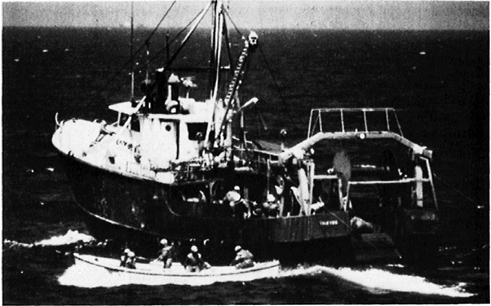
A Coast Guard boarding party conducting an underway boarding of a trawler in New England waters. (PA2 Robin Ressler, U.S. Coast Guard)
-
making safety manuals, videotapes, checklists, and similar self-help materials available through trade associations and journals; and
-
conducting training programs for basic seamanship, safety and cold water survival, navigation and piloting, and similar fundamental topics, often with support from federal discretionary funds and in cooperation with federal agencies such as NOAA and the Coast Guard.
Participation in training programs on each coast and in Alaska is limited. The training sector estimates that at best, only 10 percent of active fishermen have attended at least some programs (Colucciello, 1988; NTSB, 1987). Furthermore, there is a lack of resources to support continued coordination of training and education for the fishing industry. For example, the National Council of Fishing Vessel Safety and Insurance (NCFVSI) and the National Sea Grant College Program are examining the feasibility of establishing a national network of fishing vessel safety and sea survival instructor training programs modeled after the local instructor training program used by the Alaska Marine Safety Education Association (AMSEA). The focus of this effort is on ways to develop strong regional training networks, which could be coordinated loosely within a national framework. A lack of funding precluded a research program to catalyze establishment of such a network. NCFVSI has continued data collection, and Sea Grant marine advisory programs in some regions have attempted to coordinate their efforts and share training resources to provide
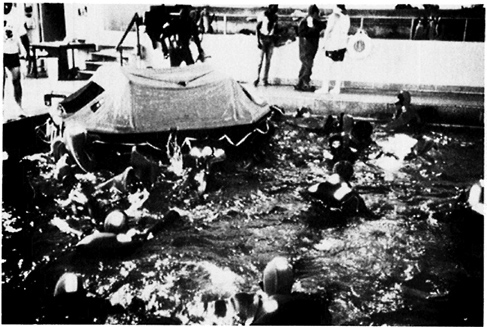
Survival training in progress. Safety and survival training programs are available from a number of trade associations, academic and training organizations, and private contractors. (North Pacific Fishing Vessel Owners' Association)
some uniformity in curriculum and training methods (R. C. Roush, NOAA, personal communication, 1989; Melteff, 1988; Keiffer, 1984).
Also notable are efforts in local fishing communities to implement safety programs beyond those required by the CFIVSA. Some fishermen and fishing communities have banded together to provide self-help assistance during emergencies, such as in one small lobstering community in Maine (Day, 1990). There are also self-insurance groups on both the East and West coasts. While their outfitting and maintenance requirements (beyond minimum federal equipment requirements) vary, they seem capable of improving safety performance (Nixon et al., 1987; Pacific Fisheries Consultants, 1987). In some cases the fishing community has fostered development and widely adopted safety equipment before it became mandatory. A good example of this is the immersion suit, which has been widely used and is credited with saving the lives of many fishermen in northern waters (NTSB, 1987, 1989e).
International and Foreign Government Safety Activities
Various international conventions promote the safety of ships at sea. They include the Safety of Life at Sea (SOLAS) and Load Lines conventions. Most fishing vessels operating domestically are exempt from these and other
conventions, but certain fish processing and tender vessels are required to have load lines (46 U.S.C.A. §5102). Recognizing the need for attention to safety of commercial fishing vessels, the IMO (formerly the International Maritime Consultative Organization, IMCO) organized an international conference, which culminated in the Torremolinos International Convention for the Safety of Fishing Vessels in 1977 (IMO, 1977). It established uniform principles and rules regarding design, construction, and equipment for fishing vessels 24 meters (79 feet) in length and over. This convention has not yet entered into full force, since not enough countries have ratified it because of concerns over technical provisions and policy issues. This includes the United States, which has not enacted legislation that would permit administration of the full range of safety measures incorporated in the convention.
Nevertheless, the Torremolinos Convention is a major milestone. It provides benchmarks for improving safety, and many fishing nations have adopted its measures into their marine safety programs. IMO is considering a protocol to the convention that would institute technological and administrative revisions to enable it to enter into force through the ratification process. The Coast Guard participated in development of the convention and is supporting development of the protocol. A major issue for the United States is whether recent law—including the CFIVSA—provides sufficient enabling authority for possible ratification.
The IMO Convention on Standards of Training, Certification and Watchkeeping for Seafarers, 1978, is another important factor. Although it specifically exempts fishing vessels, it has inspired efforts to develop personnel qualification standards. Notable among those efforts are the Document for Guidance on Fishermen's Training and Certification (IMO, 1988) and the Code of Safety for Fishermen and Fishing Vessels, Part A—Safety and health practices for skippers and crews (IMO, 1975a). Other IMO codes and guidelines include the Code of Safety for Fishermen and Fishing Vessels, Part B—Safety and Health Requirements for the Construction and Equipment of Fishing Vessels (IMO, 1975b) and Voluntary Guidelines for the Design, Construction and Equipment of Small Fishing Vessels (IMO, 1980). These standards were jointly prepared by IMO and two other United Nations subsidiary organizations, the Food and Agriculture Organization (FAO) and the International Labor Organization (ILO). They provide guidance on training and education and detailed curriculum development.
There are strong safety programs among IMO member states that include equipment standards, inspection requirements, and certification or licensing of vessel operators and crews. (International activity, Coast Guard involvement, and safety programs of selected fishing nations are summarized in Appendix C.) Rules and regulations have traditionally been developed beginning with consideration of technical systems. However, there is an increasing tendency among classification societies, legislative bodies, and international organizations
to look at technical, administrative, and human elements as a total system. This is because analyses indicate that human elements directly or indirectly contribute to 70 to 90 percent of all marine accidents (Dyer-Smith and De Bievre, 1988; USCG, 1989a; T. Stallstrom, Det norske Veritas, personal communication, 1990; NRC, 1976).
Canadian studies implicate human factors in accidents and urge education and training programs to improve safety (Gray, 1986, 1987a,b,c; Canadian Coast Guard, 1987; Canada, Government of, 1988). Based on its study and national mandates, the Canadian Coast Guard (CCG) developed a new standard for protective worksuits especially for fishermen (S. J. W. Stewart, CCG, personal communication, 1990) and is sponsoring development of a liferaft for small fishing vessels.
SAFETY AS A TOTAL CONCEPT
Safety problems and solutions are too often considered individually rather than collectively. Even when a broad range of safety options is considered, actual implementation is often fragmented and uncoordinated. The CFIVSA requires that certain survival-oriented measures be implemented before all problems facing the commercial fishing industry are completely examined. Yet, safety problems arise out of a complex variety of interacting factors:
-
vessels—construction, design, outfitting, navigational and operating equipment, gear type, and emergency, safety, and survival equipment;
-
fishermen—professional competency (training and skills) and behavior (risk-taking attitude and responsibility for safety); and
-
external forces—fisheries management, economics, and weather and sea conditions.
Individual strategies may target any or all of these risk factors, but a comprehensive program must encompass all of them as a total system. Safety options that appear to be attractive and affordable when viewed alone may offer only partial solutions, draw resources away from other options, or have unintended side effects. For example, responses from the committee's regional assessments and Coast Guard rulemaking indicate strong concern among fishermen that requirements for costly, state-of-the-art equipment such as emergency position-indicating radio beacons (EPIRBs) could result in economic hardship. Implementing these and other expensive alternatives (relative to the investment in boats and gear) could economically force some owners out of business or cause them to postpone needed maintenance (see USCG, 1971).
While each alternative needs to be measured in the context of a specific problem, it is also important to understand its contribution and cost. Such an understanding of individual elements is necessary to the creation of a package of safety alternatives that together will form a program with the greatest potential
for achieving meaningful improvements. Treating safety as a total concept is also a way to distinguish between theoretically desirable goals and reasonable and attainable objectives in formulating a program of corrective action.
Establishing a Direction
Despite the congressional mandate in the CFIVSA to improve safety in the fishing industry, clear national goals and objectives have not been established by government or industry to guide development and implementation of safety programs, nor have basic questions been answered:
-
What realistic level of safety is to be achieved; i.e., what are acceptable casualty and fatality rates?
-
What costs—culturally, technically, and economically—are acceptable for achieving these rates? and
-
What is an acceptable time frame for reaching these goals?
In 1984 the Coast Guard established a goal for its commercial vessel safety program to reduce fishing vessel casualties by 1991 by not less than 10 percent (Piche et al., 1987). The results to date are inconclusive. Special compliance examination programs targeting selected local fisheries in Alaska have demonstrated the potential for short-term, resource-intensive programs to get more vessels to carry and maintain the required safety equipment (USCG, 1988b, 1989b). Yet, so far, there are no measurable changes in the aggregate numbers of fatalities and vessel casualties.
Although the data do not show reduced numbers of fishing vessel accidents and fatalities, Coast Guard efforts do have a positive effect. For example, educational and—to a lesser degree—law enforcement actions are contributing to growing safety awareness within the industry and some local improvements. Existing efforts could be enhanced by establishing long-range objectives for which a complementary program of safety alternatives could be developed and implemented as industry and government are able to evaluate the results and bear the costs.
Safety Program Infrastructure
An effective fishing safety program will require a suitable administrative structure capable of implementing safety alternatives mandated by law or regulation. It will also need a network capable of mobilizing the affected parties (fishermen, government agencies, trade associations, and fisheries commissions and management councils) and their willingness to pay for safety services.
The only government agency with a national infrastructure capable of addressing fishing vessel issues from port to fishing grounds is the Coast Guard. It is a well-established public safety organization with administrative
and technical capability to develop and administer a comprehensive safety program. Despite its extensive experience, the Coast Guard has not had the resources or enabling authority to build more technical expertise among its marine safety personnel about the safe operation and loading of fishing vessels. Specific knowledge among field personnel is generally limited to what can be learned through on-the-job training and varies by exposure to commercial fishing activity. The agency does not appear to have the budget, personnel, or authority needed to expand its role in licensing and inspection. Nevertheless, it may be the logical choice in the near term to lead and oversee (but not necessarily conduct) commercial fishing safety programs.
Structurally, the Coast Guard's commercial vessel safety program resembles a total concept approach, though a full benefit-cost analysis of proposed and existing safety measures is not normally an element of rulemaking. When first directed by Congress to look at fishing vessel safety in 1968, the Coast Guard tried to analyze safety issues as a total concept (USCG, 1971). In practice, however, lack of congressional and industry support resulted in an incremental approach.
There is an informal network to mobilize constituent support for selected issues among the NCFVSI and some trade associations. The council and trade associations have developed safety materials, sponsored workshops, conducted safety training and research, and represented the industry during congressional hearings on vessel safety and insurance. The council consists of representatives from the major fishery trade associations across the United States. It could possibly be used to administer a comprehensive national safety program, but is not organized to do so. There is no single organization with the breadth of constituents or cohesiveness to represent the entire industry.
Although significant differences among various fishery interests and trade associations may preclude leadership by a single industry representative, the Atlantic, Gulf, and Pacific coast states' regional fishery commissions might fill such a role. Although the commissions evolved independently and thus respond differently to their regions ' needs, their potential to lead safety programs regionally merits consideration. For example, the Pacific States Marine Fisheries Commission cosponsored the West Coast regional assessment commissioned for this study. Its neutral role provided a forum for obtaining the information needed to understand safety issues there.
Monitoring and Evaluating Safety Performance
Monitoring and evaluating safety equipment, systems, and programs are fundamental. A total safety system must include ways to identify safety trends, anticipate problems, and assess program effectiveness in mitigating the severity and costs of accidents. A complete system would include reporting, data collection, and analysis of criteria on which safety performance will be based.
Data systems are needed to provide for follow-up and compliance when safety performance is unacceptable.
There is presently no universal program for evaluating safety in the commercial fishing industry. Monitoring techniques tend to be rudimentary: for example, monitoring personnel injury incidents and costs or correlating accidents with diesel fuel consumption to approximate the relative effectiveness of safety actions within comparable corporate fleets. Computer software for monitoring vessel performance was introduced by the NCFVSI in 1989, but information from such programs belongs to the user and is not tracked. Insurance claims are a natural resource for casualty statistical analyses, and the CFIVSA requires insurers to provide casualty data to the Coast Guard. This is not yet being done. Some claims data are provided voluntarily by marine underwriters to the Commercial Fishing Claims Register (CFCR) maintained by the Marine Index Bureau (see Appendix D), but the data are far from complete and cover only a portion of vessels and personnel casualties, and there is no effective monitoring system.
Coast Guard data include documentation of federal marine casualty investigations, SAR services, underway and occasional dockside boardings, and courtesy examinations. Unfortunately, the data record only limited safety performance information across the entire fleet of uninspected fishing vessels. Prevalent low-level maintenance deficiencies are indicated, and a close estimate of the number of annual fatalities is supported by the data. Secondary analysis of causal factors was only possible for about 30 percent of the fishing vessel casualties recorded in CASMAIN. Directly correlating information among data bases was not possible, however.
SUMMARY
Safety problems abound within the commercial fishing industry, despite past efforts by government and industry to correct conditions. These efforts for the most part have approached the complexities of safety improvement in a fragmented and uncoordinated way, rather than as a total concept. Goals and objectives needed to establish an overall safety program have been lacking. Safety trends cannot be effectively monitored and evaluated using present means, and without accountability, fishermen have been reluctant to accept a proactive role in safety improvement. The CFIVSA signals that this is an opportune time to address safety as a total concept leading to adoption of a comprehensive safety program involving cooperative ventures by government and industry.
In the following chapters, attention is focused on the broad safety areas identified in this chapter—safety performance, the vessels, the fishermen, survival, and external forces. Specific safety issues are discussed and alternatives considered. Specific problems and possible solutions are addressed as discrete components that can be fitted into a safety program with a national infrastructure and a means of evaluating it.


