
2
Commercial Fishing: An Industry Overview
The United States—with coastline on two oceans, the Gulf of Mexico, the arctic seas, and the Great Lakes, and its extensive rivers, lakes, and reservoirs —is among the leading fishing nations of the world. Fishery resources within its 200-nautical-mile exclusive economic zone (EEZ) make up about 15 percent of the world's total. Commercial fishing makes significant contributions to the national and regional economies; in 1989 10.7 billion pounds of fish were landed by U.S. vessels, fifth in total world harvest behind Japan, the Soviet Union, China, and Peru (National Oceanic and Atmospheric Administration [NOAA], 1990a).
The U.S. fishing industry is composed of harvesting, processing, and marketing segments, each with an associated infrastructure. The numbers of Vessels used in this report are estimates based on composite data of widely varying statistical validity and are presented to provide a frame of reference for development and analysis of safety-improvement strategies and alternatives later in this report. About 30,000 fishing industry vessels were documented with the federal government in early 1990 (vessels 5 net tons and over). Table 2-1 depicts the actual number of documented vessels that could be categorized as “fishing industry vessels” on March 31, 1990. The ports in which these vessels are documented do not necessarily reflect the regions where they are employed. For example, a significant number of vessels from the West Coast, and to a lesser degree from the North Atlantic region, are operated in North Pacific and Alaskan waters. Fish processing and fish tender vessels are operated almost exclusively in North Pacific and Alaskan waters (a few operate in the North Atlantic region). An estimated 260 fishing industry vessels have federal
TABLE 2-1 Documented Self-Propelled Vessels Under 5,000 Gross Tons with a Fisheries Endorsement but not a Passenger or Offshore Supply Vessel on March 31, 1990
|
Coast Guard Documentation Port |
Number of Vessels |
|
Atlantic Coast |
|
|
Boston, Massachusetts |
3,255 |
|
New York, New York |
950 |
|
Philadelphia, Pennsylvania |
715 |
|
Hampton Roads, Virginia |
3,668 |
|
Miami, Florida |
3,467 |
|
Great Lakes |
|
|
Cleveland, Ohio |
155 |
|
Gulf Coast |
|
|
New Orleans, Louisiana |
3,264 |
|
St. Louis, Missouri |
55 |
|
Houston, Texas |
2,224 |
|
West Coast |
|
|
Long Beach, California |
974 |
|
San Francisco, California |
1,945 |
|
Portland, Oregon |
1,522 |
|
Seattle, Washington |
2,835 |
|
Alaska |
|
|
Juneau, Alaska |
4,335 |
|
Hawaii/Southwest Pacific |
|
|
Honolulu, Hawaii |
305 |
|
Total |
29,669 |
|
SOURCE: Data recorded in U.S. Coast Guard Marine Safety InformationSystem by Coast Guard Headquarters, Washington, D.C., on March 31,1990. |
|
or state permits to process (e.g., freeze or can) fish. Of these, about 210 have both harvesting and processing capabilities. A documented vessel's actual use in the fishing industry is not monitored by Coast Guard automated information systems or data bases.
In 1987, the latest year for which broad-based industry data are available regionally, it is estimated that about 31,000 federally documented fishing industry vessels and 80,000 smaller craft were registered with the coastal states (with the Coast Guard in Alaska) and bearing state numbers (Table 2-2). These
TABLE 2-2 Estimated Number of Fishing Industry Vessels Active During 1987 by Region Fished1
|
Region |
Documented Vessels |
State-Numbered Vessels |
|
North Atlantic |
||
|
New England |
1,800 |
16,500 |
|
Mid-Atlantic |
800 |
5,500 |
|
Chesapeake Bay |
2,500 |
3,500+2 |
|
South Atlantic |
2,700 |
13,500 |
|
Gulf/Caribbean |
||
|
Gulf Coast |
10,000 |
26,5003 |
|
Caribbean |
1,500 |
|
|
Great Lakes |
||
|
West Coast |
5,000 |
6,000 |
|
Alaska |
8,000 |
9,000 |
|
Hawaii/Southwest Pacific |
200 |
200 |
|
Total |
31,000+/− |
80,000+/−6 |
|
1Numbers are composite estimates from regional sources. Principal sources include records of fish landings maintained by National Marine Fisheries Service regional offices, permit data maintained by the Commercial Fishing Entry Commission in Juneau, Alaska, and regional assessments commissioned for this study, and economic analyses available for some fisheries. 2Based on 1986 estimate of Chesapeake Bay oyster fishery (Sutinen, 1986). 3Includes a large number of small boats engaged in shrimp fisheries in bays, sounds, and estuaries. 4Negligible. 5Current information is not available. 6The number of commercial fishing vessels bearing state numbers is not known. West Coast and Alaska figures are close approximations. All other data presented are general estimates. |
||
vessels and small craft employed many types of gear to catch, transport, or process a wide variety of finfish and shellfish. The number of vessels constructed as fishing vessels but not actively used in fishing is not known.
The number of individuals who fish commercially is not known, nor is there a statistically valid average number of fishermen per vessel. The number of fishermen varies from 1 to 20 or more, depending on the size of the vessel and its fishing activity. Generally, the majority of the documented fleet is estimated to have three to four fishermen per vessel, and state-numbered vessels one to two. If all the vessels were under way at the same time, this would equate to a capacity for about 230,000 jobs. However, the actual number of individuals is probably significantly higher. This is because many people are
hired as part-time and seasonal workers, and there is high turnover among entry-level crewmen. Thus, the number of people employed as fishermen that is used in this report is only a crude estimate to provide a reasonable frame of reference.
The U.S. catch landed at U.S. ports in 1989 totaled nearly 8.5 billion pounds (3.8 million metric tons), with a value of $3.2 billion. Commercial landings by U.S. fishermen at ports outside the 50 states or transferred to foreign vessels within the U.S. EEZ were an additional 2.2 billion pounds (994,000 metric tons) valued at $326.7 million. Most of this consisted of tunas landed at canneries in American Samoa, Puerto Rico, and foreign ports and pollack transferred to foreign processing ships within the U.S. EEZ.
Within the processing and wholesale sector, there are about 4,200 establishments employing 103,000 people (annual average). These operations process and market fishery products throughout the United States and abroad. Some processing is conducted aboard ship, principally in North Pacific and Alaskan waters. In addition, U.S. processors import 3.2 billion pounds of edible seafood products valued at $9.6 billion for further processing before they are marketed. The U.S. commercial marine fishing industry contributed $17.0 billion (in value added) to the U.S. gross national product in 1988 (NOAA, 1989) and $17.2 billion in 1989 (NOAA, 1990a).
Imported seafoods are becoming an increasingly important source of products for America's seafood consumers. Although imports have continuously represented less than 50 percent of the total edible seafood supplies in the United States, since 1966 they have increased at an annual average rate of about 5 percent. In contrast, domestic landings have increased at about 2 percent. If menhaden (used for industrial products) and Alaskan pollack are excluded, there has been a decline.
International trade in seafood has become a dominant force that shapes the economic performance of the commercial fishing industry. If the growth of the U.S. industry is constrained by external factors affecting fishery resource management or declining resources force curtailments, imports will fill the demand. As some countries rapidly expand aquaculture production, prices for wild caught species, especially shrimp and salmon, may be undercut (McDowell et al., 1989). Although it is beyond the scope of this study, the committee notes that erosion of economic returns from U.S. fisheries competing with aquaculture products may increase economic pressures in some fisheries, detracting attention from safety.
FISHING INDUSTRY VESSELS AND FISHERMEN
This introduction to the commercial fishing industry turns now to the vessels, the people who earn their living aboard them, and the working conditions in
which they pursue their profession. These are the areas where safety problems occur, which motivated the Commercial Fishing Industry Vessel Safety Act of 1988 (CFIVSA) and this study. The U.S. commercial fishing fleet is one of the world's largest in total numbers in which most of the craft are linked to coastal and estuarine fish stocks. Since the 1976 Magnuson Fisheries Conservation and Management Act (MFCMA) was implemented, the U.S. fleet has expanded and modernized to a large degree. Yet, many old vessels remain in the fisheries and will, under present circumstances, continue to be operated for many years. The fishermen who operate these vessels are as diverse as the vessels themselves.
The Vessels
In simplest terms, commercial fishing vessels are self-propelled or wind-driven platforms used to catch fish for profit. In the broadest sense they are a workplace, a means of transportation to and from the fishing grounds, an itinerant domicile for overnight or extended trips, and for some an industrial plant for processing products. Although it is correct to refer to them as “vessels,” many can be appropriately considered “boats,” reflecting their relatively small size. In length, vessels of the U.S. fishing industry fleet range from under 25 feet to over 300 feet. But the majority of the fleet are small fishing vessels; about 99 percent are 79 feet or less in length. It is estimated that roughly 80 percent are less than 40 feet. Their hulls are of wood, aluminum, steel, fiberglass, and even concrete. In age, they range from those under construction to those constructed prior to the turn of the century. Their fishing riggings include various types of nets, trolling gear, trawls, hooks, dredges, rakes, and traps.
Vessel Technology
Tremendous progress has been made in new vessel design and construction. Shipbuilding techniques and new fishing experiences are reflected in the design, construction, and operations of modern fishing vessels. Hydraulic power is used on many vessels to operate most deck gear through remote workstations. Electronic navigation, communications, and fish-locating equipment fills many bridges. Mechanical cooling and freezing equipment is common, particularly on vessels operating on longer trips. Factory trawlers and ships carry industrial processing equipment as well. Midwater and off-bottom trawls, techniques employed in European fisheries for many years, are now successfully employed in U.S. fisheries of the Pacific and Atlantic oceans and the Gulf of Mexico.
What has emerged is a modern, efficient fleet capable of taking large quantities of fish and successfully replacing the foreign fleets in the offshore fisheries. Many traditional fishing boats and small craft continue to dominate the coastal, estuarine, and Great Lakes fisheries. These smaller craft employ
fishing gear much like that used in the past. The major exception has been the menhaden fishery, where vessels, gear, and efficiency rival that of the modern offshore fleet.
Commercial Fishermen
The men and women who work the fisheries of the United States are as diverse as the fish they seek. They are of all races and ages. Some are first-generation fishermen; some come from generations of fishermen, often with one or more family-owned boats. Some have no alternative marketable skill or source of employment and fish as a source of income or subsistence. Others become commercial fishermen because they like it and they have a share in the vessel's earnings (see Nixon, 1986). Therein lies a major difference from the fisherman 's onshore counterparts. As a rule, fishermen get no guaranteed wage, no overtime pay, and few fringe benefits. They get only the promise of hard work, long hours, a high-risk workplace, and—by any standards —cramped living quarters in exchange for a share of the net proceeds at the end of the trip.
A fisherman may be a fishing vessel owner who serves as captain of his own vessel (owner/operator), a person employed by the owner to operate the vessel (operator, individual in charge, or captain), or a crewman. Used collectively in this study, the term fisherman applies to the captain and all members of the crew engaged in service on deck or in engineering departments or capacities aboard a fishing industry vessel. Principal occupational activities include vessel, fishing, harvesting, and delivery operations. Processing-line workers aboard catcher/processors or floating processors are also part of a vessel's crew. But they are not employed in the occupational activities associated with fishermen, instead performing an industrial function.
Functionally, processing-line work is best characterized as unskilled. Entry-level line workers frequently have extremely limited, if any, maritime experience. Some speak English only as a second language, a complicating factor during emergencies. Although they are not characterized as fishermen for this study, their safety is an issue insofar as they may be jeopardized by vessel operations, and the analysis of safety presented in this report applies. Processing-line safety is an issue of concern but is beyond the scope of this study.
Culture and Social Organization
Fishermen are often viewed by social observers as a quaint subcultural group displaying special social and cultural qualities: individualistic, carefree, rugged, self-sufficient, and in some cases fatalistic. Fishermen more frequently characterize themselves as hunters. During this study, the committee was continually struck by what appear to be basic social and psychological assumptions (sometimes verging on stereotypes) of fishermen as possessing social
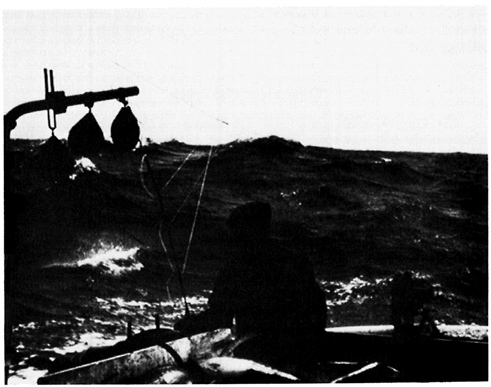
The lonely vigil—a West Coast albacore fisherman waiting for a strike. (Oregon Sea Grant)
characteristics far from the mainstream culture, similar to earlier sociological conceptualizations of farmers (Gross, 1958). This may be the case in some fishing communities, particularly those where fishing is a significant element of the local economy. Also, demands of the workplace distinguish fishermen as a unique occupational group (Browning, 1980; Maiolo, 1990)—e.g., their temperament and the ability to endure long periods of boredom and isolation and long hours of physical labor (Browning, 1980).
The fishing industry has attracted people from many ethnic groups. Some are immigrants who speak their native language and may have little understanding of English. Most quickly assimilate into the workplace with minimal problems. However, as technology has made fishing operations more complex, familiarity with a common language is a necessity. During the regional investigations, anecdotal information indicated that language barriers may hinder communication and contribute to accidents. This is mostly a regional factor that is typically associated with relatively few ports, areas, and fisheries (e.g., shrimp and tuna) and particular operations (e.g., factory trawlers).
Fishermen can be classified in terms of their occupation as skilled. Perhaps the major factor distinguishing them from other occupations is the eclectic nature of the skills required, ranging from shipwright and diesel mechanic
to refrigeration engineer and electronics technician. The level of knowledge required varies significantly by vessel, gear configuration, and status as captain or crew member. As with other occupations, fishermen are differentiated by skills that distinguish the successful from their marginal counterparts. For most of the fleet, which is small-scale in nature, the role of the fisherman is “similar in many respects to that of the independent farmer, the one-business merchant, the autonomous professional” (Miller and Van Maanen, 1982).
Fishermen as Participants in the Labor Market
An alternative view of fishermen as a segment of the labor market was prepared for this study (Gale, 1990). Analysis of labor market behavior of fishermen suggests the general approach they take with regard to the workplace, where accidents occur. Accidents, probabilities, and reactions to vessel inspection and other possible safety programs would be influenced by both work setting characteristics (e.g., gear type) and fishermen's behavior and motivation.
Gale suggests there are different generic characteristics of how fishermen approach fishing as an occupation, and this affects how they respond to safety considerations. There are those who have a strong commitment to fishing, some of whom will adapt to change and others who will resist it. Some fishermen enter and leave fishing in order to supplement their income with other work. Those who are not primarily fishermen pursue the short-term monetary reward. Each responds to safety considerations differently. Thus, fishermen differ in their response to the labor market, their commitment to the occupation of fishing (in contrast to specific tasks or jobs), their motivation for making fishing a career, and their reaction to safety and safety programs. Gale suggests that no single strategy will solve all safety problems and that rigid programs will vary in effectiveness depending on the relationship of the targeted fishermen to fishing as an occupation.
As regulations mandated by the CFIVSA and safety decisions deriving from it come into effect, fishermen—people who historically have lived with risk and danger, who often display characteristics of subcultures, and who display intense individualism—will be compelled to meet safety standards mandated by a distant decision-making body, the Congress of the United States. A chief implementation problem may be cultural and social uniqueness; however, commercial fishermen in the United States have found ways to cope with previous mandates, such as the resource management schemes of the MFCMA and ensuing state and regional management developments. The indicators of adjustment are increased involvement of commercial fishermen in the management process, such as participation on advisory panels, attendance at hearings, the strengthening of association ties to promote their interests, and the use of political influence. Such adjustments have not always come easily in the past, but what
appears important is bringing those who must comply with new regulations into the decision-making and implementation processes as participants.
The Working Conditions
Working conditions throughout the national fleet and the fishing grounds further complicate safety. R. M. Snyder (1973), an early oceanographer, succinctly put into context the ocean as a working environment:
There are things about the sea which man can never know and can never change. Those who describe the sea as “angry” or “mean” or “gentle” or “ferocious” do not know the sea. The sea just doesn't know you're there—you take it as you find it, or it takes you.
There is no room for carelessness or arrogance on the ocean. Fishermen are continuously exposed to high risk in the workplace during transit and while fishing. They are required to work extremely long, unregulated hours, often under very severe environmental conditions. In most cases, fishermen are not required to have their professional competency validated by third parties or their physical condition screened prior to employment. In the majority of the fleet, fishing vessels are not surveyed or inspected during construction or operation to ensure satisfactory material condition (vessels do not maintain themselves). Fishing vessels obtain cargo from the sea and must be loaded at sea, resulting in open hatches and considerable deck activity. This often occurs in changing—often marginal—weather on moving vessels with high pitch and roll movement and relatively low freeboard (see Browning, 1980; Canadian Coast Guard, 1987; Murray, 1962). Furthermore, fishermen (and processing workers) for the most part are a nonunion work force. There are no third parties monitoring work hours, health benefits, time at sea, profit sharing (most fishermen do not work for wages), grievances, or collective bargaining. These working conditions are not inviolable; some elements hold potential for improving safety.
U.S. LAWS AFFECTING COMMERCIAL FISHING
There are a number of laws that have an impact on the commercial fishing industry. The principal ones important to this study are those pertaining to fisheries management and legal liability.
Fisheries Management
Traditionally, commercial fisheries have been highly competitive. Return to capital and labor has been based on sharing of revenue generated by sale of catches, either by the trip or over the whole season. Even in colonial days, competition was keen. The drive to be the first to market with catches from the Grand Banks is reflected in historical records. This longstanding
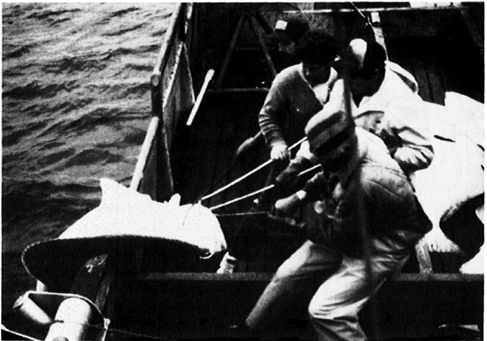
A large halibut hauled aboard with gaff hooks. Fishing industry vessels load cargo at sea rather than in port, creating unique operating conditions and risks to vessels and fishermen. (Robert Jacobson, Alaska Sea Grant)
practice of high pay for successful fishing varies little across geographic area and fisheries. Fishermen share a percentage of the proceeds from the sale of the catch after deductions for vessel and trip expenses (e.g., fuel costs, groceries, bait, electronics, leasing fees, etc.), owner's share, and bonuses or premium for skippers and other personnel. This traditional payment method produces strong economic incentives for maximizing catches and minimizing costs. These practices predate any significant efforts at fishery management, which today frequently conflict with the fishermen's desire to increase their incomes through larger catches. Presently, conservation efforts have led to quota management, resulting in shorter fishing periods.
Prior to enactment of the MFCMA, most marine fishery management regimes were within the purview of the states. Federal management was the result of international treaty obligations covering tunas, Pacific halibut, West Coast salmon, and most finfish and some shellfish of the northeast Atlantic. These earlier conservation regimes addressed seasons, gear limitations, national quotas, and some area closures and size limits. Overfishing of stocks was attributed to foreign fishing activity, and efforts to reduce fishing effort focused on foreign fleets. Thus, recent regulatory regimes to control direct fishing effort have their beginnings in the international forums or (since 1976) within the eight
fishery management councils created by the MFCMA (Grasselli and O 'Hara, 1983; Nies, 1986; Sutinen and Hennessey, 1986; Alverson, 1985).
The MFCMA authorized the federal government to conserve and manage all fishery resources except tuna within the U.S. fishery conservation zone (200 nautical miles from the coast). The eight regional fishery management councils (FMCs) have the principal responsibility for developing fishery management plans (FMPs), which generate management measures for particular fisheries. Fishing industry views are represented to the regional councils through industry advisory committees and opportunities to speak at council meetings open to the public. Inasmuch as most fisheries are specific to a geographic area, fishermen transferring from one region to another are confronted with a wide variety of regulations (Grasselli and O'Hara, 1983; Nies, 1986; Sutinen and Hennessey, 1986; Frady, 1985).
The FMCs have continued the traditional management practices of the past. During this same period, many U.S. fisheries have witnessed significant technological improvements in vessels, deck gear, electronic fish-finding and navigational equipment, and fishing gear and technology. As a result, many stocks of finfish and shellfish have declined, in large part from overexploitation by U.S. fishermen. This has resulted in more restrictive conservation regimes, designed to arrest declines, begin stock rebuilding, or preclude overfishing (Frady, 1985). Whatever the reason, whichever the fishery, the restrictive measures—coupled with greater fishing effort—have resulted in economic pressures on fishermen with indirect adverse effects on safety.
Legal Liability
The Jones Act (46 U.S.C. §883) requires that the coastwise transportation of merchandise (i.e., goods, wares, and chattels of every description including fish and fish products [19 U.S.C §1401]) between two points in the United States must be on board a U.S.-built and -flagged vessel. Beyond that, the act is best known for establishing an injured seaman's right to trial by jury for any action for damages suffered at the hand of his employer. This, together with the general maritime doctrine of unseaworthiness that enables all persons in service of the vessel to recover full indemnity if injury was caused by any condition of the vessel, its equipment, or crew that a court may construe as rendering the vessel “unseaworthy,” is a basis for liability findings and settlements. The system effectively incorporates the potential for high awards inherent with fault-based liability and the virtual certainty of recovery usually associated with no-fault or workmen's compensation types of systems. This legal liability regime is considered onerous and economically disruptive by many fishing vessel owners, because it generates problems in the pricing and availability of liability insurance. (Chapter 7 discusses the impact of this legislation further.)
REGIONAL FISHERIES
The commercial fishing industry has traditionally been regional in character. Unique regional factors include fishery stocks, environmental conditions, and significant interregional issues that affect safety, such as fishing outside the vessel's or fisherman's home region and converting vessels designed and constructed for one region or fishery for use in another. The regional nature of U.S. fisheries was reinforced by organizational changes to fisheries management practices, mandated by Congress in 1976, which created the federal regional FMCs.
Safety analysis begins with a summary of the regional fisheries, including intra- and interregional issues and estimated 1987 baseline numbers of vessels and fishermen developed for this study (Table 2-2). Fisheries data are generally collected regionally. Timely data on vessels and fishermen are woefully incomplete, however, and the numbers are at best composite estimates based on correlation of data from national and regional sources. The number of vessels in the national fishing fleet is constantly changing. The number of fishing industry vessels active in 1987 is believed to represent a decline of undetermined size from the fleet size in 1982. A 25 percent decline is evidenced for the West Coast, for which statistically valid historical data were available on the number of active fishing industry vessels (Jacobson et al., 1990).
North Atlantic Region
The North Atlantic (New England through mid-Atlantic ocean waters and Chesapeake Bay) fishing fleet operates from Maine through Virginia in both nearshore and distant waters. Exclusive of vessels home-ported outside the region, there are about 5,100 documented fishing industry vessels operating from ports in the North Atlantic region. Of these, fewer than 12 have combined catching and processing capabilities, and there are a few fish tenders (Griffen, 1989a,b; Piatt, 1990). The remainder are fishing vessels. In addition, there are approximately 25,500 state-numbered fishing vessels. The majority of the fleet operates in coastal and estuarine waters south of the Canadian border, but some vessels venture to the outer edge of the Grand Banks (outside Canadian jurisdiction) for groundfish (e.g., cod, haddock, and flounder), and others operate well offshore for swordfish and tuna. Some catcher/processors from the region have operated in the Gulf of Mexico for squid and butterfish, and at least one shifted to the North Pacific trawl fisheries during this study. There is a major oyster fishery in the Chesapeake Bay, principally manned by 3,500-4,500 fishermen in small boats employing hand or mechanical tongs. About 30 traditional sail dredges have also been used in this fishery (Sutinen, 1986).
Environmental conditions can be severe, especially during the winter months. During periods of better weather, many vessels from outside the
region—some as far away as Texas—travel to these waters to fish. Twelve of the nation's top 60 fishing ports are located in the North Atlantic region, accounting for approximately 20 percent of the nation's catch by value and 9 percent by volume in 1989. Groundfish, lobster, and scallops collectively make up about 60 percent by value of the region's total. The rest is divided among other species (butterfish, clams, crab, herring, mackerel, menhaden, northern shrimp, squid, swordfish, and tunas) (NOAA, 1989, 1990a). Each of these fisheries presents its own safety problems because of the wide variety of gear and vessel types used (Allen and Nixon, 1986; Gordon, 1989; Nixon, 1990).
South Atlantic Region
The South Atlantic region extends from North Carolina to the Florida Keys. It accounted for about 5 percent of the nation's catch by value and 3 percent by volume in 1989. Fishing provides significant employment to the regional economy. About 2,700 documented and 13,500 state-numbered vessels are used to fish commercially (Jones and Maiolo, 1990; NOAA, 1990b; National Marine Fisheries Service [NMFS], unpublished data, 1990). No fish processing vessels operate in the region. There are few offshore operations in the region. Most fishing craft operate within state jurisdiction (within 3 nautical miles of the shoreline and within bays and inlets).
The region is characterized by diverse fisheries, the most important being menhaden, shrimp, crab, flounder, and calico scallop. Major inshore species are crabs and various food fish taken by traps, pots, gill nets, and seines. Slightly farther offshore (outside 3 nautical miles), a variety of finfish are taken by seiners, trawlers, trollers, and gill-netters (Gordon, 1989; Jones and Maiolo, 1990; Allen and Nixon, 1986; NOAA, 1990b).
Since nearly all fishermen depend on daily or weekly sales of fresh fish, the economic incentive to operate year round is high. Environmental conditions are generally not a limiting factor except for hurricanes, periodic storms, and sea conditions that impair departure and entry to some fishing ports. Many offshore operators, particularly those from North Carolina, also fish in the North Atlantic region, landing their catch in ports adjacent to the fishing grounds. Such interregional activity, also found on the West Coast and Alaska, greatly increases the local knowledge needed by vessel captains to operate safely.
The Gulf of Mexico and Caribbean Region
The Gulf Coast extends from the Florida Keys west to the U.S.-Mexican border. There are approximately 10,000 documented fishing vessels. No fish processing vessels are based in the region, although one vessel is being converted to process multiple species in the Gulf of Mexico. The states accounted
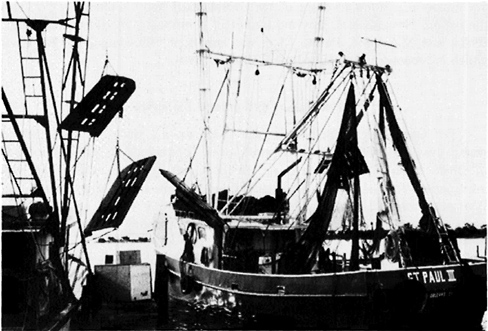
The fishing vessel St. Paul III typifies the vessels which operate in the Gulf of Mexico shrimp fishery. (Randall G. Prophet, Florida Seafood Marketing)
for 20 percent of the nation's catch by value and 21 percent by volume in 1989. Additionally, there are many small craft (estimated at 26,500)—usually one-person operations—fishing commercially in sheltered inland waters, principally for shrimp (NOAA, 1990b; NMFS, unpublished data, 1990; Hollin, 1990). Environmental conditions affecting the Gulf Coast are relatively benign. Fishermen must, however, be alert to occasional tropical storms and hurricanes as well as squalls and thunderstorms, which can occur throughout the year.
The Gulf Coast includes high-volume menhaden and shrimp fisheries. The fleet is numerically dominated by smaller craft, yet larger offshore shrimp vessels number about 7,500. Recently, there has been a move to develop a longline fleet for pelagic (open sea) fisheries. Some new vessels have been constructed for this fishery; others are older vessels converted from shrimping. Overall, the majority of fishing vessels operate within 3 nautical miles of shore. The major commercial fisheries are shrimp, menhaden, spiny lobster, stone crab, swordfish, reef fish, and oysters (NOAA, 1990b). These fisheries require diverse vessels and gear, with different operating procedures for safe handling (Gordon, 1989; Hollin, 1990; Marine Advisory Service, 1986).
The Caribbean encompasses the fisheries of the Commonwealth of Puerto Rico and the U.S. Virgin Islands. The island-based craft are small and total about 1,500. The number of fishermen is small—about 2,000. Their landings
are minor in relation to those of the overall Gulf and Caribbean region and the nation. Nevertheless, they are important contributors to island economies. Ponce and Mayaguez, Puerto Rico, are important offloading ports for tuna, which is processed and canned there (Jones, 1990).
Great Lakes and Inland Fisheries
The Great Lakes (included in the scope of this study) and vast inland waterways of the United States support varied commercial fisheries. Hundreds of small, state-numbered boats, and in the Great Lakes a small number of documented vessels as well, utilize gill nets, trot lines, seines, traps, hand lines, fyke nets, trammel nets, trawls, and other minor gear. Most of the smaller boats are operated by the owners. Larger vessels operating on the Great Lakes may carry a crew of up to five. Most, if not all, vessels are operated as day boats, leaving port in early morning and returning in late afternoon. No current information is available on the number of vessels actively employed in commercial fishing. NMFS figures for 1977, the most recent vessel employment information available for Great Lakes and inland fisheries, estimated that 225 documented vessels and 586 state-numbered boats operated on the Great Lakes (NMFS, unpublished data, 1990). Commercial fishing activity has declined since 1977. Coast Guard documentation data for March 1990 and vessel employment in other regions suggest that the number of active documented vessels with fisheries endorsements on the Great Lakes is less than 150. The number of commercial fishermen on the Great Lakes is small—2,000 to 3,000. Although outside the scope of safety analysis presented in this report, the 1977 NMFS data estimated that 8,613 state-numbered boats operated in the 20 states comprising Mississippi River fisheries (NMFS, unpublished data, 1990).
Landings taken by Great Lakes and inland fishermen are small in comparison to U.S. fisheries in other regions. Nevertheless, the fisheries are important contributors to local economies and frequently are the major source of fishery products on local markets.
West Coast Region
There are nearly 5,000 documented fishing vessels operating in waters off the West Coast, providing work for about 11,000 fishermen. An estimated 6,000 fishing vessels bearing state numbers also operate in these waters (Jacobson et al., 1990). The number of fishermen operating state-numbered vessels is not known. Fleet profiles developed for Washington State waters estimate that 3,525 fishing industry vessels employed 6,972 fishermen during 1987 (Natural Resource Consultants, 1988).
West Coast states (California, Oregon, and Washington) accounted for about 10 percent of the nation's catch by value and 9 percent by volume in
1989. From northern California to Washington, the salmon fishery is the most valuable. It also employs the greatest number of gill net, troll, and seine vessels. The trollers are relatively small (18-60 feet), yet operate up to 50 nautical miles offshore throughout the salmon and tuna fisheries. Gill-netters and seiners operate in the relatively protected waters of estuaries, bays, and inlets during the seasonal salmon fishery. During 1987, about 85 percent of vessels operating in Washington State local waters were engaged in the salmon fishery (Natural Resource Consultants, 1988). No U.S.-flag fish processing vessels were identified as operating in West Coast waters. There are limited fish tender operations, consisting principally of fishing vessels seasonally converted to tendering for river runs of salmon in sheltered inland waters (Jacobson et al., 1990).
Fishing vessels throughout the region, especially from northern California through Washington, face a full seasonal range of environmental conditions offshore, including high winds and seas and fog. There are few areas along the entire coast outside of harbors in which to seek shelter. The major fishing ports from northern California to Washington are renowned for hazardous local conditions. Vessels frequently must ride out storms at sea or risk crossing hazardous bars to enter port. Coast Guard search and rescue (SAR) data disclose heavy “clustering ” of emergency assistance incidents in these areas. Additionally, the coastal waters of northern California and Oregon are frequently fogbound and are heavily used by coastal freighters and fishing vessels in transit, increasing the threat of collision (see Bard, 1990).
Distant-Water Fleet
There are major fisheries based in the United States that operate both in and beyond the U.S. EEZ, such as the vessels from the West Coast and Hawaii that engage in distant-water fisheries. The distant waters include the U.S. possessions or trust territories of the central and western Pacific. They also include North Pacific and Alaskan waters for a large number of vessels home-ported on the West Coast.
The major fishing grounds for many vessels from Oregon and Washington are in the Bering Sea, Gulf of Alaska, and Alaska State waters for salmon, king and tanner crabs, halibut, and groundfish. The number of vessels engaged in these fisheries is included in the estimate for the Alaska region. Fleet profiles developed for vessels operating from Washington State but fishing in the Alaska region estimate that 1,552 fishing industry vessels employed 8,163 fishermen during 1988. About 70 percent were engaged in the salmon fishery. There were also about 43 factory trawlers and 25 mobile crab processors (Coopers and Lybrand, 1990; Natural Resource Consultants, 1988).
Prior to 1976, the groundfish fishery off Alaska in what is now the U.S. EEZ was dominated by foreign fishing vessels. “Americanization ” of this fishery
has taken place, initially through U.S.-foreign joint ventures, and subsequently through a combination of shoreside processing operations and catcher/processor vessels. Joint ventures with foreign-flagged vessels are being phased out (although there are significant foreign investments in some U.S.-flag processors and catcher/processors), and new joint venture arrangements are occurring domestically through alliances between U.S.-flag factory processing and fishing vessels. Many of the larger vessels are based in Puget Sound and other Pacific Northwest ports (Coopers and Lybrand, 1990; Natural Resource Consultants, 1986, 1988; Campbell, 1990). There is some acrimony between Alaska operators and fishing operations based in Oregon and Washington competing for the available resources, and there is some evidence that the fishery may be overcapitalized (Bernton, 1990; Campbell, 1990; Wiese, 1990; Matsen, 1989). It was estimated that during 1990 the fleet would grow to 54 factory trawlers and 3 mother ships, with additional modest growth anticipated (Coopers and Lybrand, 1990; Natural Resource Consultants, 1988, 1989; Munro, 1990). In July 1990, Alaska Factory Trawler Association (now American Factory Trawler Association) records indicate the number had grown to 68 active factory trawlers.
Most notable of those fishing outside the EEZ are the tuna fishing vessels based in San Diego and Los Angeles, California, or Honolulu, Hawaii. The U.S. tuna industry today operates tuna fishing fleets virtually throughout the tropical oceans. Principal fishing areas are in the eastern, central, and western Pacific, and some in the Atlantic and Indian oceans. Targeted species are yellowfin,
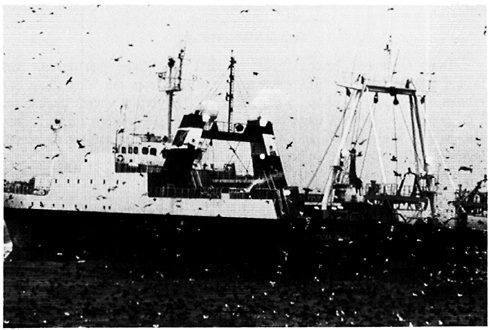
A modern U.S. flag factory trawler. (David Sears, American Factory Trawler Association)
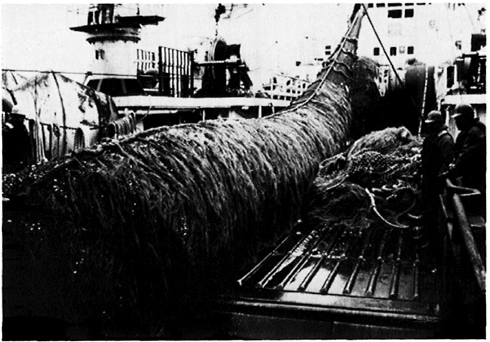
A loaded cod end being brought aboard a factory trawler configured with a stern ramp. Industrial safety equipment such as hard hats are in use aboard some vessels. (American Factory Trawler Association)
skipjack, and albacore. Bigeye, bluefin, bonita, and black skipjackare also taken. Abut 65 large superseiners operate throughout the tropical Pacific, some venturing into the Atlantic and Indian oceans pursuing yellowfin and skipjack tuna. Some distant-water vessels operate off Central America, and some venture farther into the south-central Pacific. Most of these are based in U.S. ports and utilize fishing grounds within the fishery zones of one or more nations. Smaller vessels (about 165) operating from Hawaii and the West Coast use longline or troll gear to fish for bigeye, bluefin, and albacore (Bourke, 1990).
Alaska Region
If Alaska were an independent country, it would probably rank near the top 10 nations of the world for fisheries production by volume and value—in 1986 it would have ranked number 11 (McDowell Group, 1989). It accounts for nearly 50 percent by volume and almost 40 percent by value of the total U.S. landings. This region encompasses the vast oceanic and coastal areas in the Gulf of Alaska and the Bering Sea, some of the world's richest fishing grounds. The fishing industry is Alaska's largest private employer, providing nearly 70,000 seasonal jobs, about 50,000 of them in the harvesting sector
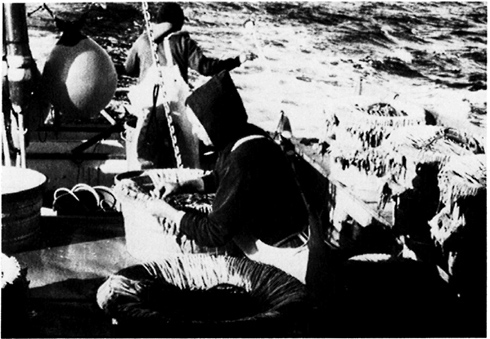
Crew preparing longline for black cod fishery. The groundline, consisting of approximately 12,000 to 15,000 hooks spaced at intervals, is stored in tubs. Each tub may hold as much as 1,200 feet of groundline and 140 hooks. As many as 100 tubs of gear may be on board. The hooks are baited either while underway or, in the case of a short opening as is common in the North Pacific halibut fishery, prior to leaving port. (Herb Goblirsch, Oregon Sea Grant)
(Munro, 1990; McDowell Group, 1989; McDowell et al., 1989; Coughenower, 1987).
Vessel license data maintained by the Commercial Fishing Entry Commission in Juneau, Alaska, indicate that in July 1990, there were about 17,000 vessels licensed to fish commercially in four categories—fishing vessel, freezer/canner, tender/packer, and charter vessel. These numbers include vessels operating from West Coast ports and can vary significantly from year to year. Charter vessels, of which there are about 1,400, have expanded significantly in number over the past several years and are outside the scope of this study (some may be converted fishing vessels, but this cannot be determined from available data) (see Coughenower, 1986). There are about 175 freezer/canner and 1,400 tender/packer licenses; the remainder are fishing vessel licenses. The State of Alaska Fish and Game Processor Detail List for 1990, as of June 15, 1990, included about 200 vessels as combined catcher/processors (including those that process fresh fish) and 47 floating processors. Many of the tender/packers are fishing vessels employed full- or part-time to transport fish. About 80 percent of tender/packers are 78 feet or less in length; 37 percent are 40 feet or less.
Alaska's fishing industry can be divided into two parts—the nearshore,
small-boat fleet and the larger, more highly capitalized vessels of the offshore fleet. The small-boat fleet concentrates on seasonal salmon, herring, halibut, black cod, and—to a lesser extent—Dungeness crab. In July 1990, there were 9,052 vessels licensed for the salmon fisheries, 2,162 in Bristol Bay alone. The size of vessels in some fisheries is strictly regulated by the state. Length limits for those in salmon fisheries are 32 feet in Bristol Bay and 58 feet in other areas. Vessels are typically owner-operated, 25 to 60 feet long, and valued under $500,000. Because overall length of vessels is limited under Alaskan conservation law, other dimensions are altered to accommodate greater carrying capacity. The ground fish fishery and most of the king and tanner crab harvests are conducted well offshore in the Bering Sea and Gulf of Alaska. Vessels in the groundfish fisheries are typically corporate-owned, 60 to 300 feet long, and valued between $1 million and $40 million (Coopers and Lybrand, 1990; Munro, 1990; McDowell Group, 1989; Natural Resource Consultants, 1988).
Vessels from ports in Alaska, Washington, and Oregon or from as far away as New England operate in the Gulf of Alaska and the Bering Sea. The fishing vessels used in these fisheries range from small, outboard-powered skiffs to large (300 feet or longer), sophisticated factory trawlers, crab vessels, and factory ships. In the latter examples, management is production and business oriented.
In this vast area, tenders, processing barges, power scows, and supply ships frequently operate in protected waters close to the fishing grounds to provide support for fishing activities. Many small ports receive varying volumes of products. Small, remote ports represent some of the most dangerous areas for fishing craft. High winds and waves at sea, sudden violent windstorms (williwaws or Taku winds) along the mountainous coastlines, rocky bottoms, winter icing conditions, and dense fog make operations in these waters dangerous and difficult. The nature of the region ensures that the captain and crew of all commercial vessels (big or small) must depend on onboard equipment and personal skills for survival. In these remote situations, surviving on shore can be as challenging as surviving at sea.
SUMMARY
Commercial fishing is an important, diverse, national industry with large numbers of vessels, high value produced, and many people employed. There are many kinds of fish, vessels, and fishing gear and techniques, but reliable data on the total numbers of vessels and fishermen are lacking. The operating environment is both dynamic and hostile. Economics, social organization, and human behavioral factors are complex, and external factors like fisheries management practices influence how, when, and where fishing is conducted. All these factors interact to form a mosaic in which safety is only one component. It is in this context that safety programs will need to be developed and implemented.


